THE PURPOSES OF USING PHONOLOGICAL DEVIATION
IN NICKI MINAJ’S SONGS
AN UNDERGRADUATE THESIS
Presented as Partial Fulfillment of the Requirements for the Degree of Sarjana Sastra
in English Letters
By
SEPTI PUTRI ALMADITA
Student Number: 154214114
DEPARTMENT OF ENGLISH LETTERS FACULTY OF LETTERS
UNIVERSITAS SANATA DHARMA YOGYAKARTA
ii
THE PURPOSES OF USING PHONOLOGICAL DEVIATION
IN NICKI MINAJ’S SONGS
AN UNDERGRADUATE THESIS
Presented as Partial Fulfillment of the Requirements for the Degree of Sarjana Sastra
in English Letters
By
SEPTI PUTRI ALMADITA
Student Number: 154214114
DEPARTMENT OF ENGLISH LETTERS FACULTY OF LETTERS
UNIVERSITAS SANATA DHARMA YOGYAKARTA
vii
Kawula mung Sadhêrma
viii
For whose body becomes an earth
whose soul flies to the universe
but whose love remains in my veins,
ix
ACKNOWLEDGEMENTS
First of all, I would like to give my gratitude to Allah SWT for all
blessings given to me during and after the process of writing this thesis. I thank
Him for the endless love and grace to guide me through my family and friends
who support and motivate me in every situation of my life.
Secondly, I would like to express my gratitude to my thesis advisor Arina
Isti’anah, S.Pd, M.Hum., for guiding and supporting me by understanding my
difficulties during the process of writing this thesis. I am so thankful for her
suggestions and encouragements that make my thesis a success and make me
finish it on time. Thirdly, I thank my co-adviser and academic advisor, Dr.
Bernadine Ria Lestari, M.Sc. for the support and advices. Fourthly, I thank my
other academic advisor, F.X. Risang Baskara, S. S., M. Hum. for his endless
support.
Fifthly, I would send thank to my family, especially my beloved mother,
Ervina Novianti Suwoto, and my grandmother, Suparjilah, for their endless
support, prayer, and motivation to finish my thesis. Next, I would also thank my
college best friends The Micins in Blue Group (Vatma, Ayu, Widi, Mitha, and
Mbak Uuz) for their influences to my college life. I also thank my other best friends Bidadari Mentel (Mbak Pi, Mbak Bro, Mbak Krib, and Mbak Selpong) or their endless support. Finally, I thank all of my friends in English Letters
Department of 2015 for the support in finishing my thesis.
x
CHAPTER I: INTRODUCTION ... 1
A. Background of the Study ... 1
B. Problem Formulation ... 4
C. Objectives of the Study ... 4
D. Definition of Terms ... 4
CHAPTER II: REVIEW OF LITERATURE ... 6
A. Review of Related Studies ... 6
B. Review of Related Theories ... 10
1. Stylistics ... 10
2. Deviation ... 12
3. Phonological Deviation ... 13
a. Elision ... 14
b. Substandard Pronunciation... 15
c. Substitution of Sounds ... 15
4. Phonological Devices ... 17
a. Rhyme ... 17
C. Theoretical Framework ... 25
CHAPTER III: METHODOLOGY ... 28
A. Object of the Study... 28
B. Approach of the Study ... 29
C. Method of the Study ... 29
xi
2. Data Analysis ... 30
CHAPTER IV: ANALYSIS RESULTS AND DISCUSSIONS ... 31
A. Phonological Deviation Found in Nicki Minaj’s Songs ... 31
1. Substitution of Sounds ... 32
a. Feature Changing Sound ... 32
b. Insertion... 35
c. Metathesis ... 35
2. Elision ... 36
a. Aphaeresis ... 36
b. Syncope ... 38
c. Apocope ... 39
3. Substandard Pronunciation... 41
B. The Purposes Made of Phonological Deviation ... 42
1. Rhyme ... 43
2. Meter ... 49
3. Consonance ... 55
4. Alliteration ... 58
CHAPTER V: CONCLUSION ... 60
REFERENCES ... 63
APPENDICES ... 66
Appendix 1: The Types of Phonological Deviation in Nicki Minaj’s Songs ... 66
xii
LIST OF TABLE
No. Table Page
1 Table 1. Phonological Deviation Found in Nicki Minaj’s Songs 31 2 Table 2. Phonological Deviation of Feature Changing Sounds 33
3 Table 3. Phonological Deviation of Insertion 35
4 Table 4. Phonological Deviation of Metathesis 35
5 Table 5. The Aphaeresis of Phonological Deviation 36
6 Table 6. The Syncope of Phonological Deviation 38
7
Table 7. The Apocope of Phonological Deviation
Table 8. Phonological Deviation of Substandard Pronunciation Table 9. The Rhyme Purpose of Elision
Table 10. The Rhyme Purpose of Substitution of Sounds Table 11. The Consonance Purpose of Elision
Table 12. The Consonance Purpose of Substitution of Sounds Table 13. The Alliteration Purpose of Substitution of Sounds
xiii
ABSTRACT
ALMADITA, SEPTI PUTRI. (2019). The Purposes of Using Phonological
Deviation in Nicki Minaj’s Songs. Yogyakarta: Department of English Letters, Faculty of Letters, Universitas Sanata Dharma.
Language is the human expression of ideas, feelings, and thoughts. However, humans tend to use language differently from one another. It is based on the purposes that the speaker wants to achieve. It is not only in written language which is important but also in spoken. The example is the language in songs. Singers are possible to deviate language when they sing songs in order to make the songs sound beautiful for the listeners. They deviate the pronunciation of words or lyrics in order to gain purposes which concern with phonological devices. This case happened to one of African-American singers, Nicki Minaj. She is a famous singer or rapper in the world with 17 songs on the top 10 in Billboard Chart throughout her career. When she sings her songs, she purposively makes phonological deviation in order to get phonological purposes in her songs.
This research focused on the phonological deviation in three Nicki
Minaj’s songs:“Chun Li”, “Barbie Dreams”, and “Coco Chanel”. There were two objectives of this research. First, the researcher presented the phonological
deviation found in the Nicki Minaj’s songs. Second, the researcher found the purposes of the deviation made.
Stylistics is the most suitable approach for this research. It is a branch of linguistics which deals with the relation of the language and its artistic function in literary works, songs, advertisement, and so on. This study uses one level of stylistic analysis, phonology. The method used was purposive sampling method. There were four steps conducted. First, the researcher listened to the songs from
www.youtube.com and checked the pronunciation with the lyrics from
www.genius.com. Second, the researcher analyzed the words which were
pronounced different from English’s dictionary transcription. Third, they were
classified into types. Last, analyzing the purposes were made because of it.
The result is there are 176 phonological deviations found in the songs which consist of 77 words. The types of phonological deviation found are substitution of sounds, elision, and substandard pronunciation. The most dominant type is substitution of sounds with 54 %. The less ones are elision with 33% and substandard pronunciation with 13%. The purposes made by the deviation are to make certain rhyme patterns, metrical patterns, and repetition of consonant sounds in the lines.
xiv
ABSTRAK
ALMADITA, SEPTI PUTRI. (2019). The Purposes of Using Phonological
Deviation in Nicki Minaj’s Songs. Yogyakarta: Program Studi Sastra Inggris, Fakultas Sastra, Universitas Sanata Dharma.
Bahasa merupakan keindahan ekspresi ide, perasaan, dan pikiran manusia. Namun, penggunaan bahasa berbeda dari satu pengguna dengan pengguna lainnya. Hal ini bergantung pada tujuan yang akan dicapai si pengguna. Tidak hanya bahasa tulis yang penting akan tetapi juga bahasa lisan. Salah satu contoh ialah penggunaan bahasa di dalam lagu. Penyanyi berkemungkinan melakukan deviasi atau penyimpangan bahasa ketika menyanyikan lagu mereka untuk membuat lagu terdengar lebih indah bagi para pendengar. Mereka melakukan deviasi dalam pengucapkan lirik lagu untuk membuat efek yang berhubungan dengan fitur-fitur fonologi. Salah satu penyanyi yang mendeviasi lagunya adalah Nicki Minaj. Ia merupakan penyanyi Afro-Amerika. Sepanjang karirnya, 17 lagu yang dinyanyikannya pernah masuk di jajaran 10 teratas tangga lagu Billboard. Ia melakukan deviasi fonologi dengan tujuan fonologi tertentu di lagunya.
Penelitian ini berfokus pada deviasi fonologi di dalam tiga lagu Nicki
Minaj, “Chun Li”, “Barbie Dreams”, dan “Coco Chanel”. Penelitian ini memiliki
dua tujuan. Pertama, peneliti menyajikan deviasi-deviasi fonologi yang ditemukan pada lagu-lagu Nicki Minaj. Kedua, peneliti mencoba menemukan tujuan-tujuan dari deviasi yang dibuat.
Stilistika merupakan pendekatan yang cocok untuk penelitian ini. Stilistika merupakan cabang ilmu linguistic yang berfokus pada hubungan bahasa dan fungsi atistiknya didalam karya sastra, lagu, iklan dan yang lainnya. Hanya ada satu level analisis stilistika yang digunakan yaitu fonologi. Penelitian ini menggunakan teknik purposive sampling. Ada empat langkah yang dilakukan. Pertama, peneliti mendengarkan lagu Nicki Minaj dari www.youtube.com dan dicocokkan dengan lirik lagu tertulis pada laman www.genius.com. Kedua, peneliti menganalisis kata-kata yang diucapkan berbeda dengan transkrip yang ada di kamus Bahasa Inggris. Ketiga, kata-kata yang dideviasi lalu diklasifikaiskan ke beberapa tipe. Terakhir, peneliti menganalisis efek-efek yang kemungkinan dibuat dari deviasi-deviasi tersebut.
Hasil yang ditemukan ada 176 deviasi-deviasi fonologi yang terjadi di tiga lagu Nicki Minaj yang terdiri dari 77 kata. Tipe-tipe deviasi fonologi yang terjadi adalah substitution of sounds, elision, dan substandard pronunciation. Tipe yang paling dominan adalah substitution of sounds dengan total 54% . Dua tipe yang lainnya adalah elision dengan total 33% dan substandard pronunciation
dengan total 13%. Tujuan yang dibuat oleh deviasi yang terjadi adalah untuk membuat pola rima dan meter yang sama serta pengulangan suara konsonan di dalam baris-baris lirik lagu.
1 CHAPTER I
INTRODUCTION
A. Background of the Study
Language is defined as a medium of communication to deliver the beauty
of human expressions. Those are human’s ideas, thoughts, and feelings which can
be expressed through language. It is used to interpret everything around us. “It is
natural to imagine that something as powerful and fundamental to human nature
as language would influence how we think about or perceive the world around us”
(Fromkin, Rodman, & Hyams, 2011, p. 29). It means that language has a big
impact for human life. Language helps us to understand each other.
Language can be learned more deeply in order to understand more about
everything it deals with. The study of language is called linguistics. Burton,
Déchaine and Vatikiotis-Batesan believe that linguistics is focused to understand
more on how language works (2012, p. 9) . Thus, it helps us to understand on how
humans use language as a medium of communication. Linguistics deals with the
human abilities on how producing sounds, words, sentences, meanings, and so on.
Humans tend to use language in different ways one to another. The
differences are based on conditions and their purposes. The example is the usage
of language in literature and songs. It has its own style of language which is
different from other usages. The style of language which is used in both of them is
Stylistics is a study which centred on how language used in songs and
literary works, such as poems, prose, novels, and so on. Its aim in all of them is to
deliver the writer’s or poet’s or singer’s messages by using language in a certain
way. Leech and Short say that stylistics concerns about the relation between
language and its artistic function (2007, p. 11). Thus, literary works use a style of
language that encourages readers to not only read it but also understand it more
due to the artistic function of it. Verdonk adds that stylistics is as the analysis of
distinctive expression of language and its purposes and effects (2002, p. 4).
Furthermore, stylistics also concerns with the language and its purposes used by a
speaker or writer.
Stylistics is not only focused on written but also spoken language. The
analysis of stylistics in spoken language can be done by songs. A song is the
product which attracts people not only by its lyrics but also on how the singer
delivers the lyrics orally. It means that stylistics can also deal with phonology. In
order to analyse the problems in this research, the writer will use stylistics as the
approach.
Phonology is a branch of linguistics that deals with the sounds that
someone produces. It is supported by Odden (2005),
A verybrief explanation is that phonology is the study of sound structure in language, which is different from the study of sentence structure (syntax), or word structure (morphology), or how languages change over time (historical linguistics) (p. 2).
It means that every word has its own standardized sounds or rules. However, a
singer can produce different sounds from the Standard. In certain genres of songs,
they do not pronounce every word clearly and standardly. It is called as deviation
in stylistics.
Deviation, in stylistics, is the use of language pattern which is different
from its standard. It can be found in music due to some purposes. According to
Leech, language pattern is deviated because of melody, rhythm, harmonic
progression, abstract form, and so on (1969, pp. 56-57). It means that the rule of
Standard English is not obeyed. It is done in order to deliver message in a certain
way which is believed can attract more others’ attention.
Hip-hop songs have fast melody and its African-American singers. One
of the famous African-American Hip-hop singers is Nicki Minaj. She is
well-known as an international singer. Moreover, her songs are well-known all around the
world. However, when she sings in a fast melody she also produces some words
which are different from Standard English. African-American English has
different rules in linguistic aspects from Standard English. Holt claims that
African-American youngsters tend to innovate new various phonological,
syntactical, and pragmatics aspect of the language (2013, p. 16). Meaning to say,
it is a variety of English which different from its standard.
The aims of the research are to analyse phonological deviation in Nicki
Minaj’s songs and the purposes made by the deviation. The phonological
deviation made in the songs has certain purposes. One of them can be the rhyme
so that it will make the easy to be listened. Hence, this study will focus on
analysing the words or lyrics which are not produced or pronounced the same as
B. Problem Formulation
In order to analyse phonological deviation in Nicki Minaj’s songs, this
study aims to answer some problems. The problems are as follows:
1. What kinds of phonological deviation are found in Nicki Minaj’s songs?
2. What purposes are revealed by the deviation?
C. Objectives of the Study
There are two objectives that will be accomplished in this study. The first
objective is to identify the kinds of phonological deviation. It will analyse on how
the lyrics produced by Nicki Minaj in her songs. Thus, it will be analysed and be
categorized into the kinds of the deviation in each song. It will be focused on the
sounds which are different from Standard English.
The second objective is to find out the purposes of the deviation which is
made. For example, the deviation made in the songs is due to the rhyme so it can
be listened easily and beautifully. In this case, the use of language is for artistic
function not as Standard English. This study’s goal is to analyse Nicki Minaj’s
phonological deviation in pronouncing the lyrics of her songs and the purposes
made in that deviation.
D. Definition of Terms
In this section, the writer explains about the terms that are used in the
analysis. The terms are phonology, phonological deviation, purpose, song, and
The first term is phonology. Phonology is a branch of linguistics which
deals with sound patterns produced by a speaker. Odden says that phonology
concerns with the “sounds” of a language (2005, p. 2). It deals with how a
speaker pronounces the words.
The second term is deviation. Deviation in linguistics is “disobeying” the
rule in a language which has certain reasons. Leech claims that deviation is an
important part of interpreting the message of literary works which is against the
rule of language (1969, p. 57). Thus, phonological deviation means that someone
pronounces the words in literary works differently due to some reasons. Leech
also elaborates that phonological deviation used because of verse composition and
the convenience of rhyming (1969, p. 47). These reasons are artistic function of
language in literary works, such as poems, novels, short stories, songs, even
advertisement, and many more.
The third term is purpose. Purpose is something that somebody wants to
get or achieve. In this study, the purposes are something made of phonological
deviation. Leech and Short declare that a purpose concerns with why and how
language is used in a certain way (2007, p. 11).
The fourth term is stylistics. Stylistics is a branch of linguistics focusing
on the language in literary writings. Simpson agrees that stylistics is a study of
textual interpretation in literary works, advertisement, popular music, and so on
(2004, pp. 2-3). It means that stylistics deals with all linguistic levels. This study
6 CHAPTER II
REVIEW OF LITERATURE
In this chapter, there are three parts of review of literature. They are
review of related studies, review of related theories, and theoretical framework. In
review of related studies section, the writer explains the previous studies which
are similar to the study. They are done by different writers. In review of related
theories, the writer elaborates the theories which are relevant with the study. In
theoretical framework, the writer shows how the problems are answered using the
theories.
A. Review of Related Studies
In this part, there are four previous studies which are related to this
research. They consist of two theses and two journal articles. Those studies
analyse stylistics in songs and other literary works. It means that they contribute
to develop the analysis of this study.
The first study is an undergraduate thesis from Asmara (2018) entitled
Phonological Features in Robert Frost’s Fire and Ice and Nothing Gold Can Say Poems. The approach used in the study is stylistics. Asmara’s study focuses on phonological features used and how they constitute the style of Robert Frost. The
phonological features analysed are rhymes, meters, alliterations, assonances, and
Asmara uses several steps of the method to answer the problem
formulations. First, he analyses the segmental sound features which are
alliteration, consonance, and assonance. Second, he analyses the supra segmental
sound features which are meter and rhyme. Hence, he gains the result from the
previous steps to answer the second problem formulation. In this study, there are
two results. First, Frost uses rhyme, meter, repetition, consonance, and assonance.
Second, he uses a rhythmical style in making his poems.
Asmara’s study has contributions for and differences from this study. The
contribution lies on the theory and the method. The theory of stylistics and
phonological features in literary works that Asmara used will also use to develop
this study’s idea. The method used in Asmara’s study will also be used to analyse
the data in this study. The differences are the data and the focus of the study. This
study uses songs but his study uses poems. His study’s focus is on the
phonological level, yet this study is the reason on how a singer deviates the
phonological rule in the songs. Hence, this study will discover something different
from his study.
The second is a journal article from Febriyanti (2015) entitled
Assimilation, Reduction and Elision Reflected in the Selected Song Lyrics of Avenged Sevenfold. The songs are “Gunslinger” and “Second Heartbeat”. This
study is focused on the phonological phenomena in Avenged Sevenfold’s song
lyrics. The phonological phenomena are assimilation, reduction, and elision
Her analysis process starts from transcribing the lyrics of songs while
checking them to the internet source. Then, the researcher observes the lyrics
based on her transcription. The result of the analysis is there are three processes in
the two songs: assimilation, reduction, and elision. The difference between those
songs is in Gunslinger, there are four kinds of assimilation while in “Second
Heartbeat”, there are three kinds of assimilation.
Febrianti’s study has contributions for and a difference from this study.
The first contribution is the method. Her method to analyse the data will help to
develop the idea of this study. The steps she used to analyse the data will also use
in this study. Second, the approach also contributes to develop the idea. Stylistics
will contribute to elaborate more about this study. Third, the theory used in her
study will also help this study to analyse the data. It is due to phonological
deviation which means that there will be “deviation” of the phonological rule. The
difference lies on the data. Even though both studies use songs, they are different.
This study will use Nicki Minaj’s songs. Thus, this study will develop the method
that she uses.
The third is a postgraduate thesis from Trichomwaree (2015) entitled A Stylistic Analysis in Selected Popular Song Lyrics Of Oasis During 1994-1997.
The songs as the data used are “Live Forever”, “Supersonic”, “Wonderwall”,
“Some Might Say”, “Don’t Look Back In Anger”, “Stand By Me”, and “Rock N
Roll”. This study focused on analysing the use of figurative language and poetic
There are few results of this study. First, the figurative languages mostly
found in those songs are metaphor. Second, rhyme and repetition are used in the
songs as poetic devices to charm the sounds with rhythm including with repetition
of word, phrases, or choruses. Third, the type of rhyme found in the discussion is
masculine which is to emphasize the meaning of verse. Last, the repetition of
choruses and words is important in the songs which performs to show the
meaning of the songs’ content.
Trichomwaree’s study contributes to this study. The contribution lies on
the theory. The theory of the poetic devices can be applied to the data. Due to the
fact that the data both in Trichomwaree’s study and this study are the same, songs,
the theory can be applied properly. The difference between the studies is the
songs. This study will use Nicki Minaj’s songs. This study will develop the theory
of Trichomwaree’s study.
The fourth study is an article of a journal from Abbas (2017) entitled
Exploring Types of Linguistic Deviations in the Poem Adonais. This research focuses on identifying the kinds of linguistic deviations used in the poem and the
reasons of using them. Abbas uses Leech’s theory in order to define the kinds of
linguistic deviations. According to him, there are eight types of deviations:
lexical, grammatical, phonological, semantic, graphological, dialectical, register,
and historical period deviation.
From the findings, there are only six out of eight types of linguistic
deviations in the poem. They are lexical, grammatical, phonological, semantic,
rule of grammar, enhancing the aesthetic value of the poem, showing emotions,
creating new words, and using the rhyming schemes. The reason behind the usage
of those deviations is to make readers interpret certain phrases, sentences beyond
the surface meanings.
The article’s contribution lies on the theory that is used. Abbas uses
Leech’s theory to analyse the data. This theory also can help this study to develop
or dig more about linguistic deviation. Nevertheless, this study only focuses on
the phonological deviation. Abba’s study uses a poem to be analysed but this
study will use songs. Therefore, this study will develop Abbas’s study’s theory
from Leech.
B. Review of Related Theories
Theories that related to the study will be discussed in this part. Those are
related to stylistics, phonology, phonological deviation, and also songs.
1. Stylistics
Stylistics is a branch of linguistics that deals with the style of language
use. It is supported by Leech and Short who explain it as what use is made of
language (2007, p. 11). The meaning of the language use is style. Stylistics can be
analysed in forms of discourse, such as literary works, advertising, journalism,
popular music, and so on (Simpson, 2004, pp. 2-3). However, this study focuses
on the style of language in songs which have similar linguistic features with
literary works. They can be phonological, grammatical, syntactical, lexical
Simpson believes that the style of language used in literary works does
not merely show the meaning of the context but helps to interpret the content of
the works (2004, p. 2). It indicates that role of language is important in the literary
works. Language style used in the literary works can be different from the one that
are used in daily life. They use beautiful language in order to arouse readers’
interests and encourage them to interpret the content. Leech and Short agree that
stylistics can be relational concept that can deal with the relation between
interesting sense and aesthetic appreciation of readers to the writer’s language
(2007, p. 11). Hence, it shows that language has artistic function in literary works
in order to “deliver” the writer’s messages. The artistic function of language can
be noticeable from linguistic aspects such as sounds, words, patterns, structures,
and so on.
Stylistics is focused on linguistic aspects of the literary works,
advertisements, popular music, and so on. According to Simpson, the levels of
language that can be analysed with stylistic are phonology, graphology,
morphology, syntax, grammar, lexical analysis, semantics, and pragmatics (2004,
p. 5). This study will be centred in phonology. Stylistics theory will be applied to
analyse how the singer pronounces the lyrics or words in songs.
The phonological level focuses on the sound patterns that the singer
pronounces. The way a speaker pronounces the words can be different from one to
another due to his or her mother tongue. Hence, it also deals with the matter of
that function as to beautify the language or message delivery. Therefore, it will
deal with rhyme and meter in the line of the lyric of the songs.
2. Deviation
The meaning of deviation in stylistics is how language used deviates
from the rules. According to Mukařovský,
This is not to deny the close connection between the two, which consists in the fact that, for poetry, the standard language is the background against which is reflected the aesthetically intentional violation of the norm of the standard (1964, p. 43).
Thus, the principle term of linguistic deviation is foregrounding. Leech declares
that foregrounding is the principle of linguistic deviation as an artistic
communication that deviates from the standard (1969, p. 56). Furthermore,
Mukařovský and Leech agree that the linguistic deviation happens because of an
artistic reason. The artistic reason mostly concerns about the beauty of language.
It can be found in literary works, advertisement, songs, and so on in order to gain
others’ attention. It means that the way of the person who produces literary works
and the others intentionally violates the standard language in order to beautify the
message delivery.
Linguistic deviations can happen in all of linguistic aspects. According to
Leech, there are eight kinds of deviations; those are lexical, grammatical,
graphological, phonological, semantic, dialectical, register, and historical period
deviation (1969, pp. 42-52). It indicates that linguistic deviation can affect the
readers who receive the message of the speaker or the writer. However, this study
3. Phonological Deviation
According to Leech, phonological deviation occurs when non ordinary
speech has a deviant phonological characteristic to have a special pronunciation
(1969, p. 47). This special pronunciation can affect the language used such as
rhyming pattern. Therefore, phonological deviation will deal with meter, rhyme,
assonance, consonance, and alliteration as phonological devices in literary works
and songs. Thus, the devices can be a reason speakers violate the language rules.
It means that, in this study, it is used to analyse the sound patterns that the speaker
produces in singing the songs.
In this study, the speaker analyzed is an Africa-American singer, Nicki
Minaj. African-Americans have their own English called African-American
Vernacular English or AAVE. “African-American Vernacular English (AAVE) is
the dialect spoken by the majority of African Americans in America” (Lewis,
2008, p. 157). Furthermore, their English is different from Standard English.
However, according to Green (2002) in Lewis, AAVE still has some similar
features with the Standard English (2008, p. 159). It can be found in all linguistic
levels.
According to Leech (1969, p. 47), there are several types of phonological
deviation. The first type is conventional licenses of verse composition, such as
elison, aphesis, apocope, and syncope. The second is special pronunciation for
convenience of rhyming. Budiharto suggests two types of phonological deviations
a. Conventional of Licenses of Verse Composition
In this type, Leech explains it as the omission of sound in the words or
syllables. The term of the omission is elision. Crystal adds that it is the omission
in connected speech which affects consonants and vowels (2008, p. 166). Elision
is divided into three types according to Budiharto (2016, p. 715). They are
aphaeresis, syncope, and apocope. They deal with the omission of sound in a
certain position.
1) Aphaeresis
Aphaeresis is the omission of the initial sound of a word (Crystal, 2008,
p. 29). Supported by Bussmann (1996, p. 71) that it is the loss of the initial sound.
For examples are the words “him” and “them”. In some cases, they are
pronounced by omitting the initial consonant sound. The word “him” should be
pronounced as /hɪm/ but sometimes it is pronounced as [ɪm]. Next, the word
“them” should be pronounced as /ðƏm/ but in some cases, it is pronounced as
[Əm].
2) Syncope
It is the omission of sound which is located in the middle of a word
(Crystal, 2008, p. 166). The examples of syncope are the words “honestly” and
“camera”The word “honestly” should be pronounced as /ˈɒnɪstli/ but sometimes
it is pronounced as [ˈɒnɪsli]. The word “camera” should be pronounced as
3) Apocope
Apocope is the omission of sounds in the final position of a word
(Crystal, 2008, p. 166). The examples of apocope are the words “biology” and
“gymnasium”. The word “biology” should be pronounced as /bʌɪˈɒΙədʒi/ but
sometimes pronounced as [bʌɪˈɒ]. The word “gymnasium” should be pronounced
as /dʒɪmˈneɪzɪəm/ but the last sounds can be omitted to be only [dʒɪm].
b. Special Pronunciation for Convenience of Rhyming
Budiharto suggests two types of phonological deviations, such as the
substandard pronunciation and the substitution of sounds. They deal with the
different pronunciation of words from the rule.
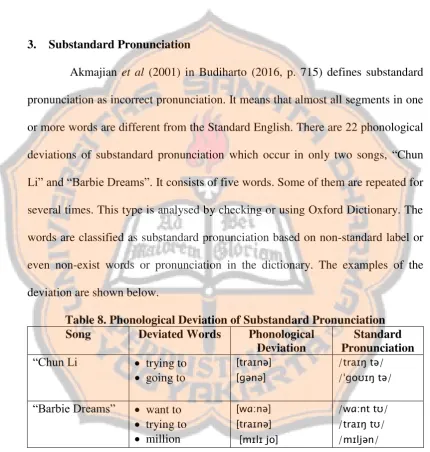
1) Substandard Pronunciation
Akmajian et al (2001) in Budiharto (2016, p. 715) defines substandard pronunciation as incorrect pronunciation. It means that almost all of the sounds
are different with the rules. The examples are the word “gotcha” and “ain’t”. The
correct standard of the word “gotcha” is “got you”. Then, the correct standard of
the word “ain’t” is “isn’t” or “aren’t”.
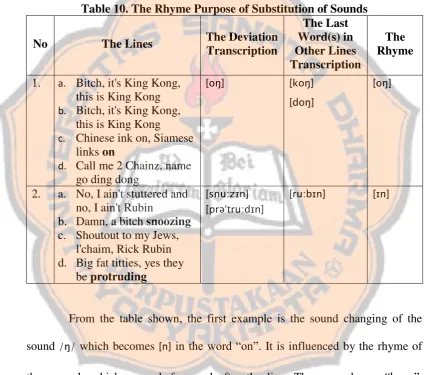
2) Substitution of Sounds
According to Sadoon and Al-Aassam, substitution of sounds is the defect
of sounds (2011, p. 23). It can be said as the changing of sounds in a word or
syllables. The types of sound changing in words are feature changing sound,
a) Feature Changing Sound
Feature changing sound is sound which is produced differently from the
standard pronunciation in the dictionary. “In some cases a feature already present
is changed” (Fromkin, Rodman, & Hyams, 2011, p. 249). The examples of feature
changing sound are the words “thing” and “with”. The word “thing” should be
pronounced as /ɵɪŋ/ but sometimes people pronounced it as [tɪŋ]. Last, the word
“with” should be pronounced as /wɪð/ but sometimes the last sound can be
changed to be like [wɪv].
b) Sound Insertion
Not only elision or omission of sound exists but also sound insertion.
“The process of inserting a consonant or vowel is called epenthesis” (Fromkin,
Rodman, & Hyams, 2011, p. 250). It is supported by Crystal who defines
epenthesis as an extra sound inserted in a word (2008, p. 171). The example is the
word “please”. Some cases it pronounced as [phəlɪz] rather than /phlɪz/. The
additional sound produced in the word is [ə].
c) Metathesis
It is possible that sounds may also reorder to one another (Fromkin,
Rodman, & Hyams, 2011, p. 253). This phenomenon is called metathesis. Crystal
defines it as the alteration of elements in the standard sequence in syllables,
words, and so on (2008, p. 303). It means that one sound can replace to the other
word is pronounced as [æks] rather than/æsk/. The order of sounds of [s] and [k]
are replacing one and another.
4. Phonological Devices
Phonology is defined as a branch of linguistics that deals with the sound
patterns produced by a speaker. McMahon states that phonology is the language
selection and organisation of sounds to deliver meanings (2002, p. 2). Fromkin et al agree and define it deeper,
The word phonology refers both to the linguistic knowledge that speakers have about the sound patterns of their language and to description of that knowledge that linguists try to produce (2011, p. 227).
It implies that someone’s linguistic knowledge about sound pattern can be
understood and identified from his or her pronunciation. This study will analyse
some of phonological devices due to answer the questions. Phonological devices
deal with rhyme, meter, assonance, consonance, and alliteration.
Phonological devices analysed in this study are the devices or “tools” of
language in the literary works. It covers supra-segmental and segmental features.
Phonological devices explained in this study are the devices used in poetry. It is
because its function in poetry and songs is similar. They are rhyme, meter,
consonance, assonance, and alliteration.
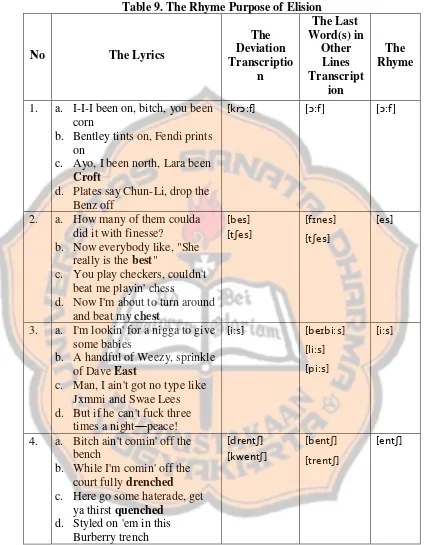
a. Rhyme
Rhyme is a phonological device which focuses on the final sound of a
word. In phonology, rhyme deals with the matter of nucleus and coda or vowel
and consonant in the end of the syllable or word. Madden (2002) defines it as the
is an echo of sound from one word in a line with others (2009, p. 52). It means
that it focuses on the final sound in every line which can be the same with another
line. “Rhyme is one of the stylistic devices which for developing phonological
sensitivity in poetry and song” (Trichomwaree, 2015, p. 8). Therefore, the line of
poetry and song is just the same to be analysed. It means that rhyme is one of the
supra-segmental features.
The same sound in the final position among lines can support the beauty
of language in song and poetry. Trichomwaree states that it can make songs
interested, pleasant to hear and the flow of lyrics can be good as well (2015, p. 8).
Khader adds that rhyme can be also attract people’s attention to what it is
importance (2016, p. 28). Thus, rhyme is an important phonological device in
songs.
According to Bradley, there are three types of rhymes that can be
analysed, such as monosyllabic, disyllabic, and multisyllabic rhyme (2009, p. 53).
Monosyllabic rhyme only has one syllable, for example is the word “rat” and
“pet”. Disyllabic rhyme consists of two syllables, such as the word “jelly” and
“belly”. The last one is multisyllabic rhyme which has more than one syllable but
can be found in words and also combination of phrases. For example, the words
“vacation” and “relation” containing the sound rhyme of “ation”. The example of
phrases are “stay with us” and “play with us” containing the rhyme of “with us”.
Bradley also mentions that rhyme can be perfect and not perfect (2009, p.
53). The perfect rhyme is also called full rhyme. It contains the same vowel sound
perfect rhyme is the words “all” and “ball”. The imperfect rhyme is also called
slant. It contains shared final-consonant sound but different vowel sound
(Bradley, 2009, p. 57). The example of slant rhyme is “all” and “bowl”. However,
Bradley believe that slant rhyme is common in Hip-hop song as poetic from
which can be found in the oral tradition (Bradley, 2009, p. 58).
b. Meter
Meter is a phonological device which deals with stressed and unstressed
syllable. Arp and Johnson say that it is the regular pattern of stress which is
repeated in syllables (2009, p. 1664). Simpson declares that meter is an
organisation of strong and weak syllables repeated which makes unusual
communicative situation (2004, p. 15). Meter in poetry or song needs a
measurement in order to identify the organisation. The measurement of meter can
be analysed from the foot. Simpson (2004, p. 15), Arp and Johnson (2009, p. 838)
agree that foot is the basic unit of the stressed or unstressed syllable. Using foot,
the pattern of meter can be analysed clearly.
The types of foot, according to Arp and Johnson, are iambic, trochaic,
anapestic, dactylic, and spondaic (2009, p. 839). The representation of stressed
syllable is with the symbol (
ˊ
). Thus, the unstressed syllable is with (˘
). Thosetypes are described as follow:
1) Iambic Foot
Iambic foot is the type of minimal unit of meter which has pattern as the
examples of iambic foot is two lines of Edna St. Vincent Millay’s Love Is No All
sonnet:
˘
ˊ
˘ ˊ ˘ ˊ
˘ ˊ
˘ ˊ
a) Nor yet \ a float\ing spar \to men\ that sink
˘
ˊ
˘
ˊ
˘
ˊ
˘
ˊ
˘
ˊ
b) And rise \ and sink \ and rise \ and sink \ again
2) Trochaic foot
Trochaic foot is the opposite of the iambic foot. It starts with stressed (
ˊ
)syllable and then the second is unstressed (
˘
) syllable. For example:
ˊ
˘
ˊ˘
ˊ ˘
ˊ
a) Truth, not \ cruel \ to a \ friendˊ
˘
ˊ
˘
ˊ
˘
ˊ
b) Pleasure, \ not in \ haste to \ end
3) Anapestic foot
Anaphestic foot is the type of foot which the first and second are
unstressed (
˘
) syllables followed by stressed (ˊ
) syllable. For example:˘
˘
ˊ
˘
˘
ˊ
˘˘
ˊ
˘
˘
ˊ
a) It’s the end \ of an er\ a it’s time\ for goodbye
˘
˘
ˊ
˘
˘
ˊ
˘
˘
ˊ
4) Dactylic foot
Dactylic foot is a type of foot is the opposite of anapaestic foot. It has the
first syllable is stressed (
ˊ
) then the second and the third are unstressed (˘
). Forexample:
ˊ ˘ ˘ ˊ ˘
˘
a) Are you still \ standing there
ˊ ˘ ˘ ˊ
˘ ˘
b) East of the \ Garden of
5) Spondaic foot
Spondaic foot is the last type of foot which has 2 stressed (
ˊ
) syllables.For examples:
ˊ
ˊ
a) Big truck
ˊ ˊ
b) Be near
Not only the types of foot that concerns about the pattern of stressed and
unstressed syllables in a line but also types of foot which concerns about the
numbers. Each line can have different numbers of foot. According to Arp and
Johnson, there are six types of foot based on the number in a line. Lethbridge and
Mildorf purpose eight types (2004, p. 150). They are explained as follows:
1) Monometer (one foot), for example:
ˊ ˘
(trochaic, one foot) b) Higher
2) Dimeter (two feet), for example:
˘
ˊ
˘
ˊ
(trochaic foot, two feet) a) The dust \ of snow
˘
˘
ˊ
˘
˘
ˊ
(anapaestic feet, two feet) b) Of a day \ I had rued3) Trimeter (three feet), for example:
ˊ
˘
ˊ
˘
ˊ
˘
(trochaic, three feet) a) Higher \ still and \ higher˘
ˊ
˘
ˊ
˘
ˊ
(iambic, three feet) b) But I \ hung on \ like death4) Tetrameter (four feet), for example:
˘
ˊ
˘
ˊ
˘
ˊ
˘
ˊ
(iambic, four feet) a) Though as \ for that \ the pas\ing there˘
ˊ
˘
ˊ
˘ˊ
˘
ˊ
(iambic, four feet) b) What I \ don’t know \ isn’t \ knowledge
5) Pentameter (five feet), for example:
˘
ˊ
˘
ˊ
˘
ˊ
˘
ˊ
˘ ˊ
(iambic, five feet) a) Shall I \ compare \ thee to \ a sum\mer’s day?˘
ˊ
˘
ˊ
˘
ˊ
˘
ˊ
˘
ˊ
(iambic, five feet) b) When, far \ beneath \ a wrink\led, ba\by hand6) Hexameter (six feet), for example:
˘
ˊ
˘
ˊ
˘
ˊ
˘
ˊ
˘
ˊ
˘
ˊ
(iambic, six feet)b) With sad\ness while \ my mood \ reflects \ my inn\er pain
7) Heptameter (seven feet), for example:
ˊ
˘
ˊ
˘ˊ
˘
ˊ
˘
ˊ
˘
ˊ
˘
ˊ
˘
(trochaic, seven feet)
a) Tis but \ as i\vy leaves \ around \ the ru\in’d tur\ret wreathe
˘
ˊ
˘
ˊ
˘
ˊ
˘
ˊ
˘
ˊ
˘
ˊ
˘
ˊ
(iambic, seven feet)
b) All green \ and wild\ly fresh\ without \but worn \ and gray \ beneath
8) Octameter (eight feet), for example:
ˊ
˘
ˊ
˘
ˊ
˘
ˊ
˘
ˊ
˘
ˊ
˘
ˊ
˘
ˊ
˘
(trochaic, eight feet)
a) Once up\on a \ midnight \ dreary\ while I \ pondered \ weak and \ weary
˘ˊ
˘
ˊ
˘
ˊ
˘
ˊ
˘
ˊ
˘
ˊ
˘
ˊ
˘
ˊ
(iambic, eight feet) b) I am \ the ve\ry mo\del of\ a mo\dern Ma\jor Ge\neralc. Assonance
One of the segmental features that can be analysed in song is assonance.
Assonance, according to Arp and Johnson (2009), is the repetition of vowel
sounds (p. 820). It is supported by Kennedy and Gioia that the repetition of vowel
is to produce assonance (2002, p. 172). Assonance is the vowel harmony that
consolidates points of equivalence throughout the poetic line (Simpson, 2004, p.
52). For example is the words “fly high”. In those words the repetition of vowel is
d. Consonance
The next segmental feature is consonance. Consonance is the repetition
of consonant sound (Madden, 2002, p. 70). Consonance occurs when words or
phrases have same consonant sounds but a different vowel (Kennedy & Gioia,
2002, p. 176). Arp and Johnson believes that consonance it only occurs in the
final position (2009, p. 820). It can be conclude that consonance is the repetition
of consonant sound which occurs in the final position. The example of consonance
is the line 5 of poem “Nothing Gold Can Stay” by Robert Frost (Asmara, 2018, p.
43). It is “Then leaf subsides to leaf”. The consonance is the sound /f/ that occurs
in the same two words mentioned within a line.
e. Alliteration
The last segmental feature that can be analysed is called alliteration.
Alliteration is almost same with consonance. “Alliteration occurs in the repetition
of the same consonant sound as the beginning of successive words” (Kennedy &
Gioia, 2002, p. 170). It was supported by Arp and Johnson (2009, p. 820) and
also Madden (2002, p. 70) that alliteration occurs in the initial position. Therefore,
the difference between alliteration and consonance is in the position. Alliteration
occurs in the initial position while consonance is in the ending. The example of
alliteration is the line “Betty bought butter but the butter was bitter”. In the
example the consonance is the repetition of the sound /b/. It was repeated in the
5. Song
Song can be analysed through stylistic studies. It is not only by the
written text but also the spoken language. It is because song has the same features
which can be analysed as poem, phonological features or devices. It is supported
by Simpson that it deals with sound patterning in literature and features (2004, p.
15). Features in poem and song have the same function, as to beautify the words.
Both song and poem also concern with the words within lines. Therefore, they
concern about the rhyming pattern. Mayer et al declare that rhyme is the most
common language style used in poetry and song (2008, p. 2). Madden agrees that
the rhyme in poetry can be experienced the same when listening to music (2002,
p. 70).
This study will analyse “Hip-Hop” or “Rap” song. This genre of song is
known as rapid beat. According to Mayer and Reuber, each genre has different
rhyming pattern and “Hip-hop” music tends to have a heavy one (2011, p. 677).
Bradley adds that the common rhymes that used in Rap song are in the end of the
last beat of the musical measure (2009, p. 50). In short, Hip-hop or Rap music has
a heavy rhyme tat mostly in the end of the musical beat. Rhyme is used as a
strategy to fulfil the listener’s expectation and new expressive possibilities
(Bradley, 2009, p. 51).
C. Theoretical Framework
The theories explained in the previous section are used in this study to
phonological deviation, phonological devices, and song. It will be limited to the
focus of this study. The deviation theory will be narrowed into phonological
deviation that deals with the pattern of sounds. The theories used are elision,
substandard pronunciation and substitution of sounds. The theory of phonology
will focus on the phonological devices. It will deal with rhyme, meter, assonance,
consonance, and alliteration.
The theory of stylistics is used as “the foundation” of this research. This
theory deals with the language levels in literary works, songs, advertisement and
so on. It will focus on the phonological level. Therefore, it means that this study
analyses how a speaker or singer produces sounds when he/she speaks or sings
songs. Thus, the theory of stylistics explains about language deviations. It shows
the use of language which deviates with the standard rule. One of them is
phonological deviation. Moreover, this research aims to analyse the sound
patterns produced by a speaker or singer which deviates from the rule of language.
The types of phonological deviation are elision, substandard pronunciation, and
substitution of sounds. Those theories are used to classify the types of
phonological deviation in the data. Moreover, these theories are to answer the first
problem formulation which concerns with the types of phonological deviation in
the data.
From the previous explanation, the theory of phonology and song
obviously are used in this study to analyse the data to answer the second problem
formulation. The theory of phonology focuses on phonological devices and song.
study analyses deviated sounds and their purposes in the data. After classifying
the deviation into several types, the purposes can be analysed based on those
types. The theory of song helps or supports the purposes of the phonological
28 CHAPTER III
METHODOLOGY
This chapter consists of three parts. Those are object, approach, and
method of the study. The object of the study focuses on phonological deviation
analysed in the data. The approach of the study is to show the approaches used to
analyse the phonological deviation. Last, the method of the study describes the
way of collecting the data and analysing it.
A. Object of the Study
The object of this study focused on how Nicki Minaj sings her songs.
The songs analysed in this study were “Chun Li”, “Barbie Dreams”, and “Coco
Chanel”. Those songs were included in Nicki Minaj’s Queen album. It was
released on August 10th 2018. It consisted of nineteen songs. The song “Chun Li”
had forty nine lines. ”Barbie Dreams” had one hundred and two lines. The last
was “Coco Chanel” which had thirty five lines. From those songs, researcher
analysed the sound produced by the singer which deviates from the rule.
Those songs were not selected randomly. However, they were chosen
based on the phonological deviation which found and analysed. One of the
examples was the line “And I shine, shine, shine, got diamonds all in my cubans”.
The word “diamonds” was pronounced as [ˈdaıəməns]. The type of phonological
deviation found in the word was apocope. It was the deletion of sounds in the end
B. Approach of the Study
Stylistics is the approach applied as the foundation of this study. Verdonk
states that stylistics is as the analysis of distinctive expression of language and its
purposes and effects (2002, p. 4). It means that stylistics focuses on the use of
language and its purposes in the data. It is chosen to analyse the data in order to
understand the phonological deviation occurs in songs. Thus, it is analysed further
into its purposes in the data. It deals with phonological devices such as rhyme,
meter, assonance, consonance, and alliteration as the purposes of the deviation.
C. Method of the Study
1. Data Collection
In order to collect the data, the researcher used purposive sampling
method. According to Etikan et al, this method was defined as a method by finding out someone who is relevant to give information by the virtue of
knowledge or experience (2016, p. 2). It meant the data chosen were not random
but purposively selected to deliberate the theories. The data in this study were
Nicki Minaj’s songs. They were “Chun-Li”, “Barbie Dreams”, and “Coco
Chanel”. They were chosen purposively due to its availability of phonological
deviations. Thus, the phonological deviations had purposes for the songs.
The researcher conducted four steps in this study. The first was
listening to the “Chun-Li”, “Barbie Dreams”, and “Coco Chanel” song on
www.youtube.com while comparing those to the written lyrics which accessed on
singer which were different from the English dictionary’s transcription. The last
step was analysing the phonological deviations by classifying the types and the
purposes they were made.
2. Data Analysis
To analyse the data, the researcher used the theories of phonological
deviation and devices in stylistics. Phonological deviation was used to answer the
first question. It dealt with types of phonological deviation: elision, substandard
pronunciation, and substitution of sounds. Phonological devices were used to
answer the second question. It dealt with the purposes of phonological deviation:
rhyme, meter, assonance, consonance, and alliteration.
The data, which were different from Standard English pronunciation in
Oxford Dictionary, was grouped into several types based on the theory of Leech
(1969) and Budiharto (2016). Standard pronunciation used is American because
the singer is an African-American. Those theories helped to identify the different
pronunciation or the deviation which made in the data. Thus, the classified data
were analysed their purposes. The purposes could be made by the deviation which
dealt with phonological devices. This study used Arp and Johnson (2009),
Bradley (2009), and Simpson (2004) in order to analyse the phonological devices.
31 CHAPTER IV
ANALYSIS RESULTS AND DISCUSSIONS
This chapter consists of two parts. The first is the discussion of the
phonological deviation in Nicki Minaj’s songs in order to answer the first
question. The second part is the discussion of the purposes made by the deviation
that deals with phonological devices in order to answer the second question.
A. Phonological Deviation Found in Nicki Minaj’s Songs
This part discusses the finding of the phonological deviation in Nicki
Minaj’s songs. Thus, it is classified into three types of the phonological deviation.
They are elision, substandard pronunciation, and substitution of sounds. Elision
consists of three categories: aphaeresis, syncope, and apocope. Substitution of
sounds consists of feature changing sound, insertion and word order.
The table below provides the information of the types of phonological
deviation found in Nicki Minaj’s songs.
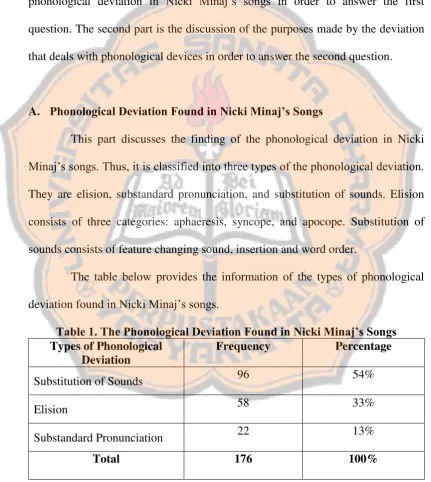
Table 1. The Phonological Deviation Found in Nicki Minaj’s Songs
Types of Phonological Deviation
Frequency Percentage
Substitution of Sounds 96 54%
Elision 58 33%
Substandard Pronunciation 22 13%
From the table, there are 176 phonological deviations found in Nicki
Minaj’s songs. Thus, there are three types of phonological deviation found in the
songs: elision, substandard pronunciation, and substitution of sounds. The most
dominant deviation is substitution of sounds with 96 deviations out of 176 with
percentage of 54%. The second is elision with 58 deviations with the percentage
of 33%. The least dominant deviation is substandard pronunciation with 22
deviations which is 13%. The discussion and explanation of each type is shown
below.
1. Substitution of Sounds
The most frequent type of phonological deviation is substitution of
sounds. There are 96 deviations found in the Nicki Minaj’s songs. The
phonological deviations of substitution of sounds occur in some types. They are
feature changing sounds, insertion of sounds, and metathesis. The analysis of each
type of the substitution of sound is presented as follows.
a. Feature Changing Sounds
Feature changing sounds occur when a sound produced is changed or
different (Fromkin, Rodman, & Hyams, 2011, p. 249). Feature changing sounds
is the most dominant type of substitution of sounds which occurs in the three
songs with 91 deviations. In “Chun Li”, there are 13 deviations of it. There are 74
deviations which occur in “Barbie Dreams”. The last is in “Coco Chanel” with
only 4 deviations of the feature changing sounds. The examples are shown in the
Table 2. The Phonological Deviation of Feature Changing Sounds Song Deviated Words Phonological
Deviation
From the table shown, the most common feature changing sounds made
are the words containing the addition {–ing}. It can be seen in the words “going”,
“coming”, “looking”, “moving”, “biting”, “talking”, and “bumping” in the table.
Those words contain the final consonant sound of /ŋ/. The sound changes
become [n] in every word in the songs. It means that the feature change is from
nasal velar becomes nasal alveolar. This kind of feature changing happens to 67
deviations which consist of 37 words. This phenomenon is the most common
deviation in the Nicki Minaj’s songs.
Another deviation is the word “nigger”. It is pronounced as [nɪgʌ]. It has
the changing of the sound in the final position of the word. The sound [r] is
allowed not to be pronounced in American pronunciation. However, it is supposed
from mid reduced sound to low central sound. It occurs eight times in only two
songs, “Barbie Dreams” and “Coco Chanel”.
The next one is the final changing sound of the plural forms of “niggers”
and “killers”. The rhyme of those words should be pronounced as /əz/ but it is
pronounced as [ʌz]. The sound change is the vowel sound from mid reduced
sound becomes low central sound. The feature changing sound of the word
“niggers” occurs seven times and the word “killers” only once.
The next example is the final changing sound of the word “could’ve” and
“would’ve”. The changing sound is in the final sound of the consonant. It should
be pronounced as /əf/ rather than [ʌ]. The deviation in the word “would’ve” and
“could’ve” only happen once in each. The feature changing sound is from two
sounds, a vowel and a consonant, become only one sound. From two sounds, the
vowel is mid reduced sound. The consonant is voiceless labiodental fricative
sound. The sound [ʌ] is low central sound.
The other examples are found in to the word “though” and “you”. The
word “though” has the change in the initial sound of the consonant. It should be
pronounced as /ðəʊ/but it is pronounced as [dəʊ]. The feature change is from a
voiced interdental become a voiceless alveolar. Next, the word “you” has the
change of the sound in the final sound of the vowel. It should be pronounced as
/ju:/ instead of[jʌ]. The deviation in the word “you” and “though” occurs once in
the feature changing sound can occur in all position of segments of the sound
within a word or syllable.
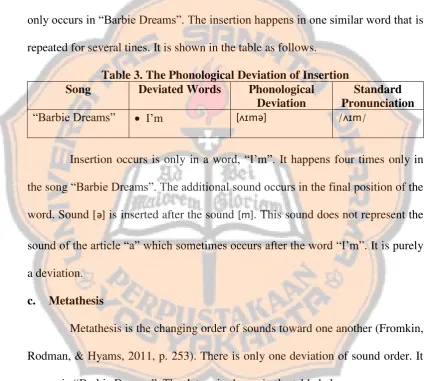
b. Insertion
Insertion is the process of inserting a vowel or consonant sound
(Fromkin, Rodman, & Hyams, 2011, p. 250). In total, there are four deviations. It
only occurs in “Barbie Dreams”. The insertion happens in one similar word that is
repeated for several tines. It is shown in the table as follows.
Table 3. The Phonological Deviation of Insertion Song Deviated Words Phonological
Deviation
Standard Pronunciation “Barbie Dreams” • I’m [ʌɪmə] /ʌɪm/
Insertion occurs is only in a word, “I’m”. It happens four times only in
the song “Barbie Dreams”. The additional sound occurs in the final position of the
word. Sound [ə] isinserted after the sound [m]. This sound does not represent the
sound of the article “a”which sometimes occurs after the word “I’m”. It is purely
a deviation.
c. Metathesis
Metathesis is the changing order of sounds toward one another (Fromkin,
Rodman, & Hyams, 2011, p. 253). There is only one deviation of sound order. It
occurs in “Barbie Dreams”. The datum is shown in the table below.
Table 4. The Phonological Deviation of Metathesis Song Deviated Words Phonological
Deviation
Metathesis only happens in the song “Barbie Dreams”. Thus, it also
happens once in the song. The word “lisp” has two sounds which reorder to one
another. The sounds are [s] and [p]. It should be the sound [s] first which is
produced then [p]. However, the singer pronounced it the opposite.
2. Elision
Elision is the second type of phonological deviation found in Nicki
Minaj’s songs. There are 58 deviations of it. Elision is the omission in connected
speech which affects consonants and vowels (Crystal, 2008, p. 166). It consists of
three types based on the position of sounds omitted. They are aphaeresis, syncope,
and apocope. The examples and the explanation of them are discussed as follow.
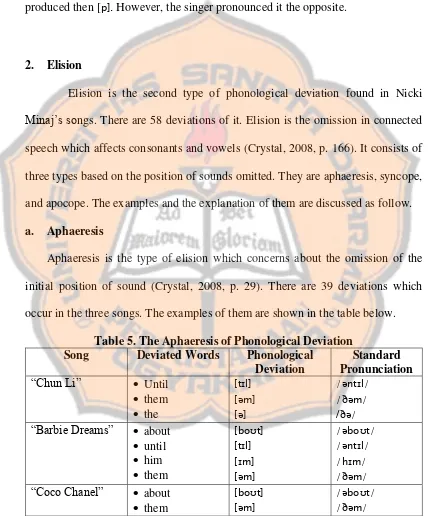
a. Aphaeresis
Aphaeresis is the type of elision which concerns about the omission of the
initial position of sound (Crystal, 2008, p. 29). There are 39 deviations which
occur in the three songs. The examples of them are shown in the table below.
Table 5. The Aphaeresis of Phonological Deviation Song Deviated Words Phonological