Beginning Reading and Writing
Beginning Reading and Writing
WITH THE PICTURE WORD INDUCTIVE MODEL
Teaching
Teaching
Beginning Reading and Writing
WITH THE PICTURE WORD INDUCTIVE MODEL
Teaching
Emily F. Calhoun
Gene R. Carter,Executive Director
Michelle Terry,Associate Executive Director, Program Development
Nancy Modrak,Director, Publishing
John O’Neil,Director of Acquisitions
Julie Houtz,Managing Editor of Books
Darcie Simpson, Associate Editor
Mary Beck Desmond,Proofreader
Charles D. Halverson,Project Assistant
Gary Bloom,Director, Design and Production Services
Karen Monaco,Senior Designer
Tracey A. Smith,Production Manager
Dina Murray,Production Coordinator
John Franklin,Production Coordinator
Valerie Sprague,Desktop Publisher
Copyright © 1999 by the Association for Supervision and Curriculum Development. All rights reserved. No part of this publication may be reproduced or transmitted in any form or by any means, electronic or mechanical, including photocopy, recording, or any information storage and retrieval system, without permission from ASCD. Readers who wish to duplicate material copyrighted by ASCD may do so for a small fee by contacting the Copyright Clearance Center, 222 Rosewood Dr., Danvers, MA 01923, USA (telephone: 978-750-8400; fax: 978-646-8600). ASCD has authorized the CCC to collect such fees on its behalf. Requests to reprint rather than photocopy should be directed to ASCD’s permissions office at 703-578-9600.
ASCD publications present a variety of viewpoints. The views expressed or implied in this book should not be interpreted as official positions of the Association.
Printed in the United States of America.
s3/99
ASCD Stock No. 199025
Also available as an e-book through ebrary, netLibrary, and many online booksellers (see Books in Print for the ISBNs).
Library of Congress Cataloging-in-Publication Data Calhoun, Emily.
Teaching beginning reading and writing with the picture word inductive model / Emily F. Calhoun.
p. cm.
Includes bibliographical references. ISBN 0-87120-337-5
1. Language arts (Primary) 2. Reading (Primary) 3.
Reading—Phonetic method. 4. English language—Composition and exercises—Study and teaching (Primary) 5. Pictures in education. I. Title.
LB1528 .C35 1999
372.6—dc21 98-58153
CIP
Preface · · · v
1. Glimpsing the Model in Kindergarten and 2nd Grade · · 1
2. Describing the Picture Word Inductive Model· · · 21
3. Using the Model in a Language Arts Unit · · · 31
4. Designing Multidimensional Reading and Writing Instruction · · · 52
5. Getting Started in Your Classroom or School · · · 66
6. Working with Older Beginning Readers · · · 88
Endnote · · · 104
Appendix 1—Explicit Instruction and Suggestions · · · 106
Appendix 2—Concept Attainment · · · 108
Appendix 3—Vocabulary Development · · · 111
Appendix 4—Reading Aloud · · · 116
Bibliography · · · 118
About the Author · · · 124
and the provision of instruction
is at the heart of the contribution schools make
to the academic achievement of students.
This book is about teaching beginning reading and writing. It is based on the belief that we can teach children to be more observant and con-scious of the patterns at work as people communicate—particularly through reading and writing—and that as teachers we can use what they are able to do and what they are able to see to bring them rapidly and naturally into greater literacy.
As author, I have three primary objectives: (1) to share the picture word inductive model (PWIM) for teaching beginning reading and writing; (2) to encourage the writing and reading of informative prose with beginning readers; and (3) to promote continuous focused inquiry into the development of literacy and into the results of teacher-and-student interactions.
Objective one is specific and limited to introducing and explaining the picture word inductive model. The PWIM is a strategy that uses an integrated language arts approach to teaching beginning reading and writing, and it includes the component skills of phonetic analysis, structural analysis, spelling, and mechanics.
Objective two is simple but potentially far-reaching: Increased attention to writing and reading informative prose could improve the quality of students’ writing and their comprehension of informative and expository prose. In most classrooms and schools, we do much more with fiction and narrative writing and reading in our primary cur-riculum than we do with nonfiction and the development of informa-tive, high-quality prose. The PWIM can help us to provide a better curricular and instructional balance by focusing lessons on composing and comprehending nonfiction prose.
Objective three is general and complex and includes illustrating a teaching stance that analyzes how language works, teaches students to
engage in a parallel analysis, analyzes students’ responses to instruc-tional moves, and takes action based on these responses. This teaching stance has allowed me to continue learning about reading, writing, and teaching for more than a quarter century, and I’m not finished yet!
I am passionate about the PWIM, but I feel the same way about other teaching strategies that are flexible, comprehensive, fun, and productive for students. I’ve used the PWIM since 1976—longer than most other strategies—as a 1st grade teacher and later with students ranging from kindergarten, to middle school, to adult nonreaders. Dur-ing the last 20 years, I have taught many kindergarten, 1st grade, 2nd grade, upper-elementary and special-needs teachers to use the model as a vehicle for integrating language arts. I’ve watched their success and delight with students’ growth in reading and writing. Working with others has given me many opportunities to learn from them and from their applications of the model, and has pushed me toward greater clar-ity in articulating the sequence and rationale for the model.
What would you see if you visited some of these teachers? If you vis-ited one classroom over several days and watched the teacher use the picture word inductive model, you would see students generating words and sentences about a large picture and studying those words and sen-tences. Some days a lesson would last 15 minutes, other days 35 min-utes. The students would be working in various ways depending on the task: individual students classifying the words; pairs of students reading sentences to each other; all the students working with the teacher on one useful phonics generalization; or individuals or large groups writing a paragraph about the picture and thinking about a title that accurately describes the picture. For the casual observer, the lessons might seem simplistic; the knowledgeable observer might become excited about the number, range, and complexity of language concepts being taught.
picture word inductive model as a framework for language arts units, thus their lessons consume a larger portion of the instructional day. You would notice that some teachers limit the use of the model to building sight vocabulary and the recognition and use of phonics and spelling patterns, while other teachers extend its use as far into the communica-tions process as the students are able to participate—for example, into modeling and providing students practice with sentence and paragraph construction.
If you observed a few teachers for several weeks, you would discover that the lesson structure of the picture word inductive model keeps stu-dents engaged in continuous inquiry into how language works and keeps teachers engaged in continuous inquiry into how students are progressing as readers and writers. Thus, along with promoting student growth in reading and writing, long-term use of the model teaches stu-dents how to learn about language and helps teachers learn how to study student progress in reading and writing.
▼ ▼ ▼
Using the printed page, I’ll take you into a few classrooms to see what inquiring minds can find. As you read the scenarios of teachers and students using the model, I hope you will feel its potential uses. As you read the sections on rationale and theoretical underpinnings, I hope you will form hypotheses about the different moves or sequences that compose the model and test them in your own classroom. And, of course, my personal teacher’s dream is that something here will support student growth in reading and writing and your continued inquiry into language literacy.
1
Glimpsing the Model
in Kindergarten and 2nd Grade
In this five-day scenario, about six weeks into the school year, we visit with Nancy Tayloe and her kindergarten stu-dents as they use the picture word inductive model. Ms. Tay-loe’s 5-year-old students at Ben Hill Elementary School are working on building their reading vocabularies. They are also beginning their study of phonics by analyzing the struc-tures of words that are in their listening, speaking, and read-ing vocabularies. Later in the chapter we’ll visit a 2nd grade classroom for three weeks of lessons.
The children are seated on the floor, facing a poster that features a teddy bear propped against a tree in a large yard or park. The poster is mounted in the middle of a large blank sheet of paper. Ms. Tayloe says, “We’re going to get some of the words for this week’s reading vocabu-lary by shaking words out of this picture. I want you to study the picture carefully and when I call on you, come up and point to something in the picture and say what it is. Then I’ll write the word and draw a line from that part of the picture to the word. We’ll start learning to read the words as we go along.”
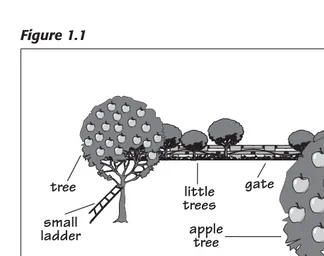
The children study the picture (Figure 1.1). After a few minutes, Ms. Tayloe asks them if they have found something they’d like to share. All hands go up, and Ms. Tayloe calls on Celeste.
Celeste reaches up, points, and says, “That’s aladder.”
Ms. Tayloe draws a line from the ladder and writesladderin large print, announcing each letter as she writes it: “l-a-d-d-e-r spellsladder.” She then spellsladderagain, while the children watch and listen. “Now, I’ll spell it again, and you say each letter after me.” She does, and then asks another child for a word.
“Small ladder,” says Brent. “There’s another ladder, asmall ladder.” Ms. Tayloe draws a line from the small ladder and writessmall ladder
in large print, announcing each letter as she writes it: “s-m-a-l-l spells
small;ladder, l-a-d-d-e-r spellsladder.Small ladder,” she says as she places her hand under the first word and then the next. Then she asks the stu-dents to spell the words with her.
“Sit,” says Marvin, and points to the teddy bear. “The bear’ssitting.” Ms. Tayloe draws a line from the bear’s seat and writessitting. She spells the word aloud and then asks the children to spell the word with her.
She then points to the first word. “What is this word?” “Ladder,” they chorus.
Ms. Tayloe asks, “And if you saw the word and couldn’t remember it or weren’t quite sure, what could you do?”
“Go down the line to the ladder in the picture,” they say.
“Right,” Ms. Tayloe responds. “Find the word or the group of words, trace the line, and check your reading.”
The lesson continues. “And what’s this word?” Ms Tayloe asks, pointing to the wordsmall.
“Small,” they chorus again. She repeats the process with ladder
then asks for the whole phrase, and calls on Chris. “Small ladder,” says Chris.
up. The teacher continues to elicit words from the children, continu-ing the pattern as before, examincontinu-ing each word and regularly reviewcontinu-ing all of them.
By the end of the session the class has identified the words listed in Figure 1.2 (p. 4) and can say each word as the teacher points to it and runs her hand down the line for them to check their reading. Ms. Tay-loe finishes this segment of the picture word inductive model by asking the students to notice if any of the same words appear in the books they are taking home for the evening to share with their parents.
The following day, as the children enter the classroom, some go to the picture word chart and look at the words, saying them to each other and following the lines from the words they don’t remember to the
basket
apples ladder
small
ladder appletree
tree little
trees
gate
teddy bear half
eaten apple grass
Figure 1.1
elements of the picture. Again, the children sit near the poster. Ms. Tayloe has them read the words, using the picture to help them locate the referents for the words.
Ms. Tayloe has taken the computer file of words that were shaken out of the picture and printed them in large type to make word cards. She includes duplicates of them to read their set. If they can’t remember a word, they are expected to go to the poster, match the word, and trace the line to the part of the pic-ture it represents.
Much activity ensues. The children find their personal space, spread out their word cards, peer at the words, and say them (usually aloud) to themselves. Occasionally, the students ask Ms. Tayloe if they are right, and she sends them to the picture to find out for themselves. Soon, children are getting up and down, holding a word card and locat-ing the word on the chart.
As she moves around the classroom, Ms. Tayloe encourages the stu-dents, notes which students are reading their words correctly, which words are causing the most difficulty, and which students need to visit and revisit the chart.
She notices that Derrick has his word card withappleupside down as he searches the chart. She takes his card and turns it right-side-up, saying, “Try it this way, Derrick. Some of these letters are tricky and you
have to study them very carefully.” She notices Janine is getting frus-trated as she searches for half-eaten and gives her a clue by saying, “Janine, this word describes one of the apples; take a look at the bottom of the chart.”
After 30 minutes, most of the students are still actively engaged with studying and reading their words, but Ms. Tayloe decides this is enough for today’s lesson. “All right, let’s put our word cards back in their envelopes.”
The following morning, she again reviews the chart with the chil-dren. Then she asks them to take out their word cards and put words together according to how they are spelled. Ricardo says thattreeand
treesandladderhave two letters just alike. Ms. Tayloe asks him to point to the letters and he does. Jan putappleandteddytogether because one has two p’s together and the other has two d’s together. Kareem responds to Jan’s category by saying thatappleshas two just alike; Brian putteddyandladdertogether because they have twod’s in the middle. Ms. Tayloe decides to expand on that point by asking the students to look atappleandapplesand to figure out how the words are the same and how they are different. Robin responds by saying that they are spelled the same except for the circles on the end. After prompting, Robin says thatappleshas the circles on the end, and Zoe sayss, apples has ans. And
appleis just one apple andapplesis two apples.
The students continue sharing their categories. Ms. Tayloe pauses whentreeandtrunkare placed together because of thetrat the begin-ning. She asks, “Now, think very carefully.” She takes a pair of scissors and cuts a bit off one edge. “I just trimmed this piece of paper. How do you think the wordtrimwill be spelled at the beginning?”
The children are puzzled for a minute, and then hands begin to go up. Ms. Tayloe waits until nearly all the pupils have an idea, and then calls on Bernardo, “Liketree!”
The class discusses Bernardo’s answer, and then Ms. Tayloe writes
the chart once more, and end for the day. Ms. Tayloe finishes by asking the children to see if they notice any words that begin liketree,trunk, andtrim in the books they are taking home for the evening to share with their parents. If they find any new words she says they should write them down to add to the new poster tomorrow.
On the fourth day, after they have read the words on the chart, Ms. Tayloe and her students develop sentences about the picture. The sen-tences include “The teddy bear is sitting in the countryside,” and “There are apples all over the place.” One child points to an apple core and wonders, “Who do you suppose ate that apple? Can teddy bears eat apples?” Ms. Tayloe records about a dozen sentences, and they read them together before closing the session.
The next morning, every student receives a printout of the previ-ous day’s sentences including the author’s name. Their task is to find a word they can read, find their own sentence, and just have fun reading what they have created.
In this scenario, Ms. Tayloe was using the picture word inductive model to elicit words from the children’s listening and speaking vocabularies. She then helped the students to study and begin to mas-ter those words for use in their individual reading and writing. By reclassifying some of the words according to letter sounds, she also began an early exploration of phonics.
The PWIM in 2nd Grade
Frazier is still teaching them the moves of the model.
Ms. Frazier gathers the students in front of a large picture that is sta-pled to the bulletin board and centered in the middle of two large strips of light-blue board paper. As they seat themselves on the rug, she says, “Make sure you have your personal space around you and that you can see the picture.” She takes a minute to help students adjust their spaces and continues, “We’re going to work with this picture for the next few days, just like we did with the picture of the playground. We’ll shake a lot of words out, learn to read and spell those words, and maybe we’ll write about the picture so we can practice our writing. Now, be ready to tell us something you recognize in the picture. Everybody will have a chance to share.”
Ms. Frazier waits about a minute until most hands are up and calls on Enrique, “What’s something you see in this picture?”
Enrique points to a necktie one of the children in the picture is wearing and says, “That’s anecktie.”
Ms. Frazier draws a line from the necktie to the paper and says “Necktie. Now, I want you to listen while I spellnecktiefirst and then we’ll spell it together so that you get lots of practice on your spelling.” The children listen while Ms. Frazier says, “N-e-c-k-t-i-e,” and writes the letters as she says them. Then again, “N-e-c-k-t-i-e spellsnecktie. Now, all together.”
The children chorus the spelling as Ms. Frazier points to each let-ter. “Now, that spells . . . ?”
“Necktie!”
Ms. Frazier calls on Maryanne, who points to a roll of tape in the picture and says,“Tape.”
Ms. Frazier draws a line from the roll of tape to the paper and says, “Now, let’s learn how to spelltape.” She spells it, then has the students spell it as she points to each letter and says “Now, t-a-p-e spells . . .?”
“Tape,” the children say almost in unison.
the picture. Gold letters, books, white board, and children are quickly identified. For each word, Ms. Frazier spells the word and pronounces it again, and then the children spell and pronounce it. One student adds
peopleas another word for the group of children in the picture.
Periodically, Ms. Frazier reviews the words, pointing to each and showing the students how they can follow the line from the word to the object it refers to. As in their first unit, they are building a picture dic-tionary. If they need the meaning of a word for independent reading or writing, they can trace the line from the word to the object.
Yellow book and blue bookand shiny book are added to the chart.
T-shirt is volunteered and Ms. Frazier spells it t-e-e s-h-i-r-t. Harry bursts out with, “That’s notT-shirt. It’s spelled with a big T!” Ms. Frazier addsT-shirtto the chart as well. She has students read both versions but spell onlyshirtwith her. She says, “I’ll have to check and see if both spellings are correct. See what you can find out.”Boy, girl, uniform, and
uniformsare added, as are green hatand picture. Altogether, about 25 words appear.
Ms. Frazier reviews all the words with the children, then leads them into a discussion of the picture: “Now, several of you asked me where these children are. Where do you think they are?”
“School,” says Marta.
“How many of you agree with Marta? And what makes you think they are in school?”
“Well, it could be a family, but there are too many children.” One student asks, “Why are they all wearing red?” Ms. Frazier has them speculate for a while and ideas like “special class” and “their school makes them do it” surface.
Robert suggests that it’s probably a school because there’s a white board in the picture and most houses don’t have white boards. Francesca suggests that the presence of a big library corner makes it likely that the picture is of a group of students at school.
Anna adds, “And homes don’t have bookcases.” There’s some discus-sion about these statements.
Finally, Ms. Frazier confirms that it is a school. In this school stu-dents wear uniforms; the school is in Nottingham, England, about 6,500 miles from their school in California; and these are 5-year-old students. Ms. Frazier shows the class a map and asks Sarah to come up and put her hand on California. Ms. Frazier puts her hand on Notting-ham to show the distance.
“Tomorrow we’ll continue with our picture. When you have a little time today, practice reading our words. If you have trouble reading a word, what do you do?” asks Ms. Frazier.
“Trace the line to the picture,” says the class. And the first lesson ends.
The next day the students gather around the picture at 9 a.m. and Ms. Frazier announces, “We’re going to work on our silent reading a little before we read our new words.”
Ms. Frazier points tobookon the picture chart. “Book!” she shouts. “Was I reading that word silently?”
“Noooo,” they respond.
“That’s right. I read it aloud, didn’t I? Now, as we read the words around the picture, I’ll point to a word, and you say it silently to your-self. Then I’ll trace the line from the word to the picture so we can check our reading, and then we’ll say the word silently and then read and spell it together, aloud. Let’s do one together for practice. Here we go, silently.”
Ms. Frazier points to a word and about half the children read it aloud. She says, “Let’s all read it again . . . silently. Don’t let any letter sounds or words escape your mouth. Here we go, just practice reading it in your mind.” She points to a word, holding her hand against her lips, everyone is silent. She traces the line, “Now, aloud.”
“Great!” exclaims Ms. Frazier. “Look at this word. Read it silently. Don’t let any words or any letter sounds escape from your mouth.” She points touniformsand traces one line and then the other to students wearing uniforms, and then says, “Now, aloud.”
“Uniforms,” they chorus.
“What good readers. Let’s do another one.” And the process con-tinues, with Ms. Frazier pointing to words, the students reading them silently, Ms. Frazier tracing the line so they can check their reading, and everyone reading the words aloud.
Ms. Frazier gives them envelopes with word cards from yesterday’s work and says, “For the next 15 minutes, I want everyone to work indi-vidually on reading your set of words. Use the picture chart when you need to.”
They begin the third lesson the next morning with a quick review of the chart. After all the words are read, Ms. Frazier begins to prepare students for the process of classification. She begins with concrete objects because the attributes are so easily clarified.
Ms. Frazier picks up a yellow plastic bucket and shakes it, “What’s this?” The class responds:
• Our math bucket; • Our pattern blocks; • Our shapes; and
• Triangles and rectangles.
Ms. Frazier says, “I’m going to select some pattern blocks from this bucket. I’m going to sort out some and put them together. I want you to think about why I put them together. See if you can come up with at least two reasons.”
Ms. Frazier pulls out five pattern blocks and holds them so students can see them. Then she calls on Kerri, who says, “You put them together because they’re all red.”
have four sides. Again, Ms. Frazier asks who agrees. They all do. Serena says, “You put them together because they are red, have four sides, and are square.”
“Serena just gave us three reasons why I might have put these pat-tern blocks together,” says Ms. Frazier. “Who agrees with all three rea-sons?” Some students who saw only one attribute come to recognize that the teacher made a category of objects that have several attributes in common.
“Now, let’s switch to words. I want you to learn to study words care-fully and put them together in groups based on how they are spelled or what they mean.” She places several word cards in the large pocket chart with the words turned away from the students. “I want you to do the same kind of detective work with these words as you just did with our pattern blocks,” says Ms. Frazier as she turns the cards over. “Every-one read them silently.” Then she demonstrates “checking your read-ing” by taking each card and placing it under the matching word on the chart and running her finger down the line to the object(s). Ms. Frazier has chosen the word cardsperson, people,andpictures.
“Now, why do you think I might have put these words together?” asks the teacher.
She calls on Jeselle, who shyly ventures that the reason is that all three words begin withp.
“Who agrees? These three words begin with the letterp?” Ms. Frazier pauses for the students to study the words for a few seconds. “Now,” says Ms. Frazier, “let’s read the words together and see if you can come up with another reason why I might have put them together.” They read them, first silently, then aloud, as she points to them. “Now, I am going to read them aloud and you listen. See if you can think of another reason. You were right, one reason was they all begin with the letterpas inpig.”
She pronounces person, people, andpictures carefully and several hands go up. She calls on Annelle who states that the words all havee
“That’s correct,” says Ms. Frazier. “What else can you discover?” “Person has a ‘son’ in it,” observes Ron.
“Can you think of anything else, Christina?” asks Ms. Frazier. Christina responds that it’s like they’re two words. Ms. Frazier prompts Christina to explain that, and the student says that it’s like it has two parts, two pieces. The teacher then pronounces the three words, slightly emphasizing the two syllables. “Good thinking, you dis-covered both reasons I put those words together: They all begin withp
and they all have two parts or syllables. Wouldpaperfit in this group?” She writespaperon the board and the students assure her it would fit the group.
“How aboutpen?” asks Ms. Frazier. There is some disagreement about whetherpenwould belong, so Ms. Frazier uses the difference betweenpen
andpencilfor a little more practice. Then she asks the students to “sort the words in your envelope any way you want to, and be prepared to share your groups and tell us why you put the words together.”
She passes out the envelopes, helps the students spread out, and they get to work. Ms. Frazier circulates, observing the word groups being formed, checking to be sure the students can read the words, sending some students to the chart to check their reading, and asking students to tell her why they put words together.
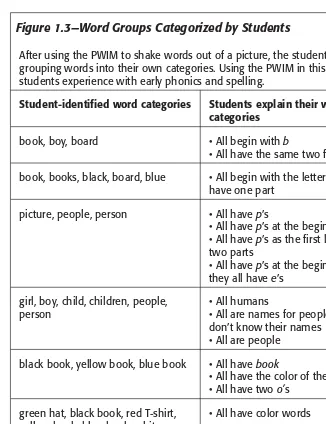
Lots of categories emerge (see Figure 1.3). Although many students have similar groups, what they see in the words and what they can articulate vary widely. Some students attend more to letters and sounds, some to the meanings of words, and some to a combination.
Ms. Frazier ends this lesson by commenting on several categories and then uses her large word cards to share the category containing
book,board, andboy. The class discusses the initial /b/ sound and the varying sounds of /oo/, /oa/, and /oy/. Their homework is to find at least six words that begin withbando, list them on a piece of paper, and drop them in the picture word box in the morning.
a few words to the chart. Then Ms. Frazier uses some of the words from the homework papers for a short explicit-instruction lesson on /oo/, /oa/, and /oy/. Part of the content generated by students during this
Figure 1.3—Word Groups Categorized by Students
After using the PWIM to shake words out of a picture, the students practice grouping words into their own categories. Using the PWIM in this way gives students experience with early phonics and spelling.
Student-identified word categories Students explain their word categories
book, boy, board • All begin withb
• All have the same two first letters book, books, black, board, blue • All begin with the letterband
have one part picture, people, person • All havep’s
• All havep’s at the beginning
• All are names for people when we don’t know their names
• All are people black book, yellow book, blue book • All havebook
• All have the color of the book • All have twoo’s
green hat, black book, red T-shirt, yellow book, blue book, white board, gold letters
• All have color words necktie, white board, child, children,
shiny book, hair, red T-shirt, girls, pictures
• All havei’s
segment includes a list of words that rhyme withbookandboyand a dis-cussion of the influence of r on vowels. Then she asks students to reclassify their words to see if they can identify any new groups, and to make sure they can read every word on the chart. Their homework is to see if they can find any more words that stand for people when we don’t know their names.
During Friday’s lesson, Ms. Frazier begins working with the stu-dents on titles and sentences. She’s worked with them a little on titles during read-aloud time and during their group language- experience lessons. As the students gather around the picture, she says, “Who remembers what a title does?” The responses include “Names of books,” “Names of stories,” “Covers of books,” “Tells us what the story’s about.” Ms. Frazier asks the students to study the picture carefully and think of a good title for it. She gives them a minute to think, then col-lects about 10 titles. As students volunteer titles, she asks them how the various titles relate to the picture. Some are comprehensive and accurate; some are less so; and some are sentences. Here are a few of their responses:
“I think the picture should be called ‘all colors,’ because there are so many colors in it.”
“ ‘Children in uniforms,’ ’cause they’re all wearing red uniforms.” “ ‘Shiny books,’ there are lots of shiny books in their school.” “ ‘Kids in school.’ They are at school.”
After listening to some proposed titles, Ms. Frazier notes to herself that she wants to bring a few books to class to spark discussion using both familiar titles and new ones; she’ll talk with students about length, content, and promises to the reader represented by informative titles. For now, however, they move on to sentences.
Ms. Frazier writessentenceon the board and under it she writes two of the sentences she heard during discussion:
• The students are all wearing uniforms.
She asks the students to read the sentences silently, reading as many words as they can. Then they read the sentences together.
“Remember, we helped Davida turn the first sentence into the title Students Wearing Uniforms because Davida mentioned that the stu-dents are all wearing uniforms. That seemed really weird to her, and so much of the picture was taken up by students in uniforms. And Gini came up with the title of Children Around Their Teacher. Well, that is good thinking. You came up with some nice titles that describe what is happening or what we can see in our picture. Later, we’ll work on titles again. For journal time, you may want to write something that goes with your title.
“Now, homework,” says Ms. Frazier. “Study our picture sometime today and pretend you are going to write a letter describing the picture to someone who has not seen it. Be ready on Monday to share some-thing from your pretend letter.”
On Monday morning, when it’s picture word time, Ms. Frazier has the overhead projector set up. She and the students begin the lesson with a quick reading of the picture word chart, work on two target sight words, and add a few more /oo/, /oa/, and /oy/ words to the wall charts. They spend the next two days generating and recording sentences describing things in the picture. The sentences cover almost everything in the picture. Of course, not all students generated complete sentences. For example, “Gold letters are on the uniform” began with a student observing “gold letters.” The teacher prompted the student by asking where the letters appear. The teacher worked with the student’s response of “On the uniform” to produce the sentence. Other sen-tences proposed by the students include the following:
• They like school because they’re smiling.
When the students offer ideas that are not obvious or that might require interpretation, Ms. Frazier asks them for their evidence. For example, the proposed sentence “The children are learning by listen-ing to the teacher” prompted the teacher to ask, “Why do you say that?”
“They are all being quiet, sort of leaning close to the teacher, and it doesn’t look like they’re talking,” responds the student.
Serena adds, “They are learning because they are good listeners and they read lots of books.”
“All the kids in this picture love school.” “They look like they are happy.”
“Why do you think so?” Ms. Frazier asks.
“Most of them are smiling. They look like they’re happy working together.”
“These kids are learning how to read and write.”
“How do you know?” Ms. Frazier asks. “Could they be getting ready for music?”
“I see their work, and they have a chart up too! And you said they were kindergarten kids.”
On Wednesday, the teachers gives each student a copy of all the sentences printed on light green paper. The next few lessons focus on learning to read the sentences. As Ms. Frazier walks around listening to the students read their sentences, she targets some high-frequency words (in,on,The/the,They/they) for additional work.
One student describes her category as “all have five words and the word
thein them.” About half the students put sentences together based on a topic or what they think the sentences are about, such as students in uniforms or what’s in the room. Some students group their sentences according to both content and sentence structure.
After the second session of reading sentences and classifying them however they wish, Ms. Frazier selects one of the topic categories she has noticed several students use. Ms. Frazier uses the category to dem-onstrate grouping sentences by content. She asks students to find a partner and encourages every partnership to find at least one group of sentences that go together because of what they are about. Before they begin, however, Ms. Frazier does a quick drill on an, and, are,
all—high-frequency words that she’s heard some students confuse and that she wants every student to master.
Through the PWIM, Ms. Frazier is preparing her students for work on writing informative paragraphs about a single topic and main idea, and is showing them how an accurate brief description of their category can provide a good title. For their next lesson, Ms. Frazier will take one of their categories, put together a paragraph, and then talk about how she formed the paragraph.
On Thursday, Ms. Frazier begins the picture word lesson by telling the students that they’ve put together a number of good categories with their sentences. She elaborates, “Some of you put together sentences about uniforms; some about all the colors in the picture; some about the books, where they were and how they were being used; and some about what the students were doing. Several of you put together three or four different categories, and some of you have written your own piece about what you were most interested in.
about our picture. Let’s read these sentences, then I’ll share my para-graph.” Ms. Frazier chose the following sentences:
• They have many talents.
• They are learning how to write words and spell.
• They are learning by listening to the teacher and by reading lots of books.
• They look like they are happy working together. • All the kids in this picture love school.
Ms. Frazier continues, “There are lots of good groups we could write about, but I selected this one because when I asked why you put them together, you talked about kids learning. And that’s one of the things I think is special when I look at our picture, and that’s what I wanted to write about.”
Ms. Frazier displays this title and paragraph on the overhead projector:
All Kids Learning
These young students have many talents. They’re learning how to write words and how to spell. Reading lots of books and listening to the teacher helps them learn. They look like they’re happy working together. The kids in this classroom love school because they are learning.
Ms. Frazier gives students time to read the paragraph silently, then she reads it aloud and briefly talks about how to tell the reader who
(young students), what (learning happily), how (by reading lots of books, by listening to the teacher, by working together, and because they have many talents) andwhere(in a classroom).
Ms. Frazier continues by explaining why she changed the firstThey
sentence. Ms. Frazier puts her first draft on the projector as she talks about a couple of the changes she made in word order and sentence order, and students ask her about a few of the changes from the original sentences.
One student suggests the last sentence needs to be the first sen-tence. Ms. Frazier agrees that it would make a good opening sentence and that they could switch the first and last sentence and the paragraph would still have the same main message. She also shares why she decided to open with the sentence about talents: “When I look at the picture it reminds me a bit of looking at you and how I feel about you as learners. I have a room full of smart and talented students who can learn anything they want to.”
One student suggests that she add “in Nottingham, England,” to the first sentence.
“That’s good thinking, Enrique,” says Ms. Frazier, “because that would tell the reader more about who and where. But where they are attending school wasn’t so important to what I wanted to say in my paragraph. Now, if I had been writing about uniforms, I might . . .”
2
Describing the Picture
Word Inductive Model
In this chapter, you’ll find a definition of the picture word in-ductive model (PWIM), an outline of the general sequence of lessons when the full model is used, and a rationale for its use. While the PWIM has uses from primary through secon-dary school, this chapter focuses on using it with students at the emergent and beginning stages of literacy, especially those students in kindergarten through 2nd grade.
The PWIM is an inquiry-oriented language arts strategy that uses pic-tures containing familiar objects and actions to elicit words from chil-dren’s listening and speaking vocabularies. Teachers use the PWIM with classes, small groups, and individuals to lead them into inquiring about words, adding words to their sight-reading and writing vocabu-laries, discovering phonetic and structural principles, and using obser-vation and analysis in their study of reading and writing.
The picture word inductive model can be used to teach phonics and spelling both inductively and explicitly. However, the model is designed to capitalize on children’s ability to think inductively. The PWIM enables them to build generalizations that form the basis of
structural and phonetic analysis. And it respects their ability to think. Thus, a major principle of the model is that students have the capabil-ity to make generalizations that can help them to master the conven-tions of language.
The instructional sequence of the model cycles and recycles through the following activities: The students study a picture selected by the teacher; identify what they see in the picture for the teacher to label; read and review the words generated; use the picture word chart to read their own sets of words; classify words according to properties they can identify; and develop titles, sentences, and paragraphs about their picture. Figure 2.1 shows the moves and the overall sequence of the model. The full sequence of a PWIM unit may take three days or two months: The length of units and number of lessons within a unit depend on the richness of the picture, the age and language develop-ment of the students, and the language objectives of the teacher.
For example, teachers using the model to develop sight-word vocabulary and to work on phonemic and graphemic awareness may stop at #7. Teachers who want to work with their students on reading and writing sentences and paragraphs use all the moves of the model. Teachers may recycle 4 through 9 completely or move backward or for-ward depending on student performance and the objectives for that lesson.
Moves of the PWIM
1. Select a picture.
2. Ask students to identify what they see in the picture.
3. Label the picture parts identified. (Draw a line from the identified object or area, say the word, write the word; ask students to spell the word aloud and then to pronounce it.)
4. Read and review the picture word chart aloud.
5. Ask students to read the words (using the lines on the chart if necessary) and to classify the words into a variety of groups. Identify common concepts (e.g., beginning consonants, rhyming words) to emphasize with the whole class.
6. Read and review the picture word chart (say the word, spell it, say it again).
7. Add words, if desired, to the picture word chart and to the word banks. 8. Lead students into creating a title for the picture word chart. Ask stu-dents to think about the information on the chart and what they want to say about it.
9. Ask students to generate a sentence, sentences, or a paragraph about the picture word chart. Ask students to classify sentences; model putting the sentences into a good paragraph.
10. Read and review the sentences and paragraphs.
Strengths of the PWIM
The basic moves of the PWIM stress these components of phonics, grammar, mechanics, and usage:
• Students hear the words pronounced correctly many times and the picture word chart is an immediate reference as they add these words to their sight vocabulary. The teacher can choose to emphasize almost any sound and symbol relationship (introduced or taken to mastery).
• Students hear and see letters identified and written correctly many times. • Students hear the words spelled correctly many times and participate in spelling them correctly.
• In writing the sentences, the teacher uses standard English (transforming student sentences if necessary) and uses correct punctuation and mechanics (e.g, commas, capital letters). As different mechanical and grammatical devices are used, the teacher describes why the device is used. After many lessons and experiences with the teacher modeling the devices, the students learn how to use them too.
years old to notice and comment on spelling and phonetic structure. Until the words are part of the student’s sight vocabulary, they are anchored by their representations on the picture word chart.
For most beginning readers and writers, the PWIM is a satisfying and pleasurable activity: They enjoy finding objects and actions in the picture, seeing the words and sentences they generate expressed in print and become part of the curriculum, classifying words and sen-tences, and discovering useful language concepts and generalizations. The PWIM motivates students because most become successful learn-ers. Learners succeed when using the model because the PWIM is based on inquiry into how children learn and how to enhance their learning, including their development of language, the process of learning to read and write, and the reading and writing connection.
Building on Language Development
By the time most children in the United States are 5 years old, they can listen to and speak 4,000 to 6,000 words with understanding and also use the basic syntactical structure of the language (Chall, 1967; Clark & Clark, 1977). They can listen with understanding to complex sentences and longer communications. They produce sentences that include prepositions and conjunctions and make causal connections like “If we go to the store now, we could watch ‘Thomas the Tank Engine’ when we get back.” They gobble up words, play with them, and have conversa-tions with stuffed animals and dolls—composing ideas and manipulating words much as they will when they begin to write. Children’s natural acquisition of language is a dimension of culture and brings with it a great sense of personal power and satisfaction as young learners receive communications and learn to put their ideas into words.
pictures as a stimulus for language experience activities in the class-room was developed specifically for teaching young students to read and write (e.g., see Adams, Johnson, & Connors, 1980). In the struc-ture of the picstruc-ture word inductive model, young children are presented with pictures of familiar scenes or photographs of everyday items. They shake out words from the picture by identifying objects, actions, and qualities they recognize in the picture. The words or phrases the stu-dents use to identify the objects, actions, or qualities are connected to words already in their naturally developed listening and speaking vocabularies. The next step occurs as the teacher draws a line from the object to the surrounding paper and writes the word or phrase.
Both the process (moves) and the structure of the model respect children’s language development and enable them to begin reading by using their language in conjunction with the pictures. The PWIM is designed to enable students to be immediately successful as language learners in the formal school setting and to immerse them in how lan-guage works.
The connections between the children’s language and the items and actions in the picture support the transition from oral (listened to and spoken) language to written (read and written) language. Students witness the transformation from oral to written expression. They watch the words being spelled and spell them with the teacher. They connect something in the picture with a word and then watch that word appear as letters. They can now read that word. Shortly, they learn that we always spell that word the same way. They identify a dog in the picture, see dog written, hear it spelled, spell it themselves, and on the way home from school they see a Lost Dog poster on the street corner and read the word again.
Ramey (1998). These professors and researchers offer six “developmen-tal priming mechanisms” repeatedly associated with “positive cognitive, social, and emotional outcomes of children” (Ramey & Ramey, 1998, p. 115) (and probably also with the continuing development of adults):
• Encouragement of exploration,
• Mentoring in basic cognitive and social skills, • Celebrating new skills,
• Guided rehearsal and extension of new skills,
• Protection from inappropriate punishment or ridicule for devel-opmental advances, and
• Stimulation in language and symbolic communication. (Ramey & Ramey, 1998, p. 115)
According to Ramey and Ramey, the priming mechanisms need to be present in children’s lives on a frequent and predictable basis. The framework of the PWIM addresses five of the six priming mechanisms for continued development. Meanwhile, we continue to learn about education and the brain and what is needed to support language devel-opment and literacy (Education Commission of the States & The Charles A. Dana Foundation, 1996; Bruer, 1997).
A major principle of the picture word inductive model is to build on children’s growing storehouse of spoken and understood words and syntactic forms and facilitate the transition to writing and reading. Most children want to make sense of the language around them and they eagerly engage in unlocking its mysteries. A corollary principle of the PWIM is that the approach respects the children’s language devel-opment: Their words are used and their ability to make connections is central to the learning process and the model.
Stimulating Reading and Writing Skills
several types of learning need to be accomplished to develop reading and writing skills.
Children must build a substantial sight vocabulary—a storehouse of words instantly recognizable by their spellings. We want students reading books as soon as possible for many reasons: for literacy acquisi-tion; for skills practice; for their self-esteem as learners; and for devel-oping a sense of literate behavior that comes through being able to independently access the ideas of others through the alphabetic code of their native language (as in “I can read this book! Hear me!”). About 100 words bring simple books like Go, Dog, Go (Eastman, 1961) within reach. Also, once students have about 50 sight words, their study of phonics is greatly facilitated, as are many other aspects of learning, including the development of more vocabulary (Graves, Watts, & Graves, 1994). About 450 words bring children to the stage in which many picture storybooks are available to them.
The picture word inductive model approaches the development of sight vocabulary directly. The students read and spell the words that are shaken out of the picture. Then, these words are placed on large word cards that they can look at and the teacher can use for group instruc-tion. Students also get their own set of word cards. They sort these words and consult the picture dictionary to check their understanding and refresh the meaning of the words. The students keep word cards in envelopes, word banks, or word boxes, consulting them as they wish and eventually using the cards and words to compose sentences.
With respect to sound and print forms (phonetic, often called sound-and-symbol or letter-and-sound relationships), children need to learn that nearly all words that begin with a particular sound begin with particular letters that represent that sound. Periodically, a teacher using the PWIM will ask students to pull out all the words they have in their word bank that contain aband they will concentrate on that let-ter. Another time,atwill get attention. After the students have learned to read most of the words on the picture chart, the teacher may ask them to pull out all the words in which they can hear /s/. Thus, pho-netic and structural analysis skills are learned through developing con-cepts and applying them to the reading and writing process.
The PWIM can help students learn about the structure of words as they build an understanding of inflection, the change of form that words undergo to indicate number, gender, person, tense, case, mood, or voice. For instance, in Chapter 1, Ms. Tayloe directed her kindergar-ten students to notice the similarities and differences between singular and plural words, specifically howappleandapplesare alike and differ-ent. Although it may seem impossible for students to believe, structural conventions eventually result in more rapid and accurate communica-tion of their ideas.
The picture word inductive model induces students to classify their words, building the concepts that enable them to unlock unfamiliar words. The English language has about 44 sounds represented in more than 200 forms—some say as many as 250 forms (Morris, 1997— because some have multiple representations: /sh/ut, na/tion/. As stu-dents work with their words, they develop categories: these words all begin likeboy; these words all have two d’s in the middle like ladder.
Students develop word families that they can use to read and spell words they have not memorized; for instance, the word family ofbat,
Students will be amused at some of the ways we spell words such as
ateandeight,and will sigh occasionally at our insistence that they learn the peculiarities our language has developed. They will be perplexed by
seeandseaand want to know why we made them sound alike. At times, all we can say is what our teachers said to us, “You’ll just have to memo-rize them.”
Strengthening the Reading and Writing Connection
Reading and writing are naturally connected, can be learned simulta-neously, and can be used together to rapidly and effectively advance growth in language use (Stotsky, 1983; Tierney & Pearson, 1985; Hill-ocks, 1987; Shanahan, 1988, 1990; and Heller, 1991). How is the read-ing and writread-ing connection used in the PWIM? As the students search a picture for items and objects they can identify with words or phrases, the teacher writes their words on the picture word chart, which launches the students into the early stages of formal writing. Later, the students make up short sentences about the picture and begin to write longer sentences and then paragraphs with the help of the teacher. Through repetition, the words in the sentences are added to their storehouse of knowledge.
Gradually, as the students read more trade books, they learn to ana-lyze how others write and they begin to use the conventional writing devices to enhance their ability to express themselves. Essentially, they come to use the library of the world as models for sharing and commu-nicating ideas through writing. As they read picture storybooks and short informative books, they discuss them by making up sentences about the book. Many students begin to feel that their reading is not complete until they have said something about the book in their own words, completing the communication loop between the author and the reader.
paragraphs, they select and discuss titles. The teacher leads metacogni-tive discussions on choosing titles and talks to the students about which title is most comprehensive, which title might be most interest-ing to one audience or another, which sentences go with one title, which with another. When writing a paragraph or creating a title, the teacher helps students to focus on the essence of communication: What do we want to say to our readers? to ourselves? Focusing on com-munication is what Mrs. Frazier and her 2nd grade students were doing in their lessons. Her students use the reading and writing connection as she has them think about what they want to share, what they most want the reader to know, and how to help the reader get this informa-tion. The reading and writing connection culminates as the class evaluates their effectiveness in sharing what they wished to share. Mrs. Frazier continues to work on this link until it becomes explicit and accessible for the students to use as independent learners.
▼ ▼ ▼
3
Using the Model
in a Language Arts Unit
In this scenario, we visit with Velma Lewis and her 1st grade students for three weeks. Mrs. Lewis’s class moves through the model in the same way that Ms. Tayloe’s class did in Chapter 1. The same kinds of questions and ideas are gener-ated as the class shakes words out of the picture of a sports equipment room. Note the similarities in how the PWIM is used with students from kindergarten through 2nd grade. As you read this, see if you can feel the sequence of the model and the continuous diagnosis into language learning that is similar across grade levels.
Mrs. Lewis’s 6-year-olds at Washington Primary School are working on building their reading and writing vocabularies. They are also working on their phonics and spelling skills by analyzing the structures of words that are in their listening, speaking, and reading vocabularies.
After working for several days with a picture of a sports equipment storage room, they have created an illustrated dictionary (picture word chart) by shaking out words from the picture. Mrs. Lewis has supplied the words to each student on word cards. She gives each child a set with
22 of the more than 50 words shaken out of the picture; she will add the other cards later.
This lesson from the fourth day of the PWIM unit opens with stu-dents reading the words on the picture word chart (Figure 3.1). Then Mrs. Lewis takes out six word cards that she has selected for special attention. These words are written in large print on sentence strips (larger versions of the word cards). In yesterday’s lesson, these six words and phrases were among the most frequently “read” words at the pic-ture word chart, probably because they were on top of the stack in the envelope:baseball, baseball bat, football, yellow football, basketball,and
ball. Today, the group practices locating each word visually on the chart, and then Mrs. Lewis calls on a student to match the word on the sentence strip to the word on the picture word chart. The other stu-dents raise their hands if they agree with the match, then the group reads and spells the word
Tommy says that he can read all of them, and Jordan notices that all of the words have letters. Chaminade observes that the list contains two “baseballs.” Miranda saysbaseball, football, basketball, andballall have
ballin them. And Louis blurts out that the words all have twol’s at the end. Mrs. Lewis asks Miranda to arrange those words in a column on the pocket chart and then says. “Watch carefully as Miranda points out
ballinbaseball, football,andbasketball.” Miranda points outballin each word and returns to her seat.
Then Mrs. Lewis says, “Louis, you were being a good word detec-tive. These four words, let’s read them together . . . all have twol’s. We cannot writeball,b-a-l-l, or any word withballin it without using two
l’s. Let me hear everyone spellball.” “B-a-l-l,” the class shouts.
“Study the letters inballcarefully, only those four letters, in that order, will spell the wordballin English,” says Mrs. Lewis. She specifi-cally mentions spelling in English because the class has discussed differ-ent languages and they have learned four or five Arabic words from a classmate whose parents speak Arabic and English.
Mrs. Lewis pulls out two word cards,batandyellow, that students do not have as separate word cards. She says, “Everyone look carefully at these words. When you think you know what they are, raise your hand.”
Jordan responds to the teacher’s prompt by saying, “Bat, the short one isbat.”
“Good reading, Jordan. Can you come up and point to the wordbat
on a word card in our pocket chart?” Jordan comes up and points to the wordbaton the word card that saysbaseball bat.
“Now, this one,” Mrs. Lewis says holding up the card withyellow
written on it. She gives students a minute and calls on Jessica. “Yellow football,” says Jessica.
not blurt out. What is this word, Jessica?” “Yellow football.”
Mrs. Lewis hands Jessica the word card and says, “Jessica, would you place this word right under its match on the chart?” Jessica gets up, walks to the charts, pauses a moment, and places the word card under
footballin the phraseyellow football.
“Good reading,” says Mrs. Lewis. “What is that word?” “Football,” says Jessica.
“And what color is this football?” “Yellow.”
“Can you put your hand underyellow?” Jessica points out the word and returns to her seat.
Mrs. Lewis places the card withyellow footballon the left side of the pocket chart and says to the students, “We have two separate words on this card,yellow,” placing one hand underyellow, “andfootball.” Then she places the word cardsyellowandfootballone under the other in the pocket chart.
“Does anyone see another card in our list with two separate words?” The students identifybaseball bat,and they spend a few min-utes on those words.
Mrs. Lewis’s experience has taught her to stop the lessons at appro-priate conceptual loop or lesson loop times, to stop when the students have been engaged for a long time (more than 30 minutes), and to stop when they get too squirmy because it’s time to go to the media center, lunch, or music. At this point, she finishes this segment of the lesson by saying, “I am going to leave our six word cards in the pocket today. Study them, practice reading them, and see if you notice anything else about them.”
Recognizing similarities and differences helps students learn to read these words and helps them to classify words according to their struc-tural and phonetic properties.
The following morning, Mrs. Lewis reviews the picture word chart with the children, reading and spelling the words together. They review the six word cards and Mrs. Lewis decides to work with the students on dis-criminating singular and plural words because she noticed that some students were readingbookasbooksandhookashooks. She does this to move students toward recognizing the concept of singular and plural and how-sworks in forming many plural nouns.
Mrs. Lewis uses the flip chart and begins the lesson by leading stu-dents in brief silent and oral reading practice on these words, similar to what they did with the six words in yesterday’s lesson. Several students eagerly share thatbook,books,hook, andhooksall have two letters just alike, side by side. Part of the visual study and practice in this segment of the lesson emphasizes how to discriminatebookfrombooksandhook
fromhooks, with work on the sounds represented bybandh, some work on the /oo/ sound as in bookand hook. Discussion of rhyming words (students generate several additional words that rhyme—look, looks, cook, andcooks), and some discussion of how-sby itself at the end of a word often indicates more than one object. Their homework is to see if they can find other words that rhyme withbookorbooks.
The next day, the lesson begins with a silent reading of all the words on the chart and the teacher calling on students to read them aloud. Then she reviews the two sets of special study words followed by a check on homework discoveries. They addtookandshookto the flip chart. Now the list includesbook, books, hook, hooks, look, looks, cook, cooks, took, shook. They spend a few minutes developing meaning for took and
describing her action in a sentence,I took Brian’s book. She writes the sentence on the board, reads it, and has the students read it. Mrs. Lewis does one demonstration forshook,“I shook my head.” Mitch comes up with “The puppy shook mud all over me.”
Angela suggests adding tooks and shooks to the flip chart. The teacher responds that Angela’s idea makes sense and fits a pattern, and she reads and points tobook, books, hook, hooks, look, looks, cook, cooks. Mrs. Lewis explains, however, that “tooksandshooksdid not become words in our language. We use takes andshakes instead.” Mrs. Lewis does not take this line of reasoning any further; she does not believe her beginning 1st graders are ready for conjugating irregular verbs with any level of conceptual understanding. She may explain this concept later, or with another group of students, or with a smaller group.
Mrs. Lewis begins to prepare her students for classifying their words. She briefly reviews what they have been working on in math: sorting their red cubes from their green triangles and making patterns. She holds a set of pattern blocks of various colors and shapes in a small tray and asks the students to look at them. Then she says, “Watch care-fully, see if you can be a very good detective. I am going to select three of these that go together. Your job as a detective is to think of as many reasons as you can why they go together.” Mrs. Lewis selects three green triangular shapes and asks the students to think about how these three are alike. She gives students a minute to study. The students respond that
• They’re all green;
• They all have three sides; • They are pattern blocks;
• On Saturday we went to the store to look for some; • Three points; and
• Green triangles!
takes Ricky’s thoughts and expresses the idea that a square has four sides; Annalyn says that it can’t belong because it’s a square, triangles have three sides. Another student comments that it is shaped like the roof of a house.
“You’re right. This pattern block does not belong in my set because it has more than three sides. It is not a triangle. Now look carefully.” Mrs. Lewis holds up a red triangle and asks the student if it would fit her group.
Angela explains that it doesn’t fit because it’s a red triangle. Mrs. Lewis responds, “What good detectives you are. You noticed that the pattern blocks in my set were all green, had three sides, had three points, and are called triangles. You have been using a very important thinking skill called classifying. Let’s do one more practice classifying together before you do it by yourselves. Watch carefully.”
Mrs. Lewis picks up the large name cards the class uses as she takes attendance. She calls Jake to the front and hands his name card to him, and repeats the pattern with Jordan, Jeanette, and Jessica. Mrs. Lewis asks the class to study each name card carefully and figure out how they are alike. She gives them a minute to think silently and then she asks for responses:
• They’re all kids;
• They’re all in 1st grade; • Two boys and two girls; • They all havej’s; and
• They’re all alike at the start.
Mrs. Lewis asks Bruce to point to where the names are “all alike,” and he does. The class is asked to agree with Bruce or not, and then Mrs. Lewis writes aJon the chart nearby. She explains thatJake, Jor-dan, Jeanette, and Jessica all begin with the same letter. Jessica can’t stand it any longer and blurts out, “It’s aj!”
Louis gets up and walks up to the cards. He points to thejandain each word and says, “They all haveJ’s andA’s.”
Mrs. Lewis says, “Everyone watch carefully. Louis, would you point to those letters again?” Louis does so and returns to his seat. Mrs. Lewis collects the name cards from the students and places them in the pocket chart, “Thank you, Jeanette, Jordan, Jessica, and Jake.”
Mrs. Lewis, holding up Chaminade’s name card, asks, “Would this name fit in our group?” She calls on several students who give varying but correct responses about why it could not belong. Then she holds up Jackie’s name card, students easily identify it as a member of the group. Mrs. Lewis places it in the pocket chart and helps her students think about writing and spelling by saying, as she points to the j in each name, “Yes, if we want to write Jeanette’s, Jordan’s, Jessica’s, Jake’s, or Jackie’s name, we have to begin it with an uppercase or capitalJ.”
She brings the group practice to a close and reinforces and extends the students comments and thinking by saying, “You were good detec-tives. I did put these names together because they all begin withj. I did not think aboutabeing in every name, but Louis spotted it. Tomorrow, you’ll begin to classify the words in your envelopes. So be sure to study all the words on the chart—how they are spelled and how they sound. That will help you become a super classification detective.”
Mrs. Lewis brings her students into formal classification of words by connecting the classification work they have done in forming groups and sets and working on shapes in mathematics. She begins with objects that are tangible and concrete (the pattern blocks); then moves them to relatively familiar words (their names), and then on to looking at the letters in their new words. She had planned for students to begin classifying their words today, but the lesson had gone on long enough.
reads the words aloud for the students to check their reading.
Then she says, “Now watch carefully. I am going to make another set of words, a set of words that go together.” She writesbook, hook, look, cook, shookon the other side of the flip chart, reads them aloud slowly, and says, “I put these words together because they all have the /oo/ in them and they all rhyme. Let’s read them together and listen to the /oo/ and to the rhyme.” The class reads the list of words aloud and then Mrs. Lewis leads them into classifying the words from the book, books, tooklist. The class addstookto the list.
She moves the students into their first independent classification of the words from the chart. Each student has a set of cards and is fully engaged in studying the words. Mrs. Lewis asks the students to find some words that go together because they are alike in some way. Stu-dents find their personal space and spread out their cards. There is a regular stream of traffic as students go to the picture chart to check their reading. Mrs. Lewis walks around the room observing and asking students about their word groups.
The students are given 15 minutes to work individually on reading and classifying their words. Some students read their words to her when they describe their group; others do not. Some students identify the likenesses by pointing and saying that their words have the same two letters in them. Mrs. Lewis extends their learning by pointing to these letters and saying, “You’re right:ball, baseball, small wagon, baseball bat
all have twol’s in them. Can you find any more words with twol’s in them?”
A few students are still practicing their reading, so Mrs. Lewis praises them for their good reading and asks them to see if they can find at least two words that go together for some reason. She ends the lesson by having the class read the words on the chart aloud.