SYNTHESIS AND CHARACTERIZATION OF
CYCLOALIPHATIC AND AROMATIC
POLYESTER/POLY(DIMETHYLSILOXANE) SEGMENTED
COPOLYMERS
Jeffrey Mecham
Thesis submitted to the faculty of the Virginia Polytechnic Institute and State University in partial fulfillment of the requirements foor the degree of
Master of Science in
Chemistry
James E. McGrath, Chair Thomas C. Ward
James F. Wolfe
December 12, 1997 Blacksburg, Virginia
SYNTHESIS AND CHARACTERIZATION OF CYCLOALIPHATIC AND
AROMATIC POLYESTER/POLYDIMETHYLSILOXANE SEGMENTED
COPOLYMERS
by
Jeffrey Mecham
Committee Chairman: Dr. James E. McGrath
Department of Chemistry
(ABSTRACT)
Linear thermoplastic polyesters are commonly used in high volume
applications such as food containers, films and textile fibers. The physical and
mechanical properties of these materials are well documented and are a function
of chemical structure and morphology (e.g. semi-crystalline, amorphous, etc.).
Polyesters, as are many organic polymers, are quite flammable.
Polydimethylsiloxane homopolymer exhibits low mechanical strength and,
even at high molecular weight, exists as a viscous fluid rubbery gum due to its
low glass transition temperature of approximately -123°C. However, one of the
many attractive properties of this polymer is its relatively low flammability and if
properly designed, organic “sand-like” silicates are produced in oxidizing
atmospheres at elevated temperatures (e.g. 500-700°C).
This thesis discusses the synthesis and characterization of novel, high
molecular weight cycloaliphatic and aromatic polyester/ poly(dimethylsiloxane)
segmented copolymers. The cycloaliphatic copolymers were synthesized via a
melt process using a high trans content 1,4 dimethylcyclohexanedicarboxylate,
and 1,4 butanediol or cyclohexanedimethanol, while the partially aromatic
systems were synthesized using dimethyl terephthalate and butanediol. Primary
and secondary aminopropyl terminated poly(dimethylsiloxane) oligomers of
controlled molecular weight were endcapped with excess diester to form an
amide linked diester terminated oligomer. The latter was then incorporated into
copolymer. Selected compositions showed enhanced ductility and hydrophobic
surface modification.
The polysiloxane segment was effeciently incorporated into the
copolymers and was unaffected by the transesterification catalyst under typical
reaction conditions.
The homopolymers and copolymers were characterized by solution,
thermal, and mechanical, and surface techniques. The segmented copolymers
were demonstrated to be microphase separated as determined by differential
scanning calorimetry (DSC), dynamic mechanical analysis (DMA), and
transmission electron microscopy. The surface of the copolymers was enriched
with the polysiloxane segment as evidenced by contact angle analysis.
Thermal gravimetric analysis of the segmented copolymers containing
identical amounts of PDMS, but varying in the primary or secondary nature of
their amide linkages, exhibited quantitatively identical char yields and weight loss
behavior. The segmented copolymers exhibited char yields in air superior to
those of their respective homopolymers.
Additionally, aromatic poly(tetramethyleneoxide) (PTMO) based
polyether/polyester segmented copolymers were modified with
poly(dimethylsiloxane). DMA revealed an apparent shift (higher Tg) of the PTMO segment reflecting an increase in phase mixing with the “hard” polyester
ACKNOWLEDGMENTS
I would like to thank Professor James E. McGrath for his friendship and
guidance during my many years at Virginia Tech. As an undergraduate I worked
for him as a technician, and with his support and encouragment I was able to
realize that a graduate degree was something that was attainable. Without him, I
never would have considered such a thing was possible.
I would also like to thank the members of my advisory committee, Dr. T.C.
Ward and Dr. J.F. Wolfe, for their patience and for being patient with the many
scheduling changes for the thesis defense.
I would also like to thank Dr. Timothy Long of Eastman Chemical for
allowing me the opportunity to experience industrial research “up close and
personal”. Mr. Rodney Bradley of Eastman also deserves recognition for his
incredible talent and teaching ability with respect to melt polymerization.
I am grateful to the many technicians, graduate students and postdoctoral
fellows who assisted me with data and results: Patti Patterson measured intrinsic
viscosity; Dr. Qing Ji for his GPC measurements and invaluable assistance with
compression molding of films; Steve McCartney for transmission electron
microscopy; Mark Muggli for advice regarding dynamic mechanical analyses;
Ojin Kwon for training on the minimat mechanical analyzer; and especially Tom
Glass for his expertise with the 400Mhz NMR.
I would like to thank all of the ladies in the NSF Center office for their
friendship and help. Laurie Good, Esther Brann, Millie Ryan and Joyse Moser
have all contributed to my success in this program in many ways, great and small.
I am perhaps most indebted to my wife, Sue Mecham. Although she was
busy working on her own Ph.D., she listened to countless complaints and helped
with research “sticking points”. Without her support, understanding, and love, I
don't think I could have made it.
Finally, I would like to thank my two sons, Michael and Shane for making
SYNTHESIS AND CHARACTERIZATION OF CYCLOALIPHATIC AND
AROMATIC POLYESTER/POLYSILOXANE SEGMENTED
COPOLYMERS
Page
Chapter I. Introduction ...1
Chapter II. Literature Review...4
A. Characteristics of Poly(dimethylsiloxane)s...4
B. Polyesters...28
1. Aliphatic/Cycloaliphatic Systems...28
2. Aromatic Systems...37
C. Fire Resistance: Fundamental Considerations...41
Chapter III. Experimental A. CHARACTERIZATION AND PURIFICATION OF MATERIALS...50
1. Polysiloxane Oligomer...50
2. Polyester Monomers...50
B. OLIGOMER AND COPOLYMER SYNTHESIS...51
1. Poly(butylene cyclohexanedicarboxylate)...51
2. Poly(cyclohexanedimethanol cyclohexanedicarboxylate)...53
3. Poly(butylene terephthalate)...53
4. Effect of Catalyst on Poly(dimethylsiloxane) Stability...54
5. Poly(butylene cyclohexanedicarboxylate) / Poly(dimethylsiloxane) Segmented Copolymers...54
a. Endcapping of Poly(dimethylsiloxane)...54
b. Synthesis of Poly(butylene cyclohexanedicarboxylate) / Poly(dimethylsiloxane) Segmented Copolymers...55
6. Poly(cyclohexanedimethanol cyclohexanedicarboxylate) / Poly(dimethylsiloxane) Segmented Copolymers...55
b. Synthesis of Poly(cyclohexanedimethanol
cyclohexanedicarboxylate) / Poly(dimethylsiloxane) Segmented
Copolymers...55
7. Poly(butylene terephthalate) / Poly(dimethylsiloxane) Segmented Copolymers...56
a. Endcapping of Poly(dimethylsiloxane)...56
b. Synthesis of Poly(butylene terephthalate) / Poly(dimethylsiloxane) Segmented Copolymers: 2° Aminoalkyl terminated Poly(dimethylsiloxane)...56
c. Synthesis of Poly(butylene terephthalate) / Poly(dimethylsiloxane) Segmented Copolymers: 1° Aminoalkyl terminated Poly(dimethylsiloxane)...57
8. Poly(butylene terephthalate) / Poly(dimethylsiloxane) / Poly(tetramethyleneoxide) Segmented Terpolymers...57
a. Endcapping of Poly(dimethylsiloxane)...57
b. Poly(butylene terephthalate) / Poly(dimethylsiloxane) / Poly(tetramethyleneoxide) Segmented Copolymers...57
C. CHARACTERIZATION OF OLIGOMERS AND POLYMERS...58
1. Fourier Transform Infrared Spectroscopy...58
2. Nuclear Magnetic Resonance Spectroscopy...58
a. Solution Proton NMR...58
b. 29 Si NMR...58
3. Intrinsic Viscosity...59
4. Gel Permeation Chromotography...59
5. Compression Molding...59
6. Differential Scanning Calorimetry...59
7. Thermal Gravimetric Analysis...60
8. Dynamic Mechanical Analysis...60
9. Transmission Electron Microscopy...60
CHAPTER IV. RESULTS AND DISCUSSION...62
A. POLY(BUTYLENE CYCLOHEXANEDICARBOXYLATE)...62
B. POLY(CYCLOHEXANEDIMETHANOL CYCLOHEXANEDICARBOXYLATE)... ...66
C. POLY(BUTYLENE TEREPHTHALATE)...66
D. SYNTHESIS OF POLYESTER / POLYDIMETHYLSILOXANE SEGMENTED COPOLYMERS...72
1. Research Introduction...72
2. Effect of Titanate Catalyst on Poly(dimethylsiloxane)...73
3. Endcapping of Poly(dimethylsiloxane)...73
4. Poly(butylene cyclohexanedicarboxylate) / Poly(dimethylsiloxane) Segmented Copolymers...75
5. Poly(cyclohexanedimethanol cyclohexanedicarboxylate) / Poly(dimethylsiloxane) Segmented Copolymers...78
6. Poly(butylene terephthalate) / Poly(dimethysiloxane) Segemented Copolymers: 2° Aminoalkylterminated Poly(dimethylsiloxane)...80
7. Poly(butylene terephthalate) / Poly(dimethysiloxane) Segemented Copolymers: 1° Aminoalkylterminated Poly(dimethylsiloxane)...82
E. CHARACTERIZATION OF COPOLYMERS...82
1. Incorporation of Poly(dimethylsiloxane) into Copolymers...82
2. Chemical Composition...83
3. Fourier Transform Infrared Spectroscopy...83
4. Intrinsic Viscosity...87
5. Gel Permeation Chromatography...87
6. Thermal Analysis...91
7. Transmission Electron Microscopy...94
8. Mechanical Testing...94
9. Contact Angle Measurement...94
CHAPTER V. CONCLUSIONS...99
CHAPTER VII. REFERENCES...102
LIST OF FIGURES
Figure Page
3.1 Melt Polymerization Reactor...52
4.1 1H NMR of 90% trans dimethyl 1,4-cylohexanedicarboxylate...63 4.3 Gel Permeation Chromatogram of
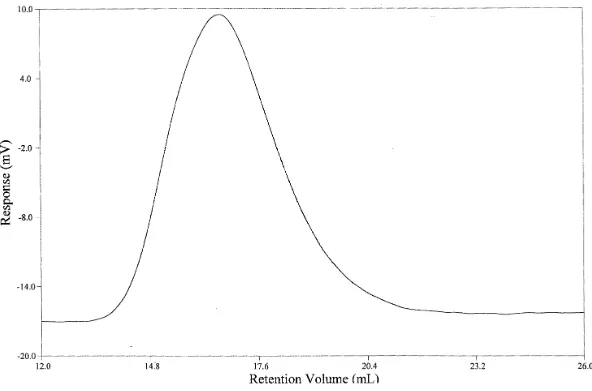
Poly(butylenecyclohexanedicarboxylate)...64
4.4 Gel Permeation Cromatogram of
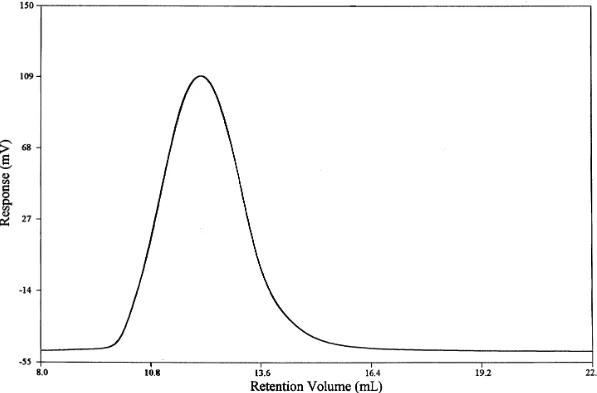
Poly(cyclohexanedimethanolcylohexanedicarboxylate)...67
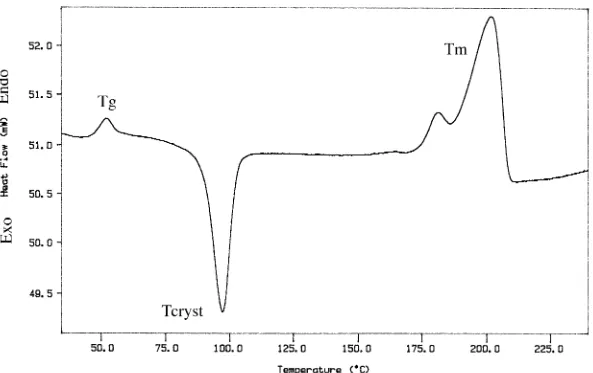
4.5 DSC Thermogram of PCDCD Homopolymer...68
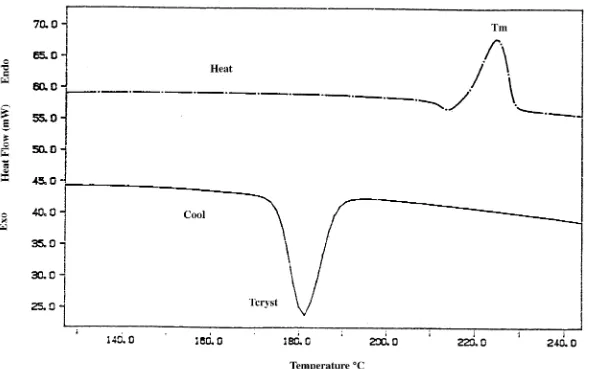
4.6 DSC Thermogram of PBT Homopolymer...69
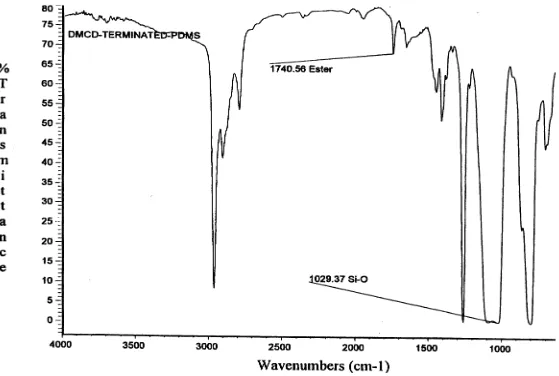
4.9 Infrared Spectrum of 1,4 dimethylcyclohexanedicarboxylate-terminated
PDMS...76
4.10 1H NMR of Poly(cyclohexanedimethanolcylohexanedicarboxylate)...86
4.11 Infrared Spectra of 30 Weight Percent PDMS/PBCD
Segmented Copolymer...90
4.12 TGA of PBT Homopolymer and Copolymers...92
4.13a DSC Thermogram of PBT Homopolymer...93
4.13b DSC Thermogram of a 30 Weight Percent PDMS/PBT
copolymer...94
4.14 DMA of PDMS/PBT Segmented Copolymers...96
4.15 DMA of PDMS/PTMO/PBT and PTMO/PBT Segmented Copolymers...97
4.16 Stress-Strain Curves for PBT Homopolymer and
LIST OF TABLES
Table Page
2.1 Structural Units of Polyorganosiloxanes...8
2.2 Effect of Aromatic Rings on the Oxygen Index and Char Yield of
non-Halogenated Polymers...45
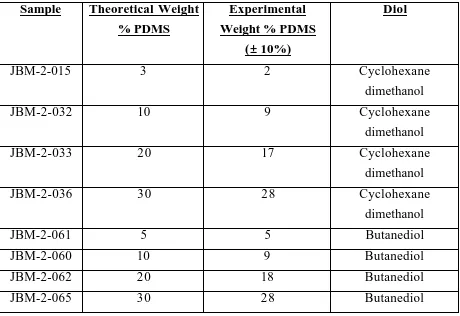
4.1 Incorporation of Poly(dimethylsiloxane) into Cycloaliphatic Polyester
Copolymers...84
4.2 Theoretical and Experimental Values for % Si and weight % PDMS for the
Cycloaliphatic Polyester Copolymers...85
4.3 Theoretical and Experimental Values for % Si present in the PDMS /
Aromatic Polyester Copolymers...85
4.4: Assignments for PBCD / PDMS Copolymer in the Infrared...88
LIST OF SCHEMES
Scheme Page
2.2 Mechanism of the Synthesis of Methylchlorosilanes...16
2.3 Hydrolysis and Condensation of Dimethyldichlorosilane...17
2.4 Synthesis of 1,3-Bis(3-aminopropyl)tetramethyldisiloxane...20
2.5 Synthesis of an Endblocked Poly(dimethylsiloxane)...23
2.6 Redistribution Processes Occurring During Siloxane Equlibration...24
2.8 General Procedures for the Synthesis of Polyesters...32
2.9 Direct Esterification Reactions...35
2.10 Transesterification...36
2.11 A Mechanism for Char Formation...42
4.1 Synthesis of Poly(butylene cyclohexanedicarboxylate)...65
4.2 Synthesis of Poly(cyclohexanedimethanol cyclohexanedicarboxylate)...70
4.3 Synthesis of poly(butylene terephthalate)...71
4.4 Synthesis of Ester Terminated PDMS...74
4.5: Synthesis of Poly(butylene cyclohexanedicarboxylate) / Poly(dimethylsiloxane) Segmented Copolymers...77
4.6 Synthesis of Poly(cyclohexanedimethanol cyclohexanedicarboxylate) / Poly(dimethylsiloxane) Segmented Copolymers...79
Chapter I
INTRODUCTION
Multiphase copolymers are of great importance and much has been written in
the literature concerning these materials. Covalent bonding of two different
polymeric blocks displaying very different properties allows for specific tailoring of
the ultimate performance of the two-phase system.
Poly(dimethylsiloxane) containing copolymers have been extensively studied
and described frequently in the literature.1,2 Incorporation of
poly(dimethylsiloxane) into a wide variety of homopolymers to form block or
segmented copolymers is made possible due to the many organo-reactive endgroups
that can be placed onto the siloxane segment. These can include carboxyl, hydroxyl,
amino, epoxy, as well as others.
Polyorganosiloxanes exhibit many important and interesting properties.
Although possessing a very low glass transition temperature, these polymers are able
to maintain thermal stability over a wide temperature range in both inert and
oxidizing environments. Furthermore, these materials are resistant to UV radiation,
ozone and atomic oxygen and are known to form a silicate char under oxidizing
conditions at temperatures of 500-700°C. Low surface tension, low surface energy,
physiological inertness, and high gas permeability are only a few of the many other
interesting properties that these materials exhibit. These physical properties are
relatively unaffected by temperature.
Polyesters are produced in high volume that exceeds 30 billion pounds a year
worldwide.3 Polyesters receive extensive use as fibers for textiles, coatings, and as a material for packaging of food and beverages. The vast majority of these
engineering polyesters are based on aromatic starting materials, whereas the
cycloaliphatic derivatives are used principally as outdoor coatings and housings due
to their increased UV resistance over their aromatic counterparts due to their lack of
especially in the case of textiles for young children, a flame retardant is added to
combat this.
Melt transesterification is a major commercial route to the synthesis of
polyesters. This solventless route involves high temperatures with relatively long
reaction times that involve reduced pressures in the final step. Catalysts (e.g. titanium
alkoxide) are required to decrease reaction times.
The major goal of this research was to use traditional melt polymerization
techniques to form segmented polyester copolymers from a preformed
aminoalkyl-terminated poly(dimethylsiloxane) oligomer. The hypothesis was that by forming a
segmented siloxane-containing copolymer, the heat release rate would be decreased
and the flammability of the copolymer would be much less than that of the polyester
homopolymer. Both cycloaliphatic and aromatic polyesters were investigated since
the cycloaliphatic systems providing solubility in common solvents which allowed
for solution based characterization. Furthermore, the dimethyl
1,4-cylohexanedicarboxylate based monomers have the added advantage of relatively
low polarity as compared to their aromatic counterparts. Poly(dimethylsiloxane) is a
very nonpolar polymer and it was hoped that by using a low polarity cycloaliphatic
polyester monomer, miscibility could be maintained throughout the melt reaction.
This would afford a well defined high molecular weight segmented copolymer that
was soluble and allow for molecular weight and other solution characterization
methodologies. Melt polymerization methods were used to generate aromatic segmented copolymers that had a high enough degree of crystallinity to be solvent
resistant.
A series of cycloaliphatic and aromatic polyesters were produced with varying
compositions. Thus, the weight percent of poly(dimethylsiloxane) was varied with
respect to the polyester segment; either butanediol or cyclohexanedimethanol was
used as the diol to afford several differing copolymer compositions. Generally, the
aminopropyl-endcapped poly(dimethylsiloxane) was endcapped with diester
monomer to form the amide-linked ester-terminated oligomer, prior to addition of the
generated a polyester segment whose length was a function of composition, but
which was nevertheless statistically related to the siloxane segment in length and
Chapter II
LITERATURE REVIEW
A. POLYORGANOSILOXANES
1. Introduction
, Polyorganosiloxanes have received the most attention of all the semi-organic
polymers. They first achieved commercial significance as specialty materials in the
1940’s. However, silicon chemistry has a long history dating as far back as the 19th
century as illustrated by the preparation of chloro- and hydrosilanes.4,5 Some of the
earliest publications date back to 1863-1880 with the synthesis of tetraethylsilane by
Friedel and Crafts and later by Ladenburg6. They showed that organosilicon
compounds could be synthesised by heating dialkylzincs with silicon tetrachloride to
about 160°C. Later research by Pape showed that these compounds could also be
formed by reaction of trichlorosilane with dipropylzinc. In 1885, Polis synthesized
aromatic derivatives via the Wurtz-Fittig reaction.7 In 1904, Kipping utilized the
Grignard reaction to synthesize R-Si-X compounds fron tetrachlorosilane. These
compounds could be hydrolyzed to silanol compounds which underwent
self-condensation to form -Si-O-Si- cyclic or chain compounds.8 The cyclic monomers
could then undergo polymerization or redistribution reactions in the presence of a
strong acid or basic catalyst. Interestingly, Kipping overlooked the polymeric
by-products and chose to investigate the monomeric crystalline compounds.7,9 The
new polymers were first named silicoketones or silicones as an analogy to ketones
because the structural unit (R2SiO) appeared to correspond to that of organic
ketones (R2CO).2 Structural studies elucidated the true structure as,
S i R '
R O
disproving the analogy.10 The terms siloxanes or polysiloxanes are most common in
today’s usage.
All of the above methods for siloxane synthesis required the preparation of an
organometallic compound followed by a reaction with a covalent compound of
silicon in a solvent or an excess of a reagent. The silicon halide must be prepared
from silicon, and extra steps are required if an ester used.11 Monomer synthesized in
this manner afforded low yields and polysiloxanes did not reach early
commercialization. It remained for Rochow (General Electric Company) to develop a
direct process for the synthesis of organosiloxanes by the catalystic reaction of
elemental silicon with alkyl chlorides, that scale-up was possible.11,12 At nearly the
same time, Hyde (Corning Glass Works), and later Andrianov, made similar
discoveries.7 Since that time, poly(dimethylsiloxane) and related derivatives were
developed which broadened the application range of these new materials. The
growth relates to many interesting properties including a low glass transition
temperature, excellent thermal and oxidative stability, low surface energy, high gas
permeability, and stability to UV radiation. The incorporation of polysiloxanes into a
large number of copolymers is also possible since a large variety of functional groups
can be placed on the end of the polysiloxane chain, including epoxy, amine,
hydroxyl, carboxyl, and vinyl, etc.
The literature review will focus on the unique properties of
polyorganosiloxanes and how these are applicable to industrial systems. The
synthesis and nomenclature of polyorganisiloxanes will also be discussed. More detailed information on these issues can be found in a number of excellent
books7,9,13-17 and review articles.1,2,5,10,18,19
2. Properties of Polyorganosiloxanes
The polyorganosiloxane repeat unit consists of alternating silicon-oxygen
atoms in which two monovalent organic radicals are attached to each silicon atom
S i R '
R O
n
in which R and R' may be alkyl, haloalkyl, vinyl, hydrogen or phenyl substituents.
Poly(dimethylsiloxane), where R=R'=CH3, is of the greatest commercial importance,
although other important substituents include phenyl, 1,1,1-trifluoropropyl, hydrogen
and vinyl groups.2
Silicon has very interesting properties, including the fact that the conceptual
Si=O double bond is unstable, unlike the ketone C=O double bond. Its tendancy to
form single Si-O-Si bonds can produce linear or cyclic polymers, unlike C=O double
bonds.7 The Si-O bonds in tetravalent silicon compounds consist of σ bonding of the hybridized s and p electrons of the silicon atom with the p electrons of the
oxygen, and an additional π interaction between the unshared p electrons of oxygen and the unfilled 3d orbitals of silicon, resulting in a partial double bond character.
Unlike the p orbitals, not all of the 3d orbitals have the same shape and relative
orientation in space. Therefore, the 3d orbitals of the silicon can form the π bond with any spatial orientation of the oxygen, and the large degree of mobility around
the siloxane bond does not contradict the existence of pπ - dπ bonding between oxygen and silicon.13
The silicon in polyorganosiloxanes can be combined with one, two, or three
organic groups with oxygen taking up the remaining valences. If Si(CH3)4 is considered as a reference, then by substituting a methyl group with -0-R, one can
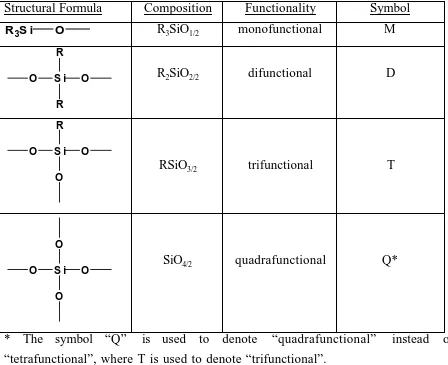
assemble polysiloxanes from four types of structural units, as described in Table 2.1.7
As a result, these materials form linear, branched, and cross-linked topologies. The
symbols M, D, T, and Q are used to represent Mono, Di, Tri, and Quaternary (tetra)
functional siloxane monomers and polymers. Use of this common nomenclature has
been applied even complex molecules. Examples of how this terminology is used are
H3C S i
Additionally, there is a well-established terminology to identify various siloxane
structures, depending on the type of substituent attached to the silicon atom. They
are D, which represents the dimethyl substituted structure, (CH3)2SiO; D′, which represents the methyl-phenyl, (C6H5)CH3SiO; D′′ for diphenyl, (C6H5)2SiO; and F, 1,1,1-trifluoropropy1, for (CF3CH2CH2)CH3SiO. This type of nomenclature is used widely, particularly in the patent literature.
Polysiloxanes are extremely flexible molecules due to the free rotation about
the Si-O and Si-C bonds, and poly(dimethylsiloxane) exhibited the most flexibility.
The Si-O-Si bond angle has been shown to vary greatly between compounds, and
varies as a function of measurement technique within the same compounds.5 A
generally accepted value for the Si-O-Si bond angle in poly(dimethylsiloxane) is
143°20 and the C-Si-C bond angle is 111°.10 The highly flexible nature of the
polysiloxane chain is due to exceptionally low rotational barriers of the bonds
Table 2.1: Structural Units of Polyorganosiloxanes7
Structural Formula Composition Functionality Symbol
R3S i O R3SiO1/2 monofunctional M
O S i R
O
R
R2SiO2/2 difunctional D
O S i R
O O
RSiO3/2 trifunctional T
O S i O
O
O SiO4/2 quadrafunctional Q*
* The symbol “Q” is used to denote “quadrafunctional” instead of
motion results in greater intermolecular distances and lower intermolecular forces,
resulting in an extremely low glass transition temperature of -123°C and a large molar
volume of 75.5 cm3/mole.22 It also results in low surface tension and low viscosity. Weak intermolecular forces also explain the low dielectric constant and low
temperature coefficient of viscosity.21 Poly(dimethylsiloxane)s are also transparent
to visible and UV light, very resistant to ozone and corona discharge7,13 and stable
against atomic oxygen23 and oxygen plasma.24 Moreover, these properties are
virtually unaffected by temperature. Other important properties include high gas
permeability, hydrophobicity, and chemical and physiological inertness.7
The Si-O bond is one of the most thermally stable bonds formed by silicon
with a bond dissociation energy of 110 kcal/mole as compared with 85.5 kcal/mole
for C-O, 82.6 kcal/mole for C-C, and 76 kcal/mole for Si-C bonds.9 This thermal
stability is partially due to the high bond strength. In addition, the Si-O bond length
(1.64,Å)2,10,13, which is significantly less than the value calculated from additivity of
atomic radii (1.17Å for silicon and 0.66Å for oxygen yields a theoretical value of
1.83Å).9 This supports the theory of pπ - dπ bonding between silicon and oxygen as previously described. The high strength exhibited by the Si-O bond accounts for the
high thermal and oxidative stability of these materials and is a result of the partial
ionic character of the Si-O bond.
Early studies indicated that the Si-O bond was approximately 50% ionic in
character as calculated from Pauling's electronegativity, using silicon as the positive
member.7 Later, Hannay25 and Pauling26 revised this value to approximately 40%
ionic character. These materials are resistant to homolytic cleavage. However, due to
the ionic nature of the bond, they are very susceptible to attack by polar compounds,
such as strong acids or bases. While this is a disadvantage in the final polymers, this
weakness is exploited in their synthesis. The cleavage by acids and bases is in
contrast to the Si-C bond (in the pendant or end groups attached to the Si-O
remains intact during polymerization. If the pendant group is strongly
electronegative however (i.e. CH2Cl, CF3, CN), the Si-C bond becomes more polar and can be cleaved by bases. Aromatic pendant groups cause the Si-C bond to be
more susceptible to acid attack.5
The thermal stability of poly(dimethylsiloxane) homopolymer is considered to
be in the range of 350-400°C in an inert atmosphere and 400°C in the presence of
air. The large difference in stability is due to the different degradation mechanisms
that occur in the presence and absence of an oxidizing environment. In the absence
of air, the degradation occurs due to redistribution of the siloxane bonds resulting in
the formation of low molecular weight cyclics. In the presence of air, oxidation of
the C-H bonds occurs at high temperature, which weakens the Si-C bonds, and
causes intermolecular cross-linking and other degradative processes.9
As previously mentioned, certain physical properties of polysiloxanes, unlike
other polymers, are virtually unaffected by temperature. This is especially true in the
case of poly(dimethylsiloxane), possibly due to weak intermolecular forces. Polymers
whose properties are a result of strong intermolecular forces, e.g. hydrogen bonding,
maintain those properties until a temperature is gradually reached which disrupts
these forces. As soon as the polymer absorbs sufficient energy to overcome
intermolecular forces, the properties of the material change, usually with unwanted
results. Polyorganosiloxanes, with their low intermolecular forces, do not undergo a
large intermolecular disruption at somewhat elevated temperatures, and, hence, are
not very temperature dependent.
In addition to weak intermolecular forces, another point helps to explain the mild temperature dependency of polysiloxanes. The linear polymers are helical in
structure and it takes approximately six or seven siloxane units to form one 360°
rotation of the spiral. This has been explained due to weak dipole interactions5,20,
and also as a result of stereochemistry.27 Due to the large radius of the silicon atom
and the large Si-O-Si bond angle, the alkyl substituents on the silicon atom project
outward from the helix. This largely contributes to the non-polar and hydrophobic
resulting in an increase of intermolecular interactions, which would normally translate
into an increase in viscosity. In the present systems, however, the increase in
molecular entanglements compensates for the increased molecular movement which
occurs as the temperature is increased. As a result, the viscosity of polysiloxanes is
only slightly affected by temperature.
Polysiloxanes have a uniquely high viscosity index. This can be explained by
comparisons with a polymer in which the silicon is replaced with carbon. One
observes in a space model that is fairly rigid and cannot coil because of the small size
of the carbon atom as compared to the silicon. Therefore, the high viscosity index of
polysiloxanes (compared to ether or hydrocarbon analogs) is due to the large size of
the silicon atom. This permits a freedom of rotation not found in hydrocarbons or
molecules which contain only carbon, hydrogen, or oxygen.27
Surface activity is another property unique to polyorganosiloxanes. The
helical form of the poly(dimethylsiloxane) chain results in the alkyl group facing
outward from the helix, and cosequently, the methyl groups have a tendency to
orient toward the air or vacuum surface. This results in surface tensions of 15 dyn/cm
(for hexamethyldisiloxane) to 22 dyn/cm (for higher molecular weight silicone oils).7
As a result of its extraordinarily low surface energy, the siloxane component of a
phase separated siloxane-containing copolymer or polymer blend migrates to the
air/polymer interface, resulting in a siloxane rich surface. The extent of migration is
dependent on whether the phase separated material is a blend or copolymer. A
copolymer, in which the polysiloxane segments are covalently bonded to the bulk material would permit less movement and hence less migration. Additionally, within a
series of copolymers, the molecular weight of the siloxane oligomer would also be a
factor because the middle of a lower molecular weight segment would be more
restricted in motion than the middle of a much longer segment, resulting in less net
migration in the lower molecular weight siloxane containing copolymer. These
features of siloxane copolymers have been tailored and exploited in a large number
of applications which require physiological inertness and atomic oxygen
As was mentioned previously, poly(dimethylsiloxane) is the most important of
the commercial polyorganosiloxanes. However, replacing the pendant methyl
groups with various substituents is possible. When this occurs, many properties are
usually affected, the extent of which is dependent on the type of substituent. In this
manner, the properties of a polysiloxane can be tailored to meet specific needs simply
by changing the substituent attached to the silicon atom. This is not difficult, and it
is what has made polyorganosiloxanes attractive and versatile. A few of the more
important examples are discussed below.
Replacing the methyl groups with longer chain alkyl groups results in better
lubricating properties and better compatibility with organic compounds.30 Since
C-C bonds are not as thermally or oxidatively stable as C-C-Si bonds, pendant alkyl
chains decrease thermal performance. Additionally, surface tension increases and
release performance decreases.
Replacing methyl groups with phenyl substituents improves the thermal and
oxidative stability when compared to poly(dimethylsiloxane). This occurs because
of the inherent stability of the phenyl ring and also because the phenyl group
strengthens the siloxane bond by increasing dπ-pπ contribution.7
Adding a small percentage of diphenyl or phenyl-methyl substituents to
poly(dimethylsiloxane) disrupts the symmetry, and hence low temperature
crystallizability of the methyl sequences. The net result is better flexibility at low
temperatures. High concentrations of phenyl groups (e.g. >50 mole%), however,
result in crystallization of phenyl sequences. Poly(diphenylsiloxane) has a much
higher glass transition temperature and viscosity than PDMS, due to the limited
mobility of the bulky phenyl groups. This polymer also has a higher solubility
parameter due to enhanced intermolecular interactions. The solubility parameters of
dimethyl, methyl-phenyl, and diphenyl substituted slioxanes are 7.5, 9.0, and 9.5
(cal/cm3) 0.5
respectively.21,31 As expected, the miscibility of polyorganosiloxanes
with organic polymers increases with increasing solubility parameter. By increasing
the polarity of the pendant substituents, one can also increase the solubility
achieved by using substituents such as trifluoropropylmethyl. However, due to the
polar and aliphatic nature of the substituent, the thermal and oxidative stability is
sacrificed.32 The presence of these substituents also results in an increase in glass
transition temperature as well as viscosity. By substituting a methyl substituent with
a methylvinyl group, a cross-linking site is introduced. The resulting siloxane
elastomers are then reinforced using fillers such as fume silicas.
Another important modification of polysiloxanes involves the incorporation of
a functional group,either along the backbone, or particularly at the chain end. A
functional terminal unit allows the polysiloxane to become a reactive intermediate,
and thus be incorporated into a wide range of siloxane-organic copolymers. This
discussion has attempted to demonstrate the great versatility of polyorganosiloxanes
and has been intended to provide an understanding of hybrid siloxane-organic
copolymers are of great interest
4. Synthesis of Polyorganosiloxanes
Polyorganosiloxanes are synthesized commercially by the hydrolysis and
subsequent condensation of organohalosilanes or by the acid- or base- catalyzed
ring opening polymerization of cyclic siloxane monomers. Molecular weight is
controlled by introducing a monofunctional component or chain transfer agent.
Other methods of synthesizing polysiloxanes include the living “promoted” anionic
polymerization of hexamethylcyclotrisiloxane (D3) employing an alkyl lithium as the initiator. The following discussion will include the synthesis of monomers and
polymers as well as a comparison of the living anionic and equilibration processes.
a) Monomer Synthesis
The first step in the synthesis of the monomers involves the "direct process”
first discovered by Rochow11,12 variations of which are now used throughout the
industry worldwide. This step is the preparation of methylchlorosilanes or
phenychlorosilanes. The process involves the exothermic reaction of an organic
halide (i.e. methylchloride) with elementary silicon in the presence of a copper
catalyst. The reaction scheme for the preparation of dimethyldichlorosilane is shown
2 CH3Cl + Si 250-300°C C l2S i ( C H3)2 + hea Cu
Dimethyldichlorosilane is not the only product. In fact, as expected, a mixture of
substituted silanes results. The side reactions which occur are described
elsewhere.11 The desired product is isolated via fractional distillation, in yields
greater than 8O%.5 The mechanism for this reaction is quite complicated, but it is
believed that heterogeneous reactions involving the halide, silicon, and catalyst (if
present) take place at the silicon surface to produce the various organosilicon
halides. The course of the primary reaction is dependent on temperature, time of
contact with the silicon, the type of catalyst used, and the manner in .which the
catalyst associates with the silicon.11 If the temperature is kept as low as possible
the major product is R2SiX2. As the temperature is increased, the rate of reaction also increases, but the chance of pyrolysis of free radicals also increases and mixtures of
products becomes richer in halogen and lower in organic groups.11
The role of the catalyst in this synthesis is equally obscure. Hurd and
Rochow33 postulated that the mechanism involves the initial formation of activated
silicon nuclei which are then subject to alkylation or further halogenation. The chief
function of the metal catalyst is believed to make the halogen of the organic halide
readily available for reaction with (and activation of) the silicon and, secondarily, to
make the organic group more labile by transporting and effectively prolonging the
life of free radicals in the form of metal alkyls. The mechanism proposed by Hurd and
Rochow33 reveals that the catalyst accelerates the over-all reaction rate to such an
extent that the reaction can be carried out at a lower temperature than would be
required in the absence of catalyst. This results in a faster reaction rate with less
pyrolysis and a higher percent yield. In the absence of catalyst, the initial activity is
poor and declines rapidiy, producing as major products methyltrichlorosilane and
While copper is the best catalyst for the preparation of alkylsilicon halides,
diphenyldichlorosilane is reportedly synthesized by reacting chlorobenzene with
metallic silicon at 550°C in the presence of a silver catalyst. Yields are approximately
50% possibly due to steric effects. By varying the reaction conditions, such as
temperature and catalyst, the composition of the crude product can be modified.7,11
While early researchers believed that the direct process proceeded via free
radical mechanisms33, more recent suggestions involve chemisorption, polarization
and charge transfer phenomena.5,7
The organochlorosilanes just described undergo hydrolysis followed by
self-condensation to produce a mixture of linear diols and cyclics of various sizes. The
hydrolysis and subsequent condensation reactions of dimethyldichlorosilane are
shown in Scheme 2.2. The ratio of cyclic to linear products can be controlled
somewhat by varying the reaction conditions.7 Conducting the hydrolysis in the
presence of a water-insoluble, non-polar solvent, produces the desired cyclics in as
high as 90% yield. This is because the non-polar, organic solvent solubilizes the
organohalosilanes and the polyorganosilanes, which lowers their concentration in
the aqueous phase. Therefore, intramolecular condensation predominates over
2 Cu + CH
3Cl
250°C
CuCl + CuCH
3Si + CuCl
Cu + (SiCl)
xactive intermediate
(SiCl)
x+ CH
3(CH
3SiCl)
x(1)
(2)
(3)
(*)
(*)
(SiCl)
x+ CuCH
3(CH
3SiCl)
x+ Cu
(SiCl)
x+ CuCl
(SiCl
2)
x+ Cu
Other possibleReactions
The reaction continues to form SiCl
4C l S i C H3
C l
C H3
+ 2 H2O
H O S i C H3
O H
C H3
+ 2HCl
- H2O
H O S i C H3
C H3
O S i C H3
C H3
O H + S i
C H3
C H3 O
x y
y = 3-11
Mn≈ 1-3000 g/mole
Scheme 2.3: Hydrolysis and Condensation of Dimethyldichlorosilane2
The preparation of controlled molecular weight functional polysiloxane
oligomers by equilibration processes often requires the use of a functional
endblocker, which acts as a chain transfer agent. Functionally terminated siloxane
oligomers can be classified into two groups. The first group consists of oligomers in
which the functional unit is bonded directly to the silicon (Si-X). The second group
consists of oligomers in which the functional group is attached to an alkyl or
aromatic group which is then bonded to the silicon (Si-R-X).2 The Si-X type of
functionality is used in silicone rubber technology, and was the first example of
functionally terminated siloxanes. The literature contains many discussions
regarding these types of materials.7,14,17,31 Important functionalities in this group
include chloro, hydroxyl, methoxy, ethoxy, hvdrogen, amine, dimethyl amine, and
vinyl. The Si-X functionality is much more reactive toward nucleophilic reagents
compared to their C-X counterparts. This is due to the difference in
electronegativities of silicon (1.8) and carbon (2.5)9. The Si-X bond is much more
polar than the C-X bond. Therefore, the silicon halides are much more reactive
toward nucleophilic reagents than halocarbons.2 These materials are used in RTV
silicone rubber and adhesives.2,7,34
Upon incorporation of Si-X functionalities into copolymers, an Si-O-C link is
formed, which is susceptible to hydrolysis.1,35 Although the Si-O-C link is not as
susceptible to hydrolysis in polymers as it is in small molecules, it is still often
undesirable and it becomes necessary to replace this with another, more stable
linkage. The Si-R-X functional oligomers eliminate this problem. Also, by choosing
the appropriate R group, the miscibility of the siloxane oligomer and organic
monomers can be enhanced,2 increasing the ease of copolymerization. These
carbofunctional siloxanes have a longer shelf-life since they do not undergo
hydrolysis. α,ω-Organofunctionally terminated disiloxanes are the key starting materials in the preparation of functionally terminated siloxane oligomers via
equilibration reactions. Some functional groups include hydroxyl, 1° and 2° amino,
Aliphatic primary and secondary amine terminated poly(dimethylsiloxane)
oligomers were used in this research. The synthesis of
1,3-bis(3-aminopropyl)tetramethyldisiloxane (primary aminoalkyl disiloxane) is discussed here.
One synthetic route for the preparation of this material was reported by Saam and
Speier.36, while further work in this area has been conducted by our research group
more recently. Their method involves hydrosilation and is shown in Scheme 2.4. It
involves the protection of the alkyl-protected amine37 to allow a clean hydrosilation
with tetramethyldisiloxane before conversion to a free amine. The coupling step
involves addition of the Si-H bond to the CH2=CH double bond. Here, silicon can add to either the CH2 or CH carbon. Steric considerations suggest that the major attack would be on the CH2 carbon. and indeed this is the case (abnormal addition). The product does contain a small amount of the isopropyl moiety, however. This
results in a decrease in the thermal and oxidative stability of this endblocker. The
mechanism of hydrosilation reactions is not very clear, but it is known that catalyst
type and concentration, structure of the olefinic compound, reaction temperature,
and solvent all play key roles.38
b) Synthesis of Polysiloxane Oligomers
As previously described, polysiloxane oligomers can be synthesized via
various routes. They include living anionic polymerization, acid-catalyzed
equilibration and base-catalyzed equilibration. In this research, base-catalyzcd
equilibration was used to generate primary and secondary aminoalkyl terminated
poly(dimethylsiloxanes. The discussion will focus on anionic and base catalyzed
synthetic methods.
i) Living Anionic Polymerization of Polyorganosiloxanes
Early work on the use of organolithium compounds as initiators for the
polymerization of hexamethylcyclotrisilioxane (D3) was reported by Bostick39 and
CH2 CH CH2 NH2 + H N
Si(CH3)3
Si(CH3)3
2
CH2 CH CH2 N
2
H
H2C CH CH2 NH2 H N
controlled molecular weights and narrow molecular weight distributions, in
accordance with living polymerization.41 It is possible to polymerize D3 in this fashion due to its high ring-strain. D4 can also be polymerized by this method, but narrow molecular weight distributions and controlled molecular weights are not
possible. Unlike D4, D3 is planar42, its Si-O-Si bond angle is 136° its O-Si-O bond
angle is 104° 20, abnormally low, compared to the non-planar, unstrained D4 molecule. This ring strain in D3 results in an exothermic ∆H which permits exclusion of redistribution processes and ring-forming side reactions other than the desired
ring-opening chain propagation process. Specifically, it was reported33 that the use
of sufficiently weak- bases in hydrocarbon solvents would result in the selective
polymerization of strained systems such as D3. In this case, polymerization of D3 does not proceed except in the presence of a “moderate” Lewis base promoter such as
tetrahydrofuran. It is possible to terminate these reactions to introduce a reactive
end group into the polymer chains. This is an excellent method for the preparation of
macromonomers.43 The literature contains many excellent references regarding the
living anionic polymerization of cyclosiloxanes.44-50
ii) Equilibration Polymerization of Polyorganosiloxanes
There are two general methods used for the equilibration polymerization of
polyorganosiloxanes. They are catalysts with acids51-54 or with strong bases.55
The molecular weight and functionality of the resulting oligomers can be controlled
by the addition of specified amounts of linear disiloxane endblocker.7,21,51,56 This
equilibration reaction is an important commercial process. The general scheme for the
polymerization of D4 in the presence of an endblocker (MM) is shown in Scheme 2.5. Equilibration (or redistribution) of siloxanes is the process where Si-O bonds
in a mixture of siloxanes (both cyclic and linear) are continuously broken and
reformed, in the presence of a catalyst, until the system reaches its thermodynamically
most stable equilibrium state. Because of the random nature of the equilibration
process, the molecular weight distribution of the linear species is Gaussian at
polymers and about 10- 15 weight percent cyclics. The equilibrium concentration of
cyclic species increases as a function of molecular weight of the linear chains. The
distribution of the rings decreases as ring size increases. The equilibrium weight
fraction of rings increases with the polarity of the alkyl substituent bonded to the
silicon.57 In addition, the equilibrium concentration of small, unstrained rings
increases with the size of the substituent:58
H < CH3 < CH3CH2 < CH3CH2CH2 < CF3CH2CH2
and the equilibrium concentration for larger cyclics decreases with increase in
substituent size. This can be explained using steric arguments. Small rings can adopt
many conformations which would keep the molecule free from steric, or strained,
interactions. The larger the substituent, the less amount of strain-free conformations
become available to the cyclic, so more linear chains are formed.58 By increasing the
pressure of the reaction, the equilibrium concentration of cyclics decreases. A more
detailed review of equilibration reactions of cyclosiloxanes has been published by
Wright.59 The redistribution reactions are shown in Scheme 2.656. Reactions (1)
and (2) result in an increase in the number average molecular weight of the system,
while reactions (3) and (4) affect only the higher moment molecular weight averages
and are responsible for the attainment of the final equilibrium.56,59 The position of
equilibrium is independent of the type of catalyst and is instead determined by the
nature of the substituents on the silicon atom, temperature, and extent of dilution
(bulk vs. solution polymerization).2,13,60 The type of catalyst, however, affects the
path by which final equilibrium is reached. Equilibrium concentrations of cyclics
increase with increasing size and polarity of the substituent on the silicon atom. The
change in enthalpy of the ring opening of D4 is approximately zero, and the process is believed to be entropically driven. The positive change in entropy can be
explained bv the high degree of flexibility of the linear poly(dimethylsiloxane)
R S i
Dx + D4 Dx + 4
k1
Dx
k2
+ MM MDxM
MDxM + M M Dx-zM + MDzM
MDyM
MDxM MDx+wM MDy-wM
( 1 )
( 4 ) ( 3 ) ( 2 )
k3
k4
The theory of equilibrium molecular weight distribution in linear
polycondensation systems, including the equilibration of cyclics, was first described
by Jacobson and Stockmayer.60 They showed that the percent of rings increased
with dilution and that a critical dilution existed above which it was possible to obtain
a 100% yield of rings. Brown and Slusarczuk 63experimentally verified this theory
for large rings, using GPC to measure the concentrations of macrocyclic
dimethylsiloxanes (D15 to D200) in equilibrium with linear poly(dimethylslloxane). This theory was revised by Flory and Semlyen in order to account for the formation
of small unstrained rings (D4 and D5) which were present in large excess of predictions. They took into account the relative orientation of the terminal bonds of
a short chain when these bonds are forced into close proximity. Here, the proximity
of the termini would be conducive to ring formation, rather than uncorrelated as
predicted by theory. This consideration accounts for high concentrations of the
cyclic tetramer. Other studies concerning dilution, solvent effects, and siloxane chain
conformation on cyclization equilibrium constants have been reported.64-66
As previously described, the nature of the Si-O bond is partially ionic, and this
permits the synthesis to proceed in the presence of either an acid or basic catalyst.
The choice of catalyst is dependent on the nature of the endgroups on the
endblocker and the types of substituents present on the silicon.57 An acid catalyst
is required when the functional groups are susceptible to attack by base, and a basic
catalyst is required when the functional groups are susceptible to attack by acid.
Many studies have been presented regarding the acid catalyzed
polymerization of cyclosiloxanes.67-76 This method will be discussed only briefly,
since the polysiloxanes in this research were synthesized using a basic catalyst.
Base-Catalyzed Polymerization of Polyorganosiloxanes
The base-catalyzed ring opening-polymerization of cyclosiloxanes has been
extensively studied.7,13,77-79 It has been well established that the active agent is
the oxygen atom, or ionic form derived from it, which acts as an electron donor to
exchange mechanism. This proceeds by the attack of a base on a silicon atom with
displacement of a siloxanyl bond.80,81 The mechanism is shown below:56
S i O S i S i B O S i
B _
+ _
The most widely used basic catalysts are hydroxides, phenolates and slioxanolates of
the alkali metals and quaternary ammonium and phosphonium bases and their
siloxanolates. The activity of the alkali metal hydroxides and siloxanolates decrease
in the following order:2
Cs > Rb > K > Li
This trend indicates a decrease in tendency for ionic aggregation with a
corresponding increase in the nucleophilicity of the silanolate terminal. The activity
of the tetramethylammonium and tetrabutylphosphonium siloxanolates are close to
the cesium siloxanolates.81 Rates of the various processes depend on the catalyst
type, concentration, temperature, and nature of the substituent attached to the silicon
atom. Electron acceptor substituents increase the effective positive charge on the
silicon atom, facilitating nucleophilic attack by base.
The alkali metal hydroxides (such as KOH) and their siloxanolates can
withstand higher reaction temperatures (>140°C) than the quaternary bases, but then
must be completely removed or deactivated to prevent depolymerization or
degradation in the final polymer product, should it be exposed to higher
temperatures.
Instead of using a catalyst which requires neutralization or deactivation of the
final product, thermally labile catalysts can be utilized.82-84 These are the
quaternary ammonium and phosphonium bases which are termed "transient" due to
their thermal instability. They decompose rapidly above 130°C and the products of
siloxanolate decomposes to methanol or methoxysilane and trimethylamine, which
will not catalyze siloxane equilibration reactions. Therefore, no danger exists for
degradation of the polysiloxane due to residual catalyst at high temperatures. A
disadvantage of this catalyst is the residual amine odor which is almost impossible to
completely remove.
The phosphonium bases thermally decompose to form phosphine oxides and
hydrocarbons.83 These decomposition products are also ineffective towards
decomposition or redistribution of the final polymers.
Early kinetic studies on the base-catalyzed ring opening polymerization of
cyclosiloxanes determined that the order of reactivity towards the basic catalysts
discussed is:56
D3 > D4 > MD2M > MDM > MM
The greater reactivity of the D dominated compounds is due to electron withdrawal
from silicon by two adjacent oxygens rather than one (as is the case for MM)85,
resulting in an increased partial positive charge on the silicon atom. This agrees with
the mechanism proposed by Hurd, et al.81, which involves the attack of the basic
catalyst at the silicon atom. Because the cyclic monomer is much more reactive than
the functional endblocker, during the course of the reaction, the molecular weight
builds up rapidly, resulting in a viscosity maximum (in Scheme 2.6, kl >> ki). As the less reactive endblocker is then incorporated during the equilibration process, the
molecular weight, and hence viscosity, decreases.51,56
The various siloxanolate catalysts incorporate D4 and the aminopropyldisiloxane endblocker at different relative rates, although in each case,
D4 is incorporated faster. The rate of the incorporation by the catalyst of D4 and
endblocker increases in the following order:62
S i O +K < S i O +N ( C H3)4 < S i O +P(C4H9)4
Although all three incorporate D4 efficiently, a large difference exists in the rate of incorporation of the disiloxane. This order of reactivity follows the orde of
the concentration of active catalyst. In addition to ion dissociation, the more organic
tetramethylammonium and tetrabutylphosphonium catalysts would be more soluble
than the potassium ion. This would also result in a higher concentration of active
catalyst and therefore, a faster rate of polymerization.
B. POLYESTERS
1. Introduction
Polyesters are one of the most versatile synthetic polymers. They are widely
used commercially as fibers, plastics, and coatings.86-88 They are heterochain
macromolecules that possess carboxylate ester groups as integral components of
their polymer backbones. They differ from other ester-containing polymers (such as
polyacrylates and cellulose esters) in that the ester functionality is part of the
backbone and not a pendant group.
Polyesters have recieved a great deal of attention since the early work of
Carothers, who initiated study on many step-growth polymerizations.89 His work
involved A-B ω-hydroxy-acids, the polymerization of certain lactones, and the esterification of A-A linear diols with B-B terminal aliphatic dicarboxylic acids. The
resulting polymers were of low molecular weight (8,000-10,000 g/mol) hard,
crystalline solids, and susceptible to conversion from the molten (or dissolved) state
to filaments which could be stretched below their melting point with an ultimate
increase in strength. Carothers worked with aliphatic straight-chain polyesters,
which were soluble in organic liquids, low melting and had poor resistance to
hydrolysis, polyesters were not used as textile fibers.87 The extension of these
concepts later led to the discovery of nylon-6,6 in 1935 and Whinfield and Dickson's
development of poly(ethylene terephthalate) (PET) in 1941.90 A partially aromatic
organic structure was necessary to increase Tm above 250°C.
A large number of polyester structures have found use in industry today
which display a wide variety of properties and applications. The synthesis of all
2. Properties and Applications of Aliphatic and Cycloaliphatic Polyesters
The properties of polyesters in general, as in many polymers, are determined by
the geometry, symmetry, polarity, and segmental mobility of the chain structures.
Their intermolecular reactions are relatively weak and their properties are therefore
more sensitive to molecular geometry than more polar materials such as polyamides,
and hence, have a wider use range.3
Aliphatic and cycloaliphatic polyesters are substantially resistant to oxidation
by air or ozone under normal conditions, but are degraded rapidly by ammonia,
hydrazine, warm alkali solutions and primary or secondary amines, which cleave the
ester linkage forming hydroxyl groups and the salt or amide derivatives of the
carboxyl functionality. Cycloaliphatic based polyesters contain two tertiary protons
per repeat unit, which adds to the molecule's thermal instability. These materials are
light stable and hydrophobic in nature and this provides extra resistance to chemical
attack by aqueous based reagents. Hydrolysis can occur at elevated temperatures or
by steam.3,46
The melting points of linear aliphatic polyesters increase with increased
methylene/carboxylate ester group ratio in the repeat unit. In addition, polyesters
with an even number of methylene groups are consistently higher melting than those
containing an odd number of methylene groups.91 These materials are capable of
forming fibers at degrees of polymerization of about 40. Aliphatic polyesters do not
absorb in the visible or normal-range UV spectral regions, but they do absorb in the
infrared.
The properties of ring containing polyesters are dependent on the
conformation, symmetry and structure of the cyclic unit. Typically, a ring-containing
polyester composed of predominately cyclic component (whether it be aromatic,
alicyclic, or heterocyclic), then the polyester, if it contains semi-crystalline regions,
will have a melting temperature considerably higher than those of the acyclic
polyesters. This trend is also reflected in the glass transition temperature, which is
higher restriction of chain motion in the ring as compared to the acyclic
counterparts.3
With the introduction of a cycloaliphatic moiety into the unit, the ratio of cis
to trans isomers becomes an important factor and can greatly affect the ultimate
polymer properties. Polyesters with a high trans content are usually semi-crystalline,
while those with a high cis content are amorphous, or have a much lower Tm. For example, poly(1,4 cyclohexanedimethylene propylene dicarboxylate) containing the
all trans isomer has a melting temperature of 50°C, while the all cis derivative is
amorphous. Poly(1,4-cyclohexanedimethylene butylene dicarboxylate) synthesized
from the all trans isomer has a melting temperature of 124°C while the cis derivative
has a Tm of 55°C.3
Aliphatic or cycloallphatic polyesters are used in applications which require
UV resistance since the aromatic polyesters absorb strongly in the UV region
resulting in chain scission and subsequent degradation. Because of their
combination of low melting points, solubility, and limited hydrolytic stability, most
acyclic polyesters are not used as structural materials. Their low glass transition
temperatures enable them to be used as plasticizers and as components in
polyurethanes.
Some alicyclic containing polyesters are used commercially as fibers. For
example, poly(cyclohexane-1,4-dimethylterephthalate) containing about 70% of the
alicyclic rings in the trans configuration was commercially introduced in 1955 as
Kodel® by the Eastman Kodak Company.86 In fact, most aliphatic polyesters are
utilized as one part of a copolyester block copolymer or blend, and these applications
will be discussed in greater detail in a later section. More extensive discussions of
the properties and applications of linear acyclic polyesters are found in various
books and reviews.3,86-88
3. Synthesis of Polyesters
Polyesters have traditionally been categorized as step or condensation
polymers (along with polyamides, polyureas, and others) because of the loss of water
addition polymers. However, polyesterification, involves several equilibration steps,
which markedly distinguishes them from both classes of polymers. The products of
polyester synthesis from difunctional monomers are linear species as well as cyclics.
A number of synthetic approaches exist for the preparation of
polyesters.86-88,91 These include direct esterification, transesterification (ester interchange), and the reaction of alcohols with diacid chlorides. The general reaction of each of the
three methods is illustrated in Scheme 2.7. Each method involves nucleophilic
addition to the carbonyl group, which is facilitated by the polar nature of the
carbon-oxygen bond and the ability of the carbonyl carbon-oxygen to assume a formal negative
charge. Each step of the nucleophilic addition is reversible, except in the case of the
reaction involving the diacid chloride. Here, the by-product (HCl) is less nucleophilic
than the alcohol and is typically removed as the reaction proceeds.
Direct esterification and transesterification are slow equilibrium processes.
Catalysts are generally required to increase the rate of reaction. Both acidic and
basic catalysts can be used. Acidic catalysts include protonic acids, Lewis acids, and
titanium alkoxides. These acidic catalysts coordinate with the carbonyl oxygen,
rendering the carbonyl carbon more susceptible to nucleophilic attack. A general
R C O
O H R C
O
OR'
R C
O
OR" R C
O
OR'
R C
O
C l R C
O
OR'
+ R'OH H2O
Direct Esterification
Transesterification
R'OH + R"OH
Reaction of Alcohols with Acid Chlorides
+
R'OH + HCl
R C
Weakly basic catalysts convert the reacting hydroxyl group to the corresponding
(and more nucleophilic) alkoxide anion, which is then a more effective intermediate
for the interchange process. The three types of polyester synthesis are discussed in
greater detail below, along with the much less common addition polymerization of
cyclic esters.
a) Direct Esterification
Direct esterification is the reaction of a diol with a dicarboxylic acid (or cyclic
anhydride) or the self-condensation of a hydroxycarboxylic acid as shown in
Scheme 2.9. The by-product of direct esterification is water. Direct esterification is a
slow process. The carboxylic acid functional group provides protons to catalyze the
reaction, but since the concentration of carboxylic acid groups decreases as
conversion increases, it is often necessary to employ an additional catalyst. These
catalysts include protonic acids or Lewis acids, titanium alkoxides, and dialkyl-tin(IV)
oxides. Because this is an equilibrium process, water must be effectively removed in
order to push the equilibrium toward high molecular weight polvmer. To achieve
this, high temperatures are required. Therefore, a reaction temperature must be
chosen which strikes a balance between what is required for the reaction to proceed
as a homogeneous melt, and that which minimizes the risk of thermal degradation
over the required reaction time. The side reactions which can occur include readily
decarboxylated acids or isomerizable cis-substituted reactants which may be
transformed either partly or wholly to trans.
Achieving stoichiometric equivalence for the A-A / B-B systems is difficult
since the diol is usually quite volatile. Therefore, the diol is charged in excess with
b) Transesterification
Transesterification (also known as ester exchange or ester interchange)
involves a two-stage reaction of a dialkyl (i.e. dimethyl) ester (instead of a
dicarboxylic acid) with a diol in an ester interchange process and is generally carried
out in the presence of a proton donating or weakly basic catalyst. Such catalysts
include the carbonates, alkanoates, hydrides, or alkoxides of sodium, lithium, zinc,
calcium, magnesium, and bimetallic alkoxides such as NaHTi(OC4H9)6, MgTi(OC4H9)6, and CaTi(OC4H9)6. The by-product is an alcohol (i.e. methanol). This procedure is widely applicable for the formation of homo- and copolyesters of aliphatic or
alicyclic diols with aliphatic, alicyclic, aromatic, or heterocyclic dicarboxylic acids.
At the end of the first stage of the reaction, the major product is a
bis(hydroxyalkyl) ester and/or an oligomer thereof. In the second stage, the ester is
subjected to polycondensation by alcoholysis, forming the high molecular weight
polyester. In this stage the by-product is the diol for each step of chain growth. The
general reaction is illustrated in Scheme 2.10. The first stage is usualIy carried out at
150-200°C until the evolution of the alcohol is complete. The second stage is
usually carried out at 220-290°C under reduced pressure in order to facilitate
complete removal of the diol. The choice of the temperature of the second stage of
melt polymerizations is governed by the requirement that the polymer remain a
homogeneous melt. It must, therefore, be at least 20°C above the highest melting
temperature of the final product. Since each stage is an equilibrium process and
therefore reversible, the equilibrium can be forced to favor polymerization by
continuous removal of the alcohol and diol by-products. As in direct esterification,
1:1 stoichiometry is extremely difficult to insure due to the volatility of the diol as
well as the tendency of many of the diesters to sublime. The diol is charged in a 50
percent excess (by moles) with respect to the diester. This helps insure 1/1
stoichiometry in the end, but it also serves to drive the first stage of the reaction to
completion at a faster rate.
Another procedure, which avoids the high temperatures and long melt
Diol Reaction with Dicarboxylic Acid
H O C
O
R C
O
O H + n H O R' O H
C O
R C
O
R' O
n
+ 2n H2O
Self-Condensation of a Hydroxyacid
H O R C
O
O H
Catalyst
O R C
O
n
+ n H2O