The journal homepage www.jpacr.ub.ac.id p-ISSN : 2302 – 4690 | e-ISSN : 2541 – 0733
Synthesis and Characterization of Ni/Hydrotalcite and Its
Application in Hydrocracking
Calophyllum Inophyllum
Oil
Hafshah1, Achmad Roesyadi1, Danawati Hari Prajitno1,*
1
Department of Chemical Engineering, Faculty of Industrial Technology, Sepuluh Nopember Institute of Technology, Surabaya, Indonesia
*
Corresponding email : [*[email protected]]
Received 27 May 2016; Revised 23 November 2016; Accepted 6 December 2016
ABSTRACT
This research aims to synthesize hydrotalcite as an alternatives of catalyst support of hydrocracking of vegetable oils. Hydrotalcite can be synthesized in several ways, the most common is coprecipitation method. Hydrotalcite was synthesized using Mg/Al mole ratio of 1: 1, NaOH and Na2CO3 as base solutions. Ni/hydrotalcite catalyst was synthesized by incipicient wetness impregnation method with Ni impregnation of 10% w/w. The characterization of the crystal structure was determined by X-ray diffraction (XRD). The spesific surface area (SBET) was determined by adsorption-desorption of nitrogen, it were obtained 201 m2/g after impregnation and 191 m2/g before impregntion. The test of performance of catalyst was conducted by hydrocracking reaction of Calophyllum inophyllum oil. The liquid products were analyzed by gas chromatography mass spectrometry (GC-MS). Hydrocracking process produced gasoline, kerosene, gas oil with yield of 0.36%, 2.45%, 54.88% respectively, conversion of 96.26% and selectivity of gas oil of 84.39%.
Keywords: Ni/hydrotalcite, coprecipitation, hydrocracking, calophyllum inophyllum oil, biofuel
INTRODUCTION
The search and development of renewable energy become the main agenda in the Indonesia energy sector to achieve energy independence and sovereignity. The development and use of biofuels were the efforts made by government. Biofuel is an alternative renewable energy to substitute petroleum fuel. It can be obtained by hydrocracking vegetable oil into gasoline, kerosene, and diesel oil (gas oil). Cracking of vegetable oils has been done as the potential way to produce biofuel. Generally, triglycerides are composed of fatty chains of 16 to 24 carbon in length, which are ideal for the production of synthetic fuels and biochemical [1]. Calophyllum inophyllum oil as non edible oil is potensial source for biofuel because it has high rendemen oil of about 70 % [2]. Biofuel is obtained from the saturation reaction of triglycerides and termination of long-chain triglycerides into shorter chain with hydrogen and a catalyst. The reaction pathway includes the hydrogenation of the C=C bonds of the vegetable oils and oxygen removal to produce alkanes through three different pathways: decarbonylation,decarboxylation and hydrodeoxygenation [3].
it can be synthesized easily and is useful in various applications [4,5]. Catalyst selectivity is not only depend on the composition of the catalyst but also on the support of the catalyst and the dispersion of the metal on the support used. Metal catalyst was impregnated into the catalyst support to maximize the performance of the catalyst so that it has a high surface area and high catalytic activity. The catalyst with large surface area and high value of acidity showed activity of hydrocracking with a high conversion, and it affects to the distribution of the liquid product [4]
Hydrotalcite was classified into mineral layered double hydroxide. It has been known as one of the interest, prospective and promising minerals because it can be synthesized easily, and it useful in various applications [5][6]. Applications of hydrotalcite are very broad as catalysts, catalyst supports, adsorbents, anion scavengers, anion exchangers, polymer stabilizers, antacids and antipeptin. Hydrotalcite can be converted into mixed oxides through thermal decomposition which posses large surface area [7]. When the material hydrotalcite is calcinated, the molecules are decomposed and leave pores thereby it increases the surface area of the particles.
This work focuses on preparing hydotalcite by coprecipitation under low supersaturation. Low supersaturation co-precipitation is a common method used in the process of preparation of hydrotalcite because the growth of particles in this condition usually success. The process is performed by slow addition of mixed salt metals solution into aqueous solution of desired interlayer anion at constant pH. In previous research [17] on hydrocracking calophyllum inophyllumoil reported that at a concentration of 10% CoMo/γAl2O3 the conversion and yield higher than most other concentration. The impregnation of 10% nikel on hydrotalcite catalyst support is expected to increase the surface area and catalytic activity so that the conversion and yield of the reaction hydrocraking also increase.
EXPERIMENT
Chemicals and instrumentation Chemicals
Magnesium Hexahydrate (Mg(NO3)2.6H2O) (Merck), Aluminium Nonahydrate (Al(NO3)3.9H2O) (Merck), Natrium hydroxide (NaOH), Natrium Carbonate (Na2CO3), Ni(NO3)2.6H2O (Merck 98%) as Ni precursors.
Instrumentation
The surface area (SBET) calculated by Brunauer Emmett Teller (BET) on Quantachrome NovaWin Version 10.0 based on the adsorption data with partial pressure (P/Po) range 0.097183 - 0.30026, through recording process of isoterm BET on 5 Points. Total pore volumes calculated from the amount of nitrogen adsorbed at P/Po=0.99789
Functional groups of catalysts were investigated by Thermoscientific Nicolet IS10 FTIR Spektrometer. X-Ray diffraction (XRD) patterns were obtained in the 2θ range = 5-90° using
PANanalytical X’Pert PRO X-ray Diffractometer operating at 40 kV and 30mA with CuKα radiation source and
Procedure reaction
Preparation Of Hydrotalcite
Ni/hydrotalcite was synthesized by co-precipitation method at constant temperature and pH. It was prepared by slow co-addition of metal solution (Mg(NO3)2.6H2O and Al(NO3)3.9H2O) and NaOH into Na2CO3 solution under vigorous stirring. After 5 hours, the suspension was filtered and washed with aquades until pH 7. Hydrotalcite was dried at 110°C for 12 hours. Solid of hydrotalcite was calcinated for 6 hours at 600°C,
Impregnation of Nickel
Solid hydrotalcite was impregnated with solution of Ni(NO3)2.6H2O (10%). Ni/hydrotalcite dried in the oven at 110°C for 12 hours, and then continued with calcination for 3 hours at 400°C and reduction for 2 hours at 450°C under hydrogen atmosphere.
Catalyst Application
Catalyst performance test was conducted in a Parr USA pressure reactor equipped with mechanical stirrer at 350°C under 20 bar. The catalyst of 5 gram and Calophyllum inophyllum oil of 200 ml was poured into reactor, then it was purged with nitrogen. Reaction was took place for 2 hours in presence of hydrogen.
RESULT AND DISCUSSION Catalyst Characterization
FTIR spectra for Ni/hydrotalcite are shown in Fig.1. The absorption bands 548, 1354 and 3419 cm-1 which is the main character of hydrotalcite looks quite strong. It shows that hydrotalcite is already formed. Davydov [8] reported that the presence of stretch vibration of Al-O and Mg-O present in the region of 500-600 cm-1. From the analysis of absorption band at 3 samples of hydrotalcite component before calcination, after calcination and after impregnation, there are a number of material changes of hydotalcite when the calcination was processed. The first change is increasingly weak absorption bands at 548, 655.769 and 966 cm-1 and the spectrum for uncalcined hydrotalcite. It shows a large band at 3300-3400 cm-1 and 1300 cm-1 indicates vibration OH group and CO32- respectively. These bands disappear when catalyst is calcinated at 600°C, the loss of water and carbonate ionic during calcination process is a mechanism of loss during thermal decomposition of the hydrotalcite.
Figure 1. IR Spectra of hydrotalcite (right) :
The addition of nickel metal causes two absorption bands at 1900 and 2042 cm-1. This fits with previous research conducted by Mette [9] who reported that the main contribution of metallic Ni was between 2100 and 1800 cm-1.
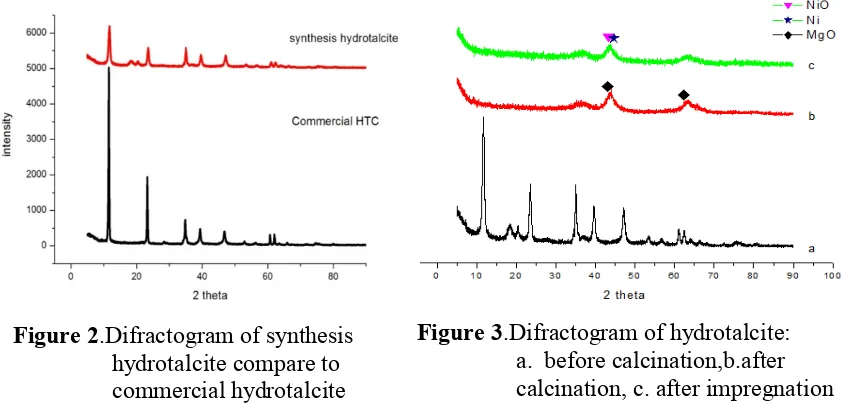
Hydrotalcite synthesis show a high match with difractogram of commercial hydrotalcite as shown in Fig.2. It can be concluded that the hydrotalcite synthesis was successful, because of high compatibility of hydrotalcite synthesis and commercial hydrotalcite.
XRD patterns of uncalcined, calcined, and Ni impregnated hydrotalcite are shown in Fig.3. Uncalcined hydrotalcite has seven high peaks located at 2θ: 11.74°; 23.55°; 35.07°; 39.59°; 47.11°; 60.99° and 62.50°. A typical hydrotalcite structure is often very poorly
crystallized. Difraction shows a broad and low intensity line at high value of 2θ, a sharp and
high intensity line at low value of the 2θ [10]. The intense peaks at 11.74°, 23.55° and 34.59° are characteristic of a layered structure and correspond to the 003,006 and 009 reflections respectively. As reported by Heraldy [11] the most intense peak at 2θ of 11.4°-11.7°(d003); 23.0-23.6°(d006); 34.9°-35.1°(d009) and 61.0°- 62.0° indicates that the interlayer of hydrotalcite are carbonate anion. After hydrotalcite was calcinated and nikel was impregnated, it has 3 main peaks at 43,26°, 43,93° dan 62,93°. Meira [12] found the same peak that correspond to MgO (Magnesium Oxide). Comelli [13] reported that hydrotalcite is calcined at 600°C a form of magnesium oxide is observed, as shown at Fig.3.
The physical and chemical properties of catalyst Ni/hydrotalcite was summarized in Table.1
Table 1. Component, SBET and Total pore volume of the Ni/hydrotalcite sample
Sample Nia (%) Ratio Mg/Al
SBETb (m2/g)
Total pore volumeb (cm3/g)
Hydrotalcite - 1:1 190.166 -
Ni/Hydrotalcite 7.56 1:1 201.340 0.7714
a
The elemental composition was determined by AAS
Figure 3.Difractogram of hydrotalcite: a. before calcination,b.after calcination, c. after impregnation
The AAS result show the actual content of active metal nickel 7.56% is smaller than nominal content of 10%. Because the dispersion of nikel on hydrotalcite support during process of impregnation was not spread evenly. SBET and total pore volume of the Ni/hydrotalcite sample are 201.340 m2/g and 0.7714 cm3/g respectively. Before Ni impregnated, hydrotalcite has surface area as catalyst support material of 190,166 m2/g.
After impregnation 10% of Ni and reduced for 3 hours with H2 at temperature of 450°C, the surface area of the catalyst to increase to 201.340 (m2/g). It’s indicating the reconstruction of the surface of the catalyst. According to Song, 2014 [14] the salt of nickel decomposed when the reduction take place, resulting a larger surface area of the hydrotalcite before impregnated. This result is similar to Qi [7] that impregnation of Ni can increase the surface area of the catalyst.
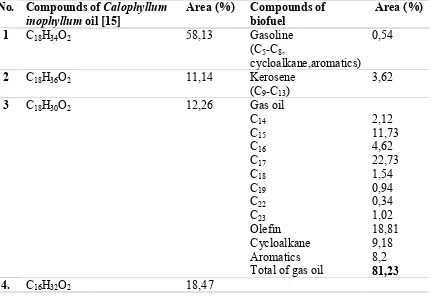
Fig.4.a shows the chromatogram of GC-MS of calophyllum inophyllum oil [15] and hydrocracking product at a temperature of 350°C under 20 bar. Components with retention time of 7-19 minutes in the calophyllum inophyllum oil disappear after hydrocracking reaction take place. Triglyceride of calophyllum inophyllum oil is converted into short-chain molecules through hydrocracking process as shown in table 2. As described by Sotelo-Boyas et al, 2012 [16] in order to convert the triglycerides into biofuel through a complex reaction. The reaction consists of several steps starting from the saturation of the double bonds of triglycerides and the removal of oxygen through a different reaction, decarboxylation, decarbonylation, and hydrodeoxygenation. As shown in Fig 4.b, the number of components of the product in retention time of 2-13 minutes increases. Biofuel products contain paraffin compounds in large quantities, olefins, cycloparaffins and alcohols. Paraffin compounds were over 40%, consisted of heptadecane and pentadecane. As reported by Rasyid [15], Biofuel from calophyllum inophyllum oil is approaching the characteristics of hydrocarbons including gasoline fractions, diesel oil, kerosene and aromatic fraction with operating conditions at a temperature of 350 °C using a catalyst CoMo with various support catalysts. The fatty acids as the raw material components that not successfully converted in the form of oleic acid by 1.43% area. Carboxylic acid as an intermediate product in the form n, 2,3 -trimethyl-2-butenoic acid, cycloparaffins in the form as cyclohexane (4.45% ) and cyclopentane (4.65%).
a b
Table 2. Compounds of Calophyllum inophyllum oil and biofuel respectively, and the selectivity of gas oil 84.39%. The selectivity of Ni is greater than CoMo to gas oil as reported by Rosyadi [17]. The increasing concentration of Ni in the catalyst of NiMo, the activity of catalyst will lead to products gas oil than gasoline or gas products. This indicates that the catalytic hydrocracking reaction with catalyst Ni/hydrotalcite occurred successfully and selective to gas oil.It is possible if the reaction is carried above the temperature of 350°C and reaction time over 2 hours will obtain greater conversion and yield.
CONCLUSION
Based on the discussion, Ni/hydrotalcite as hydrocracking catalyst of Callophyllum inophyllum oil can be synthesized by low supersaturation co-precipitation method and incipient wetness impregnation, it resulted high surface area of catalyst about 201.340 m2/g. Hydrocracking reaction with 7.56 % Ni/hydrotalcite catalyst at 350°C gave the conversion of 96.26%, yield of gasoline, kerosene, gas oil 0.36%, 2.45 % and 54.88% respectively and the selectivity of gas oil was 84.39%. The main product was paraffins which consist of heptadecane and pentadecane.
ACKNOWLEDGMENT
REFERENCES
[1] L. Dandik, H. A. Aksoy, and A. Erdem-Senatalar, Energy Fuels, 1998,12, 1148–1152. [2] A. E. Atabani and A. da S. César, Renew. Sustain. Energy Rev, 2014, 37, 644–655. [3] U. G. P. K. Kulkarni and A. K. P. P. Chaudhari, Catalyst, 2015, 34, 51-55
[4] Z. Tong, T. Shichi, and K. Takagi, Mater.Lett, 2003, 57, 2258–2261.
[5] V. Rives, Layered double hydroxides present and future, 2001, Nova Science Publishers, New York.
[6] M. Climent, J. Catal, 2004, 225, 316–326.
[7] Y. Qi, Z. Cheng, and Z. Zhou, Chin. J. Chem. Eng, 2015, 23, 76–85.
[8] Davydov, A. A, Infrared Spectroscopy of Adsorbent Species on The Surface of Transitional Metal Oxides, 1984, John Wiley and Sons, New York.
[9] K. Mette, Development of hydrotalcite-derived Ni catalysts for the dry reforming of methane at high temperatures, Disertation, Technische Universität Berlin, 2015
[10] F. Cavani, F. Trifirò, and A. Vaccari, Catal. Today, 1991, 11, 173–301.
[11] E. Heraldy, K. D. Nugrahaningtyas, F. B. Sanjaya, D. S. Handayani, Y. Hidayat, Influence of Variation (Ca-Mg)/Al Molar Ratios on Phase Composition of Ca-Mg-Al Hydrotalcite, 2013, International Conference on Chemical, Agricultural and Medical Sciences (CAMS-2013) Dec. 29-30, 2013 Kuala Lumpur (Malaysia)
[12] D. M. Meira, G. G. Cortez, W. R. Monteiro, and J. A. J. Rodrigues, Braz. J. Chem. Eng, 2006, 23, 351–358.
[13] N. A. Comelli, M. L. Ruiz, N. A. Merino, I. D. Lick, E. Rodríguez-Castellón, A. Jiménez-López, and M. I. Ponzi, Appl. Clay Sci, 2013 80–81, 426–432.
[14] H.S.Song. S.J.Kwon. W.S.Epling. E. Croiset. S.C.Nam and K.B.Yi. (2014), Clean Technol, 2014, 20, 2, 189–201.
[15] R. Rasyid, A. Prihartantyo, M. Mahfud, and A. Roesyadi, BCREC, 2015, 10, 61–69 [16] R.Sotelo-Boyas, F.T.Zarraga, and J.Hernandez-Loyo, Hydroconversion of
triglycerides into green liquid fuels, 2012 in Karam, I. (Ed.),Hydrogenation, InTech [17] Rosyadi, E, Conversion of vegetable oils into green diesel and green gasoline with the