• Tidak ada hasil yang ditemukan

Artikel FalehSB UNDIP 2

N/A
N/A
Protected

Academic year: 2017

Membagikan "Artikel FalehSB UNDIP 2"

Copied!
6
0
0

Teks penuh

(1)

THE STUDY OF CONVERSION

CPO TO POLYOL (POLYALCOHOL)

F. S. Budi

1)

and Z. Abidin

2)

Abstract

Indonesia is the second big CPO producer after Malaysia. The CPO production of Indonesia gradually increases and reaches 8.2 million tones. About two third of it is used to meet the domestic demand and the other is exported in crude. The value of it is low. If it is exported in crude, Indonesia will receive little income. Therefore, it must be converted into the other product, which has the high value. The main component of it is glyceride composed of glycerol and fatty acid. The glyceride can be converted into polyol (polyalcohol) which is the material in manufacturing polyurethane, cosmetic, lubricant etc. The process of converting of CPO into polyol is called the hydroxylation. This research aims to study the hydroxylation process of CPO into polyol and to optimize the variable which really affects the hydroxyl number of product. Based on the experiment, the optimum condition of hydroxylation of CPO with the hydrogen peroxide (H2O2) and the formic acid (HCOOH) into polyol

is got as follows: temperature 50 oC, composition of reactant 40 %, and time 2 hours. The Polyol produced has the hydroxyl number 148.

Keywords : CPO; hydroxylation; polyol

Introduction

Indonesia is the second big CPO producer after Malaysia. The CPO production of Indonesia increased gradually from 1968 to 2001. Now Indonesia produces 8.2 million tones of CPO and in 2005 it is predicted up to 10.2 million tones of CPO. This is caused by opening new plantation in Sumatera and Kalimantan. About two third of it is used for domestic industry, such as RBD oil industry and Oleo chemical industry and the rest is exported. The price of CPO is low. If they are exported in crude, the foreign exchange which will be received is little. Therefore, it must be converted to the other products having the higher value.

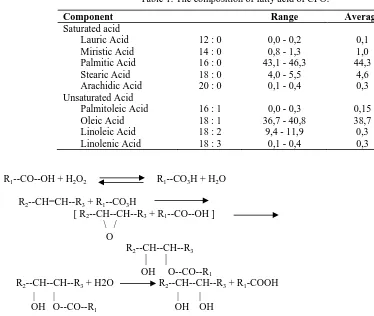
CPO is a vegetable oil produced by palm tree. As the other oils and fats, CPO contains triglyceride or triacylglyceride, which is the main component, with concentration 93 %. It is triester from glycerol and free fatty acids. The other glycerides in CPO are diacylglyceride 4.5 %, and monoacylglyceride 0.9 %. Moreover, CPO also contains impurities, i.e., free fatty acid and gum which consists of phospholipids and glycolipid. The kinds of fatty acid present in CPO depend on the location of the plantation, the variety of the palm tree and the maturity of the fruit, as well as the post harvest handling. Table 1 shows the composition of fatty acid of CPO from 45 samples derived from many areas in the world.

Glyceride is an ester compound formed from glycerol and free fatty acid. The free fatty acid is comprised of saturated and unsaturated free fatty acid.

Thus, glyceride has chemical properties as those of ester and olein (unsaturated compound). As ester, it reacts with alkali base (the saponification reaction) to form soap and glycerol. It reacts with alcohol. An example of alcoholisis is methanolisis which produces methyl ester and glycerol. Glycerides can also be hydrolyzed to produce glycerol and free fatty acid. As olein, it can be carried out the addition reaction with halogen, the epoxidation reaction, the oxidation reaction and the hydroxylation reaction.

Polyol or polyalcohol is a compound having more than two hydroxyl groups. It can be classified into polyester polyol and polyether polyol. It is an important compound in manufacturing of polymer such as polyurethane, lubricant and cosmetic. It used in manufacturing of polymer is the derived product from the petroleum. However, it must be remembered that the petroleum is the an unrenewable material with limited source. Consequently, the alternative material must be found out to replace it. The alternative material which is very potential to be used is the vegetable oil. One of the vegetable oil is CPO.

In polymer terminology, the term of polyol includes all compounds possesing hydroxyl group (OH), including polyhydroxy glyceride. The polyhydroxy glyceride from castor oil is composed of ricinoleic acid which contains hydroxyl group so that it is a natural polyhydroxy glyceride. Meanwhile, synthetic polyhydroxy glyceride is made by hydroxylation reaction.

1)

Chemical Engineering Department, Engineering Faculty 8

(2)

Table 1. The composition of fatty acid of CPO.

Hydroxylation reaction is a reaction initiated by changing double bond compound with epoxide compound, followed by opening of the epoxide ring with hydrogen donor such as water, alcohol and amine. This changing is also called the epoxidation reaction. Generally, the epoxidation of glyceride use the hydrogen peroxide (H2O2). The property of it as

oxidator is not strong enough so that it is usually transformed to the other form more active.

The peroxy acid formed from hydrogen peroxide and the low aliphatic acid such as the formic acid and the acetic acid is the reactive form. It reacts very fast with unsaturated compound. At 40 oC, the rate of forming of peroxyformic acid (from H2O2 and

HCOOH) is three times faster than that of the peroxy acetic (from H2O2 and CH3COOH with H2SO4 as

catalyst). The property of formic acid which is strong can also open the oxirane ring to produce the derived product of hydroxy – formoxy (Swern, 1945). The reaction occurred can be written as equation (1), (2) and (3)

Materials And Method

CPO used in this experiment is obtained from PT. Perkebunan Nusantara VIII. CPO must be previously purified to remove impurities such as gum and free fatty acid so that they don’t interfere the hydroxylation process. Hydrogen peroxides (H2O2) 30

% and Formic acid (HCOOH) 98 – 100 % are obtained from Brastaco (A Chemical Store in Bandung).

The main equipments used in this experiment are as follows: 1 liter three neck flask, thermometer 100 oC, reflux condenser, water bath, and mixer. Other equipment used are 1 liter separating flask, 1 liter beaker glass, 1 liter Erlenmeyer flask and hot plate.

(3)

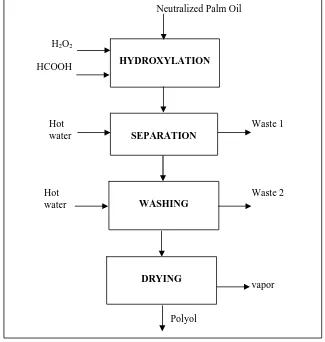
Figure 1. The flow of the hydroxylation process

Figure 1. Flow diagram of the process conversion CPO to Polyol

Table 1. The operation variables of hydroxylation process

Variable Low Level (-) High Level (+)

Composition of reactant (X1) 30 % berat NPO 70 % berat NPO

Temperature (Y1) 40 oC 80 oC

Time (Z1) 1 hour 4 hour

Note :

- NPO : neutralized palm oil

- The rotation speed of agitator : 300 - 350 rpm [ 6]. - Ratio H2O2 30 % with HCOOH 1: 14 mol [26].

Factorial design level 2 is used to determine variable having the most significant effect on the hydroxyl number of the product. Then it is optimized to get the optimum condition of process. The variables of the hydroxylation process can be seen at the Table 1. The experiment is carried out in 8 running.

The hydroxy number and the weight of the product are used to determine the conversion of the reaction. The hydroxyl number represents the sum of hydroxyl group in the product.

Result And Discussion

The result of filtering of experiment variables using of factorial design level 2 is shown in the Table 2.

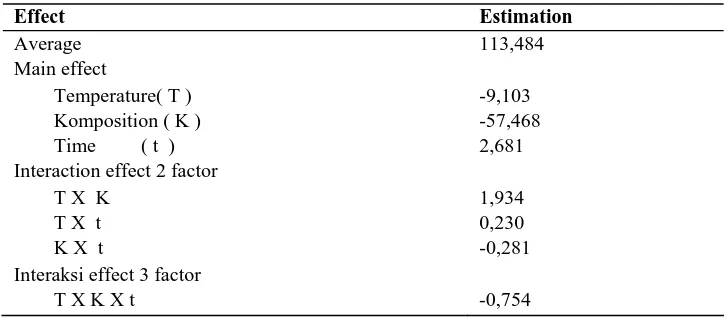
The data in Table 2 are calculated to determine the effect of each variable and the variable having the most significant effect. The result of calculation main and interaction variable effect are as follows.

The calculation results shown in Table 3 shows that the composition and temperature have Neutralized Palm Oil

H2O2

HCOOH

Hot Waste 1 water

HYDROXYLATION

Hot Waste 2 water

vapor

SEPARATION

WASHING

Polyol

(4)

significant but negative effect on Hydroxyl Number of the product, but the effect of composition is bigger than that of temperature. The effect of composition will decrease Hydroxyl Number of the product about 57,468 and that of temperature will drop Hydroxyl Number about 9,103. Meanwhile, the effect of time variable and interaction variables are very small so that they can be ignored.

The temperature optimization shows that at temperature 50 oC will be reached Hydroxyl Number of the product 148,296. This is the maximum point. In the range 40 – 50 oC, the rise of temperature will increase the Hydroxyl Number of product, but above temperature 50 oC, the rise of temperature will decrease

it. The phenomena are caused by increase of the reaction rate in the range 40 – 50 oC and decrease of that above temperature 50 oC. In addition to, the rise of temperature also causes the active oxygen losses. It occur because the peroxy formic acid is decomposed. The reaction of forming peroxy formic acid from H2O2 and HCOOH is the reversible and

exothermic reaction. The rise of temperature will cause the increase of the rate of reaction and the decomposition of peroxy formic acid. Above temperature 50 oC, the rate of decomposition is faster than that of forming.

Table 2. The result of filtering of experiment variables.

Run Suhu

( oC )

Komposisi ( % NPO)

Waktu ( jam )

Berat

(gram) Bil. (OH

)

1 40 30 2 31,458 146,747

2 40 30 4 31,974 148,726

3 40 70 2 69,034 86,873

4 40 70 4 71,853 89,797

5 80 30 2 30,682 134,727

6 80 30 4 30,956 138,672

7 80 70 2 68,418 80,228

8 80 70 4 69,745 82,104

Note :

For the composition variable

ƒ Low level (-) = 30 % NPO, 10,5 % H2O2 and 59,5 % HCOOH ƒ High level (+) = 70 % NPO, 4,5 % H2O2 and 25,5 % HCOOH ƒ

Table 3. The result of calculation main and interaction effect.

Effect Estimation

Average 113,484 Main effect

Temperature( T ) -9,103 Komposition ( K ) -57,468 Time ( t ) 2,681 Interaction effect 2 factor

T X K 1,934

T X t 0,230

K X t -0,281

Interaksi effect 3 factor

(5)

0

Figure 2. The effect of temperature to OH Number of product.

Figure 3. The effect of temperature to weight of product

0

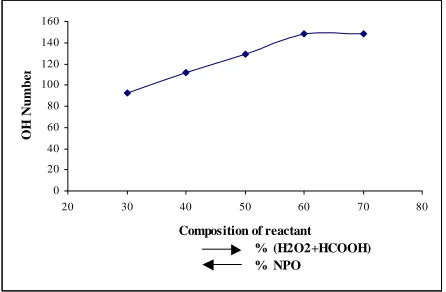
Figure 4. The effect of composition to OH Number of product

Figure 5. The effect of composition to weight of product.

The same trend is also occurred on Figure 3 which shows temperature vs product weight. The rise of temperature on the range 40 – 50 oC will enhance the weight of product and above temperature 50 oC the rise of temperature will drop the weight of product.

The optimization of composition shows that at composition 40 % NPO we will get the Hydroxyl Number of product maximum, i.e., 148.278. The rise of composition H2O2 + HCOOH in the mixture of

reaction will increase the Hydroxyl Number of product. After composition 60 % (H2O2+HCOOH),

the rise of composition will not increase the Hydroxyl Number oh product again and the using of H2O2+HCOOH is excessive.

Figure 5 which represents the relation of composition vs the rise of weight also shows that the maximal rise of weight 3.608 is also reached on the composition 40 % NPO (60 % H2O2 + HCCOH). The

increase of composition (addition of H2O2 +

HCOOH) in the mixture of reactant will also enhance the rise of weight. But above temperature 60 % (H2O2 + HCOOH) the rise of composition will

decrease the rise of weight. The trend on Figure 4 is different with the trend on Figure 5. This is possibility caused by occurrence of the lost product when the product is separated from the remain of reactant, is washed and is dried of product. The rise of product at composition 70 % (H2O2 + HCCOH)

and at composition 60 % (H2O2 + HCCOH) should

be similar because the number of the hydroxyl group is same. However, the lost product decreases the rise of weight.

The rise of product shows that the hydroxyl groups are established so that the weight of molecule increases. The molecule of polyol is more weight than that of glyceride.

Conclusion

Based on the result of experiment, we can conclude that

1. The composition and temperature variables really affect to the Hydroxyl Number of product. 2. The optimum condition for producing polyol

from CPO with the hydroxylation process is temperature 50 oC, composition 40 % NPO and time 2 hours.

3. The polyol produced at the optimum condition has the Hydroxyl Number 148,296 and weight 43,608 gr

References

Deffense E. (1985), ”Fractionation of Palm Oil”, J.

Am. Oil Chem. Society : 2, page : 376 - 385

(6)

Gunstone, (1995), ” The Lipid Handbook”, 2nd edition , Chapman and Hall

Gunter O., (1994), “Polyurethane Handbook”, 2nd edition, Hanser, Munich,.

Ketaren S., (1986), ”Introduction of Technology of

Edible Oil and Fat”, UI Publishing, Jakarta (page : 195

– 203).

Lubis and Naibaho, ”The Prospect of Upstream

Industry Development for Palm Processing” Center

of Plantation Researching Marihat – Bandar Kuala.

Swern D., et all, (1945), Journal American Oil

Chemistry Society, 67, page : 1786 – 1789.

Gambar

Table 1. The composition of fatty acid of CPO.
Figure 1. The flow of the hydroxylation process                                             vapor
Table 2. The result of   filtering of experiment variables.
Figure 2. The effect of temperature to OH Number of  product.

Referensi

Dokumen terkait

(2008) research which studied about consumers’ confusion effect to their preference and purchase of local and foreign brands and also how brand knowledge took a role as mediator

1 Effect of a Cartoon and an Information Video About Intravenous Insertion on Pain and Fear in Children Aged 6 to 12 Years in the Pediatric Emergency Unit: A

1991 examined the effect of the connection on the mechanical properties will increase when the number of layer increases in sengon wood, Fakri 2000 examined the effect of the number of

Meanwhile, according to several Regional Regulations in the Maluku Province Region, in particular according to the Ambon City Regional Regulation Number 8 of 2017 about Negeri in

IV-29 A Soewito1, B Suwandi1 1Faculty of Politics and Social Science, Bandar Lampung University, Indonesia Abstract Economic development is not merely about increasing the number of

13 Interaction effect of variety and planting material on number of effective tillers m-2 of inbred and hybrid boro rice 57 14 Interaction effect of variety and planting material on

So there was an effect of the application of contextual teaching learning towards students’ listening ability and the students who taught by contextual teaching learning will perform

Management system based on ISO 10002 : 2004 In an organization that will be implanted standard of ISO 10002 : 2004 about handling system of complaint, has two mainly aims such as