Nama Jurnal : Jurnal Dinamika Manajemen Volume, Issue : 13, 1, 2022
Link Jurnal
: https://journal.unnes.ac.id/nju/index.php/jdm/article/view/33253
Link Artikel
: https://journal.unnes.ac.id/nju/index.php/jdm/article/view/33253/12808
Link Indeks Jurnal
: https://sinta.kemdikbud.go.id/journals/detail?id=881
No. Tanggal Aktivitas Korespondensi Halaman
1 10 November 2021 Proses submission artikel (Lampiran 1)
1 2 18 November 2021 Peer Reviewer 1
(Lampiran 2)
14 3 07 Desember 2021 Hasil Revisi Peer Reviewer 1
(Lampiran 3)
31 4 2 Januari 2022 Peer Reviewer 2
(Lampiran 4)
43 59 6 02 Maret 2022 Authorproof final
(Lampiran 6)
70 7 11 Maret 2022 Letter of Acceptance
(Lampiran 7)
71 8 11 Maret 2022 Artikel published
edisi Maret 2022 (Vol. 13, No.1, Hal. 78-86) (Lampiran 8)
72 5 15 Januari 2022 Hasil Revisi Peer Reviewer 2
(Lampiran 5)
http://jdm.unnes.c.id
Nationally Accredited based on the Decree of the Minister of Research, Technology and Higher Education, Number 36a/E/KPT/2016
ANALYSIS OF THE EFFECT OF NON PERFORMING LOANS (NPL), RETURN ON ASSETS (ROA), RETURN ON EQUITY (ROE) AND SIZE (BANK SIZE) ON BANKING LIQUIDITY RISK
(Case Study on Conventional Banks Registered in IDX period 2016 – 2020) ENDANG TRI WIDYARTI1, YOHANES SUHARDJO2
1.Management, Faculty Of Ecoonomic and Bussinees, University Diponegoro
2.Accounting Faculty Of Economics, University Of Semarang, Article
Information
Abstract
History of article:
Accepted Approved Published
____________
Keywords:
Non-Performing Credit (NPL), ROA, ROE, Size (Bank Size), liquidity risk.
In the economy of a country, banking has a big part to do. Banking plays an important role in lending in public and private areas. The function of banking as an intermediary, which the bank is useful as an intermediary between the parties who are sufficient to those in need. This research is focused on areas that have an effect on liquidity risk in banks. The purpose of this research is nothing but to analyze the securities of NPL, ROA, ROE and Size to liquidity risk in banks listing in IDX for the period 2016-2020.
The samples used in the research of all banks, both state-owned (SOE) and National Private Banks in Indonesia are recognized in BI from 2016 to 2020. From the criteria obtained by 40 banks, the method used is purposive sampling. The method of analysis used in this research is linear regression, which is tested through classical assumptions with normality, multicollinearity, autocorrelation and heteroscedasticity.
The results showed that roa and ROE variables have a good and significant effect on liquidity risk. Medium variable NPL and Size have an adverse and insignificant effect on liquidity risk.
Indonesian Title (Capitalize Each Words)
History of article:
Accepted Approved Published
____________
Kata Kunci:
NPL, ROA, ROE, Size, risiko likuiditas.
Abstrak
____________________________________________________________
Dalam perekonomian suatu negara, perbankan punya andil yang besar. Perbankan memainkan peran penting. Fungsi perbankan sebagai intermediary, dimana bank berfungsi sebagai perantara antara pihak berkecukupan dengan membutuhkan. Penelitian ini difokuskan pada area yang berpengaruh terhadap risiko likuiditas pada bank. Tujuan dari penelitian ini tidak lain untuk menganalisis efek NPL, ROA, ROE dan Size terhadap risiko likuiditas pada bank- bank yang listing di BEI periode 2016-2020.
Sampel yang digunakan dalam penelitian adalah seluruh bank, baik Bank BUMN maupun Swasta Nasional di Indonesia yang diakui di BI dari tahun 2016 hingga 2020. Dari kriteria yang diperoleh 40 bank, metode yang digunakan adalah purposive sampling. Metode analisis yang digunakan dalam penelitian ini adalah regresi linier yang diuji melalui asumsi klasik dengan normalitas, multikolinearitas, autokorelasi dan heteroskedastisitas.
Hasil penelitian menunjukkan bahwa variabel roa dan ROE berpengaruh baik dan signifikan terhadap risiko likuiditas. Variabel sedang NPL dan Size berpengaruh negatif dan tidak
INTRODUCTION
Banks have a meaningful role and position in the economy of a country. Roman and sargu, 2016, said that the banking zone has a significant position in financing public or private zones. For Budisantoso and Nuritomo, the bank as a financial intermediary has universally been the main use of raising funds from citizens and channeling them back to citizens for various purposes. They say that more specifically the bank can play the role of trust agent, development agent, and service agent.
Universal liquidity is the bank's expertise to fund the increase in legacy and fulfill liabilities at maturity without incuring losses that can not be anticipated by the bank. Banking activities are collecting, disbursing funds and other banking services that are very vulnerable to various risks.
Effendi and Disman said that of the many risks experienced by banks, liquidity risk is a very significant risk. Because when a bank is entwined with lack of liquidity, the bank cannot carry out its business activities and if this is always established, the bank will face bankruptcy.
Previous research related to variables that influence liquidity risk has been tried by some researchers, but there is still a comparison of the results of the research. Research attempted by Effendi and Disman in 2017 has resulted in npls having a positive and significant influence on liquidity risk. But unlike the research tried by Azhary and Muharam in 2017, the results of npl negatively affect. Research attempted by Sukmana and Suryaningtyas in 2016 created a positive and significant bond between ROA and liquidity risk. But unlike the research tried by Bani and Yaya in 2016, it creates a negative and significant bond between ROA and liquidity risk.
Previous research on the effect of ROE on liquidity risk was tried by Iqbal in 2012, which showed a positive bond between ROE and liquidity risk. But research attempted by Muharam and Kurnia in 2012 reported that ROE negatively affects liquidity levels in conventional banking In research attempted by Iqbal in 2012,
size and liquidity risk. In contrast, the research tried by Bani and Yaya in 2016 created that there is no bond between liquidity risk and size.
The purpose of this research is to recognize how npl, ROA, ROE, and Size influence on liquidity risk in conventional banks listed on the Indonesia Impact Exchange for the period 2016 to 2019.
LITERATURE REVIEW
Based on Law No. 10 of 1998 concerning banking, the Bank is "a business entity that collects funds from citizens in the form of deposits and distributes its funds to citizens in the form of credit and other forms in order to improve the standard of living of the people". For Budisantoso and Nuritomo, according to the Bank's function, "collecting public money and then lending it to citizens for various purposes or as intermediaries in the field of finance".
Universal liquidity is the bank's expertise in meeting short-term needs that have matured A bank is said to have the ability to meet withdrawals from savings, current accounts, time deposits, bank debt maturities, meet loans without any delays. Activities in the world of banking is a business transaction that is tried every day and makes it vulnerable to various risks. Sourced from Bank Indonesia regulation No. 5/ 8/ PB / 2003, the risk is the ability to form a company that wants to cause losses on the part of the bank. Pandia (2012) said that liquidity risk is a risk caused by the lack of immediate fulfillment by the bank to not be able to fulfill its responsibilities either to fulfill the request for withdrawal by the saver or distribute debt to prospective debtors.
Liquidity risk can be measured using the Ratio of Liquid Asset to Total Asset (LTA).
Sukmana and Suryaningtyas (2016) pointed out that LTA is the ratio used to calculate the number of liquid relics from the total relics owned by banks where the relics can be converted. Bank Indonesia Regulation No. 13/ 24/ DPNP/ 2011 concerning evaluation of universal bank health levels is a guideline in determining LTA. Which in
universal banks consists of 2 aspects are sourced on the legacy of primary liquid and secondary liquid relics. Legacy of primary liquid, generally used to meet the liquidity needs of banks in the form of Third Party Funds (DPK) as well as obligations to banks that have matured. Sukmana and Suryaningtyas, 2016, said that the large LTA Ratio showed assets converted into cash were also large and showed good liquidity of banks.
Effect of Non Performing Loan (NPL) on Liquidity Risk
NPL or non-performing loans are ratios calculated using the method of equalizing all non- performing loans compared to all loans distributed by banks. Based on Bank Indonesia Circular Number.13/ 30/ DPNP on December 16, 2011, NPL can be searched using the following methods:
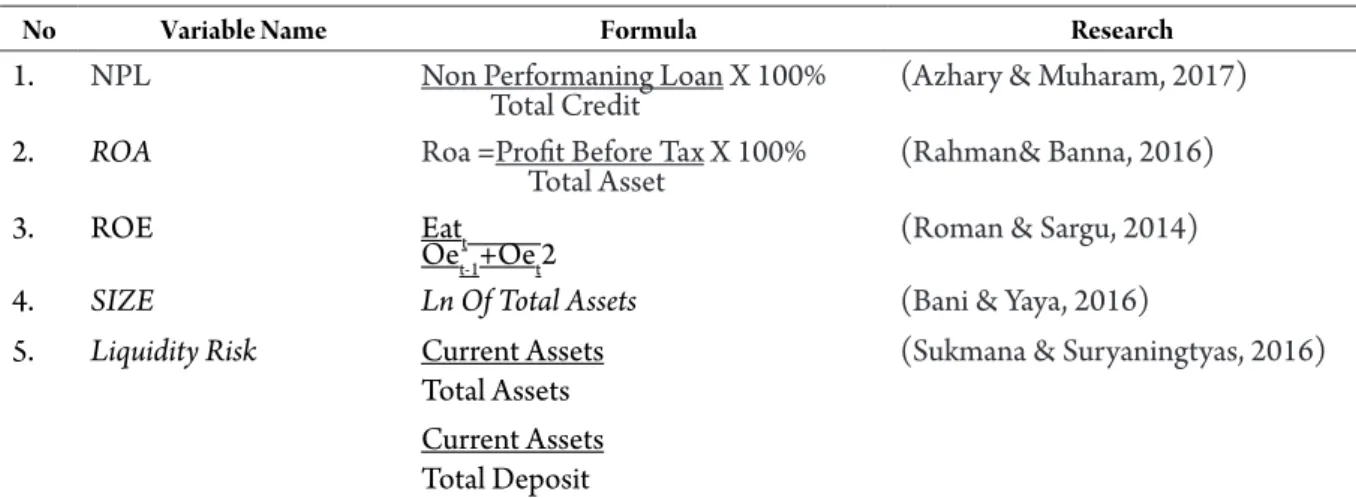
NPL = Non performance Loan x 100%
Total Credit
Based on the anticipated revenue theory, banks allocate credit to sectors that benefit banks with longer maturity installment methods. The risk of long-term crediting arises if the borrower does not pay the installment on time then the credit has not been paid off or bad credit. If the bad credit is large until the payment of credit installments to be received by the bank is sourced on the agenda that has been set to be late. Orderly credit installments are expected to be a source of liquidity of banks but because of the problem of borrowers not paying installments in a timely manner, they want to raise liquidity risk to the bank. Previous research that Azhary and Muharam tried in 2017 that produced results that NPL negatively influenced both research models. Not only that, the research tried by Ghenimi and Omri in 2015 also created a negative and significant influence of NPL on the risk of liquidity. Iqbal, 2012, said that NPL had a negative influence and was concerned about liquidity risk. So for them continue to be low NPL something banks to continue to be a big liquidity
H1: Non Performing Loans (NPL) negatively affect liquidity risk.
Effect of Return On Asset (ROA) on Liquidity Risk
ROA is a marker that illustrates the power of banks to earn a return on some of the assets owned by banks. Bank Indonesia Circular Letter Number 6/23/DPNP 31 May 2004, ROA can be calculated using the formula as below:
ROA =Profit before tax x 100%
Total Asset
Arthesa, in 2006, said that if it comes to
"theory trade off between liquidity and profitability," if a bank wants to strengthen its liquidity position it is trying to strengthen cash reserves by imposing assets owned by the bank to raise some of the idle funds, thus lowering profitability at the bank. Conversely, if the bank wants to strengthen its profitability until the bank has to risk liquidity, because cash reserves derived from the consumption of bank assets are used for liquidity needs to be used by banks for other interests that can increase profitability in the bank so as to increase liquidity in the bank to decrease and cause cases of liquidity effects.
Previous studies have been attempted by Azhary and Muharam, Effendi and Disman, Rahman and Banna, Roman and Sargu, 2014, Muharam and Kurnia, Anam et al. in 2012, Iqbal, and Akhtar, Ali, and Sadaqat, who produced results if ROA had a good and significant impact on liquidity effects.
H2: ROA positively affects liquidity risk.
Effect of Return On Equity (ROE) on Liquidity Risk
ROE is a marker of banking expertise in managing existing capital to obtain a net profit.
Sourced in Bank Indonesia Circular Message No.
6/ 23/ DPNP on May 31, 2004, ROE can be calculated using the following formula:
ROE =Profit after tax x 100%
Total Capital
Based on the theory of trading between liquidity and profitability, Arthesa said that on
H1(-) H2(+) H3(+) H3(-) level, but on the other hand banks must also seek profit and profitability not only to keep the business at the bank profitability also means for investors in obtaining dividends related to their investments. To protect its liquidity the bank charges its capital to protect liquidity reserves to reduce the occurrence of liquidity effects. A previous study of the effect of ROE on liquidity effects was attempted by Iqbal in 2012, which showed a positive relationship between ROE and the liquidity effect. The study was supported by studies that Bani and Yaya tried in 2016, Roman and Sargu, as well as Akhtar, Ali and Sadaqat in 2011.
H3: ROE positively affects liquidity risk
Effect of Size on Liquidity Risk
The size of the banking is a scale, which can be classified as small in size yes the banking for total assets, log size, and stock market value.
For Bani and Yaya, the bank's 2016 calculation of the size of the bank's total assets, which is due to the comparison of each bank's assets that have such a large difference, so as to cause such an extreme difference in value. Sourced on The Subject until size can be calculated by using the following formula:
Bank Size= Ln (Total Assets)
Based on the theory of economies of scale, which is a relative increase in output resulting from the accumulation of commensurately from all inputs. Something banks reach economies of scale when they are able to create more output with a relatively smaller proportion of pay increases. Kusuma ( 2005) towered if the industry with large assets tends to be more profitable than with small industries, so that the bank will tend to wear its assets to obtain a large profit, so as to make the need to fulfill its liquidity by wearing liquid assets to be low that gives rise to the effect of liquidity on the bank continues to be large. Previous studies by Azhary and Muharam, Effendi and Disman, Bani and Yaya, Rahman and Banna, Abdullah and Khan, and Anam et al, resulted in a negative relationship between Size and the liquidity effect. because if a bank has a size that continues to be large, until the bank has a lot of assets , so that banks do not have to worry about the burden that is about to mature.
H4: Size( dimension of the bank) negatively affects liquidity risk
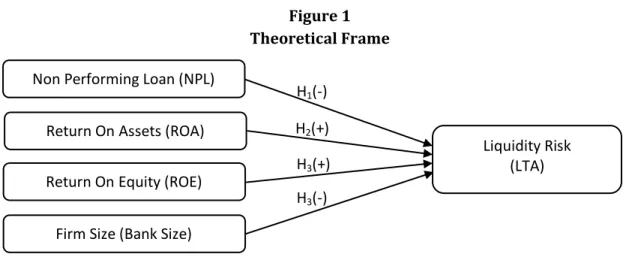
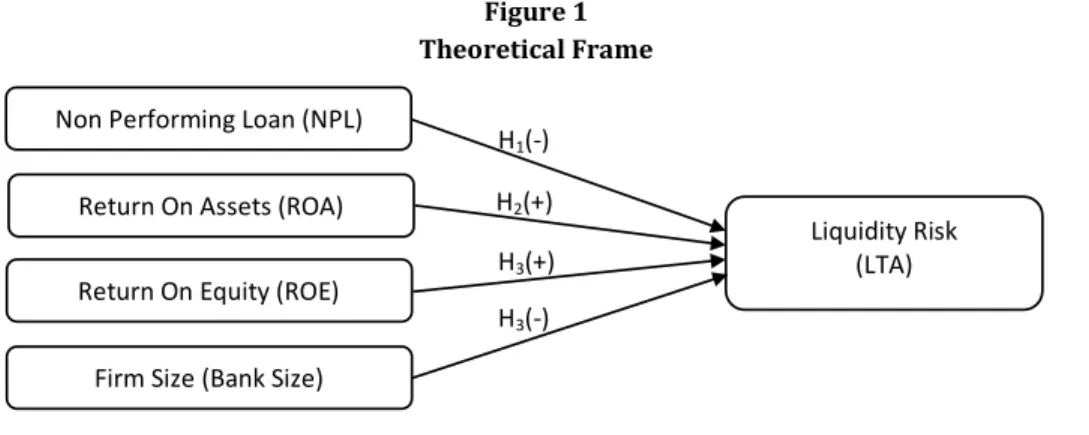
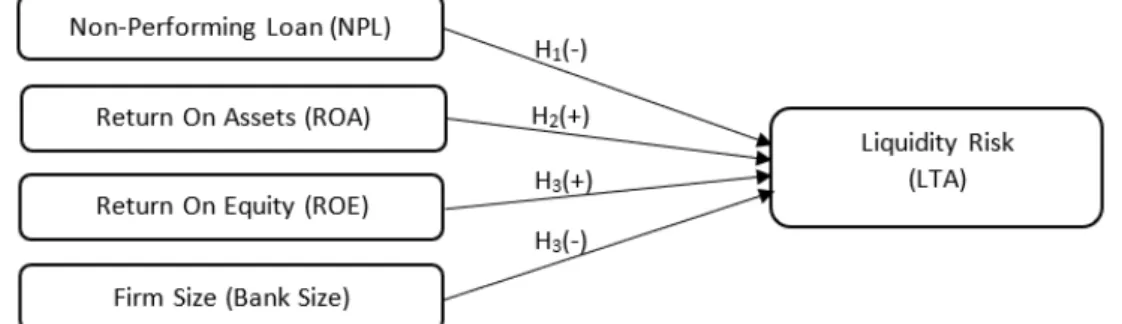
Based on the relationship of NPL, ROA, ROE and Size variables and theories related to variables, the theoretical frame of thought can be drawn as follows:
Figure 1 Theoretical Frame
Non Performing Loan (NPL)
Return On Assets (ROA)
Return On Equity (ROE)
Firm Size (Bank Size)
Liquidity Risk (LTA)
Source : Effendi and Disman (2017), Azhary and Muharam (2017), Bani and Yaya (2016), Sukmana and Suryaningtyas (2016), Ghenimi and Omri (2015), Rahman and Banna (2015), Roman and Sargu (2014), Muharam and Kurnia (2013), Abdullah and Khan (2012), Anam et all (2012), Iqbal (2016), Akhtar, Ali, and Sadaqat (2011)
RESEARCH METHODS Research Variables
This study put on 2 types of variables, namely dependent variables and independent variables. The dependent variable used is the liquidity effect as measured by wearing the LTA ratio. In contrast, the independent variables used in the study consisted of NPL, ROA, ROE and Firm Size.
Population
The population in this study consists of all banking industries, both state-owned banks and national private public banks in Indonesia registered with Bank Indonesia from 2016 to 2020.
Sample
The samples used in this research were selected using purposive sampling procedures.
Illustration retrieval method with purposive sampling procedure is an illustration retrieval method that is tried because it is sourced on the criteria that have been determined by researchers. After trying to select illustrations sourced on the criteria, 40 conventional banks that were listed on IDX from 2016 to 2020 passed the criteria.
Analysis Methods
The data in this study comes from secondary data sourced from Bloomberg as well as the annual report of each banking illustration in question obtained from the IDX website.
The analysis method used in this study is multiple linear regression, which is tested to pass classical assumptions with tests of normality, multicolonierity, autocorrelation and
heteroskedastisity. In this study, multiple regression equations are used as follows:
Y = α + β1X1 + β2X2 + β3X3 + β4X4 + β5X5 + e
Where, Y = dependent variable (liquidity risk), = constant, = multiple linear regression coefficient, = Non Performing Loan (NPL), =
Return On Asset (ROA), =Return On Equity (ROE),
= Firm Size (Bank Size), Error
RESULTS OF RESEARCH AND DISCUSSION Descriptive Statistical Analysis
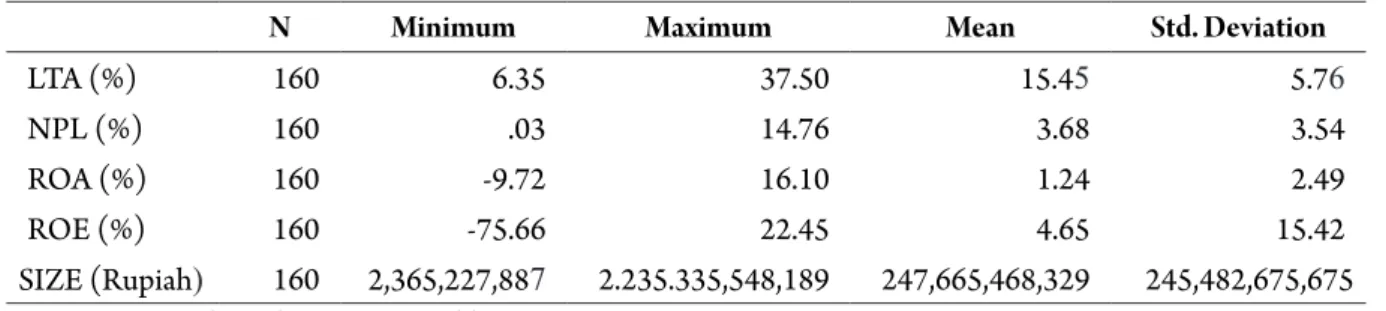
Descriptive statistical analysis can be used as a basis in describing and describing a data from illustrations sourced on mean values, standard deviations, variants, maximum values, minimum values. Based on data obtained from Bloomberg and the annual report of each banking illustration in question obtained from the IDX website from 2016 to 2019. Until the results of the analysis for each variable LTA, NPL, ROA, ROE and size in conventional banks registered in IDX in 2016 to 2020 are as follows:
Table 1
Descriptive Statistical Analysis Descriptive Statistics
N Minimum Maximum Mean Std. Deviation
LTA (%) 160 6,35 37,50 15,4557 5,76066
NPL (%) 160 ,03 14,76 3,6875 3,54667
ROA (%) 160 -9,72 16,10 1,2434 2,49750
ROE (%) 160 -75,66 22,45 4,6557 15,42339
SIZE (Rupiah) 160 2.365.227.887 2.235.335.548.18 9
247.665.468.32 9
245.482.675.67 5 Valid N
(listwise) 160
Source: Secondary data processed by SPSS 24 Sourced in table 1 shows the number of observations on conventional banks registered with IDX in this study as many as 160 data illustrations. Not only that, the table also showed variables analyzed in the study consisting of LTA, NPL, ROA, ROE and size.
In table 1 dependent variable in this research is LTA has an average value of 15.
4557% with a standard deviation value of 5.76066. LTA has a minimum value of 6.35%
from the Central Java Regional Development Bank in 2017. On the contrary, the maximum value is 37.50% at Bank Central Asia Tbk in 2016.
Table 2
Determination Coefficient Test Results Model Summaryb
Descriptive Statistics
N Minimum Maximum Mean Std. Deviation
LTA (%) 160 6,35 37,50 15,4557 5,76066
NPL (%) 160 ,03 14,76 3,6875 3,54667
ROA (%) 160 -9,72 16,10 1,2434 2,49750
ROE (%) 160 -75,66 22,45 4,6557 15,42339
SIZE (Rupiah) 160 2.365.227.887 2.235.335.548.18 9
247.665.468.32 9
245.482.675.67 5 Valid N
(listwise) 160
Source: Secondary data processed by SPSS 24
Sourced in table 1 shows the number of observations on conventional banks registered with IDX in this study as many as 160 data illustrations. Not only that, the table also showed variables analyzed in the study consisting of LTA, NPL, ROA, ROE and size. In table 1 dependent variable in this research is LTA has an average
value of 15. 4557% with a standard deviation value of 5.76066. LTA has a minimum value of 6.35% from the Central Java Regional Development Bank in 2017. On the contrary, the maximum value is 37.50% at Bank Central Asia Tbk in 2016.
Table 3
Determination Coefficient Test Results Model Summaryb
Model Summaryb Model R R Square Adjusted R
Square
Std. Error of the Estimate
1 ,346a ,187 ,236 ,24335
a. Predictors: (Constant), SIZE, ROE, NPL, ROA b. Dependent Variable: LTA
Based on the results of the determination coefficient test (R^2) in table 2 indicates if the value of the adjusted coefficient of determination (Adjusted R Square) is 0.236. The subject indicates that
the ability of LTA dependent variables can be presented by independent variables NPL, ROA, ROE and SIZE of 23.6% and the remaining 76.4% influenced by other aspects.
Table 4
F Statistical Test Results ANOVAa
ANOVAa
Model Sum of Squares Df Mean Square F Sig.
1
Regression ,376 4 ,087 6,254 ,003b
Residual 2,645 169 ,018
Total 3,113 174
a. Dependent Variable: LTA
b. Predictors: (Constant), SIZE, ROE, NPL, ROA Source : Secondary data processed by SPSS 24
Based on the results of Statistical Test F (Test of overall significance of illustration regression) in table 3 obtained a calculated value of F of 6, 254 with a significance value of 0.003.
The significance value smaller than 0.05 indicates
and that LTA dependent variables can be displayed by independent VARIABLES NPL, ROA, ROE, and SIZE. Based on the comparison of the calculated F and F values of the table, the table F value is 3.76. The calculated F is greater than the
table F, so it can be inferred if simultaneously all independent variables affect dependent variables
Table 5
Statistical Test Result t (Individual parameter significance test) Coefficientsa
Coefficientsa
Model Unstandardized Coefficients Standardized Coefficients
t Sig.
B Std. Error Beta
1
(Constant) 1,222 ,206 5,547 ,000
NPL -,085 ,061 -,180 -1,265 ,337
ROA ,047 ,016 ,369 3,482 ,022
ROE ,006 ,001 ,360 5,536 ,001
SIZE -3,122 4,659 -,067 -,657 ,366
a. Dependent Variable: LTA
Source: Secondary data processed by SPSS 24 Based on the test results of statistical test results t( individual parameter significance test) in table 4. 7, until you can get multiple linear regression equations as follows:
LTA (t-1) = 1.222– 0.085 NPL + 0.047 ROA + 0.006 ROE – 3.122 SIZE
Discussion of Research Results
The results of the study on early hypothesis testing obtained results if NPL negatively influenced not signfikan to the effect of liquidity projected with the ratio of LTA. The result is based on the coefficient direction of the NEGATIVE VALUE NPL with values t– 1, 265 and significance values of 0.337. Because the value of significance is greater than 0.05 until the early hypothesis (H1) which tells if NPL negatively affects the effect of liquidity is rejected. In 2016, the npls were negatively linked to liquidity. The large NPL ratio shows the magnitude of bad loans and eventually causes losses on the part of banks.
Iqbal also said that the large NPL ratio of conventional banks was due to careless lending applications and that it was a factor in liquidity cases. Bank Indonesia has set the maximum npl
5%. The average value of NPL (Non Performing Loan) in the illustration of the bank used is 2.7867%. The results showed banks could reduce the NPL ratio below 5% to cause substantial profitability, as banks look to save money to form non-performing loans and PPAP.
The results of the study on the second hypothesis, obtained results if ROA positively influenced and signfikan to the effect of liquidity projected with the ratio of LTA. The result is based on the direction of positive regression coefficient with values t 3, 482 and significance values of 0.022. Because the significance value is smaller than 0.05 until the second hypothesis (H2) which tells if ROA positively affects the effect of liquidity is accepted. Sourced on theory trade of between liquidity and profitability, if a bank wants to Strengthen its liquidity position is tried by means of increasing reserves in cash by imposing assets owned by your bank to raise some of the idle funds, thus lowering the profitability of the bank. Conversely, if the bank wants to strengthen its profitability until the bank has to risk liquidity, because cash reserves derived from the consumption of bank assets are
other interests that can increase profitability in the bank so as to increase liquidity in the bank to decrease and cause cases of liquidity effects. The results of the study were unchanged, compared with studies tried by Azhary and Muharam in 2017, Effendi and Disman, Rahman and Banna, Muharam and Kurnia, Anam et al. in 2016, Iqbal, and 2016.
The results of the study on the third hypothesis, obtained results if ROE influenced positive and signfikan to the effect of liquidity projected with the ratio of LTA. The results are based on the results of multiple regression analysis showing if the coefficient of positive regression with values t 5, 536 and significance values of 0.01. Because the value of significance is smaller than 0.05 to the third hypothesis (H3) which tells if ROE positively affects the effect of liquidity is accepted. Referring to theory trade of between liquidity and profitability, Arthesa said that on the one hand the bank must protect its liquidity level, but on the other hand banks must also seek profit and profitability not only to keep the business at the bank profitability also means for investors in obtaining dividends related to their investments. To protect its liquidity the bank charges its capital to protect liquidity reserves to reduce the occurrence of liquidity effects. The results of the study were unchanged, compared with studies tried by Ghenimi and Omri in 2015, Rahman and Banna, Roman and Sargu, and Seta Iqbal in 2016. Iqbal, who has a strong roe ratio, said the large ROE ratio shows that the return on investment from shareholders is more lightning. when banks have a larger ROE they have a large income that can be used to support short-term liabilities and banks want to have fewer cases or risky conditions.
The results of the research on the fifth hypothesis, obtained results if the size of the bank affects negatively and does not signfikan against the effect of liquidity projected with the ratio of LTA. The results are based on the direction of the firm size, which is negative with a value of t- 0, 657 and a significance value of
than 0.05 to the 5th hypothesis, which reports that the size of the bank affects negatively against liquidity risk is rejected. The size does not affect liquidity risk due to conventional banks, competition in the banking market continues to be strong, because the rise of sharia banking is therefore a race to acquire customers. Bani and Yaya, 2016, said the issue led to conventional banks increasing their assets and improving their business so that customers were comfortable with the services provided. And the small amount of total assets owned by a bank so as not to cause liquidity effects on the bank. The study was in line with studies attempted by Azhary and Muharam, Effendi and Disman, Bani and Yaya, Rahman and Banna in 2015, Ghenimi and Omri, as well as Akhtar, Ali and Sadaqat, who said the size of the bank had no effect on liquidity effects.
The results showed that the minimum value of size measured by total assets was 2. 365. 227.
887 and the maximum value is 2. 235. 335. 548.
189. The comparison between the minimum value and the maximum is quite large showing that the small amount of total relics owned by a bank does not want to cause the formation of liquidity risk in the bank.
Conclusion
The results of this research show that there are some aspects that influence liquidity as measured by using LTA variables. Of the 5 aspects studied consisting of NPL, ROA, ROE and Firm Size. From the results of the study it was proven that roa and ROE variables have a positive and significant influence on the effect of liquidity.
In contrast, other variables consisting of NPL and Firm Size do not affect the liquidity effect. On the contrary, other variables consisting of NPL and Firm Size do not affect liquidity risk.
This research has limitations that the beginning is the results of the determination coefficient test shows the value of Adjusted R Square only 0.236. This means that if only 23. 6%
of dependent variables can be displayed by independent variables. The opposite of the
beyond the variables used in this study. Not only that this study also has limitations The study is only focused on conventional banks, so it has not been able to compare the liquidity effect with variables used in sharia banks and banks that conduct mergers.
Based on the results of this research, there are some initial recommendations for banks that banks must be more selective in sharing credit periods and keeping a close eye on the condition of prospective credit recipients. Not only that, it is expected that the bank is able to manage productive assets that can increase the source of liquidity in the bank. And banks are also obliged to manage their income such as accumulated capital from investors so that more liquid relics are available, so as to minimize liquidity risk. Not only recommendations for banks, there are some recommendations that can be considered for future research.
For the next research can classify the illustration of the banking to be used, a kind of sourced at the small dimension of the bank, so that better results can be obtained. Not only that, the next research can equate 2 types of banks more specifically to recognize how liquidity risk comparison in banks, for example the comparison between conventional bank liquidity risk with sharia banks such as research tried by Efendi and Disman (2017), Sukmana and Suryaningtyas (2016), and Muharam and Kurnia (2013). And the next research could raise independent variables that support liquidity effects, such as NIM, NWC, GDP growth, and inflation levels as tried by Ghenimi and Omri, Rahman and Banna, as well as Anam et al. in 2012.
REFERENCE
Abdul-Rahman, A., Sulaiman, A. A., & Mohd Said, N. L. H. (2018). Does financing structure affects bank liquidity risk? Pacific Basin Finance Journal, 52(August 2016), 26–39.
https://doi.org/10.1016/j.pacfin.2017.04.004
Abdullah, A., & Khan, A. Q. (2012). Liquidity Risk Management: A Comparative Study between Domestic and Foreign Banks in Pakistan.
Journal of Managerial Sciences., 6(1), 61–72.
Retrieved from
https://www.semanticscholar.org/paper/Liquid ity-Risk-Management-%3A-A-Comparative- Study-and-Abdullah-
Khan/63339eb3110d9192f86621245fbcdcd9f0 1fef7f
Ali, Masyhud. 2006. Manajemen Risiko : Strategi Perbankan dan Dunia Usaha Menghadapi tantangan globalisasi bisnis. Jakarta :PT Raja Grafindo Persada.
Antariksa, R. (2006). Pengaruh Risiko Likuiditas Terhadap Profitabilitas (Studi Kasus pada PT.
Bak Muamalat Indonesia). Eksis, 2(2), 109390.
Azhary, A. & Muharam, H. (2017). Analisis Faktor – Faktor yang Mempengaruhi Risiko Likuiditas pada Bank Konvensional,vol. 1, no.
1, pp. 65–77.
Bani, F., & Yaya, R. (2016). Risiko Likuiditas pada Perbankan Konvensional dan Syariah di Indonesia, 16(1), 1–26.
Berger, A. N.,& Bouwman, C. H. (2005). Bank capital , risk and liquidity creation. no. June, p.
43, 2005.
Budisantoso, Totok dan Nuritomo. (2015). Bank dan Lembaga Keuangan Lain. Jakarta : Salemba Empat.
Dendawijaya, Lukman.2005. Manajemen Perbankan. Bogor : Ghalia Indonesia.
Effendi, K. A., & Disman, D. (2017). Liquidity risk:
Comparison between Islamic and conventional banking. European Research Studies Journal, 20(2), 308–318.
Ghozali, Imam. 2018. Aplikasi Analisis Multivariate dengan program IBM SPSS 24 8 ed.
Semarang : Badan Penerbit Undip.
Tingkat II. Jakarta : PT Gramedia Pustaka Utama.
Iqbal, A. (2016). Liquidity Risk Management : A Comparative study betwen conventional and islamic banks of Pakistan. Global Journal of Management and Business Research, 12(5), 54–64. https://doi.org/Online ISSN: 2249- 4588 & Print ISSN: 0975-5853
Jaara, O. O., Jaara, B. O., Shamieh, J., & Fendi, U.
A. (2017). Liquidity Risk Exposure in Islamic and Conventional Banks, 7(6), 16–26.
Kasmir. 2010. Bank dan Lembaga Keuangan Lainnya Ed. Revisi. Jakarta : Rajawali pers.
Management, L. R., Study, C., & Banks, C. (2015).
Arabian Journal of Business and Liquidity Risk Management : A Comparative Study between Islamic and Conventional Banks, 5(6). https://doi.org/10.4172/2223- 5833.1000166
Management, R., Islamic, F., Emirates, U. A., Islamic, D., Act, B. C., & Islamic, B. (2008).
Liquidity Risk Management : a Comparative Study Between Conventional and Islamic, 5(January), 35–44.
Mirajudin, M., & Prasetiono, P. (2017). Analisis Liquidity Creation Pada Perbankan Di Indonesia Tahun 2007-2013 (Studi Kasus Pada 10 Bank Besar Di Indonesia Tahun 2013).
Jurnal Studi Manajemen Organisasi, 12(1), 76. https://doi.org/10.14710/jsmo.v12i1.13424 Muharam, H., & Kurnia, H. P. (2016). Liquidity Risk on Banking Industry: Comparative Study Between Islamic Bank and Conventional Bank in Indonesia. Al-Iqtishad: Journal of Islamic
Economics, 5(2).
https://doi.org/10.15408/aiq.v5i2.2565
Nishanthini, A., & Meerajancy, J. (2015). Trade-Off between Liquidity and Profitability : A Comparative Study between State Banks and Private Banks in Sri Lanka. Research of Humanities and Social Sciences, 5(7), 78–86.
Nugraheni, P., & Alam, W. F. I. (2014). Pengaruh Risiko Likuiditas Terhadap Profitabilitas Pada Perbankan Syariah dan Konvensional di Indonesia. Jurnal Akuntansi Dan Penanaman
Modal, 15(174), 1–16.
https://doi.org/10.1109/IROS.1995.525848 Pandia, Frianto. 2012. Manajemen Dana dan
Kesehatan Bank. Jakarta : Rineka Cipta.
Pardede, Marulak. 1998. Likuidasi Bank dan Perlindungan Nasabah. Jakarta : Pustaka Sinar Harapan.
Prochnow,H. V. (1949). Bank Liquidity and the New Doctrine of Anticipated Income.J.
Finance, vol. 4, no. 4, pp. 298–314, 1949.
Rahman, M. L., & Banna, S. H. (2016). Liquidity Risk Management: A Comparative Study between Conventional and Islamic Banks in Bangladesh. Journal of Business and Technology (Dhaka), 10(2), 18–35.
https://doi.org/10.3329/jbt.v10i2.29465 Rattan, G. K., Librarian, A., Kahn, B., & Nabha, S.
(2016). Asian Journal of Multidisciplinary Studies. Asian Journal of Multidisciplinary Studies ISSN:, 4(2), 35–41.
Roman, A., & Şargu, A. C. (2014). Banks Liquidity Risk Analysis in the New European Union Member Countries: Evidence from Bulgaria and Romania. Procedia Economics and Finance, 15(14), 569–576.
https://doi.org/10.1016/s2212-5671(14)00512- 7
Scannella,E. (2016). Theory and regulation of liquidity risk management in banking. Int. J.
Risk Assess. Manag., vol. 19, no. 1/2, p. 4, 2016.
Silberston, A. (2017). Economies of Scale in Theory and Practice Author ( s ): Aubrey Silberston Source : The Economic Journal , Vol . 82 , No . 325 , Special Issue : In Honour of E . A . G . Robinson Published by : Wiley on behalf of the Royal Economic Society Stable URL : htt,”
Sukmana, R., & Suryaningtyas, S. (2016).
Determinants of Liquidity Risk in Indonesian Islamic and Conventional Banks: A Panel Regression. Al-Iqtishad: Journal of Islamic
Economics, 8(2), 187–200.
https://doi.org/10.15408/aiq.v8i2.2871
Sunaryo,T.2007. Manajemen Risiko Financial.
Jakarta : Salemba Empat.
Taswan. 2006. Manajemen Perbankan Konsep Teknik dan Aplikasinya. Yogyakarta : UPP STIM YKPN.
www.bi.go.id diakses Desember 2018.
www.idx.co.id diakses Januari 2019.
Database Bloomberg, diakses Januari 2019
How to Cite: Author’s name. (20…). Title of the article. Jurnal Dinamika Manajemen, Vol(No), xx-xx ARTICLE REVIEW FORM
JURNAL DINAMIKA MANAJEMEN Management Department Faculty of Economics
Universitas Negeri Semarang
Dear Reviewer,
Thank you in advance for reviewing the following article. Please be mindful that you belong to a community of scholars, educators, and practitioners who devote their energy to sharing knowledge. Always be respectful and professional when providing feedback.
Referees are encouraged to be critical, constructive, and, above all, respectful.
Read the article and complete the reviewer report form within this document.
Make annotations or comment to the article using a method that clearly differentiates your text from the author’s such as block letters, different colored text, or the “Track Changes” function in Microsoft Word.
Please make sure that your identity stay hidden while you are make a comment as we are using double-blind review process.
Upload the completed report using the same link from which you downloaded the original report. When uploading the completed report, please include the recommendation regarding the publication decision.
Deadline: Reports should be returned within two weeks of this invitation. Please see the referee selection email for your deadline.
Please do not hesitate to contact us by email if you have any questions about the refereeing process. We look forward to hearing from you.
Sincerely,
Jurnal Dinamika Manajemen
JDM
MANAJEMEN Semarang Gedung L2 Kampus Sekaran Gunungpati, Semarang IndonesiaTelp/Fax: +6224-8508015;Hp: 0813-8507-2404 Email: [email protected]
PLANNING REVIEW ARTICLES
Tittle
ANALYSIS OF THE EFFECT OF NON PERFORMINGLOANS (NPL), RETURN ON ASSETS (ROA), RETURN ON EQUITY (ROE) AND SIZE (BANK SIZE) ON BANKING LIQUIDITY RISK
REVIEW ARTICLES
Please give examination on each of the section on table below
General Comments Still need more elaboration on several aspect (as mentioned in comments)
Abstract Good
Introduction 1. Give more reasons why the author decides more than one variables in hypotheses examination
2. Strengthen the argument within hypotheses development section
Method Good
Result &
Discussion
Sufficient but will be better if the result not in the raw form of SPSS
Conclusion &
Recommendation
Good
References
ASSESTMENT SUMMARY (please check the boxes)
ASSESSMENT INDICATORS Very Good Good Fair Poor
Originality ☐ ☒ ☐ ☐
Scholarly ☐ ☒ ☐ ☐
Technical Quality ☐ ☐ ☒ ☐
Appearance ☐ ☒ ☐ ☐
Depth of the Research ☐ ☐ ☒ ☐
ASSESTMENT SUMMARY
Reviewer Recommendation
☐ Accepted with minor revisions
☒ Accepted with major revisions
☐ Suggested to sent it to other journals such as:
☐ Rejected with the reason:
Jurnal Dinamika Manajemen, Vol (No) 20…., xx-xx http://jdm.unnes.c.id
Nationally Accredited based on the Decree of the Minister of Research, Technology and Higher Education, Number 36a/E/KPT/2016
ANALYSIS OF THE EFFECT OF NON PERFORMING LOANS (NPL), RETURN ON ASSETS (ROA), RETURN ON EQUITY (ROE) AND SIZE (BANK SIZE) ON BANKING LIQUIDITY RISK
(Case Study on Conventional Banks Registered in IDX period 2016 – 2020) Article
Information Abstract
History of article:
Accepted Approved Published ____________
Keywords:
Non-Performing Credit (NPL), ROA, ROE, Size (Bank Size), liquidity risk.
In the economy of a country, banking has a big part to do. Banking plays an important role in lending in public and private areas. The function of banking as an intermediary, which the bank is useful as an intermediary between the parties who are sufficient to those in need. This research is focused on areas that have an effect on liquidity risk in banks. The purpose of this research is nothing but to analyze the securities of NPL, ROA, ROE and Size to liquidity risk in banks listing in IDX for the period 2016-2020.
The samples used in the research of all banks, both state-owned (SOE) and National Private Banks in Indonesia are recognized in BI from 2016 to 2020. From the criteria obtained by 40 banks, the method used is purposive sampling. The method of analysis used in this research is linear regression, which is tested through classical assumptions with normality, multicollinearity, autocorrelation and heteroscedasticity.
The results showed that roa and ROE variables have a good and significant effect on liquidity risk. Medium variable NPL and Size have an adverse and insignificant effect on liquidity risk.
Indonesian Title (Capitalize Each Words)
History of article:
Accepted Approved Published ____________
Kata Kunci:
NPL, ROA, ROE, Size, risiko likuiditas.
Abstrak
____________________________________________________________
Dalam perekonomian suatu negara, perbankan punya andil yang besar. Perbankan memainkan peran penting. Fungsi perbankan sebagai intermediary, dimana bank berfungsi sebagai perantara antara pihak berkecukupan dengan membutuhkan. Penelitian ini difokuskan pada area yang berpengaruh terhadap risiko likuiditas pada bank. Tujuan dari penelitian ini tidak lain untuk menganalisis efek NPL, ROA, ROE dan Size terhadap risiko likuiditas pada bank- bank yang listing di BEI periode 2016-2020.
Sampel yang digunakan dalam penelitian adalah seluruh bank, baik Bank BUMN maupun Swasta Nasional di Indonesia yang diakui di BI dari tahun 2016 hingga 2020. Dari kriteria yang diperoleh 40 bank, metode yang digunakan adalah purposive sampling. Metode analisis yang digunakan dalam penelitian ini adalah regresi linier yang diuji melalui asumsi klasik dengan normalitas, multikolinearitas, autokorelasi dan heteroskedastisitas.
Hasil penelitian menunjukkan bahwa variabel roa dan ROE berpengaruh baik dan signifikan terhadap risiko likuiditas. Variabel sedang NPL dan Size berpengaruh negatif dan tidak signifikan terhadap risiko likuiditas.
INTRODUCTION
Banks have a meaningful role and position in the economy of a country. Roman and sargu, 2016, said that the banking zone has a significant position in financing public or private zones. For Budisantoso and Nuritomo, the bank as a financial intermediary has universally been the main use of raising funds from citizens and channeling them back to citizens for various purposes. They say that more specifically the bank can play the role of trust agent, development agent, and service agent.
Universal liquidity is the bank's expertise to fund the increase in legacy and fulfill liabilities at maturity without incuring losses that can not be anticipated by the bank. Banking activities are collecting, disbursing funds and other banking services that are very vulnerable to various risks.
Effendi and Disman said that of the many risks experienced by banks, liquidity risk is a very significant risk. Because when a bank is entwined with lack of liquidity, the bank cannot carry out its business activities and if this is always established, the bank will face bankruptcy.
Previous research related to variables that influence liquidity risk has been tried by some researchers, but there is still a comparison of the results of the research. Research attempted by Effendi and Disman in 2017 has resulted in npls having a positive and significant influence on liquidity risk. But unlike the research tried by Azhary and Muharam in 2017, the results of npl negatively affect. Research attempted by Sukmana and Suryaningtyas in 2016 created a positive and significant bond between ROA and liquidity risk. But unlike the research tried by Bani and Yaya in 2016, it creates a negative and significant bond between ROA and liquidity risk.
Previous research on the effect of ROE on liquidity risk was tried by Iqbal in 2012, which showed a positive bond between ROE and liquidity risk. But research attempted by Muharam and Kurnia in 2012 reported that ROE negatively affects liquidity levels in conventional banking In research attempted by Iqbal in 2012, it creates a significant and positive bond between size and liquidity risk. In contrast, the research
tried by Bani and Yaya in 2016 created that there is no bond between liquidity risk and size.
The purpose of this research is to recognize how npl, ROA, ROE, and Size influence on liquidity risk in conventional banks listed on the Indonesia Impact Exchange for the period 2016 to 2019.
LITERATURE REVIEW
Based on Law No. 10 of 1998 concerning banking, the Bank is "a business entity that collects funds from citizens in the form of deposits and distributes its funds to citizens in the form of credit and other forms in order to improve the standard of living of the people". For Budisantoso and Nuritomo, according to the Bank's function, "collecting public money and then lending it to citizens for various purposes or as intermediaries in the field of finance".
Universal liquidity is the bank's expertise in meeting short-term needs that have matured A bank is said to have the ability to meet withdrawals from savings, current accounts, time deposits, bank debt maturities, meet loans without any delays. Activities in the world of banking is a business transaction that is tried every day and makes it vulnerable to various risks. Sourced from Bank Indonesia regulation No. 5/ 8/ PB / 2003, the risk is the ability to form a company that wants to cause losses on the part of the bank. Pandia (2012) said that liquidity risk is a risk caused by the lack of immediate fulfillment by the bank to not be able to fulfill its responsibilities either to fulfill the request for withdrawal by the saver or distribute debt to prospective debtors.
Liquidity risk can be measured using the Ratio of Liquid Asset to Total Asset (LTA).
Sukmana and Suryaningtyas (2016) pointed out that LTA is the ratio used to calculate the number of liquid relics from the total relics owned by banks where the relics can be converted. Bank Indonesia Regulation No. 13/ 24/ DPNP/ 2011 concerning evaluation of universal bank health levels is a guideline in determining LTA. Which in the regulation evaluation of the health level of universal banks consists of 2 aspects are sourced
Comment [A1]: Change the literature review to hypotheses development
on the legacy of primary liquid and secondary liquid relics. Legacy of primary liquid, generally used to meet the liquidity needs of banks in the form of Third Party Funds (DPK) as well as obligations to banks that have matured. Sukmana and Suryaningtyas, 2016, said that the large LTA Ratio showed assets converted into cash were also large and showed good liquidity of banks.
Effect of Non Performing Loan (NPL) on Liquidity Risk
NPL or non-performing loans are ratios calculated using the method of equalizing all non- performing loans compared to all loans distributed by banks. Based on Bank Indonesia Circular Number.13/ 30/ DPNP on December 16, 2011, NPL can be searched using the following methods:
NPL = Non performance Loan x 100%
Total Credit
Based on the anticipated revenue theory, banks allocate credit to sectors that benefit banks with longer maturity installment methods. The risk of long-term crediting arises if the borrower does not pay the installment on time then the credit has not been paid off or bad credit. If the bad credit is large until the payment of credit installments to be received by the bank is sourced on the agenda that has been set to be late. Orderly credit installments are expected to be a source of liquidity of banks but because of the problem of borrowers not paying installments in a timely manner, they want to raise liquidity risk to the bank. Previous research that Azhary and Muharam tried in 2017 that produced results that NPL negatively influenced both research models. Not only that, the research tried by Ghenimi and Omri in 2015 also created a negative and significant influence of NPL on the risk of liquidity. Iqbal, 2012, said that NPL had a negative influence and was concerned about liquidity risk. So for them continue to be low NPL something banks to continue to be a big liquidity risk of the bank.
H1: Non Performing Loans (NPL) negatively affect liquidity risk.
Effect of Return On Asset (ROA) on Liquidity Risk
ROA is a marker that illustrates the power of banks to earn a return on some of the assets owned by banks. Bank Indonesia Circular Letter Number 6/23/DPNP 31 May 2004, ROA can be calculated using the formula as below:
ROA =Profit before tax x 100%
Total Asset
Arthesa, in 2006, said that if it comes to
"theory trade off between liquidity and profitability," if a bank wants to strengthen its liquidity position it is trying to strengthen cash reserves by imposing assets owned by the bank to raise some of the idle funds, thus lowering profitability at the bank. Conversely, if the bank wants to strengthen its profitability until the bank has to risk liquidity, because cash reserves derived from the consumption of bank assets are used for liquidity needs to be used by banks for other interests that can increase profitability in the bank so as to increase liquidity in the bank to decrease and cause cases of liquidity effects.
Previous studies have been attempted by Azhary and Muharam, Effendi and Disman, Rahman and Banna, Roman and Sargu, 2014, Muharam and Kurnia, Anam et al. in 2012, Iqbal, and Akhtar, Ali, and Sadaqat, who produced results if ROA had a good and significant impact on liquidity effects.
H2: ROA positively affects liquidity risk.
Effect of Return On Equity (ROE) on Liquidity Risk
ROE is a marker of banking expertise in managing existing capital to obtain a net profit.
Sourced in Bank Indonesia Circular Message No.
6/ 23/ DPNP on May 31, 2004, ROE can be calculated using the following formula:
ROE =Profit after tax x 100%
Total Capital
Based on the theory of trading between liquidity and profitability, Arthesa said that on the one hand the bank must protect its liquidity
Comment [A2]: There are several hypotheses testing in this research, please elaborate the reason of using those variables in hypotheses testing (give example from previous researchers)
Comment [A3]: How come NPL and liquidity risk correlate? As we all know NPL represent risk in long term while liquidity will affect firm in short term, please give more explanation on this matter
H1(-) H2(+) H3(+) H3(-) level, but on the other hand banks must also seek profit and profitability not only to keep the business at the bank profitability also means for investors in obtaining dividends related to their investments. To protect its liquidity the bank charges its capital to protect liquidity reserves to reduce the occurrence of liquidity effects. A previous study of the effect of ROE on liquidity effects was attempted by Iqbal in 2012, which showed a positive relationship between ROE and the liquidity effect. The study was supported by studies that Bani and Yaya tried in 2016, Roman and Sargu, as well as Akhtar, Ali and Sadaqat in 2011.
H3: ROE positively affects liquidity risk
Effect of Size on Liquidity Risk
The size of the banking is a scale, which can be classified as small in size yes the banking for total assets, log size, and stock market value.
For Bani and Yaya, the bank's 2016 calculation of the size of the bank's total assets, which is due to the comparison of each bank's assets that have such a large difference, so as to cause such an extreme difference in value. Sourced on The Subject until size can be calculated by using the following formula:
Bank Size= Ln (Total Assets)
Based on the theory of economies of scale, which is a relative increase in output resulting from the accumulation of commensurately from all inputs. Something banks reach economies of scale when they are able to create more output with a relatively smaller proportion of pay increases. Kusuma ( 2005) towered if the industry with large assets tends to be more profitable than with small industries, so that the bank will tend to wear its assets to obtain a large profit, so as to make the need to fulfill its liquidity by wearing liquid assets to be low that gives rise to the effect of liquidity on the bank continues to be large. Previous studies by Azhary and Muharam, Effendi and Disman, Bani and Yaya, Rahman and Banna, Abdullah and Khan, and Anam et al, resulted in a negative relationship between Size and the liquidity effect. because if a bank has a size that continues to be large, until the bank has a lot of assets , so that banks do not have to worry about the burden that is about to mature.
H4: Size( dimension of the bank) negatively affects liquidity risk
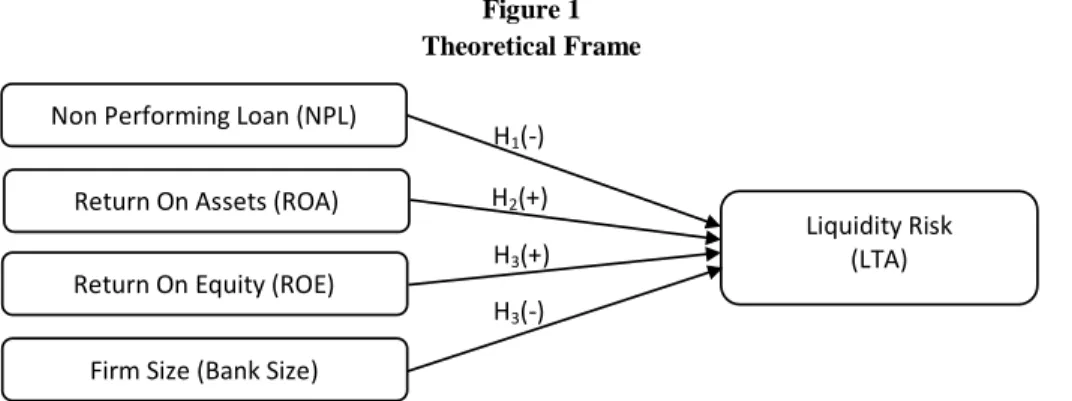
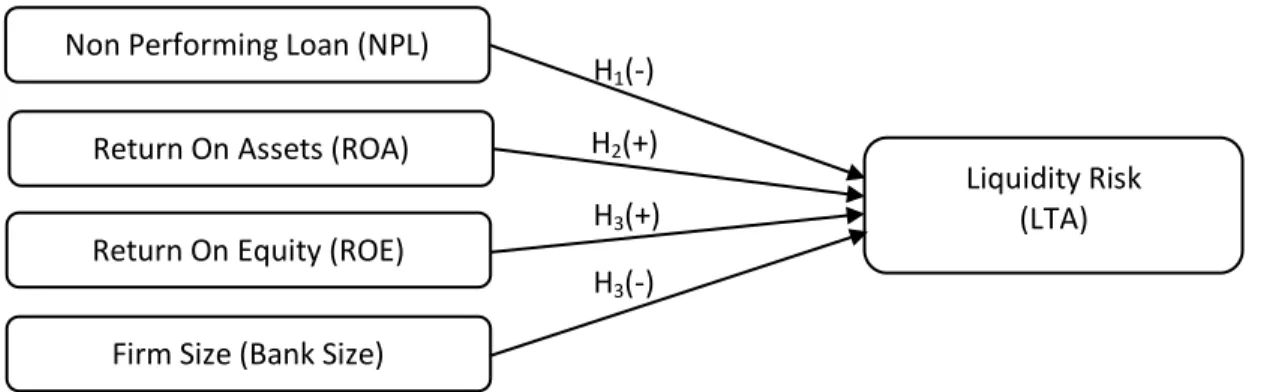
Based on the relationship of NPL, ROA, ROE and Size variables and theories related to variables, the theoretical frame of thought can be drawn as follows:
Figure 1 Theoretical Frame
Non Performing Loan (NPL)
Return On Assets (ROA)
Return On Equity (ROE)
Firm Size (Bank Size)
Liquidity Risk (LTA)
Source : Effendi and Disman (2017), Azhary and Muharam (2017), Bani and Yaya (2016), Sukmana and Suryaningtyas (2016), Ghenimi and Omri (2015), Rahman and Banna (2015), Roman and Sargu (2014), Muharam and Kurnia (2013), Abdullah and Khan (2012), Anam et all (2012), Iqbal (2016), Akhtar, Ali, and Sadaqat (2011)
RESEARCH METHODS Research Variables
This study put on 2 types of variables, namely dependent variables and independent variables. The dependent variable used is the liquidity effect as measured by wearing the LTA ratio. In contrast, the independent variables used in the study consisted of NPL, ROA, ROE and Firm Size.
Population
The population in this study consists of all banking industries, both state-owned banks and national private public banks in Indonesia registered with Bank Indonesia from 2016 to 2020.
Sample
The samples used in this research were selected using purposive sampling procedures.
Illustration retrieval method with purposive sampling procedure is an illustration retrieval method that is tried because it is sourced on the criteria that have been determined by researchers. After trying to select illustrations sourced on the criteria, 40 conventional banks that were listed on IDX from 2016 to 2020 passed the criteria.
Analysis Methods
The data in this study comes from secondary data sourced from Bloomberg as well as the annual report of each banking illustration in question obtained from the IDX website.
The analysis method used in this study is multiple linear regression, which is tested to pass classical assumptions with tests of normality, multicolonierity, autocorrelation and
heteroskedastisity. In this study, multiple regression equations are used as follows:
Y = α + β1X1 + β2X2 + β3X3 + β4X4 + β5X5 + e
Where, Y = dependent variable (liquidity risk), = constant, = multiple linear regression coefficient, = Non Performing Loan (NPL), =
Return On Asset (ROA), =Return On Equity (ROE),
= Firm Size (Bank Size), Error
RESULTS OF RESEARCH AND DISCUSSION Descriptive Statistical Analysis
Descriptive statistical analysis can be used as a basis in describing and describing a data from illustrations sourced on mean values, standard deviations, variants, maximum values, minimum values. Based on data obtained from Bloomberg and the annual report of each banking illustration in question obtained from the IDX website from 2016 to 2019. Until the results of the analysis for each variable LTA, NPL, ROA, ROE and size in conventional banks registered in IDX in 2016 to 2020 are as follows:
Table 1
Descriptive Statistical Analysis Descriptive Statistics
N Minimum Maximum Mean Std. Deviation
LTA (%) 160 6,35 37,50 15,4557 5,76066
NPL (%) 160 ,03 14,76 3,6875 3,54667
ROA (%) 160 -9,72 16,10 1,2434 2,49750
ROE (%) 160 -75,66 22,45 4,6557 15,42339
SIZE (Rupiah) 160 2.365.227.887 2.235.335.548.18 9
247.665.468.32 9
245.482.675.67 5 Valid N
(listwise) 160
Source: Secondary data processed by SPSS 24 Sourced in table 1 shows the number of observations on conventional banks registered with IDX in this study as many as 160 data illustrations. Not only that, the table also showed variables analyzed in the study consisting of LTA, NPL, ROA, ROE and size.
In table 1 dependent variable in this research is LTA has an average value of 15.
4557% with a standard deviation value of 5.76066. LTA has a minimum value of 6.35%
from the Central Java Regional Development Bank in 2017. On the contrary, the maximum value is 37.50% at Bank Central Asia Tbk in 2016.
Table 2
Determination Coefficient Test Results Model Summaryb
Descriptive Statistics
N Minimum Maximum Mean Std. Deviation
LTA (%) 160 6,35 37,50 15,4557 5,76066
NPL (%) 160 ,03 14,76 3,6875 3,54667
ROA (%) 160 -9,72 16,10 1,2434 2,49750
ROE (%) 160 -75,66 22,45 4,6557 15,42339
SIZE (Rupiah) 160 2.365.227.887 2.235.335.548.18 9
247.665.468.32 9
245.482.675.67 5 Valid N
(listwise) 160
Source: Secondary data processed by SPSS 24
Sourced in table 1 shows the number of observations on conventional banks registered with IDX in this study as many as 160 data illustrations. Not only that, the table also showed variables analyzed in the study consisting of LTA, NPL, ROA, ROE and size. In table 1 dependent variable in this research is LTA has an average
value of 15. 4557% with a standard deviation value of 5.76066. LTA has a minimum value of 6.35% from the Central Java Regional Development Bank in 2017. On the contrary, the maximum value is 37.50% at Bank Central Asia Tbk in 2016.
Table 3
Determination Coefficient Test Results Model Summaryb
Model Summaryb Model R R Square Adjusted R
Square
Std. Error of the Estimate
1 ,346a ,187 ,236 ,24335
a. Predictors: (Constant), SIZE, ROE, NPL, ROA b. Dependent Variable: LTA
Based on the results of the determination coefficient test (R^2) in table 2 indicates if the value of the adjusted coefficient of determination (Adjusted R Square) is 0.236. The subject indicates that
the ability of LTA dependent variables can be presented by independent variables NPL, ROA, ROE and SIZE of 23.6% and the remaining 76.4% influenced by other aspects.
Table 4
F Statistical Test Results ANOVAa
ANOVAa
Model Sum of Squares Df Mean Square F Sig.
1
Regression