Full Terms & Conditions of access and use can be found at
http://www.tandfonline.com/action/journalInformation?journalCode=vjeb20
Download by: [Universitas Maritim Raja Ali Haji] Date: 11 January 2016, At: 22:14
Journal of Education for Business
ISSN: 0883-2323 (Print) 1940-3356 (Online) Journal homepage: http://www.tandfonline.com/loi/vjeb20
Air Force Commanders and Barriers to Entry Into a
Doctoral Business Program
Tony Williams & Steven D. LeMire
To cite this article: Tony Williams & Steven D. LeMire (2011) Air Force Commanders and Barriers to Entry Into a Doctoral Business Program, Journal of Education for Business, 86:3, 140-147, DOI: 10.1080/08832323.2010.489589
To link to this article: http://dx.doi.org/10.1080/08832323.2010.489589
Published online: 24 Feb 2011.
Submit your article to this journal
Article views: 42
ISSN: 0883-2323
DOI: 10.1080/08832323.2010.489589
Air Force Commanders and Barriers to Entry Into a
Doctoral Business Program
Tony Williams
Air Command and Staff College, Maxwell Air Force Base, Alabama, USA
Steven D. LeMire
University of North Dakota, Grand Forks, North Dakota, USA
The authors examined professionally qualified Air Force commanders’ barriers to entry into a business doctoral degree program related to the factors of time, financial means, academics, and motivation. Of the 116 present commanders, 63% were interested in pursuing a doctorate in business. For the commanders interested in obtaining a doctorate degree in business, time was the largest barrier whereas financial, academics, and motivation were, on average, not found to be large barriers to entry. For the barrier of time, the commanders indicated a willingness to first sacrifice personal time and then family time to pursue the doctoral degree.
Keywords: Air Force commanders, business, doctoral program, entry barriers
In the present study we evaluated the barriers of time, finan-cial means, academic ability, and motivation for Air Force commanders entering doctoral business programs. By the end of their military careers, commanders have one or more master’s degrees and are professionally qualified to teach in university business schools. These commanders could be a source of qualified doctoral students in business. What is un-known is how these military officers view the barriers to entry into a business doctoral program and whether their barriers are similar to other potential PhD candidates. To address this question, we evaluated the impact of barriers of time, finan-cial means, academic ability, and motivation for Air Force commanders’ entry into doctoral business programs.
REVIEW OF LITERATURE
“The future of any academic discipline is dependent upon the supply of new scholars entering its ranks” (Wheeler, 1967, p. 35). From studies conducted between 1955 and 1975, 70% of graduate students expressed a desire to enter academia (Doctoral Faculty Commission, 2003; Wheeler). These results are dramatically different than that of
re-Correspondence should be addressed to Tony Williams, Air Command and Staff College, Department of Leadership & Strategy, 225 Chennault Circle, Room 187, Maxwell Air Force Base, AL 36112, USA. E-mail: [email protected]
cent history (1975–present), in which the average has been about 40% interest in college teaching (Doctoral Faculty Commission).
With increasing business school faculty member retire-ments, a decrease in the production of business doctoral degrees, and an ever-increasing number of schools offer-ing MBA programs, there is an identified need for addi-tional academically qualified faculty members. According to the Association to Advance Collegiate Schools of Business (AACSB) 2003 Report of the Doctoral Faculty Commission, there will be a shortage of at least 2,400 and possibly as many as 5,700 business doctoral faculty by 2012 (Doctoral Faculty Commission, 2003).
Among all majors, business undergraduates are least likely to attend graduate school and subsequently are less likely to enroll in doctoral programs (Zhang, 2005). Additionally, only a small number of students express an interest in a career in academia (Felbinger, Holzer, & White, 1999). According to the Graduate Enrollment and Degrees Report (Council of Graduate Schools, 2006), doctorate applications in business totaled 15,705, whereas the business schools themselves accepted only 2,849 doctoral students. At 18%, this was the lowest percentage of all degree programs. Of those who enroll in doctoral programs, fewer than one in ten obtain a doctorate (Zhang). Without finding a new source of qualified students, faculty recruitment continues to be a chronic problem for business schools.
BARRIERS TO PHD 141
There is one potential source of faculty members presently not being recruited to help fill this shortage. The population is highly qualified; many have multiple master’s degrees and at least 5 years of leadership experience in addition to a minimum of 3 years college teaching experience. The poten-tial faculty members are retiring Air Force Reserve Officer Training Corps (AFROTC) commanders. In order to reach this untapped source of potential doctoral business candi-dates, information is needed on what barriers are keeping them from pursuing doctoral degrees in business.
Previous research has identified barriers that keep grad-uate students from completing their doctoral degree. These barriers include age, gender, undergraduate GPA, and grad-uate admission test scores. Historically, most gradgrad-uate stu-dents came directly from the undergraduate ranks; they were 21–25 years old and unmarried (Berg & Ferber, 1983). How-ever, this demographic is changing. Research indicates that 60% of all graduate students were between 30 and 49 years of age (Dorn, Papalewis, & Brown, 1995; National Science Foundation, 2009; Snyder, Tan, & Hoffman, 2004). Addi-tional characteristics of those who completed their degree include gender and prior graduate experience (Allan & Dory, 2001; Baker, 1998; Fischer & Zigmond, 1998). According to the National Science Foundation (NSF), 73% of all 2008 re-search doctorate recipients had already earned a master’s de-gree, with men and women having a 58% and 55% PhD com-pletion rate, respectively. Hirt and Muffo (1998) described other barriers as financial issues, personal concerns, curric-ular requirements, and relationships with faculty. Based on the qualifications held by the AFROTC commanders these themes were used to inform a survey given to see which bar-riers exist for military commanders. For the purpose of this study, the barriers addressed were the personal concerns of time, financial means, academics, and motivation.
PERSONAL CONCERNS
Time
When examining the reasons why fewer students are com-pleting doctoral degrees, it seems intuitively obvious that the large time demand necessary for successful degree comple-tion is not compatible with full-time employment. The doc-toral experience normally begins with a very structured first few years of coursework and progresses to a less structured experience during the dissertation research process, both of which are time consuming (Katz, 1997).
According to the U.S. Bureau of Labor Statistics (2008), employed full-time workers between the ages of 25 and 54 years who lived in households with children under 18 years averaged 8.7 hr daily on work or work-related activities; 7.6 hr sleeping; 6.0 hr caring for others, eating, doing household activities, and exercising; leaving only 1.7 hr for anything else. Etzkowitz, Kemelgor, Neuschatz, and Uzzi (1992) and
Santiago and Einarson (1998) reported that graduate stu-dents often have external nonacademic responsibilities that hinder degree completion. Older graduate students typically have more competing demands (e.g., marriage, parenting, employment) on their time than younger students (Battle & Wigfield, 2003; Jacobs & King, 2002; Kluever, 1997). The more competing demands for individuals’ time usually leaves less time for studies, which in turn increases the probability of not being able to persist until completion (Jacobs & King; Stack, 2004).
Financial
As potential students decide whether to enroll in a doctoral program, two main financial concerns arise. The first finan-cial issue is the actual cost (tuition, fees, and books) of the program. The second financial concern is the ability of stu-dents to support themselves and their family while in school. Research shows that students decide about doctoral degree enrollment based on an assessment of the benefits and costs of enrollment (Jantzen, 2000; Kluever, 1997; Montgomery & Powell, 2006; Perna, 2004).
During the last decade, universities have seen slight in-creases in the contribution of gifts and endowments, but the increases have not been large enough to offset the gov-ernmental decreases (Britt, 2007; McPherson & Schapiro, 1996). One way universities are able to recoup the differ-ence is through tuition increases. These tuition increases have caused heightened concern about how to finance a doc-toral degree (McPherson & Schapiro). Tuition increases often result in students having to deplete their savings or take on additional debt. In 2005, the median amount borrowed by doctoral students was$44,733 (American Council on
Edu-cation, 2005). The potential to accumulate such a large debt has an adverse effect on graduate school enrollments. A study of 2,000 borrowers in 1998 by Baum and Schwartz (as cited in Millet 2003), found that 35% of individuals who decided not to go to graduate school indicated a concern over borrow-ing. It has been shown that enrollment is negatively affected by tuition costs, especially among minorities (Hirt & Muffo, 1998; Jantzen, 2000; Lang, 1992). Students select universi-ties to attend based on net costs (tuition costs minus financial aid) of program completion (Brewer, Eide, & Ehrenberg, 1999).
Academics
When students begin to make the determination about enter-ing graduate school, they consider their undergraduate ex-perience and GPA. However, it must be noted that graduate academic success and ability does not necessarily manifest itself in the form of GPA. Although studies have tried to link undergraduate GPA as a predictor of doctoral comple-tion, Attiyeh (1999) and others (Hurtado, Inkelas, Briggs, & Rhee, 1997; Zwick, 1991) have shown that undergraduate GPA is not a valid predictor of doctoral degree completion.
However, it has been shown that with a higher undergrad-uate GPA aspirations for a doctoral degree have increased (Walpole, 2006). Although undergraduate GPA may not be the best predictor of doctoral completion, already having at-tained a master’s degree does appear to be a good academic aptitude indicator of doctoral degree completion. Using the results of a 1998 longitudinal study, Attiyeh suggested that students who complete master’s degree programs are better prepared for the rigors and are more likely to persist in doc-toral programs. Baker (1998) also found that students who had already earned a master’s degree were more likely to complete doctoral degrees.
Students who have already earned a master’s degree tend to be older and more mature, and have a higher level of moti-vation. The increased levels of maturity and motivation older students bring to their educational endeavors may be due to their recognition of the importance obtaining the doctoral degree can have on their lives (Jacobs & King, 2002). This recognition can lead to higher persistence and completion rates. The strength of motivation for enrolling in a doctoral degree program should aid in the prediction of persistence and completion as well (Scott, Burns, & Cooney, 1998). In the case of Air Force commanders, all of them already have at least one master’s degree.
Motivation
Among the many reasons students decide to enroll in doc-toral programs, the majority of individuals cite at least one of the following: enjoyment of learning, enhanced social sta-tus, higher earning potential, better working conditions, or a lower probability of unemployment (Boshier, 1971; Perna, 2004). Whatever the reason for enrollment, it takes a lot of motivation and persistence to complete a doctorate. In fact, “to earn a doctorate, a student must find the time and moti-vation in nonworking hours to attend classes, read, research, and write papers” (Dorn et al., 1995, p. 305).
A high level of self-esteem is associated with high con-fidence levels (Leary, 2007). For students, a high level of self-esteem usually comes from previous academic successes fostered by their academic ability. It is the academic ability that influences the students’ assessment of their ability to complete a doctoral program (Perna, 2004). A lack of con-fidence in academic ability can manifest itself in failure to enroll in a doctoral program as well as failure to complete the degree. Approximately 50% of those individuals who drop out of doctoral programs do so within their first 2 years of graduate school (Ehrenberg & Mavros, 1995). Some of this high attrition can be attributed to the students in that they sometimes do not fully understand the substantial amounts of aptitude, time, and work effort demanded by doctoral pro-grams, which ultimately leads to lower levels of motivation (Grove, Dutkowsky, & Grodner, 2007).
It is widely known that doctoral programs are extremely demanding, thereby potentially causing academic burnout
and a decrease in motivation. According to the Council of Graduate Schools (2007), for those individuals who do com-plete a graduate degree, the median time spent enrolled as a graduate student has increased to 8 years. This increase in completion time can also have a negative impact on motiva-tion to enroll in a doctoral degree program. Addimotiva-tionally, the lack of structure in the dissertation phase has been shown to affect the motivation level of many students (Allan & Dory, 2001; Kluever, 1997). One way to aid in the motivation of students is for graduate programs to ensure that structures and policies are designed to promote student success (Hirt & Muffo, 1998; Seagram, Gould, & Pyke, 1998).
Graduate students who complete their degree in a timely fashion have some common characteristics. Among these characteristics is a strong internal desire to complete the pro-gram. This has a significant effect on motivation (Ivankova & Stick, 2007). Other research (Golde, 1998; Kluever, 1997) suggests students without this strong internal desire are likely to be less motivated to enroll and persistent in degree com-pletion.
AFROTC commanders presently teach at colleges and universities around the country. These commanders are qual-ified for graduate business programs; many have multiple master’s degrees and at least 5 years of leadership experience. Additionally, these commanders should have organizational skills necessary to successfully complete a doctoral degree if they have the desire to overcome entry barriers. Presently there are no studies assessing the entry barriers for doctoral business program for this population.
STATEMENT OF THE PROBLEM
The purpose of this study was to assess how Air Force com-manders feel about the barriers of time, financial means, academics, and motivation for pursuing a doctoral degree in business and to assess any difference in these factors with interest in pursuing a doctoral degree or not and teaching or not. We hypothesized that commanders who wish to obtain a doctoral degree would perceive the barriers to be lower than would those commanders who do not wish to obtain a doctoral degree.
Problem Significance
In order to succeed in obtaining a doctoral degree in business, a student has to overcome entry and completion barriers. En-try and completion barriers present challenges for students. However, entry barriers are the first screening process for po-tential candidates. Understanding the type of student who can become a successful research leader in business research and the potential barriers that could exclude the individual from pursuing a doctoral degree is fundamentally important. By investigating a population that is already professionally qual-ified to teach leadership courses in most business programs
BARRIERS TO PHD 143
and are likely near a midlife career change with retirement from the Air Force, we can gain important insight into bar-riers affecting potentially qualified candidates for doctoral business programs.
METHOD
Participants
The population sampled included approximately 50 colonels and 93 lieutenant colonels serving as detachment comman-ders at the AFROTC programs at colleges and universities across the United States who were assembled at the 2007 AFROTC Commanders Conference held in Atlanta, Georgia. To become a commander, the individual must meet a se-lection board comprising peers and superior officers from throughout the U.S. Air Force. The selection board looks at the academic credentials as well as the officer’s overall per-formance record as derived from his or her last five annual performance evaluations. All of the commanders selected have a minimum of one master’s degree.
Instrument
The one page survey captured demographic data as well as 13 questions related to the entry barriers of time, financial, academics, and motivation. Constructs were formed from the present body of literature that identified these constructs as barriers to entry of doctoral programs. The 6-point Likert-type scale after each question allowed the respondent to chose a response ranging from 1 (strongly disagree) to 6 (strongly agree).
Statistical Methods
Independent sample ttests were conducted to compare the outcomes. The dependent variables were interest in pursing a doctoral degree and interest in continuing to teach. The independent variables were time, financial, academics, and motivation. Each individual statistical tests was given a Type I error rate of .05.
Procedure
The survey was administered to 143 Air Force comman-ders at the annual AFROTC Commancomman-ders Conference. The purpose of the research was explained to the commanders, who were then asked to participate in completing the survey. The surveys and an associated Institutional Review Board informed consent form were distributed following a break between presentations. The participants were told not to put any personal identifying information on the survey and that their responses would be anonymous.
TABLE 1
Demographic Information of Sample (N=116)
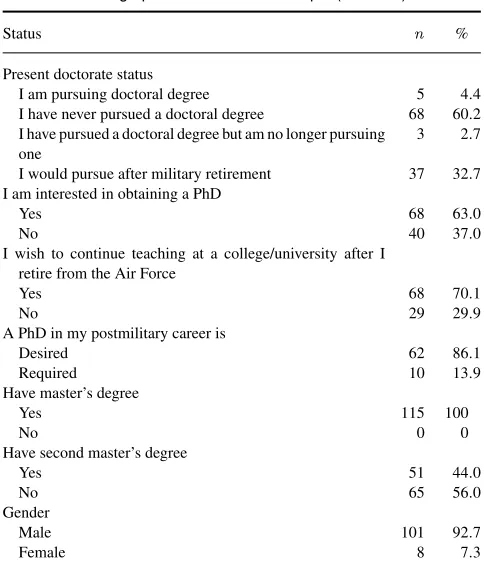
Status n %
Present doctorate status
I am pursuing doctoral degree 5 4.4 I have never pursued a doctoral degree 68 60.2 I have pursued a doctoral degree but am no longer pursuing
one
3 2.7 I would pursue after military retirement 37 32.7 I am interested in obtaining a PhD
Yes 68 63.0
No 40 37.0
I wish to continue teaching at a college/university after I retire from the Air Force
Yes 68 70.1
No 29 29.9
A PhD in my postmilitary career is
Desired 62 86.1
The survey return rate was 81% (116 out of 143 possible responses). As shown in Table 1, only 4.4% of these individ-uals were pursing a doctoral degree. We also see that 63% indicated interest in obtaining a PhD and 70.1% wished to continue teaching at a college or university after retiring from the Air Force. Of the respondents completing the surveys, 7.3% were women.
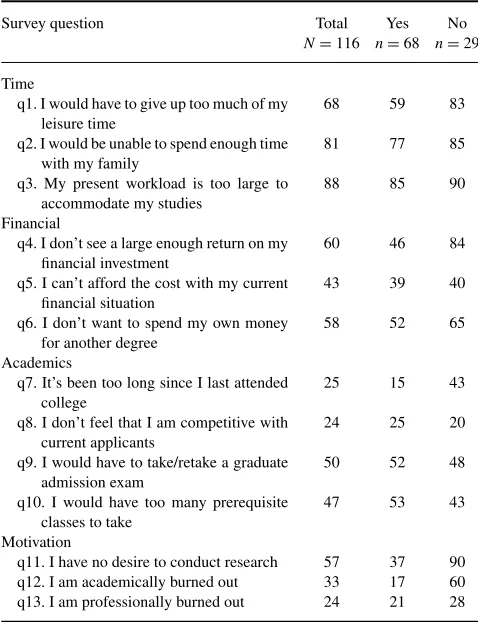
To investigate the individual questions for the barriers of time, financial, academic, and motivation, the percentages of some form of agreement (slightly agree, agree, strongly agree) for each of the items are shown in Table 2 for all of the individuals along with an additional breakdown for those individuals who indicated interest in obtaining a PhD (63%) or not obtaining a PhD (37%).
For the time barrier, the order as agreement of a barrier was consistently ranked from leisure to family to present workload. The largest difference between those interested in obtaining a PhD or not was in agreeing that they would have to give up too much leisure time, while the individuals interested in obtaining a PhD viewed this as less of a barrier. For the financial barrier, the largest difference between those interested in obtaining a PhD or not was for question 5, related to seeing a large enough return on their investment. Individuals interested in obtaining a PhD indicated a higher percentage of agreement that it would be a large enough
TABLE 2
Percentage of Some Form of Agreement (Slightly Agree, Agree, Strongly Agree) for All Individuals and
Individuals Interested or Not Interested in Obtaining a PhD
Survey question Total Yes No
N=116 n=68 n=29 Time
q1. I would have to give up too much of my leisure time
68 59 83
q2. I would be unable to spend enough time with my family
81 77 85
q3. My present workload is too large to accommodate my studies
88 85 90
Financial
q4. I don’t see a large enough return on my financial investment
60 46 84
q5. I can’t afford the cost with my current financial situation
43 39 40
q6. I don’t want to spend my own money for another degree
58 52 65
Academics
q7. It’s been too long since I last attended college
25 15 43
q8. I don’t feel that I am competitive with current applicants
24 25 20
q9. I would have to take/retake a graduate admission exam
50 52 48
q10. I would have too many prerequisite classes to take
47 53 43
Motivation
q11. I have no desire to conduct research 57 37 90 q12. I am academically burned out 33 17 60 q13. I am professionally burned out 24 21 28
return. As far as affording the present cost of earning a PhD, 43% indicated agreement.
For the academic barrier, the largest difference between those interested in obtaining a PhD or not was for question 7, with only 15% of those respondents interested in obtaining a PhD, agreeing that it has been too long since they had last at-tended college. Overall, about 25% of respondents indicated that they agreed that it had been too long since they attended college or that they felt that they would not be competitive with present applicants.
Some of the largest differences between those who were interested in obtaining a PhD and those who were not were in motivation. The largest percentage of some form of agree-ment difference was for question 11, which dealt with a desire to conduct research. Although only 37% of those indicating interest in obtaining a PhD agreed that they had no desire to conduct research, 90% of those who were not interested in obtaining a PhD indicated the same. Considering that a PhD is a research degree, this is a sound reason for lack of interest in obtaining a PhD. Another area in which there was a large difference between those interested in obtaining a PhD and those who were not was academic burnout. Whereas only
TABLE 3
Correlation of Subscale Constructs and Measures of Internal Consistency
Subscale Time Financial Academics Cronbach’sα
Time: q1, q2, q3 — .73
Financial: q4, q5, q6 .34 — .64 Academics: q7, q8, q9, q10 .15 .44 — .71 Motivation: q11, q12 ,q13 .36 .20 .35 .70
17% of individuals who indicated an interest in obtaining a PhD agreed to some form of academic burnout, 60% of those not interested in a PhD indicated some form of agreement to academic burnout. To further investigate the barrier dif-ferences for those interested in pursing a PhD, the individual items of each construct were averaged; the reliability coeffi-cients and the correlations between the constructs are shown in Table 3.
Table 4 shows the independent sample t tests for each of the barrier constructs for those interested in obtaining a PhD and those not interested. The only comparison that was not statistically significant was academics. The largest effect size for the statistically significant factors was for motivation followed by time and financial. As we saw in Table 2, the largest differences for those interested in obtaining a PhD or not occurred for those interested in doing research and academic burnout.
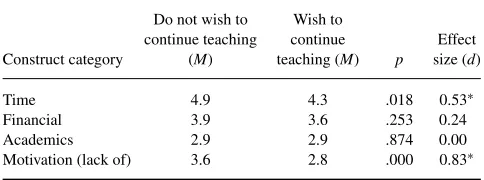
Table 5 shows the independent samplet tests for those interested in continuing teaching or not for each of the en-try barrier constructs. Both time and motivation were found to be statistically significant with the larger standardized ef-fect size for lack of motivation. Although only 7.3% of the respondents were women, comparisons were run between men and women for the four entry barriers constructs and no evidence of a difference in perception of barriers was found.
TABLE 4
Comparison Among Individuals Interested in Obtaining a PhD and Those Who Were Not
Construct category
Financial 4.0 3.4 .011 0.56∗
Academics 3.1 2.8 .131 0.33
Motivation (lack of) 3.8 2.6 .000 1.33∗
Note.For response to “I am interested in obtaining a PhD,” 1=strongly disagree, 6=strongly agree.
∗p<.05.
BARRIERS TO PHD 145
TABLE 5
Comparison Among Individuals Interested in Continuing Teaching and Those Who Were Not
Construct category
Financial 3.9 3.6 .253 0.24
Academics 2.9 2.9 .874 0.00
Motivation (lack of) 3.6 2.8 .000 0.83∗
Note.For response to “I wish to continue teaching at a college/university after I retire from the Air Force,” 1=strongly disagree, 6=strongly agree.
∗p<.05.
DISCUSSION
Findings
The results of the present study show that a substantial portion (63%) of present AFROTC Commanders would be interested in obtaining a doctoral degree in business, and a large por-tion (70%) would like to continue teaching at a college or university. For those interested in continuing to teach after retirement, time and lack of motivation were less of barriers in obtaining a doctorate degree than were those who did not wish to continue teaching. Time was rated highly as a barrier among those interested in obtaining a doctorate and those with no interest in obtaining a doctoral degree. Motivation was not rated highly as a barrier for those commanders in-terested in obtaining a doctoral degree, whereas it was rated highly as a barrier by those with no interest in obtaining a doctoral degree. Apathy toward conducting research was a major component of this lack of interest. Academics and finances were not rated high as barriers by either those com-manders interested or those comcom-manders with no interest in obtaining a doctoral degree.
We hypothesized that commanders who wished to obtain a doctorate would perceive the barriers to be lower than those who did not wish to obtain a doctoral degree. The results partially support our hypothesis in that those commanders who wish to obtain a doctoral degree viewed the barriers of time, finances, and motivation—but not academics—as less of a barrier than those commanders who do not wish to obtain a doctorate (see Table 4).
Time was shown to be a substantial barrier to earning a doctoral degree for the majority of survey participants, but it was more of a barrier for those not interested in obtaining a doctoral degree. These results are consistent with existing research for other potential students. Older students typically have more competing demands on their time (i.e., marriage, parenting, and employment) than do younger students (Battle & Wigfield, 2003; Jacobs & King, 2002). More demand for an individual’s time usually means less time for studies, which in turn increases the probability of not being able to persist
until completion (Jacobs & King; Stack, 2004). We found that time was a barrier for those interested in obtaining a PhD, but in order to overcome this barrier they were willing to first give up their own leisure time and then time with family.
The results of our study indicate that finances were not shown to be a large barrier to earning a doctoral degree for most commanders. These results are atypical accord-ing to Baker (1998), who found that students with loans, self-support, and tuition waivers were less likely to com-plete doctoral degrees. Additionally, in a study conducted at Boise State University on present graduate students and potential graduate students, Belcheir (1996) found that one of the biggest obstacles to degree completion was finances. Both present graduate students and recent graduates also re-ported that finances were one of the biggest obstacles to overcome (Belcheir). Financial support is reported to be one of the major stressors encountered by graduate students (Nonis, Hudson, Logan, & Ford, 1998; Rocha-Singh, 1994). Our study indicates that commanders would not have the fi-nancial barriers that typical graduate students face and, there-fore, would be desirable candidates to recruit into doctoral business programs.
Academic ability was not perceived as a barrier by either those commanders who wanted to obtain a doctoral degree or those who did not. For a student, a high level of self-esteem usually occurs due to previous academic successes fostered by their academic ability. Although an earned mas-ter’s degree does not prove the ability to succeed in a doctoral program, it is an indicator of having the capability to succeed in a doctoral program. It is academic ability that influences the student’s assessment of completing a doctoral program (Perna, 2004). Using the results of a 1998 longitudinal study, Attiyeh (1999) suggested that students who complete mas-ter’s degree programs are better prepared for the rigors and are more likely to persist in doctoral programs. Baker (1998) also found that students who had already earned master’s de-grees were more likely to complete doctoral dede-grees. These results are supported by the fact that 100% of respondents have one master’s degree and 44% have two, along with college teaching experience.
The largest difference in barriers for those interested in obtaining a PhD and those who were not interested was mo-tivation. It takes a lot of motivation and persistence to com-plete a doctorate. In fact, “to earn a doctorate, a student must find the time and motivation in nonworking hours to attend classes, read, research and write papers” (Dorn et al., 1995, p. 305). Motivation was perceived to be a barrier by those commanders who did not wish to obtain a PhD, whereas it was perceived as less of a barrier by those commanders who wished to obtain a PhD. These findings are consistent with prior research (Golde, 1998; Kluever, 1997) indicat-ing that internal motivation is a key to completion. Within the motivation barrier, the principal difference was interest in conducting research, with 90% of those individuals not
interested in obtaining a PhD agreeing that they had no de-sire to conduct research.
Conclusion
The results showed that a large percentage of commanders have a desire to obtain a PhD. The barrier for commanders most in agreement with the typical doctoral degree candi-date interested in obtaining a PhD was the barrier of time. An explanation for this could be that military commanders spend large amounts of time away from their families over the course of a career and would be seeking ways to spend more time with their families. Although time was a con-sistent barrier both for traditional graduate students and the commanders, the high degree of interest, strong internal mo-tivation, and minimal financial barrier coupled with a proven academic ability makes the commanders a desirable source of potential doctoral graduate students for business schools. With the potential shortage of doctoral business faculty estimated to be between 2,400 and 5,700 by 2012 (Doc-toral Faculty Commission, 2003) schools must find innova-tive ways to recruit qualified graduate business school candi-dates. The present Air Force commanders—as demonstrated by this research—are a potential source of qualified graduate business candidates. They have at least one master’s degree and are professionally qualified to teach business leadership courses within business departments.
REFERENCES
Allan, P., & Dory, J. (2001).Understanding doctoral program attrition: An empirical study. Unpublished manuscript.
American Council on Education. (2005). Federal student loan debt: 1993 to 2004 (Issue Brief). Retrieved from http:www.acenet.edu/ AM/Template.cfm?Section=Search§ion=issue briefs&template= /CM/ContentDisplay.cfm&ContentFileID=1128
Attiyeh, G. M. (1999).Determinants of persistence of graduate students in PhD programs. Princeton, NJ: Educational Testing Service.
Baker, J. G. (1998). Gender, race and PhD completion in natural science and engineering.Economics of Education Review,17, 179–188. Battle, A., & Wigfield, A. (2003). College women’s value orientations
to-ward family, career, and graduate school.Journal of Vocational Behavior,
62, 56–75.
Belcheir, M. J. (1996).A survey of present & potential graduate students
(ResearchReport 96–04). Boise, ID: Institutional Assessment, Boise State University.
Berg, H. M., & Ferber, M. A. (1983). Men and women graduate students: Who succeeds and why?The Journal of Higher Education,54, 629–648. Boshier, R. (1971). Motivational orientations of adult education partici-pants: A factor analytic exploration of Houle’s typology.Adult Education Quarterly,21(3), 3–26.
Brewer, D. J., Eide, E. R., & Ehrenberg, R. G. (1999). Does it pay to attend an elite private college? Cross-cohort evidence on the effects of college type on earnings.The Journal of Human Resources,34(1), 104–123. Britt, R. (2007).Universities report stalled growth in federal R&D funding
in FY 2006(NSF07–336). Arlington, VA: National Science Foundation. Council of Graduate Schools. (2006).Graduate enrollment and degrees:
1996–2006. Washington, DC: Author.
Council of Graduate Schools. (2007).Task force report on the professional doctorate. Washington, DC: Author.
Doctoral Faculty Commission. (2003).Sustaining scholarship in business schools: Report of the Doctoral Faculty Commission to AACSB Interna-tional’s board of directors. St. Louis, MO: Author.
Dorn, S. M., Papalewis, R., & Brown, R. (1995). Educators earning their doctorates: Doctoral student perceptions regarding cohesiveness and per-sistence.Education,116, 305–314.
Ehrenberg, R. G., & Mavros, P. G. (1995). Do doctoral students’ financial support patterns affect their times-to-degree and completion probabilities?
The Journal of Human Resources,30, 581–609.
Etzkowitz, H., Kemelgor, C., Neuschatz, M., & Uzzi, B. (1992). Athena un-bound: Barriers to women in academic science and engineering.Science and Public Policy,19, 157–179.
Felbinger, C. L., Holzer, M., & White, J. D. (1999). The doctorate in public administration: Some unresolved questions and recommendations.Public Administration Review,59, 459–464.
Fischer, B. A., & Zigmond, M. J. (1998). Survival skills for gradu-ate school and beyond.New Directions for Higher Education, 101, 29–40.
Golde, C. M. (1998). Beginning graduate school: Explaining first-year doctoral attrition. New Directions for Higher Education, 101, 55–64.
Grove, W. A., Dutkowsky, D. H., & Grodner, A. (2007).Survive then thrive: Talent, research motivation, and completing the economics PhD. Unpub-lished manuscript.
Hirt, J. B., & Muffo, J. A. (1998). Graduate students: Institutional climates and disciplinary cultures.New Directions for Institutional Research,98, 17–33.
Hurtado, S., Inkelas, K. K., Briggs, C., & Rhee, B. (1997). Differ-ences in college access and choice among racial/ethnic groups: Iden-tifying continuing barriers. Research in Higher Education, 38(1), 43–75.
Ivankova, N. V., & Stick, S. L. (2007). Students’ persistence in a dis-tributed doctoral program in educational leadership in higher educa-tion: A mixed methods study. Research in Higher Education, 48(1), 93–135.
Jacobs, J. A., & King, R. B. (2002). Age and college completion: A life-history analysis of women aged 15–44.Sociology of Education, 75, 211–230.
Jantzen, R. H. (2000). Price and quality effects on the demand for U.S. grad-uate business programs.International Advances in Economic Research,
6, 730–740.
Katz, E. L. (1997). Key players in the dissertation process.New Directions for Higher Education,99, 5–16.
Kluever, R. C. (1997). Students’ attitudes toward the responsibilities and barriers in doctoral study. New Directions for Higher Education,99, 47–56.
Lang, M. (1992). Barriers to Blacks’ educational achievement in higher education: A statistical and conceptual review.Journal of Black Studies,
22, 510–522.
Leary, M. R. (2007). Motivational and emotional aspects of the self.Annual Review of Psychology,58, 317–344.
McPherson, M. S., & Schapiro, M. O. (1996, January).Are we keeping college affordable? Student aid, access, and choice in American higher education(Discussion Paper No. 34). Paper prepared for The Princeton Conference on Higher Education, Princeton, NJ.
Millet, C. (2003). How undergraduate loan debt affects application and enrollment in graduate or first professional school.The Journal of Higher Education,74, 386–427.
Montgomery, M., & Powell, I. (2006). The effect of tuition and opportunity cost on the pursuit and completion of a graduate management degree.
Journal of Education for Business,81, 190–200.
National Science Foundation. (2009).Doctorate recipients from U.S. univer-sities: Summary report 2007–08(SpecialReport NSF 10–309). Arlington, VA: Author.
BARRIERS TO PHD 147 Nonis, S. A., Hudson, G. I., Logan, L. B., & Ford, C. W. (1998).
Influence of perceived control over time on college students’ stress and stress-related outcomes. Research in Higher Education, 39, 587–605.
Perna, L. W. (2004). Understanding the decision to enroll in graduate school: Sex and racial/ethnic group differences.The Journal of Higher Education,
75, 487–527.
Rocha-Singh, I. A. (1994). Perceived stress among graduate students: De-velopment and validation of the graduate stress inventory.Educational and Psychological Measurement,54, 714–727.
Santiago, A. M., & Einarson, M. K. (1998). Background characteristics as predictors of academic self-confidence and academic self-efficacy among graduate science and engineering students.Research in Higher Education,
39, 163–198.
Scott, C., Burns, A., & Cooney, G. (1998). Motivation for return to study as a predictor of completion of degree amongst female mature students with children.Higher Education,35, 221–239.
Seagram, B. C., Gould, J., & Pyke, S. W. (1998). An investigation of gender and other variables on time to completion of doctoral degrees.Research in Higher Education,39, 319–335.
Snyder, T. D., Tan, A. G., & Hoffman, C. M. (2004).Digest of education statistics 2003. Washington, DC: U.S. Department of Education, Institute of Education Sciences.
Stack, S. (2004). Gender, children and research productivity.Research in Higher Education,45, 891–920.
U.S. Bureau of Labor Statistics. (2008).American time use survey summary. Washington, DC: Author.
Walpole, M. B. (2006). Emerging from the pipeline: African American students, socioeconomic status, and college experiences and outcomes.
Research in Higher Education,49, 237–255.
Wheeler, J. T. (1967). Doctorates in business administration: A demand and supply analysis.California Management Review,10(1), 35–50. Zhang, L. (2005). Advance to graduate education: The effect of college
quality and undergraduate majors.The Review of Higher Education,28, 313–338.
Zwick, R. (1991, May).An analysis of graduate school careers in three uni-versities: Differences in attainment patterns across academic programs and demographic groups (GRE Board Professional Report No. 86-21P). Princeton, NJ: Educational Testing Service. (ERIC Document Reproduc-tion Service No. ED386475)