Adsorption of β-Carotene in Isopropyl Alcohol with Decolorized Activated Carbon
as Model for β-Carotene Adsorption in Crude Palm Oil
Maria Ulfah
1,*, Sri Raharjo
2, Pudji Hastuti
2, and Purnama Darmadji
2 1Department of Agricultural Technology, Institute of Agriculture STIPER, Jl. Nangka II, Maguwoharjo, Depok, Sleman 55282, Yogyakarta, Indonesia 2
Department of Food and Agricultural Product Technology, Faculty of Agricultural Technology, Universitas Gadjah Mada, Jl. Flora No. 1, Bulaksumur, Yogyakarta 55281, Indonesia
Received October 15, 2016; Accepted January 12, 2017
ABSTRACT
The objective of this research was to characterize the porosity of decolorized activated carbon (DAC) and its
ability to adsorb β-carotene as a preliminary study to characterize activated carbon as an adsorbent to adsorb carotene from crude palm oil. The capability of DAC to adsorb β-carotene was studied using isopropyl alcohol as a
solvent in equilibrium conditions. The adsorption time was specified for 0.5 to 60 min, while the DAC optimum
concentration for adsorption of β-carotene was determined at a concentration of 0.5 to 2.5%. Adsorption isotherm study was conducted for a β-carotene concentration of 100 to 500 ppm and at temperatures of 30, 40 and 50 °C at
equilibrium time and DAC optimum concentration. The results showed that the DAC had a surface area of 1068.391 m2/g, total pore volume of 0.952 cc/g, mesopore volume of 0.528 cc/g (55.4%) and mesopore radius of 15.26 Å.
Based on the levels of β-carotene adsorbed onto the DAC, the equilibrium was reached after adsorption of 5 min. Decolorized activated carbon with a concentration of 1.5% was able to adsorb carotene optimally. Adsorption of
β-carotene at 40 °C for 60 min according to Freundlich models with the intensity of adsorption of 1.002 and adsorption
capacity of 63.358 L/mg. While the adsorption of β-carotene at 50 °C for 60 min in accordance with the model of
Langmuir, the adsorption capacity of 33.206 mg/g and the Langmuir adsorption equilibrium constant of 1.721 L/mg.
Keywords:β-carotene; decolorized activated carbon; porosity; adsorption isotherm
ABSTRAK
Tujuan dari penelitian ini adalah untuk mengkarakterisasi porositas decolorized activated carbon (DAC) dan
kemampuannya untuk mengadsorpsi β-karoten sebagai studi awal karakterisasi karbon aktif yang akan digunakan sebagai adsorbent β-karoten minyak sawit kasar. Kemampuan DAC dalam mengadsorpsi β-karoten dipelajari
menggunakan isopropil alkohol sebagai pelarut pada kondisi keseimbangan. Waktu adsorpsi ditentukan selama
0,5-60 menit, sedangkan konsentrasi DAC optimum untuk adsorpsi β-karoten ditentukan pada konsentrasi 0,5-2,5%. Studi adsorpsi isotermal dilakukan pada konsentrasi β-karoten 100-500 ppm dan suhu 30, 40 and 50 °C pada waktu
keseimbangan dan konsentrasi karbon aktif optimum. Hasil penelitian menunjukkan bahwa DAC memiliki luas permukaan 1068,391 m2/g, volume pori total 0,952 cc/g, volume mesopore 0,528 cc/g (55,4%) dan radius mesopore
15,26 Å. Berdasar kadar β-karoten yang terjerap ke permukaan pori DAC, keseimbangan tercapai setelah 5 menit adsorpsi. Decolorized activated carbon pada konsentrasi 1,5% mampu mengadsorpsi β-karoten secara optimal. Adsorpsi β-karoten pada suhu 40 °C selama 60 menit, sesuai model Freundlich dengan intensitas adsorpsi 1,002 dan kapasitas adsorpsi Freundlich 63,358 L/mg. Sedangkan adsorpsi β-karoten pada suhu 50 °C selama 60 menit,
sesuai model Langmuir dengan kapasitas adsorpsi sebesar 33,206 mg/g dan adsorpsi Langmuir pada keseimbangan konstan sebesar 1,721 L/mg.
Kata Kunci:β-karoten; decolorized activated carbon; porositas; adsorpsi isotermal
INTRODUCTION
Crude palm oil (CPO) contains β-Carotene as much as 630-700 ppm [1]. In physical refining, approximately 20% of carotenoids are lost after the bleaching process and up to 98% are lost after
carotenoids from CPO prior to physical refining is deemed necessary.
Several methods have been developed to recover carotenoids from CPO. These methods include the saponification method, selective solvent extraction, transesterification followed by molecular distillation and adsorption using a synthetic resin, silica gel and reverse phase C18 silica, adsorption chromatography and membrane technology [9]. β-Carotene adsorption models using carbon coated monolith has been done by Muhammad et al. [10]. β-carotene was dissolved in isopropyl alcohol at 50 °C with maximum β-carotene adsorption capacity of 22.37 mg/g. According to Baharin et al. [11], isopropyl alcohol (IPA) can dissolve the CPO completely at 50 °C and less able to dissolve β-carotene. Therefore, isopropyl alcohol is suitable solvent for CPO, while the carotenoids were adsorbed onto the adsorbents, including activated carbon.
β-Carotene is a non-polar molecule with a total length of 3.8 nm and a height of ≈ 0.5 nm [12] so that mesoporous activated carbon (2-50 nm in diameter) with an optimum surface area could effectively adsorb β-carotene. Decolorized activated carbon (DAC) from Sigma is one of the adsorbents can be used to decolorize liquids. The DAC characteristics which include the pattern of N2 adsorption isotherms and Brunauer-Emmet-Teller (BET) surface area had been published [13]. The pattern of N2 adsorption isotherms indicated that the DAC has a lot of mesopore with a BET surface area of 1068.391 m2/g, but mesoporosity and surface functional groups of DAC have not been published. The potency of DAC to adsorb of β-carotene had been studied [13]. The DAC can adsorb β-carotene up to 21.56 mg/g. While equilibrium time and optimum DAC concentration were used to adsorb β-carotene and pattern of adsorption isotherm of β-carotene have not been published.
The aims of this study were to characterize the mesoporosity and surface functional groups of decolorized-activated carbon (DAC) and to determine the pattern of adsorption isotherms of β-carotene at equilibrium.
EXPERIMENTAL SECTION
Materials
β-Carotene and decolorized activated carbon (DAC) were obtained from Sigma-Aldrich; isopropyl alcohol (IPA) and n-hexane from Merck; nitrogen gas (high purity) from Samator Indonesia.
Instrumentation
Quantacrome NovaWin2-NOVA Instrument was used to analyze the porosity of DAC; Scanning Electron Microscopy (SEM) (JEOL JSM-6510LA) was used to evaluate the microstructure of DAC; Fourier Transform infrared spectrometer (FTIR) (Horizon MB 3000) was used to analyze surface functional groups of DAC. An adsorption-desorption batch reactor equipped with a vacuum outlet, N2gas inlet and stirring hot plate (Thermo Scientific CimarecTM) was used. A centrifuge (Hettich EBA Zentrifugen 20) was used to separate the filtrate from DAC after adsorption-94 desorption process. The concentration of β-carotene was analyzed by UV-Vis Spectrophotometer (Shimadzu UVmini 1240).
Procedure
Porosity characterization of DAC
Porosity characteristics of DAC were analyzed by N2 adsorption-desorption at 77.3 K and relative pressure (P/Po) from 0,005 to 0.999 using a surface area analyzer. Textural characteristics of DAC include surface area and total pore volume was determined by Brunauer-Emmet-Teller (BET) method, mesopore size distribution was determined by Barret-Joyner-Halenda (BJH) method.
Estimation of DAC surface functional groups Surface functional groups of DAC was estimated based on the transmittance spectrum of the organic components produced using a Fourier transform infrared spectrometer/FTIR. The spectra were recorded from 4000 to 500 cm-1. By comparison to the standard frequency patterns, various characteristic chemical bonds were determined, from which certain surface functional groups could be derived.
Surface physical morphology observation of DAC The surface physical morphology of the DAC was observed using Scanning Electron Microscopy (SEM)
Determination of equilibrium time of β-carotene
adsorption onto the DAC
A stock solution of β-carotene (500 mg/L) was prepared by dissolving β-carotene in IPA. Aliquots of 50 mL of β-carotene solution were prepared for adsorption of β-carotene for 0.5, 5, 10, 15, 20, 30, 40 and 60 min. The β-carotene solution for each treatment was put into a 125 mL conical flasks and DAC was added as much as 1%. The adsorption process was performed under a nitrogen atmosphere. The flask was plugged with a rubber stopper and wrapped with aluminum foil to minimize β-carotene degradation by oxygen or light. Batch adsorption was performed on a hot plate and stirring at 150 rpm and 50 °C for a specified time to obtain equilibrium time adsorption.
The filtrate was separated from DAC by centrifugation at 3500 rpm for 5 min after adsorption process was completed. β-carotene filtrate content was analyzed using the method from Palm Oil Research Institute of Malaysia (PORIM) [14]. Approximately 1 g of the filtrate was put into a 25 mL flask and diluted using n-hexane. The absorbance of the solution was measured using a spectrophotometer at a wavelength of 446 nm. The content of β-carotene can be calculated by the following formula:
Total carotenoids pp 25 383 A 0
where 25 is the volume used for analysis, 383 is the extinction coefficient for carotenoids, Abs is the absorbance of the sample and W is the sample weight in grams.
Determination of optimum concentration of DAC for
adsorption of β-carotene
Carotene solution prepared for adsorption of β-carotene at concentration of DAC (0.5, 1.0, 1.5, 2.0, and 2.5%) respectively of 50 mL taken from a stock solution of β-carotene (500 mg/L). The optimum concentration of DAC for adsorption of β-carotene was characterized by the amount of β-carotene was adsorbed onto the DAC during equilibrium time is not increasing anymore.
Adsorption isotherms study
β-Carotene were dissolved in isopropyl alcohol to obtain β-carotene concentrations 100, 200, 300, 400 and 500 mg/L. Aliquots of 50 mL from each concentration were put into a 125 mL conical flasks. Decolorized activated carbon was added at optimum concentration, adsorption process carried out during equilibrium time. The adsorption process was performed at temperatures of 30, 40 and 50 °C. After equilibrium was reached, the filtrate was separated from DAC and β-carotene content was analyzed.
Adsorption capacity at equilibrium can be calculated by the following formula from Muhammad et al. [10] as follows:
where qe is adsorption capacity at equilibrium phase (mg/g), Co is the initial concentration in the liquid phase (mg/L), Ce is the liquid phase concentration at the equilibrium (mg/L ), V is the volume of liquid (L), and m is the mass of activated carbon (g).
Adsorption isotherms study was conducted using Langmuir and Freundlich models. The Langmuir model according to Wu et al. [24], can be represented in linear form as:
1 1 1 1
qebKb Ce b (3)
where b is the Langmuir constant, which is equal to the adsorption capacity [24] or monolayer capacity of adsorbent (mg/g) [10]. The parameter Kb represents the Langmuir adsorption equilibrium constant (L/mg) and Ce is the equilibrium concentration of β-carotene in the liquid phase (mg/L). Constant Kb and b can calculate from the slope and intercept of the straight line by plotting 1/Ce versus 1/qe [10].
Freundlich model assumes that uptake or adsorption of adsorbate occurs on the heterogeneous surface by monolayer adsorption. Freundlich model was described by the following equation [24]:
1 nwhere Kf is Freundlich constant that can be related to the adsorption capacity (L/mg), n is adsorption intensity [24] or heterogeneity factor [9]. Value 1/n is in the range of 0.1–1.0. The adsorption intensity (1/n) and Freundlich constants (Kf) were obtained from slope and intercept of the straight line by plotting of log qe versus log Ce, respectively [10,24].
RESULT AND DISCUSSION
Porosity Characteristics of DAC
Porosity characteristics of DAC include the pattern of N2 adsorption isotherms and surface area of DAC had been published [13]. From the pattern of N2 adsorption isotherms showed a mix of type I and IV isotherm, characterizing the micro- and mesopores. The formation of hysteresis loops at a relative pressure at higher than 0.4 indicates the essential multilayer adsorption process characterizing the mesoporous structures.
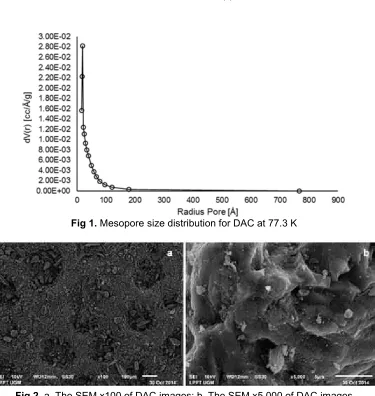
Fig 1.Mesopore size distribution for DAC at 77.3 K
Fig 2.a. The SEM x100 of DAC images; b. The SEM x5.000 of DAC images
area is 275.431 m²/g and mesopore volume is 0.528 cc/g (55.4%).
Surface Physical Morphology of DAC
Scanning Electron Microscopy (SEM) was used to observe the surface physical morphology of the sample. Fig. 2 shows the SEM images of the microstructure of DAC. The SEM image (Fig. 1a and 1b) show that the DAC have a high porosity.
Surface Functional Groups of DAC
Fig. 3 shows the FTIR spectra of DAC to estimated surface functional groups on pore surface of DAC. Surface functional groups of DAC based on FTIR transmittance spectra consists of NH stretch in amine hydrohalide or P-H in phosphine (2360 cm-1) [15], C-H stretch in ester (1731 cm-1), N-H bend in primary amine (1569 cm-1), carbonate ion (1423 cm-1), C-N stretch in primary amine (1056 and 1037 cm-1), C-H bend in alkyne
(875 cm-1) [16] and C-I stretch in aliphatic iodo compounds (559 and 516 cm-1) [15].
Equilibrium Time of β-Carotene Adsorption onto
the DAC
Fig 3.Spectra FTIR of decolorized activated carbon
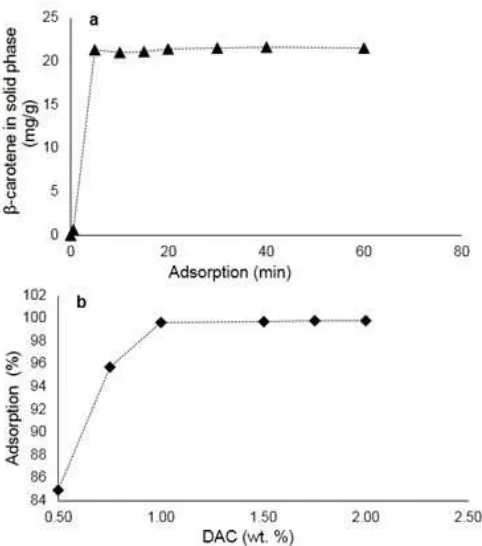
Fig 4. a). Concentrations of β-carotene in the solid phase (the DAC) after adsorption at a different time; b). Adsorption of β-carotene onto DAC at the different DAC concentration
from the surface of a particle (such as activated carbon) to get inside the particles.
The high adsorption of β-carotene onto DAC related to the mesoporosity level of the DAC which reaches up to 55.4%. Size distribution of micro- and mesopore DAC influencing of adsorption capacity. The high mesopore degree important to select the activated carbon type in order to adsorb contaminants from the
liquid phase [19-20]. Activated carbon has a specific surface area, surface reactivity was high and porous structure, so it is good as an adsorbent to remove organic components of the wastewater [21]. Mesoporous activated carbon is very important in decolorization technology [20].
Optimum Concentration of DAC for Adsorption of
β-Carotene
The optimum concentration of the DAC for adsorbing β-carotene was reached when the percentage of β-carotene adsorbed onto the DAC was constant. The percentage of β-carotene adsorbed onto the DAC is presented in Fig. 4b.
Fig. 4b shows that increasing of DAC concentrations can increase the amount of β-carotene was adsorbed and constant at 1.5%. The concentration of DAC higher than 1.5% is not able to absorb more a lot of carotene, this was caused the amount of β-carotene have maximum adsorbed onto the pore surface of DAC. According to Karabulut et al. [22], the increase of activated carbon dosage provides more surface area for adsorption, but at a certain dosage was slow and subsequently is constant. Sabah et al. [23] reported that dosage of 1% activated sepiolite could adsorb β-carotene more efficient, this caused the active centers of pore the activated carbon most occupied by molecules of β-carotene.
Adsorption Isotherms
Fig 5. Langmuir isotherm for adsorption of β-carotene onto the DAC (adsorbent mass: 1.5 wt.%; β-carotene concentrations: 100-500 mg/L; adsorption time 30 min)
Fig 6. Freundlich isotherm for adsorption of β-carotene onto the DAC (adsorbent mass: 1.5 wt.%; β-carotene concentrations: 100-500 mg/L; adsorption time 30 min)
Table 1.Langmuir and Freundlich isotherm parameters and correlation coefficients for adsorption of β-carotene onto the DAC at different temperatures
Isotherms Parameters 30 °C 40 °C 50 °C
b (mg/g) 38.160 -2897.460 33.206
Kb (L/mg) 0.692 -0.022 1.721
Langmuir
R2 0.800 0.999 0.969
Kf (L/mg) 14.514 63.358 22.673
1/n 0.544 1.002 0.609
Freundlich
R2 0.709 0.999 0.875
adsorbed adsorbate [24]. Langmuir equation was based on the assumption that maximum adsorption corresponds to a saturated monolayer of solute on specific homogenous sites of the adsorbent surface containing a finite number of identical sites. The energy of adsorption was constant, and there was no transmigration of the adsorbate in the plane of the surface [25].
Plots of 1/Ce vs.1/qe and log qe vs. log Ce evaluated Langmuir and Freundlich isotherms of DAC were shown in Fig. 5 and 6, respectively. Langmuir and Freundlich constants and correlation coefficient for adsorption of β-carotene onto DAC were summarized in Table 1.
Fig 7.Adsorption of β-carotene onto the DAC (adsorbent mass: 1.5 wt.%; β-carotene concentrations: 100-500 mg/L; adsorption time 30 min)
not applicable because of the R2 value smaller than the R2at 50 °C. The R2for Langmuir isotherm highest at 40 °C, but because b value is negative, so Langmuir isotherm model is not suitable for 40 °C. β-Carotene adsorption at 40 °C is suitable with Freundlich model, but tend linear. β-Carotene adsorption was recommended at 50 °C because had the R2 value is higher than the R2 at 30 °C and 1/n<1. According to Fettaouche et al. [26], the value of 1/n<1 indicate that adsorption of dye on adsorbent is reactive and favorable. Adsorption of β-carotene onto the DAC is shown in Fig. 7. It shows that β-carotene was adsorbed slowly onto the pores of DAC at 30 °C, whereas quickly at 50 °C. According to Muhammad et al. [10], adsorption of β-carotene increased with the increase of the temperature. This result suggested that the intra-particle diffusion rate of adsorbate molecules onto the pores increased with increasing the temperature since diffusion was an endothermic process.
CONCLUSION
The activated carbon prepared from decolorized activated carbon (DAC) had a surface area up to 1068.391 m2/g and mesopore volume/total pore volume as much as 55.4%. The DAC had potential as an adsorbent for adsorption of β-carotene. Adsorption of the β-carotene onto DAC was recommended to be performed at 50 °C for 30 min.
ACKNOWLEDGEMENT
This research was supported by Research Grant 2015 (Contract Number: 75/LPPM/2015) administered by Universitas Gadjah Mada under the Ministry of Research, Technology, and Higher Education, Republic of Indonesia.
REFERENCES
[1] Zeb, A., and Mehmood, S., 2004, Carotenoids Contents from Various Sources and Their Potential Health Applications, Pak. J. Nutr., 3 (3), 199–204.
[2] Silva, S.M., Sampaio, K.A., Ceriani, R., Verhé, R., Stevens, C., Greyt, W.D., and Meirelles, A.J.A., 2013, Adsorption of carotenes and phosphorus from palm oil onto acid activated bleaching earth: Equilibrium, kinetics and thermodynamics,J. Food Eng., 118 (4), 341–349.
[3] Terao, J., Minami, Y., and Bando, N., 2011, Singlet molecular oxygen-quenching activity of carotenoids: relevance to protection of the skin from photoaging, J. Clin. Biochem. Nutr., 48 (1), 57–62.
[4] Ariviani, S., Raharjo, S., and Hastuti, P., 2011, Potensi mikroemulsi β-karoten dalam menghambat fotooksidasi vitamin c sistem aqueous, Jurnal Teknologi dan Industri Pangan, 22, 33–40.
[5] Ariviani, S., Raharjo, S., Hastuti, P., 2011, Aplikasi mikroemulsi β-karoten untuk menghambat kerusakan fotooksidatif vitamin c pada sari buah jeruk,Agritech, 31 (3), 180–189.
[6] Zeb, A., 2011, Effects of β-carotene on the thermal oxidation of fatty acids,Afr. J. Biotechnol., 10 (68), 15346–15352.
[7] Tang, G., 2010, Bioconversion of dietary provitamin A carotenoids to vitamin A in humans, Am. J. Clin. Nutr., 91 (5), 1468S–1473S.
[9] Othman, N., Manan, Z.A., Alwi, S.R.W., and Sarmidi, M.R., 2010, A review of extraction technology for carotenoids and vitamin e recovery from palm oil,J. Appl. Sci., 10 (12), 1187–1191. [10] Muhammad, Choong, T.S.Y., Chuah, T.G., Yunus,
R., and Yap, Y.H.T., 2010, Adsorption of β-carotene onto mesoporous carbon coated monolith in isopropyl alcohol andn-hexane solution: equilibrium and thermodynamic study, Chem. Eng. J., 164 (1), 178–182.
[11] Baharin, B.S., Rahman, K.A., Karim, M.I.A., Oyaizu, T., Tanaka, K., Tanaka, Y., and Takagi, S., 1998, Separation of palm carotene from crude palm oil by adsorption chromatography with a synthetic polymer adsorbent,J. Am. Oil Chem. Soc., 75 (3), 399–404. [12] Barό, A.M., Hla, S.W., and Rieder, K.H., 2003,
LT-STM study of self-organization of β-carotene molecular layers on Cu (1 1 1),Chem. Phys. Lett., 369 (1-2), 240–247.
[13] Ulfah, M., Raharjo, S., Hastuti, P., and Darmadji, P., The potential of palm kernel shells activated carbon as an adsorbent for β-carotene recovery from crude palm oil, 2016,AIP Conf. Proc., 1755 (1), 130016. [14] Dauqan, E.M.A., Sani, H.A, Abdullah, A., and
Kasim, Z.M., 2011, Fatty acids composition of four different vegetable oils (red palm olein, palm olein, corn oil and coconut oil) by gas chromatography, International Proceedings of Chemical, Biological and Environmental Engineering (IPCBEE), International Association of Computer Science and Information Technology (IACSIT) Press, Singapore, 31–34.
[15] Lambert, J.B., Shurvell, H.F., Cooks, R.G., 1987, Introduction to Organic Spectroscopy, 1st ed., Macmillan Publication, New York.
[16] Coates, J., 2000, “Interpretation of infrared spectra, a practical approach” in Encyclopedia of Analytical Chemistry, Meyers, R.A. (Ed.), John Wiley & Sons Ltd., Chichester, 10815–10837.
[17] Muslich, Suryadarma, P., and Hayuningtyas, R.I.R., 2009, Kinetika adsorpsi isotermal β-karoten dari olein sawit kasar dengan menggunakan bentonit, Journal Teknologi Industri Pertanian, 19 (2), 93–100.
[18] Ferhan Çeçen, F., and Aktaş, Ö, 2011, Activated Carbon for Water and Wastewater Treatment: Integration of Adsorption and Biological Treatment, Wiley-VCH Verlag GmbH & Co. KGaA, Germany. [19] Mak, S.M., Tey, B.T., Cheah, K.Y., Siew, W.L.,
and Tan, K.K., 2009, Porosity characteristics and pore developments of various particle sizes palm kernel shells activated carbon (PKSAC) and its potential applications, Adsorption, 15 (5), 507–519.
[20] Lim, W.C., Srinivasakannan, C., and Balasubramanian, N., 2010, Activation of palm shells by phosphoric acid impregnation for high yielding activated carbon,J. Anal. Appl. Pyrolysis, 88 (2), 181–186.
[21] Okoniewska, E., Lach, J., Ociepa, E., and Stępniak, L., 2013, Removal of selected organic compounds on modified activated carbons, Environ. Prot. Eng., 39 (2), 135–144.
[22] Karabulut, I., Topcu, A., Akmil-Basar, C., Onal, Y., and Lampi, A.M., 2008, Obtaining butter oil triacylglycerols free from ß-carotene and -tocopherol via activated carbon adsorption and alumina-column chromatography treatments, J. Am. Oil Chem. Soc., 85 (3), 213–219.
[23] Sabah, E., Ҫinar, M., and Ҫelik, M.S., 2007, Decolorization of vegetable oils: Adsorption mechanism of β-carotene on acid-activated sepiolite,Food Chem., 100 (4), 1661–1668.
[24] Wu, X.W., Ma, H.W., Zhang, L.T., and Wang, F.J., 2012, Adsorption properties and mechanism of mesoporous adsorbents prepared with fly ash for removal of Cu(II) in aqueous solution, Appl. Surf. Sci., 261, 902–907.
[25] Badr, N., and Al-Qahtani, K.M., 2013, Treatment of wastewater containing arsenic using Rhazya stricta as a new adsorbent, Environ. Monit. Assess., 185 (12), 9669–9681.