ASSESSING THE INFLUENCE OF INITIAL MOISTURE CONTENT AND DENSITY ON RUBINATE UPTAKE BY MICROWAVE-DRIED
SITKA SPRUCE WOOD
(Uji Pengaruh Kadar Air Awal dan Kerapatan Kayu terhadap Penyerapan
Rubinate oleh Sitka Spruce yang Dikeringkan dengan Energi Mikrowave)1
Karnita Yuniarti
The data used in the paper were collected during the involvement of 1st author in Sitka Spruce project at University of Melbourne and funded by CRC for Wood Innovation
2 Center for Forest Products Research and Development, Bogor
3 University of Melbourne and Researcher of CRC for Wood Innovation 4 Biomaterial Research Center-LIPI, Cibinong
ABSTRAK
Penggunaan gelombang mikro direkomendasikan untuk meningkatkan permeabilitas kayu Sitka spruce. Akan tetapi, kayu yang diproses dengan gelombang mikro yang dipancarkan melalui aplikator terowong cenderung mengalami kerusakan struktur, terutama patahnya sel-sel jari-jari. Proses impregnasi kayu dengan resin, seperti rubinate, diharapkan dapat mengatasi masalah tersebut.
Beberapa faktor perlu diperhatikan dalam proses impregnasi kayu dengan bahan kimia. Beberapa faktor internal kayu yang berperan adalah tipe noktah antar sel, kadar air kayu awal dan kerapatan. Penelitian dilakukan untuk menguji pengaruh kadar air awal dan kerapatan kayu Sitka spruce yang dikeringkan dengan gelombang mikro-terhadap penyerapan rubinate. Hasil yang diperoleh menunjukkan bahwa penyerapan rubinate lebih dipengaruhi oleh kadar air awal kayu dan tidak dipengaruhi oleh kerapatan kayu.
ABSTRACT
The use of microwave energy is recommended to improve the permeability of
Sitka spruce wood that is known as refractory or difficult-to-chemically treat species.
However, wood processed with microwave energy emitted through waveguide applicator
tends to get some wood structure rupture, particularly their ray cells. Impregnating the
microwave-processed wood with resins, such as rubinate, is opted to solve this problem.
To successfully impregnate wood with chemical materials should consider
factors that may influence the process. Some internal factors of the wood that may affect
the treatment process are pit type, initial moisture content and density. The experiment
was carried out to assess the influence of initial moisture content and density of
microwave-processed Sitka spruce wood on its ability to absorb the rubinate resin. The
result showed that rubinate uptake was affected significantly by initial moisture content
and less affected by the wood density.
Keywords: Moisture content, density, Sitka spruce, microwave, rubinate
I. INTRODUCTION
Sitka spruce is recognized as a refractory softwood species. It means that
the species is difficult to chemically treat (Kartal and Lebow, 2002, Messner, et
al., 2002). Dried samples of spruce were more difficult to treat than the green
samples due to the aspiration of pits during the drying process (Messner, et al.,
2002). On the other way around, preservative treatment of this species is essential
since spruce heartwood is still prone to decay (Alden, 1997).
The use of microwave energy, particularly those emitted through
wave-guide applicator, is recommended for improving the permeability of Sitka spruce
(Yuniarti, 2005). However, wood processed with microwave energy emitted
through wave-guide applicator tends to get some structure ruptured, particularly
the microwave-processed wood with resins, such as rubinate, is opted as this kind
of chemical is not only able to protect wood but also could seal back the ruptured
structures during the pressing stage that follows after the impregnation process.
Rubinate itself is an isocyanate-based resin and free from formaldehyde resin
(Walker, et al., 1993).
To successfully impregnate wood with chemical materials should consider
both external and internal factors that may influence the process. External factors
refer to conditions such as chemical types and impregnation method. Information
and research so far only discussed the influence of common chemical types used
to preserve wood (water-based and oil-based types), and rarely on resin-based
types.
Internal factors refer to those within the wood that may affect the
treatment process such as pit type, initial moisture content and density. According
to Kollmann and Cote (1968), mostly articles describing influence of wood
structure on preservative uptake discussed on pit types existed in the wood, and
rarely on either moisture content or density of the wood itself.
Kollmann and Cote (1968) explained that higher permeability could be
found in dry wood rather than in wet wood. However, Johnston and Maass (1929)
in (Kollmann and Cote, 1968) previously stated that the penetration speed of
impregnated chemical improved in green wood as well as in sapwood during
pressure treatment. These contradictory opinions open the fact that the influence
of initial moisture content on the uptake of preservatives by wood is still
also still received scarce attention. Thus, this paper aims to assess the influence of
initial moisture content and density of microwave-processed Sitka spruce on its
ability to absorb the rubinate resin. The rubinate resin was opted for this
experiment due to its superiority as one of isocyanate-based resin that could
produce very strong bond with hydroxyl groups of wood.
II. MATERIALS AND METHOD A. Materials and Equipment
The materials used were 20 Sitka spruce boards taken from 10 logs with
the width and thickness of each board 85 mm and 40 mm respectively; and
rubinate resin as the chemical to be impregnated into the boards. The resin
chemical (rubinate 1780) was provided by Huntsman Polyurethane Australia and
is a typical di-isocyanate resin, which is a “benchmark” resin used for wood and
wood-based products production. The logs were originally from a 1924s
plantation in Beech Forest Plantation, Otway Ranges, about 150 km south-west of
Melbourne. The kinds of equipment used were balance, timer, vacuum-pressure
treatment vessel (small 25 L), and oven.
B. Method
The experiment was carried out in stages as follows:
1. Sampling and Microwave Conditioning Process
The boards were dried with microwave energy at 12 kW and 13.33 mm/s
applicator developed by the University of Melbourne. Afterward, each dried Sitka
spruce board was cut into five samples of around 410 mm in length, 85 mm in
width and 40 mm in thickness. Biscuits at a length of 20 mm were taken between
the samples and were used to determine the initial moisture content of the samples
(Figure 1).
Figure 1. Sampling pattern for biscuits for initial moisture content determination Gambar 1. Pola pengambilan contoh uji kadar air
2. Treatment Process
The samples were weighed before being stacked in the vessel. Afterwards,
the vessel was closed and a vacuum (–85 kPa) was applied for five minutes.
Subsequently, rubinate 1780 was introduced into the vessel, and pressure (200
kPa) applied for five minutes. Finally, the timber was removed from the vessel
and drained before being reweighed.
3. Data Collection and Analysis
The data collected were green and oven dry mass of the biscuits, the
dimension and weight of post-microwave treated samples; and post-treatment
weight of the samples. The initial moisture content and density of the samples
were determined with formula 1 and 2, while the uptake of rubinate resin was
counted with formula 3.
20 mm biscuits for MC determination 410-mm
Moisture Content (%)= green mass – oven dry mass x 100% ………… (formula 1)
oven dry mass
Density (g/cm3) = initial weight of samples (g) ………… (formula 2) initial volume of samples (cm3)
Rubinate uptake (g) = post-treatment weight (g) – post-microwave weight (g) (formula 3)
The data were then tabulated in table with moisture content and density as
the independent variables and rubinate uptake parameter as the dependent
variable. Mean and standard deviation values of each data were calculated. To
assess the influence of moisture content and density on rubinate uptake, the data
gathered were analyzed with linear regression analysis. Using SPSS 12 software,
the analysis procedures were carried out subsequently as follow:
(i) Colinearity test to investigate the correlation between the independent
variables observed. The test could be continued if there was no correlation
between independent variables.
(ii) F- test to assess the accuracy of selected regression model; and
(iii) Partial test/t-test to assess the influence of moisture content and density on
III. RESULTS AND DISCUSSION
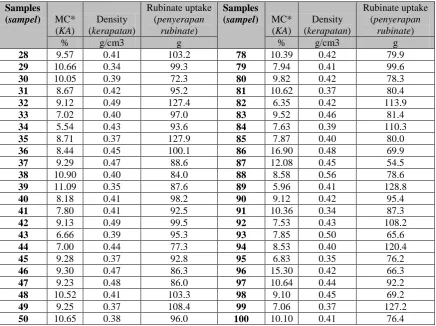
Table 1 showed the result of rubinate impregnation, the moisture content
and density of each sample used in the experiment. As read, the initial moisture
content of the samples used ranged from 5,4% to 17,55%, the density ranged from
0,33 g/cm3 to 0,56 g/cm3, and the rubinate uptake by the samples ranged from
54,5 g to 210,9 g.
Table 1. Rubinate uptake (g), initial moisture content (%) and density (g/cm3) of each sample used in the experiment
Tabel 1. Penyerapan rubinate (g), kadar air awal (%) dan kerapatan (g/cm3) dari masing-masing sampel yang digunakan dalam pengujian
Samples
Explanation (keterangan) : * MC = Moisture Content (KA = kadar air)
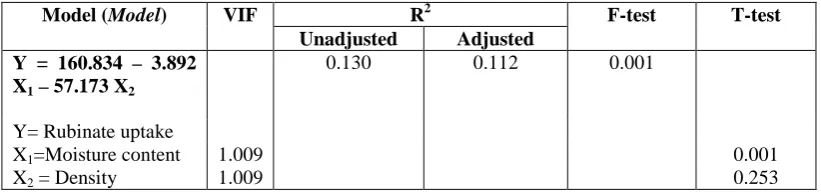
As previously mentioned, the data in Table 1 was further analyzed with
linear regression method. The result of linear regression analysis was summed in
Table 2. As read in Table 2, the variance index factor(VIF) values of independent variables were below 5, thus it was concluded that there was no multi co-linearity
between variables and all independent variables that could be used in the model
tested. Therefore, the linear regression model that could be developed for the data
was as follow:
Y = 160.834 – 3.892 X1 – 57.173 X2
with Y representing rubinate uptake, X1 representing initial moisture content (%)
around 13.0% and adjusted R2 around 11.2%. This showed that the developed
model could explain around 13% of the variety of the Y-value obtained. Though
the R2 values were low, Table 2 also showed that the F-value of the developed
model was significant at confidence level of 95%. This showed that
simultaneously the independent variables (X1, X2) affected the value of dependent
variable (Y).
Table 2. Linear regression analysis result Tabel 2. Hasil analisa regresi linear
Model (Model) VIF R2 F-test T-test
Unadjusted Adjusted
Y = 160.834 – 3.892 X1 – 57.173 X2
0.130 0.112 0.001
Y= Rubinate uptake
X1=Moisture content 1.009 0.001
X2 = Density 1.009 0.253
Further assessment on influence of each independent variable on rubinate
uptake was carried out with T-test at confidence level used was 95%. As read in
Table 2, the significant value for moisture content variable was 0.001, indicating
that moisture content had a significant influence on rubinate uptake.
The significant influence of moisture content on rubinate uptake showed
that the dryness level of the wood plays an important role in successfully
impregnating wood with rubinate. According to Usta (2004) the existence of
moisture content does affect the available void volume inside the wood that can
be filled with preservative materials. In general, it is known that if the moisture
decrease and vice versa (Usta 2004). Furthermore, dependency of rubinate
impregnation on initial moisture content of the wood might also be affected by the
rubinate character as a based material. Unlike water-based materials,
resin-based material is usually more viscous and thus more difficult to flow into the
wood (Yuniarti, 2005).
The same t-test procedure as well showed that the significant value for
density variable was 0.253. This indicated that the rubinate uptake by
microwave-dried samples was not affected significantly by the density variation. Since the
samples were collected from trees with similar age, it was preliminary assumed
that the density variation was less varied and the microwave phase did not
resulted in significant variation change, thus might contribute to the result
obtained from this analysis. Further experiment with different ages of trees used
for sampling process and wider range of microwave power used for drying
process is suggested to be carried out to complete the information already
obtained in this experiment.
IV. CONCLUSION AND RECOMMENDATION
The experiment showed that rubinate uptake by Sitka spruce previously
microwave-dried at 12 kW and 13.33 mm/s speed was significantly affected by
variation in initial moisture content resulting from the radiation phase. Influence
REFERENCES
Alden, H. A. 1997. Softwoods of North America. Forest Products Laboratory. Madison, Wisconsin.
Kartal, S. N. and S. T. Lebow. 2002. Effects of incising on treatability and leachability of CCA-C-treated Eastern Hemlock. Forest Product Journal 52 (2):44-48.
Kollmann, F. F. P. and J. W.A. Cote. 1968. Principles of Wood Science and Technology. Springer-Verlag. Berlin, Germany.
Messner, K., A. Bruce and E. Tucker. 2002. Making refractory wood species treatable by fungal pre-treatment. Enhancing the Durability of Lumber and Engineered Wood Products. Forest Products Society. Kissimme (Orlando), Finland.
Usta, I. 2004. The effect of moisture content and wood density on the preservative uptake of Caucasian Fir (Abies nordmanniana (Link) Spach.) treated with CCA. Turkish Journal of Agriculture and Forestry 28 1-7. Tubitac.
Walker, J.C.F, B.G. Butterfield, T.A.G. Langrish, J.M.Harris,. & J.M. Uprichard, 1993. Primary Wood Processing:Principles and Practices.Edisi 1. Chapman & Hall, London.