Email : salvijyotsna@gm ail.com
Research Article
Nutritional Composition of
Momordica dioica
fruits: As a wild vegetable
Jyotsna Salvi and S. S. Katewa
Laboratory of Ethnobotany and Agrost ology. Department of Botany, University College of Science, Mohanlal Sukhadia University, Udaipur (Rajasthan), India.
ARTICLE INFO ABSTRACT
Received 10/03/2015 Received in revised form 25/03/2015
Accepted 25/04/2015 Available online 01/5/2015
Samples of Momordica dioica Roxb. ex Willd fruits were collected from Jhadol Tehsil of southern Rajasthan . The fruits were washed, ground into powder and analyzed for the proxim ate, vit amins, mineral and Fatty acid compositions. The values (% DW) of moisture, ash, crude protein, crude fiber, crude fat and carbohydrate available were 87, 14, 52.06, 15.36, 4 and 14.58, respectively. Le vels (g/100g DW) of vitamins A, B1, B2, B6, H and K were 2.5, 1.8, 3.5, 4.3, 6.5 and 15 respectively. The values (mg/100g DW) of minerals potassium , sodium, calcium, zinc, Copper and magnesium were 370, 58, 26000, 8.5, 1.7 and 14000 respectively. Comparing the mineral and vitamin composition with recommended dietary allowances (RDA), the result indicated that Momordica dioica fruits could be good supplement for vitamin B1, B2, B6, B9, Ca and Mg. The value s (% DW) of fatty acids i.e. Oleic acid, Palmitic acid, Linoleic acid, Myristic acid and Stearic acid of fruits were 56.253, 12.157, 22.511, 3.589 and 3.547 respectively. The results indicated that
Momordica dioica fruits could be a good supplement for some nutrients, minerals and fatty acids such as fiber, protein, carbohydrates, calcium, magnesium , Oleic acid, and Linoleic acid. The fruit could be prom oted as a mineral and vitamin supplement for cereal -based diets in poor rural communities.
Keywords: Momordica dioica, micronutrients, proximate, vit amins, mineral and Fatty acid composition, southern Rajasthan.
1. Introduction
Analysis of the wor k done all over the world on a survey am ong native societies and review of the ethnobot anical literature reported many wild edible plant s, which is not only satisfy hunger of the people but also provide a good source of nutrition have been proved nutritious too. It has been observed that many tribal communities live in undisturbed forest areas and that having the traditional food practices. This may emphasize on sound nutritional quality of wild edible plant s, consumed by rural pe ople s as regular food or supplementary food. It was observed that during adverse conditions when food is not available due to drought, flood or other calamities, the se tribes go for consuming other herbal edibles. The nutritional
composition of a large num ber of wild edible plant s were used in emergency by various tribes in different parts of the world has been evaluated.
least one billion people are thought to use wild food in their diet (Burhingame 2000).
Momordica dioica is climber plant commonly known as Teasle Gourd, Kakr ol, Kankro, Kartoli, Kantoli, Kantola, Kantroli, Bhat karela, Kaksa, Ban kar ola, Jungli karela or small bitter-gour d. It is locally known as
Kikoda and is relatively small oval to ovoid vegetable.
The plant is perennial, dioceous climbing creeper with tuberous roots belonging to family Cucurbitaceae . Fruit is shortly beake d, densely echinate with soft spines, densely echinate with soft spines, green and yellow at maturity. This is climbing creeper generally found throughout India, Pakistan, Banglade sh, Himalayas to Ceylon.
2. Material And Methods 2.1. Plant Material
For the present studie s the unripe fruits of
Momordica dioica were collected fr om tribal dominated area of Jhadol Tehsil of southern Rajasthan. The plant material was collected in the m onth of September. The fruits were washe d, dried and ground into powder for examination of its nutritional composition.
2.2. Proximate analysis
The methods recommended by the Association of Official Analytical Chemists, 18th edition (2005) were used for crude protein (921.20), crude lipid (922.06) and crude fibre (993.21) analysis. Indian standards were use d to determine ash (IS: 2860:1964), carbohydrate (IS: 1656:2007) and reducing sugar (IS: 4079:1967).
2.3. Vitamin analysis
The vitamins were determined according to the method by Ekinci and Kadakal (2005). The sample was prepared using solid- phase extraction, SPE in order to remove components thatmay cause interference with vitamins. Four parts of deionised water (20 g) were added into one part of Plant sample (5 g). T he mixture was hom ogenized using a homogenizer at medium speed for 1 min. The homogenized sample s were centrifuged. The Solid-Phase Extraction method of was used for the extraction of water-soluble vitamins (Cho et al. 2000). The stationary phase was flushe d with 10 mL methanol and 10 mL water adjusted to pH 4.2 to activate the st ationary phase . Homogenized and centrifuged sam ple (10 mL) was the loaded. The sam ple was eluted with 5 mL water (pH 4.2) then 10 mL methanol at a flow rate of 1 mL min-1. The eluent was collected in a bottle and e vaporated t o dryne ss. The residue was dissolved in mobile phase. Before HPLC
analysis all samples were filtered through . μm pore
size FP 30/45 CA-S filters (Schleicher and Schuell,
Darmstadt, Germany at bar max. Samples μL of
solutions of the water-soluble vitamins were injected into the HPLC column. The column eluate was monitored with a photodiode -array detector at 265 nm for vitamin C, 234 nm for thiamine, 266 nm for riboflavin, 324 nm for pyridoxine, 282 nm for folic acid, 204 nm for biotin, 261 nm for niacin, and 204 nm for pant othenic acid. The mobile phase was filtered through a 0.45-μm
membrane and degassed by sonication be fore use . The mobile phase was 0.1 mol L-1K H2PO4 (pH 7)–methanol,
90:10. The flow-rate was 0.7 mL min-1. The column was operated at room temperature (25°C). Chromat ographic peak data were integrated up to 39 min. Identification of com pounds was achieved by com paring their retention times and UV spectra with those of standards stored in a data bank. Concentrations of the water-soluble vit amins were calculated from integrated areas of the sam ple and the corresponding standards. (Ayieko et al. 2011).
2.4. Mineral analysis
Ca, Mg Na, K, Cu and Zn were investigated using atomic absorption spectrophotometer equippe d with flame and gr aphite furnace. Air-acetylene flame was used for analyzed of these mineral contents.
2.5. Fatty acid Analysis
Oil from the date palm fruit was extracted by the soxhlet extraction using petroleum ether. The oil extracted was converted to methyl ester using the method describe d by Hall (1982). The fatty acid methyl ester was analyze d using Chemito Model 1000 FI D gas
Momordica dioica have significant am ount of protein (52.06g/100g). The crude fat content (4g/100g) is almost close with those reported by Aberoum and(2011a, 2011b) and Singh et al. (2009). The crude fiber value (15.36g/100g) is higher than value reported by Singh et al. (2009) and lower than value reported by Aberoumand (2011a, 2011b). The calorific value of
Momordicadioica was estim ated to be 302.56 kcal/100g DW, which is an indication that it could be a good source of energy.
3.2. Vitamin composition
Vitamin B- com plex which is principally function in macronutrient metabolism are present in fruits of
Momordica dioica in high concentr ation. Fruits of
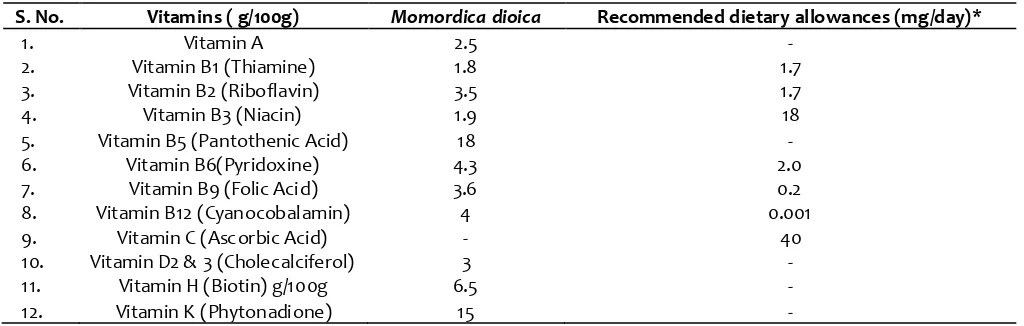
Momordica dioica are good source of all type s of vitamins. Concentration of vitamin B2 (3.5g/100g), vitamin B6 (4.3g/100g), vitamin B9 (3.6g/100g) and vitamin B12 (4g/100g) is higher in fruits of Momordica dioica when compared with recommended dietary allowance s (Nutrient Requirements and Recommende d Dietary Allowance s for Indians, 2009, Hyderabad). 3.3. Mineral composition
20 Table 1 Proximate composition of fruits of Momordica dioica
S. No. Parameter Momordicadioica Roxb. ex Willd.
1. Water 87 g/100g
2. pH 6.5
3. Crude protein 52.06 g/100g
4. Crude lipid 4 g/100g
5. Crude fibre 15.36 g/100g
6. Ash 14 g/100g
7. Carbohydr ate 14.58 g/100g
8. Total solids 12.9 g/100g
9. calorific value 302.56 kcal/100g DW*
*DW = Dry weight
Table 2 Vitamin composition of fruits of Momordicadioica
f
S. No. Vitamins ( g/100g) Momordicadioica Recommended dietary allowances (mg/day)*
1. Vitamin A 2.5 -
2. Vitamin B1 (Thiamine) 1.8 1.7
3. Vitamin B2 (Riboflavin) 3.5 1.7
4. Vitamin B3 (Niacin) 1.9 18
5. Vitamin B5 (Pantothenic Acid) 18 -
6. Vitamin B6(Pyridoxine) 4.3 2.0
7. Vitamin B9 (Folic Acid) 3.6 0.2
8. Vitamin B12 (Cyanocobalamin) 4 0.001
9. Vitamin C (Ascorbic Acid) - 40
10. Vitamin D2 & 3 (Cholecalciferol) 3 -
11. Vitamin H (Biotin) g/100g 6.5 -
12. Vitamin K (Phytonadione) 15 -
Table – 3 Mineral Composition of fruits of Momordicadioica
Mineral Recommended dietary allowances (mg/day)* Available quantity in Momordica
dioica in mg/100g DW
Children 7-10 years
Adult male
Adult female
Pregnant and lact ating mother
Calcium 26000 600 600 600 1200
Magnesium 14000 100 340 310 310
Potassium 370 1600 2000 2000 2000
Sodium 58 1005 2092 1902 1902
Copper 1.7 - 2 2 2
Zinc 8.5 8 12 10 12
* Sources - National Institute of Nutrition, Hyderabad. Table 4 Fatty acid com position of fruit s of Momordicadioica
S.No. Fatty Acids Momordicadioica
1. Myristic Acid (%) 3.589
2. Palmitic Acid (%) 12.157
3. Stearic Acid (%) 3.547
4. Oleic Acid (%) 56.253
5. Linoleic Acid (%) 22.511
magnesium and adequate level of copper and zinc, but had low level of pot assium and sodium . The fruit s of
Momordica dioica contained higher level of calcium , magnesium and zinc, whe n com pared with value s reported by Aberoumand (2010a, 2010b, 2011a, 2011b) and Aberoum and & De okule (2009a, 2009b). Amount of copper is equal to recommended dietary allowances for all categories of people .
3.4. Fatty acid composition
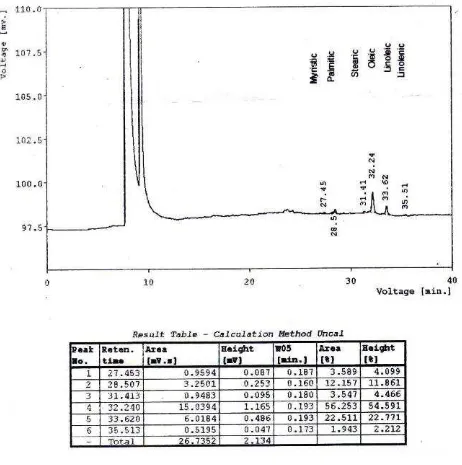
Table 4 shows the major fatty acids of the fruits of Momordica dioica. The GC-FI D chromatogram of FAMEs in fruits of Momordica dioica ( Figure-1) present s the fatty acid composition of the sample. Momordica dioica fruits are rich source of oleic acid (56.253). Oleic acid was the principal mono – unsaturated fatty acid. It was significant to note particularly high content of linoleic acid (22.511%), which was an e ssential fatty acid. On the other hand another essential fatty acid was very
low i.e. alpha-Linolenic acid (1.943%), Stearic acid (3.547%) and myristic acid (3.589%).
5. Conclusion
The results of the nutritional analysis show that
Momordica dioica fruits are a good source of fiber, protein, mineral, vitamin and fatty acids. The results sugge st that, if consumed in sufficient amount s, the
Momordica dioica fruits could contribute greatly towards meeting human nutritional requirements for normal gr owth and adequate pr otection against diseases arising from m alnutrition. From t he results,
22 the presence of anti-nutritional/toxicological factors and
biological evaluation of nutrient contents 6. Acknowledgements
The authors are thankful to UGC, New Delhi for providing financial assist ance to carry out the present work. The authors are also thankful to Gujarat labor atory, Ahmadabad for providing facilities to carry out biochemical analysis of the plant material.
7. References
1. Aberoumand, A. 2010a. A Com parative Study of Nutrients and Mineral Molar Ratios of S ome Plant Foods with Recommended Dietary Allowances. Adv. J. Food Sci. & Tech. 2(2): 104-108.
2. Aberoumand, A. 2011a. Screening of Le ss known Two Food Plant s for Comparison of Nutrient Contents: Iranian and Indian Vegetables, Functional Foods in Health and Disease. 10:416 -423.
3. Aberoumand, A. 2011b. Studie s on preliminary compar ative of nutritive aspects of food plants. J. Agri. Technol. 7( 3): 789-795.
4. Aberoumand, A. and Deokule, S. S. 2009a. Studie s
on nutritional value s of some wild edible plant s
from Iran and India. Pak. J. Nutri.8 (1): 26-31.
5. Aberoumand, A. and Deokule, S . S. 2009b.
Determination of Elements Profile of Some Wild
Edible Plants. Food Anal. Methods. 2:116–119.
6. Aberoumand, A. 2010b. Comparison of proximate and mineral compostion between Aspar agus officinalis and Momordica dioica: Iranian and Indian vegetables. Iranica J. Energy and Environment. 1 (3): 196-199.
7. Ali, A. 2009. Proximate and Miner al Composition of the Marchubeh (Asparagusofficinalis) in Iran. J. Diary. Food Sci. 4(2): 145 - 149.
8. AOAC (Association of Official Analytical Chemist).
. Official Methods of Analytical of the
Association of Official Analytical chemist , th
edn. Washington, D. C. Underlying Cause of Morbidity and Mortality. Bull. World Health Organis..8 (2): 79.
11. Burhingame, B. 2000. Comparison of Tot al Lipids, Fatty Acids, Sugars and Non Volatile Organic Acids in Nuts from Castanea species. J. Food Comp. Anal. 13: 99 - 100.
12. Cho, C.M., Ko, J. H., and Cheong, W.J. 2000. Simultaneous determination of water-soluble vitamins excreted in human urine after eating an overdose of vitamin pills by a HPLC method coupled with a solid phase extraction. Talanta 51: 799.
13. Ekinci, R. and Kadakal, C. 2005. Determination of se ven water-soluble vitamins in tarhana, a traditionalTurkish cereal food, by High -Performance Liquid Chrom atogr aphy. Act a Chromatographica. 15:289-297.
14. Hall, G. M. 1982. Silage from tropical fish: Lipid behavior. J. food Technol.21: 45-54.
15. Hyson, D. 2002. Health Benefits of Fruits and Vegetable. Scientific overview for health profe ssionals produce for better health foundation,Washington D.C: 20.
16. IS (Indian standard) Bureau of Indian Standards, (Manak Bhavan, 9 Bahadur Shah Zafar Marg, New Delhi - 110002).
17. NIN (National Institute of Nutrition). 2009. Nutrient Requirements and Recommende d Dietary Allowance s for Indians, (Indian Council of Medical Rese arch, Jam ai-Osmania PO, Hyderabad).
18. Singh, D., Bahadur , V., Singh, D. B. and Ghosh, G. 2009. Spine Gourd (Momordica dioica): An Underutilized Vegetable with High Nutritional and Medicinal Value s. In: proceeding of the ISHS Acta Horticulturae 809: International Sym posium on the Socio-Economic Impact of Modern Vegetable Production Technology in Tropical Asia. Chiang Mai, Thailand. Vol. 1.