J.Food Pharm.Sci. 1 (2013) 74-80
Avalaible online at www. jfoodpharmsci.com
Research Article
Physico-Chemical, Mineral, Amino Acid Composition,
in Vitro
Antioxidant
Activity and Sorption Isotherm of
Pithecellobium dulce
L. Seed Protein
Flour
Galla Narsing Rao
Council of Scientific and Industrial Research - Central Food Technological Research Institute - Resource Centre, Habshiguda, Uppal Road, Hyderabad-500 007, India
ARTICLE INFO ABSTRACT
Received 12/10/2012
Received in revised form 07/11/2012 Accepted 08/11/2012
Available online 13/11/2012
1. Introduction
Pithecellobium dulce (Quamachil) belongs to the
leguminoseae family and grows to a medium height. The tree is a native of America, and widely distributed in the Indian states such as Andhra Pradesh, Tamil Nadu, Karnataka, Uttar Pradesh and Maharastra. Quamachil is also grown at roadsides as an ornamental plant because of its attractive fruits (pods). The fruit arils are eaten in the raw form, they possessed low sugar, high polyphenol and are astringent in taste. The pods of quamachil are used as feed for cattle, sheep and goats. The fresh pods consist of 50.3% fruit pulp (aril), 25.3% seed and 24.4% peelings. The seed and leaves are rich in protein and have good medicinal value. The seeds are consumed in the raw/roasted/cooked form (The Wealth of India, 1952).
The seed yields 19.6% oil and defatted meal has a high protein content of 29.7%, which is used for animal feed. Protein and amino acid composition of the
Pithecellobium species were reported by Peter and
Robert (1977). The seed oil resembles in physico-chemical properties to kapak (Pterospermum
acerifolium) and ground nut (Arachis hypogaea) oil in its
fatty acid composition. Acylated saponins were isolated from the alcoholic extract of seed (The Wealth of India, 1952). Seed composition and fatty acid profiles were reported earlier by Duke (1983). The seeds are eaten raw/roaster/toasted and they contain 17% protein (Kesava-Menon, 1910).
Previously, our group has worked on chemical composition and storage stability of aril (Narsing Rao et al., 2011). They reported that the dried aril is rich in iron (12-16 mg/100g), considerable quantities of calcium
(60-Pithecellobium dulce L. seed protein flour (PSPF) was evaluated for the
chemical, mineral, amino acid composition, in vitro antioxidant activity and sorption isotherm. Protein content was found to be 39.22% PSPF. Calcium (48 mg) and phosphorus (542 mg/100 g) were observed in major quantities. Major amino acids were determined as glutamic acid, arginine, aspartic acid, lysine, valine, threonine and leucine. The ratio of essential to nonessential amino acids was observed to be 0.61. Essential amino acids were higher than the reported amounts for 70 kg person (100 g seed protein flour) as per FAO/WHO/UNU requirements. DPPH, Inhibition (25-73%) and ferric reducing power OD (0.136-0.523) are increased with increasing concentration of PSPF from 3-15 mg. SDS-PAGE of PSM and PSPF showed similar polypeptides with molecular weights from 205 kDa to 12 kDa. The IMC (10.34%) of PSPF, which equilibrated at 69% RH, indicated the non-hygroscopic nature.
Keywords: Amino acid, antioxidant activity, Pithecellobium dulce, seed protein flour, sorption isotherm
62 mg/100 g) and protein (12-15%). The seed total lipid and their fatty acid classes like neutral (69.2%), glycol (30.7%) and phospho (0.03%) were also reported (Prabhakar Rao et al., 2009). The protein solubility studies were carried out by Narsing Rao et al. (2008) and they reported that the defatted seed flour possesses high protein solubility (96%) at pH 12.
A complete protein and quality of protein depends on their amino acid composition particularly, the ratio of essential amino acids to non-essential amino acids and processing condition for production of proteins and their catabolism after consumption, which also provide the nutritional status of specific proteins. A variety of plant foods help in delivering a balanced combination of essential amino acids required for healthy living. Developed a product to meet a dietary requirement of protein and minerals by blending a suitable combination of cowpea, maize, peanut and soya bean and also improve the nutrition quality of product by blending various foods reported in the literature (Radha et al., 2007; Schuster-Gajzago et al., 2006).
Chemical, mineral and amino acid composition of uncommon sources like soy, gumkaraya, feronia, aegle, pithecellobium and jangli badam seeds have been reported (Obulesu and Bhagya, 2006; Narsing Rao and Rao, 2010; Narsing Rao et al., 2012; Narsing Rao et al., 2011; Narsing Rao et al., 2011a; Narsing Rao et al., 2008; Narsing Rao and Rao, 2009).
Proteins and bioactive components are responsible for antioxidant activity was reported in the literature. Particularly, peptides from soybean, canola, maize and capalin were reported. However, all amino acids have been shown to have antioxidant activity in some systems, which probably reflect the antioxidant nature of the amino group. The use of a protein or a peptide for the improvement of the antioxidative activity in functional foods might be a more practical approach than the use of individual amino acids, because proteins and protein hydrolysates have some specific functional properties (Amarowicz, 2008). Apart from the proteins the antioxidant activity of mushroom, tomato and orange were also reported in the literature (Elmastas et al., 2007; Guil-Guerrero et al., 2009; Klimczak et al., 2007).
Interestingly, the Pithecellobium dulce aril based products specially, beverages, aril powder stability, seed lipid characterization, seed protein solubility studies are reported earlier, even though the seed was rich in protein, very little information is available on these aspects. Generally, the seed is discarded as by-product waste during process. Hence, the further investigation was under taken to determine the physic-chemical, mineral, polyphenol, in vitro antioxidant activity, amino acid composition, colour units, SDS-PAGE and storage stability by sorption isotherm of Pithecellobium dulce
seed protein flour.
2. Materials and Methods
2.1. Material and preparation of Pithecellebium dulce seed protein flour
Pithecellobium dulce fruit pods (12 kg) were
personally collected from the trees at campus of Osmania University and National Institute of Nutrition, Hyderabad, India. Analytical grade chemicals and solvents used in the study were purchased from Sd Fine-Chem Ltd (Mumbai, India). Standard protein markers for SDS-PAGE (myosin 205 kDa, phosphorylase B 97 kDa, bovine serum albumin 66 kDa, ovalbumin 45 kDa, carbonic anhydrase 29 kDa and cytochrome C 12 kDa) were procured from Sigma Chemicals Co., St. Louis, USA.
Pithecellebium dulce seeds were separated
manually from fruit pods and aril. The seed hull was removed manually and cotyledons were dried in tray drier at 45 ± 2 °C for 6 h. The dried cotyledons were ground in a laboratory mixer (Sumeet, Nasik, India) and passed through sieve 30 mesh (500 µ). The ground material was soaked in hexane to remove fat according to a reported method by Narsing Rao, and Rao (2010) with minor modifications at 26 ± 2 °C room temperature (RT) with occasional stirring for a period of 3 h, solvent was separated and extractions were repeated four times with fresh solvent. The residue was tray dried (Chemida, Mumbai, India) at 45 ± 2 °C, ground to pass through a 60 (240 µ) mesh sieve and obtained Pithecellobium dulce
seed protein flour (PSPF). The seed protein flour was packed in metallized polyester polyethylene laminated (MPE) pouches and stored at RT for further experiments. A part of the whole seed was ground in mixer and taken as Pithecellobium dulce seed meal (PSM)
2.2. Physico-chemical composition
The bulk density of PSPF was measured by noting the volume occupied by 20 g sample in a 100 ml graduate cylinder and expressed as g/cc. Lovibond Tintometer (Model F, Salisbury, UK) was used to determine red and yellow colour units of Pithecellobium dulce seed protein flour. Physico-chemical properties such as moisture, total ash and crude protein of PSPF were carried out using standard methods (Ranganna, 1986). Protein content was estimated by using standard micro-Kjeldahl method and the protein conversion factor used as 6.25.
2.3. Mineral content and total polyphenol content
Minerals like calcium, iron, phosphorus, cadmium, chromium, copper, potassium, magnesium, lead, and zinc were determined in PSPF by preparing ash from 5 – 6 g PSPF in muffle furnace at 525 – 550 °C for 6 h till the form of white ash, the ash was dissolved in hydrochloric acid (6 N) and heated on water bath. Later, the contents were made up to 100 ml with dilute HCl and filtered through ashless filter paper (Whatman No. 40). The ash solution was used for the estimation of minerals according to the standard reported methods (Ranganna, 1986; AOAC, 1995; Raghuramulu et al., 2003) and expressed as mg/100g PSPF. Minerals like Cd, Cr, Cu, K,
Mg, Pb and Zn in PSPF was determined by using atomic absorption spectroscopy (Shimadzu AA 6701 F, Atomic Absorption Flame Emission Spectrophotometer, Shimadzu Ltd, Japan) with standard method (AOAC, 1995). The total polyphenol content was measured using standard method reported by Sadasivam and Manickam ( 1997) based on standard gallic acid.
2.4. Estimation of amino acid composition
The amino acid profile was determined using an automatic amino acid analyzer (Biochrom 30, Cambridge, England). Amino acids were detected after post column derivatisation with Ninhydrin reagent (Agilent amino acid standard kit, California, USA). Cysteine and methionine contents were determined according to the method reported by Moore (1963).
2.5. In vitro antioxidant activity
DPPH (2, 2-diphenyl-1-picrylhydrazyl) radical scavenging activity and ferric reducing power of PSPF were determined using standard reported method (Theodore et al., 2008).
2.6. SDS-PAGE (Sodium dodecyl sulphate polyacryl amide gel electrophoresis)
Sodium dodecyl sulphate polyacrylamide gel electrophoresis of PSPF was carried out according to the standard reported method by Laemmli (1970) using 4% stacking and 10% separating polyacrylamide gels.
2.7. Equilibrium moisture content and relative humidity (EMC-RH) studies
EMC-RH studies were carried out for PSPF at room temperature following the method suggested by Ranganna (1986). PSPF of 5 g in glass petri plates was exposed to the different RH conditions ranging from 10 to 100% maintained using appropriate normal solutions of sulphuric acid in desiccators to determine the data on EMC-RH for storage stability.
3. Results and Discussion
3.1 Processing yield of seed protein flour
Pithecellobium dulce pods yielded 8%, dry seed, in
which 20% hull and 80% cotyledons. The seed (100 g) on processing obtained 52 g of PSPF. The photograph of the seed at various processing stages such as whole seed, cotyledons and PSPF are presented in Figure 1.
3.2. Determination of physico-chemical composition
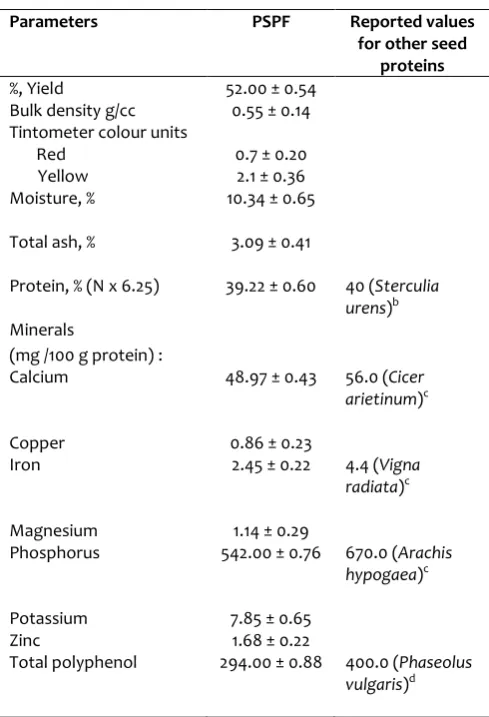
The results of physico-chemical composition of PSPF are presented in Table 1.The bulk density showed the seed protein flour is 0.55, which indicates its heaver nature. Bulk density measurements will help the processors in the industry for packaging and dispensing units to determine the size and shape of the container/columns/reactors or for selection of films for package.The material, which is having more minerals,
(iii)
(ii)
(i)
Fig 1. Photograph depicting the various samples during seed processing (i) whole seed; (ii) de-hulled seed; (iii)
Pithecellobium dulce seed protein flour
Table 1. Physico-chemical, mineral and total polyphenol contenta and antioxidant activity of PSPF and
related references
Parameters PSPF Reported values
for other seed proteins
%, Yield 52.00 ± 0.54
Bulk density g/cc 0.55 ± 0.14 Tintometer colour units
Red 0.7 ± 0.20
Yellow 2.1 ± 0.36
Moisture, % 10.34 ± 0.65
Total ash, % 3.09 ± 0.41
Protein, % (N x 6.25) 39.22 ± 0.60 40 (Sterculia urens)b Minerals
(mg /100 g protein) :
Calcium 48.97 ± 0.43 56.0 (Cicer arietinum)c
Copper 0.86 ± 0.23
Iron 2.45 ± 0.22 4.4 (Vigna
radiata)c
Magnesium 1.14 ± 0.29
Phosphorus 542.00 ± 0.76 670.0 (Arachis
hypogaea)c
Potassium 7.85 ± 0.65
Zinc 1.68 ± 0.22
Total polyphenol 294.00 ± 0.88 400.0 (Phaseolus vulgaris)d
a Values are means of triplicate analyses with standard deviation.
PSPF: Pithecellobium dulce seed protein flour.
%, Yield: Yield of seed protein flours on whole seed basis.
b Narsing Rao and Rao (2010). c Singh et al. (1989).
will have a more bulk density than materials contain more organic matter. The appearance of PSPF to naked eye is light yellow in colour, which further conformed by lower red (0.7) and higher yellow (2.1) colour units through Tintometer.
PSPF found to be rich in protein (39.22%) and mineral matter (3.09%). The values are comparable with the reported values for seed protein flours of Sterculia
foetida (protein content 40%), Pithecellobium dulce (37%),
Sterculia urens (40%) and Glycine max (55%) (Narsing Rao
and Rao, 2009; Narsing Rao et al., 2008; Narsing Rao and Rao, 2010; Obulesu, & Bhagya, 2006). The preliminary data obtained on the composition is encouraging and substantiates the need to carry out further research on mineral, amino acid, SDS-PAGE and storage stability through sorption isotherm studies.
3.3. Mineral and polyphenol contents
The mineral composition of PSPF is presented in Table 1. The ash content was found to be very high, which indicated that these flours are good source of essential minerals. It was further confirmed that seed protein flour was found to be considerably rich in minerals such as Ca (48.97 mg/100 g), Fe (2.45 mg/100 g), K (7.85 mg/100 g) and P (542 mg/100 g). Toxic minerals like Cd, Cr and Pb were not found in PSPF. Ca, Fe and P contents were found to be similar to those reported for cereal grains (Gopalan et al., 2007). In general, wheat flour used in the baking industry is deficient in some minerals like Ca and Fe and is a poor source of proteins and minerals (Akpapunam and Darbe, 1994). Hence, fortification of wheat flour with these seed protein flour could improve their nutritional quality, and as a protein supplementation in cereal based foods. These results may focus the interest of using PSPF in some food formulations.
The total polyphenol content was 294 mg /100 g observed in PSPF. A higher polyphenols was reported in
Aegle marmelos (745 mg/100 g), Feronia limonia (358
mg/100 g) and Sterculia urens (316 mg/ 100 g) seed protein flours (Narsing Rao et al., 2011; Narsing Rao et al., 2011a; Narsing Rao and Rao, 2010). The total polyphenol content of mustard seed protein flour was reported to be in the range of 370 - 460 mg/100 g. This total polyphenols can be further recovered and used as source of natural antioxidants (Ildiko et al., 2006).
3.4. Amino acid composition
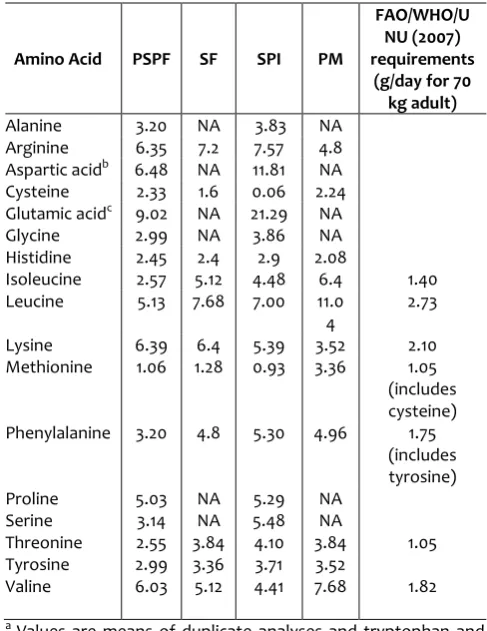
Amino acid composition of the PSPF is presented as g/100 g protein in Table 2. The protein content, 36.7% was found in PSPF. Higher amounts of glutamic acid (9.02 g/100 g), arginine, aspartic acid, arginine lysine and valine were found in PSPF. In the present study significant quantities of leucine (5.14 g/100 g) and isoleucine (2.57 g/100 g) were observed in PSPF. The ratio of essential to non essential amino acids in PSPF was found to be 0.61. Balanced essential amino acid profile obtained by blending soy, sesame and peanut flours in 1.1:1.7:0.7 ratios reported by Radha et al. (2007). In our study, PSPF
Table 2. Amino acid compositiona of PSPF (g /100 g protein)
and related references PSPF: Pithecellobium dulce seed protein flour.
b Aspartate + Asparagine c Glutamate + Glutamine
SF: Soy flour (Gopalan et al., 2005). SP: Soy protein isolate (Tang et al., 2006). PM: Pearl millets (Gopalan et al., 2005). NA: Not available.
was observed to contain essential amino acids leucine (5.13 g) and lysine (6.39 g) followed by phenylalanine and valine, when compared to soy protein isolate (SPI) and casein wherein leucine (7.0, 8.4 g), lysine (5.39, 7.1 g) and phenyl alanine (5.3, 4.5 g) were reported by Tang et al. (2006). The proportions of the essential amino acids available in the protein were very much higher when comparable to those of the required amino acids as per FAO/WHO/UNU (2007). Hence, the seed protein can be termed as a superior quality protein due to double the quantities of required essential amino acids per 100 g protein. The total amino acids accounted for 70.91 g/ 100 g protein and the rest of the nitrogen could be from tryptophan which was not determined in this method and non-protein nitrogen such as alkaloids, ammonia, purines, pyrimidines, vitamins and amino sugars.
The overall quality of the protein in the PSPF sample can be assessed by its higher essential amino acid content (26.93 g/ 100 g) of the total amino acid. In this study it was found that 100 g PSPF protein provides good quantities of leucine (5.130 mg) and isoleucine (2570 mg). The recommended values of essential amino acids (mg/ kg body weight per day) for adult humans are isoleucine (20), leucine (39), lysine (30), methionine and
cysteine (15), phenylalanine and tyrosine (25), threonine (15), tryptophan (4) and valine (26) (FAO/WHO/UNU, 2007). A 70 kg/ day adult required 100 ± 5 g of PSPF to meet the daily required essential amino acids. These investigations provided valuable information on amino acid composition, which indicated PSPF, can be a good source for preparation of protein concentrates, isolates and hydrolysates.
3.5. In vitro antioxidant activity
The antioxidant activity determined as DPPH radical scavenging activity in terms of inhibition percent and optical density of 0.136 was read for 3 mg and for 15 mg it was 0.523. The activity measured was much lower, when compared with synthetic BHT, which gave an optical density of 0.42/0.05 mg. The antioxidant activity of PSPF may be due to the larger, smaller peptides and polyphenols present in the sample, which is further supported by SDS-PAGE profiles and total polyphenols (294 mg /100 g). The present study revealed that ~10 and 30 kDa molecular weight peptides may be responsible for antioxidant activity. The free amino acids, type of proteins, nature of peptides present in a sample and method opted for preparation of particular proteins are also influence the antioxidant activity (Amarowicz, 2008). The polyphenols are responsible for antioxidant activity was reported by Saxena et al. (2007).
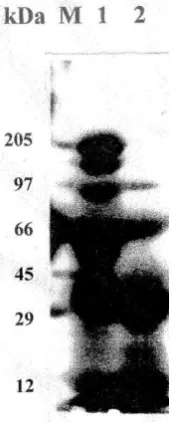
Table 3. Antioxidant activity of Pithecellobium dulce seed soluble PSM and PSPF. In total, nine protein bands were observed, whereas six of them were matching with the molecular marker, which were found to be 12, 29, 45, 66, 97 and 205 kDa in PSPF. Apart from these, other protein bands were also noticed below 12, 66 and 205 kDa and absent of 205 kDa was noticed in PSM. The SDS-PAGE profile indicated that the lower and higher molecular protein bands were present in the Pithecellobium dulce
seed. Similar protein band trend was observed in hemp
and bael seed protein powders (Tang et al., 2006; Narsing Rao et al., 2011) and concluded that defatting process might have some effect on appearance of protein bands.
Fig. 2. SDS-PAGE Pattern of Pithecellobium dulce seed protein (1) SDS soluble PSPF (2) SDS soluble PSM M: Broad band standard molecular weight protein markers (myosin 205 kDa, phosphorylase B 97 kDa, bovine serum albumin 66 kDa, ovalbumin 45 kDa, carbonic anhydrase 29 kDa and cytochrome C 12 kDa)
3.7. Experimental sorption isotherm of seed flour
moisture content (CMC) was noted from the isotherms in the zone where there was sudden rise in the moisture content for a small change in RH. The CMC was 11.48%, which equilibrated at 71% RH. The critical moisture content and equilibrium moisture contents varied in samples because of the differences in initial moisture contents of the samples (Ranganna, 1986). The PSPF gained moisture and discoloration was observed above 70% RH. With this data the water activity of the PSPF was calculated to be 0.71. The water activity data is very much useful in the preparation of food formulations. If the water activity value is less than 0.4, the product will pick up moisture rapidly and lead to mold growth.
Sterculia urens, Aegle marmelose and Feronia limonia
seed protein flours reported to possess CMC 9.2, 8.76 and 9.9%, which equilibrated at 72, 68 and 69% RH (Narsing Rao and Rao, 2010; Narsing Rao, et al., 2011; Narsing Rao et al., 2011a). The EMC - RH studies indicated that the PSPF was non-hygrosciopic in nature and can be packed in polyethylene pouches for storage at RT.
4. Conclusions
The unit operations involved in the production of
Pithecellobium dulce seed protein flour is easy and viable.
The PSPF is rich source of protein, considerable quantities of essential mineral and polyphenols. The seed possessed higher quantities of essential amino acids with good antioxidant activity. The PSPF is superior quality of protein in terms of total essential amino acid value recommended by FAO/WHO/UNU standards. Hence, PSPF can be blended with other seed meals in appropriate proportions to get an optimum amino acid balance. The seed other ways being wasted as processing by-product can be produce a valuable protein source for human food and animal feed. The knowledge derived would be helpful in the preparationof protein isolates/ concentrates and hydrolysates, which is further useful in the formulation of tailor-made proteins specially, essential amino acid. The total lipid also further can be studied on utilization of bio-diesel production or soap manufacture.
5. Acknowledgements
The author thanks Central Food Technological Research Institute, Mysore, for permission to carryout work. I thank Director, National Institute of Nutrition, Hyderabad, India for providing amino acid composition.
References
Akpapunam, M.A.; Darbe, J.W. Chemical composition and functional properties of blends of maize and bambara groundnut flours for cookie production. Plant Foods Hum. Nutr. 1994, 46, 147-155.
Amarowicz, R. Antioxidant activity of protein hydrolysates. Eur. J. Lipid Sci. Technol. 2008, 110, 489-490.
AOAC. Official methods of analysis of Association of Official Analytical Chemists (AOAC) International (16th ed.)
Association of Official Analytical Chemists International, Washington, DC, USA, 1995.
Duke, J.A. Hand Book of Energy Crops, Centre for New Crops and Plants Products, Purdue University, USA, 1983. Elmastas, M.; Isildak, O.; Turkekul, I.; Temur, N. Determination
of antioxidant activity and antioxidant compounds in wild edible mushrooms. J. Food Comps. Anal. 2007, 20(3-4), 337-345.
FAO/WHO/UNU. Protein and Amino Acid Requirements in Human Nutrition. WHO, Geneva, 2007, pp. 150.
Gopalan, C.; Rama Sastri, B.V.; Balasubramanian, S.C.; Narasing Rao, B.S.; Deosthale, Y. G.; Pant, K.C.; Nutritive value of Indian Foods. National Institute of Nutrition, Indian Council of Medical Research, Hyderabad, India, 2007. Guil-Guerrero, J.L.; Rebolloso-Fuentes, M.M. Nutrient
composition and antioxidant activity of eight tomato
(Lycopersicon esculentum) varieties. J. Food Compos.
Anal. 2009, 22(2), 123-129.
Ildiko, S.G.; Klara, K.A.; Marianna, T.M.; Barath, A.; Zsuzsanna, M.B.; Balint, C. The effect of radio frequency heat treatment on nutritional and colloid-chemical properties of different white mustard (Sinapis alba L) varieties. Innovative Food Sci. Emerging Technol. 2006, 7, 74-79.
Kesava-Menon. Indigenous drugs of India. J. Soc. Chem. Ind. 1910, 29, 1428 - 1432.
Klimczak, I.; Małecka, M.; Szlachta, M.; Gliszczynska-Swigło, A.
Effect of storage on the content of polyphenols, vitamin C and the antioxidant activity of orange juices. J. Food Compos. Anal. 2007, 20(3-4), 313-322.
Laemmli, U.K. Cleavage of structural proteins during assembly of the head of bacteriophage T4. Nat. 1970, 227, 680-685.
Moore, S. On the determination of cystine as cysteic acid. J. Biological Chem. 1963, 238, 235-237.
Narsing Rao, G.; Rao, D.G. Physico-chemical and functional properties of defatted Sterculia foetida seed flour. J. Food Sci. Technol. 2009, 46(3), 225-227.
Narsing Rao, G.; Rao, D.G. Chemical and functional characterization of Sterculia urens (Sterculia urens L.) seed meal. Food Hydrocolloids. 2010, 24, 479-485. Narsing Rao, G.; Balaswamy, K.; Rao, D.G.; Prabhakar Rao, P.G.;
Satyanarayana, A. Nutritional quality, fatty acid, amino acids and functional characteristics of bael (Aegle
marmelos L.) seed protein concentrate. J. Food Drug
Anal. 2011, 19 (4), 528-535.
Narsing Rao, G.; Nagender, A.; Satyanarayana, A.; Rao, D.G. Preparation, chemical composition and storage studies of quamachil (Pithecellobium dulce L.) aril powder. J. Food Sci. Technol. 2009, 48(1), 90-95.
Narsing Rao, G.; Prabhakar Rao, P. G.; Rao, D.G. Preparation of wood apple (Feronia limonia L.) seed protein concentrate and evaluation of its nutritional and functional characteristics. Int. Food Res. J. 2011, 18, 914 -920.
Narsing Rao, G.; Prabhakara Rao, P. G.; Satyanarayana, A. Chemical, amino acid and fatty acid composition of gum karaya (Sterculia urens L.) seed. Food Hydrocolloid. 2012, 28, 320-324.
Narsing Rao, G.; Rao, D.G.; Jyothirmayi, T. Physico-chemical and functional properties of defatted Pithecellobium dulce seed flour. J Food Sci Technol. 2008, 45(6), 480-483. Obulesu, M.; Bhagya, S. Biochemical, functional and nutritional
characteristics of soy protein concentrate prepared by thermal processing. J Food Sci Technol. 2006, 43, 161-166.
Peter, F.; Robert, B. Protein and amino acid composition of tree legume seeds. J. Sci Food Agric. 1977, 28, 791 – 797. Prabhakara Rao, P. G.; Narsing Rao, G.; Jyothirmayi, T.; Karuna,
M.S.L.; Prasad, R.B.N. Analysis of lipid classes and fatty acid composition of jangle jalebi (Pithecellobium dulce L.) seed oil. J Lipid Sci Technol. 2009, 41(1), 5-7.
Radha, C.; Ramesh, P.; Prakash, V. Preparation and characterisation of protein hydrolysate from an oil seed flour mixture. Food Chem. 2007, 106, 1166-1174.
Raghuramulu, N.; Madhavan, N.K.; Kalyanasundaram, S. A Manual of Laboratory Techniques. National Institute of Nutrition, Hyderabad, India, 2003, pp. 181-182.
Ranganna, S. Hand Book of Analysis and Quality Control for Fruits and Vegetable Products (2nd ed.) Tata
McGraw-Hill Publishing Company limited. New Delhi, India, 1986. Sadasivam, S.; Manickam, A. Biochemical Methods, 2nd ed. New
age international publishers., New Delhi, India, 1997, pp. 193-194.
Saxena, R.; Venkaiah, K.; Anitha, P.; Venu, L.; Raghunath, M. Antioxidant activity of commonly consumed plant food of India: contribution of their phenolic content. Int. J. Food Sci. Nutr. 2007, 58, 250-260.
Scalbert, A.; Manach, C.; Morand, C.; Remesy, C.; Jimenez, L. Dietary polyphenols and the prevention of diseases. Critical Reviews in Food Sci. Nutr. 2005, 45,287-306. Singh, U.; Rao, P.V.; Seetha, R.; Jambunathan, R.; Nutrient
losses due to scarification of pigeonpea (Cajanus cajan L) cotyledons. J. Food Sci. 1989, 54, 974-981.
Tang, C.H.; Ten, Z.; Wang, X.S.; Yang, X. Physico-chemical and functional properties of hemp (Cannabis sativa L.) seed protein isolate. J. Agric. Food Chem. 2006, 54, 8945-8950.
The Wealth of India – Raw Materials. A Dictionary of Industrial
Raw Materials and Industrial Products. Council of
Scientific and Industrial Research, New Delhi, India, 1952, pp. 140-142.