ORIGINAL
The Porcupine Bank Canyon coral mounds: oceanographic
and topographic steering of deep-water carbonate mound
development and associated phosphatic deposition
A. Mazzini&A. Akhmetzhanov&X. Monteys&M. Ivanov
Received: 15 February 2011 / Accepted: 1 September 2011 / Published online: 27 October 2011 #Springer-Verlag 2011
Abstract The head of a canyon system extending along the
western Porcupine Bank (west of Ireland) and which accommodates a large field of giant carbonate mounds was investigated during two cruises (INSS 2000 and
TTR-13). Multibeam and sidescan sonar data (600–1,150 m
water depth) suggest that the pre-existing seabed topography acts as a significant factor controlling mound distribution and shape. The mounds are concentrated along the edges of the canyon or are associated with a complex fault system traced around the canyon head, comprising escarpments up to 60 m high and several km long. The sampling for geochemical and petrographic analysis of numerous types of authigenic deposits was guided by sidescan sonar and video recordings. Calcite-cemented biogenic rubble was observed at the top and
on the flanks of the carbonate mounds, being associated with both living and dead corals (Lophelia pertusa, Madrepora oculataand occasionalDesmophyllum cristagalli). This can plausibly be explained by dissolution of coral debris facilitated by strong currents along the mound tops and flanks. In turn, the dissolved carbon is recycled and precipitated as interstitial micrite. Calcite, dolomite and phosphatic hardgrounds were identified in samples from the escarpment framing the eastern part of the survey area. The laterally extensive phosphatic hardgrounds represent a novel discovery in the region, supplying hard substrata for the establishment of new coral colonies. Based on existing knowledge of regional oceanographic conditions, comple-mented with new CTD measurements, it is suggested that water column stratification, enhanced bottom currents, and upwelling facilitate the deposition of organic matter, followed by phosphatisation leading to the formation of phosphate-glauconite deposits. The occurrence of strong bottom currents was confirmed by means of video observations combined with acoustic and sampling data, providing circumstantial evidence of fine- to medium-grained sand. Evidently, slope breaks such as escarpments and deep-water canyon headwalls are important structural elements in the development of mature carbonate mounds induced by deep-water coral growth. Stable isotope data show no evidence of methane-derived carbon in the carbonates and lithified sediments of the Porcupine Bank Canyon mounds.
Introduction
Carbonate mounds, also called coral build-ups, reefs, lithoherms or banks, are documented in the fossil record to have existed since the Proterozoic (Wilson1975; Neumann et al. 1977; Bosence and Bridges 1995; Paull et al. 2000;
A. Mazzini (*)
Physics of Geological Processes (PGP), University of Oslo, P.O. Box 1048, 0364 Blindern, Norway
e-mail: [email protected]
A. Akhmetzhanov
National Oceanography Centre, Southampton, Empress Dock, Southampton, SO14 3ZH, UK
X. Monteys
Geological Survey of Ireland, Haddington Road,
Dublin 4, Ireland
M. Ivanov
UNESCO Centre for Marine Geology and Geophysics, Moscow State University,
Moscow 119899, Russia
Present Address: A. Akhmetzhanov
Lukoil Overseas UK, Charles House, 5-11 Regent Street,
Freiwald2002). Their dynamics include the growth of living colonies and the build-up of in situ coral debris combined with the trapping of externally supplied sediment. This mixture of sediment and skeletal remains contributes to the formation of mound structures in up to 300-m-high and 10-km-long reefs which can grow in a wide range of water depths (between 50 and 1,300 m) and temperatures (between 4 and 12°C; Mullins et al.1981; Frederiksen et al. 1992; Rogers
1999). The dominant cold-water coral species areLophelia pertusa and Madrepora oculata; less common are species such asDesmophyllum cristagalli,Dendrophyllia cornigera,
Enallopsammia rostrataandSolensmilia variabilis.
North Atlantic and Norwegian Sea carbonate mound areas have been intensively studied during the last two decades in the course of numerous marine expeditions (Hovland et al.
1994,1998; Kenyon et al.1998,2003a; Henriet et al.2001; Huvenne et al.2003; van Weering et al. 2003; Kano et al.
2007; Wheeler et al. 2007). Various factors have been
suggested to favour the initiation and development of these cold-water coral banks: (1) oceanographic conditions (mainly strong current activity, high nutrient supply and low sedimen-tation rates; Mullins et al.1981; Kenyon et al.1998; De Mol et al.2002), (2) focused hydrocarbon seepage resulting in the fertilization of the seafloor (Hovland1990; Hovland et al.
1994; Hovland and Thomsen 1997; Henriet et al. 1998,
2001; Hovland and Risk 2003) and (3) the availability of suitable substrates. Commonly, the settlement of coral colonies (mainly L. pertusa) takes place on hard substrata such as drop stones and rocky outcrops (e.g. Wilson1975; Kenyon et al.1998,2003a) or eventually on methanogenic carbonate deposits which precipitate at seepage sites (Rogers
1999; León et al. 2007). Once initiated, the growth of the colony can become self-sufficient in terms of primary substrate; new corals grow on top of dead ones, the activity of the colony being largely controlled by ambient environ-mental conditions such as organic matter and sediment supply, current speed, pH, temperature and salinity. This fragile system can collapse when the equilibrium between sedimentation rate and biological growth is disturbed, and excessive sedimentation leads to a progressive burial of the coral colony (e.g. Kenyon et al.2003a). However, if favourable conditions persist over sufficiently long periods of time, the carbonate build-ups can reach considerable dimensions. Conceptually, it seems probable that the growth of the mounds is further promoted by the presence of carbonate-cemented coral rubble mixed with trapped foraminifer-rich hemipelagic sediment. Such solidified deposits provide additional surfaces on which new coral colonies can develop. So far, this aspect has been examined only superficially.
The Logachev Mounds on the south-western Rockall Trough margin (Kenyon et al.2003a; Mienis et al. 2007) represent a good example of an advanced stage of mound development. To date, the information on the internal
structure of these and neighbouring carbonate mounds is limited (Expedition-Scientists-ODP-307 2005; Williams et al. 2006; Kano et al. 2007). High-resolution acoustic data obtained during surveys offshore Ireland revealed the presence of a strong reflector underneath the mounds (e.g. Kenyon et al. 2003a; van Weering et al. 2003). However, such profiles are often of little help because they usually show blank zones within these structures (e.g. Kenyon et al.
1998; Bailey et al. 2003; Huvenne et al. 2003). Thus,
interpretations are overall limited to inferences based on shallow cores and visual observations.
Within this context, the oceanographic, geomorphological and biological conditions required for mound initiation and evolution have been investigated during several recent research cruises to the western Porcupine Bank offshore south-western Ireland (Fig. 1a). During the year 2000, the Irish National Seabed Survey (R/V Bligh) conducted by the Geological Survey of Ireland (GSI) completed multibeam and CTD surveys revealing, for the first time, the presence of a large cluster of inferred carbonate mounds on the western Porcupine Bank. In 2003, the area was once more visited during the Training Through Research 13 (TTR13) marine expedition of the R/V Professor Logachev, in the course of which detailed sampling, seafloor video recordings, and sidescan sonar and subbottom profiler surveys were performed. A preliminary report of this newly discovered deep-water coral mound province can be found in Kenyon et al. (2004).
This paper provides a detailed presentation and interpreta-tion of the sidescan sonar data from the western Porcupine Bank, supported by CTD and bathymetric data as well as selected seafloor video images. This is complemented by geochemical and petrographic analyses conducted on authigenic deposits associated with coral colonies sampled in the region during the TTR13 cruise. The aim of this paper is to evaluate the significance of the environmental controls in the growth of the coral colonies and the factors driving the formation of the authigenic deposits.
Geological and oceanographic setting
Off the southwest coast of Ireland, the Porcupine Bank is framed by the amphitheatre-shaped Porcupine Seabight to the south, and the Porcupine Ridge and Slyne Ridge to the
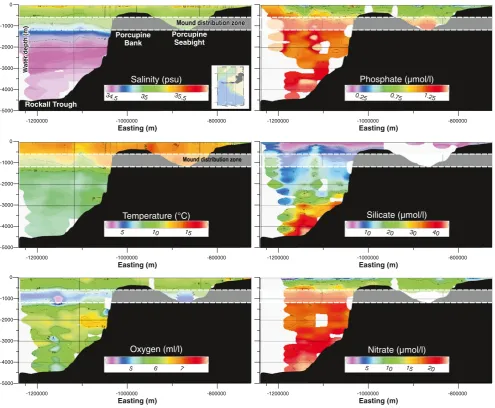
Fig. 1 aLocality map of the study area (red square), and location of the oceanographic transects (yellow band) in Fig. 5. b Multibeam bathymetric map of the survey area with sample stations (dots) and the outline of the sidescan sonar coverage (white dashed line). c
Topographic profile (A–A′) along the edge of the canyon, showing the carbonate mound distribution. dMagnification of a part of the bathymetric map showing the locations of the CTD stations. e
Nepheloid layers recorded in the study area (vertical profiles along B–B′are from Dickson and McCave1986), and acoustic single-beam water column imagery along profile C–C′shown inb
north. The Porcupine Basin is influenced by strong bottom currents which have formed channel systems and sediment
waves (McDonnell and Shannon 2001). Three major
mound provinces have been described in the bight, these being the Belgica Mounds, the Hovland and Magellan
Mounds, and the Pelagia Mounds (Wheeler et al. 2007).
The present study focuses on an area located in the westernmost part of the Porcupine Bank where a series of canyons with mound features are located (Fig.1).
The region is known to be influenced mainly by the northward-flowing Eastern North Atlantic Water (ENAW)
and Mediterranean Outflow Water (MOW; White2007) but
is also influenced by minor water masses derived from the western North Atlantic, which are carried northwards by the eastern boundary slope current (van Aken and Becker
1996; De Mol et al.2005; White2007).
Materials and methods
In the year 2000, a multibeam survey with the R/V Bligh investigated the study area, mapping it with a deep-water multibeam Kongsberg-EM120 (12 kHz, 1°×1°) echosounder system and a 3.5-kHz subbottom profiler. Bathymetric and backscatter data were processed by means of the Caris HIPS 6.0 software. From this, bathymetric derivatives such as digital terrain models, and shaded relief and slope maps were produced. Multibeam backscatter mosaics were generated by applying angular and slope correction techniques. Conductivity–
temperature–depth (CTD) measurements were conducted in the
region during the months of July and August. Discussed here are the results of four stations located within the area outlined in Fig.1d.
In the year 2003 (TTR13 cruise), a survey using a MAK deep-towed sidescan sonar operating at 30 kHz frequency with a built-in 5-kHz subbottom profiler was performed in the vicinity of mounds located within the area delimited in Fig.1b. Survey lines MAKAT-99 to MAKAT-104 were run parallel to each other from north–northeast to south–southwest,
obtain-ing a complete coverage of approx. 200–250 km2of seafloor
at water depths varying from 600 to 1,150 m. Based on the sidescan sonar images, 21 sites of particular interest were selected and then surveyed with an underwater video system (Fig. 1b, Table 1), samples being collected by means of a dredge, gravity corer, box-corer, and camera-guided grab sampler.
Semi-quantitative bulk mineralogical compositions of the authigenic deposits were determined by X-ray diffraction analyses, using a Dron-3 instrument with CoKαradiation by
step-scanning at 0.02×2Å with fixed counting times (Shlikov
and Kharitonov 2001). The petrography of the hard-rock
samples was studied in thin sections following standard petrographic and fluorescence techniques. Scanning electron
microscope (SEM and BSE) studies were performed by means of an ISI ABT-55 SEM.
Aliquots for isotopic analyses were collected from various rock types with a hand-held micro-drill. Bulk portions of cement where drilled at spots selected to minimise contami-nation from any bioclasts present in the matrix cement.
Measurements were performed on CO2 liberated by the
standard phosphoric acid technique (MaCrea 1950; Sharma
and Clayton1965) using a Carbonate Prep System linked to an AP2003 mass spectrometer. Theδ13C andδ18O results are
reported relative to the V-PDB standard (Craig1957; Coplen
1994); the precision of the analyses is ±0.2‰.
Oceanographic data from 19,801 stations covering most of the western Irish Margin were retrieved from
the World Ocean Database 2005 (Boyer et al. 2006).
These were analysed using the Ocean Data View software developed by the Alfred Wegener Institute, Bremerhaven (Schlitzer2007).
Results
Acoustic data
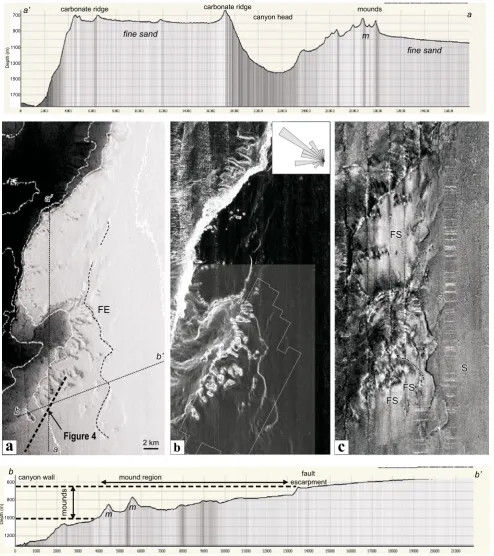
Multibeam and sidescan sonar data enabled the identifica-tion of a cluster of steep-sided mounds 50 to 220 m high, with base diameters varying from 300 to 2,000 m along the western edge and in the central part of the survey area. The seabed dips gently towards the southwest and, as a result, the mound tops are located at depths ranging from 550 to 900 m (Fig.1b, c). The mound area is delimited to the east by a long escarpment, and to the north and northwest by the canyon head and a carbonate ridge (see Fig.2and profile a′–
a). Between the escarpments and the edge of the canyon, the slope gradients across the intermound region range between 1–3°. To the northwest of the canyon head, at similar water
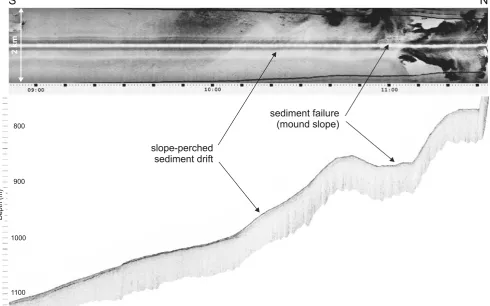
depths, the gradients are less than 1° (Fig.1). These mounds are characterised by high backscatter commonly associated with reflections from steep slopes (slope gradients between 25 to 35°; Figs. 2, 3). Some of the mounds have several peaks. The flanks of some mounds appear to have smooth surfaces, whereas others appear to be hummocky, presumably due to the presence of coral colonies. Transparent acoustic wedges found at the bases of some mounds probably represent aprons of coral debris (Fig. 4), as observed also on video images. Sidescan and multibeam records show patches of high and irregular backscatter at the base of some mounds, which are interpreted as small landslides, hardgrounds or coral patches covered by sediment (Fig.4).
Most of the mounds are elongated in shape and have
near-symmetrical slopes (Fig. 2b). Individual conical
mounds were also recognised in the south of the study
north, closer to the canyon head, mound distribution gets denser. Here the mounds have lower topography and form E-W-elongated ridge-like features.
The seafloor between these ridges is often characterised by sinuous bands of low backscatter, interpreted as path-ways of bottom currents (Figs.2,3). This was corroborated by sediment samples collected during the cruise (Table1, samples AT504G to 507 G) and by underwater video observations. The majority of the individual mounds and ridges are concentrated in two elongated clusters extending for 8 and 10 km in north–south and southwest–northeast
directions. These clusters contain the largest mounds recorded in the area and are separated by one of the main
sand transport pathways (Fig. 3a). A prominent E–W
carbonate ridge rises up to 120 m above the surrounding seafloor and extends for more than 5 km along the western
flank of the canyon head in the northwest of the study area (Fig.3a). On the acoustic data the ridge is seen to have high backscatter levels suggesting a hard-bottom seabed. This high backscatter signature extends northwards of the ridge for hundreds of metres onto the flat seabed, becoming gradually irregular and patchier. Beyond this patchy zone, the seabed is characterised by mostly lower backscatter which is attributed to a sandy bottom. This ridge is interpreted to represent a carbonate build-up similar to the ones seen along the eastern flank of the canyon head. The distribution of the mounds, however, differs from that along the eastern flank as the ridge represents the only major topographic feature running predominantly along the edge of the canyon head. Small E-W-aligned clusters of low mounds (25–50 m high) can be found a few km north of the
ridge (Figs. 1, 2). The eastern flank, by contrast, is
Table 1 Sampling stations on the western Porcupine Bank with geographic positions, water depths, and short descriptions of the geographical settings and sedimentary characteristics. Letters after the station numbers indicate the sampling method:Dgravity core,B
box-core,Grremote-controlled TV grab (double coordinates refer to start and end of the TV survey). Note that stations TTR13AT502B and TTR13AT503G were collected outside the mound area and are not shown in Fig.1
Station no. Lat. (N) Long. (W) Depth (m) Geographical setting Sedimentary summary
TTR13AT489B 51°54,300 15°00,725 773 Edge of canyon Hemipelagic sediments TTR13AT490Gr 51°50,884 14°57,828 694 Carbonate mound Living corals, coral debris,
hemipelagic sediments 51°50,883 14°57,823 693
TTR13AT491B 51°43,701 15°04,638 900 Top of carbonate mound Coral debris, hemipelagic sediments TTR13AT492G 51°43,697 15°04,642 897 Top of carbonate mound Coral debris
TTR13AT493G 51°45,837 15°02,153 737 Top of carbonate mound Coral debris
TTR13AT494G 51°48,597 15°05,224 1,588 Canyon Coral and shell debris, calcite-cemented TTR13AT495G 51°47,053 14°59,620 740 Saddle on top of carbonate mound Alternated foraminiferal and coccolith
ooze, coral and shell debris, terrigenous sediment TTR13AT496G 51°46,523 14°55,650 651 Upper part of escarpment Sand
TTR13AT497G 51°46,271 14°55,863 715 Lower part of escarpment Sand
TTR13AT498D 51°46,408 14°55,746 697 Steep slope along escarpment Authigenic deposits: calcite, dolomite, phosphatic hardgrounds+drop stones 51°46,544 14°55,639 650
TTR13AT499D 51°45,840 14°55,518 684 Steep slope along escarpment Authigenic deposits: calcite, phosphatic hardgrounds 51°45,860 14°55,395 646
TTR13AT500D 51°46,302 14°55,642 677 Steep slope along escarpment Authigenic deposits: calcite
glauconite-rich, calcite coccolith-rich, phosphatic hardgrounds
51°46,337 14°55,476 646
TTR13AT501D 51°51,003 14°57,730 726 Slope of carbonate mound Calcite-cemented bioclasts, coral rubble 51°50,776 14°57,929 640
TTR13AT502B 51°46,201 14°45,895 497 Pockmark area Hemipelagic sediments TTR13AT503G 51°43,971 14°47,996 535 Scour mark area Hemipelagic sediments, sand
TTR13AT504G 51°46,730 14°57,504 762 Intermound area Sand
TTR13AT505G 51°47,795 14°58,260 787 Intermound area Sand, clay TTR13AT506G 51°47,706 14°59,044 828 Intermound area Sand, shell debris
TTR13AT507G 51°47,874 14°59,902 852 Intermound area Sand
TTR13AT508D 51°43,650 15°06,373 1,212 Escarpment Corals
51°43,565 15°06,260 1,133
Fig. 2 Combination of bathymetry, slope gradients, and reflectivity data from the study area.aBathymetry: 25-m grey-shaded relief. The topographic control of the mound province is clearly delimited. The line annotatedFEindicates the faulted escarpment. Lines a–a′and b–b′ indicate the locations of two profiles through the canyon and the carbonate mound field (see top and bottom of figure;mmound). The profile reproduced in Fig.4is marked by athick dashed line.bSlope map in 25-m grey scale:light greyhigh slope (>1°),dark greylow slope (<1°). The N-S-oriented escarpment fault and the mound crests are
characterised by the presence of several mound clusters oriented predominantly normal to the canyon edge (Fig.3b).
Besides the described clusters, a system of escarpments was observed extending from south to north for up to 10 km in
Fig. 3 a Bird’s eye view of the carbonate mound field (vertical exaggeration 1:4) based on multibeam echosounder and sidescan sonar data. It shows the pathways of bottom currents and sand transport, the locations of sediment drifts, the E-W-oriented carbonate ridge in the northern sector, and the two major carbonate mound clusters in the central
the north-eastern part of the study area at 600–700 m water
depth (Fig.1). These features are up to 60 m high and are separated by terraces characterised by moderate backscatter levels. The main lineament appears segmented into a number of curvilinear escarpments with high backscatter ascribed to their steepness and the presence of bedrock outcrops (Fig.3b). In some places the high backscatter is disrupted by areas of low relief and patchy backscatter signatures. Multibeam data show that these discontinuities are associated with individual small carbonate build-ups growing along the edge of the escarpment. Trends of individual ridges within the main clusters (Fig.2b) suggest that they also grow along a series of characteristic shaped escarpments. The crescent-shaped geometry indicates that, as in the case of the other escarpments, these are the seabed expression of a regional listric fault system.
On multibeam and sidescan sonar images, the south-eastern part of the study area is generally characterised by a smooth
relief and homogeneous low backscatter levels (Fig. 2),
implying a transitional thickening of the soft sedimentary drape towards the south. The 5-kHz subbottom profiler records show that the sedimentary cover often thickens at these locations. Here, the seabed has a convex morphology
which onlaps onto the underlying sediments. Where the thickness is lower, erosional features are visible. Such sediment distributions and acoustic signatures indicate the presence of several small, fine-grained drifts formed by the northward-flowing bottom current (Fig.4).
Oceanographic data
The regional, E-W-oriented temperature and salinity profiles across the area indicate the existence of a major interface between Eastern North Atlantic Water and Mediterranean
water masses at about 1,100 m water depth (Fig.5). CTD
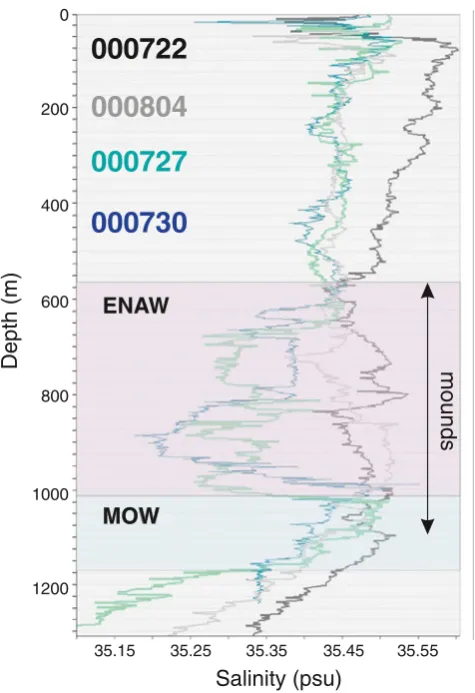
profiles taken from the southern (000730) and northern parts of the study area (000727) have a similar structure, showing a salinity peak associated with MOW between 900 and 1,150 m (Fig. 6). This corresponds to the lower limit of mound distribution. Furthermore, in the vicinity of the mound region, an irregular salinity pattern is observed over the depth range of the mounds (600–1,000 m). This could be
caused by MOW mixing with the ENAW, but may also be induced by the locally irregular topography within the deep-water canyon system. Such irregular deep-water mass patterns are not detected in the profiles of stations in deeper water to the
Fig. 4 Slope-perched sediment drift: the area of low backscatter with seabed striations observed on the sonograph corresponds to the stratified, pinching-out units seen on the deep-tow subbottom profiler
southwest (000722) and west (000804) of the study area. Salinity plots of the latter two stations show a smoother transition between the ENAW and the MOW, suggesting that the MOW signature becomes more mixed in deeper water.
Profiles of oxygen, nitrate, phosphate, salinity and temper-ature show another interface at about 600 m water depth, which corresponds to the upper limit of mound occurrence (Fig.5). The oxygen profile also reveals a marked oxygen minimum zone (OMZ) between the two interfaces.
Authigenic deposits: morphology and petrography
At many of the sampling stations (Table1, Fig. 1), mostly rounded gravels and boulders (up to 0.5 m in diameter) of different lithologies were retrieved, indicating that the entire region has in the past been exposed to the discharge of ice-rafted material. More detailed sampling on selected carbonate
mounds and along the north-eastern escarpment (Table 1)
revealed the presence of two main rock types (carbonate, phosphate) associated with outcrops of authigenic deposits (Table2). These rocks are all heavily bored, a feature ascribed to annelids and crustaceans coexisting with sponges and other encrusting organisms.
Carbonate deposits
Carbonate deposits were retrieved in three distinct settings: the
escarpmentin the eastern part of the survey area, theupper parts of carbonate mounds, and the flanks of carbonate mounds.
Theescarpment along the eastern side of the study area (Fig. 3b) was initially surveyed with an underwater video camera, which revealed irregularly shaped carbonate blocks with bored surfaces. Occasional small colonies of living
-1200000 -1000000 -800000
corals were observed on these surfaces. These blocks consist of porous micritic calcite cementing foraminiferal (planktonic and benthic) and coccolith ooze. Some better lithified samples (e.g. station AT500D, Fig.7a–d) show broadly distributed glauconite peloids and bryozoan remains; others samples
(stations AT498D, AT499D, AT500D, Fig. 7e, f) are less
lithified and lack any signs of glauconite.
Large reddish-pink elongated blocks of dolomite were also collected from the escarpment (Fig. 7g; e.g. station AT498D). Although borings have affected the outer surfaces of these samples, epibenthic biota were rarely observed. Thin sections and XRD analyses revealed the presence of a fine-grained dolomite groundmass with coarser-grained crystals occupying the voids. The observed microfossil ghost features are consistent with re-cementation of older hemipelagic deposits now exposed on the seafloor (Fig.7h).
35.15 35.25 35.35 35.45 35.55 0
Fig. 6 Salinity profiles from four stations (see locations in Fig.1d) collected during 2000 (last four digits of each station represent the month and day of sampling) showing the distribution of different water masses in the study region; the stations deployed in deeper waters to the southwest (000722) and west (000804) of the study area show an irregular water column structure in the depth range of mound occurrence (cf. main text for details)
Video images from theupper parts of carbonate mounds
showed dense thickets of living white and pink corals abundantly colonized by various species of echinoderms and crustaceans up to an approx. water depth of 1,125 m (Fig.8a). Thickets ofL. pertusa,M. oculataand occasional
D. cristagalli were observed to populate well-cemented
carbonate blocks dredged at station AT509D (Fig.8b). Petrographic observations are similar to those made on rock samples from the escarpment region, micritic calcite being the main cement binding together coccolith and foraminiferal ooze but, in this case, with high contents of sponge spicules and partly dissolved coral branches. Organic matter and aggregates of pyrite framboids are concentrated in defined areas of the rock samples (Fig.8c). A similar type of carbonate lithology was retrieved at station AT494G, representing the deepest site sampled in the canyon.
The video surveys run on theflanks of carbonate mounds
revealed the presence of irregular blocks protruding from fine-grained sediment together with scattered bioclasts and ice-rafted debris. Dredge hauls from this area (stations AT509D, AT501D) retrieved rocks similar to those described from the tops of the mounds, except that the corals show evidence of much stronger dissolution (Fig.8d–f). Noé et al. (2006) and Mienis et al. (2009) possibly describe similar authigenic deposits from carbonate mounds of the NE Atlantic, which contain carbonate-cemented layers with dissolved coral branches.
Phosphatic hardgrounds
The video record run along the escarpment shows wide-spread slabs populated by abundant fauna, in places including small colonies of living corals. The large slabs retrieved from dredge hauls have a yellowish-red colour, and are very well lithified and heavily bored (stations AT498D, AT499D, AT500D; Fig.9a). Freshly broken surfaces reveal a greenish internal structure consisting of cm-sized, subrounded brownish intraclasts and large (>0.5 cm) bioclasts supported by a yellowish-green groundmass (Fig.9b).
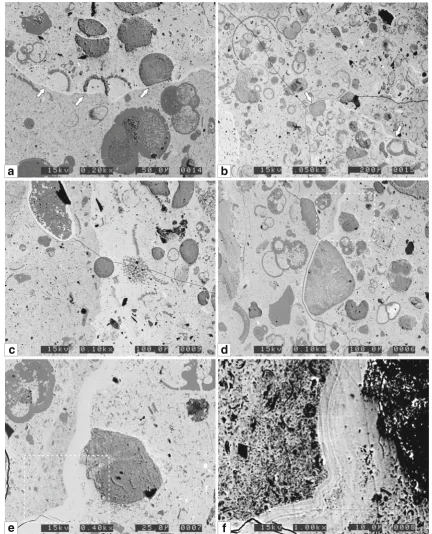
Petrographic analyses (Table2) show the cement of the microfossil-rich groundmass to consist of collophane binding together hemipelagic sediment, microfossils, apatite and sparsely distributed glauconite aggregates, the latter confer-ring the greenish colour to the samples (Fig.9c). A similar composition is recorded for the lighter-coloured intraclasts (Mg-calcite 33.4%, fluorapatite 66.6%) as well as the darker ones (Mg-calcite 18.2%, fluorapatite 81.8%; Fig. 9c). The intraclasts typically contain higher amounts of fluorapatite, and occasionally also hemipelagic clay, hence the darker colour in comparison to the groundmass. Bioclasts (e.g. bivalves, corals, fish teeth, microfossils) are scattered throughout the sample. Microfossils are mostly disrupted within the intraclasts, in contrast to their good preservation in
the groundmass. In addition, the contact intraclast–
ground-mass shows truncations of shells and glauconite, indicating prior transportation before their final deposition (Fig.10a, b). In some instances the edges of irregularly shaped intraclasts reveal the presence of cross-cutting glauconite pellets on the intraclast margins (Fig. 10c, d), which is consistent with continued local in situ diagenesis. These intraclasts have sharp margins defined by a zoned rim of collophane cement (Fig.10e, f).
Microfossil identification suggests a relatively recent age for these hardgrounds (Early Pliocene), as indicated by the presence of foraminifers such as orbulinids and numerous thin-walledGlobigerinoides.
Carbon and oxygen stable isotopes
The majority of the analysed samples (Table2) have small variations in stable isotope composition, with δ13C values
between 0 and 2‰andδ18O values between 3 and 4.6‰.
Sonar images and sediment samples taken around the mound area suggest that development of a small sediment drift is currently taking place. This is consistent with the observations of bottom current activity on the video footage of the seafloor surrounding the mounds. Furthermore, measurements conducted by a current-meter array a few kilometres farther south revealed average bottom current
speeds of 30–50 cm/s (Dickson and McCave 1986), which
are capable of transporting up to medium-grained sand. The interpretation of the acoustic data agrees with that of previous studies in other carbonate mound areas along the Irish margin (Kenyon et al. 1998, 2003a; Wheeler et al.
2005), where the low backscatter has been ascribed to the accumulation of fine- to medium-grained sand along the
bottom current pathways (Kenyon et al. 2004). This
interpretation indicates that the current from the south is responsible for the accumulations of lag sands and perhaps also for the transport of nutrients necessary for coral growth. It is suggested that the colonisation started from isolated symmetrical build-ups which then spread along the edge to form elongated complexes of merged mounds, the growth of which was facilitated by strong geostrophic flow along the escarpment and by tidal currents running in an E–
coral settlement (Wilson 1975). Mound growth is then facilitated by bottom currents and the hydrodynamic regime in the canyon where local current speed enhancement can be expected to occur due to the irregular topography around the edge of the canyon.
According to the sand transport pathways identified on the MAK-1 sonographs, prominent carbonate mounds also contribute to the topographic steering of the current. Abundant linear irregularities of high backscatter recog-nized on the sonographs are interpreted as half-buried escarpments located under the drift sequence along the southern extension of the previously described fault system
(Fig. 2). The gradual northward variation in mound
alignment from NW–SE to E–W, their shape evolution
from conical to elongated ridge, and their increase in abundance emphasise the importance of the canyon head in enhancing the hydrodynamic conditions which then favour mound growth. Similar conditions within canyons funnel-ling nutrients and sediments to the benefit of coral growth have been reported by de Stigter et al. (2007) and Orejas et al. (2009). These observations, in combination with video surveys, also suggest that numerous coral colonies were initially emplaced along regional fault-related escarpments which provided a hard substratum suitable for later growth and preferential southward expansion into the current. A similar type of accretion was reported by Paull et al. (2000) from the Florida–Hatteras Slope.
Different mound distribution patterns along the western and eastern flanks of the canyon head may indicate the presence of cascading bottom flow (Shapiro and Hill1997), which should be more intense on the eastern flank, thereby favouring mound growth. The western flank is less affected by the current, and the dominant process promoting coral growth there is probably the edge-related enhancement in turbulence.
The presence of several interfaces within the water
column—e.g. between the MOW marked by the salinity
anomaly, the OMZ and the ENAW—facilitates the
wide-spread development of nepheloid layers in the depth interval between 300 and 1,000 m (Dickson and McCave
1986; Rice et al. 1991; De Mol et al. 1998). These
nepheloid layers are an important source of detrital organic particles which increase the food availability for bottom fauna (Frederiksen et al. 1992). These layers spread out along the interfaces between the different water masses in the form of bottom-attached and intermediate nepheliod
sheets (BNL and INL; Dickson and McCave1986).
The development of nepheloid layers can be facilitated by a number of processes, including localised downwelling events following slack periods of tides (Davies et al.2009, Mingulay Reef off NW Scotland), tidally pulsed Ekman drainage (driven by cascading of denser trapped winter water on the bank) which flushes the nutrient- and organic
matter-rich‘soup’from shallow waters downslope into the
bathyal realm (White et al. 2005), and others. To identify the process which is most active in the area lies beyond the scope of this paper, although prominent tidal influence can be inferred from analogy with other mound areas in the region (Dorschel et al.2007; Mienis et al.2007).
Both INL and BNL layers were initially described for the study area on the basis of CTD profiles (Dickson and
McCave 1986; Fig. 1e). More recent single-beam surveys
have provided acoustic images of three such layers in the north of the study area (Fig.1e). These layers occur in the same depth range as the mounds (600–1,000 m; Fig.1) and
are therefore likely to be responsible for the enhanced coral growth.
The present findings are consistent with strong current activity facilitating the dissolution of aragonitic bioclasts and the precipitation of calcitic micrite. The observed aragonite dissolution (mainly from corals) operates as carbonate source for the precipitation of micritic calcite (e.
g. Mazzullo 1980; Lasemi and Sandberg 1984). This
process is favoured where coarser bioclasts are present and where a higher flux of water can be flushed through the pores to improve ion transport under oxic conditions. van der Land et al. (2010, 2011) have also demonstrated that carbonate precipitation is greatly enhanced by the presence of coccoliths which form the nucleation sites for calcite precipitation. In contrast to the previous sampling by Mienis et al. (2009), where carbonate-cemented intervals were cored in the subsurface, the present findings show that these rocks actually crop out on the seafloor. The model proposed herein is thus consistent with observations at the top and along the flanks of the carbonate mounds where coarse coral debris are present and where the currents are stronger, favouring better cementation and enabling the cemented blocks to remain exposed. The existence of such localized hard substrata would have an active role in promoting the continuous growth of the mounds.
The formation of carbonate deposits at the base of the mounds is unlikely to be due to high sedimentation rates or the supply of large amounts of coral debris from the upper part of the mounds. These conditions would not be
Fig. 7 Escarpment area.aHand sample of lithified carbonate rock (station AT500D); the greenish colour denotes a high glauconite content. b Thin section plane light image showing glauconite aggregates often coated by organic matter in a foraminifer- and organic-rich micritic calcite groundmass.cSEM image showing some glauconite aggregates in micritic calcite groundmass.dThin section plane light image showing bryozoans (arrow) in micritic, organic-rich groundmass with benthic and planktonic foraminifers and larger bioclasts. e Hand sample of less-lithified carbonate rock; note the greyish colour and the numerous borings.fSEM image of the internal part of the sample ineshowing coccolith-rich groundmass devoid of glauconite.gLarge block of dolomite (dredged).hThin section plane light image showing fine-grained dolomite cement with microfossil ghost features (centre)
a
mb
f
c
md
5 cm
e
m 10 cm
favourable for carbonate dissolution and further precipita-tion, as confirmed by core AT495G (see log in Kenyon et
al. 2004) recovered from the moat of a multi-peaked
carbonate mound. The 5-m-long core penetrated a sequence rich in coral debris intercalated with clay or sand beds and occasional pebble layers. Similar cores from the bases of other mounds along the Irish margin are documented in Kenyon et al. (1998, 2003b). This implies that periods of fast growth (and higher rates of debris production) of the coral colony alternate with periods of dominant hemi-pelagic and terrigenous sedimentation (and perhaps ero-sional events). The presence of water-saturated coral debris layers suggests rapid burial, presumably occurring when the angle of repose of the mounds is exceeded, causing the collapse of the mounds accompanied by reduced coral growth. The absence of lithified hemipelagic sediment in the core strengthens the contention that carbonate precip-itation occurs only at specific sites.
Interrelationships with phosphatic hardgrounds
As stated in the Introduction, the presence of phosphate deposits in carbonate mound regions of the Irish Margin has been poorly documented so far. Phosphatic hardgrounds were particularly common during the Cretaceous and are today cropping out in southern England (e.g. Kennedy and
Garrison 1975a, 1975b), in Northern Ireland
(Marshall-Neill and Ruffell 2004), and at various places along the Irish west coast (Wilson1975). More recently, Haughton et al. (2005) documented the stratigraphy of three borehole sites on the western slope of the Porcupine High. At borehole 83/20-sb01, a thin phosphatised crust was cored between Maastrichtian chalky micrites and the overlying Miocene silty clays. However, it is currently unknown whether deposition of phosphate-rich sediments recurred in the recent past. The textural and petrographic characteristics of the hardgrounds in the present study area are very similar to those described by Haughton et al. (2005). By contrast, the Early Pliocene age estimated here indicates that they are much younger. It cannot be excluded that these laterally extensive hardgrounds correspond to the erosional unconformity observed at the base of mounds in the Porcupine Seabight and on the Rockall Bank (e.g. Stoker et al. 2005), but more data are required to verify this hypothesis.
Based on the present findings, the phosphatic hard-grounds could be the result of two different depositional processes. The rounded intraclasts, which contain more fragmented fossils and broken shells and minerals, repre-sent the initial deposition on the upper part of the escarpment. These poorly lithified clasts were then locally moved along the seabed before they became fully cemented within the lighter-coloured groundmass. The well-preserved
microfossils within the collophane groundmass suggest that
cementation occurred at or close to the sediment–water
interface.
In most cases, this type of hardground occurs as a consequence of the deposition of large amounts of organic material, this being frequently related to upwelling currents. The onshore (UK, Ireland) record of such deposits in the geological history indicates a recurrence of such events. Dinoflagellate blooms associated with major benthic and pelagic mortalities related to small-scale coastal upwelling events have indeed been documented along the southwest coast of Ireland (e.g. O’Boyle 2002; Silke et al. 2005),
although of considerably smaller magnitude than those occurring, for example, off south-western Africa (e.g. Carr
2002; Weeks et al. 2004; Santana-Casiano et al. 2009). Such events occur where abrupt bathymetric changes take place (e.g. escarpments, continental shelf breaks). They generally induce high organic productivity and phytoplank-ton growth, resulting in the deposition of organic-rich sediments in the neighbouring escarpment area. Low sedimentation rates and bacterial decay of organic matter liberate phosphates which can then induce the phosphogenesis of hardgrounds containing glauconite. High-energy conditions are required to allow these reactions and to erode the hemipelagic capping sediment, or to prevent its deposition, in order to expose the hardgrounds at the seafloor.
This scenario seems to apply to the Porcupine Bank Canyon escarpment region where the presence of strong currents was confirmed by sidescan sonar data and the medium- to coarse-grained sand with foraminifers and shell debris retrieved at sampling station AT496G (Mazzini et al.
2004). Moreover, the water depth in this area coincides with the limits of the previously described OMZ. The regional oceanography also provides complementary arguments to explain the presence of phosphate deposits. Glenn et al. (1994) describe phosphate precipitation as a widespread phenomenon in marine sediments, but emphasise that the accumulation of such deposits requires the maintenance of the phosphogenic system for extended periods of time coupled with prolonged concentration of phosphatic par-ticles by current winnowing and transport. In the Porcupine
Fig. 8 a–cTop of coral mounds.aDense thicket of corals (scale: ca. 1 m). b Hand sample consisting of micritic calcite cementing foraminiferal ooze; note the numerous borings and attached living corals. c Thin section plane light image showing micrite-cemented foraminiferal ooze with locally high concentrations of organic matter (dark colour). d–g Flank of coral mounds. d Extensive carbonate deposits rich in coral debris associated with attached thickets of living corals (scale: ca. 1 m).eDetail of a partly dissolved coral fragment extracted from carbonate deposits. fHand sample of micritic calcite cementing hemipelagic sediments rich in coral and shell debris.gThin section plane light image showing micritic calcite cementing hemi-pelagic sediments rich in microfossils (mostly planktonic) and bioclasts (e.g. shell fragment toright)
2 cm
5 cm
2 cm
m m
a
b
f
e
g
c
Bank Canyon area, the water column stratification and the circulation pattern can provide the mechanism for efficient trapping and concentration of organic matter within narrow zones along the continental margin. The bottom nepheloid
layers described by Dickson and McCave (1986) and Rice
et al. (1991) can evidently supply large volumes of
suspended organic matter, and the long-term persistence of these conditions along the Irish continental margin would
4 cm
m
a
b
c
Fig. 9 Escarpment area, phosphatic hardgrounds.aLarge slab; note the intense boring and fauna colonizing the external surface.bFreshly broken surface of a slab showing yellowish-green groundmass and
thus promote the formation of phosphate crusts which, in turn, provide the hard substrata required for the establishment of deep-water coral bioherms. These conditions persist to the
present day, as indicated by the thriving coral colonies and by the glauconite aggregates observed within the carbonate deposits of the escarpment (e.g. station AT500Gr). This
c
d
e
f
a
b
Fig. 10 SEM-BSE images of phosphate deposits.aContact between nodule (top) and groundmass; sharp truncations of the glauconite and microfossils (arrowed) suggest fracturing and transportation of this nodule.b Groundmass and nodule (bottom right, dotted line); the truncated glauconite and foraminifers (arrowed), the fragmented microfossils within the nodule, and the better preserved microfossils in the groundmass suggest that the nodule was not fully lithified when
implies constant slow accumulation rates, which is a precondition for the in situ formation of glauconite at the water–sediment interface.
The association of phosphatic hardgrounds with corals has also been widely documented in the literature. For example, Jarvis (2006) described deep-water colonial coral thickets (Diblasus arborescens) in conjunction with phosphate-rich hardgrounds in the Santonian–Campanian phosphatic chalks
of England and France. Phosphate‘nodules’and intraclasts
were drilled close to the base of the Magellan carbonate mound (Expedition-Scientists-ODP-3072005). Furthermore, glauconite has been observed to occur in the upper bathyal coral zone of the Rockall Bank (Scoffin et al.1980), in the
hardgrounds near Connacht Mound (Noé et al. 2006), in
bathyal gorgonian skeletons from the Bay of Biscay margin (Noé et al. 2007), on the Sula Reef of the mid-Norwegian shelf (Freiwald et al.2002), and in Gonicorella thickets of
the Chatham Rise, New Zealand (Dawson 1984; Kudrass
and von Rad1984).
The data available to this study are insufficient to determine to what extent the localised upwelling events known to occur in the area have contributed to the development and maintenance of the deep-water coral ecosystem. The distribu-tion of the mounds along the escarpments along the canyon head suggests that the role of upwelling is substantial. However, the increased current-induced turbulence at the escarpment edges is probably also sufficient to create the enhanced nutrient fluxes needed for coral growth. A combi-nation of both factors would, of course, also be plausible. Whichever the case, the formation of phosphate crusts greatly enhances the probability of widespread coral settlement. The high backscatter recorded in the escarpment area together with the phosphate deposits suggest that it would not be unrealistic to expect much more extensive deposits of this kind in the Porcupine Bank region.
Insights from isotopic signatures
The isotopic values show that seawater was the initial source of the carbon in the cements and bioclasts of the authigenic deposits in the study area. With δ18O=0.6‰SMOW as the
present-day value for the Porcupine region bottom waters (F. Mienis, personal communication), and applying the equa-tions of, for example, Friedman and O’Neil (1977) and
Grossman and Ku (1986), the oxygen isotopes of the
analyzed samples indicate that these carbonates precipitated in equilibrium with the actual seafloor conditions (~7°C). Moreover, the δ13C values show no significant depletion
which could be related to seepage of hydrocarbon-rich fluids. This is consistent with the findings of Noé et al. (2006) who obtained similarδ18O and δ13C values for carbonate
hard-grounds from the Propeller Mound in the Porcupine Seabight. The association of coral reefs, carbonate deposits and
methane seepages therefore remains a speculative issue at this stage.
Conclusions
The western margin of the Porcupine Bank is characterised by pronounced bathymetric variations and a high variety of depositional environments. In the course of this multidisci-plinary study, a large province of carbonate coral mounds was examined together with the environmental controls and depositional processes involved in their formation. The mounds are located in a distinctive geomorphological and oceanographic setting when compared to other large mound provinces in Irish waters, and thus represent an important case study for research on mound development.
The data presented in this study show that particular oceanographic processes are the predominant factor con-trolling mound distribution and growth. Water column properties indicate mixing of water masses across the mound depth interval. In addition, a distinct salinity peak at about 1,000 m associated with the MOW coincides with the lower limit of the mounds. The available geophysical evidence indicates that the distribution of the mounds follows the pre-existing seabed topography, being located on the almost flat seabed along the edges of the canyon system framed by fault escarpments in the easternmost part. Furthermore, mound density increases towards the canyon head where the specific hydrodynamic regime effectively influences the shape and orientation of mound morphology. Different types of authigenic deposits (carbonate and phosphatic) have been identified. On the top and along the flanks of the mounds, calcite and coral-rubble deposits are present. The model proposed in this study implies that strong currents facilitate the dissolution of coral debris and the precipitation of micritic calcite. Phosphatic and carbonate deposits have been sampled from the eastern escarpment. These phosphatic hardgrounds may extend well beyond the eastern part of the survey area. The bottom currents in this area and localised upwelling favour the formation of these phosphate-rich deposits, at the same time preventing their burial.
Sampling and video observations show that all the described authigenic deposits represent a hard substratum enhancing the growth of the mounds and promoting the establishment of new coral colonies along the escarpment. The available geochemical data do not support any relationship between methane seepage and coral colony emplacement.
director for access to the multibeam and CTD data and for allowing their publication. We are grateful to Felix Gradstein for his assistance in microfossil identification, J. Still for help during microprobe and SEM analyses, and also J. Parnell for his support. We would like to acknowledge the crew and the Scientific Party of the TTR-13 cruise and the UNESCO-MSU Centre for Marine Geosciences. The UNESCO, and in particular Alexei Suzyumov, are thanked for their support during the preparation of this manuscript. M. Badali, F. Mienis, B.T. Cronin, A. Freiwald, as well as the editors M.T. Delafontaine and B.W. Flemming are acknowledged for their suggestions and critical reviews.
References
Bailey W, Shannon PM, Walsh JJ, Unnithan V (2003) The spatial distributions of faults and deep sea carbonate mounds in the Porcupine Basin, offshore Ireland. Mar Petrol Geol 20:509–522 BODC (2003) Centenary Edition of the GEBCO Digital Atlas,
published on CD-ROM on behalf of the Intergovernmental Oceanographic Commission and the International Hydrographic Organization as part of the General Bathymetric Chart of the Oceans. British Oceanographic Data Centre, Liverpool
Bosence DWJ, Bridges PH (1995) A review of the origin and evolution of carbonate mud-mounds. In: Monty CLV, Bosence DWJ, Bridges PH, Pratt BR (eds) Carbonate mud-mounds: their origin and evolution. Spec Publ Int Assoc Sedimentol 23:3–9 Boyer TP, Antonov JI, Garcia HE, Johnson DR, Locarnini RA,
Mishonov AV, Pitcher MT, Baranova OK, Smolyar IV (2006) World Ocean Database 2005. In: Levitus S (ed) NOAA Atlas NESDIS 60. US Government Printing Office, Washington, DC, p 190 Carr M-E (2002) Estimation of potential productivity in eastern boundary
currents using remote sensing. Deep-Sea Res II 49:58–80 Coplen TB (1994) Reporting of stable hydrogen, carbon, and oxygen
isotopic abundances. Pure Appl Chem 66:273
Craig H (1957) Isotopic standards for carbon and oxygen and correction factors for mass spectrometric analyses of carbon dioxide. Geochim Cosmochim Acta 12:133–149
Davies AJ, Duineveld GCA, Lavaleye MSS, Bergman MJN, van Haren H, Roberts JM (2009) Downwelling and deep-water bottom currents as food supply mechanisms to the cold-water coral Lophelia pertusa (Scleractinia) at the Mingulay Reef complex. Limnol Oceanogr 54:620–629
Dawson EW (1984) The benthic fauna of the Chatham Rise: an assessment relative to possible effects of phosphorite mining. Geol Jahrb D65:209–231
De Mol B, Keppens E, Swennen R, Henriet JP (1998) Isotopic characterisation of ahermatypic coral on a‘Hovland’mound. In: De Mol B (ed) Geosphere-biosphere coupling: carbonate mud mounds and cold water reefs. International Conference and 6th Post-Cruise Meeting of the Training Through Research Programme, 7–11 February 1998, Gent, Belgium. Intergovern-mental Oceanographic Commission, UNESCO, Worksh Rep 143, pp 31–32
De Mol B, Van Rensbergen P, Pillen S, Van Herreweghe K, Van Rooij D, McDonnell A, Huvenne V, Ivanov M, Swennen R, Henriet JP (2002) Large deep-water coral banks in the Porcupine Basin, southwest of Ireland. Mar Geol 188:193–231
De Mol B, Henriet J-P, Canals M (2005) Development of coral banks in Porcupine Seabight: do they have Mediterranean ancestors? In: Freiwald A, Roberts JM (eds) Cold-water corals and ecosystems. Erlangen Earth Conference Series, vol 32. Springer, Berlin Heidelberg New York, pp 515–533
de Stigter HC, Boer W, Mendes PADJ, Jesus CC, Thomsen L, van den Bergh GD, van Weering TCE (2007) Recent sediment transport
and deposition in the Nazare Canyon, Portuguese continental margin. Mar Geol 246:144–164
Dickson RR, McCave IN (1986) Nepheloid layers on the continental slope west of Porcupine Bank. Deep-Sea Res 33:791–818 Dorschel B, Hebbeln D, Foubert A, White M, Wheeler AJ (2007)
Hydrodynamics and cold-water coral facies distribution related to recent sedimentary processes at Galway Mound west of Ireland. Mar Geol 244:184–195
Expedition-Scientists-ODP-307 (2005) Modern carbonate mounds: Porcupine drilling. IODP Prel Rep 307. doi:10.2204/iodp. pr.307.2005
Frederiksen R, Jensen A, Westerberg H (1992) The distribution of the scleractinian coral Lophelia pertusa around the Faeroe Islands and the relation to internal tidal mixing. Sarsia 77:157–171 Freiwald A (2002) Reef-forming cold-water corals. In: Wefer G,
Billett D, Hebbeln D, Jørgensen BB, Schlüter M, van Weering TCE (eds) Ocean margin systems. Springer, Berlin Heidelberg New York, pp 365–385
Freiwald A, Hühnerbach V, Lindberg B, Wilson JB, Campbell J (2002) The Sula Reef Complex, Norwegian shelf. Facies 47:179–200 Friedman I, O’Neil JR (1977) Compilation of stable isotope
fractionation factors of geochemical interest. In: Fleisher M (ed) Data of geochemistry, 6th edn. USGS Prof Pap vol 440-KK, p 12 Glenn CR, Föllmi KB, Riggs SR, Baturin GN, Grimm KA, Trappe J, Abed AM, Galliolivier C, Garrison RE, Ilyin AV, Jehl C, Rohrlich V, Sadaqah RMY, Schidlowski M, Sheldon RE, Siegmund H (1994) Phosphorus and phosphorites: sedimentology and environments of formation. Eclogae Geol Helvet 87:747–788
Grossman EL, Ku TL (1986) Carbon and oxygen isotope fractionation in biogenic aragonite: temperature effects. Chem Geol 59:59–74 Haughton P, Praeg D, Shannon PM, Harrington G, Higgs K, Amy L, Tyrrell S, Morrissey T (2005) First results from shallow stratigraphic boreholes on the eastern flank of the Rockall Basin, offshore western Ireland. In: Doré AG, Vining B (eds) Petroleum geology: North-West Europe and global perspec-tives. Proc 6th Petroleum Geology Conf, Geological Society of London, pp 1077–1094
Henriet J-P, De Mol B, Pillen S, Vanneste M, Van Rooij D, Versteeg W, Croker PF, Shannon PM, Unnithan V, Bouriak S, Chachkine P, Belgica 97 Shipboard Party (1998) Gas hydrate crystals may help build reefs. Nature 391:648–649
Henriet J-P, De Mol B, Vanneste M, Huvenne V, Van Rooij D, the ‘Porcupine-Belgica’ 97, 98 and 99 Shipboard Parties (2001) Carbonate mounds and slope failures in the Porcupine Basin: a development model involving fluid venting. In: Shannon PM, Haughton PDW, Corcoran DV (eds) The petroleum exploration of Ireland’s offshore basins. Geol Soc Lond Spec Publ 188:375–383 Hovland M (1990) Do carbonate reefs form due to fluid seepage?
Terra Nova 2:8–18
Hovland M, Risk M (2003) Do Norwegian deep-water coral reefs rely on seeping fluids? Mar Geol 198:83–96
Hovland M, Thomsen E (1997) Cold-water corals - are they hydrocarbon seep related? Mar Geol 137:159–164
Hovland M, Croker PF, Martin M (1994) Fault-associated seabed mounds (carbonate knolls?) off western Ireland and north-west Australia. Mar Petrol Geol 11:232–246
Hovland M, Mortensen PB, Brattegard T, Strass P, Rokoengen K (1998) Ahermatypic coral banks off mid-Norway: evidence for a link with seepage of light hydrocarbons. Palaios 13:189–200 Huvenne VAI, De Mol B, Henriet J-P (2003) A 3D seismic study of
the morphology and spatial distribution of buried coral banks in the Porcupine Basin, SW of Ireland. Mar Geol 198:5–25 Jarvis I (2006) The Santonian-Campanian phosphatic chalks of
England and France. Proc Geol Assoc 117:219–237
X, Integrated Ocean Drilling Program Expedition 307 Scientists (2007) Age constraints on the origin and growth history of a deep-water coral mound in NE Atlantic drilled in IODP Expedition 307. Geology 35(11):1051–1054
Kennedy WJ, Garrison RE (1975a) Morphology and genesis of nodular chalk and hardgrounds in the Upper Cretaceous of southern England. Sedimentology 22(3):311–386
Kennedy WJ, Garrison RE (1975b) Morphology and genesis of nodular phosphates in the Cenomanian glauconite marl of South East England. Lethaia 8:339–360
Kenyon NH, Ivanov MK, Akhmetzhanov AM (1998) Cold water carbonate mounds and sediment transport on the Northeast Atlantic margin. Intergovernmental Oceanographic Commission, UNESCO, Technical Series 52
Kenyon NH, Akhmetzhanov AM, Wheeler AJ, van Weering TC, de Haas H, Ivanov MK (2003a) Giant carbonate mud mounds in the southern Rockall Trough. Mar Geol 195:5–30
Kenyon NH, Ivanov MK, Akhmetzhanov AM, Akhmanov GG (2003b) Interdisciplinary geoscience research on the North East Atlantic Margin, Mediterranean Sea and Mid-Atlantic Ridge. Intergovernmental Oceanographic Commission, UNESCO, Techni-cal Series 67
Kenyon NH, Ivanov MK, Akhmetzhanov AM, Kozlova E, Mazzini A (eds) (2004) Interdisciplinary studies of North Atlantic and Labrador Sea margin architecture and sedimentary processes. Intergovern-mental Oceanographic Commission, UNESCO, Technical Series 68 Kudrass H-R, von Rad U (1984) Underwater television and photography observations, side-scan sonar and acoustic reflectivity measure-ments of phosphorite-rich areas on the Chatham Rise (New Zealand). Geol Jahrb D65:69–89
Lasemi Z, Sandberg PA (1984) Transformation of aragonite-dominated lime muds to microcrystalline limestones. Geology 12:420–423 León R, Somoza L, Medialdea T, González F, Díaz-del-Río V,
Fernández-Puga M, Maestro A, Mata M (2007) Sea-floor features related to hydrocarbon seeps in deepwater carbonate-mud mounds of the Gulf of Cádiz: from mud flows to carbonate precipitates. Geo-Mar Lett 27:237–247. doi:10.1007/s00367-007-0074-2
MaCrea JM (1950) On isotope chemistry of carbonates and paleotemperature scale. J Chem Phys 18:849–857
Marshall-Neill G, Ruffell A (2004) Authigenic phosphate nodules (Late Cretaceous, northern Ireland) as condensed succession microarchives. Cretaceous Res 25:439–452
Mazzini A, Akhmetjanov AM, Kozlova E, Sarantsev E, Ovsyannikov A, Barvalina O, Belan E, Bileva E, Blinova V, Khamidullin R, Korost D, Poludetkina E, Ptashnaya T, Niggli S, Tsilikishvili Z (2004) Western Porcupine Bank: bottom sampling. In: Kenyon NH, Ivanov MK, Akhmetzhanov AM, Kozlova E, Mazzini A (eds) Interdisciplinary studies of North Atlantic and Labrador Sea margin architecture and sedimentary processes. Intergovernmental Oceanographic Commission, UNESCO, Technical Series 68, pp 84–88
Mazzullo SJ (1980) Calcite pseudospar replacive of marine acicular aragonite, and implications for aragonite cement diagenesis. J Sediment Res 50:409–422
McDonnell A, Shannon PM (2001) Comparative Tertiary stratigraphic evolution of the Porcupine and Rockall basins. Geol Soc Lond Spec Publ 188:323–344
Mienis F, de Stigter HC, White M, Duineveld G, de Haas H, van Weering TCE (2007) Hydrodynamic controls on cold-water coral growth and carbonate-mound development at the SW and SE Rockall Trough Margin, NE Atlantic Ocean. Deep-Sea Res I 54:1655–1674
Mienis F, van der Land C, de Stigter HC, van de Vorstenbosch M, de Haas H, Richter T, van Weering TCE (2009) Sediment accumu-lation on a cold-water carbonate mound at the Southwest Rockall Trough margin. Mar Geol 265:40–50
Mullins HT, Newton CR, Heath K, Vanburen HM (1981) Modern deep-water coral mounds north of Little Bahama Bank: criteria for recognition of deep-water coral bioherms in the rock record. J Sediment Petrol 51:999–1013
Neumann AC, Kofoed JW, Keller GH (1977) Lithoherms in the Straits of Florida. Geology 5:4–10
Noé S, Titschack J, Freiwald A, Dullo W-C (2006) From sediment to rock: diagenetic processes of hardground formation in deep-water carbonate mounds of the NE Atlantic. Facies 52:183–208 Noé S, Lembke-Jene L, Reveillaud J, Freiwald A (2007) Microstructure,
growth banding and age determination of a primnoid gorgonian skeleton (Octocorallia) from the late Younger Dryas to earliest Holocene of the Bay of Biscay. Facies 53:177–188
O’Boyle SMB (2002) Summer flora of shelf waters around western Ireland: interactions between physical dynamics and phytoplankton and consequences for potentially harmful algal events. PhD Thesis, National University of Ireland, Galway
Orejas C, Gori A, Lo Iacono C, Puig P, Gili JM, Dale MRT (2009) Cold-water corals in the Cap de Creus canyon, northwestern Mediterranean: spatial distribution, density and anthropogenic impact. Mar Ecol Prog Ser 397:37–51
Paull CK, Neumann AC, am Ende BA, Ussler W III, Rodriguez NM (2000) Lithoherms on the Florida-Hatteras slope. Mar Geol 166:83–101
Rice AL, Billett DSM, Lampitt RS, Thurston MH (1991) The Institute of Oceanographic Sciences biology programme in the Porcupine Seabight: background and general introduction. J Mar Biol Assoc UK 71:281–310
Rogers AD (1999) The biology ofLophelia pertusa(Linnaeus 1758) and other deep-water reef-forming corals and impacts from human activities. Rev Hydrobiol 84:315–406
Santana-Casiano JM, Gonzalez-Davila M, Ucha IR (2009) Carbon dioxide fluxes in the Benguela upwelling system during winter and spring: a comparison between 2005 and 2006. Deep-Sea Res II 56:533–541
Schlitzer R (2007) Ocean Data View.http://odv.awi.de
Scoffin TP, Alexandersson ET, Bowes GE, Clokie JJ, Farrow GE, Milliman JD (1980) Recent, temperate, sub-photic, carbonate sedimentation - Rockall Bank, Northeast Atlantic. J Sediment Petrol 50:331–356
Shapiro GI, Hill AE (1997) Dynamics of dense water cascade at the shelf edge. J Phys Oceanogr 27:2381–2394
Sharma T, Clayton RN (1965) Measurement of18O/16O ratios of total
oxygen in carbonates. Geochim Cosmochim Acta 29:1347–1353 Shlikov VG, Kharitonov VD (2001) On method of quantitative X-ray analysis of mineral composition of the rocks (in Russian). Geoecol Eng Geol Hydrogeol Geocryol 2:129–140
Silke J, O’Beirn F, Cronin M (2005)Karenia mikimotoi: an exceptional dinoflagellate bloom in western Irish waters, summer 2005. Marine Institute, Galway, Marine Environment and Health Series 21 Stoker MS, Praeg D, Shannon PM, Hjelstuen BO, Laberg JS, Nielsen
T, van Weering T, Sejrup HP, Evans D (2005) Neogene evolution of the Atlantic continental margin of NW Europe (Lofoten Islands to SW Ireland): anything but passive. Geol Soc Lond Petrol Geol Conf 6:1057–1076
van Aken HM, Becker G (1996) Hydrography and through-flow in the north-eastern North Atlantic; the NANSEN project. Prog Oceanogr 38:297–346
van der Land C, Mienis F, de Haas H, Frank N, Swennen R, van Weering TCE (2010) Diagenetic processes in carbonate mound sediments at the south-west Rockall Trough margin. Sedimentology 57:912–931
van Weering TCE, de Haas H, de Stigter HC, Lykke-Andersen H, Kouvaev I (2003) Structure and development of giant carbonate mounds at the SW and SE Rockall Trough margins, NE Atlantic Ocean. Mar Geol 198:67–81
Weeks SJ, Currie B, Bakun A, Peard KR (2004) Hydrogen sulphide eruptions in the Atlantic Ocean off southern Africa: implications of a new view based on SeaWiFS satellite imagery. Deep-Sea Res I 51:153–172
Wheeler AJ, Kozachenko M, Beyer A, Foubert A, Huvenne VAI, Klages M, Masson DG, Olu-Le Roy K, Thiede J (2005) Sedimentary processes and carbonate mounds in the Belgica Mound province, Porcupine Seabight, NE Atlantic. In: Freiwald A, Roberts JM (eds) Cold-water corals and ecosystems. Erlangen Earth Conference Series, vol 32. Springer, Berlin Heidelberg New York, pp 571–603 Wheeler A, Beyer A, Freiwald A, de Haas H, Huvenne V, Kozachenko M, Olu-Le Roy K, Opderbecke J (2007) Morphology and environment of cold-water coral carbonate mounds on the NW European margin. Int J Earth Sci 96:37–56
White M (2007) Benthic dynamics at the carbonate mound regions of the Porcupine Sea Bight continental margin. Int J Earth Sci 96:1– 9
White M, Mohn C, de Stigter H, Mottram G (2005) Deep-water coral development as a function of hydrodynamics and surface productivity around the submarine banks of the Rockall Trough, NE Atlantic. In: Freiwald A, Roberts JM (eds) Cold-water corals and ecosystems. Erlangen Earth Conference Series, vol 32. Springer, Berlin Heidelberg New York, pp 503–514
Williams T, Kano A, Ferdelman T, Henriet J-P, Abe K, Andres MS, Bjerager M, Browning EL, Cragg BA, De Mol B, Dorschel B, Foubert A, Frank TD, Fuwa Y, Gaillot P, Gharib JJ, Gregg JM, Huvenne VAI, Léonide P, Li X, Mangelsdorf K, Tanaka A, Monteys X, Novosel I, Sakai S, Samarkin VA, Sasaki K, Spivack AJ, Takashima C, Titschack J (2006) Cold-water coral mounds revealed. Eos 87(47):525–526