DOSA: Design Optimizer for Scientific Applications
∗David A. Bader
1and Viktor K. Prasanna
21
College of Computing
2Ming Hsieh Department of Electrical Engineering
Georgia Institute of Technology
University of Southern California
Altanta, GA 30332
Los Angeles, CA 90089
[email protected]
[email protected]
Abstract
In this work, we propose an application composition system (ACS) that allows design-time exploration and au-tomatic run-time optimizations so that we relieve applica-tion programmers and compiler writers from the challeng-ing task of optimizchalleng-ing the computation in order to achieve high performance. Our new framework, called “Design Optimizer for Scientific Applications” (DOSA), allows the programmer or compiler writer to explore alternative de-signs and optimize for speed (or power) at design-time and use its run-time optimizer as an automatic ACS. The ACS constructs an efficient application that dynamically adapts to changes in the underlying execution environment based on the kernel model, architecture, system features, avail-able resources, and performance feedback. The run-time system is a portable interface that enables dynamic appli-cation optimization by interfacing with the output of DOSA. It thus provides an application composition system that de-termines suitable components and performs continuous per-formance optimizations. We focus on utilizing advanced ar-chitectural features and memory-centric optimizations that reduce the I/O complexity, cache pollution, and processor-memory traffic, in order to achieve high performance. The design-time effort uses a computer-aided design space ex-ploration that provides a user-friendly graphical modeling environment, high-level performance estimation and profil-ing, and the ability to integrate low-level simulators suitable for HPC architectures.
1. Introduction
High-performance computing (HPC) systems are taking a revolutionary step forward with complex architectural
de-∗This work is supported in part by the National Science Foundation, USA, under grant numbers CNS-0614915 and CNS-0613376.
1-4244-0910-1/07/$20.00 c2007 IEEE.
signs that require application programmers and compiler writers to perform the challenging task of optimizing the computation in order to achieve high performance. In the past decade, caches and high-speed networks have be-come ubiquitous features of HPC systems, canonically rep-resented as clusters of multiprocessor workstations. To ef-ficiently run application codes on these systems, the user must carefully lay out data and partition work so as to re-duce communication, maintain a load balance, and expose locality for better cache performance. Realizing the gap between processor and memory performance, several HPC vendors, such as IBM and Cray, are incorporating into their next-generation systems innovative architectural features that alleviate this memory wall. These new architectural features include hardware accelerators (e.g., reconfigurable logic such as FPGAs, SIMD/vector processing units such as in the IBM Cell Broadband Engine processor, and graph-ics processing units (GPUs)), adaptable general-purpose processors, run-time performance advisors, capabilities for processing in the memory subsystem, and power optimiza-tions. With these innovations, the multidimensional design space for optimizing applications is huge. Software must be sensitive to data layout, cache parameters, and data reuse, as well as dynamically changing resources, for highest perfor-mance.
spe-cific optimization to make use of the unique features avail-able to it. HPC systems may have adaptavail-able resources such as processors, and the run-time system gains new respon-sibility for requesting the appropriate configuration for the workload. Also, in a large, complex computing system, the available resources may change during iterations, and the run-time system must monitor, select, and tune new compo-nents to maintain or increase performance. Our goal is to design a dynamic application composition system that vides both high-performance computing and increased pro-ductivity. In this work, we discuss the Design Optimizer for Scientific Applications (DOSA), a semi-automatic frame-work for software optimization. DOSA will allow rapid, high-level performance estimation and detailed low-level simulation.
2. DOSA Framework
2.1. Framework Overview
In this paper we use the following naming conventions. In the framework, applications will be represented in terms of the kernels of which they are comprised. Kernels, in turn, are made up of tasks and are represented as task flow graphs. Tasks correspond to the components in the component li-brary. For example, molecular dynamics (MD) simulation is an application. One kernel of MD simulation is non-bonded force calculation. One task of non-non-bonded force calculation is the transmission of the molecule-position in-formation to the appropriate processors. The component library would provide various components for carrying out this task, such as one component with which the transmis-sion would be carried out through traditional message pass-ing and another component with which the transmission would be carried out through cache injection. Throughout the paper, we use the term “performance models” to de-scribe the models that are used within and produced by our DOSA framework. When describing theoretical models, such as the I/O complexity model, we use the term “model.” The design framework (DOSA) allows various optimiza-tions to be explored based on the architectural features of the HPC platforms. In the DOSA framework, at design time, the designer models the kernels and architectures of her/his application. This modeling process includes perfor-mance estimation, simulation, identification of bottlenecks, and optimization. Through this modeling process, the de-signer identifies sets of components in the component li-brary that can be utilized for the tasks in the kernels of her/his application. We will implement a high-level es-timator that will estimate bandwidth utilization, memory activity, I/O complexity, and performance. Our approach is hierarchical: the framework will be used to perform a coarse exploration to identify potential optimizations,
fol-Tuned Component(s)
Processing Directives
Models
Run-Time System Kernel Representation
Performance Information
Component Library
Component(s) for Task
Run-Time Optimizer
Architecture/Operating System Model Parameter Values
Requests for New Component(s)
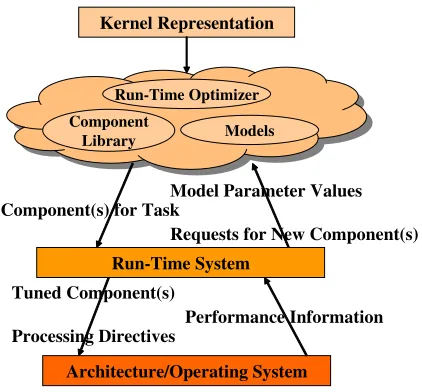
Figure 1. The run-time optimizer and run-time system compose applications dynamically based on system performance and available resources.
lowed by detailed simulations to validate the performance improvements of the optimizations. The detailed simula-tions can also expose additional optimizasimula-tions. This design-time exploration is manual. Thus our framework uses a semi-automatic design space exploration tool. The frame-work outputs a representation of the kernel, the performance models, and a run-time optimizer that can use these for ef-ficient execution of the kernel (see Fig. 1).
The run-time system is a portable, high-level advisor that interfaces between the underlying execution system (oper-ating system and architecture) and the application. During a kernel’s execution, the execution system supplies perfor-mance information that is used by the run-time system to determine if the run-time optimizer should be called and to update the values of the parameters in the performance models. The run-time optimizer uses the updated perfor-mance models to select appropriate component(s) from the set determined during design-time optimization for execut-ing the current task. Together, the time system and run-time optimizer make the run-run-time optimization decisions as a dynamic application composition system.
2.2. Framework Implementation
perfor-GME
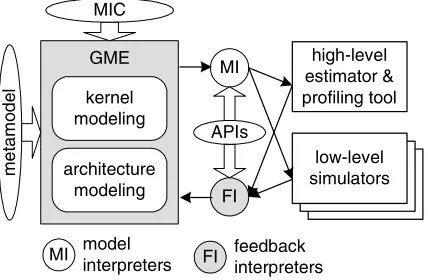
Figure 2. Design of the DOSA framework
mance estimation and profiling, integrate low-level simula-tors, and facilitate semi-automatic design space exploration. For each kernel, there are three outputs from the design pro-cess: a representation of the kernel, the performance models that describe the kernel’s performance given under various conditions, and a run-time optimizer that handles the selec-tion of components at run time.
We will use the Model Integrated Computing (MIC) methodology to create the design framework [11, 14]. The MIC approach advocates the extension of the scope and usage of models such that they form the “backbone” of a model-integrated system design process [7, 8]. In this de-sign process, a model captures the information relevant to the system to be developed, represents the designer’s un-derstanding of the entire system, and specifies dependen-cies and constraints among the different components of the system.
The Generic Modeling Environment (GME) is a config-urable graphical tool suite supporting MIC [5, 9]. GME allows the designer to create domain-specific models [14]. A metamodel (modeling paradigm) is a formal description of model construction semantics. Once the metamodel is specified by the user, it can be used to configure GME itself to present a modeling environment specific to the problem domain. MIC enables design reuse through the models. For example, several kernels can be optimized for the same ad-vanced architecture, each using the same model of the sys-tem. We will use the model database supported by GME to save and reuse models.
Model interpreters are software components that trans-late the information captured in the models to drive inte-grated tools that estimate the performance (latency, energy, throughput, etc.) of a system. Model interpreters can also be configured to automatically translate the models into ex-ecutable specifications. Feedback interpreters are software modules that analyze the output generated by the integrated tools and update the models. These interpreters are
essen-tially automation tools that, once written, can be used for several system design problems. GME supports a set of well-defined C++ APIs that provide bidirectional access to the models [5]. Both model and feedback interpreters are developed using these APIs.
2.3. Design Flow for Design-Time
Opti-mization
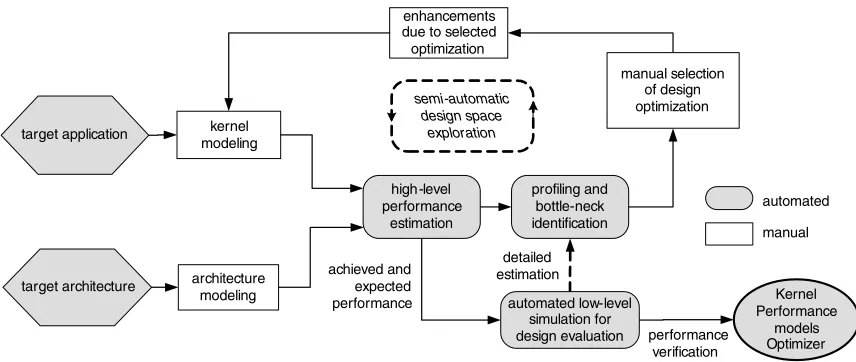
The design flow consists of two phases: configuration and exploration. In the configuration phase, the framework is configured based on the target kernel and the architecture. The kernel developer (designer) initially defines a structural model of the target architecture. The structural model ctures the details of the architecture. The designer uses ap-propriate micro-benchmarks and model and feedback inter-preters to automatically perform cycle-accurate architecture simulation using integrated simulators (such as Mambo or SimpleScalar) to estimate the values of these parameters and update the model. We also plan to create a library of ar-chitecture models because it is likely that a designer would optimize several kernels for the same target architecture. If architecture models are available for the target architecture, then the designer can choose to skip the configuration phase and use the library instead. Along with the architecture, the designer also models the kernel. Kernel modeling in-volves describing the kernel as a task graph and specifying the components that implement these tasks. We will create a library of common components, such as matrix multipli-cation, FFT, and graph operators [3, 4]. If the desired com-ponent is not in the library, the designer can develop it from within the framework. We will write model interpreters that will generate executable specifications from a task graph. Once a kernel is modeled, the designer uses the integrated simulators to automatically generate a memory access trace for each code segment and associate it with the model.
Kernel Performance
models Optimizer target architecture
target application kernel modeling
architecture modeling
semi-automatic design space
exploration
manual selection of design optimization enhancements
due to selected optimization
automated low-level simulation for design evaluation high-level
performance estimation
profiling and bottle-neck identification
achieved and expected performance
performance verification detailed
estimation
automated
manual
Figure 3. Design flow using the DOSA framework
low-level simulation to verify design decisions. Note that the low-level simulation is optional. By using the high-level models and the estimations, the design time can be reduced significantly. However, low-level simulations can provide additional insights with respect to optimizations to be considered. The designer continues to perform estima-tion, optimizaestima-tion, and low-level simulation until desired performance is reached or optimal processor-memory traf-fic is achieved. Similarly, for memory energy optimizations, the designer can identify data placement schemes (blocking, tiling, etc.) and memory/bank activation schedules and use the performance estimator to evaluate reduction in energy dissipation. Simplifying assumptions made to enable rapid estimation may induce errors in the estimates. Therefore, the DOSA framework will support specification of multi-ple candidate designs with estimated performance close to the desired performance. The framework will then output a representation of the kernel, the performance models, and a run-time optimizer that will use the representation and the performance models for efficient execution of the kernel.
2.4. Run-Time System Implementation
The run-time system automates the component selection process rather than requiring manual intervention from the user and hence, increases the productivity for efficiently us-ing available resources. The design-time effort produces a set of components from the component library for the tasks in each kernel. These components are targeted towards dif-ferent optimization points and architectures. Together with the run-time optimizer output from the DOSA framework, the run-time system provides a dynamic application com-position system that selects from these components using the performance models. The run-time optimizer is hooked into the computation when the kernel executes. The first
time the kernel executes, the run-time optimizer makes an initial selection from the optimal designs using the design-time analysis, performance models, execution-system in-formation, and knowledge obtained from prior runs. For each task in the kernel, the run-time optimizer selects the component(s) from the component library, requests any sys-tem configurations and adaptations required by the com-ponent(s), and sets up its baseline for tracking the compo-nent’s performance. At this point, the component selection is made, and the run-time optimizer calls the component. When the component returns, the run-time system logs its resource usage. On the next call for this kernel, the run-time system evaluates whether the system performed as the performance models suggest (or within the power budget), and takes corrective action, if needed. For instance, it may tune cache parameters within the component, select a dif-ferent component (perhaps from other leading components for the task), and/or request a processor reconfiguration or system adaptation. Once the performance is within toler-ance, the run-time system may back-off from its manage-rial role, only checking occasionally that the achieved ker-nel performance is still within an acceptable range. When an application finishes its execution, the run-time forensics and learned configurations, performance, and behavior, are incorporated as knowledge into the component library so that future runs may benefit from these optimizations.
2.5
Performance Optimizations
We divide the optimizations facilitated by the DOSA framework into two classes: design-time optimizations and run-time optimizations.
Design-Time Optimizations
(a) I/O complexity optimizations. We will extend the standard, theoretical I/O complexity model to incorporate multi-level memory hierarchies of the proposed HPC architectures. This will allow us to derive communication complexity bounds and exploit these bounds in software develop-ment using the framework.
(b) Data layout optimizations. In many HPC ap-plications, sophisticated data layouts in mem-ory can significantly improve performance over na¨ıve data layouts. For instance, techniques such as blocking, tiling, and linked-list to array con-version can be applied. Data locality and, conse-quently, cache utilization are improved.
2. Optimizations for Memory Energy.The problem of optimizing for memory energy dissipation reduces to structuring the computations such that data accesses are localized to individual memory banks and defining an activation schedule to put unused memory banks in a sleep state. We will study optimizations for the ker-nels, making the assumption that they access a multi-level memory hierarchy with an in-memory processor that is capable of changing the data layout dynami-cally.
Run-Time Optimizations These optimizations are per-formed dynamically by the time system and the run-time optimizer that is output from the framework, using the performance models and the representation of the kernel.
1. Data Remapping Optimizations. Remapping be-tween computation stages can significantly reduce processor-memory traffic and lower the consumed memory bandwidth—a critical resource limitation in many important applications. Data stored in memory can be efficiently remapped using in-memory process-ing features of HPC systems. The DOSA will choose components that perform the appropriate amount of remapping for the system and its current performance.
2. Optimizations for System Throughput and Overall Energy Dissipation. System throughput is a metric by which to evaluate the overall system performance in executing multiple instances of a kernel. We model system throughput as a flow optimization problem with costs associated with computation and communica-tion, as well as memory accesses. In addicommunica-tion, we will represent the energy dissipation as another variable.
3
Representative Applications to be Studied
Three representative applications will be used as exam-ples in investigating various dynamic optimizations and use
on our framework demonstration. Our component library will incorporate the design-time optimizations, and the run-time optimizer will compose applications from these critical design points.
A. Molecular dynamics (MD) is a technique for the simulation of the interactions between the molecules in a system over time. It is used in a wide variety of fields, in-cluding nanotechnology and biology [10, 15]. In the largest simulations, there are over a billion molecules. The sim-ulations are extremely time-consuming: to simulate a mi-crosecond of time can take a week of compute time. As a result, there has been much work done toward develop-ing scalable versions of MD to be executed on tightly cou-pled parallel machines and on cluster machines [2, 6, 12]. Even so, the most time-consuming part of the simulation is the non-bonded force calculation [1]. We, therefore, propose two memory-centric optimizations for non-bonded force calculation in MD simulations.
In MD simulations, the simulation space is broken into cells which are distributed among the processors of a paral-lel machine. Initially, molecules are randomly placed into the cells. The mapping between cells and molecules is kept in a linked list. During non-bonded force calculation, the positions of some molecules on each processor must be transmitted to other processors. We envision an optimiza-tion in which the in-memory processor uses cache injecoptimiza-tion to communicate these positions to the required processors, thereby reducing the amount of communication that must be carried out by each processor and ensuring that the data needed by each receiving processor is already in the cache. In non-bonded force calculation, the processor must tra-verse the linked list to calculate the molecule interactions. Since the placement of molecules in simulation space is ran-dom, this linked list traversal leads to truly random mem-ory access patterns. This randomness leads to poor cache performance. Therefore, we propose data remapping as an optimization for MD. An in-memory processor acts as a data remapping engine, traversing the linked cell list and reordering it such that during non-bonded force calculation, the data is accessed in a sequential manner.
B. Dynamic programmingis a general problem-solving technique used widely in various fields such as control the-ory, operations research, cryptanalysis and security, and bi-ology.
an-other optimization we consider is performing the computa-tion directly within the memory system. In this case, the core processor could issue a work parcel to the in-memory processors describing the recurrence in the dynamic pro-gramming algorithm, and the in-memory processors would easily handle the natural flow of computations with respect to the data dependencies.
C. Graph theoretic.We focus on sparse, irregular graph problems that are notoriously hard to solve efficiently in part because of a lack of spatial and temporal locality. Sup-pose a sparse graphGV, Eis given.V is the set of vertices andE is the set of edges. Vertexv ∈V has multiple char-acteristicsf1(v), ... fi(v). Edge(u, v) ∈ Ehas multiple
characteristicsg1(u, v), ...,gj(u, v).Finding paths:Given
a pair of verticesxandy, find all paths such that the num-ber of vertices in the path is less than a specified numnum-ber
min nodes in pathand the degree of all nodes in the path is less than a specified degreemin degree Characteristic-based graph matching: Given a graph representation of an interaction patternPVp, Epwhere each vertexv ∈Vp
and each edge (u, v) ∈ Ep has certain (possibly
mul-tiple) specific characteristics, find a sub-graph G′ in G
such that a certain similarity metrics(G′, P)is maximized.
Characteristic-based graph partitioning:Find a partition
V1, V2,· · ·, VkofV so that vertices within each subsetVi
is reasonablyclusteredand any two setsVi andVj are
rea-sonablyseparated.
4. Concluding Remarks
The goal of our research is to develop a framework that supports design-time optimizations of applications in high-performance computing and whose output can then be used to perform further optimizations at run-time. For design-time optimization, we will study HPC architectures and define a hierarchical performance model for the memory subsystem associated with these architectures. To support this modeling, we will develop the DOSA framework. Do-ing so includes creatDo-ing a metamodel based on the mem-ory performance model to configure GME [5] and devel-oping a library of components for common tasks in high-performance computing. Using the configured GME, we will define detailed models of several HPC architectures. We will define a semi-automatic design flow using the framework to optimize kernels using HPC architectures. To illustrate our ideas, we plan to use kernels from the domains of molecular dynamics, gene sequence analysis, and graph theory.
References
[1] M. Allen and D. J. Tildeseley. Computer Simulation of
Liq-uids. Oxford University Press, New York, 1987.
[2] G. S. Almasi, C. Cascaval, J. G. Castanos, M. Denneau, W. Donath, M. Eleftheriou, M. Giampapa, H. Ho, D. Lieber, J. E. Moreira, D. Newns, M. Snir, and H. S. Warren, Jr. Demonstrating the scalability of a molecular dynamics
ap-plication on a petaflop computer. Research Report RC
21965(98713), IBM Research Division, Yorktown Heights, NY, February 2001.
[3] D. Bader and G. Cong. Fast shared-memory algorithms
for graph theoretic problems. Journal of Parallel and
Dis-tributed Computing, 66(11):1366–1378, 2006.
[4] D. Bader and G. Cong. Efficient parallel graph algorithms for shared-memory multiprocessors. In S. Rajasekaran and
J. Reif, editors,Handbook of Parallel Computing: Models,
Algorithms, and Applications. CRC Press, 2007.
[5] Generic modeling environment. http://www.isis.
vanderbilt.edu/Projects/gme/.
[6] L. Kal´e, R. Skeel, M. Bhandarkar, R. Brunner, A. Gur-soy, N. Krawetz, J. Phillips, A. Shinozaki, K. Varadarajan, and K. Schulten. NAMD2: Greater scalability for
paral-lel molecular dynamics. Journal of Computational Physics,
151:283–312, 1999.
[7] G. Karsai, J. Sztipanovits, A. Ledeczi, and T. Bapty.
Model-integrated development of embedded software.Proceedings
of the IEEE, 91(1):145–164, January 2003.
[8] A. Ledeczi, J. Davis, S. Neema, and A. Agrawal. Model-ing methodology for integrated simulation of embedded
sys-tems.ACM Transactions on Modeling and Computer
Simu-lation, 13(1):82–103, January 2003.
[9] A. Ledeczi, M. Maroti, A. Bakay, G. Karsai, J. Garrett, C. Thomason IV, G. Nordstrom, J. Sprinkle, and P. Volgyesi.
The generic modeling environment. InProc. of Workshop on
Intelligent Signal Processing, 2001.
[10] Z. Mao, A. Garg, and S. B. Sinnott. Molecular dynam-ics simulations of the filling and decorating of carbon
nan-otubules.Nanotechnology, 10(3):273–277, 1999.
[11] Model integrated computing. http://www.isis.
vanderbilt.edu/research/mic.html.
[12] A. Nakano, R. K. Kalia, P. Vashishta, T. J. Campbell, S. Ogata, F. Shimojo, and S. Saini. Scalable atomistic
sim-ulation algorithms for materials research. InProceedings of
the 2001 ACM/IEEE Conference on Supercomputing, New York, November 2001. ACM Press.
[13] T. F. Smith and M. S. Waterman. Identification of common
molecular subsequences. J. Molecular Biology, 147:195–
197, 1981.
[14] J. Sztipanovits and G. Karsai. Model-integrated computing. IEEE Computer Magazine, 30(4):110–111, April 1999. [15] P. Tang and Y. Xu. Large-scale molecular dynamics
sim-ulations of general anesthetic effects on the ion channel in the fully hydrated membrane: The implication of molecular
mechanisms of general anesthesia. Proceedings of the