Community-specific impacts of exotic earthworm invasions
on soil carbon dynamics in a sandy temperate forest
JASMINEM. CRUMSEY,1,4JAMESM. LEMOINE,1YVANCAPOWIEZ,2MITCHELLM. GOODSITT,3SANDRAC. LARSON,3 GEORGEW. KLING,1ANDKNUTEJ. NADELHOFFER1
1
Department of Ecology and Evolutionary Biology, 2019 Kraus Natural Science Building, 830 North University Avenue, University of Michigan, Ann Arbor, Michigan 48109 USA
2
INRA, UR 1115 Plantes et Syste`mes Horticoles, 84914 Avignon Cedex 09, France
3Department of Radiology, 1500 East Medical Center Drive, University of Michigan, Ann Arbor, Michigan 48109 USA
Abstract. Exotic earthworm introductions can alter above- and belowground properties of temperate forests, but the net impacts on forest soil carbon (C) dynamics are poorly understood. We used a mesocosm experiment to examine the impacts of earthworm species belonging to three different ecological groups (Lumbricus terrestris [anecic], Aporrectodea trapezoides [endogeic], and Eisenia fetida [epigeic]) on C distributions and storage in reconstructed soil profiles from a sandy temperate forest soil by measuring CO2and dissolved
organic carbon (DOC) losses, litter C incorporation into soil, and soil C storage with monospecific and species combinations as treatments. Soil CO2loss was 30%greater from the
Endogeic3Epigeic treatment than from controls (no earthworms) over the first 45 days; CO2
losses from monospecific treatments did not differ from controls. DOC losses were three orders of magnitude lower than CO2losses, and were similar across earthworm community
treatments. Communities with the anecic species accelerated litter C mass loss by 31–39%with differential mass loss of litter types (Acer rubrum.Populus grandidentata.Fagus grandifolia .Quercus rubraPinus strobus) indicative of leaf litter preference. Burrow system volume, continuity, and size distribution differed across earthworm treatments but did not affect cumulative CO2 or DOC losses. However, burrow system structure controlled vertical C
redistribution by mediating the contributions of leaf litter to A-horizon C and N pools, as indicated by strong correlations between (1) subsurface vertical burrows made by anecic species, and accelerated leaf litter mass losses (with the exception ofP. strobus); and (2) dense burrow networks in the A-horizon and the C and N properties of these pools. Final soil C storage was slightly lower in earthworm treatments, indicating that increased leaf litter C inputs into soil were more than offset by losses as CO2 and DOC across earthworm
community treatments.
Key words: Aporrectodea trapezoides; community composition; Eisenia fetida; exotic earthworm; Lumbricus terrestris;soil carbon storage; temperate forest; University of Michigan Biological Station.
INTRODUCTION
European earthworm introductions into northern U.S. temperate forests have attracted increased attention during the past decade. Although endemic earthworms have been slow to recolonize the northern U.S. temperate forests from which they were extirpated during the last glacial advance (James 1995), human activities in the past century have led to introductions of peregrine earthworm species, such as Dendrobaena octaedra,Lumbricus rubellus,L. terrestris,Aporrectodea caliginosaandA. trapezoides(Holdsworth et al. 2007). Dense earthworm invasions have shifted understory plant diversity, increased leaf litter decay rates, and diminished forest floor horizons (Bohlen et al. 2004b,
Hale et al. 2006, Frelich et al. 2006, Holdsworth et al. 2007, Sackett et al. 2012). Invasions have also been linked to decreased soil C stocks (Scheu 1997, Burtelow et al. 1998, Bohlen et al. 2004b, Marhan and Scheu 2006, Eisenhauer et al. 2007), soil C redistribution (Burtelow et al. 1998, Bohlen et al. 2004a, Wironen and Moore 2006, Straube et al. 2009), and increased soil CO2
emissions (Marhan and Scheu 2006). While impacts on subsets of forest ecosystem functions and properties have been described, community-specific impacts of earthworm invasions on forest soil C cycling and net C storage are less understood.
Earthworm invasions in forest ecosystems can involve multiple species (Araujo et al. 2004, Fisk et al. 2004, Wironen and Moore 2006, Eisenhauer et al. 2007, Costello and Lamberti 2009) with diverse feeding, dispersal, and burrowing behaviors (Bouche´ 1977, Lee 1985, Je´gou et al. 1998b, Hale et al. 2005, Curry and Schmidt 2006). Interspecific interactions (Je´gou et al.
Manuscript received 10 September 2012; revised 6 May 2013; accepted 23 May 2013; final version received 14 June 2013.
Corresponding Editor: R. D. Evans.
4E-mail: [email protected]
2000, Capowiez et al. 2001, Whalen and Costa 2003) can, in turn, mediate earthworm community impacts on forest ecosystem properties and processes (Wolters 2000, Uvarov 2009). However, direct tests of how earthworm species interactions mediate impacts on forest soil C dynamics and storage are limited (Hale et al. 2005, Postma-Blaauw et al. 2006, Straube et al. 2009).
In this study, we examined monospecific and multi-species earthworm community impacts on C loss and C redistribution in reconstructed forest soil profiles with mixed-species leaf litter (Oi ) horizons representative of temperate forests on sandy soils in the Upper Great Lakes region, USA. We report the results of a mesocosm experiment in which earthworm species of three functional groups (Lumbricus terrestrisL.,Aporrectodea trapezoides Duge`s, and Eisenia fetida Savigny) were combined in a factorial design. Over one year, we measured carbon dioxide (CO2) and dissolved organic
carbon (DOC) losses, and related C losses to earthworm species combinations. At the end of the experiment, we (1) assessed relationships between subsurface burrow system structure and soil C budget components, and (2) quantified net changes in soil C storage. We expected that impacts on CO2 and DOC outputs, leaf litter C
inputs, and net C storage would be mediated by earthworm community composition, and that burrow system properties would be related to C redistribution in soil profiles.
METHODS
Experimental design
We conducted a mesocosm experiment from August 2009 to August 2010 in a belowground laboratory (Lussenhop et al. 1991) at the University of Michigan Biological Station, Cheboygan County, USA (UMBS; see Appendix A for study area description), using seven combinations of three exotic earthworm species present in forest soils as treatments and no-earthworm controls in uniform leaf litter and soil profiles. Adults of the earthworm species representing different functional groups included: L. terrestris[anecic, which are litter feeding and vertical burrowing], A. trapezoides [endo-geic, mineral soil feeding and dwelling],andE. fetida
[epigeic, litter feeding and surface dwelling]. Treat-ments, hereafter capitalized, included species monocul-tures: Epigeic Alone, Endogeic Alone, and Anecic Alone; and mixed treatments: Epigeic 3 Anecic, Epigeic 3 Endogeic, Endogeic 3 Anecic, and All Species. Earthworm biomass additions were higher than observed in field surveys (21 6 2.66 g/m2 fresh mass [mean 6 SE]), but allowed for the scaled additions of anecic species across monocultures and mixed treatments. Earthworm biomass amounts were also within ranges of values reported in similar northern temperate forests (e.g., Hale et al. 2005, Sua´rez et al. 2006 ). Earthworm biomass was constant at 20 60.5 g (fresh mass) per mesocosm. Earthworm biomass was 2060.5 g in species monocultures, 106
0.5 g of each species in two-species treatments, and 6.5 6 0.5 g of each species in the All Species treatment. Biomass additions in monocultures corresponded to 27 61 endogeic earthworms per mesocosm, 3161 epigeic earthworms per mesocosm, and 3 anecic earthworms per mesocosm.
Mesocosms were contained in 20-L plastic buckets (20 cm diameter and 30 cm depth). Soil profiles were constructed by adding 25 kg (fresh mass) of sieved and homogenized B-horizon material packed to a bulk density of 2.5 g/cm3, and 5 kg (fresh mass) of sieved and homogenized A-horizon material packed to a bulk density of 1.3 g/cm3. Leaf litter additions were scaled from area-normalized leaf litter data of the UMBS AmeriFlux site in 2008 (C. S. Vogel,unpublished data). Leaf litter additions from overstory tree species summed to 16.5 g: 41%Populus grandidentata, 32%Acer rubrum, 21%Quercus rubra, 4%Fagus grandifolia, and 2%Pinus strobus(Table 1).
Mesocosm C loss measurements (CO2and DOC)
Soil CO2 efflux was measured from August 2010 to
June 2011 (25 times over a 320-day period). Measure-ments were taken daily in week one, and three times in week two when burrow production and initial soil redistribution likely occurred (Je´gou et al. 1998a, 2000, Capowiez et al. 2011); weekly during early fall and spring months when earthworm activity is highest (Callaham and Hendrix 1997); and monthly during late fall and winter months when earthworm activity and soil CO2efflux is lowest (Toland and Zak 1994, Davidson et
al. 1998). CO2efflux was measured using an infrared gas
analyzer (IRGA, LICOR-6400; LICOR Biosciences, Lincoln, Nebraska, USA) connected to an air-tight lid placed on each mesocosm. In a 4.67-L headspace, air flowed in a closed loop to the LI-6400, temperature was measured with a type E thermocouple (Omega, Stam-ford, Connecticut USA), and a capillary tube was inserted for air pressure equilibration. Soil CO2 efflux
rates (Fc) were determined by measuring 10 lmol/mol
change in CO2 concentration (DCO2) over a 20-s
measurement period, from which CO2-C loss rate per
unit soil surface area was calculated as
Fc¼
where Fc is corrected for headspace volume (V) and
surface area (S) (lmol CO2m2s1), t is time, P is
atmospheric pressure (kPa), R is the universal gas constant, and Tis temperature (8C). CO2efflux values
were integrated to derive cumulative curves for each mesocosm.
and stored at208C until analyzed for DOC concen-tration using an Aurora (Model 1030) OI Analytical TOC analyzer (OI Analytical, College Station, Texas USA). DOC loss values were integrated to derive cumulative curves for each mesocosm.
Three-dimensional reconstruction and quantification of burrow systems
Soils containing earthworm treatments were imaged using X-ray computed tomography (X-ray CT; GE Discovery CT 750 HD scanner [General Electric Healthcare, Waukesha, Wisconsin USA], 140 kV, 500 mA, 1 s, 0.984:1 pitch, 1.25-mm slice interval, 1.25-mm slice thickness, 0.78 mmXandYresolution, 40 cm field of view, Bone reconstruction filter) at the School of Radiology, University of Michigan Hospital (Ann Arbor, Michigan, USA). The sequential analysis of two-dimensional binarized images enables three-dimen-sional tracking of earthworm burrows and subsequent three-dimensional volumetric reconstructions of the burrow systems (Fig. 1). Image preparation and quantification of burrow continuity, volume, and size distribution followed methods previously described (Capowiez et al. 2001, Pierret et al. 2002, Bastardie et al. 2005).
Litter and soil sampling, C and N content
Mesocosms were destructively harvested by first collecting intact leaf litter remaining on the soil surface. Soils were excavated by first removing A-horizon soil, followed by removal of B-horizon soil that was separated into burrow and non-burrow soil (i.e., soil not visibly altered by earthworm burrowing activity or ingestion). Separation of burrow and non-burrow soil in the A-horizon was not feasible due to highly dense burrow networks across treatments (Fig. 1). Pool subsamples were weighed fresh, dried at 608C, weighed again to obtain dry-mass corrections, and pulverized for C and N analyses using a CN elemental analyzer (Elemental Analyzer 1030; Costech Analytical Technol-ogies, Valencia, California, USA). Species-specific leaf litter mass losses were used in calculating a weighted average of composite leaf litter C and N properties expressed at the end of the experiment.
Soil C mass storage
We used an elemental mass balance equation to calculate net changes in soil C storage as follows:
DC¼ ðLcþEÞ
where DCis the net storage of C inputs to soil as leaf litter mass loss (i.e., from the soil surface) across control and earthworm treatments (Lc) plus earthworm biomass
not recovered at the end of the experiment (E), minus C outputs via 320-d cumulative CO2efflux (Fc in Eq. 1),
plus dissolved organic C export (DOCEX). Minor C
fluxes occurring in aerobic upland forest soils, including CH4 consumption (Castro et al. 1995, Le Mer and
Roger 2001), and dissolved inorganic C export (Kaiser and Zech 1998), were not measured in this study.
Statistical analyses
We used Kruskal-WallisHtests (H, df¼7,n¼32,a¼ 0.05) with nonparametric multiple comparisons to assess treatment differences in soil C budget components, burrow system variables, and soil C storage. To assess treatment effects on CO2and DOC loss over time, we
used a general linear model (GLM) with repeated measures, followed by Bonferroni-corrected pairwise comparisons of cumulative curves. We used Spearman rank correlations (q, n¼32, a¼0.05) to characterize relationships among soil C budget components and among burrow system variables. Soil C budget compo-nent and burrow system variable associations were characterized using co-inertia analysis (CoIA), which identifies co-relationships between two ecological data matrices first transformed, in this case, by principal component analysis (Doledec and Chessel 1994, Dray et al. 2003). Statistical significance of the CoIA was assessed by Monte Carlo permutation tests (999 permutations; P , 0.05). Statistics were done in R v2.15.2 (R Development Core Team 2012) on RStudio v0.96.331 (available online),5 using the packages ade4
TABLE1. Initial leaf litter, A-horizon, and B-horizon C and N properties.
Pool C (g/m2) %C %N C:N
Leaf litter 128 (0.26) 47.9 (,0.01) 0.65 (,0.01) 74.2 (0.03)
Acer rubrum 39.68 (0.06) 46.5 (0.4) 0.5 (0.04) 98.8 (,0.01)
Pinus strobus 2.01 (0.01) 50.3 (0.03) 0.4 (0.01) 137.6 (,0.01) Populus grandidentata 53.65 (0.24) 49.2 (0.6) 0.8 (0.1) 62.7 (,0.01) Quercus rubra 27.25 (0.07) 47.9 (0.4) 0.6 (0.03) 74.2 (,0.01) Fagus grandifolia 5.44 (0.02) 45.7 (0.5) 0.7 (0.06) 62.2 (,0.01) Bulk soil 2882 (67.57) 1.14 (0.08) 0.05 (,0.01) 22.02 (0.13) A-horizon 994 (42.31) 1.56 (0.07) 0.07 (,0.01) 21.7 (0.31) B-horizon 1761 (35.53) 0.6 (0.01) 0.03 (,0.01) 22.4 (0.28)
Notes:Values represent means, with SE in parentheses;n¼6.
(Dray and Dufour 2007), Hmisc (Harrell 2012), lattice (Sarkar 2008), and pgirmess (Giraudoux 2012).
RESULTS
Cumulative CO2-C and DOC loss
Rates of respiratory CO2loss decreased after the first
six weeks of the experiment as winter temperatures decreased (Fig. 2A). We found no significant differences in total CO2loss across treatments at the end of the
one-year incubation period (Kruskal-Wallis H test, P . 0.05). When mesocosms were destructively harvested at the end of the experiment, we found no adult earthworms and juvenile biomass accounted for ,1%
of initial earthworm biomass. To evaluate differences in cumulative CO2 and DOC loss over time, we thereby
restricted data analysis to the first 45 days of the experiment when temperature was above 208C, earth-worm mortality and reproduction were likely low, and treatment variance was uniform. Earthworm treatments significantly affected CO2 loss over the first 45 days
(GLM with repeated measures, P ¼ 0.042). The Endogeic 3 Epigeic treatment lost significantly more CO2 than the control, Endogeic Alone, and Epigeic
Alone treatments (Bonferroni test, P , 0.05). The Epigeic Alone and Endogeic Alone treatments had the lowest rates of CO2loss, and were similar to CO2loss in
controls (Bonferroni test,P.0.05). Total CO2loss was
4.54–6.16% of total C, and was similar across
treat-ments (Kruskal-Wallis H test, P . 0.05). DOC loss increased over time (GLM with repeated measures,P¼ 0.049), though no significant effects of earthworm treatments were detected (Kruskal-Wallis H test, P . 0.05). Total DOC loss was three orders of magnitude lower than CO2(Fig. 2B), and represented,0.01%of
total initial C.
Leaf litter and Soil C
Earthworm community composition significantly af-fected leaf litter C loss (Fig. 3; Appendix B: Table B1). Leaf litter C remaining in treatments including anecic species was 3339%less than in controls, but only 4–9%
less where anecic species were absent. Two leaf litter types lost significant C:A. rubrumandP. grandidentata
(Kruskal-Wallis H tests, P , 0.05). Treatment and controls lost similar F. grandifolia, P. strobus, and Q. rubraleaf litter C (Kruskal-Wallis H tests,P .0.05). Across treatments, the morphology of decayed leaf litter remaining at the soil surface was primarily petioles and mid-veins of A. rubrum and P. grandidentata litter, largely intactF. grandifoliaandQ. rubralitter (i.e., most soft tissue, mid-veins, and petioles remained), and fully intactP. strobuslitter.
. 0.05). Burrow soil, which accounted for 2–5% of total soil C mass (Fig. 4), showed significantly higher
%C and%N values than non-burrow soils (Appendix B: Table B2). Burrow soil C content and %C was positively correlated with A-horizon and leaf litter C content and%C. Total soil C, horizon C mass, A-horizon%C, and were positively correlated with total CO2 loss. No significant correlations between soil C
properties and DOC loss were observed (Appendix B: Table B3).
Burrow system structure
Across treatments, burrow system structure differed significantly in total macroporosity, A-horizon burrow volume, the continuity of burrows with vertical lengths .3.75 cm (i.e., 0–15%of core length) and burrow size classes (Kruskal-WallisHtests,P,0.05; Appendix C: Table C1). Measures of burrow system structure, with the exception of burrow continuity classes characteristic of vertical burrowing activity by anecic species (25%to
FIG. 2. (A) Cumulative soil CO2-C efflux and (B) cumulative dissolved organic carbon (DOC) efflux across earthworm
FIG. 3. FinalFagus grandifolia(Fagr),Populus grandidentata(Pogr),Acer rubrum(Acru), and total leaf litter C mass across
.50%of core length), were highly correlated (Appendix
C: Table C2).
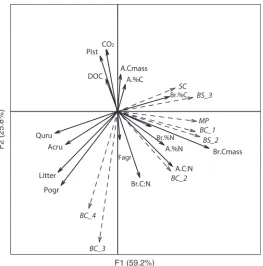
Two axes (F1 and F2) of the co-inertia analysis explained 85.0% of the total variability in the burrow
system structure and soil C budget components data co-structure (Monte Carlo permutation tests, P¼0.007;
Fig. 5). In the co-inertia factorial plane, projections of burrow system structure variables discriminated be-tween burrow structure in the A-horizon and subsurface burrow structures in the B-horizon; projections of soil C budget components discriminated between leaf litter mass losses, A-horizon and burrow soil properties, and C losses as CO2 and DOC. Along F1 (59.2% of total
inertia), total macroporosity and burrow structures in the A-horizon (surface connectivity, burrow size classes, and burrow continuity classes ,25% of core length) were correlated with A-horizon and burrow soil C and N properties (C and N content,%C, and%N). Along F2
(25.8% of total inertia), burrow structures in the
B-horizon, characteristic of anecic species presence (i.e., burrow continuity classes 25–50% and .50% of core length), were correlated with leaf litter mass losses (with the exception ofP. strobus). CO2and DOC losses were
not correlated with burrow system properties.
Soil C storage
Inputs of C to soils from litter in control mesocosms (25.0 6 4.59 g C/m2 [mean 6 SE]) were less than C outputs as CO2 and DOC (1536 6.73 g C/m2). As a
result, soil C storage (DC) in controls was negative, representing a baseline net loss from the soil system (128.52611.31 g C/m2; Fig. 6). Litter C inputs to soils were higher in all treatments with anecic species (Mann-WhitneyU tests,P,0.05), though C outputs did not differ significantly across control and earthworm treat-ments (Kruskal-Wallis H test, P . 0.05). Significant shifts inDC were not detected, though a trend of greater
FIG. 4. Leaf litter and soil C pools expressed as the
percentage of total C across the control and treatments (see Fig. 1 for abbreviations).
FIG. 5. Relationships between burrow system
(dashed arrows, italicized text) and C budget measures (solid arrows, plain text) according to relative positions on the Fl3F2 co-inertia plane. Burrow system structure measures are: macro-porosity (MR), surface connectivity (SC), size class (BS, defined as: 2, 0.17 to,0.34 cm2; 3, .0.34 cm2), continuity class (BC, defined as: 1, 0–15%; 2, 15–25%; 3, 25–50%; 4, .50%). C budget components are: A. rubrum (Acru), F. grandifolia (Fagr), P. strobus (Pist), P. grandi-dentata(Pogr), Q. rubra(Quru), and total leaf litter C loss; A-horizon (A) and burrow (Br) C and N properties (C:N,%N,%C, and Cmass); and CO2 and DOC loss. Co-inertia axis
DC occurred across earthworm treatments (Kruskal-WallisHtest,P.0.05).
DISCUSSION
Our results suggest earthworm communities have important nonadditive effects on processes including soil CO2loss and mediate leaf litter redistribution, soil C
budget components, and soil physical structure. First, soil CO2loss rates were highest during the first weeks of
the experiment, though no differences in total CO2 or
DOC loss were observed at the end of the incubation. As species monocultures had the lowest CO2 efflux rates,
significant increases in CO2efflux rates in multispecies
treatments suggests enhanced access to C resources by functional groups. Previous studies show increased soil CO2losses of 7–58%, following earthworm invasions in
forest soils (e.g., Borken et al. 2000, Speratti et al. 2007) attributed to leaf litter incorporation into soil, highly localized organic matter redistribution, and increased microbial respiration in casts and burrow soils (Scheu 1987, Wolters and Joergensen 1992, Tiunov and Scheu 1999, Brown et al. 2000). DOC loss represented,0.01%
of total C and showed no response to earthworm treatments, in contrast to a 50%reduction in DOC loss from earthworm-invaded forest soils observed by Bohlen et al. (2004a). In our study, low DOC losses could be due to root exclusion, which removed root exudates and decay as sources of DOC outputs, and possible adsorption of DOC transported from A-horizon to B-A-horizon soils (Currie et al. 1996, Kaiser
and Zech 1998, Kalbitz et al. 2000). It is unlikely that C redistribution and burrow system differences were generated during winter months when earthworm activity is lowest and differential mortality and repro-duction occur (Lee 1985, Edwards and Bohlen 1996, Callaham and Hendrix 1997, Uvarov et al. 2011). Observed patterns of early, rapid C losses are thereby consistent with burrow system production and organic matter redistribution in the first weeks of our experi-ment. Further, lower rates of C losses and increased variability within treatment replicates with time are consistent with differential mortality, reproduction, or activity during fall and winter months.
Earthworm-mediated litter decomposition is deter-mined by rates of litter comminution, consumption, and translocation into soils (Shipitalo and Protz 1989, Edwards and Bohlen 1996), and constrained by leaf litter chemistry and earthworm food preference (Reich et al. 2005, Hobbie et al. 2006, Sua´rez et al. 2006, Holdsworth et al. 2008). Our results showed leaf litter C loss increased by 33–39%in communities containing the
anecic species, and differential mass loss and morphol-ogy of decayed leaf litter types (A. rubrum . P. grandidentata.F. grandifoliaQ. rubra.P. strobus). Enhanced leaf litter decomposition with earthworm invasions has been widely observed in temperate forests (Scheu and Wolters 1991, Sua´rez et al. 2006, Holds-worth et al. 2008, Zicsi et al. 2011). Higher losses reported in field studies may be due to higher earthworm densities, longer observation periods, and the larger
FIG. 6. C inputs, C outputs, and net C mass storage (DC; Eq. 2) across the control and treatments. Lowercase letters represent
community of soil invertebrates. For example, Sua´rez et al. (2006) observed leaf litter remaining in earthworm-invaded plots was 1.7–3.0 times less than in reference plots in a hardwood forest after 540 days. Holdsworth et al. (2008) observed increased litter mass loss from coarse-meshed litter bags, which allowed enhanced access and leaf litter translocation by the broader soil invertebrate community.
In contrast to our prediction, significant changes in C storage were not linked to earthworm community composition, although C storage generally decreased across treatments. Lack of significant changes in soil C storage could be attributed to earthworm density and activity (because burrow soils only accounted for up to 5% of soil C mass), incubation time, and land use
history. For example, Alban and Berry (1994) observed earthworm density increases over a 13-year period, the concurrent development of an A-horizon, and increased mineral soil %C. Bohlen et al. (2004a) demonstrated land-use history as a factor constraining earthworm invasion impacts on soil C pools, finding no influence of earthworm invasions on soil C storage at a previously cultivated forest site with low forest floor accumulation rates. A 28%reduction in soil C storage and reduced soil
C:N ratios were, however, observed in undisturbed forest sites of similar earthworm density (Bohlen et al. 2004a). Past disturbances of logging and wildfires constrain soil C storage rates in these forests (Gough et al. 2008), and with earthworm density and time, may constrain the impact of earthworm communities on soil C budgets.
Our results partially support the prediction that burrow system properties would be directly related to shifts in C redistribution. Burrow system structures differed significantly across earthworm treatments and were in agreement with the known behavior of the different ecological groups (Bastardie et al. 2005). Somewhat surprisingly, burrow systems did not affect CO2or DOC loss, showing no evidence of increased soil
C losses with greater soil porosity. This may be attributed to the well-drained nature of these soils, where C losses are controlled by production rather than diffusion or infiltration rates. However, subsurface burrow systems were associated with vertical redistribu-tion of litter-derived organic material into the A-horizon, as indicated by strong correlations between (1) subsurface burrows characteristic of vertical bur-rowing by anecic species, and leaf litter mass losses (with the exception of P. strobus); and (2) dense burrow networks in the A-horizon and the C and N properties of these pools.
In sandy soils, it appears earthworm community composition and associated burrow system structures mediate litter translocation and soil physical structure, altering soil organic matter inputs while having modest impacts on C losses in the short term. This outcome suggests the net effects of earthworm communities on the primary carbon pools and fluxes in these soils is
moderate, with the expected increases in leaf litter translocation and burrow system formation, but with minimal or no significant effects on carbon outputs and annual carbon storage. However, as our experiment excluded plant and root exudates, both significant drivers of belowground forest C cycling (Nadelhoffer and Raich 1992, Andrews et al. 1999, Gaudinski et al. 2000), our ability to extrapolate to earthworm invasions impacts under in situ conditions is limited. Overall, this work contributes to the process-level understanding of how earthworm species interactions modify factors that ultimately determine soil C storage across forest ecosystems. Future studies with increased observation times and comparative studies that manipulate both earthworm species diversity and forest soil types would build on this baseline understanding of the net impacts of earthworm communities on forest soil C storage.
ACKNOWLEDGMENTS
We thank M. Grant for analytical services; C. Vogel for AmeriFlux field data; and B. Carson, P. Rink, R. Spray, T. Sutterly, and S. Webster for preparatory support. The NSF Doctoral Dissertation Improvement Grant 1110494, the NSF-IGERT Biosphere Atmosphere Research and Training Pro-gram (NSF-IGERT-0504552), and the University of Michigan Rackham Graduate School and Department of Ecology and Evolutionary Biology funded this research.
LITERATURECITED
Alban, D. H., and E. C. Berry. 1994. Effects of earthworm invasion on morphology, carbon, and nitrogen of a forest soil. Applied Soil Ecology 1:243–249.
Andrews, J. A., K. G. Harrison, R. Matamala, and W. H. Schlesinger. 1999. Separation of root respiration from total soil respiration using carbon-13 labeling during free-air carbon dioxide enrichment (FACE). Soil Science Society of America Journal 63:1429–1435.
Araujo, Y., F. J. Luizao, and E. Barros. 2004. Effect of earthworm addition on soil nitrogen availability, microbial biomass and litter decomposition in mesocosms. Biology and Fertility of Soils 39:146–152.
Bastardie, F., Y. Capowiez, and D. Cluzeau. 2005. 3D characterisation of earthworm burrow systems in natural soil cores collected from a 12-year-old pasture. Applied Soil Ecology 30:34–46.
Bohlen, P. J., D. M. Pelletier, P. M. Groffman, T. J. Fahey, and M. C. Fisk. 2004a. Influence of earthworm invasion on redistribution and retention of soil carbon and nitrogen in northern temperate forests. Ecosystems 7:13–27.
Bohlen, P. J., S. Scheu, C. M. Hale, M. A. McLean, S. Migge, P. M. Groffman, and D. Parkinson. 2004b. Non-native invasive earthworms as agents of change in northern temperate forests. Frontiers in Ecology and the Environment 2:427–435.
Borken, W., S. Grundel, and F. Beese. 2000. Potential contribution of Lumbricus terrestris L. to carbon dioxide, methane and nitrous oxide fluxes from a forest soil. Biology and Fertility of Soils 32:142–148.
Bouche´, M. B. 1977. Strategies lombriciennes. Pages 122–132in U. Lohm and T. Persson, editors. Soil organisms as components of ecosystems. Ecological Bulletins, Stockholm, Sweden.
Burtelow, A. E., P. J. Bohlen, and P. M. Groffman. 1998. Influence of exotic earthworm invasion on soil organic matter, microbial biomass and denitrification potential in forest soils of the northeastern United States. Applied Soil Ecology 9:197–202.
Callaham, M. A., and P. F. Hendrix. 1997. Relative abundance and seasonal activity of earthworms (Lumbricidae and Megascolecidae) as determined by hand-sorting and formalin extraction in forest soils on the southern Appalachian Piedmont. Soil Biology and Biochemistry 29:317–321. Capowiez, Y., P. Monestiez, and L. Belzunces. 2001. Burrow
systems made by Aporrectodea nocturnaand Allolobophora chlorotica in artificial cores: morphological differences and effects of interspecific interactions. Applied Soil Ecology 16: 109–120.
Capowiez, Y., S. Sammartino, and E. Michel. 2011. Using X-ray tomography to quantify earthworm bioturbation non-destructively in repacked soil cores. Geoderma 162:124–131. Castro, M. S., P. A. Steudler, J. M. Melillo, J. D. Aber, and R. D. Bowden. 1995. Factors controlling atmospheric methane consumption by temperate forest soils. Global Biogeochemical Cycles 9:1–10.
Costello, D. M., and G. A. Lamberti. 2009. Biological and physical effects of non-native earthworms on nitrogen cycling in riparian soils. Soil Biology and Biochemistry 41:2230– 2235.
Currie, W. S., J. D. Aber, W. H. McDowell, R. D. Boone, and A. H. Magill. 1996. Vertical transport of dissolved organic C and N under long-term N amendments in pine and hardwood forests. Biogeochemistry 35:471–505.
Curry, J. P., and O. Schmidt. 2006. The feeding ecology of earthworms: A review. Pedobiologia 50:463–477.
Davidson, E. A., E. Belk, and R. D. Boone. 1998. Soil water content and temperature as independent or confounded factors controlling soil respiration in a temperate mixed hardwood forest. Global Change Biology 4:217–227. Doledec, S., and D. Chessel. 1994. Co-inertia analysis: An
alternative method for studying species environment rela-tionships. Freshwater Biology 31:277–294.
Dray, S., D. Chessel, and J. Thioulouse. 2003. Co-inertia analysis and the linking of ecological data tables. Ecology 84: 3078–3089.
Dray, S., and A. B. Dufour. 2007. The ade4 package: implementing the duality diagram for ecologists. Journal of Statistical Software 22:1–20.
Edwards, C. A., and P. J. Bohlen. 1996. Biology and ecology of earthworms. Chapman and Hall, London, UK.
Eisenhauer, N., S. Partsch, D. Parkinson, and S. Scheu. 2007. Invasion of a deciduous forest by earthworms: Changes in soil chemistry, microflora, microarthropods and vegetation. Soil Biology and Biochemistry 39:1099–1110.
Fisk, M. G., T. J. Fahey, P. M. Groffman, and P. J. Bohlen. 2004. Earthworm invasion, fine-root distributions, and soil respiration in North temperate forests. Ecosystems 7:55–62. Frelich, L. E., C. M. Hale, S. Scheu, A. R. Holdsworth, L. Heneghan, P. J. Bohlen, and P. B. Reich. 2006. Earthworm invasion into previously earthworm-free temperate and boreal forests. Biological Invasions 8:1235–1245.
Gaudinski, J. B., S. E. Trumbore, E. A. Davidson, and S. Zheng. 2000. Soil carbon cycling in a temperate forest: radiocarbon-based estimates of residence times, sequestration rates and partitioning of fluxes. Biogeochemistry 51:33–69. Giraudoux, P. 2012. pgirmess: data analysis in ecology. R
Package version 1.5.6. R Foundation for Statistical Com-puting, Vienna, Austria. http://CRAN.R-project.org/ package¼pgirmess
Gough, C. M., C. S. Vogel, H. P. Schmid, and P. S. Curtis. 2008. Controls on annual forest carbon storage: Lessons from the past and predictions for the future. Bioscience 58: 609–622.
Hale, C. M., L. E. Frelich, and P. B. Reich. 2005. Exotic European earthworm invasion dynamics in northern hard-wood forests of Minnesota, USA. Ecological Applications 15:848–860.
Hale, C. M., L. E. Frelich, and P. B. Reich. 2006. Changes in hardwood forest understory plant communities in response to European earthworm invasions. Ecology 87:1637–1649. Harrell, F. E. 2012. Hmisc: Harrell miscellaneous package. R
package version 3.10-1. Foundation for Statistical Comput-ing, Vienna, Austria. http://CRAN.R-project.org/ package¼Hmisc
Hobbie, S. E., P. B. Reich, J. Oleksyn, M. Ogdahl, R. Zytkowiak, C. Hale, and P. Karolewski. 2006. Tree species effects on decomposition and forest floor dynamics in a common garden. Ecology 87:2288–2297.
Holdsworth, A. R., L. E. Frelich, and P. B. Reich. 2007. Regional extent of an ecosystem engineer: earthworm invasion in northern hardwood forests. Ecological Applica-tions 17:1666–1677.
Holdsworth, A. R., L. E. Frelich, and P. B. Reich. 2008. Litter decomposition in earthworm-invaded northern hardwood forests: Role of invasion degree and litter chemistry. Ecoscience 15:536–544.
James, S. W. 1995. Systematics, biogeography, and ecology of nearctic earthworms from eastern, central, southern and southwestern United States. Pages 29–52inP. F. Hendrix, editor. Earthworm ecology and biogeography in North America. Lewis Publishers, Boca Raton, Florida, USA. Je´gou, D., D. Cluzeau, J. Balesdent, and P. Trehen. 1998a.
Effects of four ecological categories of earthworms on carbon transfer in soil. Applied Soil Ecology 9:249–255.
Je´gou, D., D. Cluzeau, V. Hallaire, J. Balesdent, and P. Trehen. 2000. Burrowing activity of the earthworms Lumbricus terrestris and Aporrectodea giardi and consequences on C transfers in soil. European Journal of Soil Biology 36:27–34. Je´gou, D., D. Cluzeau, H. J. Wolf, Y. Gandon, and P. Trehen. 1998b. Assessment of the burrow system of Lumbricus terrestris,Aporrectodea giardi, and Aporrectodea caliginosa using X-ray computed tomography. Biology and Fertility of Soils 26:116–121.
Kaiser, K., and W. Zech. 1998. Rates of dissolved organic matter release and sorption in forest soils. Soil Science 163: 714 –725.
Kalbitz, K., S. Solinger, J. H. Park, B. Michalzik, and E. Matzner. 2000. Controls on the dynamics of dissolved organic matter in soils: A review. Soil Science 165:277–304. Lee, K. E. 1985. Earthworms: their ecology and relationships
with soils and land use. Academic Press, Sydney, Australia. Le Mer, J., and P. Roger. 2001. Production, oxidation, emission
and consumption of methane by soils: A review. European Journal of Soil Biology 37:25–50.
Lussenhop, J., R. Fogel, and K. Pregitzer. 1991. A new dawn for soil biology: Video analysis of root soil microbial faunal interactions. Agriculture Ecosystems and Environment 34: 235–249.
Marhan, S., and S. Scheu. 2006. Mixing of different mineral soil layers by endogeic earthworms affects carbon and nitrogen mineralization. Biology and Fertility of Soils 42:308–314. Nadelhoffer, K. J., and J. W. Raich. 1992. Fine root production
estimates and belowground carbon allocation in forest ecosystems. Ecology 1139–1147.
Pierret, A., Y. Capowiez, L. Belzunces, and C. J. Moran. 2002. 3D reconstruction and quantification of macropores using X-ray computed tomography and image analysis. Geoderma 106:247–271.
R Development Core Team. 2012. R: a language and environment for statistical computing. R Foundation for Statistical Computing, Vienna, Austria.
Reich, P. B., et al. 2005. Linking litter calcium, earthworms and soil properties: a common garden test with 14 tree species. Ecology Letters 8:811–818.
Sackett, T. E., S. M. Smith, and N. Basiliko. 2012. Indirect and direct effects of exotic earthworms on soil nutrient and carbon pools in North American temperate forests. Soil Biology and Biochemistry 57:459–467.
Sarkar, S. 2008. Lattice: multivariate data visualization with R. Springer ScienceþBusiness Media, New York, New York, USA.
Scheu, S. 1987. Microbial activity and nutrient dynamics in earthworm casts (Lumbrucidae). Biology and Fertility of Soils 5:230–234.
Scheu, S. 1997. Effects of litter (beech and stinging nettle) and earthworms (Octolasion lacteum) on carbon and nutrient cycling in beech forests on a basalt-limestone gradient: A laboratory experiment. Biology and Fertility of Soils 24:384– 393.
Scheu, S., and V. Wolters. 1991. Influence of fragmentation and bioturbation on the decomposition of C-14-labeled beech leaf litter. Soil Biology and Biochemistry 23:1029–1034. Shipitalo, M., and R. Protz. 1989. Chemistry and
micromor-phology of aggregation in earthworm casts. Geoderma 45: 357–374.
Speratti, A. B., J. K. Whalen, and P. Rochette. 2007. Earthworm influence on carbon dioxide and nitrous oxide fluxes from an unfertilized corn agroecosystem. Biology and Fertility of Soils 44:405–409.
Straube, D., E. A. Johnson, D. Parkinson, S. Scheu, and N. Eisenhauer. 2009. Nonlinearity of effects of invasive ecosys-tem engineers on abiotic soil properties and soil biota. Oikos 118:885–896.
Sua´rez, E. R., T. J. Fahey, P. M. Groffman, J. B. Yavitt, and P. J. Bohlen. 2006. Spatial and temporal dynamics of exotic
earthworm communities along invasion fronts in a temperate hardwood forest in south-central New York (USA). Biolog-ical Invasions 8:553–564.
Tiunov, A. V., and S. Scheu. 1999. Microbial respiration, biomass, biovolume and nutrient status in burrow walls of Lumbricus terrestris L. (Lumbricidae). Soil Biology and Biochemistry 31:2039–2048.
Toland, D., and D. Zak. 1994. Seasonal patterns of soil respiration in intact and clear-cut northern hardwood forests. Canadian Journal of Forest Research 24:1711–1716. Uvarov, A. V. 2009. Inter- and intraspecific interactions in
lumbricid earthworms: Their role for earthworm perfor-mance and ecosystem functioning. Pedobiologia 53:1–27. Uvarov, A. V., A. V. Tiunov, and S. Scheu. 2011. Effects of
seasonal and diurnal temperature fluctuations on population dynamics of two epigeic earthworm species in forest soil. Soil Biology and Biochemistry 43:559–570.
Whalen, J. K., and C. Costa. 2003. Linking spatio-temporal dynamics of earthworm populations to nutrient cycling in temperate agricultural and forest ecosystems. Pedobiologia 47:801–806.
Wironen, M., and T. R. Moore. 2006. Exotic earthworm invasion increases soil carbon and nitrogen in an old-growth forest in southern Quebec. Canadian Journal of Forest Research 36:845–854.
Wolters, V. 2000. Invertebrate control of soil organic matter stability. Biology and Fertility of Soils 31:1–19.
Wolters, V., and R. Joergensen. 1992. Microbial carbon turnover in beech forest soils worked by Aporrectodea caliginosa(Savigny) (Oligochaeta, Lumbricidae). Soil Biolo-gy and Biochemistry 24:171–177.
Zicsi, A., K. Szlavecz, and C. Csuzdi. 2011. Leaf litter acceptance and cast deposition by peregrine and endemic European lumbricids (Oligochaeta: Lumbricidae). Pedobio-logia 54:S145–S152.
SUPPLEMENTARYMATERIAL
Appendix A
Description of the study area (Ecological ArchivesE094-261-A1).
Appendix B
Tables showing numerical values of soil C budget variables (leaf litter mass loss, post-treatment soil C and N properties) across treatments, and a figure showing Spearman rank correlations (Ecological ArchivesE094-261-A2).
Appendix C