A long-term record of carbon exchange in a boreal black
spruce forest: means, responses to interannual variability,
and decadal trends
A L L I S O N L . D U N N*, C A R O L C . B A R F O R Dw, S T E V E N C . W O F S Y*, M I C H A E L L . G O U L D E Nzand B R U C E C . D A U B E*
*Department of Earth & Planetary Sciences, Harvard University, 20 Oxford St., Cambridge, MA 02138, USA,
wCenter for Sustainability and the Global Environment, University of Wisconsin, Madison, 1710 University Ave., Madison, WI 53726, USA,zDepartment of Earth System Science, University of California, Irvine, Croul Hall, Irvine, CA 92697, USA
Abstract
We present a decadal (1994–2004) record of carbon dioxide flux in a 160-year-old black spruce forest/veneer bog complex in central Manitoba, Canada. The ecosystem shifted from a source (141 g C m2, 1995) to a sink (21 g C m2, 2004) of CO2 over the decade, with an average net carbon balance near zero. Annual mean temperatures increased 1–21
during the period, consistent with the decadal trend across the North American boreal biome. We found that ecosystem carbon exchange responded strongly to air temperature, moisture status, potential evapotranspiration, and summertime solar radiation. The seasonal cycle of ecosystem respiration significantly lagged that of photosynthesis, limited by the rate of soil thaw and the slow drainage of the soil column. Factors acting over long time scales, especially water table depth, strongly influenced the carbon budget on annual time scales. Net uptake was enhanced and respiration inhibited by multiple years of rainfall in excess of evaporative demand. Contrary to expectations, we observed no correlation between longer growing seasons and net uptake, possibly because of offsetting increases in ecosystem respiration. The results indicate that the interactions between soil thaw and water table depth provide critical controls on carbon exchange in boreal forests underlain by peat, on seasonal to decadal time scales, and these factors must be simulated in terrestrial biosphere models to predict response of these regions to future climate.
Keywords: boreal, black spruce, decomposition, global change, interannual variability, net ecosystem exchange, peatland, photosynthesis,Picea mariana, soil carbon
Received 5 May 2005; revised version received 28 September 2005 and accepted 11 October 2005
Introduction
Boreal forests represent 22% of global forest area, and more than half of North American forests (Iremonger et al., 1997; Schlesinger, 1997). These small stature forests contain only 13% of global biomass carbon, but their peat-rich soils hold nearly half (43%) of global soil carbon stores, 450 Pg (equivalent to 200 ppm atmo-spheric CO2; Gorham, 1991; Schlesinger, 1997). Climate has warmed in the boreal forest in the past century, and precipitation has increased (Myneniet al., 1997; Keyser et al., 2000; Zhang et al., 2000; Stoneet al., 2002). The
IPCC Third Assessment Report (2001) predicted that the high northern latitudes will continue to warm more rapidly than the global average in the 21st century, and will experience the largest changes in precipitation. Primary production may increase in response to a warmer climate (Myneni et al., 1997), but warmer cli-mates may also lead to growth declines in boreal species adapted to cooler climates (Barber et al., 2000; D’Arrigoet al., 2004; Wilmkinget al., 2004) and to more frequent and extensive wildfires and insect outbreaks (Flannigan & Van Wagner, 1991; Clark, 1988), as oc-curred during the warm 1980s (Stocks, 1993).
The sensitivity of boreal soil carbon to climate change is a major uncertainty in predicting responses to climate forcing by the coupled atmosphere–biosphere system. Peatlands accumulate organic matter in part due to cool Correspondence: Allison Dunn, tel. 11 617 495 9624,
fax 11 617 495 2768, e-mail: [email protected]
temperatures and high water tables, and unless climate warming is accompanied by a substantial increase in precipitation, accumulation of organic carbon in peat-lands may cease or reverse (Schreaderet al., 1998). The IPCC (2001) predicted that peatland ecosystems may continue to accumulate carbon in the face of water table drawdown, but this ability would be compromised in the case of extended or more frequent droughts, which may leave deep organic soils susceptible to fire.
The net exchange of carbon dioxide is the residual of the coupled processes of respiration and photosynth-esis, and small changes in either process can signifi-cantly impact the net exchange. During the growing season, boreal forests can act as a sink for atmospheric carbon dioxide (Baldocchiet al., 1997; Blacket al., 2000; Griffis et al., 2003; Suni et al., 2003a) or a source (Goulden et al., 1998; Lindrothet al., 1998; Milyukova et al., 2002). The dormant wintertime period is charac-terized by a slow, steady efflux of carbon (Winstonet al., 1997; Goulden et al., 1998; Suni et al., 2003a) which, when taken over the course of a long boreal winter, can contribute significantly to the annual carbon balance (Hobbie et al., 2000). As photosynthesis provides the organic substrate for respiration, the processes are strongly coupled when long time scales are considered. But imbalances can persist seasonally, annually, and even for very long periods. In peatlands, carbon has been accumulating at a rate of 3–50 g m2yr1following deglaciation 12 000–8000 years ago (Clymo, 1984; Gorham, 1991; Hardenet al., 1992; Trumbore & Harden, 1997). Hence, to understand the role of boreal systems in the global carbon cycle, we must understand the processes that regulate photosynthesis, respiration, and burning of peat in forest fires on all time scales.
Previous studies have identified key factors regulat-ing the carbon exchange of boreal forests. The sprregulat-ing- spring-time onset of photosynthesis in deciduous and coniferous boreal forests is controlled by air and soil temperature (Bergh & Linder, 1999; Suni et al., 2003b), and varies considerably from year to year (Blacket al., 2000; Barr et al., 2002; Suniet al., 2003a). Annual gross ecosystem exchange (GEE) was found to be less variable than ecosystem respiration (R) by Bubieret al. (2003a) and Valentini et al. (2000), but Barret al. (2002) found more variability in GEE than Rat a deciduous boreal site. The shutdown of photosynthesis at the end of the summer appears to depend on photoperiod, as well as climatic factors (Suniet al., 2003a). Valentiniet al. (2000) and Bubieret al. (2003a) found that ecosystem respira-tion was the main determinant of variarespira-tions in annual net carbon exchange in European forests and an Ontario peatland, respectively. While boreal soil respiration is sensitive to soil temperature (Rayment & Jarvis, 2000; O’Connellet al., 2003b; Wanget al., 2003), the position of
the water table also exerts important control on decom-position of soil organic carbon (Funket al., 1994; Bubier et al., 1998; Schreaderet al., 1998).
In this paper, we investigate the response of an old (160 year) boreal black spruce forest (the most widely occurring forest type in the boreal region of North America, O’Connell et al., 2003a) to environmental forcing on instantaneous, seasonal, annual, and inter-annual timescales. We present the long-term record (1994–2004) of eddy-covariance measurements of CO2 and energy exchange, made every 30 min. We supple-mented these measurements in 2001 with continuous data for water table depth and soil water content, and in 2003 with smaller-footprint measurements of CO2, heat and water vapor fluxes in upland and wetland patches of the forest. We use our long data record to quantify the influence of meteorological, hydrological, and related factors on ecosystem carbon balance. These data pro-vide internally consistent information on ecosystem response to environmental forcing for times from hourly to decadal, and at scales from meters to kilo-meter, allowing us to infer the critical processes under-lying ecosystem–atmosphere exchange.
Methods
Site location and description
The study area is located at 55.881N, 98.481W, in central Manitoba, Canada (Map 1). It was established in 1993 as the Northern Old Black Spruce (NOBS) site for NASA’s Boreal Ecosystem-Atmosphere Study (BOREAS), an international field experiment examining atmosphere– biosphere interactions in the Canadian boreal forest (Sellerset al., 1995). It is situated on the low-relief terrain of the Canadian Shield, near the northern limit of the continuous boreal forest (Trumbore & Harden, 1997). The site is 40 km from the nearest town (Thompson), and 4 km south of the closest road (Provincial Highway 391). It is accessible only by foot, all-terrain vehicle, or snowmobile.
The vegetation at the site consists of regrowth since the last fire, dominated by 160-year-old black spruce trees (Picea Mariana(Mill.), Goweret al., 1997); the stand age reported here represents a correction from that of Goulden et al. (1997), based on tree-ring data. The average stem density is 5450 trees ha1, with a basal area of 35.6 m2ha1, sapwood volume of 82.5 m3ha1, and leaf area index of 4.2 (Gower et al., 1997). Small topographic variations cause large changes in vegeta-tion, with 10-m-tall spruce in the uplands and chlorotic, 1- to- 6-m- tall spruce and tamarack (Larix laricina (Du Roi) K. Koch) at slightly lower elevations (Plate 1). Mosses dominate the ground cover: feathermosses
(Pleurozium and Hylocomium) in the dense upland stands andSphagnumspp. in the low-lying veneer bogs (Trumbore & Harden, 1997). The understory is quite diverse, including bog birch (Betula glandulosavarhallii), blueberry (Vaccinium spp.), and willow (Salix spp.) in the veneer bogs, wild rose (Rosa spp.) in the uplands, and Labrador tea (Ledum groenlandicumOeder) through-out. The mosaic of vegetation within a radius of 500 m consists of approximately 25% moderately well drained upland forest, 50% imperfectly to poorly drained feath-ermoss/Sphagnum veneer bogs, and 25% very poorly drained Sphagnum/brown moss areas, including fens (Hardenet al., 1997).
The peat-rich soils at this site developed atop the clay/silt sediments of glacial Lake Agassiz over the past 8000 years (Veldhuiset al., 2002). The soil carbon profile is very heterogeneous, reflecting differences in drainage associated with the same low-relief topography that controls the vegetation cover (Trumbore & Harden, 1997). The moderately well drained feathermoss/ spruce uplands can burn deeply during forest fires, and consequently contain relatively modest amounts
of soil carbon (13 kg C m2, Trumbore & Harden, 1997). The poorly drained soils inSphagnumveneer bogs and other wetlands are protected by high water tables and retain much of their soil organic matter during fires, resulting in higher soil carbon content (25 kg C m2, Trumbore & Harden, 1997). The site is in the zone of discontinuous permafrost, with thin layers of perma-frost occasionally present in veneer bogs and uplands (Veldhuiset al., 2002). Methane production and oxida-tion are both significant processes during the growing season at this site, with upland areas consuming be-tween 0.14 and 0.51 mg CH4m2day1and topographi-cally lower areas producing between 0.14 and 2.83 mg CH4m2day1 (Moosavi & Crill, 1997), but CH4 is a relatively small component of the carbon budget (o10 g C m2yr1).
Flux measurements were made from a 31-m-tall, triangular cross-section (30 cm on a side) tower (Rohn 25G, Peoria, IL, USA; see Plate 1). Other instrumenta-tion and data acquisiinstrumenta-tion equipment were located in a climate-controlled hut 20 m northeast of the tower. Power was provided by two diesel generators, a pri-mary and backup, located 300 m to the east of the tower. The generators were equipped with an automatic switch that activated the backup generator in case of primary generator failure. In conjunction with an unin-terruptible power source (APC UPS 2200, Smart-UPS, APC, W. Kingston, RI, USA), this allowed the site to continue operation without human intervention in the case of generator failure. The data acquisition and control system was automated, with a local technician downloading the raw data weekly and shipping it to the laboratory.
Map 1 Manitoba, Canada, showing the location of the Boreal
Ecosystem-Atmosphere Study–Northern Old Black Spruce site (X, 55.881N, 98.481W).
Plate 1 Northern Old Black Spruce site, including: (A) 30 m
instrument tower, (B) instrument hut, (C)Sphagnumbog study area, (D) upland feathermoss study area. Note the heterogeneity in the tower’s footprint; scale is approximate due to oblique angle of photo.
Measurements
All signals associated with determination of turbulent fluxes were measured at 4 Hz from a sampling height of 29 m. The three-dimensional wind vector and virtual tem-perature were measured with a sonic anemometer (SATI/ 3 K, Applied Technologies Inc., Boulder, CO, USA). The mixing ratios of CO2and H2O were measured by sam-pling 20 standard L min1 at 29 m through a 50-m-long, 0.64-cm inner diameter Teflon PFA tube. A subsample of 4 standard L min1 was drawn through a short piece of tubing into a CO2/H2O infrared gas analyzer (IRGA; Model 6262, LI-COR Inc., Lincoln, NE, USA). The raw voltages from the IRGA were recorded and the gain was calculated every 3 h by a standard addition of 4% CO2at 40 and 80 standard mL min1. The IRGA zero was mea-sured every 3 hours by drawing sample air through a CO2 scrubber (soda lime) and desiccant (Mg(ClO4)2).
Measurements of the mixing ratio of CO2and H2O at 0.3, 1.5, 4.6, 8.4, 12.9, and 28.8 m were made sequentially at 0.5 Hz. These profile measurements were calibrated every 3 hours with two CO2mixtures traceable to the National Oceanic and Atmospheric Administration (NOAA)/Climate Monitoring and Diagnostics Labora-tory (CMDL) standards. These data were used to com-pute the half-hourly change in CO2concentration below 28.8 m (canopy storage of CO2). Additional data were collected at 0.5 Hz to characterize the physical environment. Measurements of photosynthetically ac-tive radiation (PAR) were made via quantum sensor (PAR, Model LI-190, LI-COR Inc.) at 29 m (upward-facing and downward-(upward-facing) and at eight sensors on the moss surface. Net radiation was measured at 29 m with a thermopile net radiometer (Model Q*6, REBS, Seattle, WA, USA). Air temperature at 2, 10, and 30 m was measured using aspirated thermistors. Five arrays of thermistors in the soil measured the soil temperature profile at 5, 10, 20, 50, and 100 cm depths.
Additional instrumentation was added during 2001–2003 to measure soil hydrologic parameters and carbon fluxes at two sites: aSphagnumveneer bog and a forested upland (Plate 1). Soil moisture and tempera-ture profiles, soil heat flux, and water table depth were measured at these sites with contrasting soil carbon profiles and hydrology (Trumbore & Harden, 1997). These data allowed us to investigate the role of hydrol-ogy and substrate quality in the carbon cycle of the boreal forest. In 2003, we added measurements of near-surface CO2 fluxes via the modified Bowen ratio method (Meyerset al., 1996; Liu & Foken, 2001).
Analysis
The eddy-covariance technique was used to calculate the turbulent fluxes of sensible heat, latent heat, CO2,
and momentum at 29 m. CO2flux was calculated as the 30 min covariance of the vertical wind velocity (w0) and
CO2mixing ratio (c0). The time lag was determined by maximizing the correlation between w0 and c0. Fluxes
were rotated to the plane in which mean vertical wind speed was zero (McMillen, 1988). The CO2 and water vapor signals were adjusted to account for dampening in high-frequency fluctuations due to the long sampling tube and closed-path IRGA (Gouldenet al., 1997). The net ecosystem exchange (NEE) of carbon dioxide was calculated by adding the turbulent flux of CO2 to the time derivative of the column storage of CO2between 0 and 28.8 m.
The flux data were carefully examined for errors on a weekly basis and during year-end analysis procedures. NEE was determined by summing the CO2 flux and canopy storage of CO2except during brief periods for which the storage data were unavailable, when only flux was used. The sonic anemometer experienced occasional failures (spiking) during precipitation (due to water buildup on transducers) and during extreme cold weather (generallyo201C). If spikes in the sonic data constituted more than 5% of data in a half-hour, the flux datum from that period was excluded. The sonic temperature signal was monitored and flux data ex-cluded if the data were too noisy (sTsonic411). The
concentration from the flux IRGA was compared with that of the profile IRGA at 29 m and CO2 data were excluded if there was a mismatch or a divergence between the sensors.
Ecosystem respiration (R) was determined from night-time NEE measurements for well-mixed periods (u*40.2 m s1; Fig. 3a Goulden et al., 1997), excluding times when wind came from the quadrant containing the generator (45–1351from north). To obtain a contin-uous time series of ecosystem respiration (including daytime and poorly mixed nights), the dataset was divided into intervals approximately 10 days in length consisting of 100 valid night-time NEE observations. Data for each interval were tested for a linear relation-ship with air temperature at 30 m. If a linear fit (Rupon T) was significant, the resulting linear function was used to calculate Rfor the daytime and poorly mixed night-time half-hours in that period. If the linear rela-tionship was not significant,Rwas interpolated, based on mean valid night-time NEE at 101intervals. We used a linear rather than exponential fit to temperature based on the following reasoning: while the response ofRto temperature may be exponential over the entire tem-perature range of a site, we calculated R response to temperature in intervals of roughly 10 days. On this timescale, the linear fits to data were more robust than the exponential (median P-values of 0.03 and 0.15, respectively). We investigated whether the use of a
linear rather than exponential fit would affect our calculation of annual total respiration: the annual sums calculated both ways were not significantly different. Treatment of respiration during wintertime was slightly different than during the growing season. Temperatures less than101C were assumed to correspond with zero photosynthesis, and all NEE measurements, therefore, represented respiratory fluxes.
GEE was determined as the difference between mea-sured NEE and derived respiration during daytime periods whenT4101andu*40.2 m s1:
GEE¼NEER: ð1aÞ
Note that uptake of CO2 from the atmosphere corre-sponds to NEEo0. To obtain a continuous record of daytime GEE, the data were divided into periods of 150 good GEE observations and tested for linear or quad-ratic dependence on PAR. If the quadquad-ratic coefficients were significant, a nonlinear least squares regression model was used to determine GEE for the poorly mixed (u*o0.2 m s1) daytime periods using the functional form
GEE¼AþBPAR=ðCþPARÞ: ð1bÞ
Otherwise, a linear least squares fit was used to deter-mine GEE for the same periods.
In order to determine seasonal and annual NEE, GEE, and R, gaps in the data record must be filled, and gap-filling methodologies have generated much discussion (Goulden et al., 1996b; Falge et al., 2001). Several types of events lead to gaps in the record, and the treatment of these gaps differs. Gaps due to a
malfunctioning sonic anemometer, IRGA, or pump are filled by using the estimatedR(from temperature, using the fit from proximate days) and GEE (from PAR) to fill for NEE. More serious gaps occur when the entire system goes down due to generator failure, lightning strikes, or computer problems, leaving no temperature or PAR data to calculate NEE fromRand GEE. In this case, PAR was estimated using a lookup table consisting of the average PAR for each half-hour of an average year as determined from the entire dataset. Temperature was filled with mean daily tem-perature from the Thompson airport weather station, 40 km to the east, for which there is excellent corre-spondence with NOBS temperatures (Fig. 1). These temperatures were corrected to account for the mean systematic difference between NOBS and Thompson airport temperatures. These estimated PAR and tem-perature values were used to calculate R and GEE, respectively, which were then summed to arrive at an estimate of NEE during system downtime. After gap filling, annual NEE was derived from the cumulative NEE over the calendar year. GEE and respiration sums were calculated in the same way.
Results
Climate at NOBS and the surrounding region
Air temperatures at NOBS correspond well with other climate stations in a 300 km radius (Fig. 1), suggesting that the climate variations at NOBS are typical of a much larger region. Temperatures in the region were Thompson
Flin Flon Lynn Lake
Norway House Gillam NOBS
1970 1980 1990 2000
−6 −4 −2 0 2
−15 −10 −5 0 5 10 15
Mean temperature (
°
C)
Precipitation anomaly (cm) (a)
(b)
Fig. 1 (a) Regional temperature trend, adjusted to Northern Old Black Spruce mean. (b) Precipitation anomaly at Thompson airport
relative to 1970–2004 mean.
anomalously cold (compared with the 1971–2000 mean of 3.21C) from the late-1980s to 1997, recovering during our study period. From 1994 to 1997, mean annual temperatures (at the Thompson airport climate station) were less than or equal to3.21C, while 5 of the 7 years from 1998 to 2004 were warmer than the long-term average, with four warmer than11C. Although this difference in mean annual temperature between 1994–1997 and 1998–2004 was significant (P50.01), it has not yet led to a significant increase in length of the growing season (LGS). In addition, the beginning of the study period coincided with the end of a prolonged period of below-average precipitation (for 8 of the 10 years from 1987 to 1996; Fig. 1, bottom panel), suggest-ing that the early years of our study may show the response to a decadal water deficit. These decadal variations are larger than the long-term climatic trends in this region of Canada, south of 601N. During the 20th century, mean annual temperatures and precipitation increased, by 0.5–1.51C and 12%, respectively, although springtime snowfall decreased (Zhanget al., 2000).
Tower footprint and source areas
The area surrounding the tower is quite heterogeneous (Plate 1), comprising a continuum of drainage classes (from moderately well drained to very poorly drained; Hardenet al., 1997) and soil carbon profiles (from 4.3 to 27.9 kg C m2; Trumbore & Harden, 1997). The area within a 500 m radius of the tower is approximately 25% well drained, 50% imperfect to poorly drained, and 25% very poorly drained (Harden et al., 1997). We analyzed the data to test for influence of source area on the carbon exchange measured at the tower. We divided the data into four quadrants representing the four cardinal wind directions; we excluded the eastern quadrant from subsequent analyses as its source area includes the diesel generator (this quadrant was also excluded from our determination ofR). The number of measurements with u*40.2 m s1 from the three re-maining quadrants did not differ significantly, suggest-ing that there is no samplsuggest-ing bias in the tower data in terms of the source area. We examined data from each quadrant separately to test for differing photosynthesis response to PAR and respiration response to tempera-ture. Drainage class and vegetation cover differed markedly between the quadrants: the southern and western quadrants were 40% well drained and 60% imperfectly to very poorly drained; the northern quad-rant only had 8% well drained, with 92% of the cover imperfectly to very poorly drained. There was no appreciable difference in light curve response between the data from each quadrant. Respiration response to temperature was similar in the western and southern
quadrants, and was slightly smaller (approximately 25%) in the northern quadrant.
Seasonal cycle of carbon exchange
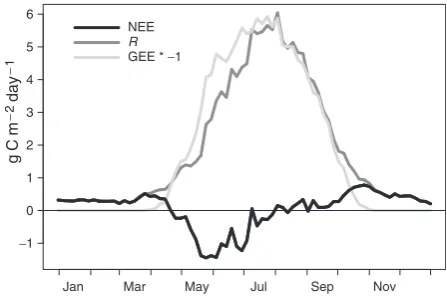
The average seasonal cycles of NEE, GEE, and R, as calculated from the nearly 10 years of eddy-covariance data, are shown in Fig. 2. The mean date for onset of photosynthesis in mid-April is similar to observations at a southern black spruce forest 475 km to the WSW (Griffiset al., 2003), but is several weeks before measur-able photosynthesis is seen at deciduous forests in the region (Black et al., 2000), and even at Harvard Forest 121to the south (Gouldenet al., 1996a). On average the forest has the greatest net uptake of atmospheric CO2 during the months of May and June, also similar to observations in southern black spruce and jack pine forests (Griffiset al., 2003). The system is roughly carbon neutral from July until the end of September, when a peak in CO2 emission occurs that slowly declines through the winter (Gouldenet al., 1998).
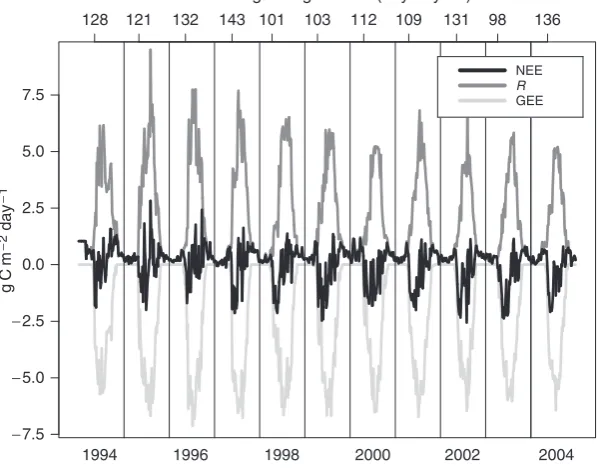
Initiation of photosynthesis in boreal conifer forests is largely regulated by air temperature, requiring daytime temperatures above freezing (Goulden et al., 1997; Bergh & Linder, 1999; Suni et al., 2003b). NEE turns positive in July and August because of high respiration rates, and hence we could not define the growing season simply by the sign of net daily CO2 exchange. We instead designated the onset and end of the growing season (OGS and EGS, respectively) as the first and last day of the year where forest GEE achieves 10% of the summertime maximum GEE. There was significant variation in the onset of photosynthesis (Fig. 3), with OGS as early as day of year (DOY) 99 (2003) or as late as DOY 143 (1997), a difference of more than 6 weeks. There was considerably less variability at the end of the growing season, which ranged from DOY 284 to 302,
NEE
R
GEE * −1
Jan Mar May Jul Sep Nov
−1
Fig. 2 Mean annual cycle of net ecosystem exchange,R, and
gross ecosystem exchange (GEE), averaged on 5-day intervals. Note the lag of theR-curve, peaking a month later than GEE.
suggesting that decreasing day length and/or low light intensity limited late-season photosynthesis (Suniet al., 2003a), even in the warm autumns of 1998 and 2000.
The seasonal increase in respiration begins at ap-proximately the same time as photosynthesis, but is initially weaker than photosynthesis for two reasons. First, conifers may initially allocate more photosynthate to replenishing carbohydrate reserves than to growth, limiting growth respiration in spring and early summer (Gouldenet al., 1997). Second, heterotrophic respiration is limited in early summer by soil climate in thawing, meltwater-saturated soils. Respiration rates continue to rise until August, as the slow thawing of the carbon-rich, deeper soil layers progressively provide additional substrate for heterotrophic respiration (Goulden et al., 1998); this phenomenon gives the seasonal course of ecosystem respiration a significant lag relative to photo-synthesis (Fig. 2). The reverse process, gradual freezing of soils during the cold season, leads to even longer lags in the fall. Respiration rates decline slowly and CO2 efflux continues throughout the winter.
Effect of water tables on carbon exchange
Soils below the water table are typically low in oxygen or anoxic (Clymo, 1984; Clymo & Pearce, 1995), which inhibits decomposition (Funket al., 1994; Bubieret al., 1998; Schreader et al., 1998). We investigated the role of summertime (DOY 150–250) water table position on ecosystem respiration using measurements at a
Sphagnum veneer bog in the northern portion of the eddy-covariance tower footprint, the locus of the largest reservoir of soil carbon at the site (Plate 1). We found that increased depth to water table was significantly correlated with increased CO2 flux during well-mixed night-time periods (daily:P5o11010,r50.36) dur-ing summer 2002–2004. Depth to water table in the veneer bog was a predictor for ecosystem respiration observed at the main tower, accounting for 11% of the half-hourly variance inRduring the summers of 2002– 2004 (Po11010). This result is not surprising given the dominance of wetlands in the tower footprint.
We constructed two multiple linear regression mod-els, using half-hourly and daily time steps, to investi-gate the relative contribution of water table depth and soil temperature to total ecosystem respiration. We found that depth to water table and soil temperatures at the carbon-rich 20 cm depth predicted 57% of the half-hourly variance in R (Po11010), with 10% of the variance attributable to depth to water table, 46% to soil temperature, and 1% to the interaction between the two variables. On a daily time step, these two factors accounted for 64% of the daily variance in R; 15% attributable to water table depth, 48% to soil tempera-ture, and 1% to the interaction between the two vari-ables. The daily model fit took the form of:
Rpredicted¼0:0877WTdepth;bogþ0:583
Tsoil;20 cm0:0106WTdepth;bog
Tsoil;20 cm1:36; ð2Þ
−7.5 −5.0 −2.5 0.0 2.5 5.0 7.5
1994 1996 1998 2000 2002 2004
NEE
R
GEE
121 143 103 109 98
128 132 101 112 131 136
Onset of growing season (day of year)
g C m
−
2 day
−
1
Fig. 3 Carbon exchange averaged on 5-day intervals.
where Rpredicted (for the whole ecosystem) is in g C m2day1, andWTdepth, bogandTsoil, 20 cmare in cm to water table and 1C, respectively. Based on this relationship, a 2 cm drop in water table depth integrated over the 100 days translates into18 g C m2additional R– enough to tip the overall carbon balance from a sink to a source in some years (Table 1). Note that this investigation only considered a 100-day thawed period (DOY 150–250) for 3 years, and would not be applicable during other seasons. Our data showing R positively correlated to temperature and negatively correlated with higher water tables corroborate the findings of Bubieret al. (1998) and Funket al. (1994).
It is important to note that the position of the water table is an important contributor to the observed varia-bility inR, even though most of the ecosystem respira-tion is autotrophic or derived from the aerobic upper soil layers, and controlled by soil temperature: the variations in water table depth between 20 and 30 cm represent a critical factor regulating variability in R on seasonal and annual time scales. Water table movement at these depths brings into play a relatively old, abun-dant reservoir of organic matter and makes a significant contribution to total deep decomposition (30– 130 g C m2yr1, Gouldenet al., 1998).
The water table in the Sphagnum veneer bog re-sponded both to precipitation and to seasonal progres-sion associated with low permeability at the frost line, which inhibits the drainage of snowmelt and precipita-tion. Frozen soil layers and perched springtime water tables prevent oxygen from reaching deeper soil layers,
and our data show that respiration rates respond directly to these conditions (Fig. 4). The interaction between soil thaw and water table depth in poorly drained areas is a key factor in controlling whole-forest respiration rates observed at the eddy-covariance tower at seasonal time scales.
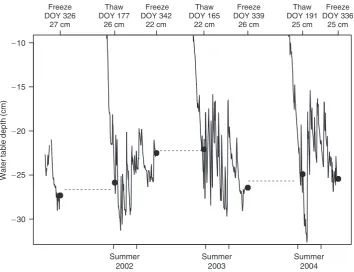
Our results from theSphagnumveneer bog also sug-gest that these interactions are important on longer timescales, and that water table depths in the bog appear to be influenced by the preceding year. In all years for which we have data, the position of the water table once thaw was complete appeared to be correlated with the previous year’s position at freeze-up (Fig. 5). The water tables at the veneer bog reflect the ecosys-tem’s overall water balance, with a net rise in water table over the course of a wet summer (2002, Fig. 5) and a net fall in water table in a dry summer (2003, Fig. 5). As the veneer bog lies in a topographical low underlain by clay, it likely experiences very little runoff (H. Veldhuis, personal communication), allowing water table depth to reflect the time-integrated water balance.
Interannual variability: trends and drivers
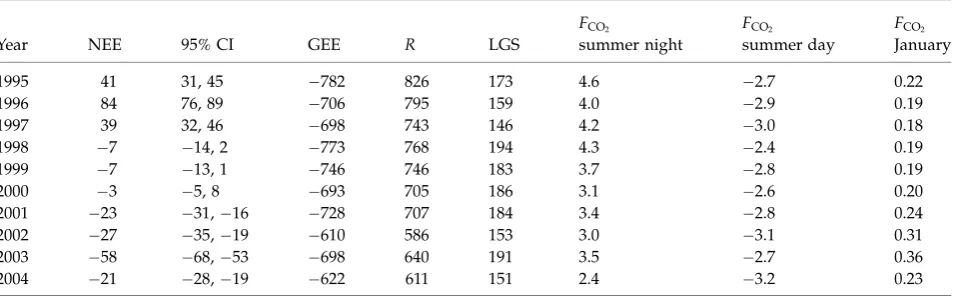
NOBS unexpectedly switched from a modest net annual source to a small annual sink for atmospheric CO2 between 1994 and 2004 (Table 1; Fig. 6). There was a significant (P50.03) trend toward decreased night-time efflux in the summer, likely driving the decreasing R observed over the study period (Table 1). There was also a significant (P50.04) trend towardincreased
Table 1 Annual net ecosystem exchange (NEE), gross ecosystem exchange (GEE), and ecosystem respiration (R) at BOREAS– NOBS (g C m2yr1), length of growing season (LGS), mean summer (DOY 150–250) night-time and daytime, and mean January fluxes (mmol m2s1)
Year NEE 95% CI GEE R LGS
FCO2
summer night
FCO2
summer day
FCO2
January
1995 41 31, 45 782 826 173 4.6 2.7 0.22
1996 84 76, 89 706 795 159 4.0 2.9 0.19
1997 39 32, 46 698 743 146 4.2 3.0 0.18
1998 7 14, 2 773 768 194 4.3 2.4 0.19
1999 7 13, 1 746 746 183 3.7 2.8 0.19
2000 3 5, 8 693 705 186 3.1 2.6 0.20
2001 23 31,16 728 707 184 3.4 2.8 0.24
2002 27 35,19 610 586 153 3.0 3.1 0.31
2003 58 68,53 698 640 191 3.5 2.7 0.36
2004 21 28,19 622 611 151 2.4 3.2 0.23
Confidence intervals were estimated by first determining an error distribution for each half-hour, consisting of: (1) instrumentation error calculated via daily difference method of Hollinger & Richardson (2005) and Richardsonet al. (2006), (2) error associated with the model fit forR/GEE, and (3) error associated with fillingTand PAR during gaps. These error distributions were used to generate different 500 simulations of the NEE time series, from which confidence intervals were bootstrapped. The confidence intervals vary between the years due to distribution of gaps in different years.
BOREAS, Boreal Ecosystem-Atmosphere Study; NOBS, Northern Old Black Spruce.
0 2 4 6
8 R, measured
R, modeled
0 2 4 6 8
150 175 200 225 250
0 2 4 6 8
Day of year 2004 2003 2002
R
(µmol m
−
2 s
−
1)
R
(µmol m
−
2 s
−
1)
R
(µmol m
−
2 s
−
1)
Fig. 4 Measured respiration and respiration modeled as a function of soil temperature and depth to water table during summer 2002,
2003, and 2004.
−30 −25 −20 −15 −10
Water table depth (cm)
Thaw DOY 177
26 cm
Freeze DOY 342
22 cm
Thaw DOY 165
22 cm
Freeze DOY 339
26 cm
Thaw DOY 191
25 cm
Freeze DOY 336 25 cm
Summer 2004 Summer
2003 Summer
2002 Freeze
DOY 326 27 cm
Fig. 5 Interannual variability in water table depth is affected by final position of water table in the preceding year. Thaw times were
determined via soil temperature at 20 cm (soil temperature measurement closest to zone of active water table movement); freeze times were defined as last valid measurement of water table before transition to ice. Note changes in water table depth due to wet (2002) and dry (2003) summers. Dashed lines (- - - -) during the frozen and spring thaws periods are included as visual aids.
January efflux (Table 1), possibly due to warmer soil temperatures during the latter part of the study period. We observed no trend in growing season daytime CO2 flux. Likewise, we observed no trend in annual energy budget closure, suggesting that the trends observed in CO2 flux do not reflect instrumentation or calculation error. There were significant trends toward decreased annual NEE (more uptake) and respiration (P50.002 and 0.0001, respectively). There was nearly 50% more interannual variability in respiration than photosynth-esis, suggesting that more of the variability in NEE is attributable toRrather than GEE, as observed by Bubier et al. (2003b) using chambers in a mid-latitude bog. There was no relationship between annual GEE and NEE, but increased annual R was significantly (P50.01) correlated with increased NEE (less uptake). We investigated the influence of mean annual air temperature, precipitation, PAR, and potential evapo-transpiration (PET) on annual carbon balance using three different annual bases: calendar year, April 1– March 31, and November 1–October 31. No significant difference in controlling variables was observed be-tween the annual bases, so our analysis is reported according to calendar year carbon exchange. We deter-mined PET via the simplified Penman–Monteith equa-tion of Hogg (1997), calculating each year from the previous September through current August in order to capture the time period most relevant to growing season water balance. Warmer annual temperatures were associated with increased net uptake (53% of the variance, P50.02), but had no significant association with annual R nor GEE. PET was associated with enhanced photosynthesis (44% of the variance, P50.04). Annual precipitation did not explain any of the variability in NEE,R, or GEE.
We tested for longer-term effects of water balance on carbon exchange as the results given above show that water table depth at the veneer bog in the tower’s
footprint provided an important control on whole-forest respiration rates, and depended on climate in previous years. Hogg (1997) defined a climate moisture index (CMI)
CMI¼precipitationPET ð3Þ
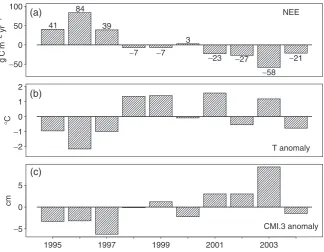
to estimate the availability of water in excess of eva-porative demand. We calculated CMI on a monthly basis, and determined annual CMI from the previous September through the current August. We then created a variety of lagged indices (CMI.1, CMI.2, CMI.3, CMI.4) consisting of the mean CMI for theprevious 1, 2, 3, or 4 years to test for longer-term moisture effects on carbon exchange (current year is excluded). We found significant negative correlations between CMI.2, CMI.3, and CMI.4 and annual NEE, supporting the view that abundant moisture enhances net carbon uptake. CMI.3 was particularly well correlated with NEE, accounting for 66% of the variance (P50.005). Annual values for NEE, T anomalies, and CMI.3 anomalies are shown in Fig. 7.
When combined with other climatic variables, the role of these lagged indices in explaining interannual variability was striking. CMI.3 (representingpast years) and PET (current year) explained 75% of the interannual variability in NEE (P50.008; Table 2). A similar rela-tionship was observed inR, with high values of CMI.3 decreasingRand high values of PET increasingR. For GEE, high values of CMI.3 were associated with in-creased GEE (less photosynthesis) and inin-creased PET with decreased GEE (more photosynthesis). These re-sults suggest that the effects of precipitation anomalies on carbon exchange may only be evident after several years of drought or wetness, as the water table at NOBS integrates the water balance over several years. The strong autocorrelations of annual NEE andRtime series (1-year lagged autoregression coefficients were 0.7 and 0.45, respectively) also indicate that processes with long timescales are important. Our results are consistent with Arneth et al. (2002), Bubier et al. (2003a, b), and Almet al. (1999), all of who found that dry conditions increased NEE by enhancingRin peat bogs.
Myneni et al. (1997) reported progressively earlier onset, and longer duration, of the growing season in
1994 1996 1998 2000 2002 2004
0 100 200
50 150 250
g C m
−
2
Fig. 6 Cumulative carbon balance at Northern Old Black
Spruce.
Table 2 Results of regressions between annual carbon ex-change, 3-year lagged climate moisture index (CMI.3), and current year potential evapotranspiration (PET)
CMI.3 coefficient
PET
coefficient R2 P
NEE 9.5 0.4 0.75 0.008
R 18.4 2.0 0.87 0.0008
GEE 8.7 1.6 0.77 0.006
northern high latitudes between 1981 and 1991, based on satellite observations of NDVI and CO2 concentra-tion data. White et al. (2000) and Berthelotet al. (2002) predicted that increases in growing season length would translate into a marked decrease in NEE (more uptake) in boreal regions. We tested this hypothesis by investigating the influence of OGS, EGS, and LGS on the annual carbon budget at NOBS. In contrast to expecta-tions, years with earlier OGS (1998, 1999) were not associated with decreased NEE (i.e., annual uptake of CO2 was not enhanced), and neither NEE nor R re-sponded directly to LGS. Longer growing seasons did enhance photosynthesis (38% of the variance,P50.06), but this did not translate into greater net uptake in years with earlier OGS. Rmay also have been enhanced by LGS when taken into conjunction with CMI.3 (P50.04 for LGS). As factors controllingR, such as soil thaw and drainage, may be as sensitive to LGS as is GEE, we are not surprised that LGS has little effect on annual net carbon balance.
The NOBS results must also be considered in light of their regional context, especially because Picea forests are the most widely occurring forest type in the North American boreal forest biome (39%, Blacket al., 2004). Temperatures in Canada south of 601N have warmed 0.5–1.51C during the 20th century, and precipitation has increased by 5–35% in the same time period (Zhang et al., 2000; Gillettet al., 2004). The close correspondence between climate at NOBS and local climate stations (Fig. 1) suggests that our results are representative of processes occurring at other mature black spruce forests in the region. The portion of the growing season favor-able to heterotrophic respiration is currently limited at NOBS due to slow thaw and drainage of the soil column, causing the seasonal cycle of Rto lag that of GEE. Atmospheric CO2 concentrations across boreal regions are closely linked to the timing of these two offsetting processes, so proper representation of this cycle is clearly essential for inverse models using ob-served CO2 concentrations, and for assessment of long-term carbon balances.
Discussion
The annual carbon budget of the site has changed over the last 10 years in a manner that cannot be fully explained by the prompt responses of plant and eco-system physiology to weather. The longer-term ecosys-tem water balance, and particularly the depth of the water table, are clearly important, and may explain much of the observed interannual variability and trend. Factors such as ecosystem water balance operate on timescales longer than most physiological and ecologi-cal studies, and, as a result, are poorly described and
understood. Nonetheless, these factors may have key implications for ecosystem resistance and resilience in the face of changes in climate or climate variability.
There is a long-term trend of increasing annual tem-perature in the region (Fig. 1), which was particularly pronounced during the middle part of the study period (Fig. 7, second panel), and was unexpectedly correlated with increased net carbon uptake. Warming during the decade of observations provided an excellent opportu-nity to test ideas about ecosystem response to projected future climatic warming. Most interactive vegetation– climate models represent respiration as a strongly in-creasing function of temperature, with photosynthesis assumed a function of light, subject to limitations due to temperature, LGS, and availability of water and nutri-ents. The results from NOBS show that these simplified functional representations are incomplete in the case of boreal peatlands, particularly with respect to ecosystem respiration.
Our results show that while temperature and LGS exerted important controls on photosynthesis, respira-tion rates were influenced by both temperature and seasonal and interannual patterns of ecosystem water availability. No increase in ecosystem respiration was observed during the mid–late years of the study, which experienced warmer temperatures than the 30-year mean (Fig. 7, middle panel). Instead, a trend toward decreased respiration was observed in the night-time CO2 fluxes from the summer (Table 1), which have showed a significant (P50.03) decline since the start of the study, and in the annualRsums (Table 1). While wintertime CO2fluxes have increased during the study period (Table 1), perhaps as a result of warmer tem-peratures, wintertime effluxes are low when compared with summertime respiration.
The observed decrease in overall respiration is a direct consequence of the increase in water availability in the growing season during this time period: CMI.3 values, on average, increased over the study period (Fig. 7, panel 3), indicating a shift in the overall water balance from a deficit to a surplus. Before 1997, the region experienced nearly 10 years of below-average rainfall (Fig. 1), CMI.3 values were low, and 1995 and 1996 were the years of largestRat our site. In compar-ison, the two dry years of 2003–2004 followed several years of above average or average rainfall, CMI.3 values were average to high, andR rates remained low. Our results thus suggest that several consecutive years of drought or water surplus have a greater impact on respiration rates than one or two anomalous years in isolation, reflecting long-term shifts in regional water tables.
The net result is that the NEE of the forest has decreased under this warmer, wetter regime, turning
it from a modest source into a weak sink for atmo-spheric CO2. As depth of the water table appears to be an important factor, the warmer–wetter regime may also lead to reduced losses of peat in a fire.
There are several factors that contribute to the reten-tion of water in these soils, with important implicareten-tions for decomposition of organic matter. Low-permeability glaciolacustrine clays, exposed only 8000 years ago at the retreat of Lake Agassiz, underlie much of Manitoba, western Ontario, and central Saskatchewan, and drai-nage in the region is poorly developed (Veldhuiset al., 2002). As a result of this poor drainage, water tables in our veneer bog exhibit a notable carryover effect, whereby water table depth at the end of one growing season strongly influence water table depth early in the next summer, after soil thaw is complete. The poor drainage and cold temperatures in the soils inhibit breakdown of organic matter, favoring the development of deep organic soils. The presence of a distinct frost line in the soil for much of the early growing season limits infiltration of snowmelt and precipitation in the wettest parts of the tower’s footprint, which also con-tain the largest soil organic carbon stores. As a result, early- and mid-summer water tables in the wetland areas are kept higher than they would be in the absence of a frost line, especially when enhanced by early-season precipitation.
The role of soil moisture in depressing respiration rates is seen at all time scales, from instantaneous (depth to water table explains 15% of the daily variance
inRin for DOY 150–250 of 2002–2004) to interannual, providing a rationale for why the multiyear climate moisture index, in combination with the year’s eva-porative demand, explains 87% of the interannual variability in R. The significance of precipitation, eva-porative demand, and depth to water table reflects the central importance of the seasonal soil freeze–thaw cycle and associated hydrologic variations in control-ling annual carbon exchange. Our findings illustrate that soil water balance may be as critical as temperature in controlling the long-term carbon balance in boreal forests underlain by peat, and must be factored into predictions of ecosystem response to future climate. Carbon balance in these areas is very sensitive to water table depth, and small fluctuations in its position may be enough to shift the net carbon balance to a source or sink.
The strong influence of slowly changing parameters, such as water balance, reminds us that boreal systems tend to change slowly, and that observations to assess long-term factors are critical for understanding climate– carbon cycle interactions in this biome. A warmer climate may lead to release of CO2from deep organic soils in the boreal region if they became drier, but if the climate were also wetter than the long-term mean, these soils could continue to accumulate organic matter. It is, therefore, critical to properly represent soil hydrologic processes, rainfall, and soil thaw in order to predict the response to changing climate of the extensive black spruce-Sphagnumwetland biome of North America. 41
84
39
3 −7 −7
−23 −27
−58 −21 −50
0 50 100
−2 −1 0 1 2
−5 0 5
1995 1997 1999 2001 2003
NEE
T anomaly
CMI.3 anomaly
g C m
−
2 yr
−
1
°
C
cm
(a)
(b)
(c)
Fig. 7 Comparison with (a) net ecosystem exchange, (b) temperature anomaly, (c) 3-year lagged climate moisture index anomaly.
Acknowledgements
This work was supported by the US National Aeronautics and Space Administration (NAG5-11154, NAG5-7534, NAG5-2253) and by a NASA Earth System Science Fellowship (A. Dunn, R-ESSF/03-0000-0092). We especially thank Alfram Bright, John Budney, Lucy Hutyra, Christine Jones, Bill Munger, Leo Grenier, Bert Lesley, and Ted Hogg.
References
Alm J, Schulman L, Walden Jet al. (1999) Carbon balance of a boreal bog during a year with an exceptionally dry summer.
Ecology,80, 161–174.
Arneth A, Kurbatova J, Kolle O et al. (2002) Comparative ecosystem-atmosphere exchange of energy and mass in a European Russian and a central Siberian bog II: interseasonal and interannual variability of CO2fluxes.Tellus,54B, 514–530.
Baldocchi DD, Vogel CA, Hall B (1997) Seasonal variation of carbon dioxide exchange rates above and below a boreal jack pine forest.Agricultural and Forest Meteorology,83, 147–170. Barber VA, Juday GP, Finney BP (2000) Reduced growth of
Alaskan white spruce in the twentieth century from tempera-ture-induced drought stress.Nature,405, 668–673.
Barr AG, Griffis TJ, Black TAet al. (2002) Comparing the carbon budgets of boreal and temperate deciduous forest stands.
Canadian Journal of Forest Research,32, 813–822.
Bergh J, Linder S (1999) Effects of soil warming during spring on photosynthetic recovery in boreal Norway spruce stands.
Global Change Biology,5, 245–253.
Berthelot M, Friedlingstein P, Ciais Pet al. (2002) Global response of the terrestrial biosphere to CO2and climate change using
a coupled climate–carbon cycle model. Global Biogeochemical Cycles,16, 1084.
Black TA, Chen WJ, Barr AG et al. (2000) Increased carbon sequestration by a boreal deciduous forest in years with a warm spring.Geophysical Research Letters,27, 1271–1274. Black TA, Gaumont-Guay D, Jassal RS et al. (2004) Carbon
balance research in boreal biomes. In:Carbon Balance of Forest Biomes(eds Griffiths H, Jarvis PJ), Garland Science/Taylor & Francis, Abingdon, UK.
Bubier JL, Bhatia G, Moore TRet al. (2003a) Spatial and temporal variability in growing-season net ecosystem carbon dioxide exchange at a large peatland in Ontario, Canada.Ecosystems, 6, 353–367.
Bubier J, Crill PM, Moore TRet al. (1998) Seasonal patterns and controls on net ecosystem CO2exchange in a boreal peatland
complex.Global Biogeochemical Cycles,12, 703–714.
Bubier J, Crill P, Mosedale Aet al. (2003b) Peatland responses to varying interannual moisture conditions as measured by automatic CO2chambers.Global Biogeochemical Cycles,17, 1066,
doi: 10.1029/2002GB001946.
Clark JS (1988) Effect of climate change on fire regimes in northwestern Minnesota.Nature,334, 233–235.
Clymo RS (1984) The limits to peat bog growth. Philosophical Transactions of the Royal Society of London B,303, 605–654. Clymo RS, Pearce DME (1995) Methane and carbon dioxide
production in, transport through, and efflux from a peatland.
Philosophical Transactions of the Royal Society of London A,350, 249–259.
D’Arrigo RD, Kaufmann RK, Davi Net al. (2004) Thresholds for warming-induced growth decline at elevational tree line in the Yukon Territory, Canada.Global Biogeochemical Cycles,18, 3021, doi: 10.1029/2004GB002249.
Falge E, Baldocchi D, Olson Ret al. (2001) Gap filling strategies for defensible annual sums of NEE. Agricultural and Forest Meteorology,107, 43–69.
Flannigan MD, Van Wagner CE (1991) Climate change and wildfire in Canada.Canadian Journal of Forest Research,21, 66– 72.
Funk DW, Pullman ER, Peterson KMet al. (1994) Influence of water table on carbon dioxide, carbon monoxide, and methane fluxes from taiga bog microcosms.Global Biogeochemical Cycles, 8, 271–278.
Gillett NP, Weaver AJ, Zwiers FWet al. (2004) Detecting the effect of climate change on Canadian forest fires.Geophysical Research Letters,31, 18211, doi: 10.1029/2004GL020876.
Gorham E (1991) Northern peatlands: role in the carbon cycle and probable responses to climatic warming.Ecological Appli-cations,1, 182–195.
Goulden ML, Daube BC, Fan S-M et al. (1997) Physiological responses of a black spruce forest to weather. Journal of Geophysical Research,102, 28987–28996.
Goulden ML, Munger JW, Fan S-Met al. (1996a) Exchange of carbon dioxide by a deciduous forest: response to interannual climate variability.Science,271, 1576–1578.
Goulden ML, Munger JW, Fan S-Met al. (1996b) Measurements of carbon sequestration by long-term eddy covariance: meth-ods and a critical evaluation of accuracy.Global Change Biology, 2, 169–182.
Goulden ML, Wofsy SC, Harden JWet al. (1998) Sensitivity of boreal forest carbon balance to soil thaw.Science,279, 214–217. Gower ST, Vogel JG, Norman JMet al. (1997) Carbon distribution and aboveground net primary production in aspen, jack pine, and black spruce stands in Saskatchewan and Manitoba, Canada.Journal of Geophysical Research,102, 29029–29041. Griffis TJ, Black TA, Morgenstern Ket al. (2003) Ecophysiological
controls on the carbon balance of three southern boreal forests.
Agricultural and Forest Meteorology,117, 53–71.
Harden JW, O’Neill KP, Trumbore SEet al. (1997) Moss and soil contributions to the annual net carbon flux of a maturing boreal forest.Journal of Geophysical Research,102, 28805–28816. Harden JW, Sundquist ET, Stallard RFet al. (1992) Dynamics of soil carbon during deglaciation of the laurentide ice sheet.
Science,258, 1921–1924.
Hobbie SE, Schimel JP, Trumbore SEet al. (2000) Controls over carbon storage and turnover in high-latitude soils. Global Change Biology,6(Suppl. 1), 196–210.
Hogg EH (1997) Temporal scaling of moisture and the forest-grassland boundary in western Canada.Agricultural and Forest Meteorology,84, 115–122.
Hollinger DY, Richardson AD (2005) Uncertainty in eddy covariance measurements and its application to physiological models.Tree Physiology,25, 873–885.
IPCC (2001)Climate Change 2001: The Scientific Basis. Contribution of Working Group I to the Third Assessment Report of the
governmental Panel on Climate Change. Cambridge University Press, Cambridge.
Iremonger S, Ravilious C, Quinton T (1997)A Global Overview of Forest Conservation. Including: GIS Files of Forests and Protected Areas, Version 2. CD-ROM, Center for International Forestry Research & United Nations Environment Programme - World Conservation Monitoring Centre, Cambridge, UK.
Keyser AR, Kimball JS, Nemani RRet al. (2000) Simulating the effects of climate change on the carbon balance of North American high-latitude forests.Global Change Biology,6(Suppl. 1), 185–195.
Lindroth A, Grelle A, Moren A-S (1998) Long-term measure-ments of boreal forest carbon balance reveal large temperature sensitivity.Global Change Biology,4, 443–450.
Liu H, Foken T (2001) A modified Bowen ratio method to determine sensible and latent heat fluxes. Meteorologische Zeitschrift,10, 71–80.
McMillen RT (1988) An eddy correlation technique with ex-tended applicability to non-simple terrain. Boundary Layer Meteorology,43, 231–245.
Meyers T, Hall M, Lindberg Set al. (1996) Use of the modified Bowen-ratio technique to measure fluxes of trace gases. Atmo-spheric Environment,30, 3321–3329.
Milyukova I, Kolle O, Varlagin Aet al. (2002) Carbon balance of a southern taiga spruce stand in European Russia. Tellus, 54B, 429–442.
Moosavi SC, Crill PM (1997) Controls on CH4and CO2emissions
along two moisture gradients in the Canadian boreal zone.
Journal of Geophysical Research,102, 29261–29277.
Myneni RB, Keeling CD, Tucker CJet al. (1997) Increased plant growth in the northern high latitudes from 1981 to 1991.
Nature,386, 698–702.
O’Connell KEB, Gower ST, Norman JM (2003a) Comparison of net primary production and light-use dynamics of two boreal black spruce forest communities.Ecosystems,6, 236–247. O’Connell KEB, Gower ST, Norman JM (2003b) Net ecosystem
production of two contrasting boreal black spruce forest com-munities.Ecosystems,6, 248–260.
Rayment MB, Jarvis PG (2000) Temporal and spatial variation of soil CO2efflux in a Canadian boreal forest. Soil Biology and Biochemistry,32, 35–45.
Richardson AD, Hollinger DY, Burba GGet al. (2006) A multi-site analysis of uncertainty in tower-based measurements of carbon and energy fluxes.Agricultural and Forest Meteorology, 136, 1–18.
Schlesinger WH (1997) Biogeochemistry: an Analysis of Global Change, 2nd edn. Academic Press, San Diego, CA.
Schreader CP, Rouse WR, Griffis TJet al. (1998) Carbon dioxide fluxes in a northern fen during a hot, dry summer. Global Biogeochemical Cycles,12, 729–740.
Sellers P, Hall F, Margolis Het al. (1995) The boreal ecosystem-atmosphere study (BOREAS): an overview and early results from the 1994 field year.Bulletin of the American Meteorological Society,76, 1549–1577.
Stocks BJ (1993) Global warming and forest-fires in Canada.
Forest Chronicle,69, 290–293.
Stone RS, Dutton EG, Harris M et al. (2002) Earlier spring snowmelt in northern Alaska as an indicator of climate change.Journal of Geophysical Research,107, 4089.
Suni T, Berninger F, Markkanen Tet al. (2003a) Interannual variability and timing of growing-season CO2exchange in a
boreal forest.Journal of Geophysical Research,108, 4265. Suni T, Berninger F, Vesala Tet al. (2003b) Air temperature
triggers the recovery of evergreen boreal forest photosynthesis in spring.Global Change Biology,9, 1410–1426.
Trumbore SE, Harden JW (1997) Accumulation and turnover of carbon in organic and mineral soils of the BOREAS northern study area. Journal of Geophysical Research, 102, 28817–28830.
Valentini R, Matteucci G, Dolman AJet al. (2000) Respiration as the main determinant of carbon balance in European forests.
Nature,404, 861–865.
Veldhuis H, Eilers RG, Mills GF (2002) Permafrost distribution and soil climate in the glacial Lake Agassiz basin in north-central Manitoba, Canada. Paper presented at 17th World Conference on Soil Science, Bangkok, Thailand, 13–20 August.
Wang C, Bond-Lamberty B, Gower ST (2003) Soil surface CO2 flux in a boreal black spruce fire chronosequence. Journal of Geophysical Research, 108, 8224, doi: 10.1029/ 2001JD000861.
White A, Cannell MGR, Friend AD (2000) The high-latitude terrestrial carbon sink: a model analysis.Global Change Biology, 6, 227–245.
Wilmking M, Juday GP, Barber VAet al. (2004) Recent climate warming forces contrasting growth responses of white spruce at treeline in Alaska through temperature thresholds.Global Change Biology,10, 1724–1736.
Winston GC, Sundquist ET, Stephens BBet al. (1997) Winter CO2
fluxes in a boreal forest.Journal of Geophysical Research,102, 28795–28804.
Zhang X, Vincent LA, Hogg WDet al. (2000) Temperature and precipitation trends in Canada during the 20th century. Atmo-sphere-Ocean,38, 395–429.