323
LEARNING ONE-DIGIT DECIMAL NUMBERS BY MEASUREMENT
ACTIVITY
Puji Astuti
Surabaya State University [email protected]
Abstract
It is a prerequisite for students to have an understanding of the concept of fractions to learn decimals. Also, modelling the decimals, like using the number line, supports students to see where the decimal numbers are among the whole numbers and the decimal numbers itself. Therefore, this study aims to support children’s understanding of the meaning of decimals by seeing: 1) the tenths and hundredths of decimal numbers by the context of measurement; 2) the representation of decimal numbers on number line. With this aim, design research method is used in this study. We develop an intervention to improve conventional teaching approaches in decimals through instructional activities on measurement activity and game context. By the measuring activity, students are hoped to be able to relate tenths and hundredths to one-digit and two-digit decimals. Besides, the number line through game activity is hoped to
contribute to students’ development of decimal concepts. The instructional activities are designed and compacted in the Hypothetical Learning Trajectory (HLT). The HLT was carried out in two cycles involving the 4th grade of elementary school students. Data of the learning activities collected from videotaping along teaching process, field notes by the researcher, and the completed learning worksheet are used to refine the HLT. This article describes and discusses the learning activity of 2 meetings of cycle 2 of our focus group students of grade 4 elementary school in Surabaya: SDIT Al Ghilmani. The data
indicated that the learning activities promoted the students’ understanding of one-digit decimal numbers.
Keyword : measurement, decimal numbers, number line
INTRODUCTION
Background
The concept of decimals is included in the mathematics curricula and is considered to be of great significance especially due to its application and use in everyday life (Michaelidou, Gagatsis, & Pantazi, 2004). In Indonesia, the concept of decimal numbers is stated in the curriculum, Kurikulum Tingkat Satuan Pendidikan (KTSP), for the fifth grade of elementary school. It is important for students to learn decimals also because the decimal concepts support learning other mathematics topics especially measurement of length and area, and arithmetic. In brief, decimals are essential in both mathematics and its applications.
Nevertheless, some recent studies reported students weakness on decimals Bell, Swan, & Taylor, 1981; Moloney & Stacey, 1997; Stacey et al, 2001; Steinle, 2004; Lai & Tsang, 2009; Sengul & Guldbagci, 2012). Most common areas of problems in learning decimals from the literatures are weak understanding of place value and weak
324 notions of the magnitude of decimal numbers. Grossman (in Steinle, 2004) indicated
students weakness on magnitude decimal numbers with data that only % of a
large sample of students was able to choose the smallest decimal number from a list of five different decimal numbers. While weak in place value, for example, is students assume that the relationships within the whole number system can be transferred unaltered to the decimal number system. For example in whole numbers, 20 is ten times greater than 2, but it is not correct to say that 0,20 is ten times greater than 0,2 (Moskal & Magone, 2001). As is often the case, when being asked to compare 2.25 and 2.3, students would choose 2.25 as the larger number because 25 is bigger than 3.
These facts lead to investigation what and how decimals are usually taught, and arises a need for intervention for teaching and learning building an understanding of decimals. Lai and Tsang (2009) outlined that in learning decimals, students in primary school are pushed to learn the four operations of decimal numbers rather than to understand the meaning of decimal numbers. According to Lai and Tsang,
focussing on students computational skills on four operations of decimal numbers is
merely rote learning and devoid of any meaning. In a similar vein, I argue that it is dangerous to learn operations on decimals without understanding the meaning of decimals because students might expert only in calculation but do not have convincing ideas what they are doing. Unfortunately, teaching emphasizing computational skills in learning decimals also happens in Indonesia. My investigation starts with an idea that the textbooks used for teaching-learning might reflect what
teacher teaches in mathematics classroom. The observation about students
textbooks (see Sumanto, Kusumawati, & Aksin, 2008; Soenarjo, 2008) gives impression that students are taught about the concepts of decimals in a very formal way. A procedural way was introduced to find decimals: changing a fraction by multiplying the numerator and denominator with the same number, or using a traditional method division.
This kind of learning decimals could be reasons behind students misconceptions on
decimal numbers. While it is known many studies have investigated that students still have to struggle on understanding decimals, it is not known how teachers can support students to learn decimals. Hence, we aim to develop teaching sequences to avoid the misconceptions, not necessarily teaching which opposes the misconceptions one by one but teaching which supports building an understanding the meaning of decimals.
At present, international studies report teaching practices designed to avoid confronting difficulties on decimal numbers (Helme & Stacey, 2000; Huang, Lium, & Shiu, 2008; Yildiz, Baki, Aydin, & Kogce, 2010; Lachance & Confrey, 2002; Brousseau, G., Brousseau, N., Warfield, 2007). However, research in Indonesia about intervention in teaching learning decimals has been minimal. Pramudiani (2011) implemented
activities about weight and volume measurement to promote the students notion of
325 symbol notation and provide the reasons for the symbol rules such as dividing the numerator by the denominator to write a common fraction as a decimal. Therefore, the present study differs in ways of the focus; we think to support children s learning
decimals with aim students understanding of: the meaning of decimal notation;
fractions and decimals are similar thing.
Research Questions
The general research question for this study is: (ow can measurement activities
facilitate the students notion on decimal numbers? )n answering this research
question, the following sub-question are to be investigated:
1. How can students develop an understanding of one-digit decimals?
The answer of the question would be description on how making partition into ten of measurement unit activity leads students to an understanding of one-digit decimals. This is done through the thinking process of finding length of things to giving them decimal notation.
2. How can students develop an understanding of two-digit decimals?
We investigate on how making partition into one hundred of measurement unit
leads to students understanding of two-digit decimals.
Aim of the Research
The present study concerns on doing intervention by learning experience for students to construct the knowledge about decimals. Students are hoped to be able to relate tenths and hundredths to one-digit and two-digit decimals. However, the study does not discuss about conversion of fractions to decimals. We propose an activity to measure length, in which students need to cooperate in investigating the best way to represent a part of a whole number. The reason an activity to measure length is chosen to learn about decimals, is because a measurement scale could be easier to relate to the number line. The present study also proposes number line to support
students understanding on decimals. As Thomson and Walker in Michaelidou,
suggested that the number line contributes to the development of concepts not only related to the identification and comparison of decimals but also to the ability to perform operations. A recent study by Michaelidou et al (2008) also showed that students succeed in representing the concept of decimals using a number line.
This paper will present the learning process of the students to answer question research 1.
Research Method
This study aims to develop intervention to improve conventional teaching
approaches in decimals through measurement context. Therefore, design research
method is used in this study. The design research in this study is an iterative process which refers to the research incorporates a cyclic approach of preparing for the experiment, teaching experiment, and retrospective analysis (van den Akker, Gravemeijer, McKenney, & Nieveen, 2006).
326 video recording of the whole class learning process, the video recording of the focus group, and the field notes.
This paper will explain about the teaching and learning process of cycle 2 for meeting 1 and meeting 2 which is about one-digit decimals.
MAIN SECTION
Here we present a description of learning decimal numbers of students in the 4th grade of SDIT Al-Ghilmani and more focus to our focus group students: Aam, Daya, Rifan, and Shofil.
Pre-Test Decimal Numbers
The pre-test questions were designed to know if the students have preliminary knowledge to learn about decimal numbers. The problems included were fair sharing problems, guessing number between two whole numbers like is there any number between 3 and 4?, numbers on number line, and measurement.
In fair sharing problems, the students divided the bar properly and wrote correct fraction notation. However, some still used words to notate the fraction, for example
seperempat a quarter , setengah a half , and sepersepuluh a tenth .
Many of the students could not guess decimals on guessing number problem. They
answered no numbers or with correct fractions, like three and a half , only one
student, Raju, answered with a decimal number ,5 .
All students did well writing consecutive whole numbers on number line. But most did not recognize decimal numbers labeled by a letter put in the middle of two numbers on number line. Only five students: Daya, Arya, Shofil, Daffa, Alawi correctly identified decimals on the number line, such as 1,5; 2,5; 3,5 and 4,5. The others just said or a half or incorrect fractions, like .
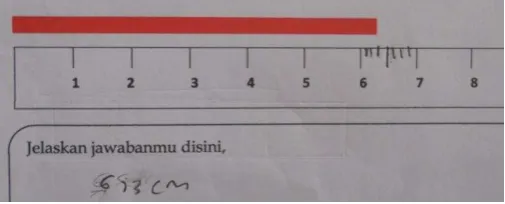
When the students did measurement problem, they also recognized decimals. Yet, their decimal numbers were not correct (see figure 1). They probably emerged the decimal numbers because their experience and knowledge using a ruler. The one and only who made 10 partitions on the paper strip drawn and notated with correct decimals was Aam.
Figure 11: Daud s misconception on decimals
From all the data above, the students seemed to have good understanding on
fractions. The students responses of the tasks also displayed how far they knew
327 known that with number line model there were some who had recognized that a half was ,5. In addition, from our measurement problem, we could see the students would use decimal numbers when the result does not fit.
Before this test, the focus group students were already chosen: Aam, Daya, Rifan, and Shofil. It was found the four students familiar with number line. Aam was accurate than the others on dividing the bar, he used ruler, and wrote fractions properly. He also showed his recognition of decimals although in some answers were incorrect. Daya knew fractions and used decimals but did not recognize any numbers between 3 and 4. Rifan was good at fair sharing problems, but could not appear decimal number. Shofil was also good at fractions, appeared decimals in his answer some correct and some not.
Overall, it was concluded that the students had enough prior knowledge to follow our learning series. They had knowledge about fractions: dividing a bar into equal parts and gave name the parts with fractions, and about number line.
Meeting 1: Measure things until they decide to use 10th
The first meeting aims to encourage students to use tenths in notating length of things before they turn into a decimal quotient later. There are two main activities: first, they measure table with their span and investigate why the measuring would give different length result for same objects, so how we could get the same measuring result? The discussion would end by introducing the paper strip as the standard length of their span to do measuring. Second, they explore measuring with the paper strip and discuss what would you do if the paper strip does not fit for many times? This leads them to symbolize the length as unit-fractions.
In the first activity, not as expected in the HLT students would get various length when measuring a table with a span, in the class, the students measured various things with various non-standard measurements: span, thumb, and foot. Although so, they who measured a table compared, in the whole class, the different result of their measurement: 3 spans, 1 step, 34 thumbs, 3 feet, 50 little fingers, and 3 caps. Being asked why different, the focus group students argued it was because of different ways of measuring and different children who measured.
The focus group students suggested using a ruler and a paper strip so that the measurement result would be the same (these students knew the paper strip because they opened the next page of their worksheet). Although they were cheating, it was known that they gained idea for a refinement of a standard measurement tool. Other groups discussed why different, because: the measurement tool they used were different; there was a long span and a short span. One group suggested using a measurement tool which has the same length.
In the next activity, as the students suggested using the same measurement tool, expected in the HLT, hence the paper strip was introduced, representing a span. They in group measured things in the classroom. They were struggling to say the rest length; the length which was not exact whole paper strip. In the focus group, Daya initially measured the length of a table and found that the table did not fit completely the paper strip. He and friends discussed how to say it and started to use unit-fractions (see fragment 1).
328 2 Shofil A half (showing the middle of the paper strip)
3 Aam It is a quarter.
3 Researcher (respond to Shofil) yes, a half. If this one? (Asked the rest of the paper strip). Listen to your friend, he said a quarter, prove it. Let s prove it.
4 Daya (measured again the table) 5 Researcher Yes, try it. Is it correct a quarter?
6 Daya Wrong.
7 Researcher How is the length of a quarter?
8 Daya It is as long as a train. Fil (Shofil), what s this? ) can t, Fil. 9 Aam It is one-fifth.
10 Researcher One-fifth. How? How do you show that it was one-fifth? 11 Aam (Aam, used his hand, estimated dividing the paper strip into 5) 12 Researcher You show this to your friend. Hey, look at your friend, he got
it.
13 Aam One-fifth.
14 Daya Three-fifth? (confused because the table was 2 paper strips with rest)
15 Aam One-fifth.
16 Teacher How is the length? What did you measure?
17 Aam Two-fifth (changed from one-fifth to two-fifth because the table was 2 paper strips with rest).
Fragment 1: Discussion on notating length with fractions
In fragment 10, the students showed their mastery of naming fraction parts but confused because the length was mixed fraction (fragment 1 line 13-17). The following discussion showed they used both fraction and decimal numbers to say the length. (See fragment 2).
1 Daya Two-fifth. How we would write it?
2 Aam Two comma five.
3 Teacher Just write what your group discussed, how do you think, if you found three, three and what?
4 Daya Ok, it is two comma five? 5 Teacher Two comma five what [unit]?
6 Aam This one (showing the paper strip), what paper is this? 7 Daya Paper strip.
Fragment 2: Students started using decimals
The teacher then conducted classroom discussion and invited the students to compare their approach dividing the paper strip. This actually was way to compare different fractions of the length of same object. The different fractions would puzzle the students whether the length is actually the same, so they need a refinement of
fractions they need to use. (owever, only Nabil s group, with divisions, came in
front of the class with fractions. The classmates seemed confused how to notate the rest: only in terms of halves, quarters, making incorrect fractions and even pretended that the length was exact the paper strip. Thus, the teacher directly asked the students to divide the paper strip into 10 parts. He explained this decision was made because of our ten-base system.
329 teacher measured the height of the whiteboard and guided the students to name the length in tenths. The plan to ask the students to measure again with divided paper strip was cancelled due to time limit.
From the findings so far, it was observed that the focus group students were in their phase developing the fraction language to represent the parts of the paper strip. Another fact, they performed decimals in incorrect manner. Fragment 10 and fragment 11 give information how they misunderstood naming with fractions and decimals: 2 paper strips and was said as and was written 2,5. It was also noticed the other students had problems naming fractions. Overall, the students still had problem: 1) name the fractional pieces, especially writing mixed fraction and 2) make incorrect equivalent relation of fraction and decimal number.
In conclusion, however, this lesson 1, with the paper strip, gave experience for the students measured things, divided the paper strip, gave estimation and discussed its rest with fraction language. Although it was the teacher telling them to divide the strip in 10, from the process gaining fraction it is known that they developed the sense of tenths. The instructional activities were set for students understanding of decimal notation by its relation with tenths. Therefore, although the decimal numbers were already mentioned by students at initial phase, it was decided, as in HLT, to
begin with students good sense of tenths.
Meeting 2: One-digit Decimal Numbers
In the second lesson the context of measurement was again presented to generate decimal notation. They were asked to measure things in the classroom with divided-10 paper strip and notate the result in terms of fractions. Then, the question asked to them was to leave out the fraction tenth, what would you write?
At the beginning of the class, the students divided the paper strip into 10 parts by themselves. Some folded it and some used ruler making each part 2 cm (the paper strip was 20cm). It was noticed that students of our focus group used long names for the fractions that came up, but improved their fraction understanding, like the length
of a stake was more paper strips . They explained, in worksheet, their numbers
as follow, 8 was 8 paper strips and was 2 parts which was folded by 10 (they meant 2 pieces of 10). While, there were some students excluding the focus group struggled making the fractions in term of the length of a paper strip, for instance the length of a cap was written as 1 and 5 paper strip (the students intended to say 1 ),
and the height of a table was written = 2 (the students counted the small part of the paper strip, so 2 paper strips was 20 small parts).
The problem what do you write for the length if we do not use tenths? was supposed
330 1 Teacher )f we don t use the word more like this, in mathematical
language, whose answer we could use? 2 Students (pointed the answer 8,2 paper strip) 3 Teacher What does 8,2 mean?
3 Abil Its rest.
4 Nabil I know, ustadz (teacher). It is equal with 8 .
5 Teacher Can you relate 8,2 with the paper strip? what is 8, what is comma, what is 2?
6 Nabil Comma is decimal fraction
7 Abil It was 10 (moving his hand as if drawing paper strip), and the rest was 8.
8 Teacher Who measured the stake? What does 8 mean? 9 Aam (who measured the stake) 8 paper strips
10 Teacher And the rest was means 2 parts of 10 parts. So, when we
deleted , Abil wrote 8,2. What is 8?
11 Students Paper strips
12 Teacher 8 means ones, and what is 2? 13 Daya 2 parts of 10 parts
14 Teacher Why do we have comma?
15 Aam Comma means more, because there is more 16 Nabil Decimal fraction
17 Teacher Why it was decimal fraction? Why we use comma? 18 Arya To differ the rest
19 Teacher To differ the rest and the ones
Fragment 3: Whole class discussion about decimal notation
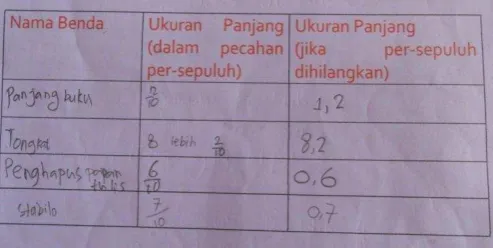
Soon, our students in the focus group were able to communicate their measuring result, using fraction tenth before, in decimal numbers (see figure 2).
Figure 2: Focus group students transformed tenths into decimal numbers
While discussing tenths to decimal numbers, the confusion of focus students appeared how to name the length with decimal number for small things, like the length of an eraser, (see the fragment 4).
1 Researcher If what is the decimal form of it?
2 Rifan Six comma ten [6,10] 3 Researcher Shofil, is already 1 or not?
3 Shofil Not yet.
331 5 Teacher (Came and gave explanation) show me where is ? (referred
to the paper strip), is it already one paper strip? 6 Rifan Not yet.
7 Teacher What number is before number 1?
8 Aam Zero [0]
9 Aam So how do you write ?
10 Students Zero comma six [0,6] 11 Teacher Write it.
Fragment 42: The focus group discussion about decimal number of
All above, it is noticed the focus students, and the rest, struggled to transform from informal to formal notation and from tenths to decimal numbers. The conjecture in HLT students would use strip, apostrophe, as separator wholes and tenths did not appear. How the students could come with the idea using comma symbol quickly? They were already familiar with decimal numbers. As appeared in the pre-test and meeting 1, if the length could not be said in ones, the students tended to say in decimals, though in incorrect manner. In this second lesson, their prior knowledge of decimals was intervened by the idea that the decimal is another way to write fraction tenth.
The fragment 12 shows clearly now the students could reason what they meant by 8,2 and why comma was used. Surprisingly, they saw the number relationships, which the ones and the tenths. Moreover, the confusion notating length of small things with decimal numbers (shown in fragment 4) actually shows how the students were gradually building idea of the meaning of decimal numbers.
CONCLUSION
The conclusion for meeting 1 is that the context supports the students to investigate how to notate the rest of things measured with the paper strip. The students initially suggested fractions and decimals though in incorrect manner to notate the rest. Later, they argued the idea to use the same fraction. Then ten-partition was introduced
directly by the teacher not by the students side. For the next cycle, it should be prevented that the teacher tells much about the idea. Let the students discuss first what to do if they use different fractions. Also, some practical things are needed to notice:
1. Let the students measure a table with their span, rather than students measure many things and at final only compare one thing, it is better for them to be instructed from the beginning to measure one thing only. It is also to make them focus in measuring one thing and would discuss why the result of their measurement are different
2. The teacher should notice that there would be students who did not care about the rest. Students just say the length in terms of the paper strip, for example 3 paper strips, without counting on the rest.
3. Some students still use ruler to measure things.
332 length along the paper strip and the parts. Although so, it was noticed that the students needed considerable time to come to the idea of using decimal numbers. But at least, it was observed the students tried, argued, and discussed why they need to use comma.
The general conclusion to answer sub research question How can students develop an understanding of one-digit decimals? is that the students gradually developed their understanding of decimal one-digit. The context brings the students from misunderstanding of decimal numbers (shown in pre-test), puzzling naming with incorrect fractions, here in the situation of measuring result, to using tenths, then to using decimal numbers. This learning should be supported by the discussion among the students themselves. Let the students argue and give their opinion; also, the teacher should guide them by giving good question like, why you use this? What does it mean?
REFERENCES
Bell, A., Swan, M., & Taylor, G. (1981). Choice of operation in verbal problems with decimal numbers. Educational Studies in Mathematics, 12, 399-420.
Bright, G., Behr, M., Post, T., & Wachsmuth, I. (1988). Identifying fractions on number lines. Journal for Research in Mathematics Education, 19, 215-232.
Brousseau, G., Broussaeau, N., Warfield, V. (2007). Rationals and decimals as required in the curriculum part 2: from rationals to decimals. Journal of Mathematical Behavior, 26, 281-300
Depdiknas (2006). Kurikulum Tingkat Satuan Pendidikan Sekolah Dasar. Jakarta: Depdiknas
Gravemeijer, K. (2004). Regular lecture from ICME 10: Creating Opportunities for Students to Reinvent Mathematics. The Netherlands.
Helme, S., & Stacey, K. (2000). Can minimal support for teachers make a difference to
students understanding of decimals?. Mathematics Teacher Education and Developmetn, 2, 105-120.
Huang, T., Liu, Y., & Shiu, C. (2008). Cnstruction of an online learning system for decimal numbers through the use of cognitive conflict strategy. Computers & Education, 50, 61-76.
Lachance, A., & Confrey, J. (2002). Helping students build a path of understanding from ratio and proportion to decimal notation. Journal of Mathematical Behavior, 20 (2002), 503-526.
Lai, M. Y., & Tsang, K. W. (2009). Proceedings from HKIEd: Understanding Primary
Children’s Thinking and Misconceptions in Decimal Numbers. Hong Kong.
Michaelidou, N., Gagatsis, A., & Pitta-Pantazi, D. (2004) Proceedings from conference PME 28th: The Number Line As A Representation of Decimal Numbers: A Research
with Sixth Grade Students. Cyprus.
Moloney, K., & Stacey, K. . Changes with age in students conceptions of
333 Moskal, B. M., & Magone, M. E. (2001). Making sense of what students know: examining the referents, relationships and modes students displayed in response to a decimal topic. Educational Studies in Mathematics, 43 (2000), 313-335.
Pramudiani, P. (2011). A concrete situation for learning decimals. IndoMS.J.M.E., 2 (2), 215-230.
Sengul, S., & Guldbagci, H. (2012). An investigation of 5th grade Turkish students
performance in number sense on the topic of decimal numbers. Social and Behavioral Science, 46, 2289-2293
Soenarjo, RJ. (2008). Matematika 5. Jakarta: Pusat Perbukuan Departemen Pendidikan Nasional.
Stacey, K., Helme, S., Steinle, V., Baturo, A., Irwin, K., Bana, J. (2001). Preservice
teachers knowledge of difficulties in decimal numeration. Journal of Mathematical Behavior, 4, 205-225.
Steinle, V. (2004). Changes with Age in Students’ Misconceptions of Decimal Numbers. Australia: Unievrsity of Melbourne.
Sumanto, Y. D., Kusumawati, H., & Aksin, N. (2008). Gemar matematika 5. Jakarta: PT Intan Pariwara.
Widjaja, W. (2008) Local Instruction Theory on Decimals: The Case of Indonesian Pre-Service Teachers. Australia: University of Melbourne.
Widjaja, W. Stacey, K. Steinle, V. (2011). Locating negative decimals on the number line: Insights into the thinking of pre-service primary teachers. The Journal of Mathematics BEhavior, 30, 80-91.
van Galen, F., Feijs, E., Figueiredo, N., Gravemeijer, K., van Herpen, E., & Keijzer, R. (2008). Fractions, percentages, decimals and proportions. Rotterdam/Taipei: Sense Publishers.
Yildiz, C., Baki, A., Aydin, M., & Kogce, D. (2010). Development of materials in instruction of decimals according to constructivist approach. Procedia Social and Behavioral Sciences, 2, 3660-3665.
This paper can be cited as Zulkardi(2013). Proceeding The First South East Asia Design/Development Research (SEA-DR) International