ISSN 1746 6377 (Print) ISSN 1746-6385 (Online)
International Journal
of
Citizenship and Teacher Education
Editor - Dr. Ian Davies, Department of Educational Studies, University of York,
YO10 5DD, UK. E-mail: [email protected]
Book Reviews Editor – Professor Mark Evans, OISE, University of Toronto, Canada
Chief Regional Editors:
Africa - Professor Penny Enslin (University of the Witwatersrand)
Asia - Professor Kerry Kennedy (Hong Kong Institute of Education, Hong Kong)
and Professor Wing On Lee (University of Sydney)
Australia - Professor Murray Print (University of Sydney)
Canada - Professor Alan Sears (University of New Brunswick)
Europe - Mitja Sardoc (Educational Research Institute, Slovenia)
South America - Rosario Jaramillo Franco (Ministry of Education of Colombia)
USA - Professor Judith Torney Purta (University of Maryland)
Editorial Committee:
Dr Bernadette Dean, Aga Khan University, Pakistan.
Professor Kerry Kennedy, Hong Kong Institute of Education, Hong Kong
Professor Wing On Lee, University of Sydney, Australia
Professor Norio Ikeno, Hiroshima University, Japan.
Professor Isoo Tabuchi, Nara University of Education, Japan
Professor Murray Print, University of Sydney, Australia
Professor Alan Reid, University of South Australia, Australia
Professor Mark Evans, OISE, University of Toronto, Canada
Professor Yvonne Hébert, University of Calgary, Canada
Professor Will Kymlicka, Queens University, Kingston, Ontario, Canada
Professor Graham Pike, University of Prince Edward Island, Canada
Professor Alan Sears, University of New Brunswick, Canada
Professor Carole Hahn, Emory University, USA
Professor Walter Parker, University of Washington, USA
Professor Judith Torney-Purta, University of Maryland, USA
Professor John Annette, Birbeck College, University of London, UK
Professor James Arthur, Canterbury Christ Church University, UK
Dr. Peter Brett, St. Martin’s College, Lancaster, UK
Dr. Ruth Deakin Crick, University of Bristol, UK
Professor Jon Davison, Institute of Education, University of London, UK
Dr. Elizabeth Frazer, University of Oxford, UK
Professor Márta Fülöp, Institute for Psychology, Hungarian Academy of Sciences,
Hungary
Cathie Holden, University of Exeter, UK
David Kerr, National Foundation for Educational Research, UK
Professor Concepcion Naval, University of Navarra, Spain
Professor Alistair Ross, London Metropolitan University, UK
Don Rowe, Citizenship Foundation, UK
About citizED
citizED is funded by the Training and Development Agency for Schools (TDA) in the
UK. citizED is a collaboration within higher education organised principally around
citizenship education in primary, secondary, cross curricular, post 16 and community
involvement contexts. It is working in partnership with a wide variety of individuals
and organisations including the Association for Citizenship Teaching (ACT).
citizED’s Director is Professor James Arthur of Canterbury Christ Church University.
(Tel +44 (0)1227 782277, email [email protected]). The Deputy Directors are Dr
Ian Davies of the University of York (Tel +44 (0)1904 433460, email
[email protected]) and Professor Jon Davison of the Institute of Education, London
(Tel +44 (0)207 612 6567, email [email protected]). The project administrator is
Roma Woodward at Canterbury Christ Church University. (Tel +44 (0)1227 782993,
email [email protected]).
citizED’s website may be found at
http://www.citized.info
About ‘Citizenship Teaching and Learning’
Formerly published as ‘The International Journal of Citizenship and Teacher
Education’, the Journal is now renamed ‘Citizenship Teaching and Learning’
reflecting our interest in citizenship teaching and learning in all contexts, for all ages
within and beyond schools; international, global and cosmopolitan with a
commitment to academic excellence within diverse democracies.
Citizenship and civics education are diverse and contested fields encompassing,
amongst other matters, social and moral considerations, community involvement and
political literacy. The Journal appeals to those large academic and professional
populations within the field of social studies education. The Journal exists as an
international forum in which researchers, policy makers, administrators and practising
professionals in a range of local, national and global contexts and age-related phases
within and beyond formal educational institutions report and discuss their on-going or
completed work.
Volume 1 Number 2 December 2005
Contents
Editorial – Ian Davies (Editor)
Articles –
KATHY BICKMORE
OISE, University of Toronto
– Teacher Development for Conflict
Participation: Facilitating Learning for ‘Difficult Citizenship Education
LYNN DAVIES
,
University of Birmingham
– Teaching About conflict through
citizenship Education
BERNADETTE L. DEAN
,
Aga Khan University, Pakistan –
Citizenship Education in
Pakistani Schools: Problems and Possibilities
RUTH DEAKIN CRICK
,
University of Bristol –
Citizenship Education and the
Provision of Schooling: A Systematic Review of Evidence
HARRIET MARSHALL
,
University of Bath –
Developing the Global Gaze in
Citizenship Education: Exploring the Perspectives of Global Education NGO Workers in
England
NORIO IKENO,
Hiroshima University, Japan –
Citizenship Education in Japan after
World War II
Book Reviews
:
The following
Book Reviews
are available in this edition:
Howard Zinn on Democratic Education
- Zinn, Howard with Donaldo Macedo. (2005),
Boulder, CO: Paradigm Publishers. Reviewer: Daniel Schugurensky, Associate Professor,
Ontario Institute for Studies in Education, University of Toronto (OISE/UT)
Citizenship Education in Asia and the Pacific: Concepts and Issues
- Edited by W. O.
Lee, David L. Grossman, Kerry J. Kennedy & Gregory P. Fairbrother. Published 2004 by
Comparative Education Research Centre, The University of Hong Kong. Reviewer:
Yeow Tong Chia, Doctoral Student, The Department of Theory and Policy Studies in
Education, Ontario Institute for Studies in Education, University of Toronto
Learning to Teach Citizenship in the Secondary School
- Edited by Liam Gearon.
Published 2003 by RoutledgeFalmer, London. Reviewer: Yves Laberge, Ph.D. (retired
lecturer), Institut québécois des hautes études internationals, Département de sociologie,
Université Laval, Québec City, Canada
Vol 1, No. 2, December 2005
http://www.citized.info ©2005 citizED
Editorial
In July 2005 the first issue of the International Journal of Citizenship and Teacher Education was launched at a very successful major international conference at the Ontario Institute for Studies in Education, University of Toronto. Some of the excellent papers that were presented at that conference can be seen at http://www.citized.info/ijcte/conf_2005.htm. A selection from all papers has been made by the conference organisers and is presented here in issue 2 of the Journal.
The conference brought together fifty of the leading academics in citizenship education and teacher education from around the world (Australia, Canada, Europe, Hong Kong, Japan, Pakistan, USA). Supported and jointly organized by citizED and OISE/UT (CTL, CIDE, TLC) the conference keynotes, paper presentations and panels discussed current key developments in research, policy and practice in citizenship education across the world at national, regional and international levels and explored significant possible future initiatives in citizenship education and teacher education.
This special conference issue of the Journal includes some of those voices from around the world that were heard at our inaugural conference. Kathy Bickmore (University of Toronto, Canada) reflects on the significant distinctions that can exist between the expansive rhetoric associated with teacher education programmes and the at times impressive - but also very challenging - realities. Ruth Deakin-Crick (University of Bristol, UK) uses a high profile research methodology to review the literature of citizenship education and points to priorities for teacher education. Lynn Davies (University of Birmingham, UK) makes an argument based on a range of research projects for ways to consider educating about conflicts. Bernadette Dean (Aga Khan University, Karachi, Pakistan) provides insights into the state of citizenship education in Pakistan. Norio Ikeno from Hiroshima University, Japan discusses the trends in citizenship education in Japan since world war 2. Harriet Marshall (Bath University, UK) discusses findings from a recently completed research project in which she explored the nature of the ‘global gaze’ that may be relevant to the development of citizenship education.
These papers are individual pieces of work that show the rich tapestry of initiatives and thinking that exist in the contested and increasingly significant field of citizenship education. And yet, they have a common base in that they all represent aspects of the high quality work that is taking place around the world. They all provide meaningful insights into contemporary and likely future issues, are international (and/or global in their scope or perspective), and are based on the latest research and scholarship.
Vol 1, No. 2, December 2005
http://www.citized.info ©2005 citizED
Teacher Development for Conflict
Participation: Facilitating Learning for
‘Difficult Citizenship’ Education
KATHY BICKMORE, OISE, University of Toronto
ABSTRACT A key to citizenship for socially just democracy is the development of capacity to nonviolently and equitably manage conflict. How are teachers educated and supported for this responsibility? This paper is drawn from a larger on-going study that compares implicit and explicit curricula, policies and programming for ‘peacekeeping’ (security), ‘peacemaking’ (dialogue and conflict resolution), and ‘peacebuilding’ (difficult citizenship — redressing social fractures and injustices that underlie destructive conflicts) in three urban Canadian school districts serving racially and culturally diverse populations. In particular, this paper examines the professional development-related opportunities available to teachers to support their facilitation and teaching for peacebuilding citizenship. The few teacher learning opportunities offered seem unlikely to enhance teachers' capacity to foster diverse students' development of agency for difficult citizenship. Much of the explicit professional development available in the schools examined emphasizes teachers' control of students and containment of disruption (peacekeeping), instead of their facilitation of diverse students’ participation in constructive conflict management (peacemaking and peacebuilding). Professional learning opportunities are often relegated to short, fragmented occasions, primarily during teachers’ volunteer time after school: this severely limits their potential to foster critical dialogic learning on the difficult issues of citizenship education practice.
Introduction
Teacher expertise and confidence is crucial, to effectively encourage and guide student participation in conflict education. Significant global and local citizenship subject matter is complex, often ill-defined, and sometimes controversial (Kelly & Brandes, 2001; Parker, 2004). Intersecting identities and justice issues —for example in relation to gender, ethno-cultural/racial diversity, international disparities, heterosexism, and inter-religious biases— influence the interpretation, ramifications, and options for handling each conflict. Much of this social, political, and moral subject matter was not taught to teachers when they were students (Ayers, Hunt, & Quinn, 1998; Boler & Zembylas, 2003; Freire, 1998; Van Galen, 2004). Further, today’s populations of students are increasingly diverse, with unequal social status and incommensurate prior knowledge bases (e.g. Banks & Banks, 1995; Bickmore, 1999; Cochran-Smith, 1995; Harris, 1996). Twenty-first century students evidently impact, and are more clearly impacted upon by, a much wider world than students of past generations (e.g. Elkind, 1995; Kirkwood-Tucker, 2004; Thornton, 2005; Torres, 1998). Thus to teach for democratization, in the context of student diversity and globalization, requires more substantive knowledge, more skills, and more comfort with openness and uncertainty than to teach for unquestioned dominant ‘common sense.’ This can feel overwhelming, especially for novice teachers. Such complexity is not easy to handle, especially in the context of educational systems’ social pressures and sanctions (Bigelow et al., 2002; Ladson-Billings, 2004).
Teachers’ knowledge and comfort zones are shaped by the formal and informal learning experiences they have had access to, by the discourses shaping thought, and by actual participation (practice) and the feedback it elicits. This paper considers how teachers may develop capacity and confidence to teach complex, conflictual, globally-relevant subject matter —thus to facilitate students’ capacity development for difficult citizenship— in equitable, inclusive, and dialogic ways. Later, I juxtapose these insights from the research literature with an in-depth investigation in one large urban school district (supplemented by more cursory study in two other districts), of the actual resources and infrastructure available to support such teacher learning for difficult citizenship education.
Contexts for difficult citizenship learning: culture, politics and conflict in schools
Citizens’ (students’ and teachers’) ways of thinking, being and behaving are not completely autonomous. Rather, individual and collective agency is shaped and constrained by the currents of power surrounding cultural patterns, social locations, and education. Prevailing discourse shapes learning by encoding and reinforcing relations of power through its presumptions, for example in the ways it recognizes, denies, normalizes or constructs as ‘other’ certain identities and patterns of behavior (e.g. Butler, 1999; Ellsworth, 1997). Identities each person ‘performs’, language used, and mass public media shape what each of us comes to believe is natural and possible (also Epstein & Johnson, 1998). Young citizens can learn to be relatively critical, self-reflexive participants in cultural rituals and popular media — consciously questioning and influencing, though inevitably also influenced by, the discourses around them (Applebaum, 2004; Cary, 2001).
intra-organizational tensions, corrupt leadership, scheming. To try to reverse this incentive toward cynicism and disengagement, citizenship education often idealizes the politics of governance and inter-group interaction, preaching tolerance and the power of the democratic process. Such avoidance or palliative care is insufficient to handle social ills and build social harmony, and even counter-productive, where school knowledge thereby appears naïve and irrelevant to students steeped in public media images of dirty dealing and social tensions. Any teaching (even or especially that which ignores/assumes power relations) is inevitably political — it has ramifications for the distribution of power. Thus clearly some kind of practice with recognizing and handling social/ political conflict in constructive ways is essential to education for difficult citizenship.
A powerful aspect of citizenship education is the modeling and practice embedded in the implicit and informal curriculum of school social relationships, including the climate of competition or equity, the sanctioning of violence, dissent and (dis)obedience, and the opportunities for democratic engagement by students, faculty and staff (Bickmore, 2004a). Schooling is by no means always a benign force for democratic justice. It can promote violence, for example in dehumanizing and inequitable punishment, condoning sexual and homophobic abuse, or indoctrination into militarism, violent masculinities, or hatred of the ‘other’ (Bush & Saltarelli, 2000; Callender & Wright, 2000; Davies, 2004; Harber, 2004; McCadden, 1998). Through explicit and implicit expectations and reward structures, school and classroom climates can exacerbate (or alleviate) the status competition and prejudice that underlie most harassment and social exclusion (Aronson, 2000; Bickmore, 2002; Gordon, Holland, & Lahelma, 2000). Educators shape and limit (in)equitable opportunities for diverse students to transcend their traditional roles and practice making a difference, for example in student governance, or peer leadership for conflict resolution, anti-bias, or social and environmental change (Bickmore, 2001, 2003; Close & Lechmann, 1997). School social justice education initiatives will not be successful unless they also help to redress inequities in students’ opportunities for educational success (Ghosh, 2004; Maynes & Sarbit, 2000). In an international study, Akiba and colleagues (2003) found that (independent of violence rates outside schools) school systems that reduced the variance between most-successful and least-successful students (for example, because they de-emphasized tracking and/or offered remedial help) also had lower rates of overt physical violence than more competitive systems. Thus citizenship education for social justice includes educators’ roles in shaping the school and school system’s human rights climate, as well as classroom curriculum (Opffer, 1997; Osler & Starkey, 1998; Smith, 2004).
The remainder of this paper investigates how public school teachers might be prepared and supported to build such citizenship capacities. In light of this framework, I then examine the context for teacher professional learning in one large Canadian school district.
individual and procedural capacities are (by themselves) not sufficient to equip students/ citizens for social justice building, but they are certainly a necessary condition. Democracy and social change require conflict management. It seems obvious that students/citizens are likely to gain capacity in democratic processes when they have opportunities to practice these processes, with guidance and feedback, in the classroom. Matters of conflict and fairness are intrinsically interesting (as well as all around us in society), so school knowledge is also more engaging and credible when students have opportunities to practice handling conflicting perspectives. In this postmodern era, alternative (including critical and subaltern) perspectives and knowledges are technically more accessible than ever before. Yet it requires not only pedagogical skill, but also sophisticated subject-matter understanding, for teachers (and teacher educators) to be able handle such complex information in an open (constructively-conflictual) and accessible manner (Kymlicka, 1998, 2003; Parker, 2004; Thornton, 2005).
Any transformation in curriculum depends heavily on teachers’ academic and professional preparation. Especially in resource-poor communities, textbooks (although these typically rely on uncritical master narratives and fragmented/overloaded information) often form the main basis for the implemented curriculum (e.g. Milligan, 2003; Tupper, 2005). Official curriculum materials and textbooks (that very often guide teachers’ as well as students’ knowledge development) too often gloss over or censor critical or troubling information — for example, Laura Finley (2003) asks, “how can I teach peace when the book only covers war?” Other such sources are downright inaccurate. For example, Karen Riley and Samuel Totten (2002) critique several U.S. state-endorsed human rights and Holocaust curricula, pointing to shallow analysis, inattention to multiple factors shaping contexts and events, and historical inaccuracy. Paulette Patterson Dilworth (2004) finds similar kinds of problems, along with a few shining alternatives, in the multicultural content of social studies curricula implemented in selected U.S. classrooms. Robert Nash (2005) cites U.S. Supreme Court decisions ensuring schools’ right and responsibility to teach about multiple world religions in a balanced fashion, yet laments that such topics are typically avoided or presented in woefully misleading ways. Even relatively-available resources that could supplement or replace textbooks (such as material found on the internet, in newspapers, and distributed by business-oriented development initiatives) themselves can be shallow, decontextualized, and uncritical of social injustices.
is at least as important in teacher education as it is in elementary and secondary classrooms.
Teachers’ capacity development for critical citizenship education
The initiatives that show the most promise in meeting teachers’ need for deeper, experientially grounded professional development for social justice citizenship education do not involve simple knowledge dissemination. Quantity of knowledge cannot substitute for quality of knowledge, nor for a sense of efficacy (agency) in interpreting and applying that knowledge. The teacher development opportunities that seem to offer this quality tend to be relatively horizontal —built around extended experiences of dialogue, critical reflection on practice, and dissent among peers— rather than the typical vertical, short, administratively convenient dissemination materials or workshops (Little, 1993; McLaughlin, Pfeifer, Swanson-Owens, & Yee, 1986; Solomon, 1995; Wallace & Louden, 1994). This kind of dialogic teacher learning opportunity is by no means the norm in North American public schools.
Despite recognition of its importance, the professional development currently available to teachers is woefully inadequate … inservice seminars and other forms of professional development are fragmented, intellectually superficial, and do not take into account what we know about how teachers learn. … Teachers generally welcome the opportunity to discuss ideas and materials related to their work … yet, discussions that support critical examination of teaching are relatively rare (Borko, 2004 p.3 & 7).
Research shows that teachers need opportunities to bring artefacts of classroom practice (e.g. lesson plans, videotapes of teaching, student work samples) into discussion-based professional development settings (Borko, 2004; Darling-Hammond, Hammerness, Grossman, Rust, & Shulman, 2005).
A culture of joint educative dialogue among school staff members could be created through schoolwide inquiry and acknowledgement that the curriculum inevitably has moral ramifications that are not (and should not be) neutral: “controversy is inevitable when people talk about things that matter to them” (Simon, 2001 p.219). Facilitation and supportive contexts for such dialogue can arise from inside or outside the school. For example, interactive teacher education pedagogies grounded in carefully-chosen internet-based and United Nations information seem to help build critical, gender-equitable international perspectives and capacities (Crocco & Cramer, 2005; Kirkwood-Tucker, 2004). A series of collaborative dialogues among social studies and English educators from a university and local secondary schools yielded insights about alternate ways to implement a concern for social justice in the classroom (Brandes & Kelly, 2000). In another interesting case, teachers from schools with underachieving African-American students observed master teachers teaching their ‘own’ students in an after-school program (Foster, Lewis, & Onafowora, 2005). Each of these initiatives provoked both dissonance (in the latter case, watching their students doing things the teachers hadn’t known they could do) and dialogue (questioning and problem-solving debriefing among the teachers) to build teachers’ understanding.
histories of marginalization and oppression) and collective participation in culturally meaningful learning activities (Hesch, 1999 p.380). Many teachers already feel a “deep-seated sense of ambiguity” toward prevailing curricula that reflect fragmented information and a “mythic structure of modernism” amid “postmodern realities” (Richardson, 2002 p.135). Richardson facilitated a collaborative teacher action research effort to find legitimate spaces for teaching pluralist and dynamic citizenship within the existing Alberta curriculum, facilitating learning by surfacing the participants’ deeply conflicting interpretations of national identity. Instead of shying away from such controversy, it is worth seeking out as the motivation and frame for teacher development.
Unfortunately, even the best professional development initiatives that currently exist primarily involve only the unusually motivated individuals who choose to seek out learning opportunities, often donating their own time (Borko, 2004 p.5). The scarcest resource to support such learning, for the broad majority of North American public school teachers, is time during the school day.
Collaborative time for teachers to undertake and then sustain school improvement may be more important than equipment or facilitities or even [explicit] staff development. … Unless the ‘extra energy requirements’ [for school change] are met by the provision of the time, the change is not likely to succeed (Raywid, 1993, p.30, citing research by Fullan and Miles, Louis, and Rosenholtz).
Furthermore, Raywid adds, it is unrealistic to expect teachers to add on thoughtful critical and creative work meetings at the exhausted end of a regular school day. ‘Creating’ that extended, quality professional development time (under conditions of scarcity that prevent adding much staff) requires political will and creativity to redesign existing timetables, add time to school days or school years, and/or change staffing patterns by creating some larger or combined classes to free up other time.
Open, equitable, well-facilitated classroom discussion of important political and moral issues is a necessary, although by itself insufficient, condition for students’ development of social justice citizenship capabilities and motivations. To give such pedagogies life and meaning for democratization requires broadening educators’ international, pluralistic, critical knowledge bases, as these apply to their classroom practice. To facilitate such teacher learning, there is no substitute for ensuring that new and continuing teachers have ample opportunity and support to engage in challenging, dialogic, time-intensive problem-solving learning about specific instances of practice with professional colleagues. Teachers’ participation in discussion-rich learning about crucial issues, incidents, viewpoints and options can facilitate their capacity to engage diverse students, equitably and effectively, in dialogic learning for social justice citizenship.
Professional development for peacebuilding citizenship education in Canada today
urban boards would be more likely than others in their regions to have diversified staff allocated to a variety of programme initiatives and professional development-related activities. Prevailing discourse about teachers’ knowledge (which influences the spaces available for learning in these school districts) is reflected in what professional development opportunities are offered and how professional learning is discussed.
For this part of the study, my student team and I examined the teacher resource materials and staff/ services available during 2004-05 in three city school districts in different provinces (including resources from ministry of education, teachers’ federation, and other organizations). Further, we interviewed over 40 educators (in eight schools, focusing primarily on two high schools and three elementary schools serving low-income populations, plus centrally-assigned staff) in one of those districts. The focus schools were identified by centrally-assigned safe schools staff on the basis that they all had low-income, high-needs student populations, but had different patterns of student conflict and conflict management (as reflected primarily in suspension rates). The other schools and centrally-assigned staff were identified through ‘snowball’ sampling, focusing on key informants about programming and services especially relevant to peacekeeping (safety and security intervention and discipline), peacemaking (conflict resolution intervention and practice of dialogue), and/or peacebuilding (long range prevention of harm through inclusivity, overcoming inequities, and social justice education).
Each school board (directly and through allied organizations or government programs) did offer a range of teacher development workshops, the vast majority of these in short one-time meetings after school at central locations (see Table 1). What is striking in the lists of workshops and related resources for school staffs (reinforced by interview data) is the emphasis on short-term control for security purposes, such as crisis intervention, threat assessment, discipline, anti-bullying, internet safety. Even many of the workshops potentially related to peacemaking (such as problem-solving, gentle teaching, managing conflict, fixing broken teams) and peacebuilding (such as cross-cultural competency, youth homelessness, teaching in cultural mosaic classrooms), especially given their short duration, seemed more oriented toward quick-fix management of disruption than toward development of diverse students’ citizenship capacities.
With varying degrees of severity in different school boards, staffing and funding for formal professional development, as well as for any joint teacher thinking/ planning time, is extremely scarce. Teachers and school principals report that curriculum changes, coupled with staff cuts, have intensified staff workloads such that there is less time than ever (during their career memories), and fewer resource people to facilitate, opportunities for teachers to talk, work and learn together.
In theory, the board through our division has great programs to offer, and can come out and work with kids, but they’re not that accessible. We really haven’t had much contact. For example in safe schools, there seem to be only a couple of people for this whole family of schools, and they seem to be run off their feet. Basically I find resources on my own (HS2 T, May 4).
citizenship are available in board resource centres and on-line. The increasingly-accessible internet does allow some teachers to find resources produced by educators elsewhere (although in some schools there was little paper to print them on). It also facilitates school board leadership staffs’ capacity to disseminate materials and information. Yet most teachers reported that they were unable to find the time (above and beyond their existing workloads) to even find and read these materials, never mind to meet with colleagues for even a few minutes to discuss, assess, implement or adapt them for use in their own classrooms.
No, the [printed teaching resource materials] aren’t useful: it’s time. … Just trying to manage the needs that the students present on a day-to-day basis … there just isn’t time to make use of those kinds of resources (Elem5 P June 29).
Some staff (especially novice teachers with high needs and motivation) made clear that they didn’t know how to access even these basic, generic, non-dialogic resources at all. The sparse curriculum leadership staff surely did reach some individuals, and the people in those leadership positions believed that
if teachers wish to be connected, they can be” (bd. curric. leader, July 6; bd. equity leader, June 15)
However, some teachers, especially those with the fewest years of experience, told a different story:
I realized, students need a forum. They need a place to talk about [bias, equity and peacebuilding issues], without somebody shaking their finger at them and saying ‘that’s wrong.’ So I talked to the principal … There was a [teacher] equity committee, but it wasn’t doing anything. … So, in January, four of us [restarted the school equity committee] … Black history month was fast approaching; that seemed like the first opportunity to do something. … We had kept thinking there must be some kind of information, some kind of Bible for Black history month. There must be teachers doing this all over the city! … It didn’t seem like we should have to be creating all these things from scratch. … At the same time I was doing my ESL [Additional Qualifications course at the university], and by chance [one of the school board’s few remaining equity studies staff] came in as a guest speaker. She had some good ideas and resources. … If it hadn’t been for the ESL AQ course I happened to be enrolled in, and that guest speaker, I wouldn’t have known [those resources] existed (HS1 T5, June 3).
having been galvanized into action by one late-April after-school video and workshop on bullying among girls (HS2 T1 May 4, Elem1 T1 May 10). Another teacher reported having attended one slightly-meaningful workshop in recent years:
I can’t think of any professional development. Actually that’s not true, we had one session that was for mentors and new teachers, about the degrees of inclusivity, multicultural education. … But otherwise, I’ve not seen a lot of that. … and even some of that is just token, like having books with different pictures in them (HS1 T2 May 5).
In some schools, some teachers complained that even basic information was not disseminated, even when they made inquiries (e.g. HS1 T2 May 5). This information vacuum could have direct ramifications for teachers’ interpretation of school rules (patterns of implicit citizenship socialization):
we’re not a zero tolerance board any more, we’re a progressive discipline school, but I don’t think most teachers know about that. We have had no p.d. or information about that at all (Elem1 T2, May 10).
Redesigned (increasingly centralized and cost-saving) leadership infrastructure, especially pertaining to high schools, exacerbated the challenge. For example, when the board replaced department headships (which had been subject-specific and included some release time) with restructured headships (responsible for multiple subject areas, often without release time), the capacity to offer professional development support plummeted (curric. leader July 6; HS1 T4 May 13). Even finding a common lunch period for teachers to work together on committees (that would contribute to teacher learning as well as peacebuilding citizenship education opportunities in the school) was a challenge, especially in the high schools (e.g. HS1 T5 June 3; HS2 support staff1 May 11). As one of the school board staff put it,
we don’t have thinking time (safe schls. leader2 July 7).
The most serious problem, according to educators in all eight schools as well as centrally-assigned board personnel, was teacher time to talk and work together (with or without a formal professional development facilitator). A provincial government hostile to public education, in power for about ten years until voted out recently, had caused teachers’ ‘work’ to be defined very narrowly as classroom teaching time, while also cutting resources for support infrastructure such as curriculum development leaders, conflict resolution advisors, and student services. An elementary principal explained that, as one consequence of this shift, many of her staff had no access to formal learning time with their colleagues.
…Years ago we used to have a number of [non-teaching] days. Now we have a number of [non-teaching] days for [parent-teacher] interviews, one for the union so we can’t do anything in that one, so there’s not much (elem3 P April 19).
Furthermore, like many such commercially-produced teacher resource packages, professional developers were only allowed to use the particular material this principal refers to if they had been certified in an expensive training for trainers. Resources to hire one of these trainers, or to get an existing staff member trained, were scarce. It was essentially luck that this school’s new vice principal had taken initiative earlier to earn that training certificate, so that she could lead her own staff’s inservice workshop series.
However, some innovative principals, supported by area administrators, were able to create exactly the kinds of opportunities for teachers to talk and work together that Borko, Raywid and others recommend. Even though they had no more resources per student or staff member, and if anything fewer explicit peacebuilding citizenship-related programs than any of the other schools in the study, these principals had assigned teachers’ work differently in order to make time for dialogue and joint work on an on-going basis. One elementary school principal routinely assigned teachers to work collaboratively with combined grades or integrated divisions (elem2 P & others May 2, May 18, June 30). One high school principal had recently initiated a problem-solving process with all staff, in which every staff member identified issues of concern, and then committees were formed to work on each category of concern. Regular staff meeting time was given over so that these small committees could meet, and the principal had tentative approval to change the students’ schedule for the coming year so that these teacher committees could meet every Wednesday morning (HS2 P & others April 26, May 4, May 11). Data analysis is on-going, but it seemed that the staff morale and climates for teacher learning were somewhat more positive in those environments.
Thus there are important exceptions that point toward possibilities for improvement, but the overwhelming finding of this research is that teacher learning for critical democratic citizenship education is profoundly under-supported. The interviews with educators in one district suggest that the vast majority of the scarcest resources (the time of educational leaders who could directly or indirectly support teacher learning) seem to be allocated to intervention after violence has erupted and to short-term control. The discourse of teacher learning primarily describes quick-fix packages and coping with disruption. Most of the currently-available professional development resources in this school district do not even pay lip service to the kinds of teacher knowledge-building pedagogy and collective discussion that we know facilitate inclusive democratic citizenship education. It is not clear that many opportunities for dialogic examination of important difficult issues are provided for most students: It is crystal clear that such opportunities are hardly ever provided for most of their teachers.
Conclusion
velo
Toronto District School Board (300000 students)
PeaceBUILDING-related Tchg in cultural mosaic classrm
Equity dept. wksps (array, limited staff to deliver) (e.g. racism, body image, class bias, homophobia, gender equity, Holocaust ed, linking isms, etc) Equity dept print resources (array)
Print & video resources include African & Asian heritage activities, anti-racism, challenging homophobia, Aboriginal studies, disability Fedn print resources include equity school, First Nations activities, community role models
Online courses include gender equity, Native studies PeaceMAKING-related
Tribes (2+)
Cognitive coaching (expensive) Fixing broken teams
Listening, handling tough situations (staff & Ts) Critical thinking in organizations (staff & Ts) Emotional intelligence (staff & Ts)
(Communication & CR for admin staff only) Print resources include environmental ed, dealing w/ controversial issues, media studies, civics, world politics, social studies g.1-3, healthy active living Teachers federation print resources include critical media Gr.7-8, environmental studies
PeaceKEEPING-related
Creating safe schools (admin, elem & sec Ts) Internet safety (2)
Print resources include Stop Bullying, internet safety for PHE, rules & responsibilities (Gr.1)
Bullying/violence (federation conference) Safe/healthy schools (federation conference)
Halifax Regional School Board (57000 students)
PeaceBUILDING-related RCH=Race,X-cultural,HumanRts (admin/ldrsp)
Diversity management
Building inclusive schls (5+, conf. grant& Oct PD)
Racial equity interdiscip. (conf. grant& Oct PD)
Queer eye for straight ¬ T Oct PD day Youth justice (2) Oct PD day
Gender diffs in learning Oct PD day Youth homelessness/preventive Oct PD day Schooling & social justice (conf)
PeaceMAKING-related
Managing conflict (admin/leadership staff) Tribes (2, conference grants)
Managing conflict/strong schl culture (conf. grant)
Caring education (St FX U conference) Roots of Empathy Oct PD day Student leadership teams Oct PD day World village Oct PD day
Fair trade/global economy Oct PD day Wars have limits Oct PD day
Facing fear: terrorism Oct PD day PeaceKEEPING-related
NV crisis intervention (5, admin & some Ts) S behaviour & discipline (admin/ldrsp) Threat assessment (3, w/safe schls consultant) Bullying/ peaceful schools Oct PD day Law, conflict mgt, justice, young offenders
Winnipeg School Division 1 (34000 students)
PeaceBUILDING-related
Aboriginal/First Nations education Worldviews/awareness (8, some for admin) X-cultural competency
Body image/weight preoccupation
Diversity (Assn School Superintendents conf) Cross-cultural understanding (Ctr for the Performing Arts workshop)
PeaceMAKING-related
Comprehensive Assessment Pgm workshops include Social-Emotional learning
(other CAP - health, English Language Arts) Problem solving (N-Gr2, Gr4-5)
Lions Quest Talking tools Gentle teaching
Child Guidance Ctr wksps including leadership, peer mentoring, teacher advisory
Education & democracy (U of MB conf) PeaceKEEPING-related
NV crisis intervention Talking about touching Restitution (1 & 2) Behaviour support
Positive classroom management & discipline Crisis negotiation (administrators?)
Bullyproofing
Harassment/intimidation
Correspondence: KATHY BICKMORE, OISE, University of Toronto, 252 Bloor St. West - CTL Toronto, Ontario, M5S 1V6, CANADA
REFERENCES
AKIBA,M.,LETENDRE,G.,BAKER,D.,&GOESLING,B. (2003). Student victimization: National and school system effects on school violence in 37 nations. American Educational Research Journal, 39(4 (Winter), 829-853.
APPLEBAUM,B. (2004). Social justice education: Moral agency and the subject of resistance. Educational Theory, 54(1), 59-72.
ARONSON,E. (2000). Nobody Left to Hate: Teaching Compassion after Columbine. New York: Worth Publishers.
AYERS,W.,HUNT,J.A.,&QUINN,T. (Eds.). (1998). Teaching for Social Justice. New York: New Press and Teachers College.
BANKS,C.M.,&BANKS,J. (1995). Equity pedagogy: An essential component of multicultural education. Theory Into Practice, 34(3), 152-158.
BICKFORD,S. (1996). The Dissonance of Democracy. Ithaca, NY: Cornell University Press. BICKMORE,K. (1999). Elementary curriculum about conflict resolution: Can children handle global
politics? Theory and Research in Social Education, 27(1), 45-69.
BICKMORE,K.(2001). Student conflict resolution, power 'sharing' in schools, and citizenship education. Curriculum Inquiry, 31(2), 137-162.
BICKMORE,K. (2002). How might social education resist (hetero)sexism? Facing the impact of gender and sexual ideology on citizenship. Theory and Research in Social Education(Summer), 198-216. BICKMORE,K. (2003). Conflict resolution education: Multiple options for contributing to just and
democratic peace. In J. Killian (Ed.), Handbook of Conflict Management (pp. 3-32): Marcel-Dekker Publishers.
BICKMORE,K. (2004a). Discipline for democracy? School districts' management of conflict and social exclusion. Theory and Research in Social Education, 32(1), 75-97.
BICKMORE,K. (2004b). Education for Peacebuilding Citizenship: Teaching the dimensions of conflict resolution in social studies. In I. Wright (Ed.), Challenges and Prospects for Canadian Social Studies. Vancouver: Pacific Educational Press.
BICKMORE,K. (2005). Foundations for peacebuilding and discursive peacekeeping: Infusion and exclusion of conflict in Canadian public school curricula. Journal of Peace Education, 2(2) 161-181.
BIGELOW,B.,CHRISTENSEN,L.,SWOPE,K.,DAWSON,K.,KARP,S.,LEVINE,D.,PETERSON,B.,&WEISS,D. (2002). Teaching to make a difference: Advice to new Ts from Ts who've been there. Rethinking Schools, 13-17.
BOLER,M.,&ZEMBYLAS,M. (2003). Discomforting truths: The emotional terrain of understanding difference. In P. Trifonas (Ed.), Pedagogies of Difference: Rethinking Education for Social Change (pp. 110-136). Halifax: Fernwood.
BORKO,H. (2004). Professional development and teacher learning: Mapping the terrain. Educational Researcher, 33(8), 3-15.
BRANDES,G.M.,&KELLY,D. (2000). Placing social justice at the heart of teacher education: Reflections on a project in process. Exceptionality Education Canada, 10(1-2), 75-94.
BUSH,K.,&SALTARELLI,D. (2000). The two faces of education in ethnic conflict: towards a peacebuilding education for children. Florence, IT: UNICEF Innocenti Research Centre. BUTLER,J. (1999). Gender Trouble: Feminism and the Subversion of Identity (2nd edition). London:
Routledge.
CALLENDER,C.,&WRIGHT,C. (2000). Discipline and democracy: Race, gender, school sanctions and control. In J. Dillabough (Ed.), Challenging democracy: International perspectives on gender, education and citizenship (pp. 216-237). London: Routledge.
CLOSE,C.,&LECHMANN,K.(1997). Fostering youth leadership: Students train students and adults in conflict resolution. Theory Into Practice, 36(1), 11-16.
COCHRAN-SMITH,M. (1995). Uncertain allies: Understanding the boundaries of race and teaching. Harvard Educational Review, 65(4), 541-570.
CROCCO,M.S.,&CRAMER,J. (2005). Women, WebQuests, and controversial issues in the social studies. Social Education, 69(4), 143-148.
CURLE,A.,FREIRE,P.,&GALTUNG,J. (1974). What can education contribute towards peace and social justice? Curle, Freire, Galtung panel. In M. Haavelsrud (Ed.), Education for Peace: Reflection and Action (pp. 64 - 97). Keele, UK: University of Keele.
DARLING-HAMMOND,L.,HAMMERNESS,K.,GROSSMAN,P.,RUST,F.,&SHULMAN,L. (2005). The design of teacher education programs. In J. Bransford (Ed.), Preparing Teachers for a Changing World. DAVIES,L. (2004). Education and Conflict: Complexity and Chaos. London: Routledge/Falmer. DILWORTH,P.P.(2004). Multicultural citizenship education: Case studies from social studies classrooms.
Theory and Research in Social Education, 32(2), 153-186.
ELKIND,D. (1995). School and family in the postmodern world. Phi Delta Kappan, 77(1), 8-14.
ELLSWORTH,E.(1997). Teaching Positions: Difference, Pedagogy, and the Power of Address. New York: Teachers College Press.
EPSTEIN,D.,&JOHNSON,R. (1998). Sexualities, nationalities, and schooling, Schooling Sexualities. Buckingham, UK: Open University Press.
FINLEY,L. (2003). How can I teach peace when the book only covers war? Online Journal of Peace and Conflict Resolution, 5(1), 150-165.
FOSTER,M.,LEWIS,J.,&ONAFOWORA,L. (2005). Grooming great urban teachers. Educational Leadership, 62(6), 28-32.
FREIRE,P.(1970). Pedagogy of the Oppressed. New York: Seabury Press.
FREIRE,P. (1998). Pedagogy of Freedom: Ethics, Democracy, and Civic Courage. Lanham, MD: Rowman & Littlefield.
GALTUNG,J. (1996). Peace By Peaceful Means: Peace and Conflict, Development, & Civilization. London: Sage Publications & International Peace Research Assn.
GHOSH,R. (2004). Public education and multicultural policy in Canada: The special case of Quebec. International Review of Education, 50(5-6), 543-566.
GORDON,T.,HOLLAND,J.,&LAHELMA,E.(2000). Making Spaces: Citizenship and Difference in Schools. London, UK: MacMillan.
GUTMANN,A. (2004). Unity and diversity in democratic multicultural education: Creative and destructive tensions. In J. Banks (Ed.), Diversity and Citizenship Education: Global Perspectives (pp. 71-96). San Francisco: Jossey-Bass/ Wiley.
HARBER,C. (2004). Schooling as violence: How schools harm pupils and societies. London: Routledge. HARRIS,I. (1996). From world peace to peace in the 'hood: Peace education in a postmodern world.
Journal for a Just and Caring Education, 2(4), 378-395.
HESCH,R. (1999). Culturally relevant teacher education: a Canadian inner-city case. Canadian Journal of Education, 24(4), 369-382.
KELLY,D.,&BRANDES,G.M. (2001). Shifting out of 'neutral:' Beginning teachers' struggles with teaching for social justice. Canadian Journal of Education, 26(4), 437-454.
KIRKWOOD-TUCKER,T.F. (2004). Empowering teachers to create a more peaceful world through global education: simulating the United Nations. Theory and Research in Social Education, 32(1), 56-74. KUMASHIRO,K. (2004). Against Common Sense: Teaching and Learning toward Social Justice. New
York: Routledge.
KYMLICKA,W. (1998). The theory and practice of Canadian multiculturalism [Available on line: www.fedcan.ca/english/policyandadvocacy/breakfastonthehill/breakfast-multiculturalism.cfm]. Government of Canada (Multiculturalism Secretariat). Retrieved, 2004, from the World Wide Web:
KYMLICKA,W. (2003). Two dilemmas of citizenship education in pluralist societies. In J. Annette (Ed.), Education for Democratic Citizenship: Issues of Theory and Practice (pp. 47-63). Aldershot, Hants, UK: Ashgate.
LADSON-BILLINGS,G. (2004). Forward. In K. Kumashiro (Ed.), Against Common Sense: Teaching and Learning toward Social Justice (pp. xiii-xxviii). New York: Routledge.
LITTLE,J.W. (1993). Teachers' Professional Development in a Climate of Educational Reform. Educational Evaluation and Policy Analysis, 15(2), 129-151.
MÁTRAI,Z. (2002). National identity conflicts and civic education: a comparison of five countries. In J. Schwille (Ed.), New Paradigms and Recurring Paradoxes in Education for Citizenship: An International Comparison (pp. 85-104). Amsterdam: JAI/ Elsevier Science.
MCCADDEN,B.M. (1998). Why is Michael always getting timed out? Race, class and disciplining other people's children. In B. McEwan (Ed.), Classroom discipline in American schools: Problems and possibilities for democratic education (pp. 109-134). Albany: State University of New York Press. MCLAUGHLIN,M.,PFEIFER,R.,SWANSON-OWENS,D.,&YEE,S. (1986). Why teachers won't teach. Phi
Delta Kappan, 67(6), 420-426.
MILLIGAN,J. (2003). Teaching between the cross and the crescent moon: Islamic identity,
postcoloniality, and public education in the Southern Philippines. Comparative Education Review, 47(4), 468-492.
NASH,R. (2005). A letter to secondary teachers: Teaching about religious pluralism in the public schools. In N. Noddings (Ed.), Educating Citizens for Global Awareness (pp. 93-107). New York: Teachers College Press.
OPFFER,E.(1997). Toward cultural transformation: Comprehensive approaches to conflict resolution. Theory Into Practice, 36(1), 46-52.
OSLER,A.,&STARKEY,H. (1998). Children's rights and citizenship: Some implications for the management of schools. International Journal of Children's Rights, 6, 313-333.
PANG,V.O.,&VALLE,R.(2004). A change in paradigm. Theory and Research in Social Education, 32(4), 503-522.
PARKER,W.(2004). Diversity, globalization, and democratic education: Curriculum possibilities. In J. Banks (Ed.), Diversity and Citizenship Education: Global Perspectives (pp. 433-458). San Francisco: Jossey-Bass/ Wiley.
PRINT,M. (1998). From Civic Deficit to Critical Mass: The New Civics Education. Australian Curriculum Studies Association. Retrieved, 2005, from the World Wide Web: http://www.abc.net.au/civics/teach/articles/mprint/mprint1.htm
RAYWID,M.(1993). Finding time for collaboration. Educational Leadership, 30-34.
RICHARDSON,G. (2002). The Death of the Good Canadian: Teachers, National Identities, and the Social Studies Curriculum. New York: Peter Lang.
RILEY,K.,&TOTTEN,S. (2002). Understanding matters: Holocaust curricula and the social studies classroom. Theory and Research in Social Education, 30(4), 541-562.
ROSS,M. (1993). The Management of Conflict. New Haven: Yale University Press.
SALOMON,G.,&NEVO,B. (Eds.). (2002). Peace Education: The Concept, Principles, & Practices around the World. Mahwah, NJ: Lawrence Erlbaum Associates.
SIMON,K. (2001). Moral Questions in the Classroom. New Haven: Yale University Press. SMITH,G.A. (2004). Cultivating care and connection: Preparing the soil for a just and sustainable
society. Educational Studies, 36(1), 73-92.
SOLOMON,P.G. (1995). No Small Feat! Taking Time for Change. Thousand Oaks, CA: Corwin Press. TAWIL,S.,&HARLEY,A.(Eds.). (2004). Education, Conflict & Social Cohesion. Geneva: UNESCO/
International Bureau of Education.
THORNTON,S. (2005). Incorporating internationalism into the social studies curriculum. In N. Noddings (Ed.), Educating Citizens for Global Awareness (pp. 81-92). New York: Teachers College Press. TORNEY-PURTA,J. (1999). Civic Education across Countries: 24 National Case Studis from the IEA
Civic Education Project. Amsterdam: International Association for the Evaluation of Educational Achievement.
TORRES,C.A. (1998). Democracy, education, and multiculturalism: Dilemmas of citizenship in a global world. Comparative Educational Review, 42(4), 421-447.
TUPPER,J. (2005, April). Social studies teachers speak up! Uncovering the (im)possibilities of citizenship. Paper presented at the American Educational Research Association, Montreal. VAN GALEN,J.A. (2004). Seeing classes: toward a broadened research agenda for critical qualitative
researchers. International Journal of Qualitative Studies in Education, 17(5), 663-684.
WALLACE,J.,&LOUDEN,W. (1994). Collaboration and the growth of teachers’ knowledge. Qualitative Studies in Education, 7(4), 323-334.
WOYSHNER,C. (2002). Political history as women's history: toward a more inclusive curriculum. Theory and Research in Social Education, 30(3), 354-380.
Vol 1, No. 2, December 2005
http://www.citized.info ©2005 citizED
Teaching About Conflict Through
Citizenship Education
LYNN DAVIES, University of Birmingham
ABSTRACT Beginning from the findings of a research project on the needs of teachers and learners in global citizenship education, this article develops a typology of ten modes of teaching about war and conflict. These range from those processes which are more likely to increase conflict, through neutral or passive stances, to those acting to challenge negative conflict through positive and active learning approaches. Ways to move peace education much higher up the agenda for schools and teacher education are explored. The question of what constitutes ‘useful knowledge’ for global survival is posed, and examples of stimulus material given. An active role for teachers is implied, to tackle both difference among people and indifference about war.
Introduction
One of the starting points for this paper is a research project that a team at the Centre for International Education and Research at Birmingham have just completed on the needs of teachers and learners in global citizenship (Davies, Harber and Yamashita 2004). The project was funded by the UK Department for International Development (DFID) under their Development Awareness Fund, in the context of the growth of citizenship education in schools and yet some uncertainty about the meanings of ‘global citizenship’ and how it could be taught. Through interviews and observations in case study primary and secondary schools in the West Midlands, we therefore explored what was understood by this notion of global citizenship, and, under this umbrella, what it was that students and teachers thought should be learned. We found that the most outstanding concern for students was war and conflict – and in the current context, not just historically. After giving some detail of these concerns, this paper attempts to develop a typology of different ways that schools teach about conflict before making more general arguments about the importance of peace education within a citizenship education framework, and the role of teachers in tackling both difference and indifference.
Student concerns about war
war, how war was possible, the reasons for hate, and the reasons for UK involvement in Iraq.
The past behind Iraq, and why it hates like America and stuff so much. The conflict in the Middle East I suppose, what’s it all due to… I think North Korea and why it hates America, the past behind the wars and stuff
In Afghanistan and other places where there was war, what happened to them? That’s what.
Common phrases were ‘we don’t really know what’s happening’ ‘how it starts’, ‘more of the facts, really’. ‘what’s going to be decided’. A few students wanted to learn about wars ‘in the olden days’, but for the vast majority the need was for a much more immediate focus:
But it’s us learning what’s going on now, that’s what we want to learn about.
Together with the basic understanding of why it happened and is happening now, comes the need for specific knowledges about war, violence and weapons:
‘what the country’s actually doing to the people’; ‘what other people are doing about it to save it’; ‘Why they’re torturing them’; ‘People who get to make decisions about the war’ ‘why some countries fight and not others’; ‘why do they want the oil in Iraq?’ ‘Why did they ever invent guns?’
There was genuine puzzlement about how war is possible, why we can’t live in peace:
Why can’t we just, like, accept other people, like, religion and things like that, and just…they start war about that and things like that…Why do we have to make weapons at all…when we can blow up the world three times, I mean, what’s the point of making that…
It was instructive how critical young people were of Blair and Bush. Hypocrisy was not missed, even by primary age children:
Yeah how come we’re accusing the Iraqis when America has ‘weapons of mass destruction’?
They don’t care if they bomb some other country, but if something happens to them, it’d be like the end of the world, no offence like, but that’s what they think.
I think it’s the Defence Secretary, Donald Rumsfeld from America, it showed a picture of him shaking Saddam Hussein’s hand, because when he helped him killing… maybe it was the Kurds I’m not too sure. You just feel you know, this man now, you’re saying we’ve got to destroy this man and ten years ago these two were over here… and it just feels like you’re part of a little game really.
Some students would have a sophisticated awareness that there were different sides to the story, and that that the information or spin they got was ‘one-sided’ or pro-government; they thought they should read other national newspapers to get away from the bias in the UK press..
I think we should have different, other thoughts on other countries, like views on it, because it’s a bit one sided and we don’t really know what’s actually happening. My dad’s got like channels in Iraq and it’s totally different what they’re saying to what we’re saying really.
And in the newspaper I saw that they were saying that Muslim religious building, it has biological weapons in it, and that’s making assumptions which are untrue.
I think sometimes they want to be more politically correct… I don’t know whether that’s the right term, but they often want to make sure that they’re not going to be seen as going against our government and what we ought to be all thinking…… we’re all meant to be thinking that we should definitely going to war and the news is often a lot more biased in that opinion, because the government are pumping it out…
Yet in spite of this thirst for knowledge, understanding and a range of viewpoints, and in spite of a clear potential for critical understanding and social and political critique, students felt they were being short changed. Little about contemporary conflict was ever tackled in depth. Young people of all ages felt they were being sold short in terms of information and understanding:
sometimes it’s harder to understand what’s really going on because people don’t explain in proper detail to us.
Children in one primary school explained how they had done a ‘little bit’ about World War Two, but next to nothing on the current war.
They only thing we’ve got to do that is, like, newspapers, kids’ newspapers, and there’s only, like, half a page, not much.
Well we haven’t really talked to any great extent to be honest, about it, because I don’t know much about it myself, we just talked very kind of, almost kind of… just generally about Iraq, like they say ‘what do you think Mrs H…?’, ‘Well I don’t know, it’s a very difficult question’
The children did mention the horrific images some of them had seen of September 11th, and I think as staff, we didn’t know quite how to deal with it. I mean, because of none of us are old enough to remember the war, we hadn’t had anything like that happen in our lives, so how were we supposed to cope with it…. So we would just keep to the routine, rather push it to the side I am afraid, in order to help the children settle, because that is what this school needs.
I mean obviously if you’re talking about weapons you’ve got to understand the reason why people have weapons and so we’re not just talking about war, we’re talking about protection as well. Taking the fact that people are trying to avoid war by having the weapons, I mean that’s what the Americans claim, isn’t it? And the fact that if one country feels it’s stronger then another country then may feel that they won’t be picked, I mean Korea is in a similar position at the moment, isn’t it, where it’s developing weapons. I don’t know really, I’ve not really ever thought about it that deeply to be honest, but the children certainly need to understand the reasons behind what’s going on.
While teachers of young children had concerns that children would become anxious learning about current wars, the children themselves were clear they wanted information. Only one mentioned safety issues. Teachers agreed in the main that students wanted and needed to know about war, and that the school had a responsibility given the ‘barrage of news’. There was consensus that a complex approach was needed, that war ‘isn’t about winners and losers’, that both sides should be presented, and that alternatives to war should be discussed. For one teacher it was about emotions:
I think the thing that a lot of them missed is they didn’t appreciate the passion and the emotion that is involved in the whole issue of conflict in Ireland, I think they were missing that, they couldn’t understand why people felt so strongly about it, to them the IRA were just terrorists, they were just completely wrong people who should just be locked up and then throw away the key.
Where there was considerable debate among teachers was how far a teacher should express his or her own views on a conflict, as on political issues generally. The students wanted to know what teachers thought, and, again, felt frustrated when teachers refused to tell them. The majority of teachers interviewed said that they always tried to ‘be neutral’ and not give their own opinions on issues. A significant conversation with one focus group went as follows:
Interviewer: Do teachers say how they feel about it, do you say? A: Only if you ask them, but they don’t really put anything in it.
Interviewer: Do you think it would be good for you to know the teacher’s opinion?
B: Yeah I think it’s really good, I’ve got a teacher, I won’t mention her name and she’s like really good, she has an opinion that there shouldn’t be any war and she’s really anti-war like myself and I get along with her and it’s nice to know that there’s somebody.
I will return later to the need for teachers to ‘model’ commitment. It is not just in UK that children want to know about war, and where teachers are more reluctant. In interviews in Bosnia and Herzegovina (BiH), students were adamant that war should be studied and discussed if lessons are to be learned for future generations and if there is to be an end to the ‘fifty year cycle of wars in the Balkans’. Yet for teachers of History, there was a relatively consistent view that a study of the history of the last decade in BiH should not be included in the curriculum; and if it were, only a ‘basic outline’, and not with ‘multi-perspectivity’ (Stabbak 2004). In a 2002 study by Harland in Northern Ireland, pupils reported that they would like more help understanding the problems of Northern Ireland, and that this might have a direct benefit to wider society (reported in Arlow 2004).
Our own report concluded that there was a pressing need to include teaching about conflict in teacher education, both in pre and in-service training. Teachers needed confidence in dealing with controversial issues; and they needed preparation in how to tackle current events as they occurred. While there are manuals and textbooks on teaching about war and conflict, these normally give examples from past conflicts, or those that are far away. The disposition (and time) to keep up with the news, to work out a viewpoint on it and to tackle contemporary sensitive issues in a multicultural classroom is not something that comes naturally to all teachers. Headteachers, too, were aware of the dilemmas around ‘active citizenship’ – should pupils be allowed (or encouraged?) to go on a demonstration against war? The reality was very mixed in our project. As well as insufficient preparation, teachers in many countries lack freedom – whether because of traditions of centralised control in countries such as BiH or increasing demands for accountability and standards in a neo-liberal market system in UK or USA. With both teachers and students assessed on narrow ‘competences’, critical thinking does not enter this scenario.
Approaches to teaching about war
peace education initiatives has to be seen against this backdrop of what ‘normal’ schools do. There are a host of different ways in which war and conflict are ‘taught’, and these will often reflect the overall culture of the school (in spite of ‘outlier’ teachers who subvert such a culture in different directions).
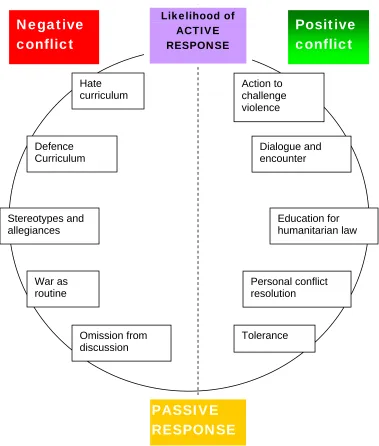
In the book (Davies 2004) I looked mostly at indirect ways in which schools contribute to conflict, and used complexity theory to show the way various hidden pedagogies and structures combine in this amplification. In this paper, I want to look at the direct and deliberate ways teachers and schools teach about conflict (or deliberately do not), and which of these are likely to be negative and which positive in terms of the likelihood of contribution to peace. I would like to hazard a typology of teaching about conflict, which has ten possibilities forming a sort of continuum from negative conflict to positive conflict. However, it bends more into a circle, as, at both poles, there is more likely to be action as a result of the teaching and learning. See Fig 1. In this discussion I start with the ‘negative’ end and move to the ‘positive’ pole. Some approaches would be through history curriculum, some through citizenship, and I will look finally at the potential of citizenship education for using positive conflict and what I term ‘interruptive democracy’.
The denigration or ‘hate’ curriculum
This heading refers to the situation where, usually in history but sometimes in civics or social science textbooks, the enemy is described in graphic and denigrating terms and one’s own nation is portrayed in heroic ones. Textbooks in Bosnia in each of the three ‘nations’ had portrayals of aggressors and victims which were ‘not helpful for peace building and reconciliation’ (Stabback 2004:60). In Rwanda, the history books portrayed the Tutsi as rich, foreign and oppressive; children were indoctrinated to believe in artificial differences. Textbooks in Sri Lanka in 1970s and 1980s declared the Tamils were the historical enemy of the Sinhalese and stylised the Buddhist Sinhalese, in denial of the historical facts, as the only legitimate heirs of the history of Sri Lanka (GTZ 2004). Mitter (2001) points out for central and Eastern Europe:
Teachers have had to tackle emergency situations in their everyday practice; in some countries this has not come yet to an end at all. In all the countries it started with cancelling certain syllabi and with withdrawing, or at least selecting, application of hitherto valid textbooks….in many schools old textbooks are still used, with “offensive” papers or passages eliminated (p155).
I have certainly seen this in BiH, with names and maps taken out in black felt pen. During the civil war in Lebanon, it was said by a prominent Druze leader that ‘the continuing civil war in Lebanon was, in a fundamental way, a war to determine the correct history of the country’ (Frayha 2004). The (re) writing of textbooks was a necessary precondition for any lasting settlement.
The ‘defence’ curriculum
South Africa during the apartheid era was a classic case of ‘preventive’ military training; but the defence curriculum still continues in BiH and in Korea. Various sorts of military training – whether cadet forces in UK or the preparation for the army courses in Israel - will of necessity contain images of war and of the ‘opposing forces’.
Fig 1 Approaches To Teaching About Conflict
National and transnational stereotypes
War and conflict are taught not specifically as hating or fearing an enemy, but as the result of a stereotypical culture which permeates everyone in that country. The Japanese ‘people’ were waging war on the American ‘people’ or vice versa,
Hate curriculum
Defence Curriculum
Stereotypes and allegiances
Education for humanitarian law Dialogue and
encounter Action to challenge violence
War as routine
Personal conflict resolution
Tolerance
Posit ive
c onflic t
N e ga t ive
c onflic t
Omission from discussion