This art icle was dow nloaded by: [ Universit as Dian Nuswant oro] , [ Ririh Dian Prat iw i SE Msi] On: 27 January 2014, At : 00: 59
Publisher: Rout ledge
I nform a Lt d Regist ered in England and Wales Regist ered Num ber: 1072954 Regist ered office: Mort im er House, 37- 41 Mort im er St reet , London W1T 3JH, UK
Accounting and Business Research
Publicat ion det ails, including inst ruct ions f or aut hors and subscript ion inf ormat ion:
ht t p: / / www. t andf online. com/ loi/ rabr20
International Financial Reporting Standards
(IFRS): pros and cons for investors
Ray Ball a
a
Universit y of Chicago
Published online: 28 Feb 2012.
To cite this article: Ray Ball (2006) Int ernat ional Financial Report ing St andards (IFRS): pros and cons f or invest ors, Account ing and Business Research, 36: sup1, 5-27, DOI: 10. 1080/ 00014788. 2006. 9730040
To link to this article: ht t p: / / dx. doi. org/ 10. 1080/ 00014788. 2006. 9730040
PLEASE SCROLL DOWN FOR ARTI CLE
Taylor & Francis m akes every effort t o ensure t he accuracy of all t he inform at ion ( t he “ Cont ent ” ) cont ained in t he publicat ions on our plat form . How ever, Taylor & Francis, our agent s, and our licensors m ake no represent at ions or warrant ies w hat soever as t o t he accuracy, com plet eness, or suit abilit y for any purpose of t he Cont ent . Any opinions and view s expressed in t his publicat ion are t he opinions and view s of t he aut hors, and are not t he view s of or endorsed by Taylor & Francis. The accuracy of t he Cont ent should not be relied upon and should be independent ly verified w it h prim ary sources of inform at ion. Taylor and Francis shall not be liable for any losses, act ions, claim s, proceedings, dem ands, cost s, expenses, dam ages, and ot her liabilit ies w hat soever or how soever caused arising direct ly or indirect ly in connect ion w it h, in relat ion t o or arising out of t he use of t he Cont ent .
5
zyxwvutsrqponmlkjihgfedcbaZYXWVUTSRQPONMLKJIHGFEDCBA
International Financial Reporting Standards
(IFRS): pros and cons for investors
Ray Ball*
zyxwvutsrqponmlkjihgfedcbaZYXWVUTSRQPONMLKJIHGFEDCBA
Abstract-Accounting in shaped by economic and political forces. It follows that increased worldwide integration of both markets and politics (driven by reductions in communications and information processing costs) makes in- creased integration of financial reporting standards and practice almost inevitable. But most market and political
forces will remain local for the foreseeable future, so it is unclear how much convergence
zyxwvutsrqponmlkjihgfedcbaZYXWVUTSRQPONMLKJIHGFEDCBA
in actualfinancial re-porting practice will (or should) occur. Furthermore, there is little settled theory or evidence on which to build an assessment of the advantages and disadvantages of uniform accounting rules within a country. let alone interna- tionally. The pros and cons of IFRS therefore are somewhat conjectural, the unbridled enthusiasm of allegedly al- truistic proponents notwithstanding. On the ‘pro’ side of the ledger. l conclude that extraordinary success has been achieved in developing a comprehensive set of ‘high quality’ IFRS standards, in persuading almost 100 countries to adopt them, and in obtaining convergence in standards with important non-adopters (notably. the US). On the ‘con’ side, I envisage problems with the current fascination of the IASB (and the FASB) with ‘fair value account- ing‘. A deeper concern is that there inevitably will be substantial differences among countries in implementation of IFRS. which now risk being concealed by a veneer of uniformity. The notion that uniform standards alone will pro- duce uniform financial reporting seems naive. In addition. I express several longer run concerns. Time will tell.
1. Introduction and outline
It is a distinct pleasure to deliver the 2005 PD Leake Lecture, and I sincerely thank the Institute of Chartered Accountants in England and Wales (ICAEW) for inviting me to do so. PD Leake was an early contributor to a then fledgling but now mature accounting literature. His work on good- will (Leake, 1921a,b) stands apart from its con- temporaries, so it is an honour to celebrate the contributions of such a pioneer. My introduction to Leake’s work came from a review article (Carsberg, 1966) that I read almost 40 years ago. Ironically, the review was published in a journal I
now co-edit (Journal of Accounting Research), and was written by a man who later became a pio- neer in what now are known as International Financial Reporting Standards (the subject of this lecture), and with whom I once co-taught a course on International Accounting (here in London, at London Business School). It truly is a small world
in many ways
zyxwvutsrqponmlkjihgfedcbaZYXWVUTSRQPONMLKJIHGFEDCBA
- which goes a long way to explain- ing the current interest in international standards.*The author is Sidney Davidson Professor of Accounting at the University of Chicago. His paper is based on the PD Leake Lecture delivered on 8 September 2005 at the Institute of Chartered Accountants in England and Wales, which can be
accessed at
zyxwvutsrqponmlkjihgfedcbaZYXWVUTSRQPONMLKJIHGFEDCBA
http://www.icaew.co.uWindex.cfm?route= I 12609,It draws extensively on the framework in Ball (1995) and ben- efited from comments by Steve Zeff. Financial support from the PD Leake Trust and the Graduate School of Business at the University of Chicago is gratefully acknowledged. Correspondence should be addressed to Professor Ball at the Graduate School of Business. University of Chicago. 5807 S . Woodlawn Avenue, Chicago. IL 60637. Tel. +00 1 (773) 834
594 I
zyxwvutsrqponmlkjihgfedcbaZYXWVUTSRQPONMLKJIHGFEDCBA
: E-mail: [email protected]International Financial Reporting Standards
(IFRS) are forefront on the immediate agenda be- cause, starting in 2005, listed companies in European Union countries are required to report consolidated financial statements prepared accord- ing to IFRS. At the time of speaking, companies are preparing for the release of their first full-year IFRS-compliant financial statements. Investors have seen interim reports based on IFRS, but have not yet experienced the full gamut of year-end ad- justments that IFRS might trigger. Consequently, the advantages and disadvantages of IFRS for in- vestors (the specific topic of this lecture) are a matter of current conjecture. I shall try to shed some light on the topic but, as the saying goes, only time will tell.
I . I . Outline
I begin with a description of IFRS and their his-
tory, and warn that there is little settled theory or evidence on which to build an assessment of the advantages and disadvantages of uniform account- ing rules within a country, let alone international-
ly. The pros and cons of IFRS therefore are somewhat conjectural, the unbridled enthusiasm of allegedly altruistic proponents notwithstanding. I
then outline my broad framework for addressing the issues, which is economic and political.
On the ‘pro’ side of the ledger, I conclude that extraordinary success has been achieved in devel- oping a comprehensive set of ‘high quality’ stan- dards and in persuading almost 100 countries to adopt them. On the ‘con’ side, a deep concern is that the differences in financial reporting quality
6
zyxwvutsrqponmlkjihgfedcbaZYXWVUTSRQPONMLKJIHGFEDCBA
that are inevitable among countries have been pushed down to the level of implementation, and now will be concealed by a veneer of uniformity. The notion that uniform standards alone will pro- duce uniform financial reporting seems nayve, if only because it ignores deep-rooted political and economic factors that influence the incentives of financial statement preparers and that inevitably
shape actual financial reporting practice.
zyxwvutsrqponmlkjihgfedcbaZYXWVUTSRQPONMLKJIHGFEDCBA
I envis-age problems with the current fascination of the IASB (and the FASB) for ‘fair value accounting’. In addition, I express several longer run concerns.
ACCOUNTING AND BUSlNESS RESEARCH
uniformity in accounting standards, at least to my knowledge?
There thus is good reason (and, I will argue below, some evidence) to be sceptical of the strong claims that its advocates make for a single global set of accounting standards. So while this means Europe’s adoption of IFRS is a leap of faith, it also means it is a Brave New World for commentators on IFRS, myself included. I therefore caution that the following views are informed more by basic tenets of economics (and some limited evidence) than by a robust, directly-relevant body of re- search.
2.
Background
zyxwvutsrqponmlkjihgfedcbaZYXWVUTSRQPONMLKJIHGFEDCBA
2.1. What are IFRS?
IFRS are accounting rules (‘standards’) issued by the International Accounting Standards Board (IASB), an independent organisation based in London, UK. They purport to be a set of rules that ideally would apply equally to financial reporting by public companies worldwide. Between 1973 and 2000, international standards were issued by the IASB’s predecessor organisation, the International Accounting Standards Committee (IASC), a body established in 1973 by the profes- sional accountancy bodies in Australia, Canada, France, Germany, Japan, Mexico, Netherlands, United Kingdom and Ireland, and the United States. During that period, the IASC’s rules were described as ‘International Accounting Standards’ (IAS). Since April 2001, this rule-making function has been taken over by a newly-reconstituted IASB.’ The IASB describes its rules under the new label ‘International Financial Reporting Standards’ (IFRS), though it continues to recog- nise (accept as legitimate) the prior rules (IAS) is- sued by the old standard-setter (IASC).2 The IASB is better-funded, better-staffed and more independ- ent than its predecessor, the IASC. Nevertheless, there has been substantial continuity across time in its viewpoint and in its accounting standards.’
2.2. Brave New World
I need to start by confessing substantial igno- rance on the desirability of mandating uniform ac- counting, and to caution that as a consequence much of what I have to say is speculative. There simply is not much hard evidence or resolved the- ory to help.
This was an unsettled issue when I was an ac- counting student, over 40 years ago. A successful push for mandating uniformity at a national level occurred around the turn of the twentieth century. National uniformity was a central theme of the first Congress of Accountants in 1904.“ A century
later, there is an analogous push for mandating uniformity at an international level, but in the meantime no substantial, settled body of evidence
or literature has emerged in favour
zyxwvutsrqponmlkjihgfedcbaZYXWVUTSRQPONMLKJIHGFEDCBA
- or against -2.3. Some thoughts on the role of mandatory uni- form accounting standards
IFRS boosters typically take the case for manda-
tory (i.e., required by state enactment) uniform (i.e., required of all public companies) accounting standards as self evident. In this regard, they are not alone: in my experience, most accounting text- books, most accounting teachers and much of the accounting literature are in the same boat. But the case for imposing accounting uniformity by fiat is far from clear. Some background analysis of the economic role of mandatory uniform accounting standards, one hopes, will assist the reader in sort- ing through claims as to the pros and cons of the European Union mandating of IFRS.
Voluntary standards. The fundamental economic function of accounting standards is to provide ‘agreement about how important commercial transactions are to be implemented’ (Ball, 1995: 19). For example, if lenders agree to lend to a company under the condition that its debt fi- nancing will not exceed 60% of tangible assets, it helps to have agreement on how to count the com- pany’s tangible assets as well as its debts. Are non- cancellable leases debt? Unfunded health care commitments to employees? Expected future tax payments due to transactions that generate book income now? Similarly, if a company agrees to provide audited profit figures to its shareholders, it is helpful to be in agreement as to what constitutes a profit. Specifying the accounting methods to be
’
The International Accounting Standards Committee (IASC) Foundation was incorporated in 2001 as a not-for- profit corporation in the State of Delaware, US. The IASC Foundation is the legal parent of the International Accounting Standards Board.For convenience, I will refer to all standards recognised by the IASB as IFRS.
’
The IASB account of its history can be found atzyxwvutsrqponmlkjihgfedcbaZYXWVUTSRQPONMLKJIHGFEDCBA
http://www.iasb.org/about/history.asp.
“The proceedings of the Congress can be found on the web-
site of the 10th World Congress of Accounting Historians:
zyxwvutsrqponmlkjihgfedcbaZYXWVUTSRQPONMLKJIHGFEDCBA
http://accounting.rutgers.edu/raw/aah/worldcongress/high-
1ights.htm. See also Staub (1938).
The available literature includes Dye (1985). Farrell and Saloner (1985). Dye and Verrecchia (1995) and Pownall and Schipper (1999).
International Accounting Policy Forum. 2006
zyxwvutsrqponmlkjihgfedcbaZYXWVUTSRQPONMLKJIHGFEDCBA
zyxwvutsrqponmlkjihgfedcbaZYXWVUTSRQPONMLKJIHGFEDCBA
followed constitutes an agreement as to how to im- plement important financial and legal concepts such as leverage (gearing) and earnings (profit). Accounting methods thus are an integral compo- nent of the contracting between firms and other parties, including lenders, shareholders, managers, suppliers and customers.
Failure to specify accounting methods
zyxwvutsrqponmlkjihgfedcbaZYXWVUTSRQPONMLKJIHGFEDCBA
ex antehas the potential to create uncertainty in the pay- offs to both contracting parties. For example, fail- ure to agree in advance whether unfunded health care commitments to employees are to be counted as debt leaves both the borrower and the lender un- sure as to how much debt the borrower can have without violating a leverage covenant. Similarly, failure to specify in advance the rules for counting profits creates uncertainty for investors when they receive a profit report, and raises the cost of capi- tal to the firm. But accounting standards are costly to develop and specify in advance, so they cannot be a complete solution. Economic efficiency im- plies a trade-off, without a complete set of stan- dards that fully determine financial reporting practice in all future states of the world (i.e., ex- actly and for all contingencies). Some future states of the world are extremely costly to anticipate and explicitly contract for! Standards thus have their limits.
The alternative to fully specifying ex ante the ac- counting standards to meet every future state of the world requires what I call ‘functional completion’ (Ball, 1989). Independent institutions then are in- serted between the firm and its financial statement
users, their function being to decide ex
zyxwvutsrqponmlkjihgfedcbaZYXWVUTSRQPONMLKJIHGFEDCBA
post on the accounting standards that would most likely havebeen specified ex ante if the actually realised state had been anticipated and provided for. Prominent examples of independent institutions that play this role in contracting include law courts, arbitrators, actuaries, valuers and auditors. When deciding what would most likely have been specified ex ante if the realised state had been anticipated and provided for, some information is contained in what was anticipated and provided for. This infor- mation will include provisions that were specified for similar states to that which occurred. It also will include abstract general provisions that were intended for all states. In financial reporting, this is the issue involved in so-called ‘principles-based’ accounting: the balance between general and spe- cific provision for future states of the world.
Uniform voluntary standards. I am aware of at least three major advantages of uniform (here in- terpreted as applying equally to all public compa- nies) standards that would cause them to emerge voluntarily (i.e., without state fiat). The first ad- vantage - scale economies - underlies all forms of
uniform contracting: uniform rules need only be invented once. They are a type of ‘public good’, in
7
that the marginal cost of an additional user adopt- ing them is zero. The second advantage of uniform standards is the protection they give auditors against managers playing an ‘opinion shopping’ game. If all auditors are required to enforce the same rules, managers cannot threaten to shop for an auditor who will give an unqualified opinion on a more favourable rule. The third advantage is eliminating informational externalities arising from lack of comparability. If firms and/or coun- tries use different accounting techniques - even if unambiguously disclosed to all users - they can impose costs on others (in the language of eco- nomics, create negative externalities) due to lack of comparability. To the extent that firms inter- nalise these effects, it will be advantageous for them to use the same standards as others.
These advantages imply that some degree of uni- formity in accounting standards could be expected to arise in a market (i.e., non-fiat) setting. This is what happened historically: as is the case for most professions, uniform accounting standards initially arose in a market setting, before governments be- came involved. In the UK, the ICAEW functioned as a largely market-based standard-setter until re- cently. In the US, the American Association of
Public Accountants - the precursor to today’s American Institute of Certified Public Accountants
- was formed in 1887 as a professional body with-
out state fiat. In 1939, the profession accepted gov- ernment licensure and bowed to pressure from the SEC to establish a Committee on Accounting Procedure. The CAP issued 51 Accounting Research Bulletins before being replaced in 1959 by the AICPA’s Accounting Principles Board (APB), which in turn was replaced in 1973 by the current FASB. While the trend has been to in- creased regulation (fiat) over time, the origin of uniform accounting standards lies in a voluntary, market ~ e t t i n g . ~
There also are at least three important reasons to expect somewhat less-than-uniform accounting methods to occur in a voluntary setting. First, it is not clear that uniform financial reporting qualit4, requires uniform accounting rules (‘one size fits all’). Uniformity in the eyes of the user could re- quire accounting rules that vary across firms, across locations and across time. Firms differ on myriad dimensions such as strategy, investment policy, financing policy, industry, technology, cap- ital intensity, growth, size, political scrutiny, and geographical location. The types of transactions they enter into differ substantially. Countries differ
In the extreme case of presently unimaginable future states, i t is infinitely costly (i.e., impossible, even with infinite resources) to explicitly contract for optimal state-contingent payoffs, including those affected by financial reporting.
’
Watts and Zirnmerman (1986) note the market origins offinancial reporting and auditing more generally.
8
zyxwvutsrqponmlkjihgfedcbaZYXWVUTSRQPONMLKJIHGFEDCBA
ACCOUNTING A N D BUSINESS RESEARCHstandards is increased cross-border integration of markets and politics (Ball, 1995). Driving this in- tegration is an extraordinary reduction in the cost of international communication and transacting. The cumulative effect of innovations affecting al-
most all dimensions of information costs -
zyxwvutsrqponmlkjihgfedcbaZYXWVUTSRQPONMLKJIHGFEDCBA
for ex-ample in computing, software, satellite and fibre-optic information transmission, the internet, television, transportation, education - is a revolu- tionary plunge in the cost of being informed about and becoming an actor in the markets and politics of other countries. In my youth, only a small elite possessed substantial amounts of current informa- tion about international markets and politics. Today, orders of magnitude more information is freely available to all on the internet. Informed cross-border transacting in product markets and factor markets (including capital and labour mar- kets) has grown rapidly as a consequence. Similarly, voters and politicians are much better informed about the actions of foreign politicians, and their consequences, than just a generation ago. We have witnessed a revolutionary internationali- sation of both markets and politics, and inevitably this creates a demand for international conver- gence in financial reporting.
How far this will go is another matter. Despite the undoubted integration that has occurred, no- tably in the capital and product markets, most mar- ket and political forces are local, and will remain
so for the foreseeable future. Consequently, it is
unclear how much convergence
zyxwvutsrqponmlkjihgfedcbaZYXWVUTSRQPONMLKJIHGFEDCBA
in actualfinancialreporting practice will (or should) occur.
zyxwvutsrqponmlkjihgfedcbaZYXWVUTSRQPONMLKJIHGFEDCBA
I returnto this theme below.
in how they run their capital, labour and product markets, and in the extent and nature of govern- mental and political involvement in them. It has never been convincingly demonstrated that there exists a unique optimum set of rules for all.
Second, as observed above it is costly to develop a fully detailed set of accounting standards to cover every feasible contingency, so standards are not the only way of solving accounting method choices. Some type of ‘functional completion’ is required. For example, under ‘principles based’ accounting, general principles rather than detailed standards are developed in advance and then adapted to specific situations with the approval of independent audi- tors. It therefore is not optimal for all accounting choices to be made according to uniform standards. The above-mentioned reasons to expect less than uniform accounting methods in a voluntary setting share the property that uniformity is not the opti- mal way to go. The third reason, that firms and/or countries using different accounting methods might not fully internalise the total costs imposed on others due to lack of comparability, does not have that property. It therefore provides a rationale for mandating uniformity, to which I now turn.
Mandatory uniform standards are a possible so- lution to the problem of informational externali- ties. If their use of different accounting methods imposes costs on others that firms and/or countries do not take into account in their decisions, then it is feasible that the state can improve aggregate welfare by imposing uniformity. Whether the state-imposed solution can be expected to be opti- mal is another matter. Political factors tend to dis- tort state action, a theme I shall return to.
At a more basic level, it is not clear that imper- fect comparability in financial reporting practice is a substantial problem requiring state action. Is ac- counting information a special economic good? Hotel accommodation, for example, differs enor- mously in quality. Different hotels and hotel chains differ in the standards they set and the rules they apply. Their rooms are not comparable in size or decor, their elevators do not operate at comparable speed, their staffs are not equally helpful, they have different cancellation policies, etc. There is no direct comparability of one hotel room with an- other, even with the assistance of the myriad rating systems in the industry, but consumers make choices without the dire consequences frequently alleged to occur from differences in accounting rules. All things considered, the case for imposing
accounting uniformity by fiat is far from clear.
zyxwvutsrqponmlkjihgfedcbaZYXWVUTSRQPONMLKJIHGFEDCBA
2.4.
zyxwvutsrqponmlkjihgfedcbaZYXWVUTSRQPONMLKJIHGFEDCBA
Why is international convergence in accounting standards occurring now?Accounting is shaped by economics and politics (Watts, 1977; Watts and Zimmerman, 1986), so the source of international convergence in accounting
3. Scoring
IASB
against its stated
objectives
This section evaluates the progress the IASB has made toward achieving its stated objectives, which include:s
1. ‘develop
...
high quality, understandable and en- forceable global accounting standards...
that require high quality, transparent and compara- ble information...
to help participants in the world’s capital markets and other users...
.’2. ‘promote the use and rigorous application of those standards.’
3 . ‘bring about convergence
...
.’tives in turn.
I discuss progress toward each of these objec-
3.1. Development
Here the IASB has done extraordinarily well.” It
Source: http://www .iasb .org/about/const itut ion .asp Deloitte & Touche LLP provide a comprehensive review of IFRS at www.iasplus.com/dttpubs/pubs.htm.
International Accounting Policy Forum. 2006
zyxwvutsrqponmlkjihgfedcbaZYXWVUTSRQPONMLKJIHGFEDCBA
has developed a nearly complete set of standards that, if followed, would require companies to report ‘high quality, transparent and comparable information’.
I interpret financial reporting ‘quality’ in very general terms, as satisfying the demand for finan- cial reporting. That is, high quality financial state- ments provide useful information to a variety of users, including investors. This requires:
accurate depiction of economic reality (for ex-
ample: accurate allowance for bad debts; not ignoring an imperfect hedge);
low capacity for managerial manipulation; timeliness (all economic value added gets recorded eventually; the question is how promptly); and
asymmetric timeliness (a form of conservatism): timelier incorporation of bad news, relative to good news, in the financial statements. Accounting standard-setters historically have viewed the determinants of ‘quality’ as ‘relevance’ and ‘reliability,’ but I do not find these concepts particularly useful. For example, IASB and FASB recently have been placing less emphasis on relia- bility. In my view, this arises from a failure to dis- tinguish reliability that is inherent in the accounting for a particular type of transaction (the extent to which a reported number is subject to un- avoidable estimation error) from reliability arising from capacity for managerial manipulation (the extent to which a reported number is subject to self-interested manipulation by management).
Compared to the legalistic, politically and tax- influenced standards that historically have typified Continental Europe, IFRS are designed to:
reflect economic substance more than legal form; reflect economic gains and losses in a more timely fashion (in some respects, even more so than US GAAP);
make earnings more informative; provide more useful balance sheets; and curtail the historical Continental European dis- cretion afforded managers to manipulate provi- sions, create hidden reserves, ‘smooth’ earnings and hide economic losses from public view. The only qualification I would make to my
favourable assessment of IFRS
zyxwvutsrqponmlkjihgfedcbaZYXWVUTSRQPONMLKJIHGFEDCBA
qua standardszyxwvutsrqponmlkjihgfedcbaZYXWVUTSRQPONMLKJIHGFEDCBA
l o The regulation was adopted on 19 July 2002 by the
European Parliament and Council (EC) 1606/2002. After ex- tensive political lobbying and debate, the EC ‘carved out’ two sections of IAS 39, while at the same time announcing this ac- tion as exceptional and temporary, and reiterating its support
for IFRS.
9
therefore is the extent to which they are imbued by a ‘mark to market’ philosophy, an issue to which I return below.
3.2. Promotion
zyxwvutsrqponmlkjihgfedcbaZYXWVUTSRQPONMLKJIHGFEDCBA
success. Indicators of this success include: Here the IASB also has experienced remarkable
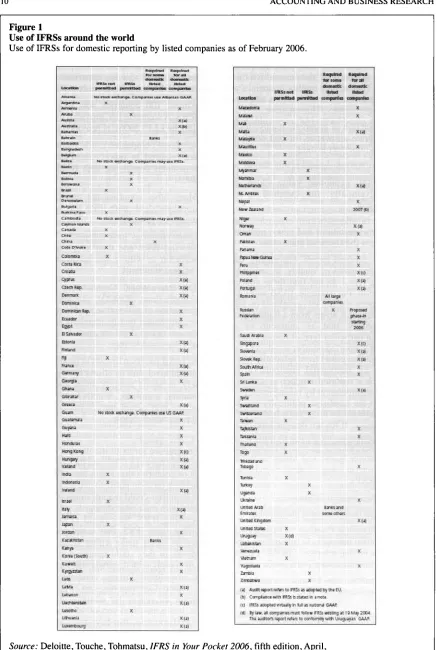
Almost 100 countries now require or allow IFRS. A complete list, provided by Deloitte and
Touche LLP (2006),
zyxwvutsrqponmlkjihgfedcbaZYXWVUTSRQPONMLKJIHGFEDCBA
is provided in Figure 1. All listed companies in EU member countriesare required to report consolidated financial
statements complying with IFRS, effective in
zyxwvutsrqponmlkjihgfedcbaZYXWVUTSRQPONMLKJIHGFEDCBA
2005.‘O
Many other countries are replacing their na- tional standards with IFRS for some or all do- mestic companies.
Other countries have adopted a policy of re- viewing IFRS and then adopting them either verbatim or with minor modification as their national standards.
The International Organization of Securities Commissions (IOSCO), the international or- ganisation of national securities regulators, has recommended that its members permit foreign issuers to use IFRS for cross-border securities offerings and listings.
The IASB has been tireless in promoting IFRS at a political level, and its efforts have paid off hand- somely in terms ranging from endorsement to mandatory adoption. Whether political action translates into actual implementation is another matter, discussed below.
3.3. Convergence
Convergence refers to the process of narrowing differences between IFRS and the accounting stan- dards of countries that retain their own standards. Depending on local political and economic factors, these countries could require financial reporting to comply with their own standards without formally recognising IFRS, they could explicitly prohibit reporting under IFRS, they could permit all com- panies to report under either IFRS or domestic standards, or they could require domestic compa- nies to comply with domestic standards and permit only cross-listed foreign companies to comply with either. Convergence can offer advantages, whatever the reason for retaining domestic stan- dards. It is a modified version of adoption.
Several countries that have not adopted IFRS at this point have established convergence projects that most likely will lead to their acceptance of IFRS, in one form or another, in the not too distant future. Most notably:
10 ACCOUNTING AND BUSINESS RESEARCH
zyxwvutsrqponmlkjihgfedcbaZYXWVUTSRQPONMLKJIHGFEDCBA
Figure 1
Use of IFRSs around the world
Use of IFRSs for domestic reporting by listed companies as of February
zyxwvutsrqponmlkjihgfedcbaZYXWVUTSRQPONMLKJIHGFEDCBA
2006.zyxwvutsrqponmlkjihgfedcbaZYXWVUTSRQPONMLKJIHGFEDCBA
Source: Deloitte, Touche, Tohmatsu, IFRS
zyxwvutsrqponmlkjihgfedcbaZYXWVUTSRQPONMLKJIHGFEDCBA
in Your Pocket 2006, fifth edition, April,at:
zyxwvutsrqponmlkjihgfedcbaZYXWVUTSRQPONMLKJIHGFEDCBA
http://www.iasplus.com/dttpubs/pocket2006.pdf.International Accounting Policy Forum. 2006
Since October 2002, the IASB and the FASB have been working systematically toward con-
vergence of IFRS and
zyxwvutsrqponmlkjihgfedcbaZYXWVUTSRQPONMLKJIHGFEDCBA
US GAAP. The Securities and Exchange Commission (SEC),the US national market regulator, has set a tar- get date no later than 2009 for it accepting fi- nancial statements of foreign registrants that comply with IFRS.
The IASB recently commenced a similar, though seemingly less urgent and ambitious, convergence project with Japan.
I repeat the caveat that converge
zyxwvutsrqponmlkjihgfedcbaZYXWVUTSRQPONMLKJIHGFEDCBA
de fact0 is lesscertain than convergence de jure: convergence in actual financial reporting practice is a different thing than convergence in financial reporting stan- dards. I return to this point in Section 6 below.
I I
adjustments analysts historically have made in order to make companies' financials more comparable internationally. IFRS adoption therefore could reduce the cost to investors of processing financial information. The gain would be greatest for institutions that create large, standardised-format financial databases. 4. A bonus is that reducing the cost of processing financial information most likely increases the efficiency with which the stock market incor- porates it in prices. Most investors can be ex- pected to gain from increased market efficiency.
5 . Reducing international differences in account- ing standards assists to some degree in remov- ing barriers to cross-border acquisitions and divestitures, which in theory will reward in- vestors with increased takeover premiums.'* In general, IFRS offer increased comparability and hence reduced information costs and informa- tion risk to investors (provided the standards are implemented consistently, a point I return to below)
4.
Advantages
of IFRS
for investors
4.1. Direct IFRS advantages f o r investors
Widespread international adoption of IFRS of- fers equity investors a variety of potential advan- tages. These include:
IFRS promise more accurate, comprehensive and timely financial statement information, rel- ative to the national standards they replace for public financial reporting in most of the coun- tries adopting them, Continental Europe in- cluded. To the extent that financial statement information is not known from other sources, this should lead to more-informed valuation in the equity markets, and hence lower risk to in- vestors.
Small investors are less likely than investment professionals to be able to anticipate financial statement information from other sources. Improving financial reporting quality allows them to compete better with professionals, and hence reduces the risk they are trading with a
better-informed professional (known as 'ad- verse selection').''
By eliminating many international differences in accounting standards, and standardising re- porting formats, IFRS eliminate many of the
4.2. Indirect IFRS advantages f o r investors
IFRS offer several additional, indirect advan- tages to investors. Because higher information quality should reduce both the risk to all investors
from owning shares (see
zyxwvutsrqponmlkjihgfedcbaZYXWVUTSRQPONMLKJIHGFEDCBA
1. above) and the risk to less-informed investors due to adverse selection(see 2. above), in theory it should lead to a reduc- tion in firms' costs of equity capital.I3 This would increase share prices, and would make new invest- ments by firms more attractive, other things equal. Indirect advantages to investors arise from im- proving the usefulness of financial statement in- formation in contracting between firms and a variety of parties, notably lenders and managers (Watts, 1977; Watts and Zimmerman, 1986). Increased transparency causes managers to act more in the interests of shareholders. In particular, timelier loss recognition in the financial state- ments increases the incentives of managers to at- tend to existing loss-making investments and strategies more quickly, and to undertake fewer new investments with negative NPVs, such as
'pet' proiects and 'trophy' acquisitions (Ball 2001 ;
zyxwvutsrqponmlkjihgfedcbaZYXWVUTSRQPONMLKJIHGFEDCBA
i i See GIosten and Milgrom ( 1985), Diamond and Ball hd"Shivakumar,2005). Ball (2004j concludesthis was the primary motive behind the 1993 deci-
Verrecchia (1991) and Leuz and Verrecchia (2000).
See Bradley, Desai and Kim (1988). sion of Daimler-Benz (now DaimlerChrvsler) AG - ,
1.1 The magnitude of cost of capital benefits from disclosure is an unsettled research question, both theoretically and em- pirically. Empirical studies encounter the problem of control- ling for correlated omitted variables, notably companies'
to list on the N~~ york'Stock Exchange and report financial statements complying with US GAAP:
due to intensifying product market competition
growth opportunities. Theory research is sensitive to model tion but not the magnitude of any effects. See Diamond and Verrecchia (1991). Botosan (1997), Leuz and Verrecchia (2000). Botosan and Plumlee (2002). Hail (2002). Daske (2006) and Easton (2006).
and hence lower profit margins in its core automo- subsidise loss-making activities. ~~~h~~~ et al. (2006) evidence that firms in countries with timelier financial-statement recognition of losses
assumptions. and frequently can offer insights into the direc- bile businesses, Daimler no longer could afford to
12
zyxwvutsrqponmlkjihgfedcbaZYXWVUTSRQPONMLKJIHGFEDCBA
are less likely to undertake negative-NPV invest- ments. The increased transparency and loss recog- nition timeliness promised by IFRS therefore could increase the efficiency of contracting be- tween firms and their managers, reduce agency costs between managers and shareholders, and en- hance corporate g 0 ~ e r n a n c e . l ~ The potential gain to investors arises from managers acting more in their (i.e., investors’) interests.
The increased transparency promised by IFRS also could cause a similar increase in the efficien- cy of contracting between firms and lenders. In
particular, timelier loss recognition in the financial statements triggers debt covenants violations more quickly after firms experience economic losses that decrease the value of outstanding debt (Ball 2001,2004; Ball and Shivakumar 2005; Ball et al., 2006). Timelier loss recognition involves timelier revision of the book values of assets and liabilities, as well as earnings and stockholders’ equity, caus- ing timelier triggering of covenants based on fi- nancial statement variables. In other words, the increased transparency and loss recognition timeli- ness promised by IFRS could increase the effi- ciency of contracting in debt markets, with potential gains to equity investors in terms of re- duced cost of debt capital.
An ambiguous area for investors will be the ef- fect of IFRS on their ability to forecast earnings. One school of thought is that better accounting standards make reported earnings less noisy and more accurate, hence more ‘value relevant’. Other things equal (for example, ignoring enforcement and implementation issues for the moment) this would make earnings easier to forecast and would improve average analyst forecast accuracy.15 The other school of thought reaches precisely the op- posite conclusion. This reasoning is along the lines that managers in low-quality reporting regimes are able to ‘smooth’ reported earnings to meet a vari- ety of objectives, such as reducing the volatility of
their own compensation, reducing the volatility of payouts to other stakeholders (notably, employee bonuses and dividends), reducing corporate taxes,
and avoiding recognition of losses . I 6
zyxwvutsrqponmlkjihgfedcbaZYXWVUTSRQPONMLKJIHGFEDCBA
In contrast,earnings in high-quality regimes are more inform- ative, more volatile, and more difficult to predict. This argument is bolstered in the case of IFRS by their emphasis on ‘fair value accounting’. as outlined in the following section. Fair value ac- counting rules aim to incorporate more-timely in- formation about economic gains and losses on securities, derivatives and other transactions into the financial statements, and to incorporate more- timely information about contemporary economic losses (‘impairments’) on long term tangible and intangible assets. IFRS promise to make earnings more informative and therefore, paradoxically, more volatile and more difficult to forecast.
ACCOUNTING AND BUSINESS RESEARCH
In sum, there are a variety of indirect ways in which IFRS offer benefits to investors. Over the long term, the indirect advantages of IFRS to in- vestors could well exceed the direct advantages.
5. Fair
value
accounting
A major feature of IFRS qua standards is the extent to which they are imbued with fair value account- ing [a.k.a. ‘mark to market’ accounting]. Notably:
IAS 16 provides a fair value option for proper- ty, plant and equipment;
IAS 36 requires asset impairments (and impair- ment reversals) to fair value;
IAS 38 requires intangible asset impairments to fair value;
IAS 38 provides for intangibles to be revalued to market price, if available;
IAS 39 requires fair value for financial instru- ments other than loans and receivables that are not held for trading, securities held to maturity; and qualifying hedges (which must be near- perfect to qualify);”
IAS 40 provides a fair value option for invest- ment property;
IFRS 2 requires share-based payments (stock, options, etc.) to be accounted at fair value; and
IFRS
zyxwvutsrqponmlkjihgfedcbaZYXWVUTSRQPONMLKJIHGFEDCBA
3 provides for minority interest to be recorded at fair value.This list most likely will be expanded over time. Both IASB and FASB have signalled their intent to do so.
I have distinctly mixed views on fair value ac- counting. The fundamental case in favour of fair value accounting seems obvious to most econo- mists: fair value incorporates more information into the financial statements. Fair values contain more information than historical costs whenever there exist either:
1. Observable market prices that managers cannot materially influence due to less than perfect
market liquidity; or
zyxwvutsrqponmlkjihgfedcbaZYXWVUTSRQPONMLKJIHGFEDCBA
l 4 These ‘numerator’ effects of higher quality financial re-
porting (i.e., increasing the cash flows arising from managers’ actions) in my view are likely to have a considerably larger
influence on
zyxwvutsrqponmlkjihgfedcbaZYXWVUTSRQPONMLKJIHGFEDCBA
firms’ values than any ‘denominator’ effects(i.e., reducing the cost of capital). See Ball (2001: 140-141).
However. it is difficult to disentangle the two effects in prac- tice.
l 5 See Ashbaugh and Pincus (2001 ). Hope (2003) and Lang, Lins and Miller (2003).
I h See Ball. Kothari and Robin (2000) and Ball. Robin and
wu
(2003).17Available-for-sale securities are to be shown at Fair Value in the Balance Sheet only.
International Accounting Policy Forum.
zyxwvutsrqponmlkjihgfedcbaZYXWVUTSRQPONMLKJIHGFEDCBA
2006zyxwvutsrqponmlkjihgfedcbaZYXWVUTSRQPONMLKJIHGFEDCBA
2. Independently observable, accurate estimates Incorporating more information in the financial statements by definition makes them more inform- ative, with potential advantages to investors, and other things equal it makes them more useful for purposes of contracting with lenders, managers and other parties.18
Over recent decades, the markets for many com- modities and financial instruments, including de- rivatives, have become substantially deeper and more liquid. Some of these markets did not even exist 30 years ago. There has been enormous con- current growth in electronic databases containing transactions prices for commodities and securities, and for a variety of assets such as real estate for which comparable sales can be used in estimating fair values. In addition, a variety of methods for re- liably estimating fair values for untraded assets have become generally acceptable. These include the present value (discounted cash flow) method, the first application of which in formal accounting standards was in lease accounting (SFAS No. 13 in
1976), and a variety of valuation methods adapted from the original Black-Scholes (1973) model. In view of these developments, it stands to reason that accountants have been replacing more and more historical costs with fair values, obtained both from liquid market prices and from model- based estimates thereof.
The question is whether IASB has pushed (and intends to push) fair value accounting too far. There are many potential problems with fair value in practice, including:Iy
of liquid market prices.
Market liquidity is a potentially important issue in practice. Spreads can be large enough to cause substantial uncertainty about fair value and hence introduce noise in the financial state- ments.
In illiquid markets, trading by managers can in- fluence traded as well as quoted prices, and hence allows them to manipulate fair value es- timates.
Worse, companies tend to have positively cor- related positions in commodities and financial instruments, and cannot all cash out simultane- ously at the bid price, let alone at the ask. Fair value accounting has not yet been tested by a major financial crisis, when lenders in particu- lar could discover that ‘fair value’ means ‘fair weather value’.
When liquid market prices are not available, fair value accounting becomes ‘mark to model’ accounting. That is, firms report estimates of market prices, not actual arm’s length market prices. This introduces ‘model noise,’ due to
imperfect pricing models and imperfect esti-
zyxwvutsrqponmlkjihgfedcbaZYXWVUTSRQPONMLKJIHGFEDCBA
a
zyxwvutsrqponmlkjihgfedcbaZYXWVUTSRQPONMLKJIHGFEDCBA
13mates of model parameters.
If liquid market prices are available, fair value accounting reduces opportunities for self-inter- ested managers to influence the financial state- ments by exercising their discretion over realising gains and losses through the timing of asset sales. However, fair value accounting in- creases opportunities for manipulation when ‘mark to model’ accounting is employed to simulate market prices, because managers can influence both the choice of models and the pa- rameter estimates.
It is important to stress that volatility per se is not the concern here. Volatility is an advantage in financial reporting, whenever it reflects timely in- corporation of new information in earnings, and hence onto balance sheets (in contrast with ‘smoothing,’ which reduces volatility). However, volatility becomes a disadvantage to investors and other users whenever it reflects estimation noise
or, worse, managerial manipulation.
The fair value accounting rules in IFRS place considerable faith in the ‘conceptual framework’ that IASB and FASB are jointly developing (IASB, 2001). This framework:
is imbued with a highly controversial ‘value relevance’ philosophy;
emphasises ‘relevance’ relative to ‘reliability;’ assumes the sole purpose of financial reporting is direct ‘decision usefulness;’
downplays the indirect ‘stewardship’ role of accounting; and
could yet cause IASB and FASB some grief. IASB and FASB seem determined to push ahead with it nevertheless. FASB staff member L. Todd Johnson (2005) concludes:
‘The Board has required greater use of fair value measurements in financial statements because it perceives that information as more relevant to in- vestors and creditors than historical cost informa- tion. Such measures better reflect the present financial state of reporting entities and better facil- itate assessing their past performance and future
I ” Ball, Robin and Sadka (2006) conclude from a cross-
country analysis that providing new information to equity in- vestors is not the dominant economic function of financial reporting (investors can be informed about gains and losses in a timely fashion via disclosure, without financial statement recognition). Conversely, the dominant function of timely loss recognition is to facilitate contracting (the study focused on debt markets).
I’ In addition, gains and losses in fair value are transitory in nature and hence are unlike recurring business income. For ex- ample, they normally will sell at lower valuation multiples. To
avoid misleading investors, fair value gains and losses need to
be clearly labelled as such.
14
zyxwvutsrqponmlkjihgfedcbaZYXWVUTSRQPONMLKJIHGFEDCBA
prospects. In that regard, the Board does not accept the view that reliability should outweigh relevance for financial statement measures.’
Noisy information on gains and losses is more in- formative than none, so even the least reliable ‘mark to model’ estimates certainly incorporate more in- formation. But this is not a sufficient basis for justi- fying fair value accounting, for at least four reasons:
1.
2.
zyxwvutsrqponmlkjihgfedcbaZYXWVUTSRQPONMLKJIHGFEDCBA
3
‘Value relevance’ (i.e., informing users) is by no means the sole criterion for financial report- ing. One also has to consider the role of finan- cial reporting in contexts where noise matters, including debt and compensation contracts (Watts and Zimmerman, 1986; Holthausen and Watts, 2001). Noise in any financial informa- tion that affects contractual outcomes (e.g., lenders’ rights when leverage ratio or interest coverage covenants are violated; managers’ bonuses based on reported earnings) increases
the risk faced by
zyxwvutsrqponmlkjihgfedcbaZYXWVUTSRQPONMLKJIHGFEDCBA
both the firm and contracting parties. Other things equal, it thus is a source ofcontracting inefficiency. Providing more infor- mation thus can be worse than providing less, if it is accompanied by more noise. ‘Mark to model’ fair value accounting can add volatility to the financial statements in the form of both information (a ‘good’) and noise arising from inherent estimation error and managerial ma- nipulation (a ‘bad’).
It is important to distinguish ‘recognition’ (in- corporating information in the audited financial statements, notably by including estimated gains and losses in earnings and book value) from ‘disclosure’ (informing investors, for ex- ample by audited footnote disclosure or provi- sion of unaudited information, without incorporation in earnings or on balance sheets). Noisy fair value information does not necessar- ily have to be recognised to be useful to equity investors?0 The case for increased deployment of fair value accounting in the audited financial statements is not based on any substantial body
of evidence -
zyxwvutsrqponmlkjihgfedcbaZYXWVUTSRQPONMLKJIHGFEDCBA
at least of which I am aware - thatgain and loss information is not available from sources outside the financial statements, and that value is added in the economy by auditing it, let alone by incorporating it in earnings. Financial reporting conveys an important eco- nomic role by accurately and independently counting actual outcomes, and hence confirm- ing prior information about expected out- comes. In particular, if managers believe actual outcomes are more likely to be reported accu- rately and independently, they are less likely to disclose misleading information about their ex- pectations. It is possible that, as a financial re- porting regime strays far from reporting
outcomes by incorporating more information
zyxwvutsrqponmlkjihgfedcbaZYXWVUTSRQPONMLKJIHGFEDCBA
4.
ACCOUNTING AND BUSINESS RESEARCH
about expectations, the reliability of the avail- able information about expectations begins to fall. A feasible outcome is that the amount of information contained in the financial state- ments rises, and at the same time the total amount of information falls?’
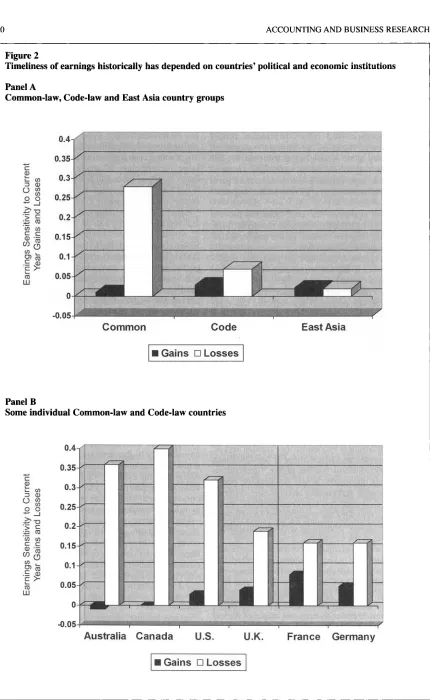
Accounting standards and - what is more im- portant - accounting practice have long since been imbued with one of the two sides of ‘fair value’ accounting. That is, timely loss recogni- tion, in which expected future cash losses are charged against current earnings and book value of equity, is a long-standing property of financial reporting. The other side of ‘fair value,’ timely gain recognition, is not as preva- lent in practice (Basu, 1997). Loss recognition timeliness is particularly evident in common- law countries such as Australia, Canada, UK and US (Ball et al., 2000). It affects financial reporting practice in many ways, including the pervasive ‘lower of cost or market’ rule (for ex- ample, accruing expected decreases in the fu- ture realisable value of inventory against current earnings, but not expected increases), accruing loss contingency provisions (but set- ting a higher standard for verification of gain contingencies), and long term asset impairment charges (but not upward revaluations). It sim- ply is incorrect to view the prevailing financial reporting model as ‘historical cost accounting’. Financial reporting, particularly in common- law countries, is a mixed process involving both historical costs and (especially contingent on losses) fair values.
In sum, I have mixed views about the extent to which IFRS are becoming imbued with the current IASB/FASB fascination with ‘fair value account- ing’. On the one hand, this philosophy promises to incorporate more information in the financial statements than hitherto. On the other, it does not necessarily make investors better off and its use- fulness in other contexts has not been clearly demonstrated. Worse, it could make investors and other users worse off, for a variety of reasons. The jury is still out on this issue.
Barth. Clinch and Shibano (2003) provide some theoreti- cal support for the proposition that recognition matters per se. though the result flows directly from the model‘s assumptions. Ball, Robin and Sadka (2006) argue that equity investors are relatively indifferent between receiving a given amount of in- formation (i.e., controlling for the amount of noise) via dis- closure and via recognition in the financial statements. Conversely, they argue that the demand for recognition versus disclosure arises primarily from the use of financial statements in debt markets.
? I See Ball (2001: 133-138) for elaboration.
International Accounting Policy Forum.
zyxwvutsrqponmlkjihgfedcbaZYXWVUTSRQPONMLKJIHGFEDCBA
20066. Effect on investors of uneven
implementation
I believe there are overwhelming political and eco- nomic reasons to expect IFRS enforcement to be uneven around the world, including within Europe. Substantial international differences in fi- nancial reporting practice and financial reporting quality are inevitable, international standards or no international standards. This conclusion is based
on the premise that
zyxwvutsrqponmlkjihgfedcbaZYXWVUTSRQPONMLKJIHGFEDCBA
- despite increased globalisa- tion - most political and economic influences onfinancial reporting practice remain local. It is rein-
zyxwvutsrqponmlkjihgfedcbaZYXWVUTSRQPONMLKJIHGFEDCBA
forced by a brief review of the comparatively toothless body of international enforcement agen- cies currently in place. The conclusion also is sup- ported by a fledgling academic literature on the relative roles of accounting standards and the in- centives of financial-statement preparers in deter- mining actual financial reporting practice.
One concern that arises from widespread IFRS adoption is that investors will be mislead into be- lieving that there is more uniformity in practice than actually is the case and that, even to sophisti- cated investors, international differences in report- ing quality now will be hidden under the rug of seemingly uniform standards. In addition, uneven implementation curtails the ability of uniform standards to reduce information costs and informa- tion risk, described above as an advantage to in- vestors of IFRS. Uneven implementation could increase information processing costs to transna- tional investors - by burying accounting inconsis-
tencies at a deeper and less transparent level than differences in standards. In my view, IFRS imple- mentation has not received sufficient attention, perhaps because it lies away from public sight, ‘under the rug’.
6.1. Markets and politics remain primarily local, not global
The fundamental reason for being sceptical about uniformity of implementation in practice is that the incentives of preparers (managers) and en-
forcers (auditors, courts, regulators, boards, block
zyxwvutsrqponmlkjihgfedcbaZYXWVUTSRQPONMLKJIHGFEDCBA
15
shareholders, politicians, analysts, rating agencies. the press) remain primarily local.
All accounting accruals (versus simply counting cash) involve judgments about future cash flows. Consequently, there is much leeway in implement- ing accounting rules. Powerful local economic and political forces therefore determine how managers, auditors, courts regulators and other parties influ- ence the implementation of rules. These forces have exerted a substantial influence on financial reporting practice historically, and are unlikely to suddenly cease doing so, IFRS or no IFRS.
Achieving uniformity in accounting standards seems easy in comparison with achieving unifor- mity in actual reporting behaviour. The latter would require radical change in the underlying economic and political forces that determine actu- al behaviour.
Sir David Tweedie, IASB chairman, premises the case for international uniformity in accounting standards on global integration of markets:22
‘As the world’s capital markets integrate, the logic of a single set of accounting standards is ev- ident. A single set of international standards will enhance comparability of financial information and should make the allocation of capital across borders more efficient. The development and ac- ceptance of international standards should also re- duce compliance costs for corporations and improve consistency in audit quality.’
But this logic works both ways. One can change the underlying premise to make a case against uni- formity. Because capital markets are not perfectly integrated (debt markets in particular), and be- cause more generally economic and political inte- gration are both far from being complete, the logic of national diflerences should be equally evident. While increased internationalisation of markets and politics can be expected to reduce some of the diversity in accounting practice across nations, na- tions continue to display clear and substantial do- mestic facets in both their politics and how their markets are structured, so increased internationali- sation cannot be expected to eliminate diversity in practice.
I have heard an analogy made between IFRS and the metric system of uniform weights and meas- ures.23 The analogy is far from exact, but instruc- tive nevertheless. There is an old saying: ‘The weight of the butcher’s thumb on the scale is heav- ier in
...
[other country XI .’ Despite uniform meas- urement rules, the butcher’s discretion in implementing them is limited only by the practised eye of the customer, by concern for reputation, and by the monitoring of state and private inspection systems. The lesson from this saying is that moni- toring mechanisms operate differently across na- tions. There is considerably more discretion in implementing financial reporting rules than in?? Considering the amount of time the IASB has exerted in
lobbying governments (the EU included) on IFRS adoption, there is some irony in Sir David focusing on international in- tegration of markets, without mentioning integration of politi-
cal forces. The strongly adverse initial reaction to the publication of Watts (1977) and Watts and Zimmerman ( 1978). introducing the topic of political influences on finan- cial reporting practice, suggests this is a sensitive issue.
23 The metric system was first proposed in 1791. was adopt-
ed by the French revolutionary assembly in 1795, and was substantially refined and widely adopted during the second half of the nineteenth century (primarily in code law coun- tries). France then ceded control of the system to an interna- tional body, and in I875 the leading industrialised countries (including the US. but not the UK) created the International Bureau of Weights and Measures to administer it.
16 ACCOUNTING AND BUSINESS RESEARCH
zyxwvutsrqponmlkjihgfedcbaZYXWVUTSRQPONMLKJIHGFEDCBA
the implication being that the primary driving forces behind the majority of actual accounting practices seem likely to remain domestic in nature for the foreseeable future.
The most visible effect of local political and eco- nomic factors on IFRS lies at the level of the na- tional standard adoption decisi0n.2~ This already has occurred to a minor degree, in the EU ‘carve out’ from IAS 39 in the application of fair value accounting to interest rate hedges. The European version of IAS 39 emerged in response to consid- erable political pressure from the government of France, which responded to pressure from domes- tic banks concerned about balance sheet volatili- ty.25 Episodes like this are bound to occur in the future, whenever reports prepared under IFRS pro- duce outcomes that adversely affect local interests. Another level at which local political and eco- nomic factors are likely to visibly influence IFRS adoption stems from the latitude IFRS give to firms to choose among alternative accounting methods.26 Local factors make it unlikely that this discretion will be exercised uniformly across countries, and across firms within countries.
Nevertheless, in my view the most likely effect of local politics and local market realities on IFRS will be much less visible than was the case with the prolonged political debate on IAS 39. I believe the primary effect of local political and market fac- tors will lie under the surface, at the level of im- plementation, which is bound to be substantially inconsistent across nations.
Does anyone seriously believe that implementa- tion will be of equal standard in all the nearly 100 countries, listed in Figure I , that have announced adoption of IFRS in one way or another? The list of adopters ranges from countries with developed accounting and auditing professions and devel- oped capital markets (such as Australia) to coun- tries without a similarly developed institutional background (such as Armenia, Costa Rica, Ecuador, Egypt, Kenya, Kuwait, Nepal, Tobago and Ukraine).
Even within the EU, will implementation of IFRS be at an equal standard in all countries? The list includes Austria, Belgium, Cyprus, Czech Republic, Denmark, Germany, Estonia, Greece, Spain, France, Ireland, Italy, Latvia, Lithuania, Luxembourg, Hungary, Malta, Netherlands, Poland, Portugal, Slovenia, Slovakia, Finland, Sweden and weighing meat, and consequently this is offset by
considerably more complex, frequent and effective financial reporting monitoring mechanisms. But here too the monitoring mechanisms operate dif- ferently across nations.
Before getting too carried away with globalisa- tion, it is worth remembering that in fact most markets and most politics are local, not global. The late Tip O’Neill, long-time speaker of the US House of Representatives, famously stated (O’Neill, 1993): ‘All politics is local.’ Much the same could be said about markets. Important di- mensions in which the world still looks consider- ably more local than global include:
Extent and nature of government involvement in the economy;
Politics of government involvement in finan- cial reporting practices (e .g., political influence of managers, corporations, labour unions, banks);
Legal systems (e.g., common versus code law; shareholder litigation rules);
Securities regulation and regulatory bodies; Depth of financial markets;
Financial market structure (e.g., closeness of re- lationship between banks and client companies); The roles of the press, financial analysts and rating agencies;
Size of the corporate sector;
Structure of corporate governance (e.g., rela- tive roles of labour, management and capital); Extent of private versus public ownership of corporations;
Extent of family-controlled businesses; Extent of corporate membership in related- company groups (e.g., Japanese keiretsu or
Korean
zyxwvutsrqponmlkjihgfedcbaZYXWVUTSRQPONMLKJIHGFEDCBA
chaebol); Extent of financial intermediation;The role of small shareholders vs. institutions and corporate insiders;
The use of financial statement information, in- cluding earnings, in management compensa- tion; and
The status, independence, training and com- pensation of auditors.
The above list is far from complete, but it gives some sense of the extent to which financial report- ing occurs in a local, not global, context. Despite increased globalisation, the clear majority of eco-
nomic and political activity remains intranational,
zyxwvutsrqponmlkjihgfedcbaZYXWVUTSRQPONMLKJIHGFEDCBA
?‘ Zeff (2006) surveys political influences on standard adop- tions in the US, Canada, the UK and Sweden, and also in re-
lation to IFRS.
zyxwvutsrqponmlkjihgfedcbaZYXWVUTSRQPONMLKJIHGFEDCBA
?s In my view, governments will not in practice cede the de-cision to impair banks’ balance sheets to accountants. In the event of a financial crisis, there is strong political pressure to not mark banks’ balance sheets to market, in order to avoid bank closures resulting from violating prudential ratios, as witnessed in Japan over the last decade.
26 See Watts (1977) and Watts and Zimmerman (1986).
International Accounting Policy
zyxwvutsrqponmlkjihgfedcbaZYXWVUTSRQPONMLKJIHGFEDCBA
Forum. 2006zyxwvutsrqponmlkjihgfedcbaZYXWVUTSRQPONMLKJIHGFEDCBA
the UK. It is well known that uniform EU econom- ic rules in general are not implemented evenly, with some countries being notorious
standout^.^'
What makes financial reporting rules different?Accounting accruals generally require at least some element of subjective judgment and hence can be influenced by the incentives of managers and auditors. Consider the case of IAS 36 and IAS 38, which require periodic review of long term tangible and intangible assets for possible impair- ment to fair value. Do we seriously believe that managers and auditors will comb through firms’ asset portfolios to discover economically impaired assets with the same degree of diligence and ruth- lessness in all the countries that adopt IFRS? Will auditors, regulators, courts, boards, analysts, rating agencies, the press and other monitors of corporate financial reporting provide the same degree of oversight in all IFRS-adopting countries? In the event of a severe economic downturn creating widespread economic impairment of companies’ assets, will the political and regulatory sectors of all countries be equally likely to turn a blind eye? Will they be equally sympathetic to companies failing to record economic impairment on their ac- counting balance sheets, in order to avoid loan de- fault or bankruptcy (as did Japanese banks for an extended period)? Will local political and econom-
ic factors cease to exert the influence
zyxwvutsrqponmlkjihgfedcbaZYXWVUTSRQPONMLKJIHGFEDCBA
on actual financial reporting practice that they have in thepast? Or will convergence among nations in adopt- ed accounting standards lead to an offsetting di- vergence in the extent to which they are implemented?
The drift toward fair value accounting in IFRS
will only accentuate the extent to which JFRS im- plementation depends on manager and auditor judgment, and hence is subject to local political and economic influence. Furthermore, the clear majority of IFRS adopting countries cannot be said to possess deep securities, derivatives and curren- cy markets. Implementation of the IFRS fair value accounting standards in many countries will en- counter problems with illiquidity, wide spreads and subjectivity in ‘mark to model’ estimates of fair value. Furthermore, in many countries the available information needed to implement the asset impairment standards is meagre and not read- ily observable to auditors and other monitors. To make matters worse, the countries in which there will be greater room to exercise judgment under
fair value accounting, due to lower-liquidity mar-
zyxwvutsrqponmlkjihgfedcbaZYXWVUTSRQPONMLKJIHGFEDCBA
17
kets and poorer information about asset impair- ment, are precisely the countries with weaker local enforcement institutions (audit profession, legal protection, regulation, and so on). Judgment is a generic property of accounting standard imple- mentation, but worldwide reliance on judgment has been widely expanded under IFRS by the drift to fair value accounting and by the adoption of fair value standards in countries with illiquid markets. It is worth bearing in mind that from the outset the IASC, the precursor to the IASB, has been strongly supported by the ‘G4+1’ common law
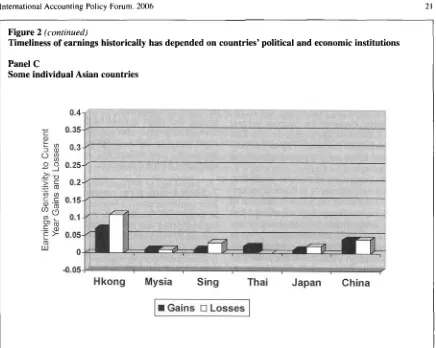
countries (Australia, Canada, New Zealand, UK and US) which have comparatively deep markets and comparatively developed shareholders’ rights, auditing professions, and other monitoring sys- tems. Its philosophy has been tilted toward a com- mon-law view of financial reporting (a topic discussed further below). This view forms the foundation for accounting standards that require timely recognition of losses, in particular the asset impairment standards IAS 36 and IAS 38. Historically, common-law financial reporting has exhibited a substantially greater propensity to recognise economic losses in a timely fashion than financial reporting in Continental Europe and Asia (Ball, Kothari and Robin, 2000; Ball et al., 2003). Implementation of IAS 36 and IAS 38 requires
subjective assessments of future cash flows, some- times decades into the future, and thus is subject to a large degree of discretion. It remains to be seen if managers, auditors, regulators and other moni- tors outside of the common-law countries will be persuaded by IFRS adoption that it is in their in- terests to radically change their behaviour.
In sum, even a cursory review of the political and economic diversity among IFRS-adopting na- tions, and of their past and present financial re- porting practices, makes the notion that uniform standards alone will produce uniform financial re- porting seems naive. This conclusion is strength- ened by the following re