Focus of Study:
What are the objects, phenomena, and problems of biology that can be found in our environment?
Objectives:
1. Students can identify various kinds of objects of biology in any Levels of Organization of Life, located in the environment.
2. Students can find the problems of biology by carrying out observations in the environment.
Basic Principles
The most essential aspect of science is accurate/precise sensing or observation. Observation can be done in various ways, not only by using our sight, but also the use of our hearing, smell, and taste. Usually, scientific observations are done indirectly using measurement devices and instruments. For examples, lenses of microscope, the movements of various instruments, etc. The observation should be focused on a phenomenon or object(s), in order to answer a certain question and solve a problem. A conclusion can then be obtained from those previous steps.
The dimension of the themes / scientific problems can be studied from the following aspects (Walde University, 2002) :
1. The theme / scientific problem as a process of discovery (Science as inquiry) regarding: (a). Scientific discovery
(b). Scientific method
2. The theme / scientific problem from the aspect of physical science (Physical Science) involving:
(a). The nature of matter and changes in material properties, (b). Motion and force
(c). Energy Transfer
3. The theme / scientific problem from the aspect of biological science (Living Science) involving:
(a). The structure and function in living systems
(c). Regulation and Behavior (d), Population and Ecosystems
(e). Diversity and adaptation of organisms.
4. The theme / scientific problem related to aspects of Earth and Space (Earth and space science), which examine:
(a). Structure of the Earth system (b). The formation of Earth's history (c). Earth and the Solar System
5. The theme / scientific problem of science related to technology (Science and technology) assess:
(a). Technology designs
(b). The linkage of science and technology
6. Themes of problem of science from the perspective of personal and social (personal and social perspectives) review:
(a). Personal hygiene
(b). Population, resources, and environment (c). Natural disasters
(d). Risks and benefits
(e). Science, technology, and society.
7. The theme / scientific problem from the history of science and the nature of science (History of science and natural), assessing:
(a). Science as a result of power chancing / human endeavor, (b). The nature of science as a science
(c). The history of science as science.
The theme / problem related to the biological aspect, can also be approached from what has been developed by the BSCS (BSCS, 1996), which includes:
1. Evolution: patterns and products of change. 2. Interaction and interdependence.
3. Maintenance of a dynamic equilibrium 4. Growth, development, and differentiation. 5. Genetic continuity
6. Energy, matter, and organization 7. Science, Technology, and Society
Monera
Protist
Fungi
Plantae
Animalia Genetic Continuity
Growth, Development, & Diffrentiation Maintenance of a Dynamic Equilibrium
Interaction and Interdependence
Energy, Matter, and Organization
Science Technology and Society
Evolution: Pattern & Product of Change
Monera
Protist
Fungi
Plantae
Animalia Maintenance of a Dynamic Equilibrium
Structure and Function Organism and Environment
Diversity and Unity
Science as Inquiry
History of Concept of Biology
Genetic Continuity
The various objects, problems, levels of life organization, and its combinations, make the scope of biology so wide and complicated. Therefore, students’ learning activities are not to memorize them but to understand and apply the concepts of biology. Students’ learning activities are also on how to obtain the concepts through scientific methods and other relevant activities to build their scientific skill, literacy, and attitude.
Setting Activities:
a. Activities: Observation, study of references, and discussion. b. Object Observation/study:
- Objects and Phenomena of Biology. - Reference books and experts
Materials:
- Plastic/polybag - Magnifying glass
Procedure for group work:
1. Identify the kinds of objects in biology that can be found at a certain area of observation (of your choice)
2. Focus your observations on the organ/part of individuals, individual, or group of individual organisms that attract your attention.
3. Observe the characteristics or phenomena that you can get, and then record or describe. 4. Referring to the structure according to BSCS Biology (modified), specify the kind of biology
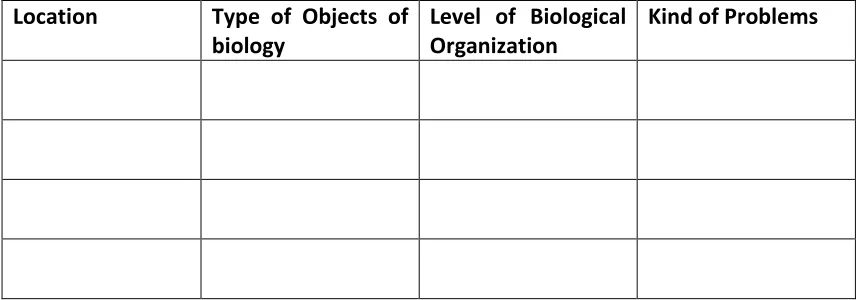
object, level of life organization, and the kind of problem from the characteristics or phenomena. Organize your answer in table 1 (in the Data section).
5. Combine your data with other friend’s data, so that the data are obtained is a class/group data.
Data Results Activities:
Table 1. Observations result concerning the kinds of biological objects, levels of life organization, and the theme / scientific problem of Biology
Location Type of Objects of biology
Level of Biological Organization
[image:5.612.71.500.171.321.2]Kind of Problems
Table 2. Data from the biology class about the kinds of objects, level of organizational life, and the themes biology problems .
Location/Area Type of Objects of biology
Level of Biological Organization
Kind of Problems
Discussion
1. Compare your class data with the number of units, kinds of object, the level of life organization, and the kinds of problems according to the structure of BSCS.
2. Give details on the kinds of object, levels life organization, and problem of biology that can still be found at the location of your observation. Also mention a method that needs to be done to observe the kinds of object, level of life organization, and the themes of problem of biology that have you have not found.
Activity Report:
Report the results of your activities as a group report with the following format: - Topic
- Objectives / Aims - Tools / Materials - Method
- Data / Results - Discussion - Conclusion
Student Task/Assignment