A JOURNAL ON TAXONOMIC BOTANY,
PLANT SOCIOLOGY AND ECOLOGY
Vol. 14(1): 1-248, December 23, 2014
Chief Editor
Kartini Kramadibrata (Mycologist, Herbarium Bogoriense, Indonesia)
Editors
Dedy Darnaedi (Taxonomist, Herbarium Bogoriense, Indonesia) Tukirin Partomihardjo (Ecologist, Herbarium Bogoriense, Indonesia) Joeni Setijo Rahajoe (Ecologist, Herbarium Bogoriense, Indonesia) Marlina Ardiyani (Taxonomist, Herbarium Bogoriense, Indonesia) Topik Hidayat (Taxonomist, Indonesia University of Education, Indonesia) Eizi Suzuki (Ecologist, Kagoshima University, Japan)
Jun Wen (Taxonomist, Smithsonian Natural History Museum, USA)
Managing Editor
Himmah Rustiami (Taxonomist, Herbarium Bogoriense, Indonesia) Lulut Dwi Sulistyaningsih (Taxonomist, Herbarium Bogoriense, Indonesia) Secretary
Endang Tri Utami
Layout Editor Deden Sumirat Hidayat Medi Sutiyatno
Illustrators Subari
Wahyudi Santoso Anne Kusumawaty
Correspondence on editorial matters and subscriptions for Reinwardtia should be addressed to: HERBARIUM BOGORIENSE, BOTANY DIVISION,
RESEARCH CENTER FOR BIOLOGY- INDONESIAN INSTITUTE OF SCIENCES CIBINONG SCIENCE CENTER, JLN. RAYA JAKARTA - BOGOR KM 46, CIBINONG 16911, P.O. Box 25 Cibinong
INDONESIA
PHONE (+62) 21 8765066; Fax (+62) 21 8765062 E-MAIL: [email protected]
1 2 3
4
1 3 4
4
Cover images: 1. Begonia holosericeoides (female flower and habit) (Begoniaceae; Ardi et al.); 2.
Abdulrokhman Kartonegoro - Herbarium Bogoriense, Bogor, Indonesia Altafhusain B. Nadaf - University of Pune, Pune, India
Amy Y. Rossman - Systematic Mycology & Microbiology Laboratory USDA-ARS, Beltsville, USA Andre Schuiteman - Royal Botanic Gardens, Kew, UK
Ary P. Keim - Herbarium Bogoriense, Bogor, Indonesia
Barry Conn - Royal Botanic Gardens National Herbarium of New South Wales, Sydney, Australia Dato' Abdul Latiff Mohamad - Universiti Kebangsaan Malaysia, Bangi, Selangor, Malaysia Daniel Potter - Department of Plant Sciences, University of California, Davis, California, USA
Deby Arifiani - Herbarium Bogoriense, Bogor, Indonesia Ferry J. W. Slik - University of Brunei Darussalam, Brunei
Henti H. Rachmat - Conservation and Rehabilitation Research and Development Center, Bogor, Indonesia Ian M. Turner - Royal Botanic Gardens, Kew, UK
Iskandar Z. Siregar - Bogor Agricultural University, Bogor, Indonesia Jay H. Bernstein - Kingsborough Community College, Brooklyn, New York, USA
Jens G. Rohwer - University of Hamburg, Hamburg, Germany Joan Pereira - SAN Herbarium, Sabah Forestry Department, Sabah, Malaysia
Kuswata Kartawinata - Herbarium Bogoriense, Bogor, Indonesia Lars H. Schmidt - University of Copenhagen, Copenhagen, Denmark
Mark Hughes - Royal Botanic Gardens, Edinburgh, UK Masahiro Kato - Kyoto University, Kyoto, Japan Nuril Hidayati - Herbarium Bogoriense, Bogor, Indonesia Ong Poh Teck - Forest Research Institute Malaysia, Kepong, Malaysia
Peter C. van Welzen - National Herbarium Netherlands, Leiden University Branch, Leiden, Netherlands Reuben Nilus - Sabah Forestry Department, Sabah, Malaysia
Rugayah - Herbarium Bogoriense, Bogor, Indonesia
Ruth Kiew - Forest Research Institute of Malaysia, Kepong, Malaysia
Vol 14, No 1, pp: 85 − 99
85
THE EFFECT OF LAND USE HISTORY ON NATURAL FOREST
REHABILITATION AT CORRIDOR AREA OF GUNUNG HALIMUN SALAK
NATIONAL PARK, WEST JAVA INDONESIA
Received December 31, 2013; accepted June 6, 2014
DIAN ROSLEINE
School of Life Sciences and Technology ITB, Jln. Ganesha No. 10 Bandung 40132, West Java, Indonesia. E-mail: [email protected]
EIZI SUZUKI
Graduate School of Science and Engineering, Kagoshima University, 1-21-35 Korimoto Kagoshima 890-0065, Japan.
ATIH SUNDAWIATI & WARDI SEPTIANA
Gunung Halimun Salak National Park, Jln. Raya Cipanas Kec. Kabandungan Sukabumi 43368, West Java, Indonesia.
DESY EKAWATI
Center for Forest Productivity Improvement R&D, Forestry Research and Development Agency (FORDA), Ministry of Forestry. Jln. Raya Gunung Batu No. 5 Bogor 16610, West Java, Indonesia.
ABSTRACT
ROSLEINE, D., SUZUKI, E., SUNDAWIATI, A., SEPTIANA, W. & EKAWATI, D. 2014. The effect of land use history on natural forest rehabilitation at corridor area of Gunung Halimun Salak National Park, West Java Indonesia. Reinwardtia 14(1): 85 –99. ― Corridor area of Gunung Halimun Salak National Park was degraded and fragmented by human activities. However, little is known about recovery process in tropical degraded forest under different land use history. To clarify vegetation structure and forest recovery related to land use history we placed 22 plots (11 of 10 × 10 m2 in abandoned plantation and 11 of 20 × 20 m2 in secondary forest, respectively). DCA (Detrended correspon-dence analysis) discriminated the plots into three community groups. Swietenia macrophylla – Agathis dammara community in abandoned plantation where had a land use history of clear felling. Maesopsis eminii – Cyathea spp. community had a history of severe human disturbance. Fagaceae –Schimawallichii was in less disturbed forest. Below the plantation canopy, light tolerant species, weeds, grasses and fern of Dicranopteris linearis were dominant. Some exotic plants spread to the disturbed forest. The less disturbed forest in distant area from village remained in good condition as indicated by dominancy of old forest species. For the forest rehabilitation in severely degraded area, human intervention by planting native species can be suggested to avoid invasive species occupancy as well as accelerate forest recovery.
Key words: Gunung Halimun Salak National Park, land use, tropical forest rehabilitation.
ABSTRAK
ROSLEINE, D., SUZUKI, E., SUNDAWIATI, A., SEPTIANA, W. & EKAWATI, D. 2014. Pengaruh pemanfaatan lahan pada masa lalu terhadap rehabilitasi hutan alam di koridor Taman Nasional Gunung Halimun Salak, Jawa Barat Indonesia. Reinwardtia 14(1): 85 –99. ― Koridor Taman Nasional Gunung Halimun Salak mengalami degradasi dan fragmentasi habitat yang cukup serius akibat aktivitas manusia. Sebanyak 22 plot (11 plot berukuran 10 × 10 m2 di bekas hutan tanaman dan 11 plot berukuran 20 × 20 m2di hutan sekunder) disebar untuk menganalisa struktur vegetasi dan melihat proses pemulihan lahan hutan yang dihubungkan dengan sejarah penggunaan lahan yang berbeda-beda di kawasan ini. DCA (Detrended correspondence analysis) mengelompokkan tiga tipe komunitas yang ditemui di kawasan koridor, yaitu komunitas Swieteniamacrophylla – Agathisdammara di lahan bekas hutan tanaman, Maesopsis eminii – Cyathea spp. di hutan yang sangat terganggu, dan Fagaceae – Schima wallichii di hutan sekunder yang mengalami sedikit gangguan. Jenis-jenis tumbuhan yang toleran terhadap cahaya, gulma, rumput dan paku Dicranop-teris linearis mendominasi lantai hutan tanaman yang telah ditinggalkan, namun beberapa tumbuhan eksotis yang dapat mengancam keanekaragaman hayati ditemukan di hutan sekunder yang terganggu. Sisa hutan alami berada di lokasi yang jauh dengan pemukiman penduduk dan masih didominasi oleh tumbuhan asli hutan pegunungan. Berdasarkan hasil penelitian tersebut, rehabilitasi hutan di kawasan yang sangat rusak sebaiknya dibantu oleh manusia dengan menanam jenis-jenis tumbuhan asli untuk menghindari masuknya tumbuhan invasif, sehingga mampu mempercepat proses pemulihan hutan.
INTRODUCTION
Deforestation in Indonesia is high due to illegal logging, forest fire, forest conversion and
agri-culture as the consequences of economic
development (Nawir et al., 2007; FAO, 2010; FAO, 2011). Considering the negative impacts of forest loss to human life and environment, government and local people implemented rehabilitation program by reforestation to restore the forest function (Nawir et al., 2007; Setiawan & Sulis-tyawati, 2008; FAO, 2010). High population num-ber in Java Island forced forest clearance especially in lowland area. The remaining natural forests are distributed mostly in remote mountain areas with less human activity (Thiollay & Meyburg, 1988; Smiet, 1992; Galudra, 2003). The protected forests and national parks are essential to reduce deforesta-tion. However, the fact showed that increasing demand of food and timber aligning with high population threats the conservation area including Gunung Halimun Salak National Park (GHSNP) as the largest natural montane forest in Java.
GHSNP is susceptible to human disturbance because of the history of community settlement since colonial era (Galudra et al., 2005). Besides protecting water catchment area for several big cities near the national park, it is also important to conserve endangered animals such as Javan gibbon
(Hylobates moloch), Javan leopard (Panthera
par-dus melas) and Javan eagle (Spizaetus bartelsii)
(Galudra, 2003; Galudra et al., 2005; Takahashi, 2006; Ario, 2007; Dewi et al., 2007; Rinaldi et al., 2008; Yumarni et al., 2011). Therefore, the Indonesian government, by the Ministry of forestry decree No.l75/Kpts-11/2003 increased the protected area Mount Halimun National Park (40.000 ha) to be merged with Mount Salak Reservation area as Gunung Halimun Salak National Park (HSNP) with total area 113.357 ha to reduce forest loss (Galudra, 2003; Takahashi, 2006; Ario, 2007; Dewi et al., 2007; Rinaldi et al., 2008; Yumarni et al., 2011). This large areas cover not only forest but also villages, tea plantation, agriculture and scrubland, which reflects the land use history in the past (Rinaldi et al., 2008; GHSNPMP-JICA, 2009). Unfortunately, these degraded areas are mainly lo-cated in corridor between Gunung Halimun and Salak area.
Halimun and Salak corridor about 7.17 km long and 1.99 km width is essential area for animal conservation because genetic exchange is allowed and the endangered animals use this place for their habitat, breeding, movement and foraging area (Sugardjito et al., 1997; Cahyadi, 2003; Rinaldi et
al., 2008). Moreover, corridor has rivers that are important for water supply to Sukabumi and Bogor district (Rinaldi et al., 2008; GHSNPMP-JICA, 2009; Yumarni et al., 2011). Nevertheless, natural forest in corridor decreased from 667 ha to 319 ha within 11 years from 1990 to 2001(Cahyadi, 2003). Based on ikonos satellite image in 2004, corridor areas was covered by natural forest, secondary forest, bush, cultivation area, Calliandra
calothyr-sus, Schima wallichii and tea plantation. The area of
secondary forest, primary forest and plantation in corridor were 759.06 ha, 268.56 ha, and 42.05 ha respectively (Cahyadi, 2003; Rinaldi et al., 2008; GHSNPMP-JICA, 2009). Some studies on javan gibbon population in corridor reported that decreasing tree canopy significantly affected the population number because this arboreal animal needs canopy for their movement and foraging (Rinaldi etal., 2008; Yumarni et al., 2011).
Therefore, rehabilitation of degraded area in corridor is necessary to restore its function. Integrated information including ecology, social and economics study is needed to design forest rehabili-tation management system. Study on spatial analysis for forest structure and function at corridor area of GHSNP has been conducted by Cahyadi (2003). Species check list of flora and fauna (Rinaldi et al., 2008; GHSNPMP-JICA, 2009), analysis of the effect forest degradation on javan leopard (Ario, 2007), javan gibbon (Dewi et al., 2007; Yumarni et al., 2011) have been conducted to support conservation of endangered animals at corridor area of GHSNP. However, there are only few studies on community structure and succes-sional pattern in abandoned lands after human activities. Thus the purpose of this study is to clarify the present vegetation composition in corridor area from plot survey and discuss the effect of previous land use history on the vegetation. This analysis will give scientific information to restore the natural vegetation in corridor area in the future.
Information of natural forest including vegeta-tion (Simbolon & Mirmanto, 1997; Suzuki et al., 1997; 1998; Alhamd & Polosakan, 2011) and flora (Suzuki, 2002; Polosakan, 2011; Priyadi et al., 2010) were available. This scientific information is essential as reference condition to confirm the successful of rehabilitation process.
STUDY SITE AND METHODS
Study site
corridor area approximately 318.985 ha (Cahyadi, 2003; Rinaldi et al., 2008; GHSNPMP-JICA, 2009;
Yumarni et al., 2011). Administratively it located within two boundaries of Sukabumi and Bogor District, West Java, Indonesia (Fig. 1). The altitude of our study area ranges from 850 m to 1100 m above sea level, which classified as submontane forest zone (Simbolon & Mirmanto, 1997). Topo-graphy of corridor area varies from flat to the very steep, where corridor at Salak area is more flat than Halimun area. As described by Rinaldi et al. (2008), soil at corridor area dominated by association of reddish-brown latosol and brown latosol.
History of Gunung Halimun Salak National Park
Galudra et al. (2005) identified that the de-forestation in Halimun-Salak area occurred since 1700s under the colonial era to establish coffee plantation. However, this plantation failed due to plant disease and it initiated the degradation of natural forest. The natural forests in GHSNP about 22.000 ha (25%) were reduced seriously because of land use conversion and timber harvesting during 1998-2001 (Prasetyo et al., 2006).
By the decree of Ministry of Agriculture No. 40/Kpts/Um/1/1979 about 40.000 ha Halimun area
was declared as nature reserve for conservation and then altered to national park in 1992. The remaining forest areas (73.357 ha) were declared as production and protected forest. As an effort to reduce forest loss, Indonesian government increased conservation area by merging Halimun National Park and Salak Reservation area (113.357 ha) in 2003 including production forest that previously managed by PER-HUTANI. The social conflicts related to land ownership, intensive land use and ongoing timber exploitation by rural community are major problems for the management of this national park (Smiet, 1990; Galudra et al., 2005; Rinaldi et al., 2008; GHSNPMP-JICA, 2009).
The corridor of Gunung Halimun Salak National Park
The corridor area was relatively covered by natu-ral forest during 1983-1989. However, corridor fragmentation was started in 1990 due to forest clearance about 35 ha for timber production. The deforestation spots increased especially in south part of corridor. It was recorded that more than 100 ha of forest disappeared up to end of 1900s. The fragmentation and degradation disrupt the function
of corridor as connector for endangered animals within two ecosystems. Recently, the remaining old forest in corridor located in high altitude and steep area (Prasetyo et al., 2006).
The corridor area was managed by stated owned company PERHUTANI as production forest before it declared as part of national park since 2003 (Galudra et al., 2005; Rinaldi et al., 2008;
GHSNPMP-JICA, 2009). The Mahogany (Switenia
macrophylla) as the most favored plantation tree in
tropical forest (Richardson, 1998; Otsamo, 2001),
Agathis damara and Altingia excelsa were planted
in corridor for timber production (Cahyadi, 2003). The pressure from community on land extension for those purposes decreased forest covers seriously at corridor.
The corridor area is defined as wet climate type B based on Schmidt and Ferguson climatic classifi-cation. The average of annual rainfall varied from moderate (4000 – 4500 mm) to high (4500 – 5000 mm). Rain season occurred in October to April and dry season started from July to September. Humidity at corridor reached 80% (Cahyadi, 2003). Mean daily temperature at Cianten (924 m alt.) area dominated by Castanopsis acuminatissima –
Schima wallichii, western patch dominantly covered
by S. wallichii – Maesopsis eminii, eastern patch
covered by Quercus gemmeliflora – S. wallichii, and Salak area dominated by Euodia latifolia (syn.
Melicope latifolia) – S. wallichii (Rinaldi et al.,
2008). The vegetation composition in each part of corridor reflected disturbance intensity in this area. The old forest was dominated by Engelhardia
serrata, Castanopsis spp., Quercus sp., Lithocarpus
spp., Litsea spp., and member of Myrtaceae. The degraded parts in corridor area are mostly covered by pioneer and secondary vegetation such as
Macaranga spp., Homalanthus populneus, Mallotus
sp., Ficus sinuata, F. hirta and F. padana. The most degraded area occupied by grass Imperata
cylin-drica and shrubs (Cahyadi, 2003; Harada, 2003;
LD1-LD4) to represent community types in corridor
area (Fig. 1). We defined three layers of vegetation as tree, seedling and herb layer. At abandoned plan-tation, diameter at breast height (DBH, cm) and height (H, m) of tree as woody species taller than 130 cm were recorded within 11 plots of 10 × 10 m for every species. However, in the secondary forest areas, 11 plots were enlarged into 20 × 20 m to aboveground biomass was estimated using allo-metric correlation method (Yamakura et al., 1986). For tree and shrub, Rdo was defined as cross-sectional area of the tree at a point 130 cm divided by total basal area (BA, m2 ha-1). However, we used cross-sectional at a point 20 cm (D20) as basal area
among corridor plots based on relative dominance of all species.
We also calculated two tree biodiversity indices: the Shannon-Wiener index (H’, Krebs, 1989) and
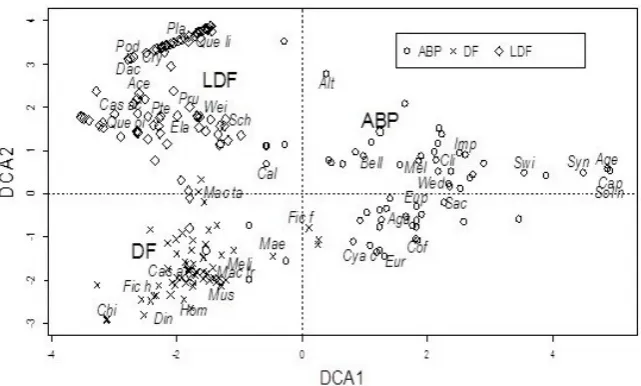
Fisher’s alpha (α, Fisher, 1943). The componens combined in Shannon-Wiener index are number of species (s) and proportion of total sample belonging to ith species (pi) as followed (Krebs, 1989). unidentified species were distinguished with local name) within 22 plots from various life forms such as tree (161 sp.), shrub (88 sp.), and herb (115 sp.). abandoned plantations were distinguished from disturbed and less disturbed forests by the value of DCA1. Within abandoned plantations, DCA 1 value reflects the disturbance intensity. Severe degrada-tion areas were grouped in high DCA1 value and less-degraded areas were placed in low DCA1 value. Within abandoned plantation there were two plots (A7 and A10) separated from the others. Plot A7 was located in area with active cultivation and dominated by plantation tree, crops and weeds, while A10 was the longest abandoned plantation, which adjacent to disturbed natural forest.
DCA1 values for two plots in natural forest around Cikaniki (P2 and P3), 11 secondary forests, and A10 were less than 0. The DCA2 values of disturbed forests were less than 0 while the less disturbed forest were more than 0. Then we separated the secondary forest plots into two types. They are seven plots (DF1 to DF7) as disturbed forest plots and four plots as less disturbed forest
S = α ln (1+N/α)
(LD1 to LD4). The sampling area for degraded forest located at central part of corridor area, while the less disturbed forests were sampled randomly at the slope and less accessible forests.
Fig. 3 shows the species score of DCA 1 and 2. The plantation trees, A. dammara and S.
macro-phylla had high value of DCA1. The pioneer trees
(Homalanthus populneus, Macaranga tanarius and
M. triloba), some invasive (Cinchonapubescens, M. DCA2. Base on these values, the study areas were composed by three communities as S. macrophylla
– A. dammara community in abandoned plantation
(plots of A1 to A11), M. eminii – Cyathea sp. at disturbed forest (plots of D1 to D7) and C.
acuminatissima – S. wallichii in less disturbed
forest (plots of LD1 to LD4) as shown in Table 1. The areas adjacent with local people settlements and accessible forest were severely degraded due to agriculture, fuel wood collecting and illegal logging. However, good condition of forest remaining at the steep places and/or far from local community.
Abandoned plantation (ABP)
This area had been the production forest and abandoned after declared as part of national park. The abandonment periods were varied among 11 plots from 1 to 30 years and it depends on the inten-sity of agriculture activity. Local people had been allowed to cultivate at some parts of production forest (Galudra et al., 2005). Therefore, the cultiva-tion areas still existed and difficult to be reduced because local community rely on agriculture to sup-port their live. As resup-ported by Cahyadi (2003), culti-vation area within 11 years increased about 8.8% from 1.356 ha in 1990 to 1.476 ha in 2001. The uniqueness of intensive cultivation (plot A7) can be shown in DCA graph (Fig. 2), that A7 was separated from fallowed plantation by the dominancy of crops (Capsicum frutescens, Coffea
arabica, Solanum nigrum and S. torvum) and weeds
(Ageratum conyzoides, Clidemia hirta,
Crasso-cephalum crepidioides, Synedrella nodiflora and
Wedelia trilobata). In the area without agriculture
and less disturbance, abandoned plantation recovered naturally to support wild life conserva-tion.
The abandoned plantation has low tree species richness as implied by low tree diversity indices
(Fisher’s α and Shannon-Wiener index), but recruitment of woody species relatively high in this
∑
pi ln pii=1
Fig. 2. The ordination of plots in corridor area based on DCA1 and DCA2 value. The abandoned plantations are marked as A (1-11); the disturbed forests are DF (1-7), less degraded forests are LD (1-4), and permanent plots (P2 and P3). The intensive cultivation led to severe degradation at plot A7. The longest abandonment period (A10) has similarity to less disturbed forest due to natural succession.
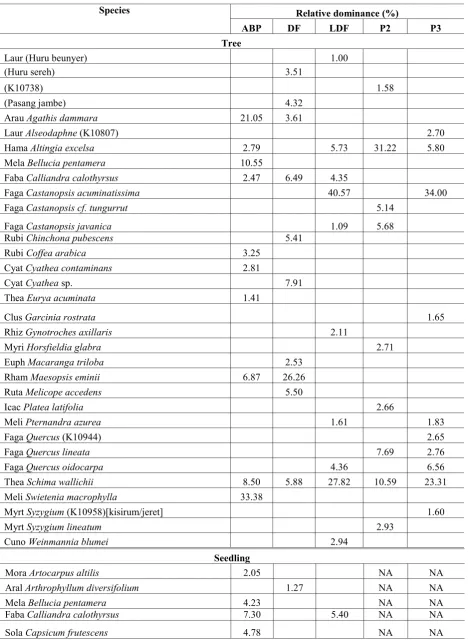
area (Table 1). Tree layer was dominated by mahogany (S. macrophylla, Rdo = 33.4%) and
damar (A. dammara, Rdo = 21.1%) as main
plan-tation tree (Table 1). The exotic fast growing species such as Bellucia pentamera (Rdo = 10.6%)
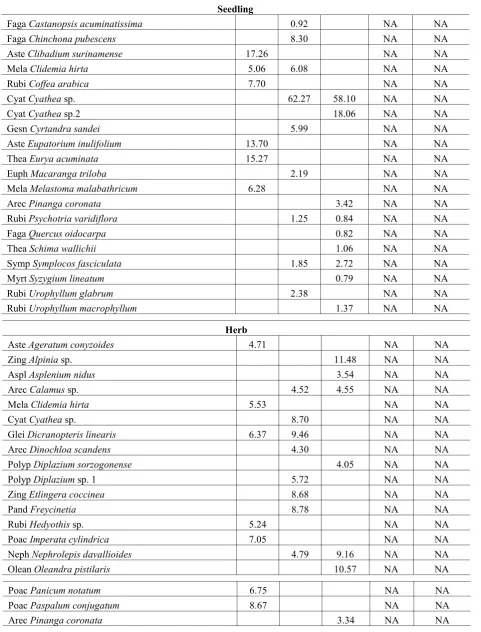
and M. eminii (Rdo = 6.9%) seem successfully to cated that forest species has possibility to establish inside this area. E. inulifolium is native to South America, introduced to Java in the 19th and now widely spread from abandoned coffee plantation to degraded forest (Smiet, 1992). Coffee (C. arabica, Rdo = 7.7%) and red pepper (C. frutescens, Rdo = 4.8%) as high economic value crops were abundant in this area. thicket below the plantation tree (Table 2). Among the study areas, abandoned plantation contained higher number of herb species than disturbed and less disturbed forest; 71, 52 and 43 species respec-tively (Table 1). It was clear that high light intensity
below plantation canopy could promote the establishment of herbaceous vegetation.
The disturbed forest (DF)
The human threats including timber and fuel wood exploitation, infrastructure establishment and invasion of exotic species degraded Halimun Salak corridor area seriously, thus forest species number decreased as indicated by low dominancy in this area (Table 2). As reported by Rinaldi et al. (2008), forest species dominated corridor approximately 27% due to occupancy of shrub, pioneer and inva-sive species.
This type of forest was derived from degraded old forest as indicated that forest species component such as Quercus oidocarpa remained as the biggest tree in this area, reached 49.6 cm in DBH and 28 m in height. The emergent tree at this site disappeared (Table 2) and now dominated by M. eminii (Rdo =
tolerant to low light intensity (Table 2).
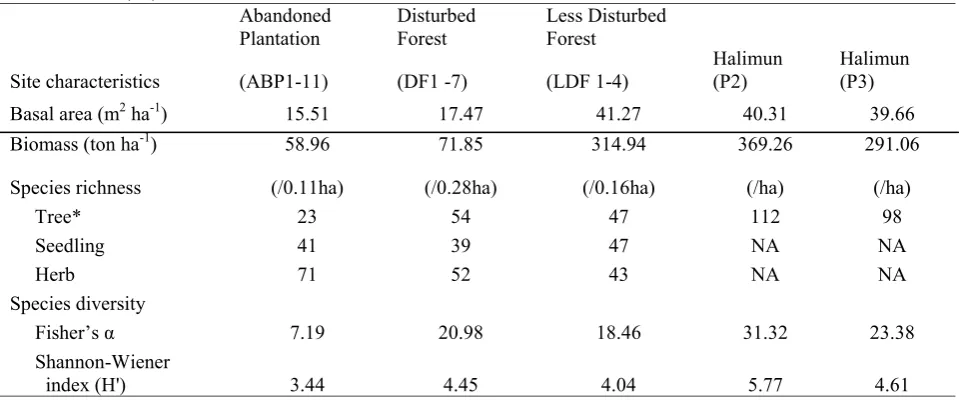
Site characteristics
Biomass (ton ha-1) 58.96 71.85 314.94 369.26 291.06
Species richness (/0.11ha) (/0.28ha) (/0.16ha) (/ha) (/ha)
Tree* 23 54 47 112 98 Halimun Salak corridor area, and reference sites at Halimun (P2 and P3) based on basal area (m2 ha-1), bio-mass (ton ha-1), species number of tree (T), Seedling (S), and herb (H), Fisher’s α, and Shannon-Wiener
Seedling
Mora Artocarpus altilis 2.05 NA NA
Aral Arthrophyllum diversifolium 1.27 NA NA
Mela Bellucia pentamera 4.23 NA NA
Faba Calliandra calothyrsus 7.30 5.40 NA NA
Sola Capsicum frutescens 4.78 NA NA
Species Relative dominance (%)
ABP DF LDF P2 P3
Tree
Laur (Huru beunyer) 1.00
(Huru sereh) 3.51
(K10738) 1.58
(Pasang jambe) 4.32
Arau Agathis dammara 21.05 3.61
Laur Alseodaphne (K10807) 2.70
Hama Altingia excelsa 2.79 5.73 31.22 5.80
Mela Bellucia pentamera 10.55
Faba Calliandra calothyrsus 2.47 6.49 4.35
Faga Castanopsis acuminatissima 40.57 34.00
Faga Castanopsis cf. tungurrut 5.14
Faga Castanopsis javanica 1.09 5.68
Rubi Chinchona pubescens 5.41
Rubi Coffea arabica 3.25
Cyat Cyathea contaminans 2.81
Cyat Cyathea sp. 7.91
Thea Eurya acuminata 1.41
Clus Garcinia rostrata 1.65
Rhiz Gynotroches axillaris 2.11
Myri Horsfieldia glabra 2.71
Euph Macaranga triloba 2.53
Rham Maesopsis eminii 6.87 26.26
Ruta Melicope accedens 5.50
Icac Platea latifolia 2.66
Meli Pternandra azurea 1.61 1.83
Faga Quercus (K10944) 2.65
Faga Quercus lineata 7.69 2.76
Faga Quercus oidocarpa 4.36 6.56
Thea Schima wallichii 8.50 5.88 27.82 10.59 23.31
Meli Swietenia macrophylla 33.38
Myrt Syzygium (K10958)[kisirum/jeret] 1.60
Myrt Syzygium lineatum 2.93
Cuno Weinmannia blumei 2.94
Seedling
Faga Castanopsis acuminatissima 0.92 NA NA
Faga Chinchona pubescens 8.30 NA NA
Aste Clibadium surinamense 17.26 NA NA
Mela Clidemia hirta 5.06 6.08 NA NA
Rubi Coffea arabica 7.70 NA NA
Cyat Cyathea sp. 62.27 58.10 NA NA
Cyat Cyathea sp.2 18.06 NA NA
Gesn Cyrtandra sandei 5.99 NA NA
Aste Eupatorium inulifolium 13.70 NA NA
Thea Eurya acuminata 15.27 NA NA
Euph Macaranga triloba 2.19 NA NA
Mela Melastoma malabathricum 6.28 NA NA
Arec Pinanga coronata 3.42 NA NA
Rubi Psychotria varidiflora 1.25 0.84 NA NA
Faga Quercus oidocarpa 0.82 NA NA
Thea Schima wallichii 1.06 NA NA
Symp Symplocos fasciculata 1.85 2.72 NA NA
Myrt Syzygium lineatum 0.79 NA NA
Rubi Urophyllum glabrum 2.38 NA NA
Rubi Urophyllum macrophyllum 1.37 NA NA
Table 2. Ten dominance species from each sampling site are displayed to describe the vegetation structure of aban-doned plantation (ABP), disturbed forest (DF), less disturbed forest (LDF) and permanent plot (P2 and P3) in corridor and Halimun area. Family name is written as four characters before species name (continued).
Herb
Aste Ageratum conyzoides 4.71 NA NA
Zing Alpinia sp. 11.48 NA NA
Aspl Asplenium nidus 3.54 NA NA
Arec Calamus sp. 4.52 4.55 NA NA
Mela Clidemia hirta 5.53 NA NA
Cyat Cyathea sp. 8.70 NA NA
Glei Dicranopteris linearis 6.37 9.46 NA NA
Arec Dinochloa scandens 4.30 NA NA
Polyp Diplazium sorzogonense 4.05 NA NA
Polyp Diplazium sp. 1 5.72 NA NA
Zing Etlingera coccinea 8.68 NA NA
Pand Freycinetia 8.78 NA NA
Rubi Hedyothis sp. 5.24 NA NA
Poac Imperata cylindrica 7.05 NA NA
Neph Nephrolepis davallioides 4.79 9.16 NA NA
Olean Oleandra pistilaris 10.57 NA NA
Poac Panicum notatum 6.75 NA NA
Poac Paspalum conjugatum 8.67 NA NA
Less disturbed forest (LDF)
The community structure as well as permanent plots in Halimun area, C. acuminatissima (Rdo =
40.6%) and S. wallichii (27.8%) took a role as important species in less disturbed forest (Table 2). The disturbance in this area indicated by invasion of fast growing tree C. calothyrsus (Rdo = 4.4%) (Table 2). Even though this forest has low number of tree species, basal area of less disturbed forest was higher than degraded forest and abandoned plantation, i.e. 41.27 m2 ha-1, 17.47 m2 ha-1 and 15.51 m2 ha-1, respectively (Table 1).
Tree fern of Cyathea sp. (Rdo = 58.1%) and
Cyathea sp. 2 (Rdo = 18.1%) were abundant in
seedling layer. Smiet (1992) reported that these species can survive in more shaded place. However, the exotic species of C. calothyrsus (Rdo = 3.4%) can survive in any forest condition as indicated by its high recruitment at disturbed and less disturbed area (Table 2). Shade tolerant species dominated herb layer such as fern (Nephrolepis davallioides, S.
plana and Diplazium sorzogonense), Oleandra
pis-tillaris and Alpinia sp. (Table 2).
Permanent plot (P2 and P3)
The communities of both permanent plots were dominated by Fagaceae, Theaceae and
Hamameli-daceae (Table 1). P2 had the highest tree species number (113 species) and basal area (40.31 m2 ha-1) (Table 1). The emergent tree (height > 30 m) at P2
was Quercuslineata reached 109 cm in DBH, while
in P3 was S. wallichii of 82 cm in DBH. The dominant species in P2 permanent plot were
Altingia excelsa (Rdo = 31.2%) and S. wallichii
(Rdo = 10.6%), while P3 dominated by C.
acuminatissima (Rdo = 34%) and S. wallichii (Rdo
= 23.3%). The species compositions in the perma-nent plots and less disturbed forest plots were rela-tively similar, thus they classified as less disturbed forest on DCA analysis (Fig. 2).
DISCUSSION
Forest succession in corridor area
The successional stage in this area can be deter-mined by species composition in each study area. The early successional stages observed in seriously degraded site, particularly in agriculture area. In the area without weeding activity, weed species such as
A. conyzoides, Synedrella nodiflora,
Crassocepha-lum crepidioides established below tree plantation.
This pattern was similar to the early succession on abandoned cropland in Sabah, where weedy species
become dominant soon after abandonment
Table 2. Ten dominance species from each sampling site are displayed to describe the vegetation structure of aban-doned plantation (ABP), disturbed forest (DF), less disturbed forest (LDF) and permanent plot (P2 and P3) in corridor and Halimun area. Family name is written as four characters before species name (continued).
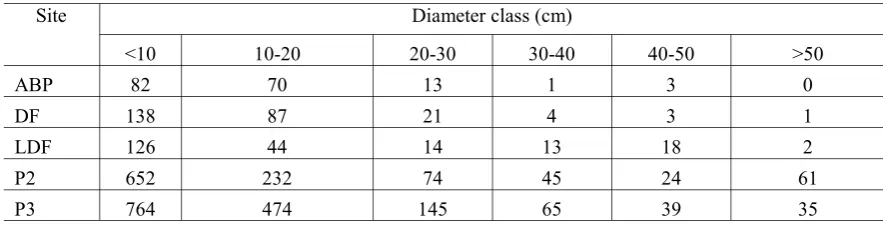
Table 3. The diameter class of tree (DBH>4.8 cm) at corridor and permanent plots. Small number of big tree (DBH>30 cm) at abandoned plantation (ABP) indicates high intensity of disturbance. The remaining big trees (DBH>30 cm) contribute to high biomass at less disturbed forest (LDF).
Site Diameter class (cm)
<10 10-20 20-30 30-40 40-50 >50
ABP 82 70 13 1 3 0
DF 138 87 21 4 3 1
LDF 126 44 14 13 18 2
P2 652 232 74 45 24 61
P3 764 474 145 65 39 35
*The species name for unidentified specimens follows the system in Herbarium of Kagoshima University
Arec Plectocomia 4.10 NA NA
Sela Saccharum spontaneum 4.94 NA NA
Thely Selaginella plana 17.15 7.55 15.28 NA NA
Acan Sphaerostephanos cf. heterocarpus 6.62 NA NA
Acan Strobilanthes sp. 4.55 NA NA
Aste Wedelia biflora 4.46 NA NA
Species Relative dominance (%)
(Ohtsuka, 1999). In some areas, understory layer is covered by perennial grass Imperata cylindrica and
Saccharum spontaneum. It is suggested that
agri-year abandonment. However, during the process of succession D. linearis often invades open area and covers the ground by its dense thicket. At the old abandoned plantation, species richness of pioneer and forest specie is low because of strong competi-tion by the exotic species (B. pentamera, M. eminii and C. calothyrsus).
The succession in disturbed areas refers to forest respond after gaps due to illegal logging. At the degraded forest, pioneer tree and some exotic species well established because they can compete in harsh condition. However, natural tree vegetation has possibility to grow naturally because forest species (Melicope accedens, Weinmannia blumei,
Schima wallichii, Rhodamnia cinerea and Prunus
arborea) still remain as seed resource for forest
rehabilitation. The less disturbed forests represent mature community in Gunung Halimun Salak National Park. C. acuminatissima, Platea excelsa,
Neolitse triplinervia, Sterculia oblongata and
Cas-tanopsis javanica were well conserved in the area
with less anthropogenic activity. The availability of forest species at corridor area takes an important role in natural successional process because they are the source of natural vegetation.
The aboveground biomass indicated the respond of vegetation to the anthropogenic disturbance. Bio-mass in abandoned plantation was produced mainly from tree plantation, but native and invasive species contribute most to biomass in degraded forest (Fig. 4). Though invasive species produced high biomass in degraded area, it does not mean that they are suitable to be planted for forest rehabilitation in corridor because their existence can modify community structure and may threaten the native species. In less disturbed forest where native species were well conserved, they produced high biomass approximately 373.34 ton ha-1 (Fig. 4).
Forest rehabilitation and its threats
Human disturbance such as cultivation, develop-ment of infrastructure, settledevelop-ment, illegal logging and fuel wood exploration are thought to be major factors of forest degradation at corridor of GHSNP. The road inside corridor to connect villages facili-tated local community to pass through this area and increased alternative access to reach forest. This
degraded and fragmented area cannot provide proper habitat especially for endangered species, therefore rehabilitation is required to restore the function of corridor.
Plantation at corridor area may not facilitate forest species establishment as indicated by low dominancy of natural forest vegetation. This was a different result with the other studies (Lugo, 1992; Parrotta et al., 1997; Boley et al., 2009) that planta-tion tree might help the establishment of pioneer woody species to accelerate natural succession. The modification of both physical and biological site condition might increase the possibility for seed to be transported from the adjacent remnant forest to germinate at plantation area. In addition, proper plantation must be considered to attract seed dis-persers such as bird and bat, thus they can disperse seed from remnant forest to the degraded area. Cusack & Montagnini (2004) reported that planta-tion could promote forest succession of woody species in understory layer by shading out the grasses, increasing soil nutrient and facilitating shade tolerant species.
Sometimes, the exotic plants are needed to convert harsh condition to be suitable one for the establishment of indigenous species (Lovejoy, 1985). Due to poor understanding of silviculture system in the tropics, some planted exotic species caused major problem to natural ecosystem (Lugo, 1992; Richardson, 2008; Binggeli, 2001). These species could shift the life-form dominance, reduce structural diversity, increase biomass and change nutrient cycle as reviewed from study case in southern hemisphere (Richardson, 2008). In Java Island, C. calothyrsus was planted for fuel, fodder establishment of native species and delay the forest rehabilitation process.
Human interference and ecological barrier following combination of competition with invasive species, low seed or root stock availability, risk of seed and seedling predation, lack of sustainable microhabitat for seed germiantion and seedling establishment, seasonal drought, soil nutrient limitation, root competition with grases and fern, and periodic fire can suppress successional process
(Lugo, 1992; Parrotta et al. 1997). Invasion of exotic species (M. eminii and C. calothyrsus) which
that regeneration of native vegetation on degraded land in Singapore was blocked by invasion of fern
D. linearis. This species in peninsular Malaysia can
survive under shading area, forms dense thickets aggressively, expands the rhizomes and excretes the allelopathic compound thereby could prevent the establishment of tree regeneration (Shono et al., succession and tree establishment in disturbed areas (Nishimura, 2011).
M. emenii as a fast growing tree now invades
natural forest widely, especially in tropical areas. Binggeli & Hamilton (1993); Binggeli (2003) and Rinaldi et al. (2008) reported that this species has strategies as follow: first, its seeds are easily distributed by bird, as hornbill in Tanzania; second, seeds and seedlings can survive in longer period and they grow rapidly when light increase due to the small shrub C. hirta at this corridor area seems not serious, however monitoring to these species is needed to control the invasion rate. Though it invaded in limited area of corridor area, the exis-tence of C. pubescens increased the risk of forest degradation because local people harvested the bark by cutting its stand for commercial use (Cahyadi, 2003).
Tree species in Halimun Salak National Park have potential as building material, fuel wood, board manufacture, edible fruit/vegetable, furniture and medical plants (Cahyadi, 2003; Gunawan et al., 2007; Polosakan, 2011). Though access to the remnant forest is difficult, local people enter the less degraded forest to explore timber trees such as
S. wallichii, A. excelsa, Myrtaceae and Fagaceae
due to economics needs (Polosakan 2011). There-fore, collaboration between local people and the manager of national park is required to conserve the corridor area.
Ecological value of corridor area
Rehabilitation of degraded forest becomes major concern in the corridor area, considering its functions to provide movement and foraging sites for endangered species, maintain water balance, support biodiversity and prevent soil and land slide (Gunawan et al., 2007; Rinaldi et al., 2008;
GHSNPMP-JICA, 2009). Degradation and frag-mentation at corridor affected population number of endangered animals (Van Ballen et al., 1999; Cahyadi, 2003; Dewi et al., 2007; Rinaldi et al., 2008; Yumarni et al., 2011). The javan gibbon needs forest canopy for their movement, but lack of emergent tree decreased their population within degraded area (Dewi et al., 2007; Yumarni et al., 2011). Ario (2007) reported that javan leopard can live close to human habitation, but they need broader habitat for foraging activity. Thus, the frag-mentation will impact the leopard population.
However, during the study, we only found leopard’s
footprints at less degraded area between Mt. Halimun and Mt. Salak. The importance of corridor is not only for conservation but also substantial for human because the rivers from this area can support some areas surrounding national park and prevent land slide during rainy season (Rinaldi et al., 2008; GHSNPMP-JICA, 2009). Therefore rehabilitation on degraded land is crucial to recover the function of corridor GHSNP.
Management strategy for forest rehabilitation Local people living adjacent to national park seem not clearly understand about the function of corridor, thus exploitation was ongoing severely in this area. Moreover, low economic level of rural community lead to high utilization of forest area for agriculture, timber, fuel wood and medical treat-ment (Galudra, 2003; Rinaldi et al., 2008; Polosa-kan, 2011). Even though resource exploitation by human intervention is prohibited in national park area, it is hard to eliminate because they settled before the establishment of national park.
The proper strategy on forest rehabilitation must be well designated for better management in the
future. The community based-conservation
management system which considering local knowledge and sharing benefit related to conserva-tion and utilizaconserva-tion initiatives are thought to be the best way to maintain conservation area (Harada, 2003; Gunawan et al., 2007; Perbatakusuma et al., 2010). In addition, environmental education must be disseminated to local people thereby local people can contribute on this conservation program in same vision. Due to local people settlement, reha-bilitation program must consider the alternative livelihood for them, which can reduce their dependence on forest. The utilization zone can be established for economic purpose of local community (Galudra, 2003).
invasive species (Richardson, 2008; Binggeli, 2001; Binggeli, 2003; Fukuda, 2010).
ACKNOWLEDGEMENTS
This study was funded by the Global Environment Research Fund (D-1005), The Ministry of The Environment, Japan. We wish to thank Mr. Istanto, the previous head of GHSNP, staffs of GHSNP, Mr. Mus composition and vegetation stucture in Gunung Halimun Salak Forest-Sukabumi. Berkala Hayati 5A: 1–4. (In Indonesian).
ARIO, A. 2007. Javan leopard (Panthera pardus me-las) among human activities: preliminary assess-ment on the carrying capacity of Mount Salak forest area, Mount Halimun-Salak National Park. Conservation International Indonesia, Jakarta.
BINGGELI, P. & HAMILTON, A. C. 1993. Biological invasion by Maesopsis eminii in the East Usambara forest, Tanzania. Opera Botanica 121: 229–235. BINGGELI, P. 2001. The human dimension of invasive
woody plants. In: MCNEELY, A. (Ed.) The great Effects of active pasture, teak (Tectona grandis) and mixed native plantations on soil chemistry in Costa Rica. Forest Ecology and Management 257(11): 2254–2261.
CAHYADI, I. 2003. Spatial analysis of structure and function of forest corridor between Mount Halimun National Park and Mount Salak Reserved Forest. Bogor Agricultural University, Bogor. (Thesis; In Indonesian).
CUSACK, D. & MONTAGNINI, F. 2004. The role of native plantation in recovery of understory woody diversity in degraded pasteurlands of Costa Rica. Forest Ecology and Management 188: 1–15. DEWI, H., PRASETYO, L. B. & RINALDI, D. 2007.
Habitat suitability mapping of silvery gibbon (Hylobates moloch Audebert 1797 in Gunung Halimun-Salak National Park. Media Konservasi 12 (1): 1–9. (In Indonesian).
DJUWANSAH, M. 1997. The soil of the Gunung Halimun National Park. In: YONEDA, M., SUGARDJITO, J. & SIMBOLON, H. (Eds.) Research and conservation of Biodiversity in Indo-nesia LIPI, PHPA & JICA, Bogor.Vol. II:105–116. DUNCAN, R. S. & DUNCAN, V. E. 2000. Forest
succession and distance from forest edge in an
Afro-Tropical grassland. Biotropica 32(1): 33–41. [FAO] FOOD AND AGRICULTURE
ORGANIZA-TION. 2010. Global forest resource assessment 2010: main report. FAO, Rome.
[FAO] FOOD AND AGRICULTURE ORGANIZA-TION. 2011. Asia Pacific forestry sector outlook of an animal population. Journal of Animal Ecology 12: 42–58.
FUKUDA, T. 2010. Experiment for the forest rehabili-tation of corridor area between Gn. Halimun- Salak dominated by Calliandra calothyrsus. Kagoshima University, Kagoshima. (Thesis).
GALUDRA, G. 2003. Conservation policies versus reality: case study flora, fauna and land utilization by local communities in Gunung Halimun-Salak National Park. ICRAF, Bogor.
GALUDRA, G., SIRAIT, M., RAMDHANIATY, N., SOENARTO, F. & NURZAMAN B. 2005. History of land-use policies and designation of Mount Halimun-Salak National Park. Jurnal Manajemen Hutan Tropika XI(1): 1–13. (In Indonesian). GHSNPMP-JICA. 2009. Ecological study
Halimun-Salak Corridor Mount Halimun-Halimun-Salak National Park. GHSNPMP-JICA, Bogor.
GUNAWAN, H., CHUMSANGSRI, T., LASTINI, T. & GUNAWAN, W. 2007. Policy in compromising ecological and social aspects for establishing Halimun-Salak corridor. SEAMEO - BIOTROP-Bogor Agricultural University, BIOTROP-Bogor.
HARADA, K. 2003. Attitudes of local people towards conservation and Gunung Halimun National Park in West Java, Indonesia. Journal of Forest Research 8: 271–281.
HILL, M. O. & GAUCH, H. G. 1980. Detrended correspondence analysis: an improved ordination technique. Vegetatio 42: 47–58.
KREBS, C. J. 1989. Ecological methodology. Harper Collins Publishers, New York.
LOVEJOY, T. 1985. Rehabilitation of degraded tropi-cal forest lands. The Environmentalist 5: 13–20. LOWE, S., BROWNE, M., BOUDJELAS, S. & DE
POORTER M. 2000. 100 of the World’s Worst In-vasive Alien Species A selection from the Global Invasive Species Database. The Invasive Species Specialist Group (ISSG) a specialist group of the Species Survival Commission (SSC) of the World Conservation Union (IUCN), Auckland.
LUGO, A. E. 1992. Tree plantation for rehabilitating damaged forest land in the tropics. In WALI, M. K. (Ed.) Ecosystem analysis and synthesis. SPB Academic Publishing, The Hague. Vol. 2: 247–255. NAWIR, A. A., MURNIATI & RUMBOKO, L. 2007.
Forest rehabilitation in Indonesia. Where to after more than three decades?. CIFOR, Jakarta.
communities in Tanjung Puting National Park, In-donesia. University of California, Los Angeles. (Dissertation).
OHTSUKA, T. 1999. Early stages of secondary succes-sion on abandoned cropland in north-east Borneo Island. Ecological Research 14: 281–290.
OTSAMO, A. 2001. Forest plantation on Imperata grasslands in Indonesia: establishment, silviculture and utilization potential. University of Helsinki, Helsinki. (Dissertation). 2010. Strengthening biodiversity conservation at key landscape in Northern Sumatra biodiversity corridor. CI Indonesia, Jakarta.
POLOSAKAN, R. 2011. Tree diversity and timber po-tential utilization by local community in Gunung Halimun Salak National Park-Sukabumi. Berkala Penelitian Hayati 5A: 67–72. (In Indonesian). PRASETYO, L. B., SETIAWAN, Y. & PERMADI, T.
2006. Land use and land cover change Gunung Halimun Salak National Park, West Java. Center for International Forestry Research (CIFOR), Bogor. RICHARDSON, D. 2008. Forestry trees as invasive
aliens. Conservation Biology 12: 18–26.
RINALDI, D., HARAHAP, S. H., PRAWIRADI-LAGA, D. M., SAMBAS, E., WIRIADINATA, H., PURWANINGSIH, FEBRIANA, I., WIDYANIN-GRUM, I. K. & FAIZIN, N. 2008. Ecology of corri-dor Halimun-Salak Mount Halimun Salak National Park. Mount Halimun Salak National Park. Gunung Halimun – Salak National Park Management Project (GHSNPMP) – JICA, Bogor. (In Indonesian). SAHOO, U. K. & LALFAKAWMA. 2010. Population
dynamic of Schima wallichii in an undisturbed vs a disturbed tropical forest stand of North-East India. International Journal of Ecology and Environ-mental Science 36 (2&3): 157–165.
SETIAWAN, N. N. & SULISTYAWATI, E. 2008. Succession following reforestation on abandoned fields in Mount Papandayan, West Java. In: Inter-national Conference on Environmental Research
and Technology on” Biodiversity conservation and protected areas management” (ICERTS 2008). 444–
447.
SHONO, K., DAVIES, J. S. & KHENG, C. Y. 2006. Regeneration of native plant species in restored for-est on degraded lands in Singapore. Forest Ecology and Management 237: 574–582.
SIMBOLON, H. & MIRMANTO, E. 1997. Altitudinal zonation of the forest vegetation in Gunung Halimun National Park, West Java. In: YONEDA M, SUGARDJITO, J. & SIMBOLON, H. (Eds.) Research and conservation of Biodiversity in Indo-nesia. LIPI, PHPA & JICA, Bogor. Vol. II: 14–35. SMIET, A. C. 1990. Forest ecology on Java: conversion
and usage in a historical perspective. Journal of Tropical Forest Science 2(4): 286–302.
SMIET, A. C. 1992. Forest ecology on Java: human impact and vegetation of montane forest. Journal of Tropical Ecology 8:129–152.
SUGARDJITO, J., SINAGA, H. & YONEDA, M. 1997. Survey of the distribution and density of pri-mates in Gunung Halimun National Park West Java, Indonesia. In: YONEDA M, SUGARDJITO, J. & SIMBOLON, H. (Eds.) Research and conservation of Biodiversity in Indonesia. LIPI, PHPA & JICA, Bogor. Vol II: 56–60.
SUZUKI, E., YONEDA, M., SIMBOLON, H., FA-NANI, Z., NISHIMURA, T. & KIMURA, M. 1998. Monitoring of vegetational change in permanent plots on Gn. Halimun National Park. In: SIM-BOLON, H., YONEDA, M. & SUGARDJITO, J. (Eds.) Research and Conservation of Biodiversity in Indonesia. LIPI, PHPA & JICA, Bogor. Vol IV:60– 81.
SUZUKI, E., YONEDA, M., SIMBOLON, H., MU-HIDIN, A., & WAKIYAMA, S. 1997. Establish-ment of two 1-ha permanent plots in Gn. Halimun National Park study of vegetation structure and for-est dynamics. In: YONEDA M, SUGARDJITO, J.
TAKAHASHI, S. 2006. Field-based research and biodi-versity conservation: review and prospects of the Biodiversity Conservation Project in Indonesia. Tropics 15: 261-265. hawk-eagle Spizaetus bartelsi. Bird Conservation International 9: 333–349.
YAMAKURA, T., HAGIHARA, A., SUKARDJI, S. & OGAWA, H. 1986. Aboveground biomass of tropi-cal rain forest stands in Indonesia Borneo. Vegetatio 68:71-82.
Scope. Reinwardtia is a scientific irregular journal on plant taxonomy, plant ecology and ethnobotany published in December. Manuscript intended for a publication should be written in English.
Titles. Titles should be brief, informative and followed by author's name and mailing address in one-paragraphed.
Abstract. English abstract followed by Indonesian abstract of not more than 250 words. Keywords should be given below each abstract.
Manuscript. Manuscript is original paper and represent an article which has not been published in any other journal or proceedings. The manuscript of no more than 200 pages by using Times New Roman 11, MS Word for Windows of A4 with double spacing, submitted to the editor through <[email protected]>. New paragraph should be indented in by 5 characters. For the style of presentation, authors should follow the latest issue of Reinwardtia very closely. Author(s) should send the preferred running title of the article submitted. Every manuscript will be sent to two blind reviewers.
Identification key. Taxonomic identification key should be prepared using the aligned couplet type.
Nomenclature. Strict adherence to the International Code of Botanical Nomenclature is observed, so that taxonomic and nomenclatural novelties should be clearly shown. English description for new taxon proposed should be provided and the herbaria where the type specimens area deposited should be presented. Name of taxon in taxonomic treatment should be presented in the long form that is name of taxon, author's name, year of publication, abbreviated journal or book title, volume, number and page.
Map/line drawing illustration/photograph. Map, line drawing illustration, or photograph preferably should be prepared in landscape presentation to occupy two columns. Illustration must be submitted as original art accompanying, but separated from the manuscript. The illustration should be saved in JPG or GIF format at least 350 pixels. Legends or illustration must be submitted separately at the end of the manuscript.
References. Bibliography, list of literature cited or references follow the Harvard system as the following examples.
Journal : KRAENZLIN, F. 1913. Cyrtandraceae novae Philippinenses I. Philipp. J. Sci. 8: 163-179.
MAYER, V., MOLLER, ML, PERRET, M. & WEBER, A. 2003. Phylogenetic position and generic differentiation of Epithemateae (Gesneriaceae) inferred from plastid DNA sequence data. American J. Bot. 90: 321-329.
Proceedings :TEMU, S. T. 1995. Peranan tumbuhan dan ternak dalam upacara adat "Djoka Dju" pada suku Lio, Ende, Flores, Nusa Tenggara Timur. In: NASUTION, E. (Ed.). Presiding Seminar dan Lokakarya Nasional Etnobotani II. LIP1 & Perpustakaan Nasional: 263-268. (In Indonesian).
SIMBOLON, H. & MIRMANTO, E. 2000. Checklist of plant species in the peat swamp forests of Central Kalimantan, Indonesia. In: IWAKUMA et al. (Eds.) Proceedings of the International Symposium on: Tropical Peatlands. Pp. 179-190.
Book : RIDLEY, H. N. 1923. Flora of the Malay Peninsula 2. L. Reeve & Co. Ltd, London.
Part of Book : BENTHAM, G. 1876. Gesneriaceae. In: BENTHAM, G. & HOOKER, J. D. Genera plantarum 2. Lovell Reeve & Co., London. Pp. 990-1025.
Thesis : BAIRD, L. 2002. A Grammar of Keo: An Austronesian language of East Nusantara.
Australian National University, Canberra. [PhD. Thesis].
Published by Herbarium Bogoriense, Botany Division, Research Center for Biology, Indonesian Institute of Sciences
Address: Jin. Raya Jakarta-Bogor Km. 46 Cibinong 16911, P.O. Box 25 Cibinong Telp. (+ 62) 21 8765066; Fax (+62) 21 8765062
E-mail: [email protected]
REINWARDTIA
Author Agreement Form
Title of article
Name of Author(s) :
I/We hereby declare that:
• My/Our manuscript was based on my/our original work.
• It was not published or submitted to other journal for publication.
• I/we agree to publish my/our manuscript and the copyright of this article is owned by Reinwardtia. • We have obtained written permission from copyright owners for any excerpts from copyrighted
works that are included and have credited the sources in our article.
Author signature (s) Date
SUZANA SABRAN, REUBEN NILUS, JOAN T. PEREIRA & JOHN BAPTIST SUGAU. Contribution of the heart of Borneo (HoB) initiative towards botanical exploration in Sabah, Malaysia 137
WENNI SETYO LESTARI, BAYU ADJIE, TASSANAI JARUWATANAPHAN, YASUYUKI WATANO & MADE
PHAR-MAWATI. Molecular phylogeny of maidenhair fern genus Adiantum (Pteridaceae) from Lesser Sunda Islands, Indonesia based on
Rbcl and Trnl-f 143
ELIZABETH A. WIDJAJA & DANIEL POTTER. Floristic study of Mekongga Protected Forest: towards establishment of the Mekongga National Park 157
YESSI SANTIKA, EKA FATMAWATI TIHURUA & TEGUH TRIONO. Comparative leaves anatomy of Pandanus, Freycinetia
and Sararanga (Pandanaceae) and their diagnostic value 163
SUHARDJONO PRAWIROATMODJO & KUSWATA KARTAWINATA. Floristic diversity and structural characteristics of mangrove forest of Raj a Ampat, West Papua, Indonesia 171
IAN M. TURNER. A new combination in Orophea (Annonaceae) for Uvaria nitida Roxb. ex G. Don 181
IVAN S AVINOV. Taxonomic revision of Asian genus Glyptopetalum Thwaites (Celastraceae R. Br.) 183
YUSI ROSALINA, NISYAWATL ERWIN NURDIN, JATNA SUPRIATNA & KUSWATA KARTAWINATA. Floristic compo-sition and structure of a peat swamp forest in the conservation area of the PT National Sago Prima, Selat Panjang, Riau, Indone-sia 193
IMAN HID AY AT & JAMJAN MEEBOON. Cercospora brunfelsiicola (Fungi, Mycosphaerellaceae), a new tropical Cercosporoid
fungus on Brunfelsia uniflora 211
MAX VAN BALGOOY & ELIZABETH A. WIDJAJA. Flora of Bali: a provisional checklist 219
EKA FATMAWATI TIHURUA & INA ERLINAWATI. Leaf anatomy of Pandanus spp. (Pandanceae) from Sebangau and Bukit
Baka-Bukit Raya National Park, Kalimantan, Indonesia 223
JULIA SANG & RUTH KIEW. Diversity of Begonia (Begoniaceae) in Borneo - How many species are there? 23 3
DIAN LATIFAH, ROBERT A. CONGDON & JOSEPH A. HOLTUM. A Physiological approach to conservation of four palm
Vol. 14. No. 1.2014
CONTENTS
PageABDULROKHMAN KARTONEGORO & DANIEL POTTER. The Gesneriaceae of Sulawesi VI: the species from Mekongga Mts.
with a new species of Cyrtandra described 1
LIM CHUNG LU & RUTH KIEW. Codonoboea (Gesneriaceae) sections in Peninsular Malaysia 13
WISNU H. ARDI, YAYAN W. C. KUSUMA, CARL E. LEWIS, ROSNIATI A. RISNA, HARRY WIRIADINATA, MELISSA E.
ABDO & DANIEL C. THOMAS. Studies on Begonia (Begoniaceae) of the Molucca Islands I: Two new species from Halmahera,
Indonesia, and an updated description of Begonia holosericea 19
YUZAMMI, JOKO R. WITONO & WILBERT L. A. HETTERSCHEID. Conservation status of Amorphophallus discophorus
Backer & Alderw. (Araceae) in Java, Indonesia 27
MOHAMMAD F. ROYYANI & JOENI S. RAHAJOE. Behind the sacred tree: local people and their natural resources sustainabil-ity 35
FIFI GUS DWIYANTI, KOICHI KAMIYA & KO HARADA. Phylogeographic structure of the commercially important tropical
tree species, Dryobalanops aromatica Gaertn. F. (Dipterocarpaceae) revealed by microsatellite markers 43
SACHIKO NISHIDA & HENK VAN DER WERFF. Do cuticle characters support the recognition of Alseodaphne, Nothaphoebe
and Dehaasia as distinct genera? 53
NURUL AMAL LATIFF, RAHAYU SUKMARIA SUKRI & FAIZAH METALI. Nepenthes diversity and abundance in five
habi-tats in Brunei Damssalam 67
NURUL HAZLINA ZATNI & RAHAYU SUKMARIA SUKRI. The diversity and abundance of ground herbs in lowland mixed Dipterocarp forest and heath forest in Brunei Darussalam 73
MUHAMMAD AMIRUL AIMAN AHMAD JUHARI, NORATNI TALIP, CHE NURUL ATNI CHE AMRI & MOHAMAD RUZI
ABDUL RAHMAN. Trichomes morphology of petals in some species of Acanthaceae 79
DIAN ROSLEINE, EIZI SUZUKI, ATIH SUNDAWIATI, WARDI SEPTIANA & DESY EKAWATI. The effect of land use history on natural forest rehabilitation at corridor area of Gunung Halimun Salak National Park, West Java, Indonesia 85
JULIUS KULIP. The Ethnobotany of the Dusun people in Tikolod village, Tambunan district, Sabah, Malaysia 101
PETER O'BYRNE. On the evolution of Dipodium R. Br 123
Reinwardtia is a LIPI accredited Journal (517/AU2/P2MI-LIPI/04/2013)
Herbarium Bogoriense Botany Division
Research Center for Biology - Indonesian Institute of Sciences Cibinong Science Center