THE INFLUENCE OF USING CLIMBING GRAMMAR MOUNTAIN (CGM) GAME TOWARDS STUDENTS’ SIMPLE PAST TENSE MASTERY AT THE SECOND SEMESTER OF THE EIGHTH GRADE AT MTs NEGERI 1
CENTRAL LAMPUNG IN THE ACADEMIC YEAR OF 2016/ 2017
A Thesis
Submitted as a Partial Fulfillment of the Requirements for S1-Degree
By :
Tiara Puspa Kusuma NPM: 1211040079
Study Program : English Education Advisor : Bambang Irfani, M. Pd Co-Advisor : Deri Herdawan, M. Pd
TARBIYAH AND TEACHER TRAINING FACULTY STATE INSTITUTE OF ISLAMIC STUDIES
RADEN INTAN LAMPUNG
ABSTRACT
THE INFLUENCE OF USING CLIMBING GRAMMAR MOUNTAIN GAME TOWARDS STUDENTS’ SIMLPE PAST TENSE MASTERY AT THE SECOND SEMESTER OF THE EIGHTH GRADE AT MTs NEGERI 1 CENTRAL LAMPUNG IN THE ACADEMIC YEAR OF 2016/ 2017
By
TIARA PUSPA KUSUMA
In this research the writer focused on the students’ grammar mastery of simple past tense. Simple past tense is one of the subjects of the structure that must students learn and master. This thesis discussed the influence of using climbing grammar mountain game in teaching simple past tense. The objective of the research is to know whether there is a significant influence of using climbing grammar mountain game towards students’ simple past tense mastery. It is expected that the result of the study will provide a deeper understanding about the use of climbing grammar mountain game for English teachers and for the readers.
The methodology of this research was quasi experimental design. The writer did three steps in conducting this research: pre-test, treatment, and post-test. the population of this research was the eighth grade of MTs Negeri 1 Central Lampung. The sample of this research was chosen by doing cluster random sampling technique. The sample consisted of two classes, one as a experimental class and another class as a control class. This research was held in three meetings 2x40 minutes for each meeting. This design used pre-test and post-test to find out students’ simple past tense mastery test. After giving the post-test, the writer analyzed the data by using independent samples test.
From the data analysis it was found that the result of T-Test is 0.045. This result is consulted to the score of the value significant generated Sig. (Pvalue) < α = 0.05. Therefore, Ho is rejected and Ha is accepted. In other words, from this research it is known that climbing grammar mountain game caan improve the students’ simple past tense mastery. It can be concluded that there is a significant influence of using climbing grammar mountain game towards students’ simple past tense mastery.
MOTTO
All that they do is noted in (their) books (of deeds) (52) Every matter, small and great, is on record (53)1
1
DEDICATION
Praise and gratitude to Allah the Almighty for this abundant blessing to me, and from my deep of heart and great love, this thesis is dedicated to:
1. My beloved parents the late Mr. Rusman Effendy and Ms. Dewi Samirawati who always support and pray for my success.
2. My beloved brothers Medico Eka Putra and Krisna Andika Putra, and sister Decera Millian.
DECLARATION
Hereby, I state this thesis entitled “The Influence of Using Climbing Grammar Mountain Game Towards Students’ Simple Past Tense Mastery at the Second
Semester of the Eighth Grade at MTs Negeri 1 Central Lampung in the Academic Year of 2016/ 2017” is completely my own work. I am fully aware that I have quoted
some statements and ideas from other sources, and they are properly acknowledge in this thesis.
Bandar Lampung, May 16th, 2017. Declared by,
CURRICULUM VITAE
The writer’s name is Tiara Puspa Kusuma. She was born in Palembang on April 28th , 1993. She is the fourth child of four children of Mr. Rusman Effendy and Mrs. Dewi Samirawati. She has two brothers; Medico Eka Putra and Krisna andika Putra, and sister; Decera Millian.
ACKNOWLEDGEMENT
Praise be to Allah the Almighty for the blessing given to her during her study and for completing this final project. Besides, she is also grateful to many people for
constributing their ideas and time given to her in completing this thesis entitled “The Influence of Climbing Grammar Mountain Game Towards Students’Simple Past
Tense Mastery at the Second Semester at the Eighth Grade of MTs Negeri 1 Central Lampung in the Academic Year of 2016/ 2017”. This thesis is presented to the
English Education Study Program of UIN Raden Intan Lampung. The primary aim of writing this thesis is to fulfill students’ partial fulfillment of the requirement to obtain
S1-Degree.
Then, the writer would like to thank the following people for their ideas, time, and guidance for this thesis:
1. The Dean of Tarbiyah and Teacher Training Faculty Dr. H. Chairul Anwar M. Pd, UIN Raden Intan Lampung with all staff who had given the writer opportunity to study until the end of this thesis composition.
2. The Chairperson of English Education Study Program of UIN Raden Intan Lampung Ms. Meisuri M. Pd.
3. Mr. Bambang Irfani M. Pd the advisor who has giving guidance and help
4. Mr. Deri Herdawan M. Pd the co-advisor who has giving guidance and supervision to finish this thesis.
5. All lectures of English Education Department of UIN Raden Intan Lampung.
6. All writers’ close friends of English Department of UIN Raden Intan Lampung.
Finally, none or nothing is perfect and neither is thesis. Any correction, comments, and criticism for the betterment of this thesis are always open heartedly welcome.
Bandar Lampung, May 16th, 2017. The Writer,
TIARA PUSPA KUSUMA
TABLE OF CONTENTS
COVER ... i
ABSTRACT ... ii
APPROVAL... iii
ADMISSION ... iv
MOTTO ... v
DECLARATION ... vi
DEDICATION ... vii
CURRICULUM VITAE ... viii
ACKNOWLEDGEMENT ... ix
TABLE OF CONTENTS ... xi
LIST OF TABLES ... xvi
LIST OF FIGURE... xvii
LIST OF APPENDICES... xviii
CHAPTER I INTRODUCTION A. Background of the Problem ... 1
B. Identification of the Problem ... 6
C. Limitation of the Problem ... 6
D. Formulation of the Problem ... 7
E. Objective of the Research ... 7
F. Uses of the Research ... 7
G. Scope of the Research ... 7
1. Subject of the Research ... 7
2. Object of the Research ... 7
3. Place of the Research ... 8
CHAPTER II REVIEW OF RELATED LITERATURE
A. Frame of Theory
1. Teaching English as a Foreign Language... 9
2. Simple Past Tense ... 11
a. Concept of Grammar ... 11
b. Concept of Tense ... 13
c. Concept of Simple Past Tense. ... 15
d. Concept of Simple Past Tense Mastery... 20
3. Climbing Grammar Mountain (CGM)Game ... 21
a. Concept of Game ... 21
b. Concept of CGM Game... 23
c. Procedure of CGM Game ... 24
d. Procedure of Teaching Simple Past Tense by Using CGM Game ... 26
e. The Advantages and Disadvantages of Using CGM Game ... 27
4. Transformation Drill Technique ... 28
a. Concept of Transformation Drill Technique. ... 28
b. Procedure of Teaching Simple Past Tense by Using Transformation Drill Tech ... 29
c. The Advantages and Disadvantages of Using Transformation Drill Technique... 29
B. Frame of Thinking ... 30
C. Hypothesis ... 32
CHAPTER III RESEARCH METHODOLOGY A. Research Design ... 33
B. Variable of the Research ... 35
C. Operational Definition of Variable ... 35
1. Independent Variable ... 35
2. Dependent Variable ... 35
D. Population, Sample, and Sampling Technique ... 36
1. Population of the Research ... 36
2. Sample of the Research ... 37
3. Sampling Technique ... 37
E. Data Collecting Technique ... 38
F. Instrument of the research ... 39
G. Research Procedure ... 40
1. Planning ... 40
3. Reporting ... 43
H. Scoring System... 43
I. Validity and Reliability ... 44
1. Validity of the Test ... 44
2. Reliability of the Test ... 46
J. The Data Analysis ... 46
1. Fulfillment of the Assumptions ... 47
a. Normality of the Test ... 47
b. Homogeneity of the Test ... 47
2. Hypothetical Test ... 48
CHAPTER IV RESULT AND DISCUSSION A. Description of MTs Negeri 1 Central Lampung ... 50
1. Situation of Research Place ... 50
2. The Teacher and staff of MTs negeri 1 Central Lampung ... 50
3. The Facilities of MTs Negeri 1 Central Lampung ... 51
B. Research Procedure ... 52
C. Process of Treatment ... 53
1. Description of the First Treatment ... 53
2. Description of the Second Treatment ... 54
3. Description of the Third Treatment ... 55
D. Result of the Research ... 56
1. Result of Pre-Test ... 56
2. Result of Post-Tes ... 58
3. Gain Score ... 60
E. Result of Data Analysis ... 63
1. Fulfillment of the Assumptions ... 63
a. Result of Normality Test ... 63
b. Result of Homogeneity Test ... 64
2. Result of Hypothetical Test ... 65
REFERENCES
LIST OF APPENDICES
Appendix 1 Interview Guideline for the Teacher... 71
Appendix 2 Transcript of Interview with the Teacher ... 72
Appendix 3 Interview Guideline for the Students ... 73
Appendix 4 Transcript of Interview with the Students ... 74
Appendix 5 PRE-TEST BEFORE VALIDITY ... 76
Appendix 6 The Answer Key of Pre-Test Before Validity ... 81
Appendix 7 POST-TEST BEFORE VALIDITY ... 82
Appendix 8 The Answer Key of Post-Test Before Validity ... 87
Appendix 9 Anates of Pre-Test Validity ... 88
Appendix 10 Anates of Post-Test Validity ... 90
Appendix 11 PRE-TEST ... 92
Appendix 12 The Answer Key of Pre-Test ... 95
Appendix 13 POST-TEST ... 96
Appendix 14 The Answer Key of Pre-Test ... 99
Appendix 15 Gain Score ... 100
Appendix 16 Result of Pre-Test in Experimental Class ... 102
Appendix 17 Result of Post-Test in Experimental Class ... 103
Appendix 18 Result of Pre-Test in Control Class ... 104
Appendix 19 Result of Post-Test in Control Class ... 105
LIST OF TABLES
Table. 1 The Data of Formative Test of Sudents at the Eighth Grade of MTs Negeri
1 Central Lampung in the Academic Year 2016/ 2017…. ... 4
Table.2Regular and Irregular Verb…. ... 17
Table.3Randomized Subjects Pre-Test Post-Test Control Group Design ... 34
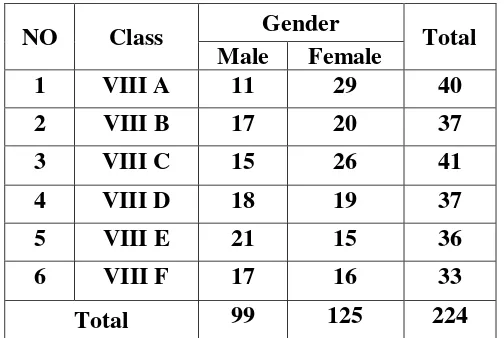
Table.4The Total Numbers of the Students at the Eighth Grade of MTs Negeri 1 Central Lampung in the Academic Year 2016/ 2017 ... 36
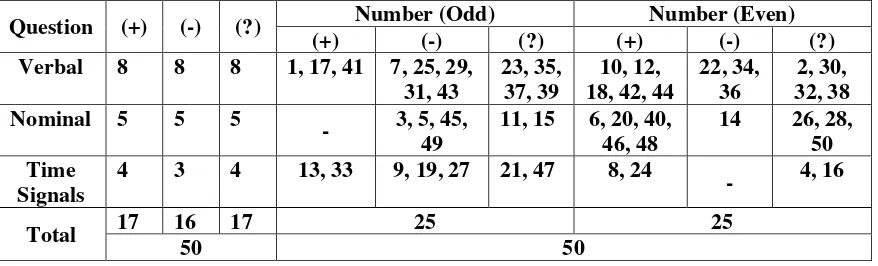
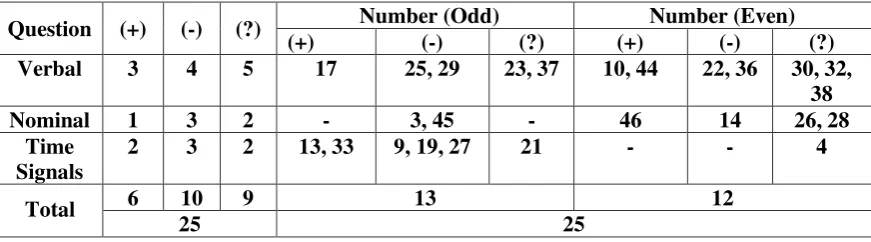
Table. 5 The Items of Test for Pre-Test and Post-Test Before Validity ... 39
Table. 6 The Items of Test for Pre-Test After Validity ... 40
Table. 7 The Items of Test for Post-Test After Validity ... 40
Table. 8 The Number of Students at MTs Negeri 1 Central Lampung ... 51
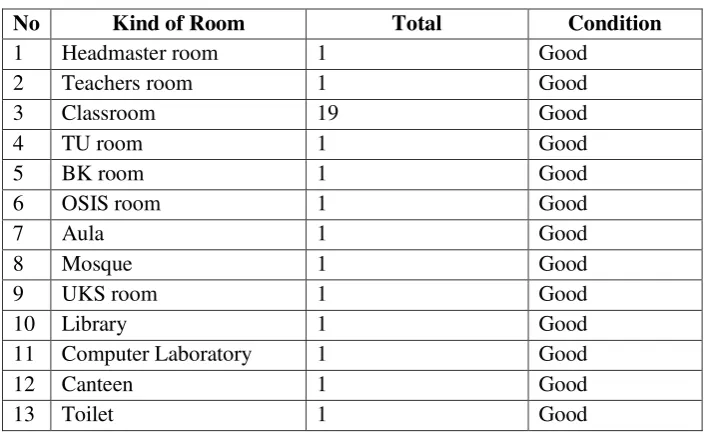
Table. 9 The Rooms of MTs Negeri 1 Central Lampung ... 51
Table. 10 The Normality Test of Experimental and Control Class ... 63
Table. 11 The Homogeneity Test of Experimental and Control Class ... 64
LIST OF FIGURE
Figure. 1 Classification of Tense ... 14
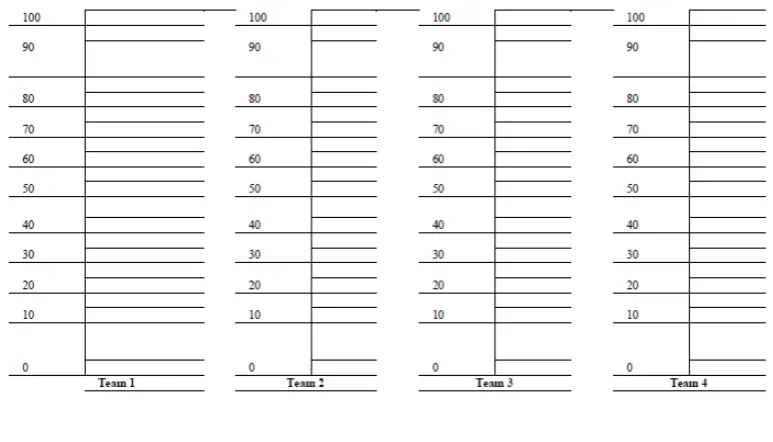
Figure. 2 Scoring of Climbing Grammar Mountain (CGM) Game ... 24
Figure. 3 The Result of Pre-Test of VIII B ... 57
Figure. 4 The Result of Pre-Test of VIII D ... 58
Figure. 5 The Result of Post-Test of VIII B ... 59
CHAPTER I INTRODUCTION
A. Background of the Problem
Language is important in human life, as human being, people use language to communicate with one and another. It is also used to deliver message or ideas from the speaker to the listener and from the writer to the reader. Without language it is impossible for people or everyone to join interaction each other in daily life or in learning something and also the human activities can not run well without language. Siahaan says, “Language is a set of rules, which is used as a tool of human communication”.2
It means that by the language people communicate with others will be easier. They can easily join interaction in daily life or in learning something. Without language it is impossible for everyone to gain knowledge, have interaction with others, or learn.
In Indonesia, English is a foreign language that is taught formally from junior high school through university levels as a compulsary subject. It is also taught at elementary school as local content. According to Harmer, English as a foreign language that is generally taken to apply to students who are studying general English at schools and institutes in their own country or as transitory visitors in target language country.3 Although English is not used for communication in their daily
2
Sanggam Siahaan, Issues in Linguistics (Yogyakarta: Graha Ilmu, 2008),p. 185. 3
lives, there are many people study English in formal or non formal, realizing that English is important for our education. English became one of requirements subjects that should be passed from the last national examination. It proves that English is important to be learnt.
All around the world, many people learn English because they think it will be useful in some ways for international communication. Such students of general English often do not have a particular reason for going to English class, but simply wish to learn to speak (read and write) the language effectively for whereever this may be useful for them. That is why, the purposes students have for learning will have an effect on what it is they want and need to learn and as a result will influence what they are taught.
In learning English, there are four English skills namely; listening, speaking, reading, and writing. While, language components include grammar, vocabulary, pronounciation and others. The four skills are bases of learning English and the English components are taught to support the four English skills.
grammatical elements can be strung together to make chains of words.4 It means that grammar is important because of mastering grammar, the students will know how to arrange a phrase, a clause in a sentence, and help to communicate well.
Tense is one of grammatical rules to learn grammar because tense is important in grammar. According to Sam, tenses is one of important parts of structure in English, in teaching learning English the teacher should make the students understand about tenses which are used to make them able to make sentence because tense is a verb form that are used in certain time.5 Tense has sixteen parts, they are; simple present tense, present continuous tense, present perfect tense, present perfect continuous tense, simple past tense, past continuous tense, past perfect tense, past perfect continuous tense, simple future tense, future continuous tense, future perfect tense, future perfect continuous tense, past future tense, past future continuous tense, past future perfect tense and past future perfect continuous tense.
Every component of tense has different function, especially in simple past tense. It is impossible for the students to have a good mastery of English without good understanding of the use tenses. They have a lot of difficulties in expressing ideas or mastering the language skills ifthey have problems with the learning material especially tenses. Thus, the English curriculum for junior high school students especially at the second semester of the eighth grade contain the material of use of
4
Jeremy Harmer, The Practice of English Language Teaching(Edinburgh Gate: Longman, 2007), p. 32.
5
tenses. It means that junior high school students are expected to master the use of tenses.
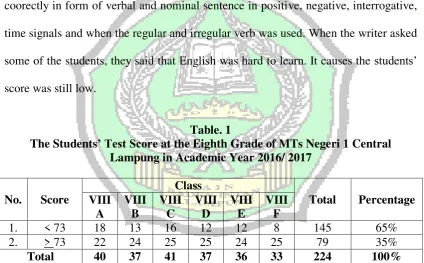
Based on preliminary research through interviewing Mr. Tugiman as English teacher of the eighth grade at MTs Negeri 1 Central Lampung, the students have difficulty in learning simple past tense.6The students were still confuse in using simple past tense coorectly in form of verbal and nominal sentence in positive, negative, interrogative, time signals and when the regular and irregular verb was used. When the writer asked some of the students, they said that English was hard to learn. It causes the students’ score was still low.
Table. 1
The Students’ Test Score at the Eighth Grade of MTs Negeri 1 Central Lampung in Academic Year 2016/ 2017
No. Score
Based on the table above, it can be known that achievement of grammar especially in simple past tense from students in MTs Negeri 1 Central Lampung was still optimal yet, there were 79 or 35% students that qualified from the KKM (Kriteria Ketuntasan
6
Minimum) score while 65% of them not yet complete. The KKM score is 73. That is why, 145 students had difficulty in learning simple past tense correctly.
According to the students also, it happens because the teacher did not use effective and interesting technique to teach simple past tense. Their teacher always use drill technique in teaching English as a basis in teaching.7 Consequently, the students got bored and had difficulties to understand it. In this case, the writer interested to increase students’ grammar especially in simple past tense mastery by using game to
learn grammar.
The purpose of using game is to make the students easy to understand the material. By using games the students were expected to be able to work cooperatively with other friends. Playing games enable the objective achievement through experience in a pleasant, informal, and relaxe atmosphere. This condition was very helpful to motivate and support the students, so that they could understood the material and their score was increase.
One of game that can be applied in classroom is Climbing Grammar Mountain Game. According to Gunn and McCallum, Climbing Grammar Mountain Game helps improve the students’ understanding of grammatical usage and helps the students
7
learn from others through peer review, team work, and group discussion.8 Based on Kartiana and Sunaryo research that the use of climbing grammar mountain game brings many advantages in classroom. It can make the students more attractive to find grammatical feature in the text, it can build they embittered to play the game.9 It means that Climbing Grammar Mountain Game focuses the students’ attention on
grammatical usage and sentence construction.
Based on the background above the writer was interested in conducting a research about the students in learning grammar especially simple past tense, and this research is entitled: “The Influence of Using Climbing Grammar Mountain Game towards Students’ Simple Past Tense Mastery at the Second Semester of the Eighth Grade at
MTs Negeri 1 Central Lampung in Academic Year of 2016/ 2017.
B. Identification of the Problem
Based on the background of the problem, the writer identified the problems are as follows:
1. The students had difficulty in learning simple past tense, because the students still confuse in using simple past tense corectly in form of verbal and nominal sentence in positive, negative, interrogative and time signals..
8
Cindy Gunn, Ann McCallum, Climbing Grammar Mountain Game: An Interactice Learning Experience (Washington DC: ET Publisher, 2005), p. 41.
9
2. The students’ motivation in learning simple past tense is still low, they assumed English was hard to learn.
3. The teacher did not use effective and interesting technique to teach simple past tense.
C. Limitation of the Problem
Based on the identification above, the writer focused on the influence of using climbing grammar mountain game towards students’ simple past tense mastery.
D. Formulation of the Problem
The writer formulate the problem as follows: Is there a significant influence of using climbing grammar mountain game towards students’ simple past tense mastery?
E. Objectives of the Research
Based on formulation of the problem, the objective of the research was:
to know whether there is a significant influence of using climbing grammar mountain game towards students’ simple past tense mastery.
F. Use of the Research
1. To give information on the research about the influence of the use of climbing grammar mountain game towards students’ simple past tense mastery.
G. Scope of the Research
1. Subject of the Research
The subject of the research was the students at the first semester at the eighth grade students of MTs Negeri 1 Central Lampung.
2. Object of the Research
The object of the research was the use of climbing grammar mountain game and students’ simple past tense mastery.
3. Place of the Research
The research was conducted at MTs Negeri 1 Central Lampung.
4. Time of the Research
CHAPTER II
REVIEW OF RELATED LITERATURE
A. Frame of Theory
1. Teaching English as a Foreign Language
Teaching is the systematic activity includes many complements. Every component cannot be separated, but it has to be run together dependently and continually. In addition, teaching is guiding and facilitating learning, enabling the learners learn will determine our philosophy of education, teaching style, approach, methods, games and classroom technique. According to Harmer, teaching means to give knowledge or to instruct or train someone.10 It means that to show somebody how to do something or to change somebody’s ideas.
The nature of language means that the characteristics of language and the language of the learners in particular. The nature of the language is included the characteristics of learners for instance their age, their interested of their cultural background and their previous knowledge about the language they are learning. The aim of instructional, for instance, is to decide what skill the learners are able to do at the end of instructions.It means that foreign language has different characteristics from mother tongue, so learning foreign language is not as simple as we think. It takes long time and much practice.
10
Teaching English as a foreign language means that English is used by the people not as their mother tongue or their native language. In Indonesia, English is taught as the foreign language. English has been taught to the students from elementary school up to the university. As a foreign language, English is not only used for daily communication. Since it is taught in school as one of the compulsory subjects, English becomes a need that must be mastered.
Setiyadi states that English is really a foreign language for language learners in Indonesia.11 It means that in Indonesia, English is just learn at school as a compulsory subject. Students seldom use English in the society, because they usually use a language based on their mother tongue.
According to Wilkins, “Foreign Language” is one in which the target language is not
the mother tongue of any groups within the country where it is being learned and has not any internal communication either.12 It means that the students how learn English as a foreign language have a little opportunity to practice the language in real communication.
Maxom states that, the aim of TEFL is to produce students who can speak the language almost as well as you can, at the most. As soon as the students feel confident that they can use English for whether purposes they need,they often get on
11
Ag. Bambang Setiyadi, Teaching English as a Foreign Language (Yogyakarta: Graha Ilmu, 2006), p. 32.
12
with their live.13It can be said that basically the purpose of TEFL is students can feel confident that they can use English for whatever purposes they need and wherever they use it.
In addition Murcia states that the goal of teaching a second or foreign language would be to gain the ability to communicate in target language that is in language learners.14 In other words, in teaching English as a foreign language, a teacher should be able to make his or her students use the language in communication.
From the statement above, English as a International language has a big influence in human life. By language we can communicate and interact with other people from different countries in the world. In Indonesia, English as a foreign language should be learned by the students.
2. Simple Past Tense
a. Concept of Grammar
Grammar is one of the skills that must be mastered by the students to learn English. Because the grammatical rules of Indonesian language are different from English. That is why, learning English grammar is very important to understand English teacher. Brown says that grammar is the system of rules governing the conventional
13
Michelle Maxom, Teaching English as a Foreign Language for Dummies (Southern Gate: John Wiley & Sons Ltd, 2009), p. 20.
14
Marianne Celce Murcia, Teaching English as a Second or Foreign Language
arrangement and relationship of words in sentences.15Thornburry states that grammar statements above, the writer assumes that by mastering grammar can help the students to complete sentences correctly.
Grammar is also called as organization words that combination into sentences to express though and feeling or to express the idea in written. In teaching English as a foreign language, the students need to master grammar because by mastering grammar students will be able to speak and write English correctly, it is fact that different countries have different countries have different languages and every language has system which is called grammar.
Grammar is important because it is the language that makes it possible to talk about language. People associate grammar with errors and correctness. But knowing about grammar also help to understand what about make a sentence, paraghraphs clear, interesting and precise. It means that grammar is a study about pattern or rule to make
15
H. Douglas Brown, Teaching by Principles An Interactive Approach to Language Pedagogy(San Fransisco: Longman, 2000), p. 362.
16
Scott Thornbury, How to Teach Grammar(Edinburgh Gate:Pearson Education Limited, 1999), p. 1.
17
a good sentence. With grammar mastery the students will be able to construct some words to be new sentences or utterances easily.
b. Concept of Tense
Tense is one of important parts of structure in English. Commonly, people think that tenses are the same as time. Wishon states that, "Tense means time. However, it should be pointed out that time in relation to action is a concept that exists in the mind of the speaker, reader, or listener. Tenses in actual usage refers consistently only to grammatical form. Often tense and time do not correspon at all.18 Richards states that, “Tense is the relationship between the form of the verb and time of the
action or states it describes.”19It means that tense has a relation of the time.
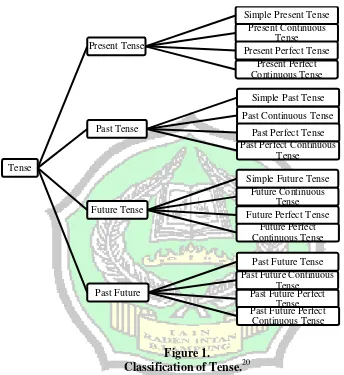
Tense divided into four major parts; present, past, future and past future. In every it major parts of tense also has four subdivided. Present tense has four, namely; simple present tense, present continuous tense, present perfect tense and present perfect continuous tense.past; simple past tense, past continuous tense, past perfect tense, and past perfect continuous tense. It the same thing with future and past future. It means that tense has sixteen tenses. See at figure. 1.
18
George E. Wishon, Julia M. Burks, Let’s Write English (New York: Litton Education, 1980), p.192.
19
Figure 1.
Classification of Tense.20
Every component of tense has different function in time. It is impossible for the students to have a good mastery of English without good understanding of the use tenses. So, in this research the writer interested to identify simple past tense because the English curriculum for junior high school students especially at the first semester of the eighth grade contain the material of use of tenses. It means that junior high school students are expected to master the use of tenses.
20
c. Concept of Simple Past Tense
Simple Past Tense is used to indicate completed in the past without indicating any connection with the present. Azar states that simple past tenseis an activity or situation began and ended at a particular time in the past.21 Beside that according to George, simple past tense is used to report a state or activity which can be ascribed to a definate past time.22 Simple past tense also called the simple past, is used for past actions that happened either at specific time, which can either be given by a time phrase (yesterday, last year, etc) or understood from the context.23It means that simple past tense is used to express the idea that happens, activity or event in the past time
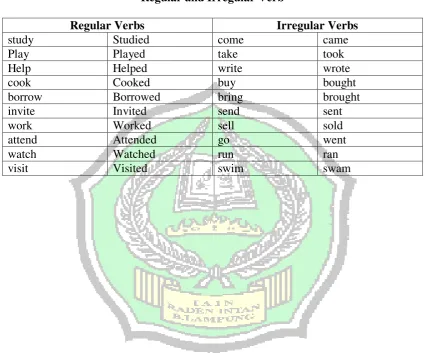
In simple past tense, we must use the specific verb. Verb in the past time also called Verb-2, the transformation of Present. The verb of simple past tense divided into two parts, are regular and irregular verb.24 So, simple past tense also has the specific verb and has two categories of verb are; regular and irregular verb.
21
Betty Azar Schrampfer, Understanding and Using English Grammar (New Jersey: Practice Hall Regents, 1989), p. 24.
22
George E. Wishon, Julia M. Burks, Op.Cit, p. 195. 23
http://www.usingenglish.com/glossary/simple-past.html#zbL1AatdJq5hm2L.99 24
The Usage of Simple Past Tense;
1. When we want to indicate that something happened at a specific time in the past. 2. For situations that existed for a period of time in the past
3. To talk about how long it has been going on for.25
Time Expression of Simple Past Tense;
*. Yesterday; *. Last;
-. Yesterday morning -. Last week
-. Yesterday afternoon -. Last Sunday
-. Yesterday evening` -. Last year
*. Ago; *. With preposition in, on, at;
-. An hour ago -. At five o’clock this morning
-. Three months ago -. On Saturday night last week
-. A week ago -. In June last year.26
25
Martin Hewings, Advanced Grammar in Use (London: Cambridge University Press, 1999), p. 6.
26
Table 2.
Regular and Irregular Verb
Regular Verbs Irregular Verbs
study Studied come came
Play Played take took
Help Helped write wrote
cook Cooked buy bought
borrow Borrowed bring brought
invite Invited send sent
work Worked sell sold
attend Attended go went
watch Watched run ran
a. Verbal Sentence
Positive Form:
Formula : Subject + Verb 2 + Object27
Example:
1. They watched television yesterday evening 2. This morning I cleaned my teeth
3. Caroline went to the cinema three times last week.28
Negative Form
Formula : Subject + did + not + Verb 1 + Object29
Example:
1. I did not watch television yesterday
2. Maria did not do anything a few minutes ago 3. They did not invite her to the party.30
27
Raymond Murphy, Essential Grammar in Use (2nd Ed) (London: Cambridge University Press, 2001), p. 32.
28
Ibid, p. 30 29
Interrogative Form
Formula : Did + Subject + Verb 1 + Object ?31
Example:
1. Did she go away last week?
2. Did you do the shopping? No, I didn’t have time 3. Did you see Joe yesterday? Yes, I did.32
b. Nominal Sentence
Positive Form
Formula : Subject + Was/ Were + Noun/ Adjective/ Adverb33
Example:
1. I was tired last night
2. The weather was good last week
30Ibid
31Ibid 32
Ibid
33
3. Last year Rachel and Mita were 22 years old.34
Negative Form
Formula : Subject + Was/ Were + Not + Noun/ Adjective/ Adverb35
Example:
1. They were not here last sunday 2. The hotel was not expensive
3. They were not be able to come because they were so busy.36
Interrogative Form
Formula : Was/ Were + Subject + Noun/ Adjective/ Adverb?37
Example:
1. Were you late? No, I wasn’t
2. Was Ted at work yesterday? Yes, he was
3. Were Sue and Steve at the party? No, They weren’t.38
34
Ibid
35Ibid 36Ibid 37
Ibid
38
d. Concept of Simple Past Tense Mastery
Mastery is a complete or the state of having control over something superiority in competition, victory eminent, or through knowledge. In addition, Flexner in the random house dictionary of the English language says that “mastery deals with
command, grasp, as of a subject.39 It means that mastery is a complete of having control over something superiority in through knowledge of a subject. According to Messer mastery is the broad knowledge and skill is understanding the world of physical objects.40 It can be concluded that mastery is have a broad competence of knowledge in understanding the objects.
According to Wishon, past tense is used to report a state or activity which can be ascribed to a definite past time.41 Past tense is used to talk about activities or situationsthat began and ended at a particular time in the past.42Simple past tense has time expression, and two categories of verb, namely; Regular Verb and Irregular Verb. To be (was, were) followed by adjective, adverb or noun. In form of negative, we need to use auxiliary verb didn’t. To make interrogative sentence, auxiliary did, was, were is in front of the sentence, while the Verb 2 is formed to Verb 1.43It means
39
Marta Dinata, The Correlation between Students’ Vocabulary Mastery towards Their
Translation Ability, at the Eleventh Grade SMAN 7 Bandar Lampung in the Academic Year of 2010/ 2011 (IAIN Raden Intan Lampung, Bandar Lampung, 2010), A Thesis, p. 9.
that past tense is used to tell the situation or activities at the past time and also has the specific criteria.
From the explanation above, it can be concluded that simple past tense mastery is the competence of knowledge in understanding of atense used to talk the situation or activities at the past time in formof verbal and nominal sentence inpositive, negative, interrogative and its’ particular time signals.
3. Climbing Grammar Mountain Game
a. Concept of Game
Games help and encourage many learners in sustaining their interest and work. By using game the students will be feel enjoy, happy and relax in following the lesson. Game is a structural activity that can be used in teaching learning activity and in the game it is not only to get fun but there also a goal and structure. By conducting games, teachers can create more useful and meaningful situations for understanding the languages. In conducting language games, both teachers and learners have critical roles to make it understandable and applicable. Games can be useful for teachers as well in their educational aspects.
together towards a common goal.44 According to Agoestyowati “learning a new language should be fun, interactive and exciting. The use of games in a learning environment will not only change the dynamic of the class, but also rejuvenate students and help the brain to learn more effectively.”45 Agoestyowati adds game allow the students to work co-operatively, compete with each other, strategize, think in different way, compare and share knowledge, learn from other, learn from mistakes, work in a less stressful and more productive environment and allow students to have fun.
Based on the definitions above, it can beconcluded that one element necessary for succesful teaching and learning in class is engage. Game is an activity with rules, a goal, and an element of fun. Game can stimulate the students to learn English better, particullary structure and grammar.
b. Concept of Climbing Grammar Mountain Game
Gunn and McCallum introduce new game in teaching grammar namely Climbing Grammar Mountain Game. Climbing Grammar Mountain Game is an easy game that is prepared and adapted to unique needs of different classrooms.
Climbing Grammar Mountain Game is a game that provides a way to address grammatical usage and sentence construction in such a way that the target structure is
44
Jill Hadfield, Intermediet Vocabulary Games (Edinburgh Gate: Pearson Education Limited, 1999), p. 4.
45
being reviewed and reinforced in an interesting and enganging manner.46 The students gain satisfaction and confidence by putting to use what they have studied.
Climbing Grammar Mountain Game helps the students to learn from other through such activities such as team work. By using this technique, students had to learn, review, and analyze the grammar structures in group in order all the members of group are able to understand and comprehend the role.47 It means that, Game “Climbing GrammarMountain” can be used as a reinforcing technique.
From the explanation above, it can be concluded that climbing grammar mountain game is a game to help the students to provide the grammatical usage and sentence construction through review, and analyze the grammar structures in group with interesting and enganging manner, so all of the students in group are able to understand.
c. Procedure ofClimbing Grammar Mountain Game
1. Draw 4 vertical climbing lines on the board or on a overhead tranparency.
Leave space on the bottom of the tranparency to show one sentence at a time
46
Cindy Gunn, Ann McCallum, Climbing Grammar Mountain Game: An Interactice Learning Experience (Washington DC: ET Publisher, 2005), p. 41.
47
Figure 2.
Scoring of Climbing Grammar Mountain Game
2. Ask the students to get into teams of four or five people depending on how many students are in the class.Have the students choose a name for their team 3. Start by playing a practice round of the game
4. Provide the whole class with a correct sentence that is fairly easy to identify as
correct. Ask each team how many vertical feet (up to a maximum of 20) they are willing to award to it. Show how you would move a player up the mountain by that many vertical feet
6. After the practice round, begin the actual play, using the sentences you prepared
7. Draw one sentence at a time
8. Show the first team one of sentence and have them make their play. If the
sentence is incorrect, give the playing team the first chance to correct the sentence for 5 bonus feet. If that team cannot correct the sentence, open it up to the rest of the class and give the answering team an extra 5 bonus feet 9. Then, move on to the next team, drawing a new sentence
10. The game continues until you have used all.48
d. Procedure of Teaching Simple Past Tense by Using Climbing Grammar
Mountain Game
1. Draw 4 vertical climbing lines on the whiteboard. See at figure 2
2. Teacher divides the students into 4 groups consists of 5 or 6 depending on how many students are inthe class. Then, the teacher arrange the group on the side of classroom, it’s suppose to each of group to become careful
with other group
48
3. Provide the whole class with some correct and incorrect sentences in simple past tense that is easy to identify
4. Before starting the game, teacher give 10 point to each group. Start by playing the game
5. Ask each team how many vertical feet they are willing to award it (maximum 20)
6. If the students can not recognize the sentence as correct or incorrect, they
must go back down the mountain that many feet. If the students recognize the sentence as correct or incorrect, they can stay where they are.
7. If that team can not correct the sentence, give the chance to other team to correct the sentencefor 5 bonus points.
e. The Advantages and Disadvantages of Using Climbing Grammar Mountain
Game
The advatages of playing climbing grammar mountain game are:
1. It encourages students’ motivation in learning grammar.
2. It can increase students’ enthusiastic. Since it is competitive game, students will work hard to find the right answer in order to win the game.
3. The students’ competence in using simple past can be increased since in playing the game.
4. It overcomes students’ boredom in learning grammar because students’ like
5. Increase positive feelings and improve self-confidence because learners do not afraid of punishment or criticsm while practicing the target language freely.
The Disadvantages of Playing Climbing Grammar Mountain Game are:
1. The class will be noisy. Considering that climbing grammar mountain game,
students are given a competition. They who will win or lose remain unanswered until the game is over. Their enthusiasm of it that makes the class noisy.
2. It takes long time. Since it is a game, it takes a long times because the instruction is too much and there are a lot of students that should be controlled.
3. Since there are many groups in the class. It will be difficult for teacher to
measure the students one by one.49
4. Drill Technique
a. Concept of Transformation Drill Technique
Drilling is a technique that has been used in foreign language classrooms for many years. It was a key feature of audio-lingual method approaches to language teaching, which placed emphasis on repeating structural patterns through oral practice. Harmers states that drilling is mechanical ways if getting students to demonstrate and practice
49
their ability to use specific language items in a cotrolled manner.50 Drilling is a technique that is still used by many teachers when introducing new language items to their students.
Drills have several kinds, in this research the teacher uses transformation drill to teach grammar especially in simple past tense. Transformation drills can provide students with a small degree of creativity and cognitive effort.
b. Procedure of Teaching Simple Past Tense by Using Transformation Drill
Technique
The teacher uses transformation drill in teaching simple past tense, transformation drill is a kind of drill technique.
1. The teacher gives explanation kind of sentence pattern of simple past tense in positive, negative, and interrogative sentence in form of verbal or nominal sentence
2. Students are asked to transform the simple present tense into simple past tense sentence
3. And then, ask the students to change into negative and interrogative sentence.51 Example:
Teacher: Tina eats noodle
Students: Tina ate noodle just now
50
Jeremy Harmer, Op. Cit, p. 123 51
Students: Tina didn’t eat nooodle just now
Did Tina eat noodle just now?
c. Advantages and Disadvantages of Drill Technique
The Advantages of Drill Technique are;
1. The teacher can encourage the students to concentrate on difficulties, because all of the student’s thought or feel, must only focus on the material or subject that
are being trained 2. Develop student’s mind
3. Pattern practice helps the students to form habits which enable the students to use the pattern.52
Based on the explanation above, it can be concluded that process teaching learning of drill technique only focus on the material. So, all of the students only focus on the subject that are being trained.
The Disadvantages of Drill Technique are;
1. It makes the students feel lazy to study 2. This is not very creative
3. The more exercises which given, it will make the students feel hate to the teacher or to the material.
4. It makes the students bored and unsatisfying.53
52
Based on the explanation above, it can be concluded that the students will get easy bored and lazzy to study because all of the students must only focus on the material.
B. Frame of Thinking
A game can motivate the students. Teaching through a game can be contextual and meaningful. Game also adventageous in the process of learning and teaching. It can make the students pay attention from on specific structure, grammar patterns and vocabulary item. It involves participation from both slow and fast learners, and suisthe age of the individuals and the levels of language skills.
Climbing Grammar Mountain Game is a game to teach grammar. Climbing grammar mountain game focuses the students’ attention on grammatical usage and sentence
construction. So, by using this game the students can analyze a sentence as a good sentence or not and make a sentence in the simple past tense well. Besides that, this game provides a way to addres an interesting and engaging manner.
The writer thinks that the teacher should motivate and help the students increase their simple past tense in their learning English process. It means that climbing grammar mountain game is one of techniques in learning and teaching English that can improve students’ understanding of the fundamentals of effective written
communication, especially grammatical usage, sentence construction, paragraphing, and essay development. Climbing grammar mountain game also can help the
53
students learn from others through such activities as peer review, team work and group discussion to easily the students learn grammar.
The students have chance to explore their mastery about simple past tense. Through the use of an interactive, student-centered game activity, students may internalize the structures of grammar so critical for effective written and spoken communication. This game creates an atmosphere of learning, becomes fun for the students, as well as easily applied in the classroom. In addtition game also stresses the cooperation group which can build up a good behavior such as, helping each other, tolerance and mutual respect among the students. Therefore, the writer assumes that climbing grammar mountain game can help the students and can increase students’ grammar mastery especially in simple past tense.
C. Hypothesis
Based on theories and the frame of thinking, the writer formulated the hypotheses of as follows:
Ho = There is no significant influence of using climbing grammar mountain game towards students’ simple past tense mastery.
CHAPTER III
RESEARCH METHODOLOGY
A. Research Design
In this research, the writer used experimental design. According to Setiyadi, experimental design intended to find the relation of variables in valid which can be used to search the conclusion in general.54 Then, experimental has three types they are; 1) pre-experimental design, this section presents two designs that have been as pre-experimental because they provide little or no control of extraneous variable. Unfortunately one finds that design are still used in educational research. 2) True experimental, Setiyadi states that true experimental method has three basic characteristic; a) a control group (or group) is present, b) both of the subject are chosen by random, c) initial test is given to see the capabilities of the two groups. 3) Quasi experimental design includes assignment, but not random assignment of participant to group.
From the statements above, the writer used quasi experimental research design to know the influence of using climbing grammar mountain game towards students’
simple past tense mastery. This design used because if the writer randomly assigns the students to classes, it would disturb classroom learning. Therefore, when randomized designs are not feasible, the writer must use of quasi experimental design.
54
In this research, the writer used two classes, one as experimental class that was given treatment by using climbing grammar mountain game and the other one as a control class that was taught by using drill technique.
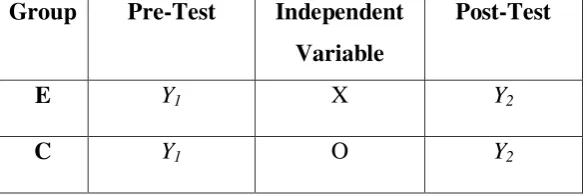
The design is illustrate as follows:
Table. 3
Randomized Subjects Pre-Test Post-Test Control Group Design
Group Pre-Test Independent
Variable
Post-Test
E Y1 X Y2
C Y1 O Y2
Adapted from Donald Ary
Notes:
E : The first group (experimental class) C : The second group (control class) Y1 : Pre-Test
Y2 : Post-Test
X : Treatments by using Climbing Grammar Mountain game O : Treatments by using Drill Technique.55
55
Donald Ary, Lucy Chanser Jacob, and Cris Sorensen, Introduction to Research in Education
B. Variable of the Research
In this research, there are two variables, namely:
1. The independent variable of the research is using climbing grammar mountain game (X).
2. The dependent variable is students’ simple pasttense mastery (Y).
C. Operational Definition of the Variable
The operational definition of variable is to describe the characteristics of the variable that is investigated, as follows:
1. Independent Variable (X)
Climbing Grammar Mountain Game is a game to help the students to provide the grammatical usage and sentence construction through review, and analyze the grammar structures in group with interesting and enganging manner, so all of the students in group are able to understand.
2. Dependent Variable (Y)
D. The Population, Sample and Sampling Technique
1. Population of the Research
According to Arikunto, population is all research subjects.56It is supposed by Bambang Setiyadi who states that all individuals which can be the target in research are called population.57 Thus, the population in this research is all the students at the eighth grade of MTs Negeri 1 Central Lampung in 2016/2017. The total number of the students are 224 students that consist of six class.
Table. 4
The Total Numbers of the Students at the Eighth Grade of MTs Negeri 1 Central Lampung in the Academic Year of 2016/ 2017
NO Class Gender Total
Suharsimi Arikunto, Prosedur Penelitian Suatu Pendekatan Praktek (Jakarta: Rineka Cipta,1993), p. 102.
57
2. Sample of the Research
According to Arikunto, sample is several or representation of population research.58 The samples of this research are two classes. One as experimental class which the students was taught by using climbing grammar mountain game, another class as control class, which the students was taught by using drill technique. In this research the writer used two classes, they are VIII B as the experimental class consisting of 37 students and VIII D as the control class consisting 37 students.
3. Sampling Technique
In conducting this research, the writer took sample from the population of the research by using cluster random technique because the population is in group and considered homogenous.59 Therefore, Umar states that the way to take in cluster random sampling one of which is lottery way, that is give the number of all members of the population, then randomly selected numbers according to a lot of the number of sample is needed.60 Steps in determining the experimental class and control class as follows:
a. The first, the writer provided six pieces of paper, eachpieces of paper contains the name of classes, took papers into glass and then the writer shaked the glasss.
58
Sugiyono, Metode Penelitian Pendekatan Kualitatif, Kuantitatif, dan R&D (Bandung: Alfabeta, 2010), p. 104.
59
Suharsimi Arikunto, Op. Cit, p. 177. 60
b. The second, the writer took one of the pieces, the first piece taken as experimental class, then the writer took it back into glass.
c. The third, the writer took another piece, the second piece is as the control class of this research.
E. Data Collecting Technique
In collecting the data, the writer used test as a instrument in collecting the data. The test consists of pre-test and post-test. the test used to know the students’ ability in their simple past tense mastery. In this research the writer used the data:
1. Pre – test
Pre-test was done to know the students’ simple past tense mastery before the treatments. The test was given to the students. Students have to answer the question and the writer got score. The scoring based on the correct answer. The result of the test was written in the scorring column on the paper.
2. Post – test
F. Instrument of the Research
In this research, the instrument was test. According to Arikunto, instrument is a tool that used in collecting the data.61 The test of pre-test and post-test is consisted of 50 items for pre-test and post-test before validity, the research was multiple choice test with 4 options a, b, c, and d. The test consists of simple past tense of nominal and verbal in form of positive, negative, and interrogative sentence and also time signals. The purpose of the test is to measure their influence of using climbing grammar mountain game towards students’ simple past tense mastery. The specification of
simple past tense test can be seen on the table below:
Table. 5
The Items of Test for Pre-Test and Post-Test Before Validity
Table. 6
The Items of Test for Pre-Test After Validity
Question (+) (-) (?) Number (Odd) Number (Even)
The Items of Test for Post-Test After Validity
Question (+) (-) (?) Number (Odd) Number (Even)
There are three procedures that were done by the writer, they were: 1. Planning
Before apply the research procedure, the writer made some planning to run the application well. There are some steps that should be planned by the writer.
a. Determining the subject
The writer determined the subject, in this phase the writer chose the second semester of the eighth grade students of MTs Negeri 1 Central Lampung as the subject of the research, one class was the experimental class and the other one was the control class. b. Preparing the try out and analyzing the data
The writer prepared try-out that was given to the students of MTs Negeri 1 Central Lampung. The writer prepared try-out test for pre-test and post-test, the total number of the test was 25 items. After the try-out was given to the students, the writer analyzed the data that got from try-out to evaluate the test items that would be tested in pre-test and post-test.
c. Preparing the pre test
The writer prepared a kind of the test (called pre-test) that was given to the students. The writer used the test instrument which has already been tried out and validated. d. Determining the material to be taught
The writer determined the material that was taught to the students. It was about simple past tense. It consits of simple past tense in positive, negative, interrogative, and time signals in form of verbal and nominal.
e. Preparing the treatment
The writer taught simple past tense by using climbing grammar mountain game in one of class as experimental class and taught by using drill technique in one of class as the control class.
The writer prepared a kind of test (called post-test) that was given to the students. By giving the post-test, the writer knew whether the students improved their simple past tense mastery or not.
2. Application
After making the planning, the writer tried to apply the research procedure that has been already planned. There were some steps in doing this research:
a. In the first meeting, the writer gave try-out
The test was multiple choices that consists of 50 items in pre-test and post-test with 4 options (a, b, c and d). This test wasgiven to the students whowere not for sample of research.
b. In the second meeting, the writer gave pre-test
The test was multiple choices that consists of 25 items with 4 options (a, b, c and d). The total number of the test items determined by the validity and realibility analysis of the try-out. It means that only the valid and reliable test items were used in pre-test.
c. Giving the treatment
d. In the last meeting, the writer gave post-test.
The test was multiple choices that consists of 25 items with 4 options (a, b, c and d). The total number of the test items was determined by the validity and realibility analysis of the try out. By giving the post-test, the writer knew whether the students improved their simple past tense mastery or not.
3. Reporting
The last point that should be done in the research procedure is reporting. There were three steps done in reporting. The steps are as follows:
a. Analyzing the data that already obtained from try-out test.
b. Analyzing the data that already obtained from pre-test and post-test. c. Making a report on the findings
H. Scoring System
Before getting the score, the writer determined the procedure to be used in scorring the students’ work. In order to do that, the writer used Arikunto’s formula. The ideal
highest score is 100. The score of pre-test and post-test were calculated by using the following formula:
𝑆= 𝑟
𝑛 . 100
Notes:
𝑆 : The score of the test
𝑛 : The total items.62
I. The Validity and Reliability
To know whether the test is good or not, some criteria should be considered. The criteria of a good test are validity (content validity and construct validity) and reliability.
1. Validity of the test
Validity is the development of sound evidence to demonstrate that the test interpretation (scores about the concept or construct that the test is assumed to measure) matches it proposed use. A test is a valid if the test can really test what needs to be tested correctly. In other words, it has high accurancy to measure the aspect that need to be measured.
a. Content validity
According to Setiyadi, content validity associated with all the test items contained in a measuring instrument.63 To get the content validity, the test adapted with the students’ book. The test was determined according to the material that teaches to the students. It means that the test have content validity since the test is a good representation of material studied in classroom. In this step, the writer adapted 50 items in multiple choice test from the students book.
62
Suharsimi Arikunto, Dasar- Dasar Evaluasi Pendidikan (Jakarta: Bina Aksara, 2013), p. 272
63
b. Contruct validity
Contruct validity is a second category of validity that the teacher must be aware of in considering language test. It means that the items should really show whether they have mastered the simple past tense or not. The test items should measure the students’ simple past tense mastery. An instrument can be called
valid when it can measure what is wanted. To measure the validity of the instrument, the writer used construct validity. Based on the result, there were 25 items that validated.
c. Internal validity
After scorring the try-out test, item analysis is carried out to find out the effectiveness of the items. In internal validity, the writer was done the item analysis. Item analysis discussed two main things. They are item difficulties and discriminating power.
1) Item difficulties
2) Discriminating power
The item discrimination analysis indicates that the items discriminate able students from less able students. In this research, the writer used Anates to calculate the data obtained from the try-out to find out the item discrimination of each items. Based on the result, there were 25 items that dicriminated. (See on appendices 9 and 10).
2. Reliability of the Test
Reliability refers to whether the test is consitent in its scoring and gives us an indication of how accurate the test score are. Cresswell states that reliability means tht scores from an instrument are stable and consistent.64 A test is reliable if the test is able to give constant result even though the test is given repeatedly to the same individuals or sample.
Reliable test is consistent and dependable. The issue of reliability of a test may best be addressed by considering a numbers of factors that may constribute to the unreliability of the test. Consider the following posibilities fluctuations in the students in scoring, in test administration and in the test itself. In this reseacrh, the writer used Anates to calculate the reliability of the test. Based on Anates, the result of reliability
test of pre-test was 0.75 and post-test was 0.21. (See on appendices 9 and 10).
64
J. Data Analysis
To analyze the data, the writer used parametric statistic. In the parametric statistics, there are assumptions which must be fulfilled, they are; normality and homogeneity test.
1. Fulfillment of the Assumptions
Parametric statistical significances test, such as aanalysis of variance and least squares regression are widely used by writer in many disciplines, including, statistics parametric test to produce accurate result, the assumption underlying them such as normality and homogeneity test must be satisfied.
a. Normality of the Test
The writer used normality test to know whether the data have a normal distributed or not.65 In this study the writer used statistical computation by using SPSS (Statistical Package for Social Science) for normality of test.
The hypotheses for the normality test are formulated as follows: Ho : the data are normally distribution
Ha : the data are not normally distribution
While the criteria for acceptance of the normality test is as follows: Hois accepted if Sig (Pvalue) > α = 0.05
Ha is accepted if Sig (Pvalue) < α = 0.05
65
b. Homogeneity of the Test
After the normality test, the writer determined the homogeneity of the test. homogeneity test used to know whether the data experimental class and control class are homogeneous or not. In this studey, the writer used statistical computation by using SPSS (Statistical Package for Social Science) for homogeneity of test. The test of homogeneity employing Levene’s Test.
The hypotheses are:
Ho : the variance of the data is homogeneous Ha : the variance of the data is not homogeneous
While the criteria for acceptance of the homogeneity test is as follows: Ho is accepted if Sig (Pvalue) > α = 0.05
Ha is accepted if Sig (Pvalue) < α = 0.05
2. Hypothetical Test
If the fulfillment of the assumptions normality test and homogeneity test are fulfilled, the writer used independent sample t-test. In this case, the writer used statistical computation by using SPSS (Statistical Package for Social Science) for hypothetical of test. The purpose of using SPSS in this case is to practicality and efficiency in the study.
The hypotheses are:
Ho : there is no significant influence of the use climbing grammar mountain game towards students’ simple past tense mastery
While the criteria of acceptance for the hypothesis is as follows: Ho is accepted if Sig (Pvalue) > α = 0.05
CHAPTER IV
RESULT AND DISCUSSION
A. Description of MTs Negeri 1 Central Lampung
1. The Situation of Research Place
MTs Negeri 1 Central Lampung is located on Jln. Negara No. 712 Kec. Terbanggi Besar Kel. Yukum Jaya Kab. Lampung Tengah Prov. Lampung. For conducting teaching learning process, MTs Negeri 1 Central Lampung had used its own buildings. The activites of teaching learning process are began in the morning at 07. 15 AM and finish at 13. 50 PM .
The school has 19 classes and has 639 students. Almost of the teachers of the school are graduated from S1 and Magister. There are some office in the school; headmaster office, teacher office, and administration office. This school also has library, science laboratory, computer laboratory, mushola, etc.
2. The Teacher and Staff of MTs Negeri 1 Central Lampung
The condition of the teacher and staff of MTs Negeri 1 Central Lampung 2016/ 2017 has people, they are;
- The Headmaster : 1 person - The CO – headmaster : 4 person
- The Teacher : 44 people
- The Administration Staff : 12 people - The Librarian : 1 person