Organisational quality and
organisational change
Interconnecting paths to effectiveness
Ian Smith
La Trobe University, Melbourne, Victoria, Australia
Abstract
Purpose– Which comes first – quality or change? Managing change is inherent in organisational quality enhancement. Managing organisational change and managing organisational quality go hand-in-hand. This paper seeks to look into quality enhancement initiatives to achieve organisational fitness for purpose.
Design/methodology/approach– This discussion focuses first on organisational quality – what quality means, why it is important and the means for achieving quality. The focus then shifts to effective management of organisational change including the nature of change and the high failure rate of change initiatives. Many models, approaches and prescriptions for understanding, and effectively managing, change are available. Two are discussed here: Kotter’s eight-step model of change and Doppelt’s seven-point “wheel of change”. Commonalities and differences of the two approaches are examined and pointers to “green” and “red” lights for change managers are highlighted. A large-scale organisational reform program at La Trobe University (Australia) provides a case study of complex change in progress. Kotter and Doppelt’s frameworks are used to reflect on aspects of that organisation’s experience of working with change.
Findings– The discussion concludes by returning to the theme expressed in the title of this paper – quality and change go hand-in-hand. Libraries and librarians operating in an environment of rapid and complex change should add to their managerial “toolkits” an understanding of the intersecting issues of organisational quality and organisational change, and a proactive approach to managing both.
Originality/value– Managers and leaders seeking to make change and achieve organisational quality may be well served by keeping these basic green and red lights as markers and check points along the path to reaching change and/or quality objectives.
KeywordsLibraries, Organizational change, Quality management, Change management, Universities, Australia
Paper typeCase study
This conference is interested in the challenges and future possibilities faced by academic libraries and librarians. Re-Imagining Libraries a joint project of the National and State Libraries of Australasia (www.nsla.org.au/projects/rls/) envisioned a future which will resonate with many of the themes of this conference, declaring that in collaboration they would:
[...] become leaders in empowering people to create, discover, use and transform our
collections, content and global information resources.
The current issue and full text archive of this journal is available at
www.emeraldinsight.com/0143-5124.htm
The views, comments and opinions stated in this paper are those of the author and do not necessarily represent the views of La Trobe University.
Organisational
quality and
change
111
Received 7 March 2010 Revised 11 April 2010 Accepted 10 July 2010
Library Management Vol. 32 No. 1/2, 2011 pp. 111-128
Working to turn that vision into reality the State Library of Western Australia (Allen, 2006) articulated a set of guiding principles for change which reflect both external factors driving change:
. access is the primary driver of the business of libraries;
. digitisation can no longer be ignored, it is a core part of library business; and
. the web is changing expectations and behaviour.
and the consequences arising from meeting those challenges:
. client spaces need to be welcoming and allow clients to be independent;
. every library job will change;
. some activities will no longer be done – productivity gains need to be made; and
. experimentation and risk are necessary.
Those ground rules for the future express many of the issues faced by, and responses required of, libraries and librarians. If libraries and librarians are to continue to play an effective role in “empowering people to create, discover, use and transform global information resources” they need to master change. If they are to provide high quality resources and services which are relevant and responsive to the needs of their clients they need to be fluid and flexible in their goals and their actions. Academic libraries should strive for organisational effectiveness and fitness for purpose. They should aim for excellence in meeting their organisational mission.
In that context, organisational cultures, structures and ways and means of working cannot be assumed to be optimal as they are currently established. Organisations cannot remain static – business as it has always been done is not a viable option. Instead, the usual approach to business needs to be (or become) one of continual review, renewal and adjustment. Experimentation, exploration and risk taking should become the norm, not an exception. The twin themes of this discussion – organisational quality and organisational change – are of direct relevance to that challenge. Active management of organisational quality and organisational change together form a powerful combination.
Libraries and librarians have a strong track record in adopting and adapting innovative management methods, and are well represented in the literature of both quality and change management. Information providers and professionals – operate in an environment of rapid and complex changes in the way that information is organised, accessed and used. To remain relevant libraries and librarians they need to adapt. They will be well served by adding to their managerial toolkits an understanding of the interconnection of active management of organisational quality and organisational change – and a proactive approach to both.
This discussion focuses on the interconnections of organisational quality and the management of organisational change (with an emphasis on the latter as that is the primary area of experience and expertise of this author). A case study of a complex organisational change program, currently in progress, is used to illustrate how a large-scale change management program is being undertaken to shift an organisation from status quo to a state of enhanced operation and performance. The discussion concludes by arguing that a focus on quality and change together can form a powerful combination. The challenge is to make change, and to achieve quality, that sticks.
LM
32,1/2
Organisational quality
Good is no longer good enough. To survive in today’s competitive environment, you need to excel. To excel, an organization needs to focus on all parts of the organization, optimizing the use and effectiveness of all of its resources (Harrington, 2005, p. 107).
Interest in organisational quality is widespread. Organisations adopting a quality enhancement focus are concerned with continually improving organisational performance and effectiveness – working actively to review, asses, enhance and maintain any and all aspects of organisational performance.
Work to review, assess, and plan actions to improve any and all aspects of organisational performance will typically include organisational structures, systems, policies, work practices, modes of operation and performance outcomes. Organisations adopting a commitment to quality typically focus on identifying good standards of performance and performance targets, working to meet the identified and desired standards of practice and then assessing performance against the standards and targets. Comparison and benchmarking with others, evidence based analysis and decision making, and the application of process and/or systems based analysis are all frequent characteristics of organisations pursuing a quality agenda. Quality initiatives focus both at the macro level and through all organisational levels down to the work of teams and individuals.
A range of quality frameworks has been developed, some reflecting their background in business and manufacturing and others more generic. Some are specific to particular subset of organisational performance (for example IIP – below). All share a common characteristic of enabling an organisation to define and set expectations, to work to meet those expectations, to asses if the set standard has been met, and giving pointers and assistance to where and how to improve quality. This work typically includes frameworks which provide for (both internal and external) benchmarking and assessment of organisational attainment. Some examples of quality frameworks – generic and specific – include:
. TQM – (Total Quality Management).
. EFQM – (European Foundation for Quality Management).
. ABEF – (Australian Business Excellence Framework).
. IIP – (Investors in People).
. PQASSO – (Practical Quality Assurance System for Small Organisations).
Another example of an internationally adopted quality framework, one frequently used in the higher education sector, is the ADRI (Approach, Deployment, Results, Improvement) framework[1]. This is a good example of both a conceptual quality framework and an approach to managing quality. The key elements of ADRI are:
(1) The approach dimension – the thinking and planning stage. This stage includes the trail from an organisation’s overall objectives, mission, vision and values through to more specific goals and the planned arrangements for how these will be achieved.
(2) Thedeploymentdimension –which considers whether, and how effectively, the approach is being put into effect.
Organisational
quality and
change
(3) Theresultsdimension – which looks at an organisation’s results as a means of determining how well the deployment is achieving the planned approach. (4) The improvementdimension – which focuses on whether the organisation is
actively and continuously engaged with understanding its performance in each of the A-D-R dimensions, and is using this understanding to bring about improvements.
Another useful perspective on the character of quality, one focused particularly on quality in higher education, is offered by Newton (2007) who argued that quality is:
. repeatable over time; and
. involves all staff.
and is characterised by:
. clear specification of roles, responsibilities and procedures;
. open and active commitment to quality at all levels;
. willingness to engage in self-evaluation;
. clarity and consistency of procedures;
. explicit responsibilities for quality control and quality assurance;
. emphasis on obtaining feedback, from a range of constituencies;
. clear commitment to identifying and disseminating good practice;
. prompt, appropriate, and sensitive managerial action to redress problems, supported by adequate information;
. prompts continuous improvement; and
. includes the specification of standards and acceptable evidence.
Many of these elements of a quality focus intersect and interconnect with the issues and strategies involved in effecting organisational change. Organisational quality initiatives are, at their core concerned with identifying and setting quality goals and then actively planning and managing to achieve those goals. Putting into place a plan to improve organisational practices, outcomes, and bottom line results assumes a change from the status quo. Management of change in order to achieve improvement is thus inherent to any quality enhancement initiative. The processes go hand-in-hand and both complement and support one another. As McGregor (2004) argues, managing organisational change and managing organisational quality are two sides of the same coin.
Organisational change management
Change is the order of the day...If ever there was a time when business as usual described
the way business ran, that time has elapsed (Webber, 1988, p. 4).
The constancy of change is a widely noted theme in any reading of the literature of organisational management. Phrases such “the only constant factor in (organisational) life is the need to change” are commonly encountered. That constancy of change is not a new concept. More than 2,000 years ago the Greek philosopher Heraclitus
LM
32,1/2
(536-470BC) held to the doctrine that everything was in a continual state of flux and that nothing is permanent but change. What is different is that the pace and scale of change – social, politico-economic and technological – are rapidly increasing. Graetz
et al.(2000, p. 550) encapsulates this well:
Against a backdrop if increasing globalisation, deregulation, the rapid pace of technological innovation, a growing knowledge workforce and shifting social and demographic trends, few would dispute that the primary task for management today is the leadership of organisational change.
Change in organisations may be continuous and incremental or rapid and discontinuous with abrupt shifts from the patterns of the past. Change may be planned or it may be emergent. The scale of change may range from fine-tuning through incremental and or modular adjustment to wide scale corporate transformation. The dynamics of organisational change may be seen as an essentially linear series of planned events – for example, Lewin’s (1951) unfreeze – change – refreeze model. Change may be open ended, ongoing and adaptive responding to changing circumstances (see for example Kanter et al., 1992). Alternatively, the character of change may sit somewhere between these two extremes of planned or loose and open ended. Dunphy and Stace (1990) for example argue for a contingency/situation analysis approach to change, one that focuses on the situational variables – both internal and external – of an organisation either undergoing, or needing to, change.
The reported success rate of change efforts is not good Between 50 percent and 70 percent of change efforts are reported as failing – either fully or partly – to achieve their objectives (see for example Kotter, 1995; Balogun and Hailey, 2004; IBM, 2008). This statistic makes worrying reading for any manager undertaking or considering a change initiative. While embarking on change initiatives may achieve transformational results there appears to be an equally strong likelihood of outright failure or, at best, only moderate result for effort. What then can assist in getting change right and leading and managing change successfully?
Models for understanding and approaching change
There are many approaches, tools and methods proposed for managing change. There is no one “right” approach. That said conceptual models of the process of change are useful in understanding the dynamics of change and how change management might best be approached.
Two models will be briefly considered here. John Kotter’s (1995, 1996) eight-step approach to achieving change is widely known and applied[2]. Bob Doppelt’s (2003) “wheel of change” model is newer and less widely known. Both provide useful perspectives on the nature of organisational change, ways to approach that work and pointers to where pitfalls may lay.
Kotter’s “eight step” change model
Kotter’s framework and analysis of change, based primarily on organisational change in the corporate sector, has been articulated and adapted since the mid-1990s. It is well known and widely quoted and applied. The language and philosophy of Kotter’s approach appears in many iterations and variations in the literature of organisational change.
Organisational
quality and
change
Kotter’s prescription for success is to recognise the importance of a staged and sequential approach, not to rush and/or to fall victim to the illusion of speed, and to look out for and correct the pitfalls that accompany each of these stages of change:
(1) Establish a sense of urgency – about the need to make changes.
(2) Form a powerful high level coalition to guide and lead the changes– a group with enough power and influence in the organisation to lead the promote the change effort.
(3) Create a vision of the organisation’s future – to help focus and direct the
change.
(4) Communicate that vision widely, repeatedly and consistently – from the
leadership level down through all organisational levels, in language and in actions and behaviours.
(5) Empower people in the organisation to act on the vision – remove obstacles to
change, improve processes and systems, encourage and enable people to take risks, engage in non traditional thinking and activities.
(6) Plan for visible short-term performance improvements – enable these to occur
and recognise their achievement and the work of those who have enabled that achievement.
(7) Consolidate improvements and produce more change – as change takes effect
build on the credibility and confidence that results, extending the reform or structures, systems and processes and encouraging and growing change agents in the organisation.
(8) Institutionalise new approaches – clearly articulate the connections between the new ways of working and organisational successes, encourage and develop ongoing leadership of change and anchor the changes into the organisational culture.
A key thread of Kotter’s analysis and prescription for approaching change is the importance of viewing organisational transformational as a long-term process – not a simple and short-term event. Further, it is a process which builds on itself. Skipping stages will not, in Kotter’s view, accelerate the process. Rather, it will, while giving the illusion of speed, slow the process, or even derail it completely.
Doppelt’s “wheel of change” model”
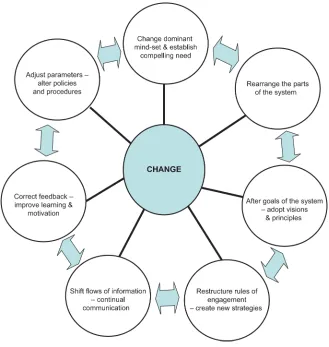
By contrast Doppelt’s (2003) analysis provides a newer and less widely known approach to understanding and approaching organisational change. This analysis of the dynamics of organisational change is drawn from wide ranging and long -term analysis of, in particular, public sector organisations and thus may be of particular value and relevance to the higher education sector. Doppelt’s primary focus is achieving organisational change in the context of achieving environmental sustainability. However, his concept can be readily applied to organisational change in any context. Doppelt views the process of change as being a cycle or a wheel. He articulates seven points at which interventions may be made or leverage applied to effect change. Significantly, and in variance to Kotter’s view of the primacy of strict
LM
32,1/2
ordering of sequential steps in the process of change, Doppelt argues that interventions may be made at any point in the cycle – provided that all steps are carried through. Doppelt acknowledges change as a messy and far from linear process and suggests that, while implementation of all seven components or leverage points is essential for achieving organisational effectiveness, it is possible to enter the change cycle at any point and to work with any of the leverage points and with vary degrees of attention to each. This process of (potentially) multiple and non sequential interventions and actions builds momentum for change.
Doppelt identified seven key leverage/intervention points in a change process. These can be found in Figure 1.
Like Kotter, Doppelt says that for change to be effective all elements in the framework must be implemented. However, a key point of difference is that Doppelt does not insist that these interventions must occur in strict sequence.
In more detail the seven elements in Doppelt’s “wheel of change” are:
Figure 1.
Dopplet’s Wheel of Change
Organisational
quality and
change
(1) Disrupt and change the dominant mindset and establish a compelling need for achieving change.Disrupting an organisation’s controlling mental models is, in Doppelt’s view, the first and most important, step toward developing new ways of operating. Little change will occur if this step is unsuccessful.
(2) Rearrange the parts of the system by organising transition teams. Having
challenged and disrupted “business-as-usual” thinking, rearrange the parts of the current system. Involve – in analysis, planning, and implementation – people from as many functions, departments, and levels of the organisation as possible, along with key external stakeholders. This shaking-up of the organisation is important in achieving change as people – from planners and decision-makers to operational staff – may tend to handle problems in the same way time after time. Loosening the constraints imposed by prevailing and dominant cultural paradigms can encourage new ideas and action to emerge at all levels of an organisation.
(3) Alter the goals of the system and create an ideal vision.Changing organisational goals, and clearly articulating a clear vision of the ends which the organisation seeks to achieve, can significantly change first order principles that guide decision making. Different kinds of decisions and outcomes/achievements can flow from this.
(4) Restructure the rules of engagement – adopt new strategies. After the
organisation has adopted and articulated revised and/or clarified purposes and goals the rules determining how work gets done must be altered. This may, for example, be done by developing new strategies, tactics, and implementation plans. These changes need to occur at both at both operational and policy/governance levels. This stage, and the stage of altering the goals (above), requires organisations to consider:
. What is the current state?
. How and where the organisation wants to be in the future?
. How does the organisation get there?
. How do we measure progress?
(5) Shift the flows of information – communicate vision, strategies, actions.This is important in order to ensure understanding and buy in by staff and other stakeholders for achieving change. Even when all other interventions have been successful, progress may stall without consistent exchange of clear information about the purpose, strategies, and benefits of the change effort. Transparent communication opens the door to honest understanding and sharing.
(6) Correct feedback loops in the organisation – encourage and reward learning and
innovation.A key element in overcoming barriers to change involves improving
feedback and learning mechanisms so that employees and stakeholders are encouraged and enabled to continually expand their skills, knowledge, and understanding. Changing that aspect of organisational functioning will mesh well with moving form traditional feedback systems – which are oriented toward maintaining the status quo – to mechanisms that foster innovation, experimentation and risk taking.
LM
32,1/2
(7) Adjust and align the parameters of the system. Align internal systems, structures, policies, and procedures with organisational goals in order to constantly reaffirm the required actions and behaviours.
Commonalities and differences – Kotter and Doppelt
There are some common features, and some differences in these two models. Both Kotter and Doppelt emphasise similar themes – albeit described differently. These are the importance of:
. establishing a sense of urgency about the need to change and disrupting business-as-usual mindsets and set ways of working;
. creating a vision of the ideal future and engaging people in the organisation with the change agenda overall and with actions to achieve the change;
. communicating the change vision widely and consistently and at all levels of the organisation;
. empowering people in the organisation to do think and act differently to take risks, explore new ways of working and overcome barriers to innovation and individual/organisational learning;
. enabling feedback loops in the organisation, recognising success in achieving change (in turn encourage more change in an exponential cycle which builds on success); and
. institutionalising new/changed approaches to working – embedding change and making it stick.
An overriding common view is that both say that change processes take time – years of work – to achieve success. The key difference in approach is that whereas Kotter asserts the primacy of each step occurring in strict sequence Doppelt’s research suggests that while there is a strong element of logical flow in these change interventions there is a high tolerance for intervention in a variety of sequences and with varying emphases. Key to his analysis is that the change effort never actually ends. Change is an iterative process. As new knowledge is generated both individual employees and the organisation as a whole incorporate new ways of thinking and acting. Doppelt’s focus is on the way in which key elements of organisational practise can interact to ultimately achieve continuous reinforcement and strengthening of new ways of working.
Both the Kotter and Doppelt models provide useful frameworks for understanding and managing the complex dynamics of organisational change. A key difference is in their analysis of the sequence and structure of change. Kotter sees need for an essentially liner and step-wise sequence. Doppelt’s though views the process as much messier and less linear process – one in which organisations step backwards and forwards between the various interventions often with activity occurring in many phases concurrently. In this regard, Doppelt’s view accords with that of Dunphy and Stace (1990) who argue for a contingency/situational analysis and approach to change
Interconnections and commonalities – quality and change
The cycle of quality enhancement is concerned with continually improving organisational performance and effectiveness, by active review assessment and planning for actions to improve operations and outcomes.
Organisational
quality and
change
There are common elements between an organisational quality cycle and an organisational change cycle. The latter typically involves:
. agreeing on objectives which the organisation aims for;
. assessing the current state – by self assessment and/or external review – or a combination of both;
. prioritising – identify the most important things;
. deciding on actions required, setting and implementing action plans; and
. reviewing and assessing.
Basic principles are common to both quality enhancement and change management. Both are typically concerned with improving ways of working – changing both broad organisational cultures and attitudes and reworking specific infrastructure, systems process and procedures. Both assume that a finite and static state is not desirable – rather that organisations will benefit from continual review, adaptation and improvement. Both are concerned with striving for optimal organisational performance. Quality initiatives focus primarily on measures and outcomes. Change initiatives focus primarily on managing the processes to achieve those outcomes. Effective organisational change can help to enhance quality and the pursuit of enhanced organisational quality can form a key impetus for making changes.
A case study of wide scale and complex change and organisational enhancement – La Trobe University’s Program of Organisational Reform La Trobe University – a university with Metropolitan and regional campuses in Victoria (South Eastern) Australia is currently in a state of extended and significant organisational change.
The objectives of the program, which cover the University’s curriculum and teaching, research programs and professional, administrative and technical services, are ambitious – seeking to profoundly change the University. The University Vice Chancellor and President (Professor Paul Johnson, 2007, 2009) described the change initiative as repositioning the University to operate more effectively and reviewing how the University approaches its fundamental business of research, teaching and learning. The changes were significantly driven by analysis of the performance of the University which showed that external indicators of achievements – in learning and teaching and research and also the financial performance of the University – were less positive than the University would have wished ( Johnson, 2009). In addition, policy changes by the Australian federal government are bringing about profound change for universities in Australia, with new modes of funding for teaching and research and new national targets for undergraduate education. In order to respond to these challenges La Trobe University began work to abandon a business-as-usual approach and to make real and fundamental change. This is a long-term and complex undertaking.
The administrative change program
For the purposes of this case study the focus will be on the subset of this overall organisational reform initiative which focuses on professional, administrative and
LM
32,1/2
technical services; the Administrative Change Program (ACP)[3] (available at: www. latrobe.edu.au/change/).
This program is a key element of the University’s overall organisational reforms. The program objective is to improve the quality and efficiency of professional, administrative and technical functions and services in the University, while simultaneously reducing the cost of these services. Work on the program began in June 2008. The University Senior Executive Group forms the Steering Committee for the program.
Overarching principles and objectives guide the review and organisational restructuring work, as follows:
. implementing an integrated professional and administrative infrastructure;
. achieving an overall reduction in expenditure on administrative activities;
. applying best practice standards benchmarking;
. developing flexibility & adaptability in organisational structures;
. embedding a strong culture of service and a high standard of service delivery in all areas of the University;
. facilitating appropriate delegation of authority; and
. establishing ongoing review of processes, systems & performance.
A key element of the program has been a series of functional reviews, covering ten functional areas within the University with consequent organisational restructuring. The functional review groupings – which deliberately cross over the boundaries of existing organisational units and groupings – are:
. research services;
. estates management;
. library services;
. information communication technology;
. human resources;
. finance & resource planning;
. faculty services;
. marketing student recruitment and international programs;
. corporate services; and
. student services & student administration.
The functional reviews work within allocated staffing envelopes, these latter informed by best practice benchmarking and the budget constraints of the University and the impact of a reduction in staff numbers via a voluntary redundancy scheme in 2008.
A university-centred approach to change – staff consultation and involvement
The approach to achieving change deliberately emphasised the importance of the organisational review and subsequent implementation of changes being developed and led by members of the University (rather than by outside consultants as is often the case with programs such as this). Thus, in the majority of cases the primary work of
Organisational
quality and
change
identifying needed changes and formulating proposals for change was completed by Functional Review Working Groups whose members were drawn from the University community and which represented staff from within the function under review, stakeholders with various perspectives and with the Program office forming a common link between all review groups. Targeted outside assistance was obtained as and where necessary. Extensive consultation with staff working in each of the functions and key stakeholders for each functional area has been emphasised with a range of consultative mechanisms – including workshops, focus groups and targeted surveys. This wide consultation was important in achieving staff engagement and understating. The extensive, and ongoing, consultation did mean though that the review process took longer than had originally been anticipated and projected.
Communication with and between University staff, students and other stakeholders throughout the change program followed these principles:
. honesty & transparency – communicating information truthfully and without
unwarranted omission;
. accuracy & clarity – communicating information as accurately as known at any given time;
. timeliness– communicating information in a timely fashion;
. interaction & responsiveness – two- way communication which enables, listens and responds to communication from staff, students and other stakeholders; and
. multi modecommunication – utilising multiple modes to capture contextual and
location specific information and needs.
What has been accomplished so far and what lies ahead?
All but one of the ten functional reviews has completed their review work and implementation of organisational changes and system and process improvements is progressing well. The review of Student Services and Student Administration the largest and most complex of the reviews is currently progressing with staged review and implementation.
Much more work is still to be done. This will include progressing changes to organisational structures and roles, improving systems and processes and increasing delegation of authority to allow decisions to be made close to the point of work and to streamline decision making and action.
Beyond the tangible and practical changes there are other apparent markers of success. Evidence of change can be seen in the observable behaviour, narrative and assumptions that have increasingly distinguished people’s engagement with the change program. There is little evidence of widespread argument with the notion that the University must change in order to prosper; or that senior management is committed to change and will therefore make sure it happens. There is evident amongst staff a sense that this initiative is less likely to peter out, as some previous such initiatives in the University have done, and therefore this change initiative is more believable and able to attract and retain support. The change program, by making tangible and observable change, demonstrates that the talk of change has practical expression. The functional reviews have provided the opportunity for examination of the nature of the various functions and roles and how each contributes to the primary tasks of the organisation. This provides a good basis for developing and extending
LM
32,1/2
greater mutual understanding of what each function contributes to what the University does. The dominant narrative, formulated by University Vice-Chancellor has wide currency and support. Thus, the shared dialogue in the organisation has reached the point where it is concerned more with how desirable changes can be made to work than with whether the University really needs to change. This shared dialogue, accepting of the need to change, is a vital step on the way to continuing the shift in the corporate culture.
An external perspective of this organisational dynamic was afforded by the University’s review and assessment conducted, as part of a regular review cycle, by the Australian Universities Quality Assessment Agency (AUQA, 2010, p. 9). AQUA commented on the wide acceptance of the change agenda:
There is an optimistic acceptance by staff of the strategic direction and preparedness to participate in the transformation project by building on the strengths of La Trobe and letting go of the weaknesses of the past.
AUQA also saw the risk of change fatigue – especially if staff are not able to see tangible and wide scale changes taking place soon:
There are challenges in moving forward on these and other activities. One of those challenges is finding the right tempo: not so fast as to engender change fatigue nor so slow that staff opt out. There is no evidence of opt-out at the moment, but there is evidence of the need for some practical and visible milestones, outcomes and evidence of benefits of the change process to occur very soon.
The University itself well recognises the risks and potential stumbling points with such a large and complex program of change. Chief amongst these are:
. Change fatigue – the pace of change may be too fast or too slow. as the AUQA
audit noted, cynicism and opting out may take hold if major change is not seen to be happening as promised or as fast as expected. Conversely, rushing implementation may lead to poor results with small or minimal real change achieved.
. Resistance to change – active and passive. While some degree or resistance is
expected, and dealt with well can become a positive, resistance can become a problem if not recognised and handled well.
. Inertia, denial, scepticism – inability to see the need for change. This is closely related to resistance and poses potential risks to achieving effective change.
. The process of changeitself puts pressure on many staff as some cope and work
with change better than others. This is especially so while working in between the old and new ways of working and with the benefits of change yet to be seen and in place.
. Bureaucracy rules and procedures may stifle or slow down innovation and the
implementation of agreed changes.
. Getting space and attention for change workcan be a major challenge. Getting
time in busy work schedules to pay attention to and deal with the work of making the changes can be a challenge.
. The scope, size and complexityof the change task poses risks in itself.
Organisational
quality and
change
Embedding the changes which have been made – making the changes “stick” and countering the tendency (individual and organisational) to revert to old ways of working is important. Work to achieve this may focus on enabling staff to understand and work within functionally aligned integrated service delivery organisational structures and emphasising the interconnectedness between the University’s academic functions and the administrative, professional and technical work which underpins the core academic purpose. Embedding organisational changes and deterring reversion to pre-change structures and operations is in part about establishing and inculcating a mindset and culture which promotes, encourages and enables a continual capacity to review and change where required.
Measuring and evaluating – are the changes having the desired result?
It is important that the impact of the change program is measured and evaluated. It is not sufficient to simply assume that the changes effected have led to the realisation of the program objectives. Equally, if the attempts at change have not been effective it is important to know why not. Establishing and implementing methods for evaluating the effectiveness of changes will also form an important element in the process of establishing and enhancing an organisational culture/capability for continual review and change – as and where it is required.
Evaluation and assessment of the effectiveness of the program thus forms an important phase of the change program work in 2010. Planning for this work is currently underway. At a broad level this evaluation is likely to focus on:
(1) What are the main changes in structure, roles, practices or processes that are observable?
(2) What are the main benefits that have accrued from these changes?
(3) Have there been cost adverse outcomes/downsides to any of these changes? (4) To what extent are the changes made consistent with the overarching principles
which guided the reform program and how is this so?
(5) Overall, to what extent have each of the changes made contributed to the objectives of the change program?
(6) What evidence is there that attitudes are changing in interesting or significant ways as a result of the organisational reform program?
At a more specific level the focus may be on evaluating the effectiveness of the change initiatives in terms of achievement of any/all of:
. cost savings;
. improvements in service quality;
. efficiencies in administrative processes and procedures; and
. improved delegations of authority.
The underlying principles for the evaluation methods and approaches are that they be:
. flexible and adaptable;
. include a range of approaches including workshops, focus group consultations, surveys, workplace/work unit self reviews, in depth interviews;
LM
32,1/2
. cover a range of stakeholders including managers at all organisational levels;
. staff (academic and administrative), union representatives and students;
. have wide coverage of functions, faculties and campuses; and
. incorporate assessment and ranking of the relative importance of the issues identified (for example, to identify if changes have been made successfully to functions/activities which are of major importance or, conversely, if change has been effected but in functions/activities which are of less relative importance to the University overall).
Assessing the La Trobe Organisational Reforms – applying the Kotter and Doppelt models
The Kotter and Doppelt models provide useful frameworks for understanding and approaching change. They can also provide a lens for examining a change program in progress or completed.
The key themes of the Kotter and Doppelt change models can be summarised as:
. establishing a sense of urgency about the need to change and disrupting business-as-usual mindsets and set ways of working;
. creating a vision of the ideal future and engaging people in the organisation with the change agenda overall and with actions to achieve the change;
. communicating the change vision widely and consistently and at all levels of the organisation;
. empowering people in the organisation to do think and act differently to take risks, explore new ways of working and overcome barriers to innovation and individual/organisational learning;
. enabling feedback loops in the organisation, recognising success in achieving change (in turn encourage more change in an exponential cycle which builds on success); and
. institutionalising new/changed approaches to working – embedding change and making it stick.
All of these elements can be seen to be present in large measure in the organisational reform work currently in progress at La Trobe University:
. theurgency to make changeshas been established and that agenda underpins all
of the organisational change work;
. thevision for the futureof the University has been articulated and communicated and staff can be seen to be committed to, and engaged with, achieving future;
. the momentum for change is being sustained (although note the AUQA
cautionary comments above); and
. people in the organisationare increasingly becoming involved in making change
happen – working differently and with encouragement to work in new and innovative ways.
Organisational
quality and
change
There is also much more to be done – in particular embedding changes which have been/will be made – making change stick, and developing an ongoing cycle of review and change which can build exponentially on success.
A key point on which Kotter and Doppelt vary is their view of the need for strict sequence (Kotter) or multiple entry points and application of leverage at any point in the cycle of change (Doppelt). Observation of the practical La Trobe experience suggests a mix of both. Much of the change work has followed the broad progression of stages which Kotter prescribes. However, there have also been interventions at various points in the cycle – with no apparent ill effect. While some key elements – in particular disrupting and organisations set pattern of working and thinking and generating understand of the need to change – are necessary up-front it is possible to work effectively on varying levels and at various stages of the change cycle.
Achieving change is a long -term and complex process. This case study of change illustrates that complexity. In the early stages of this program – in mid-2008 – many thought and hoped that, like the First World War, “it would all be over by Christmas”. It wasn’t and it isn’t. Much has been achieved by the University’s change program. There is much still to be done.
Doppelt’s “red and green lights” for managers
In concluding this discussion it is useful to return to Bob Doppelt’s analysis. From his experience in many organisations he observes eight pointers – he calls them red lights and green lights – which he says are clear signals of either opposition to or support for change (Doppelt, 2003, pp. 243-246).
Thered lights, expressed as comments that change practitioners are likely to hear, are:
. We don’t need to do that
...Straightforward, and honest, denial of the need to
change.
. We already do that
...A subtler version of outright denial – as above.
. We tried it but it didn’t work
...A more insidious form of denial – including a
denial of any responsibility to make future efforts to change.
. The successes are mostly anecdotal – we will wait for hard data
... Denial or
delaying – couched in semi-scientific/evidence based terms.
. It’s too costly (or time consuming or complicated, etc.)
...Denial – although when
challenged the evidence of costliness etc. is often not there.
. It’s [name of some other person or group]’s fault
...Denial which attempts to
blame another person or group for the inability to change.
Just as some signs point to trouble – some bode well for success. Thegreen lightsare:
. Optimism and curiosity – palpable attitudes and actions which express support
for change;
. Future orientation – developing a vision and an action plan to get to a future
state, rather than a reactive and backward focus;
. Consistency and doggedness – are necessary qualities in those working for
change. Change is difficult, it often leads to unexpected outcomes and there are likely to be many obstacles along the way to success; and
LM
32,1/2
. Whole system perspective – enabling people to see and know how what they do fits into the whole organisational endeavour and how the organisation relates to the external environment. Creative solutions and innovative approaches can come from that perspective.
Managers and leaders seeking to make change and achieve organisational quality may be well served by keeping these basic green and red lights as markers and check points along the path to reaching change and/or quality objectives.
Concluding thoughts
The challenges and future possibilities facing academic libraries and librarians – a group with a strong track record in adopting and adapting innovative management methods – forms the starting point of this discussion, and this conference.
Quality enhancement is concerned with achieving organisational fitness for purpose. A change from the status quo is assumed. Managing change is thus inherent in organisational quality enhancement – change and quality go hand-in-hand. Information providers and professionals operating in an environment of rapid and complex change should add to their managerial “toolkits” an understanding of the powerful interconnections between managing both organisational quality and organisational change – and a proactive approach to both.
Notes
1. For more on ADRI see for example: www.latrobe.edu.au/quality/assets/downloads/ADRI-08. pdf; www.usq.edu.au/planqual/quality/adri/adriimp; www.oac.gov.om/files/qe/training/ slides/01v6.pps
2. This is a brief explanation of Kotter’s ideas on leading and achieving change. There are a range of writings in the management literature based on his work and which provide useful guidance to change practitioners. Kotter’s website http://www.theheartofchange.com/ also provides more information and useful tools related to the 8-step model.
3. The author of this paper is Manager of the La Trobe University Administrative Change Program.
References
Allen, M. (2006), “Why do we need to reimagine libraries?”, available at: http://blogs.nla.gov.au/ labs/2009/11/06/why-do-we-need-to-reimagine-libraries-margaret-allen-ceo-state-library-of-western-australia/ (accessed 6 February 2010).
Australian Universities Quality Agency (2010), Report of an Audit of Latrobe University, available at: www.auqa.com.au/files/reports/auditreport_ltu_2010.doc
Balogun, J. and Hailey, V. (2004),Exploring Strategic Change, 2nd ed., Prentice-Hall, London. Doppelt, B. (2003),Leading Change toward Sustainability: A Change-Management Guide for
Business, Government and Civil Society, Greenleaf Publishing, Sheffield.
Dunphy, D.C. and Stace, D. (1990), Under New Management: Australian Organizations in Transition, McGraw-Hill, Sydney.
Graetz, F., Rimmer, M., Lawrence, A. and Smith, A. (2000),Managing Organisational Change, John Wiley & Sons, Milton.
Organisational
quality and
change
Harrington, H.J. (2005), “The five pillars of organizational excellence”,Handbook of Business Strategy, Vol. 6 No. 1, pp. 107-14.
IBM Global (2008),Making Change Work Study, available at: www-935.ibm.com/services/us/gbs/ bus/pdf/gbe03100-usen-03-making-change-work.pdf (accessed 31 January 2010).
Johnson, P. (2007),Repositioning La Trobe University: A Green Paper, La Trobe University, Melbourne, 2007, available at: http://pandora.nla.gov.au/tep/77521 (accessed 19 February 2010).
Johnson, P. (2009),La Trobe University; Strategic Options, La Trobe University, Melbourne, available at: www.latrobe.edu.au/staff/assets/downloads/strategic-options-paper.pdf (accessed 19 February 2010).
Kanter, E.M., Stein, B.A. and Jick, T.D. (1992),The Challenge of Organizational Change: How Companies Experience it and Leaders Guide it, Free Press, New York, NY.
Kotter, J.P. (1995), “Why transformation efforts fail”,Harvard Business Review, Vol. 73 No. 2, pp. 12-20.
Kotter, J.P. (1996),Leading Change, Harvard Business School Press, Boston, MA.
Lewin, K. (1951),Field Theory in Social Science – Selected Theoretical Papers, Harper & Row, New York, NY.
McGregor, F. (2004), “Quality management/change management: two sides of the same coin?”, in Library Management in a Changing Environment, Proceedings of the 25th IATUL Conference, Krako´w, Poland, 30 May-3 June 2004, available at: http://ro.uow.edu.au/ asdpapers/28/ (accessed 31 January 2010).
Newton, J. (2007), “What is quality?”,Embedding Quality Culture in Higher Education: A Selection of Papers from the 1st European Forum for Quality Assurance, 23-25 November 2006, Technisch Universita¨ t, Mu¨ nchen, Germany, pp. 14-20, available at: www.eua.be/fileadmin/ user_upload/files/Publications/EUA_QA_Forum_publication.pdf (accessed 31 January 2010).
Webber, A. (1988), “In this issue”,Harvard Business Review, Vol. 66 No. 1, p. 4.
Further reading
Broady-Preston, J. and Preston, J. (1999), “Demonstrating quality in academic libraries”,
New Library World, Vol. 100 No. 1148, pp. 124-9.
Corresponding author
Ian Smith can be contacted at: [email protected]
LM
32,1/2
128