Southeast Asian Mathematics Education Journal 2017, Vol. 7 No. 1, 57-64
57
The Impact of Gender, Parents’ Education Level, and Socio
-Economic
Status on Turkish Students’ Mathematics Performance
Rusli
Ministry of Marine and Fisheries, SUPM Sorong, West Papua, Indonesia [email protected]
This paper describes secondary data analyses that investigate the impact of gender, parents’ education level, and socio-economic status upon Turkish students’ mathematics achievement in the Program for International Student Assessment (PISA) 2009. The analyses were done quantitatively using t-tests, one-way ANOVA, correlation and linear regression. The findings revealed that gender differences and Turkish students’ mathematics performance are statistically significant but practically not significant.
Parents’ education level had an impact on Turkish students’ mathematics achievements.
The index of Economic, Social and Cultural Status (ESCS) had a positive effect on
mathematics achievements and ESCS was a significant predictor of Turkish students’
mathematics performance. The findings seem to suggest that at the school level, the school
environment is expected to build students’ motivation in learning, and the teachers in the classroom setting are expected to provide extra hours and learning consultation services for students who need it. At the student level, students were expected to have high motivation in learning and are suggested to not rely on learning facilities provided by their parents. However, further research is required prior to making any recommendations on school policy, teaching, and learning practice in the classroom setting.
Keywords: students’ mathematics performance, gender, parents’ education level, socio-economic status
Introduction
Success in students’ learning is affected by several factors including gender, parents’ level education, and socio-economic status. Gender differences, socio-economic status, and mathematics achievement were studied in 2008 based on student performance on the mathematics subsection of a nationwide high school entrance examination in Turkey and revealed that there was a statistically significant difference in mathematics performance in favor of big cities based on their economic development level although the effect size was quite small indicating that practically the difference was not significant. In addition, the study also concluded that the socio-economic development level of the areas was not an essential factor for gender differences in mathematics performance (Isiksal & Cakiroghi, 2008).
58
children to basic knowledge and basic skills. Parents with a secondary level of education tend to able to direct their children to broader knowledge and skills, not only basic skills and knowledge itself. Parents with a college level of education tend to direct their children to be able to follow recent developments of science and technology.
Based on the brief explanations above it was thought that it would be interesting to explore the impact of gender differences, parents’ education level, and socio-economic status on students’ mathematics performance. This paper focuses on examining these three main issues. The purpose of this study was to explore the influences on Turkish students’ mathematics outcomes.
Research Questions and Hypothesis
There are three research questions explored in this study as follows:
1. Is there a difference in mathematics achievements through gender?
2. Is there a difference in mathematics achievements through parents’ education level?
3. What is the influence of index of Economic, Social, and Cultural Status (ESCS) on mathematics achievements?
The hypotheses of this study are as follows.
1. The null hypothesis (H0) and alternative hypothesis (Ha) of the research question number
one are as follows.
H0: There are no significant differences between mathematics achievements by gender.
Ha: There is a significant difference between mathematics achievement by gender.
2. The null hypothesis (H0) and alternative hypothesis (Ha) of the research question number
two are as follows.
H0: There are no differences in mathematics achievements based on parents’ education
level.
Ha: There are differences in mathematics achievement between at least one pair of groups.
3. The null hypothesis (H0) and alternative hypothesis (Ha) of the research question number
three are as follows.
H0: There are no influences of index of Economic, Social, and Cultural Status (ESCS) on
mathematics achievements.
Ha: There is influence of index of Economic, Social, and Cultural Status (ESCS) on
59 Methodology
Data Source and Participants
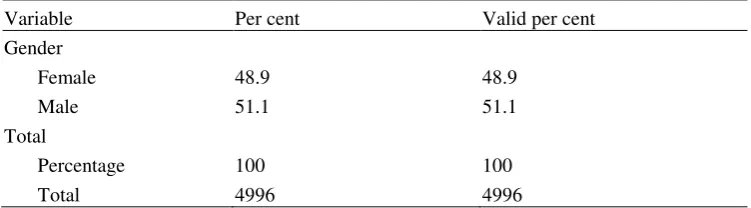
The data source for this paper was gained from the 2009 administration of PISA, which is a standardized assessment program developed internationally by cooperating Organization for Economic Co-operation and Development (OECD) countries and conducted with 15-year old students in schools from participating countries (OECD, 2010). Target population of this study was 15-year old Turkish students who engaged in PISA 2009. The data included 4996 Turkish students consisting of 2551 male and 2445 female. A brief summary of gender from the sample of this study is presented in Table 1.
Table 1.
A Summary of Turkish Students Participated in PISA 2009
Variable Per cent Valid per cent Gender
Female 48.9 48.9
Male 51.1 51.1
Total
Percentage 100 100
Total 4996 4996
One-way ANOVA
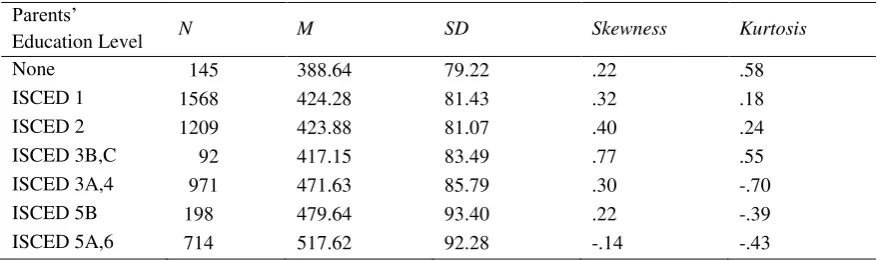
60 Table 2.
Descriptive Statistics for Parents' Education Level across Mathematics Achievements
Parents’
Education Level N M SD Skewness Kurtosis
None 145 388.64 79.22 .22 .58
ISCED 1 1568 424.28 81.43 .32 .18 ISCED 2 1209 423.88 81.07 .40 .24 ISCED 3B,C 92 417.15 83.49 .77 .55 ISCED 3A,4 971 471.63 85.79 .30 -.70 ISCED 5B 198 479.64 93.40 .22 -.39 ISCED 5A,6 714 517.62 92.28 -.14 -.43
*Notes: N/A: 6 (.1%); Missing: 93 (1.9%)
In order to investigate possible differences in mathematics achievement between students based on their highest parents’ educational level (HISCED), a one-way ANOVA was conducted. The study found evidence that there was a difference in mathematics achievements based on HISCED status (F=149.51 (6, 4890), p< .0001). Thus, the null hypothesis of no differences in mathematics achievements based on parents’ education was rejected. The 2 = .154 indicated that roughly 15% of the variation in the mean of mathematics achievements was attributable to differences between the seven groups of parents’ education level.
Table 3.
Results of ANOVA
Sum of Squares df Mean Square F Sig. Between Groups 6383981.41 6 1063996.90 149.513 .000 Within Groups 34799356.5 4890 7116.43
Total 41183337.9 4896
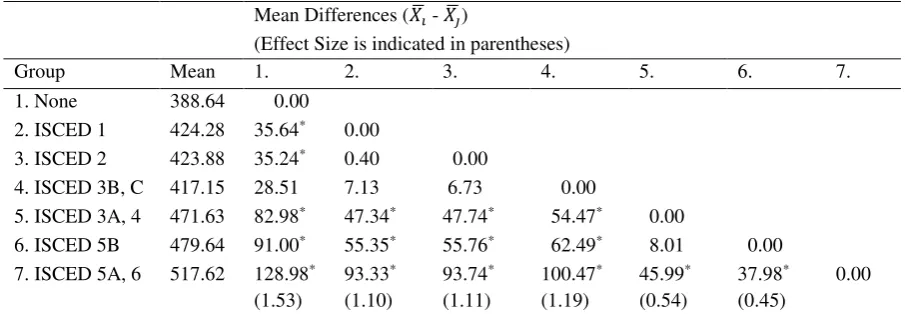
61 Table 4.
Turkey Post Hoc Results and Effect Size of Mathematics Achievements by the Highest Parents' Educational Level
*.The mean difference is significant at the .05 level.
Correlation
To examine the relationship between the index of ESCS and mathematics achievements, Pearson’s correlation was computed. The results indicated that there was a positive and significant correlation between ESCS and mathematics achievements, r= .45, n=4967, p< .001. It suggests that there was a medium relationship between ESCS and mathematics achievements (Cohen, 1992; Field, 2009). R-squared was .20, which implies that 20% of variance of mathematics achievements is associated with the variance of ESCS. In this case, missing data is 29 (.58%), which is very small and less than 5%. This missing data would not affect the estimation of the whole population.
Linear Regression
To investigate the hypothesis of the research question number three, a simple linear regression was conducted to assess if ESCS predicted mathematics achievements. Prior to analysis, the assumption of normality of independent variable (ESCS) was examined and it was concluded that it was met as its distribution was associated with skewness and kurtosis less than |2.0| and |2.0| respectively (Schmider et al., 2010).
62
Figure 1. Scatter plots of ESCS against plausible value in mathematics
The results of linear regression were significant, F (1, 4965) = 1281.46, p< .001, R2 = .20, suggesting that approximately 20% of the variation in the mathematics achievement score was predicted by the ESCS score. ESCS was a significant predictor of mathematics achievements, B=34.56, p< .001 suggesting that for every one unit increase in ESCS then mathematics achievements increased by 34.56 units. Therefore, we rejected the null hypothesis. Results of linear regression are presented in Table 6 below.
Table 6.
Results of Linier Regression with ESCS Predicting Mathematics Achievements
B SE 𝛽 t p
Constant 487.63 1.62 301.64 .00
ESCS 34.56 .97 .45 35.80 .00
Discussion
In this study, analysis of data showed that gender differences and mathematics achievement was statistically significant. Findings also revealed that male students were associated with a statistically significant larger mean of mathematics achievement than female students. Although, the mean difference of mathematics achievement between male and female was statistically significant, the effect size was quite small suggesting that the mean difference of mathematics achievement by gender was not practically significant. The findings of this research are similar to the previous study conducted by Isiksal and Cakiroghi in Turkey in 2008. They found that gender differences regarding to mathematics achievements of Turkish middle school students based on level of the economic development city was statistically significant but it was not significant practically.
63
ISCED 2, and ISCED 3B, C was quite large indicating that it was also practically significant and the effect size between ISCED 5A, 6 and ISCED 3A, 4 and ISCED 5B was quite small suggesting that practically it was not significant (Cohen, 1992).
Regarding to the influence of index of ESCS on mathematics achievements, correlation analysis revealed that there was positive and significant relationship between these two variables. ESCS has a medium relationship with mathematics achievement. Linear regression showed an increase in one unit in ESCS would increase mathematics achievements by roughly 34.56. It means that there were positive linear relationships between ESCS and mathematics achievement. Additionally, the results of the linear regression also indicated that ESCS score predicted approximately 20% variation of mathematics achievement. Therefore, it could be concluded that ESCS was a significant predictor of mathematics achievement. Indeed, the ESCS score had a positive influence on mathematics achievement. Based on correlation and linear regression analysis, it could be said generally that if the index scores of ESCS of students in Turkey were good then students’ performance in mathematics would increase.
In conclusion, there are three main issues of the findings in this study. First of all, the findings of this study have revealed that gender differences and mathematics achievement in Turkish students who participated in PISA 2009 are statistically but not practically significant. Secondly, parents’ education level of Turkish students in this research has an impact on Turkish students’ mathematics achievements. The last main point of the result in this study is the index of ESCS has a positive impact on mathematics achievement. ESCS and mathematics achievement show a positive and linear relationship. ESCS is a significant predictor of mathematics achievements.
References
Cohen, J. (1992). A power primer. Psychological Bulletin, 112(1), 155-159. https://doi.org/10.1037/0033-2909.112.1.155
Dalyono, M. (2010). Educational psychology. Jakarta: Rineka Cipta.
Dong, Y., & Peng, C.-Y. J. (2013). Principled missing data methods for researchers. SpringerPlus, 2(1), 1-17.
Field, A. P. (2009). Discovering statistics using SPSS. London: Sage.
siksal, M., & Cakiroghi, E. (2008). Gender differences regarding mathematics achievement: The case of Turkish middle school students. School Science and Mathematics, 108(3), 113-120.
64
Schmider, E., Ziegler, M., Danay, E., Beyer, L., & Bühner, M. (2010). Is it really robust? Reinvestigating the robustness of ANOVA against violations of the normal distributions assumptions. Methodology: European Journal of Research Methods, 6(4), 147-151.