Jurnal Riset Akuntansi dan Bisnis Airlangga
THE ROLE OF ISLAMIC FINANCIAL COOPERATIVE (BMT)
IN POVERTY ALLEVIATION THROUGH EMPOWERING
MICRO, SMALL, AND MEDIUM ENTERPRENEURS
Fitrah Kamaliyah1
ABSTRACT
The purpose of this study to analyze the role of BMT on MSMEs quality of life by taking a case study of BMT Bina Umat Sejahtera in Yogyakarta city. A survey on 53 respondents was conducted on September-November 2015. Non-parametric tests were applied in this study to analyze correlation between variables and CIBEST, MSMPI and IPI MODEL were employed as poverty measurement tools. This study found that financing through the entrepreneurs was effective to increase their income. Age, duration of installment, financing amount, household income and expenditure before financing found as significant factors affecting to household
income after financing. Overall, BMT’s Performance was proven to be able change
the quality of life of respondents in three models of poverty measurement positively. The results of this study are expected to BMT strategies so that financing customers can improve their standard of living as well as increase their level of spirituality
Keyword : Islamic Microfinance, Poverty, Poverty Indices.
Introduction
Since the global financial crisis which began in 2007, market growth and financial stability started deteriorate. An estimated 2,5 billion people or more than
half of world’s adult population do not have access to formal financial institutions
(Schoon and Range 2014). High unemployment, poverty and low access to formal financial institution make informal microfinance institution become popular within Micro, small, medium enterprise (MSMEs).
In islamic perspective, the conception of poverty has holistic define, it is not only seen in material aspect but spiritual dimension should be taken into consideration also. Chapra (1992) argued that moral as socio economic justice
must be injected into poverty alleviation’s strategy. The values are formed by four
basic ethical interrelated namely unity (tawhid), justice (al ‘adl wal ihsan), freedom (ikhtiy’ar), dan responsibility (fardh) (Naqvi 1994). Hasan (2010) proposed three distinct sets of measurement which are positive, preventive and corrective. The fulfillment of basic needs and efficient all human and material resources to achieve economic growth and gain the standard of living of the human kind. Because of all these, the Islamic economic system makes a substantial differentiate against conventional economic approach to solve the issues related to poverty.
1
Author : Dosen Akuntansi Fakultas Ekonomi Universitas Pamulang Telp. 021-7412566
Email : [email protected]
ARTICLE INFO
Article History :
Received 17 June 2018
Accepted 13 November 2018 Availabe online 30 November 2018
Vol.3 No.2
2018
Microfinance institutions are believed to be used as an instrument to address poverty (Riwajanti, 2013). The need of the poor is financial services to fulfill their life-cycle events (birth, marriage, death, home building, old age), recurrent incidents (expenditure related to hospital cost, lost job) and opportunities to invest in business, land and household assets (Obaidullah, 2008). Siebel (2007) says that Indonesia is the most differentiated infrastructure of microfinance institutions, about 6.000 formal and 48.000 semiformal which registered serving around 45 million depositors and 32 million borrowers. However, the reality of their performance still ups and downs especially for Islamic microfinance institutions. Lack of regulation, supervision and islamic value are main factor which led to poor performance of IMFs (Siebel 2006).
On the other hand, different perspective expressed by Beik and Purnamasari (2011) stated that the provision of micro financing to micro, small, medium enterprise (MSMEs) were effective.They argued daily business profit, montly consumption and amount of proposed financing of member had positive impact to post-financing income. Moreover, the determinants of BMT are capability to manage financial and risk management, characteristics of financing customers, familiarity between customers
and managerial team of BMT, information technology and network (Hosen and Sa’roni
2012).
In the context of Indonesia, Islamic Microfinance (IMFs) seem to be an
important tool to enlarge MSMEs’ business capacity. According to Ministry of Cooperatives and Micro, Small, Medium Enterprise, Indonesia’s population is in the area of SMEs with business unit around to 52 million in 2009 and increased to 54 million in 2010 with contribution from this sector about 99,99 percent from total business units. Moreover, the SMEs sector has absorbed the labor force of 96 million in 2009 and 98 million people in 2010. The data indicates that the presence of SMEs has enormeous influence on the growth of Indonesian economy.
According to those economic conditions, the empowerment of micro, small, medium enterprise (MSMEs) should be taken into consideration. Petesh et al ( 2005) defines empowerment is an attempt to improve both the capacity of individuals or groups to make purposeful choices and their capacity to transform these choices into desired actions and outcomes. In other words, empowerment is intended as the process of improving the ability of the poor to be able make choices that are able improve their welfare (Mason 2005).
The empowerment conducted by microfinance institution has several models. Ajaz and Ramzan (2012) describes at least three models consist of the Grameen model where empowerment through women as the main target of credit. Progressive lending model is an extension of Grameen model by providing financing to individuals. In the practical manner, this model tends to give a financing on the population and the number of large amount. While, Islam itself emphasizes the social, ethical and moral character development by providing spiritual and religious practice. Thus, IMFs has a great potential to grow up rapidly from time to time a major player in the financial practices of inclusiveness in the empowerment of SMEs. Therefore, this study tries to
analyze the effect on revenue of BMT’s partners comprising pre and post financing. It also explains the condition of their living standard after receiving funding and the strategy in poverty reduction made by BMT.
Page | 482
Jurnal Riset Akuntansi dan Bisnis Airlangga
This study explores the performance of BMT that can provide an influence on poverty alleviation, so researchers try to measure with various methods that have been developed by several previous researchers to know how effective the financing increase the economic standards of the surrounding community. In addition, BMT as a micro-Islamic institution that adheres to Islamic principles can certainly have a positive impact on increasing the spirituality of its customers. The results of this study are expected to BMT strategies so that financing customers can improve their standard of living as well as increase their level of spirituality. BMT Bina Umat Sejahtera is one of the 3 rd microfinance institutions in the city of Yogyakarta that plays a major role in developing patterns of business in sharia with the principle of profit sharing and plays a role in guiding customers to recognize Islamic finance. For this reason, researchers are interested in making BMT Bina Umat Sejahtera as the object of research.
Literature Review Poverty in Islam
The concept of poverty stated in Qur’an with the word “needy” and “poor” as
one of the group who may received zakat. It describes in QS. At-Taubah (9): 60. The
fiqh scholars (four school) dissent about the define of “faqir” and “miskeen”. Shirazi
(1980) describes according to Shafi’i and Hanbali school said a man is poor (faqir) if he does not own wealth and income, despite if he presently earning something but less than half for meeting his needs. Someone is considered as needy (miskeen) if the earnings or wealth owned only could satisfy more than half of his needs but does not reach 100 percent. On the other hand, Hanafi and Maliki school have opposite
oppinion. According to both thes schools, the economic level of the “poor” is lower than those of a “needy”. However, Shirazi (1980) continues, the the dissent for those
deffinition of “needy” and “poor” have no significant effect in practical manner. Either the “needy” or the “poor” are in the position who cannot fulfill their basic needs.
Islam as a religion already has a comprehensive system to regulate everything that exist in the world into the rules of Islamic law. The discussion of poverty in Islamic
perspective is always based on the concpt of maqāsid al-Shari’ah. Al Ghazali as mentioned in Chapra (2008)explains the objective of the Shari’ah (maqāsid al
-Shari’ah) is to protect human needs are divided into five terms consist of the religion
(din), physical self (nafs), intellect (‘aql), descent (nasl) and wealth (maal). Undoubtedly, The poverty is closely associated with the failure of protecting the soul (nafs) which is one of the main objectives of maqāsid al-Shari’ah itself (Obaidullah 2008).
Al Ghazali explain that stressed “necessity” in defining poverty. Necessities consist of all activities that are essential to perform the five pillars of Islam (Belief, Prayer, Fasting, Zakah and Hajj) (Ismail, 2010). Inability fulfill somthing that is not required cannot be said to be poor. Moreover, Al Ghazali divides poverty into two kinds namely poverty in relation to material needs and poverty in relation to spiritual needs. As poor in material needs described in QS. Al Baqarah (2): 155 and then, poor in spiritual needs expalined in QS. Al An’am (6):44.
Similarly as Ahmed (2004, 20)stated that the concept of poverty is not only can be seen from material aspect alone (goods and services), instead, spiritual aspect should
Page | 483
Jurnal Riset Akuntansi dan Bisnis Airlangga
Vol.3 No.2
be taken place into it. Thus, Al Sadr in Chapra (1992) argued that poverty and deprivation are due to inequitable distribution and lack of moral in the relationship between the rich and the poor. In addition, Chapra (2007) explained that despite the presence of justice in distribution would be imposible if moral improvement not be followed. In fact, poverty in both material and spiritual caused by a lack of moral and justice.
Poverty Measurement in Islamic Perspective
Rasool et al (2012) suggests various islamic institutions adopt had al-kifayah
(HAK) method in measuring poverty. This method is a monetary approach which determine the level of necessity needed by households to fulfill daily needs. It is calculated based on various variables such as household members, age group of members, shelter, food, health, education and transportation according to maqāsid al
-Shari’ah principles. However, this method is still less because it focused only on
material needs.
In consequence, Rasool and Salleh (2014) construct a non-monetary approach model from Islamic perspective which called Islamic Poverty Index (IPI). The idea of this model is a modification from Alkire Santos Index where the dimensions in the IPI
based on the concept of maqāsid al-Shari’ah. As Al Ghazali stated that the objective of
Shari’ah is to achieve happiness of all minkind which lies in maintaining their religion, physicalself, intellect, descent and wealth and make up an order of priority. IPI uses two threshold of poverty to decide weather a person or household is poor or not. If the score of Total Weight Index (TWI) is beyond the threshold value, then the household defined as poor.
Another method using the concept of maqāsid al-Shai’ah also built by Kasri
and Ahmed(2015) which called Maqāsid-based Multidimensional Poverty Index (MSMPI) where the model has five dimensions including faith (din), human self (nafs), intellect (‘aql), posterity (nasl) and wealth (māl). To constuct this model, it needs to set up a boundary that distinguish the poverty status. This model also can assist the stakeholder to formulate an appropriate policies related to poverty. In addition, Beik and Arsyianti (2015) try to come up with a method of poverty measurement which may cover both material and spiritual aspects. There are five variables are being used consist of prayer, fasting, zakat, the household environment and government policies environment.
IMFs as a tool to Empowering MSMEs
Devine and Wright (1993) reveal difference between the poor and other
communities are “differential capacity to translate and actualize one’s value into socially desirable repertoire of behaviors”. This expression is interpreted as any desires of the poor are often confronted with a lack of opportunity and resource needed. In fact, SMEs are classfied as the poor, hence, the problem may faced in common. In various literatures SMEs face the problem of limited capital and access to the financial institution.
Nenova et al (2009) in their empirical study claimed 60 percent of Pakistan’s population do not have access financing and 40 percent of them outside of both formal and informal financial institution. Furthermore, Khandker et al (2013) stated that SMEs
Page | 484
Jurnal Riset Akuntansi dan Bisnis Airlangga
Vol.3 No.2
in Bangladesh borrow money from informal loans such as family member, friends or informal lenders who charge exorbitant interest rates in range of 180 to 240 percent a year, then make it difficult for SMEs to sustain borrowing from these types of informal financing.
As stated by Siebel (2007), Indonesia is the most differentiated infrastructure of microfinance institutions about 6.000 formal and 48.000 semiformal which registered serving around 45 million depositors and 32 million borrowers. In general, Islamic financial institutions are divided into two types (Siebel 2004):
a. Banking institutions under the Banking Act namely Full-fledge Islamic commercial banks (BUS), Islamic banking units (UUS) and Islamic rural banks (BPRS).
b. The Islamic financial cooperatives (BMT) are not part of the formal financial sector. They also may or may not be registered with the Ministry of Cooperatives, therefore, they may be placed into either semiformal or informal fianancial sectors.
BMT is an institution that operates based on islamic principles which has two major functions. First, baitul maal or Islamic treasury, which aims to redistribute the wealth of the community collected through a variety instruments of Islamic alms including zakat, waqf, and charity. Second, baitut tamwil as Islamic business center which all activities undertake wealth generating based Islamic jurisprudence such as justice, cooperative, transparent, and Islamic value – the prohibition of riba, gambling, speculation and adverse activity (Sakai 2010).
Sakai and Marijan (2008) state BMT is a unique institutions compared to other financial institutions. in order to achieve those objectives, BMT need to provide three services (micro-financing, zakat, social welfare program, and business training) to their members or groups. Masyita (2012) argues that in practical manner, islamic
microfinance can be integrated with the principle of “profit-loss sharing” which equitably allocates risk and return between investors and entrepreneurs. Thus, Feroz
and Goud (2009) state that the Shari’ah scholars agree that musharakah is amore “Shari’ah” form of financing compared to murabaha financing.
Until 2013 there is no accurate data on the number of BMT existing in Indonesia. Aziz as quoted by Nazirwan (2015) stated that approximately 2.938 BMT operated across the provinces in 2001, PINBUK suggest the number increased to 3.600 BMT in 2006, then, it reached 5.200 in 2010 to serve more than 10 million customers (Riwajanti 2013), until the end of 2011 about 5.500 units of BMT has been established (Sakti 2013).
Role of IMFs in Poverty Alleviation
Various studies of Islamic microfinance and SMEs have been widely discussed related to eradication of poverty. Ahmed (2002) in his research said that three IMFs in Bangladesh were successfully demonstrated their ability to increase
customers’ income including their family members. The program performed in
increasing 53,8 percent on the amount of production and 36 percent the diversification of goods. Furthermore, assets and premises also improved 68 percent and 88 percent respectively.
Obaidullah (2008) argued that the program of RDS appear to have performed better than other conventional MFIs with the rate of growth 15,57 percent. Unlike the Grameen Bank has customers 94% of women, RDS prioritizes integration of the family
Page | 485
Jurnal Riset Akuntansi dan Bisnis Airlangga
Vol.3 No.2
by using “family empowerment” concept. Same results also expressed by Rahman et al
(2008), they said the RDS program in improving household income and expenditure as well as the living standard of the clients. It shows the ability to increase level of religiosity such as prayer and fasting.
According to Shirazi and Khan (2009) show a indicate Pakistan Poverty Alleviation Fund (PPAF) has reduced the overall poverty level by 3,07 percentage points (from 6,67 percent to 3,54 percent) and the borrowers have shifted to higher income during the period. On the other hand, the poverty status of the extremely poor borrowers has increased 0,63 percentage points Khaleequzzaman and Shirazi (2012) suggest extending and comprehensive strategy to eradicate the poverty issue through product diversification, innovation and downscaling operations of Islamic banks linking islamic microfinance institutions.
Investigation of the influence of Islamic microfinance in non-Muslim country conducted by Noipom (2014). The results reveals that murabaha micro-financing has
impacts on economic aspect of borrowers’ household. These are likely to be influenced
by gender, age, occupation, level of productive assets, and membership length of borrowers. In generally speaking, micro-financing has a positive impact on both household income and expenditure respectively.
In a case of Indonesia, there are few studies which have been done related to microfinance. Siebel (2006) report that the growth of IMFs is stagnant give the impact on the growth of asset was far below their conventional counterparts. A complete Lack of regulation, supervision, reliable reporting and islamic values are another factors to the poor performance of IMFs. Saad et al (2009) and Masyita and Ahmed (2013) conclude Indonesia as the largest infrastructure of IMFs. There is a huge distance between IMFs and conventional institutions based on both economic and non-economic indicators.
Meanwhile, Dariah (2012) showing BMT succesfully overcome the problems of financing by reschedulling, restructuring and reconditioning. In the process of these stages, BMT Latifah also managed bonding social capital as a means of delivering program training for clients, hearing complaints and socialization of islamic economics as well. Riwajanti (2014) a funding that IMFs can reduce poverty status by 8,1 percentage points (from 44,4 percent to 36,3 percent). The study also suggested that IMFs should increase the amount of financing taken by the clients, productinnovation
which suitable to clients’ needs and provide social services comprising education and
training to enhance understanding of the product.
Methodology
This study taking a case study from BMT Bina Umat Sejahtera in Yogyakarta city was conducted on October-November 2015. The primary data were collected from a survey by questionnaires given to members who received financing from BMT Bina Umat Sejahtera, while secondary data is obtained from various sources including Ministry of Cooperative and SMEs, Central Board of Statistic, Journals, dissertations and other scientific articles which related to this study.
This research will conduct a three stages analysis. First, to find out the effectiveness of micro-financing provided by BMT Bina Umat Sejahtera wether effective or not. Measurement of effectiveness is divided into five groups: very
Page | 486
Jurnal Riset Akuntansi dan Bisnis Airlangga
Vol.3 No.2
ineffective, ineffective, fair effective, effective and very effective. In determining the value of the group using the following formula:
Value = ...(1) Where:
b = Weight
j = Number of respondents
Since there are five groups of assessment, thus, an interval for each group could be formulated as follow:
Interval=
...(2)
Second, to quantify the impact on poverty status of target group in both economic and spiritual aspect with pre and post financing. This study employs
members’ income and the level of religiosity to capture the economic and spiritual
impact respectively. Non-parametric tests are used because the required assumptions are not met and final stage is to analyze the role of IMFs in poverty alleviation by using three models of poverty measurement from Islamic
perspective namely CIBEST MODEL, Maqāsid-based Multidimensional Poverty Index (MSMPI MODEL) and Islamic Poverty Index (IPI MODEL).
CIBEST MODEL is a mesuring poverty model which has conception in material and spiritual perspectives. There are several stages of calculation must be done for using this model (Beik and Arsyianti 2016) which are:
Firstly, measure the material poverty line (MV), determination of MV value in this study using Central Board of Statistic (BPS) standard of Yogyakarta city poverty line in 2014. Poverty line used is IDR 780.346 per capita/month with the average household member in Yogyakarta city is 3,3 persons/household. The calculation is derived using following formula:
MV = HE X AH ...(2)
Where:
MV = Material poverty line
HE = Household expenditure per capita AH = Average household member
Secondly, in determining the value of spiritual level of BMT’s member is
measured from the following formula:
Svi= ...(3)
Where:
SVi = Spiritual score Vp = Prayer score Vf = Fasting score
Vz = Zakat score
Vq = Reading Qur’an score Vb = Learning religion studies
Page | 487
Jurnal Riset Akuntansi dan Bisnis Airlangga
Vol.3 No.2
Results ≤ MV Value > MV Value
> SV Value Materially poor, Spiritually rich (Quadran II)
Materially and Spiritually rich (Quadran I)
≤ SV Value Materially and spiritually poor (Quadran (IV)
Materially rich, spiritually poor (Quadran III)
Next, there are four indices that are employed in the measurement of this model consist of welfare index, spiritual poverty index, material poverty index and absolute poverty index respectively with the formula as follow:
W= ...(4)
Where:
W = Welfare index
w = Number of welfare respondents (spiritually and materially rich) N = Total number of respondents
This general formula can be used in obtaining of other indices (material, spiritual and absolute).
The second method of poverty measurement is MSMPI MODEL (Kasri and Ahmed 2015) in which the measurement is based on maqāsid al-Shari’ah principles. This model can be constructed into five dimensions which are religion (din), health (nafs), education (‘aql), offspring (nasl) dan economic (māl). Such a formula is used as follow:
MSMPI= ...(4)
The last measurement model in this study using IPI MODEL. The dimensions in this model would be based on human needs principle according to Islamic perspective (maqāsid al-Shari’ah) by adopting a model of Multidimensional Poverty Index (MPI) developed by Alkire dan Santos(Rasool and Salleh 2014). In applying the IPI model, there are three steps of calculation must be followed. Firstly, determination of weight of each dimensions were
Where:
MSMPI = MSMPI Index n = Weightage Dimension D = Religion Dimension Nf = Physical Dimension
‘A = Education dimension Ns = Offspring dimension M = Economic dimension
Thirdly, after obtaining the value of MV and SV, then we conduct the
determination of members’ poverty status based on their material and spiritual
values into CIBEST quadrant as show in table 1 below.
Table 1 Combination of CIBEST Quadrant
Page | 488
Jurnal Riset Akuntansi dan Bisnis Airlangga
Vol.3 No.2
calculated based on the rankings given by the scholars. Secondly, calculation the weightage of each indicators was given to quantify the contribution of each indicators and thirdly, set the cutoff point or the poverty line at every level of IPI. Such a general equation could be formulated as follow:
IPI = (W1D + W2Nf + W3’A + W4Ns + W5M) X 100%...(5)
The weightage of each indicators are used the following formula:
Wi = ...(6)
Where:
Wi = Weightage of indicator Wd = Weightage of dimension n = Number of indicators
Dimensions Mean Weightage
Din 4,429 0,295
Nafs 3,786 0,252
‘Aql 2,786 0,186
Nasl 2,071 0,137
Māl 1,929 0,129
Islamic Poverty Index (IPI)
Poverty Line (K1) Destitute Line (K2)
IPI 1 40 70
IPI 2 45 75
IPI 3 50 80
Results and Discussion Respondents Profile
Where:
IPI = Islamic Poverty Index D = Religion Dimension Nf = Physical Dimension ‘A = Education Dimension
Ns = Offspring dimension M = Economic dimension
W1,2,,,W5 = Weight
The determination of the weightage of dimensions and the cutoff points in this study used the assessment done by Rasool and Salleh (2014) as shown in table 2 and table 3 below.
Table 2 Weightage of Dimension
Table 3 Poverty Line
Page | 489
Jurnal Riset Akuntansi dan Bisnis Airlangga
Vol.3 No.2
2018
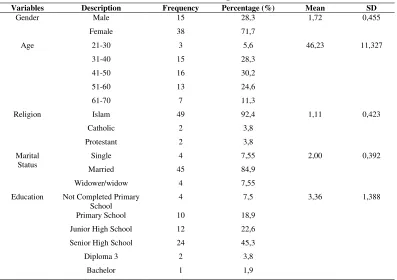
The summary of descriptive statistics of the respondents as depict in table
Variables Description Frequency Percentage (%) Mean SD
No Perception of Respondents Total Score
1 Application Stage 4,72
2 Fund Disbursement Stage 4,21
3 Repayment Stage 4,53
4 Impact of Financing 2,92
Total Average 4,1
In further findings related to the perception of respondents show that a
positive assessment of the appropriateness of Shari’ah (47,2 percent), easy
prosedure (96,2 percent), low administrative expense (83 percent), ease of collateral (96,3 percent), low profit sharing (83 percent) and ease of location of BMT (52,8 percent). Perception of respondents on asset reveal that the majority of them do not have any impact on land ownership (67,9 percent), buildings (56,6 percent), jewellery (56,6 percent) and productive assets (49,1 percent). In contrast, only private vehicles and savings that show positive response of 50,9 percent and 39,7 percent respectively. These results indicate that most of the financing was received do not change the assets owned by the respondents. To know about the profile of the research respondents, it can be further explained in detail as described earlier, depict in the following table 4.
Table 4 Profile of Respondents
Page | 490
The effectiveness of financing can be seen from table 5 below. There are four stages for assessing including application stage, fund disbursement stage, repayment stage and impact of financing stage. Further explanation would be given as follow.
The last stage related to the impact of financing on the business of respondents. It gives an explanation at this stage is quite effective. This is understandable that most of the respondents feel no impact on their income level after receiving financing. In general, the effectiveness level of the provision of micro-financing conducted by BMT Bina Umat Sejahtera is effective. It indicates that the presence of this BMT has a positive impact in helping MSMEs to obtain financing for their business.
can be observed that a significant defference statistically among the amount of respondets’ income before and after receiving financing at the confidence level of p = 0,003. It can be seen that out of 53 respondents surveyed, a total of 18 respondents have increased their income. Although, 31 of the respondents claimed not change and only 4 of them decrased. Generally speaking, it can be concluded that the amount of respondents’ income have increased after receiving financing.
Variables Description N Mean Rank Z Asymp. Sig (p) application stage is 4,72 which mean at this stage the respondents expressed very effective. Respondents can accept any requirements on the application process of financing requested by BMT, so it helps those who are in dire need of financial assistance. As for fund disbursement stage, the score obtained this stage is considered to be effective. This is due to the respondent do not take a long time to receive their financing from BMT. In average, respondents receive their financing no more than a week and even sometimes it can be received one day after filing process.
Similar result shows in repayment stage. As can be seen in table 5 the score of this stage is 4,53 and it can be concluded that highly effective. The respondents were given the choices of the types of installment according to their abilities. Moreover, type of daily installment has a positive influence on the
Impact on Income, Expenditure and Spirituality of Respondents
On the results of the Wilcoxon Signed Rank Test as shown in table 6 below, it
Table 6 Wilcoxon Signed Rank Test, Impact on Income, Expenditure and Level of Spirituality
expenditure after financing period, 32 of the respondents expressed no impact and non of them decreased. Hence, these findings indicated the improvement in expenditure amount of the respondents after receiving financing.
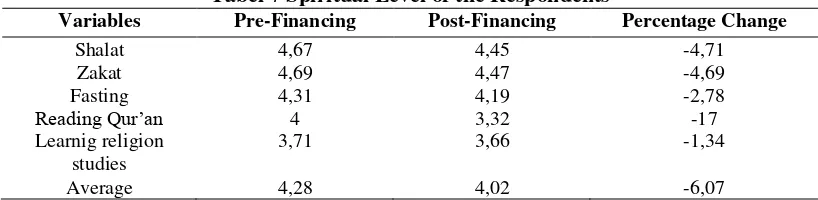
Variables Pre-Financing Post-Financing Percentage Change
Shalat 4,67 4,45 -4,71
Zakat 4,69 4,47 -4,69
Fasting 4,31 4,19 -2,78
Reading Qur’an 4 3,32 -17
Learnig religion studies
3,71 3,66 -1,34
Average 4,28 4,02 -6,07
Similar results were also seen in marital status where the group of respondents who are not married (single) received a larger amount of financing (mean = 29,5) compared to the group of respondents with married status(mean = 28,39) and widower/widow (mean = 8,88). It may caused upon consideration of the dependency which is owned by respondents who were single perceived not As for spirituality level, the result confirmed that there is a reduction impact in this aspect. 32 of the respondent sex pressed a negative impact after receiving financing, while, 6 of the respondents felt no impact and 15 of them increased their spirituality level. In general, the results seem to suggest that there is a decreasing in spirituality level for the most of them during the period. Even though, the findings stated that it has no relation to the financing received by them. Yet, BMT as one of the most important instrument in poverty alleviation program need to give attention seriously about the possibility in declining of spiritual condition of the respondents that may still continue in the future. With regards to the results obtained in table 6, the following discussion will present a more detail explanation in the changes of spiritual level of respondents.
Based table 6, it is depicted the level of spirituality of the respondents already in a very good condition. It is showed from the results of the total average owned before receiving financing with a score of 4,28 where the score is already above the poverty line was determined. However, the spiritual score of the respondents decreased by 6,04 percentage points to 4,02 after receiving the financing from BMT. Yet, in general, the score of these activities still remain on above the poverty line.
Tabel 7 Spiritual Level of the Respondents
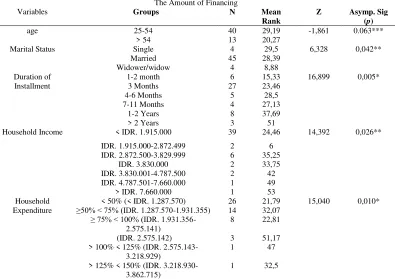
As regards to the difference amount of financing presented in table 7
below, it can be observed that statistically significant differences were found at the level(p- value) of 0,01, 0,05 and 0,10 in age (p = 0,063), marital status (p = 0,042), duration of installment (p = 0,005), household income (p = 0,026) and household expenditure (p = 0,010). At first sight, the amount of financing differ regarding in the age. The age group of 25-54 years (mean= 29,19) is greater than the age group of > 54 years (mean = 20,27). Based on these results, it can be reflected the productivity level of respondents may be an important factor for BMT in deciding the amount of financing. Besides, according to BPS (2014, 12), group 1 (25-54 years) is the respondents who are in the productive age.
Page | 492
Jurnal Riset Akuntansi dan Bisnis Airlangga
Vol.3 No.2
have a large amount of expenditure. Therefore, the risk of default from this group (single) is lower than other groups.
The Amount of Financing IDR. 2.872.500-3.829.999 6 35,25
IDR. 3.830.000 2 33,75
In the related duration of installment, the value of meanthe group with the tenure of financing more than two years has a larger amount of financing than others by 51. This result is certainly very reasonable because the greater amount of financing given a longer duration of installment will be required.
Table 8 Mann Whitney U Test and Kruskall Wallis Test, The Amount of Financing
Same results also shown in variable of household income. As described in table 8 above, respondents with income >IDR. 7.660.000 received largest amount of financing compared to other groups. It is also very reasonable that the income owned by respondents is one of significant factors in terms of risk mitigation. Regarding to household expenditure, group with total expenditure of IDR. 2.575.142 (mean = 51,17) has greatest amount of financing. While, group with the expenditure of 50 percent below the average being the smallest group in receiving the financing.
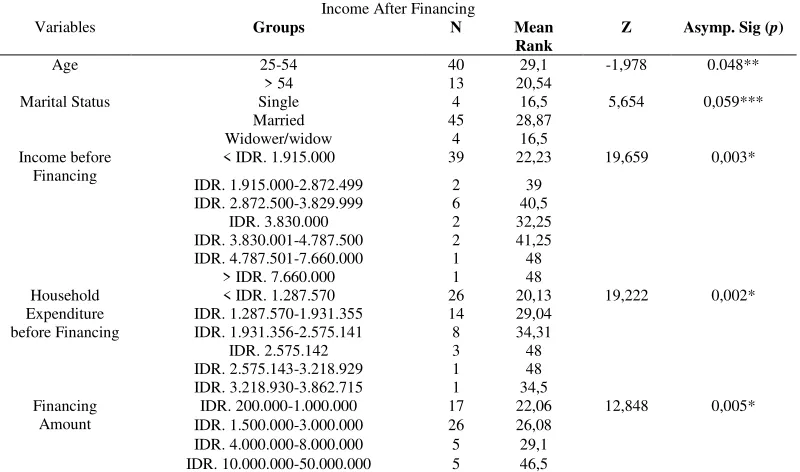
Income After Financing IDR. 2.872.500-3.829.999 6 40,5
IDR. 3.830.000 2 32,25 IDR. 3.830.001-4.787.500 2 41,25 IDR. 4.787.501-7.660.000 1 48 IDR. 1.287.570-1.931.355 14 29,04
IDR. 1.931.356-2.575.141 8 34,31
IDR. 2.575.142 3 48
IDR. 2.575.143-3.218.929 1 48 IDR. 3.218.930-3.862.715 1 34,5 Financing
Amount
IDR. 200.000-1.000.000 17 22,06 12,848 0,005* IDR. 1.500.000-3.000.000 26 26,08
IDR. 4.000.000-8.000.000 5 29,1 IDR. 10.000.000-50.000.000 5 46,5
Note: * Sig at the 0,01 level, ** Sig at the 0,05 level and *** Sig at the 0,10 level.
The results from Mann Whitney U and Kruskall Wallis Tests prove that respondents with age 25-54 years (mean = 29,1), married (mean =28,87), household income above IDR. 5 million and household expenditure IDR. 2.575.143-3.218.929 (mean = 48) as well as financing amount above IDR. 10 million (mean = 46,5) had largest total income among the other groups.It gives an explanation that the productive age and good economic level have a greater apportunity to improve their quality of life in the economic aspect. Nevertheless, an interesting result shown on marital status where the respondents with married status have largest income than the others. It can be interpreted in terms of religion that marriage could open the chance of provision wider as described in surah An-Nur (24): 32.
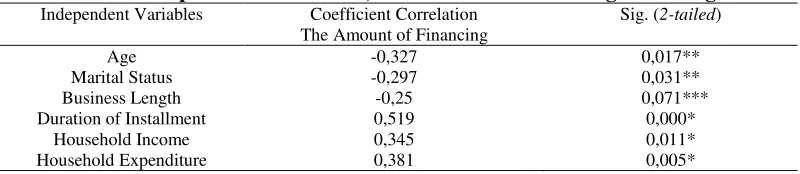
have significant correlation statistically at the level of 0,01, 0,05 and 0,10. These variables are age (p = 0,017), marital status (p = 0,031), business length (p = 0,071), duration of installment (p = 0,000), household income (p = 0,011) and household expenditure (p = 0,005).In addition, the assessment of the coefficient correlation which indicate the strenght of relationship between variables (-1 to +1) in this study
using Cohen’s criteria as cited by Riwajanti (2013, 280)were classified into three groups namely weak (0,10-0,29), strong enough (0,30-0,49) and strong correlation (0,50-1).
There is a strong enough correlation shown between age and financing amount to the value (rho = -0,327). Negative relationship explains that increasing the age of respondents, then the amount of financing received smaller. In other words, productive age has a strong enough relationship in receiving the amount of financing bigger. A negative relationship also demonstrated between marital status and amount
Table 9 Mann Whitney U Test and Kruskall Wallis Test, Income After Financing
Page | 494
of financing. There are three categories on marital status: single, married and widower/widow. Related to the strenght of relationship, it can be seen both variables have weak relationship (rho = -0,297). From these results, it can be observed that the respondents with single status receive a larger amount of financing than other groups.
Similarly the previous two variables, business lenght of respondents depicted a negative relationship but weak correlation (rho = -0,25). The result shows interesting thought, although respondents are just starting their business, but they are trusted to receive the number of significant financing. it indicates that the confidence of BMT upon its members are high enough. As for relationship between duration of financing and amount financing, it has a strong correlation (rho = 0,519). A positive sign on the correlation gave an explanation that a longer duration of financing obtain a larger amount of financing anyway.
Independent Variables Coefficient Correlation Sig. (2-tailed)
The Amount of Financing
Age -0,327 0,017**
Marital Status -0,297 0,031**
Business Length -0,25 0,071***
Duration of Installment 0,519 0,000*
Household Income 0,345 0,011*
Household Expenditure 0,381 0,005*
Note: * Sig at the 0,01 level, ** Sig at the 0,05 level and *** Sig at the 0,10 level.
Related to the household income and expenditure both have positive relation with the value of rho = 0,345 and rho = 0,381 repectively. It can be concluded that the greater household income and expenditure which are owned by respondents can increase the amount of financing received.
The result of variable age as can be seen in table 11 indicate a significant relation to income after financing but weak correlation (rho = 0,0274). A negative sign between the two variables proved that respondents with younger age have higher income than other groups. In other words, the respondents who have productive age more sucessful increased their earnings compared to unproductive age. On the duration of installment also depicts weak correlation with rhovalue of 0,242 with linier relation. It indicates respondents who have a longer duration of installment obtain greater earnings as well. Accordingly, this result proves that a larger amount of financing (rho = 0,396) is an important factor in increasing
respondents’ household income.
The last two variables, namely household income and household expenditure before financing equally have a strong relationship (rho =0,594 dan
rho = 0,573) to total income after financing. These results explain that the
Table 10 Spearman Rank Test, The Amount of Receiving Financing
Page | 495
Jurnal Riset Akuntansi dan Bisnis Airlangga
Vol.3 No.2
2018
respondents who have large household income and expenditure before financing have the opportunity to earn income larger than the other groups also.
Independent Variables Coefficient Correlation Sig. (2-tailed) Income after Financing
Age -0,274 0,047**
Duration of Installment 0,242 0,081***
Household Income before Financing
0,594 0,000*
Household Expenditure before Financing
0,573 0,000*
Financing Amount 0,396 0,003*
Note: * Sig at the 0,01 level, ** Sig at the 0,05 level and *** Sig at the 0,10 level.
Empirical Role of BMT in Poverty Alleviation
After explaining the condition of BMT’s members before and after
receiving financing from both economic and spiritual aspects, this section will address the role of BMT in poverty alleviation. To answer that, three models of Islamic poverty measurement were employed in this research including CIBEST
MODEL, Maqāsid-based Multidimensional Poverty Index (MSMPI) and Islamic Poverty Index (IPI).
Cibest Model
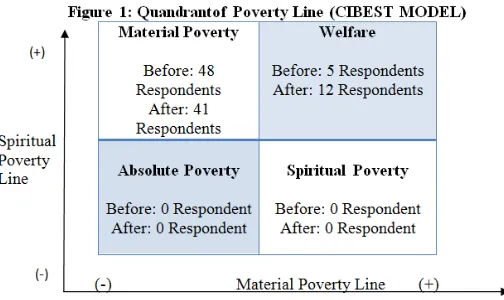
Based on figure 1 it is found thatmajority of respondents before receiving financing are in second quadrant (material poverty), only five respondentsare already in first quadrant (welfare). Conversely, none of them are in third quadrant (spiritual poverty) nor fourth quadrant (absolute poverty). It is reflected that all of respondents are already above the spiritual poverty line.
After receiving the financing, there is a positive change in which seven respondents shifting from the second quadrant to the first quadrant. The number of respondents in material poverty quadrant is 41 respondents. According to these results, it can be explained that the financing received by respondents can increase their material condition of 13,2 percentage points.
Table 11 Spearman Rank Test, Income after Financing
Page | 496
Jurnal Riset Akuntansi dan Bisnis Airlangga
Vol.3 No.2
Variables Before Financing After Financing Percentage Change
Absolute Poverty Index
0 0 0
Material Poverty Index 0,906 0,774 -14,57
Spiritual Poverty Index 0 0 0
Welfare Index 0,094 0,226 140,43
MSMPI Model
Furthermore, next measurement of poverty is Maqāsid-based Multidimensional Poverty Index (MSMPI). The model gives an overview of the performance of BMT in poverty alleviation based on maqāsid al-Shari’ah principles. Five dimensions are employed in this measurement consist of dimension of religion (din), physical (nafs), education (‘aql), offspring (nasl) and wealth (māl). Determination of the poverty status in each dimension are grouped into five categories namely, very poor (1-1,8), poor (1,9-2,6), poverty line (2,7-3,4), rich (3,5-4,2) and very rich (4,3-5).
Poverty Dimension MSMPI Score Status
Din 4,02 Rich
Nafs 2,69 Poverty Line
‘Aql 3,35 Poverty Line
Nasl 2,06 Poor
Māl 2,32 Poor
Total 2,89 Poverty Line
Moreover, the condition of respondents in both physical (nafs) and education (‘aql) dimensions are in the poverty line. Generally sepaking, it suggests the respondents are good enough in protecting their physical and education needs. However, a serious attention remain be needed in the future to keep the improvement running. It is because the vulnerability of these dimensions
Table 12 Poverty Index (CIBEST MODEL)
Based on table 12 show poverty indices in CIBEST MODEL above revealed that the provision of micro-financing conducted by BMT can improve the welfare level of 140,43 percentage points (from 0,906 to 0,774) and decreased the level of material poverty of 14,57 percentage points (from 0,094 to 0,226). Based on these results suggest that the presence of BMT Bina Umat Sejahtera as one of financial institutions has an important role in helping poverty alleviation program to micro, small, medium enterprise (MSMEs).
Page | 497
Jurnal Riset Akuntansi dan Bisnis Airlangga
Vol.3 No.2
2018
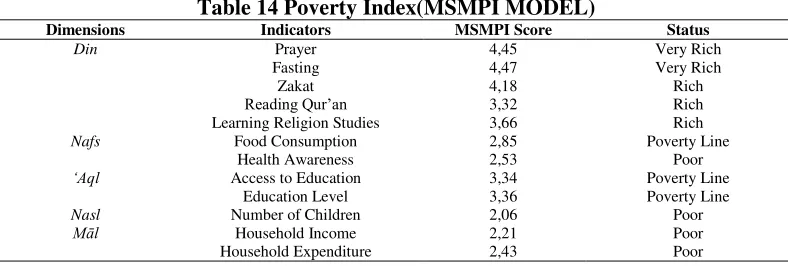
Table 13 describes respondents’ poverty status after receiving the financing
from BMT. There are two of five dimensions show the status of respondents is still below the poverty line i.e offspring (nasl) and wealth (māl) dimensions. It can be explained that the lack of material gives an impact on the decision of majority respondents to do not have many children. Perhaps majotiry of them assume that having a lot of children will give a burden on their household economy heavier. In fact, every child born in the wolrd has been guaranteed by Allah for his sustenance, as mentioned in surah Al-Isra’ (17): 31.
into poor status is still quite large. In addition, the status of religion dimension (din) is already above the poverty line with MSMPI score 4,02.
Dimensions Indicators MSMPI Score Status
Din Prayer 4,45 Very Rich
Fasting 4,47 Very Rich
Zakat 4,18 Rich
Reading Qur’an 3,32 Rich
Learning Religion Studies 3,66 Rich
Nafs Food Consumption 2,85 Poverty Line
Health Awareness 2,53 Poor
‘Aql Access to Education 3,34 Poverty Line
Education Level 3,36 Poverty Line
Nasl Number of Children 2,06 Poor
Māl Household Income 2,21 Poor
Household Expenditure 2,43 Poor
respondents’ status is still below the poverty line i.e health awareness, number of
children, household income and household expenditure. From those indicators, it can be explained due to the lack of income that is owned by respondents affecting their decision to reduce the number of expenditure such as medical expense. Likewise, as for number of children, it alsomay caused by economic problem (amount of income) make the majority of them decided do not to have many decendants.
As regards to the food consumption, access to education and education level after receiving financing, it indicates the status of the three are in poverty line meaning that the condition of respondents is considered good enough. However, if we compareMSMPI score of those indicators, the dimension of ‘aql (access to education (3,34) and education level (3,36)) is prioritized by respondents than the dimension of nafs (food consumption (2,85)).
Din is the only dimension that the entire indicator is above the poverty line where prayer and fasting are two indicators with the higher status with a score 4,45 and 4,47 respectively. It gives any senses that the respondents have a good obedience in performing their religious rituals. It is certainly a very good thing for them where Islam has explained the obedience is a crucial factor to achieve a better life, as described in surah At-Thalaq (65): 2-3.
IPI MODEL
Based on the results, it is shown the rankings of dimension given by the scholars. As can be seen, religiosity is considered as the most important dimension of human needs. In this dimension, there are five indicators, namely Further explanation about the poverty status of the respondents will be presented in table 14 below.
Table 14 Poverty Index(MSMPI MODEL)
Based on table 14, it is found that there are four indicators of the
Page | 498
Jurnal Riset Akuntansi dan Bisnis Airlangga
Vol.3 No.2
2018
the implementation of prayer, fasting, zakat, reading Qur’an and learning religion
studies with a weightage of 5,9 respectively.
Then, the physical dimension (food consumption and health awareness) as second priority with a weightage of 12,6, followed by educational dimension (spending on education and education level), offspring dimension (number of children) and wealth dimension (income and expenditure amounts) with a weightage of 9,3, 13,7 and 6,45 respectively.
Dimensions Indicators Weightage
As for BMT performance in poverty alleviation using IPI model, the result shows that the respondents have managed to be above the cutoff point on both the religion (din) and education (‘aql) dimensions. Meanwhile, on the offspring (nasl) as well as wealth (māl) dimensions show the respondents are still below in the threshold of poverty line.
Deprived Indicators TWI IPI 1
K1=40
However, Based on the total weight of all respondents obtained a score of
BMT Strategy in Poverty Alleviation
In this section will answer the last research question of this study related to the strategy of BMT in poverty reduction. To answer that, we will analyze the
Table 15 Weightage of Indicators
Page | 499
39,2 where it is lower than the threshold of poverty line have been set at all levels (IPI1, IPI2, IPI3) result from table 16. Therefore, after receiving the financing from BMT, none of them are in poor nor destitute status at any levels. This result suggests that BMT can play a crucial role in helping MSMEs to improve their standard of living.
strengths and weaknesses of BMT as well as the opportunities and threats that may faced. Therefore, SWOT analysis was employed in mapping these fourth aspects as presented in figure 2 below. Further explanation will be given as follow.
Figure 2 SWOT Analysis, BMT Performance
Strength: 1. Easy Prosedure.
2. Flexible repayment method. 3. Fast Disbursement process.
4. Spirituality level of respondents above poverty line.
5. Multidimensional poverty status of respondents atpoverty line (MSMPI MODEL).
6. Multidimensional poverty status of respondents above poverty line(IPI MODEL).
Weakness: 1. No training events.
2. No business assisting . 3. No Expansion support.
4. Majority of respondents at material poverty (CIBEST MODEL).
5. Spiritual poverty index of respondents has decresed after financing (CIBEST MODEL) 6. The number of respondents with
multidimensional poverty is still quite large (IPI MODEL).
Opportunity: 1. Competitive with other financial institutions. 2. Increasing loyality of respondents. 3. Increasing the living standard of respondents.
Threat:
1. No growth of business owned by respondents. 2. Financing default.
3. The living standard of respondents does not increase.
Based on mapping has been done on the strengths, weaknesses, opportunities, and threats from SWOT analysis. It can be formulated several
strategies which need to be done in the process of improving BMT’s performance.
There are four strategies could be given with the explanations as follow.
Strategy (S-O)
In preventing the possibility of threats may occur, BMT should be able to retain the power already owned. It is suggested that BMT need to conduct in-depth study on the filling process of financing. its has to be selective in choosing member who apply for financing, it is noted that the risk of micro-financing conducted by BMT is very high. However, since the spiritual level of respondents is high, a religious approach may be engaged as a model of risk mitigation by providing religious education related to ethics of financing (Ahmed 2002, 54).
Strategy (W-O)
Lack of income which is owned by respondents may affecting to their decision to reduce the number of necessary expenses such as medical costs. Focusing in improving the quality of life of the respondents is required as one of strategy to achieve the opportunities may have. Since loyalty and spiritual level of respondents are high, it should be taken into consideration by BMT to give them an opportunity to receive greater amount of financing.
Strategy (W-T)
In this section, it is argued that BMT need to build the capability of respondents as a strategy to prevent the possibility threats. The technical
From figure2 above, it can be observed that BMT has a good capital to increase their market share to another MSMEs that have not been touched by promoting their strengths.In addition, with a high spiritual level of the respondents, it can be considered for BMT to provide them the opportunity to obtain a bigger amount of financing. In fact, with a larger amount of financing, it will give a greater chance to the respondents to increase their standard of living.
assistance, mentoring and business expansion can be an input to this. As Obaidullah (2008, 22) suggested that the increased of ability (skill) can improve
the quality of life of BMT’s members and it is also proven by Riwajanti research
(2013, 299).
Conclussion
Regarding to the role of BMT in poverty alleviation, the results of CIBEST MODEL depicted that material poverty index can be decreased by 14,57 percentage points and welfare index can be increased by 140,43 percentage points. In contrast, the spiritual score of respondents is found to be decreased by 6,07 percentage points. It should encourage BMT Bina Umat Sejahtera to get more attentionto the posibility of decreasing this condition.
The results of MSMPI MODEL proved that the condition of respondents in both physical (nafs) and education (‘aql) dimensions are in the poverty line. Generally sepaking, it suggests the respondents are good enough in protecting their physical and education needs. However, a serious attention remain be needed in the future to keep the improvement running. It is because the vulnerability of these dimensions into poor status is still quite large. In addition, the status of religion dimension (din) is already above the poverty line with MSMPI score 4,02.
The last measurement (IPI MODEL) showed the total weight of all respondents obtained a score of 39,2 where it is lower than the threshold of poverty line have been set at all levels (IPI1, IPI2, IPI3). Therefore, after receiving the financing from BMT, none of them are in poor nor destitute status at any levels. Overall, the results from three models of poverty measurement suggest that BMT can play a crucial role in helping MSMEs to improve their standard of living.
Limitation
In this study there are several limitations that cannot be explored further, namely:
1. The researcher only conducted an analysis of one BMT, namely BMT Bina Umat Sejahtera, caused by difficult permits and incomplete data.
2. The time of research that was only conducted for 3 months could not include
Page | 501
Jurnal Riset Akuntansi dan Bisnis Airlangga
Vol.3 No.2
2018 The researchers hope that further researchers can explore further the
factors that influence the achievement of BMT in alleviating poverty that have not been included in this study, such as; managerial factors that make policies to further instill spirituality values of BMT customers so that they can be known because BMT has not been maximized in increasing the spirituality of customers.
more customers to be given a questionnaire. 3. Information provided by management is limited
Implication
The results of this study can be used as a strategic tools for BMT’s so that financing customers can improve their standard of living as well as increase their level of spirituality
Reference
Ahmed, Habib. 2002. Financing Microenterprises: An Analytical Study of Islamic
Microfinance Institutions”. Islamic Economic Studies, Vol. 9.No.2.Pp. 27-64.
Ahmed, Habib. 2004. Role of Zakah and Awqaf in Poverty Alleviation. Jeddah: Islamic Research and Training Institute.
Amalia, Euis, and Mahmudah, Atiqah. 2015. Evaluating the Models of Sharia Microfinance in Indonesia: An Analytical Network Process (ANP) Approach. Al-Iqtishad, Vol. 8. No.1. Pp. 13-30.
Beik, Irfan Syauqi and Laily Dwi, Arsyianti. 2015. Construction of CIBEST Model as Measurement of Poverty and Welfare Indices from Islamic Perspective. Al-Iqtishad, Vol. 8. No.1. Pp. 87-104.
Beik, Irfan Syauqi and Laily Dwi, Arsyianti. 2016. Measuring Zakat Impact on Poverty and Welfare Using CIBEST MODEL.Journal of Islamic
Monetary Economics and Finance, Vol.1.No.2. Pp.141-160.
Badan Pusat Statistik. 2014. Statistik Daerah Istimewa Yogyakarta 2014. Yogyakarta: Badan Pusat Statistik.
Chapra, Muhammad Umer. 1992. Islam and the Economic Challenges. Leicester: Islamic Foundation.
Chapra, Muhammad Umer. 2007. Islam and Economic Development: A Strategy
for Development with Justice and Stability. New Delhi: Adam Publishers
and Distributors.
Chapra, Muhammad Umer. 2008. The Islamic Vision of Development in the Light
of Maqashid al Sharia. London: The International Institute of Islamic
Thought.
Dariah, Atih Rohaeti. 2012. Improving Social Capital of BMT (Baitul Mal Watamwil) : An Experience From BMT Lathifah, Sumedang Indonesia”.
The International Journal of Social Sciences, Vol. 4. No.1. Pp. 64-70.
Devine, Joel E. and James D., Wright. 1993. The Greatest of Evils: Urban
Poverty and the American Underclass. New York: Aldine and Guyter.
Page | 502
Jurnal Riset Akuntansi dan Bisnis Airlangga
Vol.3 No.2
Ejaz Sh., Asad and M., Ramzan. 2012. Microfinance and Entrepreneurship: A Case Study of Akhuwat, Interdisciplinary Journal of Contemporary
Research in Business, Vol.4. No.7. Pp. 305-324.
Feroz, Ehsan H. and Blake, Goud. 2009. Grameen La Riba Model: A Strategy for Global Poverty Alleviation. Journal of Islamic Economics, Banking and
Finance, Vol. 5. No. 2. Pp. 77-100.
Ismail, Abdul Ghafar. 2010. An Islamic View on Poverty. Working Paper in
Islamic Economics and Finance 1018.
Kasri, Rahmatina and Habib, Ahmed. 2015. Assessing Socio-Economic Development based on Māqasid al-shariah Principles: Normative Frameworks, Methods and Implementation in Indonesia. Islamic
Economic Studies, Vol. 23. No.1. Pp.73-100.
Khaleequzzaman, Muhammad and Nasim Shah, Shirazi. 2012. Islamic Microfinance: An Inclusive Approach with Special Reference to Poverty Eradication in Pakistan. IIUM Journal of Economics and Management,
Vol. 20. No.1. Pp. 19-49.
Khandker, Shahidur R. 2013. Does Access to Finance Matter in Microenterprise Growth? Evidence from Bangladesh. Policy Research Working Paper
6333.
Mannan, M. A.. (1986). The Economics of Poverty in Islam with Special Reference to Muslim Countries. In Munawar Iqbal. Distributive Justice
and Need Fulfilment in an Islamic Economy. Leicester: The Islamic
Foundation: 305-335.
Masyita, Dian. 2012. Sustainable Islamic Microfinance Institutions in Indonesia: An Exploration of Demand & Supply Factors and the Role of Waqf. Phd dissertation. Durham University.
Masyita, Dian and Habib, Ahmed. 2013. Why is Growth of Islamic Microfinance is Lower than its Conventional Counterparts in Indonesia?. Islamic
Economic Studies, Vol.21. No.1. Pp.35-62.
Nazirwan, Mohamad. 2015. The Dynamic Role and Performance of Baitul Maal
wat Tamwil: Islamic Community-Based Microfinance in Central Java. Phd
dissertation. Victoria University.
Nenova, Tatiana. 2009. Bringing Finance to Pakistan’s Poor: Access to Finance
for Small Enterprises and the Undeserved. Washington: The World Bank.
Page | 503
Jurnal Riset Akuntansi dan Bisnis Airlangga
Vol.3 No.2
Noipom, Tawat. 2014. Can Islamic Micro-Financing Improve the Lives of the Clients: Evidence from a Non-Muslim Country. Kyoto Bulletin of Islamic
Area Studies, Vol.7. No.2. Pp. 67-97.
Obaidullah, Mohammed. 2008. Introduction to Islamic Microfinance. New Delhi: International Institute of Business and Finance.
Petesch, Patti. 2005. Evaluating Empowerment: A Framework with Cases from Latin America. In Deepan Narayan. Measuring Empowerment:
Cross-Disciplinary Perspectives. Washington: The World Bank: 39-68.
Rasool, Mohamed Saladin Abdul. 2015. Poverty Measurement by Islamic Institutions. International Journal of Social, Behavioral, Educational,
Economic and Management Engineering, Vol. 6. No. 5. Pp. 120-122.
Rasool, Mohamed Saladin Abdul and Ariffin Mohd, Salleh. 2014. Non-Monetary Poverty Measurement in Malaysia: A Maqashid al-Shariah Approach,
Islamic Economics Studies, Vol. 22. No. 2. Pp. 33-46.
Riwajanti, Nur Indah. 2013. Islamic Microfinance in Indonesia: A Comparative
Analysis between Islamic Financial Cooperative (BMT) and Shari’ah
Rural Bank (BPRS) on Experiences, Challenges, Prospect and Role in Developing Microenterprises. Phd dissertation. Durham University.
Riwajanti, Nur Indah. 2014. Exploring the Role of Islamic Microfinance Institutions in Poverty Alleviation through Microenterprises Development: A Case Study of Islamic Financial Cooperative (BMT) in Indonesia.
Kyoto Bulletin of Islamic Area Studies, Vol.7. No.2. Pp. 49-66.
Saad, Norma Md. 2015. Review of Current Practices of Islamic Microcredit and Microfinancing in Selected Muslim Countries. The Global Journal of
Finance and Economics. Vol. 6. No. 1. Pp. 73-92.
Sakai, Minako and Kacung, Marijan. 2008. Harnessing Islamic Microfinance. The Australian National University: Crawford School of Economics and Government.
Sakai, Minako. 2010. Growing Together in Partnership: Women’s Views of the Business Practices of an Islamic Savings and Credit Cooperative (Baitul Maal wat Tamwil) in Central Java, Indonesia. Women’s Studies
International Forum Vol. 33. No.3. Pp. 412-421.
Sakti, Ali. 2013. Mapping of Conditions and Potential of BMT: Partnership to Expand the Market and Linkage of Islamic Banking Services to the Micro Enterprises. Jurnal Al-Muzara’ah, Vol. 1. No.1 Pp. 1-18.
Page | 504
Jurnal Riset Akuntansi dan Bisnis Airlangga
Vol.3 No.2
Schoon, Natalie and Matthias, Range. 2014. Toward Inclusive Islamic Finance. Eschborn: Deutsche Gesellschaft Für Internationale Zusammenarbeit.
Shirazi, Nasim Shah. 1980. An Analysis of Pakistan’s Poverty Problem and its Alleviation through Infaq. Phd dissertation unpublished. International Islamic University Islamabad.
Shirazi, Nasim Shah and Aman Ullah, Khan. 2009. Role of Pakistan Poverty
Alleviation Fund’s Micro Credit in Poverty Alleciation: A Case Study of Pakistan. Pakistan Economic and Social Review, Vol. 47. No.2. Pp. 215-228.
Siebel, Hans Dieter. 2004. Islamic Microfinance in Indonesia. Eschborn: Deutsche Gesellshaft für Technische Zusammenarbelt.
Siebel, Hans Dieter. 2006. Islamic Microfinance in Indonesia. Cologne: University of Cologne Development Research Center.
Siebel, Hans Dieter. 2007. Islamic Microfinance in Indonesia: The Challengeof
Institutional Diversity, Regulation and Supervision. Harvard: Financing
the Poor: Towards an Islamic Micro-finance.
Page | 505
Jurnal Riset Akuntansi dan Bisnis Airlangga
Vol.3 No.2