FACULTY OF ECONOMICS UNISSULA ‑ SEMARANG
FACULTY OF ISLAMIC AND BUSINESS UIN SUNAN KALIJAGA ‑ YOGYAKARTA
INSTITUTE OF ISLAMIC BANKING AND FINANCE IIUM ‑ MALAYSIA
The Role of Zakah and Islamic Financial Institution into Poverty Alleviation and
Economics Security
SEMARANG, NOVEMBER 18–19
TH2015
No ISBN: 978‑602‑1154‑24‑1
No ISBN: 978‑602‑1154‑24‑1
i
FACULTY OF ECONOMICS UNISSULA ‑ SEMARANG
FACULTY OF ISLAMIC AND BUSINESS UIN SUNAN KALIJAGA ‑ YOGYAKARTA
INSTITUTE OF ISLAMIC BANKING AND FINANCE IIUM ‑ MALAYSIA
Assalamualaykum.Wr.Wb
Wassalamualaykum.Wr.Wb
As a steering committe of 3rd ASEAN INTERNATIONAL CONFERENCE ON ISLAMIC FINANCE (AICIF-2015), firstly I would like to say “Thank You Very Much” to all parties for their enermous effort toward the detailed arrangement for hosting this conference.
The 3rd AICIF is organized by Faculty of Economics - Sultan Agung Islamic Unisversity (UNISSULA), Faculty of Islamic Economics and Busisness - State Islamic University Sunan Kalijaga Yogyakarta (UIN Yogyakarta), and Institute of Islamic Banking and Finance – International Islamic University Malaysia.
The conference is aimed to discuss “Role of Zakah and Islamic Financial Institution into Poverty Alleviation and Economoics Security”. Islamic financial institution, such as Islamic banking, Islamic unit trust, Islamic insurance, etc..
has growth very fast for last decade. They become important part relating to the efforts improving the quality of life of the society as well as relieving the society from the riba trap. In the context of recent economy, the Islamic financial institutions as economy pillar continues to chalange effort of poverty alleviation.
Conference aims to bring together researchers, scientists, and practitioners to share their experiences, new ideas and research results in all aspects of the main conference topics.
Furthermore, I would like to extend my gratitude to authors who submitted their papers to AICIF 2015 conference and also reviewers for their contribution and effort to excellent conference proceeding.
Finally, for all of you, welcome to AICIF 2015. I hope you will enjoy the conference and have a nice time during your stay in Semarang Indonesia.
Regards,
3rd AICIF 2015 Steering Committe , Dean
Faculty of Economics
Sultan Agung Islamic University Indonesia.
Olivia Fachrunnisa, PhD
FOREWORD
iii TABLE OF CONTENT
i ii iii Key Factors Affecting Credit Risk In Indonesian Islamic Banking
Yono Haryono Noraini Mohd. Ariffin Mustapha Hamat
1
Efficiency Of The Banking Sector In Malaysia Fekri Ali Shawtari
Mohamed Ariff
2
The Role Of Relational Capital In Increas ing The Collection And Distribution Of Zakah To Eradicate Poverty In Central Java
Heru Sulistyo
3
Creating Sustainable Competitive Advantages And Improving Salesperson Performance Through Intelligence, Emotional, And Spiritual Quotients And Selling Abilit y Of Smes In Central Java Province
Asyhari
Sri Hindah Pudjihastuti Dian Marhaeni Kurdaningsih
4
Woman’s Portrait in the Chain of Poverty: Looking at Early Marriage from Gender and Sexuality Perspectives
Inayah Rohmaniyah
5
Angels: Islamic Bank Of Health Maya Indriastuti
Luluk Muhimatul Ifada
6
Child Labor in Indonesia: Education and Health Consequences Sunaryati
7
Determinants Of The Factors That Cause Abandoned Housing Projects: A Study Of Home Buyers Of Islamic Home Financing In Malaysia
Dzuljastri Abdul Razak
8
Corporate Governance And Capital Structure Analysis At Islamic Bank In Indonesia
Mutamimah
9 EDITORS
FOREWORD
TABLE OF CONTENT
The Effect Of Investment Decision, Funding Decision And Dividend Policy On Corporate Value
Dista Amalia Arifah Siti Roifah
10
Mobile Payment System Framework Based On Gold As A Measurement Of Value
Bedjo Santoso
Ahamed Kameel Meera Salina Hj. Kasim
Khaliq Ahmad
11
Corporate Financing Behaviour Of Shariah Compliant E50 Smes.
A Panel Data Approach Of GMM Razali Haron
12
Crude Palm Oil Market Volatility: Pre And Post Crisis Periods Evidence From Garch
Razali Haron
Salami Mansurat Ayojimi
13
Legal And Regulatory Framework Of Islamic Banking In Libya - Regulatory Authority, Licensing Of Islamic Bank, Shariah
Governance And Dispute Resolution Zainab Belal
Rusni Hassan
14
Developing a Comprehensive Performance Measurement System for Waqf Institutions
Nazrul Hazizi Noordin Siti Nurah Haron Salina Kassim
15
Improving Financial Education To The Poor At The Bottom - Of Pyramid: The Role Of Social Finance Vis A Vis Financial
Institutions Laily Dwi Arsyianti Salina Kassim
16
Regulatory Framework Of Islamic Banking In Afghanistan:
A Cursory Overview Mohsen Abduljamil Khan Rusni Hassan
17
v
Efektivitas Transmisi Kebijakan Moneter S yariah Jalur Pembiayaan
Rizqi Umar
Muh. Ghafur Wibowo Abdul Qoyum
18
The Environmental Development Model For Poverty Eradication Through Corporate Social Responsibility (CSR) Program
Abdul Hakim
19
The Role of Bank as Waqf Institution to Promote Indonesian Agricultural Sector
Faaza Fakhrunnas
20
The Analysis Of Profit Equalization Reserve (PER) In Income Smoothing Of Islamic Banking
Prima Shofiani Arief Bachtiar
21
The Analysis Of Determinants Selected Corporate Governance Attributes And Company Attributes On Financial Reporting Timeliness In Indonesia (Evidence From Sharia Security List The Period Of 2009-2013)
Ifa Luthfiana Iwan Budiyono Nyata Nugraha
22
The potential role of Social Impact Bond (SIB) as a financial tool that can help address the issues of poverty and socio-economic security
Syed Marwan Mujahid
23
Zakat Productive: Transforming Mustahiq To Muzakki Musviyanti
Fibriyani Nur Khairin
24
The Ways To Increase Shareholders Wealth In Indonesia Sharia Stock Index
Naqiyyah
Nunung Ghoniyah
25
Accountability Of Fund Management In Mosques, Kalimantan Timur, Indonesia
Yunita Fitria
Ahmad Zamri Osman Zaini Zainol
26
Intellectual Capital And Performance Of Islamic Banks Hendri Setyawan
Tri Dewi Jayanthi
27
Risk Management And Management Accounting Parctice Of BPRS In East Java
Ulfi Kartika Oktaviana
28
Using ZIS (Zakat Infaq Shodaqoh) Institution to Expand Access to Renewable Energy Services In Indonesia
Aji Purba Trapsila
29
Collabrate Farmer Association Based Production House and Baitul Maal Wat Tamwil : Increasing Farmer Productivity
Through Optimalization ZIS Funding and Sharia Finance Product by Farmer (Walfare Farmer) CardScheme
Rifaldi Majid Evita Meilani
30
Workplace Spirituality and Employee Engagement for Islamic Financial Institution: A Conceptual Model
Olivia Fachrunnisa
31
Transformation Of Charities By Islamic Social Movements In Yogyakarta, 1912-1931: A History Of Islamic Wealth
Management Ghifari Yuristiadhi
32
Customer Interaction Management Capabilities And Market Intelligence Quality For New Product Performance
Tatiek Nurhayati Hendar
33
Assessing The Appropriateness And Adequacy Of The Provision For Housing Under The Haddul-Kifayah For Asnaf Faqr And
Asnaf Miskin
Khairuddin Abdul Rashid Sharina Farihah Hasan Azila Ahmad Sarkawi
34
An Overview Of Corporate Governance Practices Of Selected Islamic Banks: Case Of Rhb Islamic Bank, Masraf Al Rayan And European Islamic Investment Bank
Zainab Belal Lawhaishy Mustapha Hamat
35
vii
Asnaf Of Zakat: A Comparison Between Zakat Regulations In Wilayah Persekutuan And Selangor Darul Ehsan
Aznan Hasan
Nurun Nadia Binti Mohamad
36
Review of the Theory and Practice of Islamic Banking in Indonesia
Ibnu Haitam
37
Zakatable Items: A Comparison of Definition between Syeikh Yusuf al-Qardawi and States Enactments in Malaysia
Aznan Hasan
Raja Madihah Binti Raja Alias
38
Shariah Committee Composition In Malaysian Islamic Financial Institutions: Post Implementationof The Shariah Governance Framework 2010 And Islamic Financial Services Act 2013 Muhammad Issyam b. Itam@Ismail
Rusnibt. Hassan
39
Interpretation Of Integrated Zakat And Tax: Review Of Planned Behavior Theory
Agus Setiawaty Fibriyani Nur Khairin
40
Financial Consumer Protection: An Exploratory Study On Islamic Financial Services Act 2013 (IFSA), Bnm Regulations And Other Relevant Statutes
Norzarina Nor azman Sabarina Abu Bakar
Solara Hunud Abia Kadouf Rusnibt. Hassan
MuhammdIssyam bin Itam@Ismail
41
Zakat Houses For Asnaf Faqr And Miskin: Are Houses Appropriate And Adequate?
Khairuddin Abdul Rashid Azila Ahmad Sarkawi Sharina Farihah Hasan Srazali Aripin
42
[Re] Defining Mudharabah Financing Musviyanti
Salmah Pattisahusiwa
43
Analysis Influence Of Difference Perception Between Shari’a Banking With Consumer Perception Towards Customer’s Purchase Intension Shari’a Banking in Semarang
Sri Rahayu Tri Astuti
44
Marketing at the Bottom of Pyramid: Cultural Ethnic Linkage to Islamic Microfinance Sales Promotion Scheme
Permata Wulandari Salina Hj. Kassim Liyu Adikasari Sulung Niken Iwani Surya Putri
45
Zakat As Social Function Of Shariah Banking Related To SMEs Empowerment For Poverty Alleviation
Mispiyanti Junaidi
46
Holistic View On Malaysian Islamic Interbank Money Market: A Critical Assessment
Buerhan Saiti
47
The Role Of Islamic Work Ethic, Spiritual Leadership And Organizational Culture Toward Attitude On Change With
Organizational Commitment And Job Involvement As Mediator On Bank Pembiayaan Rakyat Syari’ah (BPRS) Indonesia
Haerudin Bedjo Santoso
48
Implementation of Good Corporate Governance In Indonesian Islamic Banking
Ro’fah Setyowati Bedjo Santoso
49
Ascertaining Transparency And Accountability In The Practice Of Assessment Of Claims For Loss And Damage In Contractor’s All Risks (CAR) Takaful
Puteri Nur Farah Naadia Bt Mohd Fauzi Khairuddin Abd. Rashid
50
Market Reaction Toward Default Notice Of Islamic Bonds In Indonesia
Wuryanti Kuntjoro Happy Sista Devy
51
The Role Of Religiosity And Manifest Needs To Increase The Productivity Of Human Resources
Arizqi
Heru Sulistyo
52
ix
Islamic View On The Gold As Money Bedjo Santoso
Salina Hj. Kasim Mustofa Omar
53
The Prospects Of Islamic Banking In Higher Distance Education In Baskara
Rini Febrianti
Nadia Sri Damajanti
54
Entrusting Zakah (Alms) Administration To The Government: A Review Of Historical Study And Shari’ah Perspective
Abdulsoma Thoarlim Mursalin Maggangka
Mohamamed Muneer’deen Olodo al Shafi’i
55
Protecting Zakat And Waqaf Assets Through Takaful Puteri Nur Farah Naadia Mohd Fauzi
Khairuddin Abd. Rashid Azila Ahmad Sharkawi Sharina Farihah Hasan Srazali Aripin
56
Cooperative Takaful as a New Operational Model: A Conceptual Study
Azman bin Mohd Noor Olorogun, L.A
57
Perceived Fairness in Islamic Home Financing: Selection between BBA and MM
Mohamed Imtiyaz Salina Kassim
58
Ict Creative Industry Development : Sinergized Approach Mutamimah
Mustaghfirin Mustafa
59
The Effect Of Inflation Rate, Liquidity Ratio, And Interest Rate On Investors Reaction With Share Investment Risk As
Intervening Variable (Empirical Studies On The Jakarta Islamic Index)
Yonimah Nurul Husna Imam Setijawan
60
Analyzing The Effect Of Debt Level And Book Tax Differences On Persistent Earnings (Empirical Study on Manufacturing Company listed on the Indonesia Stock Exchange in the period of 2011-2013)
Guntur Prasetya Lulu M. Ifada
61
The Effect Of Soundness Of Banks Use Risk Based Banking Rating Method On The Financial Performance Of Islamic Banks Shintya Dewi Adi Putri
62
Organizing Optimization Of Social Insurance Agency (BPJS) Based On Public Satisfaction In Central Java
Alifah Ratnawati Yusriyati Nur Farid Noor Kholis
63
Effect Of Green Supply Chain Management Practices On Supply Chain Performance And Competitive Advantage
Osmad Muthaher Sri Dewi Wahyundaru
64
Testing The Effect Of TQM On The Islamic Microfinance
Institutions Performance Using Partial Least Squares Approach Hamzah Abdul Rahman
Abdo Ali Homaid Mohd Sobri Mina
65
The Perception And Interest Of Teachers On Islamic Bank Any Meilani
Isnina Wahyuning Sapta Utami
66
Implementing Corporate Social Responsibility (CSR) Program Through Zakat Model
Damanhur
Umarudin Usman
67
Improving Competitive Advantage Of Small And Medium Enterprises Through Green Competence And Green Image Sri Ayuni
Abdul Hakim
Agus Wachyutomo Heru Sulistyo
68
Allocation Fiscal Balance Transfers Local Goverment From The Central Government To The Prosperity For Ummah
Khoirul Fuad
69
1 THE INFLUENCE OF CORPORATE SOCIAL RESPONSIBILITY TOWARD FINANCIAL
PERFORMANCE
OKTAVIA INDRIYANI, PROVITA WIJAYANTI Economics Faculty Of Unissula
2015 Abstrack
The idea behind corporate social responsibility (CSR) is that companies not only have economic and legal obligation to shareholders but also obligations to stakeholders. One important goal of the establishment of acompany is to increase the welfare of the owners or shareholders or maximize shareholder's value by increasing the value of the companies. Social responsibility (CSR) have a strong foothold in the business world.
This study aims to analyze how the influence of Corporate Social Responsibility toward the company ‘s financial performance. Corporate Social Responsibility in the company’s activities in achieving a balance or integration between the economic, environmental, and social development without compromising the expectations of shareholders. Corporate Social Responsibility consists seven categories environment, energy, health and safety of workers, other labor, products, people, and the public. On this study financial performance is measured using return on asset, return on equity, and economic value added.
The sample used in this study are the companies listed in Jakarta Islamc Index from 2012 until 2014 using purposive sampling method 19 sample companies, so we have 57 data observation.
The result show that CSR has an influence on the financial performance.
Key words: Corporate Social Responsibility, return on asset, return on equity, economic value added.
Introduction
Corporate Social Responsibilty is a process of comunicating social and environment impact from the countries activity to the stakeholders and society. Corporate Social Responsibility (CSR) can be described as the availability of financial and non-financial report related to the interaction of organization with the physical environment and social environment, which can be made in the company's annual report or social report separately (Guthrie and Mathews, 1985). People assume that corporate responsibility towards the environment is very important. Awareness of the need to maintain an environment governed by the Limited Liability Company Act 40 Section 74 of 2007, in which the company conducts business activities related to the natural resources required to conduct a social and environmental responsibility. But not everyone agrres with this regulation, it seems that bussiness comunity of Indonesia not yet sure that CSR activity can give a positive impact for their main purpose.
There are some motivation and benefit if the countries carry out the Corporate Social Responsibility include : 1) the companies can be avoid from negative reputation which only overtake their profit without care about bad impact 2) this strategi can help the managers and official employes to overcome demand of employment 3) so the countries will give their appreciate to the companies 4) and the companies can work so good, Ambadar (2008). Even though many benefit can we got from the CSR, not all companies in Indonesia carry out this strategi to get investor’attention. Actually investation which given by investor so important to support the progress of company. Besides that sometimes the companies carry out program of CSR just for formalitas.
Muhammad (2007), Rettab et al. (2008), Vergali et al. (2009), find that Corporate Social Responsibility (CSR) and financial performance has a significant correlation. But Sarumpaet (2005) and Wijayanti et al. (2011) can not find that Social Responsibility (CSR) and financial performance has a significant correlation, because the investor more like choose to got information about their responsibility from the third side.
2 In this era, the investor more like choose the islamic companies or shariah companies to investation, why ? because on shariah companies the process of companies’s operate care the rule of shariah (islamic rule) which fair in profits and clean of the things that harm others.
Based on the above exposure, this study examines the effect of Corporate Social Responsibility (CSR) to financial performance at the companies listed in Jakarta Islamic Index start from 2012 until 2014.
Literature Review
Corporate Social Responsibility
Corporate Social Responsibility is operation bussiness which have a commitment not only to got profit financially but also to development social-economy (Suharto, 2010). Commonly CSR is manner the companies to realize a equilibrium between purposes of economy, environment, and social, and give the best for the investors and stakeholders (Suharto, 2010).
CSR is a business commitment to contribute to the development sustainable economy, working with the company's employees, their families the following local communities (local) and society as a whole in order to improve quality life. (The World Business Council For Sustainable Development in Rahman (2009: 10)).
Financial Performance
Financial Performance is the result from the many decisions which made by the management continually to reach one goal efectively and efisienly. Financial Performance can give information to management and stakeholders, which can help investor make an investasion decision (Septriani, 2011) . Evaluation of financial performance is the management’s method to fulfill their duty to the owner of companies. This evaluation need eksternal and internal standard. (Wright et al. 1996). This study use 3 indicator to evaluated financial performance, they are Return On Aset, Return On Equity, and Economic Value Added. ROE is main manner which used by investor to evaluate the financial performance. Commonly ROE is output from division of gain with equity for one year period, and ROA is output from division of gain with assets for one year period. Meanwhile economic value added (EVA) evaluate value added the companies by calculate cost of capital. The logic is no free fund.
Hypothesis development
In this section, we first dicuss our prediction concerning analyst’s positive impact Corporate Social Responsibility (CSR) toward financial statement. Corporate Social Responsibility Disclosure will expand the disclosure into annual report. Meanwhile annual report is the one of the orientation for investor. So, if the companies revealing if they apply CSR the investor will give them positive respons and will interest to invest their capital to the companies. Many people have opinion that CSR can increas the profit, which be based on their assets and equity from investor and companies. CSR also can give economic value added to the organisazion, because CSR can make people think that the companies or organization not only achieving the profit but also they have environment and society responsibility.
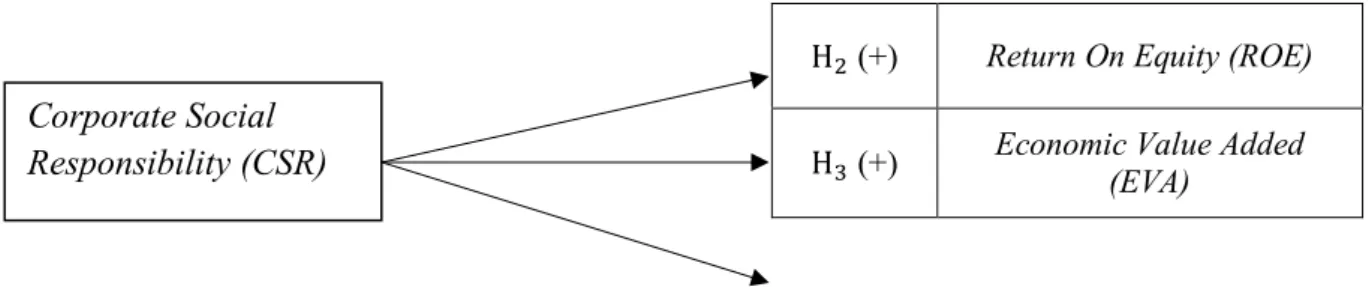
According to explanation above, we can make a hypothesis :
H1 : Corporate Social Responsibility has a positive impact significanly toward return on assets.
H2 : Corporate Social Responsibility has a positive impact significanly toward return on equity.
H3 : Corporate Social Responsibility has a positive impact significanly toward return on economic value added.
Framework :
H1 (+) Return On Asset (ROA)
3 Data and Methodologi
Approachment research
The kind of this research is causality research. Causality research use to prove the influence casuality intervariable (Sanusi, 2011, h.14). the purpose of this study is to prove the CSR influence to financial statement. The object of this study are the companies listed in Jakarta Islamic Index from 2012 until 2014. All the companies listed in Jakarta Islamic Index (JII) from 2012 until 2014 are the sample population. In this study, the sample taken by purposive sampling method. The criteria are :
1. The companies listed in Jakarta Islamic Index (JII).
2. The companies reported Corporate Social Responsibility Disclosure continually from 2012 until 2014.
3. The companies reported financial statement continually from 2012 until 2014.
This study use secondary data. This secondary data as a source from financial statement and CSR disclosure the companies listed in Jakarta Islamic Index from 2012 until 2014. The technique which used in this study are clasic assumption test include heteroskedastisitas test, autocorrelation test, normality test and t-test .
Findings and Discussion
1. The influence of CSR toward ROA a. The Result of Regression
Table 4.6 of the data processing with SPSS, then obtained the final regression model as follows:
ROA = -0.363 + 0.758 CSR + e1
The above equation, it can be explained that a constant value of -0.363 have meaning if CSR is zero, then the value of ROA amounted to -0.363. Regression coefficient value of CSR at 0.758, positive value means that if CSR increases one unit, it will increase the value of ROA amounted to 0.758.
Coefficientsa
-.363 .167 -2.167 .035
.758 .248 .381 3.052 .003
(Constant) CSR Model 1
B Std. Error Unstandardized
Coefficients
Beta Standardized
Coefficients
t Sig.
Dependent Variable: ROA a.
H2 (+) Return On Equity (ROE)
H3 (+) Economic Value Added (EVA)
Corporate Social Responsibility (CSR)
4 b. Hypothesis Testing
Testing the hypothesis in this regression model can prove statistically that the CSR effect on ROE, this is evidenced by the significant value of 0.003 <0.05. So that, Ha accepted and Ho rejected, the first hypothesis which states CSR positive effect on ROA is proven.
c. Determination Coefficient
The coefficient of determination in this study using the R Square value, because the value of the independent variable in this study is only one variable. If more than one independent variable in suggest using Adjusted R Square because the value of Adjusted R Square is not affected by the large number of independent variables. R-square value in this study amounted to 0,145, means that CSR can explain the variable ROA amounted to 14.50%, the smallness of the coefficient of determination in this model, because there are many other factors that affect ROA, such as the ratio of working capital turnover ratio, receivables turnover, the current operating cash and others.
2. The influence of CSR toward ROE a. The Result of Regression
Table 4.7 of the data processing with SPSS, then obtained the final regression model as follows:
ROE = -1,072 + 2,010 CSR + e2
The above equation, it can be explained that a constant value of -1,072 have meaning if CSR is zero, then the value of ROE amounted to -1,072. Regression coefficient value of CSR at 2,010, positive value means that if CSR increases one unit, it will increase the value of ROE amounted to 2,010.
b. Hypothesis Testing
Coefficientsa
-.363 .167 -2.167 .035
.758 .248 .381 3.052 .003
(Constant) CSR Model
1
B Std. Error Unstandardized
Coeffic ients
Beta Standardiz ed
Coeffic ients
t Sig.
Dependent Variable: ROA a.
Model Summary
.381a .145 .129 .0915904
Model 1
R R Square
Adjusted R Square
Std. Error of the Estimate Predictors: (Constant), CSR
a.
Coefficientsa
-1.072 .477 -2.246 .029
2.010 .708 .358 2.841 .006
(Constant) CSR Model 1
B Std. Error Unstandardized
Coefficients
Beta Standardized
Coefficients
t Sig.
Dependent Variable: ROE a.
5 Testing the hypothesis in this regression model can prove statistically that the CSR effect on ROE, this is evidenced by the significant value of 0.006 <0.05. So that, Ha accepted and Ho rejected, so the second hypothesis which states CSR positive effect on ROE is proven.
c. Determination Coefficient
The coefficient of determination in this study using the R Square value, because the value of the independent variable in this study is only one variable. If more than one independent variable in suggest using Adjusted R Square because the value of Adjusted R Square is not affected by the large number of independent variables. R-square value of 0.128 in this study can be interpreted that the CSR variables can explain ROE of 12.80%, the smallness of the coefficient of determination in this model, because there are many other factors that affect ROE, such as accounts receivable, cash, inventory and others.
3. The Influence of CSR toward EVA a. The Result of Regression
Table 4.7 of the data processing with SPSS, then obtained the final regression model as follows:
EVA = -25683352,265 + 43164976,813 CSR + e2
The above equation, it can be explained that a constant value of -25683352,265 have meaning if CSR is zero, then the value of EVA amounted to -25683352,265. Regression coefficient value of CSR at 43164976,813, positive value means that if CSR increases one unit, it will increase the value of EVA amounted to 43164976,813.
b. Hypothesis Testing
Coefficientsa
-1.072 .477 -2.246 .029
2.010 .708 .358 2.841 .006
(Constant) CSR Model 1
B Std. Error Unstandardized
Coefficients
Beta Standardized
Coefficients
t Sig.
Dependent Variable: ROE a.
Model Summary
.358a .128 .112 .2609976
Model 1
R R Square
Adjusted R Square
Std. Error of the Estimate Predictors: (Constant), CSR
a.
Coefficientsa
-25683352.265 6499224 -3.952 .000
43164976.813 9638641 .517 4.478 .000
(Constant) CSR Model 1
B Std. Error
Unstandardized Coefficients
Beta Standardized
Coefficients
t Sig.
Dependent Variable: EVA a.
6 Testing the hypothesis in this regression model can prove statistically that the CSR effect on EVA, this is evidenced by the significant value of 0.000 <0.05. So that, Ha accepted and Ho rejected, so the third hypothesis which states CSR positive effect on EVA is proven.
c. Determination Coefficient
The coefficient of determination in this study using the R Square value, because the value of the independent variable in this study is only one variable. If more than one independent variable in suggest using Adjusted R Square because the value of Adjusted R Square is not affected by the large number of independent variables. R-square value of 0.267 in this study can be interpreted that the CSR variables can explain EVA amounted to 26.70%, the smallness of the coefficient of determination in this model, because there are many other factors that affect EVA, such as free cash flow, earnings, managerial ownership, and other - Other.
Conclusion and Recommendations Conclusion
The conclusion that can be drawn from the results penelitaian discussed in the previous chapter are:
1. The first hypothesis testing in the regression model can be proved statistically that CSR has positive influence on ROA. This condition occurs because the express purpose company CCSR is a way that companies use to manage relationships with stakeholders.
CCSR with the disclosure by the company is expected to provide clear evidence that the production process of the company is also concerned with issues of social and environmental criteria, so as to increase the trust of stakeholders that will have an impact on increasing corporate value through increased investment which increased corporate profits.
2. Testing the hypothesis in regression models can prove statistically that CSR positive effect on ROE. This condition occurs because the disclosure of the increasingly widespread, it will give confidence to the public and other parties who require financial statements, so companies will be more trustworthy products and will result in better performance.
3. Testing of the third hypothesis in the regression model can be proved statistically that CSR has a significant effect on EVA. This condition indicates that CSR is a company's business operations are not only to increase the company financially, but also for socio-economic
Coefficientsa
-25683352.265 6499224 -3.952 .000
43164976.813 9638641 .517 4.478 .000
(Constant) CSR Model 1
B Std. Error
Unstandardized Coefficients
Beta Standardized
Coefficients
t Sig.
Dependent Variable: EVA a.
Model Summary
.517a .267 .254 3555394.04
Model 1
R R Square
Adjusted R Square
Std. Error of the Estimate Predictors: (Constant), CSR
a.
7 development of the region overall, institutionalized and sustainable. EVA positive condition reflects the level of compensation that is higher than the cost of capital. This means that management is able to create shareholder value enhancement.
Recommendations
Based on the research that has been done, the results obtained CSR variables affect the ROA, ROE and EVA, for the advice given is:
1. Investors should pay more attention to CSR of each company on the Stock Exchange, namely with regard CSR that profitable investment. Investors may also be able to analyze a given company's CSR as a form of corporate concern for the environment. If the company concerned about the environment and society, the company will create a good image for the company and will be a positive response by investors, making it profitable for investors to increase ROA, ROE and EVA because in this study CSR greater influence on ROA, ROE and EVA.
2. For companies should pay more attention to CSR by the company, because CSR is a company's long-term asset that will be used by the enterprise to maintain the sustainability of the company with a positive response from the public.
References
Achsien, Iggi. 2003.Investasi Syariah di Pasar Modal. Jakarta: PT Gramedia Pustaka Utama.
Amanti, Lutfilah.2012. Pengaruh Good Corporate Governance terhadap Nilai Perusahaan dengan Pengungkapan Corporate Social Responsibility sebagai Variabel Pemoderasi.Jurnal Akuntansi Universitas Negeri Surabaya.
Brigham, Eugene F., dan Joel F. Houston. 2006. Dasar-Dasar Manajemen Keuangan. Edisi ke 8.Jakarta : Salemba Empat.
Chairiri, Anis dan Imam Ghozali. 2007.Teori Akuntansi Edisi Pertama . Badan Penerbit Universitas Diponegoro. Semarang.
Dahlia, L. dan Siregar, V. S. 2008. PengaruhCorporate SocialResponsibility terhadap Kinerja Perusahaan (Studi Empiris pada Perusahaan yangTercatat di Bursa Efek Indonesia pada Tahun 2005 dan 2006). Simposium Nasional Akuntansi XI. Pontianak.
Ghozali, Imam. 2005.Aplikasi Analisis Multivariate dengan Program SPSS. Semarang. Badan Penerbit UNDIP.
Gunawan, Barbara., dan Suharti Tri Utami. 2007. Peranan Corporate Social Responsibility dalam Nilai Perusahaan. Jurnal Akuntansi dan Kuangan. Vol 7:2..
Kurnianto, Eko Adhy. 2011. Pengaruh Corporate Social Responsibiity terhadap Kinerja Keuangan Perusahaan.Skripsi. Universitas Diponegoro. Semarang.
Nurlela dan Islahudin. 2008. Pengaruh Corporate Social Responsibility terhadap Nilai Perusahaan dengan Prosentase Kepemilikan Manajemen sebgai Variabel Moderating. Simposium Nasional Akuntansi XI.
Rakhiemah, A.N dan Agustia, D. 2009.Pengaruh Kinerja Lingkungan terhadap Corporate Social Responsibility (CSR) dan Kinerja Finansial Perusahaan Manufaktur yang Terdaftar di BEI.
Simposium Nasional Akuntansi XII. Palembang.
Saiful M Ruky. 2007. Lebih Dalam Tentang :Economic Value Added”, EVA dan Penciptaan Nilai Perusahaan. Manajemen Usahawan Indonesia.
8 Sembiring, Eddy Rismanda. 2005. Karakteristik Perusahaan dan Pengungkapan Tanggung Jawab
Sosial pada Perusahaan yang Tercatat di BEJ.Simposium Nasional Akuntansi VIII.
Sutedi, Adrian. 2011. Sarana Investasi Keuangan Berdasarkan Prinsip Syariah. Sinar Grafika.
Jakarta.
Syahnaz, Melisa. 2012. Pengaruh Corporate Social Responsibility terhadap Kinerja Keuangan Perusahaan Perbankan. MM. Thesis. Universitas Brawijaya.
Undang-Undang Republik Indonesia Nomor 25 Tahun 2007 tentang Penanaman Modal.Melalui www.castleasia.com.
Undang-Undang Republik Indonesia Nomor 40 Tahun 2007 tentang Perseroan Terbatas.Melalui www.legalitas.org/incl-php/buka.php.
Wijayanti, Feb Tri., dan Sutaryo. 2011. Pengaruh Corporate Social Responsibility terhadap Kinerja Keuangan Perusahaan. SNA XIV Aceh.