FACULTY OF ECONOMICS UNISSULA ‑ SEMARANG
FACULTY OF ISLAMIC AND BUSINESS UIN SUNAN KALIJAGA ‑ YOGYAKARTA
INSTITUTE OF ISLAMIC BANKING AND FINANCE IIUM ‑ MALAYSIA
The Role of Zakah and Islamic Financial Institution into Poverty Alleviation and
Economics Security
SEMARANG, NOVEMBER 18–19
TH2015
No ISBN: 978‑602‑1154‑24‑1
No ISBN: 978‑602‑1154‑24‑1
i
FACULTY OF ECONOMICS UNISSULA ‑ SEMARANG
FACULTY OF ISLAMIC AND BUSINESS UIN SUNAN KALIJAGA ‑ YOGYAKARTA
INSTITUTE OF ISLAMIC BANKING AND FINANCE IIUM ‑ MALAYSIA
Assalamualaykum.Wr.Wb
Wassalamualaykum.Wr.Wb
As a steering committe of 3rd ASEAN INTERNATIONAL CONFERENCE ON ISLAMIC FINANCE (AICIF-2015), firstly I would like to say “Thank You Very Much” to all parties for their enermous effort toward the detailed arrangement for hosting this conference.
The 3rd AICIF is organized by Faculty of Economics - Sultan Agung Islamic Unisversity (UNISSULA), Faculty of Islamic Economics and Busisness - State Islamic University Sunan Kalijaga Yogyakarta (UIN Yogyakarta), and Institute of Islamic Banking and Finance – International Islamic University Malaysia.
The conference is aimed to discuss “Role of Zakah and Islamic Financial Institution into Poverty Alleviation and Economoics Security”. Islamic financial institution, such as Islamic banking, Islamic unit trust, Islamic insurance, etc..
has growth very fast for last decade. They become important part relating to the efforts improving the quality of life of the society as well as relieving the society from the riba trap. In the context of recent economy, the Islamic financial institutions as economy pillar continues to chalange effort of poverty alleviation.
Conference aims to bring together researchers, scientists, and practitioners to share their experiences, new ideas and research results in all aspects of the main conference topics.
Furthermore, I would like to extend my gratitude to authors who submitted their papers to AICIF 2015 conference and also reviewers for their contribution and effort to excellent conference proceeding.
Finally, for all of you, welcome to AICIF 2015. I hope you will enjoy the conference and have a nice time during your stay in Semarang Indonesia.
Regards,
3rd AICIF 2015 Steering Committe , Dean
Faculty of Economics
Sultan Agung Islamic University Indonesia.
Olivia Fachrunnisa, PhD
FOREWORD
iii TABLE OF CONTENT
i ii iii Key Factors Affecting Credit Risk In Indonesian Islamic Banking
Yono Haryono Noraini Mohd. Ariffin Mustapha Hamat
1
Efficiency Of The Banking Sector In Malaysia Fekri Ali Shawtari
Mohamed Ariff
2
The Role Of Relational Capital In Increas ing The Collection And Distribution Of Zakah To Eradicate Poverty In Central Java
Heru Sulistyo
3
Creating Sustainable Competitive Advantages And Improving Salesperson Performance Through Intelligence, Emotional, And Spiritual Quotients And Selling Abilit y Of Smes In Central Java Province
Asyhari
Sri Hindah Pudjihastuti Dian Marhaeni Kurdaningsih
4
Woman’s Portrait in the Chain of Poverty: Looking at Early Marriage from Gender and Sexuality Perspectives
Inayah Rohmaniyah
5
Angels: Islamic Bank Of Health Maya Indriastuti
Luluk Muhimatul Ifada
6
Child Labor in Indonesia: Education and Health Consequences Sunaryati
7
Determinants Of The Factors That Cause Abandoned Housing Projects: A Study Of Home Buyers Of Islamic Home Financing In Malaysia
Dzuljastri Abdul Razak
8
Corporate Governance And Capital Structure Analysis At Islamic Bank In Indonesia
Mutamimah
9 EDITORS
FOREWORD
TABLE OF CONTENT
The Effect Of Investment Decision, Funding Decision And Dividend Policy On Corporate Value
Dista Amalia Arifah Siti Roifah
10
Mobile Payment System Framework Based On Gold As A Measurement Of Value
Bedjo Santoso
Ahamed Kameel Meera Salina Hj. Kasim
Khaliq Ahmad
11
Corporate Financing Behaviour Of Shariah Compliant E50 Smes.
A Panel Data Approach Of GMM Razali Haron
12
Crude Palm Oil Market Volatility: Pre And Post Crisis Periods Evidence From Garch
Razali Haron
Salami Mansurat Ayojimi
13
Legal And Regulatory Framework Of Islamic Banking In Libya - Regulatory Authority, Licensing Of Islamic Bank, Shariah
Governance And Dispute Resolution Zainab Belal
Rusni Hassan
14
Developing a Comprehensive Performance Measurement System for Waqf Institutions
Nazrul Hazizi Noordin Siti Nurah Haron Salina Kassim
15
Improving Financial Education To The Poor At The Bottom - Of Pyramid: The Role Of Social Finance Vis A Vis Financial
Institutions Laily Dwi Arsyianti Salina Kassim
16
Regulatory Framework Of Islamic Banking In Afghanistan:
A Cursory Overview Mohsen Abduljamil Khan Rusni Hassan
17
v
Efektivitas Transmisi Kebijakan Moneter S yariah Jalur Pembiayaan
Rizqi Umar
Muh. Ghafur Wibowo Abdul Qoyum
18
The Environmental Development Model For Poverty Eradication Through Corporate Social Responsibility (CSR) Program
Abdul Hakim
19
The Role of Bank as Waqf Institution to Promote Indonesian Agricultural Sector
Faaza Fakhrunnas
20
The Analysis Of Profit Equalization Reserve (PER) In Income Smoothing Of Islamic Banking
Prima Shofiani Arief Bachtiar
21
The Analysis Of Determinants Selected Corporate Governance Attributes And Company Attributes On Financial Reporting Timeliness In Indonesia (Evidence From Sharia Security List The Period Of 2009-2013)
Ifa Luthfiana Iwan Budiyono Nyata Nugraha
22
The potential role of Social Impact Bond (SIB) as a financial tool that can help address the issues of poverty and socio-economic security
Syed Marwan Mujahid
23
Zakat Productive: Transforming Mustahiq To Muzakki Musviyanti
Fibriyani Nur Khairin
24
The Ways To Increase Shareholders Wealth In Indonesia Sharia Stock Index
Naqiyyah
Nunung Ghoniyah
25
Accountability Of Fund Management In Mosques, Kalimantan Timur, Indonesia
Yunita Fitria
Ahmad Zamri Osman Zaini Zainol
26
Intellectual Capital And Performance Of Islamic Banks Hendri Setyawan
Tri Dewi Jayanthi
27
Risk Management And Management Accounting Parctice Of BPRS In East Java
Ulfi Kartika Oktaviana
28
Using ZIS (Zakat Infaq Shodaqoh) Institution to Expand Access to Renewable Energy Services In Indonesia
Aji Purba Trapsila
29
Collabrate Farmer Association Based Production House and Baitul Maal Wat Tamwil : Increasing Farmer Productivity
Through Optimalization ZIS Funding and Sharia Finance Product by Farmer (Walfare Farmer) CardScheme
Rifaldi Majid Evita Meilani
30
Workplace Spirituality and Employee Engagement for Islamic Financial Institution: A Conceptual Model
Olivia Fachrunnisa
31
Transformation Of Charities By Islamic Social Movements In Yogyakarta, 1912-1931: A History Of Islamic Wealth
Management Ghifari Yuristiadhi
32
Customer Interaction Management Capabilities And Market Intelligence Quality For New Product Performance
Tatiek Nurhayati Hendar
33
Assessing The Appropriateness And Adequacy Of The Provision For Housing Under The Haddul-Kifayah For Asnaf Faqr And
Asnaf Miskin
Khairuddin Abdul Rashid Sharina Farihah Hasan Azila Ahmad Sarkawi
34
An Overview Of Corporate Governance Practices Of Selected Islamic Banks: Case Of Rhb Islamic Bank, Masraf Al Rayan And European Islamic Investment Bank
Zainab Belal Lawhaishy Mustapha Hamat
35
vii
Asnaf Of Zakat: A Comparison Between Zakat Regulations In Wilayah Persekutuan And Selangor Darul Ehsan
Aznan Hasan
Nurun Nadia Binti Mohamad
36
Review of the Theory and Practice of Islamic Banking in Indonesia
Ibnu Haitam
37
Zakatable Items: A Comparison of Definition between Syeikh Yusuf al-Qardawi and States Enactments in Malaysia
Aznan Hasan
Raja Madihah Binti Raja Alias
38
Shariah Committee Composition In Malaysian Islamic Financial Institutions: Post Implementationof The Shariah Governance Framework 2010 And Islamic Financial Services Act 2013 Muhammad Issyam b. Itam@Ismail
Rusnibt. Hassan
39
Interpretation Of Integrated Zakat And Tax: Review Of Planned Behavior Theory
Agus Setiawaty Fibriyani Nur Khairin
40
Financial Consumer Protection: An Exploratory Study On Islamic Financial Services Act 2013 (IFSA), Bnm Regulations And Other Relevant Statutes
Norzarina Nor azman Sabarina Abu Bakar
Solara Hunud Abia Kadouf Rusnibt. Hassan
MuhammdIssyam bin Itam@Ismail
41
Zakat Houses For Asnaf Faqr And Miskin: Are Houses Appropriate And Adequate?
Khairuddin Abdul Rashid Azila Ahmad Sarkawi Sharina Farihah Hasan Srazali Aripin
42
[Re] Defining Mudharabah Financing Musviyanti
Salmah Pattisahusiwa
43
Analysis Influence Of Difference Perception Between Shari’a Banking With Consumer Perception Towards Customer’s Purchase Intension Shari’a Banking in Semarang
Sri Rahayu Tri Astuti
44
Marketing at the Bottom of Pyramid: Cultural Ethnic Linkage to Islamic Microfinance Sales Promotion Scheme
Permata Wulandari Salina Hj. Kassim Liyu Adikasari Sulung Niken Iwani Surya Putri
45
Zakat As Social Function Of Shariah Banking Related To SMEs Empowerment For Poverty Alleviation
Mispiyanti Junaidi
46
Holistic View On Malaysian Islamic Interbank Money Market: A Critical Assessment
Buerhan Saiti
47
The Role Of Islamic Work Ethic, Spiritual Leadership And Organizational Culture Toward Attitude On Change With
Organizational Commitment And Job Involvement As Mediator On Bank Pembiayaan Rakyat Syari’ah (BPRS) Indonesia
Haerudin Bedjo Santoso
48
Implementation of Good Corporate Governance In Indonesian Islamic Banking
Ro’fah Setyowati Bedjo Santoso
49
Ascertaining Transparency And Accountability In The Practice Of Assessment Of Claims For Loss And Damage In Contractor’s All Risks (CAR) Takaful
Puteri Nur Farah Naadia Bt Mohd Fauzi Khairuddin Abd. Rashid
50
Market Reaction Toward Default Notice Of Islamic Bonds In Indonesia
Wuryanti Kuntjoro Happy Sista Devy
51
The Role Of Religiosity And Manifest Needs To Increase The Productivity Of Human Resources
Arizqi
Heru Sulistyo
52
ix
Islamic View On The Gold As Money Bedjo Santoso
Salina Hj. Kasim Mustofa Omar
53
The Prospects Of Islamic Banking In Higher Distance Education In Baskara
Rini Febrianti
Nadia Sri Damajanti
54
Entrusting Zakah (Alms) Administration To The Government: A Review Of Historical Study And Shari’ah Perspective
Abdulsoma Thoarlim Mursalin Maggangka
Mohamamed Muneer’deen Olodo al Shafi’i
55
Protecting Zakat And Waqaf Assets Through Takaful Puteri Nur Farah Naadia Mohd Fauzi
Khairuddin Abd. Rashid Azila Ahmad Sharkawi Sharina Farihah Hasan Srazali Aripin
56
Cooperative Takaful as a New Operational Model: A Conceptual Study
Azman bin Mohd Noor Olorogun, L.A
57
Perceived Fairness in Islamic Home Financing: Selection between BBA and MM
Mohamed Imtiyaz Salina Kassim
58
Ict Creative Industry Development : Sinergized Approach Mutamimah
Mustaghfirin Mustafa
59
The Effect Of Inflation Rate, Liquidity Ratio, And Interest Rate On Investors Reaction With Share Investment Risk As
Intervening Variable (Empirical Studies On The Jakarta Islamic Index)
Yonimah Nurul Husna Imam Setijawan
60
Analyzing The Effect Of Debt Level And Book Tax Differences On Persistent Earnings (Empirical Study on Manufacturing Company listed on the Indonesia Stock Exchange in the period of 2011-2013)
Guntur Prasetya Lulu M. Ifada
61
The Effect Of Soundness Of Banks Use Risk Based Banking Rating Method On The Financial Performance Of Islamic Banks Shintya Dewi Adi Putri
62
Organizing Optimization Of Social Insurance Agency (BPJS) Based On Public Satisfaction In Central Java
Alifah Ratnawati Yusriyati Nur Farid Noor Kholis
63
Effect Of Green Supply Chain Management Practices On Supply Chain Performance And Competitive Advantage
Osmad Muthaher Sri Dewi Wahyundaru
64
Testing The Effect Of TQM On The Islamic Microfinance
Institutions Performance Using Partial Least Squares Approach Hamzah Abdul Rahman
Abdo Ali Homaid Mohd Sobri Mina
65
The Perception And Interest Of Teachers On Islamic Bank Any Meilani
Isnina Wahyuning Sapta Utami
66
Implementing Corporate Social Responsibility (CSR) Program Through Zakat Model
Damanhur
Umarudin Usman
67
Improving Competitive Advantage Of Small And Medium Enterprises Through Green Competence And Green Image Sri Ayuni
Abdul Hakim
Agus Wachyutomo Heru Sulistyo
68
Allocation Fiscal Balance Transfers Local Goverment From The Central Government To The Prosperity For Ummah
Khoirul Fuad
69
THE ROLE OF RELIGIOSITY AND MANIFEST NEEDS TO INCREASE THE PRODUCTIVITY OF HUMAN RESOURCES
Arizqi 1), Heru Sulistyo 2)
Dept. of Economics, Sultan Agung Islamic University (UNISSULA), Jl. Raya Kaligawe Km. 4 PO Box. 1054, Semarang 50112, Indonesia, Telp: 024-6583584, Fax: 024-6582455
Email:
Abstract
This study aims to examine the effect of religiosity on the manifest needs which consists of need for achievement, need for power, need for affiliation. In addition, this study also aims to examine how the manifest needs role in triggering an improvement of labor productivity of Human Resources, as well as professional commitment variable which affects on the manifest relationship needs to work productivity.
The research is conducted by testing SEM (Structural Equation Modelling) with the help of statistical SmartPLS software. The study is conducted using a survey by distributing questionnaires to 79 lecturers remain functional positions (JAFA) Sultan Agung Islamic University. In determining the number of sample the researchers use the Slovin’s formula with proportional random sampling technique.
The results show that religiosity has significant influence on the improvement of manifest needs, and then to increase productivity of human resources can be improved by increasing the manifest needs in the dimension of the need for achievement, because it is moderated by a professional commitment. While the need for power and the need for affiliation are not able to explain the productivity of the organization despite being moderated by professional commitment.
Keywords: religiosity, manifest needs, productivity, professional commitment, SmartPLS 1. INTRODUCTION
Religiosity is generally related to cognition (knowledge of religion, religious beliefs) that affect the emotional attachment or emotional feelings about religion, and or behavior, such as attendance at a place of worship, reading scripture, and pray (Crownal et al; Elci, 2007). those who are considered as religious are those who try to understand life more deeply than the mere outward boundary, which moves in the vertical dimension of life and transcends this life (Shafiq and Wahyuningsih, 2009).
To achieve of organizational goals, human resources need motivation to work more diligently.
Knowing the importance of human resources within the organization, it will require more serious attention to the task at hand so as to achieve organizational goals. McClelland in theory that is Manifest Needs. Manifest Needs is a necessity arising from the Human Resources consisting of Need for achievement, Need for power, and the Need for Affiliation. Every organization always tries to keep its human resources can be accomplished in the form of providing maximum work productivity.
Productivity of human resources for a company is important for a measurement of success in running the business. Due to the higher productivity of human resources within the company, the company's profits and productivity will increase.
Many studies have investigated the motivation of human resources, but not much to examine the motivation of dimensions McClelland is manifest needs, with dimensions of need for achievement, need for power, especially need for affiliation that receives the least attention from researchers. Then many of the previous studies that discuss about the relationship among motivation on performance, job satisfaction, etc. Not a lot of research that examines the relationship dimension theory McClelland motivation to work productivity. Therefore, this study intends to analyze more integratively about religiosity and manifest relationship needs to work productivity of human resources and examine how the relationship between the manifest needs to be moderated by the variable productivity after professional commitment.
2. LITERATURE REVIEW 2.1 Religiosity
Elci (2007) describes the general religiosity associated with cognition (knowledge of religion, religious beliefs) that affect what is done with the emotional attachment or emotional feelings about religion and behavior, such as the presence of place of worship, reading scripture, and pray. Fetzer (2003) in "Multidimensional measurement of religiousness or spirituality for use in health research", explains the indicators of religiosity are: the importance of religious values in daily activities (daily spiritual importing), the practice of religion (religious practice), religion as coping (religious coping), and organizations or religious activities (organizational religiousness). Then indicator of Fetzer is also to be adapted in this study.
The application of religious values in unissula own one of them with the implementation of Islamic Academic Culture (Budai). Islamic Academic Culture (Budai) itself has begun to be applied in Unissula since August 18, 2005 until now. Unissula’s commitment, Bismillah Building Khaira Ummah Generation, has consequences on the optimization of the role to be part of the movement to build the Islamic civilization. In this context, Islamic Academic Culture (Budai) becomes a strategy to start a movement with the reconstruction program and behavioral sciences based on Islamic values. Based on Unissula Rector's Decree No. 4654/B.1/SA/VIII/2007, Islamic Academic Culture (Budai) in Unissula includes : movement of Islamic dress, thaharah movement (environmentally clean, healthy, and safe), and the movement of prayer in congregation, manner association sons and daughters, manner receiving guests, and manners inside and outside the classroom.
2.2 Manifest Needs
Manifest Needs is a necessity arising from Human Resources which consists of need for achievement, need for power, and need for affiliation.
Need for achievement can be interpreted as a requirement for individual to do a particular task or activity or task as well as possible in order to achieve the laudable predicate (Mangkunagara, 2006), in the presence of self-achievement motivation in human resources to build the spirit to compete healthily, be responsible, and be creative. According to Steers, Richard M. and D. Braunstein (1976) indicators of need for achievement is characterized by the seriousness of a person in improving the performance, enjoying the difficult challenges, completing the task, seting goals, and enjoying the satisfaction of a settlement difficult task.
Need for power is based on the needs of one's desire to organize and lead others. Power is the probability that makes a person within a social relationship is in a position to carry out his own desires and get rid of all obstacles that block his way. The indicators that pursue need for power by Steers, Richard M. and D. Braunstein (1976) is enjoying the competition and victory, enjoying responsibility, directing complaint, influencing others, controling the events around.
Need for affiliation is a requirement based on the desire to obtain or run a good relationship with others. People who have a high need for affiliation usually have the pleasure of affection and tend to avoid disappointment because it is rejected by a social group. Individually, they tend to try to foster a pleasant of social relationships, a sense of intimacy and understanding. The indicators that pursue social need for affiliation or by Steers, Richard M. and D. Braunstein (1976) are sharing problems outside of work, desiring to be liked, building a close relationship with the group, enjoying being part of the group, not doing individual work.
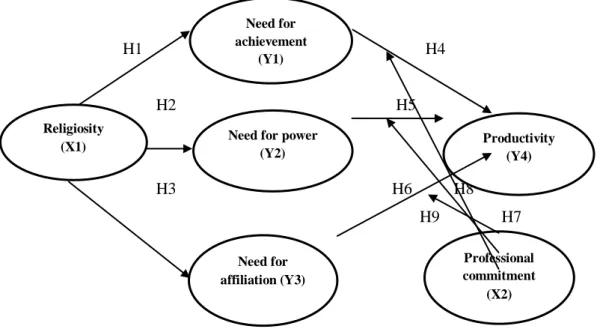
H1: There is a significant relationship between religiosity of the needs for achievement.
H2: There is a significant relationship between religiosity of the need for power.
H3: There is a significant relationship between religiosity of the needs for affiliation.
2.3 Productivity
Productivity is the ability to produce something from the duties given by the organization or company. Performance of HR of college is its success in developing the potential of Lecturer, which means the ability to empower the human resources component of the college through the optimal
action against the factors forming personal labor productivity of Lecturer, And the functional group of lecturers. The principal tasks of lecturers consists of Three Pillars of Higher Education, in GR No. 60 In 1999, Three Pillars of Higher Education includes education, research, and community service.
Three main elements above are used as indicators of labor productivity.
Mcclelland (1961, was quoted by Robbin, 2003 & Mangkunegara, 2006), in His motivation theory develop that productivity of human resources Is determined by the conditions of the soul that drives someone to able to achieve a feat he wants.
Frederick study (2010) shows that students of United States significantly have the highest level of productivity that oriented on the highest motivation than students from East Asia and other western students. Research conducted by Nenet Natasudian Jaya in 2013, shows that the three dimensions of motivation such as need for achievement , need for power and the need for affiliation a significantly influence on work productivity.
H4: There is a significant relationship between the need for achievement on productivity.
H5: There is a significant relationship between the need for power on productivity.
H6: There is a significant relationship between the need for affiliation to productivity.
2.4 Professional commitment
Professional commitment is a self-attachment to the duties and obligations that can build the responsibility and innovative attitude towards the profession undertaken. Commitment to the profession basically is the one’s perceptions of loyalty, will power, and hope guided by a value system that will direct that person to act in accordance with certain procedures in an effort to carry out their duties with a high success rate. This can make the commitment to the profession as ideas that motivate human resources in working.
Lecturers are human resources who work as educators based on education and their expertise is appointed by the organizers of the college with the primary task for educating. According Aranya and Ferris (1984) indicators of commitment to the profession are the identification, engagement, and loyalty.
Research conducted by Zainudin Awang and Junaidah Hanim Ahmad Nazmi Mohamed Zin (2010), shows that there is a significant difference between job satisfaction on the commitment to work. Lecturers who get the job satisfaction will be highly committed to their works. Many studies have shown that the human resources committed tend to be high performing HR that benefit their organization in terms of productivity and performance (Narimawati, 2007; Tella et al 2007).
H7: There is a significant relationship between the Need for achievement and the productivity that is moderated by a professional commitment.
H8: There is a significant relationship between the Need for power and the productivity that is moderated by professional commitment.
H9: There is a significant relationship between the Need for affiliation and the productivity that is moderated by a professional commitment.
H1 H4 H2 H5
H3 H6 H8 H9 H7
Figure 1. Research Empirical Model
From Figure 1 it appears that religiosity influences the manifest needs such as need for achievement, need for power and need for affiliation, then manifest needs affect the productivity which is moderated by professional commitment. Religiosity variable is free or independent variable, then the dependent variable is the manifest needs such as need for achievement, need for power, and the need for affiliation. While professional commitment is moderating variable.
3. METHODOLOGY
The type of this research is an Explanatory Research which aims to find out the relationship between the study variables. The nature of this research is a causal relationship between the variables through hypothesis testing. Source of the research data is derived from the respondents and literature/books/journal. Types of the research data is a primary and secondary data. Data collection is done by using questionnaire. The population in this study is a permanent lecturer functional position (Jafa) who have the criteria for tenure of more than 2 years. The research is conducted using survey by distributing questionnaires to 79 permanent lecturers with functional positions (Jafa). In determining the amount of the sample, the researchers use a slovin formula with proportional random sampling technique.
4. RESULTS AND DISCUSSION
The number of questionnaires is 79. the number of questionnaires which are not returned is 13, so the questionnaires that are processed are 66 questionnaires or 83.54%.
4.1 Outer Model Results
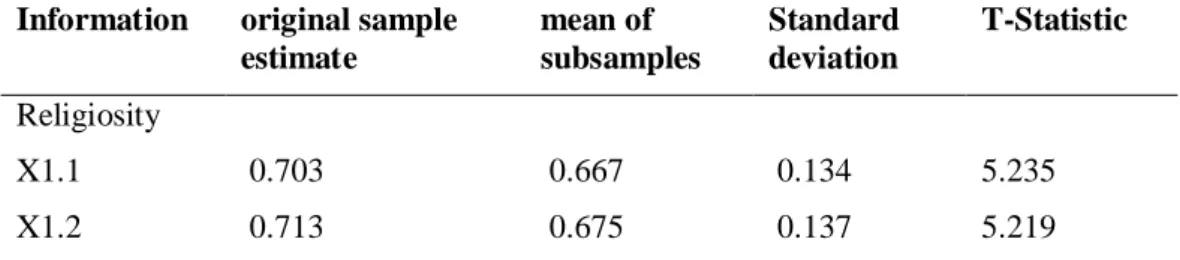
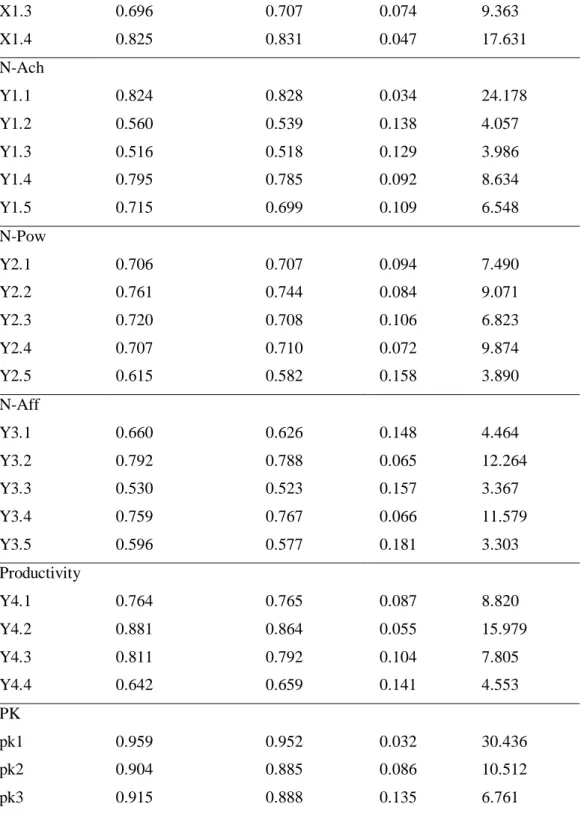
Based on the convergent validity test, it is known that the Convergent Validity of indicators of religiosity, need for achievement, need for power, need for affiliation, professional commitment and productivity have outer loading values > 0.5. Thus all of the indicator variables are valid.
Table 1. Convergent validity of Research Variable Information original sample
estimate
mean of subsamples
Standard deviation
T-Statistic
Religiosity
X1.1 0.703 0.667 0.134 5.235
X1.2 0.713 0.675 0.137 5.219
Need for achievement
(Y1)
Need for power (Y2)
Need for affiliation (Y3)
Productivity (Y4)
Professional commitment
(X2) Religiosity
(X1)
X1.3 0.696 0.707 0.074 9.363
X1.4 0.825 0.831 0.047 17.631
N-Ach
Y1.1 0.824 0.828 0.034 24.178
Y1.2 0.560 0.539 0.138 4.057
Y1.3 0.516 0.518 0.129 3.986
Y1.4 0.795 0.785 0.092 8.634
Y1.5 0.715 0.699 0.109 6.548
N-Pow
Y2.1 0.706 0.707 0.094 7.490
Y2.2 0.761 0.744 0.084 9.071
Y2.3 0.720 0.708 0.106 6.823
Y2.4 0.707 0.710 0.072 9.874
Y2.5 0.615 0.582 0.158 3.890
N-Aff
Y3.1 0.660 0.626 0.148 4.464
Y3.2 0.792 0.788 0.065 12.264
Y3.3 0.530 0.523 0.157 3.367
Y3.4 0.759 0.767 0.066 11.579
Y3.5 0.596 0.577 0.181 3.303
Productivity
Y4.1 0.764 0.765 0.087 8.820
Y4.2 0.881 0.864 0.055 15.979
Y4.3 0.811 0.792 0.104 7.805
Y4.4 0.642 0.659 0.141 4.553
PK
pk1 0.959 0.952 0.032 30.436
pk2 0.904 0.885 0.086 10.512
pk3 0.915 0.888 0.135 6.761
From the output of SmartPLS above, all constructs composite reliability values above 0.7. So it can be concluded that all variables are reliable. The following table is the value of composite reliability:
Table 2. Composite Reliability Composite Reliability
Religiosity 0.825
N-Ach 0.817
N-Pow 0.830
N-Aff 0.803
Productivity 0.859
PK 0.948
4.2 Inner Model Results
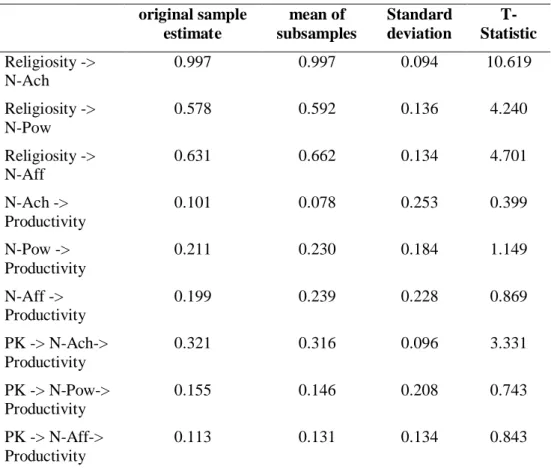
Assessing the inner model is looking at the relationship between latent constructs by seeing the results of coefficient of paramener path and the level of significance (Ghozali, 2008). The basis used in testing the hypothesis is the value wich is contained in the output of the result for the inner weight as shown in Table 3 below:
Table 3. Result for inner weight
original sample
estimate
mean of subsamples
Standard deviation
T- Statistic Religiosity ->
N-Ach
0.997 0.997 0.094 10.619
Religiosity ->
N-Pow
0.578 0.592 0.136 4.240
Religiosity ->
N-Aff
0.631 0.662 0.134 4.701
N-Ach ->
Productivity
0.101 0.078 0.253 0.399
N-Pow ->
Productivity
0.211 0.230 0.184 1.149
N-Aff ->
Productivity
0.199 0.239 0.228 0.869
PK -> N-Ach->
Productivity
0.321 0.316 0.096 3.331
PK -> N-Pow->
Productivity
0.155 0.146 0.208 0.743
PK -> N-Aff->
Productivity
0.113 0.131 0.134 0.843
Hypothesis 1 which states that religiosity significant effect on the need for achievement is received.
This is proved by the parameter coefficient value 0.997 and the significant parameter of t-statistic 10.619 > t-table 1.96. Hypothesis 2 which states that religiosity significantly effect on the need for power is received. This is evidenced by the coefficient value 0.578 and the significant parameter of t- statistics 4240 > t-table 1.96. Hypothesis 3 which states that religiosity significantly effect on the need for affiliation is received. This is evidenced by the coefficient value 0.631 and the significant parameter of t-statistics 4701 > t-table 1.96.
Hypothesis 4 which indicates that the need for achievement significantly effect on the productivity is rejected. This is evidenced by the value of parameter 0.101 and significant coefficient of t-statistic 0.399 < t-table 1.96. Hypothesis 5 which states that the need for power significantly affects the productivity is rejected. This is evidenced by the coefficient parameter 0.211 and the significant parameter of t-statistic 1.149 < t-table 1.96. Hypothesis 6 which states that the need for affiliation a significant effect on productivity rejected. This is evidenced by the value of the parameter coefficients 0.199 and significant of t-statistic 0.869 < t-table 1.96.
Hypothesis 7 which states that the need for achievement significantly affects on the productivity which is moderated by professional commitments is accepted. This is evidenced by the coefficient
value 0.321 and the significant parameter of t-statistic 3.331 > t-table 1.96. Hypothesis 8 which states that the need for power effects on the productivity which is moderated by professional commitment is rejected. This is evidenced by the coefficient value 0.155 and the significant parameter of t-statistic 0.743 < t-table 1.96. Hypothesis 9 which states that the need for affiliation affects on the productivity which is moderated by professional commitment is rejected. This is evidenced by the coefficient value 0.113 and the significant parameter of t-statistic 0.843 < t-table 1.96.
4.3 Discussion
Religiosity significantly effect on the manifest needs which consists of need for achievement, need for power and the need for affiliation. The religious is the foundation of Islam which is taken from the Qur’an and Al-Hadith as both of them are the fundamental guidance and instructions for Muslims in applying religion and in carrying out daily activities. A lecturer, if they always apply the religion values in working, he will work with the intention of worship, earnestly improve self-motivation that is the motivation to meet the needs of accomplishment. The higher religiosity of a person, the higher motivation to meet the needs of achievement. on the other hand, the lower religiosity of a person, the lower level of motivation to meet the needs of achievement. Value of religiosity that exists within Lecturers drives to carry out the mandate of authority with more sincere and just because of Allah. Religious activities are regularly conducted , including the campus Dhuha Assembly which is held every Friday morning with Islamic studies materials, Islamic Spiritual Enhancement Program (ISEP) is the evening prayer Which is held in the third week of each month, Halaqah Ulama, islamic seminar, and other programs to encourage and increase the motivation for affiliation between the members. Affiliate here means silaturahim among others.
Silaturahim basically is the teaching of Islam which is highly recommended. it is included in the Qur'an on a fragment verse 1 letter An Nisa " Fear Allah, in Whose name you plead for rights, and heed the ties of kinship”.
Manifest needs Which consists of need for achievement, need for power, and need for affiliation do not effect on the productivity. increasement of the need for achievement within the human resources is not able to increase working productivity. This is caused by external factors of a human resource. In this case, the lack of support from the organization becomes one of the factors that cause the need for achievement has no effect on work productivity. The absence of a relationship between the need for power and the productivity of work because the organization or scope of work where the respondent has implemented policies for human resources, such as promotion, clear career path, as well as definite rules against human resources. So in this study, the presence or absence of the need for power within the human resources, the respondents will remain responsible to do their jobs (Three Pillars of Higher Education). In addition, the Absence of correlation between need for power and the work productivity aside of the study site is in educational institutions (Lecturers as the respondents), where power is not the main goal. The main achievement of a lecturer is in the Functional academic not in power. The absence of a relationship between the need for affiliation and the productivity of work in this case because the academic institutions is determined by them, which is more on self-development. Sometimes, the respondents override affiliation, except if in the affiliate there is knowledge sharing among respondents. The respondents consider that whether the working productivity is increased or not, it is not related to the affiliation that they do.
Need for achievement significantly effect on the productivity moderated by Professional commitment variable. The need for achievement within the human resources will yield higher productivity if in the implementation of human resources has a professional commitment for their work. A Professional Human Resource will strive to achieve the professionalism by doing various efforts, such as improving the outcome of Three Pillars of Higher Education, with improving the quality of teaching, developing research and scientific journal publications, as well as performing community service, helping people in the business development and management, and also increasing supporting activities such as seminars, training, and others in order to be professional and excel lecturer.
For the last research results, professional commitment variable with indicator of identification, engagement, and loyalty is not a variable that can moderate the need for power, and also the need for affiliation on the productivity of human resources.
5. CONCLUSION
the increasement of working productivity of human resources within the organization can be improved through improvement of the dimensions of Needs for manifest on the dimension of need for achievement, as it is moderated by professional commitment. Thus, the stronger professional commitment of human resources within the organization that will promote the role of the manifest needs (in terms of increased need for achievement) in improving productivity. While the need for power and the need for affiliation are not able to explain the productivity of the organization although they have been moderated by professional commitments. Meanwhile manifest needs which consists of need for achievement, need for power and the need for affiliation is strongly influenced by the values of religiosity. A lecturer will be motivated to work harder to get the need for achievement, carry out the mandate more sincerely and only to seek Allah’s bless and try to establish good relations with the servants of Allah.
6. LIMITATIONS AND FUTURE RESEARCH AGENDA
This study is still limited on the scope of educational organizations, such as Lecturers as respondents which based on self-development, so it manifest needs consisting of need for achievement (need for achievement), need for power (the need for power) and the need for affiliation (need affiliated) are less implemented.
Then, agenda for future research includes: 1) Need to put more relevant variables that can affect the work productivity, as well as add other more suitable variables to the educational organizations, such as knowledge sharing. 2) Need to conduct research with a different kind of organizations that is more suitable to the needs of manifest variables, such as the organizations of manufacturing, services, and government.
REFERENCES
Ahyadi Abdul Azis. (2005). Psikologi Agama: Kepribadaian Muslim Pancasila. Cet. V; Bandung:
Sinar Baru Algensindo.
Bhukuvhani, et, al. (2014). Effect of electronic information resources skills training for lecturers on pedagogical practices and research productivity. International Journal of Education and Development using Information and Communication Technology. Vol 8 (1). 16-28.
Departemen Agama RI. (2006). Al-Qur'an dan Terjemahnya. Jakarta: Pustaka Agung Harapan.
Elci, Meral. (2007). Effect of Manifest Nrrds, Religiousity and Selected Demografics On Hard Working: An Empirical Investigation in Turkey. Journal of International Business Research, Volume 6, Number 2.
Fetzer, J. E. (2003). Multidimensional measurement of religiousness atau spirituality for use in health Research : A report of the Fetzer Institute / National Institute on aging working group. Fetzer Institute.
Gellerman, S.W. (1984). Motivasi dan Produktivitas. (cetakan Pertama). Alih bahasa: Soepomo S.
Wardoyo. Jakarta: Djaya Pirusa.
Imam, Ghozali. (2006). Aplikai Analisis Multivarite dengan SPSS, Cetakan Keempat, Badan Penerbit Universitas Diponegoro, Semarang.
Hani, T. Handoko. (2003). Manajemen. Cetakan Kedelapanbelas. J iiiii BPFE Yogyakarta, Yogyakarta.
Herzberg F. (2000). Frederick Herzberg’s Motivation and Hygiene Factors.
Hidayat, S. (2008). Hubungan minat terhadap profesi guru dan motivasi berprestasi dengan keterampilan mengajar. Jurnal pendidikan dan kebudayaan, 1140.
Jaya, N. Natasudian. (2013). Measuring productivity of the Kopertis Lecturers at the private higher education Institutions in Mataram. International Journal of Science and Engineering
Investigations, vol.2, issue 21, October 2013. Mahasaraswati University of Mataram.
Mangkunegara, A. P. (2006). Evaluasi kinerja SDM. Bandung: PT Refika Aditama.
Manulang. (2013). Pengantar Bisnis. Jakarta : PT. Indeks. Munandar, A. S. (2010). Psikologi industri dan organisasi. Tangerang: UI-Press.
Muzakkir. (2013). Hubungan religiusitas dengan perilaku prososial mahasiswa angkatan 2009/2010 fakultas tarbiyah dan keguruan UIN Alaudin Makassar. Jurnal Diskursus Islam, Volume 1, Nomor 3, Desember 2013.
Narimawati, S. E. U. (2007). The Influence of Work Satisfaction, Organizational Commitment and Turnover Intention Towards the Performance of Lecturers at West Java's Private Higher Education Institution. Journal of Applied Sciences Research, 3(7), 549 - 557.
Neuroth, M. (2009). The value of (electronic) content for research productivity. Elsevier.
Pemerintah Republik Indonesia, (1999), Peraturan Pemerintah Republik Indonesia Nomor 60 Tahun 1999 tentang Pendidikan Tinggi. Kementerian Negara Sekretaris Negara Republik Indonesia, Jakarta.
Suharti L., Fransiska R., dan Wattimuna, R.T. (2014). The Role of Work Ethos as Mediating Variable for The Influence of Organizational Culture and Religiosity on Employee’s Loyalty. The 2nd IBEA – International Conference on Business, Economics and Accounting.
Undang–Undang Republik Indonesia Nomor 14 Tahun 2005 tentang Guru dan Dosen. (2005).
Jakarta: Kementerian Pendidikan Nasional.