• Tidak ada hasil yang ditemukan

VLSI Design and Test for Systems Dependability

N/A
N/A
Protected

Academic year: 2019

Membagikan "VLSI Design and Test for Systems Dependability"

Copied!
792
0
0

Teks penuh

(1)

Shojiro Asai

Editor

VLSI Design

and Test for

Systems

(2)
(3)
(4)

Editor

VLSI Design and Test

for Systems Dependability

(5)

Shojiro Asai Rigaku Corporation Tokyo

Japan

ISBN 978-4-431-56592-5 ISBN 978-4-431-56594-9 (eBook) https://doi.org/10.1007/978-4-431-56594-9

Library of Congress Control Number: 2017963009 © Springer Japan KK, part of Springer Nature 2019

This work is subject to copyright. All rights are reserved by the Publisher, whether the whole or part of the material is concerned, specifically the rights of translation, reprinting, reuse of illustrations, recitation, broadcasting, reproduction on microfilms or in any other physical way, and transmission or information storage and retrieval, electronic adaptation, computer software, or by similar or dissimilar methodology now known or hereafter developed.

The use of general descriptive names, registered names, trademarks, service marks, etc. in this publication does not imply, even in the absence of a specific statement, that such names are exempt from the relevant protective laws and regulations and therefore free for general use.

The publisher, the authors and the editors are safe to assume that the advice and information in this book are believed to be true and accurate at the date of publication. Neither the publisher nor the authors or the editors give a warranty, express or implied, with respect to the material contained herein or for any errors or omissions that may have been made. The publisher remains neutral with regard to jurisdictional claims in published maps and institutional affiliations.

Printed on acid-free paper

This Springer imprint is published by the registered company Springer Japan KK part of Springer Nature

(6)

The technological progress, with its tremendous economic impact, of electronic systems stands out among other industrial products of modern times and has pro-duced various innovations over the last 50 years or so. It has had two major enablers, computer programs and the very-large-scale integration (VLSI) of semi-conductor circuits. The concept of programed computing first materialized in computers that crunched alphanumeric data. The computer program has gone through a remarkable transformation since the introduction of high-level pro-graming languages, close in form to human languages, describing how information is to be processed in the system; translating the program into machine-executable codes became a part of the job of computers. Electronic systems hardware has likewise shown progress in performance at an unprecedented pace starting out from the vacuum tube to the transistor to VLSI. High-performance computers, consisting of thousands of VLSI processors, each one containing billions of transistors, are being used for scientific calculations and big-data analysis. More remarkably, VLSI is used today in a far greater variety of electronic systems. Public infrastructures, such as transportation, utilities, public safety, and telecommunications, are large-scale electronic systems. Consumer items such as cell phones and automo-biles are other examples of advanced electronic systems. All these electronic sys-tems, in contrast to computers used for general computing, are customarily called computer-embedded systems. Progress in the development of these systems has been driven by the evolution of computer software (programing) and electronic hardware (VLSI among others), considered as twin engines working in harmony.

The three most important value metrics of an electronic system are performance, cost (price), and dependability. All three are carefully considered when a user is about to buy a system, or a manufacturer contemplates developing a system for sale. What is meant by performance and cost (price) is obvious and is talked about in terms of straightforward quantitative metrics. The concept of dependability, a term that has evolved from reliability, has expanded its attributes to range from a rela-tively simple quantity, such as mean time to failure (MTTF), a good statistical index of the availability of systems, to far harder to quantify metrics such as safety and tamper resistance. The bearings of dependability have become much more

(7)

important as humans increasingly rely on the convenience and benefit of electronic systems while the scale and severity of the detrimental effects of potential failures in such systems have become more devastating. The purpose of this book is to discuss how design and testing can help mitigate threats to the dependability of VLSI systems. Here the term VLSI system is meant to cover not only VLSI per se but also electronic systems that use VLSI (of semiconductor circuits) as a key component. This book consists of three parts. Part I is a general introduction to the book and is made up of two chapters. It starts by describing in Chap.1 the background and motivation that led to the undertaking of a government-funded research program entitled,“Fundamental technologies for dependable VLSI systems (called DVLSI hereafter),”funded by the Japan Science and Technology Agency (JST) under the Core Research of Evolutional Science and Technology (CREST) initiative. The program was started in April 2007 and lasted for about 8 years until March 2015, with 11 teams of researchers participating from universities, government labora-tories, and industrial corporations. The rest of Chap.1describes the scope, activ-ities, and management of the program. Detailed accounts are given as to how overarching issues of dependability were covered, how efforts were made to push expected deliverables toward applications, how exciting industry–academia col-laborations were promoted during the term, and thefinal outcomes of the program. Chapter2begins with a quick overview of the principles and disciplines of design and verification/testing of electronic systems. Then, using this as a background, the implications of new technologies developed in the DVLSI program are discussed in light of other emerging trends in technology and the markets.

Part II of this book is entitled, “VLSI Issues in Systems Dependability.” Chapters3through12 discuss various threats to the dependability of VLSIs: ion-izing radiation, electromagnetic interference, time-dependent degradation, varia-tions in device characteristics, design errors, malicious tampering, etc., and what design and testing can do to manage these threats. Part III, which is entitled, “Design and Test of VLSI for Systems Dependability,” consists of Chaps. 13 through 29, which describe technologies developed in the program as possible solutions for dependability in the design and testing of realistic systems such as robots and vehicles, data processing and storage in the cloud environment, wireless public telecommunications with improved connectivity, advanced electronic packaging with wireless interconnect, and so forth. Most chapters and sections of Part II and Part III are authored by the members of research teams in the DVLSI program, but some are contributed by“invited”authors, who, having participated in the various events of the program in one way or other, kindly agreed to express their thoughts in this book.

(8)

It was a real pleasure to be able to work with the members of the DVLSI program, and to witness industry–university collaborations from inception to frui-tion. I am thankful to numerous speakers from outside the program who gave stimulating talks and shared thoughts and discussions at program conferences. It was good to have been able to interact and exchange ideas with scholars and engineers from various parts of the world (the United States, China, Taiwan, India, and Germany) including active members of the United States program, “Failure-Resistant Systems (FRS)”sponsored by the National Science Foundation (NSF) and the Semiconductor Research Corporation (SRC), and the German pro-gram, “SPP1500 Dependable Embedded Systems,” sponsored by the Deutsche Forschungsgemeinschaft (DFG). I only wish we had closer interactions between these programs—FRS (2013–present), SPP1500 (2012–2016), and DVLSI (2007– 2015)—with more overlapping elements.

My heartfelt thanks go to the following gentlemen: Tohru Kikuno, Atsushi Hasegawa, Masatoshi Ishikawa, Yoshio Masubuchi, Naoki Nishi, Koki Noguchi, Tadayuki Takahashi, Koichiro Takayama, and Kazuo Yano, all of whom are advisory members of the DVLSI program. I would like to thank JST and all its management and staff members for their encouraging and patient support for this program: Kazunori Tsujimoto, Shinobu Masubuchi, Daichi Terashita, Toshiaki Ikoma, Michiharu Nakamura, and the late Koichi Kitazawa, to name but a few.

I would like to thank Toyota Motors Corporation for kindly providing a chart describing the power train of a hybrid vehicle to be used in this book as an illustration, and the Xilinx Company for kindly agreeing that the use of a chart showing an FPGA (Field Programmable Gate Array) coupled with an ARM (ARM is a company that provides an embedded processor architecture) processor, could be included in this book.

I am also thankful to Hikaru Shimura of the Rigaku Corporation who generously allowed me to spend some of my time on the job overseeing this program, and to his technical staff members, of which Kenji Wakasaya was one, who kindly shared their experience in systems design. I am thankful to Binu Thomas of Quest Global, a partner of Rigaku’s in software development, for sharing his thoughts about verification and testing. I cannot thank my colleagues enough at Hitachi Ltd. for stimulating and helping me form ideas about what systems design is. Just to single out a person from the many I worked with, Masayoshih Tsutsumi was an engineer– philosopher who shared his great insight into how to guide thoughts in designing a product, which I have tried to reproduce, only to a very limited extent, in Chap.2. My last thanks go to Shigeru Oho and Koki Noguchi for thoroughly reviewing the first two chapters and suggesting many important and necessary corrections.

Tokyo, Japan Shojiro Asai

(9)

Part I Introduction

1 Challenges and Opportunities in VLSI for Systems

Dependability . . . 3

Shojiro Asai 1.1 VLSI in Electronic Systems and Their Dependability . . . 4

1.2 Background and Motivation for the Program . . . 7

1.3 Threats and Opportunities for the VLSI Systems . . . 12

1.4 The DVLSI Program. . . 15

1.5 A Summary of Results . . . 21

References . . . 24

2 Design and Development of Electronic Systems for Quality and Dependability. . . 27

Shojiro Asai 2.1 Core Considerations in Designing an Electronic System Product . . . 28

2.2 Design and Development of an Electronic System Product . . . . 31

2.3 Process and Management of Product Development. . . 33

2.4 Risk Assessment and Refinement of Design Against Risks . . . . 40

2.5 Conclusion and Future Work. . . 47

2.6 Appendix to Chapter 2: The Case of a Scientific Instrument System—An Example Electronic System . . . 48

References . . . 51

(10)

Part II VLSI Issues in Systems Dependability

3 Radiation-Induced Soft Errors . . . 57

Eishi H. Ibe, Shusuke Yoshimoto, Masahiko Yoshimoto, Hiroshi Kawaguchi, Kazutoshi Kobayashi, Jun Furuta, Yukio Mitsuyama, Masanori Hashimoto, Takao Onoye, Hiroyuki Kanbara, Hiroyuki Ochi, Kazutoshi Wakabayashi, Hidetoshi Onodera and Makoto Sugihara 3.1 Fundamentals and Highlights in Radiation-Induced Soft-Errors . . . 58

3.2 Soft-Error Tolerant SRAM Cell Layout . . . 80

3.3 Radiation-Hardened Flip-Flops . . . 91

3.4 Soft-Error-Tolerant Reconfigurable Architecture . . . 101

3.5 Simulation and Design Techniques for Computer Systems . . . . 113

References . . . 118

4 Electromagnetic Noises . . . 129

Makoto Nagata, Nobuyuki Yamasaki, Yusuke Kumura, Shuma Hagiwara and Masayuki Inaba 4.1 Electromagnetic Compatibility of CMOS ICs . . . 130

4.2 Electromagnetic Noise Immunity in Memory Circuits. . . 140

4.3 Power Noise of IC Chips in Assembly and Its Mitigations . . . 145

4.4 Responsive Link for Noise-Tolerant Real-Time Communications. . . 150

References . . . 160

5 Variations in Device Characteristics . . . 163

Hidetoshi Onodera, Yukiya Miura, Yasuo Sato, Seiji Kajihara, Toshinori Sato, Ken Yano, Yuji Kunitake and Koji Nii 5.1 Overview of Device Variations . . . 164

5.2 Monitoring and Compensation for Variations in Device Characteristics . . . 171

5.3 Highly Accurate On-chip Measurement of Circuit Delay Time for Dependable VLSI Systems . . . 178

5.4 Timing-Error-Sensitive Flip-Flop for Error Prediction. . . 184

5.5 Fine-Grain Assist Bias Control for Dependable SRAM. . . 191

(11)

6 Time-Dependent Degradation in Device Characteristics

and Countermeasures by Design. . . 203 Takashi Sato, Masanori Hashimoto, Shuhei Tanakamaru,

Ken Takeuchi, Yasuo Sato, Seiji Kajihara, Masahiko Yoshimoto, Jinwook Jung, Yuta Kimi, Hiroshi Kawaguchi, Hajime Shimada and Jun Yao

6.1 Time-Dependent Device Degradation; Mechanisms

and Mitigation Measures. . . 204 6.2 Degradation of Flash Memories and Signal Processing

for Dependability . . . 210 6.3 In-Field Monitoring of Device Degradation for Predictive

Maintenance. . . 216 6.4 A Reconfigurable SRAM Cache Design for Wide-Range

Reliable Low-Voltage Operation . . . 225 6.5 Runtime Self-reconstruction for Tolerating Software/Hardware

Faults Increment from Aging. . . 233 References . . . 239 7 Connectivity in Wireless Telecommunications. . . 245

Kazuo Tsubouchi, Fumiyuki Adachi, Suguru Kameda, Mizuki Motoyoshi, Akinori Taira, Noriharu Suematsu,

Tadashi Takagi, Hiroshi Oguma, Minoru Fujishima, Ryuji Inagaki, Masaomi Tsuru, Eiji Taniguchi, Hiroshi Fukumoto,

Akira Matsuzawa, Masaya Miyahara, Makoto Iwata, Fumihiro Yamagata and Noboru Izuka

7.1 Evolution of Public Wireless Networks

and Future Challenges. . . 247 7.2 Challenges for Dependable Wireless System. . . 251 7.3 Transceiver Technologies for Dependable Wireless System. . . . 260 7.4 Broadband RF Circuit for Versatile, Dependable Wireless

Communications. . . 274 7.5 All-Si-CMOS Front-End ICs for Multiband

Micro-/Millimeter-Wave Communications . . . 279 7.6 Analog-to-Digital Converters for Versatile and Multiband

Wireless Networks . . . 292 7.7 Multimode Frequency Domain Equalizer for Heterogeneous

(12)

8 Connectivity in Electronic Packaging . . . 325

Hiroki Ishikuro, Tadahiro Kuroda, Atsutake Kosuge, Mitsumasa Koyanagi, Kang Wook Lee, Hiroyuki Hashimoto and Makoto Motoyoshi 8.1 Requirements for Dependable Electronic Packaging . . . 326

8.2 Wireless Interconnect for Dependable Electronic Packaging. . . 334

8.3 Connectivity Issues in 3D Integration. . . 342

References . . . 348

9 Responsiveness and Timing. . . 351

Tomohiro Yoneda, Yoshihiro Nakabo, Nobuyuki Yamasaki, Masayoshi Takasu, Masashi Imai, Suguru Kameda, Hiroshi Oguma, Akinori Taira, Noriharu Suematsu, Tadashi Takagi and Kazuo Tsubouchi 9.1 Responsiveness for Hard Real-Time Control. . . 352

9.2 Microprocessor Architecture for Real-Time Processing . . . 358

9.3 Asynchronous Networks-on-Chip. . . 366

9.4 Timing and Synchronicity for Dependable Wireless Network. . . 378

References . . . 391

10 Malicious Attacks on Electronic Systems and VLSIs for Security. . . 395

Takeshi Fujino, Daisuke Suzuki, Yohei Hori, Mitsuru Shiozaki, Masaya Yoshikawa, Toshiya Asai and Masayoshi Yoshimura 10.1 The Role of Security LSI and the Example of Malicious Attacks. . . 396

10.2 Methods for Tampering Cryptographic VLSIs . . . 403

10.3 Tamper-Resistant Symmetric-Key Cryptographic Circuits . . . 410

10.4 Verification Method for Tamper-Resistant VLSI Design . . . 417

10.5 A Method for Evaluating Vulnerability to Scan-Based Attacks. . . 423

10.6 Evaluation of Tamper Resistance of VLSIs . . . 427

References . . . 434

11 Test Coverage. . . 439

Masahiro Fujita, Koichiro Takayama, Takeshi Matsumoto, Kosuke Oshima, Satoshi Jo, Michiko Inoue, Tomokazu Yoneda and Yuta Yamato 11.1 Verification and Test Coverage . . . 440

(13)

11.3 High-Quality Delay Testing for In-field Self-test. . . 461

11.4 Temperature-and-Voltage-Variation-Aware Test . . . 466

References . . . 472

12 Unknown Threats and Provisions. . . 475

Nobuyasu Kanekawa, Takashi Miyoshi, Masahiro Fujita, Takeshi Matsumoto, Hiroaki Yoshida, Satoshi Jo, Seiji Kajihara, Satoshi Ohtake, Masashi Imai, Tomohiro Yoneda, Hiroyuki Takizawa, Ye Gao, Masayuki Sato, Ryusuke Egawa and Hiroaki Kobayashi 12.1 A Historical Review of Faults and Unidentified Future Problems . . . 477

12.2 Challenges to Dependability at Data Centers . . . 480

12.3 Post-silicon Validation and Patchable Hardware for Rectification. . . 485

12.4 Logging and Using Field Test Data for Improved Dependability. . . 495

12.5 Fault Detection and Reconfiguration in NoC-Coupled Multiple-CPU Cores for Deadline-Specified Periodical Tasks. . . 499

12.6 Checkpoint-Restart for Heterogeneous Multiple-Processor Systems . . . 503

References . . . 508

Part III Design and Test of VLSI for Systems Dependability 13 Design Automation for Reliability. . . 513

Hiroto Yasuura 13.1 Design Automation Tools and Dependability . . . 514

13.2 Analysis Tools for Soft Errors. . . 517

References . . . 518

14 Formal Verication and Debugging of VLSI Logic Design for Systems Dependability: Experiments and Evaluation . . . 521

Masahiro Fujita, Takeshi Matsumoto, Amir Masoud Gharehbaghi, Kosuke Oshima, Satoshi Jo, Hiroaki Yoshida, Takashi Takenaka and Kazutoshi Wakabayashi 14.1 Goal of Logic Verification and Necessity of Formal Analysis. . . 522

14.2 Formal Equivalence Checking Under C-Based Design . . . 525

14.3 Logic Debugging with Formal Analysis. . . 532

14.4 Conclusion and Future Perspectives. . . 535

(14)

15 Virtualization: System-Level Fault Simulation of SRAM

Errors in Automotive Electronic Control Systems . . . 539

Shigeru Oho, Yasuhiro Ito, Yasuo Sugure, Yohei Nakata, Hiroshi Kawaguchi and Masahiko Yoshimoto 15.1 Automotive Control Systems and Model-Based Development . . . 540

15.2 Virtual ECU and Its Applications . . . 542

15.3 Dependable SRAM. . . 543

15.4 Multilayer Modeling of Dependable SRAM and Automotive Control Systems. . . 544

15.5 Large-Scale Fault Injection Testing with Cloud Computing. . . . 547

15.6 Future Directions . . . 549

References . . . 550

16 DARTA Concept of In-eld Testing for Enhancing System Dependability . . . 553

Kazumi Hatayama, Seiji Kajihara, Tomokazu Yoneda, Yuta Yamato, Michiko Inoue, Yasuo Sato, Yukiya Miura and Satoshi Ohtake 16.1 Introduction . . . 554

16.2 Outline of DART Technology. . . 556

16.3 Outlines of DART Elemental Technologies . . . 564

16.4 Implementation of DART Technology. . . 567

16.5 Other Activities . . . 574

16.6 Conclusion. . . 575

References . . . 576

17 Design of SRAM Resilient Against Dynamic Voltage Variations. . . 579

Masahiko Yoshimoto, Yohei Nakata, Yuta Kimi, Hiroshi Kawaguchi, Makoto Nagata and Koji Nii 17.1 Introduction . . . 580

17.2 Resilient Cache. . . 580

17.3 Measurement Results . . . 586

17.4 Conclusion. . . 590

References . . . 590

18 Design and Applications of Dependable Nonvolatile Memory Systems. . . 593

Shuhei Tanakamaru and Ken Takeuchi 18.1 Introduction . . . 594

18.2 Background . . . 594

18.3 Reliability Improvement Techniques . . . 596

18.4 Summary and Conclusion . . . 604

(15)

19 Network-on-Chip Based Multiple-Core Centralized ECUs for

Safety-Critical Automotive Applications . . . 607

Tomohiro Yoneda, Masashi Imai, Hiroshi Saito, Akira Mochizuki, Takahiro Hanyu, Kenji Kise and Yuichi Nakamura 19.1 Introduction . . . 608

19.2 Asynchronous On-chip and Inter-chip Network . . . 610

19.3 Dependable Routing Algorithm . . . 617

19.4 Dependable Task Execution. . . 626

19.5 Evaluation Kit . . . 629

19.6 Conclusion. . . 632

References . . . 632

20 An On-chip Router Architecture for Dependable Multicore Processor. . . 635

Kenji Kise 20.1 Introduction . . . 635

20.2 SmartCore System . . . 636

20.3 NoC Multifunction Router for SmartCore System. . . 640

20.4 Conclusion. . . 642

References . . . 643

21 Wireless Interconnect in Electronic Systems. . . 645

Tadahiro Kuroda and Atsutake Kosuge 21.1 Introduction . . . 646

21.2 Wireless Interconnection. . . 646

21.3 Transmission Line Couplers . . . 648

21.4 Conclusion. . . 655

References . . . 656

22 Wireless Power Delivery Resilient Against Loading Variations. . . . 659

Hiroki Ishikuro 22.1 Applications and Issues of Wireless Power Delivery Systems . . . 660

22.2 Wireless Power Delivery by Inductive Coupling. . . 662

22.3 Approach for Power Efficiency Improvement and Size Reduction. . . 663

22.4 Fast Load Tracking and EMI Reduction Technique . . . 664

22.5 Wireless Power Delivery System Implementation. . . 667

22.6 Experimental Results. . . 670

22.7 Summary . . . 673

(16)

23 Extended Dependable Air: Use of Satellites in Boosting

Dependability of Public Wireless Communications . . . 675

Kazuo Tsubouchi, Suguru Kameda, Hiroshi Oguma, Akinori Taira, Noriharu Suematsu and Tadashi Takagi 23.1 3S Network: For Space, Surface, and Sea . . . 676

23.2 SS-CDMA: A Proposal for Disaster Message Exchange . . . 678

23.3 Heterogeneous Wireless System with Network Selection Scheme Using Positioning Information. . . 687

23.4 Readiness of Required Technologies . . . 690

References . . . 691

24 Responsive Multithreaded Processor for Hard Real-Time Robotic Applications. . . 693

Nobuyuki Yamasaki, Hiroyuki Chishiro, Keigo Mizotani and Kikuo Wada 24.1 Introduction . . . 693

24.2 Responsive Multithreaded Processor (RMTP). . . 695

24.3 Co-design of SoC and SiP. . . 699

24.4 Real-Time Operating Systems . . . 701

24.5 Summary . . . 705

References . . . 706

25 A Low-Latency DMR Architecture with Fast Checkpoint Recovery Scheme Using Simultaneously Copyable SRAM . . . 709

Masahiko Yoshimoto, Go Matsukawa, Yohei Nakata, Hiroshi Kawaguchi, Yasuo Sugure and Shigeru Oho 25.1 Introduction . . . 709

25.2 Proposed DMR Architecture with a Recovery Scheme . . . 710

25.3 Instantaneous Comparison and Simultaneous Copy. . . 713

25.4 Evaluation Results . . . 715

25.5 Conclusion. . . 717

References . . . 718

26 A 3D-VLSI Architecture for Future Automotive Visual Recognition. . . 719

Mitsumasa Koyanagi, Hiroaki Kobayashi, Takafumi Aoki, Toshinori Sueyoshi and Tadashi Kamada 26.1 3D-VLSI Image Sensor System for Automatic Driving Vehicle . . . 720

26.2 3D-Stacked Image Sensor for Stereo Vision. . . 723

26.3 3D-Stacked Dependable Multicore Processor . . . 727

26.4 Conclusions and Future Work . . . 730

(17)

27 Applications of Recongurable Processors as Embedded

Automatons in the IoT Sensor Networks in Space . . . 735

Hiroki Hihara, Akira Iwasaki, Masanori Hashimoto, Hiroyuki Ochi, Yukio Mitsuyama, Hidetoshi Onodera, Hiroyuki Kanbara, Kazutoshi Wakabayashi, Tadahiko Sugibayashi, Takashi Takenaka, Hiromitsu Hada and Munehiro Tada 27.1 Introduction . . . 736

27.2 Intelligent Sensors for IoT Applications—Target Applications. . . 737

27.3 Choosing Proper Processor Architecture for IoT Applications. . . 741

27.4 The FRRA Implementation of Embedded Automatons . . . 743

27.5 An Example Implementation and Result. . . 745

27.6 Discussion . . . 747

References . . . 749

28 An FPGA Implementation of Comprehensive Security Functions for Systems-Level Authentication . . . 751

Daisuke Suzuki, Koichi Shimizu and Takeshi Fujino 28.1 Introduction . . . 751

28.2 Overview of Glitch PUFs . . . 752

28.3 Physical Random Number Generator . . . 753

28.4 Unified Security Coprocessor. . . 756

28.5 Performance Evaluation. . . 762

28.6 Conclusions . . . 771

References . . . 772

29 SRAM-Based Physical Unclonable Functions (PUFs) to Generate Signature Out of Silicon for Authentication and Encryption . . . 775

Koji Nii 29.1 Introduction . . . 775

29.2 A Unique Chip-ID Generation Scheme Using SRAM-Based PUF with Random Fail-Bit Addresses . . . 777

29.3 Assessing Uniqueness and Reliability of SRAM-Based PUFs from Silicon Measurements. . . 782

29.4 Summary . . . 791

References . . . 791

(18)
(19)

Challenges and Opportunities in VLSI

for Systems Dependability

Shojiro Asai

Abstract This chapter describes the scope, activities, and results of a research program entitled, “Fundamental Technologies for Dependable VLSI Systems (DVLSI for short henceforth)” which began in 2007 and ended in 2015. The program, funded by JST (Japan Science and Technology Agency) under the CREST (Core Research of Evolutional Science and Technology) initiative, con-sisted of 11 projects and addressed problems in dependability of electronic systems from various different angles. VLSI is a complex system in its own right and involves a number of potential hazards that arise internally from aging in elements or those that can be caused by external disturbances such as ionizing radiations. Coping with these phenomena has always been a challenge in semiconductor engineering and this program as well. Fabrics (physical structures) robust against threats, bit-error correction methods, and logic-level redundancies have been extensively studied. To go further, challenges of 3-D integration, chip-area (on-chip and across-chip) network, and wireless packaging have been taken on. Exploiting the potential of VLSI in solving problems in systems that call for hard real-time response and/or synchronicity as in robotics and wireless telecommunications has been addressed as new great opportunities for VLSIs. Advanced ways of verifi -cation and test for VLSIs have also been dealt with. We will begin this chapter by going over the background of VLSIs for electronic systems and reviewing the necessity of dependability. We will then describe how this multi-project program of CREST DVLSI was formed and conducted. The university-industry collaboration in goal-oriented management efforts is highlighted as essential. A summary of results obtained follows.

Keywords Dependable system

VLSI

CREST

University-industry collaboration

Goal-oriented management

S. Asai ()

Rigaku Corporation, Tokyo, Japan e-mail: [email protected]

© Springer Japan KK, part of Springer Nature 2019

S. Asai (ed.),VLSI Design and Test for Systems Dependability, https://doi.org/10.1007/978-4-431-56594-9_1

(20)

1.1

VLSI in Electronic Systems and Their Dependability

1.1.1

Pervasiveness of VLSI

The VLSI (Very Large Scale Integration of semiconductor circuits) and software (computer program) are two great enablers of electronic systems, a synonym to modern-day convenience. Personal computers and cell phones, almost indispens-able personal items these days, are good examples. Figure1.1shows a simplified block diagram of a personal computer. It is seen that VLSI chips such as a microprocessor [1–3], and semiconductor memories [4], e.g., RAM (Random Access Memory) and NVM (Nonvolatile Memory), are the most important parts among others. Important peripheral devices such as HDD (Hard Disk Drive), communications control, and monitoring display have built-in processors as well. The PC (Personal Computer) is a typical general-purpose computer where users run various different application programs. High-performance (Super-) computers are at the highest end of general-purpose computers.

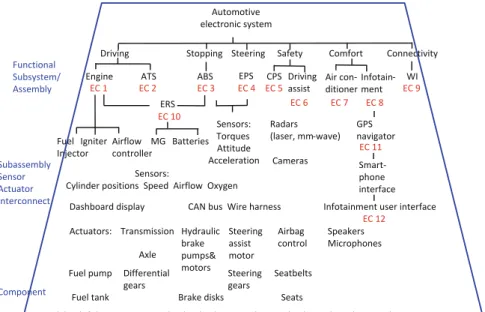
Figure1.2 depicts the power train (power generation and transmission) in a hybrid electric-gasoline-engine vehicle which uses a number of ECUs (electronic control units). Each ECU has at least one microprocessor“embedded”and is thus an electronic system in its own right. The automobile these days is a typical embodiment of embedded computing [5]. A high-end car these days uses as many

Multiple purposes:

(21)

as 80 microprocessors for various subsystem and module-level control [6]. Actually, the VLSI has provided the biggest momentum to improve the quality and reduce the cost of products or services of electronic systems. This is true with most of complex systems products, which may be mechanical (stationary or mobile), aerodynamic, electrical, electromechanical, electromagnetic, optical, electro-optical, or chemical. Because these systems generally need control for precision and throughput, which is hard to achieve were it not for the VLSI and program control. Automobiles, aircrafts, rockets, robots, chemical plants, utilities, medical devices, ATMs (Automatic Teller Machines), data storages, and agricultural plants of today are good examples of computer-embedded systems. They would not have existed without the VLSI as their key components for smart control. It is almost funny that we are accustomed to call these computer-embedded electronic systems “dedicated systems.” Although the purpose of the system is certainly“dedicated”, for example, to automotive control, computers (microprocessors) have actually found far more general and voluminous applications in embedded control than in“general-purpose”computing by PCs and HPCs (High-Performance Computers).

The more the benefits are drawn out of these systems and the more extensive their uses become over the population, the more heavily the human life depends on them. It is necessary therefore to see to it that these systems are available whenever they are needed. Because the VLSI is at the core of these systems as the workhorse, it is necessary to understand what the VLSI does in electronic systems, what would

Regenerative

(22)

happen if it fails to function as expected, what could be done to prevent serious failures from happening, and what we can innovate further in realizing more dependable systems technologies. Actually, these are the subjects discussed in this book. (Let us call the systems that use VLSIs as key components “electronic systems”hereafter. The term VLSI systems may be used interchangeably.)

1.1.2

Necessity of Dependability

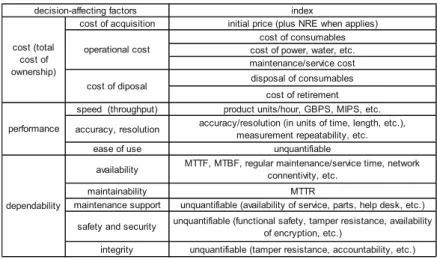
Dependability is never a single quality merit of a system. Central to the merit is rather the“performance”or“performance/cost,”in other words,“better fulfillment of the primary purpose”it is intended for. Table 1.1shows the factors that would affect the decision a user would make in the procurement of a product or service offered in the marketplace. During early stages of market introduction, cost and or performance may be the most influential factors, but as a product category and its market mature, increased attention is paid to dependability for increased social and economic implications, and this is true now with all kinds of electronic systems. These days, dependability of an electronic system is an interest shared among all those concerned: producers, users, and service providers alike.

The requirements for dependability have been discussed in and among various government regulatory agencies, global/regional/national standards bodies, mission-oriented agencies, industrial associations, and academic societies. Figure1.3 shows such organizations along with the documents they have published. It will be

(23)

relevant to refer in particular to IEC 60300 [7] for dependability management, IEC 61508 [8] for functional safety in industrial process measurement, control and automation, and ISO 26262 [9] for the functional safety for road vehicles, since these will be frequently cited throughout this book.

1.2

Background and Motivation for the Program

1.2.1

What VLSI Has Brought About

A Historical

Perspective

The VLSI has contributed to the progress in electronic systems in so many ways, which may be summarized as follows.

#1 Great number of devices integrated on a chip

Asfirst observed by Gordon Moore and later named as Moore’s Law that has held up until very recently, the number of transistors integrated on a chip of VLSI silicon has doubled every 18 months [10]. It is interesting to review the progress that the VLSI made following what Gordon Moore predicted [11]. I will not go into that here, however, since there already are abundant references available for this history

IEC

IEC 60300 dependability management IEC 60812 analysis for system reliability

IEC 61508 functional safety ISO

ISO 9000 management quality ISO 26262 road vehicle functional safety

IEEE TCFT fault tolerance,

IFIP WG10.4 dependable computing

SAE ARP4761 safety assessment process for civil airborne systems

Automotive Electronic Council: AEC Q-100, Q-101, Q-200, etc., US FDA

21 CFR Part 11 electronic records US FAA 14 CFR Part 25 airworthiness

JEDEC, JEITA Semiconductor test methods CE marking

Low-voltage directive, EMC directive, Machine directive

Conformity required for certain product categories

NASA, ESA, JAXA Spacecraft safety requirements,

standards

Systems Industry Associations Standard Bodies

Special Mission Entities Legislature Regulatory Agencies

Component Industry Associations Academic/Engineering Societies

US DoD MIL-STD-882E system safety

Government Body

(24)

[12]. It is worthwhile to note here, however, that there is a very solid theoretical background to the scaling down the sizes (other physical parameters and operating voltages as well) of the transistor, the most basic element of VLSI that has underlain its progress [13]. The number of transistors in a microprocessor has actually increased from the mere 2300 of Intel 4004 in 1971 to the billions today [14]. The same is true with memory chips. In no other technologies has it ever been possible to integrate uniformly performing, reliable components the way VLSI has enabled, which has provided the most powerful driving force for the complex electronic systems [15].

#2 Variety of circuit functions realized on silicon

The VLSI rapidly evolved from the early days of chips with a few logic gates into a variety of circuit functions covering arithmetic, logic, memory, analog, and more. Memories include SRAM (Static Random Access Memory), DRAM (Dynamic Random Access Memory), ROM (Read-Only Memory), EPROM (Electrically Programmable ROM), EEPROM (Electrically Erasable and Programmable ROM), and Flash Memory [4]. The analog and analog–digital tier of the silicon circuitry is capable of small-signal and high-power amplification, and analog-to-digital and digital-to-analog conversion [16]. A very important type of products of VLSI called FPGA (Field Programmable Gate Array) emerged during the course of the devel-opment [17,18]. Image sensors with billions of pixels have been used in cameras [19]. Micro-Electro-Mechanical (MEMS) is another direction the VLSI has taken to develop [20].

#3 Single-chip implementation of multiple circuit functions

Almost all the circuit functions described in #2 have actually been integrated in chips by now in the form of microprocessors used for personal computers, mobile communication devices, and computer-embedded electric, electronic, and software-controlled systems. The CMOS (Complementary Metal-Oxide Semicon-ductor), which emerged originally as low-power but low-speed integrated circuit technology, has since been exploited fully to realize all of the logic, memory, and coupled analog–digital functions, taking over the roles played by ECL, TTL and NMOS, and Bi-CMOS (hybrid bipolar and CMOS), realizing the highest density of integration by virtue of low power (virtually no power consumption when idle) inherent in that technology. This history is very well captured in Table1.2 com-piled by Makimoto et al. [21].

#4 Application functions and accelerated processing

(25)

Some of these application functions that were originally developed for ASICS such as efficient display control, encryption, and decryption for secure data transmission have been integrated in a general-purpose microprocessor. There are other types of VLSIs that evolved into high-performance, dedicated computation to complement microprocessors. In this category are DSP (Digital Signal Processor) [23] and GPU (Graphic Processing Unit) [24].

#5 Abundance of on-chip resource

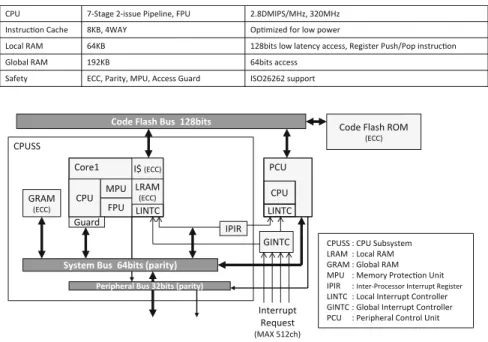
The availability of an abundance of circuit resource has been exploited to introduce fault tolerance to the VLSI. The use of redundant bits for error correction wasfirst used in DRAMs and SRAMs, easily accommodating a few defective bits to the effect of salvaging partially defective chips and thus drastically lowering the average memory prices. The introduction of error correction dramatically improved the tolerance of semiconductor memories against radiation-induced soft errors. (Please refer to paragraphs below). The fault-tolerant technology is used inflash memories in a more sophisticated fashion to optimize the memory retention and write–erase endurance. Error-correcting codes and encoding techniques are used to avoid physical interference of charges in the neighboring cells [25, 26]. Recent multiple-processor chips as well as FPGAs are capable of performing redundant concurrent calculation and then having a vote for the correct result to be robust against faults in a part of the chip. Two of most advanced VLSI architectures are shown in Figs.1.4and 1.5for illustrative purposes. Figure1.4shows a powerful integration of a multi-core processor and an FPGA which includes security features such as AES (Advanced Encryption Standard), SHA (Secure Hash Algorithm), and RSA (Rivest–Shamir–Aldeman encryption) [27]. Figure1.5is a microprocessor for automotive applications. Security features to support ISO 26262 have been inte-grated [28].

(26)

#6 Stable manufacturing and sourcing

The remarkable progress in the precision manufacturing technology for semicon-ductors and its rapid proliferation amongst players throughout the world in a competing as well as collaborating business environment has brought about high quality and stability in the sourcing of the VLSI, contributing tremendously to the build, maintenance, and maintenance support of the electric and electronic systems in terms of cost and availability. This has allowed systems houses to use multiple sources to secure procurement of key components.

(27)

#7 Distribution of reusable IPs

It has been made possible by the development of commercial practice in the semiconductor industry to distribute the rights to use the whole or parts of the design of an existing VLSI. Commerce of rights to use a semiconductor design (IP, Intellectual Property as it is called) that has proven to work has enabled reuse and helped realize more complicated chips in shorter time and with less cost of development. The last two items (#6 and #7) are a socioeconomic rather than technical phenomenon, which is worth noticing here discussing the impact of VLSI. Figure1.5in which a microprocessor IP and an FPGA IP are integrated is a good example.

The progress in VLSI technologies described above has been the contributors to progress in electronic systems, providing ever higher performance at ever lower prices, as well as dependability in compact, integral packages.

CPUSS

Core1

CPU 7-Stage 2-issue Pipeline, FPU 2.8DMIPS/MHz, 320MHz InstrucƟon Cache 8KB, 4WAY OpƟmized for low power

Local RAM 64KB 128bits low latency access, Register Push/Pop instrucƟon

Global RAM 192KB 64bits access

Safety ECC, Parity, MPU, Access Guard ISO26262 support

I$ (ECC) LRAM (ECC)

Code Flash Bus 128bits

IPIR : Inter-Processor Interrupt Register : Local Interrupt Controller System Bus 64bits (parity)

CPU CPU

(28)

1.3

Threats and Opportunities for the VLSI Systems

Great many ingenuities and tremendous efforts in engineering and associated sci-ences have been put in to accomplish the colossal tower of VLSI technology as it stands, which has impacted electronic systems with so much socioeconomic momentum.

1.3.1

Threats Arising from Miniaturization

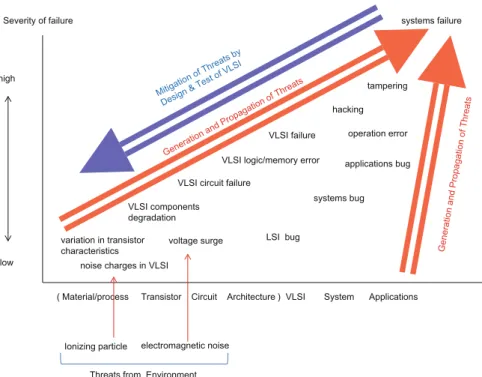
Suppose the precision printing and other manufacturing technologies continue to progress making the transistor and other device features even smaller, the VLSI engineering will be left with a pile of problems as follows to solve. Engineering has negotiated these problems of generic nature so far, but they will be much tougher to cope with in the future.

#1 Ionizing radiations and electromagnetic interference

There are the issues of various radiations in the environment that causes errors in the VLSI circuits. If a neutron from the outer space hits a VLSI chip, the electronic charges resulting from ionization in the semiconductor could cause errors in the VLSI circuits that could give rise to a system-level failure. This problem will be dealt with in Chap.3of this book. Electromagnetic interference is another persistent radiation issue. The voltage change induced by the alternating electromagneticfield generated off-chip (e.g., by an automotive engine igniter) or fed through the power line are a hazard that needs continued attention in the design of the VLSI. This problem will be handled in Chap.4.

#2 Variations and degradation in device characteristics

The variation in sizes and other parameters of the transistor, which become more pronounced as it is scaled down, leads to variation in transistor characteristics, which in turn could cause deviation in delay times in the circuits. The latter could result in a system failure. This problem is addressed in Chap. 5. There are also multiple, persistent mechanisms that cause degradation in the characteristics of transistors and other components in VLSI over time and/or under the stress of operating voltage/current, temperature, etc. The time-dependent degradation mechanisms are the topic of Chap.6.

1.3.2

Threats Arising from Scale and Complexity

(29)

consists of subsystems and modules with various different characteristics: proces-sor, SRAM,flash memory, analog–digital components in hardware; and commands and sequences in software; some being offered as existing, already-proven parts, and some being newly developed and left to be proven. The complexity arises from the interactions of various objects such as these, consuming the time and human resource to make sure that they work in coordination in practical use cases. #1 Connectivity

Interconnects and communications between subsystems are sources of system problems. Users of wireless telecommunications often experience loss of connec-tion. Importance of securing minimal connectivity even under disaster conditions has been pointed out. It will be a challenge to mitigate or perhaps eliminate this problem in a wireless system with VLSIs with new functionalities. This is the topic of Chap.7. Chapter8addresses connectivity in electronic systems and handles the challenges of wireless signal interconnects and wireless power supply for VLSI or system-level packaging.

#2 Responsiveness

A response within a certain specified length of time is often required in real-time systems. A soft real-time control is such that a late response is permissible to a certain extent as in the case of ATM as the user can wait for a second or two. A hard real-time control is such that this requirement is critical as in the case of robotics or automatic drive assistance. Meeting with the hard real-time response requirements in robotic applications and assuring synchronicity over the system-to-system han-dover in wireless applications are examples. This issue is dealt with in Chap.9. #3 Malicious attacks

Electronic systems are often the target of malicious attack of hackers who attempt to steal information, disrupt operation, etc., which poses a threat to systems security and reliability. Consideration for security and safety is adding more tasks for the VLSI systems design recently. This issue, which is becoming one of the greatest social concerns, is handled in Chap.10.

#4 Design errors and test coverage

(30)

#5 Unknown threats and provisions

No design is perfect, particularly in light of changing threats, changing uses and changing use environments. Requirements specification, even though it will be prepared with utmost care may not be perfect. Unknown threats and provisions are discussed in Chap.12.

1.3.3

Opportunities: Changing Markets and Increased

Demands for Systems Dependability

Changes in the market environment that happened during the past 10 years are opening up new opportunities for VLSIs. First of all, certain types of electronic system products are receiving increasing requirements in privacy. Personal infor-mation stored in PCs, cell phones, or credit cards are prone to criminal plots and malicious attacks. Safety is an utmost requirement in robots in assistance of the handicapped or for hazardous mission in hostile environment. The same is true with automatic driving or drive assistance in road vehicles. Conformity to new safety standards such as described in Sect.1.1.2is now a must for the electronic systems design. These changes in markets and growing demands for safety and security pose great opportunities for VLSIs.

1.3.4

A Summary of Objectives

(31)

1.4

The DVLSI Program

1.4.1

Vision, Scope, and Mission Statement

From what has been discussed in Sect.1.3, we now arrive at a vision, scope, and mission statement for the DVLSI Program as follows [29]:

• To work on technologies that would help contain the threats against depend-ability within VLSI.

New designs for dependability in physical, circuit, logic, and architectural aspects of VLSI will be explored. New methods of verification and test will be pursued as well to complement from a different angle. The VLSI, which has proven to work as most integral, most dependable parts of systems, needs further development to further improve dependability.

• To come up with ideas of new functionalities for VLSI which contribute to enhancing dependability at the system level.

Severity of failure

( Material/process Transistor Circuit Architecture ) VLSI System

Threats from Environment Ionizing particle electromagnetic noise high

low

Applications hacking

tampering

LSI bug variation in transistor

characteristics

VLSI components degradation

operation error

noise charges in VLSI

VLSI logic/memory error

systems failure

systems bug applications bug VLSI circuit failure

voltage surge

VLSI failure

(32)

Systems in their most advanced form today as those used in electronic com-merce, public telecommunications, management, robots, sensor networks, or so-called Internet of Things place challenges as described in Sect.1.3. • To provide a method for measuring the dependability of systems.

1.4.2

Program Start and Project Selection

The DVLSI program started with the appointment of the author to Research Supervisor in March 2007. In an arrangement customary to the CREST programs, we had the privilege of having distinguished advisors [30] from industry and academia shown in Table1.3join the Program Management to assist the Research Supervisor.

Thefirst RFP (Request For Proposals) was issued from JST in March 2007, the deadlines for submission set in May. The selection from the submitted proposals was conducted by the VLSI Program Management (Research Supervisor and Advisors), considering the relevance of the proposal from the following perspectives:

• If the proposal has captured essential problem(s) being experienced and/or overarching in practical VLSI design for dependability;

• What original and distinctively competitive ideas are presented to solve the problem(s) raised;

• If a target is set at a challengeable level and described as clearly and hopefully as quantitatively as possible with respect to the state of the art and on-going competing efforts throughout the world;

(33)

• What the likelihood of success in terms of PoC (Proof of Concept) demon-stration and expected successive industrial implementation is.

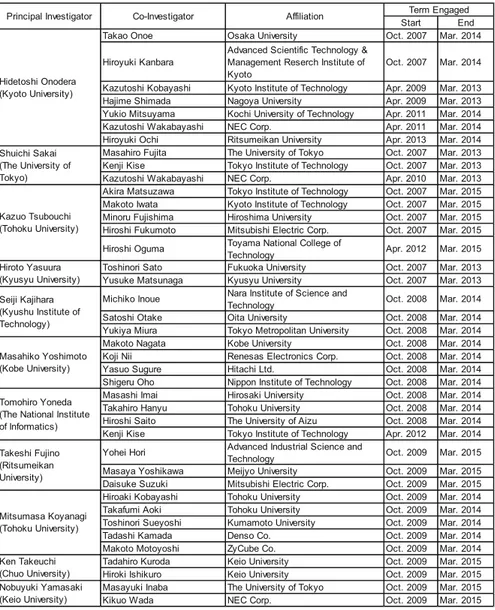
The selection process took a few months after the submission of proposals and was completed by August 2007. The same process of RFP, proposal submission, and project selection was repeated in 2008 and 2009 tofinalize the selection. The eleven projects led by the Principal Investigators were awarded with the JST CREST funds over the 3 years between 2007 and 2009 as shown in Table1.4 [31]. Table1.5is the list of Co-Investigators.

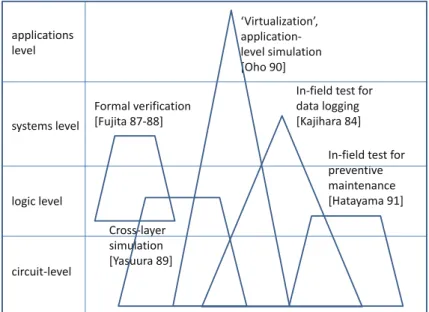
During the 3 years of selection process, it was fortunate to have the projects in the DVLSI Program cover key aspects of the problem of dependability rather comprehensively if not exhaustively. The projects address the aspects of func-tionality, design/verification tools, and test tools in most of the hierarchical layers from the physics, circuit to architecture, as shown in Fig.1.7. The vertical axis of Fig.1.7is the systems hierarchy from the physical layer at the bottom to application at the top. On the horizontal axis are the segments of research products ranging from the design tools, test tools, and concepts in chips/circuits up to proposed solutions for dependable systems. Figure1.8is another roughly sketched project portfolio of the Program compiled from the project documents positioning the projects relative to the applications areas envisioned such as aerospace, plant control, transportation, automobiles, robots, information, telecommunications, medical,finance, and consumer appliances.

1.4.3

Program Management

(34)

ever-accelerating advancement in technology and realization in products taking place worldwide, the program management that consisted of the Research Super-visor and the AdSuper-visors adopted the following practice to help the projects effec-tively carry out the mission.

(35)

• Start out and keep interacting with industry to identify/refine the problems and objectives and have shared interest between the Program and industry if that has not been done enough (Actually this often was the case.),

• Come up with methods to solve the issues that compete favorably among similar efforts worldwide,

• Keep specifying and narrowing down possible applications or opportunities of PoC (Proof of Concept) demonstration,

• Keep interacting with industry to enable research results to get the concept proven and exited to the real world,

• Get the ideas patented and standardized.

The relationship between the Program and the outside world was envisioned as depicted in Fig.1.9. It was always kept in mind to have a vertical (radial in Fig.1.9), cross-layer interactions happening exchanging ideas and collaborating with each other. In the innermost core are the teams of Projects in the VLSI Program represented by the PIs (Principal Investigators). The layer surrounding the core is the semiconductor industry and EDA (Electronic Design Automation)

Test tools

(36)

industry. The semiconductor manufacturer layer is in turn enclosed in the systems industry layer, which is then to provide the products for the service provider industry (and mission-oriented government bodies) in the outer adjacent layer. The outermost space is the consumer or the general public.

The DVLSI Program (center oval) had invited speakers, panelists, and com-mentators from the external organizations indicated in the outer shells attend the Program meetings to interact with the DVLSI Program. These organizations in effect formed special interest groups shown with elongated ovals in blue with the PIs indicated in red as the primary window of contacts. Some of these interactions have materialized into collaborative technology/product development and imple-mentation. It was intended throughout the Program to have active interactions between the Program and the outside worldfirst to obtain inputs in from, and then to promote exiting the research results back out into, the real world.

People outside the Program were invited from industries and mission-oriented government bodies such as JAXA (Japan Aerospace eXploration Agency) to par-ticipate in discussions and collaborate with the teams throughout the term of the Program. It was intended that those invited form groups of special interest as

Application Aerospace

Robot Plant Control

Transportation Auto Information Telecom

Finance

Medical Consumer

Wireless Solid-State Drive, Wireless Interconnect, Wireless Power Supply Tamper-Resistant Circuits, Tamper-Resistance Test RTOS, Micro-Controller, and SIP for Hard-Real-Time Applications

Onodera

Reconfigurable Processor, Robust Circuits, Robust Layout Failure-Resistant Architecture, Formal Design VerificaƟon

Broad-Band RF, Heterogeneous Air Interface

Systems-Level SoŌ-error SimulaƟon, SoŌ-error-resistant Circuit/Systems Design Design/Test for Field Dependability

RadiaƟon- and EMI-Hard Memory and Circuits Networked MulƟ-Core Systems 3D Processor for Image-RecogniƟon

(37)

depicted in long ovals as depicted in Fig.1.9 with project teams of matching research topics.

1.5

A Summary of Results

1.5.1

What Has Been Accomplished

#1 Fundamental study of threats against VLSI dependability and means to mitigate them

There have been many important results obtained in the DVLSI Program out of the fundamental work of studying the nature of“threats”against the dependability of VLSI systems and means to mitigate/cope with them. Detailed account is given by Program researchers in the chapters and sections of Part II in this book, which is entitled,“The VLSI Issues in Systems Dependability.”Much of the fundamental, physical-/circuit-layer research work have been transferred to industry, or being engineered for products. equipment manufacturer layer

service provider layer

consumer layer VLSI manufacturer layer

equipment manufacturer layer service provider layer

consumer layer

equipment manufacturer layer

VLSI manufacturer layer

(38)

It is due here to comment that Part II was contributed by many distinguished authors from outside the VLSI Program as well, who participated in the activities of the Program in the interactive way described in Fig.1.9, and also kindly agreed to write succinct reviews for some of the chapters in PART II to identify the over-arching issues and notable engineering efforts that had been made in the relevant area. Readers are referred to the papers in Part II for more elaborate account of the topics.

#2 Systems-/Solution-oriented results

The Program also brought forth several interesting innovative ideas for depend-ability at the systems and/or solutions layer. These are discussed in chapters of Part III in this book, which is entitled, “Design and Test of VLSI for Systems Dependability.”Many of them have been brought to the stage of demonstration in proof of concept (PoC) experiments, or preliminary implementation by the time of publication of this book. There are continued efforts being made on these proposals to have them implemented in practical systems. A survey conducted by the man-agement of DVLSI Program on its closing in March 2015 said that about a dozen “exit” efforts were being undertaken between the DVLSI project teams and cor-porations exploiting the ideas and their demonstrations that had resulted from the Program research. It is hoped that we will see them materialized in tangible products and services in the not too distant future.

Thoroughness of

V

erification/T

e

st

Robustness of Design against Threat

VLSI Dependability = Π (Robustness of Design against Threat) x Π (Verification and Test Coverage )

variability resilience

soft-error resilience

noise immunity

robust texture, redundant circuit, real-time technol.

tamper resistance aging

resilience

timing/synch robustness

X

X

X

(39)

#3 Measurement of dependability

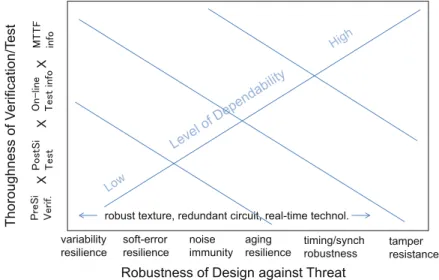
It was on the agenda for the DVLSI team since the beginning of the Program if it will ever be possible to establish quantitative metric(s) of dependability of a VLSI system. This subject was brought up to group discussions from time to time. However, we were not able to come up with a good result for quantitative metrics. Probably closest we have come to this topic is Fig.1.10, which shows a Cartesian diagram. The horizontal axis is the robustness of the technologies built-in by design and represented by a product of technology“robustness factors”comprising vari-ability resilience, soft-error resilience, noise immunity, aging resilience, timing/ synchronicity robustness, and tamper resilience. The vertical axis shows the thor-oughness of verification and test, and comprises of pre-silicon verification, post-silicon test, availability offield-test data, and MTTF information. By diago-nally sectioning the Cartesian quadrant, it will be possible to categorize a design into a few different levels of dependability, which could be useful for auditing the design practice for dependability.

Same sort of idea may be used for assessing the dependability at the systems level. In fact, it is attempted in Chap.2of this book to describe risk analysis and engineering for dependability [6]. For systems, subsystems, or systems components that have been used for a considerable period of time well into their expected full lifetime with a good record of random failure/fault events archived, it would be possible to assess their dependability in terms of MTTF (Mean Time to Failure), MTTR (Mean Time To Repair), or FIT (Failure In Time), and use this knowledge to assess the dependability of the next generation of product.

Not only the above time measures, but other measurable dependability indexes such as rates of packet loss, bit errors, etc., at systems- or subsystems-level will be considered in the dependability. It is essential that archives of failure events and their analyses are built and made accessible for basic engineering researchers as those from the DVLSI Program. It is hoped that future project teams will be able to more effectively address the subject of dependability by having access to knowl-edge of actual failures and practice of dependability design in industry.

1.5.2

Outreach

(40)

researchers and people from industry and mission-oriented national organizations, e.g., JAXA, in Japan.

1.5.3

Conclusions

The ideas borne in the DVLSI program to mitigate threats and provide solutions to dependable systems presented in this book are abundant. They may still need more brush up and further engineering, but are believed to form part of foundation for dependable design and test of the VLSI and help improve the dependability of electronic systems of the future.

References

1. J. Hennessy, D. Patterson,Computer Architecture, 5th edn. (Morgan Kaufmann, Waltham, 2012)

2. Univ. Wisconsin,“Processors Guide 2012,”A good list of commercial microprocessors can be found at this university website.https://kb.wisc.edu/showroom/page.php?id=4927 3. Manufactures are the best sources of information about the working of microprocessors

including dependability. Visit the websites of Intel, AMD, ARM, Renesas, etc

4. Memory chip manufacturers are the best sources of information about the working of DRAMs, SRAMs and NVMs including their dependability. Visit the websites of Micron, Cypress, Intel, Toshiba, for example

5. D. Patterson, J. Hennessy, Computer Organization and Design: The Hardware/Software Interface, ARM Edition, Morgan Kaufmann, Cambridge, 2017. A companion piece to Hennessy and Patterson [5] and best textbook available on embedded microprocessors 6. S. Asai, Design and Development of Electronic Systems for Quality and Dependability,

Chapter 2 of this book

7. International Standard, IEC 60300, Dependability management. https://webstore.iec.ch/ publication/1293, 1294, etc

8. International Standard, IEC 61508, Functional safety of electrical/electronic/programmable electronic safety-related systems, pp. 5515–5516.https://webstore.iec.ch/publication 9. International Standard, ISO 26262, Road vehicles—Functional safety.http://www.iso.org/iso/

catalogue_detail?csnumber=43464, etc

10. Gordon E. Moore, Cramming more components onto integrated circuits. Electron. Mag. 19 4 (1965)

11. For actual trend in the speed of integration, refer, for example, to: Intel Website,“50 years of Moore’s Law.” http://www.intel.com/content/www/us/en/silicon-innovations/moores-law-technology.html

12. Brook, David,“Understanding Moore’s Law, Four Decades of Innovation,”Chapter 4 (The Future of Integration), p. 39, CHF Publications, Philadelphia, 2006

13. For scaling down the sizes of transistors, refer to: Dennard, Robert H. et al., Design of Ion-implanted MOSFETs with very small physical dimensions. IEEE J. Solid State Circ. SC-9, 256–268 (1974)

(41)

15. For the most recent account of what is happening to the Moore’s law, readers are referred to: Tom Simonite,“Intel puts brakes on Moore’s Law,”MIT Technology Review, March 23, 2016.https://www.technologyreview.com/s/601102/intel-puts-the-brakes-on-moores-law/ 16. Refer to manufacturer’s websites for analog or analogue-digital VLSIs: Texas Instruments,

Analog Devices, etc

17. FPGA Manufacturer Websites: Xilinx, Altera, Intel

18. Rodríguez-Andina, J. Juan et al. Features, design tools, and application domains of FPGAs. IEEE Trans. Indust. Electron.54, 1810–1823 (2007)

19. Refer to a Wikipedia site,“Active Pixel Sensor.”https://en.wikipedia.org/wiki/Active_pixel_ sensor

20. As a good reference, visit MEMS & Sensor Industry Group Website. http://www. memsindustrygroup.org/?page=WhatIsMEMS

21. Makimoto, Tsugio and Sakai, Yoshio (2003),“Evolution of Low-Power Electronics and Its Future Applications,” Proceedings of the 2003 International Symposium on Low Power Electronics and Design, Seoul, Korea, August 25–27, pp. 2–5

22. Refer to a Wikipedia page,“Application-Specific Integrated Circuit.”https://en.wikipedia.org/ wiki/Application-specific_integrated_circuit

23. Please refer to manufacturers’ website, for example: Texas Instruments, “Digital Signal Processors.”http://www.ti.com/lsds/ti/processors/dsp/overview.page

24. Please refer to manufacturers’ website, for example: NVIDIA,“What is GPU-Accelerated Computing?”http://www.nvidia.com/object/what-is-gpu-computing.html

25. Tanakamaru,“Degradation of Flash Memories and Signal Processing for Dependability,” Section 6.2 of this book

26. Tanakamaru, “Design and Applications of Dependable Non-volatile Memory Systems,” Chapter 18 of this book

27. Xilinx, “Zinq-700, All-Programmable SoC.” https://www.xilinx.com/products/silicon-devices/soc/zynq-7000.html

28. Renesas web page,“RH 850 Family.” https://www.renesas.com/en-sg/products/microcontrollers-microprocessors/rh850.html

29. The DVLSI website is found at the following URL:http://www.dvlsi.jst.go.jp/english/index. html

30. Refer to the DVLSI Webpage.http://www.dvlsi.jst.go.jp/english/adviser/index.html 31. Refer to the DVLSI Webpage.http://www.dvlsi.jst.go.jp/english/list/index.html

32. Priority Programme “Design and Architectures of Dependable Embedded Systems”(SPP 1500) sponsored by DFG (Deutsche Forschungs Gemeincschaft) http://www.dfg.de/ foerderung/info_wissenschaft/2012/info_wissenschaft_12_06/index.html Started in 2011 and still running as of 2016 Also refer to:http://spp1500.itec.kit.edu/

(42)

Design and Development of Electronic

Systems for Quality and Dependability

Shojiro Asai

Abstract In this chapter, we quickly walk through the development process of electronic systems that use VLSIs as key parts to provide a background and introduction to the rest of this book. Setting a good goal for a development is not simple to begin with, and the task to get there is often more demanding than it appears at the beginning. The importance of project management and role played by the project manager isfirst pointed out along with the need to clearly define and document the system requirements specification. Besides the performance and dependability, other aspects of the design goal such as cost, timeline, and com-pliance are discussed as well, in recognition of the reality of product development. After all, the one who heads up the development is in a position to account for the quality of product throughout its life and return on the investment in the devel-opment as well. The multiple phases of the life of an electronic system are described: design, verification, prototyping, test, validation/certification, operation in thefield, andfinally, retirement. Among these, the specific process in the design of risk analysis and dependability engineering is highlighted as the central topic of this book. Simultaneous assessment of the outcome of possible systems failures and economic viability of the product being pursued is elaborated. Some of the specific technologies developed in the present work, CREST DVLSI Program sponsored by JST, are referred to as possible solutions to problems encountered in designing dependability in future electronic systems to address immediate market needs as well as far-reaching issues such as the IoT (Internet of Things) and system of systems.

Keywords Systems requirements specification

Risk analysis Dependability engineering

Internet of things

System of systems

S. Asai ()

Rigaku Corporation, Tokyo, Japan e-mail: [email protected]

© Springer Japan KK, part of Springer Nature 2019

S. Asai (ed.),VLSI Design and Test for Systems Dependability, https://doi.org/10.1007/978-4-431-56594-9_2

(43)

2.1

Core Considerations in Designing an Electronic

System Product

2.1.1

Purpose and Requirements

Think of an electronic system product—one of a kind that has fascinated and/or inspired you most recently. It could be the electronic payment, Mars Explorer, Toyota Prius, bullet train, or perhaps Apple i-phone. We are sometimes fascinated by these things and intrigued as to how one can complete the task of designing an electronic system as complex as these to perform beautifully with expected dependability, and how they are built and tested to be able to satisfy critical mission purposes or gain general public acceptance in the marketplace. It is amazing as well to recognize that all of these products are enabled by VLSIs playing their critical roles in layers of system hierarchy from the component level as high up to as the top level. In this chapter, we have tried to put together some thoughts on the design and development of complex electronic systems for quality and dependability to lay a ground for later chapters. Particularly for those readers who have basic under-standing of electrical engineering and semiconductor technologies and are inter-ested in dependability engineering, this chapter presents a meaningful collection of basic principles, worth sticking to in the design and development of electronic systems and thus will be helpful for those who want to undertake electronic systems design for profession. It is meant to be an introduction to the chapters that follow where technologies for dependability in VLSI and VLSI systems are extensively discussed.

Figure2.1 is a summary of items where attention is required in designing a system. They include: purpose, functions, dependability, economy, timeline, and compliance. The most fundamental among these items is the purpose, or what the user intends to do using the system being designed. It is often useful to come back and think what the purpose was whenever we need to disambiguate the require-ments or make a decision on possible engineering options. The next item is the functions, i.e., the capabilities the system is given by design to be able to fulfill its purpose. Dependability, the third item, is basically availability of functions throughout the expected lifetime of the system. Since this is the central topic of this

Purpose

Functions and performance Dependability

Economy Timeline Compliance

---What has not been told Fig. 2.1 Basic

(44)

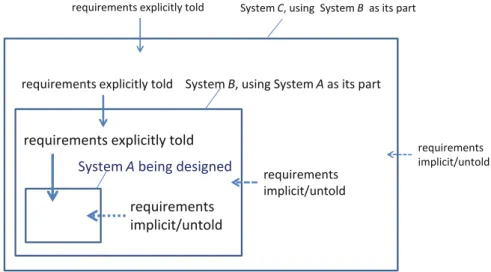
book, it will be discussed in detail in what follows. Product economy is an issue that needs to be addressed from both angles: performance/cost from the user’s per-spective or profitability over the product life from manufacturer’s perspective. The manufacturer has to recover the (i) initial cost of development (sometimes referred to as NRE (nonrecurrent engineering), (ii) direct (materials and labor) and indirect (supervising) cost of manufacturing, and (iii) SG&A (selling, general, and administrative) overhead expense, with sufficient profit margins that enable capital reinvestment for growth as well as paying out dividends for investors. The product economy from user’s perspective is the product value for him contrasting his costs that include initial product price and spending for maintenance and services throughout its life (TCO, or total cost of ownership). In the timeline consideration, it is always a good idea to start from the delivery date demanded by the customer or the predicted market window and work back to the present with time needed for shipping, test, production, and design which is the immediate future task; not to start from the present and move forward without a good grasp of how long each of these steps would take. Compliance to regulations and standards is another“must” that needs close attention. Safety is a priority issue in product compliance and can be one of the most basic functions of the system. Last but not least, there are items the designer may not be explicitly told, which will be addressed in a little more detail in the following subsections.

2.1.2

Design for X

The next consideration goes to product life management, which is summarized in Fig.2.2as the“Design for X.”Design gives birth to a system as indicated by the leftmost bold arrow on the top half of the diagram. The system is then fabricated, tested, and shipped to the user. The user often benefits from the help of the producer in maintenance and support. When the system comes to the end of life, it needs to be disposed of with safety and permissible negative impact on the environment. It is important to notice that all the collective quality of the system exhibited in its whole life goes back to the design as its origin: performance, ease of use, maintainability, manufacturability, testability, and disposability at the end of its life.

Gambar

Table 1.1 Factors affecting the decision-making for procurement of a product or service
Fig. 1.5 A functional block diagram of a multiple-core microprocessor for automotive
Fig. 1.6 Propagation and containment of threats that could cause systems failure vertical
Table 1.5 Project teams consisting of the Principal Investigators and Co-Investigators
+7

Referensi

Dokumen terkait

Pada hari ini, Selasa tanggal Dua Belas Bulan Juli Tahun Dua Ribu Sebelas, Panitia Pengadaan Barang / Jasa Dilingkungan Bidang Bina Marga Dinas Pekerjaan Umum Provinsi

Catatan : Agar membawa dokumen perusahaan asli sesuai dalam isian kualifikasi serta menyerahkan rekaman/copy-nyaM. Demikian undangan dari kami dan atas perhatiannya

For international law to be fully enforced and international good governance to take place, people of the world should work together hand-in-hand in advocacies and public

Tahap perencanaan tindakan yang dilakukan yaitu : (1) Rencana tindakan pada siklus pertama ini mengacu pada penerapan metode demonstrasi, penyajian materi dibuat lebih

Hari berganti hari, kentang² pun mulai membusuk,murid² mulai mengeluh,apalagi yang membawa 5 buah kentang, selain beratbaunya juga tidak sedap.Setelah 1 minggu murid² TK

Pendapat seorang ahli yang berhubungan dengan ilmu pengetahuan yang telah dipelajari tentang sesuatu apa yang diminta pertimbangannya, oleh karena itu sebagai saksi ahli seseorang

Teknik sampling yang digunakan adalah purposive sampling dengan kriteria Bank umum konvensional yang terdaftar di Bursa Efek Indonesia pada tahun 2012 – 2016, bank

1) Hasil pengujian ANOVA Post Hoc (Uji Bonferroni) menunjukkan dengan lebih jelas bahwa auditor yang independen memberikan pendapat yang berbeda dengan auditor yang