Effective Teaching
with Internet Technologies
Pedagogy and Practice
Alan Pritchard
© 2007 Alan Pritchard
First published 2007
Apart from any fair dealing for the purposes of research or private study, or criticism or review, as permitted under the Copyright, Designs and Patents Act, 1988, this publication may be reproduced, stored or transmitted in any form, or by any means, only with the prior permission in writing of the publishers, or in the case of reprographic reproduction, in accordance with the terms of licences issued by the Copyright Licensing Agency. Enquiries concerning reproduction outside those terms should be sent to the publishers.
Paul Chapman Publishing A SAGE Publications Company 1 Oliver’s Yard
55 City Road London EC1Y 1SP
SAGE Publications Inc 2455 Teller Road
Thousand Oaks, California 91320
SAGE Publications India Pvt Ltd
B 1/I 1 Mohan Cooperative Industrial Area Mathura Road, Post Bag 7
New Delhi 110 044
SAGE Publications Asia-Pacific Pte Ltd 33 Pekin Street #02-01
Far East Square Singapore 048763
Library of Congress Control Number: 2007921672
A catalogue record for this book is available from the British Library
ISBN 978-1-4129-3094-9 ISBN 978-1-4129-3095-6 (pbk)
Typeset by C&M Digitals (P) Ltd., Chennai, India
List of Figures
viii
List of Tables
ix
Acknowledgements
xi
Companion Website
xii
1
ICT, the Internet and Theories of Learning
1
2
The Internet, Pedagogy and Learning
13
3
Working Individually
28
4
Working Collaboratively
48
5
Longer Term Projects, Communicating and Problem Solving
72
6
End Word: Effective Teaching with the Internet
116
Appendix 1
Pedagogical and Theoretical Considerations: Explanatory Notes
123
Appendix 2
Case Studies
125
References
127
List of Figures
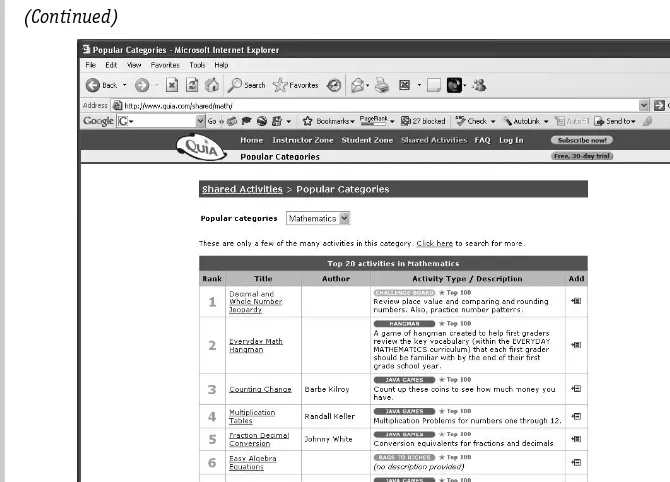
3.1 Part of the activities list in Quia for mathematics
30
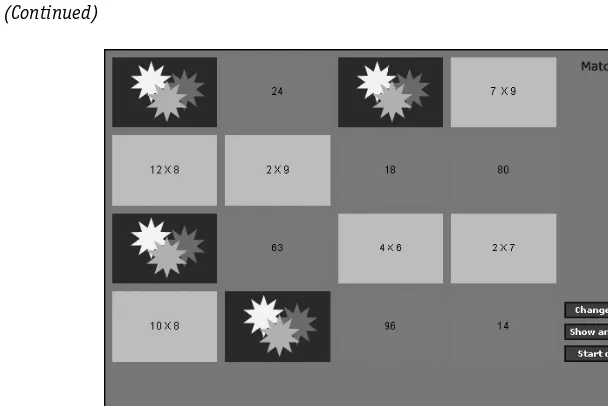
3.2 An example screen from a matching activity in Quia
32
3.3 An example of a Quia screen
35
3.4 The opening screen of a Builder Ted activity, showing the ladder
where the bricks have to be placed in the correct order
36
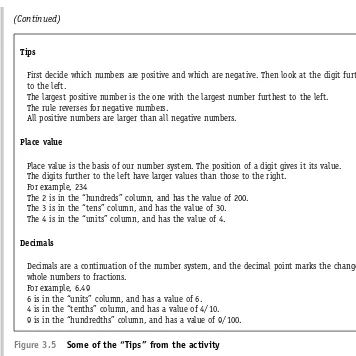
3.5 Some of the “Tips” from the activity
37
3.6 Part of the background information from the activity, which was
used with the whole class as an introduction
38
3.7 A part completed map-labelling activity
43
4.1 Example of an introductory page to the virtual war room tour
50
4.2 The map room worksheet (a simplified version of this sheet was
produced for the lower ability group to use)
51
4.3 Part of the Virtual Synagogue site
58
4.4 The beginning of the Musical Mystery
64
5.1 Welcome to Welltown
74
5.2 Games section of the Welltown site
75
5.3 A completed worksheet made by the teacher using artwork copied
from the website
78
5.4 One of the downloadable worksheets from the Welltown site
79
5.5 A completed downloadable worksheet
83
5.6 One of the pages from the developing school website.
The text was composed by the children
84
5.7 View that the teacher has of the remote class that she is teaching
88
5.8 The view of the teacher that the children have during the lesson
89
5.9 An example web page with text, images and hyperlinks
98
5.10 One of the recipes from the UK school; evaluated by
the Spanish School
104
2.1 Percentage of schools connected to the internet since 1998
(Source: DfES 2004a)
15
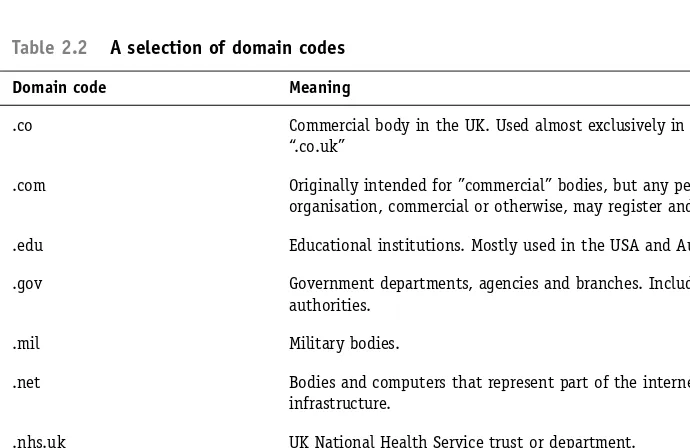
2.2 A selection of domain codes
18
3.1 Characteristics of constructivist learning that might be present in ICT
related lessons: Drilling for tables
34
3.2 Drilling for tables: Other considerations/features
34
3.3 Characteristics of constructivist learning that might be present in ICT
related lessons: Builder Ted and decimals
40
3.4 Builder Ted and Decimals: Other considerations/features
40
3.5 Characteristics of constructivist learning that might be present in ICT
related lessons: Find a place in the world
45
3.6 Find a place in the world: Other considerations/features
46
4.1 Characteristics of constructivist learning that might be present in ICT
related lessons: Virtual tour of the Cabinet War Rooms
55
4.2 Virtual tour of the Cabinet War Rooms: Other considerations/features
55
4.3 Characteristics of constructivist learning that might be present in ICT
related lessons: Exploring places of worship
61
4.4 Exploring places of worship: Other considerations/features
62
4.5 Characteristics of constructivist learning that might be present in ICT
related lessons: Key stage 1 music games
69
4.6 Key stage 1 music games: Other considerations/features
70
5.1 Characteristics of constructivist learning that might be present in ICT
related lessons: Key stage 1 health education
86
5.2 Key stage 1 health education: Other considerations/features
86
5.3 Characteristics of constructivist learning that might be present in ICT
related lessons: Modern foreign languages and video-conferencing
93
5.4 Modern foreign languages and video-conferencing: Other
considerations/features
94
5.5 Characteristics of constructivist learning that might be
present in ICT related lessons: Children publishing their work
100
5.6 Children publishing their work: Other considerations/features
100
5.7 Characteristics of constructivist learning that might be present in
ICT related lessons: International recipe exchange via e-mail
106
5.8 International recipe exchange via e-mail: Other
x
Effective Teaching with Internet Technologies
5.9 Characteristics of constructivist learning that might be present in
ICT related lessons: Using a webquest
112
5.10 Using a webquest: Other considerations/features
113
6.1 Number of times features of constructivist lessons with ICT
recorded in case studies
119
6.2 Number of times other considerations/features
Companion Website
Theories of Learning
About this chapter
In this chapter you will encounter:
• an explanation of the purpose and structure of the book
• a general review of learning theory as it might relate to the use of the internet • a detailed consideration of constructivist learning theory with particular reference to
the use of ICT and the internet.
INTRODUCTION
This book has been written with the intention of looking in detail at some of the issues
surrounding the increasing use of the internet in schools. The book also looks at the
asso-ciated areas of learning theory and pedagogy, which are likely to have an impact on the
realisation of the expected learning outcomes that teachers formulate and work towards.
The book provides the background to learning theory relevant to a consideration of
internet use in schools, and presents an overview of current views and developments
concerning pedagogy in the light of the advent of new technologies in general, and the
internet in particular.
To exemplify some of the important ideas and approaches considered in the early
chapters of the book a series of case studies, grouped according to learning and
peda-gogical principles, is also included. The case studies serve to provide a strong practical
input, helping to make the book useful for academics and practitioners alike. The case
studies are based on classroom research and as such are examples of the sort of work
currently being undertaken by teachers. The case studies emphasise the planning and
practicalities of the work and links are made to the theory that is considered earlier in
the book. The case studies also consider the learning outcomes and compare them, as
far as this is possible, to the outcomes which might have been achieved if the work had
been undertaken in a more traditional and non-ICT related way.
LEARNING THEORY AND THE USE OF ICT AND THE INTERNET
Naturally everything that teachers do in their planning and their teaching, as well as
most of their interactions with their pupils, is centred on the idea that children learn
in certain ways and that teachers plan and design activities to take advantage of this.
The arrival of new technologies in schools in the 1980s had little impact on the way
that teachers planned and taught. Many computer applications that were used in
classrooms were copies of approaches that teachers had used, and in some cases, had
stopped using over the years. An example of this is the increase in the number of
pro-grams that gave extensive repetition in basic skills and became known as “drill and
practice” programs. There is a place for this type of program perhaps, but to
concen-trate the power of a sophisticated and expensive piece of equipment on an outdated
approach to learning with questionable value is not wholly satisfactory.
With the growing awareness of the theory associated with learning and a growing
interest in the ways that new technologies might change the way that teachers teach
and children learn, there is scope, perhaps even a real need, to look at what is
cur-rently known about learning, especially in relation to the new possibilities afforded by
Information and Communications Technologies (ICTs).
If we deal quickly with the behaviourist view of learning, we will be able to
concen-trate on the constructivist theories, which seem to give far better representations of the
complex processes involved in learning. Put simply, behaviourists see learning as a
process by which learners become able to make specific set responses to particular
stimuli. This perhaps sounds very basic, and in some ways it is, but behaviourists
believe that all behaviour can be divided into small actions, each of which can be
mas-tered by a process of training, rewards and sometimes punishments, and that learning
proceeds in that way, often without the all important ingredient of understanding.
To be able to respond with the number 56 when asked the question “What are
seven eights?” is certainly commendable. However, simply responding with the
correct number cannot give any insight into the level of understanding of the
respon-dent. Of course we can say that as long as the answer is correct it does not matter, but
understanding is at the heart of effective and lasting learning. Some would argue that
being able to make the correct response is fine and that understanding may follow on
behind for many, and if it does not, then at least the response is correct.
In many contexts behaviourist style learning may be the answer, reciting
multipli-cation tables may be one of these contexts, and there are others – automatically
look-ing both ways before crosslook-ing a road; saylook-ing “please” and “thank you” appropriately;
putting “i” before “e” except after “c”. There are many more contexts when what is
really needed is the flexibility that comes with understanding. Generally speaking we
have moved away from behaviourist style teaching and learning for most learning
activities, and the school of thought that holds sway, though not always explicitly, is
the school of constructivist learning.
Constructivism, in contrast to earlier theories, puts understanding at a high level of
priority. Constructivism, as the name suggests, sees learning as a building activity in
which individuals build an understanding of events, concepts and processes, based on
their personal experiences and often supported and developed by, amongst other
things, activity and interaction with others.
Let us look at this in a little more detail. If we were to distil what has been written
about constructivist learning we might come down to the following four statements.
•
Learning is a process of interaction between what is known and what is to be
learned.
•
Learning is a social process.
•
Learning is a situated process.
•
Learning is a metacognitive process.
We will look at each of these in turn.
LEARNING AS A PROCESS OF INTERACTION BETWEEN WHAT IS
KNOWN AND WHAT IS TO BE LEARNED
We all have a wealth of prior knowledge and understanding, which we can call upon
and bring to bear on any new situation in which we find ourselves. This need not be
a formal learning situation, it could be anything: problem solving, choosing a route,
interpreting a coded message, but for this discussion let us think more about situations
where learning is planned, and indeed, expected.
Whenever we begin a new learning topic in school we bring to it what we have
already learned, our factual knowledge – sea water is “salty”; our understanding –
energy is transferable and can be neither created nor destroyed; and our skills – the
ability to multiply two-digit numbers together. We are also quite likely to bring to
the new learning some misunderstandings, or “incorrect” facts – the sun travels around
the Earth in space; swans are male ducks; steam and smoke are the same things.
The misunderstandings or incorrect facts exist for one reason or another. They may
be misconstruction, they may be misinterpretations based on insufficient evidence.
Whatever the reason for their existence, they exist in the same way as the facts and
understandings that are more accurate exist, and they are the starting point for
learn-ing more about the given topic.
Constructivist theory tells us that we build new understanding upon existing
under-standing. In this way, whatever the starting point, learning will have taken place when
something has been added – something new built upon what exists already. We can
explain this better perhaps in terms of schema theory. We build mental models of the
real world in order to help us to understand what we see, hear or otherwise
experi-ence. “Human beings understand the world by constructing models of it in their
minds.” (Johnson-Laird, 1983: 43) These mental models are sometimes referred to as
“schemas”.
Beginning with Piaget in the 1920s, followed by Bartlett (1930s), Schank (1970s)
and Rumelhart (1980s), many psychologists have examined and developed the notion
of schemas. Johnson-Laird (1983) suggests that mental models are the basic structure
of human thought: “It is now plausible to suppose that mental models play a central
and unifying role in representing objects, states of affairs, sequences of events, the way
the world is, and the social and psychological actions of daily life.” And Holland
con-siders that “… mental models are the basis for all reasoning processes.” (Holland
et al., 1986: 194)
connected to a great many others. The connections between nodes are made as a result
of there being a semantic link between the connected items. The links are personal,
and identical items in the schemas of two different people are very likely to have very
different links made for very different reasons, which could account for individuals
having a different perspective on and understanding of a topic. It is the mental process
of adding new items to schemas, and forging connections between them and the
exist-ing framework, that constitutes constructivist learnexist-ing.
As there is no limit to the size to which a schema might grow, there is also no limit to
the number of connections within a schema: there are no restrictions on how schemas
might link and interconnect with other schemas. The more connections there are within
and between schemas, the more construction has taken place, and the more it is
consid-ered that knowledge and understanding has been gained, and learning has taken place.
Schemas can be characterised in the following ways.
•
Schemas are based on our general world knowledge and experiences.
•
Schemas are generalised knowledge about situations, objects, events, feelings and
actions.
•
Schemas are incomplete and constantly evolving.
•
Schemas are personal.
•
Schemas are not usually fully accurate representations of a phenomenon.
•
Schemas often include inaccuracies and contradictions (misconceptions).
•
Schemas provide simplified explanations of complex phenomena.
•
Schemas often contain uncertainty but are used even if incorrect.
•
Schemas guide our understanding of new information by providing explanations of
what is happening, what it means and what is likely to result.
Prior knowledge has a crucial part to play in constructivist learning. An existing
schema represents the sum of an individual’s current state of knowledge and
under-standing of the topic in question. New learning concerned with the topic will involve
the processes of assimilation (adding new information) and accommodation (adding
new information and altering existing structures) and the expansion, and increase in
complexity, of the schema in question. For this reason it is very important that a
schema which is to be the focus of these processes in the introduction of a new area
of work in school, is activated and revisited at the outset of a new topic, and
re-activated in subsequent lessons. The starting point of what is already known and
understood is very important if any new learning is to be effective. Schema activation
is a process that can be encouraged in classroom situations, and teachers frequently
make use of this idea in their work.
To summarise, psychologists refer to units of knowledge, understanding and skill as
schemas. This is a way of referring to conceptual knowledge that is stored in long term
memory. It is estimated that adults have hundreds of thousands of schemas in place,
all of which are interrelated in an extremely large number of different ways. New
schemas are regularly created and existing schemas are constantly updated. The process
of creating and updating takes place every time that we read, listen to, observe, try
out, or sense in any other way, anything new. New schemas are created every time one
fact is linked to another by a logical or semantic connection. Each schema is a
schema of another larger and related schema, and each schema has a set of
sub-schemas of its own.
Mayer (1983) sets out four elements that describe a schema.
•
General: a schema may be used in a wide variety of situations as a framework for
understanding incoming information.
•
Knowledge: a schema exists in memory as something which a person knows.
•
Structure: a schema is organised around a theme.
•
Comprehension: a schema contains slots which are filled in by specific information.
LEARNING AS A SOCIAL PROCESS
Piaget, possibly the first constructivist, had a view of the growing child as a “lone
scientist”. This view depicts a child alone, exploring the immediate environment and
drawing conclusions about the nature and structure of their world. Social
construc-tivism gives us an important new dimension to the domain. Social constructivist
theory emphasises interaction between the learner and others. The “other” can come
in many forms – parent, peer, teacher, it is the dimension of social interaction that is
crucial. The main proponents of this branch of constructivism are Lev Vygotsky, a
Russian whose work was carried out at the start of the twentieth century, but not
widely available in the West until many years later, and Jerome Bruner, an American
working and publishing in the second half of the twentieth century.
Social constructivism gives a high priority to language in the process of intellectual
development. Dialogue is considered to be the means by which ideas are considered,
shared and shaped. Dialogue is often with a more knowledgeable other, but this need
not always be the case as equally valuable in terms of social constructivism is dialogue
with peers. Prior knowledge, naturally, has a part to play. It is an individual’s prior
and current knowledge that forms the basis of any contribution made to a dialogue,
and it is with reference to existing knowledge and understanding (schemas) that new
ideas and understanding can be constructed in the course of dialogue. The more
knowledgeable other need not be a teacher, or a parent, and more knowledgeable need
not imply older, or position of responsibility for learning.
Obviously learning is not restricted to the location of the classroom. Social
interac-tion with anybody, at any time, and in any place may well lead to learning. The
building and exchange of thoughts and ideas which takes place in the course of a
discussion, in any context at all, is likely for at least one of the participants, to lead to
a greater understanding of, or insight into, the topic in question.
In formal learning situations, such as classrooms, the role of the more
knowledge-able other is most often taken by a teacher, though peer–peer dialogue is also very
important. The teacher has the role of initiating dialogue and maintaining its
momen-tum. In a very real way, the teacher engages pupils in dialogue and supports the
development of understanding. The undertaking of this role, in a planned way, has a
particular name: scaffolding. To fully understand the concept of scaffolding we need
to first look at an aspect of Vygotsky’s work, which is the notion of a zone of
proxi-mal development (ZPD).
considerable impact on practice over recent years, particularly as greater importance
has been given to the notion of classroom differentiation.
The zone of proximal development is a theoretical space of understanding that lies
just above the level of an individual’s current understanding. It is the next level of
understanding that a learner is working towards. In the zone of proximal development
a learner is only able to work effectively with support. The zone, necessarily, will be
different for each individual at any given stage for any particular topic. In terms of this
theoretical area of understanding the process of learning involves moving into and
across the zone and looking towards the next level of understanding, which will
involve making similar progress across a new zone of proximal development. Sewell
(1990) describes the ZPD as “a point at which a child has partly mastered a skill but
can act more effectively with the assistance of a more skilled adult or peer”.
Making progress through the ZPD is a process that can be assisted by the
interven-tion of another. In formal situainterven-tions this interveninterven-tion might be planned, but often a
timely and, well judged intervention depends upon circumstances that cannot
neces-sarily be predicted, and therefore depends on the progress made by the learner at a
given time, and, in many situations, also upon the skill and experience of the teacher.
In many cases a teacher will fulfil this role, but others are equally capable and likely
to do so. In planning work for children a teacher needs to take into account the
cur-rent state of the understanding of the children in question, and plan accordingly and
appropriately. In an ideal situation this could mean planning for individuals, but in a
more realistic situation this is not usually possible.
Scaffolding is the name given to the process of giving support to learners at the
appropriate time, at the appropriate level of sophistication, and in an appropriate way
to meet the individual’s needs. Scaffolding takes place in many ways, some carefully
planned – the provision of tailored materials for example, others in a more
sponta-neous way – a timely question, or reminder perhaps. So scaffolding can be through
discussion – a good socially constructive approach, through the provision of materials –
perhaps supplying practical apparatus to help in the solution of problems in arithmetic,
or by designing tasks that match the level of understanding of the individual and
provide appropriate help – a list of words given to help in the process of completing
an exercise designed to assist understanding, or a list of reminders concerning the
process of undertaking the task in question – a writing frame to support a particular
style of writing piece is an example of this.
Working collaboratively with others, in pairs or small groups, is an obvious socially
constructive approach to learning. There are times when quiet individual working is
useful and important, but as a core approach this would ignore all that is known
about learning that is socially constructed.
The role of the computer in general, and the internet in particular may not be
imme-diately clear in the context of socially constructed learning. We will see later that there
are times when the internet is used in a way that is not geared towards dialogue or
col-laboration, but there are times, which will also be exemplified, when the use of the
inter-net can be clearly identified as a means of promoting this type of learning. For example:
•
There are times when a dialogue, though perhaps not an oral dialogue, is
encour-aged, even required when interacting with particular software. Questions might
need answers, or choices might be required. There are good examples of internet
activities that encourage a level of interaction with the software, which can
amount to the sort of dialogue likely to encourage thought and understanding.
•
In a more realistic, though sometimes less immediate way, dialogue can be
under-taken by means of electronic communication. We will see that this might be in
what is known as “real time” communication (synchronous), often referred to as
“chat”, or asynchronous, such as e-mail exchanges which continue over a longer
period of time, involving time delays with responses.
•
Also, activities mediated by the internet can be a stimulus for dialogue between
those taking part, either at the time, or at a later time away from the computer.
In this more recognisable way, computer and internet use can promote and inspire
dialogue between users. When children are asked to work in pairs or small groups,
the reason is often to allow them to discuss ideas related to the work and to work
together towards a shared end product. The particular activity deriving from the
internet is a stimulus for generating talk at the computer, and even when away from
the computer, in work related to the task in hand. This aspect of computer use has
been investigated in depth by researchers such as Mercer (1994), Phillips (1990) and
also Fisher (1996).
LEARNING AS A SITUATED PROCESS
Situated learning refers to the fact that all learning takes place in a context – learning
cannot take place in a “content vacuum”. The context may, or may not, be one which
is familiar to the learner. The importance of this notion is in the belief that if the
con-text is unfamiliar to the learner, learning will not necessarily proceed smoothly.
Situated learning (Lave and Wenger, 1991) suggests that skills, knowledge and
understanding that are learned in one context may not necessarily be transferred
suc-cessfully to another. Another aspect of situated learning, which is probably more
rel-evant here, is the notion that learning is most often situated in social and cultural
settings, and that if a learning context falls beyond the cultural understanding of the
learner then learning is likely, at best, to be less successful than if had it been located
in a more familiar setting. For example, asking children from a socially deprived area
to devise and solve maths problems related to expensive holidays, currency exchange
and air travel might not be appropriate (it might actually be considered highly
insen-sitive). In the same way it would be difficult for children from a remote rural area to
understand and work in a context that is steeped in the mores and conventions of an
inner city area with high proportions of ethnic minority inhabitants.
closely with the ideas put forward by the socio-cultural learning theorists. Bruner
(1996), Brown et al. (1989) and others support the need for culturally linked and
authentic learning tasks, this has the desirable effect of making the difference between
learning in school and “out of school learning” less well defined. Children working
with new ideas in a context that they recognise and to which they can easily relate, are
far more likely to take an interest, and to engage with the ideas than if the same ideas
are presented in a context alien to them.
In one sense, the internet provides a vehicle, if not a context, for learning which,
for many learners, is familiar. This, on its own, is not a strong argument in favour
of internet use, but it is a contributory factor. The way that the internet can give
context to school work is in the provision of examples: settings which are
cultur-ally recognisable, possibly in the guise of stories, locations, maps, products and
popular cultural artefacts. The internet can also provide authenticity by
present-ing real places, real statistics, real events, real people to communicate with and
real problems for consideration. Much of this – context and authenticity – may
well have been available before the advent of the internet, but never has it been
so easily accessible and so freely available.
LEARNING AS A METACOGNITIVE PROCESS
Metacognition refers to the idea of an individual considering, being aware of, and
oth-erwise understanding their own mental (cognitive) processes and ways of learning.
Cognition is an overall term that includes all of the mental activities that facilitate the
acquisition, storage, retrieval and use of knowledge. Cognition also refers to the
abil-ity to think, to process and store information, and to solve problems; it is considered
to be a high level behaviour that may be unique to humans. Obviously the role of
cog-nition in the process of learning is crucial. Metacogcog-nition can be thought of as
cogni-tion relating to cognicogni-tion – it is an individual’s awareness of their own thought
processes. This awareness can make a difference, sometimes a profound difference, to
the way that individuals view their own learning. An awareness of one’s own thought
and learning processes is likely, with encouragement, to lead to a recognition of the
ways in which personal learning might proceed effectively.
We can define metacognitive knowledge as the knowledge that an individual has
about their own cognition, which can be used to consider and to control their
cogni-tive processes. To be metacognicogni-tively aware, and to work metacognicogni-tively, is to
con-sider and take control of the processes involved in learning and thinking as they are
happening.
John Flavell (1976, 1977) first made use of the term “metacognition”. He tells us
that metacognition consists of metacognitive knowledge and metacognitive experiences
or regulation. Metacognitive knowledge is knowledge about cognitive processes, which
an individual has come to understand, and can be used to control mental processes:
“Metacognition refers to one’s knowledge concerning one’s cognitive processes and
products or anything related to them … metacognition refers, among other things,
to the active monitoring … regulation and orchestration of these processes.”
(Flavell, 1976) Brown (1987) offers a simpler version of this when he says that
“Metacognition refers loosely to one’s knowledge and control of his/her own cognitive
system”.
An example of when some small measure of metacognitive understanding can be
of benefit might be when a “learning” task is set, possibly for homework. For some
learners, to be told “Learn this for homework”, might be as helpful as asking them
to learn to fly to school. They are likely, in some cases, to have absolutely no idea
about how to go about doing it. They might resort to staring at words on a page, if
they bother to try anything at all. Others might have an idea of how to approach a
task of this type. They will have, although they would not express it in this way,
some personal metacognitive knowledge. They will have devised techniques for
learning – reading, writing, note-taking, closing their eyes and recalling, even the
social option of asking someone to help, by way of a test of some sort. Whatever
they are able to do in order to help them learn is an example of cognitive activity of
some sort or another being actively controlled.
Children are, at times, completely lost when it comes to undertaking simple mental
calculation. Individual approaches to mental calculation vary widely and some
approaches seem complicated and difficult to one person and clear and simple to
another. The Cockcroft Report (DES, 1982) found that the ways in which adults
undertook mental arithmetic tasks varied enormously and that idiosyncratic
approaches were widespread. This is wholly acceptable if arriving at the correct answer
is the prime objective, but for young children trying to find their way with mental
cal-culation, insight into their own approaches and processes can be important. This
insight into how to think, in what are for some complex abstract terms, is
metacogni-tive, and very helpful in the process of learning how to undertake the task in question.
Teachers encourage approaches to the development of metacognitive awareness in
simple ways. Children can be asked to describe their own approaches, and by giving
value to the identification of the methods and processes followed by different
individ-uals, awareness of different ways of thinking and working can be encouraged. Instead
of being satisfied with a correct answer, a teacher can probe and discover the
approach taken. Teachers and children alike can begin to note when a method is valid,
even if an incorrect answer is arrived at.
The process of sharing and experimenting with different approaches to carrying out
mental calculations in an environment which is safe and supportive can, in a socially
constructive way, lead to individuals developing both a fuller understanding of their
own processes of thinking, and in this case, an understanding of how to tackle
partic-ular tasks that they might previously have considered too difficult for them to attempt.
A consideration of which approaches best suit an individual can be of immense
value at times of “routine” learning – such times as when learning spellings,
practis-ing methods in maths, or other factual content which needs to be internalised; it can
be useful at times when revision is undertaken for exams. However, there is more to
metacognitive approaches than devising ways of memorising.
provided for them to experiment with, but it must be remembered that one strategy
might be ideally suitable for one learner, and of no real use to another.
There are metacognitive strategies that can be of value in computer and
internet-related situations. The ideas above apply equally in situations involving computer use
and the use of the internet. Metacognitive thinkers will make decisions based upon
their knowledge of their own preferences and learning inclinations, which will guide
how they use resources found on the internet. They will know, for example, that it
is not going to be helpful, at least in their case and in terms of developing
understand-ing, to simply copy and paste text from a website to a piece of their own work. (There
will be some who see this as a satisfactory approach.) They might know, for
exam-ple, that if they are to benefit from the exercise they will need to print the text and
mark it up with a highlighter pen, drawing attention, for their own benefit, to the
important points in the text. For another this technique would not be suitable, and
they would have another means of engaging with the content of the text. It is
possi-ble for teachers to draw attention to metacognitive concerns and to encourage
learn-ers to think in ways that will help them to undlearn-erstand their own cognition and
benefit from this knowledge when they engage in learning activities.
There are several types of internet based activity which, when introduced with the
development of metacognitive thinking in mind, can assist in the process of solving
problems and with learning in general. Problem-solving activities of different types,
mathematical/logical activities and some learning/revision activities all have the
potential to increase a child’s understanding of their own cognitive processes and
learning preferences. There is a connection between the skills and knowledge
involved in formulating effective searches with internet search engines and thinking
logically and, in a sense, metacognitively. Teaching search techniques, possibly in
the context of other content based work, is a valuable undertaking as, firstly, it can
make the child a more effective user of the internet and, secondly, the
understand-ing required for formulatunderstand-ing effective searches is transferable to other areas of work
and is related to other metacognitive strategies.
Finally on the matter of constructivist learning, we can look at a set of important
features that constructivist learning theory seems to be built around, and which are
summed-up below under headings proposed by Jonassen et al. (1999).
Knowledge construction and not knowledge
reproduction is paramount
It is the processes that the learner puts into place and uses that are important for
the construction of new knowledge and understanding, rather than the fact of
knowing something as an end product. A learner is actively engaged and in control
of the learning process.
Authentic tasks in a meaningful context
are encouraged
Authentic tasks, such as problem-solving, are used to situate learning in familiar,
interesting and realistic contexts.
Reflection on prior experience is encouraged
Learners are prompted to relate new knowledge and concepts to pre-existing
knowl-edge and experience, which allows the “new” to integrate with what is already
known.
Collaborative work for learning is encouraged
Dialogue with others allows additional and alternative perspectives to be taken into
account when developing personal conclusions. Different knowledge, points of
view, and understanding can be taken and considered before moving on.
Autonomy in learning is encouraged
Learners are given and accept increasing amounts of responsibility for their own
learn-ing. This happens in a number of different ways – by collaborating with others, by
working on self generated problems, and by the forming and testing of hypotheses, for
example.
SUMMARY
The internet is becoming an important resource for use in schools and as such it
has created the need to look again at what we know about how children learn,
and about how teachers approach the tasks involved in teaching.
Of all of the websites that might be used for teaching purposes, some are
specifically designed for schools and include activities and tasks to complete,
others can be equally useful but have not been created with educational purposes
as a priority. The tasks and other activities presented on websites, and the ways
in which teachers choose to encourage children to make use of websites, is
underpinned by certain theoretical approaches to teaching and learning.
Sometimes the theory has affected the design of the site, sometimes the approach
chosen by the teacher dictates the type and style of learning that is encouraged.
Teachers need to be aware of the underpinning theory, which can have a big
effect on the progress of learning. Teachers need to have clear learning outcomes
in mind, and according to these, plan appropriately. Sometimes a behaviourist
approach may be most appropriate, at other times an approach based upon
constructivist principles may be.
Behaviourist learning, sometimes characterised by memorising, or rote
learn-ing, does not necessarily lead to an understanding of ideas, but can be quite
effective for encouraging recall of facts. Constructivist learning involves more
thinking, more activity, and more interaction with others. Constructivist
learn-ing encourages and implies understandlearn-ing.
The principles of constructivist learning, which in many cases are the most
appropriate to apply in learning situations (whether or not the internet is
impli-cated) are:
•
learning is a process of interaction between what is known and what is to be
learned
•
learning is a social process
•
learning is a situated process
•
learning is a metacognitive process.
Learning
About this chapter
In this chapter you will encounter:
• background to the use of the internet in schools • the importance of evaluating internet resources
• a discussion of the key features of ICT as they relate to learning
• an overview and discussion of different pedagogies as they relate to the use of ICT and the internet
• reference to the essential links between pedagogy and learning theory
• characteristics of constructivist learning, which might be present in effective ICT related lessons.
NATURE AND HISTORY OF THE INTERNET IN SCHOOLS
The national curriculum for schools in England (DfEE/QCA, 1999) sets out four
strands which, when combined, make up the notional subject of ICT. The word
“notional” is used here because there is a strong emphasis placed on the use of ICT as
a means of supporting learning in subjects, rather than ICT for its own end. There is
a debate in academic circles concerning the nature of ICT as a subject, but this will not
be discussed here. (See Hammond, 2004, Webb, 2002, Somekh, 2000, Cordes and
Miller, 2000)
The four strands are:
•
finding things out
•
developing ideas and making things happen
•
exchanging and sharing information
•
reviewing, modifying and evaluating work as it progresses.
Traditionally, insofar as there is a tradition concerning the use of the internet in
schools, it is the first strand of the national curriculum for ICT – finding things out,
that has been the focus of internet use. There have been, however, many developments
that allow the internet to support all of the strands.
When Tim Berners-Lee (Berners-Lee, in Dern, 1994: 73), sometimes referred to as the
inventor of the internet (even though no one person can be considered to be individually
responsible), described the result of his supposed invention as a, “… wide-area
hypermedia information retrieval initiative aiming to give universal access to a large
universe of documents”, he described the mysterious nature of something that many of
us take for granted. The different elements of his definition are considered below.
Wide-area
: The World Wide Web spans the entire globe.
Hypermedia
: It contains a range of media, including text, pictures, sound and video.
The individual elements are connected by hyperlinks that connect pages to one
another, and allow for swift movement from one internet location to another.
Information retrieval
: Viewing a web document is very easy thanks to the help of web
browsers, which are the point of contact between the user and the web. Web browsers
allow the user to retrieve pages just by clicking a mouse button when the pointer on
the screen is over a “link”, or by entering appropriate web addresses. Information may
be retrieved from the web extremely quickly by any suitably set up computer with an
internet connection.
Universal access
: No matter what type of computer, or what type of computer the
page that is to be viewed is stored on, web browsers allow for apparently seamless
connection to and movement between many different internet locations which might
be stored on many different types of computer system. Increasingly newer mobile
devices, including mobile phones, are adding to this universal access.
Large universe of documents
: Anyone can publish a web page. No matter what
obscure information you want to find, there is certain to be someone who has
pro-duced and published a web page about it. It will not necessarily be exactly what you
want, it might not be accurate or written in an appropriate style, but it will be there.
“The Net consists of 2.5 billion documents, growing at a healthy clip of 7.3 million
pages per day.” (Varian, undated)
INTERNET USE IN SCHOOLS
The internet, by means of the World Wide Web, and initially by the use of simple
e-mail systems, has become the latest in a list of technological advances to be introduced
into classrooms. In the early to mid 1990s to use the internet in a primary school
set-ting was to take a bold move into the unknown. (Only 17 per cent of primary schools
even had access to the internet by 1998, see below.) At first access was slow and
unre-liable and the internet was only a tool for the enthusiasts. To make use of the internet
in school was not a particularly obvious option to follow. Certainly information of one
sort or another could be sought out for use in lessons, but to rely on the system, which
was an expensive undertaking apart from anything else, to provide access for the
dura-tion of a lesson, was asking too much. The use of e-mail was introduced
experimen-tally, and in some schools contact was made, sometimes only locally, with other classes.
Examples of contact between more remote locations at home and abroad soon came to
light. As the availability and reliability of the equipment increased, so did the
opportu-nities for teachers to try out new communications-based activities.
Official figures from the UK Government give a picture of the current position as
far as schools with internet access is concerned: since 2002 more than 99 per cent of
all schools have had access to the internet. This is not a wholly foolproof measure of
internet use because it gives no indication of the use to which the internet connection
is put, or whether the connection is used at all. However, it does show an incredible
increase over the preceding few years.
Despite the rapid increase in internet connectivity in schools, it is important to
remember that, “The internet is a generally unregulated environment …” and, “There
is a wide range of material available covering virtually every aspect of our life or activity,
much of it positive, some of it offensive.” (DfES, undated) As well as being very large
and generally of a positive nature, another aspect of the make up of the internet that
must be held firmly in mind is that a very large proportion of the internet is
attempt-ing to sell to the sometimes unsuspectattempt-ing surfer.
Through access to the internet it is possible for children to “visit” places and take
part in events that would otherwise be too far away, too dangerous, or too costly.
For example, the 24 Hour Museum (www.24hourmuseum.org.uk) enables visitors
to take a virtual tour, the Hubble Space Telescope (http://hubblesite.org or http://
hubble.nasa.gov) offers full-colour pictures of planets, while the Whole Brain Atlas
(www.med.harvard.edu/AANLIB/home.html) gives access to full colour MRI scan
images of the entire brain. Video-conferencing allows for real time communication
with experts. There are other sites specifically designed to support education in the
UK, which offer pupils, teachers and parents access to a growing collection of good
quality, “approved” resources and educational material. Searching for information
on the Web can help pupils to develop information handling skills. The internet is
an ideal vehicle for introducing pupils to, and illustrating, concepts such as
audi-ence, purpose, authorship and bias. By viewing sites that promote opposing views,
the idea of subjectivity/objectivity, fact/opinion and overt/covert bias can be
demon-strated in an immediate and powerful way. The internet is also a place for children
to publish their own work.
WEBSITE EVALUATION
When any particular resource is chosen for use in a planned learning activity the
teacher, either formally, or more likely, informally, will have made judgements about
its usefulness. This process of evaluation becomes very important when dealing with
a “large universe of documents”. Teachers must be absolutely certain, for example,
Table 2.1 Percentage of schools connected to the internet since 1998 (Source: DfES 2004a)
Percentage of schools connected to the internet
Year 1998 1999 2000 2001 2002 2003 2004
that information or activities accessed via the internet are wholly appropriate and in
no way damaging or misleading.
The site Superhighway Safety formerly hosted by the Department for Education
and Skills (DfES, undated) offered a list of website attributes that should be
consid-ered when making an evaluation of a web-based resource. Not all of the attributes
will be relevant for every site, but the list makes a useful yardstick against which
sites might be measured. The list of attributes is set out and discussed below.
•
Authority
•
Purpose
•
Audience
•
Relevance
•
Objectivity
•
Accuracy
•
Currency
•
Format
•
Links
•
Ease of use
These attributes are elaborated below (the attribute “Ease of use” has been
added). Different sets of questions are presented here and can be asked in order to
establish more information about a particular site, and to enable evaluations to be
made based on more than initial impressions. Some of the questions are taken from
the same source.
Authority
Who has written the information?
What is the authority or expertise of the author?
Are there contact details for the author?
From where does the content originate?
Is it clear who the author is and who has published the site?
Are they qualified to provide information on this topic?
Is the material biased?
Where is the content published? (Which country, for example.)
What is the domain name of the website?
Is it published by a large organisation, or on a personal website?
Does the website cover the topic fully?
Does it provide links and references to other materials?
If links to other materials are provided, are these evaluated or annotated to
provide further information? Do these links work?
Does the site contain any advertising?
Does any advertising influence the content?
Purpose, audience and relevance
What are the aims of the site?
Does it achieve its aims?
Who is the intended audience for this content?
Is the content easy to read and understand?
Is the site specifically aimed at children? If so, is the level and tone of the
content appropriate?
Is the site specifically aimed at adults?
Does the material provide everything that is needed?
Could more relevant material be found elsewhere? (In a book or magazine for
example.)
Is the site trying to sell something?
Objectivity
Is the information offered as fact or opinion?
Is the information biased in any obvious way?
Accuracy and currency
Does the information appear to be accurate?
Are additional references given?
Can the information be verified from other sources?
Is the spelling and grammar correct?
Is the content dated?
When was the content last updated?
Are all links up-to-date and valid?
Are any areas of the site “under construction”?
Format
Does the site contain information in a format that I would be able to make use of?
Links
Does the site give me advice/ideas/other choices?
Ease of use
Is the site easy to use?
Is the site well structured?
Is it easy to find relevant information?
Is the content set out in an easy to use way?
What facilities does the site provide to help locate information? Does it have a
search facility?
Is the menu navigation logical?
Does it provide a site map or index?
Does the site load quickly?
Is the site attractive in design?
These questions are all pertinent and certainly deserving of attention. Obviously
these questions could not easily be answered on the site of a specific activity (the
activ-ity itself should be evaluated with a set of criteria relating to educational value and
suitability), but the site hosting the activity can be scrutinised and evaluated in this
way. Experienced internet users often run through these points, or at least some of
them, when they visit a site for the first time. The questions as they are phrased here,
are not suitable for use directly by children, but it is possible to introduce the ideas
and skills involved in ways which children can understand. A simple sheet to fill in can
be used to encourage children to think about the issues. This need not be done as a
regular feature of work with the internet, but can be very useful as a way of
intro-ducing the process. Some teachers keep a bank of website evaluations, or mini reviews,
prepared by children as a resource for others.
There are many internet resources to help with the evaluation of websites. A
key-word search on any search engine will provide a range of sites, and some useful tools
and checklists. The ICT Advice site (http://ictadvice.org.uk) provides guidance on
eval-uating and reviewing websites, including some key considerations for teachers.
The National Grid for Learning provides a gateway to educational resources on the
internet, through a network of selected links to websites that offer high quality
con-tent and information. It also provides links to web-based resources that can assist with
evaluating websites. The national aspect of the NGfL is now closed, but its work is
continued by many local versions run by Local Education Authorities.
An important pointer to the pedigree of a website, and a means of answering some
of the questions above, can be found in its address (URL). For example, an address
which includes the characters “.ac.uk” has its source in a British academic institution,
usually a university. Table 2.2 below gives details of other elements of web addresses,
which provide insight into their background and ownership.
18
Effective Teaching with Internet Technologies
Meaning
Commercial body in the UK. Used almost exclusively in the form “.co.uk”
Originally intended for ”commercial” bodies, but any person or organisation, commercial or otherwise, may register and use .com Educational institutions. Mostly used in the USA and Australia. Government departments, agencies and branches. Including local authorities.
Military bodies.
Bodies and computers that represent part of the internet’s infrastructure.
UK National Health Service trust or department.
Designated for miscellaneous bodies that do not fit under any of the other top-level domains. Mostly used by non-profit organisations.