Characteristics of epithermal high sulfidation of Cijulang prospect
Garut, West Java, Indonesia
M.F. ROSANA1, C.Y. SUNARIE1, E.S.A SIREGAR1, O. VERDIANSYAH2, Y.YUNIARDI1, I.SYAFRI1 and Koichiro WATANABE3
1
Faculty of Geology, Padjadjaran University, Indonesia E-mail: [email protected] ; [email protected]
2
PT. ANTAM Tbk, Indonesia 3
Department of Earth Resources Engineering,
Faculty of Engineering, Kyushu University, Fukuoka 819-0395, Japan
Introduction
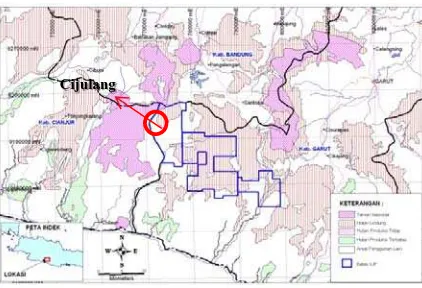
The Cijulang prospect is part of Papandayan Project for gold exploration concession operated by PT. ANTAM Tbk in Garut, West Java, Indonesia (Fig.1). The project area consists of several hydrothermal prospects for gold deposit including epithermal low sulfidation, intermediate sulfidation, high sulfidation and hydrothermal porphyry types.
Figure 1 Location of Cijulang Prospect, in Papandayan
Project, Garut-WestJava, Indonesia
The exploration history within the prospect was begun in 1994 for preliminary exploration by PT. ANTAM Tbk. The next phase of exploration was joint venture between PT. ANTAM Tbk and Strait for exploration detail and drilling program in Kuda prospect from 1996 – 2003. After that the exploration program was postponing for several reason (Antam, 2011).
In 2011 PT. ANTAM Tbk continue the detail
exploration activity in Cijulang prospect with the main tagert for discovery of high sulfidation type deposit as well as for porphyry deposit that associated with the high sulfidation system.
Method
Based on the exploration results, epithermal high sulfidation signatures for gold deposit were observed and indicated from surface and drilling data. However, there is no detail study have been done to identified the characteristics of the deposit.
This paper focuses study of samples from Cijulang prospect based on drill holes and surface outcrop, which uses for petrography, mineragraphy observation, ASD, XRD, XRF analysis, and assay data.
Regional Geology
The Cijulang prospect is located within the Neogene Sunda-Banda magmatic arc that trending from very west in Sumatera Island and continue up to east part of Nusa Tenggara Island. Physiographically, the area lies in the interior of Southern Mountains of Western Java (Van Bemmelen, 1949; Martodjojo, 1982).
According to regional geology of Sindangbarang and Bandarwaru sheets (Koesmono, et al, 1996), the Cijulang area is covered by sedimenclastic rocks of Bentang Formation of Middle Miocene and sedimenclastic and epiclastics of Koleberes Formation
of Late Miocene ages and the youngest Quaternary volcanic rocks overlay the early rocks. Regional tectonics of Southern Mountains is occurred during Oligocence – Miocene; Midlle Miocene; Pliocene – Pleistocene; and Quaternary ages, respectively. Tectonic during Pliocene-Pleistocene is believed to be responsible for the occurrences of gold mineralization along the Southern Mountain in the southern part of West Java Island.
Local Geology of Cijulang
Lithology of Cijulang prospect is covered by volcanic rocks that simplified into four rock units: Crystal tuff and Vitric tuff of Pleistocene age; and microdiorite dike to dacite of Late Miocene age.
The major structure of strike-slip fault can be observed trending almost NS along the Cikahuripan River (Limbong et al, 2013), minor structures are cross cutting the main is mainly trending NE-SW (Fig. 2).
Mineralization of Cijulang prospect mostly well exposed along the Cikahuripan main River that trending almost NS.
Figure 2. Simplify geological map of Cijulang Prospect,
Garut, WestJava, Indonesia
Alteration
Field observation indicated the alteration within
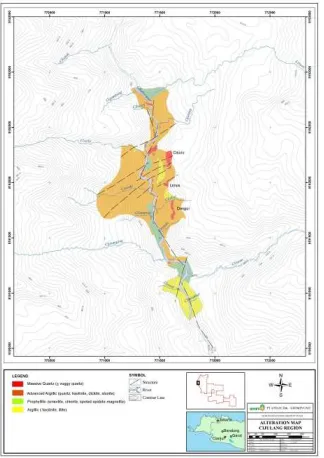
the Cijulang prospect is control by type of lithology and structure. It can be classified into four alteration zonation are as follow: Massive quartz; Advanced argillic; Prophyllitic; and Argillic zone respectively. The advance argillic alteration covered widely for about 75% of the area, while prophyllitic is about 12% and distributed parallel along the Cikahuripan especially in the downstream of Cisuren, Ciranda, Cilangong and Ciseda Creeks. The argillic zone is limited for about 5% in the slope of Cisuru and Cilukut Creek, respectively. The massive silica zone covered about 8% and is very easy to distinguish due to its topographic exposure of high relief. The well exposure of massive silica zone is located in Cisuru Peak, Limus Peak, Dangur and in the downstream of Ciseda creek.
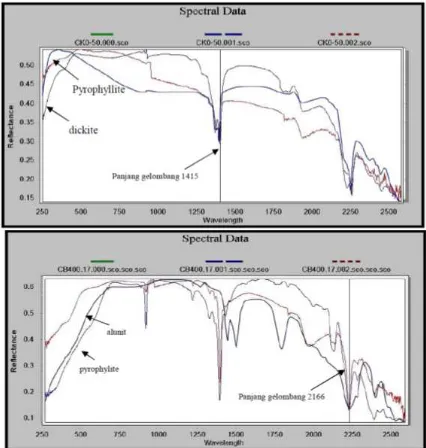
Analytical Spectral Device (ASD) measured for several hand specimens outcrop samples were done in the field, and were indicated the occurrence of alunite, dickite and phyrophylite from the samples of advance argilic alteration zone (Fig.3), illite kaolinite from argillic zone and chlorite from prophylitic zone (Fig. 4). The distribution of alteration zonation is shows in fig 5.
Figure 3. Spectral data of alunite, pyrophyllite and dickite
from outcrop sample of advance argilic zone
Crystal Tuff Microdiorite Vitric Tuff
GEOLOGICAL MAP
CIJULANG PROSPECT
Figure 4. XRD pattern of clay minerals from drill core sample
of Cijulang prospect
Figure 5. Alteration zonation of Cijulang prospect
Mineralization
The mineralization in the Cijulang prospect is well develop within the massive silica zona, and is characterized by massive quartz texture and locally with vuggy texture and veinlet of black sulfide. The main mineralized ore body is in massive to vuggy quartz texture. Those are located in Cisuru, Dangur, Limus hill and locally along the Cikahuripan and Citando Rivers (Figure 6).
Figure 6. Outcrop of massive quartz in Cikahuripan River
(left) and black sulfide band in massive quartz
Mineragraphy analysis indicate the ore mineral composition mainly occurred associated within the massive silica and occurred within the veinlet of black sulfide that composed mainly by pyrite that accompanying by tenantite-tetrahedrite, enargite, chalcopyrite, covelite and rare galena coexisting with tenantite-tetrahedrite (Figure 7).
Figure 7. Fotomicrography of tenantite-tetrahedrite and
enargite associated with pyrite from black sulfide vein in
massive quartz ore body
Discussion
This study has identified several fault system also
control the distribution of alteration and mineralization
specially along the Cikahurpan River in Cijulang
prospect (Limbong et al 2013). Based on mineral
alteration determined by petrography, ASD and XRD,
the alteration is grading from massive – vuggy silica
zone in the centre, and follows by advance argilic zone
and argilic zone (illite, smectite, pyrite), and in the outer
part of prophylitic zone (mainly composed of chlorite)
in contact with host rock. The mineralization is hosted
by volcanic tuff and in place by hydrothermal breccia
and microdiorite of Miocene age. The ore mineral
assemblage is dominated by pyrite with various amount
of enargite, tenantite-tetrahedrite, hematite and rare
galena and sphalerite.
Based on the above characteristic, it indicates that
the hydrothermal fluid responsible for mineralization is
come from acid fluid (acid pH) It’s shown by acid
alteration mineral assemblages. The quartz texture and
ore mineral also indicated the most character for high
sulfida epithermal deposit (Arribas, 1995), although few
sample indicated the occurrence of galena coexisting
with tenantite-tetrahedrite in black sulfide vein-veinlet
within the main ore body. The assay analysis from core
sample also indicates the higher content of lead (Pb) and
shows good correlation with arsenic (As) and copper
(Cu).
Further analysis is still in progress to observed
more characteristics of chemical composition minerals,
fluid salinity and temperature as well as others
properties.
Acknowledgments
The authors would like to grateful to DGHE (DIKTI) of Indonesia and UNPAD for research grant under contract No.7632/UN6.RKT/KU/2013 and also the management PT ANTAM Tbk. for permission to collect samples in Cijulang prospect and published the data; Economic Geology laboratory of Kyushu University for the facility of XRD and XRF; JSPS-Asia Africa Science Platform Program for conference support.
References
Antam, 2011, Internal report of Cijulang prospect of Papandayan project, Garut, West Java.
Arribas, A., 1995. Epithermal High Sulfidation.
Mineralogical Ass. of Canada Short Course Vol.
2.
Koesmono, dkk (1996), Geologi Lembar
Sindangbarang dan Bandarwaru, Jawa Barat,
Pusat Penelitian dan Pengembangan Geologi, Indonesia.
Limbong, T., Rosana, MF., Ismawan, Sunarie, C.Y., Verdiansyah, O., Yuniardi, Y., Watanabe, K.. 2013. Structural control on alteration distribution of high sulfidation epithermal deposit at Cijulang prospect, garut, West Java, Indonesia. Proceeding of the 3rd Asia Africa Mineral Resource Conference. Mongolia. Van Bemmelen, R.W., 1949, The Geology of Indonesia,
Vol. IA, Martinus Nijkoff, The Haque,