Guillermo D’Andrea
INSTITUTO DEALTOSESTUDIOSEMPRESARIALES
Sergio Postigo
INSTITUTO DEALTOSESTUDIOSEMPRESARIALES
Juan Florin
INSTITUTO DEALTOSESTUDIOSEMPRESARIALES
Saiar, S.A. was created in the 1940s as a joint venture between a diversified Chilean subsidiary, Hometech, which was losing money as a result of low Argentine business group with interests in petrochemicals and a European sales volume and high fixed costs. The company has received an offer manufacturer of water heaters to produce steel containers, but as fre- from an important national distributor which would help gain volume quently occurs in Latin America, the original objectives of the joint venture but would mean losing control. Apart from these decisions, the case raises were broadened to take advantage of the foreign firm’s expertise. Thus, several issues about global strategies in Latin American companies that Saiar became the first company to introduce the tank water heater to the deserve reflection and discussion. One issue is whether the formula used Argentine market, which had previously relied upon pilot electric heaters. by Saiar, to first gain a dominant position in the domestic market, then As part of a global divestiture strategy, the European manufacturer sold export to less demanding neighbors, and finally to penetrate the toughest its interest in Saiar to the Argentine group, allowing the company to world markets, is one which makes sense and may be replicated. A second continue selling under the Rheem brand name. Faced with economic issue is whether the temporary role of the foreign partner is desirable, recession and a declining domestic market, Saiar embarked upon a strategy and if so, how such temporary arrangements might be structured so as of product diversification and geographic expansion. The company broad- to maximize technology transfer while benefitting both parties. J BUSN ened its product line and began to export to less sophisticated markets RES2000. 50.47–55. 2000 Elsevier Science Inc. All rights reserved. in the neighboring countries of South America and in the Caribbean.
Having thus gained international experience, it leaped into the far more demanding markets of Australia and the United States in the early 1990s. Saiar now faced an array of strategic decisions typical of the Latin
O
ur international strategy has produced results. WeAmerican company attempting to go global. The decision that faced a have gone beyond the stage of slow and sporadic
company about to export to a new market was the selection of an appro- sales to continuous distribution of our products in priate distribution channel. In the U.S. market, Saiar has received three some overseas markets. But we are confronting new problems offers: from a small family-owned company over which it would have a in Australia, and we must decide how to distribute our prod-strong negotiating position; from a Japanese company that saw potential ucts in the North American market. We must also decide in adding Rheem-Saiar to its product line; and from a leading U.S. what to do about Hometech in Chile, and that decision will manufacturer that, despite its size, proposed to begin with a very modest have an impact on our export plans. . . .”
sales volume. The decision that faced a company that has achieved limited With these words Fernando Zapiola, general director of market penetration with exports is whether to move into overseas manufac- Saiar S.A., welcomed Jose´ Flores, his export manager, in his turing. Saiar was considering this alternative in Australia because it would
Buenos Aires office on a humid morning in late 1992. Both
enable the company to adapt its products to the needs of the local market
had been worried about the scope of the company’s export
while cutting shipping costs by more than half. However, such a move
business, now in its fourth year, and a recent communication
was threatening to local industry and could have provoked retaliation.
from their competitor in Australia had brought the situation
The Rheem subsidiary in Australia had threatened to retaliate by entering
to a head.
the Argentine market. Finally, a company that had established an overseas subsidiary was faced with the decision of when to “pull the plug” on a losing operation. Saiar management had to decide what to do about its
Company Background
Saiar, S.A. was formed in 1947 as a joint venture between
Address correspondence to G. D’Andrea, Instituto de Altos Estudios
Empresa-riales, IAE Universidad Austral, Aguero 2373 (1425), Buenos Aires, Argentina. Garovaglio y Zarroqui´n (G&Z), a prominent Argentine
busi-Journal of Business Research 50, 47–55 (2000)
ness group, and Rheem Manufacturing, a European multina- stat-controlled air flow that regulated the temperature of the environment by means of an adjustable flame, using French tional, for the manufacture of 20-litre metal pails for use in
the chemical, agrochemical, and oil industries. The G&Z technology obtained through a licensing agreement. Compet-ing space heaters in the domestic market did not have a Group also manufactured textiles and household goods and
had investments in the petrochemical industry, mining, farm- thermostat mechanism and the flame; therefore, the tempera-ture had to be controlled manually.
ing, animal husbandry, and insurance. Rheem was the leading world producer of water heater tanks.
The company soon was becoming the leading metal can
Exports
producer in the Argentine market. It introduced gas water
heater tanks in Argentina in 1962, when the only water heaters Faced with continued sales declines in the domestic market in use were of the automatic pilot type, that heated water and mounting losses, Saiar management began exporting to instantly by electric coils. Over the next 20 years, Saiar devel- the neighboring countries of Bolivia, Peru, Chile, and Paraguay oped an important market for this new product. By 1982, in South America and to Cuba and Trinidad and Tobago in water heater tanks had captured 60% of the market, versus the Caribbean, attaining sales of US$128,000 in 1989. Domes-40% for automatic water heaters. Two competitors, Orbis and tic sales in that year were approximately US$20 million. In Longvie, had appeared in the water heater tank segment, that same year, Mr. Fernando Zapiola became general director capturing 20% of the market between them. of the company. He was young and was described by acquain-As part of its worldwide divestment policy, Rheem Manu- tances as “a hands-on manager [and] dynamic,” who had a facturing sold its interest in Saiar, S.A. to G&Z in 1985. This clear vision of the importance of exporting as a means of decision was hastened by the strong recession in the Argentine improving the company’s competitiveness. In his first meeting economy and by the continued loss of the water heater market with the executive team, he said,
share to lower-priced products offered by local competition.
We are not taking advantage of our product technology, However, the European company allowed Saiar S.A. to
con-a strcon-ategic con-advcon-antcon-age thcon-at mcon-ade us mcon-arket lecon-ader. We must tinue using the name “Rheem” on its products and in its
identify and develop new markets for our products since advertising.
the domestic market will not allow us a long-term growth.
Economic instability continued to prevail in Argentina
Company Products
throughout the 1980s, and the domestic market shrank drasti-The principal products offered by Saiar, S.A. in 1992 were cally as a result. Mr. Zapiola, eager to develop export markets water heater tanks and space heaters. The water heater tanks and stabilize the company’s financial situation, hired Mr. Jose´ ranged in capacity from 60 to 150 liters. They heated water Flores to screen market opportunities abroad. Rather than by accumulation and maintained it at a given temperature. gathering information through foreign commercial attache´s, he resolved to visit the potential export markets personally. The advantage over the automatic pilot heaters was that the
temperature of the water remained constant and did not vary During the following six months, he visited Australia, New Zealand, Europe, the United States, and South Africa. “Only according to the number of electric outlets being used. Water
heater tanks were internally lined with enamel to prevent in this way could I get a feel for which of our products would have a chance of success in the marketplace,” he said. “At corrosion and contained an exterior layer of polyurethane
insulation, a burner, and a thermostat. The gas connections times it was frustrating, not only because of the large number of useless contacts, but also because we realized that most and burners were tested in 100% of the units before leaving
the production line to ensure that the gas combustion product of the products we made were not suitable in any of the markets. . . .”
installed in the home was totally safe. Improvements in design
were continually made by the research and development de- Mr. Flores concluded in his report, presented in December 1989, that the Rheem-Saiar products currently did not meet partment.
Sales in the domestic market were made directly to retail the four requisites for success in the countries he visited: quality, service support, flexibility to adapt products to local household goods stores, to housing construction
profession-als, and to contractors. Proper presentation and merchandising markets, and low price. He recommended initiating efforts to improve quality and flexibility, while seeking outside technical in the store windows of retail outlets were important factors
in sales to final consumers. Service was another important support. He did note, however, that there was a potential market for space heaters in the United States and that Australia factor, and a technical services department was created to
assist with installation and to make mechanical adjustments. had a very interesting market potential for water heaters. On the other hand, South Africa had very high tariff barriers, and All products were sold with a one-year warranty. Sales of tank
water heaters were seasonal, with the peak buying period the company was precluded from selling space heaters in Europe because of the licensing agreement terms with the occurring in the winter months between March and October.
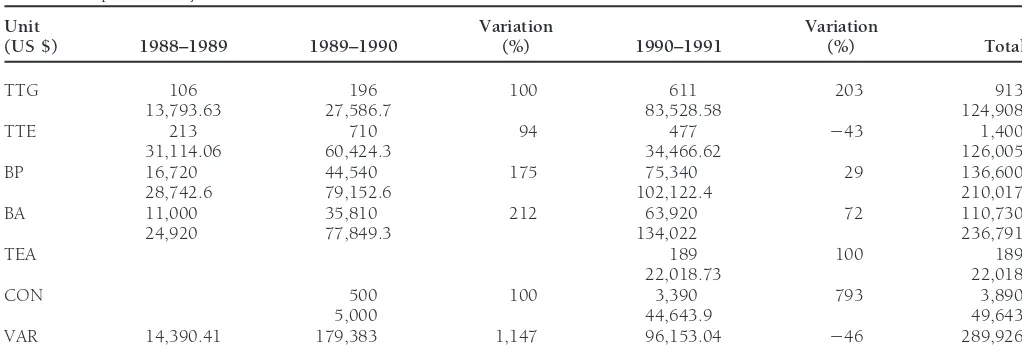
Table 1. Export Sales by Products and Year
Unit Variation Variation
(US $) 1988–1989 1989–1990 (%) 1990–1991 (%) Total
TTG 106 196 100 611 203 913
13,793.63 27,586.7 83,528.58 124,908.9
TTE 213 710 94 477 243 1,400
31,114.06 60,424.3 34,466.62 126,005
BP 16,720 44,540 175 75,340 29 136,600
28,742.6 79,152.6 102,122.4 210,017.6
BA 11,000 35,810 212 63,920 72 110,730
24,920 77,849.3 134,022 236,791.3
TEA 189 100 189
22,018.73 22,018.73
CON 500 100 3,390 793 3,890
5,000 44,643.9 49,643.9
VAR 14,390.41 179,383 1,147 96,153.04 246 289,926.5
Abbreviations: TTG, gas thermotanks; TTE, electric thermotanks; BP, plastic pails; BA, steel pails; TEA, thermostabilizers; CON, containers; VAR, spare parts, tippers, clips, bags, covers, etc.
During the 1989–1992 period, Saiar, S.A. sold products was consumed. Advertising was placed mainly through the specialized trade press, by using pictures of the product. valued at US$1.7 million in eight export markets (see export
Saiar became associated with an importer-distributor in sales statistics, Table 1). Of particular interest to Mr. Zapiola
Australia who had excellent ties with several of the most and Mr. Flores was the company’s competitive position in
important gas companies. Once its products had been ap-Australia, the United States, and Chile.
proved by the Australian N.R.A., they were introduced in the market under the brand name Cassis, the name of the distributor. Annual sales were projected to be 1,500 water
The Australian Market
heaters, which represented 3% of the market.
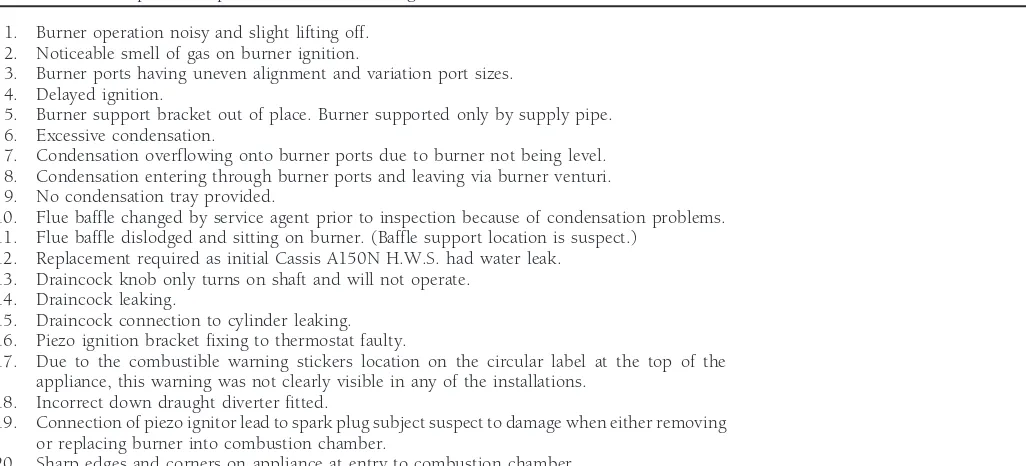
On the basis of the Flores report, Saiar sought to have its Because of their functional and modern design, Rheem-products approved by the National Regulatory Agency Saiar products were attractive to contractors and customers, (N.R.A.), which enforced some of the most rigorous quality and this contributed to rapid initial acceptance. Just as rapidly, control standards in the world. During 1990, Saiar performed however, complaints about the product came in about such all the necessary testing to have its products approved. At the defects as noisy burner operation and uneven alignment of same time, information on the new market constantly was burner ports. In one case, Mr. Joe Conway, service manager being assessed. for the International Gas Corporation Pty Ltd., repeatedly The total market for water heaters in Australia was 500,000 warned of problems with Cassis water heaters supplied to one units per year with a retail sales value of US$200 million. of his major clients, Gas & Fuel Corp. of Victoria. On July Ninety percent of the units were thermal tanks, and the re- 23, 1991 that client ordered a field inspection which revealed maining 10% were automatic electric coils. Forty percent of nineteen different types of technical problems (see Field In-the total units, or 200,000, were In-thermal tanks fueled by gas, spection Report, Table 2). Soon afterward, Gas & Fuel Corp. with a retail sales value of $90 million. of Victoria suspended purchase of all Cassis water heaters.
Upon learning of this and other complaints in Australia, The gas heating industry in Australia was dominated by
Chile, and in the home market of Argentina, Fernando Zapiola Rheem Australia, with a 95% share of the total number of
reacted immediately, issuing a memorandum to key Saiar water heaters sold. However, its product was considered to
managers on July 31 in which he stated, be high priced and unattractive. Rheem Australia relied upon
Table 2. Field Inspection Report: Cassis A150N Storage Hot Water Services
1. Burner operation noisy and slight lifting off. 9
2. Noticeable smell of gas on burner ignition. 4
3. Burner ports having uneven alignment and variation port sizes. 8
4. Delayed ignition. 5
5. Burner support bracket out of place. Burner supported only by supply pipe. 1
6. Excessive condensation. 5
7. Condensation overflowing onto burner ports due to burner not being level. 7 8. Condensation entering through burner ports and leaving via burner venturi. 1
9. No condensation tray provided. 1
10. Flue baffle changed by service agent prior to inspection because of condensation problems. 1 11. Flue baffle dislodged and sitting on burner. (Baffle support location is suspect.) 1
12. Replacement required as initial Cassis A150N H.W.S. had water leak. 1
13. Draincock knob only turns on shaft and will not operate. 1
14. Draincock leaking. 2
15. Draincock connection to cylinder leaking. 1
16. Piezo ignition bracket fixing to thermostat faulty. 2
17. Due to the combustible warning stickers location on the circular label at the top of the 9 appliance, this warning was not clearly visible in any of the installations.
18. Incorrect down draught diverter fitted. 1
19. Connection of piezo ignitor lead to spark plug subject suspect to damage when either removing 9 or replacing burner into combustion chamber.
20. Sharp edges and corners on appliance at entry to combustion chamber. 9
Available statistics indicate the Gas and Fuel Corporation had sold 31 Cassis A150N storage hot water services up to July 19, 1991. Technical Services personnel from Highett had made inspections at nine of these appliance installations in the field with the results shown.
The memorandum produced results. On September 19, heater different than the one we make in Argentina, that Jose´ Flores received a fax from Mr. Conway that said, in part: would be better adapted to the Australian market, since over there the equipment is installed in the exterior of the . . . we are very pleased with the new shipment of heaters.
houses. It is not profitable to make this in Argentina due The packing is good, the baffle is good, the sealant on the
to the fact that its new design and larger size would increase thread of the draincock, unitrol and anode is good. The
shipping costs. A specialized product, assembled in Austra-pilot supply tube is correctly offset and the new burner is
lia, would allow us to penetrate a much larger market much better. The ports of the burner are drilled even and
segment, estimated at about 50% of that market. A quick clean. My only reservations are in regard to the size of the
calculation also shows that we could save half of the ship-reservoir for holding the condensate. I feel it should be
ping costs, which add up to US$50.00 per unit. double the volume. I also sent a fax to Dino on the 5thof
September with regards to my concern about the suitability The assembly plant required an investment of approxi-of the draincock. Apart from these two points we are very mately $1.5 million with estimated sales of $8 million within pleased. . . . five years, representing approximately 10% of the water heater market in Australia. It would be complete by mid-1993 and As its quality problems were being overcome and sales
during the initial stage, from July to December 1993, approxi-growth resumed, Saiar was confronted by a new threat. Rheem
mately 500 units would be sold at a factory price of Australia filed a legal accusation charging the Argentine
com-US$100,000. pany with plagiarism in the service manuals that accompanied
As Saiar management was evaluating the decision to invest its products, and even advised Saiar to take its products off
in Australia, Mr. Zapiola received a communication from the market. New complaints began coming in, and Mr. Flores
Rheem Australia’s executive general manager which read, in suspected that Rheem Australia was using its strong ties with
part, gas company executives to drive Saiar from the market.
Fur-thermore, a recession in late 1992 produced a severe decline
. . . we believe that Mr. Jose´ Flores has recently visited in the market for gas appliances. Saiar products were not
Australia but did not make contact with us. We also under-immune to this recession and company management began
stand that part of the reason for Mr. Flores’ visit was to to consider options for continued growth in the Australian
establish a final assembly plant for the Cassius [sic] branded market.
gas water heater using cylinders and components imported One proposed project was to build an assembly plant in
from SAIAR. Clearly we would view this as an unwelcome Australia in association with Cassis. Jose´ Flores commented,
and unfriendly move which would negate any prospects of a future relationship.
Since your visit we have received Justice Department viding them with information about the product and asking their opinion on the possible degree of client satisfaction, approval to purchase another water heating company in
the USA, Mor-Flo. The combination of the Bradford-White expectations, and product name suggestions. Based on the results of the direct mailing, a trip to the U.S. was organized business and the Mor-Flo business will make us the largest
manufacturer of mains pressure water heaters in the US between July and August of 1991 to visit potential contractors and distributors. After spending almost a month in the United and worldwide. Off this substantial US base we would
consider taking a similar position in Argentina to that which States, traveling through eight states and visiting 25 prospec-tive distributors, both national and regional, Mr. Flores suc-we believe you are planning in Australia to offset any
poten-tial erosion of our Australian business. ceeded in identifying three potential national distributors who were interested in selling the products in the United States, This is a serious issue and I would appreciate your
reviewing it with your people in the water heater business two of whom were recruited by the direct mail campaign and a third who was referred to the company by a third party. and advising us of your intentions before we take any
further steps. The candidates were:
Yours sincerely.
Controlled Energy (CE), a small organization in business for Mr. Zapiola wondered whether this was an emotional reac- 10 years. It imported and sold approximately 10,000 water tion to Mr. Flores’ unannounced visit to Australia or an admo- heaters annually. The space heater would be an important nition that should be taken seriously. complement to CE’s narrow product line. CE committed itself to sell 2,000 units in the first year and was anxious to work closely with Saiar in penetrating the market.
The United States Market
Molitor, a Japanese company that sold high technology kero-Based on the conclusions of the 1989 Flores report, a decision sene space heaters. These heaters had a temperature control was also made by Saiar management to enter the United States the advantage of not emitting exhaust, as controlled air with its largest model controlled air flow space heater. The flow heaters did. Current sales volume was 5,000 units size of the U.S. space heater market was approximately per year. Molitor welcomed with pleasure the sarnple sent 250,000 units per year, huge in comparison to the Argentine by Saiar and saw great potential in adding the Argentine market. An 80% market share in Argentina would translate space heater to their product line.
to only a small niche market share in the U.S. Of the total DESA, a U.S. manufacturer and market leader of manually market, the controlled air flow segment of space heaters was controlled space heaters. It sold 150,000 units per year 50,000 units per year. There was significant growth potential and was very interested in marketing the Saiar product as since consumers replaced manually controlled space heaters a means of broadening its line of heaters. However, it for controlled air flow space heaters. was felt that this company would be reluctant to share The importance of personal safety and environmental con- information about the market. DESA proposed to start with cerns had led to strict laws in some states in which the use approximately 1,000 units per year. They also proposed of space heaters without a controlled air flow mechanism is lower prices to ensure market penetration, even if this prohibited. An example was the state of California. Aware meant sacrificing some quality.
that California was precisely the state where many new trends started in America, Saiar management reasoned that the future
in the United States was great for the market segment in which
The Chilean Market
Saiar wished to participate. There was only one potentialBy the 1990s, Chile was experiencing the most favorable eco-competitor in this segment, who sold a product designed in
nomic situation of all the countries in Latin America, and its 1950 with a rustic and old-fashioned appearance. The price
continued prospects for growth were good. However, it suf-was the same as Rheem-Saiar’s product in Argentina.
fered from problems of poor infrastructure and environmental In February 1991, Saiar contacted a consulting company
contamination. Natural gas lines as they commonly existed in Los Angeles to conduct a technical diagnosis of the product
in other countries were only installed in the southern part of changes that would be required for the U.S. market to obtain
the country, in the Punta Arenas region. The capital, Santiago, technical approval from the American Gas Association (AGA),
was fed with gas made of cracking fuel and distributed through which regulated the design of products that used gas to ensure
pipes. Construction projects to extend the natural gas line consumer safety. Management hoped to gain approval for
system from Argentina to Santiago were in progress. its product within four months, allowing the company to
Air pollution was a serious problem in Santiago de Chile. begin selling by August or September, right before the winter
Every day the pollution index was announced along with the season in North America. The AGA granted product approval
temperature. During the day, regulations existed to control in April 1992.
vehicular traffic based on a license plate serial system. At times, In mid-1992, the company initiated a direct marketing
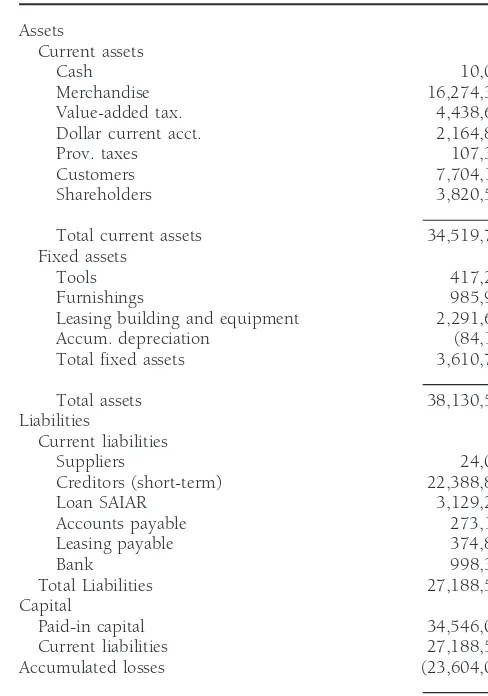
Table 3. Hometech, S.A.: Balance Sheet, December 30, 1990
Before 1988, Saiar, S.A. regularly sold its products in the Punta Arenas region. In 1988, Saiar participated in the
well-Assets
known International Trade Fair of Santiago, resulting in the Current assets
identification of several key contacts, and subsequently in the Cash 10,000
Merchandise 16,274,325
sale of industrial containers. As the Chilean market became
Value-added tax. 4,438,600
more interesting to Saiar, and the natural gas line system
Dollar current acct. 2,164,823
appeared a certainty, it considered setting up an office in that
Prov. taxes 107,372
country. Customers 7,704,114
An engineer with close contacts in the gas companies was Shareholders 3,820,500 hired to perform a market analysis. He reported that automatic
Total current assets 34,519,734
water heaters constituted 95% of the water heater market,
Fixed assets
and that Chilean consumers had a negative concept of the
Tools 417,253
water heater tank because they believed that the tanks could Furnishings 985,996 not supply enough water. Consequently, there was no distri- Leasing building and equipment 2,291,682
Accum. depreciation (84,160)
bution system for water heater tanks. Space heaters with
con-Total fixed assets 3,610,771
trolled air flow were unknown. The commercial structure was thus similar to that of Argentina in 1962. “We had the
Total assets 38,130,505
impression that we had already seen this movie,” recalled Jose´ Liabilities
Flores. Current liabilities
Suppliers 24,080
The Chilean makers of the water heaters were almost all
Creditors (short-term) 22,388,859
small job shop operations. Their design was antiquated and
Loan SAIAR 3,129,259
their cost ranged in the neighborhood of $600. The producers
Accounts payable 273,170
of space heaters in Chile were better established. An important Leasing payable 374,821 segment of the space heater industry was that of paraffin and Bank 998,325
Total Liabilities 27,188,514
kerosene space heaters, and an even more important segment
Capital
was occupied by calalytic space heaters, originally imported
Paid-in capital 34,546,000
from Spain. Since catalyic space heaters had a gas cylinder Current liabilities 27,188,514 mounted inside them, they were ideal for a city with no Accumulated losses (23,604,009) residential gas line systems.
Total Liability and Capital 38,130,505
Customs duties on water and space heater products were 15%. The Chilean regulatory agency was responsible for ap-proving the product, but in addition, each shipment entering the country had to be checked by testing a sample. The entry was authorized by placing a stamp on the product.
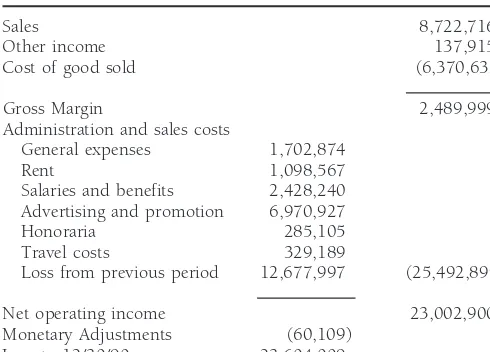
financial statements are presented in Tables 3 and 4). Though the number of water heaters sold was much less than the sales
Hometech
projection, the Saiar executive responsible for the Chileanmarket entry, Roberto Deleo, noted: At the end of 1989, the subsidiary company was founded
with the name Hometech, S.A. Ninety-nine percent of the We sold more water heaters in Chile in 1990 than we had shares were owned by Saiar, S.A. In accordance with Chilean in Argentina the first year. Everything improved even more law, two of the four members of the board of directors were when we added the space heater to our product line since Chilean, having been identified through connections that the people did not have a negative preconception toward this G&Z Group had in Chile. The other two board members were product, as was the case with water heaters.
Argentine. Beyond the top management level, the company
was staffed with Chileans. A marketing manager was hired At a cost of US$80,000, Hometech organized an advertising campaign for the space heaters called “Clean Air,” in recogni-from a local university, as was a gas technician and were the
administrative personnel. The outstanding traits of this work tion of the importance of pollution in Chile. The Rheem-Saiar product took in and expelled air with minimum pollution, group were flexibility and very low operating costs.
The most important gas companies in the country gave and it was thought that this would make a strong impression on consumers.
Saiar their support, not only because they were satisfied with
the products but also because they realized that the more Only a few complaints were received from Hometech cus-tomers, and these were mostly due to defects in installation units they sold, the more gas would be consumed by the
Table 5. Summary of Exports, by Product (April 1998–March 1991)
Table 4. Profit and Loss Statement (to December 30, 1990)
Sales 8,722,716 % FOB FOB $US
Other income 137,915
Cost of good sold (6,370,632) TTG 11.79 124,908.9
TTE 11.89 126,005
Gross Margin 2,489,999 BP 19.83 210,017.6
Administration and sales costs BA 22.35 236,791.3
General expenses 1,702,874 TEA 2.08 220,187.3
Rent 1,098,567 CON 4.69 49,643.9
Salaries and benefits 2,428,240 VAR 27.37 289,926.5
Advertising and promotion 6,970,927
Honoraria 285,105 Total 100 1,059,311.9
Travel costs 329,189
Loss from previous period 12,677,997 (25,492,899)
Net operating income 23,002,900
Monetary Adjustments (60,109)
Loss to 12/30/90 23,604,009
Suggested Questions for Discussion
1. What was the Argentine group’s objective in founding Saiar and how did this objective change over time? 2. What is your assessment of Saiar’s expansion strategy? 3. What are the major problems and opportunities that Hometech paid all installation expenses, including masonry,
the company faces in 1992? and provided a guarantee.
4. Which distributor would you recommend that the com-Saiar continued to provide a subsidy to Hometech that had
pany select in the U.S.? Why? begun at the time the Chilean company was formed. As the
5. How should the company react to the threat from Saiar board of directors was pondering what to do with
Home-Rheem Australia? Should it pursue plans to install an tech, Mr. Deleo informed Mr. Zapiola that he had received a
assembly plant in that country? firm offer from the main domestic distributor of catalytic space
6. What should Mr. Zapiola do about Hometech? Why? heaters in Chile. The offer included taking over the exclusive
distribution of all Saiar products. This Chilean firm, part of
Case Analysis
a financial group headed by a gas company, already accounted
WHAT WAS THE ARGENTINE GROUP’S OBJECTIVE IN FOUNDING
for 30% of Hometech sales. It had a large distribution network
SAIAR AND HOW DID THIS OBJECTIVE CHANGE OVER TIME? At at the national level and had a good customer service
reputa-the time of Saiar’s creation, reputa-the Argentine group (G&Z) had tion. It had also hired, within the past few days, the marketing
petrochemical investments and Rheem produced heaters with manager of Hometech. See Table 5, Table 6, and Table 7.
metal tanks, so it may be inferred that G&Z’s interest was in backward integration into metal containers as a means of import substitution. There was no initial interest in Rheem’s
Teaching Note
water heaters. Indeed, the kind of heater produced by Rheem
Case Purpose and Teaching Objectives
was unknown in Argentina. Rheem no doubt saw this as away of gaining presence in the Argentine market, still one of The purpose of this case is to analyze the strategic issues
the world’s most affluent in the 1940s. facing a local manufacturer in the process of expanding to
The decision to introduce tank-type water heaters in Argen-different markets within and outside Latin America. The case
tina in 1962 signalled a new stage in the relationship between poses decisions in Saiar’s key markets of Australia, the United
Rheem and G&Z. Both partners saw this as an opportunity States, and Chile. Learning objectives include:
to diversify beyond containers and launch a new product, and • Understanding the choices on the sequencing of alterna- the new objective was to become national market leader in tives for a Latin American company entering interna- water heaters. This meant changing the household standard tional markets. from automatic pilot heaters to the storage tank water heater, • Developing criteria with which to evaluate distributors which was accomplished over the next 20 years by capturing
in a large, unknown market. 60% of the market.
• Assessing the benefits of market expansion and the risks With the departure of Rheem, Saiar set a new objective of of retaliation in establishing overseas manufacturing market expansion to neighboring countries and to the Carib-facilities. bean. When this had been achieved, company management • Acquiring knowledge of the factors involved in evaluat- set its sights on the larger but more demanding markets of
Table 6. Export Sales by Product and by Country (Period 1988–1991)
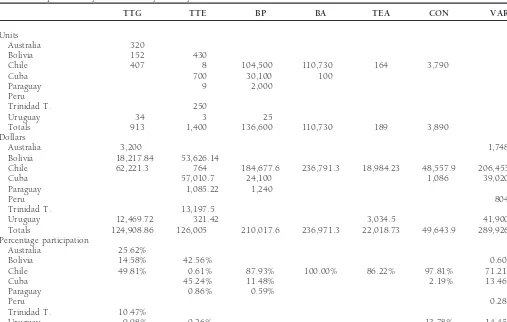
TTG TTE BP BA TEA CON VAR
Units
Australia 320
Bolivia 152 430
Chile 407 8 104,500 110,730 164 3,790
Cuba 700 30,100 100
Paraguay 9 2,000
Peru
Trinidad T. 250
Uruguay 34 3 25
Totals 913 1,400 136,600 110,730 189 3,890
Dollars
Australia 3,200 1,748.68
Bolivia 18,217.84 53,626.14
Chile 62,221.3 764 184,677.6 236,791.3 18,984.23 48,557.9 206,453.5
Cuba 57,010.7 24,100 1,086 39,020
Paraguay 1,085.22 1,240
Peru 804
Trinidad T. 13,197.5
Uruguay 12,469.72 321.42 3,034.5 41,900.49
Totals 124,908.86 126,005 210,017.6 236,971.3 22,018.73 49,643.9 289,926.7 Percentage participation
Australia 25.62%
Bolivia 14.58% 42.56% 0.60%
Chile 49.81% 0.61% 87.93% 100.00% 86.22% 97.81% 71.21%
Cuba 45.24% 11.48% 2.19% 13.46%
Paraguay 0.86% 0.59%
Peru 0.28%
Trinidad T. 10.47%
Uruguay 9.98% 0.26% 13.78% 14.45%
WHAT IS YOUR ASSESSMENT OF SAIAR’S EXPANSION STRAT- Before exporting outside South America and the Caribbean, the company conducted careful market studies. Some
alterna-EGY? The strategy of gradual outward expansion,
accompa-nied by careful preparation, appeared to be paying off by the tives, such as Europe and South Africa, were eliminated. The most promising opportunities were in Australia and the United early 1990s. Saiar began by exporting to its neighbors and to
less demanding markets in the Caribbean such as Trinidad- States. Tobago and Cuba. This allowed the company to gain the
WHAT ARE THE MAJOR PROBLEMS AND OPPORTUNITIES THAT
experience required for success in more demanding markets.
THE COMPANY FACES IN 1992? Two major problems had On the negative side, with the exception of neighboring Chile,
arisen: first, the Rheem subsidiary in Australia was threatening export volumes to these small markets were very low in
rela-retaliation if Saiar moved to establish an assembly plan there. tion to the effort required.
Second, Saiar’s Chilean subsidiary, Hometech, was suffering serious financial problems due to low sales levels and high
Table 7. Summary of Exports by Country fixed costs. The major opportunity was in the United States, where several potential distributors had made offers to the
Total FOB
company.
Country FOB (%)
WHICH DISTRIBUTOR WOULD YOU RECOMMEND THAT THE
COM-Australia 32,000 3.02
PANY SELECT IN THE UNITED STATES? WHY? The company has
Bolivia 73,592.66 6.95
received three offers for the distribution of its space heater line:
Chile 758,449.79 71.60
from Controlled Energy (CE), a small family-owned company
Cuba 121,216.7 11.44
Paraguay 2,325.22 0.22 over which it would have a strong negotiating position; from
Peru´ 804 0.08 Molitor, a Japanese company that sees potential in adding
Trinidad T. 13,197.5 1.25
Rheem-Saiar to its product line; and from DESA, a leading
Uruguay 57,726.13 5.45
U.S. manufacturer that, despite its size, proposes to begin
Totals 1,059,312 100
The advantages of CE were the strong motivation on the tion of the gas companies. Rheem understandably wanted to preserve its monopoly, but Saiar should not be intimidated. part of this small company to succeed because of the
opportu-nity offered by Saiar to complement its product line of water The opposing argument is that the penetration of Australian market is not worth placing at risk the home market, where heaters (sales of 10,000 units per year). It has committed itself
to sell 2,000 space heaters in the first year. Moreover, company sales volume is $20 million per year (though not all in water heaters) versus the $1.6 million expected in Australia. The management believed that a relationship with CE would
pres-ent an important opportunity to learn about the U.S. market. threat of Rheem Australia was credible since it had already purchased Bradford-White in the United States, and with the Like CE, Molitor saw an opportunity to broaden the line
of products that it offered to its customers. It then offered a purchase of Mor-Flo, it will apparently become the largest water heater manufacturer in the United States and the world. high technology kerosene space heater but sold only 5,000
units. Molitor management saw “great potential” in the Saiar
WHAT SHOULD MR. ZAPIOLA HAVE DONE ABOUT HOMETECH?
product but did not commit itself to a specific sales target.
WHY? A third strategic decision facing the company was DESA is the only one of the three that appeared capable
whether to close its Chilean subsidiary, which had been losing of generating significant volume, selling 150,000 units of its
money. If the decision is made to continue, Saiar had to decide own space heater per year. Moreover, it offered to reduce its
whether to accept the offer of exclusive distribution that had margin in order to facilitate market entry. However, it insisted
been received by the board. that Saiar upgrade the product quality, and its commitment
The argument for closing the Chilean subsidiary is that is for only 1,000 units per year. Saiar management was
con-the company has already accumulated losses of $67,000, in cerned that DESA will provide them with little information
addition to a subsidy provided by Saiar and despite a costly about the market. One might question DESA’s motives. Since
advertising campaign. The argument against closing is that Saiar offered a more advanced technology (thermostat
con-the subsidiary has been in operation less than two years, and trolled versus manually controlled), there is a risk that the
space heaters were added even later. First year sales of water distributor may incorporate the technology in its own products.
heaters were higher than in Argentina when that product was first introduced. Moreover, the company has made an
HOW SHOULD THE COMPANY REACT TO THE THREAT FROM
RHEEM AUSTRALIA? SHOULD IT PURSUE PLANS TO INSTALL AN investment in advertising for space heaters and the benefits of the “Clean Air” campaign have not been fully realized.
ASSEMBLY PLANT IN THAT COUNTRY? The Australian market
represented a significant opportunity for Saiar, and the con- If these arguments for giving Hometech more time are accepted, Saiar must next decide whether to accept the offer struction of an assembly plant would allow the company to
increase its market share from 3 to 50%. In 1991, Saiar sold of exclusive distribution. It is from the country’s largest distrib-utor of catalytic space heaters, with a large distribution net-320 gas water heaters, meaning the total market was
approxi-mately 11,000; so with an assembly plant, the company could work and a good reputation for customer service. Since the firm is part of a financial group headed by a gas company, increase sales by around 5,000 units, for a total sales volume
of $8 million over the next five years (5,300 units3 $300 Saiar might assume that it is financially solvent and has close links to customers. It already sold 30% of Hometech products, per unit3 5 years). Rheem Australia dominates the market
with 95%, but it has a very narrow product line, and there though one might ask why actual sales are so far off target. Also, this same company apparently hired away the Hometech is some dissatisfaction on the part of intermediaries. Saiar’s
products were well received, and there is evidence to indicate marketing manager, which might raise some questions about the ethics of its business practices.