ADMINISTRATIVE PENALTY ON LICENSES VIOLATION OF
ENVIRONMENTAL PROTECTION AND MANAGEMENT ON
REGENCIES/CITIES IN CENTRAL JAVA PROVINCE
ΩEndah Pujiastuti and Dewi Tuti Muryati
Law Faculty Universitas Semarang, Indonesia E-mail: [email protected]
Abstract
The Government of Republic Indonesia has issued a policy to provide environmental protection and management. For its effectiveness, it has been stipulated control policies and administrative penalty in case of license violation of environmental protection and management. This legal re-search analyzes regencies/city government policies in Central Java Province on administrative penal-ty on licenses violation of environmental protection and management by applying statute approach. In determining sample, this research uses purposive sampling method and secondary data analysis is done qualitatively. Based on research result, it shows that the policies of regencies/city government in Central Java Province region on environmental protection and management refer to the Law of Republic of Indonesia Number 32 Year 2009 on the Environmental Protection and Management. For the implementation, the policy was subsequently published in accordance with the needs of each re-gion in the form of local regulations which includes administrative penalty on licenses violation of environmental protection and management.
Keywords: environment, local government, administrative penalty
Abstrak
Pemerintah Republik Indonesia telah mengeluarkan kebijakan guna memberikan perlindungan dan pengelolaan lingkungan hidup. Dalam rangka efektivitas berlakunya hukum telah ditetapkan kebijak-an pengawaskebijak-an dkebijak-an skebijak-anksi administratif bila ada pelkebijak-anggarkebijak-an perizinkebijak-an terhadap perlindungkebijak-an dkebijak-an pengelolaan lingkungan hidup. Penelitian legal research ini menganalisis kebijakan Pemerintah Kabu-paten/Kota di Provinsi Jawa Tengah tentang sanksi administrasi terhadap pelangggaran perizinan bi-dang perlindungan dan pengelolaan lingkungan, dengan pendekatan perundang-undangan. Penentuan sampel menggunakan metode purposive sampling dan analisis data sekunder dilakukan secara kualita-tif. Berdasar hasil penelitian diketahui bahwa kebijakan Pemerintah Kabupaten/Kota di wilayah Pro-vinsi Jawa Tengah bidang perlindungan dan pengelolaan lingkungan merujuk Undang-Undang Republik Indonesia Nomor 32 Tahun 2009 tentang Perlindungan dan Pengelolaan Lingkungan Hidup. Untuk pe-laksanaannya kemudian diterbitkan kebijakan sesuai dengan kebutuhan daerah masing-masing dalam bentuk peraturan daerah yang didalamnya memuat sanksi administrasi jika terjadi pelanggaran perizinan bidang perlindungan dan pengelolaan lingkungan.
Kata kunci: lingkungan, pemerintah daerah, sanksi administrasi.
Introduction
The 1945 Constitution of the Republic of Indonesia has provided a regulation on the right of good and healthy environment. This right is classified into the very basic type of human
rights.1 The constitutional mandate is then
fol-lowed up by Government by issuing some
Ω Result of Competitive Research “Pengawasan dan Pene
Num-ronmental policies. In 2009, Indonesian Govern-ment issued a policy related to environGovern-mental arrangement through Law Number 32 Year 2009 on Environmental Protection and Management (UUPPLH), which replaces Law Number 23 Year 1997 on Environmental Management perceived as less powerful in imposing penalty on environ-mental licenses violation. Legally, the rules of the Law on Environmental Protection and Ma-nagement are more comprehensive in the regu-lation of environmental protection and mana-gement because in addition to refining also have incorporated various principles/principles related to the environment that developed at the international level.2
Furthermore, the Government issues the implementing regulation of the Environmental Protection and Management Act through Go-vernment Regulation of the Republic of Indone-sia Number 27 Year 2012 on Environmental Li-censes. In consideration of Government Regula-tion of the Republic of Indonesia Number 27 Year 2012, it is stated that in order to imple-ment the provisions of Article 33, Article 41, and Article 56 of the Law on Environmental Protection and Management, it is necessary to stipulate a Government Regulation on Environ-mental Licenses", thereby the provisions of Environmental Protection and Management Act can already be implemented.
The provisions in Article 33 and Article 41 of Government of the Republic of Indonesia Regulation Number 27 Year 2012 concerning En-vironmental Licenses shall govern two instru-ments of environmental protection and mana-gement, namely environmental assessment ins-truments (in the form of Environmental Impact Assessment or Environmental Management Ef-forts and Environmental Monitoring EfEf-forts or AMDAL and UKL-UPL) as well as environmental
ber No.0581/E3/2016, Contract Number No.195/USM. H9/L/2016.
1 Bambang Sutrisno, “Kerancuan Yuridis Kewenangan Perlindungan dan Pengelolaan Lingkungan Hidup dalam Perspektif Otonomi Daerah”, DIH, Jurnal Ilmu Hukum, Vol. 9 Number 17, p. 23.
2 Ida Nurlinda, “Kebijakan Pengelolaan Sumber Daya Alam dan Dampaknya terhadap Penegakan Hukum Ling-kungan Indonesia”, Jurnal Bina Hukum Lingkungan, Vol. 1 Number 1, October 2016, p. 2.
licenses instruments. An amalgamation of the substance of environmental protection and en-vironmental licenses in this PP is conducted by considering that AMDAL/UKL-UPL and environ-mental licenses are a unity. This is in line with licensing position as an prevention instrument of environmental pollution and damage and it is part of compliance through environmental law enforcement known as the command and control (CAC) approach.3
Furthermore, in the context of the legis-lation implementation, Minister of Environment of Indonesia issued a Regulation of Minister of Environment of the Republic of Indonesia Num-ber 16 Year 2012 on Guidelines for the Prepara-tion of Environmental Documents. The docu-ment includes Environdocu-mental Impact Analysis documents, Environmental Management Effort and Environmental Monitoring Efforts, and En-vironmental Management and Monitoring State-ment.
In order to improve the effectiveness of administrative penalty implementation, the go-vernment issued a new policy through Minister of Environment Regulation Number 2 Year 2013 on Guidelines for Implementing Administrative penalty in a Field of Environmental Protection and Management. The policy regulates types of violations and administrative law enforcement in the field of environmental protection and management. This type of violation is based on 2 (two) important instruments namely supervi-sion and implementation of administrative pe-nalty. This supervision is a preventive law en-forcement while the application of administra-tive penalty is a repressive law enforcement. Proper supervision will at least prevent the vio-lation of administrative law norms. Thus, any potential environmental pollution can be avoid-ed. Basically, in order to ensure legal certainty as the foundation for the protection and mana-gement of natural resources and other develop-ment activities, therefore, it is not only admi-nistrative law aspect but also criminal law
pect and civil law aspect are developed in a system of protection and environmental mana-gement which is clear and thorough.4
Generally speaking, this penalty is a form of coercion from the state administration (go-vernment) to the citizens in the case of any or-ders, obligations or restrictions stipulated in the laws and regulations issued by the state ad-ministration (government). These penalty are necessary to ensure legal certainty, consistency of law enforcement, and also law enforce-ment.5 In a sociological context, penalty are a
form of law enforcement effort. Law enforce-ment is a process for realizing legal will into reality. These are the ideas of the legislatures formulated in the law regulations.6
Adhering to the Law on Environmental Protection and Management as the basis for en-vironmental protection and management func-tioning as an umbrella act, it becomes the ba-sic stipulation of existing environmental regula-tions (lex lata) and for further regularegula-tions un-der it (lex ferandai).7 Therefore, the
impmentation regulations issued at the regional le-vel in this case the district/city should also refer to the Law on Environmental Protection and Management without having to ignore the local wisdom of each district/city. It is suspect-ed that there are still regencies/cities that ha-ve not made adjustments to the provisions as stipulated in the law.
Based on this description, the focus of this study is to examine administrative penalty of license violation of environmental protection and management determined by city/regency in the province of Central Java by formulating the problems; first, how is the policy of
4 Vica J. E. Saija, “Wewenang Pemerintah Daerah dalam Pemberian Izin Lingkungan Hidup”, Jurnal Sasi, Vol. 20 Number 1, January – July 2014, p.71.
5 Endah Pujiastutti, Efi Yulistyowati, dan Doddy Kridasak-sana, “Sanksi Administrasi terhadap Pelanggaran di Bi-dang Perizinan”, Jurnal Dinamika Sosial Budaya, Vol. 14 Number 1, June 2012, p.42.
6 Satjipto Rahardjo, 1984, Masalah Penegakan Hukum–
Suatu Kajian Sosiologis, Bandung : Sinar Baru, p.24. 7 Dahlia Kusuma Dewi, et.al., “Izin Lingkungan dalam
Kaitannya dengan Penegakan Administrasi Lingkungan dan Pidana Lingkungan Berdasarkan UU Nomor 32 Ta-hun 2009 tentang Perlindungan dan Pengelolaan Lingku-ngan Hidup (UUPPLH)”, USU Law Journal, Vol. II Num-ber 1, January 2014, p.124.
vironmental protection and management of ci-ty/regency in the province of Central Java?; and second, how is the administrative penalty determined by the Regency/City Government in the Central Java Province if license violation of environmental protection and management oc-curs?
Research Method
Type of this research is legal research with legal approach. This approach applies le-gislation and regulation. This is in order to achieve research objectives based on legal pro-visions. This research was conducted in three regencies/cities in Central Java Province. Tho-se 3 locations are Semarang, Kudus, and Peka-longan City. The selection of research location as sample is based on purposive sampling me-thod which is sample selection for certain pur-pose/consideration. The data used are secon-dary data collected through literature study. Data from the results of the study were ana-lyzed qualitatively. Qualitative analysis is in-tended to express the results of research and results of synchronization described in the form of formulations and descriptions.
Discussion
Policy on Environmental Protection and Ma-nagement of Regencies/Cities in Central Java Province Region
in-appropriateness of the environment shall be determined by the Minister, governor or re-gent/mayor in accordance with their authority
based on the assessment result of the EIA’s
Appraisal Commission. The environmental li-cense shall include the requirements contained in the environmental feasibility decision or re-commendation of UKL-UPL. The environmental licenses referring to Environmental Protection and Management Act shall be issued by the Minister, Governor or Regent/Mayor in accor-dance with their authority.
In line with the implementation of regio-nal autonomy policy, authority is given to the regions to make local policies to provide servi-ces to increase the participation, initiation, and community empowerment aimed at impro-ving people's welfare.8 Local government
polici-es on environmental issupolici-es can be environmen-tal regulations, institutional strengthening, and application of environmental documents in li-censing process, socialization/education, quali-ty improvement and quantiquali-ty of coordination among agencies, supervision, formulation of forms and penalty, as well as funding improve-ment in environimprove-mental manageimprove-ment.9
Furthermore, to follow up the Law on En-vironmental Protection and Management of re-gency/city governments, Semarang Local Go-vernment, Pekalongan Local GoGo-vernment, and Kudus Local Government have policies in terms of local regulations on environmental protect-ion and management. Semarang administratprotect-ion stipulates Local Regulation Number 13 Year 2006 on Environmental Control, Pekalongan Ci-ty stipulates Local Regulation Number 3 Year 2010 on Environmental Protection and Manage-ment, and Kudus Regency has issued Regency Regulation Number 6 Year 2014 on Environmen-tal Protection and Management. In addition to
8 Risno Mina, “Desentralisasi Perlindungan dan Pengelola-an LingkungPengelola-an Hidup sebagai Alternatif MenyelesaikPengelola-an Permasalahan Lingkungan Hidup”, Jurnal Arena Hukum, Volume 9, Number 2, August 2016, Malang: Universitas Brawijaya, p.156.
9 Mustofa, “Dana Bagi Hasil dan Konservasi Sumber Daya Alam di Indonesia Periode Desentralisasi”, Jurnal Eko-nomi dan Pendidikan, Volume 8, Number 2, November 2010, Yogyakarta: Economy Faculty Universitas Negeri Yogyakarta, p.132.
these local regulations, the three regencies al-so have regents/mayors regulations which are the substance of the regulation related to envi-ronment protection and management.10
In regards to environmental protection and management policy, Semarang Government stipulates environmental licenses through Re-gional Regulation Number 13 Year 2006 on En-vironmental Control. It determines that: first, any business plan and/or activity that has the potential to create environmental impacts must obtain a license or recommendation from the Mayor; second, land use for certain business and/or activity must obtain location license and/or principle license from Regional Govern-ment; third, the application for a license or a recommendation shall be accompanied by an environmental feasibility study document. Fur-thermore, Chapter IX of Semarang City Regula-tion Number 13 Year 2006 on Environmental Control is regulated on the Environmental Fea-sibility Study Document which consists of envi-ronmental impact analysis (EIA), envienvi-ronmental management effort document and environmen-tal monitoring effort (UKL-UPL), a statement of environmental management and monitoring (SPPL) capability, environmental impact assess-ment docuassess-ments and environassess-mental audits. In detail, the arrangements contained in Article 53 to Article 63 of Regional Regulation of Se-marang City Number 13 Year 2006 on the Con-trol of the Environment are:
a. Any business plans and/or activities that have a significant impact on the elements of the environment shall ha-ve an Environmental Impact Analysis (EIA) document in accordance with the laws and regulations.
b. Every business and/or activity must also be accompanied by document of Environmental Management Effort - Environmental Monitoring Effort ( UKL-UPL) pursuant to legislation.
c. The proponent of a business plan and/ or activity shall prepare a Letter of
Declaration on the Capability of Mana-gement and Monitoring of the Living Environment (SPPL).
d. Any running business and/or activity that do not have EIA must have an en-vironmental impact assessment docu-ment. If not, the mayor may recom-mend the Minister for environmental audits.
In the context of license in the field of en-vironmental management and protection, Peka-longan administration based on Regulation Number 3 Year 2010 Article 47 to Article 53 provides that:
a. Any business plan and/or activity that have the potential to cause environ-mental impacts must obtain a licenses or recommendation from the Mayor or an environmental agency. This licen-ses or recommendation is a licenlicen-ses or recommendation for environmental or environmental feasibility.
b. Land use for certain business and/or activities, must obtain location licen-se and/or principle licenlicen-se from Re-gional Government.
c. Application for license or recommen-dation must be completed with envi-ronmental feasibility study document.
Environmental document as regulated in Article 1 Number 50 of Pekalongan City Regulation Number 3 Year 2010 on Protection and Environ-mental Management of Pekalongan City is a do-cument containing environmental management and monitoring consisting of environmental im-pact analysis (EIA), environmental management effort life and environmental monitoring efforts (UKL-UPL), certificates of environmental mana-gement and monitoring (SPPL), environmental evaluation documents (DELH), environmental management documents (DPLH), and Environ-mental Audits.
Then article 56 to Article 61 regulate the document of environmental feasibility study as follows:
a. Every business plan and/or activity which has important effect to envi-ronmental elements are required to have a document of Environmental Impact Analysis (ANDAL) based on the regulations.
b. Every business and/or activities are required to attach the document of Environmental Management Effort – Environmental Monitory Effort (UKL-UPL) based on the regulations. c. The business plan and/or activities
pioneer is required to arrange a Cer-tificate of Environmental Manage-ment and Monitoring (SPPL).
d. Every business plan and/or activities which have already had the business and/or activity licenses but have not had Amdal document should hold En-vironmental Evaluation Document (DELH) which is a document of envi-ronmental development and monitory as part of the environmental audit process.
e. The business and/or activities which already have the business and/or ac-tivity licenses but do not have UKL-UPL must have the Environmental Management Document (DPLH) which is a document of the environmental development and monitory.
f. Environmental Audit is an evaluation conducted to assess the business and/or activity of the person in
char-ge’s obedience to legal requirement and government policy.
Likewise, Kudus Regency Government re-gulates the issue in Regional Law Number 6 Year 2015 on Environmental Protection and De-velopment. According to Article 60 Paragraph (1), every business plan and/or activity requir-ed to have Amdal or UKL-UPL which belongs to the regional authorities and must have the en-vironmental licenses from the regent. Next, ac-cording to Article 63 Paragraph (1), every busi-ness plan and/or activities producing waste wa-ter (B3) must have Environmental Protection and Development Licenses (PPLH).
Administrative Penalty Implemented by Local Governments in Central Java Province to-wards License Violation on Environmental Protection and Development.
environmental policy to realize a continual eco-friendly development. It is conducted by gua-ranteeing the legal certainty and protecting
people’s rights for proper and healthy environ-ment.11 The nature of legal certainty is a
cer-tainty of the truth and justice existence in every regulation, policy and decision.12 In this
case, one of environmental policy instruments to apply is the environmental protection and development license. A license is a preventive effort by imposing administrative penalty. Ot-herwise, the administrative penalty is a law en-forcement instrument of the environmental protection and development. This is recovery which is relevant to be applied to create envi-ronmental preservation. The envienvi-ronmental law enforcement is a forcing act and/or process to obey the law based on the regulations and/or environmental requirements.13
As it explained, any license violation on environmental protection and development will be imposed by administrative penalty. In this case, the regent/city government apply the ad-ministrative penalty for any violence of license which is written in each regional regulations. According to Article 74 Paragraph (2) Semarang regional Regulation of Environmental Control, the administrative penalties include: first, war-ning; second, governmental force and fine; and third, licenses revocation or its recommenda-tion of the business or activity.
Administrative penalty of warning is im-posed on the person in charge of the business or activity who does the violence for the first time. This punishment is written in form of first, second, and third warning letters orderly delivered. They contain a command to do par-ticular act. Each letter is given per 30 days af-ter the previous letaf-ter is arrived. The regional environment monitoring officer (PPLHD) must
11 Bachrul Amiq, 2013. Aspek Hukum Pengawasan
Penge-lolaan Keuangan Daerah dalam Perspektif Penyeleng-garaan Negara yang Bersih, p. 19.
12 Imamulhadi.”Perkembangan Prinsip Strict Liability dan
Precautionary dalam Penyelesaian Sengketa Lingkungan Hidup di Pengadilan”, Mimbar Hukum, Vol. 25, Number 3, October 2013, p. 427.
13 Tri Rusti Maydrawati, “Tinjauan Hukum Lingkungan dan Kebijakannya terhadap Perlindungan dan Pengelolaan Keanekaragaman Hayati”, Jurnal Perpektif Hukum, Vol. 16 Number 1, May 2016, p. 27.
supervise and guide along the punishment en-forcement. PPLHD is a public officer of the res-ponsible institution of the region, fulfilled cer-tain requirements, and inaugurated by the Ma-yor.
Second, administrative penalty of go-vernmental force is given when the warning pu-nishment and particular given acts are ignored. This penalty is given in form of: first, closing the waste disposal slot; second, stopping the polluting production machine; third, uninstall-ling the pollutant source; fourth, stopping the waste processing installation; fifth, temporarily stopping the business or activity; sixth, other actions to stop the pollution. The punishment is imposed in certain time period until it has been obeyed. In this case, PPLHD must supervise and guide along the punishment enforcement.
In the mean time, fine penalty is charged to the offender who ignores the previous pu-nishment. It is in form of: first, the fine of was-te disposal slot closing; second, the fine of pol-luting production machine stopping; third, the fine of uninstalling pollutant sources; fourth, the fine of uninstalling waste processing ma-chine; fifth, other actions fine to stop the pol-lution. As long as administrative fine is applied, PPLHD must supervise and guide until the pe-nalty is finished.
Administrative penalty in terms of license revocation/annulment is the last step of the administrative punishment enforcement. They are given to those who gain the business or ac-tivity licenses from the Province Government or the Central Government. The punishments de-termination may be asserted by criminal charge based on the law recommendation.
Implementation of punishment in form of warning, government force and fine, revocati-on/cancellation of licenses or its recommenda-tion is given after the report of PPLHD monito-ring. This administrative punishment is given based on violation level.
sta-ted in Article 71 Paragraph (2) Pekalongan local regulation Number 3 Year 2010 on Pekalongan Environmental Protection and Management.
Kudus government stated that any viola-tion which is done by director of business/ activity will be charged administrative penalty. This penalty is given if through monitoring, vio-lations are found in: environmental licenses, and/or PPLH, and/or regulation in environmen-tal protection and management.
The administrative penalty consists of: first, written warning. Written warning is given to director of business and/or activity who vio-late qualification and obligation in environmen-tal licenses and/or environmenenvironmen-tal protection and management licenses, yet negative impact on environment has not been proven. Second, government force. It is applied if director of business and/or activity violates qualification and obligation in environmental licenses and/or environmental protection and management li-censes; and/or causes pollution and/or any en-vironmental damage.
Second, license revocation. It is applied if director of business and/or activity; does not fulfill government coercion; conducts activity beside what is written in environmental license and license of environmental protection and management; and/or presumption of falsifying the qualification document of environmental license and license of environmental protection and management.
Third, licenses annulment. It is applied if director of business hands over the business li-cense to other parties without any written ag-reement from business license holder; does not do most of government force or even all of go-vernment force which have already appointed in particular time; and/or have caused any pol-lution and/or environmental damage which threatens human safety.
Kudus regional government also determi-nes that administrative punishment does not discharge business and/or activity director from obligation and responsibility of recovery or criminal punishment. Further provisions on administrative penalty are regulated in regional
regulation. Semarang government through Re-gulation Number 13 Year 2006 on environmen-tal control Article 74 paragraph (1) stipulates 34 Articles which can be punished by admi-nistrative penalty if business and/or activity director commits violation. The penalty is given by Mayor. Meanwhile Pekalongan government stipulates 31 Article which become foundation for Mayor to impose penalty on the offenders. Those matter have been regulated in Pekalong-an regional regulation Number 3 Year 2010 about Pekalongan environmental protection and management in Article 71 Paragraph (1).
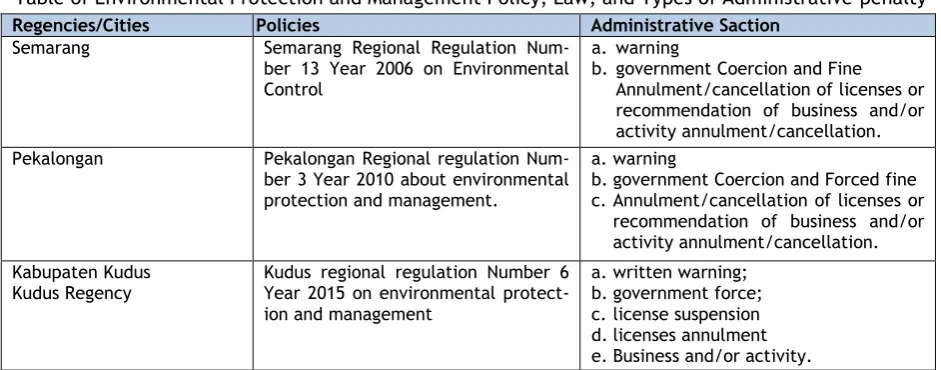
Actually, there is no differences in admi-nistrative punishment implementation in Sema-rang, Kudus, and Pekalongan government if any violation against environmental protection and management is done by small, medium, or big industries. The table below shows policy and administrative penalty in those three cities.
Conclusion
Regional government policy in Central Ja-va Province on environmental protection and management refers to Law Number 32 Year 2009 on Environmental Protection and Manage-ment. Those implementations are in accordan-ce with regional autonomy conaccordan-cept, regency or city where this research is conducted. They published a policy as a form of application of law Number 32 Year 2009 on Environmental Protection and management along with regio-nal needs. Those policy is written on regioregio-nal regulation.
Table of Environmental Protection and Management Policy, Law, and Types of Administrative penalty Regencies/Cities Policies Administrative Saction
Semarang Semarang Regional Regulation Num-ber 13 Year 2006 on Environmental Control
a. warning
b.government Coercion and Fine Annulment/cancellation of licenses or recommendation of business and/or activity annulment/cancellation. Pekalongan Pekalongan Regional regulation
Num-ber 3 Year 2010 about environmental protection and management.
a.warning
b.government Coercion and Forced fine c.Annulment/cancellation of licenses or
recommendation of business and/or activity annulment/cancellation.
Kabupaten Kudus Kudus Regency
Kudus regional regulation Number 6 Year 2015 on environmental protect-ion and management
a.written warning; b.government force; c.license suspension d.licenses annulment e.Business and/or activity. Sources: Processed secondary data
References
Amiq, Bachrul. 2013. Aspek Hukum Pengawasan Pengelolaan Keuangan Daerah dalam Per-spektif Penyelenggaraan Negara yang Bersih. Yogyakarta: LaksBang PRESSindo; Dewi, Dahlia Kusuma. et.al. “Izin Lingkungan dalam Kaitannya dengan Penegakan Ad-ministrasi Lingkungan dan Pidana Lingku-ngan Berdasarkan UU Nomor 32 Tahun 2009 tentang Perlindungan dan
Pengelo-laan Lingkungan Hidup (UUPPLH)”. USU Law Journal. Vol. II Number 1. January 2014. Pp.123-138.
Imamulhadi. ”Perkembangan Prinsip Strict Lia-bility dan Precautionary dalam Penyele-saian Sengketa Lingkungan Hidup di
Pe-ngadilan”. Mimbar Hukum. Vol. 25 Num-ber 3. OctoNum-ber 2013. Pp. 416-432. https://doi.org/10.22146/jmh.16070;
Mina, Risno. “Desentralisasi Perlindungan dan Pengelolaan Lingkungan Hidup sebagai Alternatif Menyelesaikan Permasalahan
Lingkungan Hidup”. Jurnal Arena Hukum. Vol. 9 Number 2. August 2016. Pp.149-165. DOI: 10.21776/ub.arenahukum. 2016.00902.1;
Maydrawati, Tri Rusti. “Tinjauan Hukum Ling -kungan dan Kebijakannya terhadap Per-lindungan dan Pengelolaan
Keanekara-gaman Hayati”. Jurnal Perpektif Hukum. Vol. 16 Number 1. May 2016. Pp.18-44;
Mustofa. “Dana Bagi Hasil dan Konservasi Sum-ber Daya Alam di Indonesia Periode
De-sentralisasi”. Jurnal Ekonomi dan Pendi-dikan. Vol. 8 Number 2. November 2010. Pp.116–134;
Nurlinda, Ida. “Kebijakan Pengelolaan Sumber
Daya Alam dan Dampaknya terhadap
Pe-negakan Hukum Lingkungan Indonesia”.
Jurnal Bina Hukum Lingkungan. Vol. 1. Number 1. October 2016. Pp. 1-9. DOI: 10.2497/jbhl.bln.1.1;
Pujiastuti, Endah dan Dewi Tuti Muryati. “Kebi -jakan Perlindungan dan Pengelolaan Lingkungan Hidup Pada Kabupaten/Kota
di Wilayah Provinsi Jawa Tengah”. Prosi-ding SNPK. Vol 1. September 2016. Pp. 124-134.;
---, Efi Yulistyowati, dan Doddy
Kridasak-sana. “Sanksi Administrasi terhadap Pe
-langgaran di Bidang Perizinan”. Jurnal Dinamika Sosial Budaya. Vol. 14 Number 1. June 2012. Pp. 1-20;
Saija, Vica J. E. “Wewenang Pemerintah Dae-rah dalam Pemberian Izin Lingkungan
Hi-dup”. Jurnal Sasi. Vol. 20 Number 1. Ja-nuary – July 2014. Pp. 68-80;
Rahardjo, Satjipto. 1984, Masalah Penegakan Hukum – Suatu Kajian Sosiologis. Ban-dung: Sinar Baru;
Siombo, Marhaeni Ria. “Tanggung Jawab Pemda Terhadap Kerusakan Lingkungan Hidup Kaitannya dengan Kewenangan Perizinan
di Bidang Kehutanan dan Pertambangan”.
Jurnal Dinamika Hukum. Vol. 14 Number 3. September 1014. Pp. 394-405. DOI: 10.20884/1.jdh.2014.14.4.306;
Sutrisno, Bambang. “Kerancuan Yuridis Kewe -nangan Perlindungan dan Pengelolaan Lingkungan Hidup dalam Perspektif