Assessment and Improvement
of the
Structural Performance
of
Buildings in Earthquakes
Prioritisation
Initial Evaluation
Detailed Assessment
Improvement Measures
Recommendations of a NZSEE Study Group
on Earthquake Risk Buildings
June 2006
¶ 
Foreword
The Building Act 2004 extends the previous definition of the range of buildings that could be earthquake-prone. All but small residential buildings are now covered by the new definition.
Territorial Authorities have been required by the Act to adopt policies on earthquake-prone buildings. Most of these require evaluations of the likely structural performance of buildings that could be earthquake-prone.
Assessment of the structural performance of existing buildings is a challenging task. Each building has unique characteristics and it is often difficult to determine with confidence the extent and quality of structural components and materials.
These NZSEE Recommendations provide authoritative and timely information to assist TAs, owners and their engineers to make assessments of the structural performance of existing buildings, and to determine whether or not they are earthquake-prone.
The document gives information on the background concerns that resulted in the legislation, provides guidance on how a TA might approach the situation, presents a useful Initial Evaluation Procedure, and includes processes for more detailed analysis
The Department commends the NZSEE on its achievement and trusts that these Recommendations will prove useful to those responsible for assessing the earthquake-proneness of buildings in relation to s122 of the Building Act.
Manager Building Controls July 2006
and evaluation. The inclusion of comprehensive information about measures available to improve the structural performance should help owners and their engineers to find a suitable means to do this.
Use of the Recommendations will promote consistency in assessing the structural performance of existing buildings in earthquakes and contribute to the reduction of earthquake risk in New Zealand.
Amendments
Description Date
Contents
Section 1 - Introduction 1-11
Definitions, Notation and Abbreviations 1-17
Section 2 - Legislative and Regulatory Issues 2-1
2.1 Building Act Requirements 2-1
2.2 Earthquake Prone Buildings 2-1
2.3 Risk Reduction Programmes 2-3
2.4 Advantages of a Formal Policy 2-4
2.5 Adoption/Development of a Formal Policy 2-4
2.6 Policy Content and Options 2-5
2.6.1 Policy Content 2-5
2.6.2 Implementation Options 2-6
2.7 Implementation Issues for Territorial Authorities 2-6
2.7.1 Initial Evaluation Process 2-6
2.7.2 Detailed Assessment of Earthquake Performance 2-8
2.7.3 Application of Section 112 Requirements (Alterations) 2-8
2.7.4 Change of Use Applications 2-8
2.7.5 Assessment of the Consequence of Failure 2-9
2.7.6 Prioritising Actions 2-9
2.7.7 Required Level of Structural Improvement 2-9
2.7.8 Timetables for Evaluation and Improvement 2-10
2.7.9 Serving Notice 2-10
2.7.10 Review Requirements with Owner 2-11
2.7.11 Economic Considerations 2-11
2.7.12 NZSEE Grading Scheme 2-11
2.7.13 Heritage Buildings 2-11
2.7.14 Limited Life Buildings 2-11
2.7.15 PIM and LIM Notification 2-12
2.7.16 Information Systems 2-12
2.7.17 Technical Requirements 2-12
2.8 NZSEE Grading Scheme 2-13
2.9 Implementation Options and Steps 2-15
2.9.1 Outline Process 2-15
2.9.2 Active Programme 2-15
2.9.3 Passive Programme 2-17
Section 3 - Initial Evaluation Procedure 3-1
3.1 Background 3-1
3.2 Outline of the Process 3-1
3.3 Summary of Step-by-Step Procedures 3-3
3.4 Background Guidelines and Commentary 3-16
3.4.1 Step 1- Collection of information (Table IEP-1) 3-16
3.4.2 Step 2- Procedure for assessment of (% NBS)b (Table IEP-2) 3-16
3.4.4 Step 4 - Determination of percentage of new building standard (%NBS) 3-23
3.4.5 Step 5 - Building Earthquake Prone? 3-26
3.4.6 Step 6 - Building an earthquake risk? 3-26
3.4.7 Step 7 - Seismic grading 3-26
Section 4 - Detailed Assessment – General Issues 4-1
4.1 Introduction 4-1
4.1.1 Context and Background 4-1
4.1.2 Objectives for Assessing Existing Buildings 4-1
4.2 Performance Objectives 4-2
4.2.1 Hierarchy of Performance Measures 4-2
4.2.2 Application 4-5
4.2.3 ULS as Measure of Acceptable Performance 4-5
4.3 Approaches for Performance Assessment 4-6
4.3.1 General 4-6
4.3.2 Global Analysis Considerations 4-8
4.3.3 Approach to Capacity and Demand 4-12
4.4 Building Inspection and Investigation 4-13
4.4.1 Introduction 4-13
4.4.2 General Requirements 4-14
4.4.3 Particular Check Items 4-16
4.5 Relationship with Current Loadings Standards 4-18
4.6 Overall Structural Response Considerations 4-19
4.7 Member Capacity Considerations 4-20
Section 5 - Detailed Assessment - Modelling the Earthquake 5-1
5.1 General 5-1
5.2 Acceleration Response Spectra 5-1
5.3 Displacement Response Spectra 5-2
5.4 Acceleration-Displacement Response Spectra 5-4
5.5 Acceleration Ground Motion Records and Time History Analyses 5-6
5.6 Incorporation of the Structural Performance Factor, Sp 5-6
5.7 Lateral Force/Displacement Requirements 5-6
5.8 (%NBS)t factor 5-6
Section 6 - Detailed Assessment - Procedures 6-1
6.1 General 6-1
6.2 Force-Based Methods 6-1
6.3 Displacement-Based Methods 6-4
6.4 Consolidated Force and Displacement Based Procedure 6-6
6.5 Non-Linear Pushover Procedure 6-9
Section 7 - Detailed Assessment of Reinforced Concrete
Structures 7-1
7.1 Material Properties and Member Strengths 7-1
7.2 Moment Resisting Frame Structures 7-3
7.2.1 Introduction 7-3
7.2.2 Force-Based Procedure for Frame Structures 7-5
7.2.3 Displacement-Based Procedure for Frame Structures 7-19
7.2.4 Determination of Available Ductility Capacity 7-21
7.3 Moment Resisting Frame Elements with Masonry Infill Panels 7-28
7.4 Structural Wall Buildings 7-28
7.4.1 Introduction 7-28
7.4.2 Force-Based Procedure for Wall Buildings 7-29
7.4.3 Displacement-Based Procedure for Wall Buildings 7-35
7.4.4 Deformation Capacities of Wall Elements and the Building System 7-36
7.4.5 Estimation of Equivalent Viscous Damping 7-37
7.5 Dual Frame-Wall Buildings 7-38
7.5.1 Features of Dual Systems 7-38
7.5.2 Assessment Procedure for Dual Frame-Wall Structures 7-39
Section 8 - Detailed Assessment of Steel Structures 8-1
8.1 Introduction and Scope 8-1
8.1.1 Scope 8-1
8.1.2 Useful Publications 8-1
8.2 Material Properties and Member Strengths 8-2
8.3 Evaluation Philosophy and Assumptions 8-2
8.3.1 Approach to be Used for the Evaluation of Existing Steel Seismic Resisting
Systems 8-2
8.3.2 Assumptions for the Evaluation 8-3
8.4 Assessing Member and Connection Strength and Rotation Capacity 8-3
8.4.1 General 8-3
8.4.2 Force Transfer through Connections 8-4
8.4.3 General Assessment of the Capacity of Connection Elements and
Connections 8-5
8.4.4 Bolted and Riveted Connections 8-6
8.4.5 Welded Beam Flange to Column Connections 8-7
8.4.6 Member Strength and Rotation Capacity 8-8
8.5 Evaluation Procedure for Moment-Resisting Steel Framed Systems 8-10
8.5.1 General 8-10
8.5.2 Determine Strength Hierachy of System 8-11
8.5.3 Allowance for Foundation Strength and Stiffness 8-11
8.5.4 Determine the Structural Ductility Factor necessary to meet the Design
Seismic Actions Generated by the Required Strength Assessment Limit 8-12
8.5.5 Determine Inelastic Deflection Limit for System 8-13
8.5.6 Making Allowance for P – ∆ Actions. 8-13
8.5.7 Determine Inelastic Behaviour of System from a Pushover Analysis 8-14
8.5.8 Check Stiffness, Strength and Ductility of the System in the Inelastic Range 8-14
8.6 Reporting on Results for Moment-Resisting Steel Frame System Evaluation 8-15
8.7 Evaluation of Moment-Resisting Steel Framed Systems with Infill Panels 8-15
8.8 Evaluation of Braced Buildings 8-16
8.8.1 Lessons Learned from Observed Building Behaviour in Severe Earthquakes 8-16
8.8.2 Evaluation Procedure for Concentrically Braced Framed Systems 8-17
Section 9 - Detailed Assessment of Moment Resisting Frame
Elements with Masonry Infill Panels 9-1
9.2 Solid Infilled Panel Components 9-2
9.2.1 Stiffness 9-2
9.2.2 Strength 9-3
9.2.3 Deformation Capacities 9-5
9.3 Infilled Panel Components with Openings 9-6
9.4 Out-of-Plane Behaviour of Infilled Panel Components 9-6
9.5 The Influence of Infilled Components on Frame Members 9-7
9.5.1 Shear Demands on the Frame Members 9-7
9.5.2 Modified Shear Capacity of Reinforced Concrete Frame Members 9-9
Section 10 - Detailed Assessment of Unreinforced Masonry
Buildings 10-1
10.1 General 10-1
10.2 Procedure for the Assessment of Walls Responding In-Plane 10-2
10.2.1 Notation 10-2
10.2.2 Limitations of this Section 10-3
10.2.3 Basis of this Section 10-3
10.2.4 Objective 10-4
10.2.5 General Considerations 10-4
10.2.6 Analysis 10-6
10.2.7 Constitutive Relations and Material Failure Criteria 10-7
10.2.8 Stress and Strain Limits 10-8
10.2.9 Plane Frame Analysis – Strength Limits 10-9
10.2.10 Plane Frame Analysis – Strain Limits 10-10
10.2.11 Common Stress and Strain Parameters 10-11
10.3 Procedure for the Assessment of Walls Responding Out-of-Plane 10-12
10.3.1 Notation 10-12
10.3.2 Basis of this Section 10-13
10.3.3 General 10-14
10.3.4 Procedure for Walls Spanning Vertically between Floors and/or the Roof 10-14
10.3.5 Procedures for Vertical Cantilevers 10-19
10.3.6 Procedures for Gables 10-20
10.3.7 Procedures for Walls Spanning Horizontally or Horizontally and Vertically 10-20
Section 11 - Detailed Assessment of Timber Structures 11-1
11.1 Introduction and Scope 11-1
11.2 Material Properties and Member Strengths 11-1
11.2.1 Material Strengths 11-1
11.2.2 Modification Factors 11-1
11.2.3 Element Properties 11-1
11.2.4 Connections 11-2
11.3 Timber Diaphragms 11-2
11.3.1 Existing Timber Diaphragms 11-3
11.3.2 Strength and Stiffness 11-4
11.4 Timber Shear Walls 11-5
11.4.1 Types of Timber Shear Walls 11-6
11.4.2 Strength and Stiffness 11-6
11.5 Connections 11-7
Section 12 - Detailed Assessment - Conclusions 12-1
12.1 General 12-1
12.2 Building Elements 12-1
12.3 Overall Structure 12-1
12.4 Conclusions 12-1
Section 13 - Improvement of Structural Performance 13-1
13.1 General 13-1
13.2 Performance Objectives and Criteria 13-1
13.3 Strategies for Improving Structural Performance 13-2
13.3.1 Local Modification of Components 13-2
13.3.2 Removal or Lessening of Irregularities and Discontinuities 13-2
13.3.3 Global Structural Strengthening and Stiffening 13-3
13.3.4 Seismic Isolation 13-3
13.3.5 Supplementary Energy Dissipation 13-4
13.3.6 Removal of Unnecessary Seismic Mass 13-4
13.3.7 Widening Seismic Joints 13-4
13.3.8 Linking Buildings Together across Seismic Joints 13-5
13.3.9 Seismic Emergency Gravity Supports 13-5
13.3.10 Strength and Stiffness Criteria 13-5
13.4 Global Strengthening 13-6
13.5 Strengthening Building Elements 13-8
13.6 Strengthening Unreinforced Masonry or Unreinforced Concrete Buildings 13-14
References
1
Appendices
1
Appendix 2A: Priority Factors 1
Appendix 2B: Factors to be considered when evaluating “as near as is reasonably
practicable to that of a new building” 3
Appendix 3A: Typical (%NBS)b values for Wellington, Auckland and Christchurch 5
Appendix 3B: Assessment of Attribute Score for URM Buildings 15
Appendix 4A: Typical Pre-1976 Steel Building Systems Used in New Zealand 21
Appendix 4B: Relationships Between Structural Characteristics and Steel Building
Performance in Severe Earthquakes 27
Appendix 4C: Assessing the Mechanical Properties of Steel Members and Components 31
Appendix 4D: Potential for Pounding 35
Appendix 4E: Analysis Procedures 39
4. Determine the effective height as: 54
Appendix 8A: Bolted and Riveted Joint Moment-Rotation Determination 59
Appendix 8B: Simplified Pushover Analysis for Use in the Evaluation 65
Appendix 10A: Derivation of Instability Deflection and Fundamental Period for Masonry
Buildings 67
Appendix 10B: Tests for Assessing the Strength of Masonry and Connectors 79
Appendix 11B: Timber Diaphragm Strength 89
Appendix 11C: Timber Shear Wall Stiffness 91
Appendix 11D: Timber Shear Wall Strength 93
List of Figures
Section 1 - Introduction 1-11
Figure 1.1: The relationship between the procedures for the design of new buildings and the evaluation of existing buildings 1-13
Definitions, Notation and Abbreviations 1-17
Section 2 - Legislative and Regulatory Issues 2-1
Figure 2.1: Outline of evaluation process 2-7
Figure 2.2: Implementation options and processes 2-15
Figure 2.3: Outline of Steps in Active Programme 2-16
Figure 2.4: Outline of Steps in Passive Programme 2-18
Section 3 - Initial Evaluation Procedure 3-1
Figure 3.1: Diagrammatic representation of Initial Evaluation Procedure 3-2
Figure 3.2: Initial Evaluation Procedure 3-5
Figure 3.3: (%NBS) nom for Different Building Design Vintages 3-11
Figure 3.4: Structural performance factor, Sp 3-12
Figure 3.5: Extracts from previous Standards showing seismic zoning schemes 3-13
Figure 3.6: Concepts behind scaling factors 3-21
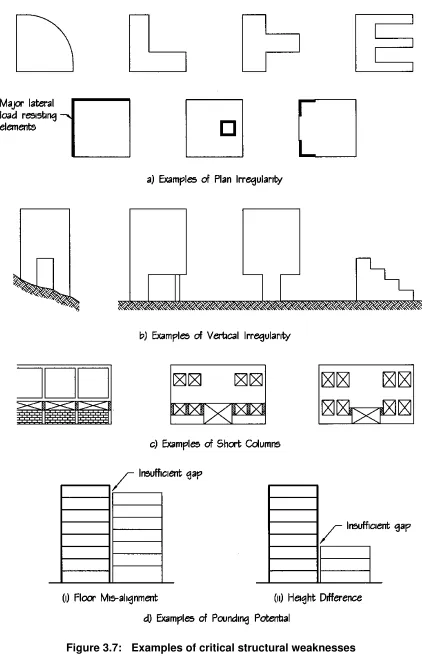
Figure 3.7: Examples of critical structural weaknesses 3-25
Section 4 - Detailed Assessment – General Issues 4-1
Figure 4.1: Strength versus risk and ULS as reference point 4-3
Figure 4.2: Real and modelled responses of buildings to earthquake 4-7
Section 5 - Detailed Assessment - Modelling the Earthquake 5-1
Figure 5.1: Displacement spectra at 5% damping for R = 1 5-3
Figure 5.2: Displacement spectra for different damping levels 5-4
Figure 5.3: Acceleration-Displacement Spectra for different damping levels 5-5
Section 6 - Detailed Assessment - Procedures 6-1
Figure 6.1: Summary of force-based assessment procedure 6-3
Figure 6.2: Derivation of effective stiffness 6-5
Figure 6.3: Summary of displacement-based assessment procedure 6-7
Figure 6.4 Explanation of terms in Eqn 6(3) 6-8
Figure 6.5 Consolidated force / displacement based assessment procedure 6-10
Section 7 - Detailed Assessment of Reinforced Concrete
Structures 7-1
Figure 7.1: Simplified force versus displacement relationships and mechanism
outcomes for reinforced concrete frames 7-5
Figure 7.2: Interior beam – column joint subjected to seismic loading 7-7
Figure 7.3: Possible mechanisms of post-elastic deformation of moment resisting frames 7-11
Figure 7.4: Mixed sidesway mechanism of gravity load dominated frames 7-12
Figure 7.5: Typical lateral force-displacement relation of a moment resisting frame 7-12
Figure 7.6: Shear strength capacity as affected by flexure and shear interaction 7-16
Figure 7.7: Degradation of nominal shear stress resisted by the concrete with imposed
cyclic curvature ductility factor 7-17 Figure 7.8: Degradation of nominal shear stress resisted by the concrete of
beam-column joints with imposed cyclic curvature ductility factor 7-18
Figure 7.9: Mixed sidesway mechanism for a storey 7-19
Figure 7.11: Considerations for beam plastic hinges 7-23
Figure 7.12: Moment-curvature relationships for beam example 7-24
Figure 7.13: Moment curvature response of unconfined columns 7-25
Figure 7.14: Inelastic displacement profile for frames 7-26
Figure 7.15: Summary of force-based assessment procedure for walls 7-30
Figure 7.16: Torsional effects in walled buildings 7-32
Figure 7.17: Required curvature ductility capacity of cantilever wall sections as a function of displacement ductility demand and aspect ratio 7-33 Figure 7.18: Bilinear idealisation of ductile element and system response for a wall
building shown in Figure 7.16 7-38 Figure 7.19: The stepwise estimation of the contribution of a frame and a wall element to
probable lateral strength and correspondence displacements of a dual
system 7-40 Figure 7.20: The bilinear simulation of the force-displacement relation of a dual system
and its two elements 7-43
Section 8 - Detailed Assessment of Steel Structures 8-1
Figure 8.1: Typical rivet shank and head diameters 8-6
Figure 8.2: Slender concentrically braced framed building with failure of brace to frame
connections, Kobe earthquake 8-17
Section 9 - Detailed Assessment of Moment Resisting Frame
Elements with Masonry Infill Panels 9-1
Figure 9.1: Modelling the infill panel of an infilled frame system as an equivalent strut 9-2 Figure 9.2: Modelling the adverse effect of an infill panel on the performance of the
perimeter frame showing (a) the placement of the strut, and (b) the moment pattern on the columns 9-8
Figure 9.3: The effect of partial infills on frame performance 9-8
Section 10 - Detailed Assessment of Unreinforced Masonry
Buildings 10-1
Figure 10.1: Gable Configurations discussed in this section 10-21
Section 11 - Detailed Assessment of Timber Structures 11-1
Section 12 - Detailed Assessment - Conclusions 12-1
Figure 12.1: Summary of Building Features 12-3
Section 13 - Improvement of Structural Performance 13-1
References
1
Appendices
1
Figure 2A.1: Occupancy Classifications (non-essential buildings) 1
Figure 3B.1: Diaphragm parametersTable 3B.3: Assessment of %NBS from Attribute
Score 19
Table 3B.3: Assessment of %NBS from Attribute Score 20
Figure 4A.1: Riveted steel fabrication details, Government Life Insurance Building, 1937 22 Figure 4A.2: Riveted steel fabrication details, Government Life Insurance Building, 1937 23 Figure 4A.3: Failed beam to column weak axis welded connection from the 1995 Kobe
earthquake 24 Figure 4A.4: Braced frame with light tension bracing showing damage but no collapse
from the 1995 Kobe earthquake 24 Figure 4A.5: V-braced CBF showing damage but no collapse from the 1995 Kobe
earthquake 25 Figure 4B.1: Example of soft storey generated by change from braced to moment frame
at bottom storey, 1995 Kobe earthquake 28 Figure 4B.1: Local column crippling failure due to lack of stiffener adjacent to incoming
beam flange in a welded, moment-resisting beam to column connection,
1995 Kobe earthquake 29
Figure 4D.1: Example of differing floor elevations in adjacent buildings 37
Figure 4E.1: Plausible force distribution in a flexible diaphragm 41
Figure 4E.2 Diaphragm and wall displacement terminology 44
Figure 4E.3 Beam shears 48
Figure 4E.4 Beam hinges 49
Figure 4E.5 Sway potential 50
Figure 4E.6 Mechanisms 51
Figure 4E.7 Overturning capacity 52
Figure 4E.8 Frame ultimate displacement capacity 53
Figure 4E.9 Strength eccentricity 53
Figure 8A.1: Joint detail 60
Figure 8A.2: Moment–rotation curve 61
Figure 8A.3: Comparison of bare steel and encased moment–rotation behaviour 63
Figure 8A.4: Comparison of monotonic and cyclic moment–rotation behaviour 63
Figure 8B.1: Moment–rotation curve for riveted clip-angle/T – stub connection 65
Figure 10A.1: Configuration at incipient rocking 69
Figure 10A.2: Configuration when rotations have become significant 70
Figure 10A.3: Single cantilever 76
Figure 10 B.1: Bonding requirements for unreinforced masonry walls 79
Figure 10B.2: In-place mortar shear tests 80
Figure10B.2: Bed joint shear test arrangement 82
List of Tables
Section 1 - Introduction 1-11
Definitions, Notation and Abbreviations 1-17
Section 2 - Legislative and Regulatory Issues 2-1
Table 2.1: Grading system for earthquake risk 2-13
Table 2.2 NZSEE Risk Classifications and Improvement Recommendations 2-14
Section 3 - Initial Evaluation Procedure 3-1
Table IEP-1: Initial Evaluation Procedure – Step 1 3-6
Table IEP-2: Initial Evaluation Procedure – Step 2 3-7
Table IEP-2: Initial Evaluation Procedure – Step 2 continued 3-8
Table 3.1: Return period scaling factor 3-12
Table 3.2: Ductility factors to be used for existing buildings 3-12
Table 3.3: Ductility scaling factor 3-12
Table IEP-3: Initial evaluation procedure – Step 3 3-14
Table IEP-4: Initial evaluation procedure – Steps 4, 5 and 6 3-15
Table 3.4: Guide to severity of critical structural weaknesses 3-24
Section 4 - Detailed Assessment – General Issues 4-1
Table 4.1: Hierarchy of performance measures 4-4
Table 4.2: Summary of recommended analysis procedures and applicability guidelines 4-9
Section 5 - Detailed Assessment - Modelling the Earthquake 5-1
Section 6 - Detailed Assessment - Procedures 6-1
Table 6.1 Typical values of ξeff for various structural types and materials 6-8
Section 7 - Detailed Assessment of Reinforced Concrete
Structures 7-1
Section 8 - Detailed Assessment of Steel Structures 8-1
Section 9 - Detailed Assessment of Moment Resisting Frame
Elements with Masonry Infill Panels 9-1
Table 9.1: Out-of-plane infill strength parameters 9-7
Section 10 - Detailed Assessment of Unreinforced Masonry
Buildings 10-1
Table 10.1: Notation 10-2
Table 10.2: Strength parameters for preliminary assessments 10-7
Table 10.3: Notation 10-12
Section 11 - Detailed Assessment of Timber Structures 11-1
Table 11.1: Strength values for existing materials 11-4
Table 11.2: Characteristic stresses for visually graded timber [NZS 3603:1993] 11-8
Section 12 - Detailed Assessment - Conclusions 12-1
Section 13 - Improvement of Structural Performance 13-1
Table 13.1: Global strengthening approaches 13-6
Table 13.2 Techniques for strengthening building elements 13-8
Table 13.3: Techniques for strengthening unreinforced masonry or unreinforced
concrete buildings 13-14
References
1
Appendices
1
Table 2A.1: Modification factors K1 and K2 2
Table 3A.1: (%NBS)b Wellington, µ = 1.25, Importance Levels 2, 3 and 4 5
Table 3A.2: (%NBS)b Wellington, µ = 2, Importance Levels 2, 3 and 4 6
Table 3A.3: (%NBS)b Wellington, µ = 3, Importance Levels 2, 3 and 4 7
Table 3A.4: (%NBS)b Auckland, µ = 1.25, Importance Levels 2, 3 and 4 8
Table 3A.5: (%NBS)b Auckland, µ = 2, Importance Levels 2, 3 and 4 9
Table 3A.6: (%NBS)b Auckland, µ = 3, Importance Levels 2, 3 and 4 10
Table 3A.7: (%NBS)b Christchurch, µ = 1.25, Importance Levels 2, 3 and 4 11
Table 3A.8: (%NBS)b Christchurch, µ = 2, Importance Levels 2, 3 and 4 12
Table 3A.9: (%NBS)b Christchurch, µ = 3, Importance Levels 2, 3 and 4 13
Table 3B.1: Assessment of Attribute Score 16
Table 3B.2: Definition of attributes and scores 16
Table 4A.1: Main periods of the structural use of cast iron, wrought iron and steel 21
Table 4C.1: Minimum material properties for steels and rivets manufactured in the USA 32 Table 4C.2: Typical properties of structural steels from the UK for the period 1906–68 32 Table 10A.1: Static instability defection for uniform walls, various boundary conditions 75 Table 10B.1: Determination of design values from in-place mortar shear tests and bed
joint shear tests 82
Section 1 - Introduction
Basic Aims of this Document
The underlying aim of the New Zealand Building Act 2004 is to reduce the risk of death or injury that may result from the effects of a significant earthquake on buildings that represent a higher than normal risk in earthquake.
The Building Act legislation will greatly increase the awareness of earthquake risk amongst building owners. It will also result in the need to assess the earthquake performance of many more existing buildings than has previously been the case.
This document (the Guidelines) describes approaches, steps and procedures to assist in assessing the earthquake performance of existing buildings of various material types and configurations, notably reinforced concrete, steel, timber and unreinforced masonry. Guidance for improving the performance of such buildings is also given.
The basic aim of this document is to provide a set of guidelines that are helpful to Territorial Authorities, consultants and building owners, and that can be applied consistently to assess the earthquake performance of a building.
Background
Reconnaissance visits mounted by the New Zealand Society for Earthquake Engineering to the scene of major earthquakes over the past two decades have returned with a consistent message regarding the vulnerability of structures designed to early codes. Acknowledging these concerns, and foreshadowing a revision of the Building Act 1991, the Building Industry Authority commissioned the New Zealand National Society for Earthquake Engineering to produce a document setting down the requirements for structural engineers to follow when evaluating and strengthening pre-1976 buildings.
Prior to the enacting of the The Building Act 2004, the term earthquake risk buildings related only to unreinforced masonry buildings. The risk posed by such buildings, along with the early concrete and steel structures designed prior to the first New Zealand seismic design code, NZSS 95 published in 1935, is readily apparent. The prime characteristic of these buildings is that wind loading was the only (if any) lateral force considered in their design.
While most buildings designed before the publication of NZS 4203:1976 (SNZ 1976) and associated materials codes have often been designed to similar levels of strength as modern structures, they typically do not have either the level of ductility or appropriate hierarchy of failure required by current design standards.
The level of risk posed by buildings constructed as recently as the early 1970s is now more widely appreciated. The Northridge and Kobe earthquakes have highlighted the vulnerability of this category of structure.
As a consequence of the awareness of this vulnerability, the Building Act was revised to encompass any building which is considered to not be capable of an adequate seismic performance. Accordingly, the expression earthquake risk building is now regarded as applying to any building that is not capable of meeting the performance objectives and requirements outlined in this document.
The Building Act focuses particularly on buildings of high risk. These buildings are referred in the legislation as Earthquake Prone Buildings and form a subset (the worst) of earthquake risk buildings
Key Features
The key features outlined in this document include:
A summary section on legislative and regulatory issues to assist Territorial Authorities in implementation
Full details of the Initial Evaluation Procedures, previously published separately.
Assessment procedures for reinforced concrete, steel, timber and unreinforced masonry buildings
Introduction of approaches and procedures that view structural performance in relation to displacements generated. (Displacement-based approach)
A section on approaches and techniques commonly used for improving structural performance. (Strengthening and retrofitting).
The approaches and procedures presented have been developed especially with the process of assessment in mind. Such processes differ distinctly from the design processes for a new building. Most of these procedures have yet to be evaluated fully in actual situations, and some refinement can be anticipated as a result of feedback received from Territorial Authorities, consultants and owners.
Several procedures are based on evaluating the performance of individual earthquake-resisting elements. Considerable engineering judgement is required when assessing the implications for individual elements of overall building response, particularly given the configurational shortcomings of earlier structures. Judgement is also required to ensure that elements and components selected for detailed analysis provide a realistic yet conservative assessment of the overall building.
At this stage, the displacement-based approaches and procedures have only been described in detail for structures of reinforced concrete since it is these structures that have received most attention from researchers. However, the displacement-based approaches outlined could quite easily be applied to other materials also. Procedures reflecting a displacement based approach are expected to become more common in future.
the design objective for a new building of precluding a particular limit state from occurring. Less stringent assumptions than used in design also reflect that the building exists and therefore actual material strengths, for example, can be checked.
Guidance given to improve structural performance is general in nature only, due to the wide range of possible options available and of building characteristics. The material presented is intended to assist structural engineers to determine suitable, effective and economical solution. It should be noted that new approaches and techniques are constantly developing.
Purpose and Objective
The purpose of this document is to assist designers and Territorial Authorities in implementing the requirements of the Building Act.
This document:
a) provides a means of assessing the earthquake structural performance of an existing building, and in particular its capability to reach a minimum required level of performance
b) provides approaches to and guidance on techniques for improving seismic performance. . Subsequent sections define the respective seismic performance criteria, and express them in terms of current design standards.
The relationship between the design of a new building and the assessment and strengthening of an existing building is established in the following sections. This relationship is represented diagrammatically in Figure 1.1. The key principle is that the current loadings standard in conjunction with current materials standards is common to both procedures. Both the philosophies and detailed steps to enable existing buildings to be evaluated in this way are presented in the following sections, including modifications to factors and/or materials values contained in current codes where considered appropriate.
Figure 1.1: The relationship between the procedures for the design of new buildings and the evaluation of existing buildings
Scope
Emphasis in this document is placed on the most common structural configurations that are considered to pose the greatest risk. The seismic resisting elements for which direct guidance is offered in this document are as follows:
reinforced concrete moment resisting frames reinforced concrete structural walls
structural steel moment resisting frames unreinforced masonry buildings
frame structures (concrete or steel) with masonry infill. Timber diaphragms and shear walls
Bridge structures have not been specifically addressed in this version of these Guidelines, although most of the issues and approaches outlined for reinforced concrete frame structures are applicable. The term improving the structural performance of is used in the title of this document rather than
strengthening in acknowledgment of the wide range of options for structures that are found to be
earthquake risk buildings. Some of these options involve only the removal or separation of
components, and others affect a relatively small number of members. For brevity in this document, however, strengthening and retrofitting are used most commonly, and should be taken as having the same meaning as “improving the structural performance of”.
These Guidelines draw together current New Zealand and international knowledge in this field, and will be subject to ongoing refinement and development as further understanding is gained.
This document concentrates on matters relating to life safety; that is to say, performance at the ultimate limit state. Emphasis is therefore placed on the identification and elimination of possible undesirable collapse modes that could affect either part of a building or the entire structure. As well as considering the relative strengths of structural members, there is a need to evaluate the consequences of critical structural weaknesses that could lead to collapse, such as excess torsional responses, or soft or weak stories created by vertical irregularities or adjacent buildings. Lack of seismic separation between structural and non-structural items can also be a life safety issue. Damage to the building itself is a secondary consideration, and this point along with the associated implications must be made clear to the owners of buildings by users of this document. Insurance considerations are not specifically addressed in the Guidelines due to the many commercial factors involved on a case-by-case basis. Buildings that are either assessed as being acceptable in terms of this document or are actually strengthened could be damaged beyond repair by a significant earthquake.
Although serviceability limit state issues are not specifically addressed, serviceability limit state loads from current design standards can be used to represent the likely onset of damage.
NZSEE Grading Scheme
The NZSEE is promoting the use of a grading scheme for classifying buildings according to earthquake performance. While grades are to be based on assessment scores from procedures in this document, it should be recognised that the determination of a grade is not a requirement of the proposed legislation. Refer Section 2.8. The Grading Scheme proposed in Section 2.8 is likely to influence insurers in their assessment of their risk exposure.
Document Status and Outline
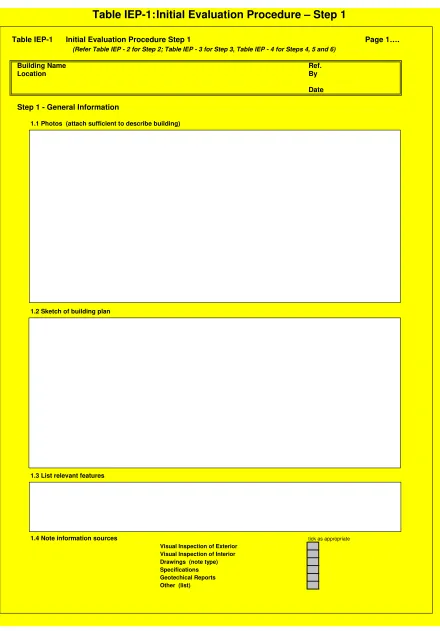
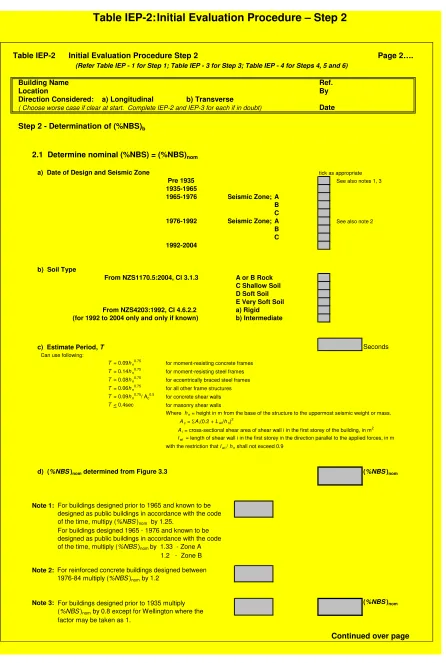
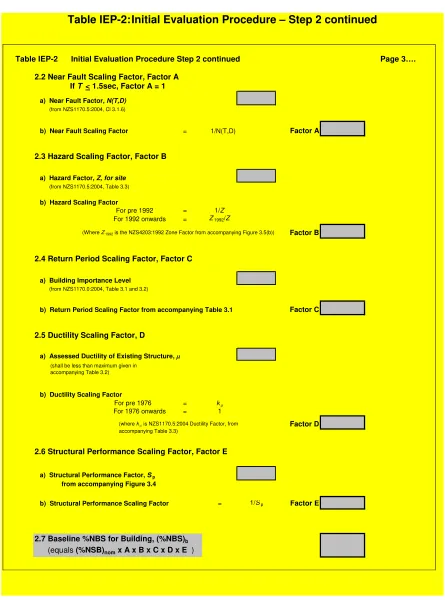
Material that presents assessment procedures has been highlighted with a yellow background (grey when printed on black and white). This device is intended to aid interpretation and application of procedures once a user is familiar with the background.
In Section 2, legislative and regulatory issues are summarised. This section describes the overall approach to evaluating ERBs from a regulatory and compliance perspective. Guidance is given especially to TAs to help them develop formal and consistent policies to deal with the technical, legislative, regulatory, economic and social factors involved.
The section specifically indicates the role of the initial evaluation procedure and detailed evaluation procedure as well as giving guidance on the setting of requirements for improving structural performance.
Section 3 incorporates the Initial Evaluation Procedure. This has been published previously (NZSEE 2000) but has now been revised with NZS 1170.5 forming the “current standard”.
Section 4, Detailed Assessment – General Issues, sets out general issues relating to the detailed assessment of buildings.
Section 5 defines the earthquake shaking parameters that should be adopted for a detailed assessment.
In Section 6 the recommended assessment procedeures for a detailed assessment are described. Sections 7 to 11 contain the bulk of the document. This material is largely new but builds on material previously in the 1996 Document (NZSEE 1996 Green Book). For completeness, unreinforced masonry buildings and timber structures have been included and the steel sections have been extended.
Section 13, Improvement of Structural Performance, provides guidance on performance objectives, approaches and techniques for improving the structural performance of existing buildings.
It is hoped that this document will not only provide guidance to professionals with responsibilities for implementation of the new provision of the Act but also raise awareness amongst owners and the general public of the need to bring many existing buildings closer to the standard required for new buildings.
NZS 4203:1992 and AS/NZ1170:2002
Acknowledgements
The study group which compiled this document consisted of: David Brunsdon (Spencer Holmes)
Charles Clifton (HERA)
Carl Devereux (Ian Smith and Partners) David Hopkins (David Hopkins Consulting) Rob Jury (Beca)
Professor John Mander (University of Canterbury)
Professor Nigel Priestley (University of California, San Diego) Lou Robinson (Hadley and Robinson)
Bruce Shephard (Seismic Consultants Ltd) Kevin Spring (Ormond Stock and Associates)
Sulo Shanmuganathan (Opus International Consulting) Craig Stevenson (Connell Mott McDonald)
John Taylor (Christchurch City Council) Grant Wilkinson (Holmes Consulting Group)
Adam Thornton (Dunning Thornton Consultants Limited) Peter Moss (Emeritus Professor, University of Canterbury). The late Professor Robert Park (University of Canterbury)
The financial assistance provided by the Department of Building and Housing is gratefully acknowledged.
Important Note
It is recommended that those carrying out evaluations and reviews using these guidelines recognise the responsibilities involved and the liabilities to which they may be exposed.
Neither the NZSEE or any member of the Study Group accepts any liability for the application of these Guidelines in any specific instance.
Definitions, Notation and Abbreviations
Definitions
For ease of reference, definitions are given in the relevant Section or Chapter
Notation
For ease of reference, notation is given in the relevant Section or Chapter
Abbreviations
Anairp As near as is reasonably practicable. CBF Concentrically braced frame. CQC Complete Quadratic Combinations CSW Critical structural weakness.
DCB Design and Construction Bulletin (HERA publication). (D)MRSF (Ductile) moment resisting structural frame.
EBF Eccentrically braced frame.
EMA Elastic modal analysis – same as MRSA.
EPB Earthquake prone building – refers to definition in the Building Act 2004 i.e. < 33%NBS.
ERB Earthquake risk building – a building assessed as having greater than moderate risk i.e. < 67%NBS.
ES(M) Equivalent static (method).
GSAP Global structural analysis procedure. GSM Global structural model.
HERA Heavy Engineering Research Association.
HRB High risk building – a building that does not meet the criteria in the Building Act Section 122.
IEP Initial Evaluation Procedure. ITHA Inelastic time history analysis.
LIM Land Information Memorandum – refer Local Government Official Information and Meetings Act Section 44a.
LPA Lateral push-over analysis.
MRSA Modal response spectrum analysis – same as EMA.
NBS New Building Standard – i.e. the standard that would apply to a new building at the site. This includes loading to the full requiremnets of the Standard.
NZS New Zealand Standard.
PIM Project Information Memorandum – refer Building Act Section 31. RSJ Rolled steel joist.
Section Section (of an Act of Parliament) SLaMA Simple lateral mechanism analysis.
SLS Serviceability limit state as defined in NZS 1170.5:2004 (or NZS 4203:1992), being the point at which functionality of the structure and its contents become unacceptable. SANZ Standards Association of New Zealand
SNZ Standards New Zealand, formerly SANZ. SPS Structural performance score.
SRSS Square Root of Sum of Squares T(L)A Territorial (Local) Authority.
ULS Ultimate Limit State. This is generally as defined in NZS 1170.5:2004 and AS/NZS1170.0.
Refer Section 4.2.3
URM Unreinforced masonry. %NBS Percentage of new building standard
Section 2 - Legislative and Regulatory Issues
2.1 Building
Act
Requirements
The sections of the Building Act 2004 that have implications for the seismic resistance of existing buildings are;
Sections 112 and 113 cover buildings undergoing alteration including the situation where the intended remaining life is less than 50 years.
Section 115 provides requirements for buildings where a change of use is proposed. Section 122 and its associated Regulations define an Earthquake-Prone building (EPB). Sections 124 to 130 provide power for territorial authorities (TAs) to act on earthquake-prone buildings and set out how this action is to be taken.
Sections 131 and 132 require the territorial authorities to establish earthquake-prone building policies and specify how the policies are to be established, what they are to include and when they are to be reviewed.
The implications of these requirements on the seismic resistance of existing buildings is discussed in the following sections.
2.2 Earthquake
Prone
Buildings
The definition of an earthquake-prone building (EPB) is set out in Section 122 of the Act and in its associated Regulations.
Quoting from the Act;
122 Meaning of earthquake prone building
(1) A building is earthquake prone for the purposes of this Act if, having
regard to its condition and to the ground on which it is built, and because of its construction, the building –
(a) will have its ultimate capacity exceeded in a moderate earthquake (as
defined in the regulations): and
(b) would be likely to collapse causing –
(i)
injury or death to persons in the building or to persons on any other
property; or
(ii) damage to any other property
(2) Subsection (1) does not apply to a building that is used wholly or mainly for
residential purposes unless the building-
(a) comprises 2 or more storeys: and
And from the Regulations;
7. Earthquake-prone buildings: moderate earthquake defined-
For the purpose of section 122 (meaning of earthquake-prone building) of the Act, moderate earthquake means, in relation to a building, an earthquake that would generate shaking at the site of the building that is of the same duration as, but that is one-third as strong as, the earthquake shaking (determined by normal measures of acceleration, velocity, and displacement) that would be used to design a new building at that site.
This definition of an EPB is significantly more extensive and more stringent than that provided by the 1991 Building Act. It encompasses all buildings, not simply those constructed of unreinforced masonry or unreinforced concrete, though it exempts small residential buildings. The definition is also linked to the current standard which is significantly more demanding than that provided under the previous Act.
In developing these Guidelines NZSEE has taken the following definitions to apply with respect to the wording of section 122 and its associated regulations:
(a) “ultimate capacity” means ultimate limit state capacity as defined in current design standards.
(b) “likely to collapse causing injury or death to persons in the building” means that collapse and therefore loss of life could well occur as a result of the effects of earthquake shaking on the building.
(c) “earthquake that would generate shaking at the site of the building one-third as strong as the earthquake-shaking that would be used to design a new building at that site” means that the inputs of load, displacement, velocity and/or acceleration used for a new building are scaled by one-third, but the duration would be unchanged. Note that this last point becomes very significant if a designer chooses to use time-history analysis to demonstrate acceptable performance.
NZSEE holds the view that the collapse criterion given in subclause 122 (1) (b) of the Act does not relate back to expected performance in a moderate earthquake but rather to an overall expectation. Thus it does not in itself affect the recommendations made in these guidelines. NZSEE recognises however that this is an interpretation of a clause that may be considered to have some ambiguity. NZSEE would like to see this subclause deleted as it is almost impossible to predict collapse and the reference to collapse only has the potential to confuse rather than assist application of the earthquake prone building requirements.
The level of “one-third as strong” (corresponding to a Percentage of New Building Standard (%NBS) of 33, (Refer Section 3.2) is considered a reasonable balance (for the present time) between imposing a requirement to upgrade all non-complying buildings (< 100%NBS) and the previous position where only URM buildings were addressed. 33%NBS corresponds to approximately 20 times the risk of the building reaching a similar condition to that which a new building would reach in a full design earthquake.
It is arguable whether or not loss of life would occur in a new building under a design earthquake. Structural collapse is generally regarded as making loss of life a certainty (assuming the building is occupied). However, the view is taken that loss of life in or near a properly designed new building could also occur due to factors other than structural collapse. Thus, meeting of earthquake code requirements for a new building may be taken as representing an acceptable probability (or likelihood) that loss of life will occur.
In the same way a building with 33%NBS, when subject to earthquake input factored by one-third, could be regarded as having the same acceptable probability of loss of life. However, the generally lower ductility exhibited by older buildings implies more brittle behaviour and more sudden loss of structural integrity. An existing building with 33%NBS, subject to a one-third earthquake would generally represent a higher probability of loss of life than a new building subject to a design earthquake.
The wording of the Regulations refers to the response of the site rather than just the building seismic coefficient. This allows engineers the widest possible scope in demonstrating satisfactory performance of the building. For example, they may wish to do a site-specific study of seismic shaking or to carry out time history analyses of the existing building.
2.3 Risk Reduction Programmes
Sections 131 and 132 of the Building Act require TAs to establish a risk reduction policy for EPBs. The main purpose of the legislation is to reduce earthquake risk in the community. The new requirements recognise the total impracticality of bringing all existing buildings up to the standard of new buildings. The threshold of one-third of the earthquake shaking represents about 20 times the risk of a new building. Buildings below this threshold are categorised by NZSEE as high risk in terms of the hierarchy of performance criteria given in Section 2.1 of these Guidelines.
The Building Act is silent on the level to which an EPB should be strengthened unless a change of use is also involved. It is the view of NZSEE that EPBs should be brought to a standard that is “as near as is reasonably practicable to that of a new building”.
Two issues arise:
a) What to do with buildings that pass the one-third criterion, but which still represent a significant risk. Legally, no action is required, but the NZSEE view is that any building below 67%NBS should be regarded as a questionable earthquake risk and therefore still an Earthquake Risk Building (ERB). Its structural performance should be improved to protect the interest of both the owner and the community generally.
b) What level of performance improvement represents “as nearly as is reasonably practicable to that of a new building”? This level will vary from case to case and, subject to sound reasoning on the practicability of improving the performance, any level above 33%NBS will be legally acceptable. Again, the NZSEE strongly recommends that every effort be made to achieve improvement to at least 67%NBS. This reduces the relative risk from around 20 times to around 3 times that of a new building.
Thus, the new legislation targets only the worst buildings – the sort of buildings we see collapsed in other cities following major earthquakes. There will be many buildings that represent a considerably greater earthquake risk than buildings designed and built correctly to current standards.
Section 2.8 below. This, in conjunction with legislation covering the worst risks, is seen to be an effective way of dealing with the worst buildings in a reasonable timeframe and of achieving ongoing earthquake risk mitigation for the remainder.
These Guidelines are intended to assist building owners, their advisors and TAs to deal with the requirements of the proposed legislation. In particular, this section is intended to encourage and assist TAs to develop a comprehensive risk reduction programme by establishing a formal policy on ERBs and EPBs, through consideration of:
advantages of a formal policy
adoption/development of a formal policy policy content and options
implementation options and approaches technical requirements and procedures.
In addition, the Guidelines are intended to be of assistance to TAs in the exercise of their discretion in the implementation of the structural requirements of Section 115 of the Building Act covering change of use.
It is emphasised that the recommendations and guidance notes given in this Section are those of NZSEE, and are not intended to imply any additional legal obligation under the Act.
2.4 Advantages of a Formal Policy
The higher than normal risk of many existing buildings is a fact. It is important that TAs determine a clear and comprehensive policy, consistent with the new legislation and the perception of earthquake risk in their communities
It is strongly recommended that all TAs adopt a formal policy, consistent with their particular circumstances. The extent of relevant building stock and the technical and financial resources of the territorial authority, and the community it represents, are clearly considerations.
Regardless of the approach chosen, the decision taken and the reasons for it should be formally made and recorded. In the event of a major earthquake, the decision taken and the reasons for it will need to be capable of being seen as reasonable and defensible, especially in hindsight.
Advantages of a formal policy are:
a demonstrable recognition by the TA of the risk, and a commitment to a risk reduction programme
a defensible and logical basis for such a programme
a means to make building owners and the public aware of the issues involved definitive procedures and predictable outcomes for owners and their advisors
clearly defined requirements based on authoritative Guidelines, such as these NZSEE Guidelines.
the security and convenience of a consistent nationally accepted standard.
2.5 Adoption/Development of a Formal Policy
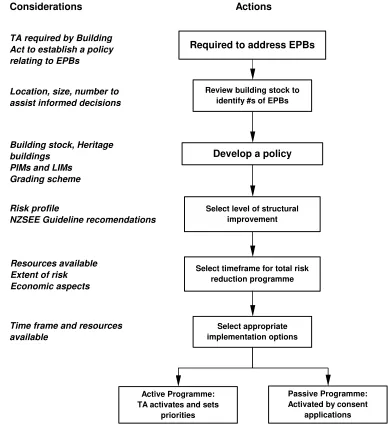
a) Decide to address earthquake risk buildings. It is recommended that every TA address the potential risk of non-complying existing buildings in its community, even if the decision is made to take no action. This will allow the TA to be fully informed on the nature and extent of the risk in making decisions on what to do about it.
b) Identify potential earthquake risk buildings. It is envisaged that a TA would examine its
building stock as a “desk-top” study, assessing the numbers of buildings in each age bracket, the total floor area involved, and other data on the physical characteristics. Buildings which are likely to be Earthquake Prone (i.e. high risk) would be identified. It is recommended that all or a representative sample be subjected to the initial evaluation process assessment (refer Section 3 of these Guidelines).
c) Develop and adopt a formal policy. Based on the above assessment, a decision should be
made on the extent to which the TA will implement a risk reduction strategy. This decision and the reasons for it should be formally recorded, even if the decision is to take no action. On the basis that the decision is to implement the provisions, the TA should:
d) Decide on a realistic total timeframe for completion of the risk reduction programme, taking account the impact on the community, and balancing the need to reduce earthquake risk with economic and social constraints.
e) Select an appropriate implementation option, taking account of the required timeframe and
the particular circumstances of the local community and TA.
The adoption and recording of a formal policy should reflect a genuine commitment to a progressive upgrading of the region’s building stock for earthquake resistance. The proposed policy will need to be sustainable with reference to its economic impact on the region’s commercial sector, while recognising and responding to the growing knowledge and awareness of earthquake risk, and the variation with time of public perceptions of it.
2.6 Policy Content and Options
This Section sets out suggestions for the content and implementation options of the policy. TAs are also directed to the Policy Guidance for Territorial Authorities document prepared by the Department of Building and Housing and available from their web site. This document draws from the suggestions made in this section of the Guidelines.
2.6.1 Policy
Content
The formal policy should include consideration of and clearly defined approaches to the following: initial evaluation process
detailed assessment of earthquake performance technical requirements and criteria
implementation options prioritising actions
application of Section 112 requirements approach to Section 115 considerations change of use requirements
assessment of the consequence of structural failure required levels of structural performance improvement timetables for evaluation and improvement
serving notice
heritage buildings limited life buildings information systems.
To ensure a consistent and even-handed application of the policy, the TA should adopt formal guidelines based on Building Act requirements and relative safety. The guidelines should include some form of initial evaluation to allow appropriate prioritising of building improvements.
The guidelines should be transparent and defensible, and should define the scope of the envisaged upgrading. This document is intended to assist TAs in this regard.
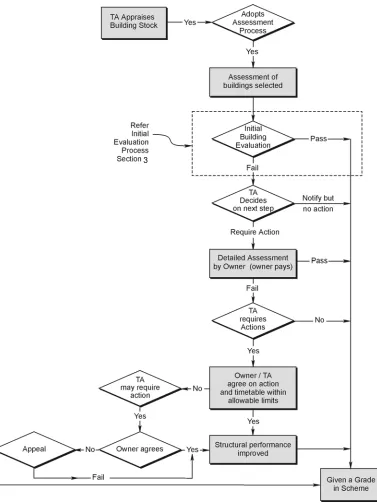
An outline of the overall evaluation process envisaged is given in Figure 2.1.
2.6.2 Implementation
Options
Territorial authorities are obliged by the new legislation to establish a policy on Earthquake Prone buildings. The policy must indicate the approach that is to be followed, the priorities that will be set and how the policy will apply to heritage buildings.
The Territorial Authority has two principal options: a) an active risk reduction programme
b) a passive risk reduction programme.
In an active programme, the TA, using the IEP, would actively identify high risk buildings, set priorities and timeframes for action, and set guidelines for performance levels for upgrading. The TA would then serve notice on the owners requiring them, at their cost, to carry out detailed assessment and/or performance improvement as appropriate. This process will provide a TA with the best possible risk reduction programme as it is able to set and control the timing of mitigation work. There are significant costs to the TA to set up and administer an active programme.
In a passive programme assessment and improvement of structural performance would be activated by an application under the Building Act for an alteration (if the TA had reason to believe that the building was Earthquake Prone) or change of use. Assessment of the structural performance of the building would be at the owner’s cost. The passive programme therefore has the significant disadvantage of relying on a somewhat haphazard order based on owners intentions for the buildings. This could leave some significant high risk buildings untouched for a long period. The TA may find it difficult to defend a passive programme when viewed with the hindsight of a major event. However the TA’s costs to administer the programme will be significantly less than those for the active programme.
Section 2.7 discusses issues which a TA will need to address in developing its formal policy. Section 2.8 outlines the steps required in the development and implementation of the formal policy.
2.7 Implementation Issues for Territorial Authorities
2.7.1
Initial Evaluation Process
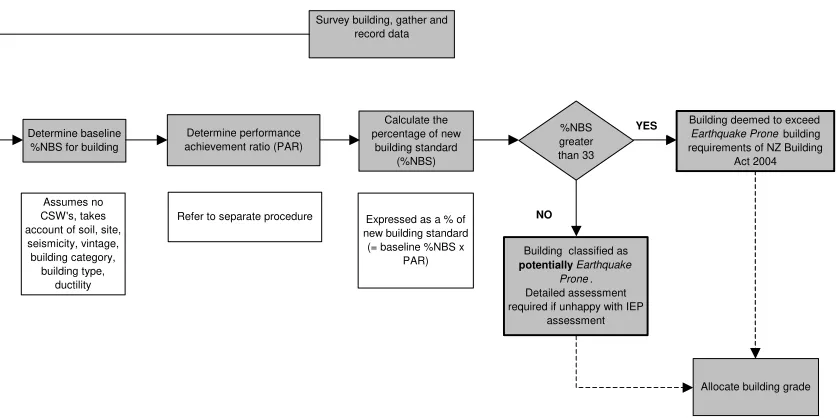
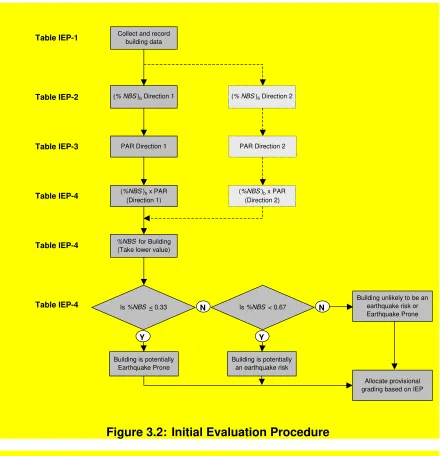
Section 3 of these Guidelines details an initial evaluation procedure (IEP) to be applied to buildings. The procedure is intended to be a coarse screening involving as few resources as reasonably possible to identify potentially high risk (or Earthquake Prone) buildings.
The results obtained in the IEP may be used to:
provide a means of determining priorities for improvement of structural performance. The objective of the IEP is to identify, with an acceptable level of confidence, all high risk buildings. At the same time the process must not catch an unacceptable number of buildings that would, on detailed evaluation be outside the high risk category.
It is expected that those carrying out the IEP would be New Zealand Chartered Professional Engineers with a background of experience in design of buildings for earthquake or having received some specific training.
The initiating circumstances and the responsibility for carrying out the initial evaluation process will vary with the implementation option selected, and is described more fully in Section 2.8.
2.7.2
Detailed Assessment of Earthquake Performance
made n whether or not the building is to be classified as high risk.
essment, at the quest of the TA. The assessment must be carried out by an engineering consultant suitably
.7.3
Application of Section 112 Requirements (Alterations)
be at liberty to require an IEP had reason to believe the building could be Earthquake Prone.
(cost, extent and/or nature) below which, at e TA’s discretion, an evaluation would not be required. Alternatively the TA may request an
erformance improvement under Section 5.
adopted, any structural work required to improve the n alteration to the building. Section 112 of the Building Act
l depend on the nature and implications of the change of use.
Where an initial evaluation indicates that the building is likely to be high risk (Earthquake Prone), it is desirable that a detailed assessment is carried out as set out in Section 4 of these Guidelines. This will provide a more specific and convincing evaluation on which a final decision can be o
The building owner will generally be responsible for submitting the detailed ass re
experienced in earthquake design.
The initiating circumstances, time required for submission, and follow up requirements will depend on the implementation option selected, and is detailed in Section 2.8.
2
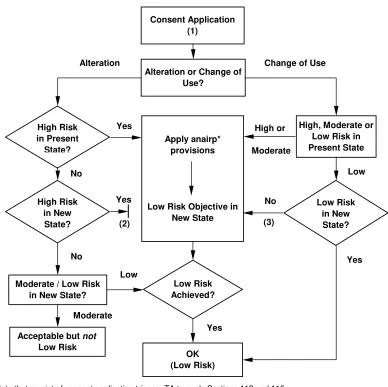
On receipt of a consent application for alterations, the TA would
assessment to be submitted with the application for building consent, if this requirement was part of its formal policy and/or it
If the TA adopts a passive programme, all applications for a building consent for a building alteration should be assessed under the policy. However as the cost is to be met by the applicant, it may be reasonable to specify a minimum level of work
th
initial evaluation to identify the status of the building even if it elects not to require performance improvement at that time.
If the consent application includes significant structural work, and the building before the alteration is deemed to be Earthquake Prone, it is recommended that the altered building should follow the guidelines for p
Regardless of the implementation performance of a building constitutes a
therefore applies. In such a case the TA is required to also consider means of escape from fire and the provision of access and facilities for persons with disabilities to the extent required by the Act.
2.7.4
Change of Use Applications
For the TA to approve a change of use under Section 115 of the Act, it is required to believe that the building will meet the structural performance standards of the building code as nearly as is reasonably practicable as if it were a new building.
An assessment should be requested from the owner for all change of use applications. The extent of this assessment wil
2.7.5
Assessment of the Consequence of Failure
lding design.
number of people at risk in the
n done. Guidance on these priority
ility of loss of life. For a new
e a genuine commitment to pgrading their buildings.
identify priority buildings for
ment
does not address wider considerations, it may be appropriate to include some
setting
It is the recommendation of NZSEE that the expected performance level should be set at as nearly as is reasonably practicable to New Building Standard. Thus the initial target level for improvement should be 100% NBS. In many cases this will not be practicable and it will be necessary to establish a reasoned reduction to an acceptable level. In any event NZSEE B1.3.4 of the Building Code requires the owner to make allowance for the consequences of failure in bui
These Guidelines thus incorporate provision to consider the determi ation of the time prescribed for the mitigation work to be factors and their application is given in Appendix 2A.
It should be noted that, although, the proposed IEP is based on a comparison with loadings and aterial standards, this provides a comparative measure of the probab
m
building, the current standards implicitly define the attainment of ultimate limit state as the boundary between acceptable and unacceptable loss of life. By retaining the comparison with current standards when measuring the performance of existing buildings, the same boundary is again implicit.
2.7.6 Prioritising
Actions
It is probably not realistic to expect many territorial authorities to carry out a complete evaluation of their entire building stock in the short term, even where they hav
u
For an “active” procedure, it will therefore be desirable to easily
attention. The IEP described in Section 3 was developed for this purpose, focussing on critical structural weaknesses. A TA may elect to deal with different groups of buildings to different timetables to spread workload, provided consistency is achieved, e.g. to focus first on buildings in
he CBD or of a particular vintage or type. This could be done based on a simple visual assess t
taking account of basic vulnerability features. Buildings so identified would then be assessed using the IEP in Section 3.
The results of the initial evaluation process will give the TA an approximate quantitative measure of building performance, which will form the basis of prioritising for further action. However,
ecause the IEP b
quantitative recognition of building importance, building occupancy (number and intensity), and building location as well as the building under-capacity in determining priorities. Appendix 2B provides priority factors to assist territorial authorities to account for this consideration.
A detailed assessment under Section 4 will give a more rigorous measure of the likelihood of ailure of the building under earthquake ground motions. It is recommended that, when
f
priorities for action, the output from the analysis (i.e. %NBS) be adjusted using Appendix 2B. Note that the priority factors in Appendix 2B are for establishing relative priorities for action only. They must not be applied in determining whether the building is Earthquake Prone in terms of the
ct. A
2.7.7
Required Level of Structural Improvement
recommends that 67%NBS be regarded as a minimum to be achieved in the structural improvement measures notwithstanding that the legal minimum requirement is possibly only 34%NBS.
will need to assess the time required to complete a quantified
ed to determine a reasonable timeframe for
, building ccupancy (number and intensity), and building location as well as structural performance.
two-year timetable indicates a ery high risk building with earthquake performance of approximately 10%NBS.
r a etailed evaluation for buildings that are not altered or subject to a change of use over a long on to a intended life of 50 years or a cut-off date (e.g. e that all earthquake risk buildings were addressed
consider serving notice on all uildings that are confirmed by the detailed assessment procedures, not to be safe in terms of the
pecify a time for the work to be done.
nded that the TA issue an initial notice on all buildings
d by assessed buildings.
Guidelines should be developed by each TA to deal with the range of buildings likely to be encountered, and particularly special cases such as heritage buildings.
2.7.8
Timetables for Evaluation and Improvement
There are a number of issues that must be considered in determining the total time to complete a TA’s risk reduction programme. These include the time for evaluation of the buildings as well as the time to be allowed for the required improvement work on each building to be completed.
or an active programme the TA F
initial evaluation of the relevant buildings and to serve notice on the owners requiring a detailed evaluation. It is recommended that the period required for completion of the detailed evaluation be no more than one year. This will require consideration of economic and social impact as well as
arthquake risk. e
On receipt of the evaluation report, the TA is requir
completion of improvement work for each building. To reflect the consequence of failure as implied by the Act, suggested priority factors are provided in Appendix 2B. This will allow the timetables set to give quantitative recognition of such things as building importance
o
If the TA adopts a passive programme, it is recommended that any building for which the policy indicates a time for improvement of less than two years should have the improvement work included in the original consent for change of use or alteration. The
v
If the TA elects to adopt a passive programme, it may decide to define a maximum period fo d
period. The period could be specified in relati 2020). This would enable the TA to ensur
within the timeframe selected. It would however require the TA to carry out an IEP on all relevant buildings to identify those that do not meet the performance target of the Act.
2.7.9 Serving
Notice
For either the active or passive implementation option, the TA should b
Act. The legislative procedures for serving notice under the Act are detailed in Section 125. The notice is required to s
For the active programme, it is recomme
identified by the IEP as potentially Earthquake Prone in terms of the Act. The notice should record the result of the IEP and request either a detailed assessment from the owner or a commitment to performance improvement within specified times. It is strongly recommended that the priority list be completed before notices are served, to enable the simultaneous issue of notices, at least for
uildings of similar risk profile. b
To ensure that its actions are transparent and defensible, any action by the TA in respect of serving notice should be strictly in accordance with the formal policy previously adopted, and would be