JOSÉ MANUEL JIMENEZ OLMEDO!, BASILIO PUEO!, ALFONSO PENICHET TOMÁS!
1
Sports Science, Faculty of Education, University of Alicante, SPAIN
Published online: September 26, 2016 (Accepted for publication September10 2016)
"#!$%&&'()* %($!+%$,!-.
The analysis of performance in beach volleyball should consider the development of the set or game systems in connection with successful completion. In this paper, we present a study of defensive system in university beach volleyball players in order to determine the evolution throughout the set and effectiveness in relation to the performance factors of the game. A total of =937 blocking actions were analyzed by means of video recordings from 24 European men's teams from 16 different nationalities at the Ninth European Beach Volleyball Championship EUSA GAMES. The analysis of the videos was carried out using the free software program LongoMatch v.0.27 by an experienced observer. Reliability performed on the intra observer analysis showed a margin of error lower than 5%. Both effectiveness of the game systems and frequency of winning and not winning points were annotated for each period of points. Statistical significance of the comparison of systems was calculated using the Z test to compare proportions. Results showed that the most widely used game system was 2:1 with 67.2% ( =630) with statistically significance ( 0.001). Regarding effectiveness, system 2:1 presented an efficiency of success of 30.8% ( =194), whereas system 1:2 presented a moderately low value of 25.7% ( =79). When comparing periods of points (F1:1 to 7, F2: 8 to 14, F3: 15 to 21), system 2:1 showed higher effectiveness than 1:2 for the last two periods F2 and F3. Finally, a decrease in unscored point actions was observed in both systems between periods F1 to F3 (59.63% for 1:2 and 45.35% for 2:1).
/ 0 #beach volley, training, beach sports, university sport, block, blockers.
"
Both defensive and offensive systems are a fundamental part of the sporting success of a team since the tactical decisions determine the development of the game and lead a team to the victory or defeat.
In recent years, researchers have focused on the development of computer systems and tracking technologies to analyze, evaluate and detect game systems because detecting patterns of play is difficult to perform. Several studies have used tools to evaluate the game, one based on the use of video (Link, 2014; Tilp, Koch, Stifter, & Ruppert, 2006) and another to develop standards based data mining analysis (Zhang, Zhao, & Wu, 2006). Other research has investigated the development of technology for tracking moving objects such as balls, with the support of photogrammetry 2D (Gomez, Herrera López, Link, & Eskofier, 2014; Jlassi, Douik, & Messaoud, 2012), as well as with 3D photogrammetry (Chen, Tsai, Lee, & Yu, 2012). These studies have provided teams with the strategies and tactics of the game through ball movements analyzed using these systems. The interpretation and reading of the game are related to different variables that influence the players, both directly and indirectly. There is a relationship between the success of the athlete and the experience in performing various technical actions: in senior categories (García Alcaraz, Palao, & Ortega, 2014; Moreno Arroyo, Moreno Dominguez, Urea Espa, & Garcia Gonzalez, 2008; Palao & Ortega, 2015; Palao & Ureña, 2004), and junior categories (Medeiros, Marcelino, Mesquita, & Manuel Palao, 2014). This dependence is related to the position of the players during the game, because both a good position and reading of the opposite game facilitate the successful completion of technical actions and help establish a tactical foundation (Chen, 2014). Not only the set of technical measures provides a tactical game model, but also there are technical elements, like the serve that, by themselves, constitute the beginning of the tactics and strategy of a team. These actions can modulate the types of serve (Jimenez Olmedo, Penichet Tomas, Saiz Colomina, Martinez Carbonell, & Jove Tossi, 2012) their speed (Gea & Molina, 2013) and the player who receive the serve.
Professional teams selected high blockers accompanied by shorter defenders, which is valid for both men (Tili & Giatsis, 2011) and women (Giatsis, Tili, & Zetou, 2011). This difference is related to the specialization by playing position, because in teams where roles changed there is no such differentiation (Palao, Gutierrez, & Frideres, 2008). Consequently, according to the literature that states that the tactical roles are set depending on the physical capacity of the players (Palao, Valadés, Manzanares, & Ortega, 2014), the optimal game model assumes the combination of high blocker and lower but agile defender (Kim, Yusof, Lam, Fauzee, & Kwong, 2012).
Despite the specific literature on game tactics, it is only possible to find a research that evaluates in detail play systems in women´s beach volleyball (Seweryniak, Mroczek, & Lukasik, 2013). However, tactical development evolves like the game does, because players are adapting to game conditions. Therefore, game systems should be evaluated in relation to the development of the set or game, as a means of supplementary information to the analysis of the performance.
After reviewing the literature on the matter, we realized that no studies evaluating in detail game systems used in connection with completion have been carried out. The same applies to studies on whether the systems evolve or not along a set in men’s university beach volleyball.
This article presents a study of defensive system in university beach volleyball players in order to determine the evolution throughout the set and effectiveness in relation to the performance factors of the game.
Data were collected from the videotaping of games running from the 23rd to the 28th of July, 2013 in the Portuguese city of Oporto, during the Ninth European Beach Volleyball Championship EUSA GAMES. The championship featured men's and women´s categories. In this study, 24 European men's teams from 16 different nationalities were analyzed. Moreover, blockers´ actions were analyzed using 937 blocking actions.
A video camera Sony DCR cx 280 with a focal length equivalent of 29.8 to 953.6 mm and a resolution of 1920x1080p / 50fps was used. The camera was calibrated using four placeholders to create a framework containing an overlap of 30% above the limits of the field
Blocking actions performed by players in different games ranging from the group stage to the final stages of the championship were analyzed. The analysis of the videos was carried out using the free software program LongoMatch v.0.27.
After transcoding the video, we were able to combine the characteristics of the files with the software requirements analysis of LongoMatch using the open source software Handbrake. The combination of frequencies obtained from the analyzed categories and subcategories was made with the implementation of Google Drive Sheets.
An experienced observer made the visualization and analysis of the video recordings. During the study, displays of two intra operator were performed to prove the reliability of the observation (Davies, 2008).
For each variable analyzed, calculating the percentage error was made using the following mathematical expression (Hughes, 2004): Erm=(Σ(mod[V1V2])/Vmean)*100 where V1 are the frequencies of the first
visualization, V2 the frequency of the second visualization, Vmean the average of the two frequencies visualization
registered, and mod is the module.
Reliability performed on the intra observer analysis showed a margin of error lower than 5%. (James, Taylor, & Stanley, 2007), established within acceptable margins of error.
To carry out the analysis of the actions undertaken by the blockers, different categories of observation, that would allow collecting the necessary frequencies to answer research questions, were established.
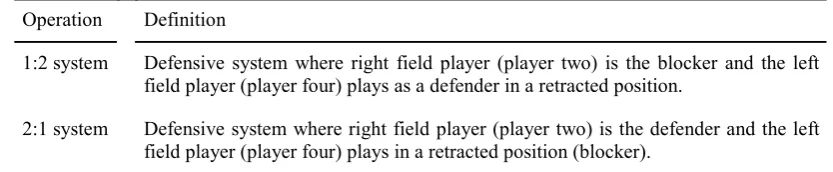
First, we analyzed the systems used to defend the attacks from the opposing team (Table 1).
Table 1. Categorizing systems analyzed.
Operation Definition
1:2 system Defensive system where right field player (player two) is the blocker and the left field player (player four) plays as a defender in a retracted position.
Once established the systems to be analyzed, an observation matrix was developed to determine the effectiveness of the systems and frequency points or loss. A classification of completion point was raised (Table 2).
Table 2. Description completion point. Operation Definition
Win When the disputed point is won following an attack.
Not Win When the game following an attack continues because the defending team continues to dispute the point or the point is lost.
Furthermore, we classify completions and frequency depending on the time that the action occurred along the set. By doing so, it is possible to see the evolution of systems, completions and frequencies throughout these periods of the game. To do this, the following periods were established (Table 3).
Table 3. Description and division of sets in period of points.
Operation Definition
F1 Actions between point 1 and 7 of the analyzed team.
F2 Actions between point 8 and 14.
F3 Actions between point 15 and 21.
Note: F1: Period point 1; F2: Period point 2; F3: Period point 3.
The significance of the comparison of systems is calculated using the Z test to compare proportions.
1
After carrying out the analysis of the most used systems by male players in the European University Championship, we learned that the most widely used one was 2:1 system with 67.2% ( =630). In this system, the left player (number 4) is the blocker and the right player (number 2) is the defending field player or the delayed player. By contrast, the least defense system used was the 1:2 system with 32.8% ( =307), establishing a statistically significant difference in comparing their proportions ( <0.001).
On the one hand, regarding winning points effectiveness, system 1:2 presents a moderately low value of 25.7% ( =79). By contrast, most of the disputed points in this defensive system are not won (74.3%, =228). This low value indicates that a great defensive difficulty exists in beach volleyball, 1 of every 4 actions can defend and end up by scoring the point in this system. In addition, there is a significant difference between the points scored and unscored with this game system ( <0.001).
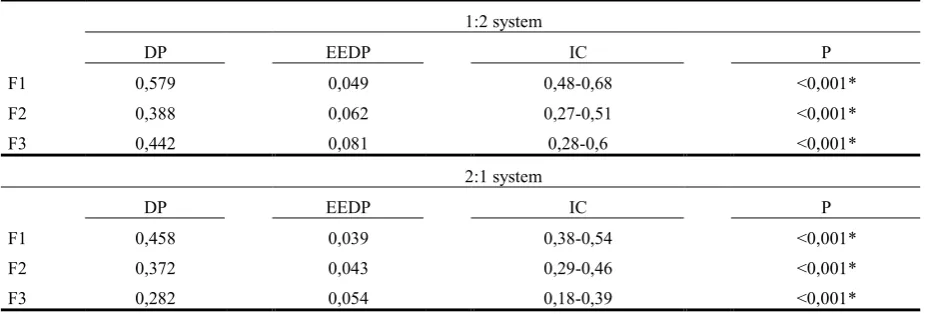
On the other hand, the system 2:1 presents an efficiency of success of 30.8% ( =194) whereas the majority of the points disputed with this defensive system are not scored (69.2%, =436). As in the 1:2 system, a great defensive difficulty exists since the majority of the defended points do not end up by being scored. A significant difference between the scored and unscored points using this game system ( <0.001) has been established (see Table 4).
Table 4. Comparison of proportions between earned and unearned points by systems and periods.
1:2 system
DP EEDP IC P
F1 0,579 0,049 0,48 0,68 <0,001*
F2 0,388 0,062 0,27 0,51 <0,001*
F3 0,442 0,081 0,28 0,6 <0,001*
2:1 system
DP EEDP IC P
F1 0,458 0,039 0,38 0,54 <0,001*
F2 0,372 0,043 0,29 0,46 <0,001*
F3 0,282 0,054 0,18 0,39 <0,001*
Note: F1= Period 1, point from 1 to 7; F2= Period 2, point from 8 to 14; F3= Period 3, point from 14 to 21. In third set, F1 is from point 1 to 5, F2 from point 6 to 10 and F3 from point 11 to 15.
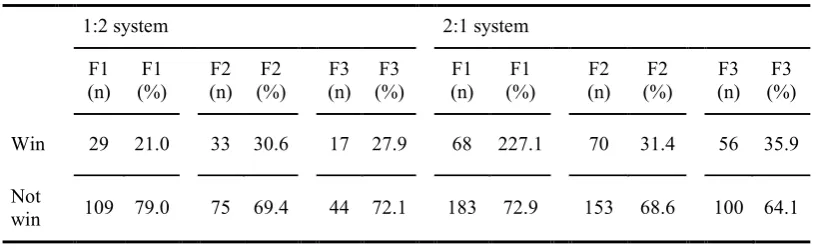
Then, Table 5 presents a comparative analysis of these two game systems to observe the differences.
On the one hand, the effectiveness of success depending on the system do not show great differences among the relative values of percentage, but they do show them in the absolute values of frequency. A deeper analysis reveals greater percentage difference in effectiveness in period 3 (F3). In fact, the system 1:2 showed an effectiveness of 27.9%, while in system 2:1, the effectiveness was higher with 35.9%, the biggest difference recorded between two systems. Notably, similar values were recorded during period 2 (F2) for both system 1:2 to system 2:1.
On the other hand, it should be noted that regarding unscored points, a decrease in the actions was experienced in both systems. A loss of 59.63% of absolute actions between period 1 (F1) and period 3 (F3) of the system 1:2 has been established, opposite to 45.35 % of loss between the same striping of the system 2:1. As mentioned above, it is necessary to remember that in the unscored actions, the actions are included where after an assault the point is continued. This type of actions poses a greater stringency on the players, as they must continue to extend the average time points, which might explain this decrease so accused in the absolute frequencies of unscored points.
Finally, if the efficacies of both systems, regardless of the absolute values are compared, it is possible to see an increased use of system 2:1 compared to 1:2, with no statistically significant differences between the use of one system or another ( =0.109). If a comparison by periods of points is performed, no statistically significant differences between the efficacies of both systems are established.
The situation and attack position determine the range of possibilities of attack, widely described in the literature reviewed. An attack by zone 4 has four possibilities: line attack, feinting to the line, the attack on the long diagonal and a short diagonal attack (Schläppi Lienhard & Hossner, 2015). Therefore, taking into account these possibilities, the positions of the game are set to cover the widest possible area, both online and in the field. Considering this defensive structure, a study containing an analysis on professional women´s beach volleyball players distinguished fourteen gaming systems (Seweryniak et al., 2013), of which only four stood out. This research is only based on two systems, but the authors state that these are the basis of the fourteen included in their study of defense in women's beach volleyball.
Of the two systems analyzed, the predominance of one of them arises, the system 2:1, being the most frequently presented. This prevalence could be explained by different causes, including the fact that blockers are higher than defenders (Tili & Giatsis, 2011). The height difference means that taller players occupy the fourth position in the field, as this allows a greater possibility of strong attacks for the right handed players. Players who play defensive roles have better values in their physical conditions and agility than their peers (González, Sedano, Fernández, & Díaz, 2014), which would support this idea. This defensive game delayed or position in zone two field requires better values of speed, agility and movement, which determine the type of defensive tactic employed to neutralize the attacks of the opposing team.
As it was suggested by the literature, on teams where two players with similar characteristics, roles of defense and blocking are exchanged (Palao et al., 2008). This could explain that, independently of the game system used only 2:1 system shows an increase of 5.1% of relative effectiveness compared to the system 1:2.
Most teams had a 2:1 system configuration to suit the anthropometric characteristics of their players, i.e., a high block and a short defender. This configuration could explain that the differences are not in the relative effectiveness values, but in absolute values.
completed. These types of actions mean that the average time points increase, which directly influences the charging game and therefore causes the drop in performance because of fatigue (Cameli et al., 2005). Given that jump height is a determining factor in sporting success (Batista et al., 2008), fatigue shows a decrease of 25% in the jumping capacity (Edwards, Steele, & McGhee, 2010), which takes players to be less strong and effective in both attack and defensive actions.
Finally, the increase of the efficiencies as the set advances might be explained as a consequence of the reading and the interpretation of the game on the part of the defensive team (Güldenpenning, Steinke, Koester, & Schack, 2013), since the reading of the game is based on the experience of the players (Cañal Bruland, Mooren, & Savelsbergh, 2011). Therefore, a better reading of the game and evaluation as the set develops would help to increase the relative values of efficiency, regardless of the type of defensive system used. This is why it is very important to plan meetings, because stressful situations lead to a negative reading of the game, and this can make someone take the wrong decision, which will end up affecting negatively the development of the game (Vieira, Carruzo, Malheiros, Aizava, & Rigoni, 2013).
The most used system of game is the system 2:1 with 67.2 % of the total of analyzed actions. The most effective system was again 2:1 with 30.8 % of the disputed points.
The efficiency of both systems evolves positively as for efficiency.
The frequency of absolute actions undergoes a negative decrease especially when it comes to the Not Win (NW) points.
1
Batista, G. R., De Araujo, R. F., & Guerra, R. O. (2008). Comparison between vertical jumps of high performance athletes on the Brazilian men’s beach volleyball team. Journal of Sports Medicine and Physical Fitness, 48(2), 172–176.
Bishop, D. (2003). A comparison between land and sand based tests for beach volleyball assessment. , (4), 418–423.
Cameli, S., Ferretti, A., Fontani, G., Gallozzi, C., Menchinelli, C., Montorsi, A., & Zeppilli, P. (2005). Physiological and clinical aspects of volleyball and beach volley. , !(1), 65–71. Cañal Bruland, R., Mooren, M., & Savelsbergh, G. J. P. (2011). Differentiating Experts Anticipatory Skills in
Beach Volleyball. " # $ , !%(4), 667–674.
Chen, B. (2014). The Study on Lack of Ready Stance and Movement in College Volleyball Teaching. In
& ' ( (pp. 242–249).
Chen, H. T., Tsai, W. J., Lee, S. Y., & Yu, J. Y. (2012). Ball tracking and 3D trajectory approximation with applications to tactics analysis from single camera volleyball sequences. )
* , +,(3), 641–667.
Edwards, S., Steele, J. R., & McGhee, D. E. (2010). Does a drop landing represent a whole skill landing and is
this moderated by fatigue? - . , %,(3), 516–523.
García Alcaraz, A., Palao, J., & Ortega, E. (2014). Perfil de Rendimiento Técnico Táctico de la Recepción en Función de la Categoría de Competición en Voleibol Masculino. / , 0 (1).
Gea Garcia, G. M., & Molina Martin, J. J. (2013). The Serve as a Decisive Action in the Ranking in Women’s Beach Volleyball. 1 & 1 2 , (22), 49–58.
Giatsis, G., Kollias, I., Panoutsakopoulos, V., & Papaiakovou, G. (2004). Biomechanical Differences in Elite Beach Volleyball Players in Vertical Squat Jump on Rigid and Sand Surface. 3 , (1), 145–158.
Giatsis, G., Tili, M., & Zetou, E. (2011). The height of the women’s winners FIVB Beach Volleyball in relation
to specialization and court dimensions. 4 $ , +(3), 497–503.
Gomez, G., Herrera López, P., Link, D., & Eskofier, B. (2014). Tracking of ball and players in beach volleyball videos. 5 , 6(11), e111730.
González, Y., Sedano, S., Fernández, J., & Díaz, H. (2014). Estudio comparativo de factores antropométricos y de condición física en jugadores jovenes de voleibol colombiano. " - 78 818* * .
- 9 1 : , 0;(1), 53–63.
Güldenpenning, I., Steinke, A., Koester, D., & Schack, T. (2013). Athletes and novices are differently capable to recognize feint and non feint actions. $ 3 " , % ,(3), 333–43.
Hughes, M. (2004). Notational analysis – A mathematical perspective.
* , (2), 97–139.
James, N., Taylor, J., & Stanley, S. (2007). Reliability procedures for categorical data in Performance Analysis.
* , ;(1), 1–11.
Jimenez Olmedo, J. M., Penichet Tomas, A., Saiz Colomina, S., Martinez Carbonell, J. A., & Jove Tossi, M. A.
(2012). Serve analysis of professional players in beach volleyball. 4 $ ,
Jlassi, M. M., Douik, A., & Messaoud, H. (2012). Objects Detection by Singular Value Decomposition Technique in Hybrid Color Space: Application to Football Images. 1
1 1 , (2), 193–204.
Kim Geok, S. O. H., bin Yusof, A., Kim Lam, S. O. H., Fauzee, M. S. O., & Hiong Kwong, M. O. H. (2012). Agility and leg power comparison between university Indoor and beach volleyball players. *
. " , 0!(1), 31–35.
Link, D. (2014). A toolset for beach volleyball game analysis based on object tracking.
1 , 0 (1), 24–35.
Magalhaes, J., Inacio, M., Oliveira, E., Ribeiro, J. C., & Ascensao, A. (2011). Physiological and neuromuscular impact of beach volleyball with reference to fatigue and recovery.
, 0(1), 66–73.
Medeiros, A., Marcelino, R., Mesquita, I., & Manuel Palao, J. (2014). Physical and temporal characteristics of
under 19, under 21 and senior male beach volleyball players. ,
0 (3), 658–665.
Moreno Arroyo, M., Moreno Dominguez, A., Urea Espa, A., & Garcia Gonzalez, L. (2008). Representacion de problemas tacticos en colocadoras de voleibol de las selecciones nacionales españolas: efecto de la pericia.
" - < = , (2), 229–240.
Palao, J. M., Gutierrez, D., & Frideres, J. E. (2008). Height, weight, Body Mass Index, and age in beach
volleyball players in relation to level and position. , !(4),
466–471.
Palao, J. M., & Ortega, E. (2015). Skill efficacy in men’s beach volleyball.
* , 0 (1), 125–134.
Palao, J. M., & Ureña, A. (2004). Effect of team level on skill performance in volleyball. 4
* , (2), 50–60.
Palao, J. M., Valadés, D., Manzanares, P., & Ortega, E. (2014). Physical actions and work rest time in men’s beach volleyball. >? " - @A : , %,(3), 257–261.
Schläppi Lienhard, O., & Hossner, E. J. (2015). Decision making in beach volleyball defense: Crucial factors
derived from interviews with top level experts. $ , 0+(P1), 60–73.
Seweryniak, T., Mroczek, D., & Lukasik, L. (2013). Analysis and evaluation of defensive team strategies in women’s beach volleyball – An efficiency based approach. 4 - , 0 (1), 48–55.
Smith, R. (2006). Movement in the sand: Training implications for beach volleyball. 1 , %!(5), 19–21.
Tili, M., & Giatsis, G. (2011). The height of the men’s winners FIVB beach volleyball in relation to
specialization and court dimensions. 4 $ , +(3), 504–510.
Tilp, M., Koch, C., Stifter, S., & Ruppert, G. S. (2006). Digital game analysis in beach volleyball.
* , +(1), 1.
Vieira, L. F., Carruzo, Nayara Malheiros. Aizava, P. V. S., & Rigoni, P. A. G. (2013). Análise da síndrome de “burnout” e das estratégias de “coping” em atletas brasileiros de vôlei de praia. " - 3
@A : , %, 269–276.
Zhang, Y., Zhao, H., & Wu, J. (2006). Research and application of data mining algorithm on technical tactics