249 , Tracing the linguistic crossroads
© 2015 Faculty of Humanities, University of Indonesia
Tom G. Hoogervorst took his PhD degree at the University of Oxford as part of a project
on cultural contact in the pre-modern Indian Ocean World. He is currently a postdoctoral researcher at the Royal Netherlands Institute of Southeast Asian and Caribbean Studies (KITLV). His main research interest is in the Malay language and linguistic history. In this field of inquiry, his former teacher Hein Steinhauer has been and continues to be an inspiration. Tom G. Hoogervorst may be contacted at: [email protected].
Tracing the linguistic crossroads
between Malay and Tamil
Tom G. Hoogervorst
Coretan ini cuma salah satu dari hasil karya yang terlahir dari kemurahan hati dan dorongan yang berterusan dari Pak Hein.
Abstract
Speakers of Malay and Tamil have been in intermittent contact for roughly two millennia, yet extant academic work on the resultant processes of contact, lexical borrowing, and language mixing at the interface of these two speech communities has only exposed the tip of the proverbial iceberg. This paper presents an historical overview of language contact between Malay and Tamil through time and across the Bay of Bengal. It concludes with a call for future studies on the lexicology, dialectology, and use of colloquial language of both Malay and Tamil varieties.
Keywords
Malay, Tamil, language contact, loanwords.
1. Introduction
since time immemorial. However, while the lexical influence from high-status literary languages such as Sanskrit and Arabic on Malay is relatively well-known (Jones 2007), the impact of spoken vernaculars remains much less so. This is due in part to the fact that many vernacular languages of South and Southeast Asia are themselves understudied, especially in language ecologies characterized by wide-ranging diglossia. Furthermore, language contact between Southeast Asia and other regions of Asia has long been approached as a unidirectional process, reducing Southeast Asia’s populations to mere recipients. There is a modicum of work on the dispersal of pre-modern loanwords from West-Malayo-Polynesian languages to other languages of the Indian Ocean (Hoogervorst 2013), but more could be done in this area. With the exception of Sri Lanka Malay, mixed languages at the interface of Malay and Tamil are almost undocumented.
An historical analysis of language contact between Malay and Tamil, as will be attempted here, provides a better understanding of the past of the Bay of Bengal as an axis of global trade and cultural exchange. This study traces the shared history of two of the largest speech communities of the Indian Ocean World, reconstructing their inter-relationship across several time periods and geographical settings. In the absence of accurate grammatical descriptions of most of the “hybrid“ linguistic varieties discussed in this paper, much of my analysis will be of etymological nature. Consequently, this paper cannot be anything but sweeping and remains far from exhaustive. Most of the data and insights presented here are taken from secondary sources, rather than first-hand fieldwork. That being said, the paucity and scattered distribution of scholarship on Malay-Tamil language contact calls for a synthesis and overview of the available data as a first step to determine pathways for further research. In doing so, this study serves to demonstrate what we know, but also what we do not know. It is structured as follows: Section 2 summarizes the long history of contact between Malay and Tamil; Section 3 focuses on relationship between the two languages as reflected in the classical Malay literature; Section 4 introduces the type of Malay spoken by Tamils at present; Section 5 surveys Malay varieties in historical contact with Tamil; Section 6 traces the languages spoken by mixed Malay-Tamil communities; and Section 7 synthesizes our present state of knowledge on the Tamil variety (or varieties) used in Malaysia.
2. History of contact
The archaeological record reveals that contact between South India and Southeast Asia was regular from the first centuries BCE (Ardika and Bellwood 1991; Bellina and Glover 2004). The Old Javanese kakawin literature contains numerous Tamil loanwords, as does classical Malay (Hoogervorst in press a).1
From at least the ninth century, Tamil inscriptions surface across Southeast Asia (Karashima and Subbarayalu 2009), while different Indian ethnonyms
1 And see Ronkel (1902), Asmah (1966), and Jones (2007) on Tamil loans in modern
, Tracing the linguistic crossroads
start to feature in the Old Javanese literature around the same time (Christie 1999). For example, early eleventh century Airlangga inscriptions make a distinction between Kling, Āryya, Singhala, and Karṇaṭaka (Krom 1913), while the mid-fourteenth century Nāgarakərtāgama adds Goḍā and Kāñcipurī (Pigeaud 1962: 36). South Indian influence is especially strong in North Sumatra. The Dutch orientalist Van Ronkel (1918) was the first to call attention to a number of cultural and lexical peculiarities among the Karo-speaking Sembiring clan, which he connected to the historical presence of Tamil trading guilds in the region. Recent archaeological research supports the settlement of South Indian populations in North Sumatra in medieval times (Guillot and Fadillah 2003; Perret and Surachman 2009). In later times, multi-ethnic Islamic networks between South India, Sri Lanka and the Malay World begin to overshadow earlier Hindu and Buddhist connections (ʻĀlim 1993; Tschacher 2001; Feener and Sevea 2009; Ricci 2011).
The South Indian populations in contact with Maritime Southeast Asia were diverse in terms of religion and caste. By the fourteenth century, Tamil-speaking Muslim communities started to outnumber their Hindu compatriots (McPherson 1990). The first group was then commonly known as Kling or Keling. This ethnonym is probably connected to the Kaliṅga State in present-day Odisha and would later become the generic name for “Indian“, even applied to some Indianized communities in Southeast Asia (compare Damais 1964; Mahdi 2000: 848). At present, the term is regarded as pejorative across the Malay-speaking world. The collective term for South Indian Muslim traders was Chulia or Chuliah.2 The Chulia were seen as distinct
from mercantile Muslim groups from Gujarat and other western regions of India, such as the Ḵẖojā and the Bohrā (compare Hussainmiya 1990; Noor 2012).3 South Indian Muslim communities display a substantial and at times
confounding terminological variety (Bayly 1989; ʻĀlim 1993; Tschacher 2001; Hussein 2007; Pearson 2010). One of the terms used for them by non-Muslim Tamils is Jōṉagaṉ (ேசானகன்), which is especially applied to Muslims of partly Arabic or Turkish descent. The colonial British censuses typically distinguish the following subgroups of South Indian Muslims:
1. Marakkar or Maricar (Tamil: Marakkāyar; மரக்காயர், Malay: Marikar) A group claiming ancestry from Arabic merchants, as opposed to less esteemed local converts. They were mostly involved in international shipping trade, inhabited coastal regions, and adhered to the Shāfiʿī school (maddhab) of Islamic jurisprudence (fiqh). The Kāyalār, from the coastal town Kāyalpaṭṭiṉam, are normally considered to be a subgroup of the Marakkāyar.
2 Malay Culia, Tamil Cūliyā (�லியா). The origins of this term are uncertain. See Khoo
(2014) for a history of the Chulia community in Penang.
2. Labbai or Labbay (Tamil: Labbai; லப்ைப, Malay: Ləbai)
Originally an honorary term for an Islamic functionary,4 but later used to
designate a particular Tamil-speaking community of the Ḥanafī maddhab. They were traditionally involved in trade, pearl-diving and betel-cultivation. The term Labbai is also occasionally applied to non-Marakkāyar Tamil-speaking Muslims as a whole.
3. Mappila or Moplah (Malayalam: Māppiḷa; മാപിള) പ
Malayalam-speaking Muslims of partly Arabic ancestry who chiefly resided in the M
.
alabār region (present-day Kerala). The majority follow the Shāfiʿī
maddhab
4. Muslims “from the north”
A container term for predominantly Urdu-speaking Muslims residing in different parts of South India, encompassing the ethnonyms Navaiyat, Sayyid, Shayḵẖ, and Paṭhān. These groups claim be descended from non-Dravidian men in service of the Mughal and Deccan sultans. Special mention can be made of the Rowthers (Tamil: Rāvuttar;
ரா
�த்தர்
), a Tamil-speaking group of the Ḥanafī maddhab claiming descent from Turkish (Tulukkar; ��க்கர்) horsemen.Many Indian merchants who ventured to Southeast Asia married local women. The affluent and influential mixed community that thus emerged became known in Malay as the Jawi Pəranakan ‘local-born Jawi’.5 These children of
merchants were well-connected with the Muslim elites in Southeast Asia and beyond (Fujimoto 1989). In the Straits Settlements, their multilingual background, including in English, qualified them for lucrative employment under the colonial government. They were also involved in the printing press. In 1876, a Singapore-based Malay printing office under the name Jawi Pəranakan
published – at the same time – Southeast Asia’s first Tamil and first Malay newspaper (Birch 1969; Tschacher 2009).6 In Aceh, mixed people of Tamil
ancestry – mentioned by Snouck Hurgronje (1893: 20) as basterd-Klinganeezen – appear to have largely assimilated into the Acehnese mainstream, being only recognizable on a phenotypical level. A still existing hybrid group are the so-called Chitty (Tamil: Ciṭṭi; சிட் �), the offspring of Kəling fathers and Malay mothers in Malacca. Their name goes back to Chetty (Tamil: Ceṭṭi;ெசட் �, Malay: Ceti), a term loosely applied to a number of South Indian mercantile castes and money-lenders in the Malay World. The Chitty people have kept their Hindu
4 In Sri Lanka Malay, lebbe still refers to an Islamic scholar (Saldin 1993: 1015). In
Indonesia, ləbai typically refers to a mosque official.
5 In Penang, the term Jawi Pəkan ‘urban Jawi’ is more common. The word Jawi
presumably goes back to Arabic Jāwī, an umbrella term for Malays and other Southeast Asian Muslims.
6 The Tamil newspaper was named Taṅgai Siṉēhaṉ (தங் ைக சிேனகன் ), the Malay
newspaper Jawi Peranakan. Contrary to popular belief, the latter was not the world’s first Malay
, Tracing the linguistic crossroads
religion to this day, yet can be considered Malay in terms of language and culture (Raghavan 1977).7 In post-independence Malaysia, however, Chitties
have thus far been unsuccessful in claiming bumiputra-ship, whereas most Muslim Jawi Peranakan conveniently registered themselves as Malays.8
Cultural contact between South and Southeast Asia persisted into modern times. While the British Government had a long tradition of employing Indian personnel in the Straits Settlements, the late nineteenth century saw a substantial increase of labour migration from South India to the Malayan rubber plantations and tea estates. This led to an influx of Indian Tamils, Sri Lankan Tamils, Malayalis, Telugus, and other South Asian communities, then known as ‘coolies’ (Tamil: kūli; �லி). This system of indentured labour depended on local recruiters and became known as the ”kangani system” (compare Guilmoto 1993), from the Tamil word kaṇgāṇi (
கண்கா
ணி) ‘supervisor of coolies in plantations’. Around the same time, the Dutch relied on agricultural labourers from South India and other regions to work on the infamous estates of Deli in northern Sumatra (Mani 1993a). The cultural cross-fertilization between South and Southeast Asian populations in Malaysia, Singapore, southern Thailand and parts of Sumatra led, among other things, to the emergence of a mixed Indian-Malay cuisine known as mamak food, from the Tamil word māmā (மாமா
) ‘uncle’. Popular dishes include roti canai‘layered flatbread’, murtabak or martabak ‘stuffed pancake’, nasi kandar ‘steamed rice with various curries’, mamak rojak ‘fruit and vegetable salad’ and teh tarik ‘pulled tea’.
3. Literary connections
In the light of the trans-regional Islamic networks across the Bay of Bengal, it is not surprising to see South Indian influence reflected in the classical Malay literature. The Hikayat Səri Rama – the Malay version of the Rāmāyaṇa – for example, displays some uncommon Tamil words. One example is c-ng-g-l-n-r
‘a type of water-lily with miraculous powers’, which reflects Tamil ceṅgaḻunīr (ெசங் க ழ நீ ர் ) ‘purple Indian water-lily; red Indian water-lily’ (compare Von de Wall 1877-97, appendix: 24; Van Ronkel 1902: 107). Other examples are parwadam ‘mountain’ from Tamil parvadam (
பர் வதம்
) (Juynboll 1899: 66) and tərisulam ‘trident’ from tirisūlam (திரி�லம் ) (Van Ronkel 1919: 383). The names of some of the characters, too, suggests that the hikayat contains Tamil influence (Table 1).7 The fact that the Chitties have never converted to Islam would either imply that
not all Malays were Muslims by the time this hybrid group emerged, or that interreligious marriages were historically seen as less problematic in the Malay World than they are at present (Raghavan 1977: 444-445).
Malay Tamil Sanskrit
Baradan Baradaṉ (பரதன்) Bharata
Kikukan Kukaṉ (�கன்) Guha
Nikumbili Nikumbalai (நி�ம்பைல) Nikumbhilā
Surapandaki Sūrppaṇakai (�ர்ப்பணைக) Śūrpaṇakhā Səri Jati9 Tirijaṭai (திரிசைட) Trijaṭā
Bibusanam Vibiṣaṇaṉ (விபி
ஷ
ணன்) Vibhīṣaṇa9101112131415
Malay Tamil
Anji-w-n-t-r Añjuvaṉattār (அஞ்�வனத்தார்) Bijayanagaram Vijayanagaram (விசயநகரம்) Cit-m-b-ram Cidambaram (சிதம்பரம்)10
Kh-l-y-k-t11 Kō
ḻikkōṭu (ேகாழிக்ேகா�)12
K-n-di Kaṇḍi (கண்�)13
K-s-n-r-y-n Kiruṣṇarāyaṉ (கி௫
ஷ்
ணராயன்)14K-s-t-r-y-n Kṣattiriyaṉ (
�த
்திரியன்)M-l-wari Malabāri (மலபாரி)
N-l-s-ng-kun15
Narasiṅgaṉ (நரசிங்கன்)
The Hikayat Hang Tuah contains more clues to Tamil influence on the classical Malay literature. During his diplomatic journey to the Tamil Land (Bənua Kəling), the story‘s protagonist surprised his hosts with his fluency in Tamil,
9 This form is evidently rationalized as consisting of the Malay honorific Səri, which is
Sanskrit Śrī.
10 This is the name of a famous Shaiva shrine in the Arcot district. The word was left unidentified by Van Ronkel (1904: 315) and is commonly transliterated as the meaningless compound sitam bərama in later editions of Hikayat Hang Tuah.
11 Van Ronkel (1904: 314) regards this form as a misspelling of P-l-y-k-t (Pulicat). 12 Presumably the city of Calicut.
13 This presumably denotes the city of Kandy (Sri Lanka), although Van Ronkel (1904:
314) connects it to the Kannaḍa community in South India.
14 Reflecting Sanskrit Kr̥ṣṇarāja, a common title for South Indian kings.
15 At present, this name is typically transliterated as Nala Sang Guna, which makes little
etymological sense.
Table 1. Tamil names in the Hikayat Səri Rama (Juynboll 1899; Muniandy 1995).
, Tracing the linguistic crossroads
which he proclaimed to have learned from a Ləbai from that country. As first pointed out by Van Ronkel (1904), here too we find a number of Tamil-derived onomastics and caste names. Table 2 above lists the Jawi transliterations and their tentative precursors.
A third Malay literary work that casts some light on Malay notions of India is the Hikayat Pərintah Nəgəri Bənggala. This text, written in 1811 by the Chulia author Ahmad Rijaluddin, contains a number of uncommon Tamil loanwords, such as bangku ‘dagger’ from vāṅku (
வாங்
�) and banam ‘rocket’ from vāṇam (வாணம்
) (Skinner 1982: 168, 173). In addition, we come across a number of Malay names for South Indian toponyms (Table 3), although it is uncertain what role, if any, these places play in the popular Malay imagination of those days.16
Malay Tamil English
Harkat Āṟkāṭu (ஆற்கா�) Arcot
Macəli Maccilippaṭṭaṇam (மச்சிலிப்பட்டணம்) Masulipatam Mahu Māhē (மாேஹ) Mahé Naga Patan Nāgappaṭṭiṉam (நாகப்பட்�னம்) Negapatam
Nagor Nāgūr (நா�ர்) Nagore
Tanjauru Tañjāvūr (தஞ்சா�ர்) Tanjore
Tipu16 Srīraṅ
gappaṭṭaṇam (�ரங்கப்பட்டணம்) Seringapatam
Muslims of mixed Malay-Tamil ancestry were often bilingual if not multilingual. By the late nineteenth century, they typically published both Tamil and Malay newspapers in Sri Lanka (Hussainmiya 2008) as well as the Malay World. In the Straits Settlements, Jawi Pəranakan children would have learnt Malay from their mothers and Tamil from private tutors (Fujimoto 1989: 98 fn. 18). This is confirmed in the writings of the famous early nineteenth-century Munshi Abdullah, a Malacca-born author of mixed origins who grew up in a district known as Kampung Pali (Tamil: paḷḷi; பள்ளி) – ‘Kampung of the Mosque’ – a historical part of Malacca known for its mixed population. In his mid-nineteenth century autobiography named Hikayat Abdullah, he wrote that “it had been the custom from the time of our forefathers in Malacca for all the children of good and well-to-do families to learn it [Tamil]. It was useful for
doing computations and accounts, and for purposes of conversation because at that time Malacca was crowded with Indian merchants. Many were the men who had become rich by trading in Malacca, so much so that the names of Tamil traders had become famous. All of them made their children learn Tamil” (translation from Hill 1955: 48).
The tradition of multilingualism among the literate elite led to a degree of convergence between Islamic Malay and Tamil literature. As previous scholars have pointed out (ʻĀlim 1993: 95-99; Tschacher 2009: 53-54; Ricci 2011: 174), these shared origins become evident upon comparing the ways in which sounds absent in the Arabic alphabet are represented in Arabized Malay (Jawi) and Arabized Tamil (Arwi). This is done in a remarkably similar way, with minor differences on a diacritical level: the voiceless bilabial stop /p/ is written as fā’ <ف> with three upper dots in Jawi and with one lower
dot in Arwi, the velar nasal /ŋ/ as ‘ayn <ع> with three upper dots in Jawi
and with three lower dots in Arwi, and the palatal nasal /ɲ/ as nūn <ن> with
three upper dots in Jawi and two lower dots in Arwi. It should be noted here that the Arabicized writing practice dates back to the early fourteenth century in the Malay World, whereas it presumably developed around the late sixteenth century in the Tamil-speaking areas of South India (Tschacher 2001: 27; Ricci 2011: 98), cautioning researchers not to assume an a priori eastward directionality of cultural transmission.
Regrettably, it is not known how many multilingual or otherwise hybrid manuscripts are housed in public and private libraries worldwide. In the late nineteenth-century, there is some circumstantial evidence that the Acehnese kept their administrations records in Klingaleesch, to wit, Tamil (Scherer 1891: 298). One of these manuscripts is mentioned by Voorhoeve (1952: 212) in his inventory on Indonesian manuscripts at the Leiden University Library. That same library also houses the ʿIẓām al-fawā’id fi niẓām al-ʿaqā’id, a 1730s manuscript written partly in Tamil and partly in Malay (Van Ronkel 1922; Tschacher 2009: 54). ʻĀlim (1993: 105-106) calls attention to “a book on Muslim Medicine edited in 1807 AD […] written in four languages: Javanese (Javi) [sic!], Persian, Arwi and Arabic” kept in the “Indonesian Manuscript Library at Jakarta”, which is likely to be the same manuscript (B.A. Hussainmiya, personal communication on 12 December 2014). This multilingual Islamic tradition may have persisted into recent times. An undated but modern-looking manuscript discovered in 2008 by Mahyudin Syukri and Siti Aisyah in Balai Jering (Kampar, Riau Province, Indonesia) contains a quadrilingual word-list – Arabic, Malay, Urdu and Tamil – written by a local Muslim scholar (Aisyah 2014). It is hoped that similar works will surface in private collections in Indonesia, Malaysia and Sri Lanka.
4. The Malay used by Tamils
, Tracing the linguistic crossroads
Kelantan, Rafferty (1982) on Malang, Oetomo (1987) on Pasuruan, and Wolff and Poedjosoedarmo (1982) on Central Java. The same cannot be said of varieties spoken by Indian communities. Mohamed (2006) describes the lexico-phonology of the dialect belonging to the Chitty community, whereas Hassan (1969) and Kader (1971) provide some notes on colloquial Malay as spoken by Tamils. While the majority of local-born Indians speak Tamil at home and some have switched to English, a small part of this group have adopted the Malay language.17 A systematic study on Malay as spoken by people of South
Indian ancestry, however, remains to be conducted to this day.
Research on errors (kəsalahan) in Malay offers an otherwise infrequent glimpse into the Malay speech habits of Tamils. I can only give an incomplete set of isolated examples from the sources available to me. On a phonological level, the following tendencies, some of which inconsistent, are observed among Tamil pupils in Malaysian schools (Gan 1982, quoted in Onn 1989: 78-79):
(1) Omission of /h/
boleh > bole ‘can’ hisap > isap ‘to suck’ hujan > ujan ‘rain’ puluh > pulu ‘ten’ sudah > suda ‘already’ tahun > taun ‘year’
18
(2) Substitution of /ə/ by /a/, /e/ or /i/18 əmpat
>
ampat ‘four’ənam
>
anam ‘six’ pəcah>
pica ‘broken’ səlalu>
silalu ‘always’ səndiri>
sindri ‘self’ təmpat>
tempat ‘place’ tərus>
terus ‘direct’(3) Gemination of word-medial stops apa
>
appa ‘what’ sədikit>
siddikit ‘a little’17 In 2005, 10.6% of Singapore’s Indian population spoke Malay at home (Aman et al. 2009).
The Malaysian statistics are unknown to me.
18 All three variations are attested, for example, in the Tamil renditions of Malay
(4) Devoicing of /g/
gətah
>
keta ‘rubber’ goreng>
koring ‘to fry’ tiga>
tika ‘three’(5) Fricativization of /w/
wang
>
van [vang?] ‘money’ wayang>
vayang ‘movie’(6) Monophthonization of /ai/ kədai
>
kede ‘shop’Gan (1982) gives no examples on the pronunciation of the diphthong /au/. Mohamed (2006: 88-89) mentions in passing that kalau ‘if’ is pronounced as kalu by Tamil speakers.19 She also lists two examples which make it clear that the
glottal stop /ʔ/ at the end of a syllable – written in Malay as <k> – is omitted by Tamil mother tongue speakers: anak > ana ‘child’ and kakak > kaka ‘older sister’. In addition, it has been pointed out that Tamil-speakers pronounce orang ‘person’ as worang and barang ‘goods’ as bareng (Hassan 1969: 218). Both examples can be explained through the phonology of colloquial Tamil. The automatic onset of /w/ before close and close-mid back vowels is common across spoken Tamil varieties (Schiffman 1999: 16). In certain dialects, the word-final ending –/aN/ is pronounced as –/ẽ/ (Schiffman 1999: 18), which would explain the transcription of bareng for standard Malay barang. No further examples are given by Hassan (1969) or other scholars to determine the distribution and regularity of this phonological tendency.
On a grammatical level, Kob (1989: 495) provides the following examples of interference from colloquial Tamil on the word order of spoken Malay (here and elsewhere: the spelling, translations and glosses are mine):
(7) Itu saya punya suka=lah
dem 1sg pos like=part
Inda enuḍaiya viruppam (Tamil) dem 1sg.gen desire
‘That’s the one I like.’
(standard Malay: Saya suka itulah.)
(8) Api kəreta jalan sudah fire cart go already
, Tracing the linguistic crossroads
Pugai=vaṇḍi pōy=viṭṭadu (Tamil) Fire=cart go=leave.pst
‘The train has departed.’
(standard Malay: Kəreta api sudah jalan.)
However, the latter example may also reflect a Hokkien structure (Kob 1989: 495):
(9) Hóe chhia kiâⁿ liáu
火 車 行 了
fire cart go already
Rather than dismissing these phonological and syntactic patterns as erroneous, Hassan (1969) introduces the term ‘Tamil Bazaar Malay’ (Bahasa Məlayu Pasar Tamil) and lists a number of characteristics. While the noun phrase-initial position of the demonstratives – as seen in example (7) – is quite common cross-linguistically and could reflect interference from Tamil, Hokkien or other languages, the clause-final position of the verb in Tamil Bazaar Malay specifically points to Indian influence.20 Hassan (1969: 212) provides the
following examples:
(10) Ahmad pokok panjat Ahmad tree climb ‘Ahmad climbs a tree.’
(standard Malay: Ahmad məmanjat pokok.) (11) Itu budak bola sepak
dem kid ball kick
‘That kid kicks a ball.’
(standard Malay: Budak itu mənyepak bola.)
In addition to clause-final verbs, Tamil and many other Indian languages also display postpositions instead of prepositions. This impacts on the Malay they use, as Mohamed (2006: 13) demonstrates in an isolated example:
(12) Saya rumah misjid bəlakang juga ada 1sg house mosque behind also is ‘I also have a house behind the mosque.’
(standard Malay: Saya juga ada rumah di bəlakang masjid.)
20 The basic SOV word order is common in Indian languages of various families,
Other characteristics of Tamil Bazaar Malay include a set of distinct personal pronouns and the use of the particle punya as a possessive marker. These features are shared with several other Malay contact varieties and will be addressed in more detail in the next section. Hassan (1969: 214) provides the following examples in Tamil Bazaar Malay:
(13) Saya punya rumah bəsar punya anjing ada 1sg pos house big pos dog is ‘There is a big dog in my house.’
(standard Malay: Di rumah saya ada səekor anjing bəsar.) (14) Saya punya rumah puteh (ada)
1sg pos house white (is) ‘My house is white.’
(standard Malay: Rumah saya bərwarna putih.)
In a MA thesis on Malay spoken by Tamils, Kader (1971: 446, quoted in Mohamed 2006: 31) provides some additional examples displaying the abovementioned features:
(15) Ittu jam worang tarak banyak dem hour people neg many
‘Not many people were around at that hour.’
(16) Ittu ujan tara brənti, sampe sattu ari po wora dem rain neg stop so.that one day part people tara kitta diyam sajja
neg 1pl still part
‘It was raining non-stop, so that nobody showed up for the entire day [and] we had nothing to do.’
, Tracing the linguistic crossroads
5. Bazaar Malay and other contact varieties
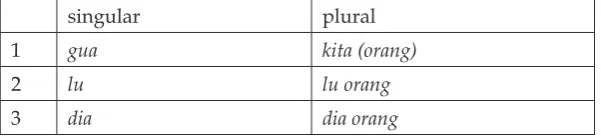
As mentioned in the previous section, some of the characteristics of colloquial Malay spoken by Tamils are attested more widely, especially in what is known as “Bazaar Malay“ – the container term for Malay contact varieties not spoken as a mother tongue. The Malaysian Tamils presumably learnt this basilectal variety for out-group communication. Studies on West Malaysian Bazaar Malay are not well-distributed beyond a local level and often remain unpublished (Hassan 1969: 210 fn. 3). On the Singaporean variety, Daw (2005) offers the most complete description. Across West Malaysia, Bazaar Malay is spoken by Tamils and Chinese as a contact language. Its personal pronouns (see Table 4), resemble those of other “pidgin-derived Malay varieties“.21
singular plural
1 gua kita (orang)
2 lu lu orang
3 dia dia orang
The Bazaar Malay personal pronouns reflect Chinese influence. The 1sg goes back to Hokkien góa (我), whereas the 2sg reflects dialectical Hokkien lú (汝) in the same meaning. The use of orang as a plural marker corresponds to lâng (人
or 儂) in some Hokkien dialects, including in the original meaning of ‘person; people’. This usage is also found in Chitty Malay (Mohamed 2006), Baba Malay (Gwee 2006), Sri Lanka Malay (Nordhoff 2009), Cocos Malay (Adelaar 1996) and several Eastern Indonesian Malay varieties (Paauw 2008). Sri Lanka Malay, along with other Malay varieties, also displays other loanwords from Hokkien, including loːteng ‘storey, floor’ and kuːwe ‘breakfast’ (Paauw 2004: 45).22 Other tentative Chinese loans attested as far as Sri Lanka include bangsat
‘bedbug’ and bopeng ‘pock-marked’ (compare Saldin 1993).23 This implies
that the Chinese played some role in the making of a vehicular Malay trade variety. On a grammatical level, this is corroborated by the use of punya as a possessive marker, which is attested in roughly the same pidgin-derived Malay varieties as the above-mentioned Chinese-derived personal pronouns. Pakir (1986: 141-162) demonstrates that the use of mia in Baba Malay – which goes back to punya – largely mirrors the Hokkien syntax:
21 In a paper on the language history of Malay, Adelaar and Prentice (1996) distinguish
“literary Malay varieties“, “pidgin-derived varieties“, and “Malayic vernaculars“. This distinction roughly corresponds to ‘written Malay’ (Bahasa Məlayu Tulisan), ‘regional Malay’ (Bahasa Məlayu Daerah) and ‘spoken Malay’ (Bahasa Məlayu Lisan), and ‘Bazaar Malay’ (Bahasa Məlayu Pasar) proposed by Hassan (1969).
(17) Dia mia mənantu (Pakir 1986: 141) I ê sin-pū (Hokkien)
伊 的 新婦
3sg pos daughter-in-law ‘His daughter-in-law’ (18) Kasi gua wangi mia
Hō góa pang ê (Hokkien)
予 我 方 的
give 1sg fragrant pos ‘Give me the fragrant one.’
(19) Ini bukan səbarang mia (Pakir 1986: 161) Chit-lé m̄-sī chin-chhái ê (Hokkien)
這禮 毋是 清采 的
dem neg careless pos
‘This is not careless(ly done).’
However, the use of the possessive marker punya is by no means limited to Chinese and Chinese-influenced varieties. In a paper on Sri Lanka Malay, Jayasuriya (2002: 49) provides an example in which Sri Lanka Malay, colloquial Sinhala and Sri Lanka Tamil are syntactically identical (the spelling is mine):
(20) Sriː Laŋkaː =pe teː daːwon
Sriː Laŋkaː =ve teː koːɭə (Sinhala) Sriː Laŋkaː =ɖa teːle tuːɭ (Tamil) Sri.Lanka =pos tea leaves
‘Sri Lankan tea leaves’
, Tracing the linguistic crossroads
segment, including Malays, groups from Northwest India,24 and the so-called
”Moors”. The term Moor historically referred to Muslims in general and is not regarded as particularly derogatory in a Sri Lankan context. It specifically denotes Tamil-speaking Muslims, who generally do not consider themselves Tamils. Sri Lankan Malays, too, see them as distinct communities; they call the former Keling and the latter Mulbar (Saldin 1993).
Aside from a rather brief description (Hussein 2007: 40-48), systematic and well-distributed linguistic research on the Tamil variety of the Moors – known as Shonam or Sonam and traditionally written in Arwi script – is lacking to this day.25 There appear to be at least two distinct dialects, one spoken by the
inland ‘Sri Lankan Moors’ or Sōnahar and one by the coastal ‘Indian Moors’ or Sammankārar (Nuhman 2007: 25; Hussein 2007: 473).26 Most scholars of
Sri Lanka Malay believe that the language received significant grammatical influence from Shonam. A counterview has been proposed by Ansaldo (2008), who takes issue with what he calls the ”Tamil bias” and contends that the rather atypical grammatical features of Sri Lanka Malay may equally well reflect Sinhala influence. While descriptions of Sri Lanka Malay occasionally contain elicited Shonam data (Jayasuriya 2002; Slomanson 2011), this variety deserves a systematic description in its own right if we are to advance the discussion of Sri Lanka Malay origins (Ansaldo 2014: 383-384).
A number of typological features of Sri Lanka Malay can be attributed to Tamil (or Sinhala) influence. These include consonant gemination, the presence of long vowels, SOV word order, postpositions, adjectives preceding nouns, and suffixed conditions (Adelaar 1991; Jayasuriya 2002; Paauw 2004). As we have seen in the previous section, several of these features also occur in Bazaar Malay used by Tamil speakers. Other characteristics of Sri Lanka Malay, such as the position of the demonstratives and the use of a possessive marker, are quite common cross-linguistically – in particular in contact languages – and are therefore poor markers of contact-induced borrowing (compare Ansaldo 2008). Likewise, the omission of /h/ in Sri Lanka Malay (see Saldin 1993: 1001), which could point towards Tamil influence, presumably already took place in the Malay World, where it is quite common across dialects.
As mentioned previously, Sri Lanka Malay bears the greatest typological resemblance to the pidgin-derived varieties of East Indonesia. Paauw (2008) highlights a set of features shared by the varieties of Manado, North Maluku, Ambon, Banda, Kupang, Larantuka and Papua, which he argues go back to an historical ”Eastern Indonesian Trade Malay”. In summary, these include: the monophthongization of /au/ to /o/ and /ai/ to /e/, the loss of /h/, the loss of the glottal stop at the end of a syllable, the lowering of /i/ to /e/ and /u/ to /o/ in closed final syllables, the use of punya or a derived form
24 These include the so-called Memon from the Sindh region and the aforementioned Ḵẖojā and Bohrā, who migrated to Sri Lanka in colonial times (Hussainmiya 1990).
25 Shonam corresponds to standard Tamil Cōṉam (ேசான ம, ), a term denoting Muslims ்
or (other) foreigners.
26 Corresponding to standard Tamil Cōṉakar (ேசானகர் ) and Cammāṉkārar (சம் மான் காரர் )
as a possessive marker, the shortening of the demonstratives ini ‘this’ and itu ‘that’ for discourse strategies, plural pronouns formed with orang, and tara as a negative particle. Interestingly, several of these features are also found in Bazaar Malay, Chitty Malay, Baba Malay, Sri Lanka Malay, Cocos Malay, and colloquial Indonesian (compare Adelaar 2005). Regardless of whether we prefer the term ”pidgin-derived Malay varieties”, ”contact varieties”, ”trade Malay” or ”vehicular Malay”, it is important to keep in mind that varieties displaying this largely shared set of features are geographically attested throughout the Malay speech area – often in a diglossic continuum with standard Malay.
In addition to these shared grammatical features, Malay contact varieties – including colloquial Indonesian – exhibit a set of lexical discrepancies from the acrolectal, inherited varieties of Sumatra and West Malaysia, which stood at the cradle of standardized Malay. In other words, the vocabulary shared by pidgin-derived Malay varieties across a broad geographical range indicates a common origin. Some examples are given in Table 5.
27
Baba Malay (Gwee 2006)
Sri Lanka Malay (Paauw 2004)
Colloquial Indonesian
Inherited Sumatran /West Malaysian Malay
Gloss
bikin bikin buat ‘to do, to make’
bilang biːlang bilang cakap ‘to say’
buntot buntut ekor, punggung ‘tail, rear part’
capek (‘lame, limping’)27
caːpe capek lətih, pənat ‘tired’
dia orang derang dia orang məreka 3sg
dukun duːkun dukun bidan, bomoh ‘medical healer,
midwife’
gampang gampang gampang mudah, sənang ‘easy’
gini giːni gini bəgini ‘like this’
gitu giːtu gitu bəgitu ‘like that’
gua goː gua saya 1sg
kasi kaːsi kasih~kasi bəri, bagi ‘to give’
kəmaren (‘two days ago’)
kumaːreng kəmaren səmalam ‘yesterday’
kuping kuːping kuping təlinga ‘ear’
lu luː lu kau, awak 2sg
lu orang lorang lu orang kalian 2pl
pantat pantat pantat punggung ‘buttocks’
, Tracing the linguistic crossroads
Baba Malay (Gwee 2006)
Sri Lanka Malay (Paauw 2004)
Colloquial Indonesian
Inherited Sumatran /West Malaysian Malay
Gloss
pi piː (compare
several Malay dialects: pi ~ pigi)
pərgi ‘to go’
piara piyaːra piara pəlihara ‘to take care of’
tarok taːro taruh lətak ‘to put’
təman (‘female slave or nanny’)28
tuman təmən kawan ‘friend’
28
Sri Lankan Malay has also adopted some Tamil words at the cost of their Malay equivalents (Table 6).
Sri Lanka Malay Tamil Standard Malay Meaning
kusni kusiṉi (�சினி) dapur ‘kitchen’
mami māmi (மாமி) bibi ‘aunt’
nondi noṇḍi (ெநாண் �) pincang ‘lame’
wauwal vavvāl (வவ் வால் ) kəlawar ‘bat’
More Tamil loans in Sri Lanka Malay are given in Scott Paauw‘s MA thesis on the lexical origins of Sri Lanka Malay (2004). Some of the words listed in this study appear to display phonological innovations specific to Shonam (compare Hussein 2007), providing some further support to the hypothesis that the latter had influenced the former to a considerable extent. This again underlines the need for an accurate description of this variety if the discussion of Sri Lanka Malay origins is to be taken any further. A modest number of examples are given in Table 7.
Sri Lanka Malay Shonam Literary Tamil Meaning blaːngga bulāṅga viḷāṅgāy (விளாங் காய் ) ‘wood-apple’
mawen mavan magaṉ (மகன் ) ‘boy, son’
mawol mavaḷ magaḷ (மகள் ) ‘girl, daughter’
28 Borrowed from Tamil tamaṉ (தமன் ) ‘male relative or friend’.
Table 5. Some lexical similarities in Malay contact varieties.
Table 6. Tamil loans in Sri Lanka Malay (Hussein 2007: 419).
Other Tamil loans in Sri Lanka Malay appear to go back to another type of colloquial Tamil, whose precise dialectical origins remain obscure. Some examples taken from Paauw (2004) are listed in Table 8; the envisioned dialectical Tamil etyma are mine.
Sri Lanka Malay dialectical Tamil literary Tamil meaning eːpong *eːppõ ēppam (ஏப்பம் ) ‘burp, hiccup’ konyong *koɲɲõ koñjam (ெகாஞ் சம் ) ‘some, little, few’ kuːre *kuːre kūrai (�ைர) ‘roof’
oːɖe *oːɖe ōḍai (ஓைட) ‘canal’
poːn *poɳ peṇ (ெபண் ) ‘bride’
rete *reʈʈe iraṭṭai (இரட் ைட) ‘twins’
For the sake of completeness, it should be added that Sri Lanka Malay also exhibits some lexical influence from Sinhala, although the role of the latter as a lexifier is more modest than that of Tamil. Some examples from Paauw (2004) are given in Table 9; the tentative Sinhala precursors are mine.
Sri Lanka Malay Sinhala Meaning
koːci kōcci ‘train’
maheteya mahattayā ‘Sir’
nariːya nariyā ‘fox’
poːre pōra ‘manure’
pus pus ‘mould on food’
rastiyadu (jaːɖi) rastiyādu ‘to roam without a purpose’
(ruːma) oːla ōla ‘cadjan hut’
siwura siwura ‘robe’
tape tāppe ‘bund, retaining wall’
teːro tera ‘Buddhist monk’
Table 8. Colloquial Tamil loans in Sri Lanka Malay (Paauw 2004).
, Tracing the linguistic crossroads
6. Lexical traces of mixed languages
This section highlights a number of poorly described and quickly disappearing Malay varieties influenced by Tamil, whose documentation is typically restricted to small glossaries. The available information is therefore largely lexical. The aforementioned variety used by the Chitty, also known as Malaccan Creole Malay, has around 200 remaining speakers in Malacca, while an even smaller group have migrated to Singapore in the early twentieth century (Dhoraisingam 2006). Some brief notes on their language are given in Moorthy (1997). The most complete analysis of this Malay variety is a lexico-phonological description by Mohamed (2006). Phonologically as well as syntactically, Chitty Malay appears to be quite similar to Baba Malay. In all likelihood, both varieties developed out of a stabilized form of Bazaar Malay.
In terms of phonology, we find several more characteristics of pidgin-derived Malay varieties, including the monophthongization of /au/ to /o/ and /ai/ to /e/ and the deletion of /h/. The glottal stop, however, is retained in Chitty Malay. As in Baba Malay, a word-final glottal stop – written as <k> – is added to a limited number of words (Mohamed 2006: 93):
(21) Addition of word-final glottal stop in Chitty Malay: bawa > bawak ‘to bring’
cari > carik ‘to search’ garu > garok ‘to scrape’ nasi > nasik ‘boiled rice’
Chitty Malay also exhibits the assimilation of consonant cluster /mb/ to /m/ in intervocalic position. This phonological innovation is also attested, for instance, in Baba Malay, Kelantan Malay and subdialects in Kedah and Sarawak (Mohamed 2006: 92), but not among (other) pidgin-derived Malay varieties.
In terms of lexicon, Chitty Malay is predominantly Malay. Some Tamil vocabulary occurs in the domains of family members, religious terms, cultural items, traditional clothes, food, and wedding-related terms (Mohamed 2006: 124-127). A small selection of these loanwords is presented in Table 10.
Chitty Malay (Malacca)
Tamil Meaning
aneng aṇṇaṉ (அ ண் ண ன் ) ‘elder brother’ arjanai arccaṉai (அ ர் ச் சைன) ‘a religious ritual’ besti vēṣṭi (ேவ
ஷ
் �) ‘white man’s cloth’kolem kōlam (ேசாலம் ) ‘ornamental figures drawn on floor with rice flour’
Chitty Malay (Malacca)
Tamil Meaning
parpu paruppu (ப௫ப் �) ‘pigeon peas’
patrige pattirigai (பத் திரிைக) ‘invitation card for a wedding’ sudem sūḍaṉ (�டன் ) ‘camphor’
talpa talaippā (தைலப் பா) ‘turban’
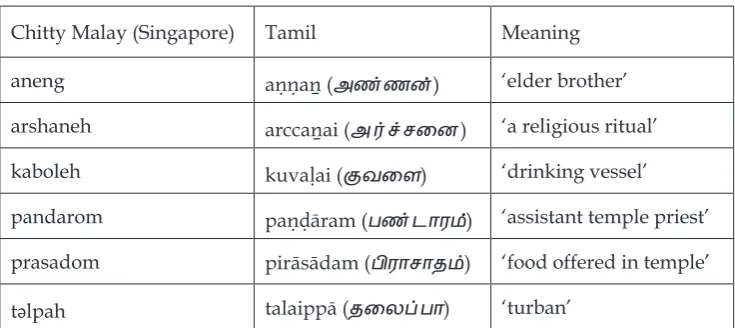
Upon comparing the short glossary of Singaporean Chitty Malay given in Dhoraisingam (2006: 94), we see some minor discrepancies in pronunciation (Table 11), possibly due to infrequent usage or dialectical differences.
Chitty Malay (Singapore) Tamil Meaning aneng aṇṇaṉ (அண் ணன் ) ‘elder brother’ arshaneh arccaṉai (அ ர் ச் சைன ) ‘a religious ritual’ kaboleh kuvaḷai (�வைள) ‘drinking vessel’ pandarom paṇḍāram (பண் டாரம் ) ‘assistant temple priest’ prasadom pirāsādam (பிராசாதம் ) ‘food offered in temple’ təlpah talaippā (தைலப் பா) ‘turban’
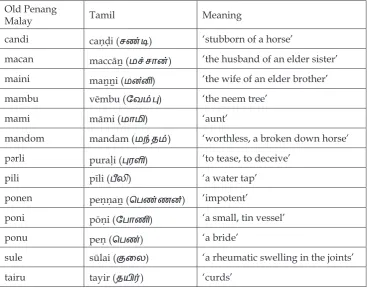
A comparable mixed variety must have existed in Penang. This commercial entrepôt, historically belonging to the Kedah Sultanate, was frequented by South Indian communities from pre-colonial times. Since its acquisition in 1786 by the East India Company, the British encouraged foreign settlement, including from India and China. In a description of this dialect as it was used in the early twentieth century, Hamilton (1922: 57) contends that Penang Malay “is really the Malay of Kedah altered slightly to suit the needs of a cosmopolitan town population with a large element of Southern Indians from the Madras Presidency”. The author lists various lexical items, many of which borrowed from Tamil and Hindustani, that make this dialect stand out among other Peninsular Malay varieties. When I checked these words with Penang Malay speakers in 2014, many of them were only recognized by people older than 40, who associated them with the speech of their parents and grandparents. Penang Malay has recently converged with a more mainstream type of colloquial Malay found, with minor regional differences, across West Malaysia. Table 12 lists the Penang Malay words given in Hamilton (1922) that go back to Tamil.
Table 10. Some Tamil loans in Malaccan Chitty Malay.
, Tracing the linguistic crossroads
Old Penang
Malay Tamil Meaning
candi caṇḍi (சண் �) ‘stubborn of a horse’
macan maccāṉ (மச் சான் ) ‘the husband of an elder sister’ maini maṉṉi (மன்னி) ‘the wife of an elder brother’ mambu vēmbu (ேவம் �) ‘the neem tree’
mami māmi (மாமி) ‘aunt’
mandom mandam (மந் தம் ) ‘worthless, a broken down horse’ pərli puraḷi (�ரளி) ‘to tease, to deceive’
pili pīli (பீலி) ‘a water tap’ ponen peṇṇaṉ (ெபண் ணன் ) ‘impotent’
poni pōṇi (ேபாணி) ‘a small, tin vessel’
ponu peṇ (ெபண் ) ‘a bride’
sule sūlai (�ைல) ‘a rheumatic swelling in the joints’ tairu tayir (தயிர் ) ‘curds’
In addition, some words in Penang Malay can be attributed to colloquial Malayalam, a language closely related to Tamil. These include pətəras ‘pride, arrogance’ from patrās (പ�താസ്) and pokəri ‘a profligate, a blackguard’ from pōkkiri (േപാ
�
�
രി), as well as the generic Peninsular Malaysian term tandas ‘toilet’ from taṇḍās (ത�
ാസ്).29 I have looked at pre-modern Malayalamborrowings into Maritime Southeast Asia in another paper (Hoogervorst in press a), but this topic remains underexplored.
Studies on Malay language contact rarely take into account colloquial speech or dialects, neither of the donor nor the recipient language. We may mention in passing the neighbouring dialect of Kedah, which exhibits the loanwords kambi ‘plain metal earring’ (Tamil: kambi;
கம்
பி ‘kind or earring’) and kawar ‘thief; trespasser’ (Tamil: kavar;கவர்
‘to steal’) (Asmah 1966). A systematic study will almost certainly reveal more examples. On a related note, I would argue that lexicographic practices obscure the actual influence of Tamil on generic Malaysian Malay, as numerous loanwords known to and used by its speech community are omitted in most dictionaries. Table 13 lists some examples.29 I am indebted to Abdur Rahoof Ottathingal and Mahmood Kooria for bringing this
to my attention.
Malaysian Malay Tamil Meaning
dipawali (~ deepavali) dīpāvaḷi (தீபாவளி) ‘name of a festival’ kawadi (~ kavadi) kāvaḍi (காவ�)
‘a decorated pole carried on shoulders with offerings’
taipusam (~ thaipusam) taippūsam (ைதப் �சம் ) ‘name of a festival’ tose tōsai (ேதாைச) ‘kind of rice-cake’
toti tōṭṭi (ேதாட் �) ‘a menial servant’
umapodi ōmappoḍi (ஓமப்ெபா�) ‘kind of confectionary’
In addition, several Malaysian slang words have escaped the attention of linguists. This is a largely unexplored field requiring knowledge of both Malay and Tamil slang. Elsewhere I call attention to the Malay slang word rendek ‘to be together with someone’, which goes back to colloquial Tamil reṇḍu (
ெரண்
�) ‘two’ (Hoogervorst in press b).30 Other examples that I have collected duringseveral brief periods of fieldwork in and around Kuala Lumpur are listed in Table 14.
Malaysian slang Tamil slang Meaning
aney aṇṇē (அண் ேண) ‘employee of mamak restaurant’31
ayoyo aiyyayō (ஐய் யேயா) intj maca maccā (மச் சா) ‘buddy’
manjen mañjaṉ (மஞ் சன் ) ‘Chinese man (derogatory)’ nandrek naṉṟi (நன்றி) ‘Thank you!’
pondan peṇḍaṉ (ெபண் டன் ) ‘effeminate man’ porah ~ podah pōḍā (ேபாடா) ‘Get lost!’ pundek puṇḍai (�ண் ைட) ‘cunt’ tanggaci taṅgaicci (தங் ைகச் சி) ‘girl’ yilek illai (இல் ைல) ‘absent’32
3132
30 The word final <u> is pronounced as a high central rounded vowel /ʉ/ in spoken
Tamil. The colloquial pronunciation of this form, hence, is /reɳɖʉ/. Interestingly, the same word is attested in the gold traders’ slang of Malang (Table 16).
31 Original meaning: ‘elder brother’. 32 Original meaning: ‘no’.
Table 13. Tamil loans in Malaysian Malay.
, Tracing the linguistic crossroads
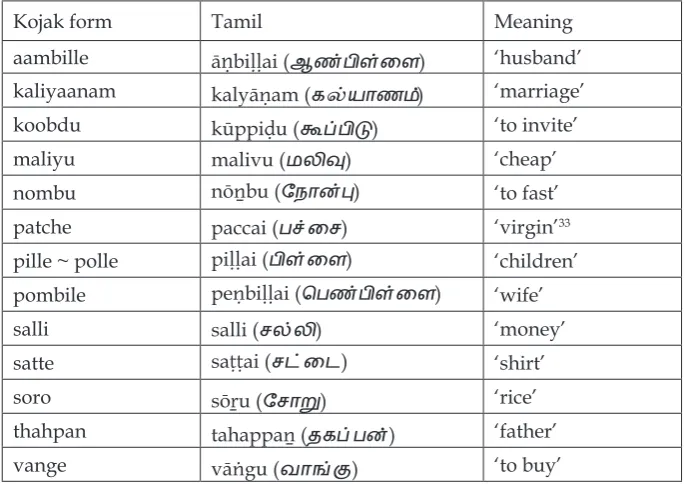
Kojak form Tamil Meaning
aambille āṇbiḷḷai (ஆண் பிள் ைள) ‘husband’ kaliyaanam kalyāṇam (க
ல
் யாணம)் ‘marriage’ koobdu kūppiḍu (�ப் பி�) ‘to invite’maliyu malivu (மலி�) ‘cheap’
nombu nōṉbu (ேநான் �) ‘to fast’
patche paccai (பச் ைச) ‘virgin’33
pille ~ polle piḷḷai (பிள் ைள) ‘children’ pombile peṇbiḷḷai (ெபண் பிள் ைள) ‘wife’
salli salli (சல் லி) ‘money’
satte saṭṭai (சட் ைட) ‘shirt’
soro sōṟu (ேசா�) ‘rice’
thahpan tahappaṉ (தகப் பன் ) ‘father’
vange vāṅgu (வாங் �) ‘to buy’
33
Indonesia exhibits a slightly different situation. With the exception of North Sumatra (Mani 1993a), Tamil communities were generally too small to remain independent and eventually assimilated into the mainstream. In Indonesia, the most common Malay term to denote Indian Muslims was Koja ~ Kojah ~ Khoja, from the aforementioned Ḵẖojā and ultimately from Persian Ḵẖẉāja () ‘a man of distinction’. The word is first documented in the late fourteenth century in the Tanjung Tanah manuscript, which was written by a certain Kuja Ali (Mahdi 2015). Javanese exhibits the related word Koja ‘merchant (usually Muslim Indian)’. Historically, several harbours on Java’s north coast had a Pakojan; a quarter where the Koja resided. While the term Ḵẖojā normally implies a northwest Indian origin, the eponymous community in the north Javanese city of Semarang traces their ancestors to Tamil-speaking Marakkāyar, with a small minority of Māppiḷa and Gujarati Ḵẖojā (Mani 1993b: 126). At one point, they may have spoken a mixed language akin to Chitty Malay. Mani (1993b: 126-127) briefly addresses the “secret” language of this mercantile community, which at the time of his research was only used by speakers older than 40. Some examples are given in Table 15 above (spelling of the Kojak forms as in original).
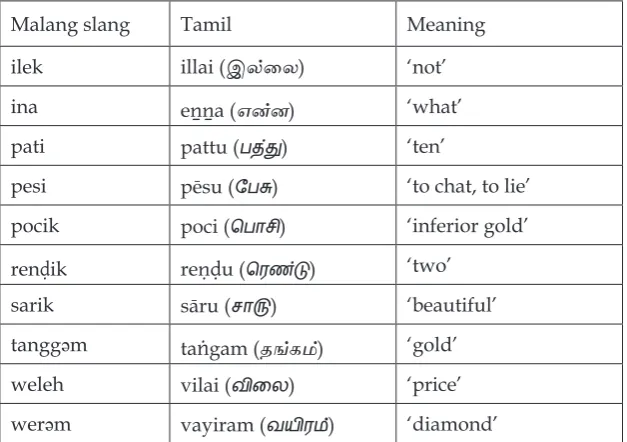
Another Tamil-influenced in-group language has been documented in Malang. In the 1950s and 1960s, the gold trade in this East Javanese city was dominated by Indians. Even when local people took over in the 1970s, their cryptolect still consisted of Tamil words (Pujileksono and Kartono 2007: 23-24; Hoogervorst 2014: 114-115). Some examples are given in Table 16.
33 Original meaning: ‘green’.
Malang slang Tamil Meaning
ilek illai (இல்ைல) ‘not’
ina eṉṉa (என்ன) ‘what’
pati pattu (பத்�) ‘ten’
pesi pēsu (ேப�) ‘to chat, to lie’ pocik poci (ெபாசி) ‘inferior gold’
renḍik reṇḍu (ெரண்�) ‘two’
sarik sāru (சா௫) ‘beautiful’
tanggəm taṅgam (தங்கம்) ‘gold’
weleh vilai (விைல) ‘price’
werəm vayiram (வயிரம்) ‘diamond’
The opposite phenomenon has also been documented. In colonial times, the cryptolects of the Tamil-speaking Paṟaiyar community in Jaffna (Lewis 1890) and the merchants of the Coromandel Coast (Pandit 1894) have been identified as partly inspired by Malay or a closely related language (Kern 1894; Hoogervorst 2013: 17-18, 27-28). Unsurprisingly, multilingual traders would have communicated in a language they picked up far away to keep their transactions back home a secret.
7. Malayicized Tamil?
As the previous three sections have explored Malay varieties influenced by Tamil, this section discusses localized Tamil varieties of Maritime Southeast Asia. As has been discussed in Section 2, the historical practice among Indian merchants to marry into local, Malay-speaking families gave rise to a wealthy, influential generation of bilinguals. The linguistic competence of such hybrid communities, however, would typically decrease as they assimilated into the mainstream. In all likelihood, a stabilized, “Malayicized“ variety of Tamil could only develop in recent times, with substantial numbers of women to ensure intergenerational transmission. Whether we can indeed speak of such a variety remains open for discussion. It may be pointed out that Tamil has been used as a medium of education and local literary works in Malaysia and Singapore since the independence of both nations (see Willford 2006: 45-52). While the phrase “Malaysian Tamil“ occasionally surfaces in the literature (compare Renganathan 2009), it is rarely qualified. In general, scholarship on any aspect of Malaysian Tamil remains limited and poorly distributed (see, for example, Fernandez 2008; Karunakaran and Krishnan 2013). A monograph-length description of colloquial Malaysian or Singaporean Tamil is still needed.
, Tracing the linguistic crossroads
The available information is at times contradictory. For example, Venugopal (1996: 5) contends that Malaysian Tamil is relatively Anglicized. He points towards the English educated background of most Malaysian Tamils and gives some examples of lexical influence from English in Malaysian Tamil literature (Venugopal 1996: 285-286). Conversely, Ramasamy and Moses (2004: 58-59) hold that Indian Tamil contains a comparatively larger proportion of English, implying that Malaysian Tamil has remained closer to its roots. The authors further state that there is little dialectical difference in Malaysia, as opposed to India (and Sri Lanka). In addition, they call attention to a number of common Malay loanwords in Malaysian Tamil, as listed in Table 17. The fact that many Tamil-speakers learned Bazaar Malay would have accounted for this situation.34
Malaysian Tamil Malay Standard Tamil Meaning aːttaːppu atap kūrai (�ைர) ‘(thatched) roof’
campoːru campur cēr (ேசர்) ‘to mix’
klaːmbare kəlambu kosuvalai (ெகா�வைல) ‘mosquito net’ pasaːru pasar candai (சந்ைத) ‘market’
saron sarung kaili (
ைக
லி
) ‘sarong’vakulu bakul kūḍai (�ைட) ‘basket’
In his treatise on Malaysian literature in Tamil, Venugopal (1996: 299) lists a number of words he considers to be characteristic of Tamil used in Malaysia. These include some Malay loanwords, such as itik ‘duck’, janji ‘promise’, kəpala ‘head’, lalang ‘tall grass’, lampu ‘light’, ringgit ‘dollar’, rokok ‘cigarette’, samsu ‘illicit liquor’, sələsai ‘solved’, sənang ‘easy’, səpatu ‘shoe’ and tukang ‘carpenter’. The Tamil spelling and pronunciation of these words are not given, which makes the examples of limited use for linguistic purposes. The author also calls attention to a number of neologisms specific to Malaysian Tamil, such as
āyākkoṭṭagai (ஆயாக்ெகாட்டைக) ‘child centre’, kākkā kaḍai (காக்கா கைட) ‘Indian Muslim shop’ and piraṭṭukkaḷam (பிரட்�க்களம்) ‘the place where workers give their names for attendance’. More examples of Malaysian Tamil vocabulary are given in a pioneering lexical study of the Tamil dialects in lower Perak (Subbiah 1966). Some instances of Malay loanwords in Lower Perak Tamil are listed in Table 18.
34 Venugopal (1996: 301) provides examples of code-mixing and code-switching between
Tamil and colloquial Malay in Malaysian Tamil literature, but does not present any first-hand data.
Lower Perak Tamil Malay Meaning attāppu (அத்தாப்�) atap ‘roofing-thatch’ beṇḍāṉ (ெபண்டான் ) ~ veṇḍāṉ
(ெவண்டான்) bəndang ‘irrigated paddy fields’
īttai (ஈத்ைத) itik ‘a duck’
kampam (கம்பம்) kampung ‘a Malay settlement’ kīlā (�லா) gila ‘mad’
kirās (கிராஸ்) kəras ‘tight, stiff’ kōsam (ேகாசம்) kosong ‘empty’
kurisu (�ரி�) kurus ‘lean’
lombam (ெலாம்பம் ) lombong ‘a tin mine’
pārāṅ (பாராங் ) barang ‘goods, things’
piñjam (பிஞ்சம் ) pinjam ‘a loan’ sālā (சாலா) salah ‘fault’ sīlāppu (�லாப்�) silap ‘a fault’
tāṅgā (தாங்கா) tangga ‘house steps’
toṅkāṉ (ெதாங்கான்) tongkang ‘a large boat’ vakkuḷ (வக்�ள் ) bakul ‘a basket’
Balasubramaniam (1994) offers another isolated contribution to the study of Malaysian Tamil. In his exploration of the language used by tea pluckers and factory workers in the tea estates of the Cameron Highlands, he calls attention to a number of loanwords and hybrid constructions (Table 19).
Cameron Highlands Tamil
Meaning Malay
element
Meaning
boṅkusu kāmarā ‘section where packing is done’ bungkus ‘packet’ campalac-cūra ‘wage slip, salary slip’ surat ‘letter’
jāmāṅkoṭṭāy ‘latrine’ jamban ‘toilet’
kāmarā ‘room type structure; section of factory’ kaməra ‘chamber, cabin’ kappalā ‘attendant in the estate dispensary’ kəpala ‘head’
, Tracing the linguistic crossroads
Cameron Highlands Tamil
Meaning Malay
element
Meaning
lampuk-kāsu ‘light money (money deducted from the workers’ pay)’
lampu ‘lamp, light’
tiṭṭi ‘a day off’ cuti ‘leave of absence’
tōmpukoṭṭāy ‘shed for heating water in large drums for bathing’ tong ‘drum’
Unsurprisingly in the light of the strong connections of Southeast Asian Tamils to their ancestral land, some of these Malay loanwords gained currency back in India. Contemporary examples include kittā (கித்தா) ‘rubber’ (Malay: gətah) and sēvā (ேசவா) ‘to rent’ (Malay: sewa).35 Elsewhere, I have called attention to
other examples of Malay loanwords in Tamil (Hoogervorst 2013). The lexical items highlighted in the latter study were presumably transmitted before interethnic commerce in the Indian Ocean World had become a European-dominated enterprise. A selection is given in Table 20.
Tamil Malay Meaning
jōṅgu (ே
சாங
்�) jung ‘sea-going ship’ kaiyāppuḍai (ைகயாப்�ைட) kayu putih ‘cajuput tree’kajaṅgu (
கசங
்�) kajang ‘mat protection against the rain’ kākkattuvāṉ (காக்கத
்�வான்) kakaktua ‘cockatoo’kambīr (கம்பீர்) gambir ‘a plant used for betel chewing’ kiṟisu (கிறி�) kəris ‘a kind of dagger’
sagu (ச�) sagu ‘sago’
sāmbal (சம்பால்) sambal ‘chili-based spicy sauce’ sambāṉ (சம்பான்) sampan ‘a type of boat’
sappaṅgi (சப்பங்கி) səpang ‘a type of fragrant wood’
taṅgāṉ (தங்கான்) təngahan ‘half’
35 The form sēvā (ேசவா) is only in use among the Nāṭṭukkōṭṭai Chetties, a mercantile
caste who often migrated to Southeast Asia (Subbiah 1966: 151).
Table 19. Loanwords and hybrid constructions in Cameron Highlands Tamil (Balasubramaniam 1994).
8. Conclusions
In his treatise on Malaysian Tamil literature, Venugopal (1996: 285) contends that “[p]urity of language is not found in the writings of these novelists”. Diglossia and the existence of high-status literary languages have made expressions of the above type almost commonplace in both South and Southeast Asia. Yet notions of language purity obstruct, rather than stimulate, in-depth linguistic research. Academic attention to the colloquial and dialectical registers of Malay and Tamil remains remarkably sparse, although the situation is gradually improving for Malay. The traditional focus on “high language” has left the vernacular dimensions of language contact across the Bay of Bengal largely underexplored, leading to an imbalanced understanding of the cultural history of this part of the world. Indeed, while artists, scholars and scribes feature prominently in South and Southeast Asian historiographies, merchants, middlemen and labourers remain poorly documented. That the latter groups were vital to the introduction of products and ideas across geographical and ethno-linguistic boundaries becomes clear – among many other things – from the lexical and grammatical influence of Tamil and Hokkien dialects on Malay contact varieties, including Sri Lanka Malay. The role of Indian communities in these networks deserves closer academic attention in the future.
If we are to understand the wide range of activities underpinning cultural and linguistic contact in the Bay of Bengal and elsewhere, we need to focus on non-standardized languages. I have mentioned in passing the influence of Malayalam on the Peninsular Malay varieties. This topic merits a more thorough analysis than has been possible here. The same holds true for specific Tamil dialects or sociolects, especially those belonging to mercantile groups (both Hindu and Muslim). Fieldwork-based grammatical descriptions of Shonam, Malaysian Tamil and Malay spoken by Tamils, too, are lacking to this day. Local scholarship in this area is often of great interest, but poor distribution leaves much of it neglected in wider academic circles. Meanwhile, there is no reason to believe that similar mixed languages did not exist before colonial times. Varieties spoken by the hybrid communities highlighted in this paper must have been common historically. The present overview has only been able to scratch the surface of the linguistic processes and phenomena emerging at the crossroads of Malay and Tamil.
, Tracing the linguistic crossroads
place outside the present-day borders of the countries under research. Yet at the same time, a series of pivotal, transnational events left a deep impact on all regions involved. One prominent example is the emergence of the Malay printing press in Colombo and later in Singapore, which was spearheaded in both cities by culturally hybrid groups. More comparative work in the fields of historical linguistics, literature, manuscript studies, religion, and other disciplines is required to explore broader perspectives of language contact and etymology in some of the world’s most diverse and exciting language ecologies.
Abbreviations used
1 : first person 2 : second person 3 : third person dem : demonstrative gen : genitive neg : negation intj : interjection part : particle pl : plural pos : possessive pst : past sg : singularSOV : subject-object-verb
References
Adelaar, A.K. 1991. “Some notes on the origin of Sri Lanka Malay”, in: Hein Steinhauer (ed.), Papers in Austronesian linguistics, pp. 23-37. Canberra: Australian National University.
Adelaar, A.K. 1996. “Malay in the Cocos (Keeling) Islands”, in: Bernd Nothofer (ed.), Reconstruction, classification, description; Festschrift in Honor of Isidore Dyen, pp. 167-198. Hamburg: Abera Verlag.
Adelaar, A.K, 2005. “Structural diversity in the Malayic subgroup”, in: Alexander K. Adelaar and Nikolaus P. Himmelmann (eds), The Austronesian languages of Asia and Madagascar, pp. 202-226. London/New York: Routledge. Adelaar, A.K and D.J. Prentice. 1996. “Malay; Its history, role, and spread”,
in: S.A. Wurm, P. Mühlhausler, and D. Tryon (eds), Atlas of languages of intercultural communication in the Pacific, Asia, and the Americas, pp. 673-693. Berlin/New York: Mouton de Gruyter.
ʻĀlim, Tayka Shuʻayb. 1993. Arabic, Arwi, and Persian in Sarandib and Tamil Nadu; A study of the contributions of Sri Lanka and Tamil Nadu to Arabic, Arwi, Persian, and Urdu languages, literature, and education. Madras: Imāmul ʻArūs Trust.
Aman, Norhaida; Viniti Vaish; Wendy Bohkorst-Heng; Aisha Jamaludeen; Durgadevi P.; Feng Ying Yi; Khoo Boon Suan; Mardiana Roslan; Pauline Appleyard; and Tan Teck Kiang. 2009. The sociolinguistic survey of Singapore 2006. Singapore: Centre for Research in Pedagogy and Practice, National Institute of Education.
Ansaldo, Umberto. 2008. “Sri Lanka Malay revisited; Genesis and classification”, in: K. David Harrison, David S. Rood, and Arienne Dwyer (eds), Lessons from documented endangered languages, pp. 13-42. Amsterdam / Philadelphia: John Benjamins.
Ansaldo, Umberto. 2014. “SLM is dead, long live Sri Lanka Malay; A review article of Nordhoff 2013”, Journal of Language Contact 7: 381-391.
Ardika, I.W. and Peter Bellwood, 1991. “Sembiran; The beginnings of Indian contact with Bali”, Antiquity 65(247): 221-232.
Asmah, binte Haji Omar. 1966. “The natural of Tamil loan words in Malay”, Proceedings of the First International Conference of Tamil Studies, Kuala Lumpur. Vol. II, pp. 534-558. Kuala Lumpur: International Association of Tamil Research.
Balasubramaniam, P. 1994. “Occupational registers in selected tea estates”, Journal of Tamil Studies 46: 39-54.
Bayly, Susan. 1989. Saints, Goddesses and Kings; Muslims and Christians in South Indian society 1700-1900. Cambridge: Cambridge University Press.
Bellina, Bérénice and Ian Glover. 2004. “The archaeology of early contact with India and the Mediterranean World, from the fourth century BC to the fourth century AD”, in: Ian Glover and Peter Bellwood (eds), Southeast Asia; From prehistory to history, pp. 68-88. London/New York: Routledge Curzon.
Birch, E.W. 1969. “The vernacular press in the Straits”, Journal of the Malaysian Branch of the Royal Asiatic Society 41/1 (215): 192-195.
Christie, Jan Wisseman. 1999. “Asian sea trade between the tenth and thirteenth centuries and its impact on the states of Java and Bali”, in: Himanshu Prabha Ray (ed.), Archaeology of seafaring; The Indian Ocean in the ancient period, pp. 221-270. Delhi: Pragati Publications.
Damais, L-C. 1964. “Études sino-indonésiennes. III. La transcription chinoise Ho-ling comme désignation de Java”, Bulletin de l’École française d’Extrême-Orient 52(1): 93-141.
Daw, Khin Khin Aye. 2005. Bazaar Malay; History, grammar, and contact. Singapore: National University of Singa