Identifying Potential Estate Commodity for Agropolitan
Development in Ponorogo
Pawana Nur Indah
Department of Agribussines, Faculty of Agriculture, Universitas Pembangunan Nasional Veteran Jawa Timur (UVJT), Indonesia. Rungkut Madya Gunung Anyar, Surabaya, Indonesia
Tel. +62 31 870 6369 Fax. +62 31 870 6369 E-mail : [email protected]
Zainal Abidin Sam
Department of Agribussines, Faculty of Agriculture, Universitas Pembangunan Nasional Veteran Jawa Timur (UVJT), Indonesia. Rungkut Madya Gunung Anyar, Surabaya, Indonesia
Tel. +62 31 870 6369 Fax. +62 31 870 6369 E-mail : [email protected]
Effi Damaijati
Department of Agribussines, Faculty of Agriculture, Universitas Pembangunan Nasional Veteran Jawa Timur (UVJT), Indonesia. Rungkut Madya Gunung Anyar, Surabaya, Indonesia
Tel. +62 31 870 6369 Fax. +62 31 870 6369 E-mail : [email protected]
(Received: Mar 29, 2017; Reviewed: Apr 20, 2017; Accepted: Jun 9, 2017)
DOI: http://dx.doi.org/10.20956/ijas.v5i1.1171
Abstract:Agropolitan development concept appear from the gap with urban development as a center of economic activity and growth in the rural areas as agricultural activity center left. Rural areas with agricultural activities, which are always experiencing decline productivity, on the other side of the urban area as a destination market and growth centers receive overload that led to the discomfort caused by the conflict, crime, disease, pollution and poor sanitation neighborhoods. The specific objective of the study was to identify potential estate commodity in supporting agropolitan development. Getting a plate form agribusiness competitiveness through agropolitan using Location Quotien (LQ) Method. The results show that several comodities namely coconut, cocoa, dairy, red onion, which have a high LQ value. Development agropolitan can improve equitable development refers to agricultural revitalization program, given the selected sector is the basis of community activity.
Keywords: LQ; agropolitan; estate commodity
1. Introduction
The concept of agropolitan
develop-ment problems appear from the gap between
the region’s development as a center of the
city, and the economic growth of rural areas
as agricultural activity center left. According
to (Muhammadi et al., 2015) development of
the city as a center of growth is not give
ef-fect to the hatch down (trickle down efef-fect),
but it was a cause of resource depletion
fects of the surrounding area (backwash
ef-fect). (Friedmann, 2005) In other words,
there has been economic in net transfer of
resources from rural areas to urban areas on
development, consisting of: created social conditions conducive, strengthen economic potential, and protect people from his own weaknesses (Bahua et al., 2016).
Development agribusiness system and
food security is the target of agricultural
de-velopment (Afgani et al., 2012). The results
of empirical relationships village-city
devel-opment strategy in perspective agropolitan
in supporting the development ofagri-based
economy of the regioncan be formulated
some anticipation issues (Li, 2009). In many
cases, rural impoverishment, increasing
in-come disparity and environmental
degrada-tion and hamper the sustainability of
agricul-ture and rural development (Thayib, 2010).
Agropolitan development concept was first introduced Mc. Douglass and Fried mannin (Pasaribu, 1999) as astrategy for
ru-ral development. System development and
agribusiness and food security is the goal,
and once the target of agricultural
develop-ment (Apriyanto, 2008). Agribusiness de-velopment in order to provide benefits and maximum impact foreconomic development
an dimprovement of local people’s income,
it needs a new approach in the development of agribusiness in the field (Krisnamurthi, 2005). Considered an effective approach is
to synergize the development of
agribusi-ness in the context ofregional economic
de-velopment, so thatthe totalvalue added
agri-business development can been joyed by the
local community is generally referred to as
development agropolitan (David and
Erick-son, 1987).
Agropolitan development also meant
that the service center of agricultural
activi-ties (agribusiness) is very close to the
set-tlement of farmers, both service regarding
cultivation techniques and working capital
credit system services and market in
forma-tion. Thus, information can be received so
that the changes can be anticipated.
Agropolitan are a consist so farm town
and villages agricultural production centers
are nearby, where the agricultural are a has
facilities like urban. Agropolitan basically
amove menttore-build the village. Good
vil-lage should ideally be able to be a place that
is comfortable, dignified and prosperous so
-ciety. Do not assume that the village should
be developed that city. However, making
the village in to a decent place. This creates
idea of Agropolitan (Hamenda, 2007). The
concept of this agropolitan base on the build
farm town functions in a broad sense. Where
agriculture was not seen on the side of
plant-ing and hoeplant-ing saja.in agropolitan here must
be industry, services, tourism, and so on, but
the agricultural base in the broadest sense
(BAPPENAS, 2007).
Concept development agropolitan not
a new concept but it is optimizing
develop-ment out comes in selected are a seitherin the
form of Regions Production Centers (RPC),
Integrated Economic Development Zone
(IEDZ) and certain other priority areas. It
should be noted that the concept of
develop-ment agropolitan also include optimization
ofthe results of programs that have already
implemented such as: Guidance program,
Plantation Society Industrial Area Program
(IAP), Animal Husbandry Enterprise Zone
Program (AEZP), Program Provision of
Ru-ral Infrastructure (PPSD) and the Districts,
Development Program (KDP). Thus, the de
complementa-ry Agropolitan Regions and synergistic with
both programs originating from the central,
provincial and district/city. Agropolitan area development is integrated to plan in order to
obtain maximum efficiency and effective -ness in the implementation of it’s develop-ment (Hamenda, 2007). Purpose of location quotion analysis is to determine the
pre-emi-nent commodity in an area. Which stands on the concept of efficiency to achieve compar -ative and competitive advantage in terms of
supply or demand. The specific objective of
this study was to identifying potential estate
commodity in supporting agropolitan
devel-opment.
2. Method
2.1. Location quotient analysis
Location Queotion (LQ) is an index
for comparing the commodity at the district
level in Ponorogo. More operational, LQ is defined as the ratio of the percentage of the total activity of agriculture observed.
The formula of LQ is:
LQ =(Xij/Xi)/(Xij/Xj)
Where:
Xij=production of kinds of commodities until in
the district
Xi=total production of commodity farming the
district
Xj=total production of kinds of commodities until j
X=the total production of commodity farming
district
2.2. Interpretation of the value of LQ
To be able to interpret the results of the
analysis of LQ, then:
(1) If the value of LQ> 1, indicating a
con-centration of agricultural production district
level relative to the total concentration of the
district or the activity happening in the
Dis-trict. Or a surplus commodity production in
the district and is a sector basis in the
Dis-trict; (2) If the value of LQ = 1, then the
sub-district has agricultural activity equivalent to
the District; (3) If the value of LQ <1, then
the sub-district in Ponorogo have a
relative-ly smaller share than the district agricultural
activity, or there has been a production defi
-cit in the district.
3. Results and Discussion
Development Analysis of agricultural
commodities in Ponorogo will be explained
below. Ponorogo is located as strategic
position in the development of agropolitan
in East Java Province. This strategic position
include: skipped national and transportation
routeslinking the major cities in East Java,
Central Java (Madiun, Solo, and Malang).
Ponorogo currently includes pathway for
the transport of goods with southern cross.
The existence of these path ways open up
great opportunities forrevenue. Particularly
for sectors that require transportation as a
stimulant, such as agriculture, trade, services,
and tourism. In addition, it also has
opportunity to extend market for commodity
exports to the region this region, in addition
tolarge potential resources contained in this
region.
Ponorogo leading sector are tourism
sector, plantations, and agriculture. Priority
development activities in the unit area of
Ma-diun evelopment activities aimedat the trade,
commercialservices, financial, manufactur
-ing andother public services. Development
agri-cultural, plantation, and fisheries. Ponorogo is the producer of durian fruit, melon, mango
and orange. Ponorogo has huge potential in
agriculture, particularly forrice crops, types
of vegetables such as beans, peas, onion,
corn and soy bean. All of the abovetypes
of plants, both in terms of productivity and
total production per year havingan average
value of production of the province, thus
al-lowing it tobe used as a companion in the
region leading commodity of Ponorogo
ag-ropolitan.
Identification Ponorogo agropolitan starts with an understanding of the existence
of a basic physical condition,
socio-econom-ic, infrastructure and facilities, human
re-sources, technology, commodities,
agribusi-ness, agro-tourism, economic institutions,
and social culture. It is more focused on the
spatial aspects and agribusiness, as well as
the region’s development strategy into
agro-politan. In order to improve the welfare of
the community and local revenue should be
autonomous agribusiness development plan
with a regional and commodity approaches.
With regard to agricultural commodities
pro-duced, it must have a comparative
tiveness principe and high dynamic
competi-tif, then the existence of the product needs to
be done with the extension and orientation to
the market demand. Ponorogo in addressing
these demands, economic potential
develop-ment planto prioritize theim provedevelop-ment of
agriculture and agribusiness approach
agro-politan. Agribusiness commodity based on
the concept that emphasizes the importance
of choosing the coupled leading
commod-ity position as a leading commodcommod-ity product diversification. Leading commodities as an
alternative product has a broad, both as
pri-mary and secondary products.
The basic concept is agropolitan area is
the development of a particular region which
has it’s main agricultural activity, which is
equipped with facilities and infrastructure
and urban accessibility. This concept
basi-cally aims to provide accessibility of urban
services in rural areas or in rural areas
cre-ate a city. Thus farmers or rural communities
do not necessarily have to go into town to
meet daily needs as well as to obtain other
services, both in the services related to
pro-duction issues, marketing, Issues relating to
the social, economic and cultural. Analysis
of location determination Agropolitan area
in the district, followed by determination of
it’s development strategy into an agropolitan
in Ponorogo (Table 1).
In order to gain information about
po-tential agricultural commodities in
Ponoro-go, it is necessary to use an analysis tool that
LQ (Location Quotien). LQ is a technique
used to measure the concentration ofan
eco-nomic activity or sectorina region by
com-paring its rolein the regional economy to
the role of economic activity/same sector
the national level. In other words, the
sec-tor in a region by comparing its role in the
regional economy to the role of economic
activity/same sectorat the national level. The
rationale behind of this method is as
fol-lows. For example, an industrial area there
are two, namely A and B. Industry A serving
local markets and markets outside the region
(X), the industry is called the industrial base.
While industrial base Bisnon-local
indus-try or indusindus-try, because only serve the local
tech-nique is the basis of economic theory, as
pre-viously discussed above, which in essence
is as follows. Industry A is called industrial
base because in addition toserving the local
market also do X that gave discordant greater
than the contribution of industry to the GDP
formation B and employment opportunities.
The increase inper capita incomeinthe
area-due toindustrial activities resulted in alocal
market de mand willin crease out put, not
only from industry A, but also the industry
B. The increase in demand is further
boost-edthe industry’s first B due to growth in in
-dustrial out put A. In other words, through
the multiplier effect, the industry a gives a
large positive impacton the economy of the
area.
The analysis area used to determine
the commodity base, distribution
charac-teristics and its contribution as a producer
of the commodity production (coconut,
co-coa, cows, onion, cabbage, hot chilli
pep-pers, lemon juice, salak) in support of the
region’s economy in the region (oil, cocoa,
cows, onion, cabbage, hot chilli peppers,
lemon juice, salak) does not necessarily
in-dicate that the region is the base area of the
commodity. Centers of commodities such as
base sector (Table 1), through the approach
of Location Quotient (LQ). LQ can be
cal-culated through Production (coconut, cocoa,
cows, onion, lettuce, hot chilli peppers,
lem-on juice, salak) plem-onorogo and GDP of each
commodity (oil, cocoa, beef, onion, mustard,
chili pepper, lemon juice, bark) of East Java.
Similarly Production (coconut, cocoa, beef,
onion, mustard, capsicum pepper, lemon
juice, bark) and EastJava GDP each
com-modity (oil, cocoa, beef, onion, mustard,
capsicu,, lemon juice, bark) East Java (BPS,
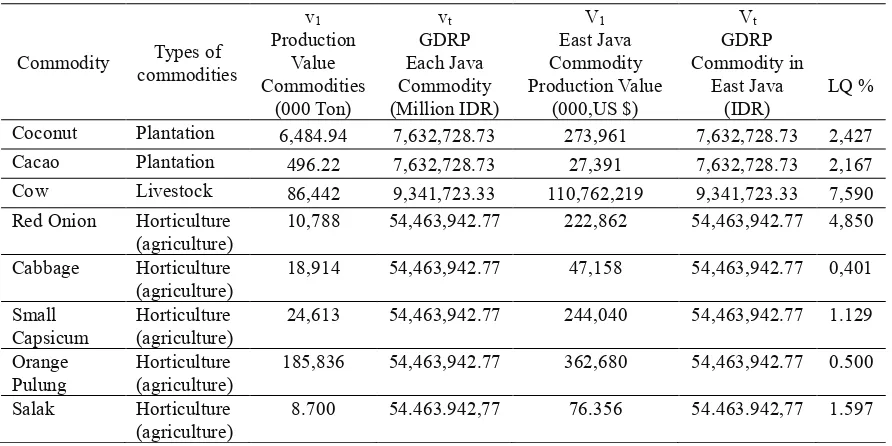
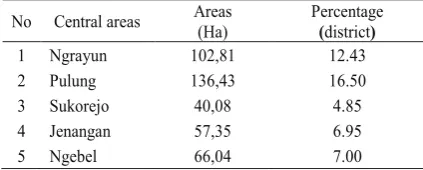
Ponorogo). Area of Coconut in Ponorogo
distric thas great potential with the value
of LQ=(2.427) where coconut plantation
area of 827.44 hectares with production of
6,484.94 tons and are scattered through out
the District in Ponorogo, while the largest is
the districts Ngrayun, Pulung, Sukorejo,
Jen-angan and Ngebel (Table 2). Table 1. Identifying Potential Agricultural Commodities in Ponorogo Regency
Source: Data Processing (2016)
Commodity commoditiesTypes of
v1 Production
Value Commodities
(000 Ton)
vt GDRP Each Java Commodity (Million IDR)
V1 East Java Commodity Production Value
(000,US $)
Vt GDRP Commodity in
East Java
(IDR) LQ % Coconut Plantation 6,484.94 7,632,728.73 273,961 7,632,728.73 2,427 Cacao Plantation 496.22 7,632,728.73 27,391 7,632,728.73 2,167 Cow Livestock 86,442 9,341,723.33 110,762,219 9,341,723.33 7,590 Red Onion Horticulture
(agriculture) 10,788 54,463,942.77 222,862 54,463,942.77 4,850 Cabbage Horticulture
(agriculture) 18,914 54,463,942.77 47,158 54,463,942.77 0,401 Small
Capsicum Horticulture (agriculture) 24,613 54,463,942.77 244,040 54,463,942.77 1.129 Orange
Pulung Horticulture (agriculture) 185,836 54,463,942.77 362,680 54,463,942.77 0.500 Salak Horticulture
Volume 5 Issue 1 June 2017
[ ] Table 2. Regional Center of Coconut Commodities
Source: Data Processing (2016)
Table 2 clearly shows that the Pulung is
the largest oil production area in Ponorogo,
so that the area is an area of development in
the oil commodity Agropolitan development
of the area. Area of Cocoa in Ponorogo
district has great potential with the value
of LQ= (2.167), where coconut plantation
area of 689.30 hectares with aproduction of
496.22 tons and are scattered throughout the
District in Ponorogo, whilethe largest in the
District Sawoo, Pulung, Jenangan, Ngebel
(Table 3).
Table 3. Regional Center of Cacao Commodities
Source: Data Processing (2016)
Table 3 shows that Pulung is the
larg-est cocoa production centers in Ponorogo, so
that the area is an area of developmentin
the-cocoacommodityAgropolitandevelopment
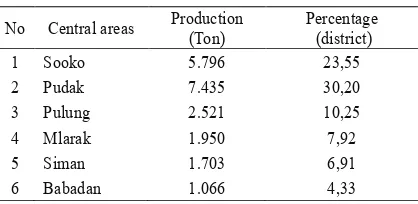
of the area. Dairy Cow and broiler
produc-tion in Ponorogo district have great
poten-tial with the value of LQ= (7,59) where live
stock production Cattle Dairy Cattle and 86
442 tonnes and are scattered throughout the
district in Ponorogo, while the largest in the
District Pudak, Soko and Pulung (Table 4).
Table 4. Regional Center for Animal Husbandry and
Dairy Cow Cattle
Source: Data Processing (2016)
Table 4 show that the region is an area
of central Pudak’s Dairy and Cattle
Ponoro-go largest, so that the area is a developing
area of the Center’s Dairy and Cattle in the
development of the area Agropolitan. Onion
production in Ponorogo district
mampun-yai huge potential with the value of LQ =
(4.85) where the production of 10 788 tonnes
of onion scattered throughout the Districtin
Ponorogo, while the largest in the District
Sawoo, Pudak, Pulung, Mlarak and Sukorejo
(Table 5).
Table 5. Regional Horticultural Crop Production Center Onion
Source: Data Processing (2016)
Table 5 shows that the area is the
pro-duction center Pudak Hortikulturt a Plant
Red Onion largest Ponorogo, so that the area
is a developing area in the development of
commodity Red Onion Agropolitan region.
Chilli production in Ponorogo district have
huge potential with the value of LQ=(1.129)
where production amounted to 24,613 ton
sof spicy chili spread through out the
Dis-trictin Ponorogo, while the largest in Sooko,
Pudak, Pulung, Mlarak, Siman and Babadan
(Table 6).
65 No Central areas Areas
(Ha)
Percentage
(district) 1 Ngrayun 102,81 12.43 2 Pulung 136,43 16.50 3 Sukorejo 40,08 4.85 4 Jenangan 57,35 6.95
5 Ngebel 66,04 7.00
n
n
n
n
( )
No Central areas Areas (Ha)
Percentage (%)
1 Sawoo 52.35 7.60
2 Pulung 289.72 42.03 3 Jenangan 105.27 15.27 4 Ngebel 155.36 22.53
n
n
n
No Central areas Production (Ton)
Percentage (district)
1 Pudak 4.247 4,91
2 Sooko 3.536 4,10
3 Pulung 2.997 3,46
n
n
n
( )
No Central areas Production (Ton)
Percentage (%)
1 Sawoo 1.444 13,40
2 Pudak 2.989 27,70
3 Pulung 2.829 26,22
4 Mlarak 1.391 12,90
5 Sukorejo 1.050 9,75
n
International Journal of Agriculture System (IJAS)
Table 6. Regional Horticultural Crop Production Center shot chili
Source: Data Processing (2016)
Table 6 also shows that the Pudak a
Horticultural crop production areas larges
thot chili Ponorogo, so that the area is a hot
chili commodity development areasint he
re-gion Agropolitan development. Production
Salak in Ponorogo district has great potential
value= LQ (1.597) in which the production
of 24,613 tons Salak scattered throughout
the District in Ponorogo, while the largest in
Sooko and Pulung (Table 7). It also shows
that the Pulung a production center of
Hor-ticultural Crops largest Salak Ponorogo, so
that the area is a developing area of
horti-cultural crops in the development of the area
Agropolitan of Salak.
Table 7. Regional Horticultural Crop Production Center Salak
Source: Data Processing (2016)
4. Conclusion
It can be concluded that several
co-modities namely coconut, cocoa, dairy, red
onion have a high LQ value to support
ag-ropolitan development. This tells us to say
that these commodities could be expect to
help agropolitan development. In addition, it
can improve equitable development between
region by improving agricultural
revitaliza-tion program, given the selected sector as the
basis of community activity.
References
Afgani Y, Ahmad Y And Saad H (2012).
Implementation Of Agropolitan
Ap-proach In Malaysia: Preliminary Study
At Pulau Banggi, Prosiding
Interna-tional Conference On Construction,
Facility And Asset Management
(Ic-cfm). 21-22 Nov 2012. Padang, West
Sumatera Indonesia.
Alice Bauxa, Julien Wegmüller, Annelie Holzkämper (2015). Exploring cli-matic impact on oilseed rape yield in Switzerland. Procedia Environmental Sciences 29 .P. 123.
Arsyad, M., (2010). The Dynamics of Cocoa Smallholders in Indonesia: An Appli-cation of Path Analysis for Poverty Re-duction (Abstracts of Doctoral Thesis on Indonesian Economy). Bulletin of Indonesian Economic Studies, 46(2): 251-254.
Austin K. Baldwin , Steven R. Corsi, Laura
A. De Cicco, Peter L. Lenaker, Mi-chelle A. Lutz, Daniel J. Sullivan,
Kevin D. Richards (2016). Organic
contaminants in Great Lakes tributar-ies: Prevalence and potential aquatic toxicity. Science of the Total Environ-ment 554–555 P: 42–52.
Anis Zakiah Mazlan, Hazilia Hussain, Mo-hamed Azwan MoMo-hamed Z. (2016) . Potential Dermal Exposure Assess-ment of Farmers to HerbicideImaza-pic in an Agriculture Area. Procedia No Central areas Production
(Ton)
Percentage (district)
1 Sooko 5.796 23,55
2 Pudak 7.435 30,20
3 Pulung 2.521 10,25
4 Mlarak 1.950 7,92
5 Siman 1.703 6,91
6 Babadan 1.066 4,33
n
( )
No Central areas Production (Ton)
Percentage (%)
1 Slahung 637 3.66
2 Sooko 4.248 24.42
3 Pulung 8.695 49.98
- Social and Behavioral Sciences 234:
144 – 153.
Bahua, M.I., M. Arsyad, M.H. Jamil (2016).
Farmers Community Empowerment through Institutional Strengthening of Rural Food Barn. International Journal of Agriculture System, 4(2):161-167.
Bosshard, A. A, (2000). Methodology and
terminology of sustainability
assess-ment and its perspective for rural
plan-ning. Agriculture, ecosystems, and
en-vironment Journal ; 77 P: 29-41.
Buang, A., Habibah, A., Hamzah, J., &
Rat-nawati, Y. S. (2011). The
agropoli-tan way of re-empowering the rural
poor. World Applied Sciences
Jour-nal, 13(13 SPECIAL ISSUE), 1-6
Boonrawat Pruksanubal (2016). Land Use Transformation Process in Chacho-engsao Province, Thailand. Procedia- Social and Behavioral Sciences 222: 772 – 781
C. Kenny (2005). Why Are We Worried About Income? Nearly Everything
That Matters Is Converging World
De-velopment, 33 (1):1–19.
Daidullah, S. T. (2006). Strategi
Pengem-bangan Agropolitan Dinas Tanaman
Pangan Hortikultura, Perkebunan dan
Peternakan Kabupaten Buol. Yogya
-karta. Thesis: Program Studi Magister
Manajemen Agribisnis Sekolah
Pas-casrjana Universitas Gajahmada.2006.
Dirjen BPPHP Deptan (2002). Rencana
Strategis Ditjen BPPHP 2001.
De-partemen Pertanian. Jakarta.
Djakapermana, R D. (2007). Pengembangan Kawasan Agropolitan Dalam Rangka Pengembangan Wilayah Yang
Berba-sis Rencana Tata Ruang Wilayah
Na-sional. Jakarta. Direktorat Jendral
Pe-nataan Ruang Departemen Pemukiman
dan Prasarana Wilayah R.I.
Douglass M. (1981). Agropolitan
Develop-ment: An Alternative for Regional
De-velopment in Asia. Himalaya Review,
13:37-71.
ECERDC (2009) “Agropolitan; Bermulanya
Masa Depan Gemilang”. Majlis
Pem-bangunan Wilayah Ekonomi Pantai Timur. Kuala Lumpur.
Edwin N, M. and H. Usman. (2007). Proses Peneltian Kualitatif. Jakarta. FE UI Friedmann J. (1981). The active
communi-ty: Toward a political-territorial
frame-work for rural development in Asia.
Economic Development and Cultural
Change 29:235-261.
Gumbira Said, E., A. Harizt Intan. (2001).
Manajemen Agribisnis. Ghalia,
Indo-nesia. Jakarta.
Hamenda. J. (2007). Peranan Investasi dalam
mengembangkan Kawasan Agropoli
-tan yang berbasis Komoditas. Konsul
-tan PT. Prakarsa Internasional. Jakarta.
Hartono, N. Jakarta. (2008). Penguatan
Kelembagaan Petani. Dalam Peman
-faatan Air Irigasi Dalam Pengemban-gan Agribisnis (Study 98 Kasus di Kabupaten Tasikmalaya). Pusat Study dan Pengembangan Sumberdaya Air
dan Lahan (PSDAL), LP3ES. Jakarta.
Hermawan, R. (2008). Membangun Sistem
Agribisnis. Agroinfo. Yogyakarta.
2008.
Khaled S. Balkhair, Muhammad Aqeel
veg-etable crop irrigated with sewage wa-ter in weswa-tern region of Saudi Arabia. Saudi Journal of Biological Sciences 23, S32–S44
K.M. Barlowa,, B.P. Christya, G.J. O’Leary,
P.A. Riffkin , J.G. Nuttall. (2015). Sim-ulating the impact of extreme heat and frost events on wheat crop production: A review . Field Crops Research 171 P: 109–119
Li, M. (2009). The choice of Sustainable
de-velopment model of China’s.
Agricul-ture .Asian Social Science, 5 P: 91-93. Miladis M. Afidchaoa, C.J.M. Mustersa,
Ada Wossinkc, Orlando F. Baldera-mad, Geert R. de Snoo (2014). Ana-lysing the farm level economic impact of GM corn in the Philippines. NJAS - Wageningen Journal of Life Sciences 70–71 P: 113–121.
Michael W. Palace, Franklin B. Sullivan, Mark J. Ducey, Robert N. Treuhaft, Christina Herrick, Julia Z. Shimbo, Jonas Mota-E-Silva (2015). Estimat-ing forest structure in a tropical forest
using field measurements, a synthetic
model and discrete return lidar data. Remote Sensing of Environment 161: 1–11.
John W. Mc Arthura, Gordon C. McCordb (2017). Fertilizing growth: Agricultur-al inputs and their effects in economic development.
Rahman, T., Mittelhammer Rc,
Wandschnei-der Pr. (2011) “Measuring Quality of
Life Across Countries: A Multiple
Indicators And Multiple Causes
Approach.” The Journal of
Socio-Economics. 40: 43-52.
Seragaldin (1994). Making development
sustainable: from concept to action.
The International Bank for
Recon-struction and Development/The World
Bank Washington DC. USA; 1994.
Suthathip Riwthong, Pepijn Schreinemach-ers, Christian Grovermann, Thomas Berger, (2016). Agricultural commer-cialization: Risk perceptions, risk man-agement and the role of pesticides in Thailand. Kasetsart Journal of Social Sciences xxx P: 1- 9.
Robert K. Y. (2002). Studi Kasus Desain & Metode. PT. Raja Grafido Persada. Cet. I 1996, Edisi Revisi. Jakarta. Robert G. Berger, MelissaWhitfield Aslund,
Greg Sanders, Michael Charlebois,
Lo-ren D. Knopper, Karl E. Bresee (2016).
A multiple lines of evidence approach for the ecological risk assessment of an accidental bitumen release from a steam assisted gravity drainage. Sci-ence of the Total Environment 542 P: 495–504.
Ruchyat D. D. (2007). Pengembangan Ka
-wasan Agropolitan Dalam Rangka
Pengembangan Wilayah Yang
Ber-basis Rencana Tata Ruang Wilayah
Nasional. Direktor Jenderal Penataan
Ruang Departemen Pemukiman dan
Prasarana Wilayah R.I. Jakarta.
Yusof Ahmad, Hamid Saad, Eusoff ,Yendo
Afgani, Naeemah Yusof. (2014).
Qual-ity of Life amongst Agropolitan
Par-ticipant Project: A Malaysian
experi-ence. Procedia - Social & Behavioral