i
DEVELOPING A SET OF SUPPLEMENTARY LEARNING MATERIALS OF WRITTEN CYCLE FOR STUDENTS OF GRADE XI OF AUTOMOTIVE
ENGINEERING IN SMKN 1 SEYEGAN
A Thesis
Presented as a Partial Fulfillment of the Requirements for the Attainment of a
Sarjana Pendidikan Degree in English Language Education
Anas Putra Pamungkas
12202244020
ENGLISH EDUCATION DEPARTMENT FACULTY OF LANGUAGES AND ARTS STATE UNIVERSITY OF YOGYAKARTA
v
MOTTO
“Nothing is Impossible”
(BMW)
“The general who wins the battle makes many calculations in his
temple before the battle is fought. The general who loses makes but
few calculations beforehand.”
(Sun Tzu)
“
If you know the enemy and know yourself you need not fear the
results of a hundred battles.
”
vi
DEDICATIONS
I fully decicate this thesis to my family, friends and teachers.
vii
ACKNOWLEDGEMENT
All praises may be sent to Allah SWT, the Most Gracious and the Most
Merciful, for all his blessings, time and opportunities, so I can finish this thesis after
a long journey. Eternal peace may also be given to Muhammad SAW, his family,
companions and followers. I would like to express my gratitude to people who have
given me guidance and support in the process of thesis writing.
My first appreciation goes to my supervisor Mr. Sukarno, M.Hum. for his
insights, suggestions and motivation in writing this thesis. I also would like to
express my gratitude to Mrs. Siti Mahripah, M.App.Ling. for her willingness to
evaluate the materials that I have developed.
Next, my gratitude is also conveyed to Mr. Suparjo, an English teacher of
SMKN 1 Seyegan where I did this research. Furthermore, I would like to express
my appreciation to the students of XI TKR 1, as the subject of this research.
Then, my deepest gratitude goes to my parents for their support,
motivations and love. My thank also goes to my classmates: Arum, Basir, Febha,
Rama, Rima, Tita, Sulastri and others who keep giving me their motivation to finish
this thesis. A big thank is also sent to my friends of KKN: Fauziyah, Rosita, Dias
who always force me to finish this thesis. My gratitude is also sent to Mr. Rahmat,
Rusdhi and Agung for giving insights, ideas to finish this thesis.
Hopefully, this thesis will be useful for those who pursue similar topics. I
realize that this thesis is not perfect. critics and suggestions are highly appreciated for
the improvement of this thesis.
Yogyakarta, November 07, 2016
viii
TABLE OF CONTENTS
TITLE PAGE ... i
APPROVAL SHEET ... ii
RATIFICATION SHEET ... iii
PERNYATAAN ... iv
MOTTO... v
DEDICATION... vi
ACKNOWLEDGEMENT ... vii
TABLE OF CONTENTS ... viii
LIST OF FIGURES ... xi
LIST OF TABLES ... x
LIST OF APPENDICES ... xv
ABSTRACT ... xvi
CHAPTER I: INTRODUCTION ... 1
A. Background of the Study ... 1
B. Identification of the Problem ... 2
C. Delimitation of the Problem ... 4
D. Statements of the Problem ... 5
E. Objectives of the Research... 5
F. Significances of the Research ... 5
CHAPTER II: LITERATURE REVIEW AND CONCEPTUAL FRAMEWORK ... 7
A. Literature Review ... 7
1. Teaching English as a Foreign Language in Indonesia ... 7
2. Teaching English in Vocational Schools ... 7
3. Curriculum ... 8
a. Definition... 8
ix
4. Written Cycle of Language ... 12
a. Definition of Written Cycle of Language... 12
b. Definition of Reading ... 13
c. Subskills of Reading ... 13
d. Definition of Writing Skills... 13
e. Types of Written Languages ... 14
f. Writing Stages ... 15
5. English for Specific Purposes ... 16
a. Learners’ Needs ... 16
1). Necessities ... 17
2). Lacks ... 17
3). Wants ... 17
b. Learning Needs ... 17
c. Material Development ... 18
6. Material Development ... 20
a. Good Learning Materials... 20
b. Roles of Learning Materials ... 22
c. Principles of Learning Material Development ... 22
d. Material Design Model ... 23
e. Material Evaluation ... 24
7. Theme-based Instruction ... 25
8. Unit Development ... 26
a. Models of Unit Development ... 26
b. Task Continuity ... 27
9. Task Development ... 29
a. Definition of Tasks ... 29
b. Task Components ... 29
x
B. Review of Relevant Studies ... 32
C. Conceptual Framework ... 32
CHAPTER III: RESEARCH METHODOLOGY ... 34
A. Type of the Research ... 34
B. Research Setting & Subjects ... 34
C. Research Procedures... 35
D. Data Collection Techniques... 37
E. Data Analysis Techniques... 39
CHAPTER IV: RESEARCH FINDINGS AND DISCUSSION ... 40
A. Research Findings ... 40
1. The Results of Need Analysis ... 40
2. The Course Grid ... 61
3. The First Draft of Materials ... 62
4. The Expert Judgement and the Revisions ... 64
B. Discussions ... 65
CHAPTER V: CONCLUSIONS AND SUGGESTIONS ... 78
A. Conclusion ... 78
1. The Result of the Need Analysis ... 78
a. The Target Needs ... 78
b. The Learning Needs ... 79
2. The Characteristics of Appropriate Written Cycle Learning Materials for Automotive Engineering ... 79
B. Suggestions ... 81
REFERENCES ... 83
xi
LIST OF FIGURES
Figure 1. The Schema of Scientific Approach ... 10
Figure 2. The Flow of Research Procedure... 35
xii
LIST OF TABLES
Table 1. Types of Written Language ... 18
Table 2. Principles of Task Continuity ... 28
Table 3. Organization of Need Analysis Questionnaire ... 37
Table 4. Organization of Expert Judgment Questionnaire ... 38
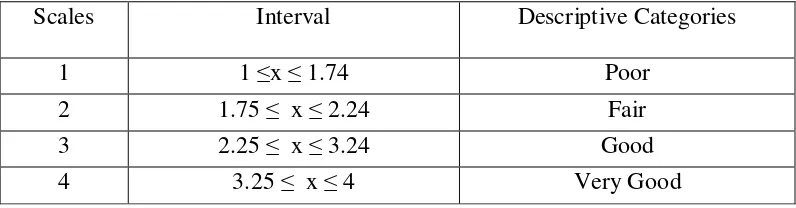
Table 5. Data Conversion Table ... 40
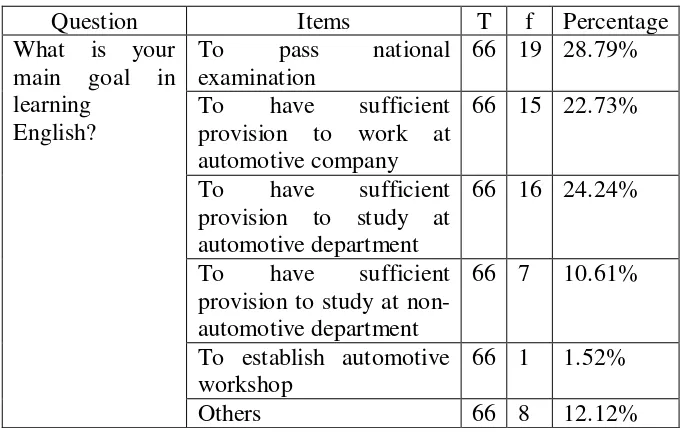
Table 6. Students’ Choice about Target Goals of English at SMK ... 41
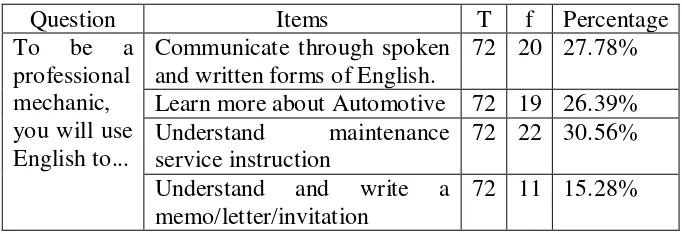
Table 7. Students’ Choice about English Usage. ... 42
Table 8. Students’ Choice about The Importance of English in Working Situations ... 42
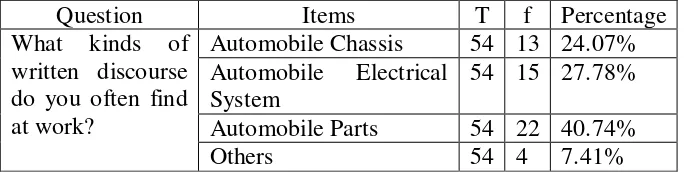
Table 9. Students’ Choice about Written Discourse... 43
Table 10. Students’ Choice about Needed Skills ... 43
Table 11. Students’ Choice about English Use at Workshops. ... 44
Table 12. Students’ English Proficiency Level ... 44
Table 13. Students’ Vocabulary Mastery. ... 45
Table 14. Students’ Difficulties in Learning English ... 45
Table 15. Students’ Difficulties in Reading. ... 46
Table 16. Students’ Difficulties in Writing ... 46
Table 17. Relationship between Students’ Writing and Familiar Topics ... 47
Table 18. Students’ Wants in Learning English. ... 47
Table 19. Students’ Choice for Input Text ... 48
Table 20. Students’ Choice for the Length of Input Text... 49
Table 21. Students’ Choice for Availability of Glossary ... 49
Table 22. Students’ Input Choice for Learning Writing. ... 49
Table 23. Students’ Choice in Reading Comprehension Tasks ... 50
xiii
Table 25. Students’ Preference in Writing Tasks ... 51
Table 26. Students’ Choice in Learning Grammar ... 51
Table 27. Students’ Choice in Learning Vocabulary ... 52
Table 28. Students’ Preference in Doing Reading Tasks. ... 52
Table 29. Students’ Preferance in Doing Writing Tasks ... 53
Table 30. Students’ Choice in Teacher Roles. ... 53
Table 31. Students’ Choice in Teacher Respond to Students’ Difficulty ... 54
Table 32. Student Roles in Reading Writing Learning Process. ... 54
Table 33. Students’ Agreement of Other Student Roles in Learning Process ... 56
Table 34. Students’ Choice about Book Cover. ... 57
Table 35. Students’ Choice about Ideal Font of Book Cover. ... 57
Table 36. Students’ Choice about Ideal Font Size for Book Cover. ... 57
Table 37. Students’ Choice about Font for Instructions. ... 58
Table 38. Students’ Choice about Font Size for Instructions. ... 58
Table 39. Students’ Choice about Letter Spacing. ... 58
Table 40. Students’ Choice about Letter Color in Unit. ... 59
Table 41. Students’ Choice about Unit Illustration. ... 59
Table 42. Students’ Choice about Picture and Material Proportion. ... 59
Table 43. Students’ Choice about the Length of Task Instruction ... 59
Table 44. Students’ Choice about Number of Effective Tasks. ... 60
Table 45. Students’ Choice about Unit Cover. ... 61
Table 46. The Appropriateness of the Content. ... 63
Table 47. The Appropriateness of the Presentation. ... 63
Table 48. The Appropriateness of the Language. ... 64
Table 49. The Appropriateness of the Layout ... 64
Table 50. Revision of Unit ... 65
Table 51. The Appropriateness of the Content. ... 67
xiv
Table 53. The Appropriateness of the Language. ... 68
Table 54. The Appropriateness of the Layout ... 69
Table 55. Revision of Unit ... 70
Table 56. The Appropriateness of the Content. ... 72
Table 57. The Appropriateness of the Presentation. ... 72
Table 58. The Appropriateness of the Language. ... 73
Table 59. The Appropriateness of the Layout ... 73
xv
LIST OF APPENDICES
APPENDIX A. THE NEEDS ANALYSIS INSTRUMENTS
APPENDIX B. THE NEEDS ANALYSIS RESULTS
APPENDIX C. THE COURSE GRID
APPENDIX D. THE FIRST DRAFT OF MATERIALS
APPENDIX E. THE EXPERT JUDGMENT QUESTIONNAIRE
APPENDIX F. THE EXPERT JUDGMENT RESULTS
APPENDIX G. THE FINAL DRAFT OF THE MATERIALS
xvi
DEVELOPING A SET OF SUPPLEMENTARY LEARNING MATERIALS OF WRITTEN CYCLE FOR STUDENTS OF GRADE XI OF
AUTOMOTIVE ENGINEERING IN SMKN 1 SEYEGAN
Anas Putra Pamugkas 12202244020
ABSTRACT
The objectives of this study were (1) to find out targets’ needs and learning needs of eleventh grade students of Automotive Engineering major in SMKN 1 Seyegan, (2) to develop appropriate written cycle learning materials for grade XI students of SMKN 1 Seyegan.
This was an educational research and development study. The research subjects were the grade XI of automotive engineering students of SMKN 1 Seyegan. The research procedure, was adapted from Borg & Gall (1983) procedure with heavy adjustments. The study used two types of questionnaire: 1) need analysis questionnaire to find out students’ needs and learning needs and 2) material evaluation questionnaire based on Pedoman Buku Bahasa Inggris SMK. To analyze the questionnaires, descriptive statistics was used.The steps of this research were 1). Research and Information Collecting, where students were given questionnaire to identify their needs and learning needs, 2). Planning; in this stage, the course grid was developed based on the results of questionnaire, 3). Developing Preliminary Product/First Draft Materials, the course grid was the basis of the first draft of the materials, 4). Expert Judgement, the developed materials were evaluated by an expert by distributing the second questionnaire 5). Developing Final Product, the results of expert judgment were the basis to develop final product.
1
CHAPTER I INTRODUCTION A.Background of the Problem
English has been an international language that enables people from
different countries to communicate with one another easily. Its use covers many
areas in real and virtual world from theory to practice, such as improving field
knowledge or having a professional job. Because of its importance, mastering
English is necessary.
The fact that English is the international language has made the Indonesian
government introduce English to all Indonesian schools, including vocational
schools. It can be seen from the government action to make English as a major in
every curriculum implemented by the Indonesian government. Currently, English
is also a major in Curriculum 2013.
Curriculum 2013 by nature is different from its predecessors. The main
difference is that the government through Ministry of Education and Culture
develops the curriculum, syllabuses and materials for vocational highschools
majors, including English. Because the government is the one that develops
English materials, the Ministry of Education and Culture hopes that students of
vocational highschools are able to reach the goals that had been set by the
government. The Goals are that vocational students have potentials as good
workers, and enterprenuers and vocational students have good communication
2
To engage the students, the materials for spoken cycle and written cycle
should be developed by taking into a account of both Curriculum 2013 and the
results of need analysis: target needs and learning needs. In reality, English
materials provided by the Ministry of Education and Culture are general. Students
of vocational highschools have difficulties in understanding the materials. As a
result, students of vocational highschools are not interested in learning English.
This research aims to give a solution to this problem by providing teachers
and students of vocationals with a set of supplementary learning materials for
written cycle. However, the materials are only specifically designed for students
of vocational highschools who has major in automotive engineering.
B.Identification of the problem
Based on The ministerial regulation number 64 year 2013, English
difficulty levels in SMK are divided into Novice, Elementary, and Intermediate. In
the second year (grade XI), English is taught at the level of Elementary.
The difficulty level of Elementary requires the students to learn more
complex language functions, both spoken and written forms. In terms of spoken
English, the students are expected to maintain communication with native
speakers whilst in terms of written communication the students are expected to be
able to produce professional message, such as writing a curriculum vitae.
Based on the preliminary observation, the teachers try to supplement
English materials with supplementary materials from other sources. However,
3
limitations are: the supplementary materials for Curriculum 2013 are limited and
the supplementary materials are not systematically developed.
The course books used for students of SMK is as the same as the book
used for SMA students. Thus, students of SMK are not provided with knowledge
of their area of expertise. The lack of knowledge creates a problem where students
find some difficulties when they have to use English in performing their expertise.
This situation is also happening at SMKN 1 Seyegan. English teachers
only use the national book. The use of supplementary learning materials in the
classroom is still limited.
In spite of the fact that the materials are not relevant for all levels, the
school has attempted to maximize the exposure of four-language skills stated in
Silabus Bahasa Inggris SMKN 1 Seyegan. Hence, as the research will be for
students of year XI, the researcher narrowed the problem dealing with the
supplementary learning materials for students of year XI. On the syllabus, each of
language skills has each own proportion and materials used.
Within the implementation of teaching and learning process, the teacher is
still following the tasks provided in the source book (Get Along With English for
Year X), for both receptive and productive skills. However, there are still
problems with the learning materials used in the teaching and learning process of
two skills.
The problems are listed as follows.
1) input texts for teaching reading.
4
texts provided in the source books as well as follows the tasks. However, text used
in the textbooks are general. The use of general input texts without supplemented
with specific input texts for students of vocational schools may render students
ability and familiarity related to their field. The extensive use of specific input text
will make students not only comprehend the features of the texts, but they also
gain some technical terms used in automotive engineering. Those technical terms
will be useful for them especially when they are working at plant or workshops or
other specific places.
2) the process of teaching writing.
In teaching writing, teachers usually gives the tasks provided in the course
book. They sometimes supplement their teaching by adopting materials from
internet, but some of them are not related to automotive engineering.
3) the process of teaching grammar and vocabulary.
Most teachers teach the grammar and vocabulary deductively. In grammar
teaching, teachers simply provide students formulas of grammar, and have
students do some exercises. In vocabulary teaching, teachers also tell students
before students face a type of texts. In spite of those, teachers usually provide
more exercises related to grammar exercises, and a new list of vocabulary which
is not related to automotive engineering.
C.Delimitation of the Problem
This study will only focus on developing a set of written cycle learning
5
Curriculum 2013 and students needs based on need analysis English for Specific
Purposes.
D.Statement of the Problem
Based on identification of the problem above, it can be concluded that
there are two focus of this research, namely:
1. What are the target needs and learning needs of eleventh grade students of
Automotive Engineering major in SMKN 1 Seyegan?
2. What kind of written cycle materials do students of eleventh grade of
Automotive Engineering major needs?
E.Objectives of the Study
Based on background of the study, identification of the problem,
delimitation of the problem and statement of the problem, it can be sum up that
the objectives of this study are:
1. To find out target needs and learning needs of eleventh grade students of
Automotive Engineering major in SMKN 1 Seyegan?
2. To develop written cycle learning materials.
F. Significances of the Study
This study is expected to provide some contributions towardstwo issues in
English teaching learning process:
1. Theoretical
This research is expected to be a relevant reference for researcher who
6 2. Practical
In terms of practical significance, It will contribute on:
This supplementary learning materials will be beneficial to student to
increase their motivation in learning English, because they are developed using
consent of students themselves. The learning materials will also enhance students
knowledge, so they will get better understanding of both English and their
expertise area. The developed learning materials of this study can be used by
teachers of vocational highschools to supplement their teaching materials.
Futhermore, this study may trigger teachers of vocational highschools to develop
7
CHAPTER II
LITERATURE REVIEW AND CONCEPTUAL FRAMEWORK A.Literature Review
1. Teaching English as a Foreign Language in Indonesia
English teaching in Indonesia has been regulated by national curriculum. It
is also regulated in law number 20 year 2003 about national eduational system. In
Indonesia, English can be considered as a foreign language. However, currently,
English is a required major in Indonesia eduational system. To answer every
challenge, Indonesian English syllabi has been revised throughout time. Today,
The Government of Indonesia uses the Curriculum 2013 as the national
curriculum, while it preserves School-based Curriculum.
There are some changes between Curriculum 2013 and School-based
Curriculum, related to English teaching. First, the amount of time allocated to
teach English is reduced. In Curriculum 2013, the allocated time for teaching
English are twice a week (40 min per lesson) in lower secondary schools and once
a week (45 min per lesson) in higher secondary schools. In School-based
Curriculum, the allocated time is four times a week for secondary schools.
Second, English teaching for elementary school is abolished in Curriculum 2013.
Last, the English learning materials is heavily dependent on books published by
ministry of education and culture.
2. Teaching English in Vocational Schools (VS)
Throughout time, the national curriculum has been changed and English
8
Vocational Schools, English is a required major, but teaching English has its own
problems. Those problems are the lacks of learners’ motivation, lacks of allocated
time, lacks of resources and materials, and the number of students. Added to those
problems, English in Curriculum 2013 expects learners to learn English as same
as students of Senior High Schools. The learning materials are published by the
Indonesian government. Teaching English in vocational school is quite
challenging if ther teachers are expected to teach many technical terms in each
major in vocational schools.
3. Curriculum a. Definition
Some experts have their own definition on what is meant by a curriculum.
According to Nation &Macalister (2010: 1), a curriculum is a guidance in
designing courses that consists of outer cycle; namely principles, environment,
and needs that involve practical and theoretical considerations that will have a
major effect in guiding the actual process of course production, and inner cycle
that consists of goals, as its centre, contents, and sequences, format and
presentation, and monitoring and assessment.
Richards and Schmidt (2002: 139) define a curriculum as a set of plan to
guide a program. The program usually has several components: (a) the aims or
goals of the program; (b) syllabus; (c) methodology; (d) assessment and testing;
9
The Laws of Education System number 20 year 2003 defines a curriculum
as a set of plan which contains goals, contents, materials, and method used as a
guide in teaching learning process.
From theories above, It can be concluded that a curriculum is the
framework that underlies before a program. It covers aims, contents, sequences
(how the contents are going to be taught), teaching principles, assessment, and
how a program are evaluated whether it reachs the goals or not in eduacational
settings.
b. Curriculum 2013
Curriculum 2013 is the latest national curriculum in Indonesia. The
curriculum is intended to succeed the school-based curriculum, the national
curriculum dated in 2006. According to Curriculum 2013, English is a required
major in vocational schools. However, the allocated time for teaching English is
only once a week. Inside Curriculum 2013, there are two important things that
need to be considered in teaching subject matter. They are Core Competence and
Basic Competence. Core Competence include four basic competences that should
be attained by students in every educational level: spiritual, social attitude,
knowledge, and skills. The Basic Competence is the further explanation of the
core competence. The following table is the core competence and basic
competence of English taught in vocational schools for grade XI.
By implementing Curriculum 2013, the government forces both students
and teachers to use Scientific Approach in teaching learning process. The
10
Figure 1. Schema of Scientific Approach
Based on the figure above, Curriculum 2013 which emphasizes on
Scientific Approach can be implemented in all field studies.
The impact of Curriculum 2013 is that the teachers are required to teach
based on the Scientific Approach (SA). The steps of implementing SA in teaching
learning process are: observing texts, questioning (asking questions),
experimenting (collecting data), associating (analyzing data and drawing
conclusions), communicating and finding (knowledge), and creating texts.
1) Observing (text)
In the first step, students are required to receive or get exposed to English
language input. This need to be done so that students have some perceptions in
11
supposed to match their previous knowledge with the new knowledge (text). The
materials used in this step may vary depending on the subjects/students’ cognitive
skills. It may be in the form of authentic materials (texts) or pedagogical materials
(texts). The items which are listed include the social function of the text, text
structure, grammar, and vocabulary.
2) questioning (asking questions)
To fully comprehend a text, students are required to match their previous
knowledge with the new knowledge (new form of texts). If there is a gap between
the existing knowledge and the new information, students need to ask or
formulate questions based on the gap. It is also suggested that students have
developed their own hypothesis on what questions that they intend to know.
3) experimenting (collecting data/information)
To get the answer of their own questions, students are encouraged to find
some reference dealing with the text. Collecting information may be in the form
of observing similar use of text in other context, browsing through internet, and if
possible doing an interview. The teacher here performs his/her role as the
facilitator. The teacher needs to guide students so that they will not lose in the
deep of the jungle.
4) associating (analyzing data and drawing conclusions)
After collecting the sufficient resources, students need to sort out, classify,
identify, and analyze collected data/information to answer their formulated
questions. In this stage, students are not only required to answer their questions
12
have the pattern and ways to deal with the text being learned.
5) communicating and finding (knowledge)
The next stage, students are required to communicate what they have in
their mind through writing/spoken text. The conclusions describe their new gain
knowledge, so that they are able to comprehend and create a new text perfectly
similar with the model text.
6) creating (text)
The last step of this cycle is creating texts. In this step, students need to
communicate ideas they have using the new knowledge they acquire. As they
know the nature of the text, they will easily form texts. It is important to
remember that learning a language does not have an end as it is a continous cycle.
This cycle will not be broken but it will only get some knowledge insertion. The
ultimate form of learning English is able to use knowledge in communicate with
people whether it is in the form of written form and spoken form.
4. Written Cycle (Reading and Writing Skills) a. Definition of Written Cycle
English skills can be divided into two cycles, namely the spoken cycle and
the written cycle. The spoken cycle consists of listening and speaking skills, while
the written cycle consists of reading and writing skills. Both have two sides,
namely receptive skills and productive skills. Listening and Reading are receptive,
13 b. Definition of Reading
Reading skill is one of language skills that belongs to the receptive one.
Reading is not only a matter of understanding text superficial meaning but the
readers also need to dig deeper what kind of information that the writer provided.
Spratt et al (2005: 21) stated that to make sense a text, one should connect
message in the text with one’s background knowledge. Because of it, reading is
truly unique yet complex process.
c. Subskills
As one of language skills, reading has sub-skills. Spratt, et.al (2005: 22)
propose three subskills of reading, they are shown as follows:
1). Reading for specific information or scanning: reader needs to pay attention on
what kind of specific information the reader needs.
2). Reading for gist or skimming: the readers read the important clue, so that the
readers will get general idea of texts.
3). Reading for detail: the reader needs to read and understand the whole text.
d. Definition of Writing
Writing is a skill that produces language by creating written text. It needs a
good communication to link the model with the idea in the mind into a good text.
According to Spratt, et.al (2005: 26), writing is one of productive skills that has
final product in the form of written text. The text should be constructed properly.
14 e. Types of Written Language
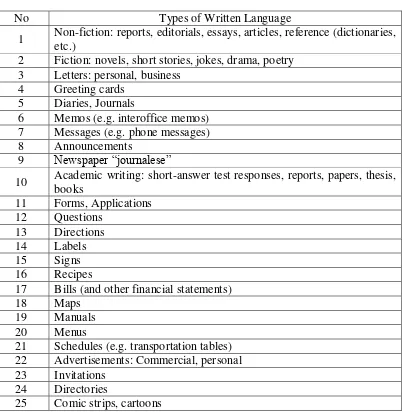
Written language has many types. According to Brown (2007: 302), there
[image:30.595.114.516.213.625.2]are many types of written language. Below is the list of types.
Table 1. Types of Written Language (Brown, 2007: 302-303)
No Types of Written Language
1 Non-fiction: reports, editorials, essays, articles, reference (dictionaries, etc.)
2 Fiction: novels, short stories, jokes, drama, poetry 3 Letters: personal, business
4 Greeting cards 5 Diaries, Journals
6 Memos (e.g. interoffice memos) 7 Messages (e.g. phone messages) 8 Announcements
9 Newspaper “journalese”
10 Academic writing: short-answer test responses, reports, papers, thesis, books
11 Forms, Applications 12 Questions
13 Directions 14 Labels 15 Signs 16 Recipes
17 Bills (and other financial statements) 18 Maps
19 Manuals 20 Menus
21 Schedules (e.g. transportation tables) 22 Advertisements: Commercial, personal 23 Invitations
24 Directories
25 Comic strips, cartoons
Based on core and basic competences of Curriculum 2013, this research
will use three types of written languages proposed by Brown (2007: 302-303):
15 f. Writing Stages
Writing skill, like other skills have its own stages. Spratt et al (2005: 27)
state that the stages of writing process which are:
1) brainstorming (thinking of everyhing we can)
2) making notes
3) planning (organising our ideas)
4) writing a draft (a piece of writing that is not yet finished, may be
changed)
5) editing (correcting and improving text)
6) producing another draft
7) proof-reading (checking for mistakesin accuracy or editing again)
According to Stifler (1996: 1), the writing process can be divided into two:
writing for self, and writing for public/audience. To create a writing for self, there
are three stages: (1) prewriting, (2) focused prewriting, (3) drafting. However, to
create a writing that become public consumption, the writer should follow six
stages in writing: prewriting, focused writing, drafting, first review, second
review, and final review.
It can be concluded that there are some stages that need to be followed by
a writer to create a good writing. In writing, there are three main stages:
prewriting, doing writing, afterwriting. Prewriting activities includes how the
writer gathers ideas in what writing, he/she wants to write, how the text skeleton
16
when he/she is writing. The last stage is after writing. In this stage, the writing is
usually published. Before the publishing, the writing needs to be checked.
5. English for Specific Purposes (ESP)
As English becomes one of major in vocational schools, students of those
schools are expected to perform well in English. However, as implied before that
students of vocational schools are people who have their own expertises, English
taught to students should also be based on English for Specific Purposes.
Hutchinson and Waters (1987: 19) state that ESP is an approach that takes
into account learners’ preferences in order to develop a good language teaching.
ESP has characteristics in which the teaching and learning concern on how
students can meet the specific needs they want to learn (Anthony, 1997: 1).
Basturkmen (2006: 17) also supports the idea in which ESP is about preparing
learners to use English within academic, professional, or workplace environment.
In language teaching, ESP is important as Nunan (2004: 7) in Basturkmen (2006:
17) also declares that ESP is the subcomponent of language teaching, with its own
approaches to curriculum development, materials design, pedagogy, testing and
research.
ESP is an approach that takes into account learners’ preferences in order to
develop a good language teaching.
a. Learners’ needs
The first analysis that should be done in ESP is the target needs which are
described as something will be needed by the learners in the future, especially
17
needs into three aspects: necessities, lacks, and wants.
1). Necessities
Necessities are the learners’ needs to know the knowledge demanded by
target situations where learners are involved.
2). Lacks
Every learner have problems in the English learning such as the lack of
proficiency, vocabulary, grammar, and it is possible that the problem varies
depend on the each student. Lacks are defined as the gap occurs between the
difficulties and the necessities by Hutchinson & Waters (1987: 55-56). When
learners cannot achieve the necessities that concern demanded knowledge, lacks
are things that need to be solved.
3). Wants
ESP learners also can determine the needs by their own out of the
necessities. This refers to Wants in which learners are also given an opportunity to
be active in deciding the needs because people can have their own thought that
may be different from what the students are supposed to do.
As stressed by Hutchinson and Waters (1987: 55) about target needs, it
can be concluded that to determine target needs, the course planner should take
three categories related to target needs analysis into account.
b. Learning needs
After getting the whole picture of learners’ needs, there is an aspect that
should be considered in planning an ESP course is learning needs. Hutchinson
18
and objectives set by the developer from the starting points. Tahir (2011: 16-17)
states that learning needs importance is equal to need analysis. Furthermore, he
suggest that learning needs should be considered more important than need
analysis by future ESP teachers.
In summary, learning needs is also as important as learners’ needs.
Because its nature is a “route”, ESP teachers need to take learning needs seriously
in planning and developing an ESP course in order to make ESP course become
enjoyable, while still able to achieve its goals and objectives.
c. Materials Development
The next step after getting information of learners’ needs and learning
needs is to develop the materials. Tomlinson (1998: 2) states that materials are
anything used by teachers and learners to achieve the learning goals. Related to
materials development, Nunan (1991: 216) states that material development is
basically dealing with selection, adaptation,and creation of teaching materials.
According to Richards (2001: 86) teaching materials in the process of teaching
and learning has functions as the language input for learners, and ideas for
teachers in planning and teaching lessons. In line with this, Dudley-Evans and St.
John (1998) suggest that for teachers of ESP courses, teaching materials function
as a source of language, learning support, for motivation and stimulation, and for
19
Hutchinson & Waters (1987: 107) describe some principles to take into
account in ESP materials.
1) a stimulus to learning
Good materials do not teach, but encourage the students to learn more and
more. Toaccomplish such feat, the materials must be able to attract students
interest such as interesting text, various enjoyable activities, and opportunities to
use existing knowledge and skills which the students and teacher able to cope up.
The materials must not be too challenging, and follow Krashen formula “i+1”.
2) providing the teaching learning process framework.
Materials can be the guidance for the teachers so that they do not get lost.
Not only that, students knowledge and skill will improve according to the
standards that they should improve.In other words, it should provide a clear and
coherent unit structure which will guide teachers and learners through various
activities in order to reach the learning goals.
3) reflecting language aspects needed to contain.
4) reflecting the nature of learning task.
Although language learning is such a complex process, materials should
try to reflect the complexity of the task, yet makes it suitable for learners. The
tasks must be constructed from the easiest into the hardest one.
5) introducing teachers to new techniques.
6) providing correct and appropriate language use model.
However, the materials do not simply become the language use, but it is a
20 language in discourse level.
In order to make the materials relevant to what the learners need, materials
development in ESP should be in line with the approach used in the materials.
Content-based instruction (CBI) is considered as the most effective approach to
be used since it can associate the materials development with the learners’ needs
in learning a second language (Richards and Rodgers, 2001: 207).
6. Materials Development a. Good Learning Materials
In teaching learning process, the learning materialsare very important.
Materials are any kinds of things that can be used in language teaching.
There are five types of materials according to Tomlinson (2001) cited in
Tomlinson (2011:2): informative (informing the learner about the target
language), instructional (guiding the learner in practicing the language),
experiential (providing the learner with experience of the language in use),
eliciting (encouraging the learner to use the language) and exploratory (helping
the learner to make discoveries about the language).
There are two types of materials: authentic and created materials
(pedagogic) according to Richards (2001: 252). The created materials (pedagogic
materials) are materials specifically developed to meet pedagogical standard
defined by authority. The authentic materials refer to any materials that are not
21
Philips and Shettlesworth (1978); Clarke (1989); Peacock (1997) cited in
Richards (2001: 252) claim that there are several main advantages of using
authentic materials:
1) They have a positive effect on learner motivation. 2) They provide authentic cultural information. 3) They provide exposure to real language. 4) They relate more closely to learners 'needs.
5) They support a more creative approach to teaching.
Developing English learning materials should follow some criteria.
Tomlinson (2011: 6-23) states the criteria of good materials as follows.
1) Materials should achieve impact.
2) Materials should help learners to feel at ease.
3) Materials should help learners to develop confidence.
4) Learners should perceive what is being taught as relevant and useful. 5) Materials should require and facilitate learners’ self-investment. 6) Learners must be ready to acquire the points being taught.
7) Materials should expose the learners to language in authentic use.
8) The learner’s attention should be drawn to linguistic features of the input. 9) Materials should provide the learners with opportunities to use the target
language to achieve communicative purpose.
10) Materials should take into account that the positive effects of instruction are usuallydelayed.
22 styles and affective attitude.
12) Materials should permit a silent period at the beginning of instruction. 13) Materials should maximize learning potentials by encouraging intellectual
aesthetic, and emotional involvement, which stimulates both right and left
brain activities.
14) Materials should not be relied too much on controlled practice. 15) Materials should provide opportunities for outcome feedback.
The good materials should make both teachers and learners comfortable
with, and increase the chances of learners to experience authentic situations, while
at the same time, still achieve the goals or aims.
b. Role of Learning Materials
In learning English, it is important for the teachers to provide their
students with exposures. The best way to introduce English to learners is to learn
in native forms. It means that in teaching English for non-native learners, teachers
should use the authentic materials. This point of view is also shared by Richard
(2001: 215). Richard point out that the materials being used to teach should be
related to learners’ expertise.
Based on Richard’s view, the material developers should provide learners
with a set of materials that makes learners not only learn English but also learn
vocabularies related to their expertise.
Another implication is that teachers in voactional schools should be able to
23
master English as the means of communication, but also have knowledge about
technical terms in their own fields.
c. Principles of Learning Materials Development
Developing a learning materials must follow some principles so that the
developed materials will be able to fulfill the goals set before. Tomlinson (2009:
45) in ILTEC seminar paper year 2009 states that materials being developed
should be coherent and they should be based on some principles such as:
1. Theories of language acquisition and development. 2. Principles of teaching.
3. Current knowledge of how the target language is actually used.
4. The result of systematic observation and evaluation of materials in use. Futhermore, Tomlinson (2009: 45) also sets up some principles based on
some situations derived from target users’ language acquisition process.
The materials developers should embrace those principles when they
develop a learning materials for target learners. It will make the developed
materials be practical in use and the learning materials can be considered as good
materials.
d. Materials Design Model
To reach the goals and objectives of language learning process, the
existence of learning materials is a must. The materials will help and guide
students because the materials can be used to expand the students knowledge even
in non-related language learning process. Hutchinson and Waters (1987:108)
24
content-focus, language focus, and tasks. However, in this study, the reseacher
develops the materials by adapting the model from Borg and Gall (1983:775), in
consent with coherent framework proposed by Hutchinson and Waters.
Designing the layout of learning materials is very important. The attractive
design of learning materials will make learners/students be interested in learning.
To make such attractive visual appearance, it is necessary to emphasize on
typography. typography has many definitions. Here are some definitions by
experts. According to Spitzmuller (2007: 10), typography is how written language
is presented, in spite of the medium being used. Based on the idea proposed by
Bringhurst (2005: 11) cited in Spitzmuller (2007: 6), typography is that something
important in written language, due to its nature that gives “live” into the written
languages. Typography has levels that can be further divided into two parts,
according to Walker (2001: 18) cited in Spitzmuller (2007: 11). They are micro
typography that includes choice of type faces, type sizes, alignment, emphasis,
letter spacing and macro typography that includes the choice of color, the image
placement, the choice of media, etc.
From theories above, it can be inferred that in developing unit of learning
materials, the developer needs to take into account its typography, because
typography serves as attention gathering. If the developer use the best
combination of micro and macro aspects of typography, the developed materials
will have “soul” and “live”. The good visualisation of a unit will have good
25 e. Materials Evaluation
Materials evaluation is a important step in materials development.
Tomlison (2012: 24) argues that the process will determine whether the developed
materials are practical in use or not, how the learners will get benefits from them.
Hutchinson and Waters (1987: 96) pointed out materials evaluation is not a tool to
determine whether the learning materials are good or not, rather how its
appropriatness in use.
In summary, materials evaluation is a step that determine whether the
product is able to fulfill its goals or not. However, in this research , the materials
development will be carried out based on Instrumen Buku Bahasa Inggris SMK.
7. Theme-based Instruction
There are some instructions used in educational settings. One of them is
theme-based instruction. The theme-based instruction is weak form
ofContent-based Instruction as stated by Brown (2002: 235-236). He states that the
theme-based instruction is more practical in vocational education as it gives an emphasis
on both subject-matter knowledge and English equally.
This is the reason why the researcher is going to use theme-based (TB) in
this research. The use of TB in developing the materials will help students learn
English better as they learn it which is connected to their major. The result of
English teaching learning process also will be different since they will concern
more on the language that fits to their major as vocational high schoolstudents.
Brown also mentioned that this model is an integrated skill instructional
26
practical, can be used as the guide to develop English materials for vocational
school especially.
In theme-based instruction, themes are the central ideas that become the
backbone of the units, so that they have to be chosen with some considerations,
such as students’ interests and needs, content resources, educational aims, and
institutional demands. TB course consists of several subunits focusing on different
topics which explore more specific aspects of the general theme. Topics then
should be arranged to provide coherence for theme unit, and to generate content
and language.
Theme-based instruction, as the name suggests, is an instructional method
that place emphasis on particular theme. From that theme, the course developer
can expand the theme to every aspect that fulfills the students needs. It is also a
connector for students who has their own expertise to mastering a language and
contents in their expertise.
8. Unit Development
The learning materials are constructed by the compilation of units. Those
units are arranged based on the course grid that the developer has created before.
To develop units, the material developer needs to follow six steps provided by
Nunan (2004: 31). Nunan argues if the material developer follows his suggestions,
the units being developed will enable learners to complete the tasks and fit to their
level proficiency. Because this study is only related to written cycle, one of the
27
focus on linguistic elements, provide freer practice, and introduce the pedagogical
task.
a. Models of Unit Development 1. schema building
In the beginning, learners are guided by teacher to build what we called as
schema. This schema will serve as the core of what learners need to do in a unit.
The schema also provides learners the key points that they are required to achieve
before doing tasks in a unit.
2. controlled practice
This step is time for students to explore their knowledge related to the use
of vocabulary, structures, and functions in particular situation. By practicing it,
learners will have better grasp on what they learn in that unit. Controlled practice
can be by listening, watching, or reading non-authentic or authentic text taken
place in particular place. i.e. workshop.
3. focus on linguistic elements
In this step, the main focus as the name suggest is linguistics elements
such as grammar and vocabulary. Unlike traditional approach that
emphasizelinguistics elements in separate way, the Content-based Instruction
gives emphasis on the relation of grammar, vocabulary that learners acquire with
their situational conditions.
4. providing freer practice
In this step, learners are expected to be able to produce their own style of
28 5. introducing the pedagogical task
At this step, it is the time to introduce the pedagogical tasks, which mean
that students are required to complete tasks in groupwork.
b. Task Continuity
To build a good structure of units, tasks need to be developed based on
continuity principle. The continuity, according to Nunan (2004: 125), means that
tasks, task components, and supporting skills unit must be interdependent with
each other. By developing tasks of unit, the learning process cycle will not be
interrupted.
Nunan (2004: 125) also provides definition of continuity from
psycholinguistics approach. Here, Nunan states that tasks are sequenced by
considering the cognitive and performance demand set for learners.
It can be inferred that task continuity is important, because it requires the
coherent and cohesive of tasks, task components, and supporting skills to make
the teaching learning process run smoothly and continuously.
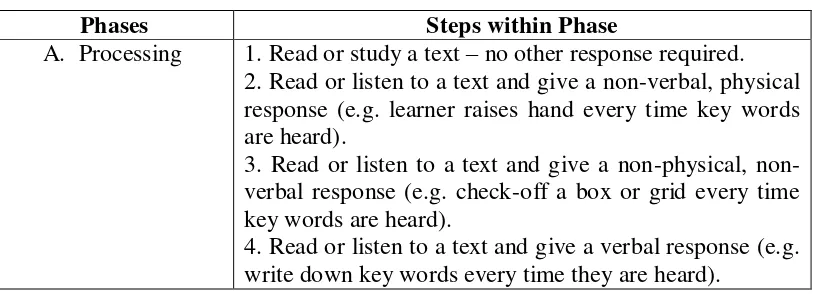
Nunan (2004: 126) also provides the task continuity principle in the
[image:44.595.110.526.605.752.2]following table.
Table 2. Principles of Task Continuity
Phases Steps within Phase
A. Processing 1. Read or study a text – no other response required. 2. Read or listen to a text and give a non-verbal, physical response (e.g. learner raises hand every time key words are heard).
3. Read or listen to a text and give a physical, non-verbal response (e.g. check-off a box or grid every time key words are heard).
29
B. Productive 5. Listen to cue utterances, or dialogue fragments and repeat them, or repeat a complete version of the cue. 6. Listen to a cue and complete a substitution or transformation drill.
7. Listen to a cue (e.g. a question) and give a meaningful response (i.e. one that is true for the learner).
C. Interactive 8. Role play (e.g. having listened to a conversation in which people talk about their family, students, working from role cards, circulate and find other members of their family).
9. Simulation/discussion (e.g. students in small groups share information about their own families).
10.Problem-solving / information gap (e.g. in an information gap task, students are split into three groups; each group listens to an incomplete description of a family; students recombine and have to complete a family tree, identify which picture from a number of alternatives represents the family, etc.).
9. Task Development a. Definition of Tasks
Tasks as main components of a unit have been variously defined by
experts. Nunan (2004: 113) claims that task is the core what developer constructs
to guide the learner in learning process.
Nunan (2004: 41) says that task is any activity or action that is carried out
as the result of processing or understanding language. The tasks done by students
should be varied that students will not easily get bored and also be able to achieve
the required competences.
It can be concluded that task is what material developers create in order to
make learners understand ongoing learning process. Furthermore, the task is the
30 b. Task Components
A task like a unit consists of some elements that together build a “block”.
According to Nunan (2004:41-56), there are six components that should be
included in the process of task development.
1.Goals
The goal is an aim that developer set before creating or developing a task.
By completing a task, learners are expected to reach the goals.
2.Input
Input of task is the material itself. The materials can be spoken, written,
pedagogical, and authentic. The role of input here is to engage learners in
learning. A variety of input will make learners feel interested in participating
learning process.
3.Procedure
In developing a task, the developer should be aware of learners are
expected to complete the tasks. Learners in this case are asked to perform acts in
order to complete the task.
4.Settings
There are two types of settings: mode and environment. Learning mode
refers to how learners do the tasks individually or groupwork. On the otherhand,
environment refers to the place of the use of language taken place.i.e. workshops,
31 5.Teacher Role
Role of teacher in task components is what teacher does in order to carry
out the learning process and communicate with learners. There are three roles of
teacher based on Breen and Candlin (1980: 89-112) cited in Nunan (2004: 67).
6.Learner Role
Role of learner is what learner should do those tasks in accordance with
having a good relationship between peers and teacher. Learners should be critical,
reflective, and independent. In this point, Curriculum 2013 has forced learners to
be critical, reflective, and independent, but learners are expected to have good
social relationship with their environments.
c. Tasks Grading and Sequencing
The tasks in unit should be arranged and developed comprehensively so
that by completing tasks of a unit, learners are expected to reach unit’s goals.
However, to make tasks viable for learners to learn from what they are working
on, the task should be arranged from the easiest way to the difficult one. Richard,
Platt, and Weber (1986:125) in Nunan (2004:113) describe grading as the helpful
presentation of unit contents. The gradation itself may differ based on the real
challenge in the pedagogical field including the arrangement of tasks complexity.
The sequence of tasks should be based on the comprehension to communication
focus where learners are expected to produce their own style of language use in
32 B.Review of Relevant Studies
There are some related studies about designing English materials for
vocational schools. The research done by Fahmi Dwi Prasetyo (2013) is relevant
with this study as the researcher also takes developing reading and writing
materials for vocational high school students as the topic and concentrates on the
materials for Pharmacy study program. Not only that, research done Jayanti
(2015) is also similar as it provides an insight to develop reading materials that
combine ESP, CBI and others. Another insight is provided by research done by
Istikharoh (2015). In her thesis, she provides insights to develop interactive
multimedia based on K13 English book published by Ministry of Education and
Culture in 2014. Among these studies, it can be concluded that the developed
materials consist of at least three units, each unit consists of three parts:
introduction, main activities, and reinforcement sections. The input of the
materials is generally in the form of texts, pictures, list of vocabulary, and
grammar explanations.The developed materials should address majority of
students needs, such as achieving success in national examination in English
subject, engaging active communication, and understanding technical term in
(pharmacy, computer engineering and networking).The materials that had been
developed by three researches were rated as good.
C.Conceptual Framework
English in vocational schools is not used for only academic purposes but
33
majors in vocational school which is close to the use of English in its field.
Curriculum 2013 emphasizes on how an individual becomes very
competent, creative, affective, and productive. To form such individual, combined
by the era of globalization, the students of vocational school majoring in
automotive engineering must have a good English. The problem is that the
English materials is too general. Thus, this condition creates a gap, between
knowledge that students needand being presented by current English materials.
To solve the problem, the researcher is going to develop a set of
supplementary learning materials for English written cycle. The product is
expected to fulfill its intended role and be able to give an appropriate
enhancement for automotive engineering students.
The materials will be constructed by combining ESP principles and
Theme-based Instruction. The model of the materials development is adapted
from Borg and Gall (1983: 775). The developed materials will be assessed
through expert judgement. Therefore, the supplementary learning materials are
34
CHAPTER III
RESEARCH METHOD
A. Type of the Research
This research was a research and development study because it created a
product, a set of supplementary learning materials for written cycle. this product
was aimed to be used by students majoring in Automotive Engineering at
vocational highschools. This research was based on Borg and Gall (1983: 775)
schema with some modifications.
B. Settings and Subjects of the Research
This research was conducted at SMKN 1 Seyegan on May 2016. The
settings of this research was Automotive Engineering department. The department
is one of seven specialized majors besides Autotronics Engineering, Motorcycle
Engineering, Computer and Networking Engineering, Metal Fabrication
Engineering, Civil and Planning Engineering (Teknik Gambar Bangunan),
Concrete Construction Engineering (Teknik Konstruksi Batu and Beton). This
school is also promoted as one of leading vocational schools in Sleman regency.
The participants of the research were grade XI students of Automotive
Engineering at SMKN 1 Seyegan. There were three classes of the department.
35 C. Research Procedure
figure 2. the flow of research procedure
This research used guidance provided by Borg & Gall (1983: 775).
However, there were some modifications to the procedure of the study. The
modifications that happened were to comply the nature of a research and
development research in Yogyakarta State University rule. The study was up to
operational product revision without preeliminary field testing and main field
testing, as both are replaced by experts’ judgement. To comply that the developed
product was good to be applied in field, the product must be in compliance with
national standard set by national education standardization commission.
There were some steps to complete this study, namely: research and
information collecting, planning, developing the preliminary form of product,
expert's judgement and writing the final product. The steps of research were as
follows.
Research and Information Collecting
planning
Developing preliminary product
Experts’ Judge e t
36 1. Research and Information Collecting
The first step of conducting the research is research and information
collecting. In this step, the need analysis was done. It aimed to find out targets’
needs and learning needs. To make need analysis feasible, the questionnaire was
distributed to students. The results of questionnaire was analyzed. The data of
analysis results then was used in second step, Planning.
2. Planning
The next step after collecting data/information is planning. In this step,
there were two activities: designing the course grid and designing the lay out of
the materials. The course grid consisted of core and basic competences, unit title,
indicators, grammar focus, vocabulary list and activities. In designing the lay out,
the data from analysis was converted to the actions.
3. Developing Preliminary Product
After done in planning stage, the next step is to develop the first draft. The
draft was derived from results of the planning stage. The preliminary materials
consisted of three units. Each unit consisted of warm-up, main activities,
reinforcement and reflection. Tasks of each unit should be appropriate for use.
Adapting and adopting process of material inputs is related to topics.
4. Expert Judgment
The first draft of the materials then was evaluated by an expert. This was
done to find out the appropriateness of the developed materials. in evaluating the
37
learning material evaluation (Instrumen Buku Teks Pelajaran Bahasa Inggris
SMK) provided by National Education Standarization Agency (BSNP).
5. Developing Final Product
The final step of this research is to develop the final products. This
process was basically revision of the preliminary product. The first draft of the
materials that was evaluated by the expert was revised based on expert’s
guidance. After revised, the first draft of the materials became the final product of
the materials. The materials were expected to fulfill students’ needs and learning
needs of automotive engineering department.
D. Data Collection Technique
The data needed was gathered using questionnaires: one was for assessing
targets’ needs and learning needs and the another was for experts’ judgement.
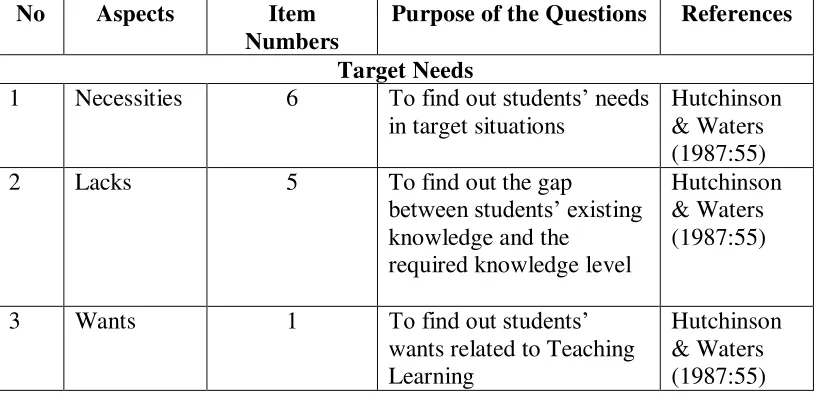
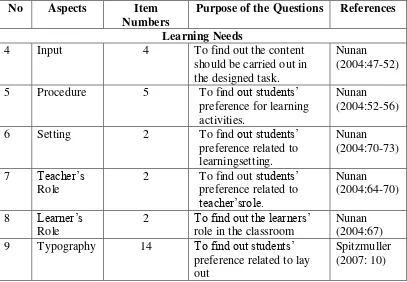
The following is the organization of the first questionnaire used to collect
[image:53.595.109.517.556.758.2]students’ needs and learning needs.
Table 3. The Organization of Need Analysis Questionnaire
No Aspects Item
Numbers
Purpose of the Questions References Target Needs
1 Necessities 6 To find out students’ needs in target situations
Hutchinson & Waters (1987:55)
2 Lacks 5 To find out the gap
between students’ existing knowledge and the
required knowledge level
Hutchinson & Waters (1987:55)
3 Wants 1 To find out students’
wants related to Teaching Learning
38
No Aspects Item
Numbers
Purpose of the Questions References Learning Needs
4 Input 4 To find out the content
should be carried out in the designed task.
Nunan (2004:47-52)
5 Procedure 5 To find out students’
preference for learning activities.
Nunan (2004:52-56)
6 Setting 2 To find out students’
preference related to learningsetting.
Nunan (2004:70-73)
7 Teacher’s Role
2 To find out students’ preference related to teacher’srole.
Nunan (2004:64-70)
8 Learner’s Role
2 To find out the learners’ role in the classroom
Nunan (2004:67) 9 Typography 14 To find out students’
preference related to lay out
Spitzmuller (2007: 10)
The second questionnaire is used to assess the materials. It is adapted from
[image:54.595.109.516.113.395.2]BSNP of Instrumen Penilaian Buku Bahasa Inggris SMK.
Table 4. The Organization of Expert Judgment Questionnaire
No Components of Evaluation
Aspects Item
numbers
References
1 Content Completeness 1 BSNP
Depth 1
Accuracy 1
Element and Meaning Structures
1
Life Skill Development 1
2 Presentation Systematic 1 BSNP
Unit balance 1
Students’ focus 1
Autonomous 1
Self-evaluation 1
3 Language The appropriateness 1 BSNP
Language Accuracy 1
The Unity of Idea 1
39 E.Data Analysis Technique
1. Need Analysis Questionnaire
Data from the questionnaire was analyzed by converting each answer on
questionnaire to the percentage using the formula:
The highest percentage on each question wass considered of students’
tendency toward to conditions.
2. Expert Judgement Questionnaire
The second questionnaire used Likert-scale measurement. The calculation
was done by using formula proposed by Suharto (2006: 52-53).
Then, the result was converted using descriptive analysis to measure its