Phylogenetic systematics and a revised generic classification of
anthidiine bees (Hymenoptera: Megachilidae)
Jessica R. Litman
a,⇑, Terry Griswold
b, Bryan N. Danforth
caNatural History Museum of Neuchâtel, Terreaux 14, 2000 Neuchâtel, Switzerland
bUSDA-ARS, Bee Biology and Systematics Laboratory, Utah State University, Logan, UT 84322, United States cDepartment of Entomology, Cornell University, Ithaca, NY 14853, United States
a r t i c l e
i n f o
Article history: Received 3 August 2015 Revised 28 February 2016 Accepted 14 March 2016 Available online 14 March 2016
Keywords: Megachilidae Anthidiini Phylogenetics Integrative systematics Nesting behavior
a b s t r a c t
The bee tribe Anthidiini (Hymenoptera: Megachilidae) is a large, cosmopolitan group of solitary bees that exhibit intriguing nesting behavior. We present the first molecular-based phylogenetic analysis of relationships within Anthidiini using model-based methods and a large, multi-locus dataset (five nuclear genes, 5081 base pairs), as well as a combined analysis using our molecular dataset in conjunction with a previously published morphological matrix. We discuss the evolution of nesting behavior in Anthidiini and the relationship between nesting material and female mandibular morphology. Following an examination of the morphological characters historically used to recognize anthidiine genera, we recommend the use of a molecular-based phylogenetic backbone to define taxonomic groups prior to the assignment of diagnostic morphological characters for these groups. Finally, our results reveal the paraphyly of numerous genera and have significant consequences for anthidiine classification. In order to promote a classification system based on stable, monophyletic clades, we hereby make the following changes to Michener’s (2007) classification: The subgeneraAfranthidium(Zosteranthidium) Michener and Griswold, 1994,Afranthidium(Branthidium) Pasteels, 1969 andAfranthidium(Immanthidium) Pasteels, 1969 are moved into the genusPseudoanthidium, thus forming the new combinationsPseudoanthidium (Zosteranthidium), Pseudoanthidium (Branthidium), and Pseudoanthidium (Immanthidium). The genus Neanthidium Pasteels, 1969 is also moved into the genus Pseudoanthidium, thus forming the new combinationPseudoanthidium(Neanthidium).
Based on morphological characters shared with our new definition of the genusPseudoanthidium, the subgenusAfranthidium(Mesanthidiellum) Pasteels, 1969 and the genusGnathanthidiumPasteels, 1969 are also moved into the genus Pseudoanthidium, thus forming the new combinations Pseudoanthidium (Mesanthidiellum) andPseudoanthidium(Gnathanthidium).
Ó2016 Elsevier Inc. All rights reserved.
1. Introduction
The megachilid tribe Anthidiini (Apoidea, Megachilidae)
includes approximately 870 described species (Ascher and
Pickering, 2015) and is widely distributed on all continents except Australia, where only one genus is native, and in the Caribbean and
Antarctica, where it is absent (Michener, 1979). They are broad,
robust bees and are usually easily distinguished from other megachilids by their dark cuticula and striking yellow, white, or
red integumental markings (Michener, 2007).
Anthidiine bees exhibit fascinating nesting behavior. Some build their nests in preexisting cavities, such as pithy plant stems,
empty snail shells, or abandoned insect galleries (Müller et al.,
1997; Xambeu, 1896; Ferton, 1911; Fabre, 1891; Grandi, 1934; Pasteels, 1977; Claude-Joseph, 1926); others build exposed nests
on the surfaces of rocks, trees, or other structures (Gess and
Gess, 2007; Ferton, 1901; Pasteels, 1977; Westrich, 1989; Muller, 1931; Müller et al., 1997); several lineages excavate their own
burrows in soil (O’Brien, 2007; Evans, 1993; Micheli, 1935;
Maneval, 1936; Pasteels, 1977; Müller et al., 1997). The French naturalist, Jean-Henri Fabre, described the ‘‘resinous putty” and
‘‘felted cotton” typical of anthidiine nests (Fabre, 1914). Fabre’s
descriptions highlight an intriguing aspect of their nesting biology: unlike members of the megachilid tribes Osmiini and Megachilini, whose primary nest-building materials may include leaf pieces, mud, pebbles, resin, flower petals, and masticated leaf pulp, the
preferredmateria primaof Anthidiini is almost exclusively limited
http://dx.doi.org/10.1016/j.ympev.2016.03.018 1055-7903/Ó2016 Elsevier Inc. All rights reserved.
⇑ Corresponding author.
E-mail addresses:[email protected](J.R. Litman),[email protected]. gov(T. Griswold),[email protected](B.N. Danforth).
Contents lists available atScienceDirect
Molecular Phylogenetics and Evolution
to one of two principal sources: plant resins and plant fibers. These materials may be supplemented with pebbles, leaf strips, grains of sand, animal fur, snail shell fragments and bits of bark or other
debris (Michener, 2007).
Fabre was among the first to classify Anthidiini into two broad
groups based on primary nest-building material (Fabre, 1891). He
recognizedles résiniers, those anthidiines that use plant resins to
build their nest cells, as a separate group fromles cotonniers, or
those anthidiines that use plant fibers to build their nest cells.
Michener’s (2007)suprageneric classification also divided Anthidi-ini into two groups: Series A includes 23 non-parasitic genera in which females have three or four rounded or blunt mandibular teeth separated by shallow concavities, while Series B includes eight genera with five or more sharp teeth separated by acute V-shaped notches. While Michener’s groups are based on mandibular dentition and Fabre’s groups are based on nesting
behavior, Michener’s Series A coincides withles résiniersof Fabre
and his Series B coincides withles cotonniersof Fabre, implying a
relationship between female mandibular dentition and choice of
nesting material (Perez, 1879, 1889; Pasteels, 1977).
The conspicuous morphological diversity of anthidiine bees has inspired multiple classification systems, with some authors prefer-ring to divide the tribe into many small genera and other authors
preferring fewer, much larger, genera.Pasteels’ (1969)classification
of Old World Anthidiini includes 47 genera andUrban and Moure’s
(2012)classification of neotropical Anthidiini includes 39 genera.
While the genera presented byMichener (2007)are more inclusive
than those of eitherPasteels (1969)orUrban and Moure (2012), he
also favors a system of multiple, small genera: his 2007 classifica-tion divides worldwide Anthidiini into 37 genera.
In contrast,Warncke’s (1980)classification of western
Palaearc-tic anthidiines recognizes only two genera: Anthidium, which
encompasses all non-parasitic anthidiines, andStelis, which includes
the parasitic anthidiines (for comparison,Michener’s (2007)
classifi-cation recognizes nine non-parasitic western Palaearctic genera).
Warncke (1980)justified his classification, noting that ‘‘Anthidium
differs in many groups but no group has developed a new
character-istic. It seems not right to split it [the genusAnthidium] in many
genera (for examplePasteels, 1969).”Michener (2007)objects,
argu-ing that Warncke’s system groups together very different forms into what is likely a paraphyletic group.
Despite the fascinating natural history of Anthidiini and the general lack of consensus regarding the assignment of anthidiine species to genera, there has been no treatment of the phylogenetic relationships among worldwide lineages of anthidiine bees and the evolutionary history of the tribe remains largely unknown. The only existing cladistic analysis of Anthidiini was presented by
Müller (1996); it included only non-cleptoparasitic western Palaearctic anthidiines, however, making it difficult to assess relationships on a world-wide basis. In this paper we reconstruct the evolutionary history of the tribe Anthidiini using model-based methods and a large, multi-locus dataset, as well as a com-bined dataset consisting of both molecular and morphological characters. We offer the first molecular-based phylogenetic hypothesis of relationships within the tribe and discuss the impact of our results on anthidiine classification. We also examine the utility of morphological characters historically used to recognize taxa. Finally, we propose a generic-level revision of Anthidiini.
2. Materials and methods
2.1. Taxon sampling
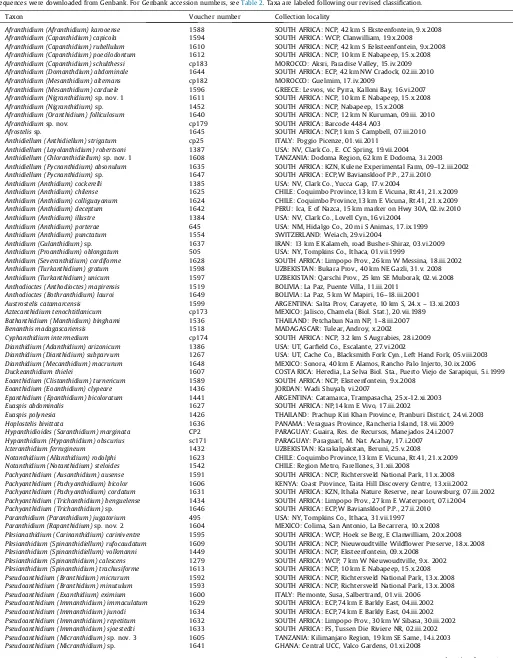
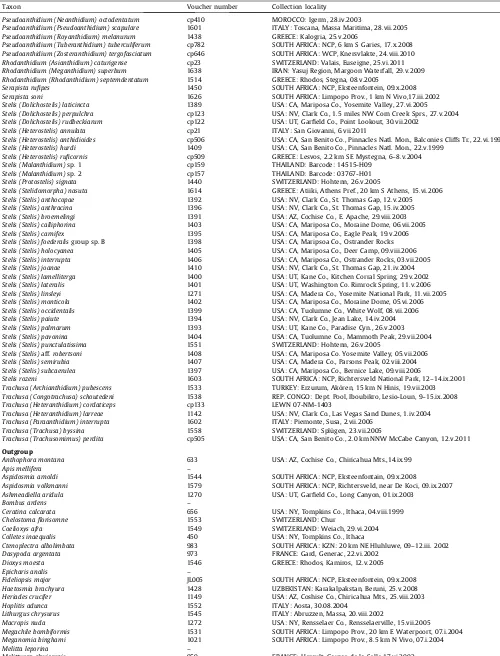
For molecular analyses, we sampled extensively within the tribe Anthidiini, choosing 123 representative species from 28
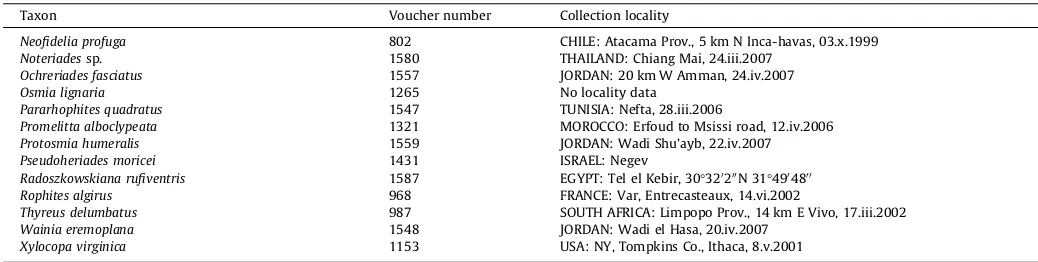
genera (Table 1). We chose 38 outgroup taxa representing all other
megachilid tribes, as well as all other families of bees. Collection
localities and DNA voucher numbers are listed inTable 1. Voucher
specimens are deposited in the Cornell University Insect Collection, in the collection at the USDA-ARS Bee Biology and Systematics Laboratory at Utah State University, and in the Litman-Praz insect collection in Neuchâtel, Switzerland.
For combined molecular–morphological analyses, we used our molecular dataset together with a subset of the taxa present in
the megachilid morphological matrix published by Gonzalez
et al. (2012). We used all of the anthidiines included byGonzalez et al. (2012)(27 genera in total), as well as 26 of their outgroup genera that overlapped with the outgroup taxa present in our molecular dataset. A total of 53 taxa were thus represented by morphological data in our combined analyses. In cases where a subgenus in the morphological matrix was represented by a differ-ent species than the species for the same subgenus in the molecu-lar matrix, we created a chimeric taxon labeled to subgenus. Use of the morphological dataset allowed us to include four anthidiine genera for which fresh specimens for molecular analyses were
unavailable: Gnathanthidium, Anthidioma, Indanthidium and
Xenostelis. The ingroup for our combined analysis thus includes 32 genera, or 89% of generic-level diversity for the tribe.
2.2. Dataset and alignment
We sequenced a total of 5081 base pairs from four nuclear protein-coding genes (CAD, 879 base pairs; NAK, 1488 base pairs; LW-rhodopsin, 672 base pairs; and EF1-alpha, F2 copy, 750 base pairs) and one nuclear ribosomal gene (28S, 1292 base pairs). All
DNA extraction and sequencing protocols followDanforth et al.
(1999). PCR primers and conditions for CAD, NAK, LW-rhodopsin,
and 28S were identical to those listed in Table S3 from Litman
et al. (2011). For EF1-alpha, we used the forward primer HaF2for1
(50 GGG YAA AGG WTC CTT CAA RTA TGC 30) together with an
anthidiine-specific reverse primer, F2RevAnth (50 AAT CAG CAG
CRC CYT TCG GTG G 30). The PCR conditions for this set of primers
were 45 s@94°C/45 s@58°C/1 m@72°C, run for 36 cycles; the PCR
runs were preceded by 5 min at 94°C and followed by 7 min at
72°C.
Sequencing was performed at the Cornell University Life Sciences Core Laboratories Center using an Applied Biosystems 3730xl DNA analyzer and at the University of Neuchâtel using an Applied Biosystems 3500 DNA analyzer. Sequences were edited
using Sequencher version 5.3 sequence analysis software (Gene
Codes Corporation, 2015). Alignments were performed using
MAFFT (Katoh and Standley, 2013) and then adjusted by eye in
MacClade (Maddison and Maddison, 2005); all introns were
removed from protein-coding genes. The ribosomal gene 28S was
aligned by secondary structure followingKjer (1995), using the
28S secondary structure model of Apis mellifera(Gillespie et al.,
2006); unalignable regions were removed. New sequence data
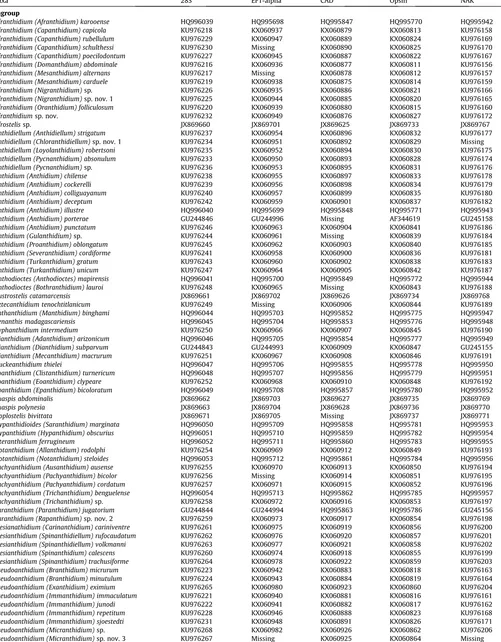
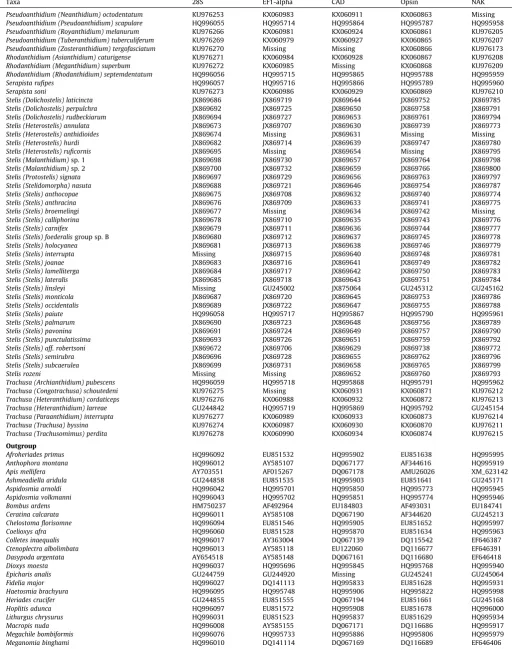
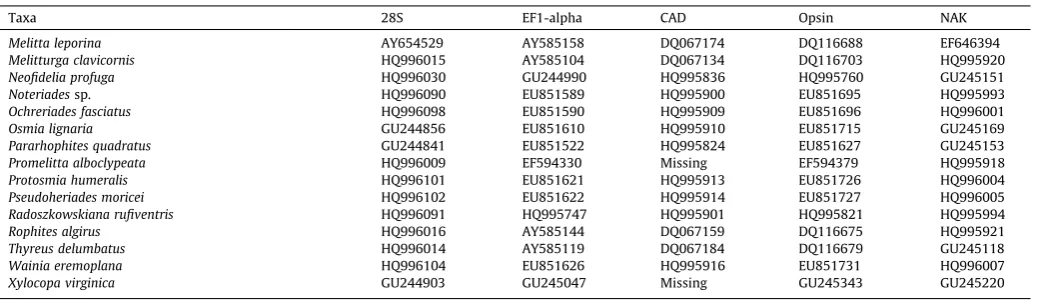
are archived in GenBank and all DNA accession numbers are listed inTable 2.
2.3. Test for nucleotide compositional bias
Nucleotide compositional bias has been cited as a source of
error in phylogenetic reconstruction (Ho and Jermiin, 2004;
Jermiin et al., 2004; Praz and Packer, 2014), namely by causing lineages sharing a similar bias to cluster together due to
conver-gent evolution rather than shared ancestry (Sheffield, 2013). RY
recoding (in which each nucleotide is recoded simply as either as a purine or pyrimidine) has been proposed as a means of eliminat-ing this bias, namely by homogenizeliminat-ing nucleotide frequencies
Table 1
Taxon list, DNA voucher numbers, collection localities and dates for specimens used in this study. Voucher numbers marked with an endash (‘‘–”) indicate taxa for which sequences were downloaded from Genbank. For Genbank accession numbers, seeTable 2. Taxa are labeled following our revised classification.
Taxon Voucher number Collection locality
Afranthidium (Afranthidium) karooense 1588 SOUTH AFRICA: NCP, 42 km S Eksteenfontein, 9.x.2008 Afranthidium (Capanthidium) capicola 1594 SOUTH AFRICA: WCP, Clanwilliam, 19.x.2008 Afranthidium (Capanthidium) rubellulum 1610 SOUTH AFRICA: NCP, 42 km S Eeksteenfontein, 9.x.2008 Afranthidium (Capanthidium) poecilodontum 1612 SOUTH AFRICA: NCP, 10 km E Nabapeep, 15.x.2008 Afranthidium (Capanthidium) schulthessi cp183 MOROCCO: Aksri, Paradise Valley, 15.iv.2009 Afranthidium (Domanthdium) abdominale 1644 SOUTH AFRICA: ECP, 42 km NW Cradock, 02.iii.2010 Afranthidium (Mesanthidium) alternans cp182 MOROCCO: Guelmim, 17.iv.2009
Afranthidium (Mesanthidium) carduele 1596 GREECE: Lesvos, vic Pyrra, Kalloni Bay, 16.vi.2007 Afranthidium (Nigranthidium)sp. nov. 1 1611 SOUTH AFRICA: NCP, 10 km E Nabapeep, 15.x.2008 Afranthidium (Nigranthidium)sp. 1452 SOUTH AFRICA: NCP, Nabapeep, 15.x.2008 Afranthidium (Oranthidium) folliculosum 1640 SOUTH AFRICA: NCP, 12 km N Kuruman, 09.iii. 2010
Afranthidiumsp. nov. cp179 SOUTH AFRICA: Barcode 4484 A03
Afrostelissp. 1645 SOUTH AFRICA: NCP,1 km S Campbell, 07.iii.2010 Anthidiellum (Anthidiellum) strigatum cp25 ITALY: Poggio Picenze, 01.vii.2011
Anthidiellum (Loyolanthidium) robertsoni 1387 USA: NV, Clark Co., E. CC Spring, 19.vii.2004
Anthidiellum (Chloranthidiellum)sp. nov. 1 1608 TANZANIA: Dodoma Region, 62 km E Dodoma, 3.i.2003 Anthidiellum (Pycnanthidium) absonulum 1635 SOUTH AFRICA: KZN, Kulene Experimental Farm, 09–12.iii.2002 Anthidiellum (Pycnanthidium)sp. 1647 SOUTH AFRICA: ECP,W Bavianskloof P.P., 27.ii.2010
Anthidium (Anthidium) cockerelli 1385 USA: NV, Clark Co., Yucca Gap, 17.v.2004
Anthidium (Anthidium) chilense 1625 CHILE: Coquimbo Province,13 km E Vicuna, Rt.41, 21.x.2009 Anthidium (Anthidium) colliguayanum 1624 CHILE: Coquimbo Province,13 km E Vicuna, Rt.41, 21.x.2009 Anthidium (Anthidium) deceptum 1642 PERU: Ica, E of Nazca, 15 km marker on Hwy 30A, 02.iv.2010 Anthidium (Anthidium) illustre 1384 USA: NV, Clark Co., Lovell Cyn.,16.vi.2004
Anthidium (Anthidium) porterae 645 USA: NM, Hidalgo Co., 20 mi S Animas, 17.ix.1999 Anthidium (Anthidium) punctatum 1554 SWITZERLAND: Weiach, 29.vi.2004
Anthidium (Gulanthidium)sp. 1637 IRAN: 13 km E Kalameh, road Busher-Shiraz, 03.vi.2009 Anthidium (Proanthidium) oblongatum 505 USA: NY, Tompkins Co., Ithaca, 01.vii.1999
Anthidium (Severanthidium) cordiforme 1628 SOUTH AFRICA: Limpopo Prov., 26 km W Messina, 18.iii.2002 Anthidium (Turkanthidium) gratum 1598 UZBEKISTAN: Bukara Prov., 40 km NE Gazli, 31.v. 2008 Anthidium (Turkanthidium) unicum 1597 UZBEKISTAN: Qarschi Prov., 25 km SE Muborak, 02.vi.2008 Anthodioctes (Anthodioctes) mapirensis 1519 BOLIVIA: La Paz, Puente Villa, 11.iii.2011
Anthodioctes (Bothranthidium) lauroi 1649 BOLIVIA: La Paz, 5 km W Mapiri, 16–18.iii.2001
Austrostelis catamarcensis 1599 ARGENTINA: Salta Prov, Carayete, 10 km S, 24.x – 13.xi.2003 Aztecanthidium tenochtitlanicum cp173 MEXICO: Jalisco, Chamela (Biol. Stat.), 20.vii.1989
Bathanthidium (Manthidium) binghami 1536 THAILAND: Petchabun Nam NP, 1–8.iii.2007 Benanthis madagascariensis 1518 MADAGASCAR: Tulear, Androy, x.2002
Cyphanthidium intermedium cp174 SOUTH AFRICA: NCP, 3.2 km S Augrabies, 28.i.2009 Dianthidium (Adanthidium) arizonicum 1386 USA: UT, Garfield Co., Escalante, 27.vi.2002
Dianthidium (Dianthidium) subparvum 1267 USA: UT, Cache Co., Blacksmith Fork Cyn., Left Hand Fork, 05.viii.2003 Dianthidium (Mecanthidium) macrurum 1648 MEXICO: Sonora, 40 km E Alamos, Rancho Palo Injerto, 30.ix.2006 Duckeanthidium thielei 1607 COSTA RICA: Heredia, La Selva Biol. Sta., Puerto Viejo de Sarapiqui, 5.i.1999 Eoanthidium (Clistanthidium) turnericum 1589 SOUTH AFRICA: NCP, Eksteenfontein, 9.x.2008
Eoanthidium (Eoanthidium) clypeare 1436 JORDAN: Wadi Shuyab, vi.2007
Epanthidium (Epanthidium) bicoloratum 1441 ARGENTINA: Catamarca, Trampasacha, 25.x-12.xi.2003 Euaspis abdominalis 1627 SOUTH AFRICA: NP,14 km E Vivo, 17.iii.2002
Euaspis polynesia 1426 THAILAND: Prachup Kiri Khan Province, Pranburi District, 24.vi.2003 Hoplostelis bivittata 1636 PANAMA: Veraguas Province, Rancheria Island, 18.vii.2009 Hypanthidioides (Saranthidium) marginata CP2 PARAGUAY: Guaira, Res. de Recursos, Manejados 24.i.2007 Hypanthidium (Hypanthidium) obscurius sc171 PARAGUAY: Paraguarí, M. Nat. Acahay, 17.i.2007 Icteranthidium ferrugineum 1432 UZBEKISTAN: Karakalpakstan, Beruni, 25.v.2008
Notanthidium (Allanthidium) rodolphi 1623 CHILE: Coquimbo Province,13 km E Vicuna, Rt.41, 21.x.2009 Notanthidium (Notanthidium) steloides 1542 CHILE: Region Metro, Farellones, 31.xii.2008
Pachyanthidium (Ausanthidium) ausense 1591 SOUTH AFRICA: NCP, Richtersveld National Park, 11.x.2008 Pachyanthidium (Pachyanthidium) bicolor 1606 KENYA: Coast Province, Taita Hill Discovery Centre, 13.xii.2002 Pachyanthidium (Pachyanthidium) cordatum 1631 SOUTH AFRICA: KZN, Ithala Nature Reserve, near Louwsburg, 07.iii.2002 Pachyanthidium (Trichanthidium) benguelense 1434 SOUTH AFRICA: Limpopo Prov., 27 km E Waterpoort, 07.i.2004 Pachyanthidium (Trichanthidium)sp. 1646 SOUTH AFRICA: ECP,W Bavianskloof P.P., 27.ii.2010
Paranthidium (Paranthidium) jugatorium 495 USA: NY, Tompkins Co., Ithaca, 31.vii.1997
Paranthidium (Rapanthidium)sp. nov. 2 1604 MEXICO: Colima, San Antonio, La Becarrera, 10.x.2008 Plesianathidium (Carinanthidium) cariniventre 1595 SOUTH AFRICA: WCP, Hoek se Berg, E Clanwilliam, 20.x.2008 Plesianthidium (Spinanthidiellum) rufocaudatum 1609 SOUTH AFRICA: NCP, Nieuwoudtville Wildflower Preserve, 18.x.2008 Plesianthidium (Spinanthidiellum) volkmanni 1449 SOUTH AFRICA: NCP, Eksteenfontein, 09.x.2008
Plesianthidium (Spinanthidium) calescens 1279 SOUTH AFRICA: WCP, 7 km W Nieuwoudtville, 9.x. 2002 Plesianthidium (Spinanthidium) trachusiforme 1613 SOUTH AFRICA: NCP, 10 km E Nabapeep, 15.x.2008 Pseudoanthidium (Branthidium) micrurum 1592 SOUTH AFRICA: NCP, Richtersveld National Park, 13.x.2008 Pseudoanthidium (Branthidium) minutulum 1593 SOUTH AFRICA: NCP, Richtersveld National Park, 13.x.2008 Pseudoanthidium (Exanthidium) eximium 1600 ITALY: Piemonte, Susa, Salbertrand, 01.vii. 2006
Pseudoanthidium (Immanthidium) immaculatum 1629 SOUTH AFRICA: ECP,74 km E Barkly East, 04.iii.2002 Pseudoanthidium (Immanthidium) junodi 1634 SOUTH AFRICA: ECP,74 km E Barkly East, 04.iii.2002 Pseudoanthidium (Immanthidium) repetitum 1632 SOUTH AFRICA: Limpopo Prov., 30 km W Sibasa, 30.iii.2002 Pseudoanthidium (Immanthidium) sjoestedti 1633 SOUTH AFRICA: FS, Tussen Die Riviere NR, 02.iii.2002 Pseudoanthidium (Micranthidium)sp. nov. 3 1605 TANZANIA: Kilimanjaro Region, 19 km SE Same, 14.i.2003 Pseudoanthidium (Micranthidium)sp. 1641 GHANA: Central UCC, Valco Gardens, 01.xi.2008
Table 1(continued)
Taxon Voucher number Collection locality
Pseudoanthidium (Neanthidium) octodentatum cp410 MOROCCO: Igerm, 28.iv.2003
Pseudoanthidium (Pseudoanthidium) scapulare 1601 ITALY: Toscana, Massa Maritima, 28.vii.2005 Pseudoanthidium (Royanthidium) melanurum 1438 GREECE: Kalogria, 25.v.2006
Pseudoanthidium (Tuberanthidium) tuberculiferum cp782 SOUTH AFRICA: NCP, 6 km S Garies, 17.x.2008 Pseudoanthidium (Zosteranthidium) tergofasciatum cp646 SOUTH AFRICA: WCP, Knersvlakte, 24.viii.2010 Rhodanthidium (Asianthidium) caturigense cp23 SWITZERLAND: Valais, Euseigne, 25.vi.2011 Rhodanthidium (Meganthidium) superbum 1638 IRAN: Yasuj Region, Margoon Waterfall, 29.v.2009 Rhodanthidium (Rhodanthidium) septemdentatum 1514 GREECE: Rhodos, Stegna, 08.v.2005
Serapista rufipes 1450 SOUTH AFRICA: NCP, Eksteenfontein, 09.x.2008 Serapista soni 1626 SOUTH AFRICA: Limpopo Prov., 1 km N Vivo,17.iii.2002 Stelis (Dolichostelis) laticincta 1389 USA: CA, Mariposa Co., Yosemite Valley, 27.vi.2005 Stelis (Dolichostelis) perpulchra cp123 USA: NV, Clark Co., 1.5 miles NW Corn Creek Sprs., 27.v.2004 Stelis (Dolichostelis) rudbeckiarum cp122 USA: UT, Garfield Co., Point Lookout, 30.vii.2002
Stelis (Heterostelis) annulata cp21 ITALY: San Giovanni, 6.vii.2011
Stelis (Heterostelis) anthidioides cp506 USA: CA, San Benito Co., Pinnacles Natl. Mon., Balconies Cliffs Tr., 22.vi.1998 Stelis (Heterostelis) hurdi 1409 USA: CA, San Benito Co., Pinnacles Natl. Mon., 22.v.1999
Stelis (Heterostelis) ruficornis cp509 GREECE: Lesvos, 2.2 km SE Mystegna, 6–8.v.2004 Stelis (Malanthidium)sp. 1 cp159 THAILAND: Barcode: 14515-H09
Stelis (Malanthidium)sp. 2 cp157 THAILAND: Barcode: 03767-H01 Stelis (Protostelis) signata 1440 SWITZERLAND: Hohtenn, 26.v.2005
Stelis (Stelidomorpha) nasuta 1614 GREECE: Atiiki, Athens Pref., 20 km S Athens, 15.vi.2006 Stelis (Stelis) anthocopae 1392 USA: NV, Clark Co., St. Thomas Gap, 12.v.2005 Stelis (Stelis) anthracina 1396 USA: NV, Clark Co., St. Thomas Gap, 15.iv.2005 Stelis (Stelis) broemelingi 1391 USA: AZ, Cochise Co., E. Apache, 29.viii.2003 Stelis (Stelis) calliphorina 1403 USA: CA, Mariposa Co., Moraine Dome, 06.vii.2005 Stelis (Stelis) carnifex 1395 USA: CA, Mariposa Co., Eagle Peak, 19.v.2006 Stelis (Stelis) foederalisgroup sp. B 1398 USA: CA, Maripsoa Co., Ostrander Rocks Stelis (Stelis) holocyanea 1405 USA: CA, Mariposa Co., Deer Camp, 09.viii.2006 Stelis (Stelis) interrupta 1406 USA: CA, Mariposa Co., Ostrander Rocks, 03.vii.2005 Stelis (Stelis) joanae 1410 USA: NV, Clark Co., St. Thomas Gap, 21.iv.2004 Stelis (Stelis) lamelliterga 1400 USA: UT, Kane Co., Kitchen Corral Spring, 29.v.2002 Stelis (Stelis) lateralis 1401 USA: UT, Washington Co. Rimrock Spring, 11.v.2006 Stelis (Stelis) linsleyi 1271 USA: CA, Madera Co., Yosemite National Park, 11.vii.2005 Stelis (Stelis) monticola 1402 USA: CA, Mariposa Co., Moraine Dome, 05.vi.2006 Stelis (Stelis) occidentalis 1399 USA: CA, Tuolumne Co., White Wolf, 08.vii.2006 Stelis (Stelis) paiute 1394 USA: NV, Clark Co., Jean Lake, 14.iv.2004 Stelis (Stelis) palmarum 1393 USA: UT, Kane Co., Paradise Cyn., 26.v.2003 Stelis (Stelis) pavonina 1404 USA: CA, Tuolumne Co., Mammoth Peak, 29.vii.2004 Stelis (Stelis) punctulatissima 1551 SWITZERLAND: Hohtenn, 26.v.2005
Stelis (Stelis)aff.robertsoni 1408 USA: CA, Mariposa Co. Yosemite Valley, 05.vii.2006 Stelis (Stelis) semirubia 1407 USA: CA, Madera Co., Parsons Peak, 02.viii.2004 Stelis (Stelis) subcaerulea 1397 USA: CA, Mariposa Co., Bernice Lake, 09.viii.2006
Stelis rozeni 1603 SOUTH AFRICA: NCP, Richtersveld National Park, 12–14.ix.2001 Trachusa (Archianthidium) pubescens 1533 TURKEY: Erzurum, Akören, 15 km N Hinis, 19.vii.2003 Trachusa (Congotrachusa) schoutedeni 1538 REP. CONGO: Dept. Pool, Iboubikro, Lesio-Loun, 9–15.ix.2008 Trachusa (Heteranthidium) cordaticeps cp133 LEWN 07-NM-1403
Trachusa (Heteranthidium) larreae 1142 USA: NV, Clark Co., Las Vegas Sand Dunes, 1.iv.2004 Trachusa (Paraanthidium) interrupta 1602 ITALY: Piemonte, Susa, 2.vii.2006
Trachusa (Trachusa) byssina 1558 SWITZERLAND: Splügen, 23.vii.2005
Trachusa (Trachusomimus) perdita cp505 USA: CA, San Benito Co., 2.0 km NNW McCabe Canyon, 12.v.2011
Outgroup
Anthophora montana 633 USA: AZ, Cochise Co., Chiricahua Mts.,14.ix.99
Apis mellifera –
Aspidosmia arnoldi 1544 SOUTH AFRICA: NCP, Eksteenfontain, 09.x.2008
Aspidosmia volkmanni 1579 SOUTH AFRICA: NCP, Richtersveld, near De Koci, 09.ix.2007 Ashmeadiella aridula 1270 USA: UT, Garfield Co., Long Canyon, 01.ix.2003
Bombus ardens –
Ceratina calcarata 656 USA: NY, Tompkins Co., Ithaca, 04.viii.1999
Chelostoma florisomne 1553 SWITZERLAND: Chur
Coelioxys afra 1549 SWITZERLAND: Weiach, 29.vi.2004
Colletes inaequalis 450 USA: NY, Tompkins Co., Ithaca
Ctenoplectra albolimbata 983 SOUTH AFRICA: KZN: 20 km NE Hluhluwe, 09–12.iii. 2002
Dasypoda argentata 973 FRANCE: Gard, Generac, 22.vi.2002
Dioxys moesta 1546 GREECE: Rhodos, Kamiros, 12.v.2005
Epicharis analis –
Fideliopsis major JL005 SOUTH AFRICA: NCP, Eksteenfontein, 09.x.2008 Haetosmia brachyura 1428 UZBEKISTAN: Karakalpakstan, Beruni, 25.v.2008 Heriades crucifer 1149 USA: AZ, Coshise Co., Chiricahua Mts., 25.viii.2003
Hoplitis adunca 1552 ITALY: Aosta, 30.08.2004
Lithurgus chrysurus 1545 ITALY: Abruzzen, Massa, 20.viii.2002
Macropis nuda 1272 USA: NY, Rensselaer Co., Rensselaerville, 15.vii.2005 Megachile bombiformis 1531 SOUTH AFRICA: Limpopo Prov., 20 km E Waterpoort, 07.i.2004 Meganomia binghami 1021 SOUTH AFRICA: Limpopo Prov., 8.5 km N Vivo, 07.i.2004
Melitta leporina –
compositional bias, we divided our dataset into fourteen partitions, one for each of the three codon positions of each protein coding gene, as well as two partitions corresponding to the stem and loop regions of 28S. Each partition was tested individually using the
‘‘Base/AA frequencies” command in PAUP⁄ 4.0a142 (X86)
(Swofford, 2003), which implements a chi-square test for nucleo-tide heterogeneity among taxa. The test was restricted to ingroup taxa. We found the third codon position of NAK to exhibit a
signif-icant compositional bias (P< 0.001) and thus this partition was
recoded (i.e. all A’s and T’s were replaced by G’s and C’s,
respec-tively;Thomas et al., 2013). The recoding effectively removed the
bias from the partition (P= 1.00 after recoding and subsequent
reanalysis in PAUP) and the recoded partition was used in all subsequent analyses. We compared this recoding method with another method in which all purines were replaced by ‘‘0” and all pyrimidines by ‘‘1”. In both maximum likelihood and Bayesian analyses, topologies, branch lengths and node support values using this binary recoding method were highly congruent with the results of the first recoding method (differences were restricted to weakly supported nodes, which were not implicated in taxonomic changes). Only results using the first recoding method are presented.
2.4. Partitioning regime and model-testing
We used the same fourteen partitions described above (using the recoded third position of NAK) and performed a greedy search
using the BIC metric in PartitionFinder v1.1.0 (Lanfear et al., 2012)
to establish a partitioning regime and determine appropriate models of nucleotide substitution. We ran the analysis twice, once to find models adapted for use in RAxML and once to find models adapted for use in MrBayes. Nine partitions were suggested for RAxML (best models in parentheses): the third position of NAK (GTR + I + G); the first position of opsin (GTR + I + G); the second position of opsin (GTR + I + G); the stem region of 28S (GTR + I + G); the first positions of CAD, EF1-alpha and NAK (GTR + I + G); the third positions of CAD and opsin (GTR + I + G); the second position of CAD and the loops region of 28S (GTR + I + G); the second positions of EF1-alpha and NAK (GTR + I + G); and the third position of EF1-alpha (GTR + I + G). Ten partitions were suggested for the MrBayes analysis (best model in parentheses): the first positions of CAD, EF1-alpha, and NAK (GTR + I + G); the second position of CAD and the loops region of 28S (HKY + I + G); the third position of CAD (GTR + I + G); the second positions of EF1-apha and NAK (GTR + I + G); the third position of EF1-alpha (HKY + I + G); the first position of opsin (HKY + I + G); the second position of opsin (SYM + I + G); the third position of opsin (SYM + I + G); the third position of NAK (HKY + I + G); and the stems region of 28S (HKY + I + G).
Both the alpha parameter of the gamma distribution and ‘I’ (i.e. the parameter that allows for an estimation of invariant sites) account for near-zero rates of nucleotide substitution in maximum likelihood and Bayesian analyses. The inevitable correlation between these two parameters makes it impossible to optimize them independently of one another and may be a source of error
in parameter estimation (Yang, 2006 and references therein;
Stamatakis, 2014). Following the remarks of Yang (2006) and
Stamatakis (2014), we excluded the ‘I’ parameter from all models also including the gamma distribution, despite the recommenda-tions of PartitionFinder. Thus for all nine models cited for the RAxML analysis and all ten models cited for the MrBayes analysis, the ‘I’ parameter was eliminated and the gamma distribution retained.
We used the same partitions as described above in combined molecular–morphological analyses, plus an additional partition for morphological data. In RAxML analyses, the morphological partition was modeled using the multi-state option with a GTR model (-K GTR). In MrBayes, we used a Lewis model.
2.5. Phylogenetic analyses
We performed maximum likelihood phylogenetic analyses
using RAxML v.8.1.11 (sequential version raxmlHPC, Stamatakis,
2006) hosted by the Cipres Science Gateway (Miller et al., 2010).
We ran 1000 bootstrap replicates using the rapid bootstrap analy-sis and then calculated the best-scoring maximum likelihood tree based on the original alignment for both molecular and combined molecular–morphological analyses. We also used MrBayes v.3.1.2 (Huelsenbeck and Ronquist, 2001; Ronquist and Huelsenbeck,
2003), hosted by the Cornell University BRC Bioinformatics Facility,
to perform Bayesian phylogenetic analyses. For molecular analyses in MrBayes, we ran six independent analyses for a total of 72 million generations; for mixed molecular–morphological analyses, we ran four independent analyses for a total of 160 million
gener-ations. We used Tracer (Rambaut et al., 2014) to evaluate
station-arity and determine an appropriate burnin.
3. Results
3.1. Molecular analyses
Maximum likelihood and Bayesian analyses of molecular data
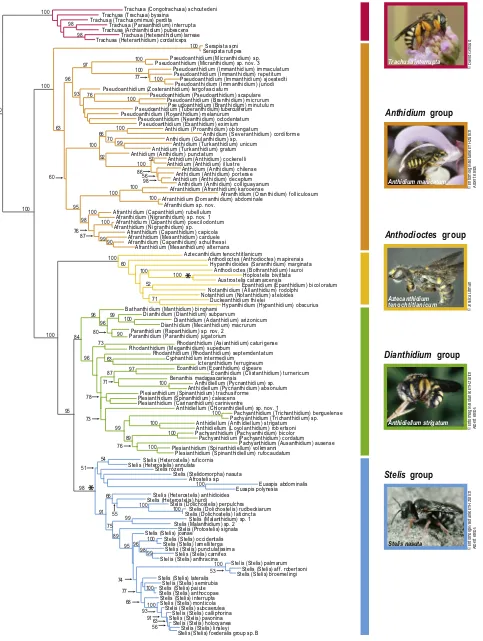
yield well-resolved, congruent phylogenies (Figs. 1andS1). Our
results support the monophyly of Michener’s Series B but his Series
A is paraphyletic, with the genus Trachusa forming a strongly
supported monophyletic clade, sister to the rest of Anthidiini (sister relationship supported by 100% maximum likelihood (ML) bootstrap support; 97% posterior probability). Our phylogeny
Table 1(continued)
Taxon Voucher number Collection locality
Neofidelia profuga 802 CHILE: Atacama Prov., 5 km N Inca-havas, 03.x.1999
Noteriadessp. 1580 THAILAND: Chiang Mai, 24.iii.2007
Ochreriades fasciatus 1557 JORDAN: 20 km W Amman, 24.iv.2007
Osmia lignaria 1265 No locality data
Pararhophites quadratus 1547 TUNISIA: Nefta, 28.iii.2006
Promelitta alboclypeata 1321 MOROCCO: Erfoud to Msissi road, 12.iv.2006
Protosmia humeralis 1559 JORDAN: Wadi Shu’ayb, 22.iv.2007
Pseudoheriades moricei 1431 ISRAEL: Negev
Radoszkowskiana rufiventris 1587 EGYPT: Tel el Kebir, 30°320200N 31°4904800
Rophites algirus 968 FRANCE: Var, Entrecasteaux, 14.vi.2002
Thyreus delumbatus 987 SOUTH AFRICA: Limpopo Prov., 14 km E Vivo, 17.iii.2002
Wainia eremoplana 1548 JORDAN: Wadi el Hasa, 20.iv.2007
Table 2
GenBank accession numbers for sequences used in this study. Taxa are labeled following our revised classification.
Taxa 28S EF1-alpha CAD Opsin NAK
Ingroup
Afranthidium (Afranthidium) karooense HQ996039 HQ995698 HQ995847 HQ995770 HQ995942 Afranthidium (Capanthidium) capicola KU976218 KX060937 KX060879 KX060813 KU976158 Afranthidium (Capanthidium) rubellulum KU976229 KX060947 KX060889 KX060824 KU976169 Afranthidium (Capanthidium) schulthessi KU976230 Missing KX060890 KX060825 KU976170 Afranthidium (Capanthidium) poecilodontum KU976227 KX060945 KX060887 KX060822 KU976167 Afranthidium (Domanthdium) abdominale KU976216 KX060936 KX060877 KX060811 KU976156 Afranthidium (Mesanthidium) alternans KU976217 Missing KX060878 KX060812 KU976157 Afranthidium (Mesanthidium) carduele KU976219 KX060938 KX060875 KX060814 KU976159
Afranthidium (Nigranthidium)sp. KU976226 KX060935 KX060886 KX060821 KU976166
Afranthidium (Nigranthidium)sp. nov. 1 KU976225 KX060944 KX060885 KX060820 KU976165 Afranthidium (Oranthidium) folliculosum KU976220 KX060939 KX060880 KX060815 KU976160
Afranthidiumsp. nov. KU976232 KX060949 KX060876 KX060827 KU976172
Afrostelissp. JX869660 JX869701 JX869625 JX869733 JX869767
Anthidiellum (Anthidiellum) strigatum KU976237 KX060954 KX060896 KX060832 KU976177 Anthidiellum (Chloranthidiellum)sp. nov. 1 KU976234 KX060951 KX060892 KX060829 Missing Anthidiellum (Loyolanthidium) robertsoni KU976235 KX060952 KX060894 KX060830 KU976175 Anthidiellum (Pycnanthidium) absonulum KU976233 KX060950 KX060893 KX060828 KU976174
Anthidiellum (Pycnanthidium)sp. KU976236 KX060953 KX060895 KX060831 KU976176
Anthidium (Anthidium) chilense KU976238 KX060955 KX060897 KX060833 KU976178
Anthidium (Anthidium) cockerelli KU976239 KX060956 KX060898 KX060834 KU976179
Anthidium (Anthidium) colliguayanum KU976240 KX060957 KX060899 KX060835 KU976180
Anthidium (Anthidium) deceptum KU976242 KX060959 KX060901 KX060837 KU976182
Anthidium (Anthidium) illustre HQ996040 HQ995699 HQ995848 HQ995771 HQ995943
Anthidium (Anthidium) porterae GU244846 GU244996 Missing AF344619 GU245158
Anthidium (Anthidium) punctatum KU976246 KX060963 KX060904 KX060841 KU976186
Anthidium (Gulanthidium)sp. KU976244 KX060961 Missing KX060839 KU976184
Anthidium (Proanthidium) oblongatum KU976245 KX060962 KX060903 KX060840 KU976185 Anthidium (Severanthidium) cordiforme KU976241 KX060958 KX060900 KX060836 KU976181
Anthidium (Turkanthidium) gratum KU976243 KX060960 KX060902 KX060838 KU976183
Anthidium (Turkanthidium) unicum KU976247 KX060964 KX060905 KX060842 KU976187
Anthodioctes (Anthodioctes) mapirensis HQ996041 HQ995700 HQ995849 HQ995772 HQ995944 Anthodioctes (Bothranthidium) lauroi KU976248 KX060965 Missing KX060843 KU976188
Austrostelis catamarcensis JX869661 JX869702 JX869626 JX869734 JX869768
Aztecanthidium tenochtitlanicum KU976249 Missing KX060906 KX060844 KU976189
Bathanthidium (Manthidium) binghami HQ996044 HQ995703 HQ995852 HQ995775 HQ995947
Benanthis madagascariensis HQ996045 HQ995704 HQ995853 HQ995776 HQ995948
Cyphanthidium intermedium KU976250 KX060966 KX060907 KX060845 KU976190
Dianthidium (Adanthidium) arizonicum HQ996046 HQ995705 HQ995854 HQ995777 HQ995949 Dianthidium (Dianthidium) subparvum GU244843 GU244993 KX060909 KX060847 GU245155 Dianthidium (Mecanthidium) macrurum KU976251 KX060967 KX060908 KX060846 KU976191
Duckeanthidium thielei HQ996047 HQ995706 HQ995855 HQ995778 HQ995950
Eoanthidium (Clistanthidium) turnericum HQ996048 HQ995707 HQ995856 HQ995779 HQ995951 Eoanthidium (Eoanthidium) clypeare KU976252 KX060968 KX060910 KX060848 KU976192 Epanthidium (Epanthidium) bicoloratum HQ996049 HQ995708 HQ995857 HQ995780 HQ995952
Euaspis abdominalis JX869662 JX869703 JX869627 JX869735 JX869769
Euaspis polynesia JX869663 JX869704 JX869628 JX869736 JX869770
Hoplostelis bivittata JX869671 JX869705 Missing JX869737 JX869771
Hypanthidioides (Saranthidium) marginata HQ996050 HQ995709 HQ995858 HQ995781 HQ995953 Hypanthidium (Hypanthidium) obscurius HQ996051 HQ995710 HQ995859 HQ995782 HQ995954
Icteranthidium ferrugineum HQ996052 HQ995711 HQ995860 HQ995783 HQ995955
Table 2(continued)
Taxa 28S EF1-alpha CAD Opsin NAK
Pseudoanthidium (Neanthidium) octodentatum KU976253 KX060983 KX060911 KX060863 Missing Pseudoanthidium (Pseudoanthidium) scapulare HQ996055 HQ995714 HQ995864 HQ995787 HQ995958 Pseudoanthidium (Royanthidium) melanurum KU976266 KX060981 KX060924 KX060861 KU976205 Pseudoanthidium (Tuberanthidium) tuberculiferum KU976269 KX060979 KX060927 KX060865 KU976207 Pseudoanthidium (Zosteranthidium) tergofasciatum KU976270 Missing Missing KX060866 KU976173 Rhodanthidium (Asianthidium) caturigense KU976271 KX060984 KX060928 KX060867 KU976208 Rhodanthidium (Meganthidium) superbum KU976272 KX060985 Missing KX060868 KU976209 Rhodanthidium (Rhodanthidium) septemdentatum HQ996056 HQ995715 HQ995865 HQ995788 HQ995959
Serapista rufipes HQ996057 HQ995716 HQ995866 HQ995789 HQ995960
Serapista soni KU976273 KX060986 KX060929 KX060869 KU976210
Stelis (Dolichostelis) laticincta JX869686 JX869719 JX869644 JX869752 JX869785 Stelis (Dolichostelis) perpulchra JX869692 JX869725 JX869650 JX869758 JX869791 Stelis (Dolichostelis) rudbeckiarum JX869694 JX869727 JX869653 JX869761 JX869794
Stelis (Heterostelis) annulata JX869673 JX869707 JX869630 JX869739 JX869773
Stelis (Heterostelis) anthidioides JX869674 Missing JX869631 Missing Missing
Stelis (Heterostelis) hurdi JX869682 JX869714 JX869639 JX869747 JX869780
Stelis (Heterostelis) ruficornis JX869695 Missing JX869654 Missing JX869795
Stelis (Malanthidium)sp. 1 JX869698 JX869730 JX869657 JX869764 JX869798
Stelis (Malanthidium)sp. 2 JX869700 JX869732 JX869659 JX869766 JX869800
Stelis (Protostelis) signata JX869697 JX869729 JX869656 JX869763 JX869797
Stelis (Stelidomorpha) nasuta JX869688 JX869721 JX869646 JX869754 JX869787
Stelis (Stelis) anthocopae JX869675 JX869708 JX869632 JX869740 JX869774
Stelis (Stelis) anthracina JX869676 JX869709 JX869633 JX869741 JX869775
Stelis (Stelis) broemelingi JX869677 Missing JX869634 JX869742 Missing
Stelis (Stelis) calliphorina JX869678 JX869710 JX869635 JX869743 JX869776
Stelis (Stelis) carnifex JX869679 JX869711 JX869636 JX869744 JX869777
Stelis (Stelis) foederalisgroup sp. B JX869680 JX869712 JX869637 JX869745 JX869778
Stelis (Stelis) holocyanea JX869681 JX869713 JX869638 JX869746 JX869779
Stelis (Stelis) interrupta Missing JX869715 JX869640 JX869748 JX869781
Stelis (Stelis) joanae JX869683 JX869716 JX869641 JX869749 JX869782
Stelis (Stelis) lamelliterga JX869684 JX869717 JX869642 JX869750 JX869783
Stelis (Stelis) lateralis JX869685 JX869718 JX869643 JX869751 JX869784
Stelis (Stelis) linsleyi Missing GU245002 JX875064 GU245312 GU245162
Stelis (Stelis) monticola JX869687 JX869720 JX869645 JX869753 JX869786
Stelis (Stelis) occidentalis JX869689 JX869722 JX869647 JX869755 JX869788
Stelis (Stelis) paiute HQ996058 HQ995717 HQ995867 HQ995790 HQ995961
Stelis (Stelis) palmarum JX869690 JX869723 JX869648 JX869756 JX869789
Stelis (Stelis) pavonina JX869691 JX869724 JX869649 JX869757 JX869790
Stelis (Stelis) punctulatissima JX869693 JX869726 JX869651 JX869759 JX869792
Stelis (Stelis) aff. robertsoni JX869672 JX869706 JX869629 JX869738 JX869772
Stelis (Stelis) semirubra JX869696 JX869728 JX869655 JX869762 JX869796
Stelis (Stelis) subcaerulea JX869699 JX869731 JX869658 JX869765 JX869799
Stelis rozeni Missing Missing JX869652 JX869760 JX869793
Trachusa (Archianthidium) pubescens HQ996059 HQ995718 HQ995868 HQ995791 HQ995962 Trachusa (Congotrachusa) schoutedeni KU976275 Missing KX060931 KX060871 KU976212 Trachusa (Heteranthidium) cordaticeps KU976276 KX060988 KX060932 KX060872 KU976213 Trachusa (Heteranthidium) larreae GU244842 HQ995719 HQ995869 HQ995792 GU245154 Trachusa (Paraanthidium) interrupta KU976277 KX060989 KX060933 KX060873 KU976214
Trachusa (Trachusa) byssina KU976274 KX060987 KX060930 KX060870 KU976211
Trachusa (Trachusomimus) perdita KU976278 KX060990 KX060934 KX060874 KU976215
Outgroup
Afroheriades primus HQ996092 EU851532 HQ995902 EU851638 HQ995995
Anthophora montana HQ996012 AY585107 DQ067177 AF344616 HQ995919
Apis mellifera AY703551 AF015267 DQ067178 AMU26026 XM_623142
Ashmeadiella aridula GU244858 EU851535 HQ995903 EU851641 GU245171
Aspidosmia arnoldi HQ996042 HQ995701 HQ995850 HQ995773 HQ995945
Aspidosmia volkmanni HQ996043 HQ995702 HQ995851 HQ995774 HQ995946
Bombus ardens HM750237 AF492964 EU184803 AF493031 EU184741
Ceratina calcarata HQ996011 AY585108 DQ067190 AF344620 GU245213
Chelostoma florisomne HQ996094 EU851546 HQ995905 EU851652 HQ995997
Coelioxys afra HQ996060 EU851528 HQ995870 EU851634 HQ995963
Colletes inaequalis HQ996017 AY363004 DQ067139 DQ115542 EF646387
Ctenoplectra albolimbata HQ996013 AY585118 EU122060 DQ116677 EF646391
Dasypoda argentata AY654518 AY585148 DQ067161 DQ116680 EF646418
Dioxys moesta HQ996037 HQ995696 HQ995845 HQ995768 HQ995940
Epicharis analis GU244759 GU244920 Missing GU245241 GU245064
Fidelia major HQ996027 DQ141113 HQ995833 EU851628 HQ995931
Haetosmia brachyura HQ996095 HQ995748 HQ995906 HQ995822 HQ995998
Heriades crucifer GU244855 EU851555 DQ067194 EU851661 GU245168
Hoplitis adunca HQ996097 EU851572 HQ995908 EU851678 HQ996000
Lithurgus chrysurus HQ996031 EU851523 HQ995837 EU851629 HQ995934
Macropis nuda HQ996008 AY585155 DQ067171 DQ116686 HQ995917
Megachile bombiformis HQ996076 HQ995733 HQ995886 HQ995806 HQ995979
Meganomia binghami HQ996010 DQ141114 DQ067169 DQ116689 EF646406
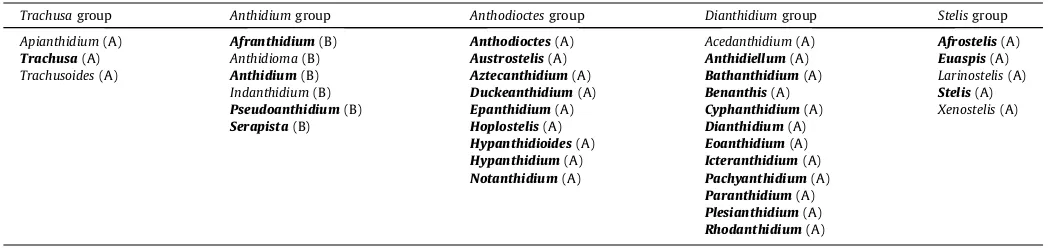
demonstrates that anthidiine bees fall into five major suprageneric clades; given the behavioral differences exhibited by these five clades, we present them as a replacement for Michener’s Series A
and Series B (Table 3). These clades are: (1) theTrachusagroup
(100% ML bootstrap; 100% posterior probability); (2) theAnthidium
group (100% ML bootstrap; 99% posterior probability); (3) the
Anthodioctesgroup (100% ML bootstrap; 99% posterior probability);
(4) the Dianthidium group (84% ML bootstrap; 95% posterior
probability); and (5) the Stelis group (98% ML bootstrap; 100%
posterior probability). The Anthidium group, which corresponds
to Michener’s Series B, are those anthidiines that use plant fibers
in nest construction. TheTrachusa,Anthodioctes, andDianthidium
groups, all included in Michener’s Series A, represent those bees that use resin in nest construction (with the exception of the
cleptoparasitic genera HoplostelisandAustrostelisin the
Anthodi-octesgroup). The Stelisgroup, also included in Michener’s Series A, is exclusively cleptoparasitic.
The descriptions of two genera not included in the phylogeny,
Trachusoides and Apianthidium, suggest a close phylogenetic
relationship with Trachusa; in order to accommodate the likely
future addition of these genera to theTrachusagroup, we choose
to refer to this clade as the Trachusa group (and not simply as
the genus Trachusa). The genus name Hoplostelis Dominique,
1898 is the oldest in theAnthodioctesgroup; we prefer to name
the group, however, for a genus whose behavior is representative of the group in general. For this reason, we name the group after the oldest available non-cleptoparasitic genus name in the group,
AnthodioctesHolmberg, 1903.
WhileMichener (2007)included the genusAspidosmia in his
Series A, both molecular and morphological data refute the
place-ment of this genus in the tribe Anthidiini (Litman et al., 2011;
Gonzalez et al., 2012). A recent paper officially removedAspidosmia
from Anthidiini and placed it in its own tribe, Aspidosmiini (Gonzalez et al., 2012). Aspidosmia is thus excluded from our classification of Anthidiini.
The results of our phylogenetic analyses challenge the current classification of anthidiine bees, primarily because many genera
and several subgenera emerge as paraphyletic. The Anthidium
group includes the genera Serapista, Anthidium, Afranthidium,
Pseudoanthidium, Neanthidium, Anthidioma, Indanthidium and
Gnathanthidium (the last three genera represented here only by morphological data). The central and southern African genus
Serapista is strongly supported as monophyletic (100% ML boot-strap support; 100% posterior probability) and is moderately
well-supported as the sister clade to the rest of the Anthidium
group (63% ML bootstrap; 98% posterior probability). The
remain-ing members of the Anthidium group form three clades. One of
these clades is the genusAnthidium, strongly supported as
mono-phyletic in both ML and Bayesian analyses (100% ML bootstrap support; 100% posterior probability).
The second clade contains most but not all subgenera of the
genusAfranthidium(i.e.Afranthidium,Oranthidium,Domanthidium,
Capanthidium, Mesanthidium, and Nigranthidium). This clade is strongly supported in both ML and Bayesian analyses (95% ML
bootstrap; 100% posterior probability). The subgeneraAfranthidium
(Capanthidium), Afr. (Mesanthidium), and Afr.(Nigranthidium) are paraphyletic.
The third clade contains all members ofPseudoanthidium, three
subgenera ofAfranthidium(Immanthidium,Branthidiumand
Zoster-anthidium) and the genusNeanthidium. This clade is strongly sup-ported in both ML and Bayesian analyses (96% ML bootstrap; 99% posterior probability).
The Anthodioctes group consists of the Central and South
American genera Aztecanthidium, Notanthidium, Epanthidium,
Anthodioctes, Hoplostelis, Austrostelis, Hypanthidium, Hypanthid-ioides, and Duckeanthidium; these genera form a strongly
supported monophyletic clade sister to the Dianthidium group
+ theStelis group. Hoplostelisis strongly supported as the sister
taxon toAustrostelisin both Bayesian and ML analyses (100% ML
bootstrap; 100% posterior probability);Anthodioctes(
Bothranthid-ium)lauroiis strongly supported as the sister taxon toHoplostelis
+Austrostelis (100% ML bootstrap; 92% posterior probability). A
sister-group relationship betweenHypanthidiumand
Duckeanthid-iumis moderately supported in ML analyses (71% ML bootstrap)
and strongly supported in Bayesian analyses (100% posterior prob-ability). While Bayesian analyses recover highly resolved relation-ships for other clades in the group, ML analyses suggest that all other phylogenetic relationships within this group are unclear.
In theDianthdiumclade, the Asian genusBathanthidiumis the
sister taxon to a clade consisting of the Central and North American
genera Paranthidium and Dianthidium. These three genera are a
strongly supported monophyletic group (96% ML bootstrap; 96% posterior probability) which is sister to a clade containing the gen-era Rhodanthidium, Icteranthidium, Eoanthidium, Anthidiellum,
Pachyanthidium, Benanthis, Cyphanthidium and Plesianthidium
(96% ML bootstrap; 100% posterior probability), all eastern
hemisphere taxa with the exception of Anthidiellum, which is
widespread in both hemispheres; this sister group relationship is well-supported in ML analyses (84% ML bootstrap) and strongly supported in Bayesian analyses (95% posterior probability). These
eleven genera together form theDianthidiumgroup. The subgenus
Anthidiellum (Pycnanthidium) is strongly supported as mono-phyletic (100% ML bootstrap; 100% posterior probability); this
subgenus, together with the genera Eoanthidium and Benanthis,
are well supported as monophyletic in ML analyses (87% ML boot-strap) and strongly supported in Bayesian analyses (100% posterior
Table 2(continued)
Taxa 28S EF1-alpha CAD Opsin NAK
Melitta leporina AY654529 AY585158 DQ067174 DQ116688 EF646394
Melitturga clavicornis HQ996015 AY585104 DQ067134 DQ116703 HQ995920
Neofidelia profuga HQ996030 GU244990 HQ995836 HQ995760 GU245151
Noteriadessp. HQ996090 EU851589 HQ995900 EU851695 HQ995993
Ochreriades fasciatus HQ996098 EU851590 HQ995909 EU851696 HQ996001
Osmia lignaria GU244856 EU851610 HQ995910 EU851715 GU245169
Pararhophites quadratus GU244841 EU851522 HQ995824 EU851627 GU245153
Promelitta alboclypeata HQ996009 EF594330 Missing EF594379 HQ995918
Protosmia humeralis HQ996101 EU851621 HQ995913 EU851726 HQ996004
Pseudoheriades moricei HQ996102 EU851622 HQ995914 EU851727 HQ996005
Radoszkowskiana rufiventris HQ996091 HQ995747 HQ995901 HQ995821 HQ995994
Rophites algirus HQ996016 AY585144 DQ067159 DQ116675 HQ995921
Thyreus delumbatus HQ996014 AY585119 DQ067184 DQ116679 GU245118
Wainia eremoplana HQ996104 EU851626 HQ995916 EU851731 HQ996007
Plesianthidium (Spinanthidiellum) rufocaudatum
Anthidiellum (Chloranthidiellum) sp. nov. 1 Afranthidium (Nigranthidium) sp. nov. 1
Afranthidium (Capanthidium) poecilodontum Pseudoanthidium (Micranthidium) sp. nov. 3
Stelis (Malanthidium) sp. 1
Stelis (Stelis) anthocopae
Bathanthidium (Manthidium) binghami Hypanthidium (Hypanthidium) obscurius
Stelis (Stelis) anthracina
Stelis (Stelis) foederalis group sp. B Trachusa (Trachusomimus) perdita
Paranthidium (Rapanthidium) sp. nov. 2
Stelis rozeni
probability). The subgenera Pachyanthidium(Trichanthidium) and
Pachyanthidium(Pachyanthidium) are each strongly supported as
monophyletic, although the genusPachyanthidiumis paraphyletic.
The generaAnthidiellumandPlesianthidiumare also paraphyletic in
both Bayesian and ML analyses.Plesianthidium(Spinanthidiellum)
and all members of Pachyanthidium and Anthidiellum (with the
exception of subgenus Pycnanthidium) together constitute a
well-supported clade (73% ML bootstrap support; 100% posterior
probability). The genusRhodanthidiumis paraphyletic in both ML
and Bayesian analyses, although node support is low.
The generaStelis,EuaspisandAfrostelisform the strongly
sup-portedStelisgroup. The lineagesStelis(Stelidomorpha)nasuta,Stelis
(Heterostelis) ruficornis, Stelis (Heterostelis) annulata, Stelis rozeni,
Afrostelis, andEuaspisform a weakly supported clade at the base
of theStelisgroup (51% ML bootstrap; 89% posterior probability).
Stelis (Heterostelis) hurdi, Stelis(Heterostelis) anthidioides and the
three species ofStelis(Dolichostelis) present in our phylogeny form
a monophyletic group, sister to Stelis (Malanthidium) +Stelis
(Protostelis) +Stelis(Stelis). The subgenusStelis (Stelis) is strongly supported as monophyletic (95% ML bootstrap; 100% posterior
probability), as are the subgenera Stelis (Dolichostelis) (100% ML
bootstrap; 100% posterior probability) and Stelis (Malanthidium)
(99% ML bootstrap; 100% posterior probability).Stelis(Heterostelis)
is paraphyletic.
3.2. Combined molecular–morphological analyses
We used combined molecular–morphological analyses to tenta-tively place four rare genera missing from our molecular dataset. No taxonomic changes were made based on these analyses. In the absence of molecular data for these taxa, however, the use of morphological data gives an idea of the placement of these four genera in the context of a molecular-based phylogenetic backbone. Maximum likelihood and Bayesian analyses of combined data
are presented inFigs. S2 and S3. In ML analyses of combined data,
Indanthidium crenulaticaudaforms a polytomy with Afranthidium
and Anthidium. In Bayesian analyses, combined data weakly
support Indanthidium crenulaticauda as the sister group to the
genus Serapista (<50% posterior probability). Anthidioma
chalicodomoidesis in a polytomy with the genusAnthidiumin ML
analyses; in Bayesian analyses, Anthidioma chalicodomoides is
nested within the subgenusAnthidium(Anthidium) (59% posterior
probability). In ML analyses, combined data placeGnathanthidium
prionognathumin a polytomy withPseudoanthidium(
Micranthid-ium) and Afranthidium (Immanthidium). In Bayesian analyses,
combined data weakly supportGnathanthidium prionognathumas
the sister taxon toPseudoanthidium(Micranthidium) (<50%
poste-rior probability). Finally, Bayesian analyses of combined data
weakly support the placement of Xenostelis polychroma within
the subgenus Stelis (Stelis). In ML analyses of combined data,
Xenostelis polychromais weakly supported as the sister taxon to Anthidiini (<50% ML bootstrap).
4. Discussion
4.1. The Trachusa group
Griswold and Michener (1988)placed the New World subgen-eraHeteranthidium,Legnanthidium,Trachusomimus, and
Ulanthid-ium into the genus Trachusa; Michener and Griswold (1994b)
later added the Old World subgenera Archianthidium,
Congotra-chusa, Massanthidium, Metatrachusa, Orthanthidium, and Paraan-thidium. The genusTrachusathus includes eleven subgenera and is identifiable by a number of synapomorphies, including the lateral ocellus closer to the eye than to the posterior margin of
the vertex (although equidistant in T. (Heteranthidium) larreae
and bequaerti, and T. (Metatrachusa)) (Griswold and Michener, 1988; Michener, 2007); a median ocellus whose anterior margin is closer to the antennal bases than to the posterior margin of
the vertex (or equidistant) (Griswold and Michener, 1988);
fore-and mid-tibial spines produced as blunt, obtuse projections that
extend along the tibial surface as carinae (Griswold and
Michener, 1988); vein cu-v of the hind wing oblique and one-half the length of the second abscissa of M + Cu (vein cu-v oblique
but less than one-half the length of M + Cu inT.(Metatrachusa))
(Michener, 2007); and a small male T7 curved under the abdomen
so that its dorsal surface faces ventrally (Michener, 2007).
The position ofTrachusaas sister to the rest of Anthidiini is
sup-ported by a series of characters that are plesiomorphic with respect to other anthidiines, including fine punctation and the general
absence of carinae, sulci, and propodeal pits (Michener, 1948;
but see subgenera Orthanthidium and Paraanthidium, Michener,
2007, both of which have a carinate omaulus and carinate or
lamel-late pronotal lobes). The six subgenera present in our phylogeny
together form a strongly supported monophyletic group (Figs. 1
and S1–S3); the future addition of the remaining subgenera to our phylogeny will clarify whether the genus as it is currently defined is monophyletic.
4.2. The Anthidium group
In the genus Anthidium, our results support the recent
synonymization ofAnthidium (Callanthidium) with the subgenus
Anthidium(Anthidium) (Gonzalez and Griswold, 2013):Anthidium Table 3
Revised suprageneric classification of Anthidiini based on the results of maximum likelihood and Bayesian phylogenetic analyses of molecular data. Genera included in our molecular dataset are marked in bold typeface; genera not included in our molecular dataset are marked in regular typeface and are proposed affiliations. Each genus is marked with either an ‘‘A” or a ‘‘B”, indicating whether they belong to Michener’s Series A or Series B(2000, 2007). Based on the results of prior studies, we have omitted the genus Aspidosmiafrom Anthidiini.
Trachusagroup Anthidiumgroup Anthodioctesgroup Dianthidiumgroup Stelisgroup
Apianthidium(A) Afranthidium(B) Anthodioctes(A) Acedanthidium(A) Afrostelis(A) Trachusa(A) Anthidioma(B) Austrostelis(A) Anthidiellum(A) Euaspis(A) Trachusoides(A) Anthidium(B) Aztecanthidium(A) Bathanthidium(A) Larinostelis(A)
Indanthidium(B) Duckeanthidium(A) Benanthis(A) Stelis(A) Pseudoanthidium(B) Epanthidium(A) Cyphanthidium(A) Xenostelis(A) Serapista(B) Hoplostelis(A) Dianthidium(A)
Hypanthidioides(A) Eoanthidium(A) Hypanthidium(A) Icteranthidium(A) Notanthidium(A) Pachyanthidium(A)
illustre, formerly placed in the subgenusCallanthidium, is clearly
nested within the subgenusAnthidium.
In the Afranthidium clade, the subgeneraAfr. (Capanthidium),
Afr.(Mesanthidium), andAfr. (Nigranthidium) are all paraphyletic (Figs. 1 and S1–S3). Michener (2007) may have unintentionally
predicted the paraphyly ofAfr.(Capanthidium), when he described
the marked differences in male genitalia within the subgenus as
either ‘‘parallel-sided” (as in Afr. capicola) or ‘‘paddle-shaped”
(as in Afr. rubellulum). Afranthidium (Capanthidium) capicola is
strongly supported as the sister taxon to a clade consisting of
Afr. (Mesanthidium) carduele, Afr. (Mesanthidium) alternans and
Afr.(Capanthidium) schulthessi;Afr.(Capanthidium)rubellulum, on
the other hand is more closely related toAfr.(Nigranthidium) sp.
nov. 1. Furthermore,Afr.(Capanthidium)poecilodontum, described
as ‘‘anomalous” by Michener (2007) due to distinctive wing
venation shared with Afr. (Nigranthidium) concolor, is strongly
supported as the sister taxon toAfr.(Nigranthidium) sp. A simple
solution would be to synonymizeAfr.(Capanthidium),Afr.(
Mesan-thidium), andAfr.(Nigranthidium). We prefer, however, to defer a final decision regarding these subgenera until further taxa may be included in the phylogeny and a more informed taxonomic decision may be made.
Combined molecular–morphological data place three genera
represented only by morphological data within the Anthidium
group (Figs. S2 and S3).Michener (2007)likenedGnathanthidium
prionognathumto the subgenusPseudoanthidium(Micranthidium), based on the almost lamellate preoccipital ridge, pronotal lobe, omaulus, and scutellar truncation, the absence of lateral teeth on male T6 and T7, and the bilobed male T7. Our results indeed
suggest a close relationship between the genus Gnathanthidium
and the subgeneraP.(Micranthidium) andP. (Immanthidium).
Indanthidium crenulaticauda exhibits a suite of characters that makes it difficult to assess its phylogenetic affinities based on
mor-phological data alone. Like the genusAnthidium, its yellow tergal
bands are divided into four spots each, yet it differs fromAnthidium
in the punctation and shape of the depressed marginal zone in the
male T5 (Michener and Griswold, 1994b).Indanthidiumhas arcuate
subantennal sutures, as does the genusPseudoanthidium; unlike
Pseudoanthidium, however, males lack combs on S1–S6 (Michener and Griswold, 1994b).Indanthidiumis unique in the shape of the
male T7 and in its one-segmented maxillary palpi (Michener and
Griswold, 1994b). Maximum likelihood analyses of combined data
placeIndanthidiumin a polytomy with the generaAnthidiumand
Afranthidium(Fig. S2), while Bayesian analyses place it as the sister
taxon to the genusSerapista(Fig. S3). The actual phylogenetic
posi-tion ofIndanthidiummay only be revealed upon the addition of
genetic data.
The genusAnthidiomais a rare, southern African bee lacking the
carinae and maculations found in most anthidiines and known only from female specimens. While certain morphological
charac-ters are shared betweenAnthidioma,Afranthidium(Afranthidium)
and Afranthidium (Oranthidium) (Michener, 2007), our analyses
suggest a closer phylogenetic relationship between Anthidioma
and the genusAnthidium(Figs. S2 and S3). Determining the
phylo-genetic position ofAnthidiomamay be facilitated by an evaluation
of male morphological characters, thus far unknown, as well as the addition of genetic data.
4.3. The Anthodioctes group
The majority of the Anthodioctes group are notable for the
presence of juxtantennal carinae (only absent in Hypanthidium,
Notanthidium, andAztecanthidium) and postspiracular pits on the
propodeum (only absent in Notanthidium, and Aztecanthidium),
characters rare elsewhere in Anthidiini. Juxtantennal carinae are
absent in theTrachusaandAnthidiumgroups, rare in the
Dianthid-ium group (only some Dianthidiumand Eoanthidium), and found
only inEuaspisandLarinostelisin theStelisgroup; postspiracular
pits are likewise absent in the Trachusa and Anthidium groups,
present only in Bathanthidium and some Anthidiellum in the
Dianthidiumgroup and occur sporadically in theStelisgroup: all
Afrostelis, Euaspis, Larinostelis, S. rozeni, S. (Protostelis),
S. (Dolichostelis), and some S. (Malanthidium), S. (Heterostelis),
S.(Stelis).
Relationships in the Anthodioctesgroup are generally weakly
supported, with the exception of the clade consisting of (
Hoploste-lis+Austrostelis) +Anthodioctes (Bothranthidium). Hoplostelis was
originally proposed by Pérez as a subgenus ofStelis(seeGriswold
and Michener, 1988) but has long been recognized as a distinct
genus (Griswold and Michener, 1988); it differs from New World
Stelisby the presence of distinct foveae between the scutum and scutellum, the short, transverse scutellum, the presence of a single spine on fore- and mid-tibiae, the apicolateral tooth of the male
sixth sternite, and the quadridentate female mandible (Griswold
and Michener, 1988).Hoplostelisalso lacks the distinctive clubbed
gonostylus of male Stelis (Griswold and Michener, 1988). Our
results clearly indicate the monophyly of the clade Hoplostelis
+Austrostelisand thus strongly support two independent origins
of cleptoparasitism in Anthidiini, one in theHoplostelis+Austrostelis
clade and the second in theStelisclade (Figs. 1andS1–S3).
The genusAustrosteliswas originally recognized as a subgenus
ofHoplostelis(Michener and Griswold, 1994a); the presence, how-ever, of unique morphological characters which clearly distinguish
it from other members ofHoplostelis, including the sparse
puncta-tion of T1 and T6, the elongate body form, and the unmodified female mandible, have caused it to be recognized as a unique
genus (Michener, 2007). Although our analyses support the
possi-bility thatAustrostelisandHoplostelisare two distinct genera, only
the inclusion of other species from both genera will clarify whether the genera are reciprocally monophyletic.
While the majority of theAnthodioctesgroup are nest-building
bees, both Hoplostelis and Austrostelis are cleptoparasites. Hosts
of Hoplostelis are bees of the tribe Euglossini, while hosts of
Austrostelis catamarcensis include Epanthidium tigrinum (Zanella and Ferreira, 2005) and, possibly, members of the genus Hypanthid-ioides(Michener and Griswold, 1994a). While the cleptoparasitic
strategy of Austrostelis is not known, adult female Hoplostelis
invade nest cells that have already been closed by the host and then kill the host’s larvae; the cleptoparasitic larvae develop on the pollen collected by the host bee for her own offspring (Bennett, 1966). Given the preference of both Austrostelis and
Hoplostelis for resin-nesting hosts, the affinity of cleptoparasites
of closed host nests for closely related hosts (Litman et al., 2013
and references therein), and the close phylogenetic relationship
between Austrostelis, Hoplostelis and the subgenus Anthodioctes
(Bothranthidium)lauroi, we predict thatAnthodioctes(
Bothranthid-ium) may eventually be revealed as a host for other species of
Austrostelis.
Two nest-building genera,Notanthidiumand Anthodioctes, are
revealed as paraphyletic, although node support values, especially
in the case ofNotanthidium, are weak. If the addition of further data
indeed supports the paraphyly of these genera, it may be more
appropriate to recognize current subgenera (as per Michener,
2007) as genera, as proposed byUrban and Moure (2012).
4.4. The Dianthidium group
The subgenus Dianthidium (Mecanthidium) was originally
described in the genusParanthidium(Michener, 1942). Although
Michener (1942)did not specify the characters that he felt allied
the subgenus Mecanthidium with the genus Paranthidium, his
on the structure of the apical margin of the female mandible and
the shape of the male T7 (Michener, 1948). Griswold and
Michener (1988) later moved Mecanthidium into the genus
Dianthidium, due to the tridentate mandible shared between the
subgenus Mecanthidium and the rest of the genus Dianthidium,
and in contrast to the quadridentate mandible of Paranthidium
(Griswold and Michener, 1988). Our results strongly support the
sister relationship betweenDianthidiumandParanthidiumand
con-firm the phylogenetic affinity of the subgenusMecanthidiumwith
the genus Dianthidium. Although Michener (2007)suggests that
Bathanthidium (Manthidium) may be more appropriately placed
in the subgenusAnthidiellum(Ranthidiellum), our results confirm
a close phylogenetic relationship betweenBathanthidium,
Paran-thidium, andDianthidium.
Branch support is low in the rest of theDianthidiumgroup and
paraphyly is rife, revealing an incoherence between existing
anthidiine classification (as perMichener, 2007) and the
underly-ing phylogenetic relationships among taxa. The genus
Plesianthid-ium emerges in two distinct clades, Plesianthidium
(Spinanthidiellum) and (Plesianthidium (Spinanthidium) +
Plesianthidium(Carinanthidium)), although the latter clade is only moderately well-supported in maximum likelihood analyses (Figs. 1 and S1–S3). Plesianthidium (Spinanthidiellum) exhibits certain morphological characters that distinguish it from other
subgenera ofPlesianthidium, including a carinate preoccipital ridge,
an angled scutellum and a weakly trifid T7. It is thus perhaps
unsurprising thatPlesianthidium(Spinanthidiellum) forms a
mono-phyletic group not closely related to the other subgenera of
Plesianthidiumpresent in our phylogeny.
Examination of the cladePachyanthidium+Anthidiellum(minus
Pycnanthidium) +Plesianthidium(Spinanthidiellum) reveals a num-ber of shared morphological characters. All have a very short mesepisternum ventrally, a broadly rectangular scutellum with a truncate posterior margin and a lamellate preoccipital margin
(except carinate inAnthidiellum s. str.), characters not found in
other members of theDianthidiumgroup. In addition, the omaulus
is complete (not interrupted ventrally) in all butSpinanthidiellum
and the pronotal lobe is lamellate (except carinate in
Spinanthidiel-lum); among related taxa, these characters are found only in some
Anthidiellum(Pycnanthidium). The wide, thin heads with narrow genae are distinctive. Members of this clade could be combined
within the genus Anthidiellumwith recognition of all subgenera
represented in the clade. In this case, however, the status of several
rare tropical Asian subgenera presently in Anthidiellum would
remain unclear, as they do not share the combination of characters outlined above.
4.5. The Stelis group
This exclusively cleptoparasitic group encompasses the greatest diversity in integumental coloration of any of the groups. Back-ground color ranges from black to red to metallic blue or green, with or without white to yellow to red markings. It also has the greatest diversity in the shape of the female sixth tergum and ster-num. Structures often appear patterned after their host. For exam-ple,Stelis(Heterostelis) has an expanded mid tibia, as does its host,
Trachusa.Stelis(Dolichostelis) is slender and elongate like its host,
Megachile (Chelostomoides), likely an adaptation to the
stem-nesting habit ofM.(Chelostomoides).Stelis(Protostelis) has a pattern
of yellow maculations, laterally expanded axillae and the broad
scutellum of its host,Anthidiellums. str.; andS.(S.)montanaand
related species are the solid blue–green of their hosts,Osmia.
Our results confirm that the cleptoparasitic generaStelis,
Afros-telis, andEuaspistogether form a strongly supported monophyletic
clade (Litman et al., 2013). The weakly supported phylogenetic
position ofAfrostelisandEuaspiswithin the genusStelis, however,
makes it unclear whether one or both of these genera render the
genus Stelis paraphyletic (either genus could be nested within
theStelis-clade or, alternatively, could represent the sister group to the rest of the clade).
The genusAfrostelisis morphologically distinct fromStelisin its
highly modified thorax and unique male genitalia (Cockerell, 1931;
Michener and Griswold, 1994b). Like Stelis, however, it exhibits two apical spines on its fore- and mid-tibiae and some have
theo-rized that Afrostelis may be a specialized derivative of Stelis
(Michener and Griswold, 1994b). The genitalia of male Euaspis
differ from those ofStelis: although the male gonostylus is slender
at the base (as inStelis), the distal end of the gonostylus is rounded
and flattened (Viereck, 1924), rather than angulate and broadened,
as inStelis. LikeStelis, however,Euaspishas two apical spines on its
fore- and mid-tibiae.Michener (2007)proposed a possible
deriva-tion of Euaspis from a ‘‘Pachyanthidium-like ancestor” and
suggested that morphological similarities between Euaspis and
Steliswere possible convergences due to a shared cleptoparasitic lifestyle.
Our results confirm the close phylogenetic relationship
betweenAfrostelis,Euaspis, andStelis and suggest that Afrostelis
andEuaspismay well be derived from withinStelis. In this case, both genera may eventually be assigned subgeneric rank within
the genus Stelis. Given, however, the uncertain phylogenetic
position ofEuaspisandAfrostelis with regard toStelis, as well as
the unique suite of morphological characters exhibited by each of these taxa, we prefer for the present to recognize three distinct
genera, as perMichener (2007).
The taxonomic assignment ofStelis rozenito the genusSteliswas
described as ‘‘provisional” byGriswold and Parker (2003), based on
the numerous morphological differences between S. rozeni and
other members of the genus, the difficulty associated with its assignment to subgenus, and the fact that males of the species were then unknown. A male has subsequently been found; the
genitalia are unlike those of Afrostelis, Euaspis and other Stelis
(T. Griswold, personal communication). Our results soundly
confirm the affinity ofStelis rozeniwith theStelisclade; likeEuaspis
andAfrostelis, however,Stelis rozenimay either be nested within theStelisclade or sister to the rest of the clade. For the moment,
we maintain its assignment to the genusStelis, although future
clarification of phylogenetic relationships at the base of theStelis
clade may eventually support placement in another genus.
Despite the paraphyly of the subgenusStelis(Heterostelis), all
known host associations are with the resin-nesting genus
Trachusa: Stelis annulata on Trachusa (Paraanthidium) interrupta
(Amiet et al., 2004), Stelis gigantea on Trachusa(Archianthidium)
pubescens(suspected association, Warncke, 1992),Stelis hurdion
Trachusa(Trachusomimus)perdita(Thorp, 1966),Stelis anthidioides
onTrachusa(Heteranthidium)timberlakei (Timberlake, 1941) and
Stelis mannionTrachusa(Ulanthidium)manni(suspected
associa-tion,Thorp, 1966). Furthermore, both Old and New World
mem-bers ofStelis(Heterostelis) belong to early-branching clades in the
Stelisgroup where almost all known host associations are with
resin-nesting bees. Old WorldStelis(Heterostelis) are found in the
same clade withAfrostelis, a parasite of Heriades (Taylor, 1965),
andEuaspis, a parasite of resin-nestingMegachile(Iwata, 1976).
New World Stelis (Heterostelis) are in the same clade as Stelis
(Dolichostelis), also parasites of resin-nesting Megachile
(Krombein, 1967; Parker et al., 1987). Stelis (Protostelis) signata,
sister to the subgenus Stelis (Stelis), also exclusively favors a
resin-nesting host, Anthidiellum strigatum (Müller et al., 1997).
Given the paraphyly ofStelis (Heterostelis) and the phylogenetic
placement of members of this subgenus, as well as the apparent
preference of early branching lineages of theStelisgroup for
resin-nesting hosts, the preference ofTrachusaas a host in both Old and