Available online at
http://ejournal.uin-suska.ac.id/index.php/jealt
J.E.A.L.T Vol. 8, No. 2, 2017, pp. 103-111 ISSN: 2407-0998 | E-ISSN 2407-1005
Email address: [email protected] 103
What Principles of Multimedia Learning Do Language Instructional
Designers Need to Know?
Muhammad Fauzan Ansyari
Faculty of Education and Teacher Training, UIN Sultan Syarif Kasim Riau,
Pekanbaru, Riau, Indonesia
ABSTRACT
One of the trends in educational technology is multimedia. Instructional material designers or developers often ignore the principles of learning with multimedia in the creation of learning materials. Therefore, the aim of the given paper is to discuss the principles of multimedia learning material design to help students learn better. This
includes Dual Coding Theory (DTC), Cognitive Load Theory (CLT), and Mayer‘s
principles of multimedia design.
KEYWORDS: Dual Coding Theory (DTC), Cognitive Load Theory (CLT), principles of multimedia learning, motivation
1 INTRODUCTION
Technological advances, especially Information and Communication Technology (ICT) have significantly influenced education. The development of technology, for example, has greatly spread over many countries and fields, and this greatly influences educational designers and teachers to design and use multimedia learning materials in classrooms. There are at least three issues why multimedia is important in student learning.
Firstly, multimedia learning works because it motivates students in learning. However, more motivation does not necessarily lead to better learning because there is sometimes a phenomenon where performance initially improves when new technology is instituted, not because of any actual improvement in learning, but rather as the response to escalating interest in the new technology, the so-called novelty effect (R. E. Clark & Salomon, 1986). Another issue here is that flexibility and ease of learning might lead to less material effort and learning.
Journal of English and Arabic Language Teaching December 2017, Vol. 8, No.2
104
Thirdly, multimedia learning works because it allows interactivity in learning. With computer-based instruction such as in Computer Assisted Language Learning (CALL), automated forms of programmed instruction referring to behavioral activity initiated learning interactivity and the improvement in the feature and capabilities of computers has enabled us to create more interactive applications, such as cognitive and constructivist learning environments (Reeve, 1998).
This paper is, therefore, intended to discuss the principles of multimedia learning material design, especially the design of multimedia learning materials to support student learning performance and motivation.
2 CONCEPTUAL ISSUES RELATED TO MULTIMEDIA LEARNING MATERIAL DESIGN
In general, Mayer (2001) argues that multimedia learning is in line with how people learn and students learn more deeply from well-designed multimedia presentations than those presented in only-verbal presentations. He further maintains four instructional design methods, namely:
1. The multimedia effect refers to the finding that students learn more deeply from a multimedia explanation presented in words and pictures than in words alone,
2. The coherence effect refers to the finding that students learn more deeply from a multimedia explanation when extraneous material is excluded rather than included,
3. The spatial contiguity effect is that students learn more deeply from multimedia explanations when corresponding words and pictures are presented near to rather than far from each other on the page or screen,
4. The personalization effect is that students learn more deeply from a multimedia explanation when the words are presented in conversational style rather than formal style.
Mayer (2001) further mentions three views of learning with multimedia. First is the
delivery view. It is concerned with which medium is used? It is learning with multiple
media, e.g., computer screen and amplified speakers; projector and lecturer‘s voice.
Second is the modality view. It refers to what senses (e.g., visual, auditory) are used? It is learning with multiple senses, e.g., narration and animation; lecture and slide. The last is the codality view or what types of representation are used for learning; it is learning with multiple representations, e.g., on-screen text and animation; printed text and illustration.
2.1 DUAL-CODING THEORY
Journal of English and Arabic Language Teaching December 2017, Vol. 8, No.2
105
2.2 COGNITIVE LOAD THEORY (CLT)
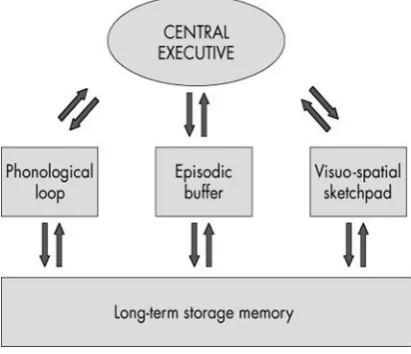
Cognitive load refers to the load related to working memory or the total amount of mental activity imposed on working memory at a certain moment in time (Cooper, 1998). This theory assumes that human working memory is limited and can only hold 7 +/- (plus or minus) two elements at one time; it means around 5 to 9 elements (Miller, 1956). Concerning working memory, Baddeley divides it into two, ‗visual-spatial
scratch pad‘ and ‗phonological loop‘. The former is dealing with visually-based information, while the letter has to do with auditory, primarily speech-based information (cf. Sweller, van Merrienboer, & Paas, 1998).
Fig. 1. Long term storage memory
The original model of working memory from Baddeley & Hitch was composed of three main components; the central executive which acts as supervisory system and controls the flow of information from and to its slave systems: the phonological loop and the visuo-spatial sketchpad. The slave systems are short-term storage systems dedicated to a content domain (verbal and visuo-spatial, respectively). In 2000 Baddeley added a third slave system to his model, the episodic buffer. Sweller, et al. (1998, p. 252) further maintain that under certain restricted conditions, working memory capacity may be increased by the use of multiple processors rather than by a single working memory processor.
Then, knowledge is organized into units or the so-called ‗schema/s‘. It is cognitive constructs that organize information according to the manner in which it will be dealt with (Sweller & Chandler, 1994). These schemas are stored in long-term memory; they provide a mechanism for knowledge organisation and storage, and could reduce working memory load (Sweller, et al., 1998). In order to construct schemas, Sweller, et al. (1998) maintain that automation becomes an important process and it can be obtained after practice, normally extensive practice. In this case, automation occurs with time and practice and allows cognitive process to occur without conscious control (Sweller & Chandler, 1994).
Journal of English and Arabic Language Teaching December 2017, Vol. 8, No.2
106
2.2.1 INTRINSIC LOAD
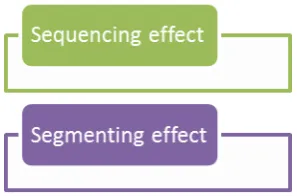
Intrinsic load is caused by the intrinsic nature of the material or the inherent level of difficulty associated with instructional materials. Sweller, et al. (1998) state that intrinsic load cannot be changed by instructional interventions. It is generally argued that intrinsic load depends on element interactivity and prior knowledge. In addition, de Jong (2010) emphasises that it also depends on types of content, learning difficulty increases when changing ontological categories, and specific characteristics of relations. In solving this load, de Jong (2010) further suggests that it be manageable through 1) sequencing the material in a simple-to-complex order, 2) introducing isolated elements before the integrated task, 3) part-whole sequencing, and 4) a whole-part approach.
Fig. 2. Managing Instrinsic Loads
2.2.2 EXTRANEOUS LOAD
Extraneous cognitive load is cognitive load that is evoked by the instructional material and that does not directly contribute to learning (schema construction) (de Jong, 2010). In other word, extraneous cognitive load is generated by the manner in which information is presented to learners and is under the control of instructional designers (Sweller, et al., 1998). Extraneous cognitive load is the result of implementing
―instructional techniques that require students to engage in activities that are not directed at schema acquisition or automation‖. In other words, extraneous cognitive
load is evoked when working memory is used for tasks that do not directly contribute to learning. The height of extraneous load depends on 1) the activities in which the learner is supposed to engage and 2) the instructional presentation of the material.
Cognitive load theory suggests preventing students from using a means-ends strategy and encouraging them to attend to problem states and their associated moves should reduce extraneous cognitive load and so facilitate schema acquisition. In general, instructional techniques should attempt to reduce extraneous cognitive load associated with constructing a representation because this facilitates learning.
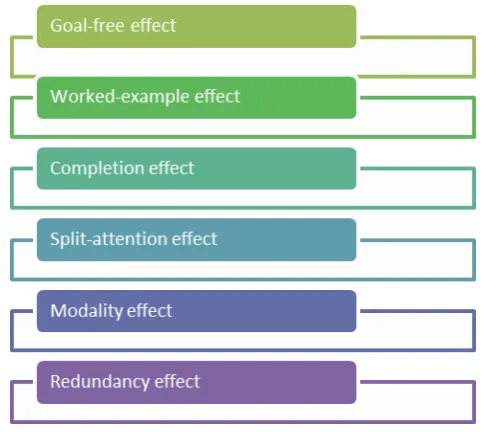
Sweller describes a series of effects and guidelines to create learning materials: 1. Goal free effect: novice learners with a specific learning goal (like a precise
question to answer) focus on the goal and pay no attention to other information. This is detrimental to learning. The goal-free effect refers to the effect that goal-free problems have on the cognitive load of a learner. Goal-free problems can be used to minimize extraneous load. A goal-free problem is a problem in which there is no end state, which means that means-ends analysis cannot be used. If means-ends analysis cannot be used, you do not have to keep in mind the goal, the givens, you do not have to consider the differences between them and to set sub-goals.
Journal of English and Arabic Language Teaching December 2017, Vol. 8, No.2
107 3. Problem completion effect: the worked out example should be followed by a
similar but unresolved problem to maximize motivation.
4. Split-attention effect: occurs when learners have to process and integrate multiple and separated sources of information. For instance, a geometrical sketch is better understood when textual information is spatially integrated rather than separated. This effect is very similar to Mayer‘s spatial and temporal contiguity principles.
5. Modality effect: two messages on similar elements should be provided through different sensory modalities. Research suggest that more memory capacity is available when dual modalities were used, however it may lead to a split-attention effect and excessive animated multimedia may lead to a general overload.
6. Redundancy effect: when the same information is presented more than once the multiple processing is negative for comprehension since it increases external cognitive load. If novices can benefit from partially redundant information (integrated text and picture for example), expert's performances can be impaired.
Fig. 3. Minimizing Extraneous Loads
These six effects try to minimize extraneous cognitive load or to reduce the number of cognitive processes involved that are unnecessary for learning.
7. Element interactivity effect: interactivity with the material increases negative effects such as split-attention and redundancy effects.
8. Isolated interacting elements effect: with complex models containing multiple interacting elements it is advisable to begin with presenting every element separately.
9. Imagination effect: mentally simulating the functioning and interaction of elements allow experts to obtain better results.
10. Expertise reversal effect: with experts, several effects are inversed. In this case, classical design rules are advisable instead of those based on cognitive load.
Journal of English and Arabic Language Teaching December 2017, Vol. 8, No.2
108
2.2.3 GERMANE LOAD
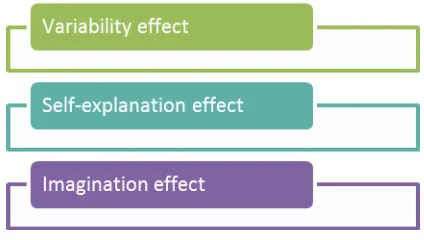
Germane cognitive load is that load devoted to the processing, construction and automation of schemas. There are three ways to maximize germane load or to facilitate effective mental processes (Sweller, Ayres, & Kalyuga, 2011). First is through variability. The variability effect occurs when example-based instruction (borrowing and organizing principle) that includes highly variable examples results in enhanced transfer performance compared to less variable, more similar examples. Second is imagination effect. In this strategy, after studying a worked example, students were instructed to turn away and try to imagine the steps involved in the procedure. Instructing learners to imagine a previously studied worked-out solution path produced better learning outcomes than studying the same worked example again. Third is self-explanation effect. It is a mental dialogue that learners have when studying a worked example that helps them Understand the example and build a schema from it (R. Clark, Nguyen, & Sweller, 2006). In other word, self-explanations require students to establish the interactions that relate various elements of a worked example both to each other and to previous knowledge (Sweller, et al., 2011).
Fig. 4. Maximizing Germane Load
In conclusion, high intrinsic load plus low extraneous load equals to high germane load (more learning). But, high intrinsic load plus high extraneous lead means low germane load (less learning). Thus, a cognitive load which is germane for novices might be extraneous to experts, the so-called expertise reversal effect. In reverse, increasing germane load can result in cognitive overload for novices.
2.3 MAYER’S PRINCIPLES OF MULTIMEDIA DESIGN
Mayer (2001) mentions seven principles for multimedia design. First, students learn better when an explanation is given in words and pictures than solely in words. This is the so called Multimedia principle. When words and pictures are presented, students have an opportunity to construct verbal and pictorial mental models and to build connections between them. But, when words only are presented, students have an opportunity to build a verbal mental model but are less likely to build a pictorial mental model and make connections between the verbal and pictorial mental models. In other words, on screen animation, slide shows, and narratives should involve both written and spoken text and still or moving pictures. Simple blocks of text or auditory only links are less effective than when this text or narration is coupled with visual images.
Journal of English and Arabic Language Teaching December 2017, Vol. 8, No.2
109 have to use cognitive resources to visually search the page or screen and learners are more likely to be able to hold them both in working memory at the same time.
Third is temporal contiguity principle. Students learn better when corresponding words and pictures are presented simultaneously rather than successively, especially when long passages are involved. When corresponding portions of narration and animation are presented at the same time, the learner is more likely to be able to hold mental representations of both in working memory at the same time, and thus the learner is more likely to be able to build mental connections between verbal and visual representations. In this case, when presenting coupled text and images, the text and images should be presented simultaneously, and when animation and narration are both used, the animation and narration should coincide meaningfully.
Fourth is coherence principle. Students learn better when extraneous material is excluded rather than included. Extraneous material here is the material that competes for cognitive resources in working memory, can divert attention from the important material, can disrupt the process of organizing the material, and can prime the learner to organize the material around an inappropriate theme. Therefore, designers should exclude interesting but irrelevant or unneeded words and pictures, or exclude interesting but irrelevant sounds and music.
Fifth is modality principle. Students learn better from animation and narration than from animation and on-screen text. Multimedia presentations involving both words and pictures should be created using auditory or spoken words, rather than written text to accompany the pictures. When pictures and words are both presented visually (i.e., as animation and text):
the visual/pictorial channel can become overloaded but the auditory/verbal channel is unused.
When words are presented auditory:
they can be processed in the auditory/verbal channel, thereby leaving the visual/pictorial channel to process only the pictures
Sixth is redundancy principle. Students learn better from animation and narration than from animation, narration, and on-screen text. Multimedia presentations involving both words and pictures should present text either in written form, or in auditory form, but not in both. Adding on-screen text to a multimedia presentation is not a good idea when that text matches the narration exactly. Thus, designer should not put redundant
text into the learner‘s visual channel. The reason underlying this principle is that when
Journal of English and Arabic Language Teaching December 2017, Vol. 8, No.2
110
Seventh is individual differences principle. Design effects are stronger for low-knowledge learners than for high-low-knowledge learners and for high spatial learners than rather than for low spatial learners. The aforementioned strategies are most effective for novices (e.g., low-knowledge learners) and visual learners (e.g., high-spatial learners). Thus, designers should create well-structured multimedia presentations, as they are most likely to help.
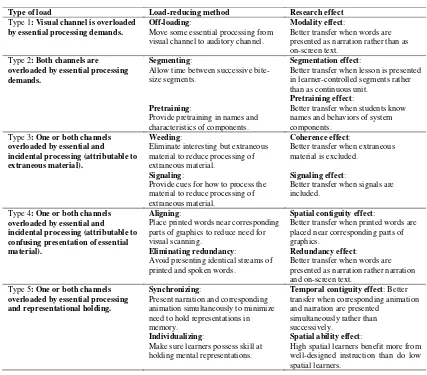
2.4 NINE WAYS TO REDUCE COGNITIVE LOAD IN MULTIMEDIA LEARNING
Mayer and Moreno (2003) distinguish three kinds of cognitive demands: Essential processing, incidental processing, and representational holding. Essential processing
refers to cognitive processes that are required for making sense of the presented material, such as the five core processes in the cognitive theory of multimedia learning—selecting words, selecting images, organizing words, organizing images, and integrating; incidental processing refers to cognitive processes that are not required for making sense of the presented material but are primed by the design of the learning
Type of load Load-reducing method Research effect
Type 1: Visual channel is overloaded by essential processing demands. presented as narration rather than as on-screen text.
Better transfer when lesson is presented in learner-controlled segments rather
Provide cues for how to process the material to reduce processing of parts of graphics to reduce need for visual scanning.
Eliminating redundancy: Avoid presenting identical streams of printed and spoken words.
Spatial contiguity effect:
Better transfer when printed words are placed near corresponding parts of
Make sure learners possess skill at holding mental representations.
Journal of English and Arabic Language Teaching December 2017, Vol. 8, No.2
111
3 CONCLUSION
The principles of multimedia learning discussed earlier should all be incorporated to design multimedia language learning materials. In other words, a successful multimedia learning design requires serious efforts in which all principles should be taken into account. The principles as mentioned above are the minimum for designers to develop multimedia learning.
REFERENCES
Clark, J., & Paivio, A. (1991). Dual coding theory and education. Educational Psychology Review, 3(3), 149-210. doi: 10.1007/bf01320076
Clark, R., Nguyen, F., & Sweller, J. (2006). Efficiency in learning: Evidence-based guidelines to manage cognitive load. . San Francisco: Pfeiffer.
Clark, R. E., & Salomon, G. (1986). Media in teaching. In M. C. Wittrock (Ed.),
Handbook of research on teaching (3rd ed., pp. 464-478). New York: MacMillan.
Cooper, G. (1998). Research into cognitive load theory and instructional design at UNSW, from http://education.arts.unsw.edu.au/CLT_NET_Aug_97.HTML
de Jong, T. (2010). Cognitive load theory, educational research, and instructional design: some food for thought. Instructional Science, 38(2), 105-134. doi: 10.1007/s11251-009-9110-0
Gerjets, P., & Kirschner, P. (2009). Learning from Multimedia and Hypermedia: Technology-Enhanced Learning. In N. Balacheff, S. Ludvigsen, T. Jong, A. Lazonder & S. Barnes (Eds.), Technology-enhanced learning: Principles and products (pp. 251-272). Netherlands: Springer Science+Business Media B.V. Mayer, R. E. (2001). The promise of multimedia learning. New York: Cambridge
University Press.
Mayer, R. E., & Moreno, R. (2003). Nine ways to reduce cognitive load in multimedia learning. Educational Psychologist, 38(1), 43-52.
Miller, G. (1956). The magical number seven, plus or minus two: Some limits on our capacity for processing information. Psychological Review, 63, 81-97.
Reeve, T. C. (1998). The impact of media and technology in schools: A research report
prepared for The Bertelsmann Foundation, from
http://it.coe.uga.edu/~treeves/edit6900/BertelsmannReeves98.pdf
Sweller, J., Ayres, P., & Kalyuga, S. (2011). Cognitive load theory. New York: Springer Science+Business Media,.
Sweller, J., & Chandler, P. (1994). Why some material is difficult to learn? Cognition and Instruction, 12, 185-233.