1
Technical Assistance Consultant’s Report
Project Number: 45181-001 July 2014
Bangladesh: Public-Private Partnership in Higher
Education
(Financed by Asian Development Bank)
Prepared by: Elizabeth Boye MA Mannan
CONTENTS
Page
I. THE CURRENT SITUATION OF HIGHER EDUCATION IN BANGLADESH 5
II. CHALLENGES FOR HIGHER EDUCATION IN BANGLADESH 16
III. STRATEGIES FOR OVERCOMING CHALLENGES FOR HIGHER EDUCATION IN
BANGLADESH 23
IV. FINANCING: CURRENT SPENDING AND SOURCES OF FUNDING 35
V. PRIVATE FINANCING IS AN INTEGRAL PART OF THE PUBLIC-PRIVATE
PARTNERSHIP CONCEPT 42
VI. UNIVERSITY BUSINESS INCUBATION 44
VII. RECOMMENDATIONS 52
REFERENCES 55
BOXES
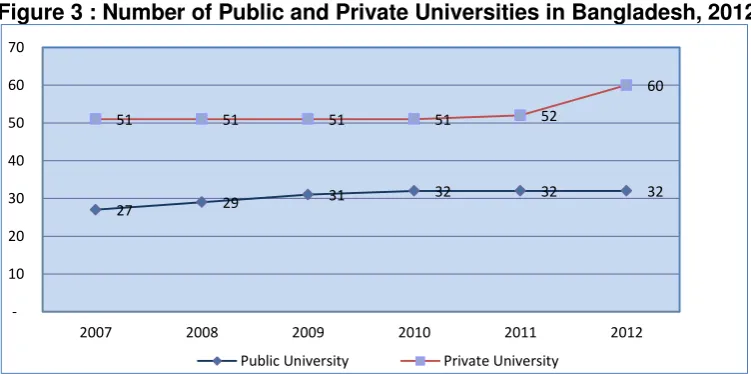
Box 1: Private Universities in Singapore
Box 2: University Financing in Hong Kong, China Box 3: Telecom Centres of Excellence in India
Box 4: Competitive Grants in the Republic of Korea and the United States Box 5: Raising Quality in Private Higher Education Institutions in Indonesia Box 6: Pohang University of Science and Technology
Box 7: Shanghai Jiao Tong University Box 8: Indian Institutes of Technology
Box 9: Pakistan—Government Funding Reform in Higher Education Box 10: Bangladesh—Asian University for Women
Box 11: The Maldives—Government Support for the Private Sector
Box 12: Central America—University–Private Sector Program for Sustainable Development Box 13: Singapore—SIM University
Box 14: Cost-Sharing System in the People’s Republic of China Box 15: Student Loans Scheme in the People’s Republic of China Box 16: University–Industry Collaboration in the United States
Box 17: Kenya—Strathmore Innovation and Technology Transfer Program Box 18: India—Indian Institutes of Technology
Box 19: Examples from the United States of America
Box 20: Hong Kong, China—Hong Kong Science and Technology Park Corporation
FIGURES
Figure 1 Number of Students in Public and Private Universities ... 9
Figure 2 Growth Rate of Public and Private University Students ... 10
Figure 3 Number of Public and Private University in Bangladesh, 2012 ... 11
Figure 4 Expansion of Faculty, Departments, and Institutes of Public Universities ... 12
Figure 5 Expansion of Faculty, Departments, and Institutes of Private Universities ... 12
TABLES
Table 1: Status of Government Funding ... 6
Table 2: Share of University in Education Budget and in National Budget ... 7
Table 3: National Budget, Ministry of Education Budget and Allocation for University Grants Commission ... 7
Table 4: Number of Students Passed in Secondary School and ... 8
Table 5: Number of Students Enrolled in First Year of Public and Private Universities ... 9
Table 6: Number of Public University Teachers by Qualification ... 10
Table 7: Number of Students by Field of Study (2012) ... 11
Table 8: Average Tuition Fees per Student (BDT) ... 12
Table 9: Average Income and Expenditure by University Type (BDT) ... 13
Table 10: Number of Students Eligible for Stipend in Private Universities ... 13
Table 11: Number of Research Activities for Public Universities (2010–2012)... 14
Table 12: Expenditure on Research by Public and Private Universities (BDT) ... 14
Table 13: Expected Enrollment in First-Year University Courses (2015 and 2020) ... 14
Table 14: Expected Number of Students in 2015 and 2020... 15
Table 15: University Expansion Requirements to Accommodate ... 15
Table 16: Number of Universities by Geographic Division ... 17
Table 17: Higher Education Students by World Regions (1991–2007) ... 28
Table 18: Shares of Research Funding Received by Academics in Selected Asian Economies, Academic Year 2008 ... 30
ABBREVIATIONS
GDP gross domestic product HEI higher education institution HSC Higher Secondary Certificate MOE Ministry of Education
PPA Public Procurement Act PPP public–private partnership PRC People’s Republic of China R&D research and development UBI university business incubator UGC University Grants Commission UIL university–industry linkage
Executive Summary
Public–private partnerships (PPPs) and university–industry linkages (UILs) in higher education offer potential for overcoming some of the critical challenges and for developing the higher education subsector in Bangladesh. Given the government’s limited budget allocation to the higher education subsector, promoting PPPs and UILs are critical to expand access of higher education, improve higher education programs in responding to the country’s needs, and improve effectiveness of management and administration.
The following are urgent challenges of higher education: (i) diversification needs of higher education institutions (HEIs), (ii) boosting quality to improve competitiveness, (iii) building research capacities to foster innovation, (iv) strengthening and applying information and communication technology infrastructure in the higher education system, (v) improvement of relevant postgraduate programs, and (vi) improving higher education sector management to ensure accountability and transparency.
The public universities currently have few links with the labor market, and thus course offerings and contents are deficient in providing graduates with knowledge and competencies sought by the labor market. The private universities tend to meet short-term training demands, although they are more responsive to labor market signals. A key concern is the international labor market, where around 7% of the total labor force is remitting a significant amount of foreign currency, 11.1% of national gross domestic product. About 4.3% of those held higher education credentials. These workers need internationally-competitive skills. This is not to mention the demand for competent, skilled workers in the growing service industry, in the expanding garment sector, and to release the tremendous development potential lying in the agricultural sector, where nearly 50% of the Bangladesh population are engaged.
I. THECURRENTSITUATIONOFHIGHEREDUCATIONINBANGLADESH
A. Background, Country Context and Economic Indicators
1. Bangladesh is a relatively small agriculture-dominated country of 147,570 km2 with a huge population of 149.71 million (around 80% live in the rural areas). The workforce has reached 73.9 million (with estimated 22.0 million new entrants between 2005 and 2015). Bangladesh has established a steady economic growth at 6%–7% per annum since 1996 and a current gross domestic product (GDP) per capita of $752 in 20122 despite the challenges that Bangladesh has been facing such as political instability, insufficient infrastructure, corruption, insufficient power supplies, economic reforms taking longer than anticipated, and the 2008–2009 global financial crisis and recession.3
2. A high illiteracy rate, low secondary and higher education enrollment ratios, low percentage of highly skilled workers, brain drain among more educated people, a predominantly rural population, high level of poverty, high dependence on agriculture, small modern sector (economic and social)—all this suggests that further improvements in competitiveness will heavily depend on expanding access to and improving quality of education, especially in science and technology.
3. Bangladesh is not in a good competitive position within the world economy. The World Global Competitiveness Report, 2013–2014 has ranked Bangladesh 120th out of 146 countries for “capacity of innovation” and 134th for “university–industry cooperation in research and development.” These rankings have been at the same level in the past few years.
4. The annual population growth rate is 1.2%4 and the population is young.5 Youth constitutes one-third of the growing total population and represents a development priority agenda for the Government of Bangladesh.6 While the unemployment rate is estimated to be 5.1% as of 2010, underemployment is estimated to be as high as 28.7% and youth unemployment at 12%–13%.
5. GDP is largely generated by three main sources: (i) agriculture contributed 17.7% of the GDP in 2012,7 (ii) the garment manufacturing sector contributed $19 billion in the year to June 2012,8 and (iii) remittances from more than five million overseas workers totalling $11 billion in 2010 accounted for almost 12% of the GDP.9
6. Although more than half of the GDP is generated through the service sector, almost half of Bangladeshis are employed in the agriculture sector, with rice as the single most important product. Garment exports, the backbone of Bangladesh’s industrial sector and accounting for 80% of total exports, surpassed $21 billion last year, 18% of the GDP. Steady garment export growth combined with remittances from overseas Bangladeshis, which
1
Government of Bangladesh, Bangladesh Bureau of Statistics. 2011. Population Census, 2011. Dhaka. 2 World Bank Indicators 2012, current US dollars.
3
US Central Intelligence Agency. 2013. Bangladesh Economy Profile. CIA World Factbook. Washington, DC. 4 2012 list by the World Bank. UN estimate is as high as 1.67 and CIA
World Factbook 1.59.
5 Age median is estimated to 24.3 years in 2014 (male: 23.8 years, female: 24.8 years). United Nations,
Department of Economic and Social Affairs. 2012. World Population Prospects: The 2012 Revision.
6 Dr. A. K. Abdul Momen, Ambassador and permanent representative of Bangladesh to the United Nations at the
General Debate on National Experience in Population Matters: Adolescent and Youth at the 45th session of the Commission on Population and Development in New York, 24 April 2012.
7
World Bank. Bangladesh at a glance. http://devdata.worldbank.org/AAG/bgd_aag.pdf
8 Md. Mazedul Islam, A. Khan, and Md. Monirul Islam. Textile Industries in Bangladesh and Challenges of
Growth. Research Journal of Engineering Sciences. 2 (2). pp. 31–37. www.isca.in/IJES/Archive/v2i2/7.ISCA-RJEngS-2013-002.pdf.
9
totalled almost $15 billion and 13% of the GDP in 2013, are the largest contributors to Bangladesh’s current account surplus and record foreign exchange holdings.
7. Bangladesh spends only 2.30% of GDP for education and 0.12% for higher education. The share of higher education in the total education budget is about 11.0%, which is the lowest in South Asia. Public universities are mostly funded by the government through the University Grants Commission (UGC).
8. Bangladesh achieved a net enrollment ratio of 96.7% and gender parity in primary education with a literacy rate of around 56%. This is a country with 104,01710 primary schools of 10 types, 19,208 secondary schools, 3,547 degree-offering colleges and institutions, 9,441 madrasahs, and 96 universities (60 private universities, 34 public universities, and 2 international universities).11 English is the second language along with the national language (Bangla) and 45 ethnic languages among the tribal population.
9. Its plentiful human resources have great potential for boosting Bangladesh's economic growth, but challenges remain in turning the young and growing population into a skilled and productive workforce and financing of the same. The government's Sixth Five-Year Plan emphasizes accelerating economic growth through productive employment (high-income jobs in the formal sector) and associated reduction in poverty, and stresses the need to address both demand and supply sides of the employment market. As the goal, as well as the means of national development, the government continues to make mass education one of its top priorities, especially at the primary and secondary levels.
B. Financing of Higher Education
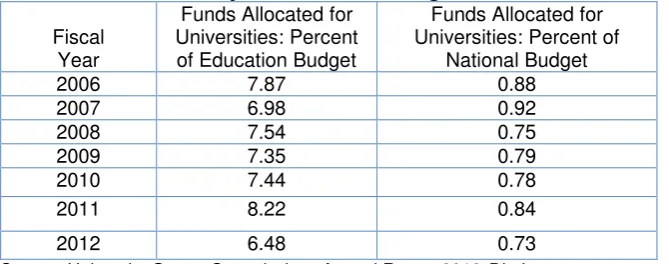
10. De facto priority in financial allocation terms reveals the following stress on higher education financing. Public expenditure per student in higher education, as percent of GDP per capita, was 28.2% in 2009. It was down to 20.0% in 2011.12 No data could be found documenting a change in this significantly downward trend in public financial allocations. Enrollment rates in secondary and higher education are below the South Asian average, and quality remains a significant issue to address. In other Asian countries, the government finances the majority of higher education costs. But in recent years in Bangladesh, public expenditure on higher education has been steadily declining. The amount of funds allocated for higher education in Bangladesh’s national budget makes it uncertain whether quality can be enhanced under the present financial conditions. This calls for new approaches and ways of closing the higher education financing gap and making higher education the development driver it has the potential to be. Prevailing public financing is illustrated in tables 1 and 2.
Table 1: Status of Government Funding – = not available, MOE = Ministry of Education, Tk = Bangladesh taka, UGC = University Grants Commission. Source: Government of Bangladesh, Ministry of Finance budget documents.
10 Government of Bangladesh, Bangladesh Bureau of Educational Information and Statistics. 2013. Bangladesh
Education Statistics, 2012. Dhaka.
11 University Grants Commission. Annual Report 2012. Dhaka. 12
Table 2: Share of University in Education Budget and in National Budget
Source: University Grants Commission. Annual Report 2012. Dhaka.
11. Table 1 shows allocation to the higher education subsector from FY2009 to FY2013. Table 2 shows the share of the budget for education that is allocated to universities and also the share of the national budget for universities in the same period.
12. In FY2011, the national budget increased by 19.59% compared with the FY2010 national budget, whereas the Ministry of Education (MOE) budget increased only by 13.42%, and the UGC budget increased by 34.46%. In FY2012 and FY2013, the national budget increased, by 23.77% and 17.21% respectively, from the previous year. However, the MOE budget declined to 4.66% in FY2012 and 8.54% in FY2013. The UGC budget sharply budget for the UGC has been stagnant or slightly declining.
Table 3: National Budget, Ministry of Education Budget and Allocation for University Grants Commission
MOE = Ministry of Education, UGC = University Grants Commission.
Data sources: University Grants Commission Annual Reports and Ministry of Finance Budget Reports.
94140
110523
132170
163589
191738
6739.22 8971.68 10175.65 10649.99 11558.97
C. The Need for Developing the Higher Education Subsector in Bangladesh
14. With a substantial increase in the number of students and applicants in HEIs due to the high increase in the number of secondary and higher secondary graduates, public funding can no longer keep up with the challenging task of expanding to meet these ever-growing needs. This warrants active private sector participation in the development of higher education to meet the challenges of a knowledge economy. Industries that are likely to benefit from a good human resources base are the primary targets for undertaking initiatives to foster collaboration with the government and the HEIs.
1. Increasing Number of Students and Applicants in Higher Education Institutions
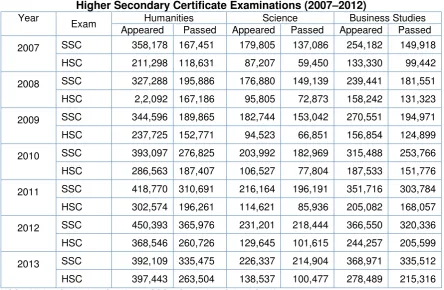
15. The number of applicants in higher secondary institutions in Bangladesh is rapidly increasing. A higher secondary certificate (HSC) is prerequisite for admission in the tertiary level of education. Table 4 shows the number of students who passed the secondary school certificate (SSC) and HSC examinations from 2007 to 2012. Table 5 shows the number of students enrolled in the first year of the public and private universities. On average, 23% of HSC graduates are enrolled in public and private universities. Others are enrolled in affiliated colleges of National University, Bangladesh Open University, and vocational and technical courses; and some are dropouts.
Table 4: Number of Students Passed in Secondary School and Higher Secondary Certificate Examinations (2007–2012) Year
Exam Humanities Science Business Studies
Appeared Passed Appeared Passed Appeared Passed
2007 SSC 358,178 167,451 179,805 137,086 254,182 149,918 HSC 211,298 118,631 87,207 59,450 133,330 99,442
2008 SSC 327,288 195,886 176,880 149,139 239,441 181,551 HSC 2,2,092 167,186 95,805 72,873 158,242 131,323
2009 SSC 344,596 189,865 182,744 153,042 270,551 194,971 HSC 237,725 152,771 94,523 66,851 156,854 124,899
2010 SSC 393,097 276,825 203,992 182,969 315,488 253,766 HSC 286,563 187,407 106,527 77,804 187,533 151,776
2011 SSC 418,770 310,691 216,164 196,191 351,716 303,784 HSC 302,574 196,261 114,621 85,936 205,082 168,057
2012 SSC 450,393 365,976 231,201 218,444 366,550 320,336 HSC 368,546 260,726 129,645 101,615 244,257 205,599
2013 SSC 392,109 335,475 226,337 214,904 368,971 335,512 HSC 397,443 263,504 138,537 100,477 278,489 215,316 HSC = Higher Secondary Certificate, SSC = Secondary School Certificate.
Source: Bangladesh Bureau of Educational Information and Statistics. BANBEIS Annual Report 2013. Dhaka.
Table 5: Number of Students Enrolled in First Year of Public and Private Universities
Note: Figures exclude National University and Bangladesh Open University enrollment. Source: University Grants Commission. Annual Reports, 2007–2012. Dhaka.
2. Number of Students Studying in Different Years in Public and Private Universities
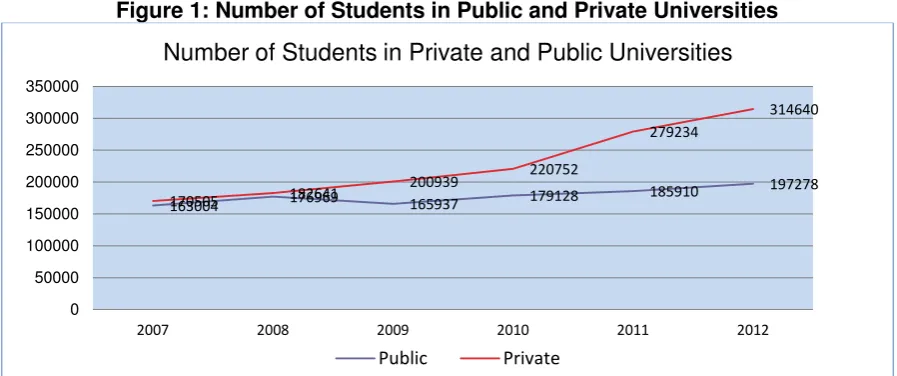
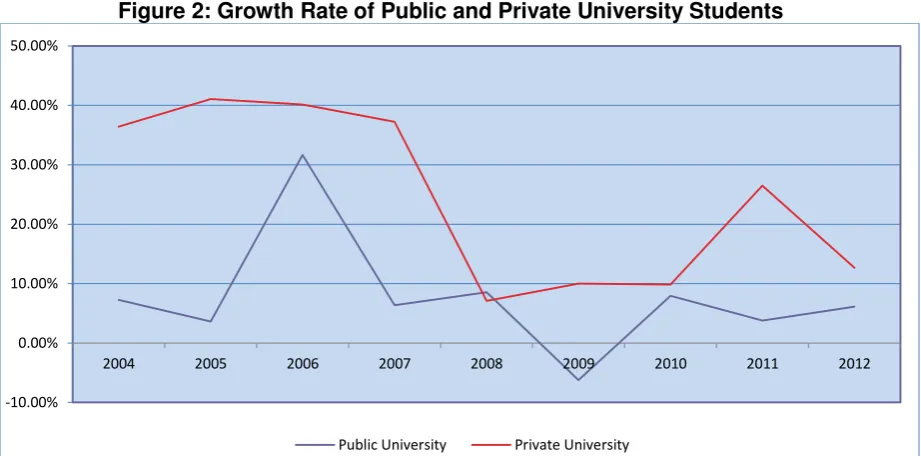
17. The increasing tendency of students in public and private universities and their growth rate is shown in figures 1 and 2 below. From Figure 1, one can observe a steady growth of students in public universities and a comparatively rapid growth of students in private universities due to the expansion of the private universities.
Figure 1: Number of Students in Public and Private Universities
Note: Figures exclude National University and Bangladesh Open University. Source: University Grants Commission. Annual Reports, 2007–2012. Dhaka.
163004 176969 165937 179128 185910
197278
Number of Students in Private and Public Universities
Figure 2: Growth Rate of Public and Private University Students
Note: Figures exclude National University and Bangladesh Open University. Source: University Grants Commission. Annual Reports, 2007–2012. Dhaka.
3. Number of Public University Teachers by Qualification
18. Table 6 shows the number of teachers in public universities by qualification. Of 10,568 teachers working in 32 public universities, 3,703 have a PhD and 1,237 teachers have other higher qualifications. The vast majority, 5,628 teachers (53%), are without any higher education degree. In private universities, there are 12,113 teachers as of 2012, but data on qualifications are not available.
Table 6: Number of Public University Teachers by Qualification
Name of Degree 2007 2008 2009 2010 2011 2012
No. of Teachers
PhD 2,701 2,796 3,021 3,056 3,570 3,703
Other higher education 1,930 2,051 1,813 1,217 1,032 1,237 No higher education 3,437 3,473 4,407 5,272 5,179 5,628 Source: University Grants Commission. Annual Reports, 2007–2012. Dhaka.
4. Classification of University Students by Choice of Field of Study in 2012
19. Business administration is the most popular subject at private universities. In 2012, the total number of students studying business administration was 159,136 (31%). Science, health care, engineering, and agriculture are the next most-chosen subjects of both private and public university students, followed by arts and social sciences, which include languages, economics, history, political science, geography, etc. Science is the most favored subject in public universities. From this analysis, it is found that students choose those subjects that offer good employment opportunities in the job market.
-10.00% 0.00% 10.00% 20.00% 30.00% 40.00% 50.00%
2004 2005 2006 2007 2008 2009 2010 2011 2012
Table 7: Number of Students by Field of Study (2012)
9 Business administration 25,950 133,186 159,136 31%
10
MPhil, PhD, PGD,diploma,
certificate 5,445 0 5,445 1%
Total 197,278 314,640 511,918 100%
Note: Figures exclude National University and Bangladesh Open University. Source: University Grants Commission. Annual Report 2012. Dhaka.
5. Expansion of Public and Private Universities, Faculties, and Departments
20. With the establishment of new public and private universities to meet the growing demands of diversification of higher education, there has been concomitant growth and expansion of the faculties, departments, and institutes for higher education in the country (figures 3, 4, and 5).
Figure 3 : Number of Public and Private Universities in Bangladesh, 2012
Note: Figures exclude National University and Bangladesh Open University. Source: University Grants Commission. Annual Reports, 2007–2012. Dhaka.
Figure 4: Expansion of Faculties, Departments, and Institutes of Public Universities
Source: University Grants Commission. Annual Reports, 2007–2012. Dhaka.
Figure 5: Expansion of Faculties, Departments, and Institutes of Private Universities
Source: University Grants Commission. Annual Reports, 2007–2012. Dhaka.
D. Tuition Fees, Scholarships, and Availability of other Facilities for Academic Staff Development and Research Programs
1. Average Tuition Fees Per Student
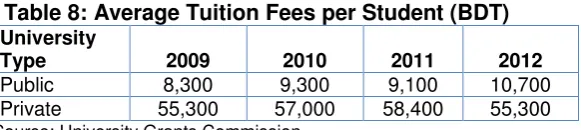
21. Table 8 shows that the average tuition fee per student in private universities is nearly five times higher than in public universities. Public universities are mostly run by government funds and the students need to bear a nominal tuition fee. On the other hand, almost all expenses in private universities are borne by student tuition fees and so the cost to those students is much higher. This calculation is made based on total average income divided by total average students of university
Table 8: Average Tuition Fees per Student (BDT)
2. Average Income and Expenditure by University Type
22. Table 9 shows average income by type of university. Income is derived from student tuition fees and other sources. In public universities, income is low because student tuition is low and expenditure is high. The gap is filled by government funding. In private universities, both income and expenditure are high, and the income mostly comes from student tuition fees.
Table 9: Average Income and Expenditure by University Type (BDT)
University
Type 2007 2008 2009 2010 2011 2012
Public Income 32,810,000 38,528,000 44,494,000 51,869,000 52,928,000 65,775,000 Expenditure 204,700,000 223,000,000 238,800,000 268,900,000 344,500,000 372,600,000
Private Income - - - 239,528,000 305,895,000 306,510,000
Expenditure - - - 272,600,000 320,200,000 284,100,000
Source: University Grants Commission. Annual Reports, 2007–2012. Dhaka.
3. Number of Students Eligible for Stipend in Private Universities
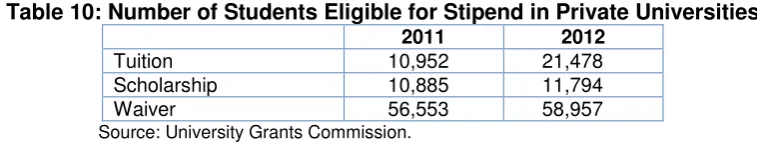
23. Table 10 shows the number of private university students eligible for stipend (free tuition, scholarships, and waivers). Although data is not available for public universities, they do provide stipend for different categories of students, such as hill track students, handicapped students, and dependents of freedom fighters.
Table 10: Number of Students Eligible for Stipend in Private Universities
2011 2012
Tuition 10,952 21,478 Scholarship 10,885 11,794 Waiver 56,553 58,957 Source: University Grants Commission.
4. University Academic Staff Development Programs
24. Public and private universities and affiliated colleges under the universities have different types of staff development programs, outlined below:
(i) UGC PhD fellowship program; (ii) UGC MPhil fellowship program;
(iii) national and international seminars, workshops, and symposium programs; (iv) UGC talent scholarship program;
(v) Janata Bank talent scholarship program; (vi) scholarship program for gifted blind students; (vii) UGC professorship program;
(viii) creation of Rokeya Chair Program.
(i) Commonwealth Academic Staff Fellowship; (ii) Commonwealth Academic Staff Scholarship; (iii) Commonwealth Staff Split-Sight Scholarship; (iv) New Zealand Commonwealth Scholarship; (v) Award of Gold Medal by Prime Ministry;
(vi) SAARC Chair, Fellowship, and Scholarship Program; (vii) UGC Award; and
5. Research Activities of Public and Private Universities
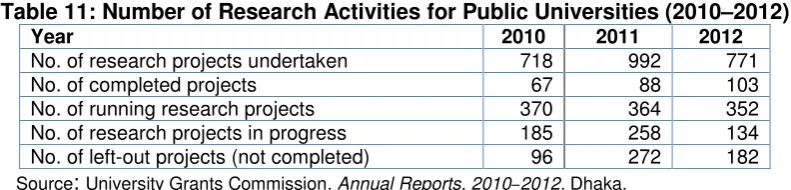
25. Table 11 shows the number of research projects undertaken by public universities and Table 12 shows the expenditure of the research activities of public and private universities. The research expenditures of public universities are very low. Some private universities have quite high research expenditures but some have none at all. The calculation is made based on total research expenditure divided by total number of universities.
Table 11: Number of Research Activities for Public Universities (2010–2012)
Year 2010 2011 2012
No. of research projects undertaken 718 992 771
No. of completed projects 67 88 103
No. of running research projects 370 364 352
No. of research projects in progress 185 258 134 No. of left-out projects (not completed) 96 272 182 Source: University Grants Commission. Annual Reports, 2010–2012. Dhaka.
Table 12: Expenditure on Research by Public and Private Universities (BDT)
Year 2010 2011 2012
Public universities 7,230,000 7,120,000 8,060,000
Private universities 191,196,000 259,153,000 410,384,000
Average research expenditure per
public university 200,000 200,000 300,000
Average research expenditure per
private university 5,031,000 6,321,000 7,100,000
Source: University Grants Commission. Annual Reports, 2010–2012. Dhaka.
26. The numbers clearly show that the private universities are heavily overrepresented in the field of research in Bangladesh.
E. Future demand of Private and Public Universities
1. Expected Number of First-Year Student Admissions in 2015 and 2020
27. Based on the last 4-year actual admission of students in the first year of university courses, 23% of students who passed HSC examination were admitted to public and private university first-year courses each year. Considering this rate of admission, and the increase in students who pass the HSC exam, it is expected that in 2015, 190,800 students will be enrolled in the first year of university and 362,000 students will be enrolled in 2020.
Table 13: Expected Enrollment in First-Year University Courses (2015 and 2020)
Number of First-Year Student Admissions in 2012
Expected First-Year Admissions in 2015
Expected First-Year Admissions in 2020
117,213 190,800 362,000
Note: Figures include public and private universities. Source: University Grants Commission.
2. Total Number of Expected Students in 2015 and 2020
Table 14: Expected Number of Students in 2015 and 2020
2012 2015 2020
Public universities 197,278 223,800 276,200 Private universities 314,640 500,600 1,085,800 Source: University Grants Commission.
3. Facility Expansion Required
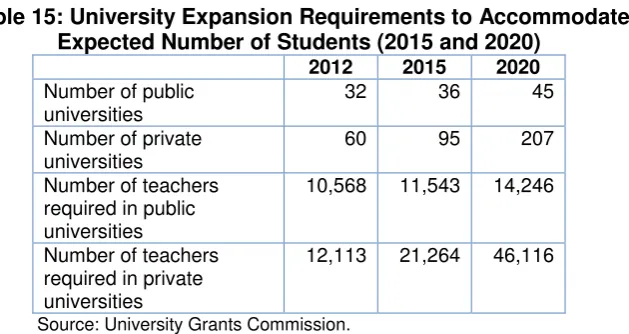
29. Based on the current university–student ratio and the growth rate of expected students, the facility expansion outlined in Table 15 will be required in 2015 and 2020.
Table 15: University Expansion Requirements to Accommodate Expected Number of Students (2015 and 2020)
30. As the numbers show, there is huge demand for higher education in Bangladesh, and to meet this growing demand, rapid growth and expansion of the number of public and private universities and their faculties, departments, and institutes will be needed. In conclusion, the numbers document a significantly increasing demand for seats in HEIs and a corresponding urgent need for facilities upgrades and expansion of the teachers’ resource base.
F. The Role of Higher Education as a Driver for Development
31. In the global knowledge economy, higher education has a crucial role in nurturing human capital. It promotes economic growth, leads social transformation, and finds solutions to national development challenges. Major challenges for higher education development are: (i) limited access despite the recent expansion, (ii) regional imbalance, (iii) questionable quality and relevance to the job market and national development priorities, and (iv) inadequate financing and governance arrangements.
32. The strengthening of higher education is required for enhancing the overall development of Bangladesh. It must focus on providing access to high-quality education services to strategically important target groups, and to ensure inclusiveness, equality, and the nurturing of talent and entrepreneurship. HEIs in the developed and in few developing countries have benefited from, and played a key role in, bringing in the scientific and information and communication technology solutions necessary for development. Unfortunately, these do not seem to be fully-utilized and Bangladesh is reported to be behind, as the framework conditions allowing such breakthroughs in science and technology are not yet in place. Evidence from East Asia confirms that both national and foreign investments are most attracted to a given country when there is a skills base to warrant a return on investments.13 In addition, Bangladesh has other challenges and opportunities that remain to be explored. Higher education has been under-resourced, even though skilled
13
labor and science and technology are vitally essential for increasing the competitiveness of Bangladesh.
33. Higher education in Bangladesh is now at a crossroad. The unfolding knowledge society is reshaping higher education on a global scale, and HEIs in Bangladesh will remain competitive only to the extent that they embrace the knowledge economy and turn out an increasingly diversified range of skills in response to development needs. The key challenges of the higher education system are training the young generation for the emerging new economy, and improving access and quality of outputs. While the government attached higher priority to primary education, followed by secondary education, with the active support of international development partners, the higher education is left out, resulting in a deterioration of quality of educational services. Also, lack of international development partner support for the promotion of higher education led to no further improvement of the quality of outputs. The consequence is that Bangladesh still has no noteworthy research and development (R&D) centers, while North America has 861, Asia 655, and Europe 1,576.14
34. One of the primary roles of the university is creation of new knowledge through conducting research, in addition to the function of teaching. R&D, without much attention to downstream activities that involve commercialization, limits the relevance of university research. Technology is the progeny of the research endeavors carried out at the universities. As such, the universities in the industrially-advanced countries have become the prime source of ideas that are increasingly being translated into viable market commodities in the shape of products, processes, and procedures.
35. Given that Bangladesh is preparing to become a middle-income country, the demand for higher education graduates will increase substantially. By the same token, there is also a need to establish university–industry linkages (UILs) through partnerships to foster business opportunities (incubation).
II. CHALLENGESFORHIGHEREDUCATIONINBANGLADESH
A. Overview of the Higher Education Subsector
36. The higher education system in Bangladesh has expanded significantly during the decades since 1990. The government committed and planned to establish at least one public university in the headquarters of each greater district. The government also allows establishment of private universities anywhere in the country in response to the increasing demands for access to higher education.
37. Bangladesh has 34 public universities, 60 private universities, over 2,000 degree colleges and institutes affiliated to National University, 2 international universities, and many other technical and professional HEIs. In accordance with the increased numbers of private universities, enrollment in the private universities has grown significantly. Despite the recent expansion, higher education enrollment rates remain very low as a whole. About 7% of the eligible age cohort continues to higher education, far lower than India’s 12%. There is also a tremendous regional imbalance. Most of the 90 universities are concentrated in a few locations: 53 (59%) are in the capital Dhaka and 10 (11%) are in Chittagong, with the remaining 27 (30%) spread over 15 of the 64 districts. The rapid quantitative expansion reportedly has come with deteriorating quality and lack of relevance of higher education as the result, which is causing a growing concern. Young public and private universities, regional universities, and particularly the vast number of colleges under National University
14
are reported to lack (i) qualified and motivated teaching staff; (ii) access to the latest books, journals, and research articles; (iii) access to internet and online communications; and (iv) research and training facilities. Following the Higher Education Strategic Plan, 2006–2026, universities have established internal quality assurance cells, but no improvements have been seen. While the strategic plan also proposed the establishment of an independent accreditation council covering both public and private universities, it has not been implemented.
38. There is an increasing demand for admission to HEIs, particularly in public universities. The public universities cannot cope with such demand, as they cannot expand at the required rate due to financial constraints and lack of faculty, space, laboratories, libraries, and other essential facilities. Private universities are interested, rather too eager, to expand, but generally at the cost of quality. National University colleges provide another option for admission seekers, but most of them are of low quality.
39. The growth of enrollment at the secondary level and the large number of students passing the HSC examinations puts pressure on HEIs for admission. Although Bangladesh has witnessed an increased number of private and public universities in recent years, there are not enough universities and other HEIs to accommodate an ever-growing number of students. In 2013, a total of 579,297 students passed HSC examinations, but the public and private universities together could admit only 250,000 on their own campuses. Many of the remaining students are going to university-affiliated colleges, which offer 3–year degree (pass) courses, 4–year degree (honors) courses, and master’s courses in some selected subjects. These affiliated colleges also face shortages of qualified teaching staff and inadequate library, laboratory, and research facilities.
40. The challenge, therefore, is how to meet the increasing demand with quality and affordability. The Private University Act, 2010 will give scope for the opening of new universities. The act will play a pivotal role in the field of higher education as well as in research activities. It will help to establish transparency, accountability, dynamism, and good governance in the private university system. It is also expected that new public universities could be established to expand the scope of higher education as well as to improve the quality of higher education in the country.
1. Geographic Imbalance of the Location of Universities
41. Universities in Bangladesh show a geographic imbalance in their location pattern, more so for private universities. The 34 campus-based public universities are located in only 16 out of the 64 districts of the country, 16 in the Dhaka metropolitan region alone. Out of the 60 private universities, 48 are located in Dhaka. This means that out of the 94 public and private universities (excluding the international universities), 64 are located in the Dhaka metropolitan area and 11 in the Chittagong metropolitan area, an extremely biased spatial pattern. Khulna and Rajshahi both have only one private university each and Barisal and Rangpur Division are without any private university. The concentration by number of students is even more lopsided (Table 16).
Table 16: Number of Universities by Geographic Division
Division Public Universities
Private Universities
Total
Rangpur 2 - 2
Total 34 60 94
Source: University Grants Commission.
Figure 6: Geographic Distribution of Public and Private Universities in Bangladesh (2012)
Source: University Grants Commission.
42. The challenge, therefore, is to create a spatial balance in the future so that aspiring students of all regions have better access to universities. Spatial or geographic distribution of universities needs to be more rationalized. The National University colleges offer better geographic coverage, but the better-quality colleges are located in Dhaka and a few other metropolitan areas.
2. Challenge of Having a Proper Campus
43. A university ideally should have a carefully laid out campus for proper physical, social, cultural, and mental development of the students. Most of the public universities have adequate land, but most private universities function within very limited space. It is encouraging that at least some private universities have their own campuses; a few others are in the process of developing theirs. The challenge remains of how to make the majority of private universities move to their own campuses. This is a legal obligation, but proving difficult to enforce.
3. Challenges in Research
44. Universities, as defined, not only transfer knowledge, but also create new knowledge. The challenge is in creating an environment for new knowledge generation through research, with adequate funds, facilities, and equipment. The faculty members have to be research-minded. Research needs to address the national agenda.
45. At present, the UGC provides a small amount of research support to more than 771 projects15 run by teachers in various universities. In 2012, the research grants amounted to
15
University Grants Commission. Annual Report 2012. Dhaka. 64 11
4 5
2
6 2
Geographic Location of Universities
Dhaka
Chittagong
Rajshahi
Khulna
Barisal
Sylhet
BDT8,100,000 and private university has BDT410,400,000 from their own resources. There are also UGC MPhil and PhD fellowships. There are other scholarships as well.
B. Current Higher Education Financing
46. Less than 10% of public university resources are self-generated. Public universities spend around 95% for recurrent costs (staff salaries, subsidized dormitories and food, etc.) and less than 5% on research activities.
47. The public universities in Bangladesh are almost fully funded by the state and the annual allocation for revenue meeting recurring expenditure in FY2013 is BDT12,480,000,000. This is far short of meeting the minimum requirement. Unfortunately, there is sometimes misuse even of these insufficient funds. The government is encouraging public universities to generate their own income through enhancement of student fees or other innovative means. The results are not encouraging.
48. The government also provides development funds to the public universities, but the amount is small. For example, the total development budget allocation to all public universities was BDT5,261,300,000 in FY2012. Allocation to higher education in the national budget is inadequate and still very low. This subsector constitutes only about 0.17% of GDP, while for education as a whole the share is a meager 2.03% (compared with 4.00% in India). The government has no obligation to finance private universities. These are initially run with funds from sponsors and later are fully dependent on student fees and other charges. Many sponsors are reluctant to invest in developing their campuses and improving laboratory and library facilities. There is very little money for research, and many universities have minimal or no allocation for research at all.
49. The UGC and MOE are currently implementing a project called the Higher Education Quality Enhancement Project (BDT6,810,000,000) for funding research and faculty development of universities with the support of the World Bank. The UGC has also mobilized research support through the British Council under the International Strategic Partnership in Research and Education Project.
50. For a developing country like Bangladesh, one of the most difficult tasks is arranging sufficient financing for promoting expansion and quality improvement of higher education. In some countries, the government finances the major share of higher education costs. In Bangladesh, public expenditure on higher education has been declining in recent years. The allocation for this sector in the national budget is so insignificant as to be nearly useless for enhancing quality. While the number of incoming students and demand for higher education are increasing rapidly, public expenditure on higher education continues to decline.
C. The Challenge of Higher Education Governance
51. Vice chancellors are appointed by the President or Prime Minister, and have strong political affiliations, and thus governance arrangements in public universities and academic decision making are affected and influenced to certain extent.
53. In the pre-independence era and several years after Bangladesh’s independence, the public universities played a key role in the higher education system. They were authorized to regulate the systems of their own campuses and of their affiliates. In 1992, the National University was established as an affiliating university, and is now the affiliating university of almost all government and private colleges. The National University is responsible for developing curricula, conducting examinations, awarding certificates and diplomas, and regulating all academic affairs of its affiliated institutions.
54. The greatest challenge to higher education in Bangladesh today lies in establishing good governance. The core characteristics of good governance are authority, autonomy, transparency, accountability, participation, responsiveness, coordination, efficiency, capacity, equity, and sustainability. Achieving satisfactory performance in all these indicators is difficult, but efforts must be made to such an end.
55. It can be said that most universities in both the public and private systems are suffering from poor governance, although the governance problems are quite different. Many public universities recently have been accused of serious administrative and financial irregularities, while many private universities have been charged with lack of transparency and noncompliance of conditions set for them by the UGC and MOE.
56. The public university system requires reforms, but such reforms are not proposed from within. If such reforms were suggested from outside the universities—such as from the UGC or MOE—these would face immediate opposition or even rejection from the universities. The malfunctioning of universities, therefore, continues. It is the same with private universities. Proposals for change are not taken easily or in good spirit.
D. The Challenge of Language of Instruction
57. The government emphasizes the use of Bangla as the language of instruction at all levels of education. This makes it legally imperative for HEIs to use Bangla. However, although the public universities are not required to follow Bangla, they cannot officially instruct students to follow English. Since the government does not strictly call for compliance of this policy, public universities informally encourage English to be used as the parallel medium of instruction. The private universities have clearly opted for English, but their students generally have low proficiency in the language when they enter and achieve only marginal improvement by the time they graduate.
58. Technical universities use English as the medium of instruction. Departments in science faculties of public universities encourage students to use English. Many social sciences and humanities departments allow use of both Bangla and English by students. Affiliated colleges under National University mostly use Bangla. The quality of English is extremely low in most of the Bangla secondary schools and intermediate colleges. Most universities as a result get only students with poor English skills.
E. The Challenge of Getting Adequate Faculty
60. Finding an adequate number of qualified teachers is a serious challenge for the universities. This applies to public and private universities, but the concerns are more serious for private universities. There is an acute shortage of experienced and qualified faculty in popular disciplines and subjects like business administration, computer science, information and communication technology, pharmacy, law, English, and textile engineering. There is also the challenge of faculty development through adequate opportunity for doctoral research and teacher training. As shown in Table 6, out of 10,568 teachers working in 64 public universities, 3,703 teachers have a PhD; 1,237 have other higher education; and the vast majority of public university teachers (5,628 teachers, or 53% of the total) have no higher education degree. This affects the quality of higher education, which is critical for the knowledge economy.
61. Above all, teachers have to be committed to their job of teaching and research. System of benefits, responsibility, and accountability among teachers have not duly established yet. Moreover, long absences and attrition have created serious problem in public universities.
62. Teacher quality is questionable and there is a lack of continuous training of academic staff; no institution exists in the country for providing training to teachers and administrative staff of HEIs. In addition, the absence of English language skills development programs, for both teachers and students, represents a barrier to development. Although some universities use English, there is no planned system in the country for skills development in spoken and written English.
63. In short, faculty development suffers from the following:
(i) There is a lack of adequate international collaborative research opportunities for faculty members.
(ii) The average quality of PhD programs is low compared with the developed countries due to the universities’ inability to employ high-quality teachers from abroad for providing expertise.
(iii) Institutes attached to various universities in many cases have not proved very productive.
(iv) Campus politics sometimes adversely affects faculty members in performing their mandated academic responsibilities.
F. The Challenge of Attaining Quality
65. Quality assurance is essential in higher education because of the generally low competence of those having postgraduate degrees as measured by employability. The existing pattern of unemployment and underemployment of university graduates implies that the system is not working efficiently and effectively.
66. Parental emphasis on measuring educational excellence by examination results, an inadequate relationship between research and classroom teaching, an unsuitable educational environment, a lack of educational implements, and an unsatisfactory teacher– student ratio are impediments to acquiring the right type of higher education in this country. The demand for higher education also affects quality. Lack of avenues for studying many diverse subjects and lack of opportunities for studying in various streams put great pressure upon the universities and colleges. Increasing pressure for admission combined with existing inadequacies in facilities, resources, personnel, libraries, laboratories, and accommodations significantly affect the quality of higher education.
1. Relevance
67. One common criticism of higher education in Bangladesh is that it is steeped in traditionalism and there is no significant relevance to national needs and problems. The unemployment of large numbers of educated youth implies that higher education institutions have been unable to properly assess and respond to the job market. If graduates are not prepared to meet national development needs, then the resources spent on them is wasted.
2. Efficiency
68. The efficiency of higher education is proved by the contribution of its graduates to society. The contribution to efficiency of the education system depends on the outputs of top administrators, scholars, and researchers working in these institutions. To measure efficiency, the output of higher education can be used as a criterion. A large number of failures (25%)16 is seen in the degree examinations. In the honors and master’s-level examinations, the percentage of those who pass is much higher than at the degree level. But among the successful candidates in the two examinations, only a few can hope to enter the professions, which require high academic competency and professional skills. Another weakness of the higher education system is that universities and colleges do not have any follow-up of the performance of their graduates. The available data on unemployment of graduates of universities and colleges are scanty and sometimes unreliable. There is also a lack of scientific tools for accurately measuring the efficiency of higher education.
69. Brain drain is another indicator of measuring efficiency of an education system. A large number of qualified undergraduate students are going to study abroad every year for two reasons. First, demand for admission to programs in specialized and job-oriented disciplines far exceeds the number of seats. Second, because of better job opportunities abroad, many bright students believe that getting degrees from good foreign universities will help them land lucrative jobs abroad.
3. Curriculum Reform
70. Modernization of curricula and syllabi to reflect new knowledge is one of the essential tasks of any education system. In the past, curricula reforms were initiated in Bangladesh but these were not radical. There are bottlenecks to reforming curricula. The composition of
16 Government of Bangladesh, Bangladesh Bureau of Educational Information and Statistics. 2013. Bangladesh
university bodies, their mode of functioning, the present system of examination, and the organizational structure of departments in universities and colleges make rational consideration of any reform difficult.
G. The Challenge of Value Education
71. Education should have systematic initiatives to include basic facts about life, including morality and social behavior. The core idea behind value education is to cultivate essential values in the students in order to sustain and continue to develop a culture that can manage complexities. It begins at home and it is continued in schools.
72. Value education is important because it helps improve an individual’s value system, which guides attitude and decision making. Thus, value education is considered essential in shaping students’ lives and giving them an opportunity to perform on the global stage. The need for value education among parents, children, and teachers is constantly increasing as violence, behavioral disorders, and lack of unity in society is continuously witnessed. The UGC and MOE are currently engaged in a process of developing value education curricula.
III. STRATEGIESFOR OVERCOMING CHALLENGESFOR HIGHER EDUCATIONIN
BANGLADESH
A. Public–Private Partnerships in Response to Challenges in Higher Education in Bangladesh
73. Acknowledging the fact that neither public nor private actors in the higher education sector have been able to meet the demand and quality expectations on their own, public– private partnership (PPP) solutions for development of the higher education sector in Bangladesh have advantages worth exploring. The current challenges and higher education’s role in transforming Bangladesh into a competitive knowledge economy in the global market call for new and innovative solutions to secure quality service delivery, outreach, and access to public service and higher education. Hence, this report focuses on how best to use public funds invested in partnerships with private partners, rather than on whether private partners shall be involved (focus on how and not if).
74. PPPs can ease some of the government’s financial constraints on infrastructure and educational service delivery, subject to a number of assumptions that are discussed below. Apart from being a mechanism to expand the higher education infrastructure, PPPs can also address some aspects of the challenges related to low and imbalanced enrollment rates, educational quality, quality assurance, service delivery, and enhancement of teachers’ qualifications.
75. The responsibility, however, for the delivery of quality higher education services will remain with the government. It is as well the responsibility of the government to design PPP procurement procedures catering for political decisions and priorities—for instance, to subsidize tuition fees for preferred subjects to balance the current imbalance in enrollment toward business and humanities disciplines to support science subjects.
division and is disbursed to the PPP project company upon request by the line ministry or implementing agency, as per the terms of the concession contract.
B. University–Industry linkages: A Supportive Measure to Overcome Challenges
77. UILs can enhance the development of higher education in Bangladesh. Win-win solutions can be created for universities and industries by allowing them to collaborate in R&D.
78. Industry can leverage universities’ R&D capacity based on basic and applied science disciplines. Universities can have students trained to gain valuable practical experience. Universities may have technology, but not the capacity and financing for product development, marketing, and distribution on a commercial scale. In incubator set-ups, the university graduates can collaborate with industry on such tasks as commercializing their concepts and technology products.
79. The UIL concept is still nascent in Bangladesh, especially in higher education. There are a few good cases of linking university functions in human resource development and research and development with industry. Most of them are ad hoc and are based on individual relationships. Public universities are not actively seeking opportunities to work with industry for cost recovery or research purposes. Industry reliance on imported technology rather than home-grown technology is also pointed out as an obstacle.17 Therefore, tremendous opportunities exist for cross-sector collaboration in the form of PPPs and UILs, starting by establishing a shared understanding of PPPs and UILs in higher education within the context of the knowledge economy and Bangladesh's development priorities.
C. Public–Private Partnerships
80. This chapter is based on international experience with PPPs and the current PPP experience of Bangladesh. It describes what a PPP is and how they could be relevant for higher education.
1. Definition of a Public–Private Partnership
81. A PPP is generally defined as a public party (ministry, government agency, etc.) entering into a long-term performance-based contract with a private party concerning the delivery of a specific agreed-upon service. A PPP is characterized as being a way of organizing a project, e.g., allocating risk in an optimal way between the public and private partners to gain efficiency and/or quality improvement.
82. Definitions of PPPs vary, but they generally share several features. It is a formal relationship between partners, most often in the form of contracts, with defined outcomes for a specific period of time. It does not matter whether the non-state partner is profit-oriented, philanthropic, faith-based, or community-based, but all PPPs contain an element of risk sharing between the public and non-state sectors. The public sector partner defines the scope of business, targets, and outputs, and the non-state partner delivers them, based on built-in incentives. PPPs can be distinguished from privatization, with the latter involving a permanent transfer of control from the public sector to the private sector, while the main aim of PPPs is to promote improvements in the financing and provision of services without altering the balance of control of one over the other.
2. Public Procurement Models
17
Box 2: University Financing in Hong Kong, China
In Hong Kong, China, the University Grants Committee (UGC) has begun to cut back its subsidies to all UGC-funded universities, and more self-financing programs and courses are being launched. For instance, the UGC has decided to gradually withdraw its funding to nearly all master’s programs; postgraduate students have to pay full fees now. In order to “balance the books,” universities have to develop hat can appeal to the public; market forces are certainly shaping the design of university curricula and academic plans. Local programs are offering distance courses, conversion courses co-run with overseas universities, and continuing education programs (e.g., master of business administration and law) on a self-financing basis. In addition, continuing education is considered one of the major sources of additional income. All universities in Hong Kong, China have set up their community colleges or continuing education units to offer programs to cater to market needs. (K. Mok. 2005. Fostering entrepreneurship: Changing role of government and higher education governance in Hong Kong. Research Policy. 36 (4).)
Box 1: Private Universities in Singapore
Singapore has a long tradition of public universities but the government started to pay private universities for educating students. The private SIM University (UniSIM) was founded in 2005 and was the first private university in Singapore. The Government of Singapore quickly recognized the advantages of private investors taking over former public tasks and introduced publicly funded full-time degree programs in UniSIM. (UNESCO 2009)(United Nations Educational, Scientific and Cultural Organization (UNESCO). 2009. Private Higher Education. Paris.)
83. The models are listed in order according to increased commitment for the private partner.
a. Traditional Public Procurement and Outsourcing
84. In a traditional tender, the public body cooperates with the private institution via competitive tendering of public operational and service tasks.
85. One way of applying this model to higher education could be that private institutions receive direct government appropriation for parts of its activities. This happens in some systems where the government, instead of building more institutions, spends unit-cost money to “buy” places in private institutions. This is particularly viable in programs related to public service, such as the training of teachers or nurses, when there is a severe shortage of personnel in those areas.
b. Service Partnership
86. A service partnership is collaboration between a public institution and a private operating contractor, which allows for more flexibility and cooperation than traditional outsourcing or service supply. Service partnerships can be usefully applied to operation and maintenance tasks with a certain task volume. The overall goal is to involve the supplier in a commitment to efficiently perform one or more public tasks. Often it can be advantageous to combine a number of similar tasks or tasks that mutually influence each other in the same partnership, for example, all the operational and maintenance tasks for a school. It creates a certain task volume, which is necessary, in order for the private party to be able to prioritize, integrate, and streamline the task.
Box 3: Telecom Centres of Excellencein India
Telecom Centres of Excellence (TCOEs) are a joint venture between the Government of India, major telecom operators, and the premier technical and management institutes of India. Eight TCOEs have been established in the Indian Institutes of Technology (IITs). The TCOE initiative intends to harness the potential of students and the industry to match global standards and competitiveness. The Government of India is supporting the initiative by cash contributions and by making available the infrastructure and faculty support at IITs, IISc, and IIM, which are largely government-funded autonomous education institutes. The telecom operators provide 90% of the funding to TCOEs. As co-chairs of the TCOE core group (which serves as the board and steering committee), they are in a position to steer TCOE’s projects and work toward areas of immediate concern and long-term needs (http://www.tcoe.in/).
88. Service partnerships in higher education are usually initiatives that open public universities to income-generating activities. Public institutions receive income from their commercial activities: fee-charging courses, commissioned training, entrepreneurial spin-offs, patents, and so forth. As a further step, public institutions also establish fully self-financing teaching programs, often in the form of an extension school for adult learning or specific programs of market value, such as an MBA.18
c. Public–Private Company: The Establishment of a Joint Company with a Private Supplier
89. The core of this cooperation is that a public body joins forces with one or more private enterprises to establish a joint venture on specific projects or programs within a public institution. The government and private actors can also establish and run an institution. For the most part, institutions in this mode remain public but benefit from the financial power of the private partner.19
d. Public–Private Partnership
90. PPPs are a special kind of cooperation that integrates finance, design, and construction of a facility or building and its future operation and maintenance. The overall goal is to achieve better overall economy and more optimal risk sharing. PPP differs from the aggregated tender by also letting the private party be responsible for financing the project and owning the asset. A PPP is characterized by the fact that financial risk is shared between the public and private partners. The goal is for the party that can most efficiently and cost-effectively accomplish and manage a given task to be responsible for it.
91. A PPP gives the private sector partner primary responsibility in all phases, beginning with design. In this case, the public partner just specifies the need—for instance, to develop a school with a conducive learning environment for x students. The private partners will come up with a design that provides the conducive learning environment and a school that can be efficiently and effectively operated and maintained.
92. Private institutions can receive project-based government subsidies through competitive grants for research, consultancy, training programs, or projects for specific purposes. Private institutions can also receive indirect government subsidies through
18 UNESCO. 2009.
Box 4: Competitive Grants in the Republic of Korea and the United States In the United States many private universities obtain substantial government money through competitive grants. Harvard University, for example, as a leading private institution, receives 30% of its income from tuition, 10% from private donations, and 60% from projects. Most of the projects are government projects allocated on a competitive basis. The university levies as much as 65% of each project as university income.
The Government of the Republic of Korea supports its private higher education institutions. Although most institutions are private, a distinctive characteristic of Korean higher education is the strong control the government traditionally has assumed. The government exerts influence through such indirect measures as competition grants and performance funding. Private research universities have significantly benefited from these government-initiated funding programs. (World Bank. 2011. The Road to Academic Excellence: The Making of World-Class Research Universities. Washington, DC.)
Box 5: Raising Quality in Private Higher Education Institutions in Indonesia In order to raise the quality of private higher education institutions (HEIs), the Government of Indonesia introduced certain forms of subsidies and incentives for private HEIs. The incentives are mainly in the form of staff either seconded from public sector HEIs or subsidized external qualified teachers. All in all, the government pays some 10% of private HEI academics. The objective of the scheme is to encourage private institutions to hire teachers with higher academic qualifications. (United Nations Educational, Scientific and Cultural Organization. 2009. Private Higher Education. Paris; Welch. 2007. Blurred Vision? Public and Private Higher Education in Indonesia. Higher Education. 54 (5). pp. 665–687)
scholarships, financial assistance given directly to students, or salary subsidies that go directly to teachers.20
e. Partnerships with Civil Society
93. In higher education, public institutions often profit from private donations. In the strictest sense of the term, donations are money given away with no financial benefit to the donor. Hence, theoretically, donors should have minimal or no effect on the operation of public institutions.
94. In the United States, for example, the tax and legal systems guarantee that donors receive handsome tax benefits in return for non-interference in the institution’s affairs. However, in many other systems where the legal bindings are loose, the donor may receive privileges, economic or otherwise (e.g., student admissions, priority partnership, free advertisements) as a reward.
D. Success of Public–Private Partnerships in Asia
95. Many Asian countries have faced fundamental changes in their higher education systems during recent years. Established HEIs could not cope with the sharply rising demand for access to postsecondary education. Table 17 shows higher education students by world regions and clearly demonstrates the enormous rise of Asia. Facing these challenges, PPPs have been gaining a momentum in many Asian countries, not to speak of other parts of the world. Whatever scant study reports are available, it is apparent that PPPs