ISBN 978-602-1328-05-7
OUTLOOK ENERGI
INDONESIA ENERGY OUTLOOK 2018
Energi Berkelanjutan untuk Transportasi Darat
Sustainable Energy for Land Transportation
Editor:
Yudiartono
Anindhita
Agus Sugiyono
Laode M.A. Wahid
Adiarso
This publication is available on the WEB at:
www.bppt.go.id
PUSAT PENGKAJIAN INDUSTRI PROSES DAN ENERGI
CENTER OF ASSESSMENT FOR PROCESS AND ENERGY INDUSTRY
BADAN PENGKAJIAN DAN PENERAPAN TEKNOLOGI
AGENCY FOR THE ASSESSMENT AND APPLICATION OF TECHNOLOGY
ii
OUTLOOK ENERGI INDONESIA 2018
INDONESIA ENERGY OUTLOOK 2018
Energi Berkelanjutan untuk Transportasi Darat
Sustainable Energy for Land Transportation
ISBN 978-602-1328-05-7
© Hak cipta dilindungi oleh undang-undang / © All rights reserved
Boleh dikutip dengan menyebut sumbernya / May be cited with crediting the source
Diterbitkan oleh /
Published by
Pusat Pengkajian Industri Proses dan Energi (PPIPE)
Center of Assessment for Process and Energy Industry
Badan Pengkajian dan Penerapan Teknologi (BPPT)
Agency for the Assessment and Application of Technology
Gedung BPPT II, Lantai 11
BPPT Building II, 11th floor
Jl. M.H. Thamrin 8, Jakarta 10340
Telp. : (021) 7579-1391
Fax
: (021) 7579-1391
email : [email protected]
Perpustakaan Nasional RI: Katalog Dalam Terbitan (KDT)
Library of Congress Cataloging-in-Publication Data
Oulook energi Indonesia 2018 : energi
berkelanjutan untuk transportasi darat = Indonesia energy
outlook 2018 : sustainable energy for land transportation /
editor, Yudiartono ... [et al.]. -- Tangerang Selatan : Pusat
Pengkajian Industri Proses Dan Energi, 2018.
84 hlm. ; 297 cm.
Bibliografi : hlm. ...
ISBN 978-602-1328-05-7
1. Politik energi. 2. Pengangkutan darat. I. Yudiartono.
iii
OUTLOOK ENERGI INDONESIA 2018
Perekonomian Indonesia dalam 5 tahun terakhir ini terus membaik dan diikuti dengan pembangunan infrastruktur
secara konsisten yang berfokus pada pemerataan antar wilayah. Pemerintah terus menjaga momentum perbaikan
ekonomi dengan tetap mengedepankan pembangunan yang berkelanjutan. Infrastruktur transportasi termasuk
salah satu yang mendapat perhatian pemerintah untuk dikembangkan. Pengembangan sistem transportasi
mengarah pada pengembangan moda transportasi massal untuk perkotaan, pengembangan jaringan kereta
api nasional, serta mempersiapkan integrasi antar moda dan integrasi ke bandara.
BPPT sebagai lembaga pemerintah yang melakukan pengkajian dan penerapan teknologi di Indonesia
berkomitmen untuk mendorong terus kemajuan pembangunan nasional melalui inovasi teknologi. Salah
satu bentuk kontribusi BPPT dalam mendukung program pemerintah adalah penerbitan buku Outlook Energi
Indonesia. Penerbitan sudah secara rutin dilaksanakan dan tahun ini merupakan terbitan yang kesepuluh.
Sejalan dengan kebijakan pemerintah dalam pengembangan sistem transportasi, maka dalam buku Outlook
Energi Indonesia 2018 ini mengambil tema khusus “Energi Berkelanjutan untuk Transportasi Darat”. Dengan
pengembangan sistem transportasi berkelanjutan diharapkan mampu mendorong penggunaan moda
transportasi yang ramah lingkungan guna menggerakkan ekonomi nasional namun tidak meninggalkan
masalah di masa mendatang. Temuan dan rekomendasi dalam buku ini diharapkan dapat menjadi acuan bagi
pemerintah dan masyarakat luas serta seluruh pemangku kepentingan yang terkait dengan pengelolaan dan
pemanfaatan energi.
Akhir kata, kami sampaikan terima kasih kepada tim penyusun dan semua pihak yang telah memberikan
dukungan dan membantu penyusunan buku ini. Saran dan kritik yang membangun dari para pembaca sangat
dibutuhkan sebagai masukan untuk kesempurnaan pada penerbitan buku berikutnya.
Jakarta, Agustus 2018
Badan Pengkajian dan Penerapan Teknologi
Kepala
iv
FOREWORD
Indonesia’s economy in the last 5 years continues to improve along with the consistent infrastructure development that focuses on equitable distribution. The Government maintains the momentum of economic improvement by continuing to promote sustainable development. Transportation infrastructure is one aspect that gets the Government’s attention to progress further. The development of transportation system leads to the development of mass transportation modes for urban areas, the development of national rail networks, as well as modes integration and network integration to airports.
BPPT as a government agency that conducts assessment and application of technology in Indonesia is committed to push forward the advance of national development through technological innovation. One form of BPPT’s contribution in supporting government programs is the publication of Outlook Energy Indonesia. BPPT’s Outlook Energy Indonesia has been regularly published and this year is the tenth issue. In line with the Government policy in developing the transportation system, Outlook Energy Indonesia 2018 takes a special theme “Sustainable Energy for Land Transportation”. The development of sustainable transportation system is expected to encourage the use of environmentally friendly modes of transport that drives the national
economy but does not leave problem for the future. The findings and recommendations in this book are expected to be a
reference for the Government and the wider community and all stakeholders related to energy management and utilization.
Finally, we would like to extend our gratitude and appreciation to the drafting team and all parties who have supported and assisted in the preparation of this book. Suggestions and constructive criticism from readers are welcome as input for improvement in the next publication.
Jakarta, August 2018
Agency for the Assessment and
Application of Technology
Chairman,
v
OUTLOOK ENERGI INDONESIA 2018
PENGARAH / STEERING COMMITTEE
Kepala BPPT
Chairman of BPPT
Dr. Ir. Unggul Priyanto, M.Sc.
Deputi Kepala BPPT Bidang Pengkajian Kebijakan Teknologi (PKT)
Deputy Chairman for Technology Policy Assessment
Dr. Ir. Gatot Dwianto, M.Eng.
PENANGGUNGJAWAB / PERSON IN CHARGE
Pusat Pengkajian Industri Proses dan Energi (PPIPE)
Center of Assessment for Process and Energy Industry
Dr. Ir. Adiarso, M.Sc.
Kepala Bagian Program dan Anggaran / Head of Program and Budget Division
Dr. Edi Hilmawan, B.Eng., M.Eng.
Kepala Program Pengkajian Energi / Head of Energy Assessment Program
Dr. Ir. Abdul Ghofar, M.Eng.
KOORDINATOR / COORDINATOR
Ketua Kelompok Perencanaan Energi / Group Leader of Energy Planning
Drs. Yudiartono, M.M.
TIM PENYUSUN / AUTHORS
Database dan Pemodelan : Anindhita, M.S.
Database and Modelling
Kebutuhan Energi : Ir. Irawan Rahardjo, M.Eng.
Energy Demand
Penyediaan Energi: Ira Fitriana, S.Si, M.Sc.
Energy Supply Ratna Etie Puspita Dewi, S.T., M.Sc. Ir. Erwin Siregar
Dra. Nona Niode
Ketenagalistrikan : Drs. Yudiartono, M.M.
Electricity
Energi Berkelanjutan : Ir. Agus Sugiyono, M.Eng.
Sustainable Energy Ir. La Ode M.A. Wahid
Prima Trie Wijaya, S.Kom., M.Kom. Ari Kabul Paminto, S.T.
Grafik dan Layout : Nini Gustriani, S.E.
Layout and Graphic
INFORMASI / INFORMATION
Program Perencanaan Energi
Pusat Pengkajian Industri Proses dan Energi (PPIPE) Badan Pengkajian dan Penerapan Teknologi (BPPT)
Gedung 720, Klaster Inovasi dan Bisnis Teknologi, Kawasan Puspiptek, Kota Tangerang Selatan Telp./Fax. (021) 7579-1391
Email: [email protected]
vi
Kami mengucapkan terima kasih kepada para
profesional di bawah ini yang telah bersedia menjadi
narasumber maupun memberikan data-data terkini.
•
Ibu Ir. Setyorini Tri Hutami, Direktur Bahan Bakar
Minyak, BPH Migas.
•
Bapak Ir. Popik Montanasyah, M.T., Sekretaris
Direktorat Jenderal Perkeretaapian, Kementerian
Perhu-bungan.
•
Bapak Sigit Irfansyah, ATD., M.Sc. Direktur
Perencanaan dan Pengem-bangan, Badan
Pengelola Transportasi Jabodetabek (BPTJ).
•
Bapak Allan Tandiono, B.Eng., Project Director
LRT Jakarta, PT Jakarta Propertindo (Jakpro).
•
Bapak Dahlan, M.T., Operation and Maintenance
Advisor, PT MRT Jakarta.
•
Ibu Suci Putri Primadiyanti, S.T., M.T., Staf Pusat
Teknologi Sistem dan Prasarana Transportasi,
BPPT.
UCAPAN TERIMA KASIH
ACKNOWLEDGMENT
We would like to express appreciation to the following
professionals who have shared their valuable
knowledge and providing the latest data.
•
Mrs. Ir. Setyorini Tri Hutami, Director of Oil Fuel,
Downstream Regulatory Agency for Oil and Gas.
•
Mr. Ir. Popik Montanasyah, M.T., Secretary of
the Directorate General of Railways, Ministry of
Transportation.
•
Mr. Sigit Irfansyah, ATD., M.Sc. Director of Planning
and Development, Jabodetabek Transportation
Management Agency (BPTJ).
•
Mr. Allan Tandiono, B.Eng., Project Director LRT
Jakarta, PT Jakarta Propertindo (Jakpro).
•
Mr. Dahlan, M.T., Operation and Maintenance
Advisor, PT MRT Jakarta.
• Mrs. Suci Putri Primadiyanti, S.T., M.T., Staff of
vii
OUTLOOK ENERGI INDONESIA 2018
Sambutan /
Foreword
.
.
.
.
.
.
.
.
.
.
2.3
Kasus Substitusi LPG ke Listrik di Sektor Rumah Tangga /
Case of LPG to Electricity
Substitution in Household Sector .
.
.
.
.
.
.
4.1
Total Produksi dan Kebutuhan Listrik Per Sektor /
Total Production and Demand of
Electricity by Sector
.
.
.
.
.
.
.
.
4.2
Kapasitas Pembangkit Listrik /
Power Plant Capacity
.
.
.
.
4.3
Kebutuhan Bahan Bakar Pembangkit Listrik /
Power Plant Fuel Demand
.
.
.
4.4
Tambahan Kapasitas Pembangkit Listrik /
Additional Capacity of Power Plant
.
viii
Bab 5 Energi Berkelanjutan untuk Transportasi Darat
/
Sustainable Energy for
Land Transportation
. .
.
.
.
.
.
.
.
5.1 Perubahan Teknologi /
Technology Advancement
.
.
.
.
.
5.2
Permasalahan dan Kebijakan Energi untuk Transportasi Darat di Jabodetabek /
Problems and Policies of Energy for Land Transportation in Jabodetabek.
.
.
5.3
Kebutuhan Energi Transportasi Darat di Jabodetabek /
Land Transportation
Energy Demand in Jabodetabek .
.
.
.
.
.
.
5.4
Perpindahan Moda Transportasi /
Transportation Modal Shift
.
.
.
5.4.1
Bus Rapid Transit
.
.
.
.
.
.
.
.
5.4.2
Mass Rapid Transit
.
.
.
.
.
.
.
5.4.3
Light Rail Transit
.
.
.
.
.
.
.
5.4.4
Kereta Rel Listrik
/ Commuter Line
.
.
.
.
.
5.5
Substitusi Bahan Bakar Minyak /
Oil Fuels Substitution
.
.
.
.
5.5.1
Pemanfaatan Energi Listrik
/ Electricity Utilization .
.
.
.
5.5.2
Pemanfaatan Bahan Bakar Gas
/ Gas Utilization
.
.
.
.
5.5.3
Pemanfaatan Bahan Bakar Nabati
/ Biofuels Utilization
.
.
.
5.6
Peningkatan Efisiensi Energi Transportasi /
Improvement of Transportion Energy
Efficiency
.
.
.
.
.
.
.
.
.
5.6.1
Mobil Penumpang
/ Passanger Car
.
.
.
.
.
5.6.2
Sepeda Motor
/ Motorcycle
.
.
.
.
.
.
5.6.3
Bus dan Truk
/ Bus and Truck
.
.
.
.
.
.
5.6.4
Kereta Rel Listrik
/ Commuter Line
.
.
.
.
.
5.7
Penurunan Kebutuhan BBM dari Pemanfaatan Energi Berkelanjutan
/ Decreasing of
Oil Fuels Demand Through Sustainable Energy Utilization .
.
.
.
5.7.1
Kasus Perpindahan Moda Transportasi /
Case of Transportation Madal Shift .
5.7.2
Kasus Substitusi BBM
/ Case of Oil Fuels Substitution
.
.
.
5.7.3
Kasus Peningkatan Efisiensi Energi Transportasi
/ Case of Improvement of
Transportation Energy Efficiency .
.
.
.
.
.
5.7.4
Penghematan BBM Menurut Kasus /
Oil Fuels Saving by Case
.
.
5.8
Emisi Gas Rumah Kaca
/ Greenhouse Gas Emission .
.
.
.
.
5.8.1
Baseline Emisi GRK di Sektor Energi
/ Baseline of GHG Emission in Energy
Sector .
.
.
.
.
.
.
.
.
5.8.2
Potensi Mitigasi Emisi GRK untuk Transportasi Darat
/ Potential of GHG
Emission Mitigation for Land Transportation
.
.
.
.
Bab 6 Penutup
/
Closing
.
.
.
.
.
.
.
.
.
Daftar Pustaka /
References
.
.
.
.
.
.
.
.
.
45
46
49
51
52
53
54
56
57
59
59
60
61
62
62
63
64
65
67
67
68
69
70
72
72
Pendahuluan
1
Introduction
2
1.1 Latar Belakang
Background
Indonesia merupakan negara dengan konsumsi energi terbesar di kawasan Asia Tenggara dan urutan kelima di
Asia Pasifik dalam konsumsi energi primer, setelah negara China, India, Jepang, dan Korea Selatan. Pertumbuhan PDB yang tinggi, mencapai rata-rata 6,04% per tahun selama periode 2017-2050, diperkirakan akan semakin mendorong peningkatan kebutuhan energi Indonesia di masa depan.
Hal ini menyebabkan peran Indonesia dalam pasar energi
dunia dan dalam upaya penurunan emisi rumah kaca global bertambah signifikan.
Konsumsi energi final (tanpa kayu bakar) Indonesia tahun 2016 masih didominasi oleh BBM sebesar 47%. Jika dilihat secara sektoral, maka sektor transportasi memiliki pangsa paling besar, yaitu sebesar 42%, lebih tinggi dari sektor industri dengan pangsa 36%. Konsumsi energi sektor transportasi hampir seluruhnya dipenuhi oleh BBM.
Di sisi lain, Indonesia telah menjadi negara net importir BBM sejak 2004. Sepertiga dari konsumsi BBM Indonesia di tahun 2016 dipenuhi oleh impor. Jika kebutuhan energi yang didominasi oleh BBM ini terus meningkat tanpa ada perubahan pola pemakaian energi, khususnya di sektor transportasi, maka keberlangsungan dan ketahanan energi Indonesia akan terganggu. Selain itu, komitmen penurunan emisi gas rumah kaca Indonesia yang tercantum dalam
First Nationally Determined Contribution, yaitu sebesar 29%
atau 314 juta ton CO2e (unconditional) dan sebesar 41%
atau 398 juta ton CO2e (conditional) pada tahun 2030 juga
bisa sulit tercapai.
Transportasi berkelanjutan merupakan solusi alternatif yang ditawarkan dalam Outlook Energi Indonesia (BPPT-OEI) 2018 untuk menjawab tantangan ini. Transportasi berkelanjutan diharapkan mampu mendorong penggunaan moda transportasi yang ramah lingkungan guna mengurangi kemacetan dan menggerakkan ekonomi nasional. Lebih lanjut, analisis transportasi berkelanjutan dalam BPPT-OEI 2018 difokuskan pada transportasi darat untuk wilayah Jabodetabek atas pertimbangan tingginya mobilitas serta konsumsi energi di subsektor ini.
Indonesia is the country with the largest energy consumption
in Southeast Asia and fifth in Asia Pacific in primary energy consumption, placed after China, India, Japan and South Korea. High GDP growth, reaching an average of 6.04% per year for the 2017-2050 period, is expected to increase Indonesia’s oil fuels demand in the future. This will escalate
Indonesia’s role both in the world energy market and in
efforts to decrease global greenhouse emissions.
Final energy consumption (excluding firewood) of Indonesia in 2016 was still dominated by oil fuels by 47%. In sectoral, the transportation sector has the largest share of 42%, higher than the industrial sector with 36% share. Energy
consumption in the transportation sector is almost entirely
met with oil fuels.
On the other hand, Indonesia has been a net importer of BBM since 2004. One third of Indonesia’s oil fuel consumption in 2016 is supplied by imports. If the increase in this oil fuel-dominated demand is not followed by any changes in the pattern of energy consumption, especially in the
transportation sector, the energy sustainability and security
of Indonesia will be disrupted. In addition, Indonesia’s
greenhouse emission reduction commitments listed in First
Nationally Determined Contribution of 29% or 314 million tonnes of CO2e (unconditional) and 41% or 398 million tonnes of CO2e (conditional) by 2030 can also be difficult to achieve.
Sustainable transportation is an alternative solution offered in the Outlook Energy Indonesia (BPPT-OEI) 2018 to address this challenge. Sustainable transportation is expected to encourage the use of environmentally friendly modes of transportation that reduces road congestion and drive the national economy. Furthermore, the analysis in BPPT-OEI 2018 is focused on land transportation for Jabodetabek area
Pendahuluan
3OUTLOOK ENERGI INDONESIA 2018
1.2 Kebijakan Energi Saat Ini
Current Energy Policies
Peraturan Presiden Nomor 22 Tahun 2017 Tentang Rencana Umum Energi Nasional (RUEN) diundangkan pada tanggal 13 Maret 2017. Secara garis besar, Perpres RUEN ini disusun oleh pemerintah sebagai landasan untuk penyusunan rencana-rencana teknis, seperti Rencana Umum Penyediaan Tenaga Listrik (RUPTL) oleh PLN, rencana penyusunan APBN/APBD, serta pedoman penyusunan rencana strategis oleh kementerian dan Rencana Umum Energi Daerah (RUED) oleh pemerintah daerah.
Untuk mencapai kemandirian dan ketahanan energi nasional, seperti yang tercantum dalam peraturan induknya, Peraturan Pemerintah No. 79 Tahun 2014 tentang Kebijakan Energi Nasional, Perpres RUEN menjabarkan
prioritas pengembangan energi Indonesia yang meliputi
beberapa hal, yaitu penggunaan energi terbarukan yang maksimal dengan memperhatikan tingkat keekonomian, meminimalkan penggunaan minyak bumi, pemanfaatan gas bumi dan energi baru secara optimal, serta menjadikan batubara sebagai andalan pasokan energi nasional.
Pemerintah menyadari bahwa Indonesia memiliki potensi sumber daya batubara yang cukup besar
dan tetap memprioritaskan sumber energi primer ini
sebagai pasokan energi nasional. Namun, dalam RUEN,
batubara diupayakan untuk dapat digunakan sebagai
pilihan terakhir untuk pemenuhan kebutuhan dalam negeri setelah memaksimalkan penggunaan energi terbarukan, meminimalkan penggunaan minyak bumi, dan mengoptimalkan pemanfaatan energi baru dan gas bumi. Secara garis besar, Pemerintah Indonesia mencanangkan untuk mengendalikan produksi batubara mulai tahun 2019 hingga sebesar 400 juta ton, kecuali jika kebutuhan domestik melebihi angka ini.
Untuk sektor transportasi, RUEN menyatakan bahwa pemerintah akan mengembangkan kendaraan bertenaga listrik/hybrid pada tahun 2025 sebesar 2.200 unit roda
empat dan 2,1 juta unit roda dua. Pemerintah juga menetapkan target pembangunan SPBG sebanyak 2.888 unit dengan total kapasitas 1.291 MMCFD di tahun 2050.
Pengembangan sistem angkutan massal terpadu seperti
Presidential Regulation No. 22 of 2017 concerning the General Plan of National Energy (RUEN) was enacted on March 13, 2017. Broadly speaking, the RUEN was prepared by the Government as the basis for technical plans such as the General Plan for the Provision of Electric Power (RUPTL) by PLN, drafting plan of State and Regional Revenue and Expenditure Budget plan (APBN/APBD), as well as guidelines for the drafting of strategic plans by the Ministry and Regional General Plan of Energy (RUED) by local governments.
To achieve independence and resilience of national energy as stated in its parent regulation, Government Regulation No. 79 of 2014 on National Energy Policy (KEN), RUEN describes the priorities of Indonesia’s energy development which includes several things, namely the use of maximum renewable energy by taking into account the level of economy, minimalizing the use of petroleum, optimization the utilization of natural gas and new energy and define coal as a mainstay of supply national energy.
The Government is aware that Indonesia has a considerable potential of coal resources and still prioritize this primary energy source for national energy supplies. However, in RUEN, coal is strived to be used as a last resort for the fulfillment of domestic demand after maximizing the use of renewable energy, minimizing the use of petroleum, and optimizing the utilization of new energy and natural gas. In general, the Government of Indonesia is aiming to control coal production from 2019 to 400 million tons, unless domestic demand exceeds this figure.
Introduction
4
Mass Rapid Transit (MRT) dan Light Rail Transit (LRT) juga menjadi salah satu poin penting dalam RUEN untuk mencapai target pangsa transportasi umum sebesar 30% dari total moda di tahun 2025.
Sebagai bentuk tindak lanjut dari upaya diversifikasi penggunaan energi untuk sektor transportasi, Kementerian ESDM mengeluarkan Peraturan Menteri No. 25 Tahun 2017 tentang Percepatan Pemanfaatan Bahan Bakar Gas untuk Transportasi Jalan. Aturan ini mewajibkan setiap SPBU menyediakan satu dispenser gas. Kewajiban penyediaan dispenser gas di setiap SPBU tersebut, tidak hanya diberlakukan kepada SPBU dalam negeri, tetapi juga milik asing. Harga gas bumi dan harga bahan bakar gas (BBG) berupa CNG akan ditetapkan oleh Menteri ESDM sesuai alokasinya dan terintegrasi. Lebih lanjut, alokasi gas bumi untuk sektor industri dan rumah tangga dibatasi paling besar 30%.
Selain BBG, dalam RUEN disebutkan bahwa Pemerintah akan menyusun peta jalan penggunaan bahan bakar nabati (BBN) pada transportasi baik transportasi darat, laut, udara dan kereta api sampai 2050. Target campuran BBN yang tercantum dalam RUEN sama dengan Mandatori BBN yang sudah ditetapkan sebelumnya dalam Peraturan Menteri ESDM No. 12 tahun 2015.
Pengendalian emisi gas rumah kaca dari sektor energi juga dijabarkan cukup detail dalam RUEN. Indikator lingkungan hidup, khususnya emisi, merupakan salah satu dasar penyusunan proyeksi kebutuhan dan pasokan energi jangka panjang. Untuk itu, Kementerian ESDM ditugaskan untuk melaksanakan konservasi di sisi hilir, mewajibkan pemanfaatan teknologi batubara yang ramah lingkungan (clean coal technology) dan boiler efisiensi
tinggi (ultra-supercritical) secara bertahap, melaksanakan pembangunan pembangkit listrik energi terbarukan. Sementara itu, Kementerian LHK difokuskan untuk dapat melaksanakan pencatatan semua aksi mitigasi gas rumah kaca yang dilakukan oleh semua institusi penanggung jawab aksi mitigasi, dan menfasilitasi verifikator internal maupun eksternal.
(MRT) and Light Rail Transit (LRT) is also one of the important points in RUEN to achieve the target of public transportation share by 30% of total modes in 2025.
As a follow-up to the efforts energy diversification for the transportation sector, the Ministry of Energy and Mineral Resources (MEMR) issued Ministerial Regulation no. 25 of 2017 on the Acceleration of Gas Fuel Utilization for Road Transportation. This rule requires each gas station to provide one gas dispenser. The obligation to supply gas dispensers at
each gas station is not only applied to domestic gas stations,
but also foreign ones. The price of natural gas and the price of gas fuel (BBG) in the form of CNG will be determined by the Minister of Energy and Mineral Resources according to its allocation and integrated. Furthermore, the allocation of natural gas for industrial and household sectors is limited to 30%.
In addition to the BBG, the RUEN mentioned that the Government would prepare a road map of the use of biofuels on the transportation of land, sea, air and rail transportation until 2050. The target of biofuels mixing in RUEN is consistent to the Biofuel Mandatory determined in Minister of Energy and Mineral Resources Regulation no. 12 of 2015.
Pendahuluan
5OUTLOOK ENERGI INDONESIA 2018
1.3.1 Model Kebutuhan Energi
Model BPPT-MEDI (Model of Energy Demand for Indonesia) merupakan pengembangan dari model MAED (Model for Analysis of Energy Demand) dari IAEA. Model ini digunakan untuk melakukan proyeksi kebutuhan energi dalam BPPT-OEI 2018. Sektor kebutuhan dibagi dalam lima sektor, yaitu sektor industri, rumah tangga, transportasi, komersial, dan lainnya. Asumsi-asumsi yang dipakai dalam Model BPPT-MEDI adalah sebagai berikut:
• Tahun dasar yang dipakai adalah 2016 dan periode proyeksi adalah hingga 2050.
• Data konsumsi energi tahun dasar diperoleh dari Handbook of Energy and Economic Statistics of Indonesia 2017, Kementerian ESDM.
• Harga minyak bumi tahun 2018-2030 mengikuti proyeksi Bank Dunia sementara untuk tahun 2031-2050 disesuaikan dengan tren pertumbuhan sebelumnya.
• Harga batubara tahun 2018-2030 mengikuti proyeksi batubara Australia dari Bank Dunia sementara untuk tahun 2031-2050 disesuaikan dengan tren pertumbuhan sebelumnya.
• Harga LNG tahun 2018-2030 mengikuti proyeksi CIF Jepang dari Bank Dunia sementara untuk tahun 2031-2050 disesuaikan dengan tren pertumbuhan harga
minyak bumi
• Pertumbuhan penduduk dan laju urbanisasi untuk periode 2016-2035 mengikuti proyeksi jangka panjang dari Bappenas-BPS-UNFPA, sedangkan pertumbuhan untuk periode 2036-2050 disesuaikan dengan tren pertumbuhan sebelumnya. Satu rumah tangga diasumsikan terdiri dari 4 orang dan berlaku hingga 2050.
• Rasio elektrifikasi dan elastisitas kebutuhan listrik untuk periode 2018-2027 mengikuti Rencana Usaha Penyediaan Tenaga Listrik (RUPTL) PT. PLN (Persero). Rasio elektrifikasi pulau Jawa diasumsikan akan mencapai 100% tahun 2021, sedangkan untuk wilayah lainnya diasumsikan mencapai 100% tahun 2025.
1.3 Model, Skenario dan Kasus
Model, Scenarios, and Cases
1.3.1 Energy Demand Model
BPPT-MEDI (Model of Energy Demand for Indonesia) is the development of MAED (Model for Analysis of Energy Demand) by IAEA. This model is used to forecast energy demand in BPPT-OEI 2018. The demand sectors are divided into five sectors, namely industry, household, transportation, commercial, and others. The assumptions used in the model are as follows:
• The base year is 2016 and projection period is up to 2050.
• Energy consumption data for base year is obtained from Handbook of Energy and Economic Statistics of Indonesia 2017, Ministry of Energy and Mineral Resources (MEMR).
• Crude oil price in 2018-2030 follows the projection of World Bank and for 2031-2050 it is adjusted to the previous growth trend.
• Coal price for 2018-2030 follows the projection of Australia’s coal price from World Bank, while for 2031-2050 it is adjusted to the previous growth trend.
• LNG price in 2018-2030 follows the projection of CIF Japan from World Bank, while for 2031-2050 it is adjusted to the trend of crude oil price growth.
• Population growth and urbanization rates for period 2016-2035 follow the long-term projections of Bappenas-BPS-UNFPA, while growth for 2036-2050 is adjusted to previous growth trends. One household is assumed to consist of four people.
Introduction
6
dipertimbangkan.
• Kebutuhan BBM tidak dibedakan antara BBM subsidi dan non subsidi.
• Konservasi energi sudah dipertimbangkan.
considered.
• Demand for petroleum fuel is not differentiated between subsidized and non-subsidized one.
• Energy conservation is considered.
1.3.2 Model Penyediaan Energi
BPPT-OEI 2018 menggunakan Model MARKAL untuk
menentukan alokasi penyediaan sumber daya energi dan
teknologi secara optimal berdasarkan fungsi obyektif biaya minimum. Model MARKAL memerlukan berbagai asumsi dan acuan dalam melakukan optimisasi penyediaan energi. Asumsi-asumsi yang dimasukkan ke dalam model adalah:
• Pasokan gas bumi mempertimbangkan Neraca Gas Bumi Indonesia 2016-2035 (Kementerian ESDM) dan mempertimbangkan cadangan terbukti dan potensial (90% P1 dan 50% P2).
• Data cadangan batubara dan minyak bumi diperoleh dari Kementerian ESDM tahun 2016. Cadangan minyak yang dipertimbangkan adalah cadangan terbukti dan potensial. sedangkan cadangan batubara yang dipertimbangkan adalah cadangan tertambang dan cadangan terbukti.
• Penambahan kilang minyak baru mempertimbangkan rencana pengembangan kilang pertamina 2017-2025. Setelah tahun 2025, penambahan kilang diasumsikan berlangsung setiap lima tahun dengan kapasitas 300 ribu barel/hari.
• Pengembangan shale gas mempertimbang-kan
masukan dari FGD “Pemanfaatan Gas Konvensional untuk Memenuhi Kebutuhan Gas Nasional” tahun 2017.
• Pengembangan CBM berdasarkan data dari VICO Indonesia yang dipresentasikan dalam IndoGAS Conference 2015.
• Rencana pembangunan jaringan gas (Jargas) untuk rumah tangga mempertimbangkan Rencana Induk Infrastruktur Gas Bumi Nasional 2016-2030 dari Kementerian ESDM.
• Penyediaan biodiesel mengikuti mandatori biodiesel
dalam Permen ESDM No. 12 tahun 2015.
• Pengoperasian pembangkit listrik ultra-supercritical
boiler untuk PLTU batubara 1.000 MW di wilayah
Jawa dan PLTU batubara mulut tambang di wilayah Sumatera dan Kalimantan sesuai dengan RUPTL 2018-2027.
• Konservasi energi mempertimbangkan pemanfaatan teknologi yang efisien.
1.3.2 Energy Supply Model
BPPT-OEI 2018 uses MARKAL model to determine the optimal allocation of technology and energy resources based on least cost objective function. MARKAL model requires various assumptions in optimizing the energy supply. The assumptions included in the model are:
• Natural gas supply considers Indonesia’s Gas Balance 2016-2035 from MEMR. Natural gas reserves considered the proven and potential reserves (90% P1 and 50% P2).
• Coal and petroleum reserves data obtained from the MEMR data 2016. The oil reserves considered the proven and potential reserves, while coal reserves considered the mined and proven reserves.
• The addition of new oil refineries considers the development plan of Pertamina refinery 2017-2025. After 2025, the refineries addition is assumed to take place every five years with a capacity of 300 thousand barrels/day.
• Shale gas development considers input from FGD “Conventional Gas Utilization to Meet National Gas Demand” in 2017.
• Development of CBM is based on data from VICO Indonesia presented at IndoGAS Conference 2015.
• Natural gas network (Jargas) development plans for households consider the National Gas Infrastructure Master Plan 2016-2030 from the MEMR.
• Supply of biodiesel follows biodiesel mandatory in Regulation of MEMR No. 12 of 2015.
• Operation of ultra-supercritical boiler power plant for 1,000 MW coal-fired power plant in Java region and mine-mouth power plant in Sumatera and Kalimantan region are according to RUPTL 2018-2027.
Pendahuluan
7OUTLOOK ENERGI INDONESIA 2018
Kasus / Cases
Kasus adalah satu set asumsi dalam model yang dampaknya dianalisis hanya terhadap bagian tertentu di sistem energi. Ruang lingkup dari kasus terbatas sehingga hasilnya dapat dianalisis dengan lebih cepat. Berikut adalah kasus-kasus yang dianalisis dalam BPPT-OEI 2018:
A Case is a set of assumptions used in the model whose effects are analyzed only on a particular part of energy system. The scope of a case is more limited so the results can be analyzed more quickly. The following are cases analyzed in BPPT-OEI 2018:
• Kasus Substitusi LPG ke Listrik di Sektor Rumah Tangga / Case of LPG to Electricity Substitution in Household Sector • Kasus Peepindahan Moda Transportasi / Case of Transportation Modal Shift
• Kasus Substitusi BBM di Sektor Transportasi / Case of Oil Fuel Substitution in Transportion Sector
• Kasus Peningkatan Efisiensi Energi Transportasi / Case of Improvement of Transportation Energy Efficiency
Tabel 1.1 Asumsi ekonomi makro dan harga energi
Table 1.1 Assumptions on macroeconomic and energy prices
Catatan / Note: *) Brent Price, **) Australian Coal, ***) CIF on Japan, R: pertumbuhan rata-rata / average growth Sumber / Source:: Diolah berdasarkan proyeksi Bank Dunia “Commodities Markets Outlook, 2018” /
Calculated based on the projections of World Bank “Commodities Markets Outlook, 2018”
Keterangan / Note Satuan / Unit Tahun / Year
2016 2020 2025 2050
PDB / GDP Trillion Rupiah
Constant 2010 9,435 11,651 15,873 69,394 - Pertumbuhan / Growth
(avg. 6.04%)
%/tahun
%/year 5.01 5.70 6.80 5.08
Populasi / Population Juta Jiwa
Million People 258.58 271.07 284.83 328.52 - Pertumbuhan / Growth
(avg. 0.71%)
%/tahun
%/year 1.23 1.16 0.98 0.41
Harga Minyak / Crude Price* USD/barrel
Current Price 45.5 65.3 62.0 67.1
Harga Batubara / Coal Price** USD/tonne
Current Price 70.0 64.9 57.2 43.0
Harga LNG / LNG Price*** USD/MMBTU
Introduction
8
Kebutuhan Energi
2
Energy Demand
10
2.1 Kebutuhan Energi per Jenis
Energy Demand by Type
Kebutuhan energi nasional hingga tahun 2050 terus meningkat sesuai dengan pertumbuhan ekonomi, penduduk, harga energi, dan kebijakan pemerintah. Dengan laju pertumbuhan PDB rata-rata sebesar 6,04% per tahun dan pertumbuhan penduduk sebesar 0,71% per tahun selama tahun 2016-2050 mengakibatkan laju pertumbuhan kebutuhan energi final sebesar 5,3% per tahun. Untuk itu, kebutuhan energi meningkat dari 795 juta SBM pada tahun 2016 menjadi 4.569 juta SBM pada tahun 2050. Pada tahun 2050, pangsa kebutuhan energi final terbesar adalah bahan bakar minyak (BBM) yakni sebesar 40,1%, diikuti oleh listrik (21,3%), gas (17,7%), batubara (11,0%), dan sisanya LPG, bahan bakar nabati (BBN) dan biomassa masing-masing di bawah 4%.
Selama tahun 2016-2050, BBM akan terus menjadi primadona energi final karena penggunaan teknologi saat ini yang masih berbasis BBM, terutama di sektor transportasi. Sektor-sektor pengguna lainnya juga tidak terlepas dari penggunaan BBM karena teknologinya cukup efisien dan harga BBM masih kompetitif dibanding dengan bahan bakar lainnya. Pangsa kebutuhan BBM pada tahun 2016 adalah sebesar 47,2% dan terus mendominasi
National energy demand until 2050 will continue to increase
in accordance with economic growth, population, energy
prices, and government policies. With an average GDP growth rate of 6.04% per year and population growth of 0.71% per year during 2016-2050 resulted in growth of final energy demand by 5.3% per year. Therefore, energy demand will increase from 795 million BOE in 2016 to 4.569 million BOE by 2050. By 2050, the largest share of final energy demand is oil fuels at 40.1%, followed by electricity (21, 3%), gas (17.7%), coal (11.0%), and the remaining are LPG, biofuels and biomass respectively below 4%.
During the year 2016-2050, oil fuels will continue to be the number one of final energy due to the use of current technology that is still based on oil fuels, especially in the transportation sector. Other sectors also can not be exempt from the use of oil fuels because the technology is quite efficient and the prices are still competitive compared to other type of fuels. The share of oil fuels demand in 2016 was 47.2% and continued to dominate although the share
Gambar 2.1 Kebutuhan energi final per jenis
Figure 2.1 Final energy demand by type
Kebutuhan Energi
11OUTLOOK ENERGI INDONESIA 2018
meskipun pangsanya sedikit menurun menjadi sebesar 40,1% pada tahun 2050.
Pemanfaatan listrik terus berkembang mengingat inovasi teknologi berbasis listrik tumbuh pesat dan digunakan hampir di semua sektor, terutama di sektor rumah tangga dan komersial. Kebutuhan listrik meningkat rata-rata sebesar 6,0% per tahun hingga tahun 2050 atau menjadi 7,4 kali lipat dari konsumsi tahun 2016.
Pada tahun 2050, kebutuhan gas diperkirakan akan naik lebih dari 7,9 kali lipat terhadap tahun 2016, atau meningkat rata-rata sebesar 6,3%. Kebijakan pengembangan jaringan distribusi gas untuk rumah tangga turut berperan dalam meningkatkan penggunaan gas untuk jangka panjang. Di sisi lain, kebutuhan batubara juga terus meningkat dengan laju pertumbuhan rata-rata 6,3% per tahun. Hal ini terjadi
karena perkembangan industri berbasis batubara yang
cukup pesat dan pemakaian batubara untuk bahan bakar pembangkit listrik “beban dasar” juga terus meningkat.
Peranan BBN, LPG, dan biomassa tidak begitu besar dalam memenuhi kebutuhan energi final nasional. Pemanfaatan BBN yang dipertimbangan adalah biodiesel untuk sektor transportasi, industri, komersial, dan pembangkit listrik. Pemanfaatan bioethanol tidak dipertimbangkan karena “ketiadaan” pasokan bahan baku bioethanol. Kebijakan mandatori BBN diharapkan dapat mendorong pemanfaatan biodiesel. LPG mayoritas dibutuhkan di sektor rumah tangga dan komersial yang pertumbuhannya terbatas karena terkait dengan pertumbuhan penduduk. Untuk jangka panjang diharapkan sebagian kebutuhan LPG dapat disubstitusi dengan listrik, sehingga dapat mengurangi impor LPG. Adapun pemanfaatan biomassa masih terbatas pada industri berbasis tertentu.
decreased slightly to 40.1% by 2050.
Utilization of electricity continues to grow due to the rapid growth of innovation in electricity-based technology and
because it is used in almost all sectors, especially in household
and commercial sectors. Electricity demand increases by an average of 6.0% per year until 2050 or to 7.4 times the consumption in 2016.
By 2050, gas demand is expected to rise by more than 7.9 times of 2016, or by an average increase of 6.3%. The policy of developing gas distribution networks for households has a role in increasing the use of gas for the long term. On the
other hand, coal demand also continue to increase at an
average growth rate of 6.3% per year. This is because the development of coal-based industry is quite rapid and the use of coal as fuel for “base load” power plants also continues
to increase.
The role of biofuels, LPG, and biomass is not significant in meeting the national final energy demand. The utilization of biofuel being considered is biodiesel in transportation, industrial, commercial and power generation sectors. The use of bioethanol is not considered because of the absence of bioethanol raw material supply. Biofuels mandatory policy is expected to encourage biodiesel utilization. The majority of LPG is needed in the household and commercial sectors
whose growth is limited because it is related to population
growth. For the long term, there is a possibility that some of the LPG demand can be substituted with electricity which can lead to the a cut in LPG imports. The use of biomass is
Energy Demand
12
2.2 Kebutuhan Energi per Sektor
Energy Demand by Sector
Kebutuhan energi final di sektor industri diperkirakan tetap dominan untuk jangka panjang dengan pertumbuhan rata-rata sebesar 6,1% per tahun selama tahun 2016-2050. Sektor industri merupakan sektor produktif yang terus
didorong perkembangannya agar dapat meningkatkan
perekonomian nasional. Pangsa kebutuhan energi final sektor industri meningkat dari 35,5% pada tahun 2016 menjadi 46,8% pada tahun 2050.
Sektor transportasi merupakan sektor yang mendukung aktivitas semua sektor pengguna energi. Untuk itu, kebutuhan energi sektor transportasi bukan hanya dipengaruhi oleh pertambahan penduduk dan tingkat kesejahteraan masyarakat, tetapi juga dipengaruhi oleh perkembangan sektor pertanian, konstruksi, komersial, dan sektor industri. Kebutuhan energi di sektor transportasi diproyeksikan mengalami pertumbuhan sedikit lebih rendah dari sektor industri, yaitu 4,6% per tahun dan akan membutuhkan energi 4,6 kali lipat pada tahun 2050 dibanding dengan tahun dasar 2016.
Final energy demand in industrial sector are expected to remain dominant for the long term with an average growth of 6.1% per year during 2016-2050. The industrial sector is a productive sector that continues to be encouraged its development in order to improve the national economy. The share of final energy demand for industrial sector will increase from 35.5% in 2016 to 46.8% by 2050.
The transportation sector is a sector that supports activities of all sectors of energy users. Therefore, the energy demand of transportation sector is not only influenced by population growth and the level of people’s welfare, but also influenced by the development of agriculture, construction, commercial and industrial sectors. Energy demand in the transportation sector is projected to experience growth slightly lower than industrial sector, which is 4.6% per year and, in 2050, will require 4.6 times the energy of base year 2016.
Gambar 2.2 Kebutuhan energi final menurut sektor
Kebutuhan Energi
13OUTLOOK ENERGI INDONESIA 2018
Gambar 2.3 Pangsa konsumsi energi sektoral per jenis energi
Figure 2.3 Share of sectoral energy consumption by type of energy
Jenis energi yang digunakan oleh setiap sektor sangat bervariasi. Sektor industri saat ini (2016) banyak menggunakan gas, batubara, dan listrik. Pada tahun 2050 diperkirakan kebutuhan ketiga jenis energi tersebut terus meningkat menggantikan BBM yang harganya lebih mahal. Energi yang digunakan di sektor transportasi hampir keseluruhannya menggunakan BBM. Kebutuhan bensin paling dominan selama kurun waktu 2016-2050. Indonesia
sebagai negara kepulauan memerlukan sarana transportasi
udara, sehingga pangsa kebutuhan avtur meningkat signifikan hingga tahun 2050.
Sektor komersial dan rumah tangga sebagian besar energinya dipenuhi oleh listrik. Untuk sektor komersial penggunaan energinya tidak banyak berubah, sedangkan untuk rumah tangga terdapat pengurangan pangsa kebutuhan LPG.
The type of energy used by each sector varies greatly. Currently (2016), industrial sector used a lot of gas, coal and electricity. In 2050, it is estimated that the demand for these three types of energy continues to increase, replacing the more expensive fuel. The energy used in the transportation sector almost entirely uses oil fuels. Demand of gasoline is the most dominant during the 2016-2050 period. Indonesia as an archipelago requires air transportation facilities so the share of avtur demand increases significantly until 2050.
The commercial and household sectors are mostly use
electricity. For the commercial sector, the energy demand
Energy Demand
14
Gambar 2.4 Konsumsi energi sektor rumah tangga per jenis energi
Figure 2.4 Household sector energy consumption by type of energy
2.3 Kasus Substitusi LPG ke Listrik di Sektor
Rumah Tangga
Case of LPG to Electricity Substitution in Household Sector
Kebutuhan energi sektor rumah tangga meningkat dari 116 juta SBM pada tahun 2016 menjadi 483 juta SBM pada tahun 2050, dengan pangsa terbesar adalah listrik diikuti LPG. Kebutuhan LPG meningkat dari 54,3 juta SBM (6,37 juta ton) pada tahun 2016 menjadi 137,1 juta SBM (16,08 juta ton) pada tahun 2050 atau meningkat rata-rata 2,8% per tahun. Namun, untuk memenuhi kebutuhan LPG diperlukan impor yang jumlahnya terus meningkat karena terbatasnya produksi LPG dalam negeri. Ketergantungan impor LPG yang semakin besar akan mengurangi ketahanan energi nasional, sehingga perlu dilakukan upaya substitusi LPG dengan listrik.
Listrik di sektor rumah tangga digunakan untuk keperluan penerangan, memasak, AC, kulkas, pompa, dan peralatan listrik lainnya. Dari survei yang dilakukan oleh JICA menunjukkan bahwa pangsa listrik untuk penggunaan lainnya (termasuk memasak) relatif terbatas dan dalam BPPT-OEI 2018 diasumsi sebesar 15% dari total kebutuhan listrik. Substitusi LPG dengan listrik hanya dapat dilakukan di rumah tangga golongan mampu (minimum 2.200 VA), karena harus menggunakan kompor listrik berdaya besar dan perlu investasi pembelian kompor yang cukup mahal.
The household sector’s energy demand will increase from 116 million BOE in 2016 to 483 million BOE in 2050, with the largest share is electricity followed by LPG. LPG demand will increase from 54.3 million BOE (6.37 million tonnes) in 2016 to 137.1 million BOE (16.08 million tonnes) in 2050 or an average increase of 2.8% per year. However, to meet the demand, import is required whose numbers continue to increase due to the limited production of LPG in the country. The increasing dependence on LPG import will harm the national energy security, so it is necessary to substitute LPG
with electricity.
Kebutuhan Energi
15OUTLOOK ENERGI INDONESIA 2018
Gambar 2.5 Substitusi LPG dengan listrik untuk memasak di sektor rumah tangga
Figure 2.5 LPG to electricity substitution for cooking in household sector
Berdasarkan data PLN, jumlah pelanggan PLN yang masuk dalam golongan rumah tangga mampu adalah 11,8 juta atau 19,1% dari total pelanggan PLN yang berjumlah 61,7 juta. Dengan mempertimbangkan harga listrik sebesar Rp. 1.467 per kWh dan harga LPG 12 kg sebesar Rp. 155.000 per tabung, serta efisien kompor listrik sebesar 85% dan kompor LPG 45%, maka biaya pemakaian listrik untuk memasak dapat lebih murah dari pada biaya pemakaian LPG.
Pada tahun 2020, kebutuhan LPG untuk memasak sebesar 63,1 juta SBM, sedang potensi pengurangan LPG akibat substitusi dengan listrik adalah sebesar 2,97 juta SBM atau 4,7% terhadap total kebutuhan LPG di rumah tangga. Dengan memperhitungkan penggunaan listriknya, maka penurunan total kebutuhan energi untuk memasak sebesar 1,4 juta SBM atau 2,2%. Adapun potensi substitusi LPG dengan listrik pada tahun 2050 meningkat hingga mencapai 22,62 juta SBM atau 16,5% dengan penurunan kebutuhan energi sebesar 10,6 juta SBM atau 7,8%. Dengan kondisi tersebut, kebutuhan LPG untuk memasak akan menurun sebanyak 0,35 juta ton dan 2,65 juta ton pada tahun 2020 dan 2050, sedangkan kebutuhan listrik akan meningkat sebanyak 2,6 TWh dan 19,8 TWh pada tahun 2020 dan 2050. Substitusi LPG dengan listrik mengurangi kebutuhan energi sektor rumah tangga karena efisiensi kompor listrik lebih tinggi dibanding kompor LPG.
in category of capable households is 11.8 million or 19.1% of the total PLN customers, amounting to 61.7 million households. Taking into account the electricity price of Rp. 1,467 per kWh and the price of 12 kg LPG is Rp. 155,000 per tube, and 85% efficient electric stove and 45% LPG stove, the cost of using electricity for cooking can be cheaper than the cost of using LPG.
Energy Demand
16
Penyediaan Energi
3
Energy Supply
18
Gambar 3.1 Sumber daya minyak dan gas bumi
Figure 3.1 Oil and gas resources
3.1.1 Energi Fosil
Cadangan minyak bumi Indonesia pada tahun 2016 adalah 7.251,11 MMSTB atau mengalami penurunan 0,74% terhadap tahun 2015. Serupa dengan minyak bumi, cadangan gas bumi juga mengalami penurunan terhadap tahun lalu sebesar 5,04%. Menurut data dari SKK Migas, cadangan minyak yang sudah diproduksi adalah sekitar 92,1% terhadap total cadangan, sedangkan cadangan gas bumi yang telah diproduksi adalah sebesar 34,5% terhadap total cadangan. Produksi minyak bumi saat ini sebesar 338 juta barel dan dengan mempertimbangkan cadangan terbukti minyak yang ada, maka diperkirakan cadangan terbukti minyak akan habis dalam kurun waktu 9 tahun lagi. Demikian juga dengan cadangan terbukti gas bumi dengan kondisi R/P saat ini diperkirakan gas bumi akan habis dalam kurun waktu 42 tahun.
3.1.1 Fossil Energy
Indonesia’s oil reserves in 2016 were 7,251.11 MMSTB or decreased by 0.74% compared to 2015. Similar to oil, natural gas reserves also decreased against last year by 5.04%. According to data from Special Task Force for Upstream Oil and Gas Business Activities (SKK Migas), oil reserves that have been produced were about 92.1% of total reserves, while natural gas reserves that have been produced amounted to 34.5% of total reserves. Oil production currently stands at 338 million barrels and, with the existing proven reserves, oil reserves will be exhausted in the next 9 years. Likewise, the proven reserves of natural gas with the current R/P condition is estimated to be exhausted within 42 years.
3.1 Potensi Sumber Daya Energi
Energy Resource Potential
Sumber / Source: Laporan Tahunan SKK Migas (2016) / Annual Report of Special Task Force For Upstream Oil And Gas (2016) Ditjen MIGAS 2016 / Directorate General Oil and Gas 2016
RESERVE OPERATED NOT YET OPERATED TOTAL
PROVEN POTENTIAL PROVEN POTENTIAL
1. Oil (MMSTB) 3,142.74 3,541.10 164.16 403.10 7,251.11 2. Gas (BSCF) 32,811.94 16,879.02 68,411.94 25,960.80 144,063.70 a. Associated 4,968.23 3,706.58 680.08 457.72 9,812.61 b. Non Associated 27,843.71 13,172.44 67,731.86 25,503.08 134,251.09 Oil
Penyediaan Energi
19OUTLOOK ENERGI INDONESIA 2018
3.1.2 Energi Baru dan Terbarukan
Potensi energi baru dan terbarukan (EBT) Indonesia cukup besar, dengan variasi jenis energi yang beragam. Namun potensi EBT tersebut belum optimal dikembangkan karena berbagai kendala penerapannya, seperti biaya investasi yang tinggi, efisiensi teknologi yang relatif rendah, letak geografis, dan faktor sosial masyarakat sebagai pengguna energi. Pemerintah sudah mendorong pemanfaatan potensi energi terbarukan (ET) sebagai pembangkit listrik yang diatur dalam Permen ESDM No. 12 Tahun 2017 dan sebagai bahan bakar sesuai Permen ESDM No. 12 Tahun 2015.
3.1.2 New and Renewable Energy
The potential of new and renewable energy (NRE) in Indonesia is quite large with various types of energy. However, this potential has not been optimally developed due to various constraints in its application, such as high investment costs, relatively low technology efficiency, geographical location, and social factors of the community as energy users. The Government has encouraged the utilization of renewable energy (RE) in power generating sector as regulated in MEMR Regulation No. 12 of 2017 and as a fuel is in accordance to MEMR Regulation No. 12 of 2015.
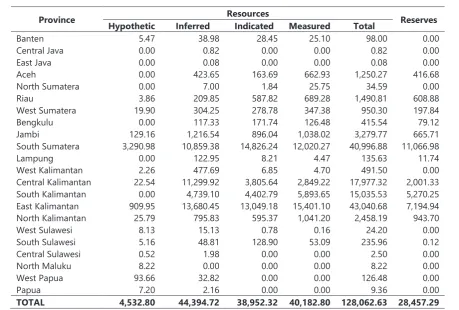
Produksi batubara untuk kebutuhan dalam negeri dan ekspor terus meningkat membuat cadangan batubara mengalami penurunan sebesar 11,8% terhadap tahun 2015. Dengan tingkat produksi batubara saat ini sekitar 417 juta ton, semua jenis cadangan batubara (lignit, sub-bituminus, bituminus) akan habis dalam kurun waktu 68 tahun. Penurunan cadangan energi fosil nasional menjadi salah satu faktor dilaksanakannya program diversifikasi bahan bakar.
Coal production for domestic demand and export continues to increase, making coal reserves decrease by 11.8% against 2015. With the current coal production levels of around 417 million tonnes, all types of coal reserves (lignite, sub-bituminous, bituminous) will run out within 68 years. The decline in national fossil energy reserves is one major factor in the importance of fuel diversification program
implementation.
Tabel 3.1 Sumber daya batubara
Table 3.1 Coal resources
Sumber / Source: KESDM (2016) / MEMR (2016)
Province Resources Reserves
Hypothetic Inferred Indicated Measured Total
Banten 5.47 38.98 28.45 25.10 98.00 0.00 South Sumatera 3,290.98 10,859.38 14,826.24 12,020.27 40,996.88 11,066.98
Lampung 0.00 122.95 8.21 4.47 135.63 11.74
West Kalimantan 2.26 477.69 6.85 4.70 491.50 0.00 Central Kalimantan 22.54 11,299.92 3,805.64 2,849.22 17,977.32 2,001.33 South Kalimantan 0.00 4,739.10 4,402.79 5,893.65 15,035.53 5,270.25 East Kalimantan 909.95 13,680.45 13,049.18 15,401.10 43,040.68 7,194.94 North Kalimantan 25.79 795.83 595.37 1,041.20 2,458.19 943.70
West Sulawesi 8.13 15.13 0.78 0.16 24.20 0.00
Energy Supply
20
Tabel 3.2 Sumber energi baru dan terbarukan
Table 3.2 New and renewable energy resources
Sumber / Source: Ditjen EBTKE, 2016/ Directorate General of NRE&EC, 2016 *) Ditjen EBTKE, 2015/ Directorate General of NRE&EC, 2015
**) Ditjen EBTKE, 2014/ Directorate General of NRE&EC, 2014 ***) Ditjen EBTKE, 2013/ Directorate General of NRE&EC, 2013 ****) Renstra ESDM 2015– 2019
*****) Laporan Tahunan SKK Migas (2016)/ Annual Report of Special Task Force for Upstream Oil And Gas (2016)
Pemerintah juga sudah mendorong pemanfaatan energi baru (EB), seperti CBM dan gasifikasi batubara, tetapi terhambat oleh keekonomiannya. Pemanfaatan EB nuklir masih menjadi pilihan terakhir dengan mempertimbangkan keamanan pasokan energi nasional dalam skala besar. Adapun pemanfaatan shale gas belum berlangsung karena belum diketahuinya besaran cadangannya. Untuk itu, pemerintah perlu mendorong pemetaan potensi EBT secara rinci untuk mendukung pemanfaatan EBT secara maksimal.
The Government has also encouraged the use of new energy (NE), such as CBM and coal gasification, but hampered by its economy. Utilization of the NE nuclear is still considered as the last choice regarding the security of national energy supply on a large scale. The use of shale gas has not yet taken place because the amount of its reserve has not been known. To that end, the Government needs to encourage the detailed mapping of NRE potentials to support its maximum
utilization. (Sumber daya teridentifikasi /
Identified resources)**
8,671 MW**
3 Mini-mikrohidro/
Mini-micro hydro
10 Gelombang Laut
Wave energy
Tide and tidal power
Penyediaan Energi
21OUTLOOK ENERGI INDONESIA 2018
Gambar 3.2 Neraca minyak bumi
Figure 3.2 Crude oil balance
3.2.1 Neraca Minyak Bumi
Produksi minyak bumi diperkirakan akan terus menurun
sekitar 4,0% per tahun akibat sumur yang sudah tua dan sumber daya yang terletak di daerah frontier. Pada tahun 2016, produksi minyak bumi sebesar 338 juta barel dan menurun menjadi 85 juta barel pada tahun 2050. Ekspor minyak bumi pada tahun 2016 sebesar 128 juta barel yang diperkirakan terus menurun secara perlahan dan akan berakhir pada tahun 2035. Pemerintah telah menetapkan berbagai kebijakan dan program guna mendorong
peningkatan eksplorasi dan eksploitasi minyak bumi dalam
rangka menambah cadangan minyak bumi nasional.
Impor minyak bumi diperkirakan akan meningkat sejalan
dengan program Refinery Development Master Plan (RDMP)
untuk merevitalisasi 5 kilang minyak eksisting (Cilacap, Balongan, Dumai, Balikpapan, dan Plaju) serta penambahan 4 (empat) kilang minyak baru dengan kapasitas masing-masing 300 MBCD. Pada tahun 2016, impor minyak bumi sebesar 148 juta barel dan akan meningkat menjadi 953
3.2.1 Crude Oil Balance
Crude oil production is expected to continue to decline by around 4.0% per year due to old wells and resources location in the frontier area. In 2016, petroleum production amounted to 338 million barrels and will decrease to 85 million barrels in 2050. Crude oil export in 2016 amounted to 128 million barrels and is expected to decline slowly until expire in 2035. The Government has set various policies and programs to encourage exploration and exploitation of oil in order to increase the national oil reserves.
Crude oil import is expected to increase in line with the Refinery Development Master Plan (RDMP) program to revitalize 5 existing oil refineries (Cilacap, Balongan, Dumai, Balikpapan and Plaju) as well as the addition of 4 (four) new oil refineries with each capacity of 300 MBCD. In 2016, crude oil import amounted to 148 million barrels and will increase by 6.4 times to 953 million barrels in 2050. The Government
Energy Supply
22
juta barel pada tahun 2050 atau meningkat 6,4 kali lipat. Pemerintah perlu memastikan keberlangsungan impor minyak bumi tersebut agar tidak mengganggu jenis dan spesifikasi produk BBM yang diharapkan.
needs to ensure the continuity of crude oil imports as not to interfere with the types and specifications of oil fuels products that are expected.
Gambar 3.3 Ekspor dan impor minyak bumi
Figure 3.3 Export and import of crude
3.2.2 Neraca Bahan Bakar Minyak
Indonesia telah menjadi negara net importir BBM sejak tahun 2004. Produksi BBM yang terbatas akibat kapasitas kilang minyak yang relatif konstan serta konsumsi BBM yang semakin meningkat menyebabkan impor BBM semakin besar dari tahun ke tahun.
Kebutuhan BBM (termasuk biodiesel) meningkat dengan pertumbuhan rata-rata sebesar 4,7% per tahun. Pada tahun 2016, kebutuhan BBM mencapai 69,1 juta kl dan meningkat menjadi 326,6 juta kl pada tahun 2050. Kebutuhan BBM ini sebagian besar dipenuhi dari impor. Impor BBM pada tahun 2016 telah mencapai 22,9 juta kl dan meningkat dengan pertumbuhan 6,3% per tahun menjadi 182,3 juta kl tahun 2050. Ekspor BBM saat ini sangat kecil, yaitu hanya sebesar 128 ribu kl dan menjadi 1,17 juta kl pada tahun 2030 serta menurun menjadi 871 ribu kl pada tahun 2050.
Produksi BBM dari kilang minyak diperkirakan akan meningkat sebesar 3,4% per tahun selama kurun waktu 2016-2050 dari 46,6 juta kl menjadi 144,2 juta kl. Peningkatan produksi BBM karena adanya program
3.2.2 Oil Fuels Balance
Indonesia has been a net importer of oil fuels since 2004. Oil fuels production is limited due to the constant capacity of oil refineries so that the increasing consumption of oil fuels causes the import also increase from year to year.
Oil fuels (including biodiesel) demand increases with an average growth of 4.7% per year. In 2016 the demand reached 69.1 million kl and will increase to 326.6 million kl in 2050. This demand is mostly met by imports. Oil fuels import in 2016 reached 22.9 million kl and will increase by 6.3% per year to 182.3 million kl in 2050. Oil fuels export is currently very small, which is only 128 thousand kl and will become 1.17 million kl in 2030 and will decrease to 871 thousand kl in 2050.
Penyediaan Energi
23OUTLOOK ENERGI INDONESIA 2018
Gambar 3.4 Neraca BBM
Figure 3.4 Oil Fuels Balance
Gambar 3.5 Ekspor dan impor BBM
Figure 3.5 Export and import of oil fuels
RDMP untuk merevitalisasi 5 kilang minyak eksisting serta penambahan 4 (empat) kilang minyak baru dengan kapasitas masing-masing 300 MBCD.
Energy Supply
24
3.2.3 Pemanfaatan Bahan Bakar Minyak
Pada tahun 2016, BBM sebagian besar dikonsumsi sektor transportasi (80,7%), diikuti sektor industri (8,1%), pembangkit listrik (5,5%), lainnya (3,9%), rumah tangga (1,0%), dan komersial (0,8%). Pada tahun 2050, pangsa ini sedikit berubah untuk sektor industri meningkat menjadi 12,3%, sedangkan untuk transportasi menurun menjadi 79,6%, meskipun masih tetap yang terbesar. Sektor transportasi relatif lebih sulit untuk beralih dari penggunaan BBM ke penggunaan bahan bakar lain karena teknologi saat ini sebagian besar masih berbasis BBM, khususnya untuk kendaraan bermotor. Bensin dan minyak solar merupakan bahan bakar yang dominan digunakan di sektor transportasi. Upaya substitusi BBM dengan bahan bakar lain terus dilakukan, diantaranya adalah: penggunaan bahan bakar nabati (BBN) khususnya biodiesel untuk kendaraan bermotor, penggunaan gas untuk transportasi massal berbasis bus, serta penggunaan listrik untuk transportasi massal berbasis kereta rel listrik (KRL).
3.2.3 Oil Fuels Utilization
In 2016, oil fuel is mostly consumed by transportation sector (80.7%), followed by industrial sector (8.1%), power plant (5.5%), others (3.9%), households (1.0%) and commercial (0.8%). In 2050, the share for industrial sector increases to 12.3%, while transportation decreases to 79.6%, although it is still the largest. Transportation sector is relatively difficult to switch from the use of oil fuels to other type of fuels because the current technology is still largely oil fuels-based, especially for motor vehicles. Gasoline and diesel oil are the dominant oil fuels used in transportation sector. Oil fuels substitution efforts will continue to be carried out, including: the use of biofuels, especially biodiesel for motor vehicles, the use of gas for bus mass transportation, as well as the use of electricity for mass transportation such as electric train.
Gambar 3.6 Pemanfaatan BBM
Figure 3.6 Oil fuels utilization
(4,4%), minyak bakar (1,1%), dan sisanya minyak tanah. Pada tahun 2050, pangsa impor tidak banyak berubah, kecuali pangsa impor avtur yang meningkat pesat. Impor BBM ini meningkat dari 3,64 juta kl pada tahun 2016 menjadi 29,14 juta kl pada tahun 2050 atau meningkat lebih dari 8 kali lipat dalam waktu 34 tahun. Meskipun ada penambahan produk BBM dari kegiatan RDMP dan penambahan 4 kilang minyak baru, tetapi tidak mencukupi kebutuhan BBM nasional, sehingga masih diperlukan BBM impor dalam jumlah yang banyak.