Dokumen diterima pada 23 Oktober 2016
The development of information and communication technology has rapidly penetrated to several sectors including health sector. A good data management has become necessity for a healthcare company since it will provide better control of the costs and mitigate risks. However, to develop a good quality data management is complex. Therefore, data mining as one of the advancements of science and technology development offers its technique (such as decision tree) to mine the hidden information from the large amounts of medical data that may improve the decision making. But still, the previous studies founded that the issue of imbalanced datasets has spread and occurs universally which affect the result of the data mining process. It is the aim of this study to identify the potential impact of the imbalanced medical data mining. The most commonly data mining technique, decision tree, was used to generate the prediction model by visualizing the tree to perform predictive analysis of chronic diseases. All the steps in data mining process such as data collection, data preprocessing and data mining have been performed by a data mining tool, named WEKA. Additionally, WEKA also was utilized to evaluate the prediction performance by measuring the accuracy. Among the result found in this study shows that imbalanced datasets caused low accuracy and incorrectly class classified.
Kata kunci: predictive data mining, imbalanced dataset, accuracy
1. Introduction
Money and people have long been considered to be assets, but nowadays, many organizations rely on their data to make more informed and effective decisions which help the organizations to achieve their goals. Hence, data needs to be managed seriously [1]. But developing a good quality data management is not easy. Still sometimes, the organization meets some challenges during data management process, especially in the health sector, huge amounts of data need to be organized and stored.
found that the issue of imbalanced data has spread and occurs universally which affect the result of the data mining process. The data is called imbalanced if a number of instances of one class is not approximately equal to another class [4].
As can be seen from the statements above, it is the aim of this study to identify the potential impact of imbalanced medical data mining. The study will utilize the health insurance data owned by BPJS Health insurance company and decision tree as the data mining technique. 2. Research Methodology
The framework of this research which is based on data mining tasks starts from stating the problem statement and formulating the hypothesis, collecting the raw data from several sources for data mining process, selecting and transforming the data, selecting and implementing the proper data mining technique, then finally, interpreting and drawing the conclusion from extracting knowledge after the data mining process.
2.1 Problem Statement and Hypothesis Formulation
The purpose of this phase is to collect some previous information related to this study obtained from the Internet, several books, articles and journals. Those collected materials are investigated and reviewed to identify the specific knowledge and experience or to discover a gap from previous works as a meaningful problem statement. Specifically, reviewing the previous studies about the challenge of data management in the health sector.
2.2 Data Collection
The purpose of this phase is to collect the dataset in order to fulfill the requirement. A personal interview session was conducted with the IT analyst in order to obtain the dataset and to gather the information about the kind of data they have and the possibility to get the data, especially, to get the data of the patient diagnosis which will be processed using the data mining technique. Additionally, personal interviews were also conducted in order to get the relevant data for the data mining process and to get the overview of the possible way to deal with the issues discovered in the healthcare data.
2.3 Data Pre-Processing / Data Preparation
Typically, the necessary data for data mining is not only from one database but from multiple databases or text files. Similar to this study, data integration was conducted since data needed for data mining process for this research is not only derived from one source but it, too, also is derived from different sources / text files. Moreover, the data obtained, either from the database of a company or from the experimental results, usually generate missing or invalid data. It is better to eliminate the irrelevant data because it can reduce the quality or accuracy of data mining results. Therefore, transformation and data cleaning have been carried out in the data integration, such as the elimination of unnecessary columns of the table or the replacement of the missing values in the data. During the transformation stage all collected data is transformed to the formats that are used for process visualization and analysis so that it will be easy to understand for an analysis.
2.4 Data Mining
The activities conducted in this phase include:
accurate prediction technique among other techniques [5]. C4.5, known as J4.8 in WEKA, was used as the algorithm to generate the decision tree.
2. Using Microsoft Excel to store the dataset and WEKA 3.6.9 (data mining software) to process the data mining.
2.5 Evaluation
In this phase the results of data mining techniques in the form of distinctive patterns and prediction models were evaluated. After that, the extracted knowledge from data mining process was formulated into a decision or action in order to generate some useful information.
3. Results and Findings
3.1 Decision Tree
This study carried out the data mining process of 2352 patients’ data from the period of
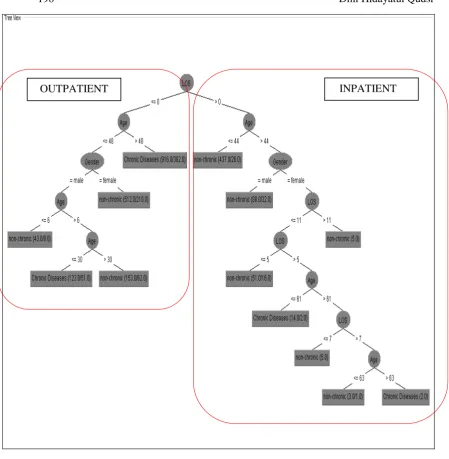
February, 1 2014 to March, 15 2014. A group of attributes has been selected to be processed in WEKA to predict the factors that influence chronic disease based on 4 criteria which are age, gender, Length of Stay (LOS) and disease. After the the data processed, the classification models are built (See Figure 4.5).
Figure 1. The Decision Tree where LOS as The Most Critical Factor
3.2 The Accuracy of Prediction Performance Analysis
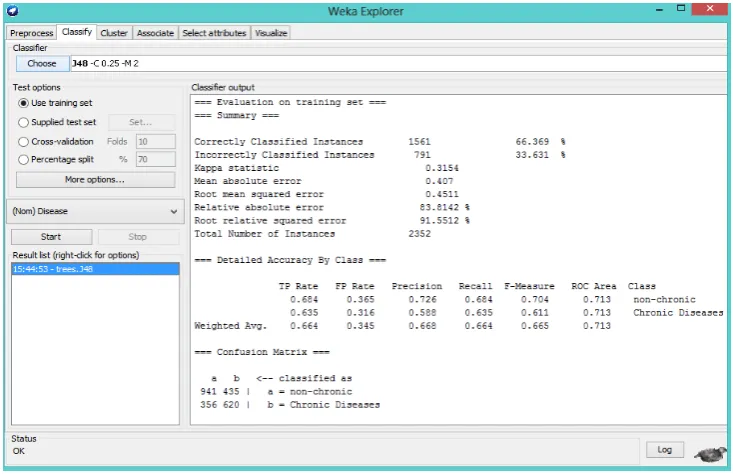
The classifier output of Decision Tree (Figure 2) generated from WEKA showed that the value of classification accuracy for predicting performance relatively above the average which is about 66.37%. 1561 instances out of 2352 were correctly classified where the category percentage of non-chronic (68.4%) is higher than chronic disease (63.5%).
Figure 2. The Classifier Output of Decision Tree
The Kappa statistic value is 0.3154 which assess the agreement among values predicted by the model. The following error values (mean absolute error, root mean squared error, relative absolute error and root relative squared error) estimate the error of the prediction. In addition, ROC area for both classes of the decision tree is 0.713, which indicates that the validity of the classifier is high. Since, the closer the ROC to 1, the higher the discriminating power of the classifier [6].
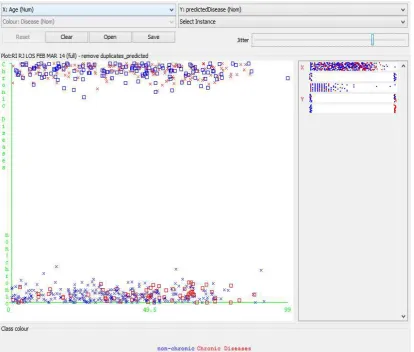
Figure 3. The Classifier Error Graph of Prediction Model
Figure 4. The Classifier Error Information
perhaps due to the lack of data patients with chronic diseases especially for the younger patients considering the ratio between young patients (below 25 years) with chronic and non-chronic diseases is 140 : 387. Consequently, the algorithm does not have enough data to predict chronic diseases for the younger patients.
Data mining is a naturally iterative process, where several steps need to be repeated many times. In this case, considering the accuracy which is not that high, data preprocessing would be performed again in order to increase the accuracy. Below are some efforts, as follow: 1. Remove the error one by one.
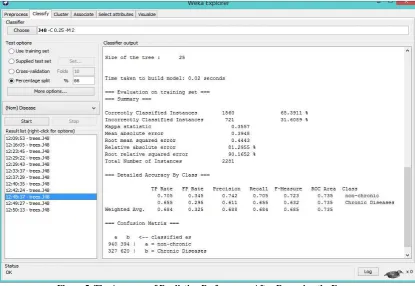
By removing some of the noisy data based on as seen in the Figure 4. As a result, the accuracy of prediction performance increases and the prediction model is correctly classified 68.39 % which will continue to increase if all of the error data is removed (See Figure 5). But, it is not an effective way to enhance the accuracy, because, by removing the data, it will reduce the contained information from the data itself.
Figure 5. The Accuracy of Prediction Performance After Removing the Errors
2. Remove the noisy data.
WEKA, a data mining tool, provides a feature to remove instances which are incorrectly classified by using the following method:
After load the file > Choose Button > WEKA > Filters > unsupervised > instance > removeMisclassField > ok > apply button > save.
Yet, instead of removing the incorrectly classified data (the noisy data), it removed all the chronic disease instances.
3. Detect the outlier
The following is the method to find the outlier, as follow:
After load the file > Choose Button > WEKA > Filters > unsupervised > attribute > inter quartile range > ok > apply button > save.
The result shows that the accuracy is not much different, even lower, about 65.7%.
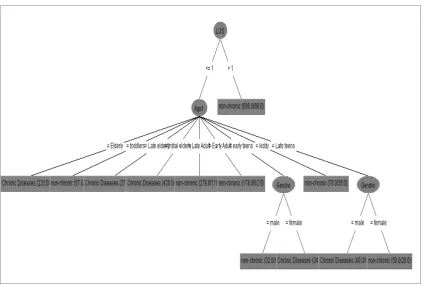
Department Republic of Indonesia. The result shows the accuracy which is not much different, with the percentage of 64.92%. Moreover, the decision tree generated (See Figure 6) did not provide the specific information, for example, about how long the patients with chronic disease stay or how old the patient with chronic disease who stays for 6 days.
Figure 6. The Decision Tree Based on Age Grouping
Therefore, based on this research, it has justified that several causes why the accuracy result is not too high, as followed:
1. Data quality.
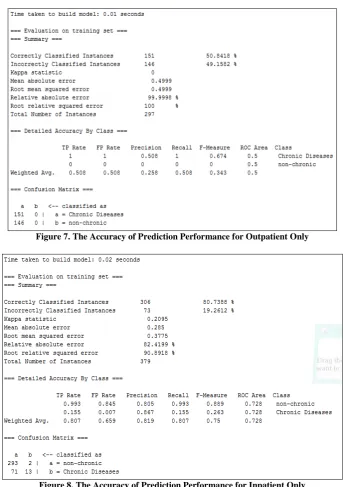
Most of the incorrectly classified data comes from outpatient. This probably happened because of the incorrectly data entry by the operators. For example, if a patient stayed for 3days, from Monday to Wednesday. She is going home on Thursday, but the disease relapses on Friday, thus, she has to visit again on Friday to be treated by the doctor. Probably, the staff will record it as outpatient, but actually it supposed to be inpatient since she has stayed at hospital for 3 days before.
Figure 7. The Accuracy of Prediction Performance for Outpatient Only
Figure 8. The Accuracy of Prediction Performance for Inpatient Only
2. Imbalanced data.
The issue of imbalance data has spread and occurs universally which affect the result of the data mining process [2]. The data is called imbalanced if a number of instances of one class is not approximately equal to another class [3]. For example, in this research, a number of outpatients are much larger than inpatients data with the ratio of 1747: 605, and a number of patients with chronic diseases are much fewer than non-chronic disease with the ratio of 976: 1376. Such imbalanced data may results in low accuracy, which in this case is 68.4 % of the model derived. [3] stated that this could occur because of the standard algorithms used to execute mainly on balanced class distribution.
Based on the findings, it can be concluded that the imbalanced data caused low accuracy and incorrectly class classified. The data used in this study is largely dominated by one class of the samples. As a result, due to the number of non-chronic diseases data that are largely dominated than the chronic diseases, there are younger patients with chronic diseases who were incorrectly classified as non-chronic. Thus, it is important to make sure that the proportion of the sample is balanced before performing data mining. It does not have to be an equal number but adequate enough for the machine, to learn how to produce the classification for each class.
5. Bibliography