Full Terms & Conditions of access and use can be found at
http://www.tandfonline.com/action/journalInformation?journalCode=vjeb20
Download by: [Universitas Maritim Raja Ali Haji] Date: 11 January 2016, At: 22:21
Journal of Education for Business
ISSN: 0883-2323 (Print) 1940-3356 (Online) Journal homepage: http://www.tandfonline.com/loi/vjeb20
Relating Gap Analysis Results to Information
Systems Program Attitudes: The Identification of
Gap Priorities and Implications
Stuart Van Auken , Earl Chrysler , Ludmilla Gricenko Wells & Mark Simkin
To cite this article: Stuart Van Auken , Earl Chrysler , Ludmilla Gricenko Wells & Mark Simkin (2011) Relating Gap Analysis Results to Information Systems Program Attitudes: The Identification of Gap Priorities and Implications, Journal of Education for Business, 86:6, 346-351, DOI: 10.1080/08832323.2010.538448
To link to this article: http://dx.doi.org/10.1080/08832323.2010.538448
Published online: 29 Aug 2011.
Submit your article to this journal
Article views: 259
ISSN: 0883-2323 print / 1940-3356 online DOI: 10.1080/08832323.2010.538448
Relating Gap Analysis Results to Information
Systems Program Attitudes: The Identification
of Gap Priorities and Implications
Stuart Van Auken
Florida Gulf Coast University, Fort Myers, Florida, USA
Earl Chrysler
California State University, Chico, California, USA
Ludmilla Gricenko Wells
Florida Gulf Coast University, Fort Myers, Florida, USA
Mark Simkin
University of Nevada, Reno, Nevada, USA
The authors utilized a gap analysis approach to assess general IS knowledge and skill voids or overages in a specific program context. The authors asked alumni to reveal the emphasis that should have been given to 10 IS knowledge and skill areas and compared the results with the emphasis that was actually given. They proceed by relating the revealed gaps to IS program attitude, thus providing a means for gap prioritization and attitudinal improvement. The authors develop perspectives into the implications of gap results, as well as other issues and limitations.
Keywords: gap analysis, general knowledge and skills, program attitude
The information systems (IS) landscape and employer de-mands continue to change, thus exerting continual pressure on IS program responsiveness (Benamati, Serva, Galletta, Harris, & Niedreman, 2006). Compounding the problem has been a declining trend in IS enrollments that have created an even greater sense of urgency for programmatic review and change. Although assessments of employer needs have been common (Benamati & Mahaney, 2007; Medlin, Schenberger, & Hunsinger, 2007; Surendra & Denton, 2009), there are other conduits open to scrutiny in the form of advisory boards and alumni surveys. In fact, the latter offers significant po-tential for they provide reflections from those actually in the field and their satisfaction with their IS program.
Correspondence should be addressed to Stuart Van Auken, Florida Gulf Coast University, Lutgert College of Business, Department of Marketing, 10501 FGCU Boulevard S., Fort Myers, FL 33965-6565, USA. E-mail: [email protected]
As a result, this study offers perspectives from IS alumni. We sought to address an approach for assessing the knowl-edge and skill requirements of the IS area (Couger et al., 1995; Lee, Trauth, & Farwell, 1995; Nelson, 1991; Todd, McKeen, & Gallupe, 1995, Zweig et. al., 2006). The litera-ture generally reports that general IS knowledge and skills are of consequence, due to the obsolescence that exists in the IS field (Yen, Lee, & Koh, 2001). Basically, the dynamic nature of the field lessens the utility of proprietary systems and software.
This study adds to the IS literature by developing a gap analysis approach that provides program-specific insights into general IS knowledge and skill voids or overages. The purpose is to determine areas of under- and overemphasis from the standpoint of IS alumni or those that are highly knowledgeable as to IS program relevancy. Program and mar-ket insights can thus be achieved from a key stakeholder and the resulting insights can lead to course content reviews and changes in emphases, as well as new courses. Consider that
RELATING GAP ANALYSIS RESULTS TO IS PROGRAM ATTITUDES 347
when faculty develop an IS curriculum, courses are designed to develop a body of knowledge and skills that may be ap-plicable at different points in the graduate’s career. Some courses contain content that may be valuable during a grad-uate’s initial position, and as the graduate is assigned new responsibilities, other courses and content become more ap-plicable. Thus, some course content that was initially of high value loses importance as the graduate is assigned new re-sponsibilities. Such insights can lead faculty to select topics and develop skills that may be useful and effective over time. In order to assess whether entry-level course content, as well as other content, is being over- or underemphasized, feedback is necessary. This work thus operates in a specific context to illustrate how selected emphases match with IS-based market realities.
This study is also unique in that it relates any revealed gaps to IS program attitudes. By so doing, the gaps that are correlated with IS program attitudes can be prioritized. Overall, this work represents a refinement in gap analysis and it develops insights into the meaning of gap results, especially their implications and limitations.
Gap Analysis
The utilization of gap analysis has been common in pedagog-ical research, especially the IS area. To illustrate, Surendra and Denton (2009) compared the skills, traits, and attributes valued by IS practitioners with the skills, traits, and attributes emphasized in traditional IS academic curricula. Medlin et al. (2007) compared how students viewed the IS technical skills necessary to be successful with the technical skills actually sought in online job advertisements. Nelson (1991) com-pared the knowledge and skill perceptions of IS personnel with end-user perceptions. Additionally, gap studies from other disciplines have been common (Davis, Misra, & Van Auken, 2002; Giacobbe & Segal, 1994; Lundstrom & White, 1997; Nordstrom & Sherwood, 1997; Winer, 1998). In all of these studies, voids are sought, yet overemphasis can also be revealed. The intent is thus to reveal and then close the gap. Uniquely, a means to prioritize gaps for closing is com-monly not addressed. This work helps to fill this vacuum and it provides perspectives as to when a gap analysis is most appropriate.
METHOD
Study Variables
Knowledge and skill variables. Table 1 presents 10 variables that manifest a general IS knowledge and skill emphasis. It is these variables that serve as the essence of this study’s gap analysis. The selection of these variables is supported by literature reviews. To illustrate, soft skills emanated from the work of Benamati and Mahaney (2007),
as well as the work of Beard, Schwieger, and Surendran (2007), and IS knowledge components came from Medlin et al. (2007). The use of IS knowledge in the form of functional area concepts and organizational requirements requiring IS implementation came from Surendra and Denton (2009). Ad-ditionally, faculty conducting programmatic reviews have typically viewed them as capturing the essence of general IS knowledge and skill requirements that all IS graduates should possess.
Utilizing the variables in Table 1, respondents were asked to indicate the emphasis that their IS instructors should have given to each of the 10 knowledge and skill areas. This was implemented through the use of 7-point Likert-type scales ranging from 1 (very low emphasis) to 7 (very high empha-sis). Respondents in another part of the questionnaire were also asked to indicate the emphasis that their IS instructors gave to the same knowledge and skill factors. Again, the same scaling format with the same scaling anchors was uti-lized. By subtracting the emphasis that was given from what should have been given, gaps are revealed. Positive scores thus denote an underemphasis, whereas negative scores evi-dence an overemphasis. Normatively, a score of zero would be ideal. In essence, some topics may require additional em-phasis, whereas other topics may not be viewed as relevant and should be deemphasized.
IS program attitude variables. The assessment of attitudes is based on the work of Mitchell and Olsen (1981) who utilized semantic-differential pairs of po-lar opposites to capture respondent perceptions and feelings. In this study, the following pairs were uti-lized: Bad use of my time–Good use of my time, Unsatisfactory–Satisfactory, Boring–Challenging, Useless– Useful, and Ineffective–Effective. These pairs were assessed on 6-point Likert-type scales ranging from 1 (negative) to 6 (positive) and appeared in a list whereby the positive (coded 6) and negative ends (coded 1) were reversed from item to item.
The Sample
The sample comprised 46, baccalaureate-degree, IS alumni from an Association to Advance Collegiate Schools of Busi-ness (AACSB)-I accredited busiBusi-ness school. Initially, 215 alumni who were 3–5 years out from graduation were con-tacted. The response rate was 21.4% and the sample is highly representative of IS involvement as 87.0% of responding alumni have been employed in some capacity within the IS field within the past five or fewer years.
Gap Assessment
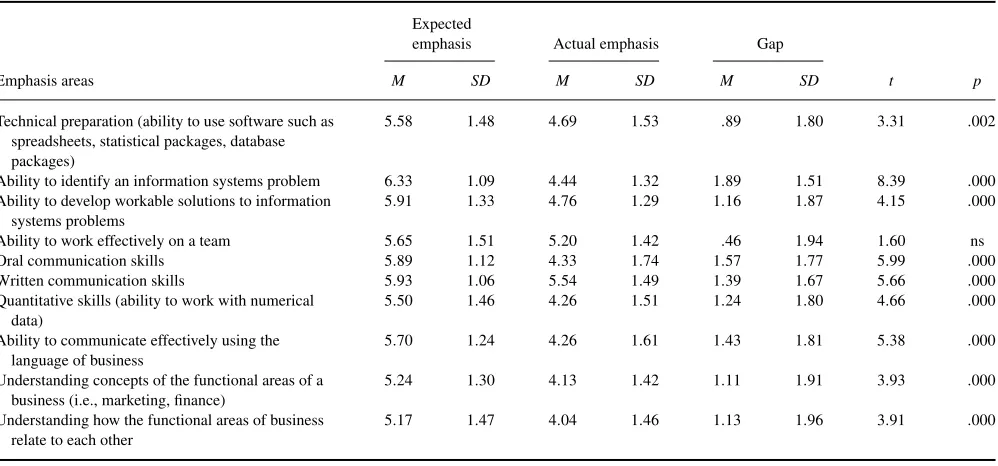
By viewing Table 2, the results of the gap analysis can be seen. As evidenced, 9 of the 10 topic areas identified in Ta-ble 1 have statistically significant differences and by viewing
TABLE 1
Program Emphasis Variables
1. Technical preparation (ability to use software, such as spreadsheets, statistical packages, database packages)
7. Quantitative skills (ability to work with numerical data)
2. Ability to identify an information systems problem 3. Ability to develop workable solutions to information
systems problems
8. Ability to communicate effectively using the language of business
9. Understanding concepts of the functional areas of business (i.e., marketing, finance)
4. Ability to work effectively on a team
5. Oral communication skills 10. Understanding how the functional areas of business relate to each other
6. Written Communication skills
their mean scores it is apparent that actual means are less than should have had means, thus suggesting an underemphasis. Other than team assignments, alumni denote a divergence between delivered coverage and expected coverage in nine areas (Parasuraman, Zeithaml, & Berry, 1985).
In this case, some of the revealed gaps may be more meaningful than others and thus may be prioritized by their need for attention. This study thus relates these gaps to an individual’s overall attitude toward the IS program. To do so requires a revisiting of the study’s five attitudinal variables.
RESULTS
Program Attitude Construction
An assessment of the reliability of the five attitudinal pairs revealed a Cronbach’s alpha value of .86. Using Nunnally’s (1978) .7 criterion for hypothesized relationships, the five attitudinal variables are reliable. In an effort to further
re-veal variable independence, a principal components analysis with Varimax rotation was run in which variables that are correlated with one another and which are independent of other subsets are combined into components or factors. The application revealed a single component that explained an acceptable 64.7% of the variance. See Table 3 for a presen-tation of the factor loadings.
As can be observed, the factor loadings are substantial and beyond the .7 criterion for sample sizes of less than 100 (Hair, Anderson, Tatham, & Black, 1998). As a result, standardized factor scores were utilized to operationalize attitude as a single dimension. While such standardization loses the level of the overall attitude, the average raw score on the five, six-point, semantic differential pairs equaled 4.75 (SD=0.79). Thus, overall IS program attitudes were somewhat favorable, but evidence room for improvement.
Establishing Gap Priorities
To develop gap priorities, each of the gaps depicted in Table 2 was correlated with factor-score attitudes toward the IS
TABLE 2
Gap Analysis Results Based on Alumni Perceptions of Should Have Versus Actual Program Emphases
Expected
emphasis Actual emphasis Gap
Emphasis areas M SD M SD M SD t p
Technical preparation (ability to use software such as spreadsheets, statistical packages, database packages)
5.58 1.48 4.69 1.53 .89 1.80 3.31 .002
Ability to identify an information systems problem 6.33 1.09 4.44 1.32 1.89 1.51 8.39 .000
Ability to develop workable solutions to information systems problems
5.91 1.33 4.76 1.29 1.16 1.87 4.15 .000
Ability to work effectively on a team 5.65 1.51 5.20 1.42 .46 1.94 1.60 ns
Oral communication skills 5.89 1.12 4.33 1.74 1.57 1.77 5.99 .000
Written communication skills 5.93 1.06 5.54 1.49 1.39 1.67 5.66 .000
Quantitative skills (ability to work with numerical data)
5.50 1.46 4.26 1.51 1.24 1.80 4.66 .000
Ability to communicate effectively using the language of business
5.70 1.24 4.26 1.61 1.43 1.81 5.38 .000
Understanding concepts of the functional areas of a business (i.e., marketing, finance)
5.24 1.30 4.13 1.42 1.11 1.91 3.93 .000
Understanding how the functional areas of business relate to each other
5.17 1.47 4.04 1.46 1.13 1.96 3.91 .000
RELATING GAP ANALYSIS RESULTS TO IS PROGRAM ATTITUDES 349
TABLE 3
Results of a Principal Components Analysis With Varimax Rotation: An Assessment of Alumni Attitude
Toward the Information Systems Program
Variable Factor loading
Note.Semantic differentials were scored on a six-point scale with the value of six anchored to the most positive response.
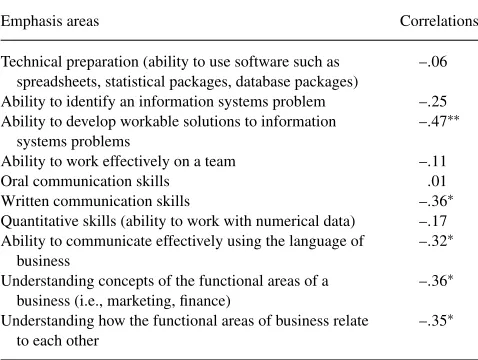
program. The resulting Pearson product-moment correlations are shown in Table 4.
As can be noted, 5 of the 10 gaps were significantly and negatively correlated with program attitude. The negative correlations indicate that alumni had a poorer attitude toward the IS program if there was an under-emphasis in a topic area overall; gaps and IS program attitude scores moved together, yet in different directions. The results suggest that a filling of the revealed gaps will improve IS program attitude.
Framework for Reflection
Gap results should be used by area faculty to further reflect on the needs of their markets as perceived by alumni. In this case, insights are sought into the five prioritized knowledge and skill gaps, revealed in Table 4. Because the gaps indicate what IS faculty should be emphasizing, and not merely business faculty in general, gaps have to be interpreted from an IS perspective. Gaps are thus the initial point of departure for IS faculty review and they possess a questioning nature.
TABLE 4
Results of Correlating Gaps With IS Program Attitude
Emphasis areas Correlations
Technical preparation (ability to use software such as spreadsheets, statistical packages, database packages)
–.06
Ability to identify an information systems problem –.25
Ability to develop workable solutions to information systems problems
–.47
∗∗
Ability to work effectively on a team –.11
Oral communication skills .01
Written communication skills –.36
∗ Quantitative skills (ability to work with numerical data) –.17
Ability to communicate effectively using the language of business
–.32
∗
Understanding concepts of the functional areas of a business (i.e., marketing, finance)
–.36
∗
Understanding how the functional areas of business relate to each other
–.35
∗
∗p=.05 (two-tailed). ∗∗p=.01 (two-tailed).
In the context of this study’s prioritized gaps, what are the IS implications of a desire among alumni to possess a greater understanding of the functional areas of business and their inter-relationships? To help answer this, faculty could consider the IS literature along with a review of their present efforts and emphases in these areas. With respect to the for-mer, IS students have always needed to understand how each segment of an enterprise relates to the entire business and MIS graduates should have knowledge of customer systems development and application software, as well as the ability to implement (Ehie, 2002). Additionally, David Foote, chief executive partner of Foote Partners, noted that “companies are looking for people with multiple skill sets who can move fluidly with marketing or operations” (Middleton, 2009, D4). Such observations also invite the creation of hypotheses that can be reviewed by recruiters and employers. The best solu-tion would be a unanimous agreement among major program stakeholders as to how to proceed.
The prioritized gaps in written communication skills and the need to communicate effectively using the language of business should also lead to faculty reflections on improve-ment beginning with current faculty emphases. All in all, skill voids are easier to interpret and they are not as debat-able, yet an overemphasis on quantitative skills would have faculty focus on those aspects that are most germane.
The prioritized gap in the alumni’s desire for more workable solutions to information systems problems could lead faculty to discuss emphases and even where information systems problems currently reside. It may be that employers are looking for IS support as they increasingly turn to social media sites like Facebook, Twitter, and LinkedIn to develop relations with customers and to promote their brands. A gap analysis may prompt such reviews. Gap results thus set the framework for introspection, discussion, and curriculum modification. Overall, every program has some uniqueness due to the requirements of its markets and the implications of gap results have to be assessed with this in mind. Still, refinements in questionnaire construction leading to greater specificity can provide additional insights, as well as the triangulating insights of recruiters and employers. It may also be that future studies are required to evaluate progress toward gap closing. What is clear is that a mismatch between what a faculty is delivering and what a market requires can be addressed.
DISCUSSION
Overall Perspectives
When correlating gaps with attitude toward an entire MIS program, one can ascertain what could be called drivers of satisfaction with a program. That is, those topics that alumni would have liked to have experienced more fully and which
shape program attitude. By filling these gaps, alumni are led to evaluate an entire IS program more favorably.
It seems reasonable to assume that, when called on, alumni are readily able to recall the topic areas where in-depth cov-erage would have been valuable upon entering the MIS pro-fession. Similarly, they are most likely able to recall not having to draw on knowledge in specific topic areas and they may believe that the time spent covering some topics could have been better utilized; especially on those topics that would have made greater contributions to effective job performance.
When faculty design the curriculum for a program, they generally agree on the topic areas to be covered in each course and, in general, also agree on how class time should be prioritized among the topic set selected for a course. Thus, a major value of the application of the methodology proposed in this study is to provide area faculty with feedback as to whether the prioritization agreed to by the faculty is providing graduates with the optimum allocation of class time given the requirements of the positions they are entering. When faculty conduct a study such as the one reported here, they are able to obtain alumni perceptions regarding the fit between faculty beliefs as to the relative value of topic coverage and the perceived requirements of those functioning in MIS positions on a day-by-day basis. Using the results of a study such as this, faculty are able to adjust the extent to which each topic area of interest needs to be emphasized to better coincide with alumni experiences.
Limitations of Gap Analysis
The use of quantitative metrics to assess program gaps among alumni is not without its limitations. The premise is that a pro-gram has developed a stability of propro-grammatic content and instruction and is reviewing or contemplating programmatic change. IS programs that have undergone radical revision and significant instructor turnover within the last 2 years present particular problems, as surveys of alumni 3–5 years out of school would not be reflective of the present situation. What may have been emphasized 3–5 years prior may not be the same for more recent alumni.
Gap analysis can additionally present the problem of a memory haze of an individual’s educational experience. However, a restriction of alumni surveys to those 3–5 years beyond graduation appears reasonable. It also focuses a re-view on a program’s present relevancy rather than entry-level strength. All too often entry-level skills are emphasized at the expense of the general IS knowledge and skills required for career success.
It may also be that some alumni respondents were more serious about their educational experience than others, yet a gap analysis views all subjects as providing the same quality of response. It is possible, however, to control for GPA and length of time from graduation in correlational analyses.
Sampling issues may also exist, such as nonresponse bias and a poor response rate. Further, the results may not be gen-eralizable to a specific program’s IS market, thus reaffirming the need for the triangularization of gap significance among recruiters and employers.
In the present study there was a stability of program courses and instructors. However, GPA data were not as-sessed, nor was the precise number of months from gradua-tion. Despite the latter, prior studies have shown that within a limited time window there was virtually no statistical dif-ference as to response based on an individual’s time since graduation (Chrysler & Van Auken, 2002; Van Auken & Chrysler, 2003).
Conclusions
Gap analyses have been pervasive in the business academy, as they are typically market driven. By correlating general IS knowledge and skill gaps as perceived by alumni with their IS program attitude, perspectives from the market are revealed and gap priorities may be addressed. In this study of alumni, it was found that gap deficits need to be removed in the following areas: the need for the development of work-able solutions to IS problems, understanding the concepts of the functional areas and their interrelationships, and commu-nicating effectively using the language of business, as well as written communication skills. Improvements in these areas should, theoretically, improve IS program attitude.
Although these results are insightful, studies of other pro-grams may reveal different perspectives. If such propro-grams are emphasizing given knowledge and skill areas, then an absence of gaps in these areas may be revealed Thus, gap re-sults are not generalizable to the entire IS field; they merely suggest the void or overage between what faculty members are doing and what given markets require. In turn, they in-vite faculty reflections as to present emphases and a realign-ment of focus and attention. Of course, the determination of how to proceed may require literature reviews and the perspectives of recruiters and employers. Clearly, topics for faculty debate and analysis are revealed by a gap analysis and program-specific insights are provided.
All in all, the study has shown how to conduct a gap analysis and how to relate the results to program attitude. It has also shows how revealed gaps provide a framework for a firmer grounding with market realities. In a time of market retrenchment for the IS major, new studies and approaches are needed, especially those that have the potential to enhance attitude toward the major.
REFERENCES
Beard, D., Schwieger, D., & Surendran, K. (2007). Incorporating soft skills into accounting and MIS curricula. In F. Neiderman, M. Sumner, D. Lending, & C. Vician (Eds.),Proceedings of the Association for Comput-ing Machinery-Special Interest Group on Management Information Sys-tems Annual Conference on Computer Personnel Research: The global
RELATING GAP ANALYSIS RESULTS TO IS PROGRAM ATTITUDES 351
information technology workforce(pp. 179–185). New York, NY: Asso-ciation for Computing Machinery-.
Benamati, J., & Mahaney, R. C. (2007). Current and future entry-level IT workforce needs in organizations. In F. Neiderman, M. Sumner, D. Lend-ing, & C. Vician (Eds.),Proceedings of the Association for Computing Machinery-Special Interest Group on Management Information Systems Annual Conference on Computer Personnel Research: The global infor-mation technology workforce(pp. 101–104). New York, NY: Association for Computing Machinery.
Benamati, J., Serva, M. A., Galletta, D. F., Harris, A., & Niedreman, F. (2006). The slippery slope of MIS academia: A discussion of the quest for relevance in our discipline.Communications of the Association of Information Systems,18, 657–675.
Chrysler, E., & Van Auken, S. (2002). Entry level value versus career value of MIS courses: Faculty expectations versus alumni perceptions.Journal of Computer Information Systems,42(3), 38–43.
Couger, J. D., Davis, G. B., Dologite, D. G., Feinstein, D. L., Gorgone, J. T., Jenkins, A. M.,... Valacich, J. S. (1995). IS’95: Guideline for
undergraduate IS curriculum.MIS Quarterly,19, 341–359.
Davis, R., Misra, S., & Van Auken, S. (2002). A gap analysis approach to marketing curriculum assessment: A study of skills and knowledge.
Journal of Marketing Education,24, 218–224.
Ehie, I. C. (2002). Developing a management information systems (MIS) curriculum: Perspectives from MIS practitioners.Journal of Education for Business,77, 151–158.
Giacobbe, R. W., & Segal, M. N. (1994). Rethinking marketing research education: A conceptual, analytical, and empirical investigation.Journal of Marketing Education,16, 43–57.
Hair, J. F., Anderson, R. E., Tatham, R. L., & Black, W. C. (1998). Mul-tivariate data analysis (5th ed.). Upper Saddle River, NJ: Prentice-Hall.
Lee, D. M. S., Trauth, E. M., & Farwell, D. (1995). Critical skills and knowledge requirement of IS professionals: A joint academic/industry investigation.MIS Quarterly,19, 313–340.
Lundstrom, W. J., & White, S. D. (1997). A gap analysis of professional and academic perceptions of the importance of international marketing curriculum content and research areas.Journal of Marketing Education,
19, 16–25.
Medlin, B. D., Schenberger, S., & Hunsinger, D. S. (2007). Perceived tech-nical information technology skill demands versus advertised skill
de-mands: An empirical study.Journal of Information Technology Manage-ment,18, 14–23.
Middleton, D. (2009, December 29). Landing a job of the future takes a two-track mind.Wall Street Journal, D4.
Mitchell, A. A., & Olsen, J. C. (1981). Are product attitude beliefs the only mediator of advertising effects on brand attitude?Journal of Marketing Research,18, 318–332.
Nelson, R. R. (1991). Educational needs as perceived by IS and end-user personnel: A survey of knowledge and skill requirements.MIS Quarterly,
15, 503–525.
Nordstrom, R. D., & Sherwood, C. S. (1997). How well are we meeting the needs of marketing students? A tool for assessment. In G. E. Belch & L. J. Morris (Eds.),Proceedings of the Western Marketing Educators’ Association(pp. 36–39). Denver, CO: Marketing Educators’ Association. Nunnally, J. C. (1978).Psychometric theory(2nd ed.). New York, NY:
McGraw-Hill.
Parasuraman, A., Zeithaml, V.A., & Berry, L. L. (1985). A conceptual model of service quality and its implications for future research.Journal of Marketing,49, 41–50.
Surendra, N. C., & Denton, J. W. (2009). Designing IS curricula for practical relevance: Applying baseball’s “moneyball” theory.Journal of Informa-tion Systems EducaInforma-tion,20, 77–86.
Todd, P. A., McKeen, J. D., & Gallupe, R.B. (1995). The evolution of IS job skills: A content analysis of IS job advertising from 1970 to 1990.MIS Quarterly,19, 1–27.
Van Auken, S., & Chrysler E. (2003). Refinements in gap analyses. In B. B. Anderson & J. Schibrowsky (Eds.),Marketing Educators’ Associa-tion conference proceedings(p. 53). Denver, CO: Marketing Educators’ Association.
Winer, L. (1998). Applying gap theory and other good stuff from services marketing literature to the administration of a business school. In L. J. Morris & M. T. Curren (Eds.),Proceedings of the Western Marketing Educators’ Association(pp. 1–4). Denver, CO: Marketing Educators’ Association.
Yen, D. C., Lee, S., & Koh, S. (2001). Critical knowledge/skill sets required by industries: An empirical analysis.Industrial Management and Data Systems,101, 432–442.
Zwieg, P., Kaiser, K. M., Beath, C. M., Bullen, C., Gallagher, K. P., Goles, T.,...Wion, R. (2006). The information technology workforce: Trends
and implications 2005–2008.MIS Quarterly Executive,5(2), 47–54.