Food Security Adjusting to Climate Change
Food Security and Development
As commonly defined, food security is translated into the availability of adequate food (and nutrition) at all times to all households. This definition also implies access, meaning that all households have to have the means to buy such food; a pathway recommended by mainstream development economists. However, this pathway fails to explain the raison d’etre for the long history of the protection of agriculture in OECD countries. None of the industrialized countries have ever laid their foundations to growth and development without invoking ‘food sovereignty’, i.e., the capacity to produce their staple within their own national boundaries. In light of this, if developing countries are to embark upon a path leading to enhanced prosperity, they will have to rethink the concept of food security.
Although climate change will undoubtedly affect food security, it is not the overriding determinant. Requirements of availability and access often means locality, therefore the endowments of natural resources play an important role; poor countries always have to try and make do with what they have, so the naturally-rich (yet poor) countries tend to fare better than their barren cousins. Another factor is the role of governments as the management of these resources is highly dependent on institutional quality and the development paradigms adopted by national governments. The paths recently taken by China and Vietnam, authoritarian yet pro-poor, and those taken by Taiwan and India – two more democratic economies, seem to indicate that proper sequencing of development policy is paramount. However, it is prudent to bear in mind that governments do not always have sovereignty over various factors; thus food geo-politics will always play a part on food security.
The Constantly Changing Climate
Jones, P.D. and Moberg, A. (2003) "Hemispheric and large-scale surface air temperature variations: An extensive revision and an update to 2001". Journal of Climate, 16, 206-223. http://www.metoffice.gov.uk/research/hadleycentre/
Figure 1. Quasi-Global Temperature Record
the zero on this figure is the mean temperature from 1961-1990
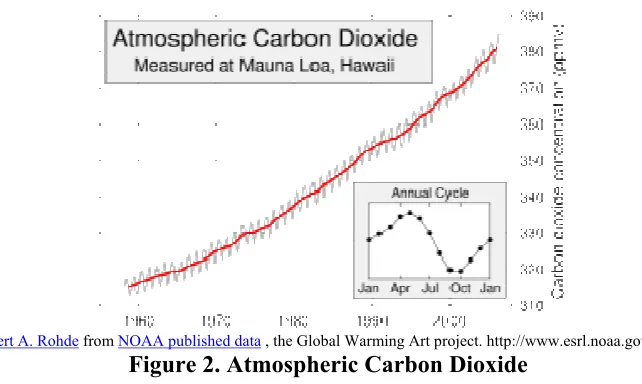
Robert A. Rohde from NOAA published data , the Global Warming Art project. http://www.esrl.noaa.gov/gmd/
Figure 2. Atmospheric Carbon Dioxide
At the current rate of emission, it is estimated that by the end of the century the mean world surface temperature will have risen by 2,5 to 5 degrees centigrade. Although 2,5 degrees might seem trivial to the layman, it could translate into a rise of sea level up to 2,5 ft, extreme weather patterns, loss of many small islands, and even extinction of the more vulnerable species.
In attempting to quantify the impacts of climate change, the Stern Review, a widely publicized report on potential economic impact, suggests that extreme weather might reduce GDP by up to 1%, and that in a worst-case scenario global per capita consumption could fall 20%. According to UNEP, the economic sectors most likely to face difficulties related to climate change include banks, agriculture, transport and others. The food security of developing countries dependent upon agriculture will be particularly harmed by global warming.
In effect, the debate is over: all our collective ingenuity should be marshaled to reduce carbon emissions, mitigate the impacts of climate change, and develop means to adapt to this all-pervasive change. Failure to comply will prove detrimental to everyone’s food security.
Nature, Man, and the Climate
Climate change is expected to bring extreme weather patterns and an increase in mean surface temperature. These global changes will undoubtedly have an impact upon man, wildlife and agriculture. Many species may be unable to cope with such changes and run the risk of extinction. Higher surface temperature may also mean smaller harvests for farmers on account of impaired water availability due to higher evapo-transpiration. It will also speed crops through their development stage, resulting in grains that are not full. This loss in biodiversity and agricultural productivity may well impair mankind’s capacity to feed itself, impinging upon food security for the most vulnerable. All such forebodings raise questions over the future of civilization. (2)
The agriculture industry is responsible for an estimated 9 % of global CO2
emissions – from the use of fossil fuels; 35-40 % of global methane emissions – from manure and enteric fermentation; as well as 64 % of global NO2 emissions – from
fertilizer use. Land cover changes such as deforestation and desertification are also commonly attributed to agriculture activity, as livestock production is estimated to occupy 70 % of all land used for agriculture or about 30 % of ice-free land surface worldwide.
Land cover change for agriculture invariably degrades habitats of various species. Injudicious use of fertilizers, pesticides, and herbicides may lead to soil degeneration and foul water run-off. Land cover change is also considered guilty of contributing to global warming through albedo changes and reduced carbon-sequestration capabilities. Land cover change may also aggravate the water cycle as less water collection ability means more surface water run-off which invariably leads to floods, droughts, and may even affect global weather patterns.(3)
suitable habitat for local species could be provided to mitigate agriculture’s environmental impacts.
However, some of these accusations may have been blown out of proportion as agriculture does not completely deplete an area’s ability to sequester carbon, collect rainwater, or the area’s albedo. This means that agricultural land clearing is less damaging to the environment compared to cutting down forests for industrial or residential estates. Furthermore, by planting, growing, and harvesting carbon-based life forms, there is a possibility that a plot of farm land could actually sequester more carbon than a plot of climax forest. As an added bonus, farmlands generate added value to the area, enabling people to live in greater harmony with nature without sacrificing economic growth whilst enhancing food security.
As the change in this age is warming of the earth, countries closest to the equator may well bear the brunt. It is important to remember that farmers in developing countries lack the capacity to convert to more effective and efficient technology. Farmers with access to rudimentary irrigation facilities will suffer more from drought and an increase in water prices compared to those who have easy access to drip irrigation facilities. Furthermore, low-income countries do not have adequate resources and physical infrastructure to protect their farmers properly against floods and extreme weather.
Therefore, any solution (asides from formulating policies that provide incentives for cutting emissions) should also aim at enhancing the capacity of those who stand to suffer most. For only by enhancing the capacity of the people to sustain themselves can we genuinely achieve food security. They already have a strong motivation for change – the risk of extinction; what they need now are the means.
Food Security Facing Stress
World demographics and growth patterns have been such that increasing demand for food is further exacerbated by rising demand for feed, pari passu with economic progress. At the same time, deeply-entrenched OECD development and trade policies have resulted in grain production shifting away from the developing countries to the big agribusinesses in the developed world. Here, too, the 20:80 formulae appear to apply: 20% of the largest farmers capture 80% of the subsidies, including the likes of the Duke of Windsor. Oftentimes, the structure of subsidies contributes to environmental degradation by encouraging bringing marginal land into cultivation. Turning a blind eye to the protectionist regimes in the OECD, the World Bank and IMF have also been pushing the liberalization of agricultural markets; in effect, pitting poor farmers in developing countries against the Treasuries of industrialized economies. According to the OECD’s own statistics, these subsidies cost six times more than their total development aid budget (ODA). As the following table demonstrates, some commodities are getting thrice as much support as what they would get from the market.
Percentage (%) of Gross Receipts
Rice 75
Sugar 58
Milk 36
Beef & Veal 34
Wheat 33
Corn 31
Oilseeds 27
Pork 21
Overall 30
Depressed agricultural prices as well as declining support from the CGIAR and their own NARS have allowed agricultural productivity to stagnate in many places. Facing bleak prospects, distress-pushed rural families have opted to move, further exacerbating urban poverty and food insecurity. Now, the world community is reaping what it has sown.
Spurred by the bio-fuel subsidies ostensibly meant to make the affluent countries energy independent, prices of all feedstock have taken off. In the last three years, it is estimated that corn prices have gone up by a factor of 3; wheat prices went up by a factor of almost 3; soybean prices went up by a factor of 2; and even rice, which is not directly used in biofuels, have went up by a factor of 3. Recent studies, including the one conducted by IFPRI using its IMPACT model, show that bio-fuel subsidies might be responsible for as much as a third of the price hikes.(4) However, bio-fuels may not be the only culprit; energy costs for agriculture production and distribution as well as population growth and the effect of climate change on agricultural productivity may also affect food prices.(5)(6) What has recently come to light is that rapacious institutional investors playing in the commodity futures markets have been bidding up food prices without giving any thought to the moral consequences.
However, since long periods of very little investment into agriculture in developing countries have led to rural de-capitalization, the farmer’s supply response is constrained by non-price factors. In the absence of supportive public investment decisions, only the agribusinesses in developing countries will be able to cash in on the price bonanza, further marginalizing the poor farmers.
Government policies as well as market trends and incentives affect what farmers grow and the foodstuffs-feedstock balance. Governance of global markets will also determine how speculators operate. Therefore, a more comprehensive understanding on the dynamics of the food-feed-fuel nexus, both on the ground and in the major bourses, is required to come out with the appropriate policies, institutions, and technologies.
CC Mitigation and The Future of Food Security
This food crisis has exposed that affluent countries have imposed double standards regarding the mitigation of climate change. They expect developing countries to “strike a balance” between development and climate change mitigation while avoiding that same criteria with arguments that industrialized countries are unable or unwilling to reduce their own emissions on the scale required to limit climate change within a certain range. According to this line of reasoning, developing countries should curb their emissions at the cost of slowing down development while developed countries may proceed with business as usual.
Such a scenario fails both the tests of equity and efficiency. By slowing development, this line of reasoning would undermine the efforts of developing countries to cope with climate change and push them into an even more vulnerable position prone to food crisis. Regarding efficiency, developed countries already have better institutional capacity to abate, mitigate, and adapt to climate change. Furthermore, it is undeniable that developed countries emit far bigger amounts of greenhouse. The scientists estimate that stabilization of carbon dioxide equivalent between 445 and 710 ppm by 2030 will result in between a 0.6% increase and 3% decrease in global gross domestic product. According to them, to limit temperature rise to 2 Degrees Centigrade, "developed countries as a group would need to reduce their emissions to below 1990 levels in 2020 (on the order of –10% to 40% below 1990 levels for most of the considered regimes) and to still lower levels by 2050 (40% (Sic. 80% in Box 13.7, p776) to 95% below 1990 levels), even if developing countries make substantial reductions.”(7) Thus it would be much wiser for industrialized countries to demonstrate leadership and reduce their own emissions commensurately.
rural labor force hollowed out by the migration of the most capable to urban areas. Thus, if poverty traps do exist, they are due to a combination of market and government failures. Escape from such traps requires concerted and effective global intervention, and for many years now many governments has had neither the resources, the institutional arrangements-cum-capacity, nor the leadership requisite to design and deliver the public goods and services that need to be in place if agriculture is to be put on a far higher growth and socio-economic development trajectory.
Global Solutions towards Food Security for All
It is now well-established that seemingly local policies and programs affect global conditions. As fellow travelers on this spaceship earth, individuals and communities can no longer treat nature with impunity and expect to never pay any retribution. Left on their own, hundreds of millions might be doomed to perpetual hardship and nutritional crisis. The current crisis is fast becoming a question of triage or cooperation; and triage seems to be the preferred choice of the better off. Such injustice can no longer be allowed to continue, it is high time that the polluter-pay principle be strictly enforced.
Agriculture will be adversely affected by climate change, and poorer harvests might translate into greater food insecurity and more potential for conflicts between populations, between communities, and between countries. Widespread drought and extreme weather will cripple and dislocate even more people and further exacerbate the Internally Displaced Persons and refugee problems already besetting us. The bird flu pandemic has exposed that globalization cannot be contained in investments and markets alone as pathogens are also jumping on the bandwagon. Thus, triage would no longer be a viable option; what transpires in the poor communities will, in one way or another, reach the doorsteps of the affluent too.
We are in such a predicament precisely because of OECD’s trade and development policies and our levels of energy consumption. The over-consumption and wasteful use of energy have led to a rapid acceleration in the rate of climate change. Nature has been providing enough for everyone’s needs, but it will certainly not be able to satisfy such greed. This calls for a change in development paradigm and for a hard look into what actually constitutes progress for civilization.
direct costs involved. Moreover, natural ecosystems may be less adaptable to rapid change and may prove more vulnerable to climate change.
It is generally accepted that development is affected by geography and the quality of institutions. Since we cannot change our geographical location, we need to focus on improving the quality of our institutions. It is incumbent upon governments, then, to begin with themselves. The executive, legislature, and the judiciary should champion policies and program which provide the proper balance of incentives and disincentives to propel the private sector and civil society to adopt more sustainable practices.
At the same time, governments should provide more quality extensions and easier access to credit and other resources so that even the small farmers can adapt. All institutions dealing with rural households need to be re-examined through a people’s lens. They should be redesigned, wherever necessary, so that they actually provide support to, and not extract from, the smallholders. Thus agrarian reform and pro-smallholder policies should be employed to inhibit rural poverty.
Local communities are much more conversant with nature; and as they are dependent upon it, they will certainly adopt practices which would allow them to survive, and perhaps even flourish. Therefore, by adopting sound agricultural practices which allows the preservation of wildlife while at the same time allowing rural communities to grow in a sustainable manner, governments working together with the private sector, NGOs, and local communities could make sure that food security is not impaired too much by the changing climate.
Just as we are all responsible for the policies, institutions, technologies, and values that have led to this state of affairs, so should we together rise to the occasion. We have to act to protect our food security, and we have to act together if we want to share a common future.
Sources:
1. IPCC. Climate change 2007: the physical science basis (summary for policy makers), IPCC. 2007.
2. Cline, William R. Global Warming and Agriculture. Finance and Development. March 2008.
www.imf.org/fandd.
3. Kniivila, Matleena. Land Degradation and Land Use/Cover Data Sources. United Nations Statistics Division. 2004.
4. von Braun, Joachim. Statement to the Senate Energy Commission. IFPRI
5. Gundzik, Jephraim P. Soaring Commodity Prices Point Toward Dollar
Devaluation. Power and Interest News Report. 2006
http://www.pinr.com/report.php?ac=view_report&report_id=497&language_id=1
6. Lucht, Gene. ‘Weak correlation’ between food and fuel prices. Farm and Ranch Guide. 2008.
http://www.farmandranchguide.com/articles/2008/01/28/ag_news/regional_news/ regs13.txt
7. Gupta, Sujata et al. Policies, Instruments, and Co-operative Arrangements. IPCC. 2008.