HOW CORPORATE GOVERNANCE AND CSR DISCLOSURE AFFECT THE PERFORMANCE OF COMMERCIAL BANKS
IN INDONESIA
ARTICLE
Proposed to Qualify The Study Program Requirement Undergraduate Program
Department of Management
Proposed by: Aditya Mahardhika
NIM: 2010210005
SEKOLAH TINGGI ILMU EKONOMI PERBANAS SURABAYA
HOW CORPORATE GOVERNANCE AND CSR DISCLOSURE AFFECT THE PERFORMANCE OF COMMERCIAL BANKS
IN INDONESIA
Aditya Mahardhika
STIE Perbanas, Surabaya, Indonesia [email protected]
Abstract:
Corporate governance has become one of the most important parts in business recently. The term of governance in this case is not new. Such term has been widely discussed over and over. Therefore, analysis and development concerning corporate governance has been done by some researchers since several decades ago. For example, it has been shown that good governance is effective in protecting stakeholder’s interests and the effects of corporate governance on firm’s performance have also been widely discussed. Another crucial part in most of business strategy is Corporate Social Responsibility, as it has also been the new business paradigm. This is due to the benefits that companies feel by implementing CSR within their businesses. In this attempt, this study aims to examine the effect of corporate governance, represented by managerial ownership structure and size of board of commissioners /BOC, and CSR expenditures disclosure on the performance of bank. In this study, Commercial Banks in Indonesia stand as the object of the study. We measure the bank’s performance by Return on Assets (ROA), Return on Equity (ROE), Net Interest Margin (NIM), and Operating Efficiency Ratio (OER). By using regression analysis, this study provides finding that managerial share-ownership has no significant influence on bank performance. Meanwhile, BOC size and CSR disclosure is proven to have a positive significant effect on bank performance.
Keywords: Corporate governance, managerial ownership, board’s size, CSR, performance
Introduction
Corporate governance has been one of the most important business parts in this recent era. The existence of governance is not new; in fact it has been widely talked, analyzed, and developed for many decades. Governance itself is the configuration and operation of a corporation in relation to its stakeholders (Erik Banks, 2004). The application of governance in a corporation has been a strong focus for public, especially the corporation’s stakeholders as it has a great impact to them. It has been shown that good governance is effective in protecting stakeholder’s interests. In the other hand,
bad governance can cause to a wide range of problems.
covered in the governance spans from ownership structure, board of director size, operations, to social activities funding.
In ownership structure, there is a possibility of what is so named as agency theory to take place. According Jensen and Meckling (1976), agency theory explains that one personnel would put his or her best interest at the top of the list. This list of priorities determines the performance of one personnel within the company. However, one individual might have different set of priorities from the other. Jensen and Meckling added that this difference of interest between parties would trigger conflicts. This conflict or problem is what means that effective corporate governance increase the probability that managers invest in profitable projects (Shleifer and Vishny, 1997). Some of the good governance that one company can apply includes giving incentive to the agent, having good system of monitoring to its agent, and setting a good management share ownership. This paper will further elaborate the last one: management share ownership. Management share-ownership will ensure managers to undertake strategies that will increase firm performance (Hutchinson and Gul 2003).
Another aspect in corporate governance, which also takes part in the corporate governance’s reporting, is the size of the corporate board of director or in this case, we use board of commissioner, one part that every public company must have. The number of boards’ member determines the size of the board itself. These members are responsible in making decisions on
major company issues, representing the stockholders.
Several studies have been conducted regarding to the effects of board of director (BOD) size as a governance mechanism on the performance of firms and have resulted various outcomes. Some researchers like Lipton & Lorsch (1992) and Jensen (1993) found that smaller size of boards are more effective than larger ones. However some other researches with otherwise results have also been conducted. Yermack (1996) found that smaller boards bring higher firm value. While Hermalin & Weisbach (2001), in his research, stated that board composition has no relation to corporate performance and size of BOD is negatively related to corporate performance. These previous researches have, by far, produced mixed corporate governance report. This is in order to fulfill transparency principle to all stakeholder groups on how the corporation spends their fund for CSR. This disclosure comes as a means of understanding and tracking CSR impacts, through creating good dialogue with stakeholders of a company and an effective CSR disclosure is intended to improve stakeholder-related performance (Bayoud, Kavanagh, and Slaughter, 2012). However, not all companies reveal their spending toward this field of activity at the same level. There are still some of the players in the market, which do not disclose their detail of CSR expenses in their annual governance report.
corporate governance, through its two
Theoretical Framework and Hypothesis
Corporate Governance and Bank Performance
Corporate governance, under this study, is represented with two aspects: ownership structure and board size. Firstly, the ownership structure is often interpreted as the distribution of equity among stockholders. These structures play great role in corporate governance as they regulate the incentives of managers and therewith the economic efficiency of the corporations they manage (Jensen and Meckling, 1976). Secondly, board size is regarding to the number of Board of commissioners (BOC) member. BOC is a group of individuals that are elected to make decisions on shareholders' behalf (Investopedia, 2013).
1. Ownership Structure and Bank Performance
Stock distribution depicts the distribution of stocks among stakeholders, in which will influence corporate actions that are dependent on shareholders voting (Hutchinson and Gul 2003). By having bigger number of managerial share ownership, the agency problem will be less complicated (Jensen and Meckling, 1976). According to them, managerial ownership may reduce the agency cost, a problem between owner and its agent. Management share-ownership will ensure managers to undertake strategies that will increase firm performance (Hutchinson and Gul 2003).
2. Size of BOC and Performance
Some researchers like Lipton & Lorsch (1992) and Jensen (1993) found that size of board does matter to the performance of its company. They (Lipton & Lorsch, 1992) stated that smaller size of board works more effectively than larger ones due to co-ordination problems in larger boards. They suggested limiting the boards’ member to ten people, with a preferred size of eight or nine. Jensen (1993) did a research under the same theme and resulted that boards with more than seven or eight people are less likely function effectively and are not easy for the CEO to control. There is a significant negative relationship between board size and bank financial performance (Uwuigbe and Fakile, 2012).
CSR Disclosure and Performance
between level of CSR disclosure in the annual reports and corporate performance, in terms of financial performance and corporate reputation. Based on the description above, the followings are hypothesis of this study:
H1: There is a significant partial effect of managerial share ownership, size of BOC, and CSR disclosure toward the bank’s ROA
H2: There is a significant partial effect of managerial share ownership, size of BOC, and CSR disclosure toward the bank’s ROE
H3: There is a significant partial effect of managerial share ownership, size of BOC, and CSR disclosure toward the bank’s NIM
H4: There is a significant partial effect of managerial share ownership, size of BOC, and
CSR disclosure toward the bank’s OER
Based on the above literature review, it can be concluded that there is a relationship between corporate governance and bank performance. Two aspects representing corporate governance and CSR Disclosure in this study, in accordance to previous researches and theory, are expected to have effects on firm / bank performance. This relationship is illustrated in the following framework:
Picture 1 Framework
Research Method
By the type of the research, this research is a hypotheses-study-testing
data collection method, this study is categorized as an observational research, since this research only observes the available secondary data.
Based on the research objectives, this study is a correlational study, which aims to identify the relationship and to identify the significance of effect of independent variable towards dependent variable within this research. In addition, based on time dimension, this research is a time series research.
Variable Identification
This research involves variables as follows:
1. Independent Variable (X): Corporate Governance, in this research represented by ownership structure and board size, and CSR expenditures disclosure through corporate’s annual governance report.
Ownership structure is the distribution of equity among stockholders. The focus area under this variable is managerial share-ownership, which is how many percent insiders own the company. The insiders here are managers within the company; they are board of commissioners and board of directors. While Board size emphasizes the number of effective member on the board. Size of board is expected to have effects on bank’s performance. Board size, in this study, is regarding to the number of board of commissioners (BOC) member. The last aspect of governance in this research is CSR disclosure. This study employs content analysis as a means to measure corporate social responsibility disclosures. Content analysis works by codifying the text (or content) of writing into various groups (or categories) depending on
selected criteria (Weber, 1988). There are 79 items of disclosure indicators, according to G3 report of Global Reporting Index (GRI) in their web site: www.globalreporting.org. The more bank disclose their CSR activity, the higher its CSRD score. The technique starts by checking all the disclosed information against the list of items. The list of items is provided in the appendix. Then, secondly, give a score based on whether an item is disclosed and the extent to which it is disclosed. Thirdly, a CSRD index is constructed by dividing the cumulative the score above with the maximum possible scores and multiplying this ratio by 100. This study employs the available data, which previously was content and Operational Efficiency Ratio (OER).
a. ROA
known as net assets or assets minus liabilities). ROE shows how well a company uses investment funds to generate earnings growth. ROE can be calculated as:
c. Net Interest Margin (NIM) Net Interest Margin (NIM) is a performance metric that examines how successful a firm's investment decisions are compared to its debt situations. A negative value denotes that the firm did not make an optimal decision, because interest expenses were greater than the amount of returns generated by investments. NIM can be computed as follow:
d. Operating Efficiency Ratio (OER)
OER is a ratio to measure the operating efficiency for banks. This ratio divides the operating expense of the bank by its net revenues. OER is formulated as below:
Population, Sample, and Sampling Method Population in this research is all commercial banks in Indonesia, which provide annual reports from year 2009 to 2012. This research period is for three years and due to the time gap, which exist between corporate governance implementation and its outcome, thus there is one year different between the governance report and performance report employed in
this study. The governance reports used in this study are from year 2009 to 2011, while the performance report used are from 2010 to 2012. This is known as lead and lag method.
The sampling method used in this research is judgment sampling (purposive sampling). Judgment Sampling is a kind of Non-Random, where the researcher considers the chosen sample meets the characteristic of sample needed for the research (Mudrajad, 2009:119). The characteristics of samples used in this study are listed as follows:
- Must be a national commercial
Data Analysis and Discussion
For all these three hypothesizes, regression analysis is used to examine and evaluate the effect of good corporate governance, which is represented by ownership structure (OS), size of BOC (BS), and CSR expenditures disclosure through corporate’s annual governance report (CSRD), towards the firm performance (in this case is the Commercial Bank in Indonesia). This analysis can be explained through following regression model:
ROA = a + β1 MS + β2 BOC + β3 CSRD + e
ROE = a + β1 MS + β2 BOC + β3 CSRD + e
NIM = a + β1 MS + β2 BOC + β3 CSRD + e
OER = a + β1 MS + β2 BOC + β3 CSRD + e
ROA = Return on Assets ROE = Return on Equity NIM = Net Interest Margin
OER = Operating Efficiency Ratio
β0 = Constanta
β1,2,3,4,5 = Regression Coefficient OS = Ownership Structure BS = Board Size
CSRD = CSR Disclosure e = Standard Error
To process it further, t-test and F-test analysis are applied to the data. The t-test is used to analyze the effect of independent variables, partially, to the dependent variable. Meanwhile, the F-test is used to analyze the effect of independent variables, simultaneously, toward the dependent variable.
Table 1
Descriptive Statistics for all Variables
Variables N Minimum Maximum Mean Std. Deviation
Managerial Share-ownership 78 0.00 57.82 3.22 11.56
Size of BOC 78 2.00 9.00 5.08 1.82
CSRD 78 7.59 26.58 14.05 3.79
ROA 78 -1.64 5.15 2.10 1.18
ROE 78 -18.96 43.83 17.56 10.60
NIM 78 1.02 14.00 5.71 2.47
BOPO 78 41.60 114.63 80.42 12.70
In the independent variables, the table shows that on the average the banks included in our sample, during the study period, has 3.22% of its shares owned by its managers, with a standard deviation of 11.56%. This means that the value of the Managerial Share-ownership can deviate from mean to both sides by 11.56%. The maximum and minimum percentages of shares owned by managers are 0% and 57.82% respectively. Meanwhile, the sample banks employ at least 2 commissioners and at maximum of 9 commissioners. Therefore, on the average, those banks have 5 commissioners in charge, with a standard deviation of 1.82%. As for the level of CSR disclosure, the sample banks have the disclosure rate of 14.05%, with a standard deviation of 3.79%. Among the samples, the minimum level of disclosure is 7.59%, with the maximum level of 26.58%.
While in the dependent variables, the sample banks generate Return on Equity (ROE) of about 2.1% on average, and a standard deviation of 1.18%. This means that the value of ROA can deviate from mean to both sides by 1.18%. The banks make -1.64% ROA at the lowest, and 5.15% of ROA at the highest during the period. As for Return on Equity (ROE), the banks make 17.56% value of it with minimum and maximum value of -18.96% and 43.83% respectively. The banks also generate NIM and BOPO of 5.71% and 80.42% on average, respectively.
and Dalton and Dalton (2005). These previous study argued that more number of people on board can bring more skilled managers or expertise which lead to more networking opportunities, expert advice, and diversified thoughts. Additionally, Kiel and Nicholson (2003) stated that larger size of boards tend to bring more diversity of
xperience, skills, and background. This situation will result in a better performance of the company. A supportive result was also obtained from a study of Mak and Li (2001) and Belkhir (2009). These study showed evidence in in favor of large board size associated with higher performance.
Table 2
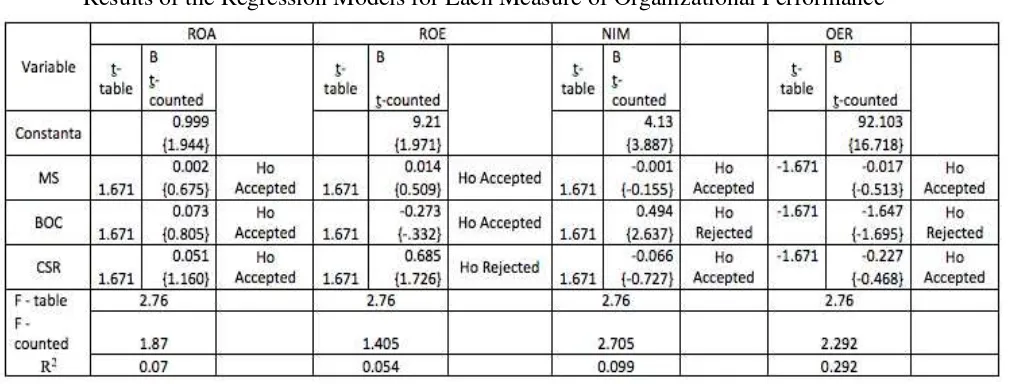
Results of the Regression Models for Each Measure of Organizational Performance
This result, however, is in contrast with the previous studies result of Lipton & Lorsch (1992) and Jensen (1993). This is because of co-ordination problems in larger boards. Their studies recommended limiting the board size to ten people, with a preferred size of eight or nine. The different result is most likely caused by the data of sample banks used in this study. The sample banks in this study have 9 persons on board of commissioner at maximum. Therefore, this study has different result with the studies of Lipton & Lorsch (1992) and Jensen (1993) and supports the statement of the bigger the board is, the better.
The other variable with positive significant influence is CSR disclosure. The variable is found to have significant positive effect on the bank’s performance: ROE.
support to the theory. Siregar and Bachtiar (2010) also argued that in order to maintain effective process in economic and financial values of one firm, it is necessary to also maintain the firm’s social value.
However, Managerial Share-ownership is statistically proven has no positive significant relationship to the bank’s performance. This is supported by the result of t-test result of MS to each of the dependent variable. For Managerial Share-ownership variable, the very low proportion of shares owned by the insiders might cause the insignificance. In fact, the majority of the data have shares less than 1% owned by its insiders, only a few banks whose insiders hold more than 1% shares. This small proportion of managerial share-ownership might lead to the insignificance of the relationship. Another reason might be the conflicted interest of the managers between their role as shareholder and as agent. This result supports the previous study of Demsetz and Villalonga (2001), in which they did not find any significant relation between managerial share-ownership and firm performance. Their results denied the belief that ownership structure affected firm performance. These two situations are some of the possible reasons why the relationship of managerial share-ownership to the banks performance is not significant.
This paper, however, has several limitations. Those limitations are listed as follows:
1. Financial performance in this study is only represented by ROA, ROE, NIM, and OER. Future researchers can use the other financial ratios to measure the financial performance.
2. CSR in this study assessed holistically (as one whole component). It is a recommendation for the future researchers to analyze the indicator aspect by aspect. Therefore the results can be more specific.
3. The data of annual report in this study is limited to three years. This is because the regulation of reporting GCG has been optimally applied since 2009. Therefore, to date, the available data is limited to three years.
4. The score of CSR disclosure in this study is a result of individual content analysis. Therefore, the score of content analysis might be slightly different between on researcher to the others.
Based on this study result, there are several recommendations for shareholders and managers, government as regulator, and future researchers. The recommendations are listed as follows:
1. Shareholders and Managers
a. In order to improve the bank’s performance, the author suggests the banks’ management to pay attention more on the implementation of CSR. This is based on the fact acquired that the implementation of CSR in Indonesia is still un-optimally implemented. The banks are suggested to pay closely attention to every aspects of CSR, and not only focus on some particular aspects. This is for a better distribution of CSR application. b. Companies in Indonesia,
public for such field. contribution of each commissioner on board and enhance effective decision-making. It will also bring about implementation, BOC size, and managerial share-ownership from year to year. Therefore the application of these aspects can improve from year to year, which in the end it will not only create a better companies/banks, as they will more socially responsible, but also a better effect to the society and the nation.
3. Future Researcher
a. Future researchers are recommended to use a wider range of data to obtain a more accurate data analysis. This is because the effect of corporate governance and CSR on banks performance takes quite some time to be seen. The author also recommends future researchers to use the other variables to assess the company’s financial performance. As in this study the author uses profitability ratios, the future researchers are recommended to use the other financial performance measurements. Thus, the future researches can be more comprehensive in presenting the results, which in the end can be more beneficial. Conclusion, Implication, Suggestions, and Limitations.
The author therefore concludes that there is a simultaneous relationship
between the independent variables
(Managerial Share-ownership, Board of
Commissioner Size, and CSR
Disclosure) and the dependent variables. Partially analyzed, BOC size and CSR disclosure are found to be independent variables, which significantly influence the bank performance, measured by NIM, OER and ROE, at a 10% level of significance. The statistic result shows that there is positive relationship between board of commissioner size and bank financial performance in Indonesia. More number of commissioners is likely to give more contribution to the bank
performance. Meanwhile, the CSR
disclosure is indicated to have a significant positive relationship with ROE. In contrast, the rest of independent variables are found to be not significant.
Based on this, the paper effective decision-making. It will also bring about cohesion among the board members.
This paper, however, has several
limitations. Firstly, financial
performance in this study is only represented by ROA, ROE, NIM, and OER. Future researchers can use the other financial ratios to measure the financial performance. Secondly, GCG in this study assessed holistically where this might be one of the reasons of the
insignificant relationship of the
future researchers to analyze the indicator aspect by aspect. Therefore the results can be more specific.
REFERENCE
Adams, R., & Mehran, H. 2005. Corporate performance, board structure, and its determinants in the banking industry, working paper. Stockholm School of Economics.
Banks, Eric. 2004. Corporate Governance; Financial Responsibility, Controls and Ethics. First Edition. New York: Palgrave Macmillan.
Bank of Indonesia. 2004. Surat Edaran Bank Indonesia No.6/ 23./DPNP. Jakarta: Bank Indonesia
Bayoud, Nagib Salem; Kavanagh, Marie, and Slaughter, Geoff. 2012. An Empirical Study Of The Relationship Between Corporate Social Responsibility Disclosure And Organizational Performance: Evidence From Libya. International Journal of Management and Marketing Research. Vol. 5. No. 3. pp: 69-82
Belkhir, M. 2009. Board of Directors, Size and Performance in the Banking Industry. International Journal of Managerial Finance, Vol. 5, No. 2, pp. 201–221.
Dalton, C. M., & Dalton, D. R. 2005. Boards of Directors: Utilizing Empirical Evidence in Developing Practical Prescriptions. British Journal of Management. Vol. 16, pp: s91-s97.
Demzetz, H., B. Villalonga. 2001. Ownership structure and corporate performance. Working paper. UCLA.
Handoyo, Ade Styo. 2009. Pengaruh Kinerja Keuangan Terhadap Perusahaan Dengan Pengungkapan CSR Sebagai Variabel Pemoderasi. Thesis is not published.
Hermalin, B., & M. Wesibach. 2001. Boards of Directors as Endogenously Determined Institutions: A Survey of the Economy Literature, Economy Policy Review. March
Hutchinson, Marion and Gul, Ferdinand A. 2003. Investment Opportunity Set, Corporate Governance Practices and Firm Performance. Journal of Corporate Finance. Vol. 10. No. 1. pp: 595-612
Jensen, M., Meckling, W., 1976. Theory of the firm: managerial behavior, agency costs and ownership structure. Journal of Financial Economics, Vol 3, No.1. PP:305-360.
Jensen, M. 1993. The Modern Industrial Revolution, Exit, and The Failure of Internal Control Systems. Journal of Finance. Vol.48, Pp.831-840.
Kiel, G.C., & Nicholson, G.J. 2003. Boards that work: A new guide for directors. NSW Sydney: McGraw Hill
Mak, Y.T., & Li, Y., 2001. Determinants of Corporate Ownership and Board Structure: Evidence from Singapore. Journal of Corporate Finance, Vol. 7, No. 1, pp. 235-256.
McGuire, J. B., Sundgren, A., & Schneeweis, T . 1988. Corporate Social Responsiblity And Firm Financial Performance. Academy of Management Journal. Vol. 3. No. 4. pp. 854-872.
Miles & Covin, J.G. 2000. Environmental marketing: A source of reputational, competitive, and financial Advantage, Journal of Business Ethics. Vol. 23. No. 3. pp. 299 – 311
Miles, M. P., Russell, G. R. 1997 ISO 14000 total quality environmental management: The integration of Environmental Marketing, Total Quality management, and corporate environmental policy. Journal of Quality Management. Vol. 2. No. 1. pp. 151-168
Mudrajad Kuncoro. 2009. Metode Riset Untuk Bisnis dan Ekonomi. Third Edition. Jakarta: Erlangga.
Mandacı, Pınar Evrim and Gumus, Guluzar
Kurt. 2010. Ownership
Concentration, Managerial Ownership and Firm Performance: Evidence from Turkey. South East European Journal of Economics & Business. Vol. 1. No. 1. pp: 57-66. Uwuigbe, Olubukunola Ranti and Fakile,
Adeniran Samuel. 2012. The Effects of Board Size on Financial Performance of Banks: A Study of Listed Banks in Nigeria. International Journal of Economics and Finance. Vol. 4. No. 2. PP: 260-267.
Shleifer, A., and R. Vishny. 1997. A survey of corporate governance. Journal of Finance 52 (June).Vol. 1. No. 1. PP: 737-783.
Siregar, Sylvia Veronica and Bachtiar, Yanivi. 2010. Corporate social reporting: empirical evidence from Indonesia Stock Exchange. International Journal of Islamic and Middle Eastern Finance and Management, Vol. 3. pp. 241-252 Yermack, D. 1996. Higher Market Valuation