analysis that functions to see a cultural process as a cultural system in the dialectic of the
dominant, the residual, and the emergent. It is true that what Williams meant by ‘the
dominant’ in his proposition is either the feudal culture and the bourgeois culture and
their transition, but he also says that the epochal analysis functions to sense a movement
in its connection to the future and the past. Williams wrote (1978, p. 121):
“…Its methodology is preserved for the very different function of historical analysis, in which a sense of movement within what is ordinarily abstracted as a system is crucially
necessary, especially if it is to connect with the future as well as with the past.
Keywords : documentary, trauma, dominant fiction, psychoanalysis
Introduction
In this paper, I will be reading one recent documentary called Jeju Prayer (original title: Bi-nyeom), directed by Im Heung-soon, by borrowing the dia-lectical proposition of the dominant, the residual, and the emergent as has been proposed by Williams. Jeju Prayer tells story about a documentarist who vis-its Jeju Island for a funeral of one his friend’s relatives. The early set-up then gone awry. Instead of telling story of one’s death, the film expands the narra -tive to the death of million people back in Jeju Massacre 1948. The film uses the funeral ceremony from the present as a gate to enter the collective trauma of Jeju people as a community, or even South Korea as a country. Later, the film displays some footage taken from the
demonstration protesting the construc-tion of American naval base in Gang-jeong,
Jeju Island. As a narrative, Jeju Prayer is basically a film about trauma, the invocation of trauma, and people’s resistance towards the trauma. There-fore, this paper will combine its reading by also involving a Freudian reading es-pecially on the theme of trauma.
early Rhee Syngman regime, interviews of witnesses and survivors, and so on.
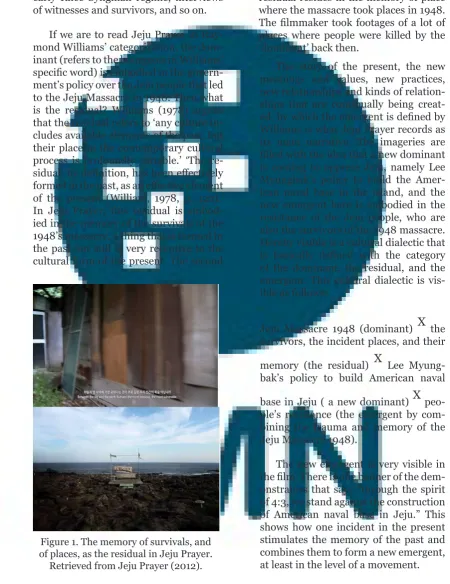
If we are to read Jeju Prayer in Ray-mond Williams’ categorization, the dom-inant (refers to the bourgeois in Williams’ specific word) is embodied in the govern -ment’s policy over the Jeju people that led to the Jeju Massacre in 1948. Then what is the residual? Williams (1978) argues that the residual refers to ‘any culture in-cludes available elements of the past, but their place in the contemporary cultural process is profoundly variable.’ ‘The re-sidual, by definition, has been effectively formed in the past, as an effective element of the present (William, 1978, p. 122).’ In Jeju Prayer, this residual is embod-ied in the memory of the survivals of the 1948’s massacre, a thing that is formed in the past but still is very receptive to the cultural form of the present. The second
residual resides in the memory of place where the massacre took places in 1948. The filmmaker took footages of a lot of places where people were killed by the ‘dominant’ back then.
Figure 1. The memory of survivals, and of places, as the residual in Jeju Prayer.
Retrieved from Jeju Prayer (2012).
The story of the present, the new meanings and values, new practices, new relationships and kinds of relation-ships that are continually being creat-ed, by which the emergent is defined by Williams is what Jeju Prayer records as its main narrative. The imageries are filled with the idea that a new dominant is coming to oppress Jeju, namely Lee Myungbak’s policy to build the Amer-ican naval base in the island, and the new emergent here is embodied in the resistance of the Jeju people, who are also the survivors of the 1948 massacre. Hereby visible is a cultural dialectic that is basically defined with the category of the dominant, the residual, and the emergent. This cultural dialectic is vis-ible as follows:
Jeju Massacre 1948 (dominant)
X
the survivors, the incident places, and theirmemory (the residual)
X
Lee Myung-bak’s policy to build American navalbase in Jeju ( a new dominant)
X
peo-ple’s resistance (the emergent by com-bining the trauma and memory of the Jeju Massacre 1948).The Residual Trauma
Through the narrative of Jeju Prayer, Jeju Massacre 1948 is portrayed as an at-tempted repression by the government (the father figure) at the time. When the North Korean started to invade the South, the government declared a policy to kill those who are suspected as leftist. This was a very act to repress some enti-ty, to evict them from the consciousness of South Korea as a capitalist “creature” that was just starting its “childhood” after a pre-birth era during Japanese coloni-zation. This incident, I suggest, is an at-tempt to establish the dominant by forc-ing the repression and the oppression of the people that results in a residual trau-ma.
Figure 2. The Naval Base Information Center (Left), a lady is protesting the police: the possibility of the emergent.
Retrieved from Jeju Prayer (2012).
The filmmaker of Jeju Prayer is at -tempting to see the possibility to emerge the emergent by retracing the residual in the form of trauma by using a sort of psychoanalytical method. Jeju become the patient, the filmmaker becomes the psychoanalyst, and the film text be -comes the notebook of the psychoana-lyst. In provoking this trauma to show itself, the filmmaker travels around the island: interviewing people, retracing graves of the victims, visiting the spots of execution, travelling to Japan to find the people who escaped the incident and then became Japanese citizens, and so on. The filmmaker did a psychoanalytic effort by finding what is being repressed in the rummage of Jeju Massacre mem-ory.
This trauma, unlike the demonstra-tion against American naval base, will not be shown if somebody doesn’t delve deep to find it. Both happen in the pres -ent as a residual of the dominant.
Historical Trauma and The
Dominant
like to find what kind of dominant fiction that Jeju Prayer is presenting. Hence in-stead of being a matter of representation, this is more of being a matter of presen-tation.
Jeju Prayer presents the ideological atmosphere of South Korea at the time as an “anti-communist” country hence the purpose of Jeju Massacre is to root out all the communists in the island. In its revisit
to the island and people, the film shows how the dominant fiction of “an -ti-communism” 4 struggled to exclude its enemy, the disturbing nuisance on its consciousness to then repress them back to the unconsciousness, or to employ Marxist term, to oppress the residual in order to prevent them being an emergent factor. In Jeju Prayer, Jeju Massacre is seen as an event when Jeju as a domi-nant ideological reality that dissents the existing residual. However, this repeating dominant repression (first in the event of Jeju massacre, and second in the build-ing of American naval base) and the peo-ple’s memory as residual don’t stand in the same line. The people are against it. The wound that was inflicted during the clash between the dominant oppression and the interexchange of residual and the memory is what comes in Jeju Prayer as trauma.
The social contradiction portrayed by Jeju Prayer seen as a wound inflicted not upon the body but upon the mind, which is embodied in an event. In Jeju Prayer, the event is Jeju Massacre, a battle be-tween the dominant and the residual that departs from a historical trauma that is dialectical in its process. The dominant is not only a fact of the past, rather still exists at the present, for example, the government’s policy to build the naval base despite the protest from the people.
The dominant and the residual here is a combination that, as mentioned in the opening of this paper, match the epoch-al anepoch-alysis of Williams in its criteria of relatedness to the past and the future.
A Double Reading on The
Fetish
There is one thing worth noticing in the first half of the film: obsession on space. Instead of recording the face of each interviewee, the film only sounds their voice while the visual wanders in the other empty spaces. There is one scene when the filmmaker follows a fam -ily visiting the grave of their deceased relatives. Instead of recording them “live,” the filmmaker photographed them and put it on the screen as a col-lection of still photography. What we comprehend lively is the voice of con-versation between the family members. Jeju Prayer assumes the still photos as empty space that has been consistently wandered since the film begin. Visually, what is lively recorded is space rather than people. The presence of the people is felt mostly through voices.
-lieve that the spaces it records still have what the past had, that the place seems transcended from its quotidian condi -tion and convince itself that those spaces can leap back through time to show what was there in the past.
The treatment of spaces in the film echoes what Freud (1925) wrote about fetishism as the substitution of penis that was once there in early childhood but had later been lost, “I hasten to add that it is not a substitute for any chance penis, but for a particular and quite spe -cial penis that had been extremely im-portant in early childhood but had later been lost. That is to say, it should nor-mally have been given up, but the fetish is precisely designed to preserve it from extinction. To put it more plainly: the fe-tish is a substitute for the woman’s (the mother’s) penis that the little boy once believed in and - for reasons familiar to us - does not want to give up.”
On its way to approach the past, Jeju Prayer doesn’t concentrate on people, rather, it concentrates on taking pic-tures of spaces as if the space still has something. In fact, the “something” of the places only existed in the past. For example, Hanra Mountain as a hiding spot was only existing in the past and no longer in the present. To use Freudian penis as metaphor, the attribute “hiding spot” for Hanra Mountain is a maternal penis that the little boy once believed. Unfortunately, this penis had later been lost while the boy doesn’t want to give up in believing. Here, the metaphor of the “little boy” is not only equal to the film -maker, but also to the spectators.
The substitution of penis as fetish-ism-at-work is also embodied in the film’s usage of still photographs in the scene of a family searching for their
ancestor’s grave. Instead of relying on live record of its subjects, the film pho -tographs them and only takes voices as live evidence. The still photographs transform the space of the everyday into a still object, an immobile object that the spectator can stare at for the seconds, exactly the same with the aforemen-tioned spaces that has been explained as a fetish. In this case, the transformation of live recordings into still photographs is also a symptom of fetishism: an act of believing that the object has what it doesn’t to later being disavowed. But unlike the beautiful spaces which im-mediately soars fetishistic fragrance, the scene of grave visitation has to be firstly transformed into still object in order to preserve its fetishistic power.
Trauma as Double Telling
the camera are mostly the places with sig-nificant connection with Jeju Massacre).
Therefore, is the trauma an encounter with the living or with the death? In her book, Caruth (1996) argues that trauma is a kind of double telling, the oscillation between a crisis of death and the correl-ative crisis of life: between the story of the unbearable nature of an event and the story of the unbearable nature of its sur-vival. Trauma as a double telling is exact-ly what Jeju Prayer is trying to approach by building a gap between the audial and the visual. The audial narrative tells the story of the living survivor, regardless of how much have they lost. There is a sur-vivor tells a story about how she lost her children in the incident, how she had sur-vived, and how her life has been in suf-fers since then. The only surviving child of mine, she says, is now living with her spouse who doesn’t like me. The other survivors tells story about how they es-caped Jeju Island to the mainland Korea with clothes full of blood. No one cared about us. It was also hard to live as main-landers since when we talk, people imme-diately recognize our accent. The other survivors are interviewed in their neigh-borhood in Osaka. These are survivors who have renounce their belief in Korea after Jeju Massacre and renounce their nationality to later become Japanese cit-izens. I came to Japan without knowing any Japanese, and now I am giving only Japanese name to my children. Now Jap-anese pops into my head before Korean. Borrowing Cathy Caruth’s categorization, the trauma in this part is a crisis of life: the story of the unbearable nature of the survival of an event.
On the other hand, this is a pessimistic complexity shown through a Williames-que mode of reading. When the people, for the sake of their own life, renounce
their capacity to become the emergent by merely staying as the residual of the dominant by registering themselves as citizens of another country. There is an unfulfilled dialectic here, shown by the contradiction between the dominant and the residual that goes out of the dialectic. Nevertheless, the filmmaker of Jeju Prayer attempts to portray the emergent, in the form of resistance of the Jeju local people against the domi-nant order by departing from the trauma of the dominant-residual dialectic in the past.
inter-twining of the confrontation with death and the confrontation with life.
The psychological trauma of one individual deals with the repression of memory in the unconsciousness, while the historical trauma of one big collec-tive often deals with death that works as an inextricable event from the process of repression.
Conclusion
This double reading, namely Marxian (through Williams, 1978) and Freudian reading towards Jeju Prayer results in a complex intermingling of social strug-gle and psychic strugstrug-gle of the Koreans (particularly the settlers of Jeju island) towards the dominant order via the ter-ror of the trauma of the past. Through the trauma, we can see the historical di-alectics of the capitalist-based South Ko-rea’s process of enforcing the dominant towards its own people, the residual it gives birth to, the risk of some elements renounces out of the cultural formation, and the potential emergent in the form of resistance.
References
Caruth, C. (1996). Unclaimed Expe-rience: Trauma, Narrative, and History. Baltimore: The Johns Hopkins Univer-sity Press.
Freud, S. (2005). The Unconscious. London: Penguin Books.
Silverman, K. (1990). Historical Trauma and Male Subjectivity in Ka-plan, A (eds). Psychoanalysis and Cine-ma. New York: Routledge.