Tourism and Sustainability
Increasingly advocates of tourism argue that tourism growth offers a means for Third World countries to escape the confines of ‘underdevelopment’ and that new forms of tourism in particular allow this transition to be achieved sustainably and equitably. Building upon this fundamental precept, this book explores and challenges the notions of sustainability, globalisation and development and their relationship to contemporary tourism in the Third World.
Adopting a broad geographical and conceptual perspective, the authors contend that a clear understanding of the tourism process and its relationship to development can only be achieved by an interdisciplinary approach touching on environmentalism, socio-cultural studies, human geography, economics and development studies.
In the first part of the book the emergence of the concepts of sustainability, globali-sation and development and their application to contemporary tourism are critically examined. Tracing the inception of sustainability within environmentalism, it is argued that sustainability has emerged as a hegemonic discourse. The meaning of sustainability is competed over by a variety of interests and the relationships between these interests and the growth of new forms of tourism are discussed. It is argued that tourism can only be fully assessed within a broader consideration of the structure and relationships of power.
Developing this conceptual framework, the second part of the book explores a number of critical themes. There are chapters on tourists, their relationship to new social move-ments, tour operators, tourist destinations, the policies adopted by national governments and on the impact of international and supranational agencies. The conclusion of the book draws the various strands together and considers a number of alternative ways in which the development of tourism in the Third World might progress.
Martin Mowforth is a freelance researcher and Visiting Research Fellow in Human
Geography at the University of Plymouth. Ian Muntis a freelance human settlements
Tourism and
Sustainability
Development and new tourism
in the Third World
Second edition
Martin Mowforth and Ian Munt
13111
For Feathers and ever present Herbie
and my beautiful Matty
First published 1998 by Routledge
11 New Fetter Lane, London EC4P 4EE
Simultaneously published in the USA and Canada by Routledge
29 West 35th Street, New York, NY 10001 Second edition 2003
Routledge is an imprint of the Taylor & Francis Group
© 1998, 2003 Martin Mowforth and Ian Munt
All rights reserved. No part of this book may be reprinted or reproduced or utilised in any form or by any electronic, mechanical, or other means, now known or hereafter invented, including photocopying and recording, or in any information storage or retrieval system, without permission in writing from the publishers.
British Library Cataloguing in Publication Data
A catalogue record for this book is available from the British Library
Library of Congress Cataloging in Publication Data
Mowforth, Martin.
Tourism and sustainability: development and new tourism in the Third World/Martin Mowforth & Ian Munt. – 2nd ed.
p. cm.
Includes bibliographical references (p. ).
1. Tourism – Developing countries. 2. Sustainable development – Developing countries. I. Title: Tourism and sustainability.
II. Munt, Ian. III. Title. G155.D44 M69 2003
338.4′791′091734–dc21 2002013770
ISBN 0–415–27168–1 (hbk) ISBN 0–415–27169–X (pbk)
This edition published in the Taylor & Francis e-Library, 2003.
ISBN 0-203-42277-5 Master e-book ISBN
Contents
Foreword to second edition vii
Acknowledgements ix
Abbreviations xi
Chapter 1 Introduction 1
Purpose and limits of the book 1
Tourism as a multi-disciplinary subject 2
Key themes and key words 3
Tourism and geographical imagination 6
Layout of the book 8
Chapter 2 Globalisation, sustainability, development 10
Tourism in a shrinking world 11
Sustainability and global change 18
Development and the Third World 30
Conclusion 42
Chapter 3 Power and tourism 44
Power play 45
The political economy of Third World tourism 49
Tourism as domination 50
Alternative critiques for alternative tourism? 57
Conclusion 78
Chapter 4 Tourism and sustainability 80
The growth in mass tourism 82
Resulting problems and the rise of new forms of tourism 90
Terminology 92
Defining the ‘new’ tourism 94
The principles of sustainability in tourism 97
The tools of sustainability in tourism 106
Whither sustainability in tourism? 113
Chapter 5 A new class of tourist: trendies on the trail 115
Class, capital and travel 116
A new class of tourist? 124
The scramble for Third World destinations 134
Conclusion 139
13111
Chapter 6 Socio-environmental organisations: where shall we save next? 141
New socio-environmental movements 142
Environmentalism and new tourism 146
Environmentalism and power 160
Conclusion 164
Chapter 7 The industry: lies, damned lies and sustainability 165
Trade and tourism 165
Size and structure of the industry 171
Re-defining sustainability 179
New personnel and new features of the new tourism industry 200
Conclusion 209
Chapter 8 ‘Hosts’ and destinations: for what we are about to receive . . . 211
Local participation in decision-making 212
Government control/community control 224
Displacement and resettlement 236
Visitor and host attitudes 243
Conclusion 250
Chapter 9 Governance, governments and tourism: selling the Third World 252
The politics of tourism 253
Assessing the politics of tourism 255
Tourism as politics 258
Globalisation and the politics of external influences 260 Sustainable tourism as political discourse 279
Conclusion 293
Chapter 10 Conclusion 294
Key themes and key words 294
New forms of Third World tourism 296
Globalisation, sustainability and development 298
Sustainability and power 299
New tourisms, new critiques 300
Whither new forms of tourism? 300
Notes 303
Appendix: Travel and tourism-related websites 308
References 310
Foreword to second edition
Much has changed since the first edition of Tourism and Sustainability. The speed of change, the pace of globalisation and the increasing prominence of ‘development’ as a global imperative have been at times breathtaking. The rise and maturity of the anti-globalisation movement symbolised by the protests at the World Trade Organisation talks in Seattle, the G8 Summit in Genoa, the unrest that has rumbled in numerous cities (from Prague to Quito), terrorist attacks on the USA and a new round of ‘crusades against evil’ are simply the most media-worthy events – the tips of an iceberg of broader and more fundamental social and economic change. In particular, much of this activity has centred on resolving the structurally unequal role of the ‘Third World’ within an emerging ‘global order’. For us, it has been necessary to understand how these global geopolitical factors and processes inform an analysis of Third World tourism.
Development, at its most basic, fashioned by the need to reduce levels of absolute poverty in the Third World, has risen to greater prominence since the early 1990s. The United Nations has set global development targets (the so-called millennium develop-ment goals), a second round of the UN family of mega-conferences (including the World Summit on Sustainable Development, better known as Rio + 10 in September 2002) has taken place, and First World governments are looking to increase their resourcing of development in exchange for economic restructuring in recipient states. In large part, some critics would argue, this is a response to the need for First World security against what are perceived as ‘rogue’ states, ‘rogue’ networks and ‘rogue’ migrants. The North Atlantic axis (USA, UK and other European states), urging the adoption of a policy of ‘liberal imperialism’ and vigorously promoting a neoliberal economic agenda through, for example, negotiations for the General Agreement on Trade in Services (GATS), is growing and becoming more explicit in its exercise of power over the rest of the world. While not at the heart of this movement for development, tourism has nevertheless found prominence. The UN’s controversial International Year of Ecotourism has spot-lighted the role of tourism, and the development potential of tourism has forced its way on to the Rio + 10 Summit agenda. The emergence of so-called people-centred approaches to development has also found resonance in pro-poor, community-centred, tourism initiatives. As a counterbalance to the top down and trickle-down approaches to tourism master planning in Third World destinations and the assumption that the tourism industry was of sufficient size to provide for development by default, pro-poor tourism is being promoted as a targeted development intervention.
We have responded to these changes since the first edition by building in more wide-ranging discussions on development, a fundamental requisite for understanding and assessing new forms of Third World tourism. This ranges from a presentation of devel-opment theory, to a critical discussion of tourism’s fair trade and pro-poor develdevel-opment potential. But the core of our argument remains unchanged in that development is an inherently unequal and uneven process, symbolised arguably by the diasporic and 13111
increasingly thwarted movements of Third World migrants to the First World, starkly contrasted to the accelerating movements of relatively wealthy western tourists to the Third World and the ideology of freedom of movement that supports this.
Critics of the first edition drew attention to the pessimistic conclusions of the oppor-tunities afforded by new forms of tourism. When we originally embarked on writing Tourism and Sustainability, it was always our intention to assess the global context within which new tourism exists rather than provide a case study guide to how it can work for the good and how it might be achieved. The case study approach is a signifi-cant line of inquiry and one that has been addressed by many authors and especially by the emerging pro-poor tourism literature. We do not wish to detract from the very real advances in tourism initiatives that have proactively addressed a development agenda and whose benefits and gains undoubtedly make tangible differences to those involved. But the question with which we embarked remains: can new forms of tourism become a significant force in global development? In the context of increasing global inequality and poverty, the overall size of the tourism industry (a point that tourism advocates invoke to explain why it should be a major force for development) and the advances made, our conclusions remain cautious. Indeed, as we write, the United Nations’ annual survey confirms that progress on reducing global poverty has slowed depressingly to a ‘snail’s pace’. Without starting from an assessment of the structures and relationships of power that influence the fate of tourism, it is, perhaps, a little too easy to be seduced by the possibilities inferred from what remain relatively few examples of positive change. To re-emphasise, however, this is not a manifesto for doing nothing. Far from it, we hope. Rather, it is a realistic starting point for an assessment of the forces within which we must work towards change.
Acknowledgements
We should like to acknowledge the work of and extend our gratitude to all those already acknowledged in the first edition of the book for allowing us to draw on their material. For this second edition, we specifically acknowledge permission granted by the following persons and organisations to use extracts from their work: Blackwell for allowing us to adapt Gregory’s Table on Modernism and Fordism (1994) (Figure 2.3); Sage Publications Ltd for Table 2.4; Survival International for material in Boxes 3.1, 6.1 and 8.12; J. & C. Voyageurs for the photograph in Box 3.5; Routledge for Table 4.1; Mick Kidd and Chris Garratt of Biff Products for Figures 4.1 and 9.5; The Guardian for extracts of an article by Alex Hamilton (1995) (Box 8.9) and Pass Notes 223 (1993) (Box 4.2); Tirso Maldonado and the Fundación Neotropica (San José, Costa Rica) for extracts from their work on carrying capacity calculations (Box 4.7); Paul Fitzgerald (Polyp) for Figure 5.2; The Open University for permission to adapt the Environmental Continuum in Table 6.1; the IUCN for the Table of Protected Area Categories (Table 6.2); Greenpeace for the data used to create Figure 6.1; the World Conservation Monitoring Centre for data on the global growth of protected areas (Figure 6.3); Dr Jules Pretty for his typology of participation (Table 8.1); The Panos Institute for mate-rial from their Media Briefing no. 14 (1995) and from their feature paper by Melinda Ham (Box 8.11); the Overseas Development Institute for Tables 9.2 and 9.3; Hotel Benchmark Team website for Figure 9.1; and Sue Curtin for access to transcripts of interviews with environmental managers of numerous tour companies (1996).
We especially wish to thank Race and Class and Theory, Culture and Society for allowing us to modify their respective articles ‘Ecotourism or ego-tourism?’ (Munt, 1994a) and ‘The Other postmodern tourism: travel, culture and the new middle class’ (Munt, 1994b), the latter being reproduced also by permission of Sage Publications Ltd; we would also like to acknowledge the inspiration provided by the material repro-duced from the Open University course (D215) ‘The Shape of the World’. Ian Munt especially wishes to thank the Association of Black Planners, Glenn Grey (for bringing the challenges and problems of Caribbean tourism to his attention in the late 1980s), Eno Amoquaye (for his constant advocacy to see planning in a different light), and Erlet Cater for both intellectual and practical support in thinking about tourism.
We owe much to the work of the following organisations which have produced reports of special relevance and significance for this field of study: the Catholic Institute for International Relations (CIIR), London; the International Institute for Environment and Development (IIED), London, especially the work of Jules Pretty on local participation; the Panos Institute, London; the Latin America Bureau (LAB), London; Survival International, London, for their reports on tourism and tribal peoples; and of course to Tourism Concern, London, without whose reports, assistance and advice our analysis would be considerably weaker – in particular, we acknowledge their permission to repro-duce material for Box 8.6. Special mention should be made of the assistance given 13111
by Paul Smith, a volunteer at Tourism Concern, who on numerous occasions provided information sources and data at a moment’s notice, but Tricia Barnett, Sue Wheat, Lara Marsh and the organisation’s other workers and volunteers also deserve special thanks. We also thank Tricia Barnett for the front cover photograph and for access to Tourism Concern’s photograph library.
The work of the Cartography Unit of the Department of Geographical Sciences at the University of Plymouth deserves special mention for its professionalism and high quality and for the patience with which the Unit’s staff, notably Brian Rogers, Tim Absalom and especially Marzuki Haji, accepted the regular changes we required to the maps, graphs, tables and drawings they created for us. David Griffiths of the Photography Unit also deserves the same credit for his assistance. Help and encouragement have been given in abundance by our editors at Routledge, Ann Michael and Andrew Mould.
Many thanks go to Alison Stancliffe who supplied the material for the case studies of Bali and served as our internal reviewer and extremely helpful critic for the first edition. For this second edition, we are extremely grateful to Prof. Mark Cleary of the Department of Geographical Sciences at the University of Plymouth for his helpful and critical comments on the new material relating tourism to the field of development studies, and to Sue Hurdle for her reflections on pro-poor tourism. Thanks also go to the invisible external reviewers on the second edition proposal, whose insightful and encouraging comments made our revisions more purposeful, and to all those who took the time to review the first edition and whose praise and criticisms have helped us formu-late this second edition.
June and Diana deserve more than gratitude for their patience and encouragement.
Abbreviations
ACPA Ambergris Caye Planning Authority (Belize) AITO Association of Independent Tour Operators
ANCON National Association for the Conservation of Nature (Panama) AONB Area of outstanding natural beauty
ASEAN Association of South East Asian Nations ASTA American Society of Travel Agents
ATEC Talamanca Association for Ecotourism and Conservation (Costa Rica) ATS Adventure Travel Society (US)
BA British Airways
BAG Burma Action Group
BAH British Airways Holidays
BASD Business Action for Sustainable Development BCES Belize Centre for Environmental Studies BCSD Business Council on Sustainable Development BEST Belize Enterprise for Sustained Technology BTIA Belize Tourism Industry Association
CAMPFIRE Communal Areas Management Programme for Indigenous Resources CANATUR Costa Rican Chamber of Tourism
CARICOM Caribbean Community and Common Market CARTA Campaign for Real Travel Agents
CCC Caribbean Conservation Corporation
CEDLA Centre for Latin American Research and Documentation (Netherlands) CERT Campaign for Environmentally Responsible Tourism
CIIR Catholic Institute for International Relations COBA Cost-benefit analysis
CONAP National Council of Protected Areas (Guatemala) CSR Corporate social responsibility
DANIDA Danish Agency for Development Assistance DFID Department for International Development DTI Department of Trade and Industry
EBRD European Bank for Reconstruction and Development ECC Effective carrying capacity
ECPAT Ending Child Prostitution, Pornography and Trafficking ECTWT Ecumenical Coalition on Third World Tourism
EDF European Development Fund
EIA Environmental impact assessment/analysis EPZ Export processing zone
EU European Union
FIDE Foundation for Investment and Development of Exports (Honduras) 13111
FOE Friends of the Earth
FOEI Friends of the Earth International FTAA Free Trade Area of the Americas
G8 Group of eight most industrialized nations GAGM Global Anti-Golf Movement
GATS General Agreement on Trade in Services GATT General Agreement on Tariffs and Trade GEF Global Environment Facility
GFI Green Flag International GIS Geographic information system GNP Gross national product
IBLF International Business Leaders Forum IDB Inter-American Development Bank IFI International financial institution
IGCP International Gorilla Conservation Programme IHEI International Hotels Environment initiative
IIED International Institute for Environment and Development ILO International Labour Organisation
IMF International Monetary Fund
INGO International non-governmental organisation INGUAT Guatemalan Institute of Tourism
IPPG International Porter Protection Group
IUCN International Union for the Conservation of Nature and Natural Resources (often referred to as the World Conservation Union) IYE International Year of Ecotourism
KWS Kenya Wildlife Service
LAB Latin American Bureau
LAC Limit of acceptable change MGP Mountain Gorilla Project MNC Multinational corporation
MRDF Methodist Relief and Development Fund NACLA North American Congress on Latin America NAFTA North American Free Trade Agreement NCA Ngorongoro Conservation Area (Tanzania) NEDA Netherlands Development Assistance NGO Non-governmental organisation
NLD National League for Democracy (Burma) NNP New National Party (Grenada)
NSPCC National Society for the Prevention of Cruelty to Children ODI Overseas Development Institute
OECD Organisation for Economic Cooperation and Development OPEC Organisation of Petroleum Exporting Countries
OPIC Overseas Private Investment Corporation PAR Participatory action research
PRA Participatory rural appraisal
PRG Peoples Revolutionary Government (Cuba) PRM Participatory research methodology PRSP Poverty reduction strategy paper PUP People’s United Party (Belize)
RA Rapid appraisal
RAT Rapid assessment techniques RCC Real carrying capacity
REA Rapid ethnographic assessment RGS Royal Geographical Society RRA Rapid rural appraisal
SAP Structural adjustment programme
SELVA ‘We are Ecologists struggling for Life and the Environment’ (Nicaragua)
SJAS San José Audubon Society (Costa Rica) SLORC State Law and Order Council (Burma)
SPDC State Peace and Development Council (Burma) SSSI Site of special scientific interest
TEA Toledo Ecotourism Association (Belize) TEN Third World Tourism European Network TIES The International Ecotourism Society
TIM-Team Tourism Investigation and Monitoring Team (Thailand) TNC Transnational corporation
TOI Tour operators initiative
UDP United Democratic Party (Belize)
UNCED United Nations Conference on Environment and Development UNCTC United Nations Centre on Transnational Corporations
UNDP United Nations Development Programme UNEP United Nations Environment Programme
UNESCO United Nations Educational, Scientific and Cultural Organisation USAID United States Agency for International Development
VSO Voluntary Service Overseas WCI Wildlife Conservation International WCMC World Conservation Monitoring Centre
WDM World Development Movement
WLT World Land Trust
WTO/OMC World Trade Organisation (Please note: Due to possible confusion with the initials WTO, signifying both the World Trade Organisation and the World Tourism Organisation, when both organisations are discussed together it is common practice to link the English initials with the Spanish and French initials. These are respectively OMC for the World Trade Organisation and OMT for the World Tourism Organisation. Thus the World Trade Organisation is abbreviated to WTO/OMC and the World Tourism Organisation to WTO/OMT. We shall follow this practice.)
WTO/OMT World Tourism Organisation WTTC World Travel and Tourism Council
WTTERC World Travel and Tourism Environment Research Centre WWC Ward Wildlife Committee (Zimbabwe)
WWF World Wide Fund for Nature 13111
Introduction
In recent years the image of the Third World in western minds has emerged in part from that of cataclysmic crisis – of famine and starvation, deprivation and war – to represent the opportunity for an exciting ‘new style’ holiday. Offering the attraction of environ-mental beauty and ecological and cultural diversity, travel to many Third World coun-tries has been promoted, especially among the middle classes, as an opportunity for adventurous, ‘off-the-beaten-track’ holidays and as a means of preserving fragile, exotic and threatened landscapes and providing a culturally enhancing encounter. At the same time, some Third World governments have seized upon this new-found interest and have promoted tourism as an opportunity to earn much-needed foreign exchange – another attempt to break from the confines of ‘under-development’.
There is something contradictory in viewing the Third World through an analysis of tourism. At one extreme there is the association of the Third World with fundamentalist terrorism, a risk to the security of the west, or overpopulation, poverty and disease. At the other there are also more subtle manipulations by the tourism industry of friendly Third World peoples, natural and pristine environments and ecological and cultural diversity. Both extremes, we will argue, form an important element in understanding contemporary Third World tourism. Importantly, and central to the line of argument developed in the following chapters, tourism is a way of representing the world to ourselves and to others. It cannot be understood as just a means of having some enjoy-ment and a break from the routine of every day, an entirely innocent affair with some unfortunate incidental impacts. Rather, a deeper understanding of tourism is needed to appreciate fully its content and expression as well as its potential impact.
Primarily, this is a book about development and its reflection in tourism; tourism is a metaphorical lens that helps bring aspects of development into sharper focus. It is not just about the role and impact of tourism in Third World development, but also about the roles of First World people and organisations (operators, tourists, non-governmental organisations, etc.) in the manufacture of ‘development’ as an idea, project or end-state.
Purpose and limits of the book
This book focuses on new and purportedly sustainable forms of tourism to Third World destinations in the context of a world undergoing accelerated processes of globalisation. The focus is relatively tight in two important respects. There are now many studies of tourism, especially tourism in the Third World, that catalogue and discuss its growth and impacts. In particular, studies have tended to highlight the economic, environmental and socio-cultural impacts of conventional package tourism.1Rather than adding to this
body of work, we focus particularly on the under-researched ‘new’ forms of tourism promoted in the First World and patronised almost exclusively by North Americans, 13111
11111
Europeans and Australasians. Although proportionately small relative to all forms of Third World tourism, the new forms of tourism are significant in terms of both the claims that are made about them and the rate at which they are growing.
Second, we do not seek to add to the growing number of accounts which attempt to identify sustainable tourism development (in terms of the environment, economy and culture) or prescribe good practice methods and tools for achieving this goal. Many of these have emerged from First World sources and necessarily involve judging the sustainability or otherwise of varying types of Third World tourism develop-ment. Instead, we explore the way in which the claim, or discourse, of sustainability is used and applied to new forms of tourism (for example, the way in which ecotourism – a new form of tourism – is premised upon the notion of sustainability). One way of capturing this important difference in our approach is to state that this is a book about sustainability and Third World tourism, rather than sustainable Third World tourism. The former approach, adopted here, signals the need for a critical analysis of the issues, while the latter implies the need to define and prescribe models of good practice.
Tourism as a multi-disciplinary subject
Rather than commencing a study of Third World tourism with the environmental, economic and socio-cultural impacts oftourism (worthy though these are as research considerations in themselves), the starting point here involves seeking to understand how socio-cultural, economic and political processes operate onand through tourism. In other words, it is necessary to take a step back in the analysis of tourism. This stems in part from the weaknesses present in the tourism literature. As Britton observes:
Although over-simplifying, we could characterise the ‘geography of tourism’ as being primarily concerned with: the description of travel flows; microscale spatial structure and land use of tourist places and facilities; economic, social, cultural, and environmental impacts of tourist activity; impacts of tourism in third world countries; geographic patterns of recreation and leisure pastimes; and the planning implications of all these topics . . . These are vital elements of the study of travel and tourism. But these sections are dealt within descrip-tive and weakly theorised ways.
(1991: 451)
This problem is of fundamental importance as it has led to an absence of an adequate theoretical critique for understanding the dynamics of tourism and the social activities it involves.
of necessity a study of tourism must be a net importer of ideas, themes and concepts from the broader social sciences.
Accordingly, our discussion draws on economics, development theory, environmental theory, social theory, politics, geography and international relations, for example. Inevitably, this breadth of consideration will mean that a number of relevant aspects are not examined in depth, and do not necessarily cover the complexity of the matters under discussion. We hope, however, that the discussion will serve as a stimulant to further thinking, discussion, research and study.
At the same time as using the concepts of a range of academic and intellectual fields in order better to understand tourism, the study of tourism helps us to illuminate more general economic, political, social, geographical and environmental processes. We try not to see tourism as a discrete field of study. Rather, it is an activity which helps us to understand the world.
Key themes and key words
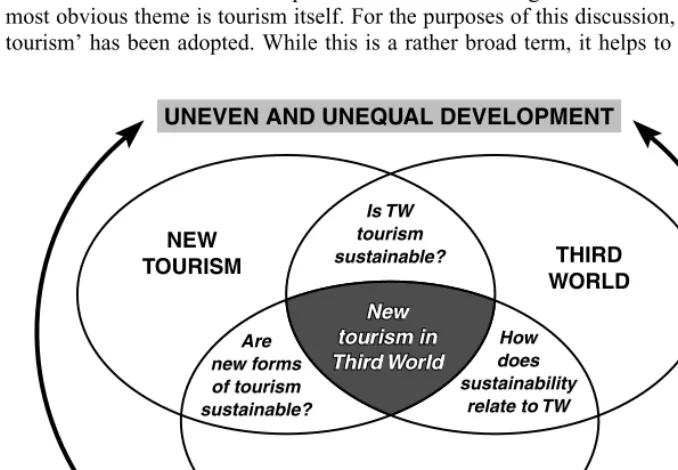
We have attempted to draw attention to the principal components of the discussion under the banners of key themes and key words. The relationships between the analysis and the key themes and key words are summarised diagrammatically in Figure 1.1. In reality these ideas are interconnected and dialectic; it is, therefore, principally a means of trying to organise our thoughts and approach.
Three themes seek to underpin the discussions throughout the book. The first and most obvious theme is tourism itself. For the purposes of this discussion, the term ‘new tourism’ has been adopted. While this is a rather broad term, it helps to indicate that a 13111
11111
UNEVEN AND UNEQUAL DEVELOPMENT
SUSTAINABILITY
GLOBALISATION
KEY THEMES KEY WORDS
RELATIONSHIPS OF POWER NEW
TOURISM
Is TW tourism sustainable?
Are new forms of tourism sustainable?
How does sustainability
relate to TW THIRD WORLD New
tourism in Third World
New tourism in Third World
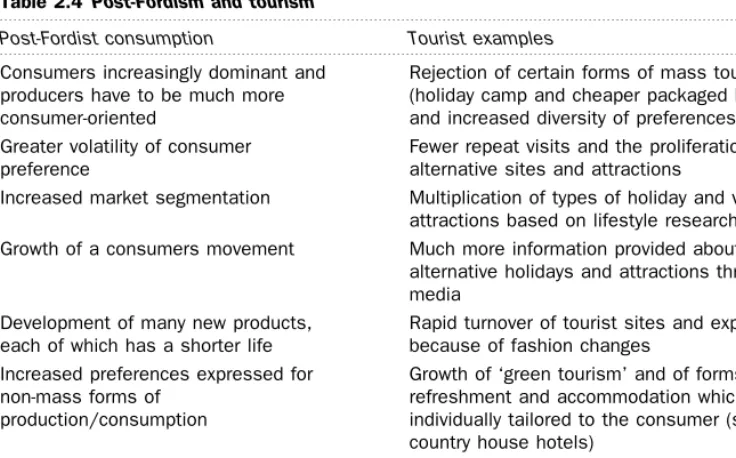
variety of tourisms have emerged and that in some important respects these seek to distinguish themselves from what is referred to as mainstream or conventional mass tourism – the type of tourism that has attracted the most academic attention and the wrath of many commentators. It will be argued later that the ‘new’ in tourism also helps us to trace the relationships with new types of consumer (known as the new middle classes), new types of political movements (ranging from new socio-environmental movements to the so-called anti-globalisation movements) and newforms of economic organisation (known as post-Fordism).
Tourism might also be regarded as a key word. The meanings attached to it are many and varied, and ‘tourism’ and ‘tourist’ have in some quarters become derided and ridiculed. How often are people heard to describe their holidays as being ‘well away from tourists and the main tourism areas’? In other quarters, Third World tourism is regarded negatively, and the word symbolises a range of problems: environmental degra-dation, the distortion of national economies, the corruption of traditional cultures, and, on a trivial level for the individual, unsanitary conditions and food poisoning. The emer-gence of new forms of tourism (prefixed with sustainableand eco-, for example) is testi-mony to the identification of the problem and the attempt to signal that these new forms aim to overcome the problem and to be something that plain old ‘tourism’ is not.
The second theme is the uneven and unequal developmentwhich underlines the rela-tionship especially between the First World and Third World (but also at inter- and intra-regional and intra-national levels), and through which we argue all forms of tourism are best understood. At its most basic level this theme is reflected in the fact that it is people from the First World who make up the significant bulk of international tourists and it is they who have the resources to make relatively expensive journeys for pleasure. Equally, processes of uneven development are reflected through the growing elite and newly wealthy classes in some Third World countries who are now able to participate in tourism. And of course tourism development is also highly uneven geographically. Areas that are in fashion today may fall from grace tomorrow.
This theme seeks to demonstrate why a critical understanding of tourism can be expanded through an analysis that places relationships of power at the heart of the enquiry. These relationships range from the political, economic and military power of First World countries in contrast to Third World countries, the power wielded by inter-national multilateral donors (from the World Bank to the European Union), the power of local elites in contrast to the local populations in tourist destination communities, and the power invested in tourists themselves. Our contention is that an analysis of tourism must start from an understanding and critical assessment of the relationships of power involved.
The final theme is the geographical focus of the analysis, the so-called Third World. The history of development studies has thrown up a variety of terms that attempt to represent and categorise countries according to their wealth and social well-being. In particular, the terminology attached to countries lower down the ‘human develop-ment index’ (a widely adopted index ranking countries on a number of criteria) has been keenly disputed – should they be described as ‘poorer’, ‘lower income’, ‘developing’, ‘under-developed’, ‘the South’, ‘Third World’, or indeed ‘non-viable economies’ (de Rivero, 2001) or ‘slow economies’ (Toffler, quoted in Sachs, 1999)? All such terms possess their advocates and detractors, reflect political priorities and dispositions, and no one term will suit all audiences. The problem of definition is made more acute when rapidly changing economic factors mean that old categories no longer hold good, and the meaning of development is constantly contested (Nederveen Pieterse, 2001).
conveyed by the alternative term is distinctly different from these two terms (for example, in a differentiation between those relatively wealthy countries with significant new middle classes with a taste for new forms of tourism and those countries where the middle classes are currently demanding conventional forms of tourism, especially those in South Asia and the Pacific Rim). Occasionally, we also refer to the West and the Rest, where the ‘West’ represents the First World capitalist economies promoting western materialistic lifestyles; and the ‘Rest’ seeks to emphasise the inherent inequality in global development.
‘Third World’ also helps to reflect on and convey the way in which we are using this term in relationship to the notion of development. For example, the word ‘developing’ is avoided, because it implies that there is an end state to the process of development and that all countries will eventually reach a ‘developed’ state. By contrast, there are strong grounds for arguing that the process of development is one which actually causes under-development elsewhere and at the very least is a state of never-ending flux to the extent that all countries are ‘developing’. The term ‘Third World’, in other words, helps to emphasise the ways in which power, resources and development are unequally and unevenly shared globally – if anything, the very term ‘Third World’ requires an acknow-ledgement that despite fifty or more years of ‘development’ activity, profound global inequalities both persist and are increasing. This is not to say, however, that the Third World is easily defined as a neat geographical entity coterminous with nation states. Inequality is of course not only manifest on a global scale; it occurs within and between countries and in relation to a variety of characteristics, particularly sex, ethnicity and class. As Dodds comments: ‘Put simply, there are parts of the Third World in the First World and vice versa’ (2002: 6; Nederveen Pieterse, 2001). In Chapters 5 to 9 we examine a number of examples of inequalities at various different scales.
Although strict geographical divisions along national borders are increasingly mean-ingless, as a generalisation in talking of the First World we are referring to the power vested in the nation states and institutions of North America, Europe, Australasia, and Japan. The Third World refers to those nation states and institutions that make up Latin America, the Caribbean, Africa and parts of Asia, although it is necessary to acknow-ledge the increasing wealth of some countries in South Asia and the Pacific Rim.
After the 11 September 2001 terrorist attacks on the USA, this simplistic division into two distinctly different worlds was re-defined along even more simplistic lines by President George W. Bush’s declaration that the world was ‘either with us or with the terrorists’ – with the ‘free’ capitalist world’s economic fundamentalism or with the fundamentalist jihad. The act itself and President Bush’s reaction to it drew more sharply than ever the lines dividing the First World capitalist economies and those which seek a different path of development and between the apparently ‘civilised’ world and the ‘uncivilised’ world, as it rapidly became labelled. Bush’s declaration and the war that followed it have been referred to as ‘the final stage of globalisation’ (Montero Mejía, 2001), in which a global world with a global army aggressively enforces and imposes the First World’s economic agenda on the rest of the world. The events of 11 September 2001 had immediate and drastic consequences for the tourism industry, although there is scant evidence to suggest that these effects will be long-lasting, unless acts such as the October 2002 bombing in Bali continue at frequent intervals. But any analysis of tourism should pay some attention to the global impacts on the industry of such events, and we briefly investigate the effects again in Chapter 9.
In addition to these three themes which inform the analysis of Third World tourism, there are a number of key words which will recur throughout the book and which struc-ture our discussion – these are globalisation, sustainability and development. In very broad terms, these ideas respectively are shorthand for the rapid pace of global change 13111
and interdependence, an increasing global environmental awareness and an accelerated concern with global inequalities and protracted structural poverty. Noteworthy here are the increasing concern and processes of change associated with each of these notions since the 1950s and of their accelerated significance since the 1980s – so much so that it is difficult to consider one without the other: sustainable development, global sustain-ability, global development, and so on.
The idea of a key word is used here because it alerts us to the fact that words are open to debate and differing interpretations; and that, consequently, there are problems in attaching uncontested meanings to words. As Williams (1988) suggests, the mean-ings of key words are closely related to the problems they seek to discuss. Take the idea of sustainabilityfor example. The very many meanings and interpretations of this idea are often a direct reflection of the explicit and implicit connections that people make (Williams, 1988: 15). For environmentalists, for example, the problem is one of the degradation of the world’s natural resources that activities such as tourism have caused. And the meaning attached to sustainability in this case is, at its core, ecological: the need to preserve and protect the natural environment. To industrialists by contrast, sustainability may represent the opportunity to reduce costs, increase or retain market share, win new customers and increase profit margins. In the former, there is an assuredly ethical dimension associated with the sustenance of the environment for all; in the latter, a primary concern to protect and enhance shareholder interest.
The point we wish to emphasise is that such is the scale, nature and depth of the processes and problems assumed within globalisation, sustainability and development, three of the most significant drivers and reflectors of change, that they should therefore hold the centrepiece of our analysis. Chapter 2 is dedicated to analysing these forma-tive ideas.
Tourism and geographical imagination
Tourism is one of the principal ways through which our ‘world-views’ are shaped. This not only results from our holidays but also from the way destinations are represented through travel reviews, travel programmes and documentaries, travel brochures and guides, advertising and the way in which we exchange our holiday experiences.
It is important to note at the outset that we are dealing with the nature of repre-sentation. Some geographers have adopted the term ‘geographical imagination’ as shorthand for these processes: the ‘way we understand the geographical world, and the way in which we represent it, to ourselves and to others’ (Massey, 1995c: 41). It is also shorthand for emphasising that activities, issues, places and so on, are subject to competing interpretations. There are as many ways to see, explain and interpret as there are positions to view ‘reality’. Benidorm, Bangkok and the Himalayas, for example, conjure up very different sorts of representations in our minds. As David Harvey suggests, the ‘eye is never neutral and many a battle is fought over the “proper” way to see’ (1989a: 1).
It is necessary to acknowledge this and work through the complexities rather than taking things for granted. Much of the argument presented in this book concerns the way in which tourism is a contested activity and how the field of tourism must be as concerned with the nature of representation and interpretation as describing a reality. This involves the way in which we represent both our own activities (how we define ourselves as, for example, tourists, travellers, visitors, and what each of these categori-sations entails)2and the places in which we holiday (for example, built-up beach resorts
We all have our individual geographical imaginations and these are formed from a variety of factors – sex, age, class, ethnicity, culture, the media and many others. As authors, both white males, writing about Third World tourism from the ‘privilege’ of our comfortable First World lifestyles, our interpretation of the issues may differ markedly from the interpretation of others who are experiencing very different circum-stances. Similarly, tourists interpret and represent their experiences in ways that may be fundamentally opposed to the experience of those being visited; and these interpreta-tions and representainterpreta-tions will differ between different types of tourists. Even the World Bank and International Monetary Fund (IMF) have a particular geographical imagina-tion of the Third World. Their representaimagina-tion of tourism and sustainability may also differ sharply from those of local communities in the countries where the policies of these supranational institutions are applied.
These differing geographical imaginations emphasise that representations of the world are socially and politically constructed and that there is an array of factors that contribute to our understanding of the world; Benidorm, Bangkok and the Himalayas are, so to speak, the social products of tourism. Take, for example, the following extract discussing the impact of tourism in the mountainous regions of South Asia. This helps to emphasise that First World views of tropical environments or mountainous regions as those of unrestrained beauty and natural bounty, to be revered and mythologised, may not be held by all. It also suggests that what is seen as worthy of tourism changes over time.
Mountains for the local mountaineers have obtained an aura of mysticism acquired from the Western ideal . . . The typical attitude of the mountaineer toward the mountains once was ‘if only they were flat, I could plough them,’ has changed through working and guiding Western Alpinists. This Western attitude is reinforced when the elite local porters and climbers are taken to Western countries for climbing workshops and tours. Gradually other notions that Westerners have about mountains such as conservation . . . seep into the vocabulary and thoughts of the local mountain populations as interaction with the tourists becomes more frequent and intense.
(Allan, 1988: 14)
This example of once divergent imaginations helps to emphasise two other points. First, some individuals, companies, institutions, and countries will be better able to diffuse their particular imaginations to others. When we think of Bali, Goa or Hawaii for example, the images and representations that are called forth are less likely to be of local people struggling to maintain cultural identity in the wake of mass tourism devel-opment and more likely to be of palm-fringed beaches and crystal blue waters (often the products of travel brochures, travel reviews and holiday programmes). In short, some imaginations are more powerful than others (Allen and Massey, 1995).
Second, and related to this exercise of power, differing and highly divergent geograph-ical imaginations imply that there is a high level of contest as dominant forms attempt to impose themselves on subordinate imaginations. The core of the argument in this book is about these contested views as they are expressed through tourism, ranging from the struggles between multinational tourism corporations and environmentalists, and the divergent understandings and definitions of sustainability, to the social struggle between so-called ‘travellers’ and tourists.
Finally, geographical imagination also makes a very distinctive contribution to our understanding of globalisation and its impacts (Allen and Massey, 1995). There is a sense that we are living in a smaller, more compressed and interconnected world, and 13111
tourism is often invoked in this process of globalisation, a process perceived differently by different people in different places. On the one hand, places are drawn into the sphere of global tourism and the feeling of a smaller world encourages consumption of further places. On the other hand, some places deemed unattractive to tourism are marginalised from the processes of global interdependence. The relationship is rather a complex and symbiotic one. Tourism is both cause and consequence within globalisation.
Layout of the book
The book aims to present many of the issues and debates associated with different aspects of new tourism as questions. To some of these questions we give our own inter-pretations; to others we do not respond, choosing instead to leave the issue open for you to examine further through the references provided.
Given our approach to the study of tourism and the multidisciplinary approach that we feel tourism studies demand, there is clearly a myriad of non-tourism sources that inform the debates and issues within and surrounding tourism. In addition, with a growing interest in and popularity of tourism studies, in recent years there has been a large and growing number of works written on tourism itself. Inevitably, therefore, the references provide but a sample of the breadth of writing on this subject. (It should also be noted that for some authors we have for practical reasons cited a number of works, to enable you to access the range of resources; it does not necessarily indicate that each piece of work develops a discrete and unique argument.)
The book is in two parts. The first, commencing with Chapter 2, attempts to critically discuss the multiple meanings and interpretations of sustainability, globalisation and development, picking up on the relationships between these words and ideas and how in a number of important ways this triumvirate is blended into one interchangeable notion. The discussion also seeks to suggest how and why new forms of tourism have emerged and how they are related to sustainability. Central to this chapter is a consid-eration of power and the ways in which globalisation, sustainability and development are used to convey the interests of different groups; these include international agen-cies, national governments, new social movements, tour operators, tourists and the local communities which receive tourists.
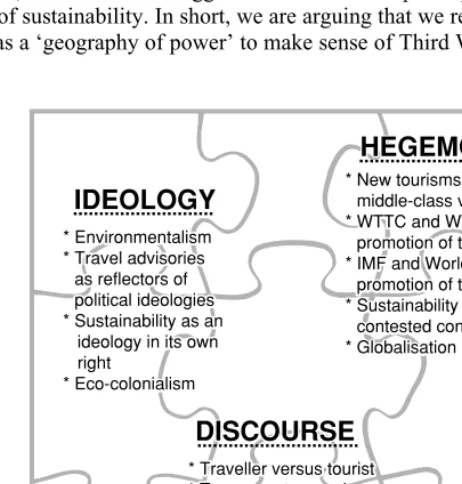
Chapter 3 builds upon this notion that power must lie at the heart of tourism analysis. Initially, it considers the tools for analysing and discussing power: ideology, hegemony and discourse. It looks at the existing political economy critiques of tourism and argues that the majority of these are set within the context of mass international tourism. Relatively little thought has been given to the role of new forms of tourism. It is suggested that a critique of these forms of tourism is required and a number of charac-teristics of such a critique are set out.
Chapter 4 looks specifically at the recent emergence of the new forms of tourism and the terminology and definitions associated with them. Principles of ‘sustainable’ tourism are examined critically along with the tools generally used to define, assess and measure sustainability in tourism. We briefly speculate on how the role of sustainability in tourism will develop in future.
Chapter 5 examines the motives, the role and characteristics of those tourists (mostly from the First World) who take part in the new forms of tourism. Building upon the earlier discussion regarding the relationship between the new middle classes and new tourism, we suggest why new forms of tourism are of importance to the new middle classes of the First World and how they protect and enhance this activity.3
Many of the ‘new’ tourists are also represented by new social organisations (or what are referred to in this book as new socio-environmental organisations) which mobilise around issues such as ecology, the environment, human rights and, most recently, anti-globalisation, or more positively, as Susan George argues, ‘global justice’ (Bygrave, 2002). Chapter 6 seeks to explore how new forms of tourism can be positioned in a discussion of environmentalism. A number of forms of environmentalism are presented and the ways in which sustainability and new tourism are related to them are assessed. The relationship between First World and Third World socio-environmental organisa-tions represents a struggle for power and control over problem interpretation and policy. The charge that global environmental organisations often intervene in ways which can be seen as eco-colonialist is also considered.
Chapter 7 analyses the way in which the tourism industry, in all its guises and facets, absorbs and adapts itself to the notion of sustainability. Different players in the industry react in different ways, but they all attempt to define sustainability in a way that reflects their particular interest; and we look at the ways in which this process of self-adjustment and subsumption of the notion of sustainability by different sectors of the industry occurs. This chapter also places the industry within the broader framework of trade, reviews current changes in global trade policy and examines the possibilities for ‘fair trade’ tourism. It includes a brief investigation into some of the new features associated with the new forms of the tourism industry.
Chapter 8 defines what is implied by the term ‘host’ populations and examines the importance of local participation (and the notion of ‘participatory development’) in the activity of tourism. A spectrum of meanings of the word ‘participation’ exists and a number of case studies are presented and set within this continuum. The techniques for measuring and improving local participation in planning, decision-making and imple-menting tourism schemes are assessed. Examples of the displacement of local popula-tions by tourism developments are given, and it is clear that area protection measures (such as the designation of national parks) are often implicated in these displacements and subsequent resettlements. The formation of local elites in exploiting the techniques and benefits of both tourism research and tourism activity is examined.
Chapter 9 looks at the role of governments and supranational institutions in tourism. The importance of political analysis in tourism studies and of analysis of the range of external influences on national governments is noted. With new forms of tourism emerging, many Third World countries have identified the opportunity of developing tourism around notions of ecology and environment and the adoption of discourses of sustainability by governments is described. The emergence of pro-poor tourism initia-tives is presented and its potential contribution to the broader pro-poor development agenda assessed.
In the final chapter, we draw several general conclusions from the discussion, and indulge in some crystal ball gazing about the future development of new tourism and its relationships with the economic, social, cultural, political and geographical aspects of development.
13111
Globalisation, sustainability,
development
There are three essential strands to Chapter 2 which are subsequently followed through in the rest of the book. First, it is necessary to establish the relationship between the Third World and tourism. At first sight this may seem an obvious link, but it is impor-tant to establish the dynamic nature of the relationship and frame it within broader, global changes. It is necessary to demonstrate the way in which tourism has expanded in the Third World, and how, so to speak, the frontiers of tourism have increasingly been pushed back. In order to do this we refer to the concept of globalisation (the first of our key words), a notion that attempts to capture the way in which the world has shrunk in relative terms. The analysis starts therefore from changes in the First World and we review the ways in which globalisation is reflected in economics, culture and politics.
We also need to look at the underlying factors which have resulted in some profound changes to tourism and at how new forms of tourism (in contrast to mass or mainstream tourism) have emerged in Third World destinations. This is not to argue that mass tourism to Third World countries has been magically displaced, but that alternatives to such tourism are now well established; subsequent chapters will demonstrate what forms such new tourisms take and discuss the extent to which these are manifest in the Third World. It is the claims made by many of these new tourisms to be sustainable and appro-priate alternatives to mass tourism that this book seeks to explore.
The second important strand is the notion of sustainability and sustainable develop-ment. We trace the relationship of these ideas to Third World tourism. An important question posed by many observers is whether and in what ways development in Third World countries, including tourism development, is or is not sustainable. This is espe-cially reflected in the debates over Third World tourism where it is often argued that existing forms of mass tourism development are unsustainable in terms of the negative impacts on the environment, the way in which it corrupts and ‘bastardises’ local cultures and the manner in which any potential economic benefits are frittered away as a result of the First World ownership of much of the tourism industry globally. It is from this negative premise that much new tourism takes its cue, in an attempt to redress the impacts of tourism and establish forms of (new) tourism that are reportedly environ-mentally, economically and culturally sustainable.
But our interpretation and discussion of sustainability is broader. This chapter takes a step back and examines the ways in which sustainability is reflected through the wider processes in economics, culture and politics in the First World; and it is argued that these changes are closely associated with globalisation. It starts from the important ques-tion of what is being sustained, by whom and for whom; do all interest groups have the same intentions or aspirations in terms of sustainability? In other words, who decides what sustainability means and entails, and who dictates how it should be achieved and evaluated?
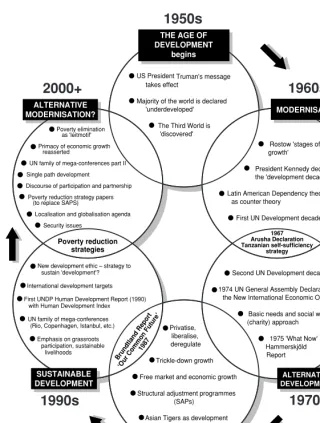
The final strand, development, looks at the ethical undertow of much new tourism and deals with perhaps the most significant issue of this century – how to address escalating poverty in the Third World and close the widening gap between increasingly rich and poor countries. In the context of tourism, advocates of new forms of tourism are asking if and how the economic benefits of tourism can be shared by Third World com-munities. We have left the discussion of development until last as it has rapidly become interchangeable with globalisation and sustainability. Our discussion of the evolution and contested nature of development will seek to bring these key strands together.
This chapter (together with Chapters 3 and 4) introduces a range of concepts and debates that are built upon in the second part of the book. They are important concepts in that they provide a way of refocusing the analysis and arguing that the emergence and development of Third World tourism can only be understood within a much broader frame of analysis.
Tourism in a shrinking world
Globalisationis a concept that is increasingly invoked in the analysis of tourism. With the seemingly limitless spread of tourism to the four corners of the world, the embracing of virtually any form of activity and the general ubiquity of tourists and tourism, the temptation to reference globalisation in discussions of tourism has been irresistible, often through casual and uncritical statements.
So what is globalisation and how can it most usefully be deployed in a critique of tourism? Essentially globalisation is a concept that seeks to encapsulate processes oper-ating on a global scale. It refers to the ever-tightening network of connections which cut across national boundaries, integrating communities in new ‘space–time combina-tions’ (Hall, 1992a: 299) and resulting increasingly in the feeling that the world is a single interconnected and interdependent whole, a shrinking world where local differ-ences are steadily eroded and subsumed in a homogeneous mass or single social order (Allen and Massey, 1995). As Giddens puts it, ‘Our lives, in other words, are increas-ingly influenced by activities and events happening well away from the social context in which we carry on our day-to-day activities’ (1989: 520). Clearly then, globalisation is much more than an abstract concept and represents a fact of our everyday lives that the world, in some crucial respects, has shrunk (Bauman, 1998).
Globalisation has been an especially appealing concept for geographers because it emphasises the way in which economic, social, cultural and environmental relationships have been stretched and interwoven across the globe. This is not to suggest, however, that globalisation is a new phenomenon. Processes of interconnection have been taking place for hundreds of years as part of an ongoing transition in the development of global capitalism. The qualitative difference today is the pace at which the process of global-isation is happening, with a current extraordinarily intensified phase of global trans-formation and change. McGrew captures the richness of the concept and the impact of this acceleration by expanding on two distinct dimensions which he terms scope (or stretching) and intensity (or deepening):
On the one hand it defines a process or set of processes which embrace most of the globe or which operate worldwide: the concept therefore has a spatial connotation. Politics and other social activities are becoming ‘stretched’ across the globe. On the other hand it also implies an intensification in the levels of interaction, interconnectedness, or interdependence between the states and societies which constitute the world community. Accordingly, alongside the 13111
‘stretching’ goes a ‘deepening’ of the impact of global processes on national and local communities.
(1992: 107)
The intensity or deepening of which McGrew speaks is reflected in the way that Third World countries and communities are increasingly drawn into tourism. A simple collage of newspaper travel pages (Figure 2.1) is testimony to the integration of once periph-eral areas into this process of spatial connectedness.
Globalisation, then, provides an organising concept through which we are able to explore the extent and impacts of global change in terms of economics, culture and poli-tics (Allen and Massey, 1995). Economic globalisation conveys the manner in which economic relationships and flows have been stretched across the globe. In the context of tourism, many point to the phenomenal growth of the industry in a global sense (it is now reputed to be the largest single industry) and the rapidity with which new places are continually drawn into the tourism process. Take for example an average travel agent and consider the range of destinations on offer. Not only has the number of holiday destinations increased but the distances between destinations and markets has increased markedly, and we will be examining how new tourism practices have helped to accelerate this process. This also suggests that globalisation is about capital-ising on the revolutions in telecommunications, finance and transport, all of which have been instrumental in the ‘globalisation’ of tourism. In addition, tourism for an increasing number of Third World countries is big business. It has been suggested that it is not just capital and commodities that can be transported and transferred easily across the world, but tourists too. It is necessary therefore to consider how changes in contem-porary global capitalism have impacted upon the development of tourism, a point we take up later.
At its crudest, cultural globalisation has been used as shorthand for the emergence of a single global culture reflected in global consumerism, most usually based on US lifestyles. As one of the most prominent tourism commentators, Dean MacCannell, argues, in this ‘giant, or global, socio-economic system, a “New World Order” . . . there is a pretence that all the sub-groups and communities are actually phased together in some kind of relational equilibrium’ (1992: 169). Burns and Holden (1995) also imply that the new world order has a direct relationship to the emergence of global consumerism, exemplified by ‘McDonald’s franchises’ or what Ritzer refers to as the McDonaldisation of society (1993).
Much commentary on tourism, and particularly new forms of tourism, is dedicated to bemoaning the armies of mass tourists who, it is claimed, voraciously consume places and cultures transforming them into Disney-like extravaganzas where cultural inau-thenticity is actively promoted. It is a cultural order, pundits argue, in which sophisti-cation, difference and authenticity are increasingly denied and cultural homogenisation is the norm. The task before us is to try to discern some of the most prominent changes in the cultural sphere and judge whether this supposed homogenisation is a reasonable reflection of reality.
13111
11111
sustainability of tourism. Again such debates have had profound effects on the devel-opment of Third World tourism, and we shall be exploring them in the following sections.
This process of globalisation locates the growth and expansion of tourism firmly within the ‘complex nature of social change’ and resonates some of the concepts that are discussed in this chapter. But it also sees the problem largely as one of ‘mass tour-ism’ and considers that solutions lie in the development of sustainable alternatives. The following chapters examine the scope of sustainable tourism and argue that the ‘humanisation’ process which, for instance, the Asian Consultation on Tourism favours is much harder to achieve in practice, even given alternatives to mass tourism.
Uneven and unequal development
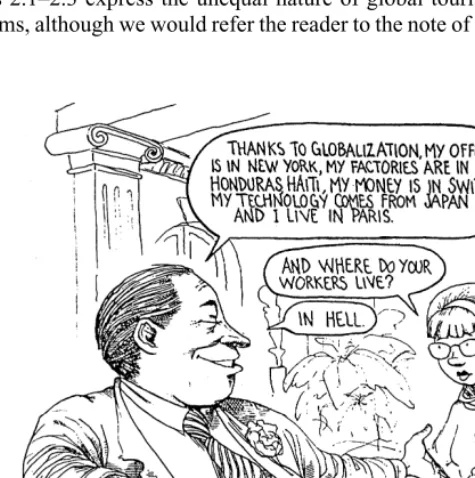
When, as a result of a coup d’état in the West African state of The Gambia, the UK Foreign Office advised British tourists to avoid the country (advice that was subsequently taken up by other European tourist-sending countries), the Gambian economy and tourism industry virtually collapsed. This is a clear reflection of the way in which places have been drawn into one another and have become interdependent, but equally it is a stark illustration of the highly uneven and unequal nature of globalisation, which is high-lighted in Figure 2.2. Clearly, The Gambia as a holiday destination is far more adversely affected by the cessation of tourism than are First World tourists. The latter only need consider alternative holiday destinations while The Gambia has little if no opportunity to consider alternative tourism markets.
Tables 2.1–2.3 express the unequal nature of global tourism development in quanti-tative terms, although we would refer the reader to the note of caution about the reliability
Figure 2.2 Globalisation: uneven and unequal development
of the World Tourism Organisation’s (WTO/OMT) statistics given in the note.1These
tables demonstrate the simple points that it is First World countries that receive the bulk of international tourists, that generate the greatest number of tourists and that receive the greatest quantity of income from them. The selected countries given in Tables 2.1 and 2.2 are generally also able to generate more income per international tourist received than are Third World countries. The list of countries given in Table 2.3 reveals that the greatest proportion of tourist income has its origins in First World countries.
Similarly, the idea of globalisation also fails to acknowledge which places and peoples are included in this process and which are excluded. When Burns and Holden (1995) suggest that ‘tourism is not so much about suntans as it is about being a major part of the globalisation of culture’ (13), they cannot be implying that all people are implicated in this cultural process, owing among other factors to the glaring inequalities among people both within the First World and between First and Third Worlds. While the rapid increase in overseas travel is seen as symptomatic of globalisation’s pleasure space, it is rarely contrasted with the massive increases in diasporic movements of the economic poor and politically refugeed from Third to First Worlds. At the same time that the fron-tiers of tourism are dismantled through the liberalisation of the service sector, the cordon 13111
11111
Table 2.1 International tourist arrivals and receipts from selected First World countries
1985 1990 1995 1999
Australia Arrivals (000s) 1,143 2,215 3,726 4,459
Receipts ($m) 1,062 4,088 7,857 7,525
000s dollars received
per arrival 0.9 1.8 2.1 1.7
Japan Arrivals (000s) 2,327 3,236 3,345 4,438
Receipts ($m) 1,137 3,578 3,226 3,428
000s dollars received
per arrival 0.5 1.1 1.0 0.8
Spain Arrivals (000s) 25,459 34,085 34,920 46,776
Receipts ($m) 8,151 18,593 25,388 32,497
000s dollars received
per arrival 0.3 0.5 0.7 0.7
UK Arrivals (000s) 14,449 18,013 23,537 25,394
Receipts ($m) 7,120 14,940 18,554 20,223
000s dollars received
per arrival 0.5 0.8 0.8 0.8
USA Arrivals (000s) 25,399 39,539 43,318 48,491
Receipts ($m) 17,762 43,007 63,395 74,881
000s dollars received
per arrival 0.7 1.1 1.5 1.5
World Arrivals (millions) 326 456 567 657
Receipts ($ billions) 116 261 407 455
000s dollars received
per arrival 0.4 0.6 0.7 0.7
sanitaireagainst migration to the developed economic core is tightened, despite the fact that migrants’ remittances are, in some cases, more significant than earnings from tourism (James, 2001). This leads Bauman to conclude that globalisation is geared to ‘tourists’ dreams and desires’, but that the unavoidable side-effect is the casting of many others as ‘vagabonds, . . . travellers refused the right to turn into tourists . . . allowed neither to stay put . . . nor search for a better place to be’ (1998: 93).
In other words, globalisation is highly uneven too, with migration as a reminder of the global map of power, and it is a concept that has become over-simplified in its appli-cation. It is important to remember, therefore, that most accounts of globalisation are by westerners (as this is) and are essentially about western globalisation as a result of the expansion of western capitalism; clearly an exercise in power. As Robins reflects, for ‘all it has projected itself as transhistorical and transnational, as the transcendant and universalising force of modernisation and modernity, global capitalism has in reality been about westernisation – the export of western commodities, values, priorities, ways of life’ (1991: 25, quoted in Hall, 1992a).
The notion that a ‘new world order’ has emerged, representing a triumph of western ideas also preoccupies the work of Francis Fukuyama (Deputy Director, US State Table 2.2 International tourist arrivals and receipts from selected Third World countries
1985 1990 1995 1999
Grenada Arrivals (000s) 52 76 108 125
Receipts ($m) 26 38 54 63
000s dollars received
per arrival 0.5 0.5 0.5 0.5
Guatemala Arrivals (000s) 252 509 563 823
Receipts ($m) 67 185 277 570
000s dollars received
per arrival 0.3 0.4 0.5 0.7
Thailand Arrivals (000s) 2,438 5,299 6,952 8,651
Receipts ($m) 1,171 4,326 7,664 6,695
000s dollars received
per arrival 0.5 0.8 1.1 0.8
Tunisia Arrivals (000s) 2,003 3,204 4,120 4,832
Receipts ($m) 551 953 1,393 1,560
000s dollars received
per arrival 0.3 0.3 0.3 0.3
Zimbabwe Arrivals (000s) 331 606 1,539 2,101
Receipts ($m) 26 64 154 202
000s dollars received
per arrival 0.1 0.1 0.1 0.1
World Arrivals (millions) 326 456 567 657
Receipts ($ billions) 116 261 407 455
000s dollars received
per arrival 0.4 0.6 0.7 0.7
Department Policy Planning) who, following the end of the Cold War, proclaims we have reached the ‘end of history’ (1989, 1992):
The triumph of the West, of the Western idea, is evident first in the total exhaus-tion of viable systematic alternatives to Western liberalism . . . and can be seen also in the ineluctable spread of consumerist Western culture . . . What we may be witnessing is not just the end of the Cold War . . . but the end of history as such: that is, the endpoint of mankind’s ideological evolution.
(1989: 3–4, quoted in MacCannell, 1992: 62)
As we shall see shortly, the transposition of western concepts and ideas also saturates the history of ‘development’.
In summary, globalisation may be an emotive and powerful idea, allowing each of us to invoke Big Macs, Coke and holidays in Thailand as our individual testimonies in support of that globalisation. But it can also be conceived as an attempt to place ethno-centric conformity over the way we perceive change and is a reflection of unequal devel-opment in its own right; an interesting story but a poor basis for analysis. Rather more ominously, it is a term that has allowed First World politicians, scholars, cultures, interest groups, business people and so on to impose an inevitability which is firmly premised upon the West – a global economy, global culture, global politics, a global environment. As such it obscures the varied processes of social and spatial changes to such an extent that globalisation defies both space and time; it is simultaneously aspa-tial and ahistorical (Daniels et al., 2001).
The reality of globalisation is considerably more complex and is characterised by uneven and unequal development. A careful examination of the economic, political and cultural processes is also central to a more in-depth analysis of the ‘globalisation’ of contemporary tourism. The next section advances and elaborates upon this discussion 13111
11111
Table 2.3 The world’s top fifteen tourism spenders (excluding transport), 1999
Rank Country Market share
(% of total)
1 United States 13.0
2 Germany 10.6
3 United Kingdom 7.8 42.7
4 Japan 7.2
5 France 4.1
6 Italy 3.7
7 Canada 2.5
8 Netherlands 2.5 13.3
9 China 2.4
10 Belgium/Luxembourg 2.2
11 Austria 2.2
12 Sweden 1.7
13 Russian Federation 1.6 8.3
14 Switzerland 1.5
15 Australia 1.3
Source: World Tourism Organisation (2001), Tourism Highlights
by considering the content and meaning of sustainability within the context of global change. Globalisation, it is suggested, i