xi
ABSTRACT
Nugraheni, Ratnasari. 2016. Gender Awareness in English Textbooks for Elementary School. Yogyakarta: English Language Studies. Graduate Program. Sanata Dharma University.
In education, a textbook can be an agent of change towards certain ideology. As the interrelation between gender and education can be also a gateway to achieve equality, it means that a textbook can be media either to serve or break the stereotyping of female and male in society. Therefore, this study aims to analyze the level of gender awareness in English textbooks and to scrutinize the connection between the author‟s belief and design.
This study is a content analysis. The data were four English textbooks. Two English textbooks, entitled English for Real Communication (ERC), were published by Grasindo. The other two textbooks, entitled English Hooray! (EH), were published by Erlangga. This study employed purposive sampling in selecting the data. As a result, the chosen English textbooks were only for third and fourth graders. The purposive sampling was employed to select the units for analysis. Moreover, interview with the authors was conducted to obtain trustworthiness. In this case, two participants were chosen, the author of ERC and EH. Therefore, the instruments used in this study were table and interview checklists.
After analyzing the data, this study found that ERC still has low level of gender awareness while EH has medium level of gender awareness. Besides, the authors‟ beliefs influence the product of material design and thus the components in the textbook‟s design reveal the author‟s beliefs. The belief is connected with the authors‟ experiences which have been built for a long time. In addition, the other important finding is regarding some attempts to break the stereotyping in depicting female and male characters. It indicates that there is a chance to employ textbook as an agent of change. In this case, the change is to raise awareness upon gender. In conclusion, this study reveals that a textbook can be used as an agent of change the stereotyping related to gender, there is a chance that gender equality can be achieved through education.
xii ABSTRAK
Nugraheni, Ratnasari. 2016. Gender Awareness in English Textbooks for Elementary School. Yogyakarta: Kajian Bahasa Inggris. Program Pascasarjana. Universitas Sanata Dharma.
Di dalam dunia pendidikan, buku pelajaran dapat menjadi agen perubahan terhadap ideologi tertentu. Seperti yang sudah diketahui bahwa inter relasi antara ilmu pengetahuan akan gender dan pendidikan menjadi sebuah solusi untuk mencapai kesetaraan, hal ini mengandung arti bahwa buku pelajaran dapat menjadi sebuah media baik untuk memaklumkan atau mematahkan stereotipe sebagai perempuan dan laki-laki di masyarakat. Oleh sebab itu, penelitian ini bertujuan untuk menganalisa level kesadaran gender pada buku mata pelajaran Bahasa Inggris dan untuk memeriksa lebih jauh mengenai hubungan antara keyakinan penulis dan desainnya.
Penelitian ini merupakan analisis konten. Data dari penelitian ini berupa empat buah buku mata pelajaran Bahasa Inggris. Dua buku pelajaran yang berjudul English for Real Communication (ERC) diterbitkan oleh by Grasindo. Du buku lainnya yang berjudul entitled English Hooray! (EH) diterbitkan oleh Erlangga. Penelitian ini menggunakan teknik purposive sampling dalam memilih data. Hasilnya, buku pelajaran yang dipilih adalah buk pelajar untuk kelas tiga dan empat. Teknik pemilihan data ini juga digunakan untuk memilih unit yang akan dianalisa. Kemudian, wawancara dengan penulis buku mata pelajaran ini juga diadakan untuk mencapai kelayakan atau kredibiltas sebuah penelitian. Sehingga, dipilihlah dua partisipan, yakni penulis buku pelajaran berjudul ERC dan salah satu penulis buku pelajaran yang berjudul EH. Oleh sebab itu, instrumen yang digunaka pada penelitian ini adalah datar tabel and interview.
Setelah analisa dilakukan, penelitian ini menemukan bahwa ERC masih memiliki level kesadaran gener yang rendah, sedangkan EH memiliki level sedang. Disamping itu, keyakinan penulis terbukti mempengaruhi produk hasil desainnya dan komponen-komponen yang ada dalam desain tersebut mengindikasikan keyakinan penulis. Keyakinan ini berhubungan dengan pengalaman penulis yang sudah terbangun dalam urun waktu yang lama. Sebagai tambahan, penemuan penting yang lain berkaitan dengan beberapa usaha untuk mematahkan stereotipe dalam menggambarkan karakter perempuan dan laki-laki. Hal ini mengindikasikan bahwa ada sebuah kesempatan untuk menggunakan buku pelajaran sebagai salah satu agen perubahan. Dalam hal ini, perubahan yang dimaksud berkaitan dengan meningkatkan kesadaran akan gender. Kesimpulannya, penelitian ini membuktikan bahwa buku pelajaran dapat menjadi agen perubahan akan stereotipe terkait gender, hal ini berarti ada sebuah kesempatan untuk mencapai kesetaraan gender melalui pendidikan.
GENDER AWARENESS IN ENGLISH TEXTBOOKS FOR ELEMENTARY SCHOOL
A Thesis Presented to
The Graduate Program in English Language Studies In Partial Fulfillment of the Requirements
for the Degree of Magister Humaniora (M.Hum.)
in
English Language Studies
by
RATNASARI NUGRAHENI 146332014
Sanata Dharma University Yogyakarta
i
GENDER AWARENESS IN ENGLISH TEXTBOOKS FOR ELEMENTARY SCHOOL
A Thesis Presented to
The Graduate Program in English Language Studies In Partial Fulfillment of the Requirements
for the Degree of Magister Humaniora (M.Hum.)
in
English Language Studies
by
RATNASARI NUGRAHENI 146332014
Sanata Dharma University Yogyakarta
vi
ACKNOWLEDGEMENTS
I would like to express my gratitude to those helping me finish this masterpiece, especially for their supports, efforts, prayers, and guidance. First of all, I praise my Lord, Jesus Christ, for His blessing and love so that I can finish my thesis.
Secondly, I would like to express my thankfulness to my parents, Surya Suparji and Titik Retno Agustina. They have raised, educated, and loved me. I really want to certainly thank F.X. Mukarto, Ph.D., my major advisor, because through her guidance, advices, and critics, I can finish this thesis. I will not forget to say my big thanks to my lecturer, Josephine S.M. She inspires me to conduct research regarding gender in English textbooks, the concern of this study. In addition, she and Silvester Goridus Sukur allow me to use their textbooks as the subjects of this study.
Then, I also want to thank my other families: Evelin Surya Puspita Jayawardani, Lutvianus Satria Kusuma, my brother in law, and my nephews Maksi and Kenzie. I would also express my sincere thankfulness to my English Language Education Study Program friends batch 2016 who have supported me. Finally, I would like to express my gratitude to many people who could not be mentioned in these acknowledgements.
vii
TABLE OF CONTENTS
THESIS TITLE ...i
APPROVAL PAGE ... ii
THESIS DEFENCE APPROVAL PAGE ... iii
STATEMENT OF ORIGINALITY...iv
PERNYATAAN PERSETUJUAN PUBLIKASI ... v
ACKNOWLEDGEMENTS ...vi
TABLE OF CONTENTS ...vii
LIST OF TABLES ...ix
LIST OF FIGURES ... x
ABSTRACT ...xi
ABSTRAK ...xii
CHAPTER 1 ... 1
1.1 Background of the Study... 1
1.2 Problem Limitation ... 4
1.3 Problem Formulation ... 5
1.4 Research Goals ... 5
1.5 Research Benefits ... 5
CHAPTER 2 ... 7
2.1 Theoretical Review ... 7
2.1.1 Gender ... 7
2.1.2 English Textbook Material ... 12
2.1.3 Author‟s Belief ... 23
2.2 Theoretical Framework ... 25
CHAPTER 3 ... 27
3.1 Research Method ... 27
3.2 Nature of Data and Sources ... 28
3.3 Instruments ... 31
3.4 Research Setting ... 31
3.5 Data Collection ... 31
3.6 Data Analysis ... 33
3.7 Triangulation ... 34
CHAPTER 4 ... 35
viii
4.1.1 The Number of Female and Male Characters ... 37
4.1.2 Firstness ... 41
4.1.3 Occupation ... 45
4.1.4 Noun ... 50
4.1.5 Masculine Generic Construction ... 55
4.1.6 Adjective... 56
4.1.7 Activities... 58
4.1.8 Place ... 67
4.2 Discussion ... 73
4.2.1 The Level of Gender Awareness and Authors‟ Beliefs ... 73
4.2.2 The Stereotyping ... 82
4.2.3 Breaking the Stereotyping ... 85
CHAPTER 5 ... 88
5.1 Conclusions ... 88
5.2 Implications ... 89
5.3 Recommendations ... 90
BIBLIOGRAPHY ... 92
ix
LIST OF TABLES
Table 3.1 The Selected Sample Data ... 30
Table 3.2 The Percentage of Female and Male Characters ... 32
Table 3.3 Components to Analyze Attributes ... 32
Table 3.4 Interview Questions... 33
Table 4.1 The Textual and Pictorial Data of the Textbooks... 36
Table 4.2 The Number of Female and Male Characters in ERC ... 37
Table 4.3 The Number of Female and Male Characters in EH ... 39
Table 4.4 The Number of Firstness in ERC ... 41
Table 4.5 The Number of Firstness in EH ... 43
Table 4.6 The Occupation for Both Female and Male Characters in ERC ... 45
Table 4.7 The Occupation for Female and Male Characters in ERC ... 47
Table 4.8 The Occupation for Both Female and Male Characters in EH ... 48
Table 4.9 The Occupation for Female and Male Characters in EH ... 48
Table 4.10 The Number of Noun Types ... 52
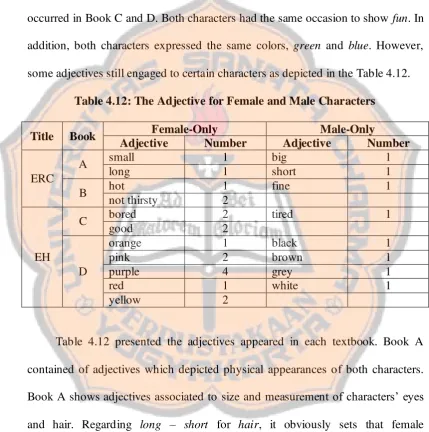
Table 4.11 The Adjective for Both Female and Male Characters ... 56
Table 4.12 The Adjective for Female and Male Characters ... 57
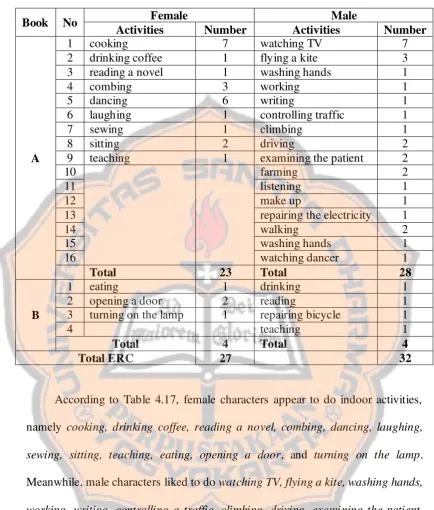
Table 4.13 The Activities for Female and Male Characters in ERC ... 61
Table 4.14 The Activities for Female and Male Characters in EH ... 65
Table 4.15 The Places in Female and Male Characters in ERC... 69
Table 4.16 The Places in Female and Male Characters in EH ... 72
x
LIST OF FIGURES
Figure 2.1 A framework of Course Development Process ... 12
Figure 2.2 Framework of Pre-understanding... 26
Figure 4.1 The Comparison of Female and Male Numbers in ERC ... 38
Figure 4.2 The Comparison of Female and Male Numbers in EH ... 40
Figure 4.3 The Comparison of Female and Male Firstness in ERC ... 42
Figure 4.4 The Comparison of Female and Male Firstness in EH ... 44
Figure 4.5 The Percentage of Occupations for Both Female and Male ... 46
Figure 4.6 The Comparison of Occupations for Female and Male Characters ... 49
Figure 4.7 The Unbalanced Activities for Both Female and Male Characters in ERC ... 59
Figure 4.8 The Unbalanced Activities for Both Female and Male Characters in Book C ... 63
Figure 4.9 The Unbalanced Activities for Both Female and Male Characters in Book D ... 64
Figure 4.10 The Comparison of Activities for Female and Male Characters... 67
Figure 4.11 The Unbalanced Places in Both Female and Male Characters in ERC ... 68
xi
ABSTRACT
Nugraheni, Ratnasari. 2016. Gender Awareness in English Textbooks for Elementary School. Yogyakarta: English Language Studies. Graduate Program. Sanata Dharma University.
In education, a textbook can be an agent of change towards certain ideology. As the interrelation between gender and education can be also a gateway to achieve equality, it means that a textbook can be media either to serve or break the stereotyping of female and male in society. Therefore, this study aims to analyze the level of gender awareness in English textbooks and to scrutinize the connection between the author‟s belief and design.
This study is a content analysis. The data were four English textbooks. Two English textbooks, entitled English for Real Communication (ERC), were published by Grasindo. The other two textbooks, entitled English Hooray! (EH), were published by Erlangga. This study employed purposive sampling in selecting the data. As a result, the chosen English textbooks were only for third and fourth graders. The purposive sampling was employed to select the units for analysis. Moreover, interview with the authors was conducted to obtain trustworthiness. In this case, two participants were chosen, the author of ERC and EH. Therefore, the instruments used in this study were table and interview checklists.
After analyzing the data, this study found that ERC still has low level of gender awareness while EH has medium level of gender awareness. Besides, the authors‟ beliefs influence the product of material design and thus the components in the textbook‟s design reveal the author‟s beliefs. The belief is connected with the authors‟ experiences which have been built for a long time. In addition, the other important finding is regarding some attempts to break the stereotyping in depicting female and male characters. It indicates that there is a chance to employ textbook as an agent of change. In this case, the change is to raise awareness upon gender. In conclusion, this study reveals that a textbook can be used as an agent of change the stereotyping related to gender, there is a chance that gender equality can be achieved through education.
xii ABSTRAK
Nugraheni, Ratnasari. 2016. Gender Awareness in English Textbooks for Elementary School. Yogyakarta: Kajian Bahasa Inggris. Program Pascasarjana. Universitas Sanata Dharma.
Di dalam dunia pendidikan, buku pelajaran dapat menjadi agen perubahan terhadap ideologi tertentu. Seperti yang sudah diketahui bahwa inter relasi antara ilmu pengetahuan akan gender dan pendidikan menjadi sebuah solusi untuk mencapai kesetaraan, hal ini mengandung arti bahwa buku pelajaran dapat menjadi sebuah media baik untuk memaklumkan atau mematahkan stereotipe sebagai perempuan dan laki-laki di masyarakat. Oleh sebab itu, penelitian ini bertujuan untuk menganalisa level kesadaran gender pada buku mata pelajaran Bahasa Inggris dan untuk memeriksa lebih jauh mengenai hubungan antara keyakinan penulis dan desainnya.
Penelitian ini merupakan analisis konten. Data dari penelitian ini berupa empat buah buku mata pelajaran Bahasa Inggris. Dua buku pelajaran yang berjudul English for Real Communication (ERC) diterbitkan oleh by Grasindo. Du buku lainnya yang berjudul entitled English Hooray! (EH) diterbitkan oleh Erlangga. Penelitian ini menggunakan teknik purposive sampling dalam memilih data. Hasilnya, buku pelajaran yang dipilih adalah buk pelajar untuk kelas tiga dan empat. Teknik pemilihan data ini juga digunakan untuk memilih unit yang akan dianalisa. Kemudian, wawancara dengan penulis buku mata pelajaran ini juga diadakan untuk mencapai kelayakan atau kredibiltas sebuah penelitian. Sehingga, dipilihlah dua partisipan, yakni penulis buku pelajaran berjudul ERC dan salah satu penulis buku pelajaran yang berjudul EH. Oleh sebab itu, instrumen yang digunaka pada penelitian ini adalah datar tabel and interview.
Setelah analisa dilakukan, penelitian ini menemukan bahwa ERC masih memiliki level kesadaran gener yang rendah, sedangkan EH memiliki level sedang. Disamping itu, keyakinan penulis terbukti mempengaruhi produk hasil desainnya dan komponen-komponen yang ada dalam desain tersebut mengindikasikan keyakinan penulis. Keyakinan ini berhubungan dengan pengalaman penulis yang sudah terbangun dalam urun waktu yang lama. Sebagai tambahan, penemuan penting yang lain berkaitan dengan beberapa usaha untuk mematahkan stereotipe dalam menggambarkan karakter perempuan dan laki-laki. Hal ini mengindikasikan bahwa ada sebuah kesempatan untuk menggunakan buku pelajaran sebagai salah satu agen perubahan. Dalam hal ini, perubahan yang dimaksud berkaitan dengan meningkatkan kesadaran akan gender. Kesimpulannya, penelitian ini membuktikan bahwa buku pelajaran dapat menjadi agen perubahan akan stereotipe terkait gender, hal ini berarti ada sebuah kesempatan untuk mencapai kesetaraan gender melalui pendidikan.
1
CHAPTER 1 INTRODUCTION
This chapter consists of five sections which expose to the rationale and purpose of the study. Those five sections are background of the study, problem limitation, problem formulation, research goals, and benefits of the study. The explanation of each section is presented as follows.
1.1 Background of the Study
Achieving gender equality remains unachieved, despite ages of struggle. Confined by its definition, “gender equality denotes women having the same opportunities in life as men, including the ability to participate in the public sphere.” (Reeves and Baden, 2000: 2). In this case, Reeves and Baden (2000) argue that it does not demand equality outcomes since the main goal is to remove the barriers of participation.
Moreover, gender equality issue also becomes more prominent when it has been discussed in many various fields (UNESCO, 2007, in Wu and Liu, 2015; Brugeilles and Cromer, 2009). In language and education field, the issue has been started since 1970s until now (Hartman and Judd, 1978; Porreca, 1984; Arliss, 1991; Rifkin, 1998; Lee and Collins, 2008; Bursuc, 2013; Toci and Aliu, 2013; Aydignolu, 2014; Wu and Liu, 2015).
They believe that education can decrease a gender gap. When students have already introduced and learned the gender equality in the school, the traditional stereotypes which label female and male are decreased as they understand the issue and knowledge earlier.
In education field, gender inequality can be detected through the use of classroom language, and teaching and learning material (Stockwell, 2003). The use of textbook as teaching and learning sources should be controlled since gender bias may appear in the textbooks. In this case, gender bias can be found in the use of names, illustration, and language.
In English education field, many scholars who are expert in linguistic and education fields have conducted a lot of interdisciplinary research related to the study of gender and education. Porreca (1984) conducts a content analysis research on sexism in ESL (English as a Second Language) materials. In that year, it becomes a great research since she examines 15 ESL textbooks from 27 ESL centers. Since her analysis are specific and detail, the other researchers replicate her research, such as Rifkin (1998), Dominguez (2003), Lee and Collins (2008), and Wu and Liu (2015).
investigate gender representation in the primary English textbooks which are used from 1978 to 2003 in China. As a result, it shows that gender bias is still maintained in the textbooks. Specifically, the results shows that female invisibility in texts and illustrations, gender stereotypes in occupational and domestic roles, and domestic and school activities, and inequality in utterances and instances of female and male firstness.
Damayanti (2014) analyzes gender representation in English textbooks in Indonesian context. However, her research is only specified in investigating the visual images in the textbooks. The results show that female characters are dependent. Moreover, they are also constructed to admire male actions. It means that English textbooks in Indonesia still have gender bias. Moreover, the textbooks are still perpetuating traditional stereotypes upon gender.
Besides, Gailea and Rasyid (2015) also conduct a study which analyzes gender representation in some English textbooks written by Indonesian and English authors. As a result, the English textbooks written by Indonesian authors still present gender inequality in the design. On the contrary, an English textbook written by English author presents gender equality in the design.
However, those studies have not explained whether those researchers also confirm their results with the authors of the textbooks or not. In fact, the confirmation can give more information on authors‟ beliefs regarding gender. It can depict whether authors‟ beliefs influence their designs or not.
Sumalatha (2004, in Toci and Aliu, 2013: 32) states that “textbooks are the
perspectives upon gender for children. Since children are in the developmental age, they can easily imitate some attitudes in their surroundings, especially imitating what they have studied in their textbooks. Thus, this current study is going to investigate gender awareness in English learners‟ textbooks for children in the elementary school.
1.2 Problem Limitation
Due to the time constraint, some limitations are considered in this study. First, the limitation is related to the number of the EFL textbooks. This study only analyzes four EFL textbooks. Two textbooks entitling English Hooray! are published by Erlangga. The other textbooks entitling English for Real Communication are published by Grasindo.
Second, the EFL textbooks are limited based on the grade. Two textbooks are used for the third graders. The other two textbooks are used for the fourth graders. The limitation is intended to conduct an efficient study since analyzing all textbooks from grade 1 to 6 is time consuming and exhausting.
Third, the analysis of text is only intended to the written texts appear in the textbooks. The spoken texts which are used to examine and practice students‟
1.3 Problem Formulation
This section presents the problem of the study. The problem is formulated in a research question. The question is what is the level of gender awareness in English Textbooks for elementary school?
1.4 Research Goals
The main purpose of this study is to find out the level of gender awareness in English textbooks for Elementary school through investigating the attributes which are used to depict female and male characters in the textbooks. Specifically, the attributes are described through the use of pronouns, nouns, and verbs in the textbooks. This information gives a big picture how gender awareness appears in EFL materials. Moreover, it leads to what authors‟ beliefs in designing the textbooks.
1.5 Research Benefits
This study provides some benefits both scientific and practical. The scientific benefit contributes on the ELS (English Language Studies) knowledge regarding gender awareness in EFL textbooks. Besides, it gives some implicative benefits to what extent beliefs influence authors in designing EFL textbooks. Thus, it exposes the way to achieve gender equality in designing EFL materials.
7
CHAPTER 2 LITERATURE REVIEW
This chapter consists of two sections of the literature review, namely theoretical review and theoretical framework. In the theoretical review, the researcher explains some theories employed in the study. Then, in the theoretical framework, the researcher depicts how those theories used to answer the research problem.
2.1 Theoretical Review
In this part, the researcher explains some theories employed in this study. There are gender, English textbook material, and author‟s belief. Those parts are
going to meticulously explain in this section.
2.1.1 Gender
Gender categorizes men and women based on their social roles and relations in community (Mlama et al., 2005). Eckert and McConnell-Ginet (2003) firmly state that gender is different from sex. According to them, sex determines a baby as a girl or boy since the baby is born. On the other hand, gender is related to “something we do (West and Zimmerman, 1987) and something we perform (Butler ,1990)” (Eckert and McConnell-Ginet, 2003: 10).
indicates that gender determines how a man and woman should possess or act based on the certain norm in community. Culturally, certain characteristics are assigned and adhered to a man and woman. Then, these characteristics will determine whether a person is acceptable or not in the community. Thus, Brannon (1996) concludes Unger‟s notion as “a social label and not a description of
biology” (p. 11). Those experts agree that gender differentiates a man and woman
in social context. Meanwhile, sex is based on reproductive functions of a man and woman.
The definitions of gender from feminist experts do not differ from those definitions above. In sociology, Candace West and Don Zimmerman (1987, in Crawford, 1995) mention the term „doing gender.‟ In psychology, feminist experts also speak the same term. „Doing gender‟ shows “how sex is a salient social cognitive category through which information is filtered, selectively processed, and differentially acted upon to produce self-fulfilling prophecies about women and men” (Crawford, 1995: 12).
From those experts‟ definitions, it can be inferred that gender and sex are different. Sex is related to biological characteristics which are given by God. Meanwhile, gender is associated to people‟s perspectives in community. It is a
2.1.1.1 Gender Awareness
Some experts have defined that gender and sex are separated. Yet, community still links them together as a unit. Eckert and McConnell-Ginet (2003) depict the notion in his book as follows.
In other words, gendered performances are available to everyone, but with them come constraints on who can perform which personae with impunity. And this is where gender and sex come together, as society tries to match up ways of behaving with biological sex assignments (p.10).
They explain that community treats people based on their sex differences. In order to do something, people are confined by their sex. It arouses an issue how an ideal man and woman should be. Thus, stereotypical gender role is created because of this issue.
Brannon (1996) defines that gender role is “like a script that men and women follow to fulfill their appropriate parts in acting masculine or feminine”
(p. 168). It shows that gender role forces men and women to act and be responsible for doing something without violating their social norms. Bursuc (2013) conducts research and finds that woman and men are portrayed in different ways. They are in charged by their gender roles. Women are responsible for undertaking domestic activities, raising children, doing housework, cooking, cleaning. Mlama (2005) agrees with Bursuc (2013). The most common example reflected in the society is that women are responsible for cooking while men are responsible for decision-making. It creates a general opinion in community that domestic work is women‟s work. Then, men are not appropriate to do so.
examined more. This becomes a great issue in community. Therefore, people generate gender awareness.
According to Mlama (2005), “gender awareness implies the ability to
identify problems arising from gender inequality and discrimination, even if these are not apparent on the surface” (p.2). It shows that inequality upon gender occurs
in community in many aspects. The gender awareness in this study is focused on an inequality between men and women which appears in the English textbooks.
2.1.1.2 Gender in Teaching and Learning Materials
Bandura (1986, in Brannon, 1996) describes two different things when children are exposed to gender-stereotypic behaviors in their activities. First, children learn behaviors to act as female and male. Second, children learn that certain behaviors are exposed to one gender only and not to another. Should children are in this situation, they do not deliberately learn gender role or stereotype. Bandura also adds that gender-stereotypic behaviors appear “in home, in schools, on playgrounds, in readers and storybooks, and in representations of society on the television screen of every household” (Brannon, 1996: 144).
Regarding Bandura‟s notion, Arliss (1991) argues that children should be
roles even in their early school experience, preschool. Both Arliss and Jones provide contention that teacher should not deliberately teach gender towards children. When teachers do it, they indirectly lead children to accept that as knowledge.
According to those expert‟s explanations, children are intended not to
learn gender role. The differences between men and female are aimed to know their sex or biological differences. When children are not exposed to female and male models in community, they become much more independent to determine their roles in community later.
Related to education, this issue also appears, especially, in teaching and learning materials. Specifically, it appears in the children‟s textbooks. In the
previous paragraph, Bandura mentions that readers or storybooks also appear as the agents which bring gender-stereotypic behaviors to children. Thus, textbooks as a tool to teach and learn should be free from stereotyping.
According to Stockwell (2003), people in teaching and publishing field have already considered to represent both female and male models in a balance way. Stockwell (2003) provides a leaflet entitle On Balance: Guidelines for the Representation of Women and Men in English Language Teaching Materials produced by group „Women in EFL Materials‟ (1991) to endorse the idea of
avoiding stereotypes in English textbook. It suggests that “to use inclusive
language and images which reflect a more balanced and accurate view of the world and of the present state of English” (2003: 85). It indicates that English
equality. Therefore, this study investigates gender representation in the English textbooks which are used for children.
2.1.2 English Textbook Material
In the previous section, the scientific reasons and importance of providing teaching and learning materials which should be balanced in representing women and men characteristics have been clarified. In line with those explanations, this section is going to explain the teaching and learning materials in English subject. Specifically, how English textbook as a product of material design is free from gender stereotyping.
2.1.2.1 English Textbook as a Product of Material Design
Designing a language course model is a complex task since many components should be considered. Graves (2000) mentions those components are assessment, content, materials, method, and evaluation. The relationship and position of those components are described in the figure 2.1.
The relationship between those components is equal. It means that a course designer can start from any stage from the framework. A course designer can start from „developing materials‟, „designing an assessment plan‟, organizing the course‟, „conceptualizing content‟, „assessing needs‟, or „formulating goals and
objectives‟. The direction of the process can be clockwise or counter clockwise.
No component is higher than others. All components have the same position as others. Hence, all components are considered important.
At the bottom of the flowchart, Graves (2003) provides the basis of the designing course process which are „defining the context‟ and „articulating
beliefs‟. „Defining the context‟ means the sense of designing a course depends on the designer beliefs and understandings. Meanwhile, „articulating beliefs‟ means
that how a course designer implements and interprets his/her beliefs in all components in the framework.
According to the framework, „developing material‟ is one of the essential
components to design a language course. Richard and Renandya (2002) classify materials into three categories, namely printed materials, non-printed materials, and materials that comprise both print and non-printed sources. In this study, the type of materials which is analyzes is printed materials. Specifically, the materials are in the form of books or usually called as textbooks. It can be inferred that an English textbook is one product of a language course design.
Hucthinson and Torres (1994, in Crawford, 2002) state that a textbook is “a possible agent for change” (p. 83). It means that a textbook can bring many
some ideologies. From this notion, Crawford (2002) adds that a textbook reflects author‟s beliefs and expectations upon the language and learning towards teacher
and learner. Hence, the idea which discerns a textbook as an agent of change is automatically associated with author‟s beliefs. Related to this study, a textbook
can change teacher‟s and learner‟s perspectives in social context. A textbook may
strengthen or weaken gender role stereotyping between women and men in community. Since a textbook may become an agent of change, it may alter the stereotyping towards male and female characters in a textbook.
2.1.2.2 Sexism in English Textbook
Sociolinguistics, the study of language which is associated with culture, depicts that a language can be sexist (Holmes, 2001). Sexism related to the use of language may stereotype men and women in society. Since language reveals attitudes of the society who speak the language, it builds attitudes stereotyping of women and men in society. As consequence, language discriminates woman and men both oral and written. Thus, it generates social inequalities between men and women through language.
According to Mills (2005), the use of sexist language may generate some effects. First, women feel alienated since men are frequently addressed in many occasions. Second, sexism may stereotype woman. Third, it may confuse audiences since an unidentified character is always addressed as „he‟. It can be
Regarding to this, she explains that sexism can appear in English language. She classifies the occurrences of sexism in English language in presenting generic „he‟, occupation, formal terms of address, familial terms, and sexual metaphors.
Sexism which appears in presenting generic „he‟ may isolate women. This kind of sexism mostly appears in written form. Arliss (1991) explains that an author chooses to use pronoun „he‟ in describing a referent pronoun which does not precisely depict male or female. After that, the possessive word „his‟ is used to describe a noun towards the character of „he‟. Other repercussion is the object of
pronoun „him‟ also tails to describe the pronoun „he‟. In most cases, pronoun „he‟ appears to mention a singular form of unspecified person. Instead of using „he‟ to mention an unspecified person, Arliss (1991) suggests author to use an alternative pronoun as „s/he‟. Although it may prolong a sentence, it can also give a tendency
that the author addresses both women and men.
Besides the generic „he‟ pronoun, most sexist cases appear regarding occupation. The labeling upon occupation is inherited from traditional perspectives towards women and men. Moreover, the language system which has been used and built for a long time strengthens the occupational label. In linguistic system, suffix –man and -er or –or are employed to certain root words in order to form a noun which describes someone‟s occupation, for instance, policeman,
legislator, or senator (Arliss, 1991). In real world, policeman, legislator, or senator is not only occupied by a man.
occupied by woman. It shows that language system is influenced by culture. Then, for children, a language system may build the system of their perspectives or values to what happen in the real world.
It cannot be denied that people still stereotype the occupation preferences for both women and men because of the assumption of this linguistics‟ system. Related to this issue, Arliss (1991) suggests that the use of gender-neutral language in occupation should be adjusted. Some occupational vocabularies have already been neutral, such as judge, law officer, and chairperson. Besides, some vocabularies also have female and male forms to indicate female and male occupations, such as actor/actresses and hero/ heroine (Holmes, 2001).
Other sexism in English language performs in addressing formal terms for men and women. Arliss (1991) explains that Mr. is employed to address a man in a formal way. Meanwhile, to address a woman, there are two terms used to show respect, namely Miss or Mrs. In tradition, Miss is used to address a single woman, while Mrs. indicates that the woman has already married. Both terms show her marital status. On the other hand, Mr. is addressed to both a single or married man.
This linguistic tradition discriminates a woman. The term Mrs. is used along with the surname of a women‟s husband. Meanwhile, Miss is followed with her
Sexism does not only happen within community, but also in family. Arliss (1991) classifies it as familial terms. As mentioned before, the term „old maid‟ is used to show an unmarried woman. Another name for her is spinster. This term is “to denote an elderly never-married woman and to connote an undesirable woman
who failed to find someone to marry her”. In real life, there is also a man
classified in this type called as bachelor. This term is to connote “a more
favorable image of an individual who chooses to remain single and could be married in the future if he wishes”. In fact, a woman also has many reasons to
remain single. She is not merely single because of failing to find a man.
Besides, the familial term also includes the term „housewife‟. Indeed, it sounds like one of the occupational terms. In the familial terms, the term „housewife‟ is related to how a woman describes in the family. She is usually
described as a housewife. This term depicts that a woman “does not work outside
of the home” (Arliss, 1991: 37). Indirectly, a woman is always positioned as a housewife who has to do all of the homework‟s jobs. Although a woman works
outside home, making sure all of the homework‟s jobs becomes her responsibility.
In fact, a man also does similar job as a housewife in the late days but there is no such term called as „househusband‟. It shows that a woman is insisted to be
responsible of homework‟s job because of this stereotyping.
Then, Arliss also mentions about sexual metaphors. In this case, Arliss (1991) explains that “metaphorical expression come and go in the form of slang
names, but the general trend toward describing females as edible objects an soft, cuddly animals remains a sharp contrast to male metaphors” (Arliss, 1991: 40). It
Particular metaphors are used for certain sex type. As food metaphors appear, they aim at describing a woman, for instance, „cupcakes‟ or „cookie‟, „dish‟ or „a feast
for the eyes‟, and „good enough to eat‟. Then, a man is described through animal
names which are considered bigger, stronger, and more sexually mature, for example, lions, rams, bulls, and bears.
When Arliss (1991) explains sexist language in general, Porreca (1984) has already investigated sexism used in the ESL materials, specifically in ESL textbooks. She analyzes sexism which appears in text and illustration of the textbooks. Based on her research, she categorizes sexism language which appears in the ESL textbooks into omission, firstness, occupations, nouns, masculine generic constructions, and adjectives.
In the omission, the ratio between female and male is counted before and after subtracting the apparent number of amounts of masculine generic constructions. The aim is to have a real depiction of the ratio since the masculine generic constructions‟ case appears afterwards. Thus, it can become an initiated
picture to determine a textbook is sexist or not.
After knowing the ratio of female to male in general, firstness is done to know which character comes first in exercises, examples, or sentences. It is to see whether female or male comes first. The information form the firstness can indicate the author‟s beliefs upon gender. However, Porreca (1984) insists that
this category cannot be the only gauge to judge. It means that a context is also considered.
Regarding occupations, Arliss (1991) seems to adapt Porreca‟s (1984) term
case, the occasion of occupational roles which are portrayed both for women and men are counted. Still, the quantity is only to present the differences. The most important thing is how both woman and man are depicted or stereotyped in the textbook.
Then, sexism appears in the textbook can abe detected through the use of noun which designs the character of a woman or man. Porreca (1984) analyzes which noun used to depict a woman and man at most. Thus, she can determine whether the noun is stereotyping the character or not.
Next, a masculine generic construction category decides the final ratio of woman and man in the omission category. A masculine generic construction category in Porreca (1984) is similar to Arliss‟ (1991) category in presenting
generic „he‟. A traditional linguistic system uses masculine generic construction in describing unidentified character. Indeed, it may refer to a woman, man, or mix group. It shows that masculine generic construction are confusing, to whom a pronoun refers to. Moreover, it alienates a woman‟s existence since audiences may directly refer a character as a man.
descriptive such as rich and poor. The eighth type is rapport or reputation such as great and unpopular. The ninth type is normality or deviance such as normal and strange. The tenth type is ability such as capable and incapable. The last type is environmentally induced such as lucky and restricted.
After some decades, Porreca‟s (1984) research inspires and is replicated by many researchers. One of them is Dominguez (2003). She evaluates gender representation in Jack C. Richards‟ book entitle New Interchange Intro (Student
Book) which is published by Cambridge University. She finds that the male and female ratio is equal. What makes her research different with Porreca (1984), she categorizes the „amount of male and female talk‟. In this case, she focuses on the
issue whether a woman talks more than a man or not. Moreover, she wants to see some interactions among fefemale, female, female, and male-male. Besides, she also evaluates gender representation in the illustration in the textbook. She categorizes it as „male and female in illustration‟. She analyzes
through investigating the contemporary fashion appears in the illustration. Then, the leading roles are also analyzed since it may give some information whether both sexes are equal or one sex is dominating another sex. Still, occupational role is also considered in this category. Moreover, the context of conversation is investigated to see what topic and the background settings are.
Besides, Rifkin (1998) also employs Porreca‟s research as one of the driven
Lee and Collins (2008) adapt some theories of sexism from Porreca (1984). However, they do not directly categorize their results into Porreca‟s category. Instead, they use their own classification. Yet, the content of classification is almost the same. Their research is similar to Dominguez (2003), but more complete. In addition, they also include theory of sexism which is similar to Arliss (1991). It appears when they are discussing female and male social and domestic roles. It seems like they analyze the occupational and familial terms. They also investigate the title uses to certain character. The title, in this case, is the same as the „formal terms of address‟ category in Arliss (1991).
The new category which has not been mentioned in the other previous research is „the female and male semantic roles‟. They adapt the theory proposed
by Lock (1996) and Halliday (2004, in Lee and Collins, 2008) regarding systemic-functional concept of transitivity. In the categorization, they focus on semantic categories of „participant‟ and „process‟. Lee and Collins (2008) explain that
“participants (the people and things involved in the situation) are expressed grammatically by nouns and noun phrases” (p. 13). Meanwhile, “processes (the
actions and states in which the participants engage) are expressed by verbs and verb phrases” (Lee and Collins, 2008: 14).
The domestic activities of adults include the ratio and number of domestic activities executed by women and men. The context of the activities is in the family. Based on their research, a woman performs activities which stereotype her, such as receiving visitors, ironing, and serving drink. Some activities which are performed by a man are watching television, coming home after work, and taking daughter to zoo. Both women and men perform some activities such as drinking water, phoning, and visiting a teacher.
Meanwhile, the school activities of children include the ratio and number of school activities performed by boys and girls. The setting of the activities happens at school. For boys, the activities‟ examples are playing football, coming late to
the school, and fighting in the library. For girls, the activities are rope skipping, making blackboard newspaper, and secretly eating snack in class. Some activities which are both performed by boys and girls are studying, playing hide and seek, and drawing.
In line with the previous theories, Stockwell (2003) also agrees that stereotyping in both sexes should be avoided. In his book, Stockwell (2003) provides information which is derived from the guideline to write ESL materials by considering gender representation. To apply this idea, there are some categories used to consider such as avoiding stereotype and false generic „man‟.
To avoid stereotyping, Stockwell (2003) suggests that an author should consider characters presented in the text, dialogue, recordings, and illustrations. An author of EFL materials can put some considerations by asking her/himself some questions related to the characters such as,
instructing, leading, and rescuing?; being instructed, led, and rescued?; displaying self-control?; responding emotionally?; being string, capable and logical?; being uncertain and in need of reassurance?; being powerful and able to deal with problems?; being inept and defeated by problems?; belonging to arrange of emotional types?; starting dialogues?; and making arrangements? (Stockwell, 2003: 85).
Meanwhile, related to generic „man‟, the issue is similar to other experts.
Stockwell (2003) argues that the generic „man‟ use does not represent the mental
images of both sexes. Otherwise, it depicts the mental image of a man first since the context may come afterwards. To avoid false generic „man‟, an author can
change the generic „man‟ into more neutral words. It means that a word can
represent both sexes such as people for mankind, work force for manpower, person-to-person for man-to-man, artificial for man-made, executive for businessman, chairperson for chairman, fire fighter for fireman, and leader for statesman.
2.1.3 Author’s Belief
In section 2.a., author‟s belief has been introduced in short. The author‟s
belief is one of the basic components in designing an English textbook (Graves, 2000). The way author articulates their beliefs influences the content material in the textbook. Those beliefs can be detected through the use of language. Moreover, images as a part of illustration also take into accounts since images can bring the referent to accelerate students in learning the language.
Grave‟s theory upon beliefs is mainly influenced from Stern‟s (1991) concepts
upon language, society, language learning, and language teaching.
First, Graves‟s (2000) theory upon social context is adapted from Stern‟s
(1991) theory of society which consists of sociolinguistic, sociocultural, and sociopolitical. Sociolinguistic issues bridge language and social context in that they are concerned with how language is adapted to fit (or not) the social context. Sociocultural issues are concerned with the interaction between language and culture. They include different dimensions of culture such as values (e.g. gender differences), attitudes (e.g. towards roles of men and women), norms (e.g. ways of greeting, eating), customs (e.g. marriage customs), and products (e.g. literature and arts). Sociopolitical issues are concerned with how a given language or social group (ethnic, gender, etc.) is viewed by other social groups, access to language and services, and also a critical awareness of how language is used.
Second, belief upon language (Grave, 2000) refers to the concept upon language. In this case, Stern (1991) reinforces the nature of language. Related to language, the investigation should be conducted in the level of speech sounds (in phonetics and phonology), words (lexicology, semantics, and morphology), sentences (in syntax), meaning (in semantics), and text, narrative, poem (in discourse analysis).
Third, belief upon learning in Graves (2000) adapts the concept of language learning in Stern (1991). This belief insists that the English design should count on the learner‟s differences and the processes of language learning. In the learner
auditory, and so on. Meanwhile, the learning process is classified into an inductive and deductive learning process.
The last, belief upon teaching from Grave (2000) is adapted from Stern‟s (1991) concept upon language teaching. In this case, the belief is closely related to teacher. However, students involve in deciding the method of teaching, knowledge, and skill.
2.2 Theoretical Framework
EFL textbooks have some roles in English teaching and learning. The first role is EFL as a supporting media in the classroom‟s activities. The second role is
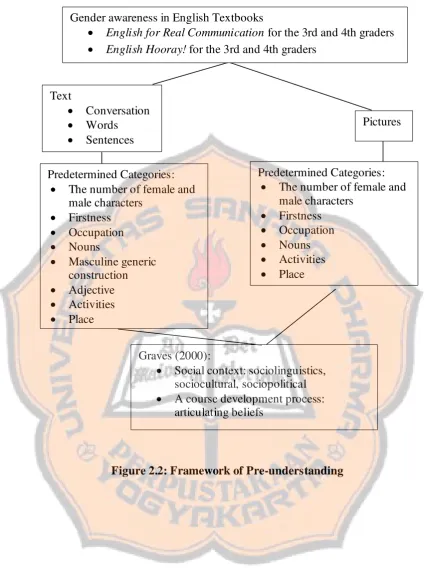
EFL as an agent of change. It indicates that the role of EFL textbooks is essential. Since this study is related to gender awareness and education, it focuses on how gender awareness appears in the content of the English textbook as illustrated in the attributes of the male and female characters. To answer research problem, the researcher adapts some theories proposed by Arliss (1991), Porreca (1984), Rifkin (1998), Stockwell (2003), Lee and Collins (2008), and Wu and Liu (2015). Then, to confirm whether the author‟s beliefs influence the design or not, the current study employs Graves‟ theory using social context namely,
Figure 2.2: Framework of Pre-understanding Gender awareness in English Textbooks
English for Real Communication for the 3rd and 4th graders English Hooray! for the 3rd and 4th graders
Text
Conversation Words Sentences
Pictures
Predetermined Categories: The number of female and
male characters Firstness Occupation Nouns
Masculine generic construction Adjective Activities Place
Predetermined Categories: The number of female and
male characters Firstness Occupation Nouns Activities Place
Graves (2000):
Social context: sociolinguistics, sociocultural, sociopolitical A course development process:
27 CHAPTER 3
RESEARCH METHODOLOGY
This chapter mainly describes the logical truth of the study. In order to achieve the highest level of the truth, all things associated with the systematic means of the study are going to meticulously demystify. Thus, this chapter provides some sections, namely research method, nature of data and sources, instruments, research setting, data collection, data analysis, and triangulation.
3.1 Research Method
The current study aims to expose how gender awareness appears in the EFL (English as a Foreign Language) textbooks. To disclose the gender awareness in the EFL textbooks, this study examined the attributes used to depict female and male characters in the textbooks. Particularly, the attributes are defined through the use of pronouns, nouns, and verbs which describe the characters.
The number of occurrences of those components is counted to see whether the EFL textbooks considered the gender awareness or not. It can be inferred that the data were dealt with numbers. It can be categorized as numerical data, dealing with the numbers of words. Thus, the appropriate method employed in this study was content analysis.
textbooks. Meanwhile, the image communication referred to illustration which stereotyped female and male characters in society.
Moreover, Cohen, Manion, and Morisson (2007) explain that content analysis is a process of summarizing and reporting written data, including with and their messages. In this case, the content messages which were investigated were whether the English books stereotype the female and male characters. It was in line with the purpose of content analysis in education field suggested by Ary, Jacobs, Sorensen, and Razavieh (2010), to analyze bias, prejudice, and propaganda in a textbook.
3.2 Nature of Data and Sources
The object of this research is EFL textbooks. Since there are many EFL textbooks, data criteria in choosing the textbooks are decided. To obtain meaningful data, purposive sampling was chosen. According to Gray et al. (2007), purposive sampling is “the researcher purposely selects certain groups or
the national scope and the book series addressed for grade 1 to 6 were written by the same author in each publisher.
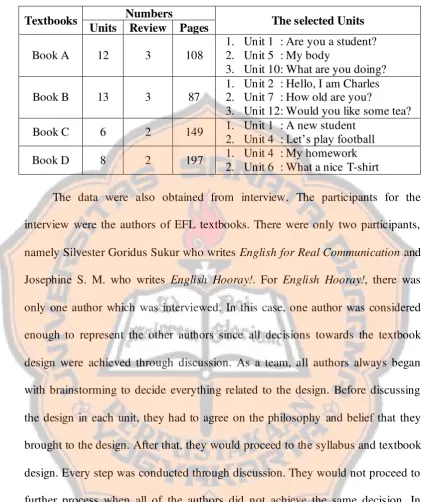
Moreover, the English textbooks contained adequate attributes for female and male characters to address gender awareness. Besides, the textbooks for grade 3 and 4 were selected in each publisher since the researcher wanted to make a sample for the textbooks inside and outside curriculum. It is because English subject is only obliged for grade 4 to 6 in curriculum 2013. The English textbooks for grade 3 and 4 which were published by Grasindo will hereafter be called as „Book A‟ and „Book B‟. Other textbooks for grade 3 and 4 which were published by Erlangga will hereafter be called as „Book C and D‟.
Table 3.1: The Selected Sample Data
Textbooks Numbers The selected Units
Units Review Pages
Book A 12 3 108
1. Unit 1 : Are you a student? 2. Unit 5 : My body
3. Unit 10: What are you doing?
Book B 13 3 87
1. Unit 2 : Hello, I am Charles 2. Unit 7 : How old are you?
3. Unit 12: Would you like some tea? Book C 6 2 149 1. Unit 1 : A new student
2. Unit 4 : Let‟s play football
Book D 8 2 197 1. Unit 4 : My homework
2. Unit 6 : What a nice T-shirt
3.3 Instruments
The instrument used in the study was the researcher since the researcher was the one who made coding and categorization. According to Ary et al. (2010), the primary instrument used for content analysis is the researcher himself or herself. However, to make the results of the study objective, other instruments used were table and interview checklists. The table checklists were built based on the construct map (See Chapter II) of the current study. The interview checklists were used to interview the authors in order to obtain more valid and richer data.
3.4 Research Setting
The study was conducted from December 2015 to March 2016. The first data collection using table analysis was conducted around Sanata Dharma University from December 2015 to February 2016. Then, the second data collection through interview was conducted on 25 May 2016 at Elti Gramedia and 2 June 2016 at Josephine‟s house.
3.5 Data Collection
According to Mayring (2004, in Cohen et al., 2011), content analysis is systematic and verifiable in its use of codes and categories, as the rules for analysis are explicit, transparent and public. Based on the notion, the data were collected through codes and categories which were decided based on the construct map.
[image:46.595.85.514.221.610.2]communication content, defining the content to be analyzed, sampling the universe of content, select units for coding, developing a coding scheme, assigning each occurrence of a unit in the sample to a code in the coding scheme, counting occurrences of the coded units and report their frequencies.
[image:47.595.88.517.235.750.2]To make all things clear, the tables were designed to categorize the data. The example is presented as follows,
Table 3.2: The Percentage of Female and Male Characters
Unit Female Male Both Unidentified
Total
Table 3.3: Components to Analyze Attributes
Category Textbook A Textbook B Textbook C Textbook D
F M F M F M F M
The number of female and male characters
The percentage of female and male characters
Firstness The percentage of female and male characters
Occupation doctor, driver, soldier, scientist, nurse, farmer teacher, seller, worker
Noun doll, car, ball, Masculine
generic construction
mankind, manpower, man-to-man, man-made, businessman, chairman, fireman, statesman, etc.
Adjective 1. Physical appearance: tall and beautiful 2. Intellectual or education: bright and stupid 3. Emotionality or state of mind: sad and calm 4. Physical state or condition: strong and tired 5. Personality traits: friendly and disagreeable 6. Age: old and young
7. Environmentally descriptive: rich and poor 8. Rapport or reputation: great and unpopular 9. Normality or deviance: normal and strange 10.Ability: capable and incapable
Category Textbook A Textbook B Textbook C Textbook D
F M F M F M F M
Activities watching television, coming home after work, and taking daughter to zoo, receiving visitors, ironing, and serving drink, playing football, coming late to the school, and fighting in the library, studying, playing hide and seek, drawing, etc.
Place library, school, hospital, police office, etc.
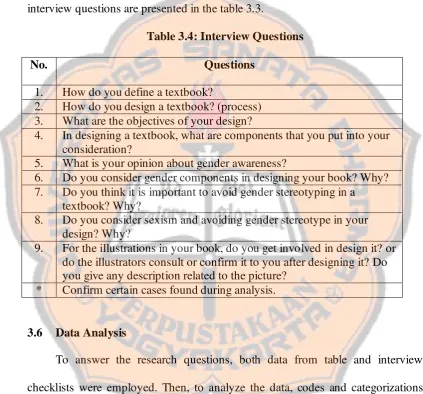
[image:48.595.86.510.224.618.2]Moreover, the interview was also employed to clarify and obtain richer data. The interview questions are presented in the table 3.3.
Table 3.4: Interview Questions
No. Questions
1. How do you define a textbook?
2. How do you design a textbook? (process) 3. What are the objectives of your design?
4. In designing a textbook, what are components that you put into your consideration?
5. What is your opinion about gender awareness?
6. Do you consider gender components in designing your book? Why? 7. Do you think it is important to avoid gender stereotyping in a
textbook? Why?
8. Do you consider sexism and avoiding gender stereotype in your design? Why?
9. For the illustrations in your book, do you get involved in design it? or do the illustrators consult or confirm it to you after designing it? Do you give any description related to the picture?
* Confirm certain cases found during analysis.
3.6 Data Analysis
and noun. However, the primary data were only from table checklist. The interview checklists were only supporting data to make the study more valid.
3.7 Triangulation
To make this study valid and reliable, triangulation was employed to make emerge trustworthiness. “Triangulation may be defined as the use of two or more
35
CHAPTER 4
RESULTS AND DISCUSSION
This chapter discusses an answer of the research problem. It consists of two sections, namely results and discussion. In the results section, the data in each book are presented and depicted thoroughly. In the discussion, the data are interpreted based on the underlying theories.
4.1 Results
In order to understand the data analysis better, this section presents the results in the form of table and then the narrative explanation is following. The results are based on the text and picture in English textbooks for third and fourth graders published by Erlangga and Grasindo, henceforth, called as Book A, B, C, and D (see chapter III). Book A and B are published by Erlangga. Then, Book C and D are published by Grasindo.
As explained previously, the data of the four textbooks are presented in Table 4.1.
Table 4.1: The Textual and Pictorial Data of the Textbooks
Book Unit
Textual Data
Pictorial Data Conversation Sentence
Word Token
A 1, 5, and 10 20 194 56 116
B 2, 7, and 12 48 110 23 36
C 1 and 4 13 114 28 43
D 4 and 6 25 156 89 119
The three units in Book A cover textual data containing of 20 conversations, 194 sentences, and 56 words. It should be understood however that Unit 1 does not include conversations and sentences and as it only includes words. Whereas, Unit 10 does not include sentences and words as it only includes conversations.
The pictorial data depicting female and male characters were 116 items. In Book B, the textual data were 48 conversations, 110 sentences, and 23 words. The pictorial data were 36 items. Meanwhile, in Book C, the textual data were 13 conversations, 114 sentences, and 28 words. The pictorial data were 43 items. In Book D, the textual data were 25 conversations, 156 sentences, and 89 words. The pictorial data were 119 items.
4.1.1 The Number of Female and Male Characters
The numbers of female and male characters for textual data derives from name and pronoun of both characters in written texts. On the other hand, textbook‟s illustrations entailing female and male characters become a source for
the pictorial data. Both data become bases to determine the numbers of female and male characters in each textbook.
In order to achieve effective results, the books under the same title will be presented into one table and figure. Moreover, one title also represents the author(s)‟s perspectives towards gender since one title is designed by the same author(s). For that reason, English for Real Communication (henceforth ERC) represents Book A and Book B. Then, English Hooray! (henceforth EH) represents Book C and D.
The first table in the following demonstrates the number of female and male characters in ERC.
Table 4.2: The Number of Female and Male Characters in ERC
Book Unit Female Male Total
Numbers Percentage Numbers Percentage
A
1 76 45% 93 55% 169
5 33 44.6% 41 55.4% 74
10 94 48.7% 99 51.3% 193
Total A 203 46.6% 233 53.4% 436
B
2 78 59.1% 54 40.9% 132
7 72 65.5% 38 34.5% 110
12 45 54.9% 37 45.1% 82
Total B 195 60.2% 129 39.8% 324
Total ERC 398 52.4% 362 47.6% 760
presenting that female characters had 398 occurrences and male characters had 362 occurrences. It can be stated that female characters often appeared than male characters. However, it does not generalize the trend in each book, notably in each unit. Therefore, in order to discern an obvious comparison between both characters, the percentages of both characters are depicted in Figure 4.1.
Figure 4.1: The Comparison of Female and Male Numbers in ERC Table 4.2 and Figure 4.1 show that the number of male characters in Book A was higher than female‟s. Totally, the number of male characters was 203 (46.6%), while the number of female character was 233 (53.4%). The trend of female and male characters‟ numbers in Book A was slightly the same as the trend
occurring in each chapter (see Appendix A), showing that the numbers of male characters were higher than female.
Figure 4.1 also shows that the difference between female and male characters in each unit was still tolerable. The biggest difference was only 10.8% (8 characters), as seen in Unit 5. Totally, the difference between female and male characters in Book A was 6.8% (30 characters).
The results in Book B are different from the results in Book A. In this book, the number of female characters was higher than the male‟s. The total number of
45 44,6 48,7 46,6
59,1 65,5
54,9 60,2 52,4 55 55,4 51,3 53,4
40,9
34,5
45,1 39,8 47,6
0 10 20 30 40 50 60 70
female characters reached 195 (60.2%), whereas the number of male characters touched 169 (39.8%). The difference was obvious, which was 20.4% (26 characters). It was the same as in each unit. The smallest difference was 9.8% (8 characters), emerged in Unit 12. Then, the biggest difference was 31% (34 characters), occurred in Unit 7. Surprisingly, the number of female characters in Unit 7 was almost the double of male‟s number.
Generally, the data in Book A and Book B show that one character has higher number than another in each chapter and as a whole. Book A shows male characters having higher numbers, meaning that male characters appear more than females. Since the differences are still tolerable, it means that female and male occurrences upon name, pronoun, and picture are almost equal. Then, in Book B, the trend is the inverse of the trend in Book A, meaning that female characters have higher numbers in each unit. However, the difference in Book B cannot be articulated the same as in Book A. Book B presents that the difference was obvious, meaning that female characters appear frequently.
EH also shows interesting results as well as ERC. Table 4.3 presents the number of female and male characters in Book C and D or under the title EH.
Table 4.3: The Number of Female and Male Characters in EH
Book Unit Female Male Total
Numbers Percentage Numbers Percentage
C
1 76 43.4 99 56.6 175
4 104 51.7 97 48.3 201
Total C 180 47.9 196 52.1 376
D
4 101 50% 101 50% 202
6 82 44.6% 102 55.4% 184
Total D 183 47.4% 203 52.6% 386
Table 4.4 shows that the number of female and male characters in EH almost seems equal, the same as in ERC in general. The number of female characters was 363 (47.6%), less than male‟s. Meanwhile, the male characters had 399 (52.4%) occurrences. To discern a vivid comparison in every unit in each textbook, Figure 4.2 illustrates the difference in percentage.
Figure 4.2: The Comparison of Female and Male Numbers in EH Figure 4.2 confirms that the numbers of female and male characters in both in Book C and D are almost equal. The height of all charts did not touch 60%. In addition, the differences of both textbooks were not high. Book C had 4.2% (16 characters in difference, while Book D had 5.2% (20 characters).
Figure 4.3 also points out that Unit 4(d) has an interesting result. In this case, the numbers of female and male characters in one unit were the same. The number of female character was 101 as we