Original scientific paper Accepted 30. 06. 2009.
G
UNTER
W
EISS
A
NA
S
LIEPˇ
CEVI´
C
Osculating Circles of Conics in
Cayley-Klein Planes
Osculating Circles of Conics in Cayley-Klein Planes
ABSTRACT
In the Euclidean plane there are several well-known meth-ods of constructing an osculating (Euclidean) circle to a conic. We show that at least one of these methods can be “translated” into a construction scheme of finding the osculating non-Euclidean circle to a given conic in a hyper-bolic or elliptic plane. As an example we will deal with the Klein-model of these non-Euclidean planes, as the projec-tive geometric point of view is common to the Euclidean as well as to the non-Euclidean cases.
Key words: Cayley-Klein plane, elation, pencil of conics, osculating circle, curvature centre
MSC 2010: 51N30, 51M15, 53A35
Oskulacijske kruˇznice konika u Cayley-Klein-ovim ravninama
SAˇZETAK
U euklidskoj ravnini postoji nekoliko dobro poznatih metoda konstrukcija oskulacijske kruˇznice konike. Cilj je te konstrukcije “translatirati” u neke od neeuklid-skih ravnina. U ˇclanku se daje op´ca konstrukcija osku-lacijske kruˇznice konike zadane s pet elemenata u euklid-skoj ravnini. Pokazuje se da je konstruktivna metoda pri-mjenjiva u hiperboliˇckoj i eliptiˇckoj ravnini. Budu´ci da je projektivno geometrijsko glediˇste zajedniˇcko euklidskom i neeuklidskim sluˇcajevima, analogne se konstrukcije koriste na Klein-ovim modelima neeuklidskih ravnina.
Kljuˇcne rijeˇci: Cayley-Klein-ova ravnina, elacija, pramen konika, oskulacijska kruˇznica, srediˇste zakrivljenosti
1
Preliminary Remark
Although the problem of constructing an osculating circle at a point of a conic seems to be anachronistic in times of numerical approximation tools, knowledge about ex-act constructive methods is not at all obsolete, particularly since these methods are uniformly applicable. Beyond that, with the following projective geometric constructions of osculating circles, we place particular emphasis on syn-thetic argumentation, which is typically for geometry. Un-fortunately Projective Geometry and Non-Euclidean Ge-ometry in the sense of F. Klein does not have much space in nowadays Mathematics education such that valuable Ge-ometry culture is in danger of vanishing. Our article might perhaps help to counteract these facts. The paper is also to be posed into the series of articles of classical Projec-tive and Non-Euclidean Geometry initiated by the second author, see [5] - [8].
It is hard to say, how “well-known” the presented consid-erations are; they could be for example exercise material to lectures on classical Projective Geometry and not consid-ered to be valuable enough to be published. To our knowl-edge lectures with related content still exist in Vienna (H.
Stachel, H. Havlicek) and Graz (J. Wallner, O. R¨oschel), where they still belong to the syllabus in teachers educa-tion in Descriptive Geometry.
2
Euclidean Osculating Circles of Conics
We start with “permissible standard givens” of a conic in the Euclidean plane, i.e. from pair of conjugate diameters AC , BD of an ellipse, from a pair of line elements(A,tA), (B,tB)of a parabola and from a pair of asymptotes(r,s)
and a point A of a hyperbola. The problem is to find the osculating circle at the given point A.
In geometry courses for engineers one usually presents the construction recipe for the hyperosculating circles at the vertex of the conic; in lectures on differential geometry for Mathematicians this recipe is also presented and the analytic equality of 4thorder is proved by calculation in each of the three cases. But for all three cases there is a uniform projective geometric idea for the solution of this (more general) problem. This idea uses properties of oscu-lating resp. hyperoscuoscu-lating pencils of conics. This unified explanation of elementary construction of hyperosculating
circles at vertices of a conic might be not new, but it is, in our opinion, not at all so well-known as it is worthy to note.
In addition, the construction principle deduced from it can be used for all Cayley-Klein geometries, as it is shown in the following chapter only for the hyperbolic and the quasi-hyperbolic geometry (which is the dual geometry to the pseudo-Euclidean geometry) as an example.
Specifically, the construction follows two steps:
Step 1: Transform the given conic c by the standard shear transformationσ1: c→c0into another conic c0, which os-culates c at the point A, and has A as a vertex. The axis of the shear therefore is the tangent tA in A. As all elations with the center N on tA, this shearσ1maps the given conic c into c0which osculates the conic c at A. The osculating circle of one is also osculating circle for the other one. Step 2: Construct the hyperosculating circle kAof the conic c0at A=A0. For this one can use an additional elationσ2 which also has tAas its axis, but the center A and it should map c0 into a hyperosculating conic c00. By demanding c0 7→kA the transformation σ2 is uniquely defined; σ2 transforms the point B0 of the osculating conic c0 (in the case of an ellipse this is a “neighbouring” vertex, in case of a hyperbola one of the asymptote’s ideal point “at infin-ity”, in the case of a parabola it is the additionally given point) into the point B00of kA. The normal from the (fixed) point T=T0=T00∈tA(T=tA∩tB=tB0∩tB) to the chord AB00=AB0of circle kAtherewith passes through the center MAof kA.
The following figures (Figures 1-3) show the construction costs, which in each of the three cases needs only a few lines.
Elliptic case (Figure 1)
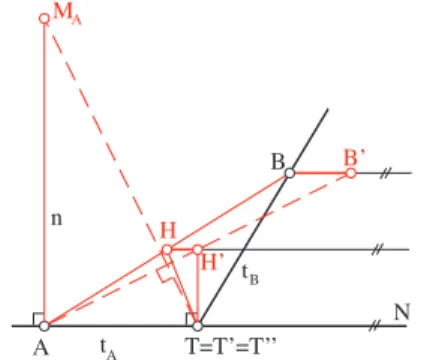
The point A is transformed into the vertex of an ellipse c0 by the shearσ1: c→c0 (tangent tA at A is the axis of σ1). Furthermore, σ2: c0→kA with the same axis, but with center A, transforms a “neighbouring” vertex B0of c0 into the point B00 of kA. The line through the fixed point T =T0=T00on tAperpendicular to the chord AB00=AB0 of the osculating circle kA intersects the normal n of the conic c given at the point A in the center MAof kA. Parabolic case (Figure 2)
The shearσ1: c→c0(axis is the tangent tAat A) transforms the point A into the vertex of a parabola c0, which osculates c. The midpoint H of the chord AB, together with the point T :=tA∩tB, defines the diameter direction of the conic c, and therefore is mapped into the point H0on the line nor-mal to tA at T . Forσ2: c0→kA(the center is A) the line AH0is a fixed line; it contains the point B00=σ2(B0)of the hyperosculating conic kA. The line through the fixed point T =T0=T00perpendicular to the chord AB00=AH0of kA passes through the sought-after curvature center MA. Hyperbolic case (Figure 3)
At first we construct the tangent tAat the point A, (A is the midpoint of the tangent segment between the asymptotes). By a suitable shearσ1one can transform the point A into the vertex of the hyperbola c0whose asymptotes are r0and s0and the center is M0. The elationσ2: c0→kAwith center A transforms the ideal point R0=B0of the asymptote r0of the conic c0into the point B00of the hyperosculating conic kA. Therefore, the line through the fixed point T on the tangent tAperpendicular to AB00=AB0passes through the common curvature center MAof the conics kA, c0and c. As AB0is parallel to r0, one only needs to draw the perpendic-ular line to the asymptote r0=M0T at the point T .
MA B’’ B’ H’ kA C D H B n A T=T’=T’’ tA B t N MA B’ H’ H B n A tA T=T’=T’’ B t N s’ r’ M’ MA s r R’=B’ M n A T=T’=T’’ tA N R
Figure1: Construction of the center MAof the osculating circle kAat the endpoint A of one of the given con-jugate diameters of the ellipse c.
Figure 2: Construction of the center MAof the osculating circle kAat the point A of the parabola c given by two line elements(A,tA),(B,tB).
Figure 3: Construction of the cur-vature center MA at the point A of the hyperbola cgiven by the pair of asymptotes(r,s)and the point A.
Remark 1 Of course, there are other nice constructions of the Euclidean curvature circle at the point of a conic, too. We want to mention the one found in [1], which is based on the differential geometric investigations and goes as follows:
“Choose two points P,Q on tangent tA symmetric to A,
draw the tangents from P and Q to the given conic c, re-ceive the contact points P0 and Q0. The normals p and q to the cords AP0and AQ0intersect the normal n in A in the points MPand MQ. Then MAis the midpoint of the segment (MP,MQ). Also this construction could be transformed to
CK-planes.”
3
Curvature Centres of Conics which are
Given by General Data in CK-planes
In the preceding chapter we started with affine-special given data of a conic. Now we choose a projective-geometric system of data defining a conic:
Let a conic c be given by two line elements(A,a),(B,b)
and a point C in a (real) projective planeπequipped with an “absolute (regular or degenerated) polarity”π⊥. (The planeπtogether withπ⊥is therewith a Cayley-Klein plane, in short a CK-plane.)
These specifications of the conic c can easily be derived from all other given data, which define conic uniquely, by applying the theorems of Pappus-Pascal and Brianchon, see [2]. These givens are also appropriate for the analytic treatment of the conic, as they can be interpreted as a pro-jective coordinate system.
Viaπ⊥the place of action is a projective plane with an or-thogonality structure “⊥” and a concept of circles in the sense of Cayley-Klein; it is therefore a “projectively ex-tended non-Euclidean plane”, a CK-plane, see e.g. [3]. Among these CK-planes we want to exclude the so-called isotropic planes (see e.g. [4]) from further considerations, because their orthogonality structure⊥is too degenerated. These CK-planes are treated separately in [7]. It turns out that for degenerated absolute polarityπ⊥one could “swap” the two steps described in chapter 2: At first one constructs the hyperosculating parabola c0at the point A of the given conic c in the isotropic planeπwith absolute point
I
at the ideal line u. This can be done with an elation with center A and axis a. Next, the parabola c0is transformed into the isotropic circle k with ideal pointI
using the shear with axis a.In the last chapter, it will be shown that in some cases of CK-planes with degenerate absolute polarity one can easily find simplier constructions using one single elation alone. The problem is to construct the curvature center MAat the point A of the given conic c. (For the sake of simplicity we
visualise again the Euclidean case in Figure 4, i.e. “⊥” and “circles” allow an elementary geometric interpretation.) Step 1: determine the normal n of the conic c at the point A with respect to⊥; i.e. one needs to construct the “absolute conjugate line” n to the given tangent a of the conic c at A with respect toπ⊥. The absolute pole N of the normal n is a point of a and it has to be used as the center of an elation σ1: c→c0 with axis a. One still needs a related pair of points to define elationσ1uniquely.
Step 2: the construction of a conic point D on the (fixed) collineation ray on BN using the theorem of Pappus-Pascal. (Naturally, it would be the same, if we constructed the point E∈c on the collineation ray CN.) In Figure 4 the necessary lines are shown:
D :=BN∩AP, whereby, P :=BC∩ (a∩b)∨(BN∩AC)
.
Step 3: determination of the 4th harmonic point H to N with respect to the pair(B,D)on line BN. This point H
shall be related to H0:=n∩BN inσ1and nowσ1: c→c0 is uniquely determined.
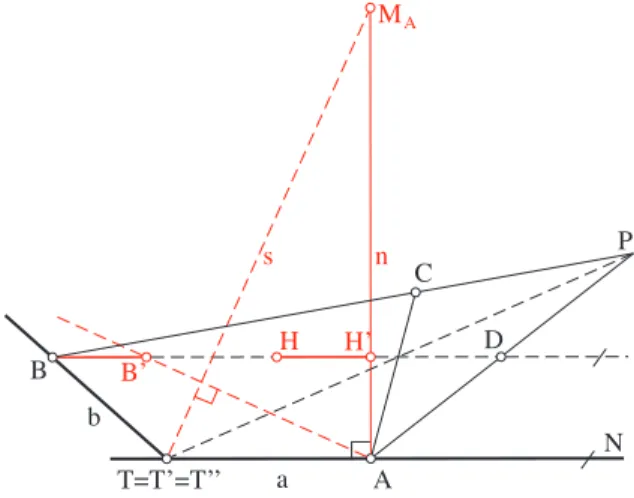
Step 4: corresponds to step 2 in chapter 2 to getσ2: c0→ kA. Explicitly, one only needs the center A of elation σ2 and the fact that the point B00:=σ2(B0)on kA belongs to the chord AB00=AB0of kA, which is fixed underσ2where B0:=σ1(B). Therewith the wanted curvature center MAis the intersection point of the normal n with the line s, which is the absolute-conjugate line to AB0through a∩b.
H H’ B’ s n MA C D P A a T=T’=T’’ b B N
Figure 4: Construction of the curvature center MA in a point A of a conic c, which is given by two line elements (A,a),(B,b)and an additional point C in the (projective
extended) elementary geometric plane. (Explanation of the construction see above.)
4
h-Curvature Circles of a Conic in the
Pro-jective Model of a Hyperbolic Plane
As an example for the construction of the osculating circle in a non-Euclidean plane with regular absolute polarityπ⊥ the complete solution will be given in a hyperbolic plane, see Figure 5.
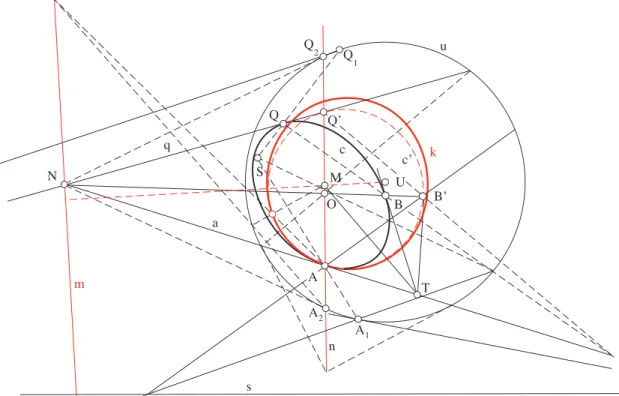
According to the projective geometric background of the idea of the construction, it is somehow natural to use the classical projective model of such a h-plane, (c.f. also [2]). This means that the place of action is essentially the inner domain of a (real) “absolute conic” u, which can be taken as an ordinary circle in elementary geometric sense. Given a conic c, the problem is to construct the h-curvature center MAto the arbitrarily given point A (with tangent a). It is expedient and practical to use a perspective collineation κ1 : u → c to construct the conic c as collinearly related image to the absolute conic u. (In Fig-ure 5 collineationκ1is defined with the center S and the axis s, and the related pair of points(A1,A).) Note, that if
s is absolute polar of S, the obtained conic c would be a circle.
Step 1: The osculating h-circle k of c at A has its center M on the h-normal n to a through A. So as a first step one needs to construct this n.
Step 2: Make A to a vertex of the conic c0, which osculates c at A. For this we use a “projective shear”, i.e. an elation σ1with axis a and centre N∈a, which is the absolute pole of n.
Step 3: Construct the hyperosculating circle of c0 accord-ing to the description to Figure 4. In Figure 5 we used the points Q and Q0=:σ1(Q)to get c0from c and the special point B0 and its tangent b. Finally we connect A with B0 and erect the h-normal line to AB0 through T :=a∩b, it intersects n in the h-curvature center M.
Step 4: If we do not use a graphics software like “Cin-derella”, where we can directly draw circles in a h-plane, we still have to construct the h-osculating circle k. This again can be done using a perspective collineation κ2: u→k; it has the center M and the axis m :=π⊥(M) and the related pair of points(A∈c,A2∈u). Because of
κ1 σ1 σ2 κ−21 u −→ c −→ c0 −→ k −→ u The product of these perspective collineations must act as a projectivityβon u. So the mappingβ: c→u→k is de-termined by three pairs of points on u, among them A1,A2
and Q1,Q2. N m k q a s n u c c’ Q 2 Q 1 Q Q’ S M U B’ B O T A A2 A1
5
Curvature Circles of a Conic in the CK-Planes with Singular Absolute Polarity
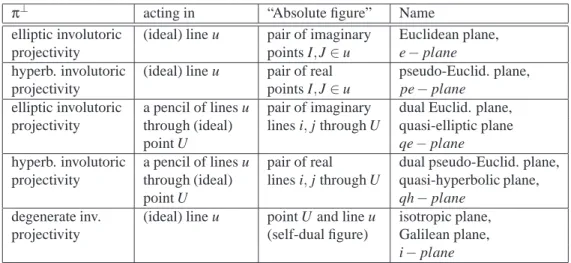
To start with, we give an overview over those CK-planes, c.f. [3]:
π⊥ acting in “Absolute figure” Name
elliptic involutoric (ideal) line u pair of imaginary Euclidean plane,
projectivity points I,J∈u e−plane
hyperb. involutoric (ideal) line u pair of real pseudo-Euclid. plane,
projectivity points I,J∈u pe−plane
elliptic involutoric a pencil of lines u pair of imaginary dual Euclid. plane, projectivity through (ideal) lines i,j through U quasi-elliptic plane
point U qe−plane
hyperb. involutoric a pencil of lines u pair of real dual pseudo-Euclid. plane, projectivity through (ideal) lines i,j through U quasi-hyperbolic plane,
point U qh−plane
degenerate inv. (ideal) line u point U and line u isotropic plane,
projectivity (self-dual figure) Galilean plane,
i−plane We treated the Euclidean case in Chapter 2 aiming at a
unifying interpretation of the classical and well-known el-ementary constructions. We will now present constructions of osculating circles by using one single elation alone. Let us begin with
1) Pseudo-Euclidean case
Figure 6 shows the projective model of a pe-plane and the construction of a pe-circle osculating a conic c at the point A.
Explanation to Figure 6:
The conic c and its line element(A,a)in the pe-plane with
absolute points I,J∈u are given. Now we choose A as the
center of an elationκ and construct its axis z: (Also this type of elations is osculation preserving!) With center A project I,J onto c getting I
0, J0. Intersect u with the line
u0=I0J0, get a fixed point F and AF=: z. Nowκis well-defined andκ(c) =: k is the desired osculating pe-circle.
I u J F I’ J’ c u’ z a A
Figure 6: Osculating pe-circle at the point A of the conic c. (Construction in a projective model of a pe-plane.)
Remark 2 The same construction principle can be per-formed also in the Euclidean case. The imaginary rays AI and AJ are defined by the orthogonal-involution in the pen-cil with vertex A and this orthogonal involution induces in c an elliptic involutoric projectivityρwith involution cen-ter R. Now we had to construct the polar line r to R with respect to c; r connects the imaginary points I0and J0and therefore is parallel to the elation axis z.
2) Quasi-hyperbolic case
Without loss of generality, let the absolute figure of the quasi-hyperbolic plane be a pair of parallel lines i,j. The
conic c and its line element(A,a)are given. A qh-circle
k is a conic k touching both absolute lines i and j. The construction is now dual to the one of Figure 6, see Figure 7. i I a i’ c n A I’ k J U j Z J’ j’ U’
Figure 7: Osculating qh-circle at the point A of the conic c. (Construction in a qh - plane with an absolute figure
Explanation to Figure 7:
Intersect the absolute lines i and j with the tangent a of the conic c at A. The tangents i0, j0 from these intersec-tion points to c intersect at the point U0which corresponds to the absolute point U in the desired elationκ with axis a. Line UU0 intersects a at the center Z of κ such that κis well-defined by {Z,a,(U,U
0)} and k :=κ(c)is the
desired osculating qh-circle. Note that UA represents the qh-normal n of the c at A.
Remark 3 The same construction principle can be per-formed also in the quasi-elliptic case. The construction “dualises” that of the Euclidean case. In the isotropic case, because of self-duality, one can use both, the prin-ciple of the “qh-construction” as well as that of the “pe-construction” to find the needed elation. As the construc-tion is obvious, it can be left to the reader to practice.
References
[1] G. BEYER, Untersuchungen zur Kr¨ummung von Kurven zweiter Ordnung in der Ebene und Kurven vierter Ordnung erster Art im Raum. Beitr¨age zur Al-gebra und Geometrie 11 (1981), 65–73.
[2] H. BRAUNER, Geometrie projektiver R¨aume 2, BI. Mannheim-Wien-Z¨urich (1976)
[3] O. GIERING, Vorlesungen ¨uber h¨ohere Geometrie, Vieweg, Braunschweig (1982)
[4] H. SACHS, Ebene isotrope Geometrie, Vieweg, Braunschweig-Wiesbaden, (1987)
[5] A. SLIEPCEVIˇ C, Iz prizemlja viˇse geometrije. KoG 5´ (2001), 73.
[6] A. SLIEPCEVIˇ C, Eine Anwendung der perspektive´ Kollineation. KoG 5 (2001), 51–55.
[7] A. SLIEPCEVIˇ C, M. KATI´ C- ˇ´ ZLEPALO, Osculating circles of conics in the isotropic plane. Slovensky ˇcasopis pre geometriu a grafiku 5 (2008), No.10, 21– 26.
[8] A. SLIEPˇCEVIC, N. KOVA´ CEVIˇ C, Hyperosculating´ circles of the conics in the Pseudo-Euclidean plane. (to be submitted).
Gunter Weiss
Technical University of Dresden Institute for Geometry, 01062 Dresden e-mail: [email protected] Ana Sliepˇcevi´c
Faculty of Civil Engineering, University of Zagreb Kaˇci´ceva 26, 10000 Zagreb