The Empowerment Strategy for The Food Crop Farmers in
Anticipating The Climate Change
Efriyani Sumastuti
IPSKR Education Faculty, University of PGRI Semarang, Indonesia Jalan Sidodadi Timur no 24 Semarang, Indonesia. Phone: +62-024-8316377,
Corresonding e-mail: [email protected]
Received: April 2015; Accepted: September 2015
Abstract
In Indonesia, the climate change and the global warming like changes in the pattern and distribu-tion of the rainfall give impacts on agricultural producdistribu-tion at large, especially in the food crops. These also cause droughts, floods, landslides, forest fires, rising temperatures in urban areas, and rising sea levels. The above impacts are felt by the farmers because those can lead to a decrease in production even the crop failure. This research aims to develop an empowerment strategy of the food crop farmers in anticipating the climate change in Central Java. The data used is the primary data obtained through in-depth interviews with key-person and the Focus Group Discussion (FGD). The Analysis Hierarchy Process (AHP) is conducted to determine the program priorities and strate-gies. The result of research shows that anticipating the climate change should be synergistically conducted in four aspects: human resources, technology, institutional and production, by involving various groups in the society. Various groups can be grouped into academics, businessmen / private sectors, government and community of food crop farmers / society.
Keywords: empowerment of farmers, food crops, climate change, food production JEL Classification:D2, C14, R3
Strategi Memberdayakan Petani Tanaman Pangan
Dalam Mengantisipasi Perubahan Iklim di Indonesia
Di Indonesia, perubahan iklim dan pemanasan global seperti : perubahan pola dan distribusi curah hujan, memberikan dampak terhadap produksi sektor pertanian secara luas, khususnya pada tanaman pangan. Selain itu juga menyebabkan kekeringan, banjir,tanah longsor, kebakaran hutan, meningkatnya suhu di daerah perkotaan, serta naiknya permukaan air laut. Dampak tersebut di atas sangat dirasakan oleh petani karena dapat mengakibatkan penurunan produksi bahkan gagal panen. Penelitian ini bertujuan untuk menyusun strategi pemberdayaan petani tanaman pangan dalam mengantisipasi perubahan iklim di Jawa Tengah. Data yang digunakan merupakan data primer yang didapatkan melalui wawancara mendalam dengan keyperson dan Focus Group Discussion (FGD). Analysis Hierarchy Process (AHP) dilakukan untuk menentukan prioritas program dan strateginya. Hasil penelitian menunjukkan bahwa dalam mengantisipasi perubahan iklim hendaknya dilakukan secara sinergis pada empat aspek, yaitu sumberdaya manusia, teknologi, kelembagaan dan produksi, dengan melibatkan berbagai kalangan yang ada di masyarakat. Berbagai kalangan tersebut dapat dikelompokkan menjadi Akademisi, pebisnis/ swasta, pemerintah dan komunitas petani tanaman pangan/ masyarakat.
Kata kunci:pemberdayaan petani, tanaman pangan, perubahan iklim, produksi pangan Klasifikasi JEL:D2, C14, R3
1. Introduction
Climate change has a considerable impact for Indonesia. Many events have occurred in Indonesia as the result of climate change and
direct impact that occurs can be seen as well as felt, such as rising temperatures in urban areas. Indirect impact is the impact on the environ-ment as a result of derivatives that happened some time ago and can be felt directly to house-holds or groups (Sylviani and Sakuntaladewi, 2010). Indirect impacts can be seen from the presence of an increase in the incidence of droughts, floods and landslides. The other impacts of climate change can be seen as the decline in agricultural production / crop failure, the rising of forest fires, and the rising sea lev-els.
The pattern and distribution of the rainfall has a tendency that dry areas become drier and wet areas become wetter that make the preser-vation of water resources disturbed. Extreme events like the rain with high intensity but in a short period of time cause the floods and land-slides. On the other hand the prolonged dry season causes the drought and water crisis and the triggering of the forest fire. Instability of the rain like the coming of a late early season and the end of more quickly one bring impacts on the agricultural sector that is the declining ag-ricultural productivity even the crop failure.
In general, the agricultural sector opera-tors (farmers) have not made the optimum use of the information on the climate. The manage-ment is based on the habit. Consequently a lot of losses are suffered such as the crop failure due to floods, droughts or the presence of cer-tain pests.
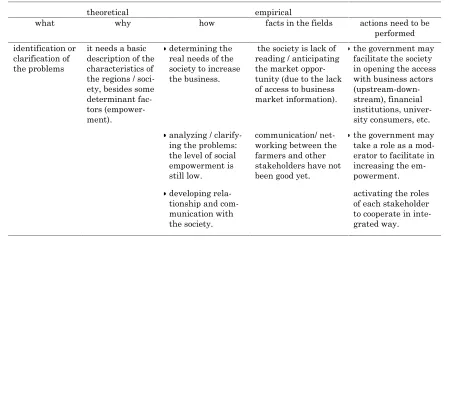
According to Susilowati (2004), the power-lessness of the society can be improved through
the stages of empowerment strategy as in Table 1. The social empowerment is a process of ca-pacity or human resource development. Having the capacity, then someone will have the strength (power) or a recognized legal authority so that he will not be marginalized (Susilowati, 2009).
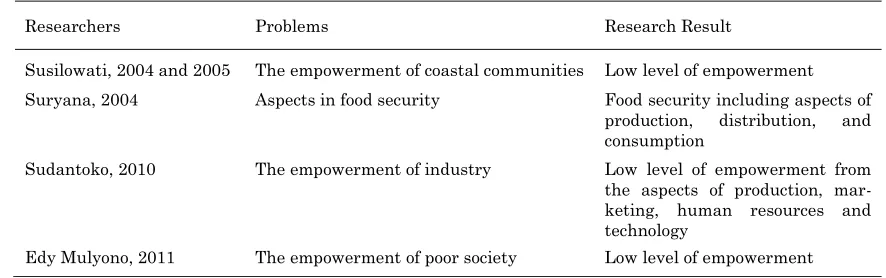
By conducting the empowerment and assis-tance in finding, creating, using the institu-tional access related to production, distribution and consumption of agricultural products, the farmers’ productivity and income will increase. But in reality, based on the findings of the re-searchers in the field, the process of empower-ment has not run optimally, as shown in Table 2.
Food Crops.Food crops have a very important and strategic role in the national and regional development. Food crop farming is the attrac-tiveness for the growth of upstream and down-stream industry. Both of these industries give relatively large contribution to the growth of the national economy.
Vegetable foodstuffs are generally derived from food crops. These commodities, especially rice, corn and soybeans are still the major source of nutritious substances, energy and pro-tein. In Indonesia, with a large population spread over many islands, the availability of food is crucial for food security, both for regional and national scope. In addition, it also affects the social, economic, political and security as a whole. Therefore, it is necessary to constantly and continuously do many efforts in the produc-tion and distribuproduc-tion of foodstuffs.
Table 2. The Mapping of the Research of Empowerment
Researchers Problems Research Result
Susilowati, 2004 and 2005 The empowerment of coastal communities Low level of empowerment Suryana, 2004 Aspects in food security Food security including aspects of
production, distribution, and consumption
Sudantoko, 2010 The empowerment of industry Low level of empowerment from the aspects of production, mar-keting, human resources and technology
Climate change impact on the economic conditions of the community, especially commu-nity who work in the agricultural sector. The agricultural sector is a sector that is very sensi-tive and vulnerable to climate change (Sub-agyono dan Elsa, 2007; Dodon dan Saut Aritua, 2013). Impacts of climate change that affects the productivity of the agricultural sector, among others, is drought and floods (Estin-ingtyas, 2011). The phenomenon of drought and floods occur almost every year in both heavy the past five years can be seen in Table 3. Based on Table 3 it is known that during the last five years there are fluctuations in the production of three excellent food crop commodities in Central Java. During the period of 2010-2013 (three years), the production trend of rice, corn and soybeans (Pajale) is similar. When compared to the production for three years, it has decreased in 2011 and it increases in the following year (2012). From the year of 2012-2014 the produc-tion trend for the three crops is different. For the rice crop it increased in 2013 and declined in 2014, while for corn and soybeans have the same trend, there was a decline in 2013 and an increase in 2014.
One of the causes of fluctuations in supe-rior food crop (Pajale)in Central Java is due to the climate change that occurred during the pe-riod of five years.
2. Research Method
This research is conducted in Central Java province. The selection of research areas is con-ducted by purposive sampling method, which aims to formulate a strategy to empower the
farmers in the regions that have superior food crops. Research data collection uses the meth-ods of (1) FGD (Focus Group Discussion) or in-depth interviews with stakeholders; (2) Obser-vation; (3) Documentation.
Focus Group Discussion (FGD) is a method of collecting data by conducting a dialogue / dis-cussion of 8-10 people with a moderator to lead the discussion for two hours. This method aims to produce the opinion, interpretation and pub-lic opinion (Sekaran, 2006). The topic of FGD is about the empowerment strategies of superior food crop farmers in anticipating the climate change. The participants of FGD consist of:(1) The farmer groups, public figures; (2) Govern-ment/related Department (BMKG, Department of Agriculture);(3)Academics;(4)Businessman
FGD is able to give solutions to the society especially the farmers to anticipate and cope with changes in rainfall pattern as a result of climate change. Furthermore, the results of observation, in-depth interviews with key persons and FGD are formulated within the framework of the hierarchy of priorities.
The hierarchical framework of priorities that have been compiled then is analyzed using the model of AHP (Analysis Hierarchy Process) to determine the strategic priorities. For the analysis it uses the program of Expert Choice version 9.0 (Saaty, 1993).
3. Results and Discussion
The aim of Analysis Hierarchy Process is to de-velop the farmers' empowerment program in anticipating the climate change in Central Java. Based on the observations, the discussions with competent key-person and FGD to the problems of climate change on agriculture in Central Java, it finds a framework arrangement of hier-archy of priorities. Among the competent key-persons are: (1) The Government, represented
Table 3. Production of Rice, Corn, and Soybean in Central Java, period of 2010-2014 No Commodities Production (ton)
2010 2011 2012 2013 2014
1 Rice 10.110.830 9.391.959 10.110.830 10.344.816 9.648.104 2 Corn 3.058.710 2.771.575 3.041.630 2.930.911 3.051.516 3 Soybean 187.992 112.273 152.416 99.318 125.467
by the Department of Agriculture of Central Java Province; (2) Group of farmers, (3) NGO; (4) Academics and; (5) Public figures who care about the Agriculture in Central Java
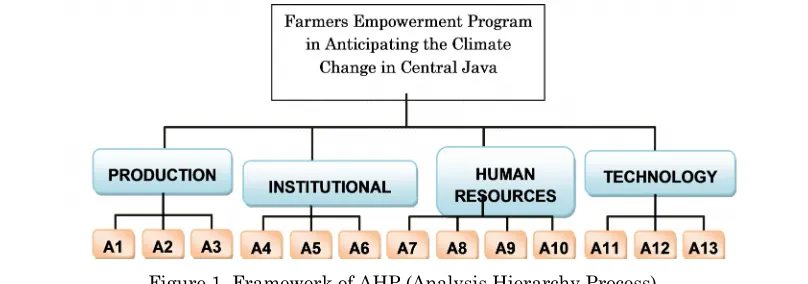
The framework of hierarchy of priorities is related to any aspect need to perform in ar-ranging the empowerment strategies for the su-perior food crop farmers in anticipating the climate change. The aspects above include the aspects of production, institutional, human resources and technology as in Figure 1. Fur-thermore, the model of AHP (Analysis Hierar-chy Process) is used to determine the strategy of priority by performing the arrangement of stra-tegic alternatives. For the analysis, it uses the program of Expert Choice version 9.0 (Saaty, 1993).
(1) Base as Considerations in Farmer Empowerment Program in Anticipating the Climate Change in Central Java
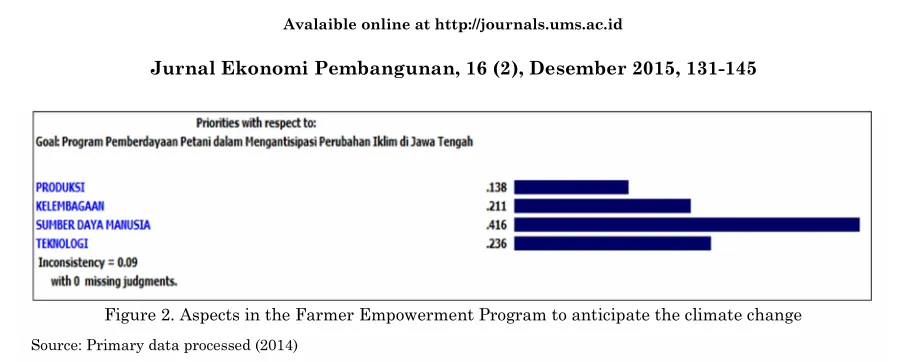
Farmer Empowerment Program in anticipating the climate change in Central Java is strongly associated with some aspects, among others: aspects of Production, Institutional, Human Re-sources and Technology. Analysis of the com-bined opinion of the respondents indicates that the aspect of human resource (weight value of 0.416) is the most important one to consider in
the arrangement of farmer empowerment pro-gram in anticipating the climate change in Cen-tral Java. The next aspects to consider are the aspects of technology (weight value of 0.236); institutional (weight value of 0.211); and pro-duction (weight value of 0.138). The value of ra-tio inconsistency is 0.09 <0.1 (the maximum limit), which means that the result of the analy-sis can be accepted. Every aspect considered in the farmer empowerment program to anticipate climate change and weight values are presented in Figure 2
The choosing of Human Resource aspect as a top priority that must be considered in the farmer empowerment program to anticipate the climate change in Central Java is that to antici-pate the climate change it needs to pay atten-tion to Human Resources or the farmers as the object of empowerment so that the empower-ment program can be run properly. Human resources in the agricultural sector are as the executor and manager that are directly associ-ated with the production process. Human Resources (farmers) as the object are the actor who must determine when to begin planting, which plants to be cultivated and how the pro-duction process to do. For the purposes above and to make the process of production of food crops can be managed properly, it needs the
Figure 1. Framework of AHP (Analysis Hierarchy Process)
skill training as well as information related to the production process. The information needed includes the climate predictions, forecast of early planting season and the types of plants to be grown.
(2) Priority Determination for the Farmer Empowerment Program in Anticipating the Climate Change in Central Java
The aspects of Human Resources include (1) conducting the training to improve technical skills, (2) conducting the training to access to climate information, (3) Anticipating the climate change, (4) Intensifying the role of field agri-cultural guidance. The weights of each criterion in the human resource aspects can be seen in Figure 3. In this figure, it seems that the criteria with the highest priority is the anticipation to the climate change (weight value of 0.589); then successively followed by the training to improve technical skills (weight value of 0.170); intensifying the role of field guidance (weight value of 0.147); and
conduct-ing the trainconduct-ing to access to the climate infor-mation (weight value of 0.09). The value of ratio inconsistence is 0.06 <0.1 (the maximum limit), which means that the results of the analysis can be accepted. Every aspect considered in the empowerment program to anticipate the climate change in Central Java with the value weights is presented in Figure 3.
Based on the opinion of the respondents, the most important aspect of human resources in the farmer empowerment program in order to anticipate the climate change is anticipating the climate change that may occur. An important implication of this is that the government must give information on the climate change that will occur that may have an impact on the agricultural sector. It also gives a solution for the farmers to anticipate the climate change that may occur. One of them is by giving the technical skill training to deal with the climate change, so the farmers will be better prepared in facing the climate change that will occur.
Farmer training in anticipation of climate
Figure 2. Aspects in the Farmer Empowerment Program to anticipate the climate change
Source: Primary data processed (2014)
Figure 3. Priority of Aspects of Human Resources in Farmer Empowerment Source: Primary data processed (2014)
change according to Laily, Heru and Farida (2013) can be done with two approaches, namely:
(1) Approach based on task. This approach is carried out with the aim to improve skills and training so that participants can solve the problems at hand. In this c ase specifically to improve skills and solve problems in the man-agement of farming. Participants can be indi-viduals or groups.
2. The approach based on the system. The goal of this approach so that farmers can have the competence to understand the situation and can take the right decision, especially with regard to environmental and sustainability of production systems in the agricultural sector of food crops
To access the training information on climate and anticipation to changes in climate, in real terms it has been done through the airy school special climate and its effects. The impacts that occurred due to climate change in General is the droughts, floods and pests.
The role of agricultural extension officers in fields largely determine the success of govern-ment programs in the agricultural sector. Because the extension officers are Messenger program information about the latest technolo-gies of san that can be used and applied. In addition the extension officers also have a duty to accompany farmers in the process of the management of farming (Herminingsih, 2014). Thus the position of extension officers are very strategic.
The second aspect to consider in the farmer empowerment program in order to anticipate the climate change in Central Java is a
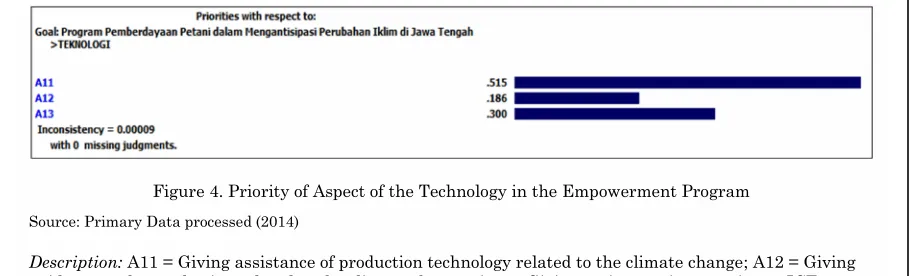
technol-ogy that consists of (1) Giving assistance of the production technology related to the climate change (2) Giving guidance and consultation related to the climate change; (3) Giving assis-tance in accessing to ICT. In the aspect of tech-nology the main priority is giving assistance of production technology (weight value of 0.515). Then the next priority in a row is the assistance of guidance and consultation related to the cli-mate change (weight value of 0.300); giving assistance in accessing to ICT (weight value of 0.186). The value of Ratio Inconsistency = 0.000. The value of ratio inconsistency is 0.000 <0.1 (the maximum limit), which means that the result of the analysis can be accepted. Each alternative of the aspect of technology consid-ered in the farmer empowerment program to anticipate the climate change in Central Java with the value weights is presented in Figure 4.
The important implication of this is that in order to anticipate the climate changes in Cen-tral Java in the farmer empowerment program from the aspect of technology, the government gives assistance of production technology that can be used by the farmers in facing the climate change that may occur. Technology policy for-mulation in anticipation of climate change needs to be done to improve production technol-ogy (Hayun dkk, 2013). The necessary produc-tion technology by farmers can be the use of superior varieties that are resistant to climate change and agricultural machine tool utiliza-tion.
Guidance and consultation related to climate change undertaken by the Department of agriculture, in particular the related food
Figure 4. Priority of Aspect of the Technology in the Empowerment Program
Source: Primary Data processed (2014)
crops and horticulture that coordinate with 7.7. For activities in the fields can be implemented directly by the individual or related service (extension off icers) and groups. The activities implemented in the Group generally involves a group of farmers, communities, community leaders, private sector and academia.
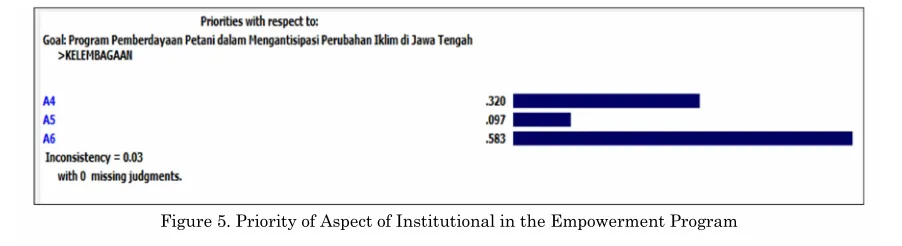
The third aspect to consider in the farmer empowerment program in order to anticipate the climate change is the aspect of institutional through some alternatives: (1) socialization of the climate cha nge and anticipating it, (2) cli-mate information, (3) information of the plant-ing season and the plant types. In the aspect of institutional aspect, the top priority is the giv-ing of information of the plantgiv-ing season and the types of plant growing season (weight value of 0.583). Next, the socialization of the climate change and anticipating it (weight value of 0.320); and the climate information (weight value of 0.097), with Ratio Inconsistency = 0.03. The value of ratio inconsistency is 0.03 <0.1 (the maximum limit), which means that the result of the analysis can be accepted. Each institutional aspect is considered in the farmer empower-ment program to anticipate the climate change and the value of the weight is presented in Fig-ure 5.
Based on Figure 5, the important implica-tion of this is that the government gives the information about planting season and plant types that is appropriate to the season at that time. Therefore the government through BMKG and the department of agriculture of food crops and horticulture always gives information on
the climate and plant types that are suitable for planting during the season at that time. Climate change information relating to the period of planting and the types of plants that fit needs to be packaged in a language that is easy to be understood by the user. In addition it should meet the needs of users and to timely and right on target. Thus can be used to make the right decisions, so that losses can be reduced or increased profits instead. Based on the analysis of the Boer and Surmaini (2006), it is noted that the farmers were responsive to information climate forecasts will benefit a larger economy than not responsive.
Institutional aspects in the program of em-powerment cannot be detached from the resources available in the Community farmers, good financial resources or non-financial. Based on the results of the research of Suradisastra (2008), in the process of empowerment of the institutional aspect, the community should be included. This is done for several purposes, including: (1) Program in accordance with local needs and real; (2) Improve public participation in the development process.
The last aspect to consider in the farmer empowerment in order to anticipate the climate change in Central Java is the aspect of produc-tion. The aspect of production presented in this research consists of some alternatives: (1) con-ducting the training of management and crea-tivity in production, (2) determining the plant-ing pattern, (3) determinplant-ing the variety of plants. From the three alternatives on the pro-duction aspect, the main alternative considered
Figure 5. Priority of Aspect of Institutional in the Empowerment Program
Source: Primary Data processed (2014)
by the respondents in the empowerment pro-gram to anticipate the climate change is deter-mining the planting pattern (weight value of 0.591). Furthermore is conducting the training of management and creativity of production (weight value of 0.297); and determining the plant varieties (weight value of 0.112) with the Ratio Inconsistency = 0.09. The value of ratio inconsistency is 0.09 <0.1 (the maximum limit), which means that the results of the analysis can be accepted. Each alternative considered in the farmer empowerment program to anticipate the climate change and the value of the weight is presented in Figure 6.
From Figure 6 it shows that the main al-ternative in the aspect of production in order to anticipate the climate change is determining the appropriate planting pattern. It can help the farmers in Central Java in facing the climate change. The proper planting pattern will minimize the losses of the farmers due to the climate change happening today.
Cropping patterns to determine the required information about the planting time with regard to climate change. Such infor-mation can be found in three forms (Subayono and Elsa, 2007), namely:
(1) Map calendar scheduling system is planting, planting. Are real farmers already apply the cropping calendar based on the natural phe-nomena that occur in each area. However, along with the population and the loss of most of the flora and fauna that serves as an indicator of lead to the application of the traditional way of
becoming less accurate (Syahbudin and Rantunuwu, 2007). As a guide, Agroklimat and Hydrology Research Hall has compiled a map of planting calendar for food crops in Java did-asrkan on a range of climate scenarios.
(2) Prediction of rainfall, is done by analyzing the monthly rainfall forecast in some areas where agricultural production, especially for the purposes of the agricultural sector
(3) Map the estimated summer and rainy sea-son, done with the analysis of spatial locality. This map is continually updated so that steps can be taken to anticipate the next cropping patterns.
To determine the varieties of crops, to do research in the field of plant breeding. Such research aims to get these kinds of plants, par-ticularly food crops that are resistant to envi-ronmental stress (Budiastuti, 2010). Thus be produced new varieties of food plants, tolerant climate change, so that the losses of farmers in the production process can be minimised.
(3) Determining the General Synthesis of the Target of the Farmer Empowerment Program in Anticipating the Climate Change
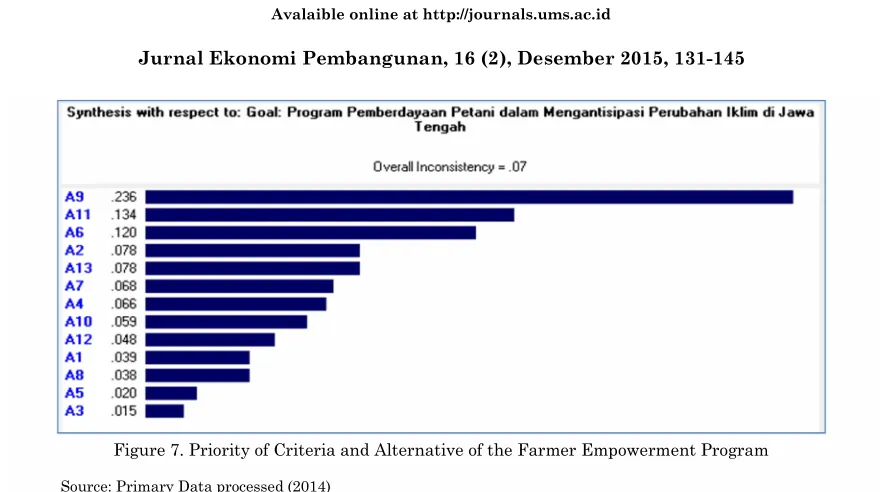
The overall results of analysis show that the priority scale of criteria and alternative of the farmer empowerment program in anticipating the climate change in Central Java by Analysis Hierarchy Process (AHP) can be seen in Figure 7.
Figure 6. Priority of Production in the Farmer Empowerment Program to anticipate the climate change in Central Java
Source: Primary Data processed (2014)
From Figure 7 it appears that the three main priorities in the farmer empowerment program in anticipating the climate change in Central Java by looking at all aspects and alternatives are (1) anticipating the climate change (weight of 0.236). The government anti-cipates the climate change as well as possible and helps the farmers in facing the climate change so as to minimize the loss of the farm-ers; (2) giving assistance of the production tech-nology that is appropriate to the climate change at that time (weight of 0.134). The appropriate technology in production in agriculture can help the farmers to prepare for the climate change; (3) giving information about the planting season and the plant types (weight of 0.120). In facing the climate change that will occur, the govern-ment should give information about the plant-ing season and the plant types that is appropri-ate to the coming or recent season. It can help the farmers to prepare for the climate change at that time. Therefore, it can minimize the greater loss on the farmers due to the climate change, so that it can maintain the farming con-tinuity. The value of overall ratio inconsistency (overall analysis) is 0.07 <0.1 (the maximum
limit), which means that the result of the analy-sis can be accepted.
(4) Empowerment Strategy
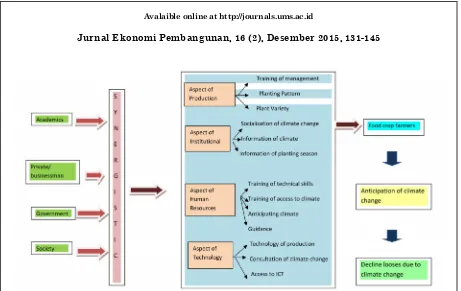
Based on the result of AHP, then a strategy of the food crop farmer empowerment in antici-pating the climate change is arranged as shown in Figure 8. Figure 8 shows that in the process of empowerment there should be a synergistic cooperation among the farmers as an object / target with the related stakeholders. The stake-holders consist of the academics, government, businessmen/private and public. The empower-ment programs are conducted in four aspects: (1) Aspect of production, including the manage-ment training, the determination of planting patterns and varieties having been adjusted to the recent climate condition. (2) Aspect of insti-tutional with the socialization of climate change, climate information and information planting. (3) Aspect of human resources, including the training of technical skills, the training of access to the climate, the climate anticipation and optimizing the field agricultural guidance. (4) Aspect of technology with program of production technology, consultation on climate
Figure 7. Priority of Criteria and Alternative of the Farmer Empowerment Program
Source: Primary Data processed (2014)
change and access to ICT (especially with regard to climate change)
Soesilowati, Dyah Rini and Widiyanto (2011) research results recommends that the empowerment of farmers should do integrated aspects of financial, research, development and production. From the side of the perpetrators, the integration needs to be done between rele-vant agencies/stakeholders. According to Rid-wan and Nurul Chazanah (2013), cooperation and sinergisme between the perpetrators of the stakeholders need to be done on an ongoing ba-sis. The things that are necessary in the process of sinergisme, among others, planning, coor-dination, monitoring and evaluation are inte-grated. The process sinergisme is not just done in the agricultural sector but also in the need in other sectors are interlinked, such as the trans-portation sector.
Besides involving the stakeholders and implemented in four aspects, the anticipation of the climate change also needs to apply the prin-ciple of 5 R (Dedik Budianta, 2012) in its im-plementation. Principle of 5 R consists of: (1) Reference, (2) Respect / Care, (3) Restrain (Control), (4) Redistribution (equalization), (5) Responsibility.
Principle of 5 R basically is that the process of food crop production needs to pay attention to the carrying capacity of the land so as not to ex-ceed the production capacity, maintain the nat-ural balance and manage the land optimally. It is necessary to keep the production process via-ble and sustainavia-ble. Thus the food supply is rel-atively safe.
4. Conclusions
The empowerment strategy for the food crop farmers in anticipating the climate change in Central Java aims to reduce the decline in pro-duction or the crop failure. The empowerment is held on various aspects, particularly the aspects of human resources, technology, institutional and production with the involvement of the related stakeholders. The stakeholders involved in the empowerment process are the academics, the businessmen / private sectoar, the govern-ments and society. To make the empowerment run well, it needs to have coordination and syn-ergistic relationship between the objects (farm-ers) and the stakeholders in the management of production. In addition, it also needs the appli-cation of the principle of 5 R.
Figure 8. Strategy of Farmer Empowerment in Anticipating the Climate Change in Central Java
5. References
BMKG,2012. Prakiraan Awal Musim Hujan 2011/2012. Jakarta: BMKG.
Boer and Surmaini. 2006. Economic Benefits of Using SOI Phase Information for Crop Management System of West Java, Indo-nesia. Proceeding of Living With Climate Variability and Change: Understanding the Uncertainties and Managing the Risk. Finland July 2006.
Budiastuti. 2006. Sistem Agroforestri: Bentuk Pemanfaatan Lahan Untuk Keberlan-jutan Fungsi Agronomi dan Ekologi. UNS Solo.
Budiastuti. 2010. Fenomena Perubahan Iklim dalam Kontinyuitas Produksi Pertanian: Suatu Tinjauan Pemberdayaan Lahan. Jurnal EkosainsVol. II No. 1 Maret 2010.
Department of Agriculture TPH Central Java Province. 2013. Antisipasi Musim Hujan dan Musim Kemarau. Semarang
Department of Agriculture TPH Central Java Province. 2013. Keadaan Banjir, Kemarau dan Serangan OPT di Jawa Tengah. Semarang.
Department of Agriculture TPH Central Java Province. 2015. Dukungan THL-TBPP dalam Pencapaian Target dan Sasaran Upsus Pajale di Jawa Tengah. Semarang.
Diposaptono, S. 2005. Bencana Alam (Pene-kanan Pada Bencana Air), [Online] Avail-able at:www.ppk.itb.ac.id.
Dedik Budianta. 2012. Pentingnya Etika Ling-kungan Untuk Meminimalkan Global Warming. Study Program of Environ-ment, Faculty of Agriculture, Sriwijaya University.
Dodon dan Saut Aritua, 2013. Asuransi Per-tanian Untuk Meningkatkan Ketahanan Ekonomi Masyarakat Petani dalam Menghadapi Perubahan Iklim. Jurnal Perencanaan Wilayah dan Kota SAPPK Vol.4 No 1 2013.
Edy Mulyono. 2011. Model Pemberdayaan Masyarakat Melalui Jalur Pendidikan Non Formal Untuk Mewujudkan Usaha Mandiri Bagi Orang Miskin (Studi Em-piris di Kota Semarang). Dissertassion. UNDIP, Semarang.
Estiningtyas. 2011. Delinasi Risiko Iklim Dan Evaluasi Model Hubungan Curah Hujan dan Produksi Padi dalam Mendukung Pengembangan Asuransi Indeks Iklim (Climate Index Insurance) Pada Sistem Usahatani Padi. Jurnal Ilmu Pertanian IndonesiaVol.16 no. 3 2011.
Hayun Anggara dkk. 3013. Model Kebijakan Teknologi Dalam Menghadapi Perubahan Iklim. Jurnal Teknologi Industri Per-tanianVol. 23 No. 2 2013.
IPCC. 2001. Chapter-6 Coastal systems and low-lying areas, Contribution of Working Group III to the Fourth Assessment Report of the IPCC. Cambridge, Cam-bridge University Press. Sector of Coastal and Marine .
Herminingsih. 2014. Pengaruh Perubahan Iklim Terhadap Perilaku petani Temba-kau di Kabupaten Jember. Jurnal Ma-tematika, Saint, dan TeknologiVol. 15 No. 1 maret 2014.
Kurniati Dewi dkk. 2014. Risiko Pendapatan Pada Usahatani Jeruk Siam di Kabu-paten Sambas.Jurnal Social Economic of AgricultureVol. 3 No. 2 Desember 2014.
Laily R, Heru dan Farida. 2013. Pemberdayaan Petani Dalam Meningkatkan Ketahanan Pangan (Studi di Desa Betet, Kecamatan Ngroggot, Kabupaten Nganjuk). Jurnal Administrasi PublikVol. 2 No. 1. 2013.
Matthews. 1995. Perubahan Iklim Global. http://climatechange.menlh.go.id - Cli-mate Change – Indonesia.
NOAA. 2008. SPI Information in National Weather Service Forecast Office, Hono-lulu, HI,
Payne. 1997.Social Work and Community Care. London: McMillan.
BMKG. 2015. Rencana Strategis Badan Meteo-rologi, Klimatologi, dan Geofisika Tahun 2010–2014. Jakarta: BMKG.
Ridwan dan Nurul Chazanah. 2013. Pe-nanganan Dampak Perubahan Iklim Global pada Bidang Perkeretaapian Me-lalui Pendekatan Mitigasi dan Adaptasi. Jurnal Teknik SipilVol. 20 No. 2 Agustus 2013.
Sakuntaladewi dan Sylviani. 2014. Kerentanan dan Upaya Adaptasi Masyarakat Pesisir Terhadap Perubahan Iklim. Jurnal Pene-litian Sosial dan Ekonomi KehutananVol. 11 No. 4 desember 2014.
Sekaran, Umi. 2006. Metodologi Penelitian un-tuk Bisnis.Jakarta: Salemba Empat.
Saaty. 1993. Pengambilan Keputusan Bagi Ma-najemen. Proses Hirarki Analitik Untuk Pengambilan Keputusan dalam Situasi yang Kompleks. Translation, Series of management No. 134. PT Pustaka Binama Pressindo.
Soesilowati, Dyah Rini dan Widiyanto. 2011. Model Corporate Social Responsibility dalam Program Pemberdayaan Petani Hortikultura. Jurnal Ekonomi Pem-bangunanVol 12 No. 1 Juni 2011.
Subagyono dan Elsa. 2007. Pengelolaan Sum-berdaya Iklim dan Air Untuk Antisipasi Perubahan Iklim. Jurnal Meteorologi dan GeofisikaVo. 8 No. 1 Juli 2007.
Sudantoko. 2010.Pemberdayaan Industri Batik Skala Kecil di Jawa Tengah (Studi Kasus di Kabupaten dan Kota Pekalongan. Dissertassion. UNDIP, Semarang.
Sumastuti and Sucihatiningsih. 2011. Adapta-tion of Agricultural Sector to Climate Change In Central Java. A Paper of Sym-posium On Economic Impacts of Global Warming. UNNES, Semarang
Sumastuti and Susilowati. 2011. Managing Natural Disaster and Climate Change
Without Management? An Empirical Evi-dence of Adaptation and Mitigatioan in The Fisheries Sector, Central Java Prov-ince-Indonesia. Symposium On Coastal Resources Management and Development. UNDIP, Semarang.
Suprihati dkk. 2015. Persepsi Petani dan Adap-tasi Budidaya Tembakau-Sayuran Atas Fenomena Perubahan Iklim di desa Tlogolele, Kecamatan Selo, Kabupaten Boyolali. Jurnal Manusia dan Lingkungan Vol. 22 no. 3 November 2015.
Suradisastra K. 2008. Strategi Pemberdayaan Kelembagaan Petani. Forum Penelitian Agro Ekonomi Vol.26 No. 2 Desember 2008.
Suryana. 2004. Kapita Selekta Evolusi Pemikiran Kebijakan Ketahanan Pangan. BPFE, Yogyakarta
Susilowati. 2009. The shock of Climate change towards the vulnerable Small scale Fish-eries Sector in Central java Province-Indonesia: The Way Forward. A Paper in the Fifth International Conference in Global Academy of Business & Economic Research, Malaysia.
Susilowati.. 2009. Penguatan Kinerja Agribisnis Tanaman Pangan Unggulan Provinsi Jawa Tengah Dalam Mendukung Keta-hanan Pangan. Report of Research, Bureau of Research and Development of Agri-culture, Jakarta
Susilowati.. 2004. Pengembangan Model Pem-berdayaan Masyarakat Pesisir Dalam Mendukung Ketahanan Pangan di Kabu-paten dan Kota Pekalongan. Report of Re-search of RUKK 2nd Year, Diponegoro University, Semarang
Susilowati.. 2008. Penguatan Kinerja Agribisnis Tanaman Pangan Unggulan Provinsi Jawa Tengah dalam Mendukung Ketahanan Pangan. UNDIP, Semarang
Syahbudin dan Runtunuwu. 2007. Penyesuaian Pola Kalender Tanam Lahan Sawah da-lam Mensukseskan P2BN. Info Agro-klimat dan Hidrologi Vol.2 No.1 2007.
Sylviani dan Sakuntaladewi. 2010. Dampak Pe-rubahan Musim dan Strategi Adaptasi
Pengelolaan di Masyarakat Desa Sekitar Taman Nasional Baluran. Jurnal Peneli-tian Sosial dan Ekonomi Kehutanan Vol. 7 No. 3 2010.
Uphoff. 2003. Some Analytical Issue in Mea-surement Empowerment for the Poor, with Concern for Community and Local Government. Paper Pressented at the Workshop on Measuring Empowerment.
6. Appendix
Table 1. Stages of Empowerment Strategy
theoretical empirical
what why how facts in the fields actions need to be performed identification or
clarification of the problems
it needs a basic description of the characteristics of the regions / soci-ety, besides some determinant fac-tors (empower-ment).
determining the real needs of the society to increase the business.
the society is lack of reading / anticipating the market oppor-tunity (due to the lack of access to business market information).
the government may facilitate the society in opening the access with business actors (upstream-down-stream), financial institutions, univer-sity consumers, etc.
analyzing / clarify-ing the problems: the level of social empowerment is still low.
communication/ net-working between the farmers and other stakeholders have not been good yet.
the government may take a role as a mod-erator to facilitate in increasing the em-powerment.
developing rela-tionship and com-munication with the society.
mobility or con-sulting
it needs data / in-formation as the reference to select the problems and determine them collectively.
stimulating the society to discuss the problems.
there is no communi-cation among the so-ciety about their business, problem solving, business pro-spective, market in-formation.
the government takes a role as the motivator of changes by giving assistance (production tech-nique, management, marketing business, finance, etc.) and by cooperating with universities, non-governmental or-ganizations, and other institutions having high com-mitment to the farmer empower-ment program.
analyzing the problems together.
the government cooperates with the related parties to hold training or workshop to assist in the arrangement of development pro-gram planning for the groups of society.
arranging the aim, action plan, and the implementa-tion.
identifying the organization leader.
stimulating the working group.
organizing it needs a media or an organization that help to man-age the admin-istration of strat-egy implementa-tion and empow-erment opera-tional.
forming or build-ing an organiza-tion with formal structure and having leadership spirit.
it has been formed but the role is not opti-mal.
education, training, and counseling
it needs the edu-cation, training, and counseling that may help the society to have more skills, abil-ity and power.
educating the soci-ety to know / per-form their rights and duties to the organization aim and its continuity.
it has been done but is not optimal yet.
the government cooperates with the related parties (like universities and non-governmental organizations) in holding training / workshop that may help the arrange-ment of program planning of increas-ing various business skills to the society to make them more empowered.
business guid-ance
it needs guidance through the demonstration to help the society to have more skills, ability and power.
guiding the society to perform their skill and ability to make them stronger and more powerful.
the guidance has been initiated but the re-sult is not optimal yet.
the government needs to keep moti-vating the efforts of guiding (like organi-zation, management, technique) in coop-erating with univer-sities, non-govern-mental organiza-tions or other insti-tutions having high commitment to the farmer empowering program.
activating / increas-ing the role of each stakeholder to coop-erate in integrated way.