! " # $ % & '
( $ !#%( "
) & "
(*+ , - . / 0 $
1 2 3" +
+ !
++ !!
+ ! ! " # $ % & '
( $ !#%( "
) & "
. / 0 $
1 2 4 34 + $ +
This paper elucidates the emergence and evolution of arabesque with specific reference to the case of arabesque in Turkish art and architecture. It is argued here that arabesque is a fusion of styles rather than a pure and homogenous style. Furthermore, the paper aims to show that although the arabesque style appears to be a fanciful and freely organized manner of artistic treatment it is based on a very complex mathematical logic which is expressed through abstractionism. In this context, the grammar of geometry is elaborately used in the implementation of abstraction. Here, general characteristics as well as different modes or types of arabesque are discussed. Starting with the etymological roots of the term, the history of its use in the literature is explored through the paper. After the inquiry of its material and pragmatic aspects, the development of the arabesque style is evaluated with regard to its transformations that took place along with its injection to Anatolia and mixing with Turkish culture. Finally, the morphological character of this fusion is put forward.
! ": Morphological character, geometry, fusion of styles, arabesque
#
Makalah ini memaparkan muncul dan berevolusinya arabesk dengan referensi khusus pada kasus arabesque dalam seni dan arsitektur Turki. Disebutkan di sini bahwa arabesk lebih merupakan perpaduan berbagai gaya dibandingkan sebuah gaya yang murni dan homogen. Selanjutnya, makalah ini bertujuan untuk menunjukkan bahwa meskipun gaya arabesk tampaknya merupakan hasil dari perlakuan artistik yang fantastis dan terorganisasi secara bebas, namun gaya ini sebenarnya didasarkan pada logika matematika yang sangat kompleks yang diungkapkan melalui abstraksionisme. Dalam konteks ini, tata bahasa geometri yang rumit digunakan dalam pelaksanaan abstraksi. Di sini, karakteristik umum serta mode'mode dan tipe'tipe yang berbeda dari arabesk dibahas. Dimulai dengan akar etimologis dari istilah arabesk, sejarah penggunaannya di dalam berbagai literatur dieksplorasi di makalah ini. Setelah penyelidikan bahan dan aspek'aspek pragmatis dari arabesk, pengembangan gaya ini dievaluasi berkaitan dengan transformasi yang terjadi bersamaan dengan masuknya ke Anatolia dan pencampurannya dengan budaya Turki. Akhirnya, karakter morfologis dari fusi ini diajukan di dalam makalah ini.
#$% &: Perpaduan gaya, karakter morfologis, geometri, arabesk
% !"$ &!%
The paper discusses that arabesque is a unique and key element of ornamentation within the frame' work of Islamic Architecture. The hypothesis that is argued here puts arabesque as a medium of fusion rather than a homogeneous and unique artistic style restricted to Arab region making particular reference to the case of Turkish art and architecture. Despite the name ‘arabesque’ may denote a narrow frame'
/ / /
/
foundations of this notion within the territories of the response strategically developed to reconcile the Islamic prohibition on re'production of figures and the eternal need to depict the nature and cosmos.
The arabesque is an artistic motif that is characterized by the application of repeating geo' metric forms and fancifully combined patterns; these forms often echo those of plants and animals. Arabesques are, as their name indicates, elements of Islamic art often found decorating the walls of mosques. The choice of which geometric forms are to be used and how they are to be formatted is based upon the Islamic view of the world. To Muslims, these forms, taken together, constitute an infinite pattern that extends beyond the visible material world. To many in the Islamic world, they concretely symbolize the infinite, and therefore uncentralized, nature of the creation of the one God (Allah). Furthermore, the Islamic Arabesque artist conveys a definite spirituality without the iconogra' phy of Christian art. The works of ancient scholars such as Plato, Euclid, Aryabhata, and Brahmagupta were widely read among the literate and further advanced in order to solve mathematical problems which arose due to the Islamic requirements of determining the Qibla and times of Salah and Ramadan. Plato’s ideas about the existence of a separate reality that was perfect in form and function and crystalline in character, Euclidean geometry as expounded on by Al'Abbās ibn Said al' Jawharī (ca. 800'860) in his Commentary on Euclid's Elements, the trigonometry of Aryabhata and Brah' magupta as elaborated on by Muhammad ibn Mūsā al'Khwārizmī (ca. 780'850), and the development of spherical geometry by Abū al'Wafā' al'Būzjānī (940– 998) and spherical trigonometry by Al'Jayyani (989' 1079) for determining the Qibla and times of Salah and Ramadan, all served as an impetus for the art form that was to become the Arabesque.
There are two modes to arabesque art. The first recalls the principles that govern the order of the world. These principles include the bare basics of what makes objects structurally sound and, by ex' tension, beautiful (i.e. the angle and the fixed/ static shapes that it creates). In the first mode, each repeating geometric form has a built'in symbolism ascribed to it. For example, the square, with its four equilateral sides, is symbolic of the equally impor' tant elements of nature: earth, air, fire, and water. Without any one of the four, the physical world, many examples of Arabesque art, some would argue that there is in fact a third mode, the mode of Arabic calligraphy.
% & %" '!($ &!% !) *$
Although its genesis can neither be attributed to one specific time nor to any single source, arabesque could be considered as a multi'cultural phenomenon that has gradually evolved by inter' weaving its multi'layered ingredients into a rich al' loy. Etymologically, the term, which is used in arts, is associated with Arabs and their artistic style meaning ‘style of Arabs’. Recent studies give an account of its various definitions and explanations that emerged in different periods of history and the various names given to it. These names often implied varying characteristics that were acquired by this art in different epochs in addition to the established articles of Mauresque, Saracenic ve Grotesque while explaining the article of Arabesque although these words do not exis in dictionaries of these Islmic countries. European writer who used the term for the first time had named the totality of the decora' tions of Islam as Arabesque by moving from the name of Arab tribes as member of the Islamic community3.
Semerkand, from North Anatolia to Yemen, has been called without discussion for approximately 300 years. Thus it is misleading6.
It is of interest to elucidate the Pre'Islamic and Asian influences as well as impacts of Nomadizm and Shamanizm on this artistic style. The relation be' tween ages'old knot techniques of rugs and carpets in Asian/Anatolian art and culture and the inherent geometrical patterns must have also been transmit' ted to the Islamic art within the context of the attempts of these geographical regions to adapt and integrate with Islam. Also the shamanic mythology of animals must also have been transmitted to Islamic culture. Thus, the possibility of Islamic artists might have drawn upon the symbols and patterns from their early Arabic and Nomadic cultures are worth considering7.
Gundogdu8 (1993) summarizes the general cha' racteristics of Islamic art, as follows:
1. Escape from Realizm
Islamic artists seem to refrain from direct depiction and copying of nature particularly after art of Early Ummayad Period reaching to the level of total abstraction starting from the 9th century. In contrast to Western art, Islamic art followed a path from depth to surface and from reality to stylization. 2. Relationship between Nature & Metaphysics
Islamic art appears to have aimed at serving the divine unity through deformations and stylization as a result of the absolute inexpediency of a total detachment from nature. It can be based on Islam’s ideals: al'Tawhid, the doctrine of unity, or multipli' city in unity9.
3. Contemplation and math/geometry
A continuous pattern, beginning and ending points of which are no longer perceivable has been the essence of the morphology of Islamic art. Thus, stars and polygons, as the main figures of this art, produce their own compositions through endless ramifications.
+ %" ( &%, !,& !) *$
Arabesque developed a unique logic based on geometric abstraction as a response to the prohibi' tion of figures by Islamic belief. Therefore, ara' besque could simultaneously be considered as both art and science. Meanwhile, the artwork is not only mathematically precise but also aesthetically pleas' ing as well as symbolic. Thus, due to this intrinsic duality of creation, they say, the artistic part of this equation can be further subdivided into both secular and religious artwork. Nevertheless, there is no distinction for many Muslims; all forms of art, the natural world, mathematics and science are all creations of God and therefore are reflections of the same thing (God's will expressed through His
Creation). In other words, man can discover the geometric forms that constitute the Arabesque, but these forms always existed before as part of God's creation10.
The uniqueness of this logic lies within its hidden complexity which may be unnoticeable at first glance. Therefore, as mentioned above, the term arabesque is usually misused particularly for floral patterns. Particularly having considered that there are many pattern designs all over the world (e.g. Nordic Europe and Celtic patterns), the key role that arabesque plays in the history of art is its difference that other patterns. The crucial difference that arabesque style has is its geometric character which is mainly non'linear. Thus, the non' linearity, which provides the main source of its endlessness, is the genuine and salient feature of arabesque. Therefore, the complex geometrical abstraction which forms the basis of arabesque art lays its roots in non'linear mathematics that is recently being discovered by both science and philosophy.
+ - ,. & %" & (& & / !) *$
Despite the fact that arabesque art is mainly conditioned by spiritual values and metaphysical attributes of Islamic belief, it also harbours a very pragmatic and material component. In that sense, it is very close both to the contemporary functional design approach as much as to phenomenological design approaches which place the human senses into the heart of design of the physical environment. Therefore, the arabesque designs are very tactile and material'specific. Arabesque style is applied through geometrical decorations on materials such as metal, wood, pottery, embroidery and on carpets and kilims. Various applications can be observed in calligraphy, ebru, stucco coloured glass, engravings on wood, mother'of'pearl and other materials, silver jewelry, miniatures, ceramics, embroidery, batik, painting on silk, textiles, leatherwork, copper work and the other areas of crafts11.
+ %&*$ $ !) *$ &% $ #& + %" +& $
/ / /
/
its location as a bridge between Occidental and Oriental spheres of culture stimulates further interactions. Secondly, continuous movements of immigration as well as their uninterrupted contact with their origins provide the dynamics for continuous synthesis and transformation. It must be emphasized that the intense history of civilizations inhabited this terrain is another significant factor in the synthetic nature of Turkish art and its relation to the cosmopolitan nature of Arabesque art. Akurgal15 (1980; 10) accentuates the strong connection with the Islamic art and the arabesque style, and points out the period between 4th and 6th centuries as the cultural high'point for cultures of Asia Minor. In other words, the cultural assets of local arts and crafts have significant influence on the formation of arabesque in Turkish territory as much as the influence of the art of Islam. Eyice16 (1980; 48'79) attracts our attention to the Byzantine era as the period in which Roman traditional stock and native skills as well as oriental influences are mixed towards the creation of almost a Christian art of the East. Thus, Turkish art was not only influenced by Islamic but also by Christian art (Figure). Along a parallel line of thought, Kuran17 (1980: 80) mentions the Turkish impact on Islamic art, establishing the roots of his arguments on the remarkable rise of Turkish tribes among the Islamic army and gradually among the elite, especially under the Abbasid caliphate. Regarding the decoration of Anatolian – Seljuk architecture, he also gives an account of the influences of Ghaznavids, Karakhanids as well as of Munghals through their continuous and partial invasions throughout the 13th century. Kuban18 (1980: 137), referring to Ottoman reign, asserts that interpenetration of two different cultural spheres (namely Islamic and Mediterranean) shape up the general character of the Ottoman art, particularly nurtured by the Ottoman Palace’s ‘court culture’ which invites a mixture of diverse artists. Thus, Ottoman art displays the fusion of the spirit of classical rationalism of Mediterranean art and medi' evalism of Islamic style. First contacts with East and Islam show the signs of the manifestation of this synthesis particularly in the southest region of Tur' key19. Furthermore, Oney20 (1980: 174'207) points out the experimental nature of Turkish art with new materials (e.g. carved stone, wood, carpet, tile, fabric, stucco, metal, etc.) and techniques (e.g.
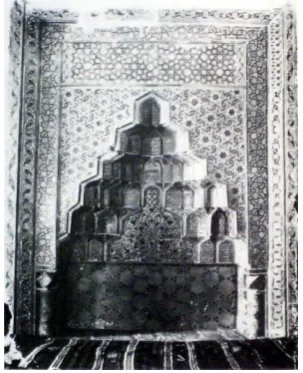
cuerda seca technique in Figure 1) synthesizing Central Asian art with attributes of Islamic art in creating both figural and ornamental compositions. According to her, after 13th century an icrease in the level of complexity can be observed. In the the use of arabesque as a background for the depiction of motifs adds multilayering, thus further depth to the Turkish art (Figure 2). Hence, it can be suggested that arabesque ornamentation, which became an
integral part of Turkish architecture since Seljuk period21,22 was a synthesis of diverse sources. The westernization movements within the Ottoman Em' pire in the 18th and 19th centuries further moulded this synthesis, and finally, with her foundation, Turkish Republic in early 20th century had decided to build her cultural framework on this synthesis, and prehistoric civilizations which inhabited this geogra' phy in particular. The nationalist style established during this era attempted to distance itself from Ottoman heritage and Islamic background23 to a certain extent and focused on the Turkoman past as well as its Asian roots.
&,$ 01 &( .! & &% + % % !) !/# /& - ( 2 % $(2 03452 &%&(& ! # $ $. 6 !$ #$ , (2 12 07892 + %" +& $ !) $ # 2
&::!(&2 ! #2 /1087;
&,$ 51 -! ( !) ( ""&% ! *$ 2 &," 2 055< 6 !$ #$ , (2 12 07892 + %" +& $ !)
$ # 2 &::!(&2 ! #2 /109=;
various references in literature can be observed, particularly when examples are not consistent with the information provided in these sources. Moreover, most of the definitions seem to have been taken from western sources as they are. In this context, Mulayim24 (1987) asserts that the term indicates vagueness today and is gradually losing its status and importance. However, he gives the reservation that this terminology have successfully sustained its existence for various centuries despite profound changes in the field of art history. He relates this strength to the word’s capacity to express very complex issues of art and decoration in a very short and simple manner. It must be emphasized that the word was so well established in 19th century Europe that it started to be used for defining decorations that were not Islamic in origin. It eventually meant Eastern style art, painting, music and sculpture. Arseven25 (1973) states that ‘floral decorations were mainly and mostly used in Turkish art before Arab artists, although floral ornaments can also be observed in Arabian art which is mainly geometrical, and thus, calling them Arab style is a purely a Western attribute’. Nevertheless, Mulayim26 (1982) argues that Arseven’s view is biased and judgemental. Furthermore, referring to numerous examples from Seljuk and Emirates periods as well as Persian art, he proves that geometric designs cannot be attribued to Arab artists. As discussed above, Islamic and Eastern Art has an abundance of floral ornamentations in their repertoire. Yet, Arseven bases his argument on Strzygowsky’s27 view that Arabian ornamentation moves primarily from animal abstraction. He makes various attempts to isolate Turkish art from Arabian art, even y proposing Turkish terms such as «girift tezyinat», «girisik bezeme» (which means intricate ornamen tation) ve «Turk yolu» (which means Turkish path) particularly in Les Arts Décoratifs Turcs28. Aslanapa29 (1971) defines the term as ‘general character of the all Islamic decoration which proceeds by maing continuous curvatures’.
However, it must be strongly emphasized, at this point, that the very term ‘arabesque’ and all decorative approaches associated with it was condemned as being kitsch or downgraded as a lower form of art, mainly due to the influence of embedded modernization idea of the Turkish Republic after 1920s and its attitude towards values and references associated with either historical past (mainly Imperial Ottoman past and its heritage), or East, or even, Arabic in particular, until the libe' ration from the established values of the republican principles under the new socio'cultural and new political context after 1980s when it was fused with features of pop'culture in a wide range of fields ranging from music to crafts, yet excluding architec' ture. Recently, a type of revivalistic architecture is
gradually introduced into public buildings under the rule of conservative government particularly after 2000s.
Mulayim30 (1994) says that the repertory of all these intricate compositions, which are conscious, deliberate and calculated in essence, can be grouped under the title “Islamic Ornamentations”. The use of this thematic material that can be defined with the term ‘Islamic Decoration’ seems to be localized according to the region and section of time. Along this line of thought, the cultural context, in other word the local identity gains priority to define its morphological character. The immense variety of examples within Turkish context by itself clearly illustrates its ability to evolve flexibly and adapted regionally without losing its essence31. In this line of thinking, in addition to pre' existing local culture, another input to ‘Arabesque Style’ is the external influences acted upon it throughout history. In that sense, Persian or Mughal influences on Turkish art are obvious mainly due to its nomadic traditions. Therefore, examples of Turkish art support Burckhardt’s32 (1976) notion of Pre'Islamic and Asian influences as well as impacts of Nomadizm and Shamanizm on Arabesque style. Therefore, it is hard to define a pure artistic style for neither ‘Arabesque’ nor ‘Turkish Art’. Thus, the extensive and repetitive use of abstract geometric designs to depict the notion of Paradise33 under the influence of the dissuasion of representation brought by Islam, found an already established ground in the pre'existing artistic context of Turkish culture which emerged as an amalgam of many sources ranging from nomadic cultures of Turkomans, Shamanic ritu' als of Asia and geometric patterns of Seljuks and Turkish Emirates, Persian and Mughal craftsmanship techniques, etc.
/ / /
/
this order; 1) closed composition, or 2) open (end' less) composition.
Closed compositions do not have any interrup' tions within the surface of depiction. In other words, the motifs are connected to eachother as pieces of a whole. Thus, all lines in the composition reach back to the beginning point after following a series of twists and folds (Figure 3). They form a vicious circle particularly when they are applied as framworks since they make turns on the corners. On the other hand, endless compositions are broken on the edges of the surface of depiction. The order of stripes is a typical example of this type of ornamentations (Figure 4).
&,$ <1 &+ " ! " & + .& .! & &% !$ !( $. !) +& 2 !% 2 05>8?8< 6 !$
( % / 2 12 07402 $ #& + %" +& $ 2 - , -$ (& + 1 ! # %" @ +&%, !%1 /1 098;
In regard to the morphology of Islamic art, geometrical nature of arabesque is emphasized37 in a series of studies. The geometrical richness of Islamic art which stems from the blend of organic and geometric, subjective and objective conception of nature through the interplay of illusion, function and dynamic interlacing38 is elucidated by means of the analysis of the visual language of arabesque39 in terms of its relation to numerology and semiology. Within the scope of shape grammar studies, which analyse the underlying grammatical structure behind the shapes40 and their relation to socio'economical and socio'political contexts41, Islamic art has been the focus of various studies that intend to derive generic models42 for their underlying geometrical logic43. All these studies reveal the underlying structure of arabesque ornamentation as a complex system accomplished through successive combina' tions of simple forms in very similar way to the fractal structures.
&,$ 31 %" + %" "!! &% !$ !( $. !) +& 2 !% 2 05>8?8< 6 !$ ( % / 2 12 07402 $ #& + %" +& $ 2 - , -$ (& + 1
! # %" @ +&%, !%1 /1 543;
Furthermore, Marouf44 (2003) groups these pattern designs as; arabesque, geometric inter' lacing, and complex polygons. He defines Arabesques as linear, usually employing vine and plant motifs with undulating abstract linear arrangements which make references to nature, the tree of life, or paradise. Meanwhile, he notes, geometric interlacing and complex polygons interweave and constitute geometric, repeating shapes. Therefore, interlacing and arabesque types of Islamic ornamentation can be seen as part of a continuum. While the Arabesque seems derivative of the decorative stripes in Classical architecture, interlacement may have inspi' ration from Roman pavements45. Marouf46 (2003) interprets these two as the manifestation of two poles of artistic expression in Islam, that is to say, the sense of rhythm and the spirit of geometry respectively. The application of complex regular polygons in arabesque style is the largest class of Islamic pattern related to the geometry of interlace' ment. It builds from a regular polygon inscribed in a circle. This cell is then translated and the innate proportions and internal symmetries of the original figure repeat infinitely across the plane through the intersections of multiple circles. The circles consis' tently guide the design, but are “felt subtly rather than obviously seen”. Islamic designs are among the most mathematically sophisticated patterns, and reflect the spiritual life and metaphysical dimensions of Islam47 as an expression of ‘Divine Unity’ under' lying the incomprhensible diversity of the universe.
rich synthesis of artistic repertoire within the geography of socio'cultural intersection between Asia, Middle East and Africa, extending – to a certain extent – into the boundaries of Mediterranean countries such as Italy and Spain. Although it is quite difficult to define the common ground in this immense diversity of this vast range of geography, it lies somewhere between the shared spiritual values of local artisan and the craftsmanship techniques to articulate the material in their hands. Hence, this synthesis enabled artists of the Oriental world to flourish a unique style which confused western scholars in ‘world art history’ to the extent to create an ambiguity in the use of the term arabesque. Consequently, it can be defined as a local variation of Eastern art influenced by pre'existing traditions almost as much as those of Islam. Consequently, this variation which can also be observed in other regions in many diverse ways is explained in the proceeding sections.
!% ($"&%, . #
The objective of this paper is to emphasize the uniqueness of arabesque within the framework of Islamic Architecture as a key element of ornamen' tation, in particular reference to the case of Turkish architecture. The paper puts forward the evidences that support the hypothesis that arabesque is a medium of fusion rather than a homogeneous and unique artistic style limited to Arab region as the name may originally yet mistakenly denotes. It is also accentuated here that arabesque harbors a very complicated underlying rationale, a mathematical logic as well as a pragmatic and material component no matter how much it is conditioned by spiritual values. Doubtlessly, this artistic style was defined by religious beliefs and cultural values prohibiting the depiction of living creatures including humans. Thus a systematic yet aesthetic approach is developed through abstraction. It was further enhanced by the belief that science is an integral part of Islam leading the arts towards the field of mathematics. This had a very rich influence in Islamic Art which beautifully combined artistic foliage designs with geometric principles to create exquisite works of art unique only to the Islamic Cultural Heritage. The reason behind the significance and popularity that arabesque gained throughout the Islamic world is mainly because it has flexibly evolved and flourished regionally, while still retaining its original prin' ciples49. Consequently, arabesque has emerged as a fusion which not only accumulates a multi'cultural heritage from different regions and periods but also re'combines them through the multi'layered mathe' matical and abstract logic that it developed as a response to the conditions posed by the Islam.
) %
1 N. Marouf. 2003. ‘Arabesque in The Crafts of The Muslim World’, Proceedings of the First International Seminar on Prospects of Development of Traditional Crafts in the
4 B. Giovanni. 1966. 11 Decameron, con un saggio di Erich Auerbach, ed. Giulio Eunaudi. Torino: Décima Giornata, Novella Nona. p. 645.
5 S. Mulayim. 1982. Anadolu Turk Mimarisinde
10 Islamic Art. 2010. Anti Essays. Retrieved March 15. from http://www.antiessays.com/free' essays/10171.html
11 N. Marouf. 2003. ‘Arabesque in The Crafts of The Muslim World’, Proceedings of the First International Seminar on Prospects of Development of Traditional Crafts in the Turkey. New York: Rizzoli. 9'11.
15 E. Akurgal. 1980. The Art and Architecture of Turkey. New York: Rizzoli. 10.
16 S. Eyice. 1980. ‘Byzantine Art in Turkey’, in E.Akurgal, ed., The Art and Architecture of Turkey. New York: Rizzoli. pp. 48'79.
17 A. Kuran. 1980 ‘Anatolian'Seljuk Architecture’, in E.Akurgal, ed., The Art and Architecture of Turkey. New York: Rizzoli. pp. 80.
18 D. Kuban. 1980. ‘Architecture in Ottoman Period’, in E.Akurgal, ed., The Art and Architecture of Turkey (ed. E.Akurgal). New York: Rizzoli. p. 137.
19 R. Riefstahl. 1931. Turkish Architecture in Southwestern Anatolia. Cambridge: Harvard University Press. p. 28
// // //
//
Architecture of Turkey. New York: Rizzoli. pp. 174'207.
21 Y.Demiriz. 1979. Osmanli Mimarisinde Susleme. Istanbul.
22 Y.Demiriz. 2004. Islam Sanatinda Geometrik Susleme. Istanbul: Yorum Sanat.
23 M. Levey. 1975. The World of Ottoman Art. London: Thames and Hudson.
24 S.Mulayim. 1987. “Đslam Sanatında Biçim Meselesinin Kaynağı”, Türkiye Kültür ve Sanat Yıllığı, 1987, Türkiye Yazarlar Birliği Yayınları. 6, Yıllık dizisi. 4, Ankara. p.273'280
25 CE.Arseven. 1973. Sanat Ansiklopedisi, V. 1, N. 93'4, V. 5. p. 2119.
26 S.Mulayim. 1982. Anadolu Turk Mimarisinde Geometrik Süslemeler. Ankara: Kultur ve Turizm Bakanligi Yayinlari.
27 J.Strzygowsky. 1974. ‘Turkler ve Orta Asya Sanati Meselesi’. Eski Turk Sanati ve Avrupa'ya Etkisi. Istanbul: Is Bankasi Kultur Yayinlari: 152, Sanat Dizisi: 21. pp. 38'102.
28 CE.Arseven. 1974. Les Arts Décoratifs Turcs. Istanbul: Milli Egitim Basimevi. p. 44.
29 O. Aslanapa. 1971. Turkish Art and Architec ture. New York: Praeger Publishers. p. 333. 30 S. Mulayim. 1994. Sanata Giris. Istanbul: Bilim
Teknik Yayinevi.
31 Islamic art. retrieved on 12 March 2010 from http://www.huntfor.com/arthistory/medieval/ islamic.htm
32 T. Burckhardt. 1976. Art of Islam; Language and Meaning. London: World of Islam Festival Trust.
33 S. Shahnawaz. Arabesque, http://www.victory newsmagazine.com/Arabesque.htm, accessed March 15, 2010.
34 S. Mulayim. 1994. Sanata Giris. Istanbul: Bilim Teknik Yayinevi.
35 G. Michell & J.Ernst. 1995. Architecture of the Islamic World: Its History and Social Meaning. London: Thames and Hudson.
36 S. Mulayim. 1994. Sanata Giris. Istanbul: Bilim Teknik Yayinevi.
37 I. El'Said, & A. Parman. 1976. Geometric Concepts in Islamic Art. London: World of Islam Festival Pub. Co.
38 K Albarn, J.M. Smith, S. Steele, D. Walker. 1974. The Language of Pattern : an enquiry inspired by Islamic decoration. London: Thames and Hudson.
39 S.J. Abas, and A.S. Salman. 1998. Symmetries of Islamic Patterns. London: World Scientific. 40 G. Stiny. 1980. ‘Introduction to Shape and
Shape Grammars’, Environment and Planning B, 7. pp. 343 – 351.
41 M. Cetin. 2003. ‘Mimarlıkta Dilbilimsel Çözümleme, [ekil Gramerleri’. Linguistic Analysis in Architecture; Shape Grammars, Gazi Sanat Dergisi (Gazi Art Journal), 1. pp. 41 ' 50 .
42 E. Ulu, & S.M. Sener. 2009. ‘A Shape Grammar Model To Generate Islamic Geometric Pattern’,
Proceedings of 12th Generative Art Conference GA2009.
43 S. Cenani, & G. Cagdas. 2007. ‘A Shape Grammar Study: Form Generation with Geometric Islamic Patterns’, Proceedings of 10th Generative Art Conference GA2007. pp. 312'28.
44 N. Marouf. 2003. ‘Arabesque in The Crafts of The Muslim World’, Proceedings of the First International Seminar on Prospects of Development of Traditional Crafts in the Muslim World. Damascus.
45 D. Wade. 1976. Pattern in Islamic Art. London: Studio Vista.
46 N. Marouf. 2003. ‘Arabesque in The Crafts of The Muslim World’, Proceedings of the First International Seminar on Prospects of Development of Traditional Crafts in the Muslim World. Damascus.
47 H. Gundogdu. 1993. ‘Ikonografik Acıdan Turk Sanatinda Rumi ve Palmetler’, Guner Inal'a Armagan. Ankara. pp. 197'211.
48 O. Aslanapa. 1971. Turkish Art and Architec ture. New York: Praeger Publishers. p. 333. 49 S. Shahnawaz, Arabesque, http://www.victory